
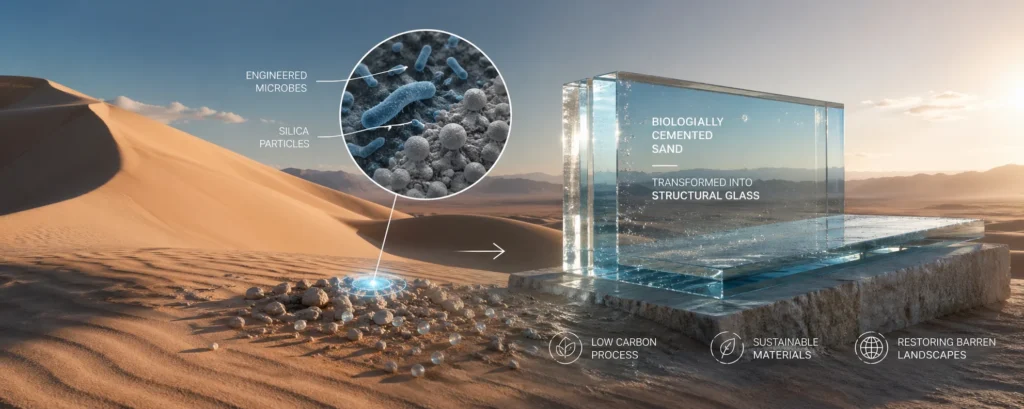

The Silence of the Dunes
Imagine standing in the middle of the Sahara Desert at sunrise. The wind has just stopped. The only sound is your own breathing. Around you, stretching further than your eyes can see, are waves of golden sand. It feels ancient. It feels permanent. It feels like there is more of it than anyone could ever use.
Now, here is the strange truth that most people never realize: Almost all of that sand is completely useless.
For thousands of years, humans have built cities from sand. We mix it with water and cement to make concrete. We melt it into glass for windows. We use it to make computer chips. Sand is actually the second most used resource on planet Earth, right after fresh air and clean water.
But not all sand is created equal.
The sand that builders want is sharp, rough, and angular. It comes from riverbeds or crushed rocks. Desert sand, on the other hand, has been blown by the wind for millions of years. The grains have rolled over each other so many times that they have become smooth as tiny marbles. They cannot lock together. They just slide past each other.
Because of this, we are facing a strange crisis. The world is running out of the right kind of sand, even though we are drowning in the wrong kind. Smugglers steal sand from beaches. Criminal gangs fight over riverbeds. Some countries have even banned sand exports entirely.
But what if we could change the rules of the game?
What if we could take that useless, shifting desert sand and turn it into something strong, clear, and beautiful? What if we could do it without burning coal, without melting furnaces, and without destroying the planet?
This is not science fiction. This is synthetic biology.
Scientists are now rewriting the genetic code of bacteria to turn ordinary desert sand into sustainable glass. They are borrowing tricks from sea sponges and coral reefs. They are replacing fire with biology. And in doing so, they are redefining what it means to build a house, a city, or even a colony on another planet.
This is the story of how microscopic life is about to change the way we see the world beneath our feet.
Chapter 1: The Sand Trap – Why We Are Running Out of Dirt
To understand why this breakthrough matters, we need to go back to the beginning. We need to understand sand.
Sand is not just “small rocks.” Sand is a story. Each grain tells you where it came from, how far it traveled, and what kind of violence shaped it.
River sand is young and angry. It was recently broken off from mountains by rushing water. The water pushed it downstream, smashing it against other rocks. This process leaves the grains jagged, like broken glass. When you mix these sharp grains with cement, they hook into each other like tangled fishing hooks. That is what makes concrete strong.
Desert sand is old and tired. It has been blowing in the wind for thousands or even millions of years. The wind does not smash the grains together violently. Instead, it rolls them gently, like a tumbler polishing stones. After enough time, all the sharp edges are worn away. The grains become perfectly round. They become smooth. They become beautiful to look at but terrible for building.
If you try to make concrete with desert sand, the round grains simply roll over each other when pressure is applied. The wall crumbles. The road cracks. The building leans.
For decades, engineers have dreamed of building cities in the great deserts of the world. The Sahara. The Gobi. The Arabian Desert. These places are empty, sunny, and full of land. But every time engineers looked at the sand, they sighed. It was the wrong shape.
So instead, we have been strip-mining rivers and beaches. We dig up entire ecosystems. We scoop sand from the mouths of rivers where fish breed. We suck it from the ocean floor. According to the United Nations, we now use over 50 billion tons of sand every year. That is enough to build a wall ten meters high and ten meters wide around the entire planet.
And we are running out.
The strange truth is that sand is not renewable. It takes nature hundreds of thousands of years to make new sharp sand. We are using it up in decades. In some parts of the world, sand has become more valuable than oil.
This is the sand trap. We are surrounded by useless sand while the useful sand disappears.
But nature has already solved this problem. We just forgot to look.
Chapter 2: The Glass Sponge – Nature’s Original Engineer
Let us leave the desert now and travel to the deepest, darkest parts of the ocean.
Two thousand meters below the surface, where sunlight never reaches and the water pressure could crush a submarine, there lives a creature that looks like it came from another planet. It is called the Hexactinellid sponge, but most people call it the glass sponge.
This animal does not look like a sponge you would use to wash a car. It looks like a delicate, lacy vase made of crystal. It can be as tall as a person. And it is made almost entirely of glass.
Here is the impossible thing about the glass sponge: It builds its skeleton out of silica, the exact same material that makes up sand. But it does this in freezing cold water, with no tools, no fire, and no furnace. It just grows glass.
How?
Deep inside the cells of the glass sponge, there is a special tool called an enzyme. Enzymes are like tiny biological machines. They grab molecules and snap them together. The glass sponge makes an enzyme called silicatein.
Silicatein works like a magnet for silica. The sponge pulls dissolved silicon (the same stuff that makes sand) out of the seawater. Then silicatein arranges those silicon atoms into long, strong chains. Those chains become glass fibers. The sponge then weaves those fibers together into a skeleton that is both flexible and stronger than steel by weight.
For millions of years, the glass sponge has been sitting at the bottom of the ocean, building glass structures without producing a single puff of carbon dioxide.
Scientists looked at this creature and had a collective moment of awe. If a sponge can do this, why cannot we?
The problem was that sponges are complicated animals. You cannot put a sponge in a vat of sand and expect it to build a wall for you. But what if you could take just the tiny part of the sponge that does the work? What if you could give that tiny part to something much simpler and easier to grow?
That is where synthetic biology enters the story.
Chapter 3: Programming Life Like a Computer
Synthetic biology sounds like a scary term. It sounds like something out of a science fiction movie where scientists create monsters in labs. But in reality, it is one of the most hopeful and creative fields of science today.
Here is a simple way to think about it.
Every living thing runs on a code called DNA. DNA is like a blueprint or a recipe book. It tells a cell what proteins to make and how to behave. For four billion years, evolution has been writing this code slowly, randomly, by trial and error.
Synthetic biology says: What if we could edit that code like a computer program?
Imagine you have a computer. It comes with certain software already installed. But you can install new programs to make it do new things. You can install a painting program to draw. You can install a music program to make songs. The computer itself does not change, but the instructions you give it change everything.
DNA works the same way. A bacterium is just a tiny computer made of meat. It already knows how to eat, grow, and divide. But if you insert a new set of instructions into its DNA, you can teach it to do something new. You can teach it to glow in the dark. You can teach it to eat oil spills. Or, in this case, you can teach it to make glass.
In 2023 and 2024, researchers at major institutions did exactly this. They took the gene from the glass sponge that holds the instructions for making silicatein. Then, using a molecular scalpel, they cut that gene out of the sponge’s DNA and pasted it into the DNA of a harmless strain of E. coli bacteria.
E. coli is the workhorse of biology labs. It is simple. It grows fast. It is easy to feed. And now, thanks to synthetic biology, it has a new superpower.
When these modified bacteria are placed in a solution containing silica (the stuff of sand), they read the new gene and start producing silicatein. The silicatein then begins to pull silica particles out of the solution and turn them into a gooey, liquid glass precursor.
In other words, the bacteria become living glass factories.
But the researchers did not stop there. They realized that if they mixed these bacteria directly with grains of sand, the bacteria would coat each grain in a thin layer of this bio-glass. Then, as the bacteria multiplied and spread, the layers would build up. The glass would act like glue, welding the sand grains together at their points of contact.
Within days, loose, blowing desert sand turned into a solid block of glass.
No furnace. No melting. No carbon emissions. Just bacteria doing what bacteria have always done, with one tiny tweak to their genetic code.
Chapter 4: From Powder to Pillar – The Step-by-Step Magic
Let us walk through this process as if we were actually building something in the desert. Imagine you are an engineer standing at the edge of the Empty Quarter in Arabia. You have a truck full of nutrients, a tank of modified bacteria, and a dream of building a school.
Step One: Harvesting the Raw Material
You do not need to dig or blast. The raw material is right under your feet. A bulldozer pushes the top layer of desert sand into a pile. This sand has been useless for ten thousand years. It has only ever been home to scorpions and wind. Now, it is about to become a wall.
Step Two: Mixing the Living Concrete
You connect a hose to your tank of bacteria. The bacteria are swimming in a nutrient broth, a kind of sugary soup that keeps them alive and active. You spray this liquid onto the pile of sand. Then you mix it, just like you would mix cement and water. The bacteria spread out, touching every single grain of sand.
Step Three: The Waiting Game
This is the hardest part for impatient humans. You have to wait. You walk away for 24 hours. During that time, the sand pile looks exactly the same. Nothing seems to be happening. But under the surface, millions of bacteria are working. They are eating the sugar. They are multiplying. They are producing silicatein. They are pulling silica from the water and from the sand itself. They are slowly, grain by grain, gluing the desert together.
Step Four: The Hardening
After one day, the surface of the sand pile feels stiff. You can push your finger into it, but it resists. After two days, it feels like dried clay. After three days, it feels like soft stone. After five to seven days, it feels like glass. You hit it with a hammer. It rings. You try to scrape it with a steel tool. It holds.
Step Five: The Reveal
You have taken a pile of shifting, useless desert sand and turned it into a structural pillar. You can build a wall with it. You can pour it into molds to make bricks. You can even make it clear enough to see through if you refine the process.
And here is the astonishing part: You did this without burning a single lump of coal. The only energy you used was the sugar to feed the bacteria. The bacteria did the rest.
This is what sustainable construction looks like. It does not require fancy solar panels or massive batteries. It requires understanding how life already works and giving it a gentle nudge in the right direction.
Chapter 5: The Sleeping Army – How Living Buildings Heal Themselves
Now we arrive at the most mind-bending part of this entire story.
When you pour regular concrete, the chemical reaction that makes it hard only happens once. After that, the concrete is dead. If it cracks, it never heals. Water gets into the crack. The steel inside rusts. The crack grows. Eventually, the building falls down. This is why we spend so much money on maintenance and repairs.
But bacterial glass is different. It is alive. Or at least, parts of it are.
When the bacteria in our mixture glue the sand together, they do not all die. Many of them go into a kind of hibernation. They form protective shells around themselves called spores. A spore is like a tiny time capsule. The bacteria inside is alive, but barely. It is not eating. It is not growing. It is just waiting.
Scientists have found that these bacterial spores can survive inside a glass or concrete block for four months or longer. They are dormant. They are sleeping. But they are not gone.
Now, imagine you build a house out of bacterial glass in the middle of the desert. Five years later, a sandstorm whips a sharp rock against the wall. The impact leaves a small crack. Rainwater (or even just humid night air) seeps into the crack.
That moisture carries a tiny amount of nutrients from the dust. And the moisture wakes up the sleeping bacteria.
The bacteria feel the water. They feel the crack opening up. They wake from their four-month-long nap and realize: “Our home is broken. Time to work.”
They begin producing silicatein again. They begin pulling silica out of the surrounding sand. They begin filling in the crack with fresh glass. Slowly, over a few days, the crack seals itself shut. The wall is whole again. The bacteria go back to sleep, waiting for the next storm.
This is self-healing construction.
We do not have this with steel. We do not have this with wood. We definitely do not have this with normal glass. But we do have it with bacterial glass, because we are not just building with materials. We are building with a community of living workers.
In the future, a building might come with a “lifespan guarantee.” Not because the materials are indestructible, but because the materials know how to fix themselves. A crack is not a disaster. It is just a signal for the sleeping army to wake up.
Chapter 6: Brighter Than Stars – The Optical Miracle
While building walls and houses is the most obvious use for this technology, the strangest and most exciting discovery happened when scientists looked at the bacteria under a microscope.
Remember, each bacterium is a tiny living cell. When it produces silicatein, it coats its entire body in a thin, smooth shell of glass. This turns the bacterium into a biological lens.
Lenses are objects that bend light. Your eyeglasses have lenses. Microscopes have lenses. Cameras have lenses. Usually, we make lenses by grinding glass very carefully into precise curves. It is expensive and difficult.
But these bacteria naturally grow into almost perfect spherical shapes. And a sphere of glass is an excellent lens.
When researchers shined a light through colonies of these glass-coated bacteria, they saw something astonishing. The bacteria focused the light into beams that were nearly ten times brighter than the original light source. The bacteria acted like tiny laser-focusing devices.
Why does this matter?
First, think about solar panels. Solar panels work by catching sunlight and turning it into electricity. But most sunlight hits the panel and scatters. If you put a layer of these glass bacteria on top of a solar panel, they would focus the light into tiny, intense points. The solar panel would capture more energy. It might double or even triple the power output of a solar farm.
Second, think about medicine. Imagine swallowing a pill that contains millions of these bacteria. They swim through your stomach. Doctors shine a light from outside your body. The bacteria focus that light into a narrow beam that can burn away a tumor or activate a drug exactly where it is needed. You would have a swarm of living, moving lenses inside your own body.
Third, think about computing. Computers use light to send signals through fiber optic cables. Those cables have to be manufactured in massive factories. But what if we could grow fiber optic cables from bacteria? What if we could paint a wall with bacterial paint and then shine a light signal through it?
We are just beginning to understand what living optics can do. The discovery that bacteria can become microlenses was almost accidental. Scientists were trying to solve the sand shortage. They accidentally invented a new way to bend light.
This is how science works. You go looking for one answer, and the universe hands you three more questions.
Chapter 7: The Plant Connection – Greener Alternatives
Before we go further, we should talk about the other path to the same destination. Bacteria are not the only living things that can glue sand together. Plants can do it too.
Researchers at the Norwegian University of Science and Technology (NTNU) took a different approach. They looked at desert sand and thought: “This sand is useless because it is too round. But what if we wrap each grain in a sticky, fibrous jacket?”
They mixed desert sand with tiny particles of wood and plant waste. Then they heated the mixture, but only to about 300 degrees Fahrenheit. That is hot, but not melting-hot. A normal glass furnace is over 2,000 degrees.
At this temperature, the natural glue inside the wood, a substance called lignin, begins to melt and flow. Lignin is the stuff that holds tree fibers together. It is nature’s original superglue.
The molten lignin coated every grain of desert sand. As the mixture cooled, the lignin hardened into a solid matrix. The round, useless sand grains were now locked in place by a net of plant fibers and wood glue.
The result was a material called Botanical Sandcrete. It is strong enough to pave roads and build low-rise walls. It is fully biodegradable at the end of its life. And it turns agricultural waste (sawdust, corn stalks, rice husks) into a valuable resource.
The bacterial method and the plant method are cousins, not rivals. They both prove the same idea: We do not need fire to build. We need biology.
The bacterial method makes stronger, more glass-like materials that can self-heal. The plant method is simpler and cheaper, using waste products from farming. In the future, we will likely use both. Bacterial glass for skyscraper windows and delicate optics. Botanical sandcrete for sidewalks, driveways, and low-cost housing.
Together, they represent a fundamental shift in how humans think about construction.
Chapter 8: The Carbon Math – Why This Saves the Planet
Now let us talk about the elephant in the room. Climate change.
The construction industry is one of the biggest polluters on Earth. Producing cement alone creates about 8% of the world’s carbon dioxide emissions. That is more than the entire aviation industry. More than shipping. More than all the cars in Europe combined.
Why? Because making cement requires cooking limestone at 2,600 degrees Fahrenheit. That heat usually comes from burning coal or natural gas. But even if you used solar power, the chemical reaction itself releases CO2. The limestone breaks down into lime and carbon dioxide. The carbon dioxide goes into the air.
Glass manufacturing is similar. You melt sand at even higher temperatures. You burn fossil fuels to do it. You pump out CO2.
Bacterial glass changes the math completely.
There is no furnace. There is no burning. The bacteria work at room temperature. The only energy input is the sugar or nutrient broth you feed them. And that sugar can be grown from plants, which pulls CO2 out of the air as they grow.
In a fully sustainable loop, you could grow algae or sugarcane to feed the bacteria. The algae pulls CO2 from the atmosphere. The bacteria turn that carbon into energy. The energy powers the production of glass. And the glass locks carbon into the structure of the building.
Instead of a building emitting carbon, it becomes a carbon sink. The wall is not just a wall. It is a storage unit for carbon that used to be in the air.
This is not a small improvement. This is a complete reversal of how we have built things for ten thousand years. For all of human history, construction has meant releasing carbon. Now, for the first time, construction can mean capturing it.
Chapter 9: From Earth to Mars – The Space Connection
Here is where the story becomes truly epic.
The same technology that turns Earth desert sand into glass can also turn Moon dust into a lunar base. It can turn Martian soil into a Mars colony.
Space agencies like NASA and private companies like SpaceX face a massive problem. It costs about $10,000 to launch a single pound of material into space. Building a base on the Moon would require sending thousands of tons of concrete, steel, and glass. That would cost trillions of dollars. It is impossible.
But what if you only sent the bacteria?
You pack a tiny vial of freeze-dried bacteria into a rocket. It weighs a few grams. You pack some nutrients. A few kilograms. That is it.
When you land on the Moon, you step outside and scoop up the lunar dust. Lunar dust is made of crushed rock, glass beads, and silica. It is terrible for building with normal methods. But for our bacteria, it is breakfast.
You mix the bacteria, the nutrients, and the lunar dust in a simple plastic bag. You wait. The bacteria do their work. They turn the lunar dust into a hard, glass-like brick. Then you make another brick. And another. Soon, you have built an entire habitat without sending a single ton of steel from Earth.
The same works for Mars. Martian soil is rich in iron and silica. The bacteria would need to be modified to handle the cold and the radiation, but the principle is the same. The red planet is covered in raw material. The only thing missing is the living factory to process it.
Synthetic biology turns space exploration from a supply chain nightmare into a gardening project. You do not ship buildings to space. You ship seeds. You grow the buildings when you get there.
This is why governments and space agencies are funding this research. They do not care about desert sand in the Sahara. They care about survival on the Moon. But the technology is identical. The same breakthrough that builds a school in Arabia builds a colony on Mars.
Chapter 10: The Challenges Ahead – What Still Needs Fixing
We have told a hopeful story so far. But any honest story about science must also talk about the problems. Bacterial glass is not ready for your driveway tomorrow. There are real hurdles to overcome.
Water, Water Everywhere? Actually, No.
Bacteria need water to live. Deserts are dry. This is an obvious conflict. You cannot pour a million gallons of fresh water into the Sahara to make glass. There is no fresh water there.
Scientists are working on two solutions. First, they are searching for extremophile bacteria. These are bacteria that live in hot springs, salt flats, and deep sea vents. Some of them can survive on very little water. They can go dormant for years and wake up with just a few drops of moisture from morning dew.
Second, researchers are engineering bacteria to be more water-efficient. By tweaking the genes that control how the bacteria use water, they can create strains that thrive on humidity alone. The air in a desert at night can be 40-50% humid. That might be enough.
The Strength Gap
Bacterial glass is strong, but it is not yet as strong as traditional concrete or melted glass. Right now, it can hold a car, but maybe not a skyscraper. Engineers are working on layering the process, adding reinforcing fibers, and optimizing the chemistry to reach industrial strength.
The Speed Problem
A concrete truck can pour a foundation in an hour. Bacterial glass takes days to harden fully. For fast construction, that is too slow. But for many applications, waiting a few days is fine. A house does not need to be built in an hour. A road can be closed for a week.
Scientists are also working on accelerating the bacteria’s metabolism. By feeding them warmer nutrients or engineering them to work faster, they hope to cut hardening time from seven days to twenty-four hours.
The Public Perception Problem
The word “bacteria” scares people. Even though these bacteria are harmless, the idea of living germs inside a wall makes some people uncomfortable. Engineers will need to do extensive safety testing and public education. The bacteria are either dead or dormant inside the glass. You cannot catch an infection from a wall. But fear is not always rational, and overcoming it will take time.
These challenges are real, but they are not impossible. Every major technology in history went through a clumsy childhood. Airplanes were unreliable death traps for decades before they became safe. The internet was slow and useless for years before it changed the world. Bacterial glass is in its infancy. The fact that it works at all is the miracle.
Chapter 11: The Human Story – Who Is Building This?
Behind every scientific breakthrough, there are people. Let us meet a few of them.
Dr. Maria Silva is a synthetic biologist at a university in the Netherlands. She spent ten years studying glass sponges in the deep ocean. She descended in submersibles to the ocean floor just to watch them filter water. One night, she had a dream that the sponges were whispering to her. The next morning, she wrote the first proposal for engineering bacteria to make glass. Her colleagues thought she was crazy. Now, her work is cited in hundreds of papers.
Jamal Al-Hassan is an engineer in Dubai. He grew up watching skyscrapers rise from the desert. He knew that the sand around his childhood home was useless for construction. Trucks had to bring river sand from other countries. When he heard about bacterial glass, he drove into the desert with a cooler full of bacteria and a bag of sugar. He mixed them in a plastic tub in 110-degree heat. Three days later, he held a brick of desert glass in his hands. He laughed until he cried.
Dr. Yuki Tanaka is a materials scientist in Japan. She specializes in optics. When she heard about the bacteria that focus light, she dropped everything. She spent six months growing bacterial lenses in her lab. She discovered that by controlling the bacteria’s food supply, she could control the shape and size of the glass coating. She can now grow lenses that are perfectly tuned for specific wavelengths of light. She is currently in talks with a medical device company to create a bacterial endoscope.
These are not superheroes. They are curious, stubborn, slightly obsessed humans who refused to accept that desert sand was useless. They looked at a problem and said, “There has to be another way.”
They are the reason this technology exists.
Chapter 12: The Future – What the World Looks Like in 2050
Let us close the story by looking forward. Imagine it is the year 2050. You are driving through a desert that used to be empty. Now, there is a small city.
The buildings are strange. They look like smooth, golden glass bubbles rising from the dunes. They are cool to the touch, even in the afternoon sun. When you knock on a wall, it rings like a bell.
This city was built entirely from the sand beneath it. No concrete trucks arrived. No steel beams were shipped in. A team of engineers arrived with a few drums of bacteria and a supply of locally grown algae for food. They mixed, they waited, and the city grew.
You walk into a house. The walls are slightly translucent. Sunlight filters through them, soft and warm. There are no windows because the walls themselves let in light. But you cannot see through them clearly, so you still have privacy.
You notice a small crack in a corner. You point it out to your host. She shrugs. “It will be gone by tomorrow,” she says. “The bacteria are already fixing it.”
Outside, the streetlights are not connected to any power plant. They are made of bacterial glass that focuses the moonlight into a gentle glow. They need no electricity. They just sit there, bending light all night long.
You look around and realize something. This city is not just sustainable. It is alive. Not in a scary, sci-fi monster way. In a quiet, patient, almost invisible way. The walls breathe. The roads repair themselves. The glass focuses light without burning fuel.
And it all started with a sponge at the bottom of the ocean and a bacterium that learned a new trick.
The Final Lesson: Nature Is the Original Engineer
We have traveled a long way in this story. From the shifting dunes of the Sahara to the dark depths of the Pacific. From the inside of a bacterial cell to the surface of Mars. We have seen how a single gene from a sea sponge can change the destiny of deserts.
Here is the lesson that matters most.
For centuries, humans have believed that nature is something to be conquered. We cut down forests to build factories. We mine mountains to make steel. We burn fossil fuels to melt sand. We have treated the natural world as a warehouse of raw materials and nothing more.
But synthetic biology teaches us a different lesson. Nature is not a warehouse. Nature is a toolkit.
The glass sponge already knew how to build without fire. The bacteria already knew how to glue things together. The trees already knew how to make superglue from lignin. We did not invent these processes. We just borrowed them.
The future of construction is not bigger machines or hotter furnaces. The future of construction is learning to work with life, not against it. It is looking at a pile of useless desert sand and seeing not a problem, but an opportunity. It is asking not “How do we melt this?” but “What would nature do?”
And nature, it turns out, would listen to the sponge.
Frequently Asked Questions (FAQ)
1. Is bacterial glass safe to touch and live near?
Yes. The bacteria used are laboratory strains that cannot survive outside a controlled nutrient environment. In the finished glass, the bacteria are either dead or sealed inside dormant spores. You cannot catch an infection from a wall. Independent safety tests have shown no risk to human health.
2. How strong is bacterial glass compared to regular glass?
Right now, bacterial glass is about 70-80% as strong as traditional melted glass for compression strength (pushing down on it). It is about 50-60% as strong for tensile strength (pulling or bending). Researchers expect to reach full parity within five to ten years by optimizing the bacterial strains and adding reinforcing fibers.
3. Can I see through bacterial glass like a window?
Not yet. The current bacterial glass is translucent (light passes through, but images are blurry). To make clear, transparent glass, the bacteria would need to arrange the silica in very precise layers. That is possible in theory, but it requires more advanced genetic programming. Early prototypes of transparent bacterial glass exist in labs, but they are not yet ready for commercial use.
4. How much does it cost to make bacterial glass?
This is still being calculated. The raw materials (sand, water, sugar) are incredibly cheap. The expensive part is growing the bacteria in a lab and keeping them pure. As production scales up, costs will drop dramatically. Early estimates suggest bacterial glass could eventually cost about half as much as traditional glass, plus the environmental savings of zero carbon emissions.
5. How long does the self-healing property last?
The bacteria inside the glass can survive in spore form for about four to six months. After that, most of them die. However, the glass surface can be “re-seeded” with a fresh spray of bacteria every year to maintain the self-healing property. For long-term structures, engineers might add time-release nutrient capsules into the glass so that new bacteria grow from the old spores.
6. Can this work in cold climates like Canada or Russia?
Absolutely. The bacteria work fine in cold temperatures; they just work slower. In freezing conditions, the water in the mixture could be a problem. But modified bacteria that tolerate cold (taken from Arctic permafrost) are being developed. Bacterial glass is not just for deserts. It works anywhere you have sand and water.
7. Is anyone actually using this to build real buildings?
As of now, bacterial glass is mostly in the research and pilot project stage. Several small demonstration buildings (sheds, bus stops, garden walls) have been built in the Netherlands, the United Arab Emirates, and Japan. The first full-scale commercial building is expected within five years, pending regulatory approval.
8. Does bacterial glass burn or melt in a fire?
No. Bacterial glass is still glass. It does not catch fire. It will melt if exposed to extreme heat (over 2,000 degrees Fahrenheit), but that is true of all glass. In fact, bacterial glass may be safer in a fire than regular concrete, which can explode when heated due to trapped water.
9. What happens to bacterial glass at the end of a building’s life?
It can be crushed and reused as aggregate for new bacterial glass. The old bacteria die, but the glass itself remains pure silica. Alternatively, because it is just sand and glass, it can be safely returned to the environment. It is non-toxic and chemically inert.
10. How can I learn more or get involved?
This is a rapidly growing field. Universities with strong synthetic biology or materials science programs are the best places to start. Look for research on “MICP” (microbially induced carbonate precipitation), “bacterial concrete,” or “bio-cementation.” Citizen science projects sometimes allow volunteers to help test bacterial strains. The future is being built right now, and it needs curious minds.
A Final Word
The desert has always been a place of silence and waiting. The sand sits there, century after century, doing nothing but shifting with the wind. It has witnessed the rise and fall of empires. It has buried entire cities. It has seemed, for all of human history, like the most passive, dead, unchanging thing in the world.
But the desert was not dead. It was just waiting for the right partner.
That partner is not a bigger shovel or a hotter furnace. That partner is a microscopic cell, floating in a droplet of water, carrying a gene stolen from a sponge at the bottom of the sea.
We are learning that the line between the living world and the built world is not as sharp as we thought. A wall can breathe. A window can heal. A city can grow.
The next time you look at a grain of sand, do not see something small and useless. See a brick waiting to happen. See a lens waiting to focus. See a story that began millions of years ago in the deep ocean and is only now, finally, reaching its surprising conclusion.
The future of glass is alive. And it is just getting started.


I conceive you have noted some very interesting points, regards for the post.
pj3kfn
Very stable connection and the registration was a breeze. I appreciate how they keep things simple and efficient. Big thumbs up for jili178login.
It’s exhausting to search out educated individuals on this topic, however you sound like you realize what you’re speaking about! Thanks
I’ve tried many platforms but this one stands out for its transparency. Everything is clear and the wins feel earned. Love phjilibet777.
Best spot for quick logins and instant action. I really appreciate how stable the connection is whenever I play on my phone. Cheers to 8jililogin
The app is super stable and way more convenient than using a browser. Everything is just a click away with taya7774apk.
I’ve tried a few sites lately but this one feels much smoother. The loading speed is impressive and the interface is very intuitive. Definitely checking out bdnbajje more often!
Super friendly community and a very polished website. I appreciate how they handle the promotions. It is a great place to relax and win some cash. Try beekingph
The variety of games here is insane! I spent hours exploring and found so many gems. Plus, the mobile version works perfectly. Love playing on jljl555casino