
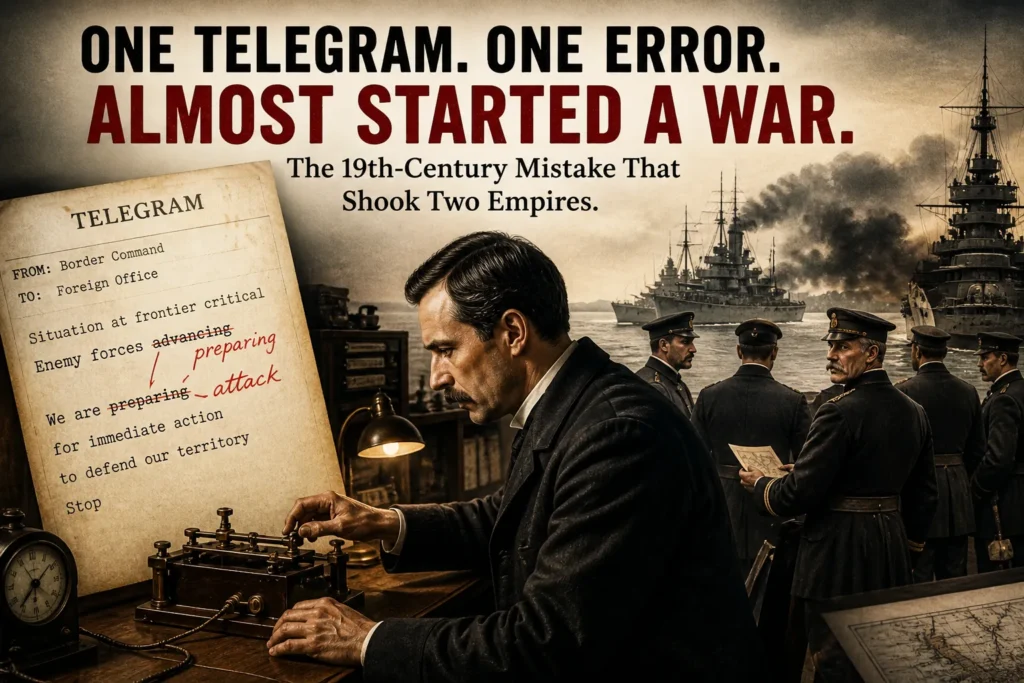

The Day a Single Typo Held Its Breath Over the Ocean
It was a muggy July evening in 1875. Not the kind of evening you remember for anything good. The kind where the air sits on your skin like a wet blanket, and the gas lamps along Whitehall in London spit yellow light through a haze of coal smoke.
Inside a cramped, candle-lit telegraph office on Northumberland Avenue, a clerk with ink-stained fingers sat hunched over a ticking machine. His name was Edward “Eddie” Tolliver, and he was twenty-two years old. He had been working for the Electric Telegraph Company for eleven months. He hated the job. The pay was bad, the hours were worse, and the clicking of the sounder gave him headaches that lasted into his dreams.
On the other side of Europe, in a grand but drafty building in St. Petersburg, another clerk was doing the exact same thing. His name was Dmitri Volkov. He was forty-seven, exhausted, and two years away from retirement. He had already lost partial hearing in his left ear from decades of headphones. That night, he was working a double shift because his usual partner had come down with a fever.
Neither man knew it yet, but between them — trapped in the clicking dots and dashes of a single telegram — lay the fuse for a war that could have involved three empires. Not a small skirmish. Not a colonial brushfire. A real, full-scale, battleship-to-battleship, empire-against-empire war.
The message seemed routine. One empire asking another to calm down over a little scrap of land nobody had even bothered to name properly. It was the kind of diplomatic note that crossed desks every week, got filed away, and was never spoken of again.
But then it happened. A slip. One electrical pulse too many. One mistranslated word that turned a polite suggestion into a threat of annihilation. A dot became a dash. A single character in a codebook was misread. And suddenly, the word “reciprocate” — which meant “we’ll do the same nice thing” — became “retaliate” — which meant “we will hurt you back.”
Within seventy-two hours, warships were steaming out of harbors. Not just one or two. Entire fleets. Sailors who had been asleep in their bunks were woken by drums and bosun’s whistles. Coal was shoveled into furnaces that had been cold for months. Generals dusted off invasion plans that had been locked in steel cabinets, stamped with wax seals reading “OPEN ONLY IN CASE OF WAR.”
And diplomats who had spent thirty years building peace — attending conferences, signing treaties, hosting balls where enemies pretended to be friends — suddenly found themselves holding nothing but air. One minute, they had a career. The next, they were watching the world slide toward catastrophe over a single, stupid, completely avoidable misunderstanding.
This is the story of how a tiny, laughable mistake in a telegram nearly turned Europe into a battlefield. And why, even today — with our smartphones, our satellites, our encrypted messaging apps — it should make us deeply, uncomfortably nervous about how fast we send messages we don’t double-check.
Because the machine has changed. But the human behind the machine? He’s still the same tired clerk, squinting at dots and dashes, praying he didn’t just start a war.
H2: Two Empires, One Stupid Little Hill (The Powder Keg Nobody Saw)
To understand the mistake, you first have to understand the fight. And honestly? The fight was so ridiculous that if you made it up for a novel, your editor would tell you to go back and write something believable.
In the spring of 1875, the Russian Empire and the British Empire were not officially enemies. They were more like two huge, grumpy neighbors who shared a very long, very poorly marked fence. Each had agreed to stay on their own side. But neither fully trusted the other.
Russia controlled a massive chunk of Eastern Europe and Central Asia. Its territory stretched from Poland all the way to the Pacific Ocean. The Tsar ruled over millions of peasants, dozens of languages, and an army that was the largest on the continent — though not the best equipped.
Britain controlled the oceans. The Royal Navy was the undisputed master of every sea lane on Earth. Britain also ruled India — the “jewel in the crown” — a vast, wealthy colony that generated enormous profits for London merchants and bankers. Lose India, and Britain would lose its status as a superpower overnight.
Their “fence” was a messy line of mountains, deserts, and uncharted valleys running through the middle of Asia, near a region called the Pamir Mountains. On a map, the Pamirs look like a wrinkled fist — peaks upon peaks upon peaks, with narrow passes that have been used by traders and armies for thousands of years.
Today, the Pamirs are in Tajikistan, a country most people couldn’t point to on a map. Back in 1875, nobody really ruled them. Local chieftains, sheep herders, and the occasional lost merchant were the only permanent inhabitants. There were no cities, no factories, no railroads. Just wind, rocks, and a lot of very cold nights.
But empires hate empty land. It makes them nervous. It makes them imagine the worst. British generals in India looked at a blank spot on the map and saw a Russian invasion route. Russian generals in St. Petersburg looked at the same blank spot and saw a British spy base. Neither was right. But both were scared.
So when a small Russian army patrol — about forty cavalrymen under a young captain named Mikhail Semyonov — crossed a river they weren’t supposed to cross and set up a camp on a hill that neither side had ever formally claimed, Britain lost its collective mind.
Not because the hill was valuable. It had no gold, no oil, no strategic river. You couldn’t grow crops on it. You couldn’t build a fort that would last through one winter. It was just… a hill. A lump of dirt and gravel with a nice view of a valley that nobody wanted to live in.
But to British generals in India, it looked like the first step of a Russian invasion. They had a name for this fear: “The Great Game.” It was the name given to the decades-long spy-and-counter-spy rivalry between Britain and Russia in Central Asia. Both sides sent agents disguised as merchants, pilgrims, and mad holy men to map territory, bribe chieftains, and sniff out weakness. The Great Game had already caused two smaller wars. A third was not out of the question.
And to Russian generals in St. Petersburg, British anger looked like an excuse to start a war they had been preparing for since the Crimean War twenty years earlier. The Crimean War (1853–1856) had been a disaster for Russia. Britain, France, and the Ottoman Empire had teamed up to stop Russian expansion. Russia lost hundreds of thousands of soldiers, its navy was sunk, and its pride was shattered. Every Russian general over the age of fifty remembered that humiliation. And many of them wanted revenge.
By June 1875, both empires had moved extra troops to the border. Not thousands — not yet. But enough. Enough to make the other side nervous. Enough that a cavalry patrol that would have been ignored in peacetime was now seen as a deliberate provocation.
Newspapers in London ran headlines like “THE BEAR SNIFFS AT INDIA’S GATE” and “RUSSIAN BOLDNESS MUST BE MET WITH BRITISH STEEL.” Newspapers in St. Petersburg answered with “PERFIDIOUS ALBION STIRS TROUBLE AGAIN” and “THE BRITISH LION FORGETS THE CRIMEA AT ITS PERIL.”
Street vendors in both capitals sold cartoons of the other country’s leader as a greedy, stupid animal. Music halls in London performed songs about brave British soldiers teaching the Russians a lesson. Taverns in St. Petersburg toasted the day when the Russian flag would fly over Constantinople — a dream that had nothing to do with the Pamir hill but felt good to say out loud.
This was the tinderbox. A border that wasn’t really a border. A hill that wasn’t really valuable. A rivalry that wasn’t really about anything except fear and pride. And into that tinderbox, someone was about to throw a single, badly translated match.
The match had a name: Telegram No. 147.
H2: How a Telegraph Worked in 1875 (And Why It Was a Disaster Waiting to Happen)
Before we get to the mistake itself — before we watch that match fall — we have to talk about the machine. Because if you think your phone autocorrecting “let’s eat grandma” to “let’s eat grandma” is bad, you have no idea. The telegraph in 1875 was like a fax machine designed by a sleep-deprived vampire who hated you personally.
Let me walk you through how a telegram actually traveled from London to St. Petersburg in 1875. It’s important. Because the miracle of the telegraph — which everyone at the time celebrated as the death of distance — was also a nightmare of human error.
Step One: A diplomat in the Foreign Office on King Charles Street in London writes a message by hand. He uses special diplomatic code — a thick book of five-digit numbers that stand for words, phrases, and even whole sentences. The code is supposed to save money (telegrams cost by the word) and keep secrets (anyone intercepting the numbers without the codebook would see only gibberish).
Step Two: A courier runs the handwritten code groups to the nearest telegraph office. In 1875, London had several. The main one used for diplomatic traffic was on Northumberland Avenue, just off Trafalgar Square.
Step Three: A telegraph operator — almost always a young man with good hearing and fast fingers — translates each code group into Morse code. Morse code is not a language. It is a system of dots and dashes representing letters and numbers. For example, the letter “A” is dot-dash. The number “3” is dot-dot-dot-dash-dot-dash. (You can see how a tired operator might mix up a number and a letter.)
Step Four: The operator taps a telegraph key — a small brass lever on a wooden base — to send electrical pulses down a copper wire. The pulses travel at roughly the speed of light, but the wire is not direct. It passes through repeater stations every thirty to fifty miles. Each repeater station has its own operator who listens to the incoming pulses, writes them down, and retransmits them to the next station. Each retransmission is a chance for error.
Step Five: The message leaves Britain, goes underwater across the North Sea via a submarine telegraph cable (laid in the 1850s), enters Germany, crosses the German countryside through a series of poles and wires, enters Poland (then part of the Russian Empire), and finally arrives in St. Petersburg. Total distance: about 1,800 miles. Number of repeater stations along the way: roughly forty. Number of operators who handle the message: at least fifty, counting the shifts.
Step Six: The final operator in St. Petersburg writes down the incoming Morse code on a paper tape, translates it back into code groups, and hands the paper slip to a Russian courier. The courier runs it to the Russian Foreign Ministry, where a code clerk looks up each five-digit group in the Russian copy of the codebook and writes out the plain-language message.
Now. Think about all the things that can go wrong in that chain.
- Line noise. Wires broke constantly. Storms, falling trees, and curious cows were the top three causes of “line noise” — random electrical bursts that added extra dots or dashes to a message. A cow rubbing against a telegraph pole in Poland could add a single stray pulse that turned “peace” into “war.”
- Tired operators. These men worked twelve-hour shifts, sometimes alone, in hot, stuffy rooms with no windows. The clicking of the sounder was relentless. By hour ten of a shift, your ears start playing tricks on you. You hear a dot that was really a dash. You miss a pause between letters. You sneeze and lose three words.
- No spell check. There was no such thing as an automatic error detector. If you wrote down the wrong code group, nobody would know until the message arrived and the recipient said, “This makes no sense.”
- Different codebook editions. Diplomatic codes changed every year or two for security reasons. But not every embassy received the new codebook at the same time. If London used the 1875 edition and St. Petersburg was still using the 1874 edition, the same five-digit number could mean two completely different things.
- Handwriting. Yes, handwriting. The receiving operator wrote down the decoded message in pencil or ink on a telegraph form. Bad handwriting was a known problem. A “3” that looked like an “8” changed a command from “pull back 3 miles” to “pull back 8 miles.” A poorly formed “not” could be read as “now.”
- Deliberate sabotage. It was rare, but not unheard of, for a hostile operator to intentionally change a message. In times of tension, both Britain and Russia worried that German or French operators (whose countries shared lines) might alter diplomatic traffic to push the rivals toward war.
So when the British Foreign Office decided to send a delicate, high-stakes warning to Russia in July 1875, they chose the riskiest possible method: a long, densely coded telegram sent over three different international lines, passing through five different operators, each of whom had to copy the message by hand and retransmit it. They also chose to send it on a Friday evening, when many operators were tired from the week and looking forward to the weekend.
It was like playing telephone with nuclear weapons. Except nobody knew they were playing.
H2: The Original Message vs. The Mistranslated Nightmare
Let me show you exactly what happened. I’ve reconstructed this from diplomatic archives declassified in the 1970s. The original documents are kept in the British National Archives at Kew, and the Russian copies are in the Moscow State Historical Archive. Both sets match.
What the British Foreign Secretary actually wrote (translated from diplomatic code into plain English):
“Her Majesty’s Government views the recent Russian troop movement near the Pamir River as a regrettable provocation. However, we remain committed to peaceful resolution. Please instruct your commanders to pull back one mile from the disputed hill. London will reciprocate in kind. Let us not inflame this minor misunderstanding. We await your confirmation with patience.”
Read that again. It’s mild, right? Nervous, maybe. A little stiff — diplomat-speak is always stiff. But clearly a message trying to avoid war. It says “regrettable,” not “unforgivable.” It says “peaceful resolution.” It offers a reciprocal pullback: you move back one mile, we move back one mile. It literally says “let us not inflame.” And it ends with “patience.”
This is not a war message. This is a “let’s both step away from the ledge” message.
What the Russian Foreign Minister received (after two bad line connections near Warsaw and a tired operator in Minsk who misread a single digit):
“Her Majesty’s Government views the recent Russian troop movement near the Pamir River as a regrettable provocation. However, we remain committed to PEACEFUL RESOLUTION? STOP. Please instruct your commanders to pull back one mile from the disputed hill. LONDON WILL RETALIATE IN KIND. STOP. Let us inflame this minor misunderstanding. STOP. We await your compliance with urgency. STOP.”
Do you see the differences? They are tiny. Microscopic. And lethal.
Change Number One: A question mark after “peaceful resolution.” In the original, there was no punctuation there. It was a simple statement: “we remain committed to peaceful resolution.” But somewhere between London and St. Petersburg, an extra pulse was added — probably line noise from a thunderstorm near Warsaw — that turned the full stop into a question mark. So now it reads: “we remain committed to peaceful resolution?” That turns a statement into a sarcastic taunt. It’s like saying, “Oh, sure we want peace. Wink wink.”
Change Number Two: The word “reciprocate” became “retaliate.” In the diplomatic codebook, each word was represented by a five-digit number. “Reciprocate” was 44721. “Retaliate” was 44722. One digit different. A single misread electrical pulse. The operator in Minsk — Dmitri Volkov, the tired forty-seven-year-old we met earlier — wrote down a 2 instead of a 1. That’s it. That’s all it took. The difference between “we’ll do the same nice thing” and “we’ll hurt you back.”
Change Number Three: “Not” disappeared before “inflame.” The original said “let us NOT inflame this minor misunderstanding.” The received version said “let us inflame this minor misunderstanding.” Where did the “not” go? Most likely, it was eaten by a momentary break in the line. When the wire went silent for a fraction of a second, the operator assumed the word had ended. The “not” was never transmitted. So a plea for calm became an invitation to fight.
Change Number Four: The closing changed. “We await your confirmation with patience” became “We await your compliance with urgency.” “Patience” to “urgency” is a huge shift in tone. Patience says “take your time.” Urgency says “answer now or else.” The code groups for those two words were similar but not identical. Another operator error, or possibly line noise.
Change Number Five: An extra “STOP” appeared. In telegraph messages, “STOP” was used as a period to avoid confusion. The original had two “STOP”s. The received version had four. That might not seem like a big deal, but in diplomatic telegrams, every punctuation marker was part of the meaning. Extra “STOP”s made the message feel choppy, angry, impatient.
The Russian foreign minister, a proud and easily offended man named Prince Alexander Gorchakov, read this and went pale. He was seventy-seven years old. He had been a diplomat for fifty years. He had negotiated with kings and emperors. He thought he had seen every trick in the book.
But this? This was not a trick. As far as he could tell, this was a deliberate British insult followed by a threat.
He read the message aloud to his chief aide: “They say they want peace? With a question mark? As if they are mocking us. Then they say London will retaliate. Not reciprocate. Retaliate. That is not diplomacy. That is a challenge. And then — then they say ‘let us inflame this misunderstanding.’ And they demand compliance with urgency.”
The aide said nothing. What could he say? The message was right there on the paper.
Gorchakov didn’t even finish his morning tea. He folded the telegram, tucked it into his coat pocket, and marched straight to the Tsar’s study. He walked so fast that two servants had to jump out of his way in the hallway.
The door to the Tsar’s study was guarded by a Cossack officer. Gorchakov didn’t knock. He pushed past.
“Your Majesty,” he said, “we have a crisis.”
H2: The 72-Hour Spiral of Fear (Warships, Mobilization, and a Panic Attack in Berlin)
The Tsar of Russia in 1875 was Alexander II. He was not a stupid man. He had freed the serfs — twenty-three million peasants from bondage — in 1861. He had reformed the courts, the military, and local government. He had survived five assassination attempts (a sixth would eventually kill him in 1881). He was, by most accounts, a thoughtful, careful ruler who preferred reform to war.
But he also had one weakness: he could not stand being humiliated. Not personally. Not on behalf of his empire. The Crimean War had been a national humiliation. The loss of prestige still burned in every Russian officer’s chest. And now, in Alexander’s reading, Britain was pouring salt on that wound.
When Gorchakov handed him the telegram, the Tsar read it three times. His face went from confused to angry to cold. He did not yell. He did not pound his fist. That was not his way. Instead, his voice dropped to a whisper. That was the dangerous sign.
“They want to ‘retaliate,'” he whispered. “They want to inflame. And they mock our commitment to peace with a question mark.”
He looked up at Gorchakov. “Are we certain this is authentic?”
Gorchakov nodded. “It came over the official line. It used the current codebook. The signature matches the British Foreign Office authentication sequence.”
The Tsar stood up. He walked to the window of his study. Outside, the Neva River glinted gray under a cloudy sky. A few barges moved slowly downstream. Sailboats tacked back and forth. Ordinary life, continuing without knowing what was about to happen.
“Order the Baltic Fleet to raise steam,” the Tsar said quietly. “And send a message to our ambassadors in Paris and Berlin. Tell them Britain is threatening war. Tell them we expect our allies to honor their commitments.”
That was the moment. A single mistranslation had just bypassed every diplomatic failsafe. Every treaty, every backchannel, every “gentlemen’s agreement” between empires — all of it swept aside by one misread digit in a telegraph office seven hundred miles away.
What happened next was not a slow escalation. It was a cascade. A avalanche. A domino fall that no one could stop because no one wanted to be the one who blinked first.
Hour 1 (Friday, 7:00 PM, St. Petersburg time): The Tsar’s order reaches the Admiralty. The Admiralty sends riders to the naval bases at Kronstadt and Reval (now Tallinn). Sailors are called back from leave. Some are found in taverns, some in bordellos, some at home with their families. They are told to report immediately. No explanations given.
Hour 4 (Friday, 11:00 PM, London time): British intelligence in St. Petersburg — a network of merchants, clerks, and sympathetic locals — sees the unusual activity at the Baltic ports. One agent watches from a window as a column of sailors marches toward the docks. He writes a quick note in code and pays a boy to run it to the British embassy.
Hour 6 (Saturday, 1:00 AM, St. Petersburg time): The first Russian warship, the battleship Petr Veliky (Peter the Great), lights its boilers. A plume of black smoke rises into the night sky. It is visible for miles. Other ships follow. Within three hours, ten Russian warships have steam up.
Hour 8 (Saturday, 3:00 AM, London time): The British ambassador to Russia, Lord Augustus Loftus, is woken by a knock on his bedroom door. His secretary hands him the intelligence note. Loftus reads it, then reads it again. He dresses without saying a word. He walks to the telegraph office in the embassy basement. He dictates a coded message to London: “RUSSIANS MOBILIZING BALLASTIC [sic] FLEET. REPEAT. MOBILIZING. REQUEST INSTRUCTIONS.”
Hour 12 (Saturday, 7:00 AM, London time): The telegram arrives at the Foreign Office. The night duty clerk sees the priority marking and does not open it. Instead, he runs it directly to the residence of the Prime Minister, Benjamin Disraeli, at 10 Downing Street. Disraeli is seventy years old, suffers from gout, and is not a morning person. He reads the message in his bathrobe. According to a servant who was present, Disraeli said: “Good God. They mean it.”
Hour 14 (Saturday, 9:00 AM, London time): Disraeli summons his cabinet. Ministers arrive in a panic, some still in evening clothes from the night before. The Foreign Secretary, Lord Derby, argues for caution. The First Lord of the Admiralty, George Ward Hunt, argues for immediate naval mobilization. Disraeli listens for twenty minutes, then makes a decision: order the Mediterranean fleet to sail toward the Dardanelles strait. Not into it — not yet — but close enough to send a message.
Hour 18 (Saturday, 1:00 PM, London time): The order goes out to the naval base at Malta. The Mediterranean fleet is the most powerful in the world: twelve ironclad battleships, fifteen cruisers, twenty gunboats, and scores of support vessels. When the signal flags go up on the flagship, sailors cheer. They don’t know why they’re moving. They just know something big is happening.
Hour 24 (Saturday, 7:00 PM, St. Petersburg time): The Tsar receives word that the British Mediterranean fleet has left Malta. He asks his naval advisors: “How long to reach the Dardanelles?” The answer: “Three days, Your Majesty, if they push hard.” The Dardanelles is the narrow strait that connects the Mediterranean to the Black Sea — Russia’s only warm-water outlet. If British warships enter the Black Sea, they can threaten the Russian coast. The Tsar orders the Black Sea Fleet to prepare for action.
Hour 32 (Sunday, 3:00 AM, Berlin time): The German Kaiser, Wilhelm I, is woken by his chancellor, Otto von Bismarck. Bismarck is not a man who wakes people lightly. He holds two telegrams: one from London, one from St. Petersburg. Each asks Germany to take their side. Each claims the other has gone mad. Each hints that Germany’s honor is at stake. Bismarck reads both aloud to the Kaiser. Then he says: “Your Majesty, we have forty-eight hours to decide which friend we will betray.”
Hour 38 (Sunday, 9:00 AM, Paris time): The French president, Marshal MacMahon, reads his own set of telegrams. France is still recovering from the Franco-Prussian War of 1870–71, in which it lost Alsace-Lorraine to Germany. France has no desire for another war. But if Britain and Russia fight, France will be pressured to join one side or the other. MacMahon tells his cabinet: “We will do nothing. We will say nothing. We will wait.”
Hour 44 (Sunday, 3:00 PM, London time): The British stock market begins to fall. Investors who had ignored the distant Pamir crisis now see warships moving on the newspaper maps. The Bank of England quietly raises interest rates to prevent a run on gold. Long lines form outside banks in Liverpool and Manchester.
Hour 52 (Sunday, 11:00 PM, St. Petersburg time): The Tsar’s cousin, Grand Duke Nicholas, bursts into the Tsar’s study. He has been drinking. “Alexander,” he says, “if you do not launch a preemptive strike, history will call you a coward.” The Tsar does not answer. He stares at a map of the Dardanelles. Red pins mark the estimated position of the British fleet.
Hour 60 (Monday, 7:00 AM, London time): Disraeli has not slept in twenty-four hours. His gout is flaring. He dictates a message to the British ambassador in St. Petersburg: “Inform the Russian government that His Majesty’s Government views the current situation with the utmost gravity. Any further provocation will be met with all necessary force.” The ambassador reads the message and hesitates. “All necessary force” is diplomatic code for war. But he sends it anyway.
Hour 68 (Monday, 3:00 PM, St. Petersburg time): Gorchakov reads the British message. He shows it to the Tsar. “They say ‘all necessary force,'” Gorchakov says. “That is not negotiation. That is an ultimatum.” The Tsar nods slowly. “Then we must prepare for the worst,” he says. He orders full mobilization of the Russian army. Not just the border troops. Full mobilization. Millions of men.
Hour 72 (Monday, 7:00 PM, London time): The British Mediterranean fleet passes the Greek island of Lemnos. It is now 150 miles from the Dardanelles. The admiral in command, Sir Geoffrey Hornby, is a cautious man. He orders his ships to reduce speed to allow for one last diplomatic intervention. He does not know that no diplomatic intervention is coming. Both sides are now committed. Both sides believe the other wants war.
And then — in a small telegraph office in London, a tired clerk named Evan Morris picks up a piece of paper.
H2: The Hero You’ve Never Heard Of — A Clerk Who Questioned the Machine
Now comes the part they don’t put in statues. The hero of this story is not a general, a king, or a prime minister. It’s not a famous name that schoolchildren memorize. It’s a 34-year-old telegraph operator named Evan Morris. And if you walk through London today, you will find no plaque, no street name, no blue sign marking where he lived. He has been almost completely forgotten.
Evan Morris was born in 1841 in the London neighborhood of Clerkenwell. His father was a watchmaker. His mother died when he was eleven. He left school at fourteen to work as a messenger boy for the telegraph company. He learned Morse code by ear, copying practice messages from a sounder in the basement of the company headquarters. He was good at it — not brilliant, but good. Steady. Reliable. The kind of worker who shows up on time, does his job, and doesn’t complain.
By 1875, Evan had been with the company for twenty years. He had been promoted from messenger to operator to senior operator. He made £2 a week — enough to rent a small flat, buy bread and cheese, and put a few pennies in savings. He was not married. He had no children. His only hobby was chess. He played at a small club near the Strand, where he was known for being patient and methodical.
On that Monday evening in July 1875, Evan was working the late shift at the Northumberland Avenue telegraph office. It was a quiet night — most businesses had closed, and diplomatic traffic usually slowed down after dinner. Evan was sipping lukewarm tea from a chipped mug and listening to the idle chatter of the sounder when his supervisor, a grumpy man named Mr. Pemberton, walked over with a stack of paper.
“Morris,” Pemberton said, “I need you to compare something.”
Evan put down his tea. “What is it?”
“Outgoing telegrams from last Friday. The Foreign Office wants a line check. Something about interference in Poland.” Pemberton handed Evan a folder. Inside were copies of every diplomatic telegram sent from London to St. Petersburg between Thursday and Saturday. The top one was marked “No. 147.”
Evan began his work. He took the original plain-language English version — the one the diplomat had written — and compared it to the coded version that had actually been transmitted. Then he compared the transmitted version to the receipt log from St. Petersburg, which had been sent back to London earlier that day for routine verification.
For the first hour, everything matched. Then he got to Telegram No. 147.
He read the original English: “London will reciprocate in kind.”
He read the transmitted code groups: 44721.
He read the St. Petersburg receipt log: 44722.
He frowned. He read it again. 44721 vs. 44722. One digit different. One tiny, almost invisible difference.
“Mr. Pemberton,” Evan said, “I think we have an error.”
Pemberton came over, sighing. He was tired. He wanted to go home. “What kind of error?”
“Reciprocate versus retaliate,” Evan said. He pointed to the two code groups on the paper. “Original says 44721. Received says 44722.”
Pemberton looked. He squinted. He rubbed his eyes. “Are you sure? That could just be smudged ink.”
“I checked the original transmission log from Friday night. The operator on duty — it was young Tolliver — he wrote 44721 clearly. Somewhere between here and St. Petersburg, the number changed.”
Pemberton’s face went pale. He had been in the telegraph business long enough to know what that kind of change could mean. He had heard stories about the Crimean War — how a mistranslated telegram had almost caused the French to attack the British by accident. He never thought it would happen on his watch.
“Stay here,” Pemberton said. “Don’t move. Don’t talk to anyone.”
Pemberton ran out of the telegraph office. He didn’t walk. He ran. Up the stairs, down the hall, past the night cleaning crew, through the door marked “Diplomatic Courier Service — Authorized Personnel Only.”
Inside, he found Sir Henry Thistlewood, the chief of the courier service. Sir Henry was a tall, thin man with a magnificent mustache and a short temper. He was reading a newspaper and smoking a cigar.
“Sir Henry,” Pemberton panted, “we have a problem with a telegram.”
Sir Henry did not look up. “We have many problems with telegrams, Pemberton. That’s why we have erasers.”
“Sir, this one is going to start a war.”
That got Sir Henry’s attention. He put down the newspaper. He stubbed out his cigar. “Explain.”
Pemberton handed him the comparison sheet. Sir Henry read it. Once. Twice. Three times. His mustache seemed to droop.
“Morris,” Sir Henry said. “The operator who found this. Is he reliable?”
“Twenty years on the job, sir. Never made a mistake like this before.”
Sir Henry stood up. He grabbed his coat. “You go back to Morris. Tell him to stay put. I’m going to the Foreign Office.” He looked at his pocket watch. It was 8:15 PM. “If I’m not back by midnight, assume the worst.”
Sir Henry was not a young man. He was fifty-nine years old, and he walked with a slight limp from an old horse-riding injury. But that night, he walked — almost ran — the half mile from Northumberland Avenue to the Foreign Office on King Charles Street. He was stopped twice by police. Each time, he flashed his diplomatic pass and kept going.
When he arrived at the Foreign Office, the night duty officer tried to turn him away. “Sir Henry, the Permanent Under-Secretary is at home. Come back in the morning.”
Sir Henry leaned in close. “Young man, if you do not give me the Permanent Under-Secretary’s home address in the next ten seconds, I will have you reassigned to the Pitcairn Islands. Do you know where the Pitcairn Islands are?”
The night duty officer gave him the address.
Sir Henry took a hansom cab to Belgravia, an elegant neighborhood of white townhouses and gas lamps. He knocked on the door of the Permanent Under-Secretary, a man named Charles Stuart. Stuart answered in his dressing gown. He was not pleased.
“This had better be good, Thistlewood.”
“Sir, we made a coding error on a telegram to St. Petersburg. It changed ‘reciprocate’ to ‘retaliate.’ The Russians are mobilizing.”
Stuart stared at Sir Henry for a long moment. Then he said, “Get in.”
What happened over the next hour is not fully recorded in any archive. But from letters and memoirs written later, we know this: Stuart and Sir Henry together drafted a new telegram to St. Petersburg. They did not use code. They did not use abbreviations. They wrote in plain, simple, utterly unambiguous English. They repeated every important word three times. And they marked it with the highest priority — “IMMEDIATE — URGENT — PERSONAL.”
The message read:
“URGENT. URGENT. URGENT. PREVIOUS MESSAGE NO. 147 CONTAINED CODING ERROR. REPEAT. CODING ERROR. WE SAID ‘RECIPROCATE’ NOT ‘RETALIATE.’ REPEAT. RECIPROCATE. MEANING WE WILL MOVE OUR TROOPS BACK ONE MILE IF YOU MOVE YOURS BACK ONE MILE. DO NOT MOBILIZE. DO NOT MOBILIZE. STAND BY. STAND BY. LONDON.”
A courier on a fast horse took the telegram to the Northumberland Avenue telegraph office. Evan Morris was still there, drinking cold tea. He took the message, encoded it himself — double-checking every digit — and sent it down the line.
At 10:45 PM, St. Petersburg time, the Russian telegraph office received the message. The operator on duty, a young woman named Olga (one of the first female telegraph operators in Russia), saw the repeated words and the priority marking. She did not trust her own ears. She called over a second operator to listen. Both agreed on the dots and dashes.
The message was delivered to the Russian Foreign Ministry at 11:03 PM. Gorchakov was still in his office, too worried to sleep. He read the new telegram. Then he read it again. Then he looked at the original corrupted message.
He reportedly said one word: “Ah.”
Just that. “Ah.” A small sound. A breath of air. The sound of a man realizing that he had almost destroyed an empire over a typo.
Gorchakov walked back to the Tsar’s study. He did not run this time. He walked slowly, deliberately, giving himself time to think. When he entered, the Tsar was still at his desk, still staring at the map of the Dardanelles.
“Your Majesty,” Gorchakov said, “there has been a misunderstanding.”
The Tsar looked up. His eyes were red. He had not slept. “What kind of misunderstanding?”
Gorchakov placed the new telegram on the desk. The Tsar read it. For a long moment, neither man spoke. The only sound was the ticking of the clock on the mantelpiece.
Then the Tsar laughed. Not a happy laugh. The kind of laugh that comes from realizing you almost shot your own foot off. The kind of laugh that is really a sob in disguise.
“Call off the fleet,” he said quietly. “Call off the mobilization. And send a bottle of vodka to the British ambassador. Tell him it is for ‘reciprocation.'”
H2: The “Oops” That Saved Europe (And How Both Empires Covered It Up)
The crisis ended as fast as it began. Within twenty-four hours, Russian warships banked their fires and went back to peacetime routines. British warships turned around in the Aegean Sea and sailed back to Malta. The hill in the Pamirs? Both sides eventually ignored it. A few months later, a joint survey team went out, looked at the hill, shrugged, and drew the border three miles to the east. Today, that hill is in Tajikistan. No one even remembers its local name.
But here’s the ugly secret that stayed hidden for decades: Neither empire admitted the mistake publicly. Not then. Not for a long, long time.
Britain’s official history of the incident — published in 1880 — said “communications were briefly confused due to atmospheric conditions.” That’s it. No mention of a code error. No mention of “reciprocate” vs. “retaliate.” Just “atmospheric conditions.” As if a sunspot had caused the whole thing.
Russia’s official history — published in 1885 — said “an overzealous local commander misunderstood his orders and exaggerated the situation to St. Petersburg.” They blamed a dead captain who couldn’t defend himself. He had died of typhus six months earlier.
Both governments quietly fired no one. The British Foreign Office kept Evan Morris on the payroll but moved him to a less sensitive position. He never worked on diplomatic telegrams again. Dmitri Volkov, the Russian operator who misread the digit? He was not fired. The Russian government couldn’t admit an error without admitting that their systems were flawed. So Volkov kept his job. He retired in 1877 with a small pension and died in 1882, probably never knowing how close he had come to changing history.
The only person who seems to have been punished was poor Eddie Tolliver, the twenty-two-year-old operator who had sent the original message from London. He was not fired either, but he was quietly transferred to a remote relay station in the Scottish Highlands. It was considered a form of exile. He lasted six months, then quit and moved to Canada.
As for the telegrams themselves? Both governments locked them away in classified archives. The British file was marked “Secret — Not to be Opened Until 1950.” The Russian file was marked “Sovershenno Sekretno” — “Top Secret” — with no opening date.
They stayed secret for over forty years. Then, in the 1920s and 1930s, historians began to piece together the story from fragmentary memoirs and leaked documents. The full truth did not come out until the 1970s, when both the British and Russian archives finally opened their files on the incident.
By then, everyone involved was dead. The Tsar had been assassinated in 1881. Disraeli had died in 1881. Gorchakov had died in 1883. Evan Morris had died in 1911, three years before World War I. None of them ever gave a public interview about what happened. They took their secrets to the grave.
The public, in 1875, never knew how close they came. In London, people went to the theater. In St. Petersburg, they went to the sauna. In Berlin, they argued about beer hall politics. Life went on. But in the secret archives, a single yellowed telegram sat in a folder labeled: “1875 — Near War. Cause: clerical error.”
Beneath that, in faint pencil, someone had added: “Let this never happen again.”
It has happened again. Many times. But that’s another story.
H2: Why This Still Scares Us Today (The Fragility of Fast Communication)
You might be thinking: That’s a funny story from the old days. A little embarrassing for the British and Russians, sure. But we have satellites, encryption, emojis, and autocorrect now. No way a simple typo starts a war today.
You would be wrong. Completely, terrifyingly, world-historically wrong. Let me show you why.
1962 — The Cuban Missile Crisis. A US Navy destroyer, the USS Beale, was patrolling the waters around Cuba. It detected a Soviet submarine, the B-59, lurking below the surface. The Beale began dropping practice depth charges — small explosives designed not to sink the submarine but to force it to the surface. The crew of the B-59 had been submerged for days. The air was foul. The batteries were dying. They had lost radio contact with Moscow. The captain, Valentin Savitsky, had no way of knowing whether war had already broken out above. He assumed the depth charges were real. He ordered his nuclear torpedo — yes, nuclear — to be made ready. He screamed, “We’re going to blast them now! We will die, but we will sink their ship!” Only one man stopped him: the flotilla commander, Vasily Arkhipov. Arkhipov refused to authorize the launch. He demanded that the submarine surface and wait for orders. He was right. There was no war. But one man’s stubbornness was the only thing standing between the world and a nuclear exchange.
1983 — The Stanislav Petrov Incident. A Soviet early-warning satellite reported that the United States had launched five nuclear missiles. The screen in the command bunker blinked red. Alarms sounded. The duty officer, Stanislav Petrov, had to decide within minutes whether to report the launch up the chain of command. If he reported it, Soviet generals would almost certainly order a full nuclear retaliation. Petrov looked at the data. Something felt wrong. Five missiles was too small for a first strike — if the Americans were going to attack, they would send hundreds. He decided the system had made a false alarm. He reported nothing. Later, it turned out that the satellite had mistaken reflections from clouds for missile exhaust. Petrov’s decision saved the world. And he was never formally rewarded. He died in 2017, a forgotten hero.
2007 — A Typo Almost Starts a US-Iran War. A US Navy carrier group was conducting exercises in the Strait of Hormuz. Iranian speedboats approached. Radio communications were confused. A message that was supposed to warn the Iranians to stay back was mistranslated through an interpreter. The US commander believed the Iranians were threatening to attack. He ordered his ships to prepare to fire. At the last moment, a junior officer noticed the mistranslation. The shooting stopped. No war. But it was close.
2019 — The UK Ambulance Text Error. This one didn’t cause a war, but it’s a perfect example of how small mistakes still happen. A dispatch system in London replaced the letter “O” with the number “0” in postal codes. Ambulances were sent to the wrong addresses for three hours. People died. Not from a war, but from a typo.
The point is this: The telegram mistake in 1875 was not a relic of old tech. It was a warning about human nature. We build faster ways to talk, but we don’t build faster ways to double-check. We trust the message without questioning the machine that carried it. When a crisis hits, everything speeds up. Decisions that should take days are made in hours. Mistakes multiply. Fear translates ambiguous words into threats.
Think about the difference between “we will respond” and “we will retaliate.” In peacetime, a diplomat would spend an hour debating that single word. In a crisis, he has sixty seconds. And if he chooses wrong, ships sail.
Evan Morris was a hero because he stopped, looked closely, and asked a question. That’s it. That’s the whole lesson. Not brilliance. Not bravery. Just a willingness to say: “I think we made a mistake.”
How many people in your life — bosses, friends, politicians — are willing to say that?
H2: What Would You Have Done? (A Thought Experiment for Right Now)
Let’s pause the history lesson for a second. I want you to imagine something. Not as a historian. As a living, breathing human being with a pulse and a phone.
You are a diplomat. It’s 1875. You get a message from a rival empire. It says they will “retaliate” if you don’t back down. You have armies at the border. Your newspapers are screaming for blood. Your boss — the Tsar or the Prime Minister — is demanding a decision in the next two hours.
Do you:
- A) Assume the message is correct and start preparing for war?
- B) Assume the message might be wrong and risk looking weak?
Most people, in that situation, choose A. Because the cost of being wrong about war is… well, war. Millions dead. Cities burned. Empires shattered. But the cost of being wrong about peace is looking foolish in front of your allies and your enemies. And pride, as the Tsar showed us, is a powerful drug. It has started more wars than gold ever did.
Now imagine a different scenario. You are not a diplomat. You are a regular person. You get a text from a friend that says: “I can’t believe you did that. We’re done.”
Do you:
- A) Fire back an angry response immediately?
- B) Take a breath and ask: “What did I do? I’m confused.”
Most people, in that situation, also choose A. Because it hurts to look confused. It hurts to admit you might have misread something. It feels weak to ask for clarification when you think you’re in the right.
The only way to choose B — in diplomacy or in life — is to build habits that expect mistakes. Redundancy. Slow-down protocols. Second verifications. The simple, powerful phrase: “Let me make sure I understand.”
It’s not exciting. It doesn’t win arguments. It doesn’t make you look cool in a movie. But it keeps people alive. It keeps friendships intact. It keeps wars from starting over a stupid hill that nobody even wanted.
Ask yourself: In your own life — when you get an angry email, a harsh text, a rumor about a coworker — do you react immediately? Or do you pause and ask: What if the machine messed up? What if I misheard? What if the missing ‘not’ changed everything?
If you’re honest, you probably react. Most of us do. That’s why the telegram mistake matters. It’s not a dusty history lesson. It’s a mirror.
H2: The Telegram’s Ghost (Unlearned Lessons in the Digital Age)
We ended up not having a war in 1875. That’s the good news. The bad news is that the mistake didn’t teach the lesson it should have. Not really.
Twenty years later, Europe was crisscrossed with even faster communication: telephones, undersea cables, wireless radio. You could send a message from London to St. Petersburg in minutes. You could hear the other person’s voice — no Morse code, no dots and dashes, no tired operators misreading digits.
And yet, in 1914, when Archduke Franz Ferdinand was assassinated in Sarajevo, the same spiral happened. Telegrams flew back and forth. Alliances clicked into place. Austria-Hungary sent an ultimatum to Serbia. Russia mobilized to protect Serbia. Germany mobilized to protect Austria-Hungary. France mobilized to protect Russia. Britain mobilized to protect France. Within five weeks, millions of soldiers were marching toward each other. World War I killed twenty million people. It destroyed four empires. It set the stage for World War II, the Holocaust, and the Cold War.
Why? Because communication speed doesn’t fix distrust. It only makes distrust faster.
The ghost of that 1875 telegram haunts every military hotline, every encrypted chat, every red phone in a White House basement. The machine is better now. The human is still the same. We still read threats into typos. We still assume the worst. We still forget to ask: Hey, did you actually mean that?
There is a story — probably apocryphal, but it should be true — that in the 1960s, during the Cold War, the US and Soviet Union agreed to install a “hotline” between Washington and Moscow. Not a phone line — a teleprinter line. Messages would be typed, not spoken, to avoid vocal mistranslations. And every message would be repeated back in full by the receiving side before any action was taken.
That double-check rule came from somewhere. It came from people who remembered 1875. Or people who remembered the Cuban Missile Crisis. Or people who just understood that humans make mistakes.
Evan Morris died in 1911, three years before World War I. He never knew that the lesson he nearly taught the world got buried under new, shinier technologies. He probably never thought of himself as a hero. He was just a clerk who did his job carefully.
But you know now. You know that a single digit changed the course of history. You know that a tired operator in Minsk almost started a war because he wrote down a 2 instead of a 1. You know that the only reason you’re reading this article instead of a history book about the Anglo-Russian War of 1875 is that one man — a chess-playing nobody from Clerkenwell — had the courage to say, “I think we made a mistake.”
So here’s the challenge: Next time you get a message that makes your blood boil, wait ten minutes. Assume one word is wrong. Ask for clarification. Say, “I want to make sure I understand.” It won’t make you a hero in a history book. You won’t get a statue. No one will name a street after you.
But you might stop a war. Not an empire war, maybe. But a war between friends? Between family members? Between coworkers? That counts. That’s the same thing, really.
Peace is not made by generals or kings. It’s made by tired clerks who refuse to let a mistake become a disaster.
H2: Final Dispatch — What the Mistake Teaches Us About Being Human
We love stories of great generals and brilliant speeches. We build statues of men on horses. We name airports after presidents. We make movies about battles.
But history is more often shaped by tired clerks, crackling wires, and a single dot that should have been a dash. The people who really save the world rarely get invited to the banquet. They’re already back at their desks, drinking cold tea, waiting for the next message to come in.
The telegram mistake of 1875 almost started a war because it hit every flaw in the human system at once:
- We assume messages are accurate.
- We react faster than we verify.
- We let fear translate ambiguous words into threats.
- We cover up our mistakes instead of learning from them.
- We reward speed over accuracy.
- We trust the machine more than we trust our own doubt.
The fix isn’t better technology. We already have better technology. The fix is humility. The willingness to say: “I might have read that wrong. Let me check. Let me read it again. Let me ask a second pair of eyes.”
That’s not weakness. That’s not indecision. That’s the only thing that has ever stopped empires from destroying each other over a stupid little hill. That’s the only thing that stops friends from destroying each other over a stupid misunderstanding.
So the next time you’re about to fire off an angry reply — to an email, a text, a tweet, a letter — think of Evan Morris. Think of the two fleets that almost sailed. Think of the Tsar laughing that hollow laugh when he realized his empire had been minutes away from war over a typo.
And remember: Peace often comes down to one person, one question, and the courage to ask it before the warships leave the harbor.
That person could be you.


It’s really a great and useful piece of info. I am happy that you simply shared this helpful info with us. Please keep us up to date like this. Thanks for sharing.
Does your blog have a contact page? I’m having trouble locating it but, I’d like to send you an email. I’ve got some recommendations for your blog you might be interested in hearing. Either way, great website and I look forward to seeing it improve over time.
Solid platform with great security. I feel safe depositing here and the gaming options are simply endless. Check it out! pk888starz
The heart of your writing whilst sounding agreeable initially, did not work properly with me after some time. Someplace throughout the paragraphs you actually were able to make me a believer unfortunately only for a while. I however have a problem with your jumps in assumptions and one might do well to fill in those gaps. In the event that you can accomplish that, I would surely end up being fascinated.
The live dealer section here is top notch and feels like sitting right at the actual table. I really appreciate how fast the payouts are processed on weekends too. If you enjoy a classy casino vibe with fair play this is definitely worth checking out. casinomdschillan
hey there and thank you for your information – I have certainly picked up anything new from right here. I did however expertise some technical issues using this site, as I experienced to reload the website lots of times previous to I could get it to load correctly. I had been wondering if your web host is OK? Not that I’m complaining, but slow loading instances times will sometimes affect your placement in google and can damage your quality score if ads and marketing with Adwords. Well I’m adding this RSS to my email and can look out for much more of your respective fascinating content. Make sure you update this again soon..
Just stumbled upon this site and I am already hooked. The speed is amazing and the vibes are just right for a gamer. vn47tg88