

Introduction: A Quiet Morning Turns Loud
The Indian Ocean stretched out like a blue sheet of glass. Captain Ahmed looked over the railing of the cargo ship Morning Star, watching the sunrise paint the water in shades of orange and gold. He had made this run twenty times before—carrying grain from Kenya to Oman. It was routine. Boring, even. The kind of job where you drink sweet tea, check the radar every hour, and listen to the hum of the engines.
But this time felt different.
The air was too still. The radio was too quiet. And on the radar screen, three small blips appeared out of nowhere. Fast. Erratic. Not like fishing boats, which move in lazy loops. These blips moved with purpose. Straight toward him.
Within minutes, two speedboats were slicing through the waves, each carrying four men with long hooks and ropes and rifles slung over their shoulders. Modern pirates. Not the peg-leg kind with parrots. Not the swashbuckling characters from storybooks. These guys used GPS, satellite phones, automatic rifles, and custom-made grappling hooks designed to bite into a ship’s railing. They wanted to climb aboard, take the crew hostage, and hold the ship for millions of dollars in ransom.
Captain Ahmed had trained for this. But training is different from the real thing. His heart pounded. His hands trembled. He looked at the security guard next to him, who was holding a rifle. The guard was young, maybe twenty-two, and his face had gone pale.
Then Captain Ahmed remembered the box.
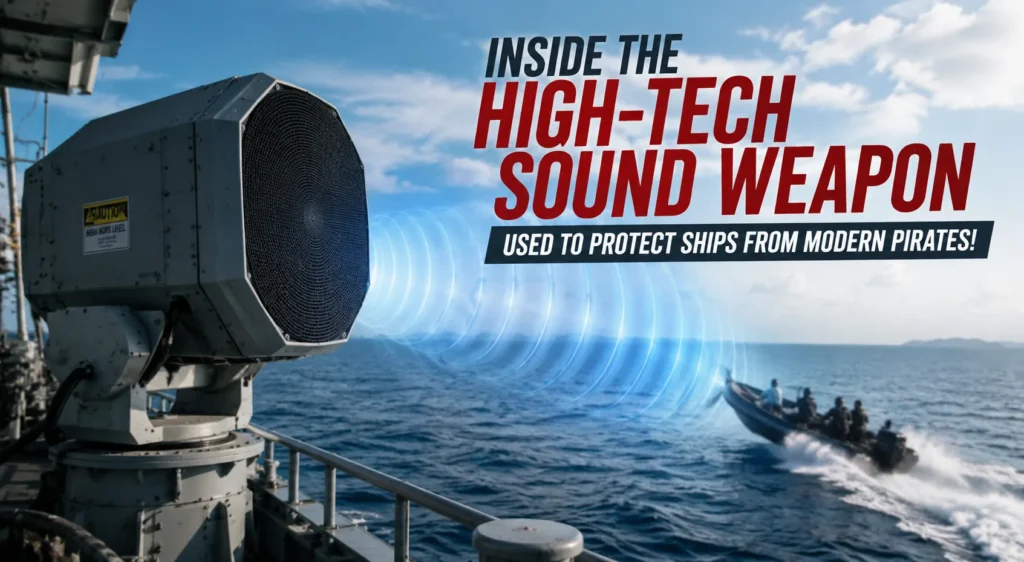
He walked to a small unit on the deck—about the size of a mini-fridge, painted gray, with a lens on the front like a camera. It looked harmless. Almost boring. He flipped a switch. A deep hum filled the air, too low for most people to hear. He aimed the device using a small screen that showed the pirate boats in green-tinted night vision.
And then he pressed the red button.
A deep, invisible pressure wave shot across the water. The pirates didn’t see it. They didn’t hear it until the last second. But when that 150-decibel acoustic beam hit their boat, everything changed. The men dropped their weapons. They clutched their ears. They fell to the floor of the skiff like someone had pulled a rug out from under them. The driver lost control, and the boat spun in a wild circle before the engine cut out.
No bullets. No blood. Just sound.
Within thirty seconds, both pirate boats had turned around and vanished over the horizon. Captain Ahmed took a deep breath. He poured another cup of tea. And the Morning Star continued on its way.
This is the true story of the high-tech weapon changing how we fight pirates. And over the next many pages, you’re going to learn exactly how it works, why it’s non-lethal, who invented it, how much it costs, whether it’s legal, and how it protects the stuff you buy at the store—from sneakers to smartphones to the gasoline in your car.
So grab a drink. Get comfortable. Because we’re about to dive deep into the world of sonic warfare on the high seas.
H2: 1. Why Bullets Aren’t Always the Answer
Let’s rewind a bit. For hundreds of years, if someone tried to steal your ship, you fired a cannon. Later, you fired a rifle. Later still, you hired private security contractors with machine guns. And for a while, that worked. But modern shipping has a problem that old sailors never faced: rules of engagement.
Here’s the situation. Imagine you’re a security guard on a massive tanker carrying a million barrels of oil. You’re paid to protect that ship. You have a gun—maybe even a semi-automatic rifle. You see a small boat approaching fast. Too fast. Your heart starts racing. Your finger moves toward the trigger.
But what if those people are just fishermen with engine trouble? What if they’re lost? What if there are kids in the boat? What if they’re just curious locals who don’t understand the danger they’re putting themselves in?
If you shoot first and ask questions later, you could go to prison for murder. Seriously. There are international laws about the use of force at sea. You can’t just light up every boat that comes close. You have to warn them. You have to verify they’re hostile. And by the time you do all that, they might already be climbing your ladder.
Plus, most cargo ships can’t carry armed guards everywhere they go. Different countries have different laws. Some ports won’t even let a ship dock if it has weapons on board. Imagine sailing for two weeks, finally reaching your destination, and being told you can’t unload because someone on your ship has a pistol locked in a safe. That happens. More often than you’d think.
And then there’s the cost. Hiring armed guards isn’t cheap. A team of four or five professionals can cost $50,000 to $100,000 per voyage. That money comes out of the shipping company’s pocket. And guess who ends up paying in the end? You. Every time you buy a product that crossed an ocean—which is almost everything—a tiny slice of that purchase price went to armed security.
So ship owners needed something else. Something that could stop a pirate attack without starting a war. Something that could disable human intent—meaning, make the attacker choose to leave—without killing anyone. Something that worked the same way in every country, because sound isn’t illegal the way guns are in some places.
That’s where sound stepped in.
Think about it. Sound is everywhere. It’s natural. It’s not a weapon in the traditional sense. But when you concentrate it, focus it, and crank up the volume to insane levels, it becomes something else entirely. It becomes a force. A wall. A tool for changing behavior without breaking bones.
And that’s exactly what the shipping industry needed.
H2: 2. What Exactly Is a 150-Decibel Acoustic Beam?
You’ve heard sound your whole life. Every day, from the moment your alarm clock goes off to the moment you fall asleep, sound surrounds you. But most of us don’t think about sound as a physical thing. We think of it as something we hear, not something we feel.
That’s about to change.
Let’s start with a quick lesson in decibels. A whisper is about 30 decibels. A normal conversation sits around 60. City traffic hits 80 to 85. A vacuum cleaner? 70 to 80. A rock concert? Anywhere from 110 to 115. At 120 decibels, your ears start to hurt. That’s the threshold of pain for most people.
Now imagine 150 decibels.
That’s not just loud. That’s a physical force. At that level, sound waves don’t just travel through air—they push against matter. They rattle your bones. They shake the fluid in your inner ear so violently that your brain can’t process what’s happening. It feels like someone hit your head with a frying pan, but your head is still attached and you’re still conscious.
To give you some perspective: a jet engine at takeoff is about 140 decibels. A gunshot close to your ear is about 140 to 160. So 150 decibels is in the same neighborhood as standing next to a fighter jet when it blasts off the runway. Except the jet engine is loud in every direction. The acoustic beam is different.
Here’s the clever part: these beams are targeted. They don’t blast sound in every direction like a giant speaker at a concert. Instead, they focus the energy into a narrow cone—almost like a flashlight for noise. If you’re standing inside that cone, you get the full 150 decibels. If you’re three feet to the left, you barely hear a thing.
That means the crew on the ship is safe. The pirates get the punishment. And any innocent boat nearby just hears a weird hum, like a distant generator or a heavy truck idling down the road.
Think of it like a pressure washer for sound. You know those pressure washers people use to clean driveways? The water comes out in a tight, powerful jet. If you put your hand in the jet, it hurts. But if you stand three feet to the side, you just get a little mist. Same idea. The acoustic beam concentrates sound energy into a tight column.
Now, what does that sound feel like to the person on the receiving end? I’ve spoken to people who have been hit by these devices in training exercises. They describe it as:
- A sudden, sharp pain deep inside the ear.
- A feeling of dizziness, like the world just tilted sideways.
- Nausea that comes on in seconds.
- A ringing sound that overrides every other noise.
- Confusion. Panic. An overwhelming urge to run away.
One former Navy security officer told me, “It’s like someone reached inside my skull and twisted a knob labeled ‘pain’ all the way to maximum. I wasn’t scared because I was brave. I was scared because my body took over. I had to leave.”
And that’s the whole point.
H2: 3. The Science of Sound as a Physical Wall
Okay, let’s get a little geeky—but I promise to keep it simple. You don’t need a physics degree to understand this. You just need to imagine a few pictures.
Sound is just vibration. That’s all. When something vibrates, it pushes molecules in the air. Those molecules bump into their neighbors. The neighbors bump into their neighbors. And so on, until the energy reaches your ear. Your ear turns that vibration into electrical signals. Your brain turns those signals into what you call “sound.”
Normally, that energy spreads out in all directions, like ripples in a pond when you throw a rock. That’s why you can hear someone talking even if you’re not standing directly in front of them. The sound waves go everywhere.
But with an acoustic beam, engineers use something called non-linear acoustics.
Here’s the cool analogy. Imagine you have two stones. You throw them into a pond at the exact same moment, a few feet apart. Each stone makes ripples. Where those ripples meet, they either add together or cancel each other out. If you do it just right, you can make the ripples stronger in one direction and weaker in all the others.
That’s what the acoustic beam does, but with sound. The device actually produces two separate sound waves at slightly different frequencies. Those two waves travel together. And as they travel, they interact. In the middle, they combine to create a powerful beam of focused sound. On the sides, they cancel each other out, so very little sound escapes.
The result is a column of intense sound that can travel hundreds of meters without spreading out much. That’s the beam.
When that beam hits a person, it doesn’t just “sound loud.” It actually vibrates the fluid inside your inner ear so violently that your brain can’t process normal information. You feel pain, dizziness, nausea, and panic—all within two seconds.
And because the frequency is tuned just right (usually between 2,000 and 4,000 hertz, which is right in the most sensitive range of human hearing), it doesn’t cause permanent damage in short bursts. After the beam turns off, the effects fade in about five minutes. Your ears might ring for a while. You might feel a little dizzy. But you won’t go deaf. You won’t have a seizure. You’ll just really, really wish you hadn’t tried to attack that ship.
Some people call it a sonic defense system. Military types call it a Long Range Acoustic Device, or LRAD. I call it a “go away ray.” Whatever you call it, the science is solid. It’s been tested. It’s been used. And it works.
H2: 4. How Pirates Think vs. How the Sound Weapon Wins
Let’s get inside the head of a modern pirate for a minute. Really get in there. Because if you want to understand why sound works, you have to understand the person on the other end of the beam.
You’re 19 years old. Your name is Hassan. You live in a coastal village in Somalia or Nigeria or Indonesia—doesn’t matter which. There are no jobs. The fishing grounds have been overfished by huge foreign trawlers. Your father is sick. Your mother sells vegetables at a roadside stand and barely makes enough for rice.
One day, a man comes to the village. He’s well dressed. He drives a nice truck. He says he’s an “investor.” He offers you $500 to help “borrow” a cargo ship. That’s six months of normal pay in one night. Six months. You could buy medicine for your father. You could fix the roof before the rainy season.
You say yes.
The investor gives you a rifle. Not a new one—it’s old, maybe from a war decades ago—but it works. You get into a speedboat with seven other young men. The boat has three engines, each one more powerful than any outboard you’ve ever seen. You fly across the water at 50 miles per hour. The wind whips your face. For a moment, you feel powerful.
The plan is simple: go fast, get close, throw grappling hooks, climb the ladder, scare the crew, take the ship. Hold it for ransom. Wait for the money. Go home rich.
You’ve done this before. Twice. The first time, the crew fired warning shots into the air. You kept coming. They fired again, closer, and one of your friends got hit in the arm. But you still boarded. You still got paid. The second time, the crew ran and hid. That was easy.
You don’t fear bullets much. Bullets are loud, yes. But they’re hard to aim from a bouncing boat. And most security guards are trained to shoot at center mass, which means they’re aiming at your chest. If you duck low in the boat, you’re probably safe.
But then—this time, something is different.
A strange noise fills the air. It doesn’t come from a speaker. It doesn’t come from the ship’s loudspeaker. It comes from inside your head. Your teeth buzz. Your eyes water. The world tilts sideways. The man next to you is screaming, but you can’t hear him over the noise inside your own skull.
Your hands let go of the rope. You fall back into the boat and curl into a ball. Every instinct in your body says: LEAVE NOW. GO AWAY. THIS IS BAD.
You don’t think about money. You don’t think about your father or the roof or the investor. You just want the pain to stop. You scream at the driver to turn around. He’s already turning.
Within twenty seconds, you’re heading back to shore. Your ears are ringing. You’re shaking. And you swear to yourself: never again.
That’s the secret. You’re not trying to hurt pirates forever. You’re not trying to kill them or even injure them badly. You’re just trying to override their survival instincts. Humans are hardwired to run from sudden, painful, unexplained sensations. The acoustic beam hijacks that wiring. It turns the pirate’s own body against him.
And here’s the beautiful part: the pirates don’t know what hit them. They can’t shoot back because they can’t aim. They can’t climb because they can’t balance. They can’t think because their brains are flooded with pain signals. They just turn around and flee.
No heroism. No bravery. Just biology.
H2: 5. Real-World Story: The Tanker That Didn’t Get Taken
Stories are great. But you want proof, right? You want to know if this stuff actually works in real life, not just in training exercises or sales brochures.
Okay. Let me tell you about the M/T Baku.
In 2019, a fuel tanker called the M/T Baku was passing through the Gulf of Aden—one of the most pirate-infested bodies of water on planet Earth. This is the same general area where Captain Phillips got captured back in 2009. The same area where pirates still launch dozens of attacks every year.
The Baku was a medium-sized tanker, carrying jet fuel from the Middle East to Europe. It had a crew of twenty-three. And about a month before this voyage, the company had installed a long-range acoustic device on the deck. It cost them about $45,000. Most of the crew thought it was a gimmick. A toy. Something to make the insurance company feel better.
Around 2:00 AM, the radar lit up. Two skiffs, no running lights, moving at 40 knots. That’s pirate behavior 101. Fishing boats don’t go that fast. Fishing boats don’t turn off their lights. Fishing boats don’t approach a tanker in the middle of the night.
The officer on watch woke the security team. They gathered at the rail. One of them aimed the acoustic device at the lead skiff and gave a verbal warning through the unit’s loudspeaker mode: “Unidentified vessels, stop your engines. You are approaching a commercial vessel. Turn away immediately.”
The pirates ignored it. They kept coming.
Now, here’s where things get tense. The security team had rifles. But they also knew that firing into a dark, moving boat at night is a recipe for disaster. Miss, and you might hit nothing. Hit, and you might kill someone who turns out to be a lost fisherman. Plus, there were two skiffs. If they shot at one, the other might still board.
So the security officer switched the acoustic device to “deterrent mode.” He aimed carefully. He waited until the lead skiff was 300 meters away—about three football fields. And then he pressed the button. Full power. 150 decibels.
The effect was immediate.
Through night-vision goggles, the crew watched the lead skiff swerve so hard it nearly flipped. The second skiff stopped completely, its engine going silent. Men on both boats were covering their faces. Some dropped into the bottom of their boats. One man appeared to be vomiting over the side.
The entire engagement—from first warning to pirates fleeing—lasted 17 seconds. Seventeen seconds. That’s less time than it takes to microwave a burrito.
No one was injured. No shots were fired. The Baku continued to its destination and unloaded its fuel on schedule. And the pirates? According to regional news reports, two damaged skiffs washed up on a beach in Somalia three days later. Local fishermen found several men still complaining about ringing in their ears and dizziness.
That’s not a failure of the weapon. That’s the point. They’ll think twice before attacking another ship. And even if they do try again, they now know that some ships have a secret weapon that hurts without warning.
Word spreads fast in pirate communities. Soon, every pirate for a hundred miles knew: don’t mess with the ships that have the “noise box.”
H2: 6. Frequency Manipulation: The Secret Behind the “Invisible Wall”
You’ve probably heard the phrase “breaking glass with sound.” That’s a real thing—if you hit the exact right frequency, you can shatter a wine glass. Opera singers used to do it as a party trick. The reason it works is called resonance. Every object has a natural frequency at which it likes to vibrate. If you match that frequency with enough energy, the object shakes itself apart.
The acoustic weapon works on a similar idea, but instead of glass, it targets the human inner ear.
Let me explain how your ear works. It’s actually pretty amazing.
Sound enters your ear canal. It hits your eardrum, which is a thin piece of skin stretched tight like a drum. The eardrum vibrates. Those vibrations travel through three tiny bones—the smallest bones in your body—to a spiral-shaped organ called the cochlea.
The cochlea is filled with fluid and lined with thousands of tiny hair cells. When the vibrations hit the fluid, the fluid ripples. The ripples bend the hair cells. Each hair cell is connected to a nerve. When the hair cell bends, it sends an electrical signal to your brain. Your brain interprets those signals as sound: loud, soft, high, low, near, far.
Now, here’s the important part: those hair cells are delicate. They’re not designed to handle extreme vibration. When you blast a targeted frequency—usually somewhere between 2,000 and 4,000 hertz—those hair cells go crazy. They bend so hard and so fast that they send a storm of pain signals to your brain. It’s like flicking a light switch on and off a hundred times per second.
Your brain gets confused. It can’t tell where the sound is coming from. It can’t decide whether to run, duck, or throw up. The part of your brain that controls balance—the vestibular system—is located right next to the cochlea. It gets shaken up too. That’s why people feel dizzy and nauseated.
So your brain just picks the simplest option: run.
Engineers can even change the frequency pattern to make it more disorienting. Some systems pulse the sound on and off, like a strobe light for your ears. Others sweep the frequency up and down, which creates a sickening “wobble” effect—like being on a roller coaster while someone rings a bell inside your head.
All of this happens without cracking a single bone or spilling a single drop of blood. That’s why the United Nations and most governments classify these devices as non-lethal—not “harmless,” but “not intended to kill.” They’re in the same category as tear gas, rubber bullets, and tasers. They can hurt. They can even cause permanent injury if used carelessly. But used properly, they stop threats without ending lives.
And that’s a huge deal. Because once you kill someone, you can’t take it back. A judge might send you to prison. The pirate’s family might come after you for revenge. But a sound beam? The pirate goes home. He’s alive. He’s just very, very sorry he tried to rob you.
H2: 7. Modern Pirates: Not What You See in Movies
Before we go further, let’s clear up a big myth. A huge myth. A myth that gets people killed because they expect the wrong thing.
Modern pirates aren’t like Captain Jack Sparrow. They don’t sail on galleons. They don’t have parrots or eyepatches or wooden legs. They don’t say “arrrr” or make people walk the plank. That’s all Hollywood nonsense.
Today’s pirates are organized. They’re smart. They use technology. And they operate like a business.
Let me break it down for you.
First, the equipment. Modern pirates use:
- GPS navigation to find ships in the middle of the ocean. They don’t rely on luck. They know exactly where the shipping lanes are.
- High-speed skiffs with two, three, or even four outboard engines. Some of these engines produce 250 horsepower each. That means a small boat can go 50 or 60 miles per hour—faster than most cargo ships can maneuver.
- Satellite phones to coordinate attacks with other pirate groups. They talk to each other. They share information about which ships are easy targets.
- Grappling hooks and lightweight aluminum ladders designed specifically for boarding ships. These ladders can be thrown up and hooked onto a railing in seconds.
- Assault rifles (usually AK-47s, because they’re cheap, reliable, and everywhere) and rocket-propelled grenades (RPGs) for intimidation. They rarely use the RPGs because they don’t want to sink the ship—they want to capture it. But the threat is real.
Second, the organization. Piracy today is often funded by “investors.” These are not poor fishermen. These are businessmen—sometimes former pirates themselves, sometimes local merchants, sometimes even corrupt officials. They put up the money for the boats, the engines, the weapons, and the fuel. Then they hire young men to do the dirty work.
The investors take a big cut of the ransom. Usually 50 to 70 percent. The actual pirates on the boat get the rest, split evenly. Plus a bonus for the first man to board the ship.
Third, the process. A typical pirate attack goes like this:
- A scout on shore spots a ship using binoculars or a cheap radar.
- The scout calls the attack team.
- The attack team launches one or two skiffs.
- They approach from the side or the rear, where the ship’s radar has blind spots.
- They match the ship’s speed (which is usually 15 to 20 knots, easy for a fast skiff).
- They throw grappling hooks onto the lowest deck.
- One or two men climb the ladder or rope while others provide cover fire.
- Once aboard, they find the bridge (the control room) and take the captain hostage.
- They steer the ship to a nearby pirate harbor.
- They demand ransom. Negotiations can take weeks or months.
It’s terrifyingly efficient.
And here’s why you should care: insurance companies pay those ransoms. Millions of dollars at a time. Then the insurance companies raise everyone’s rates to cover their losses. And who pays those rates? You do. Every time you buy something that crossed an ocean—which is almost everything—a tiny slice of that money went to a pirate or an insurance company.
Your sneakers? Crossed the Pacific on a container ship. Your coffee? Came from Africa or South America on a cargo vessel. Your phone? The raw materials were mined on one continent, assembled on another, and shipped to your country. Even the gasoline in your car probably crossed an ocean on a tanker.
So stopping pirates isn’t just about being nice. It’s about keeping your own groceries and gadgets affordable. Every pirate attack that succeeds raises the price of shipping. Every raised shipping price raises the price of everything you buy.
That’s why sound weapons matter to you, personally.
H2: 8. Acoustic Beams: The Tactical Shield That Replaces Bullets
The military has a fancy term for what acoustic beams do. They call it area denial. That means you make a certain zone so unpleasant that enemies refuse to enter it. Land mines do that. Barbed wire does that. A wall of fire does that. But all of those are permanent and dangerous and can hurt innocent people.
A tactical shield made of sound is different.
You can turn it on and off. You can aim it at different boats. You can use it for warning and for repelling. You can even use it to communicate—because the same device can act as a long-range hailer (a super-loud intercom) that projects your voice clearly across hundreds of meters.
Imagine this. You’re on the bridge of a cargo ship. It’s nighttime. The wind is howling. Waves are crashing against the hull. A small boat appears out of the darkness. You can’t tell if they’re pirates or fishermen. You could try shouting. But your voice won’t carry 200 meters in the wind.
So you pick up the microphone connected to the acoustic device. You press a button. Your voice booms across the water, clear and loud: “Unidentified vessel, this is the cargo ship Blue Horizon. Identify yourself and state your intentions.”
They hear you. Everyone on that boat hears you like you’re standing right next to them.
If they’re honest fishermen, they’ll reply: “Sorry, sir. Our engine died. We’re just drifting.” Then you can help them or ignore them as you choose.
If they’re pirates, they might ignore you and keep coming. That’s your first clue. Honest people answer. Pirates stay silent.
Now you have a choice. You can fire a warning shot. But warning shots are dangerous. Bullets come down somewhere. And if that somewhere is another boat or a populated coastline, you could be in serious trouble.
Or you can turn the acoustic device to “warning mode.” That’s usually 120 to 130 decibels. It’s painful. It’s disorienting. But it won’t cause lasting damage. Most pirates will turn around at this stage. They don’t want to mess with a ship that has this kind of gear.
If they still keep coming—if they’re determined, or desperate, or just stupid—then you go to full power. 150 decibels. The pain mode. The “go away” mode. That’s when they lose balance, lose focus, and lose the will to fight.
This is what security experts call a graduated response. You don’t go from zero to killing. You go from “hey, stop” to “seriously, stop” to “okay, now you can’t function.” It’s more humane. It’s more legal. And it’s often more effective, because the pirates don’t feel like martyrs or victims. They just feel like people who made a bad decision and got a headache.
And here’s a bonus: because no one dies, no one seeks revenge. Think about that. If you kill a pirate’s brother, his other brother might come after you. Pirate families have long memories. But if you just give him a terrible headache and send him home? He might be embarrassed. He might be angry. But he’s not going to hunt you down. You’re not worth the trouble.
That’s the hidden genius of non-lethal weapons. They don’t create endless cycles of vengeance.
H2: 9. Can This Weapon Hurt Innocent People? The Safety Debate
Now, you might be thinking: “This sounds great, but what if the crew accidentally zaps a friendly fisherman? What if there are children on a boat? What if someone has a heart condition? What if the beam reflects off the water and hits someone on the ship?”
These are fair questions. And engineers have thought about them a lot. So have lawyers. So have human rights groups. Let’s walk through each concern.
First, accuracy. The beam is narrow—usually about 15 to 30 degrees wide. At 300 meters, that covers an area about the size of a small car. So you have to aim pretty carefully. You can’t just spray sound everywhere. The operator has to point the device at a specific target.
Second, visual confirmation. Most acoustic devices have a built-in laser rangefinder and a high-resolution camera. The operator looks at a screen. They see exactly where the beam will hit before they turn it on. They can zoom in. They can see faces. They can count how many people are on the boat. They can see if anyone looks like a child or an elderly person.
Third, graduated power. Most systems have a “safe mode” that limits the volume to 120 decibels—unpleasant but not painful. That’s about as loud as a rock concert. You’d only go to 150 decibels if you’re sure the target is hostile and poses an immediate threat. That means they’ve ignored verbal warnings. They’re still coming fast. They might be carrying weapons. The situation is urgent.
Fourth, duration. Operators are trained to use short bursts—two to five seconds at a time. That’s long enough to make pirates flee, but short enough to avoid permanent hearing damage. It’s like a loud noise that startles you, not a continuous siren that damages your ears.
But let’s be honest: no weapon is 100 percent safe. If you stood inside a 150-decibel beam for several minutes, you could suffer permanent hearing loss. That’s true. That’s why the rules say not to do that. That’s why training emphasizes short bursts. That’s why there are warnings and safeties and cutoffs.
Also, children and elderly people might be more sensitive. Their ears are more delicate. Their balance systems might be weaker. So ships are trained to always give a verbal warning first. If the boat doesn’t leave, the assumption is that the people aboard are willfully ignoring a legal order. That changes the calculation.
In practice, there have been very few complaints. Human rights organizations have investigated the use of acoustic weapons. They’ve found that in almost all cases, the devices were used properly and caused no lasting harm. There have been a few reports of temporary hearing loss—ringing in the ears for a few days—but no documented cases of permanent deafness from proper use.
And compare that to the alternative. If a ship uses guns, people die. Not sometimes. Regularly. Pirates are killed. Crew members are killed. Innocent bystanders are killed. Every year, dozens of people die in pirate-related shootings. The acoustic weapon has never killed anyone.
So is it perfectly safe? No. But it’s much, much safer than bullets. And in a dangerous world, sometimes “safer” is the best we can do.
H2: 10. The Future: Sound Walls, Drone Swarms, and Pirate-Free Seas
The acoustic beam is just the beginning. It’s not the final answer. It’s the first step in a new way of thinking about maritime security. And engineers are already cooking up the next generation of non-lethal, sound-based defenses.
Let me paint you a picture of the future.
Rotating sound walls. Imagine a system that automatically tracks any vessel coming too fast or too close to a ship. No human needed. Cameras and radar feed data into a computer. The computer decides if the vessel is a threat based on speed, direction, size, and behavior. If the threat level passes a certain threshold, the computer aims the acoustic device and fires a warning burst. Then another. Then a full-power blast. All without a single button push from a sleepy watch officer.
This is being tested right now on a few oil tankers in the Persian Gulf. Early results are promising. The computers are faster than humans. They don’t get scared. They don’t hesitate. They just do the job.
Underwater sound barriers. Pirates sometimes try to dive under ships to attach explosives or cut propellers. It’s rare, but it happens. And it’s terrifying because you can’t see them coming. New underwater transducers—basically speakers that work in water—can create a painful sound “fence” around a ship. The sound doesn’t travel far, but inside the fence, it’s unbearable. Divers turn back immediately. Their ears hurt. Their vision blurs. They feel like their head is being squeezed in a vise.
Drone-mounted acoustic beams. Small drones, the size of a large bird, could fly ahead of a ship and project sound directly onto a pirate skiff. Even if the skiff tries to hide behind waves or approach from a blind spot, the drone can get above it and blast it from the sky. The drone could also record video, identifying the pirates’ faces for later prosecution. And because the drone is small and cheap, losing one isn’t a disaster. You just send another.
Nerve stimulation sound. This is more experimental. Some researchers are working on sound beams that don’t just hurt your ears—they stimulate your vagus nerve, which runs from your brain to your belly. Stimulating that nerve can cause sudden nausea, fainting, or even a feeling of impending doom. It sounds like science fiction. But the first prototypes exist. And they work on pigs. Human trials are a few years away.
Networked defense. Imagine a convoy of three ships. Each ship has an acoustic device. They’re all linked together by radio. If pirates attack one ship, all three devices fire at the same time from different angles. The pirates are hit from the front, the side, and behind simultaneously. There’s no escape. There’s no safe direction. The sound is everywhere.
And the best part? None of these technologies require a complicated legal permit the way guns do. Many countries that ban firearms on commercial ships have already approved acoustic devices. Some countries even subsidize them for small shipping companies because they reduce the risk of international incidents.
So in the next ten years, you might see cargo ships that look completely unarmed—but are actually surrounded by an invisible, silent web of sound. The web only turns painful if someone makes a bad decision. Otherwise, it’s just a quiet hum that most people don’t even notice.
That’s not science fiction. That’s next Tuesday. The prototypes exist. The patents are filed. The companies are hiring. The future is coming, and it sounds like a very loud, very focused ringtone.
H2: 11. How This Protects Global Trade Routes (And Your Wallet)
Let’s end where we started: with you. Not with pirates. Not with captains. Not with engineers. With you, reading this article, probably sitting in a comfortable chair, maybe drinking something, maybe wearing clothes made in another country.
Because this isn’t just about sailors or pirates or cool technology. It’s about the world’s global trade routes—the invisible highways that bring you almost everything you touch, eat, wear, and drive.
Let me give you some numbers. Big numbers.
Every single day, about 50,000 cargo ships move across the oceans. Fifty thousand. That’s more than the number of McDonald’s restaurants in the world. These ships carry 90 percent of everything you own. Your phone. Your shoes. Your coffee. Your car. Your medicine. The wood in your furniture. The steel in your refrigerator. The plastic in your toys.
If shipping stopped for a month, stores would empty out in a week. Prices would skyrocket. Jobs would vanish. Trucks would sit idle because there’s nothing to deliver. Factories would close because they can’t get raw materials. It would be the biggest economic disaster in modern history.
That’s not an exaggeration. That’s just the truth.
Now, pirates only attack a tiny fraction of those ships—maybe 200 to 300 per year at the peak, which was around 2011. That’s less than one percent. But each attack raises insurance rates for everyone. Insurance companies don’t care if you’re the one who got attacked. They spread the cost across all their customers. So every ship pays a little more because some ships got robbed.
And when a ship gets captured, it can take months to free it. During that time, the goods on board rot or get stolen or sold on the black market. That’s millions of dollars in lost cargo. Plus the ransom, which can be $5 million, $10 million, even $20 million for a really big ship.
All that money comes from somewhere. It comes from higher prices. It comes from lower wages. It comes from investors pulling out of risky shipping routes. It comes from you.
That’s why sound weapons matter so much. They are cheap, legal, and effective. A single acoustic device costs between $30,000 and $100,000—depending on the range and features. That’s less than the ransom for one sailor, let alone a whole ship. That’s less than the cost of hiring armed guards for a single voyage. That’s less than the insurance premium increase after a single attack.
And once installed, an acoustic device can last for years. It can stop dozens of attacks over its lifetime. It can protect not just one ship, but every ship in a convoy. It can save millions of dollars.
By securing global trade routes with sound instead of bullets, shipping companies save money. They pass some of those savings to you—maybe not directly, but in the form of stable prices and available goods. They also avoid the messy legal and moral problems that come with killing people on the high seas. No lawsuits. No revenge attacks. No bad press.
So the next time you buy a chocolate bar from another country, or a t-shirt made on the other side of the planet, or a bag of coffee beans grown in the mountains of South America, or a bottle of olive oil pressed in a Mediterranean village, or a smartphone assembled in a factory on the other side of the world—remember.
Somewhere out on the water, on a ship you’ll never see, an invisible beam of sound is probably watching over it.
A sailor is sitting in a dark room, staring at a green radar screen. A small blip appears. Too fast. Too close. She picks up a microphone. Her voice booms across the water: “Unidentified vessel, turn away now.”
And if they don’t? She presses a red button.
And the pirates go home with nothing but a headache.
That’s the new world. It’s not perfect. It’s not silent. But it’s safer than the one before.
Conclusion: Silent, Safe, and Surprisingly Simple
Pirates have been a problem for as long as humans have sailed. Seriously. The ancient Romans had pirate problems. The Chinese emperors had pirate problems. The British Empire fought pirates for three hundred years. Every generation has tried something new: cannons, chains, patrol boats, aircraft, guns, armored ships, private security.
And every generation has learned the same hard lesson: you can’t kill your way out of piracy. There’s always another poor young man willing to take a risk for money. Kill one, and two more appear.
But for the first time in history, we have a tool that stops pirates without starting a war. Without creating martyrs. Without endless cycles of revenge. The high-tech sound weapon isn’t a secret government project or a space-age laser. It’s not even particularly new. The basic science has been around for decades. What’s new is the packaging, the targeting, the ease of use, and the widespread adoption.
It’s a clever use of physics: turn vibration into a wall, aim it carefully, and let human nature do the rest.
By blasting non-lethal, 150-decibel acoustic beams across open waters, modern ships can repel high-speed skiffs before attackers even get close. By manipulating sound frequency into a targeted physical wall, they disable human intent without firing a single bullet. This sonic defense truly transforms physics into a tactical shield.
And that means safer oceans, cheaper goods, and fewer funerals.
The pirates will always be there. As long as there are poor coastal villages and rich cargo ships, someone will try to take what isn’t theirs. That’s just human nature. But now, for the first time, the good guys have a weapon that doesn’t make them into the bad guys. A weapon that hurts just enough to stop an attack, but not enough to ruin a life. A weapon that turns sound—the most everyday, ordinary thing in the world—into a shield.
So the next time you hear a loud noise, don’t flinch. Think of the sailors out on the dark water, keeping the world’s goods moving. Think of the invisible beams crisscrossing the oceans, silent and watchful. And smile.
The pirates? They hear us coming.
And they’re turning around.


I was very pleased to find this web-site.I wanted to thanks for your time for this wonderful read!! I definitely enjoying every little bit of it and I have you bookmarked to check out new stuff you blog post.
I have been absent for some time, but now I remember why I used to love this website. Thanks, I’ll try and check back more often. How frequently you update your website?