
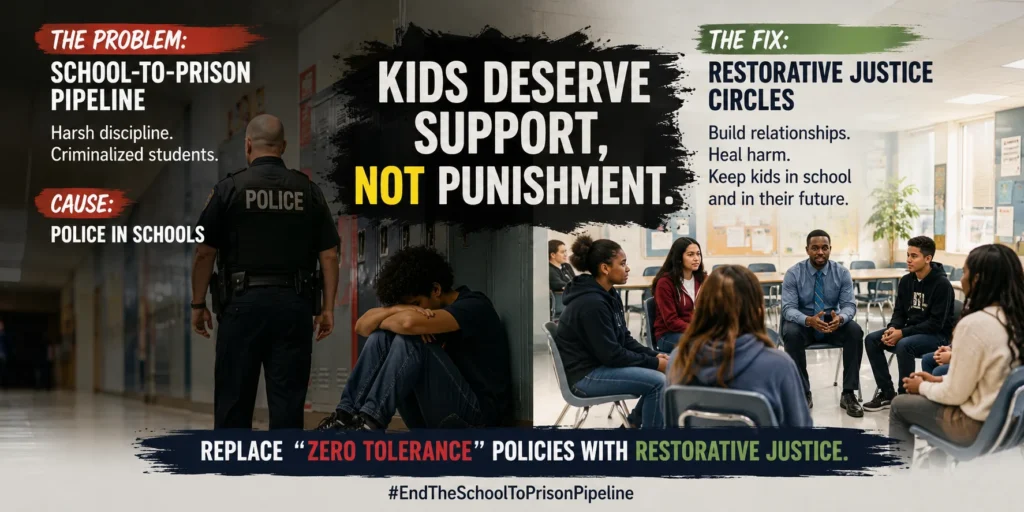

Part One: The Long Walk
A Story That Happens Every Day
Imagine you are in 8th grade. You are 13 years old. Your backpack is too heavy. Your stomach is growling because you didn’t have time for breakfast. Last night, your parents were fighting, so you only got four hours of sleep.
Now, imagine you are sitting in math class. You’re not trying to be bad. You’re just tired. You whisper to your friend, “Can I borrow a pencil?”
A teacher sees you. He calls your name. “Stop talking.”
You nod. But two minutes later, you whisper again: “What page are we on?”
That’s it.
The teacher sends you to the principal’s office. But here’s the thing—there is no counselor waiting for you. There is no nurse. Instead, standing in the hallway is a police officer. A School Resource Officer. He looks at you like you are a criminal. He grabs your wrist. He says, “You’re disrupting the peace.”
You are handcuffed. For whispering. For being tired. For being a kid.
This is not a movie. This is real life. And for thousands of students across the United States, this is the first step onto a road called the School-to-Prison Pipeline.
Let me tell you another story. This one is about a girl named Maya. She was in 6th grade. Eleven years old. She had a bad habit of chewing gum in class. Her teacher told her three times to spit it out. The third time, the teacher wrote a referral. The principal had a new rule: Zero Tolerance for gum. Maya was suspended for one day. Her mom had to leave work early to pick her up. Her mom lost money from her paycheck. Maya sat at home alone, feeling like a criminal. For gum.
One more story. This one is about a boy named DeShawn. He was 14. In the cafeteria, another student took his hat and ran away. DeShawn chased him. They bumped into a lunch lady. She dropped a tray of food. The principal called the police officer on campus. DeShawn was arrested for “assault” because he bumped the lunch lady. He spent a night in juvenile detention. All because someone stole his hat.
These stories are not rare. They are not isolated mistakes. They are the everyday machinery of a system that has learned to treat children like prisoners.
What Exactly Is the School-to-Prison Pipeline?
Let’s break that down in a way that sticks in your brain.
A pipeline is a direct path from Point A to Point B. Water flows through a pipe from your street to your sink. Oil flows through a pipe from a refinery to a gas station. Once you enter the pipe, you can’t get out until you reach the other end.
The School-to-Prison Pipeline is a system of policies and practices that push students—especially students of color, students with disabilities, and students from poor neighborhoods—directly out of school classrooms and into the criminal justice system.
Think of it like this:
Point A: A classroom in a public school. You’re sitting at a desk. You’re learning fractions or reading a novel.
Point B: A jail cell. Or a juvenile detention center. Or a courtroom.
The pipe: Harsh discipline rules, police officers in the hallways, and something called Zero Tolerance policies.
Instead of teaching kids how to fix their mistakes, the pipeline treats them like adult criminals. A spilled milk in the cafeteria becomes a “property crime.” A loud argument becomes “disorderly conduct.” A marker on a desk becomes “vandalism.” A pretend finger gun becomes “terroristic threat.”
And once you get arrested at school? Your life changes forever. You now have a record. That record shows up when you apply for college, for a job, for the military. All because of something that used to be handled by a principal with a conversation.
The History: How Did We Get Here?
To understand the pipeline, we have to travel back in time. Not hundreds of years. Just back to the 1990s.
In the 1990s, America was scared. News stories talked about “super-predators.” That was a made-up term for young people who were supposedly super violent. Politicians used that fear to pass tough laws. They said, “We need to get tough on crime.”
In 1994, Congress passed the Gun-Free Schools Act. The idea sounded good: If a student brings a gun to school, kick them out for at least one year. Keep everyone safe. Most people agreed with that.
But something went wrong. Schools started applying that “Zero Tolerance” rule to everything. Not just guns. But also:
- A 6-year-old boy who brought a camping fork-and-spoon set to school for lunch got expelled for having a “weapon.”
- A 5-year-old girl who drew a stick figure with a gun got suspended for threatening violence.
- A teenager who gave a friend a Tylenol for a headache got arrested for drug distribution.
Suddenly, Zero Tolerance meant: No questions. No context. No “why did you do that?” Just punishment. Suspension. Expulsion. Arrest.
At the same time, after the Columbine shooting in 1999, the government gave millions of dollars to put police in schools. The idea was to make schools safer. The government created a program called COPS in Schools. It paid for thousands of police officers to stand in school hallways.
But what happened instead? Police started arresting kids for things that used to be handled by the principal—like chewing gum, being late, or talking back. The number of school-based arrests exploded. Between 1995 and 2005, arrests in schools more than doubled.
And that is how the School-to-Prison Pipeline was built. Brick by brick. Handcuff by handcuff. Referral by referral.
The Numbers That Will Break Your Heart
Let me give you some numbers. These come from the U.S. Department of Education. They are not opinions. They are facts.
Every single school year, nearly 2 million students are referred to police or arrested at school. That is 2 million kids. That is more than the entire population of Houston, Texas. That is more than the population of New Mexico. Every year.
Of those 2 million students, the vast majority are arrested for something called “insubordination” or “disorderly conduct.” That means talking back. That means being loud. That means rolling your eyes. That means not sitting down fast enough.
Less than 2% of school-based arrests are for serious violence like bringing a weapon or physically attacking someone. The other 98% are for minor misbehavior that used to get you a trip to the principal’s office and a lecture.
Here’s another number: Students who are suspended just once are three times more likely to end up in the juvenile justice system within the next year. Three times. One suspension triples your chances of seeing a judge.
And here’s the kicker: Suspension doesn’t make schools safer. A major study of over 1,000 schools found that schools with high suspension rates had more violence, more drug use, and lower test scores than schools with low suspension rates. Punishment doesn’t work. It just feeds the pipeline.
Part Two: The Cause – Police in Schools (The Cop in the Hallway)
Meet Officer Miller and Officer Davis
Let me tell you about a real school in Texas. I’ll change the names to protect privacy, but the story is true. Every word of it happened.
Officer Miller is a School Resource Officer. He’s a nice guy. He coaches basketball after school. He gives high-fives in the morning. He says he loves kids. He has a sticker on his car that says “Protect and Serve.”
But one Tuesday, a 7th grader named Jamal is upset. His grandmother just died. He’s sitting in the back of science class, crying. Not loud crying. Just tears running down his face while he stares at his desk.
The teacher says, “Jamal, do your work.”
Jamal whispers, “Leave me alone.”
The teacher says, “Excuse me? That’s disrespectful. Go to the office.”
Jamal doesn’t move. He’s frozen in grief. The teacher calls Officer Miller.
Officer Miller walks in. He’s wearing a gun, a taser, and handcuffs. He asks Jamal to step into the hallway. Jamal, crying and angry, yells, “Everybody just leave me alone!”
Officer Miller grabs Jamal’s arm. Jamal pulls away—not to hit, not to fight. He’s just a scared kid trying to get space. But Officer Miller radios for backup. Within ten minutes, two more officers arrive. Jamal is on the ground. His hands are behind his back. He is in handcuffs.
He is charged with “resisting arrest” and “disruption of school.” He is 12 years old.
Now, Jamal has a criminal record. He goes to juvenile court. He misses two weeks of school. When he comes back, he’s behind in all his classes. His teachers treat him like a troublemaker. He feels like a bad kid. He stops trying. By 9th grade, he drops out. By 10th grade, he’s in a juvenile detention center for stealing a car.
Officer Miller still gives high-fives to other kids. He still says he loves kids. But Jamal’s life is now part of the School-to-Prison Pipeline.
Now meet Officer Davis. She works in a different school, in a different state. One day, a 9th grader named Elena has a panic attack. She has anxiety disorder. She starts hyperventilating in the hallway. She knocks over a trash can by accident.
Officer Davis sees the knocked-over trash can. She doesn’t ask Elena if she’s okay. She doesn’t call a nurse. She handcuffs Elena for “destruction of school property.” The property was a plastic trash can worth $12. Elena misses a week of school. She is now too scared to ever go back. She is 14.
These are not bad cops. These are good people working in a broken system. The system tells them: You are here to enforce rules. You are here to keep order. So that’s what they do. They don’t have training in child psychology. They don’t have training in grief or trauma or disability. They have training in handcuffs.
Why Are Police in Schools a Problem?
Police are trained to enforce laws. That is their job. That is what they learn in the academy. They learn how to handcuff. How to search. How to arrest. How to use force.
They are not trained to be therapists, social workers, or parents. They are not trained to recognize a panic attack versus a tantrum. They are not trained to de-escalate a child who is having a meltdown because of autism or ADHD.
When a cop walks into a classroom, their brain automatically looks for: Is this a crime? Should I make an arrest? Is this person a threat? That is what they are paid to do.
But most school misbehavior is not a crime. Talking in class is not a crime. Sleeping at your desk is not a crime. Even shoving someone in a hallway fight is usually a school discipline issue—not a job for the courts. It should be handled by a principal, a counselor, a teacher. Not by someone with a taser.
When you bring police into schools, you turn normal kid mistakes into criminal offenses. This is called criminalization—treating a child like a criminal for doing something that is wrong, but not illegal.
Think about this: In schools with police, the arrest rate for “disorderly conduct” is 500% higher than in schools without police. That doesn’t mean kids in those schools are five times more badly behaved. It means the police are there to arrest them for the same behavior.
The School Resource Officer Trap
Most people think School Resource Officers are there to stop school shootings. That makes sense on the surface. If a bad person comes to school with a gun, you want a good person with a gun to stop them.
But here’s the problem: School shootings are extremely rare. In any given year, the chance of a school shooting happening at your school is about 1 in 10 million. Meanwhile, the chance of a student being arrested for a minor misbehavior is 1 in 50.
So police in schools do almost nothing to stop shootings. But they do a huge amount to arrest kids for small stuff.
Let me prove it with data. A study from the University of Texas looked at every school shooting over 20 years. In over 80% of those shootings, the school had a police officer on campus. The officer did not stop the shooting. In fact, in several cases, the officer was hiding or ran away.
What stops school shootings? Research shows it’s not police. It’s things like: students who trust adults enough to report warning signs, mental health counselors who spot troubled kids early, and threat assessment teams that intervene before violence happens.
Police in hallways actually reduce trust. Students don’t tell cops about a friend who is dangerous, because they fear their friend will be arrested forever. Students clam up. They don’t report. And that makes everyone less safe.
Who Gets Hurt the Worst?
The School-to-Prison Pipeline does not hurt all kids equally. Some groups are hit much, much harder than others.
Black students make up about 15% of all public school students. But they make up nearly 40% of all school-based arrests. Let me say that again: 15% of the students = 40% of the arrests.
Black students are three times more likely to be arrested at school than white students for the exact same behavior. A study gave teachers and police officers videos of students misbehaving. The videos were identical except the students were different races. The adults rated the Black students as “more threatening” and “more deserving of arrest” even though the behavior was exactly the same.
Students with disabilities are also hit hard. Students with ADHD, autism, emotional disorders, or learning disabilities are twice as likely to be arrested at school as students without disabilities. Why? Because many disabilities affect behavior. A child with ADHD might not be able to sit still. A child with autism might not make eye contact. A child with an emotional disorder might cry or yell.
Under Zero Tolerance, those disability-related behaviors get punished the same as intentional misbehavior. That is not only unfair—it is illegal. Federal law says schools must make accommodations for students with disabilities. But arrests don’t accommodate anyone.
Girls of color are another group that suffers. Black girls are five times more likely to be suspended than white girls. Latina girls are twice as likely. The same behavior—talking back, wearing a hoodie, chewing gum—leads to handcuffs for girls of color and a warning for white girls.
And here’s the most heartbreaking group: elementary school children. Yes, kindergarteners and first-graders are being arrested. In one Florida county, over 1,000 elementary school students were arrested in a single year. Their ages ranged from 5 to 10. Their crimes? Throwing a crayon. Refusing to sit down. Calling a teacher a bad name.
A 5-year-old in handcuffs. Think about that image. That is the pipeline.
Part Three: The Engine – Zero Tolerance Policies
The Rule That Forgot Common Sense
Imagine a family rule: If you make any noise at dinner, you don’t eat for 24 hours.
That would be crazy, right? Because what if the noise was a sneeze? What if it was a baby crying? What if it was someone choking? A good rule has exceptions. A good rule asks, “What happened? Why? What’s the context?”
But that is exactly how Zero Tolerance policies work in thousands of American schools. Zero Tolerance means: This rule applies to everyone, every time, no exceptions, no excuses. No context. No “why.” No mercy.
Let me give you real examples. These are not made up. You can look them up.
In Pennsylvania, a 6-year-old boy brought a plastic camping fork and spoon to school in his lunchbox. It had a tiny knife edge for cutting food. The school called it a “weapon.” The boy was expelled for 45 days. He was 6 years old. He cried every day.
In Colorado, a 14-year-old girl gave her friend a Tylenol for a headache. The school had a Zero Tolerance policy for drugs. The girl was arrested for “drug distribution.” She spent three days in juvenile detention. Her friend just had a headache.
In Florida, a 5-year-old girl drew a stick figure holding a balloon. But the balloon was shaped funny, and a teacher thought it looked like a gun. The girl was suspended for “threatening violence.” She was in kindergarten.
In Texas, a 13-year-old boy burped in class. Not a loud, mean burp. Just a normal burp. The teacher said it was “disruptive.” The boy was arrested for disorderly conduct. He was handcuffed. His mother had to come get him from the police station. For a burp.
In Virginia, a high school student used his finger to pretend to shoot a basketball. A teacher said the finger looked like a gun. The student was expelled for “making a terrorist threat.” He was an honor roll student. He had never been in trouble before.
These are not anomalies. These are the everyday results of Zero Tolerance. The policy removes all common sense. It turns teachers and principals into robots who must follow the rule even when the rule is absurd.
Why Did Schools Adopt Zero Tolerance?
Fear. In the 1990s, after the Columbine shooting, parents were terrified. They demanded that schools get “tough.” School boards thought, If we kick out every kid who breaks a rule, then only good kids will be left. Schools will be safe.
Politicians loved Zero Tolerance because it sounded strong. “Zero Tolerance” is a catchy phrase. It makes voters feel like something is being done. No politician ever lost an election by saying they were “tough on school crime.”
But here’s the secret that Zero Tolerance defenders don’t want you to know: It doesn’t work. It has never worked. Study after study after study shows the same thing: Zero Tolerance policies do not make schools safer. In fact, they make schools more dangerous.
Let me explain why.
First, kids who are suspended are more likely to commit crimes. When you kick a kid out of school, they are home alone, on the streets, or with other suspended kids. That’s when they get into real trouble. They have nothing to do, no supervision, and no hope. A kid who is suspended for a week is much more likely to try drugs, join a gang, or get into a fight than a kid who stays in school.
Second, suspension doesn’t teach better behavior. It just removes the kid. They never learn why what they did was wrong. They never learn how to fix it. They just get angry. They feel rejected. They think, “The school hates me, so why should I care?” Punishment without teaching is just revenge.
Third, schools become like prisons. When students are scared of being arrested for a small mistake, they stop trusting adults. They stop reporting bullying. They stop asking for help when they are struggling. Trust is the foundation of a good school. Zero Tolerance destroys trust.
A famous researcher named Dr. Russell Skiba proved this. He studied schools in the Midwest for over a decade. He found that schools with strict Zero Tolerance had more fights, more drug problems, and more dropouts than schools with fair, flexible discipline. More punishment led to more problems.
Zero Tolerance did not stop violence. It just created a pipeline.
The Suspension Spiral
Let me walk you through how the pipeline grabs a student. I call this the Suspension Spiral. It’s like a toilet bowl—once you start going down, it’s very hard to climb back up.
Step 1: A student makes a small mistake. Maybe they talk back to a teacher. Maybe they are late to class three times. Maybe they wear a hat inside the building. Zero Tolerance says: automatic 3-day suspension.
Step 2: The student misses three days of school. While out, they don’t do their make-up work. Maybe they don’t have a computer at home. Maybe no one reminds them. Now they are behind.
Step 3: They return to class confused. They don’t understand the math lesson because they missed three days. They feel stupid. They feel embarrassed. To avoid looking dumb, they act out again. They crack a joke. They refuse to answer a question. This time: 5-day suspension.
Step 4: Repeat. Each time they come back, they are more behind. Each time, they feel more like “the bad kid.” Teachers start looking at them differently. Other students avoid them. Eventually, they stop trying. They drop out. Or they get expelled.
Step 5: Without a diploma, they can’t get a good job. They hang out on corners. They get caught with weed or in a fight. Now they are in the actual prison system.
That is the School-to-Prison Pipeline working exactly as designed—even if nobody planned it that way. It’s not a conspiracy. It’s just the result of bad policies and good intentions gone wrong.
The Racial Zero Tolerance Gap
Here’s something that will make you angry. Zero Tolerance policies are applied very differently depending on your skin color. Remember, Zero Tolerance means “no exceptions, everyone treated the same.” But that’s not what happens in real life.
A study looked at over 2,000 schools. They found that for the exact same behavior—say, a student using a bad word in class—Black students were four times more likely to be suspended than white students. Four times.
Another study gave teachers a scenario: A student is talking back and being rude. Half the teachers were told the student was named “Darnell” (a name often associated with Black students). The other half were told the student was named “Jake” (a name often associated with white students). The teachers rated Darnell as more dangerous and more deserving of arrest. Same behavior. Different name. Different outcome.
This is called implicit bias. It means our brains make quick judgments based on stereotypes without us even knowing it. A teacher might not think they are racist. But their brain has learned from TV, movies, and news that Black children are “more threatening.” So they react more harshly.
Zero Tolerance was supposed to remove bias. It was supposed to be a machine that treated everyone the same. But machines are run by people. And people have bias. So Zero Tolerance didn’t remove bias. It just gave bias a new name.
Part Four: The Fix – Restorative Justice Circles
Meet Principal Valez
Now, let me tell you a different story. This one is about hope. This one is about a school that broke the pipeline.
Meet Principal Valez. She runs a middle school in Oakland, California. When she first became principal, her school was a mess. Fights every week. Police in the hallways. Students getting arrested for stupid things like wearing the wrong color shirt.
Principal Valez used to believe in Zero Tolerance. She suspended dozens of kids every week. She had two police officers in her hallways. She thought she was being tough. She thought she was keeping order.
But one day, she looked at her data. Her school had the highest arrest rate in the entire district. And test scores? The lowest. She realized: I am not a principal. I am a pipeline manager. I am not educating kids. I am sending them to jail.
So she did something radical. She got rid of Zero Tolerance. She asked the police to leave (except for real emergencies like a stranger on campus). And she introduced something called Restorative Justice.
At first, teachers were scared. “No punishment? Kids will run wild!”
But Principal Valez explained: “Restorative Justice is not ‘no consequences.’ It’s different consequences. Right now, we punish kids and they learn nothing. Restorative Justice makes kids face what they did, understand who they hurt, and fix it. That’s harder than suspension. That’s real accountability.”
She trained every teacher. She changed the student handbook. She built a Peace Room. And slowly, things changed.
Within two years, suspensions dropped by 74%. Arrests dropped by 55%. Test scores went up. Fights went down. Students said they felt safer. Teachers said they felt happier.
Principal Valez didn’t just fix a school. She saved lives.
What Is Restorative Justice?
Let’s define this clearly. Restorative Justice is a way of handling misbehavior that focuses on three questions:
- What harm was caused?
- Who was affected by that harm?
- What needs to happen to repair the harm?
That’s it. Instead of asking “What rule was broken? What punishment should be given?” Restorative Justice asks “Who got hurt? How can we make it right?”
Let’s go back to the whispering example. Under Zero Tolerance, whispering = suspension.
Under Restorative Justice, here’s what happens:
A student whispers in class. The teacher doesn’t call the cop. Instead, the teacher asks the student to stay after class. They sit in a circle—not a “face the principal’s desk” setup where the adult is high and the kid is low. A circle where everyone is equal. Chairs in a circle. No desk in between.
The teacher asks three simple questions:
“What happened?” (The student explains: “I was tired. I didn’t know the page number. I whispered to my friend to ask.”)
“Who was affected?” (The student thinks: “The teacher felt disrespected. My classmates were distracted. I affected the learning of everyone.”)
“What can we do to make it right?” (The student says: “I can apologize to the teacher. I can apologize to the class. I can ask for a pencil before class starts tomorrow so I don’t have to whisper.”)
That’s it. No arrest. No suspension. No criminal record. The student learns something. The harm is repaired. Everyone moves on.
But wait—is that too soft? What about bigger problems? What if a student steals something or starts a fight? Does Restorative Justice just let them off the hook?
No. For serious harm, Restorative Justice uses something called a restorative circle. And that circle is not easy. It is not a hug-fest. It is intense, emotional, and hard.
The Circle: How It Works in Depth
A restorative circle is a structured meeting. It looks like this:
- Chairs in a perfect circle, no desks in between. Everyone can see everyone.
- A “talking piece” — this can be a small stone, a wooden stick, a stuffed animal, anything. Only the person holding the talking piece speaks. Everyone else listens. No interrupting. No side conversations.
- A facilitator (a teacher or counselor who has been trained) asks scripted questions. The facilitator does not judge. Does not punish. Just guides.
For a serious harm—like a fight between two students—the circle might include:
- The two students who fought.
- Their parents or guardians.
- The teacher who saw the fight.
- A school counselor.
- Two other students as peer supporters.
- A school administrator.
The circle can last 30 minutes or two hours. It depends on how much needs to be said.
The facilitator asks a sequence of questions. First to the student who caused the harm:
- “What happened from your point of view?”
- “What were you thinking at the time?”
- “What have you thought about since?”
- “Who has been affected by your actions?”
- “What do you think needs to happen to make things right?”
Then the facilitator asks the same kind of questions to the student who was harmed:
- “What happened from your point of view?”
- “How did it feel when it happened?”
- “How have you felt since?”
- “What has been the hardest part for you?”
- “What do you need to feel safe and whole again?”
Then the facilitator opens it up to others in the circle. Parents might speak. Teachers might speak. The peer supporters might speak. Everyone gets a turn with the talking piece.
The goal is not to shame anyone. The goal is to let everyone be heard. When people feel heard, they are more willing to take responsibility.
After everyone has spoken, the group works together to create a plan. That plan might include:
- Writing a sincere apology letter.
- Doing community service at the school (cleaning the cafeteria, planting a garden, painting over graffiti).
- Attending counseling sessions.
- Sitting in a “buddy circle” for a week to rebuild trust.
- Creating a presentation about conflict resolution to teach other students.
- Paying for damages (with parent permission).
The plan is written down. Everyone signs it. There is a follow-up circle in two weeks to check progress.
This is not easy. This is not “getting off easy.” A student who goes through a restorative circle has to face the person they hurt. They have to hear how it felt. They have to look them in the eye. That is much harder than sitting at home for three days playing video games.
Does Restorative Justice Actually Work?
Yes. And the data is stunning. Let me give you the numbers from real schools that replaced Zero Tolerance with Restorative Justice.
Oakland Unified School District (California):
- Suspensions dropped by 74% in the first two years.
- Arrests on campus dropped by 55%.
- Graduation rates went up by 12%.
- The racial gap in discipline shrank by half.
Chicago Public Schools (Illinois):
- After reducing police in schools and adding restorative practices, school-based arrests fell by 67%.
- Students reported feeling safer—not less safe—because they trusted adults more.
- Teacher turnover dropped. Teachers wanted to stay because they weren’t acting like prison guards anymore.
Denver Public Schools (Colorado):
- Restorative Justice reduced repeat fights by 40%.
- Students of color were no longer punished at higher rates for the same behavior. The racial gap nearly disappeared.
- The district saved $2 million in police overtime costs.
Los Angeles Unified School District (California):
- LAUSD got rid of police in schools in 2021. Then they trained 5,000 teachers in Restorative Justice.
- The next year, arrests dropped by 92%.
- Expulsions dropped by 80%.
- Test scores went up for the first time in a decade.
One study from the University of California looked at the cost. Every time a student is expelled, the school loses about $10,000 in state funding. Every time a student is arrested, the city pays about $5,000 for police, courts, and probation. Restorative Justice costs about $500 per student for training and circle facilitation. So for every student who stays in school instead of entering the pipeline, the system saves over $14,000.
Restorative Justice is not just morally right. It’s cheaper. It works better. It makes everyone safer.
What a Restorative School Looks Like (A Day in the Life)
Let me paint you a picture. Imagine you are walking through a school that has completely broken the School-to-Prison Pipeline. Here is what you would see.
8:00 AM – Morning Circle
Instead of a metal detector or police at the door, there’s a “morning circle” in every homeroom. Students sit in a circle for 15 minutes. They share how they’re feeling. One student says, “I’m angry today because my dog died.” The teacher writes that down on a sticky note. Now every teacher that day knows: be gentle with that student. Give them space.
Another student says, “I didn’t sleep. My baby brother cried all night.” The teacher says, “Thank you for sharing. You can put your head down during reading time if you need to.”
No judgment. No punishment. Just connection.
10:30 AM – The Basketball Dispute
Two students get into a shoving match over a basketball during gym class. In an old school, the police would be called. Both would be arrested for assault. In this school, the teacher says, “You two, go to the Peace Room.”
The Peace Room is not a punishment room. It has soft chairs, plants, a fish tank, and a circle of cushions. A trained counselor meets them there. The counselor leads a 20-minute restorative conversation. The talking piece goes around.
One student says, “He pushed me first.”
The other says, “You called me a name.”
The counselor asks, “What could you have done differently?”
Both students take responsibility. They agree to supervise lunch basketball together for a week. They shake hands. They go back to class. No suspension. No arrest. No record.
1:00 PM – The Cheating Incident
A student is caught cheating on a math test. In a Zero Tolerance school, automatic expulsion. In this school, the teacher asks the student to stay after class. They sit in a two-person circle.
The teacher asks, “What made you cheat?”
The student breaks down. “I didn’t sleep. My mom works two jobs. I have to take care of my little sister. I didn’t have time to study. I panicked.”
The teacher doesn’t yell. She says, “I hear you. That sounds really hard. But cheating is still not okay. It affects me because I can’t trust your work. It affects you because you didn’t actually learn the math.”
They make a plan. The student has to re-learn the material and teach it to a small group of struggling students. That way, she learns it twice. She also has to write a letter to the teacher explaining what she’ll do differently next time she’s stressed.
The student does it. She passes the next test on her own. She learns math and self-respect.
3:00 PM – Community Circle
At the end of the day, the whole school holds a “community circle” in the gym. Everyone sits in a giant circle. It takes 15 minutes just to pass the talking piece around.
They celebrate a student who helped clean up a mess they didn’t make. They talk about a problem—someone wrote graffiti in the bathroom—and brainstorm solutions together. Students suggest: more art supplies for positive drawing, a bathroom monitor rotation, a reward for keeping bathrooms clean.
The principal listens. She says, “Great ideas. We’ll try all three.”
This is not a fantasy. Schools like this exist in Maine, Minnesota, Texas, California, Colorado, and Illinois. They have less violence, less fear, and more learning.
Part Five: The Human Side – Stories from the Pipeline
Marcus’s Story
Marcus was a 9th grader in Florida. He had an IEP because he had ADHD. ADHD means his brain works differently. It’s hard for him to sit still. It’s hard for him to control his impulses. He’s not a bad kid. He just needs different support.
One day in science class, Marcus was tapping his pencil. Tap. Tap. Tap. The teacher told him to stop. He couldn’t. The tapping was helping him focus. The teacher told him again. He kept tapping. The teacher sent him to the hallway.
Marcus was frustrated. He started crying. A School Resource Officer saw Marcus crying in the hallway. The officer told Marcus to “calm down.” Marcus yelled, “You calm down!”
The officer grabbed Marcus. He pushed him against the wall. He handcuffed him. Marcus was charged with battery on a law enforcement officer—a felony. He was 14. He spent 10 days in a juvenile detention center. He was scared every night. He didn’t understand why he was there.
When he got out, his school said, “You can’t come back. You’re a threat to safety.” He was expelled. He was sent to an alternative school for “bad kids.” At the alternative school, there were no electives. No art. No music. Just worksheets and metal detectors.
Marcus never graduated. Today, at 19, he works odd jobs. He lives with his grandmother. He says, “I was just tapping a pencil. I have ADHD. That’s not a crime. But now I have a felony. I can’t vote. I can’t get most jobs. All because of a pencil tap.”
That is the School-to-Prison Pipeline.
Isabella’s Story
Isabella was a 7th grader in Minnesota. She was one of the only Latina students in her school. Three white girls bullied her every day. They called her names. They said she was “dirty.” They whispered about her in the hallways.
For months, Isabella said nothing. She was embarrassed. She thought if she told a teacher, it would get worse.
One day, she snapped. She wrote a mean note about the main bully. The note said ugly things. It said the bully was ugly and stupid and no one liked her. Isabella passed the note to a friend. The teacher found it.
Under Zero Tolerance, Isabella would have been suspended for “harassment.” She would have a record. The bullies would face no consequences because they were “just joking.”
But Isabella’s school had Restorative Justice.
They held a circle. Isabella had to sit across from the girl she wrote about. The bully had to sit across from Isabella. The facilitator asked, “What do you want Isabella to understand?”
The bully said, “I didn’t know you were being bullied too. I thought you just hated me for no reason. I’m sorry I called you names.”
Isabella cried. She said, “I’m sorry I wrote that note. I was angry. But I made it worse. I should have told a teacher instead.”
Together, they made a plan: Isabella would write an apology and join a peer mediation club. The bully would join an anti-bullying committee. Both girls would eat lunch together once a week in the counselor’s office to rebuild trust.
Isabella is now in 10th grade. She wants to be a lawyer. She says, “If they had suspended me, I would have given up. I would have thought school was against me. Instead, they taught me how to fix my mistakes.”
DeAndre’s Story
DeAndre was a high school junior. He was big for his age—six feet tall and 200 pounds. He looked like an adult. But he was 16 years old.
One day, a teacher accused him of stealing from her desk. He didn’t do it. He swore he didn’t. The teacher didn’t believe him. She called the School Resource Officer.
The officer grabbed DeAndre’s arm. DeAndre pulled away. He was scared. A fight started. DeAndre ended up on the ground with three officers on top of him. He was arrested for resisting arrest and theft.
Later, the school found the missing item in the teacher’s car. She had dropped it. DeAndre was innocent. But the arrest stayed on his record. He spent two weeks in juvenile detention before the charges were dropped.
DeAndre’s family sued the school district. They won $100,000. But DeAndre says, “The money doesn’t fix the two weeks I lost. The money doesn’t fix my record. The money doesn’t fix the nightmares.”
The Teacher’s Transformation
Ms. Henderson taught high school for 20 years. For the first 18 years, she believed in Zero Tolerance. “I kicked kids out. I called the cops. I thought I was being strict, like they needed. I thought I was teaching them respect.”
Then her school switched to Restorative Justice. She hated it at first. “I thought, ‘Now I have to be a therapist? I’m a math teacher. I’m not trained for this.’”
But after one circle, she changed her mind forever.
A student named DeShawn had cursed her out in class. In the old days, she would have had him arrested. Instead, they sat in a circle with a counselor.
DeShawn went first. He held the talking piece. He said: “Ms. Henderson, I’m sorry. But you need to know why I cursed. My mom got evicted yesterday. We slept in the car. It was cold. I haven’t eaten in 24 hours. When you told me to sit down, I just snapped. I wasn’t cursing at you. I was cursing at my life.”
Ms. Henderson started crying. She said, “I didn’t know. I’m so sorry. I should have asked if you were okay before I yelled at you.”
She left the circle, went to the cafeteria, and brought DeShawn a sandwich. He ate it in the circle. He apologized again. He never disrespected her again.
Ms. Henderson now trains other teachers. She says: “Punishment doesn’t heal hunger. Circles do. Punishment doesn’t ask ‘What happened to you?’ Circles do. I was wrong for 18 years. I’m grateful I finally learned.”
The Parent’s Perspective
Maria is a mother of three. Her oldest son, Carlos, was arrested at school when he was 12. He was playing tag in the hallway. A teacher told him to stop. He kept running. The teacher grabbed his arm. He pulled away. The cop was called. Carlos was arrested for resisting arrest.
Maria says: “I got a call at work. ‘Your son has been arrested.’ I thought he was dead. I thought it was a mistake. I drove to the school crying. I saw my baby in handcuffs. He was crying. I was crying. The cop didn’t care. He said, ‘He should have listened.’”
Carlos spent three days in juvenile detention. He came home different. He stopped talking. He stopped eating. He stopped doing homework. He said, “What’s the point? They already think I’m a criminal.”
Maria took him to therapy. She fought the school. She transferred him to a different district. But the damage was done. Carlos dropped out in 10th grade. He’s now 20, working at a warehouse, struggling with depression.
Maria says: “He was playing tag. That’s all. Tag. Now my son is broken. The school broke him. The pipeline broke him.”
Part Six: How to Fix the Pipeline (A Step-by-Step Guide for Your School)
You are a student, a parent, or a teacher. You want to break the School-to-Prison Pipeline in your own community. You feel powerless. But you are not.
Here is exactly what you can do. Step by step. No fluff. No jargon. Just action.
Step 1: Get the Data
You cannot fix what you cannot measure. The first step is to find out how bad the pipeline is in your own school.
Ask your school principal for one piece of paper: The number of suspensions, expulsions, and school-based arrests from the last three years. Then ask for that data broken down by:
- Race (Black, white, Latino, Asian, Native)
- Disability status (yes or no)
- Grade level (K-5, 6-8, 9-12)
- Reason for the punishment (what did the student actually do?)
If your school refuses? In most states, you have a legal right to this data under the Freedom of Information Act. A parent or a local journalist can request it. Don’t take no for an answer.
Look at the numbers. Do Black students get suspended at higher rates than white students? Are students with disabilities arrested more often? Are elementary school kids being handcuffed?
Once you have the data, you have power. You can say, “Look at these numbers. This is wrong. Let’s fix it.”
Step 2: Remove Police for Minor Discipline
Write a letter to your school board. Here’s a template you can use. Change the words to make it yours.
“Dear School Board Members,
We are students/parents/teachers at [School Name]. We are writing to ask you to change how police are used in our school.
Right now, School Resource Officers are being called for minor misbehavior like talking in class, dress code violations, being late, or chewing gum. This is leading to arrests for things that are not crimes.
We request that School Resource Officers no longer be involved in discipline for minor misbehavior. Police should only be called if there is a weapon, serious injury, or illegal drugs. All other misbehavior should be handled by teachers, counselors, and principals.
Please create a written policy that separates school discipline from criminal law.
Thank you for your time.”
Bring that letter to a school board meeting. Bring 20 friends. Bring parents. Bring grandparents. Be polite, but be loud. School board members listen when they see a crowd.
Some school districts have already done this. Minneapolis removed police from schools in 2020. Portland did the same. Oakland did the same. Their graduation rates went up. Their arrests went down. It works.
Step 3: Demand Restorative Justice Training
Your teachers cannot run circles if they don’t know how. Restorative Justice is a skill. It has to be taught.
Ask your principal: “Has every teacher had at least 2 days of Restorative Justice training?”
If the answer is no, ask why. If the answer is “we don’t have money,” ask to see the budget. Schools spend millions on police, metal detectors, and suspension programs. They can find money for training.
There are great organizations that provide low-cost or free training. Look for groups in your state that specialize in Restorative Justice. Many of them will come to your school for a reduced fee if you explain that you’re a low-income school.
In some states, there is state funding for this. In California, the “Restorative Justice in Schools” grant pays for training. Your school might qualify but doesn’t know it. Offer to help them apply.
Step 4: Start a Pilot Circle
You don’t need the whole school to change overnight. Big changes start small.
Find one teacher. One classroom. One lunch period. Ask that teacher to run one restorative circle per week for one month.
Start with “community building circles” where there is no problem to solve. Just questions like:
- “What’s something good that happened today?”
- “What’s a challenge you’re facing?”
- “What does respect look like to you?”
- “What’s a memory you’re grateful for?”
- “If you could change one thing about school, what would it be?”
These circles build trust. Students learn to listen. They learn to share. They learn that their voice matters.
After a month, try a “problem-solving circle” for a real conflict. Maybe two students are fighting. Maybe a student is being bullied. Use the circle to address it.
Document what happens. Take notes on how students react. Take before-and-after data on discipline referrals. Then present that data to the principal: “This worked. Let’s expand it to the whole school.”
Step 5: Change the Rules (Rewrite the Student Handbook)
Look at your school’s student handbook. Every school has one. It’s that booklet they give you on the first day with all the rules.
If it says “Zero Tolerance” anywhere, circle it. If it says “automatic suspension” for small things like gum or hats or cell phones, underline it. If it says “police will be called for insubordination,” highlight it.
Then write a new proposal. Replace automatic suspension with a three-step process:
Step 1: Verbal warning and check-in. Ask the student: “Are you okay? Do you need help? Is something going on?”
Step 2: Restorative conversation or circle. If the behavior continues, sit in a circle. Ask the three questions: What happened? Who was affected? How can we repair the harm?
Step 3: Last resort suspension. Only for violence or threats. And even then, only after a restorative circle. And with a plan for the student to return.
Bring this new handbook proposal to your school council or PTA meeting. Many schools will adopt it if you present it professionally. Show them the data from Oakland and Chicago. Show them that Restorative Justice works.
Step 6: Hold the Pipeline Accountable (Use Lawsuits and Complaints)
This is the nuclear option—but sometimes it’s necessary.
In recent years, families have sued school districts for violating students’ civil rights through the pipeline. For example:
- In Mississippi, a student was arrested for burping. The family sued. The district paid $50,000 and changed its policies.
- In Texas, a student was handcuffed to a pole for two hours for being “disruptive.” The family sued. The district removed police from elementary schools.
- In Georgia, a 14-year-old girl with autism was arrested for having a meltdown. The family sued. The district agreed to train all teachers in disability awareness.
You don’t have to file a lawsuit on your own. Contact a legal aid organization. Contact the ACLU (American Civil Liberties Union). They take pipeline cases for free. They have lawyers who specialize in this.
You can also file a complaint with the U.S. Department of Education’s Office for Civil Rights. If a school is punishing students of color or students with disabilities at higher rates, that may be illegal discrimination. The federal government can investigate and force the school to change.
Step 7: Change the Culture (The Long Game)
Changing policies is important. But changing how people think is even more important.
Start a club at your school. Call it the Restorative Justice Club. Meet once a week. Learn about circles. Practice them. Invite teachers to join.
Create posters for the hallways. Posters that say:
- “Kids are not criminals.”
- “Ask me what happened, not what rule I broke.”
- “Punishment doesn’t teach. Circles do.”
- “Handcuffs don’t belong in schools.”
Talk to your friends. Use the words “School-to-Prison Pipeline” and “criminalization.” Explain what they mean. Most people have never heard these terms. Once they hear them, they can’t unhear them.
Talk to your parents. Ask them to talk to other parents. Parents have power. When parents show up to school board meetings and say, “This is happening to my child,” principals listen.
Talk to local news. Invite a reporter to your school. Show them the data. Tell them the stories. When the pipeline gets exposed on the evening news, change happens fast.
Part Seven: Answering the Tough Questions
“Isn’t Restorative Justice too soft? What about real violence?”
This is the most common question. And it’s a fair one.
No one is saying that a student who brings a gun to school or beats another student bloody should just get a circle and a hug. That’s not Restorative Justice.
For real violence—like a student punching another student hard enough to cause injury—the circle still leads to serious consequences. That student might still be suspended or even expelled. But before they go, the circle asks: “What does the victim need to heal? What does the aggressor need to learn?”
Sometimes the consequence is not suspension but daily check-ins, anger management, community service, and supervised restorative work with the victim. Sometimes the consequence is a short-term suspension followed by a re-entry circle.
In traditional punishment, the violent student gets suspended (which often means sitting at home playing video games, not learning anything). In Restorative Justice, the violent student has to face what they did, hear how it affected the victim, and actively repair it. Which one actually teaches a lesson?
Restorative Justice is not soft. It is harder. It requires courage to face the person you hurt. It requires effort to make things right. Suspension is easy. Circles are hard.
“What if the student doesn’t want to participate?”
Then the circle doesn’t happen. You can’t force someone to repair harm if they refuse.
But here’s the secret that experienced circle-keepers know: almost every student wants to be heard. Even angry students. Even “bad” kids. Even kids who have been suspended ten times. When you give them a safe space where they aren’t screamed at or arrested, where they can tell their side of the story, they almost always choose to talk.
If a student refuses to participate in a circle, the school can still impose a consequence. But it will be a fair, explained, proportionate consequence. Not an automatic arrest. Not an automatic expulsion. Just a consequence that makes sense for the behavior.
“Doesn’t putting police in schools prevent shootings?”
No. This is the biggest myth. And the data is crystal clear.
Study after study after study shows that police in schools do not prevent school shootings. The Parkland shooter killed 17 people. The school had a police officer. The Uvalde shooter killed 21 people. The school had police. The Columbine shooters killed 13 people. The school had a police officer. In all three cases, the officer did not stop the shooting.
What stops school shootings? Better mental health support. Anonymous tip lines. Threat assessment teams. Students who trust adults enough to report warning signs. Police in hallways actually reduce trust. Students don’t tell cops about a friend who is dangerous, because they fear their friend will be arrested forever.
A major study from the National Institute of Justice found that for every school shooting prevented by a police officer, hundreds of students are arrested for minor misbehavior. The cost in ruined lives is not worth the tiny, tiny benefit.
“But some kids really are dangerous. Don’t we need zero tolerance for them?”
Yes—for the very, very few kids who bring real weapons or commit real assaults. No one is saying a school should keep a student who tries to stab someone.
But here’s the data: fewer than 2% of all school suspensions are for serious violence. The other 98% are for things like “disrespect,” “tardiness,” “dress code,” “cell phone use,” “talking back,” “chewing gum,” “running in the hallway,” and “being late to class.”
Zero Tolerance for the 2% makes sense. Zero Tolerance for the 98% is the pipeline.
“Does Restorative Justice work in high-poverty schools?”
Yes. In fact, it works best in high-poverty schools. Why? Because students in poverty face more trauma, more stress, more hunger, more instability. They need support, not punishment.
The biggest Restorative Justice success stories come from schools in poor neighborhoods. Oakland’s schools are some of the poorest in California. Chicago’s South Side schools are some of the poorest in the nation. Denver’s east side schools serve mostly low-income families. In all of these places, Restorative Justice worked.
Poverty is not an excuse for bad behavior. But it is an explanation. And Restorative Justice addresses the root causes, not just the symptoms.
Part Eight: A World Without the Pipeline – The Conclusion
Imagine This Future
It is 2030. You are walking into a middle school.
There are no police in the hallways. There is no metal detector. There is no “in-school suspension room” with empty desks and angry adults.
Instead, there is a Peace Room. It has soft chairs, plants, a fish tank, and a circle of cushions. A counselor sits there all day. When a student is upset, they go to the Peace Room—not as a punishment, but as a break. They can sit quietly. They can talk to the counselor. They can drink water. They can breathe.
When two students fight, they don’t get arrested. They don’t get suspended. They sit in a circle with their parents, a teacher, a counselor, and two peer supporters. They talk. They cry. They apologize. They make a plan. Then they go back to class together. The whole process takes two hours. The next day, they are sitting next to each other in science class. They are not enemies anymore.
When a student is struggling—tired, hungry, scared—a teacher pulls them aside quietly and says, “What do you need?” Not “What rule did you break?” Not “Go to the office.” Just “What do you need?”
The graduation rate is 92%. The arrest rate is zero. The school-to-prison pipeline has been demolished.
Teachers are happy. Students are happy. Parents are relieved.
This future is possible. It already exists in small pockets across the country—in Oakland, in Chicago, in Denver, in Minneapolis, in Portland. The question is not “Can we do it?” The question is “Will we do it?”
What You Can Do Right Now
You are in 8th or 9th grade. You are a parent. You are a teacher. You might feel small. You might feel like one person can’t change a giant system.
But here’s the truth: every pipeline was built by people. And every pipeline can be torn down by people. Not by superheroes. Not by politicians. By regular people like you.
Here is your to-do list for tomorrow. Do not wait. Do not say “someone should do something.” Be the someone.
- Talk to three friends about the School-to-Prison Pipeline. Use the word “criminalization.” Explain that sending a kid to a cop for a pencil tap or a burp is wrong. Watch their faces change. They’ll say, “That happened to my cousin.” That’s how awareness spreads.
- Find one adult you trust—a teacher, a parent, a coach, a librarian. Ask them: “Does our school have Zero Tolerance? Does our school have Restorative Justice?” If they don’t know, ask them to find out.
- Write a one-paragraph email to your principal. Say: “I’m concerned about police in our school. Can we talk about replacing punishment with Restorative Justice circles?” Keep it short. Keep it respectful. But send it.
- Share this article. Print it out. Hand it to your school counselor. Put a copy in the staff lounge. Post a link on social media. Share it with your parents. Knowledge is power.
- Don’t give up. The pipeline has been around for 30 years. It won’t disappear tomorrow. There will be setbacks. Adults will say no. Change will be slow. But every circle, every conversation, every email, every school board meeting—it’s a hammer smashing the pipe. Keep swinging.
Final Words (From a Former “Bad Kid”)
My name isn’t important. But when I was in 9th grade, I was the kid who got in trouble. I talked back. I had ADHD. I was angry because my dad left. I felt like the whole world was against me.
One day, I threw a chair. It was wrong. I know that. I could have hurt someone. I deserved a consequence.
Under Zero Tolerance, I would have been arrested. I would have a record. I probably wouldn’t be writing this article—I might be in prison. Or dead. Or on the streets.
But my teacher didn’t call the police. She pulled me into the hallway. She didn’t yell. She didn’t lecture. She said, “I’m not going to punish you. I’m going to ask you one question: What happened to you?”
I broke down crying. I told her about my dad leaving. I told her I was scared. I told her I didn’t know how to control my anger. She listened. She didn’t interrupt. She didn’t judge. She just listened.
Then she said, “You’re going to stay after school for two weeks and help me clean up this classroom. You’re going to fix what you broke. And we’re going to talk every day for 10 minutes. I’m going to teach you how to calm down when you’re angry.”
That wasn’t Zero Tolerance. That was Restorative Justice. It saved my life.
I’m a teacher now. I run circles in my own classroom. I train other teachers. And I promise you this with every bone in my body: Kids are not criminals. Kids are kids. They make mistakes. They act out when they’re hurt. They need help, not handcuffs. They need circles, not cells.
Let’s break the pipeline. Together. One circle at a time. One conversation at a time. One school at a time.
Glossary of Key Terms (For 8th & 9th Grade Understanding)
| Term | Definition |
|---|---|
| School-to-Prison Pipeline | The system of policies and practices that push students out of schools and into the criminal justice system. |
| Zero Tolerance | A rule that gives automatic punishment with no exceptions, no matter the situation or the student’s reasons. |
| Restorative Justice | A way of handling misbehavior that focuses on fixing harm and rebuilding relationships, not just punishing. |
| School Resource Officer (SRO) | A police officer assigned to work in a school. They carry guns, tasers, and handcuffs. |
| Criminalization | Treating a normal childhood mistake as if it were a crime, often leading to arrests and records. |
| Restorative Circle | A meeting where people sit in a circle, pass a talking piece, and answer questions to resolve conflict and repair harm. |
| Suspension | Being sent home from school for a period of time as a punishment. |
| Expulsion | Being permanently removed from a school, often sent to an alternative school for “bad kids.” |
| Implicit Bias | Unconscious stereotypes that affect decisions without people realizing it. It’s not intentional racism, but it has the same effects. |
| Juvenile Detention | A locked facility where children are held before their court date or after being arrested. It’s like jail for kids. |
| Disproportionality | When one group of students is punished at much higher rates than other groups, even though behavior is the same. |
| Insubordination | A fancy word for “talking back” or “not following instructions.” It is the most common reason kids get arrested at school. |
| Talking Piece | An object passed around a circle. Only the person holding it can speak. Everyone else listens. |
| Facilitator | The person who leads a restorative circle. They ask questions and keep the circle safe, but they don’t punish or judge. |
| Harm | The damage caused by a behavior. In Restorative Justice, the focus is on repairing harm, not on breaking rules. |
A Note to the Reader
You made it to the end. That means you care. That means you are part of the solution.
The School-to-Prison Pipeline is not a problem that will solve itself. It is not something that will go away if we ignore it. It grows every year. More police. More arrests. More kids in handcuffs.
But you have power. You have a voice. You have the truth.
Use it.
Talk to your friends. Talk to your parents. Talk to your teachers. Go to school board meetings. Write letters. Start circles. Share this article.
And when someone says, “But kids need to learn respect,” you say: “Respect is not taught through handcuffs. Respect is taught through circles.”
When someone says, “But police keep us safe,” you say: “Data shows police don’t stop shootings. They just arrest kids for burping.”
When someone says, “But Restorative Justice is too soft,” you say: “Facing the person you hurt is harder than sitting at home. Fixing harm is harder than suspension. Restorative Justice is not soft. It’s brave.”
You are brave. You read this whole thing. You learned the truth. Now go act on it.
The pipeline ends with you.


Hi, i feel that i noticed you visited my weblog so i came to “go back the prefer”.I am trying to in finding issues to improve my website!I guess its good enough to use some of your ideas!!
Howdy! This is my first comment here so I just wanted to give a quick shout out and say I really enjoy reading through your posts. Can you suggest any other blogs/websites/forums that cover the same topics? Thanks a ton!
If yoou want tto improve yoiur kknowledge onlyy kep viisiting this
weeb page andd bbe upxated wwith thee latest news posted
here. xnxx