
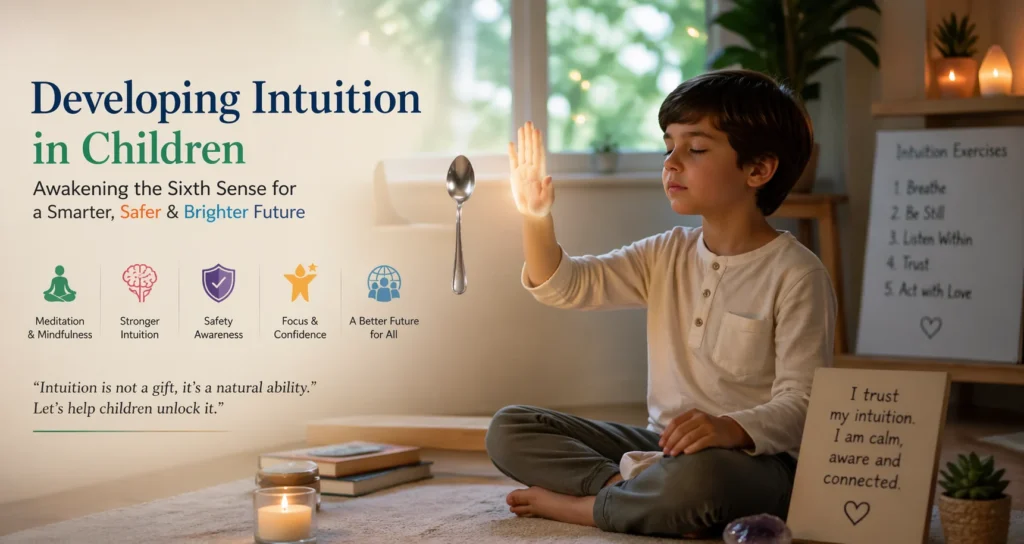

Introduction: The Unseen Language
Every parent knows the moment. You are driving on a rainy highway, and suddenly your hands tighten on the wheel for no reason. You slow down. Ten seconds later, a deer jumps into the road exactly where you would have been. You didn’t see the deer. You didn’t hear it. You just knew.
Or consider this: You are walking through a crowded mall, and your three-year-old suddenly refuses to go into a store. No tantrum. Just stillness. A quiet, stubborn refusal. You look inside the store, and everything seems normal. But you turn around and leave anyway. Later, you read a news report about a gas leak in that exact shop.
These moments are not miracles. They are not magic. They are the raw, unfiltered operation of the human intuition—a sixth sense that most of us have forgotten how to use.
Children, however, are born with this sense wide open. They see energy. They feel intentions. They know when a person is lying, even when the words sound sweet. The problem is not that children lack intuition. The problem is that we, as adults, systematically train it out of them.
We tell them, “Don’t be silly.” “You’re imagining things.” “Be polite and hug the nice man.”
Every time we say these words, we turn down the volume on their internal alarm system. This article is about turning that volume back up. It is a guide to raising children who are not only intelligent but intuitive—children who can navigate the world with a sense of deep knowing that goes beyond facts and figures.
We will explore real stories of intuition saving lives. We will dive into the controversial but fascinating practice of telekinesis as a focus tool. We will give you dozens of exercises to do at the dinner table, in the car, and before bed. And we will imagine a future where schools teach mindfulness alongside math.
This is not a quick fix. This is a lifestyle shift. But if you are willing to listen—really listen—to your child’s whisper, you might just save their life. And they might just save yours.
Part 1: The Stop Sign That Wasn’t There – A Story of Survival
Let me paint you a picture. It is a Tuesday afternoon in Austin, Texas. The temperature is ninety-two degrees. The cicadas are screaming in the oak trees. Maria Gonzalez is walking her two children home from school: Leonardo, who is eight years old and obsessed with dinosaurs, and Samantha, who is six and believes she can talk to butterflies.
They have walked this exact route two hundred and thirteen times. Maria knows every crack in the sidewalk. She knows which fence has the loose dog. She knows that Mr. Hendricks at the corner house always waters his lawn at 3:15 PM.
On this specific Tuesday, everything is normal. The sun is hot. The backpacks are heavy. Sam is singing a made-up song about a waffle. Leo is dragging his feet, looking for interesting rocks.
They reach the intersection of Elm Street and Fourth Avenue. It is a quiet residential crossing. No four-way stop. Just a crosswalk with a pedestrian signal. Maria pushes the button. They wait. The white “walk” symbol lights up. Maria looks left. No cars. Looks right. No cars. She steps off the curb.
“Mom. Stop.”
The voice is small but sharp. It is Leo. He is not whining. He is not complaining about his feet hurting. His face has gone pale. His eyes are wide, like a cat who has seen a shadow move.
“Leo, the light says go,” Maria says, reaching for his hand.
Leo pulls away. He grabs the strap of her purse instead. Hard. His knuckles are white. “We have to wait. The air is wrong.”
Maria hesitates. She is a practical woman. She works as a nurse. She believes in science, in data, in things she can measure. But she also remembers a feeling she had once, years ago, right before her grandmother called to say she was sick. A cold shiver. A pause in time.
She looks at Leo. He is not being dramatic. He is terrified. So she waits. She counts to ten in her head, mostly to prove to herself that she is not losing her mind.
One. Two. Three.
At five seconds, she hears it. A low growl. An engine accelerating, not slowing down.
At seven seconds, she sees it. A delivery truck—one of those massive box trucks with rust on the bumper—comes flying around the corner. It is moving too fast. The driver is looking down at a phone.
At nine seconds, the truck runs the red light. It does not swerve. It does not brake. It blasts through the crosswalk at forty miles per hour, exactly where Maria, Leo, and Sam would have been standing.
The wind from the truck whips Maria’s hair across her face. Sam stops singing. The truck disappears down the street. And then there is silence.
Maria drops to her knees on the hot sidewalk. She pulls both children into her arms. She is shaking. She is crying. She is also furious at herself for almost ignoring her son.
“How did you know?” she whispers into Leo’s hair.
Leo shrugs. He is already calm again, the way children are after a storm passes. “I didn’t know. I just felt it. The air felt sharp, like before a shot at the doctor’s office. And my stomach felt like it was shrinking.”
That is intuition. It is not a psychic vision. It is not a ghost. It is the human brain processing information faster than the conscious mind can keep up. Leo’s ears heard the echo of the truck’s engine two blocks away. His eyes saw the absence of birds taking flight. His skin felt the change in air pressure. His brain put all those pieces together in half a second and sent him one simple message: DANGER. STOP.
Most adults would have ignored that message. They would have said, “Don’t be silly, the light is green.” Leo didn’t ignore it because he is eight. He hasn’t yet learned to distrust his own body.
This book is about making sure he never learns that lesson.
Part 2: What Is the Sixth Sense, Really? A Journey Inside the Body
We are taught in school that human beings have five senses. Sight. Hearing. Touch. Taste. Smell. This is a lie. It is a convenient lie that fits neatly onto a classroom poster, but it is a lie nonetheless.
The truth is that human beings have anywhere from nine to twenty-one senses, depending on which scientist you ask.
Let me introduce you to a few you’ve never heard of.
Proprioception is the sense that tells you where your body is in space. Close your eyes and touch your nose. You can do it because your brain knows exactly where your hand is without looking. That is proprioception.
Equilibrioception is your sense of balance. It lives in the fluid of your inner ear. When you spin around and get dizzy, your equilibrioception is confused.
Thermoception is your sense of temperature. You know when a room is hot or cold without touching a thermometer.
Nociception is your sense of pain. It is different from touch. Some people are born without nociception. They never feel pain. They also rarely live past childhood because they don’t know when they are burning themselves.
Interoception is the most interesting one. It is the sense that tells you what is happening inside your own body. Hunger. Thirst. The need to use the bathroom. Your heartbeat. Your breathing. Interoception is why you know you are nervous without looking in a mirror.
Now, where does intuition fit into all of this?
Intuition is not a separate sense. It is the director of all your senses. Think of your brain as a busy airport control tower. Your senses are the runways. Planes (information) are landing every millisecond. Sight sends a plane. Hearing sends a plane. Touch sends a plane. Interoception sends a plane.
The control tower cannot possibly look at every plane individually. So the brain has a backroom staff—a silent, fast-processing system that scans all the incoming data, looks for patterns, and sends a simple alert to your conscious mind.
That alert is intuition.
The Science of the Gut Brain
Here is a fact that will blow your mind. Your gut contains approximately one hundred million neurons. That is roughly the same number of neurons as the brain of a cat. Scientists call this the “enteric nervous system.” Regular people call it the “second brain.”
Your second brain does not write poetry or solve algebra. But it does something arguably more important. It feels. It senses. It communicates with your main brain through the vagus nerve, a superhighway that runs from your skull to your colon.
When you have a “gut feeling,” your second brain is literally talking to your first brain. The sensation of butterflies in your stomach before a big speech? That is your second brain releasing chemicals that your main brain interprets as anxiety.
The Science of the Heart Brain
It gets weirder. The heart has its own nervous system too. About forty thousand neurons. And here is the part that will really surprise you: The heart sends more signals to the brain than the brain sends to the heart.
For decades, we thought the brain was the boss and the heart was just a pump. That is backwards. The heart is constantly sending emotional and intuitive information up to the brain. The brain then decides what to do with that information.
Have you ever walked into a room and immediately felt tension between two people, even though they were both smiling? That was your heart sensing the electromagnetic field of their emotions. The heart is, quite literally, an intuitive organ.
Why Children Are Better at This
Children have a massive advantage over adults when it comes to intuition. Their prefrontal cortex—the part of the brain that filters and doubts—is not fully developed yet. They don’t have the voice in their head that says, “That’s impossible, you’re being silly.”
A child sees a stranger and feels a bad vibe. An adult sees the same stranger, notices the nice clothes and friendly smile, and overrides the bad vibe with logic. The child is right. The adult is wrong. The child survives. The adult does not.
This is not a metaphor. This is the literal truth of how many dangerous situations unfold. Predators rely on the fact that adults will override their intuition to be polite. Children haven’t learned “politeness” yet. They just feel the truth.
Our goal, as parents and teachers, is not to destroy that raw ability. It is to refine it. To teach children how to distinguish between a false alarm (fear of the dark) and a real alarm (fear of a specific person in the dark).
Part 3: Telekinesis – The Ultimate Intuition Gym
Now we arrive at the part of the conversation that makes scientists roll their eyes and new-age enthusiasts clap their hands. Telekinesis. Moving objects with the mind.
I want to be very clear about something. I am not claiming that children can lift cars or bend spoons with their eyebrows. That is Hollywood nonsense. But I am claiming that micro-telekinesis—the subtle movement of very light objects through focused intention—is a real phenomenon that has been studied in laboratories around the world.
The Princeton Engineering Anomalies Research lab spent twenty-eight years studying whether the human mind could influence machines. Their conclusion? Yes. The effect is tiny, but it is statistically real. Human intention can shift the outcome of a random number generator by a fraction of a percent.
But this article is not about proving telekinesis to skeptics. It is about using the practice of telekinesis as a training tool for intuition and focus. Whether the object actually moves is almost irrelevant. The attempt to move it forces the brain into a state of perfect, laser-like concentration.
The Story of Elena and the Psi Wheel
Elena was nine years old, and she was drowning. Not in water. In noise. She had been diagnosed with ADHD, but that label didn’t capture the reality of her life. The reality was that Elena could not finish a single thought without three other thoughts crashing into it. She would sit down to do homework, and her brain would immediately start playing a song, remembering a fight from recess, worrying about a spider she saw yesterday, and wondering what was for dinner—all at the same time.
Her parents tried everything. Medication made her feel like a zombie. Behavioral therapy helped a little. Diet changes did nothing. Elena was smart, but she was failing school because she couldn’t focus for more than ninety seconds.
Then her uncle came to visit. Uncle Marco was not a doctor or a therapist. He was a meditation coach who worked with corporate executives. But he had a secret weapon for children: the Psi Wheel.
A Psi Wheel is absurdly simple. You take a square of thin paper—aluminum foil works too—and fold it into a four-bladed pinwheel. Then you balance it on the tip of a needle stuck into a cork or a bottle cap. The wheel sits there, motionless, waiting.
The goal is to make it spin without touching it. No blowing. No fan. Just your mind.
Elena thought this was stupid. She was nine. She wanted to play video games. But Uncle Marco was patient. He sat with her at the kitchen table.
“Close your eyes,” he said.
“No.”
“Please. Just for ten seconds.”
Elena sighed dramatically but closed her eyes.
“Now rub your hands together. Fast.”
She rubbed. Her palms got warm.
“Now hold your hands four inches away from the wheel. Don’t try to spin it. Just feel the space between your palms and the paper.”
Elena opened her eyes. She stared at the little paper wheel. Nothing happened. She felt stupid.
“I can’t,” she said.
“You can’t force it,” Uncle Marco said. “You have to become it. Imagine that the air between your hands is thick. Like honey. Imagine that the wheel is an extension of your own breath. When you breathe out, you are pushing energy toward it. Don’t look at the wheel. Look through it.”
Elena tried again. She stopped trying to make it spin. Instead, she just breathed. She focused on the warmth in her palms. She imagined a string connecting her forehead to the center of the wheel.
And then, the wheel moved.
It was a tiny twitch. A millimeter of rotation. But it moved.
Elena gasped. The wheel stopped.
“Do it again,” Uncle Marco said softly.
She did. This time, the wheel spun a full quarter turn. Then half a turn. Then, after ten minutes of silent concentration, the little paper pinwheel was spinning steadily, like a slow ceiling fan.
Elena laughed. Not a sarcastic laugh. A real laugh. A laugh of pure joy and amazement.
“Did I do that?” she whispered.
“You did that,” Uncle Marco said.
Here is the secret that Uncle Marco knew. Was it really telekinesis? Maybe. The heat from her hands could have created a convection current. The static electricity from her rubbing could have pushed the paper. Or maybe her focused intention actually moved the air molecules.
It doesn’t matter.
What matters is what happened to Elena’s brain during those ten minutes. For the first time in her life, her racing thoughts stopped. There was no song. No memory of a fight. No spider worry. There was only her breath, her hands, and the wheel. She had achieved a state of perfect, focused meditation without ever sitting cross-legged or chanting “om.”
After that day, Elena practiced the Psi Wheel for five minutes every morning. Within a month, her teachers noticed a change. She was still fidgety, but she could now sit still for a full ten minutes of reading time. She could complete a worksheet without getting up to sharpen her pencil seven times.
The wheel didn’t give her superpowers. It gave her a practice. A way to train her attention muscle. And that changed everything.
How to Build a Psi Wheel at Home
You need almost nothing.
Materials:
- A thin piece of paper (notebook paper is fine, but aluminum foil works better because it is lighter)
- A sewing needle
- A cork or a plastic bottle cap
- A flat, stable table away from air vents and fans
Instructions:
- Push the needle into the cork so the point is sticking straight up.
- Cut a small square of paper, about two inches by two inches.
- Fold the square along both diagonals. Then fold each corner toward the center, creating a four-bladed pinwheel shape. (You can look up “how to fold a Psi Wheel” online, but the exact shape doesn’t matter.)
- Balance the folded paper gently on the tip of the needle. It should be perfectly level and able to rotate with the slightest touch.
The Rules for the Child:
- No blowing. No touching. Hands must stay at least four inches away at all times.
- Do not get frustrated. Frustration creates static in the mind.
- Do not try to make it spin. Try to allow it to spin.
- Breathe slowly. Breathe out longer than you breathe in.
- Imagine that your hands are magnets and the paper is metal.
What to Expect:
- The first ten sessions: Nothing happens. The child gets bored or annoyed. This is fine. The boredom is actually the point. Learning to sit with boredom is a superpower.
- Sessions ten to twenty: Tiny twitches. The paper shifts a millimeter. The child gasps and loses focus. This is progress.
- Sessions twenty to thirty: Slow, steady rotation. The wheel spins for several seconds before stopping.
- Beyond: The child can spin the wheel at will. They learn to enter the “zone” within seconds.
Again, I am not promising that every child will become a telekinetic master. Some children never get the wheel to spin. But those children still benefit. They spend five minutes in silence, focusing on their breath, training their intuition. That is the real win.
Part 4: The Body Knows – How Intuition Feels in the Flesh
One of the biggest mistakes parents make is teaching children that intuition is a thought. It is not. Intuition is a physical sensation. It lives in the body. And different people feel it in different places.
Some people feel intuition as a knot in their stomach. Some feel it as a chill down their spine. Some feel it as a heaviness in their chest. Some feel it as a sudden urge to leave a room. Some feel it as a ringing in their ears. Some feel it as a strange taste in their mouth.
The key is to help your child identify where their intuition lives.
The Body Mapping Exercise
This exercise takes five minutes and can be done before bed.
Ask your child to lie down on the floor or on their bed. Close their eyes. Take three slow, deep breaths together.
Now say: “Think about a time when you were really happy. What did your body feel like? Was your chest warm? Did your hands feel light? Did your face feel like it was smiling even when your mouth was closed?”
Let them sit with that feeling for thirty seconds.
Now say: “Think about a time when you were really scared. Not pretend-scared from a movie. Really scared. What did your body feel like? Did your stomach feel tight? Did your throat feel closed? Did your shoulders feel like they were going up toward your ears?”
Let them sit with that feeling for thirty seconds.
Now say: “Think about a time when you knew something was wrong, but you couldn’t explain why. Maybe you didn’t want to go into a room. Maybe you didn’t trust someone even though they seemed nice. Where did you feel that feeling? Was it in your belly? Your chest? Your skin?”
This is the money question. The answer tells you where your child’s intuition lives.
For Leo, the boy who stopped his mother at the crosswalk, his intuition lives in his stomach. He feels it as a shrinking sensation, like his belly button is trying to touch his spine.
For Elena, the girl with the Psi Wheel, her intuition lives in her hands. She feels it as warmth and tingling.
For Sam, the six-year-old who talks to butterflies, her intuition lives in her ears. She hears things that aren’t there—except they are there. She just hears them before everyone else.
The Intuition Journal
Buy your child a small notebook. Call it their “Secret Sense Journal.” Every night, ask them two questions:
- Did you have any gut feelings today?
- Were they right?
That is it. Do not judge the answers. Do not say “that’s silly” or “that’s impossible.” Just write down what they say.
Over time, patterns will emerge. Your child might notice that they always get a stomachache before a fire drill at school. Or that they always feel a chill before their dad comes home from work. Or that they know when the phone is about to ring.
The journal is not about being right. It is about noticing. Noticing is the first step toward trusting.
Part 5: Meditation for Kids – No Lotus Position Required
When most adults hear the word “meditation,” they picture a bald monk in orange robes sitting perfectly still on a mountaintop for forty years. That image is intimidating. It is also wrong.
Meditation is not about emptying your mind. That is impossible. The mind is a thought-generating machine. It will never be empty. Meditation is about changing your relationship to your thoughts. It is about watching the parade go by without jumping into the parade.
For children, meditation has to be playful, short, and physical. A child will not sit still for twenty minutes. But they will sit still for two minutes. And two minutes a day is infinitely better than zero minutes a day.
The Traffic Jam Meditation (Ages 5–12)
This is my favorite meditation for children because it uses a metaphor they understand instantly.
Ask your child to lie on their back with a small stuffed animal on their belly. The stuffed animal should rise and fall with their breath.
Say this to them slowly, in a calm voice:
“Imagine that your thoughts are cars. Some cars are fast. Some cars are slow. Some cars are loud. Some cars are quiet.
A red car is ‘I want a snack.’ A blue truck is ‘I’m mad at my brother.’ A fast motorcycle is ‘I can’t wait for my birthday.’ A school bus is ‘I have a test tomorrow.’
The cars are going to drive through your head. That is fine. That is normal. You cannot stop the cars.
But here is the secret. You are not the cars. You are not the traffic. You are the sky. The sky doesn’t care about the traffic. The sky just watches. The sky just is.
So watch the cars. Let them come. Let them go. Don’t chase them. Don’t fight them. Just watch.
Every time you feel yourself jumping into a car, just come back to the sky. Come back to your breath. Come back to the stuffed animal on your belly. Up. Down. Up. Down.”
Do this for two minutes. Then stop. Do not push for longer. Two minutes is a victory.
The Bell Listening Meditation (All Ages)
This one works beautifully in classrooms but also at home.
You need a bell or a singing bowl. If you don’t have one, you can use a metal spoon and a glass cup. Ring the bell.
Tell your child: “Listen to the sound. Keep listening. When you can’t hear the sound anymore, raise your hand.”
Most children will raise their hand after five seconds. But the sound actually lingers for much longer—fifteen, twenty, sometimes thirty seconds. The vibration continues in the air and in the bones of the room.
Keep doing this. Ring the bell. Wait for the hand. Ring the bell again. Each time, encourage the child to listen longer.
What is happening here? The child is learning to sustain attention. They are learning to ignore the urge to move, to speak, to get distracted. They are training their brain to stay with one thing for an extended period.
After a few weeks of bell listening, you will notice something. Your child will become better at listening to you. They will become better at hearing the quiet voice of their own intuition.
The Balloon Breath (Ages 4–8)
Very young children cannot do complex visualizations. But they can do this.
Ask your child to stand up and put their hands on their belly.
“Pretend your belly is a balloon. When you breathe in, the balloon gets big and round. When you breathe out, the balloon gets small and flat. Let’s do it together.”
Breathe in for four counts. Breathe out for four counts. Repeat five times.
That is it. That is meditation for a four-year-old. And it works because it gives them a physical anchor. The balloon is not abstract. It is their own belly moving in and out.
The Why Behind the Practice
Why bother with any of this? Why not just let children be children?
Because the world is getting louder. Every year, the noise increases. Phones buzz. Screens flash. News alerts scream. School tests pile up. Social media demands attention.
In this environment, the quiet voice of intuition gets drowned out. Meditation is not a luxury. It is a survival skill. It is the practice of turning down the volume on the outside world so you can hear the volume on the inside world.
A child who meditates for two minutes a day is a child who can hear their gut feeling when it matters. A child who never practices stillness is a child who walks into danger because they never learned to pause.
Part 6: The Dinner Table Games – Building Intuition While Eating Pizza
You do not need special equipment or a dedicated meditation room. The best intuition training happens in ordinary moments. At the dinner table. In the car. While waiting in line at the grocery store.
Here are ten games you can play with your child today. Each one takes less than five minutes.
Game 1: The Phone Call Prediction
Every time the phone rings or buzzes, do not look at the caller ID. Ask your child: “Who do you feel that is?” They will guess. Write down the guess. Check the phone. See if they were right.
At first, they will be wrong almost every time. That is fine. Do not make a big deal about wrong answers. Just say, “Okay, let’s try again next time.”
After a few weeks, their accuracy will improve. Not to 100 percent—nothing is 100 percent—but to something statistically interesting. Forty percent. Fifty percent. That is not coincidence.
Why does this work? Because your child is picking up on subtle cues. The specific ringtone of a frequent caller. The way you tense up before answering a call from your boss. The time of day. Their brain is processing all of this subconsciously and making a prediction.
Game 2: The Emotion Jar
This game requires three empty jars and a handful of dried beans or buttons.
Label the jars: “Happy,” “Sad,” “Angry.”
Place the jars on a table across the room. You stand behind the jars. Your child stands on the opposite side of the room.
You will feel an emotion. Do not act it out with your face or body. Just feel it inside. Hold the feeling in your heart for ten seconds.
Your child walks toward the jars and drops a bean into the jar they think matches your hidden emotion. No talking. No faces. Just vibes.
After they drop the bean, you reveal whether they were right. Then switch roles. Let your child feel an emotion and you guess.
The astonishing thing is how good young children are at this game. Children under ten regularly achieve seventy to eighty percent accuracy. They are reading your micro-expressions—the tiny twitches in your face that happen in one-twenty-fifth of a second—and your heart’s electromagnetic field.
Teenagers and adults are terrible at this game. We have forgotten how to read energy. We rely on words instead. But children still know.
Game 3: The Left-Hand Drawing
Most people are right-hand dominant. The left hand is connected to the right hemisphere of the brain—the creative, intuitive, holistic side. The right hand is connected to the logical, analytical left brain.
Before bed every night, give your child a piece of paper and a crayon. Ask them to draw a picture of their day using ONLY their left hand (or their non-dominant hand if they are left-handed).
The drawings will be messy. The lines will wobble. That is the point. The messiness bypasses the logical brain’s need for perfection and allows the intuitive brain to speak.
After a week of left-hand drawings, look back through the journal. You may notice something strange. Drawings from days when nothing “happened” might show dark colors and jagged lines. Drawings from days before a big event might show symbols that predicted the event.
Do not over-interpret. Just observe. The act of drawing with the non-dominant hand is itself the exercise. It strengthens the neural pathways between the intuitive brain and the physical body.
Game 4: The Grocery Store Feeling
You are in the cereal aisle. Your child wants Froot Loops. You want something with less sugar. Instead of arguing, play this game.
Hold up two boxes of cereal. Do not show your child the front of the boxes. Show them the plain side.
Say: “Without looking at the pictures or the words, which box feels better to you?”
Your child will point to one. Turn the box around. Read the ingredients together. Talk about why one box might have felt better. Was it the color? The weight? The shape?
This game teaches children that objects have energy. That sounds like new-age nonsense, but it is actually physics. Everything vibrates. Different materials vibrate at different frequencies. Your child’s body can sense those vibrations if you teach them to pay attention.
Game 5: The Stranger Test
This one is serious. Use it carefully.
When you are at a park, a birthday party, or a family gathering, quietly ask your child: “Look at that person over there. Without talking to them, what do you feel about them?”
Do not prompt them with “good” or “bad.” Just listen.
If your child says, “I don’t like them. My stomach feels tight,” believe them. Do not force them to hug that person. Do not call them rude. Do not say, “But they’re your uncle’s new girlfriend, be nice.”
Your child’s intuition is a safety system. It has been refined by millions of years of evolution. When it fires, you should listen. Even if you don’t understand why. Even if it’s inconvenient. Even if it hurts an adult’s feelings.
A child’s politeness is never worth more than a child’s safety.
Game 6: The Dream Diary
Place a notebook and a pen next to your child’s bed. Every morning, as soon as they wake up—before they talk, before they look at a screen—ask them: “Do you remember any dreams?”
If yes, have them write down or draw one image from the dream. Just one. A color. A shape. A person. A feeling.
Do not interpret the dream. Do not say “that means you’re worried about school.” Just record it.
Over time, patterns will emerge. Many children have precognitive dreams—dreams that show them something that happens the next day. Scientists call this “deja reve” (already dreamed). It is surprisingly common, especially in children.
The dream diary is not about proving that dreams predict the future. It is about teaching your child that their sleeping mind is still working. That intuition does not turn off when the eyes close.
Game 7: The Missing Object
Hide a small object somewhere in the house. A coin. A button. A toy. Do not tell your child where you hid it.
Instead of searching room by room, ask your child to stand still, close their eyes, and take three deep breaths.
Then ask: “Which direction does the object feel like it is? Left? Right? Behind you? Ahead?”
Let them point. Then let them walk in that direction. Stop every few steps and ask again: “Does it feel closer or farther?”
This is not a reliable way to find lost car keys. But it is a reliable way to train the intuitive muscle. The child learns to trust their internal compass, even when the logical mind says “that makes no sense.”
Game 8: The Animal Whisperer
If you have a pet—dog, cat, hamster, even a fish—sit with your child in front of the pet’s enclosure or next to the pet.
Say: “Close your eyes. Take three breaths. Now, without opening your eyes, what is the pet feeling right now? Is it hungry? Tired? Curious? Playful?”
This game works best with dogs and cats because they have expressive body language. But even a fish will respond to human presence in subtle ways. Your child is learning to read non-human energy. That skill transfers directly to reading human energy.
Game 9: The Color Blind Test
This sounds impossible, but try it.
Hold up two crayons of the same color. Except one is slightly different. For example, two red crayons—one fire engine red, one brick red. The difference is subtle.
Cover the labels. Ask your child: “Which of these two colors feels warmer? Which feels cooler?”
Most children cannot see the difference with their eyes. But they can feel the difference with their intuition. Colors have temperatures. Red feels warmer than blue. But even within the same color family, different shades have different vibrational qualities.
This game teaches children that intuition is not about seeing. It is about sensing. The eyes can be fooled. The gut cannot.
Game 10: The One-Minute Silence
This is the simplest and hardest game.
Set a timer for one minute. Sit across from your child. Do not talk. Do not move. Do not look at your phone. Just sit. Breathe. Look at each other.
When the timer goes off, ask: “What did you feel during that minute?”
The answers will surprise you. “I felt like you were thinking about work.” “I felt like you were worried about Grandma.” “I felt a breeze even though the window was closed.”
Children are sponges for energy. In one minute of silence, they will absorb more information about your emotional state than they would in an hour of conversation. The silence creates a channel. The intuition flows through the channel.
Do this every day. One minute. That is all it takes.
Part 7: The Educational Revolution – Schools of the Future
Let me describe a typical elementary school classroom. Fluorescent lights buzz overhead. Thirty desks are arranged in neat rows. The walls are covered with posters about the times tables and the parts of speech. The teacher stands at the front, talking. The children sit still, listening. When the bell rings, they move to the next room. Repeat. Repeat. Repeat.
This model was designed in the 1890s for the Industrial Revolution. The goal was to produce obedient factory workers who could follow instructions, read simple signs, and not question authority. It worked. For a hundred years, it worked.
But we no longer live in the Industrial Revolution. We live in the Information Revolution. And soon, we will live in the Intuition Revolution.
Artificial intelligence can now do everything that the factory model of education teaches. AI can memorize facts. AI can solve math problems. AI can write essays. AI can pass standardized tests. AI is better than humans at all of these things.
So what is left for humans? What can a human do that AI cannot?
The answer is intuition. AI cannot read a room. AI cannot feel the tension between two people. AI cannot sense when someone is lying. AI cannot have a gut feeling. AI cannot love. AI cannot lead with empathy.
The schools of the future will look nothing like the schools of today.
Period 1: Stillness (Replacing Homeroom)
Instead of starting the day with announcements and pledges, students will sit in silence for five minutes. They will listen to a bell. They will watch their breath. They will check in with their bodies.
Why? Because a child who starts the day in stillness is a child who can learn. A child who starts the day in chaos is a child who spends the first two hours just calming down.
Period 2: Intuitive Math (Replacing Standard Math)
Math will still be taught. Numbers still matter. But math will also be taught as a felt experience. Students will close their eyes and guess how many beans are in a jar before counting. They will estimate distances by walking them blindfolded. They will feel the difference between a square and a circle without looking.
The goal is not to replace logic with feeling. The goal is to integrate them. A mathematician with intuition is better than a mathematician without it.
Period 3: Empathy Lab (Replacing Social Studies)
Instead of memorizing dates of wars, students will practice feeling the emotions of historical figures. They will look at photographs of people from different cultures and guess what those people were feeling. They will role-play conflicts and practice resolving them by reading non-verbal cues.
History is not just facts. History is human experience. Empathy is the bridge to understanding that experience.
Period 4: Energy Awareness (Replacing PE once a week)
Physical education is important. Running and jumping are good for the body. But once a week, PE will become Energy Awareness. Students will practice walking blindfolded, sensing walls before they touch them. They will practice standing back-to-back with a partner and feeling their partner’s heartbeat. They will practice sending “silent messages” across the room—thinking of a number and having a partner guess it.
Is this science? Yes. It is the science of interoception and proprioception. It is the science of the body’s hidden senses.
Period 5: Creative Expression (Replacing Art)
Art class will still involve painting and drawing. But the focus will shift from technique to expression. Students will be asked to draw how a character in a book feels, not just what they look like. They will be asked to compose music that captures a specific emotion without using words. They will be asked to dance a story without naming it.
The left brain analyzes. The right brain creates. Intuition lives in the right brain. Art is its native language.
Period 6: Nature Connection (Replacing Recess once a week)
Recess is running around on asphalt. Nature Connection is sitting under a tree. Once a week, students will go outside, find a quiet spot, and just be. They will listen to birds. They will watch clouds. They will feel the wind on their skin. They will return to the classroom and write one sentence about what they noticed.
Nature is the original meditation teacher. It asks for nothing. It teaches everything.
The Teachers of the Future
Teachers will no longer be just dispensers of information. Information is free now. Any child with a phone can access the sum total of human knowledge in three seconds.
Teachers will be guides. They will be trained not just in math and reading, but in emotional regulation, intuition development, and energy awareness. They will know how to read a child’s face. They will know when a child is lying, hurting, or hiding. They will trust their own gut feelings about their students.
And here is the beautiful thing. When teachers trust their intuition, students learn to trust theirs. It is a ripple effect. One intuitive adult can raise an entire generation of intuitive children.
The Resistance
Of course, there will be resistance. There always is. Critics will say that intuition cannot be measured. They will say that schools should stick to “facts.” They will say that teaching telekinesis or energy awareness is a waste of time.
These critics are missing the point. Intuition can be measured. We measure it every day in the real world. Which CEO makes better decisions? The one with good gut instincts. Which parent keeps their child safer? The one who listens to their feelings. Which doctor catches the rare disease? The one who notices something “off” about the patient.
Standardized tests measure memorization. They do not measure wisdom. And wisdom—the ability to apply knowledge with good judgment and empathy—is what we actually need.
The schools of the future will not abandon reading, writing, and arithmetic. They will add a fourth R: Receptivity. The ability to receive information from the body, the gut, and the heart.
That is the revolution. And it is coming.
Part 8: The Danger of Dismissing Intuition – A Cautionary Tale
Let me tell you a story that will break your heart. It is a true story. The names have been changed to protect the family.
Sarah was seven years old. She lived in a quiet suburb with her mother, father, and older brother. Every afternoon, Sarah walked home from school with a group of neighborhood kids. The walk took fifteen minutes and passed through a small park.
One Tuesday, a man appeared in the park. He was sitting on a bench, reading a newspaper. He looked normal. He looked boring. He looked like everyone’s grandfather.
Sarah stopped walking. She tugged on her friend Emma’s sleeve.
“I don’t want to go past him,” Sarah whispered.
“Why not?” Emma asked.
“I don’t know. My stomach feels sick. Let’s go the long way.”
Emma laughed. “Don’t be a baby. He’s just reading a paper.”
The other kids kept walking. Sarah hesitated. Then she followed. She didn’t want to be called a baby.
As the group passed the bench, the man looked up and smiled. He said hello. The kids said hello back. He asked if they wanted to see a magic trick. The other kids said yes. Sarah said no. But the group pressure was strong.
The man showed them a coin trick. It was fine. It was normal. Then he asked if anyone wanted to see his puppy in the car. It was just around the corner.
Sarah’s stomach was screaming now. It was not a sick feeling. It was a fire feeling. She knew—she absolutely knew—that something was wrong. But Emma was already walking toward the car. The other kids were following.
Sarah ran. She ran all the way home. She burst through the front door crying.
Her mother was on the phone. “Not now, sweetie, I’m busy.”
“But Mom—”
“I said not now. Go play in your room.”
Sarah went to her room. She sat on her bed. She felt guilty. She felt scared. She felt like she had abandoned her friends.
Two hours later, police cars flooded the neighborhood. Emma was missing. The man on the bench was gone. His car was gone. Emma was never found.
Sarah grew up carrying that weight. She carried it for thirty years. The weight of knowing. The weight of running. The weight of being dismissed.
Here is the lesson of this terrible story. It is not that Sarah should have fought the man. She was seven. It is not that she should have dragged her friends away. They would have resisted.
The lesson is that Sarah’s mother should have listened. The lesson is that when a child says “my stomach feels sick” about a person or a place, the adult should drop everything and pay attention.
The Social Pressure to Be Polite
Why do we dismiss children’s intuition? Because we are terrified of being rude. Because we have been trained since birth to prioritize social harmony over internal truth.
“Say hello to the nice man.”
“Give your aunt a hug.”
“Don’t be difficult.”
“Stop being dramatic.”
“It’s just your imagination.”
Every one of these phrases is a knife cutting the thread that connects a child to their intuition. Every one of them teaches the child that their body’s alarm system is wrong. That other people’s feelings matter more than their own safety.
This is a disaster. This is how predators operate. They know that adults will override their children’s fears to avoid awkwardness. They count on it.
The New Rule
Teach your child this rule. Write it on a sticky note and put it on the refrigerator.
“My body is never wrong. If I feel scared, I do not have to be nice. I can run. I can scream. I can say no. I will never be in trouble for trusting my gut.”
Say this rule out loud with your child every morning. Make it a chant. Make it a song. Make it the law of your household.
When your child tells you they have a bad feeling about someone, believe them. Do not ask for proof. Do not demand an explanation. Intuition does not come with footnotes. It just comes.
You can later, in a calm moment, ask questions. “What did that feeling feel like? Where did you feel it in your body?” But in the moment, action comes first. Get out. Get away. Get safe.
The Fine Line
Of course, there is a fine line. Children also have irrational fears. The dark. Monsters under the bed. Clowns. These fears are real to the child, but they are not intuitive warnings about actual danger.
How do you tell the difference?
Fear of the dark is general. It applies to all dark rooms. Intuitive fear is specific. It applies to one person, one place, one situation.
Fear of monsters is imaginary. The child cannot describe the monster. Intuitive fear is grounded. The child can say “his smile didn’t reach his eyes” or “her voice was too sweet.”
Fear of clowns is a cultural phobia. Intuitive fear is a personal alarm. “That specific clown feels wrong. The other clowns are fine.”
Teach your child to ask themselves one question: “Is my fear trying to protect me from something real, or is it trying to stop me from trying something new?”
The answer is not always clear. That is why intuition is a practice, not a perfect science. You will make mistakes. You will overreact sometimes. That is better than underreacting. That is better than the alternative.
Part 9: The Science of Intuition – What We Actually Know
Let me take a break from stories and give you some hard facts. Because intuition is not magic. It is biology. It is neuroscience. It is measurable, repeatable, and real.
The Heart Math Institute
Researchers at the Heart Math Institute in California have spent decades studying the connection between the heart and the brain. Their findings are astonishing.
The heart generates an electromagnetic field that is sixty times stronger than the brain’s field. This field can be measured several feet away from the body. When two people are near each other, their heart fields interact. One person’s heart can literally influence another person’s brain waves.
This is not speculation. This is measured data. You can buy a device that measures your heart rate variability (HRV) and see the patterns yourself.
What does this have to do with intuition? Everything. When you have a “gut feeling” about a person, you are actually feeling their heart field with your heart. Your heart is a sensory organ. It detects information that your eyes and ears cannot.
The Polygraph Problem
A polygraph machine (lie detector) works by measuring heart rate, breathing, and skin conductivity. It is not actually detecting lies. It is detecting the body’s physiological response to stress.
Here is the interesting thing. Some people can beat a polygraph. They can remain calm while lying. But those people are rare. Most people cannot hide their body’s truth.
Children are terrible liars not because they lack intelligence, but because their bodies are honest. Their heart races. Their palms sweat. Their voice cracks. The truth leaks out through a thousand small signals.
Intuition is the ability to read those signals in other people. When you feel like someone is lying, you are subconsciously noticing their increased heart rate, their micro-expressions, their shifting weight. Your brain processes all of that data in a fraction of a second and sends you a simple alert: “Lie.”
The Blindfolded Studies
In the 1970s, a researcher named Cleve Backster made a strange discovery. He hooked a polygraph machine to a plant. Then he thought about burning the plant’s leaf. The polygraph machine went wild. The plant appeared to react to his intention before he acted.
This was controversial. Many scientists dismissed it as an artifact of the equipment. But later studies with more rigorous methods found similar results. Human intention appears to affect living things at a distance. The effect is small, but it is real.
What does this mean for your child? It means that their thoughts have power. Not telekinetic power over objects, necessarily, but biological power over living systems. When your child focuses loving attention on a plant, that plant grows better. When they focus angry attention on a sibling, that sibling feels it.
This is not magic. It is the biology of intention. And it is why meditation and mindfulness are so important. A child who can control their intention is a child who can influence their environment in positive ways.
The Gut Microbiome
We are only now beginning to understand the gut’s role in intuition. The gut contains trillions of bacteria—the microbiome. These bacteria produce neurotransmitters, including serotonin and dopamine. Ninety percent of the body’s serotonin is made in the gut, not the brain.
The gut bacteria communicate with the brain through the vagus nerve. When the gut bacteria are healthy and diverse, the brain receives clear signals. When the gut bacteria are unhealthy (from sugar, processed food, antibiotics), the signals become noisy and distorted.
This means that intuition is partly dietary. A child who eats junk food has a noisier gut-brain connection. A child who eats whole foods—vegetables, fruits, fermented foods—has a cleaner signal.
The old saying “trust your gut” is not a metaphor. It is biological instruction manual.
Part 10: The Global Potential – Raising a Generation of Intuitive Leaders
Imagine a world where every child is taught to trust their intuition. What would that look like?
Less Bullying
Bullying thrives on power imbalances. The bully picks on the child who won’t fight back. But an intuitive child can sense the bully’s insecurity. They can see the fear behind the anger. They can choose to disengage, to walk away, to refuse to give the bully the reaction they want.
Intuitive children are harder to manipulate. They know when someone is trying to use them. They know when a “friend” is actually an enemy. They have boundaries made of steel wrapped in velvet.
Less Pollution
This one sounds strange, but follow me. Pollution exists because we treat the planet as an object. We dump chemicals into rivers because we cannot feel the river’s pain. We cut down forests because we cannot hear the forest’s cry.
An intuitive child grows into an intuitive adult. An intuitive adult can feel the distress of the natural world. They do not need a scientific report to tell them that the river is sick. They can sense it. And once you sense something, you cannot un-sense it. You are compelled to act.
The environmental movement has been fighting for fifty years with facts and data. Facts and data have not saved the planet. Maybe feelings will. Maybe intuition is the missing ingredient.
Less War
War happens when we dehumanize the enemy. We turn them into statistics, into flags, into abstractions. It is easy to drop a bomb on an abstraction. It is much harder to drop a bomb on a person whose fear you can feel.
An intuitive leader cannot dehumanize. Their heart field reaches across borders. They feel the hunger of the child on the other side. They feel the terror of the mother in the bomb shelter. And once you feel that, you cannot justify the violence.
This is not naive idealism. This is biological reality. The heart does not recognize flags. The gut does not care about political boundaries. Intuition is the great unifier. It reminds us that we are all made of the same meat, the same electricity, the same longing to be safe.
Less Loneliness
We are living through an epidemic of loneliness. Despite being more connected than ever by technology, we have never been more isolated. We scroll through hundreds of “friends” on social media but cannot name our next-door neighbor.
Intuition is the antidote to loneliness. An intuitive person can walk into a room full of strangers and find the one person who needs a friend. They can feel the quiet pain behind the loud laugh. They can offer comfort without being asked.
Imagine a generation of children who are seen. Not just looked at, but truly seen. Understood. Felt. That generation would not need to numb themselves with screens and substances. They would have real connection. And real connection is the only thing that fills the hole.
Part 11: A Thirty-Day Plan for Your Family
Theory is useless without practice. Here is a concrete, day-by-day plan to build intuition in your children. You do not need to do all of it. Pick what works for your family. Start small. One minute a day. That is enough.
Week One: Awareness
- Day 1: Ask your child to name three things they can hear right now. (This trains listening.)
- Day 2: Ask your child to name three things they can feel on their skin right now. (This trains touch.)
- Day 3: Ask your child to close their eyes and describe the taste in their mouth. (This trains taste.)
- Day 4: Ask your child to close their eyes and describe three smells in the room. (This trains smell.)
- Day 5: Ask your child to close their eyes and describe the temperature of the air on their face. (This trains thermoception.)
- Day 6: Ask your child to close their eyes and place a hand on their chest. Ask: “Can you feel your heartbeat?” (This trains interoception.)
- Day 7: Do nothing. Just observe. Ask your child at the end of the day: “What was the strongest feeling you had today?”
Week Two: Stillness
- Day 8: One minute of bell listening.
- Day 9: One minute of balloon breath.
- Day 10: One minute of traffic jam meditation.
- Day 11: One minute of silent staring at a candle flame.
- Day 12: One minute of lying on the floor with a stuffed animal on the belly.
- Day 13: One minute of walking slowly across the room, feeling each footstep.
- Day 14: One minute of sitting back-to-back with a parent, feeling each other’s breath.
Week Three: Play
- Day 15: Play the Emotion Jar game.
- Day 16: Play the Phone Call Prediction game.
- Day 17: Play the Missing Object game.
- Day 18: Play the Left-Hand Drawing game.
- Day 19: Play the Stranger Test game (at a park or store).
- Day 20: Play the Color Blind Test game.
- Day 21: Play the Animal Whisperer game.
Week Four: Integration
- Day 22: Build a Psi Wheel. Attempt to spin it for three minutes.
- Day 23: Attempt the Psi Wheel again. Focus on breath, not movement.
- Day 24: Attempt the Psi Wheel again. Keep a journal of what you feel.
- Day 25: Go for a “silent walk.” No talking for ten minutes. Just sensing.
- Day 26: Draw a dream from last night using the left hand.
- Day 27: Ask your child to predict three things about tomorrow. Write them down.
- Day 28: Review the predictions from yesterday. How many came true?
- Day 29: Teach your child the body rule: “My body is never wrong.”
- Day 30: Celebrate. Do something fun. You have just changed your child’s life.
Part 12: The Final Story – The Burning Barn
I want to end where I began. With a story. Because stories are how intuition travels. Stories bypass the logical brain and land directly in the gut.
This story comes from a farmer in Nebraska. His name is Dale. He is not a spiritual person. He does not meditate. He does not believe in ghosts. But he believes in this story because he lived it.
Dale has a daughter named Jenna. When Jenna was fourteen, she was a typical teenager. She rolled her eyes. She slammed doors. She spent too much time on her phone. She was not particularly intuitive or special. She was just a kid.
One night in October, the temperature dropped to freezing. The wind was howling. Dale went to bed at ten o’clock, exhausted from a long day of repairing fences. He fell asleep immediately.
At three in the morning, Jenna burst into his room. She was pale. She was sweating. Her eyes were wild.
“Dad. Get up. We have to move the cattle. Now.”
Dale blinked. “What are you talking about? It’s three in the morning. It’s freezing.”
“Dad, please. The north field. I feel fire.”
Dale sighed. He was tired. He was cold. He wanted to go back to sleep. But there was something in Jenna’s voice. A urgency he had never heard before. So he pulled on his boots and his coat and walked outside.
The north field was a quarter mile from the house. Dale walked toward it, shivering. The wind was biting. The stars were bright. Everything looked normal.
Then he smelled it. Smoke. Faint, but there.
He walked faster. The smell got stronger. And then he saw it. A glow. Orange and red, flickering behind a rise in the land.
A power line had come down in the wind. The dry grass had caught fire. The fire was moving slowly but steadily toward the barn where the cattle were sleeping.
Dale ran back to the house. He woke up his wife and his son. They moved forty head of cattle in twenty minutes. They broke fence lines. They shouted. They sweated. They got the animals to the south pasture just as the north field went up in flames.
The barn burned to the ground. The house was safe. The cattle were safe. Nobody was hurt.
After the fire trucks left and the sun came up, Dale sat on his porch with Jenna. He poured her a cup of hot chocolate.
“How did you know?” he asked.
Jenna shrugged. She was fourteen. Shrugging was her default setting.
“I was dreaming about a match,” she said. “But I wasn’t seeing the match. I was smelling the smoke in my dream. It woke me up. And then I just… knew.”
Dale nodded. He did not say “that’s impossible.” He did not say “you’re imagining things.” He said, “Thank you. You saved us.”
Jenna smiled. A real smile. A smile that said I am seen. I am heard. I am believed.
That is the power of intuition. That is the power of trusting a child. That is the power of a family that listens to the whisper behind the noise.
Your child has this power. Every child has this power. It is not rare. It is not special. It is ordinary. It is human. It is the birthright of every nervous system that has ever walked this planet.
The only question is whether you will help them keep it. Or whether you will train them to ignore it.
The choice is yours. The stakes are high. The time is now.
Trust the gut. It knows the way home.
END



I’ve learn a few excellent stuff here. Certainly value bookmarking for revisiting. I wonder how so much effort you set to make this sort of magnificent informative website.
I have learn a few good stuff here. Definitely price bookmarking for revisiting. I surprise how a lot attempt you put to make any such wonderful informative website.
I’ve been trying a few different platforms lately and this one really stands out. The interface is smooth and everything loads fast. Definitely worth checking out bdvb89
Super fast withdrawals and the customer service is very helpful. If you want a reliable site, check out phaajili.
The APK is very stable and works perfectly on my Android phone. Much better than playing in the browser. Download bd1333betapk now.
I am really impressed with the rewards system here. Everything is transparent and the games are addictive. Join vn68wimapp now!
Резервные домены Вавада полностью дублируют основной сайт: тот же баланс, та же история ставок, те же активные бонусы. Шифрованные DNS-протоколы DoH и DoT обходят блокировку на уровне провайдера без заметной потери скорости соединения. Проверить актуальный адрес можно тут: vavada казино – https://indodarts.com Такая техническая база чувствуется в скорости загрузки каталога и стабильности live-трансляций в часы пиковой нагрузки.
Living in Lima I always wanted a local spot that understands our payment habits and sports culture. This platform integrates perfectly with my usual transfer methods and covers both football and basketball with competitive lines. The dashboard stays organized and my bet history never gets messy. It finally feels like home court advantage for my wagers. micasinoperu
If you are looking for something reliable and fast, this is it. The payouts are processed quickly and the games are addictive. Check out ft999app
Finally found a platform that actually feels lucky. The bonuses are generous and the customer support is surprisingly quick. Give pklucky81 a try.
The app is super intuitive and doesn’t crash. It makes betting on the go so much easier. Big shoutout to 850betapp for the great service.