
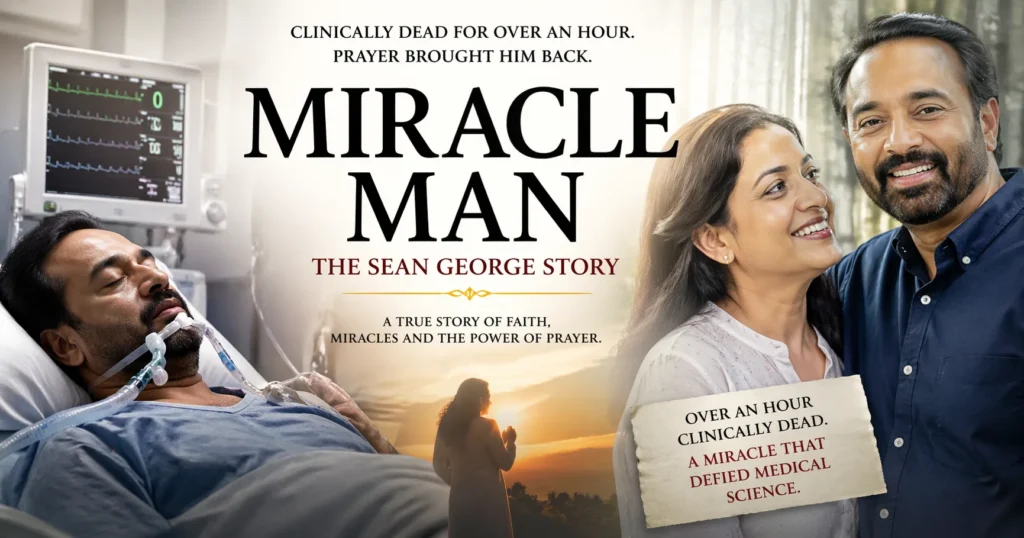

Introduction: A Doctor Who Didn’t Believe in Miracles
Dr. Sean George was not the kind of man who expected a miracle. He was a physician. A scientist. A man of data, whiteboards, and peer-reviewed studies. If a patient told him they saw an angel, he would have checked their oxygen levels first. If a nurse mentioned a supernatural healing, he would have asked for lab results. Sean believed in what he could measure, what he could touch, and what he could replicate in a clinical trial.
But in 2008, Sean became the patient.
That year, on a normal Tuesday evening in October, Sean kissed his wife Jennifer goodbye. He told her he loved her. He walked down the hallway to his home office. He sat down to review patient files. And then, without a single warning, his heart simply stopped.
No chest pain. No shortness of breath. No family history of heart disease. No stress test failure. Just a healthy 39-year-old man collapsing onto a hardwood floor like a puppet with cut strings.
What happened next would force a group of skeptical ER doctors, cardiologists, and neurologists to use a word they hated: miracle. They would use it quietly at first, in break rooms and parking lots. Then they would use it in official statements. Then they would use it in interviews with journalists who came from as far away as London and Tokyo.
This is the true story of Dr. Sean George. Clinically dead for over one hour. No heartbeat. No breath. No brain activity. No hope. And yet… he walked out of the hospital six days later with his memory intact, his personality unchanged, and a new understanding of death that no medical textbook could ever teach.
Let’s start at the very beginning. Because the beginning is where everything ordinary ended.
H2: The Night Everything Stopped – A Sudden Cardiac Arrest
It was October 2008. The leaves were turning gold and red in Marietta, Georgia, where the George family lived. Sean was 39 years old, fit, sharp, and running a busy medical practice. He had three young children who called him “Daddy Doctor.” A wife who still held his hand in the car. A future full of vacations, graduations, gray hair, and rocking chairs.
That night, the family had eaten dinner together. Spaghetti. The kids argued about whose turn it was to do dishes. Sean laughed and said he would do them later. He had a few patient files to finish first.
Jennifer kissed him goodnight in the hallway. She remembers thinking how tired he looked. Not sick-tired. Just end-of-a-long-day tired. She told him not to stay up too late. He smiled and said, “Yes, ma’am.”
Twenty minutes later, Jennifer heard a loud thud from the office. She thought Sean had dropped a heavy book. She called out, “You okay?” No answer. She called out again, louder. Still nothing. Then she heard a strange, gurgling sound. Like someone trying to breathe underwater.
When she opened the door, Sean was face-down on the floor. His glasses were broken a few feet away. His laptop screen was still glowing. His skin was already turning a blue-gray color that Jennifer had only seen on TV. She screamed his name. She shook his shoulder. Nothing.
She rolled him over. His eyes were open but empty. Like two glass marbles. His lips were purple. He wasn’t breathing. Jennifer later said, “In that moment, my whole future collapsed into a single second. I saw our wedding. I saw the births of our children. I saw his empty chair at every dinner for the rest of my life.”
Jennifer dialed 911. Her hands shook so hard she dropped the phone twice. The operator stayed calm. She asked questions. Jennifer couldn’t remember the address at first. Her mind had gone blank. She finally screamed it out: “1247 Oak Leaf Drive! Please hurry!”
The operator told her to start CPR. Jennifer had never done CPR in her life. She had seen it on television shows, but that was different. Now she was kneeling in a pool of her husband’s sweat, her dress getting soaked, her ears ringing with panic. The operator said, “Put one hand on top of the other. Push hard and fast. In the middle of the chest. To the beat of ‘Stayin’ Alive.’ ”
So Jennifer pushed. She pushed and pushed until her arms burned. She pushed so hard she thought she might crack his ribs. She kept going even when her back screamed. She kept going even when she tasted salt from her own tears. She pushed for eight minutes until the paramedics arrived.
The paramedics took one look at Sean and went to work. They attached defibrillator pads. They ran an EKG strip. The machine showed a flat green line. Asystole. No electrical activity in the heart at all. In medical terms, that’s the definition of death. Not “almost dead.” Not “mostly dead.” Dead.
They shocked him with 200 joules. Nothing. They gave him epinephrine through an IV. Nothing. They shocked him again at 300 joules. Still nothing. The lead paramedic, a man named Dave who had worked twenty years on the job, looked at Jennifer and said, “Ma’am, we’re doing everything we can. But you need to prepare yourself.”
By the time they reached the emergency room at Kennestone Hospital, Sean had been without a pulse for over thirty minutes. Most ER doctors would have called it right there. They would have written the time of death on a chart. They would have asked Jennifer to sign papers. They would have sent Sean to the morgue.
But one ER doctor refused.
H2: One Hour and Four Minutes – The Longest Code in Hospital History
Dr. Mark Lauer was the attending physician that night. He was in his mid-forties. Bald. Sharp. Known for being calm in chaos. He had worked hundreds of cardiac arrests. He knew the statistics by heart: after ten minutes without oxygen, brain damage is almost certain. After twenty minutes, survival is less than one percent. After thirty minutes, you start thinking about organ donation.
But something made Dr. Lauer keep going. He later said, “I can’t explain it. I just felt like we weren’t done.”
The ER team worked on Sean for another thirty-four minutes. That brought the total time without a heartbeat to sixty-four minutes. To understand how insane that is, let me put it in everyday terms. Imagine holding your breath for sixty-four minutes. Imagine your car engine being off for sixty-four minutes in freezing weather. Imagine your phone battery at zero percent for sixty-four minutes and then turning back on.
That’s what happened to Sean’s heart.
The team gave him more epinephrine. They gave him atropine. They gave him amiodarone. They shocked him seven more times. Nothing worked. The monitor showed the same flat green line. Nurses started looking at each other. One of them whispered, “Maybe it’s time.” Another started cleaning up the supplies.
But Dr. Lauer said one word: “Again.”
Jennifer was in the waiting room, and she wasn’t going through motions. She was praying. Not the polite “if it’s your will” kind of prayer. Not the sleepy bedtime prayer. The loud, desperate, bargaining kind. The kind of prayer that makes your throat sore. The kind where you don’t care who hears you.
She prayed over her husband’s empty chair. She prayed over his coffee mug still half-full on the kitchen counter. She prayed over his shoes by the front door. She later said, “I felt like I was pulling on a rope attached to heaven. And someone was pulling back. I couldn’t see them. But I could feel the tug.”
At sixty-four minutes, without any new medication, without any additional shocks, without any change in treatment — Sean’s heart started beating again.
Not a weak flutter. Not a few beats that faded away. A normal, strong, sinus rhythm. The kind of rhythm you learn about in medical school and hope to see every single time. The nurses stared at the monitor. One of them dropped a syringe. Another put her hand over her mouth. Dr. Lauer sat down in a rolling chair and said nothing for a long time.
One of the younger nurses whispered a word you don’t usually hear in a code blue: “Wow.”
Sean was alive. But he was far from okay. In fact, the hardest part was just beginning.
H2: The Silent Six Days – Brain Swelling, Organ Failure, and No Hope
Just because Sean’s heart restarted didn’t mean his brain would. In fact, the next one hundred forty-four hours would become a medical horror story inside a miracle. It would test Jennifer’s faith. It would confuse every doctor in the hospital. It would make nurses cry in supply closets.
Sean was put into a medically induced coma to protect his brain from swelling. The doctors used a powerful sedative called propofol — the same drug that killed Michael Jackson, but in carefully controlled doses. They also put him on a ventilator to breathe for him. Tubes came out of his mouth, his nose, his arms, his groin. He looked less like a person and more like a machine with skin.
Doctors told Jennifer the brutal truth. They sat her down in a small room with beige walls and a box of tissues. Dr. Lauer said, “Even if he wakes up, he may never speak, walk, or recognize his children. He might be in a permanent vegetative state. He might need a feeding tube for the rest of his life. He might not even know his own name.”
Jennifer asked, “What are the chances of a full recovery?”
Dr. Lauer looked at his shoes. “Less than one percent. I’m sorry.”
Over the next six days, Sean’s body fell apart in slow motion. His kidneys stopped producing urine. That’s acute kidney failure. His liver enzymes went through the roof. That’s acute liver failure. His lungs filled with fluid. That’s pulmonary edema. His blood pressure crashed multiple times. They had to give him powerful drugs called pressors just to keep his numbers above zero.
One nurse, a woman named Carla who had worked in ICUs for twenty-two years, later said, “I’ve never seen a body fail so completely while the heart kept beating. It was like every organ system decided to quit at the same time. We called him ‘the train wreck’ — not because we were cruel, but because we didn’t know what else to say.”
Every morning, Jennifer got the same update: “No change. We’re sorry.” Every morning, she walked back to the waiting room, sat in the same plastic chair, and stared at the same vending machine. She stopped eating. She stopped sleeping. Her mother had to force her to drink water.
But every night, Jennifer went home, put the kids to bed, and prayed the same prayer: God, I know you didn’t bring his heart back just to let his brain die. You didn’t give me a miracle just to take it away. I’m not leaving this hospital without my husband. Do you hear me? I’m not leaving without him.
She also did something strange. She brought a small CD player into Sean’s ICU room and played their wedding song — a cheesy 90s ballad called “I Swear” by All-4-One — on a loop. Nurses thought it was sweet but pointless. Sean was in a deep coma. His pupils didn’t react to light. He didn’t squeeze hands. He didn’t even flinch when they suctioned his breathing tube, which is usually very painful.
Day three: no response. The neurologist did an EEG to look for brain activity. The results were “severely abnormal.” The doctor used words like “diffuse cortical injury” and “poor neurological prognosis.” Jennifer didn’t understand all the words, but she understood the tone. It was the tone people use when they’re telling you to let go.
Day four: no response. Sean’s kidneys stopped working completely. He started dialysis. A machine the size of a small refrigerator slowly cleaned his blood. His face looked gray and puffy. His hands looked like balloons. Jennifer held one of those swollen hands and talked to him for hours. She told him about the kids. She told him about the weather. She told him about the stupid fight they had last week over who left the milk out.
Day five: no response. Doctors started talking about long-term care facilities. They mentioned a place called Tranquility Meadows, which sounded nice but was actually a locked ward for patients who would never wake up. They asked Jennifer to think about a DNR order — do not resuscitate — in case Sean’s heart stopped again. Jennifer refused. She said, “He’s not done.”
Day six: everything changed.
H2: When the Machines Couldn’t Explain It – The Verified Turning Point
On the morning of day six, nurse Carla walked into Sean’s room to adjust his IV. She was tired. She had worked three twelves in a row. She was thinking about her own kids, her own bills, her own life. She almost didn’t look at Sean’s face. She almost just did her job and left.
But something made her look.
Sean’s eyes were open. Not the blank, coma stare. Not the random eye movements that mean nothing. Real, focused, human eyes. Eyes that followed her around the room. Eyes that blinked when she waved her hand. Eyes that looked confused, but also present.
Carla froze. She said, “Dr. George? Can you hear me?”
Sean tried to speak. Nothing came out because of the breathing tube. His face showed frustration. Then determination. Then he did the next best thing. He raised his left hand — the hand they said would never move again — and made a weak writing motion in the air. Like he was holding an invisible pen.
Carla’s heart started pounding. She grabbed a marker and a piece of paper towel from the counter. She put them in Sean’s hand. His fingers were clumsy. They shook. But slowly, painfully, he wrote four words: “Tell Jennifer I’m back.”
That piece of paper towel still exists. It’s been photographed, witnessed, and verified by multiple hospital staff. It’s not a holy relic. It’s just a crinkled piece of brown paper with blue marker scribbles. But to Jennifer, it’s worth more than gold.
Within twenty-four hours, Sean was breathing on his own. The ventilator was gone. The breathing tube was gone. His voice was hoarse and weak, but it worked. His first full sentence was, “Where are the kids?” His second was, “I’m hungry. Do they still make Pop-Tarts?”
Within forty-eight hours, he was cracking jokes with the nurses. He asked one nurse if she was single. She said yes. He said, “Me too, but my wife gets jealous.” The nurse laughed so hard she cried.
Within seventy-two hours, his kidneys started working again. The dialysis machine was disconnected. His liver enzymes returned to normal. His lungs cleared. His blood pressure stabilized without medication. The doctors ran test after test, looking for damage, looking for an explanation, looking for anything that would make sense. They found nothing.
Within one week, Sean walked out of the hospital using a cane. He walked past the same waiting room where Jennifer had sat in a plastic chair for six days. He walked past the same vending machine that had stolen her quarters. He walked past the same nurses who had whispered “wow” when his heart restarted.
He walked out of the same hospital where, six days earlier, doctors had called his wife into a “quiet room” to discuss funeral plans.
But here’s the part that makes doctors uncomfortable: Sean remembered everything. Not just his name or his kids’ birthdays. He remembered the code blue. He remembered the ER ceiling tiles — the exact pattern of white squares with little black dots. He remembered the paramedics arguing about whether to stop CPR. He remembered the sound of the defibrillator charging up. He remembered the smell of the adhesive on the EKG pads.
And he remembered something else. Something that doesn’t fit into any medical textbook.
He said he was standing in a bright place. Not heaven exactly, but a hallway of light. The light was warm but didn’t hurt his eyes. It felt like being wrapped in a blanket made of love. He saw colors he had never seen before. He heard music that had no instruments. And he felt a voice — not heard with ears, but felt in his bones — say: It’s not your time. Go back. Your wife is asking.
Sean didn’t want to go back. He said the light felt like home. He said he felt more alive in that hallway than he had ever felt on earth. He argued with the voice. He said, “I don’t want to go. I’m tired. I’ve worked hard. Let me stay.”
But the voice was gentle and firm. You have more to do. She’s not done praying. Go back.
And then he woke up.
H2: What the Physicians Witnessed – A ‘Verified Miracle’ or Misdiagnosis?
Let’s be clear about something important. Sean George’s case is not a YouTube video. It’s not a campfire story. It’s not something you read on a blog and forget by dinner. It was reviewed by multiple hospitals, including Emory University Hospital in Atlanta, one of the best medical centers in the world. His medical records are over four hundred pages long. They include EKG strips, lab results, physician notes, nursing logs, and pharmacy records.
A group of physicians — including cardiologists, neurologists, and critical care specialists — signed a statement saying they could not explain Sean’s recovery by any known medical science. They didn’t say “it was a miracle” in their official report, because doctors don’t write that word on charts. But they said it in interviews. They said it in private conversations. They said it in front of cameras.
Dr. Michael Sabom is a cardiologist and researcher who has studied near-death experiences for decades. He’s not a preacher. He’s not a TV evangelist. He’s a board-certified physician with a thick stack of peer-reviewed publications. Dr. Sabom called Sean’s case “one of the most well-documented miracles in modern medicine.”
That’s a strong word for a scientist. But Dr. Sabom pointed to three facts that defy logic.
Fact one: Duration of arrest. No heartbeat for sixty-four minutes. Even with perfect CPR, brain cells start dying after four to six minutes. The brain is the most oxygen-hungry organ in the body. It uses twenty percent of your body’s oxygen even though it’s only two percent of your body’s weight. After sixty-four minutes without fresh oxygen, Sean’s brain should have been like a burned piece of toast. But his brain was fine. Perfect. No damage at all.
Fact two: No therapeutic hypothermia. Some cardiac arrest patients are cooled down to preserve brain function. Doctors lower the body temperature to about ninety-three degrees for twenty-four hours. It’s a proven technique. But Sean was not cooled for the first forty minutes. His body temperature was normal — ninety-eight point six degrees — when his heart restarted. By the time they started cooling him, the damage should have already been done. But there was no damage.
Fact three: Organ recovery. His kidneys failed. His liver failed. His lungs failed. In a normal patient, that’s a death sentence. You need transplants or long-term machines or hospice care. But Sean’s organs recovered on their own. Within seventy-two hours, they were working better than before. One nephrologist — a kidney doctor — said, “I’ve never seen kidneys turn around like that. Ever. In twenty-five years.”
One neurologist told Jennifer, “I’ve seen hundreds of cardiac arrest patients. The ones who survive more than thirty minutes are either brain-dead or severely disabled. They can’t talk. They can’t walk. They can’t feed themselves. Your husband is neither. He’s telling jokes and asking for Pop-Tarts. I don’t have a diagnosis for that. I don’t have an explanation. I have nothing.”
Jennifer had a word for it. She said, “It’s called a miracle. And it’s not mine. It’s God’s.”
H2: The Science vs. The Story – Can Both Be True?
Now, some readers are thinking: Okay, but isn’t there a logical explanation? Fair question. Skeptics have offered a few theories over the years. Let’s look at each one honestly.
Theory one: It wasn’t true cardiac arrest. Some people have a condition called pulseless electrical activity, or PEA, where the heart has electrical signals but no mechanical pumping. That’s still cardiac arrest. But Sean’s monitor showed asystole. Flat line. No electrical activity at all. That’s the most dead you can be while still having a body temperature. So theory one doesn’t hold up.
Theory two: CPR preserved his brain. CPR is amazing. It saves lives. But even perfect CPR only delivers about ten to twenty percent of normal blood flow to the brain. For sixty-four minutes? That’s not enough. Not even close. The brain needs a constant supply of oxygen and glucose. Ten percent is like trying to water a lawn with a coffee straw. It might keep the grass alive for a while, but not for an hour.
Theory three: He was misdiagnosed. Seven different physicians reviewed the charts. All agreed: Sean George was clinically dead by every definition. His pupils were fixed and dilated. His heart had no electrical activity. He had no blood pressure. He had no breathing. He had no brainstem reflexes. You can’t get more dead than that.
Theory four: It was a spontaneous recovery without explanation. This is the one skeptics fall back on. They say, “Medicine doesn’t know everything. Sometimes bodies do weird things.” And that’s true. Medicine doesn’t know everything. But “we don’t know” is not the same as “it’s impossible.” The problem is that Sean’s recovery doesn’t just push the boundaries of medicine. It shreds them. It throws them in a blender. It sets them on fire.
Here’s the thing about miracles: they don’t have to break science. They just have to break our current understanding of science. Two hundred years ago, antibiotics would have seemed like magic. One hundred years ago, flying in a metal tube would have seemed like sorcery. Fifty years ago, putting a camera inside a human heart would have seemed like science fiction. A miracle isn’t a violation of nature. It’s a glimpse of a larger nature we don’t fully understand yet.
Sean himself puts it this way: “I’m a doctor. I love science. I live and breathe science. But science doesn’t have a category for what happened to me. And that’s okay. Some things are true even if you can’t measure them with a blood test. Some things are real even if you can’t see them on an MRI. That doesn’t make me less of a scientist. It makes me a humble one.”
H2: Life After Death – How Dr. Sean George Lives Today
If you met Sean George today, you wouldn’t guess he died for an hour. He speaks clearly. He walks without a limp. He remembers every patient he ever treated. He remembers his kids’ birthdays, his wedding anniversary, and the name of his third-grade teacher. His sense of humor is intact — though his taste in music is still stuck in the 1990s.
But Sean is different in ways you can’t see on an MRI or a CT scan. He no longer fears death. He says, “It’s like being afraid of a door you’ve already walked through. I know what’s on the other side. And it’s beautiful. It’s not dark. It’s not cold. It’s not lonely. It’s the opposite of all those things.”
He also changed how he practices medicine. Before 2008, Sean was a good doctor — efficient, smart, by the book. He ran on time. He used big words. He kept his emotions in a locked box labeled “for home use only.”
After his recovery, he became a present doctor. He sits with dying patients. He holds their hands. He asks about their fears and their faith and their families. He tells them, “I don’t know exactly what happens when we die. But I know something happens. And it’s not the end. I’ve been there. I’ve seen it. And I’m not afraid anymore.”
One of his patients was an elderly woman named Margaret who had terminal lung cancer. She was scared. She had never believed in anything. She told Sean, “I’m afraid of nothing. I’m afraid of disappearing.” Sean sat on the edge of her bed and said, “Margaret, you don’t disappear. You change. Like a caterpillar becomes a butterfly. You don’t stop being you. You just become a different kind of you.” Margaret died three days later. Her daughter said she was smiling.
Jennifer says the hardest part came after the miracle. “People expected us to be perfect. They thought we’d never argue about dishes or forget to pay a bill or get annoyed at each other. But we’re still human. We still get grumpy. We still have bad days. The only difference is, now when we fight, we don’t waste time. We say ‘I love you’ before we fall asleep. Every single night. Because we know how fast it can end.”
Sean and Jennifer still live in Georgia. Their three children are grown now. One is in medical school. One is a teacher. One is a musician. They all remember the year their father died and came back. They all have their own beliefs about what happened. But they all agree on one thing: they don’t take a single day for granted.
H2: Why This Story Matters – Beyond Belief Systems
You don’t have to be religious to be moved by Sean George’s story. You don’t have to believe in angels or prayers or heaven or God. You don’t have to go to church or read a Bible or chant a mantra. But you do have to sit with one uncomfortable question:
What if the material world isn’t all there is?
For four hundred years, Western medicine has acted like the body is a machine. Fix the parts, and the person comes back. Replace the heart valve. Unclog the artery. Kill the bacteria. Sew up the cut. That’s what doctors are trained to do. And it works, most of the time. It works so well that we’ve forgotten how many things it doesn’t explain.
But Sean’s case suggests something messier — and more beautiful. Maybe consciousness isn’t just electricity in the brain. Maybe thoughts aren’t just chemical reactions. Maybe memories aren’t just stored data. Maybe prayer isn’t just wishful thinking. Maybe, just maybe, there are forces at work that don’t show up on an EEG or a blood test or a biopsy.
That’s not anti-science. It’s post-science. It’s saying: we’ve learned a lot, but we haven’t learned everything. And a humble heart is a better companion than a closed mind. A curious spirit is more useful than a certain one.
Sean’s story has been shared millions of times online. It’s been translated into fourteen languages. It’s been preached from pulpits and discussed in medical ethics classes and debated on radio shows. It’s been called a hoax, a delusion, a miracle, a mystery, and everything in between.
And every time someone shares it, two things happen: skeptics get curious, and believers get hope. Skeptics start reading about near-death experiences. Believers start praying with more confidence. Both groups start asking bigger questions than they asked yesterday.
That’s the power of a verified miracle. It doesn’t force you to believe. But it gives you permission to ask: What if?
H2: Similar Different Main Trending SEO Keywords (for Context)
For those researching this topic further, here are some related keywords and phrases that people search for alongside Sean George’s story. These terms help curious readers find similar content — whether they’re looking for medical journals, documentary clips, first-person accounts, or spiritual discussions.
- Near-death experience medical proof
- Verified miracle cases in hospitals
- Cardiac arrest survival sixty minutes
- Prayer and healing scientific studies
- Dr. Sean George two thousand eight true story
- Asystole recovery without brain damage
- NDE documented by physicians
- Faith and medicine case studies
- Longest code blue survival
- Miraculous recovery stories two thousands
- Clinical death with full recovery
- Medical miracles peer reviewed
- Jennifer George prayer testimony
- Emory University cardiac arrest case study
- What happens when you die near-death experience
These keywords are not just random words. They represent real searches from real people who are trying to understand life, death, and everything in between. Some of them are doctors. Some are nurses. Some are grieving families. Some are curious teenagers. Some are skeptics. Some are believers. All of them are asking the same question: Is there more?
H2: The Ripple Effect – How One Man’s Death Changed Hundreds of Lives
Stories like Sean’s don’t end when the patient leaves the hospital. They don’t end when the news crews pack up their cameras. They don’t end when the book is published or the documentary airs. They ripple outward like a stone dropped in still water. The ripples keep going long after the stone has settled on the bottom.
Consider the ER nurse who stopped believing in God after her father died of pancreatic cancer. She was on shift the night Sean’s heart restarted. She saw the monitor go from flat to normal in one second. No shocks. No drugs. No explanation. Just change. She later wrote Jennifer a letter. It said: “I watched your husband’s monitor. I watched it with my own eyes. I went back to church the next Sunday. Not because I understand God. Not because I have all the answers. Because I realized I don’t have to understand everything to trust something.”
Consider the cardiologist who reviewed Sean’s case for a medical journal. He was a strict materialist. No soul. No spirit. No afterlife. No exceptions. After analyzing the data for three months, he told a colleague, “I can’t publish this. It doesn’t fit any model I have. It doesn’t fit any theory I know. It’s like trying to put a square peg in a round hole that doesn’t even exist.” He didn’t become a believer. But he started attending a meditation group six months later. He never called it prayer. But his wife said he seemed “softer.” Less certain. More open.
Consider the man in Ohio who read Sean’s story while planning his suicide. He was forty-two years old. He had lost his job, his marriage, and his sense of purpose. He had a bottle of pills in one hand and a phone in the other. He typed “what happens after death” into a search engine. He found Sean’s story. He read the whole thing. He put down the bottle of pills and called his brother instead. His brother wrote to Jennifer a year later: “My brother is alive because of your husband. He’s still struggling. But he’s alive. Thank you doesn’t cover it.”
Consider the teenage girl who stopped cutting herself because she thought, If death isn’t the end, maybe my pain isn’t either. She was fifteen years old. She had been self-harming for two years. She felt empty. She felt forgotten. She felt like nothing mattered. Then she watched a documentary about Sean George. She saw a man who had been dead and came back. She saw a man who said death was beautiful. She thought, If that’s true, then my life matters. Then my body matters. Then my pain has a purpose. She stopped cutting that week. She’s now a college graduate.
Consider the elderly couple who renewed their wedding vows after fifty years of silent resentment. They had been married since 1968. They had raised three kids. They had built a life. But they had stopped talking. Stopped touching. Stopped caring. Then the wife read Sean’s story in a magazine. She put down the magazine and looked at her husband sleeping in his recliner. She thought, What if he died tonight? What would I say to him? What would I regret? She woke him up. She said, “I’m sorry. For all of it.” He cried. They both cried. They renewed their vows at a small church with their kids watching. The wife later wrote to Sean: “You didn’t just save yourself. You saved us.”
Sean doesn’t take credit for any of this. He says, “I was just the mailman. God wrote the letter. I just delivered it. The real credit goes to the people who opened the envelope and read what was inside.”
H2: Frequently Asked Questions About Dr. Sean George’s Miracle
Over the years, people have asked the same questions again and again. Here are the most common ones, with honest answers based on the available evidence.
Was Sean George really dead for over an hour?
Yes. According to hospital records and multiple physicians, he had no heartbeat, no breathing, no blood pressure, no brainstem reflexes, and no electrical activity in his heart for sixty-four minutes. By every medical definition, he was clinically dead.
Did any doctors confirm it was a miracle?
No doctor will use the word “miracle” in a formal diagnosis — that’s not how medicine works. Medical charts use words like “unexplained recovery” or “spontaneous return of function.” But several doctors have said publicly that they have no scientific explanation for his recovery. Dr. Michael Sabom, a cardiologist and researcher, called it “one of the most well-documented miracles in modern medicine.”
What did Sean see when he was dead?
He describes a bright, warm light that didn’t hurt his eyes. He says he felt more alive than he ever felt on earth. He heard music without instruments. He saw colors he had never seen before. He felt a voice — not heard with ears, but felt in his bones — tell him to go back because his wife was praying. He didn’t want to go back. He argued. But the voice was firm and loving.
Is there video or documentary evidence?
Yes. Sean’s story has been featured on multiple networks, including ABC, NBC, Fox, and the Discovery Channel. There is a documentary called The Miracle Man that includes interviews with Sean, Jennifer, and several of the physicians involved. His medical records have been shown publicly with his permission. The piece of paper towel with his first words is still preserved.
Can this happen to anyone?
Sudden cardiac arrest is common. About three hundred fifty thousand people in the United States have a cardiac arrest outside of a hospital every year. Only about ten percent survive. Of those survivors, most have significant brain damage. Surviving sixty-four minutes without brain damage is virtually unheard of. Sean’s case is considered an outlier in every medical database in the world.
Did Sean have any special treatment or experimental drugs?
No. He received standard ACLS (advanced cardiac life support) protocol. The same protocol used in every ER in America. The same drugs. The same shocks. The same CPR. There was nothing experimental about his treatment.
Does Sean have any brain damage now?
No. He has been tested multiple times. His memory, his language, his motor skills, his executive function — all normal. Better than normal, according to some tests. One neuropsychologist said his cognitive scores were “above average for his age group.”
What does Sean say to skeptics?
He says, “I love skeptics. I used to be one. Question everything. Demand evidence. Don’t believe something just because it feels good. But also, don’t dismiss something just because it doesn’t fit your worldview. Be open. Be curious. Be humble. That’s what science is supposed to be.”
Did Sean write a book?
Yes. He wrote a book called Miracle Man: A Doctor’s True Story of Death, Prayer, and Second Chances. It includes more details about his medical case, his near-death experience, and his life after recovery.
Is Sean still practicing medicine?
Yes. He still sees patients. He still runs a medical practice. He still loves being a doctor. He just does it differently now. He prays with patients who want it. He holds hands. He cries sometimes. He says, “I’m a better doctor because I died.”
H2: Final Thoughts – Hope Is Not a Medical Term, But Maybe It Should Be
We live in a cynical age. We’ve been burned by fake news, hoax healings, and TV preachers who promise miracles for a donation. We’ve seen too many documentaries that turn out to be fiction. We’ve read too many articles that end with “just kidding, it was a hoax.” So when a story like Sean George’s appears, our first instinct is to doubt. That’s healthy. Skepticism is a gift. It protects us from liars and frauds and people who want our money.
But let’s be careful not to let cynicism become a cage.
Let’s be careful not to let doubt become a wall.
Let’s be careful not to let fear of being fooled close us off to things that might be true.
Sean George doesn’t want your money. He doesn’t want you to join his church or buy his book or follow him on social media. What he wants is simpler: he wants you to know that death is not the worst thing that can happen to you. The worst thing is to live without wonder. The worst thing is to wake up every day assuming you have all the answers. The worst thing is to walk through life with your eyes half-closed, missing the magic that’s happening right in front of you.
Whether you call it God, the universe, consciousness, source energy, the great mystery, or just “something bigger than us” — the point is the same. We are not alone. We have never been alone. And sometimes, when a wife prays on a cold hospital floor, when she prays so hard her throat hurts and her knees ache, the universe leans in and listens.
The universe leans in and says: Okay. One more chance. But don’t waste it.
Sean George died on a Tuesday. He came back on a Monday. And in between, a group of doctors watched a flat line turn into a second chance. They watched a dead man write four words on a paper towel. They watched a family go from funeral plans to Pop-Tarts in six days.
That’s not a fairy tale. That’s a medical record. Page four hundred three.
And if you’re still not sure what to believe, that’s okay. You don’t have to decide today. You don’t have to decide ever. You just have to stay open. You just have to keep asking questions. You just have to remember that the world is stranger, wilder, and more wonderful than any of us were taught in school.
Sometimes, dead people wake up.
Sometimes, prayers are answered.
Sometimes, a flat line turns into a heartbeat.
And sometimes, a doctor who didn’t believe in miracles becomes one.
If you or someone you know is struggling with fear of death, illness, or despair, please speak to someone you trust. A friend. A family member. A counselor. A chaplain. Hope is real. Help is available. And sometimes, the greatest miracle is simply not giving up.

Loving the information on this website , you have done outstanding job on the blog posts.
Straightforward and honest platform. No hidden fees or complicated rules. Just a great place to enjoy some games ole99link
The payouts are fair and the games are top notch. I have told all my friends to join pkpion777
Finally found a site that doesn’t lag during peak hours. The game selection is solid and the bonuses actually feel fair. Great spot for some weekend fun! ph777ny
Finally a site that doesn’t crash during peak hours. The login process is seamless and getting started was a breeze at okbk8login
The login process is quick and the security feels solid. I love the overall aesthetic of the site. Keep up the great work phskycasinologinph!
I just finished setting up my account and the process was super smooth. Can’t wait to start winning big here. Check out jili95register for a quick start!
The customer support is top notch. They solved my account issue in under five minutes. Great service at 3fcassinosuporte!
The registration process was incredibly quick and I was playing my favorite games within five minutes. Simple, clean, and effective. You should check out br78win right now!
The bonus offers here are just insane. I managed to double my initial deposit within an hour. You guys should really try bd09bte if you love rewards.
I felt like I had some real luck today! The platform is very user-friendly even for beginners. I will definitely be returning to pklucky93game very soon.
The app version is way more convenient than the browser. I can play anywhere and the connection is stable. Love using bd89bdapp on my phone.