

A Normal Day That Turned Into a Once-in-a-Lifetime Story
The sun had not yet cleared the horizon over Cape Cod Bay. The sky was that deep purple-blue color that comes just before dawn. A small fishing boat named the Timothy Michael bobbed gently on the cold April water. The crew had been awake since three in the morning. They had drunk cheap coffee from thermoses. They had pulled on their thick rubber gloves and waterproof bibs. They were tired, but they were ready.
This was not a special day. There were no news cameras. No scientists waiting on the dock. Just four men who had done this same routine hundreds of times before. They would haul up lobster traps. They would measure the lobsters. They would band the claws of the ones that were big enough to keep. They would throw back the small ones, the egg-bearing females, and anything else that did not meet the rules. Then they would do it all over again, trap after trap, until their hands ached and their backs screamed.
It was honest work. Hard work. The kind of work that does not care about your feelings or your dreams. The ocean does not give you anything for free. You have to earn every single lobster.
The captain, a man named Greg who had been fishing these waters since he was a teenager, stood at the wheel. He watched the GPS and the depth finder. He knew exactly where to drop the traps. He had learned those spots from his father, who had learned them from his father before him. Fishing was in Greg’s blood. He could read the water like most people read a book.
The first few traps of the day came up empty except for a few crabs and a lot of mud. That was normal. Sometimes the lobsters moved to deeper water. Sometimes they just were not hungry. You never really knew. That was the frustrating thing about fishing. You could do everything right and still come home with almost nothing.
But around seven in the morning, things started to pick up. Trap after trap came up heavy with lobsters. Good-sized ones too. The crew worked quickly, sorting, measuring, banding. They did not talk much. They did not need to. They had worked together so long that they could almost read each other’s minds. One man pulled the trap from the water. Another opened the door. A third reached in and grabbed the lobsters one by one. The fourth handled the bait and the rebaiting. It was a smooth, practiced dance.
Then came trap number thirty-one.
Later, none of the crew could agree on exactly which trap number it was. Some said thirty-one. Some said thirty-three. One deckhand swore it was trap number forty. But they all agreed on one thing: the moment they saw what was inside, time stopped.
The trap broke the surface. Water streamed out of the mesh. Seaweed clung to the sides. And there, crawling over a pile of smaller lobsters and rock crabs, was something none of them had ever seen before.
At first, the youngest deckhand, a kid named Marcus who had only been fishing for two seasons, thought it was two lobsters stuck together. He opened his mouth to say something, but no words came out.
Then the captain leaned over the side of the boat and let out a low whistle.
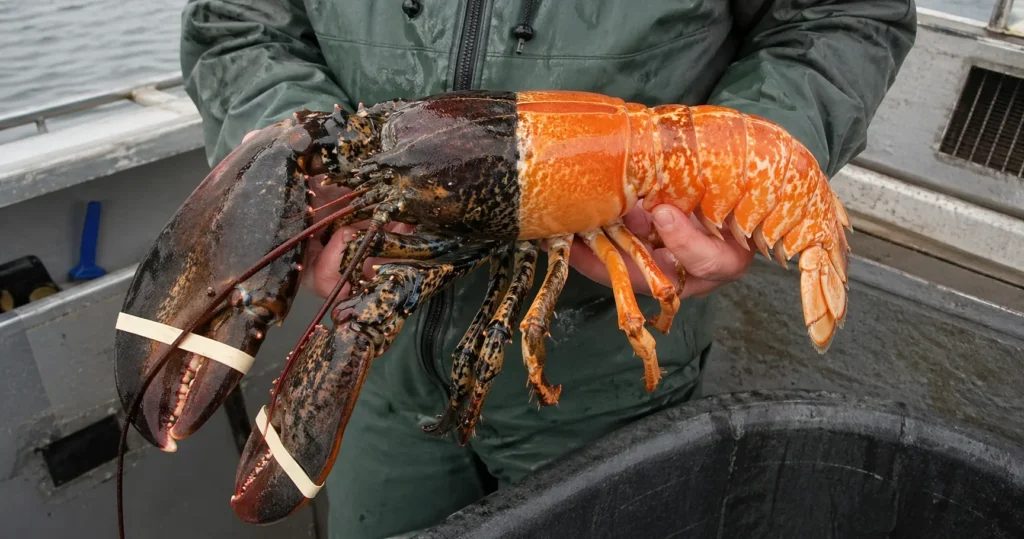
The lobster was split perfectly down the middle. The left side of its body was the normal dark greenish-brown color that lobsters use to hide on the ocean floor. That side had speckles and blotches, just like any other healthy lobster. But the right side? The right side was bright, fiery orange. Not pale orange. Not washed-out orange. But the kind of deep, vivid orange you see on a cooked lobster at a Fourth of July clambake.
The line between the two colors ran from the tip of its head, straight down the middle of its back, all the way to the end of its tail. It was so straight that it looked like someone had drawn it with a ruler.
Even the claws were different. The left claw matched the left side of the body: dark and speckled. The right claw matched the right side: bright orange. The little walking legs on each side followed the same pattern. So did the tiny swimmerets under the tail. There was no blending. No fading. Just a hard, sharp line between two completely different worlds.
Marcus later told a reporter, “I thought I was hallucinating. I hadn’t slept much the night before. I actually rubbed my eyes and looked again. But it was still there. It was real.”
The captain reached into the trap with trembling hands. He had handled tens of thousands of lobsters in his life. He had been pinched, clawed, and splashed more times than he could count. But this time, he was careful. Almost gentle. He lifted the split-color lobster out of the trap and held it up to the morning light.
The lobster waved its claws in the air, annoyed at being disturbed. It did not know it was special. It did not know that it had just become the most famous lobster in the world. It just wanted to go back to the dark, cold water where it felt safe.
The crew gathered around. Nobody spoke for a full ten seconds. On a working fishing boat, ten seconds of silence is an eternity. Finally, the captain said the only thing that made sense: “We are not selling this one.”
The Catch That Made Headlines Around the World
The crew of the Timothy Michael did not have a fancy camera. They did not have a social media manager. They did not have a publicist. What they had was a plastic bucket, some fresh seawater, and a lot of questions.
They carefully placed the split-color lobster in a separate tank. Not the main holding tank where the other lobsters were kept. That tank was crowded and dark. This lobster deserved better. They used a small, clean bucket that they usually reserved for bringing up live bait. They filled it with cold, clean seawater straight from the bay. Then they lowered the lobster inside and put a lid on top to keep it from crawling out.
The rest of the day’s fishing was a blur. The crew went through the motions of hauling traps, but their minds were elsewhere. Every few minutes, someone would walk over to the bucket and peek inside. Just to make sure the lobster was still there. Just to make sure it was still alive. Just to make sure they had not dreamed the whole thing.
By mid-afternoon, the Timothy Michael was heading back to the dock. The boat motored past the sandy beaches and rocky shores that make Cape Cod famous. Tourists were out on the water in kayaks and small sailboats. None of them had any idea what was sitting in a plastic bucket on that beat-up fishing boat.
When they reached the dock in Wellfleet, the crew carried the bucket carefully to the Wellfleet Shellfish Company. That is a wholesale and retail seafood distributor that has been on Cape Cod for years. They buy lobsters, clams, oysters, and fish from local fishermen and sell them to restaurants, markets, and individual customers. It is a busy place. Trucks come and go all day long. The air smells like salt and seaweed and diesel fuel.
The owners of Wellfleet Shellfish Company, a husband-and-wife team named Alex and Jen, were working behind the counter when the crew walked in. They saw the serious looks on the fishermen’s faces. They saw the bucket. And they knew something was up.
“You are not going to believe this,” the captain said. Then he lifted the lid.
Alex later said that he thought it was a prank at first. He had been in the seafood business for over twenty years. He had seen thousands of lobsters. He had seen blue lobsters, which are rare but not unheard of. He had seen a calico lobster once, years ago, at a trade show in Boston. But he had never seen anything like this.
Jen ran to the back office and grabbed her phone. She took about fifty photos from every possible angle. Then she started making calls. First to the local marine extension office. Then to the New England Aquarium. Then to a marine biologist she knew from a fisheries conference a few years back.
Within two hours, those photos were everywhere. Someone at the aquarium posted them on social media. A local news website picked up the story. Then a bigger news site. Then a national one. By the time the sun set over Cape Cod that evening, people in California, Florida, Texas, and New York were looking at the same split-color lobster that had been pulled from a trap that morning.
The comments exploded. People used words like “amazing,” “unreal,” and “Photoshopped.” A lot of people thought it was fake. They said there was no way a lobster could look like that. They said the photos had been edited. They said it was a plastic toy. They said it was a painted rock.
But the crew had proof. They had video. They had witnesses. They had the lobster itself, sitting in a tank at Wellfleet Shellfish Company, eating a piece of clam and looking as real as real could be.
The marine biologist who was called in to examine the lobster confirmed what the crew already knew. This was not a hoax. This was a genuine, live, healthy split-color lobster. And it was one of the rarest animals ever pulled from the Atlantic Ocean.
The Science of a One-in-50-Million Lobster
Let us take a step back and talk about numbers. Because the numbers in this story are almost hard to believe.
Most lobsters are a dull, mottled greenish-brown color. That is not a mistake. That is not a flaw. That is a brilliant piece of natural engineering. The rocky ocean floor is full of dark shadows, green seaweed, brown rocks, and patches of sand. A greenish-brown lobster blends in perfectly. A hungry codfish swimming overhead might look right at a lobster and never see it. That is the whole point. Camouflage keeps lobsters alive.
But sometimes, a lobster is born with a different color. And those different colors have different odds.
A bright blue lobster shows up once in every two million lobsters. That sounds rare. And it is. But in an industry that harvests over a hundred million pounds of lobster every year, a few blue lobsters are caught each season. They always make the local news. Sometimes they go to aquariums. Sometimes they get released back into the ocean. People love them because they are beautiful and unusual.
A yellow or orange lobster is much rarer. Those show up about once in every ten million lobsters. The color comes from a different genetic mutation. Instead of producing the normal dark pigments, the lobster produces almost none. What you see is the underlying orange or yellow pigment that is normally hidden. These lobsters look like they have already been cooked. But they are alive and healthy. They just have a wardrobe malfunction, so to speak.
A split-color lobster like the one caught off Cape Cod is in a whole different league. The odds of catching one are roughly one in 50 million.
Let us put that number in perspective.
You are more likely to be struck by lightning twice in your lifetime than to pull up a split-color lobster on your first try. You are more likely to win a small lottery prize. You are more likely to be attacked by a shark while buying a lottery ticket during a thunderstorm. Okay, that last one is an exaggeration. But you get the point.
Fifty million is a number that is hard for the human brain to grasp. So try this. Imagine you had a bucket filled with 50 million lobsters. That bucket would be the size of a football stadium. Now imagine you reached into that bucket blindfolded and grabbed one lobster at random. The chance that you would grab the split-color one is about the same as the chance that you would grab a specific grain of sand off a specific beach on a specific day. It is not impossible. But it is very, very, very unlikely.
And yet, it happened.
Marine biologists who study lobsters say that most of them will go their entire careers without ever seeing a split-color lobster in person. Some work for forty years, retire, and die without ever seeing one. That is how rare these animals are. When one shows up, it is a major scientific event.
The Genetic Glitch That Creates a Living Work of Art
Now let us talk about the science. Because the science of split-color lobsters is genuinely fascinating. And you do not need a PhD to understand it.
Every living thing on Earth starts as a single cell. A human starts as a single cell. A whale starts as a single cell. A lobster starts as a single cell. That one cell contains all the instructions for building the entire animal. Those instructions are written in a molecule called DNA. Think of DNA as a recipe book. Every page has a different recipe. Some recipes tell the body how to build a claw. Some recipes tell the body how to build an eye. Some recipes tell the body what color to make the shell.
When that first cell divides into two cells, each new cell gets a complete copy of the recipe book. Then those two cells divide into four. Then four into eight. And so on. Within a few weeks, that single cell has become a tiny baby lobster with millions of cells, each one following the same set of instructions.
But sometimes, a mistake happens.
When the first cell divides, a tiny error can occur in the copying process. A letter gets changed. A page gets skipped. A recipe gets rewritten. Scientists call these mistakes mutations. Most mutations are harmless. Some are bad. And a very, very few are spectacular.
In a split-color lobster, the mutation happens at the very first cell division. One of the two new cells gets a different set of color instructions than the other. From that point forward, every cell that comes from that first cell will follow the new instructions. Every cell that comes from the other first cell will follow the old instructions.
Because the first cell division splits the future lobster into left and right halves, the result is an animal that is one color on the left side and a different color on the right side. The line between them runs straight down the middle. There is no mixing. No blending. Just a clean, perfect split.
Scientists have a fancy name for this condition. They call it bilateral gynandromorphism. Bilateral means two sides. Gynandromorphism comes from Greek words that mean female and male. The name originally referred to animals that were female on one side and male on the other. But over time, scientists started using the same term for any animal with a clean left-right split of any trait, including color.
So the Cape Cod lobster is a bilateral gynandromorph. It is a living example of one of the strangest genetic accidents in the natural world.
Here is something else that is interesting. In some bilateral gynandromorphs, the split goes deeper than just color. It can affect internal organs, reproductive systems, and even behavior. Scientists have found split-color lobsters that were male on the left side and female on the right side. The male side had a narrow tail and hard swimmerets. The female side had a wider tail and soft, feathery swimmerets for carrying eggs. Those lobsters could theoretically mate with themselves, although no one has ever seen that happen.
It is too early to tell if the Cape Cod lobster has that trait. To find out, scientists would need to examine its underside very closely. That means handling the lobster, which causes stress. So for now, they are waiting. They want the lobster to settle into its new home first. Once it is comfortable and eating regularly, they will do a gentle, non-invasive exam. Until then, the lobster remains a mystery.
Why the Orange Side Is Not Cooked
One of the most common questions people ask about split-color lobsters is whether the orange side has been cooked. It makes sense. When you boil a normal lobster, it turns bright red or orange. So a half-orange lobster looks like it has been dipped in boiling water on one side.
But that is not what happened. Not even close.
To understand why, you need to know a little bit about a pigment called astaxanthin. Astaxanthin is a natural chemical found in many sea creatures. It is what gives salmon its pink color. It is what gives shrimp its reddish hue. And it is what gives cooked lobsters their famous red color.
In a live lobster, astaxanthin is present but hidden. The lobster’s body produces special proteins that wrap around the astaxanthin molecules like a blanket. Those proteins change the way light bounces off the pigment. Instead of looking red or orange, the lobster looks dark greenish-brown. That is the blanket effect. The color is there, but you cannot see it.
When you cook a lobster, the heat destroys those proteins. The blankets fall apart. The astaxanthin is suddenly visible. And because astaxanthin is naturally red-orange, that is the color you see. It is not that cooking creates a new color. It is that cooking removes the thing that was hiding the old color.
Now, here is where the split-color lobster comes in.
On the normal side of the lobster, everything works as it should. The proteins are present. The astaxanthin is hidden. The shell looks dark greenish-brown. That side would turn orange if cooked.
But on the orange side of the lobster, something is broken. The genetic mutation that created the split also disabled the production of those hiding proteins. The astaxanthin was never wrapped up. It has been visible since the day the lobster hatched from its egg. That side does not need to be cooked to show its color. It was born that way.
So no, the orange side is not cooked. It is not burned. It is not damaged. It is simply a lobster that never learned how to hide its true colors.
Imagine if you were born with one arm that had normal skin and one arm that had no melanin at all, so it looked pale white. That is essentially what is happening here. The orange side is not sick or injured. It is just different.
And that difference does not affect the lobster’s health in any way. It eats the same food. It breathes the same water. It grows at the same rate. The only real disadvantage is that the orange side is much more visible to predators. On the dark ocean floor, a bright orange patch stands out like a flare. That is probably why split-color lobsters are so rarely found in the wild. Most of them get eaten before they get big enough to be caught in a trap.
The fact that this lobster survived long enough to be caught is a minor miracle. It beat the odds twice: once by being born with a one-in-50-million mutation, and once by living long enough to tell the tale.
From Trap to Safe Haven: The Journey of a Lifetime
After the split-color lobster arrived at Wellfleet Shellfish Company, the owners, Alex and Jen, faced a difficult decision. They had a business to run. They had bills to pay. They had employees who depended on them for a paycheck. And sitting in a tank behind the counter was a lobster that could sell for a lot of money.
Private collectors sometimes pay thousands of dollars for rare lobsters. Aquariums pay even more. There are people in the world who would have written a check on the spot for a one-in-50-million split-color lobster. Alex and Jen knew that. They talked about it privately, in the back office, with the door closed.
But the conversation did not last long.
They decided, without any real debate, that they would not sell the lobster. Not for any price. Not to any buyer. This animal was too rare, too special, and too important to science to end up in someone’s private collection or, worse, on someone’s dinner plate.
Instead, they decided to find the lobster a permanent home in a public aquarium. Somewhere it could be studied by scientists. Somewhere it could be seen by schoolchildren and families. Somewhere it could live out its natural life in safety and comfort.
The first call went to the New England Aquarium in Boston. That aquarium is one of the most respected in the world. They have a huge tank called the Giant Ocean Tank that holds thousands of fish, sea turtles, and sharks. But they also have smaller, specialized tanks for rare and delicate animals. The staff at the New England Aquarium have experience with blue lobsters, calico lobsters, and even a few split-color lobsters from years past.
The aquarium staff was thrilled. They had not had a split-color lobster in their collection for over a decade. They immediately started preparing a tank. They adjusted the water temperature and salinity to match the conditions off Cape Cod. They ordered special food. They assigned a team of biologists to monitor the lobster’s health.
But the move could not happen overnight. The lobster needed to be kept stable and calm. Too much stress could kill it. So for the first few days, the lobster stayed at Wellfleet Shellfish Company. Alex and Jen treated it like royalty. They kept the tank clean. They fed it fresh clams and pieces of fish. They dimmed the lights to make it feel safe. They posted signs on the tank asking customers not to tap the glass or shine bright lights at the lobster.
Word spread quickly. People started coming to the shop just to see the lobster. Some drove for hours. A family from Rhode Island showed up with three kids who had seen the story on the news. A retired fisherman from Maine came with his grandson. A group of marine biology students from a university in Connecticut took a field trip to Wellfleet specifically to see the split-color lobster.
Alex later said that the lobster brought more attention to their business than anything else in their twenty-year history. But they never charged people to see it. They never tried to profit from it. They just let people look, take photos, and ask questions. It was their small way of sharing the wonder.
Other Rare Lobsters You Might Not Know About
The split-color lobster is amazing. But it is not the only strange lobster swimming in the Atlantic. Over the years, fishermen have pulled up all kinds of unusual creatures. Each one has its own story. Each one has its own odds. And each one teaches us something new about how nature works.
The Cotton Candy Lobster
Let us start with the most beautiful rare lobster. The cotton candy lobster has a shell that looks like pastel blue and pink spun sugar. It is the kind of color you would expect to see at a carnival or a birthday party, not on the bottom of the cold Atlantic Ocean. These lobsters are incredibly rare. Some estimates say they appear only once in every 100 million lobsters. The color comes from a genetic mutation that affects multiple pigment pathways at once. Only a handful have ever been caught. Each time one is found, photos go viral. People cannot believe such a beautiful animal exists in the wild.
The Halloween Lobster
This lobster is also called a calico lobster. Its shell is covered in splotches of black and orange, like a jack-o’-lantern. Unlike the split-color lobster, the colors on a Halloween lobster are not divided down the middle. They are scattered randomly across the shell. Some have more black. Some have more orange. No two are exactly alike. Halloween lobsters show up about once in every 30 million lobsters. They are slightly less rare than split-color ones, but still a huge deal. When one is caught, fishermen usually call it a “calico” and take lots of pictures before releasing it or donating it to an aquarium.
The Albino or Crystal Lobster
These lobsters have no pigment at all. Their shells are white, translucent, and almost see-through. You can sometimes see their organs and muscles through the shell. Albinism happens when the lobster’s body cannot produce any of the pigments that normally color the shell. In humans, albinism affects about one in 20,000 people. In lobsters, it is much rarer. Estimates range from one in 100 million to one in 200 million. Albino lobsters have almost no chance of surviving in the wild. Without camouflage, they are easy targets for seals, codfish, and other predators. Most are eaten within weeks of hatching. The fact that any are caught at all is a testament to luck and timing.
The Blue Lobster
This is the most famous rare lobster. Blue lobsters show up every few years on fishing boats or in grocery store tanks. Their bright cobalt shells come from an overproduction of a certain protein. That protein causes the lobster to reflect blue light instead of the normal greenish-brown. Blue lobsters are rare, but not impossibly rare. The odds are about one in two million. In an industry that harvests millions of lobsters every year, a few blue lobsters are caught each season. They always make the local news. They always bring a crowd. And they almost always end up in aquariums or back in the ocean.
The Red Lobster (Alive)
Most people have seen a red lobster. But they have only seen one on a plate. A live red lobster is a completely different thing. These lobsters are born bright red, not because they have been cooked, but because of a genetic mutation that removes the hiding proteins. They look exactly like a cooked lobster, but they are alive and healthy. The odds of catching a live red lobster are about one in ten million. That makes them rarer than blue lobsters but not as rare as split-color or cotton candy lobsters. When one is caught, fishermen often have to convince people that it is not a prank.
The Two-Clawed Oddities
Sometimes the mutation affects not color but structure. Lobsters with extra claws have been caught. Lobsters with claws growing out of their eye sockets have been found. Lobsters with both claws on the same side of their body have been documented. These structural mutations are even rarer than color mutations. They happen when something goes wrong during the early development of the limbs. Most of these lobsters do not survive long because they cannot feed themselves properly. But every few years, a fisherman pulls up a lobster with three claws or a claw growing out of its head, and the photos go around the world.
What Makes the Cape Cod Lobster Different From All the Others
By now, you might be wondering: with all these rare lobsters out there, what makes the Cape Cod lobster so special?
The answer comes down to three things: the perfection of the split, the contrast between the colors, and the scientific value of the specimen.
First, the perfection of the split. Some split-color lobsters have a wavy or uneven line between the two colors. Others have patches of one color bleeding into the other. But the Cape Cod lobster has a line so straight that it looks like it was drawn with a ruler. That tells scientists that the mutation happened at the very first cell division. Not the second. Not the third. The first. That is as early as a mutation can possibly happen. It is the genetic equivalent of a perfect bullseye.
Second, the contrast between the colors. The Cape Cod lobster is half-normal and half-orange. The orange side is so bright that it almost glows. The normal side is so dark that it looks like shadow. The contrast is extreme. That makes the lobster easy to study. Scientists can see exactly where the split is. They can measure it. They can photograph it. They can use it to understand how color genes are turned on and off in crustaceans.
Third, the scientific value. Most rare lobsters are caught and then either sold, eaten, or released. Very few end up in the hands of researchers who can study them properly. The Cape Cod lobster is different. Because it was brought to a responsible facility and because the owners refused to sell it, this lobster will be studied by marine biologists for years to come. They will take tissue samples. They will analyze its DNA. They will map the exact location of the mutation. They will publish papers about it. That knowledge will help scientists understand not just lobsters, but all crustaceans, and maybe even other animals with similar color systems.
In other words, the Cape Cod lobster is not just a curiosity. It is a living laboratory. And that makes it worth far more than any price tag a private collector could offer.
Why You Should Care About a Lobster’s Color
At this point, you might be thinking: okay, it is a weird-looking bug from the ocean. Why should I care?
That is a fair question. Let me give you three reasons.
First, rare animals remind us that nature is still full of surprises. We live in a world where we think we know everything. We have mapped the human genome. We have sent rovers to Mars. We have computers in our pockets that can answer almost any question in seconds. And yet, a fishing boat off Cape Cod can still pull up something that no scientist predicted and no algorithm could replicate. That is humbling. And humility is good for the soul.
Second, rare lobsters are a sign of a healthy ocean ecosystem. Lobsters with strange colors survive only if the water is clean, the food is plentiful, and the predators are balanced. The fact that this split-color lobster lived long enough to get caught means Cape Cod Bay is doing something right. That is good news for everyone who cares about the ocean, whether you are a fisherman, a surfer, or just someone who likes to eat seafood.
Third, these stories create curiosity. A kid sees a picture of a half-orange, half-brown lobster. That kid asks, “Why?” That kid goes to the library or searches online. That kid learns about genetics, marine biology, and evolution. That kid grows up to become a scientist, a teacher, or a veterinarian. One lobster can start a thousand careers. That is not an exaggeration. Every marine biologist I know has a story about seeing something strange in nature as a child and wanting to understand it. The split-color lobster could be that spark for the next generation.
So yes, you should care. Not because the lobster itself matters more than any other animal. But because the wonder it creates matters. Wonder is the engine of discovery. And discovery is how we make the world better.
What You Can Do to Help Rare Lobsters
You do not have to be a fisherman to help protect rare lobsters. You do not have to be a scientist. You do not have to live anywhere near the ocean. There are simple things that anyone can do.
First, support sustainable seafood. When you buy lobster, shrimp, or any other seafood, look for labels that say the product was harvested in a sustainable way. There are organizations that certify fisheries for using methods that protect not just the target species but also rare bycatch like split-color lobsters. Sustainable seafood might cost a little more, but that extra money goes toward better fishing practices.
Second, never demand rare lobsters as pets. After news stories like this, some people call aquariums and ask to buy the animal. That is the wrong move. Rare lobsters need expert care. They need the right water temperature, the right salinity, the right food, and the right tank size. Most home aquariums cannot provide these things. The lobster will suffer and die. Leave rare lobsters to the professionals.
Third, report unusual catches. If you ever see a strange-colored lobster at a market, a restaurant, or on a fishing dock, take a photo. Note the location and the date. Then contact a local aquarium, a university marine biology department, or a state fisheries office. That one report could lead to a scientific discovery. You might be the person who helps identify a new type of color mutation.
Fourth, respect catch-and-release. Some fishermen keep every lobster they haul. That is their right. But if you catch a rare one, consider letting it go or donating it to science. The money you would get from selling a one-in-50-million lobster is nothing compared to the knowledge that can be gained from studying it. Be the person who chooses wonder over wallet.
Fifth, teach kids about marine life. Take them to aquariums. Read them books about ocean animals. Watch documentaries together. The more kids know about the ocean, the more they will want to protect it. And the more they want to protect it, the better chance rare animals like the split-color lobster have of surviving.
The Emotional Side: How the Crew Felt When They Saw It
Let us step away from the science and the numbers for a moment. Because this story is not just about genes and statistics. It is about people. Real people with real emotions. People who spent their whole lives on the water and thought they had seen everything. Until they saw the split-color lobster.
The captain of the Timothy Michael is a man named Greg. He is in his late fifties. He has been fishing since he was fourteen years old. He started as a deckhand on his father’s boat. He worked his way up. He bought his own boat. He built a life on the water. He has seen blue lobsters. He has seen lobsters with weird claws. He has seen lobsters with barnacles growing on their shells and parasites living under their tails. He thought nothing could surprise him anymore.
He was wrong.
When Greg lifted the split-color lobster out of the trap, he later said that his first thought was that someone was playing a joke on him. He looked around at the other boats in the distance. He looked at his crew. He looked at the lobster again. Then he laughed. Not a nervous laugh. A real laugh. The kind of laugh that comes from deep in your belly when you realize that the universe has just handed you something impossible.
Marcus, the youngest deckhand, had a different reaction. He grew up on the internet. He had seen all kinds of weird animal photos. He always assumed they were fake. He thought people used Photoshop to make animals look strange so they could get likes and shares. But when he saw the lobster in person, he realized that nature does not need Photoshop. Nature is stranger than anything humans can invent.
“I just stood there with my mouth open,” Marcus told a reporter. “My mom is going to flip out when I tell her about this.”
The other two crew members, brothers named Dave and Tom, were quieter. They did not say much at the time. They just stared. Dave later admitted that he almost dropped the lobster when he first saw it. His hands were shaking. He had to set it down on the deck of the boat and take a step back. Tom, who is usually the joker of the crew, did not make a single joke for the rest of the day. He was too busy thinking about what they had found.
The crew named the lobster “Timmy” after their boat, the Timothy Michael. It was not a creative name. But it was theirs. And it felt right. Timmy the lobster. A regular name for a very irregular animal.
They did not get a big payday from this catch. They did not sell the lobster. They did not get a reward. They got something better. They got a story that they will tell for the rest of their lives. And they got the quiet pride of knowing that they saved something truly one-of-a-kind.
When Greg goes to bed at night, he probably thinks about that moment. The moment the trap broke the surface. The moment the sunlight hit the orange shell. The moment his whole understanding of the ocean shifted. That is not something money can buy. That is a gift. And Greg knows it.
Where Is the Split-Color Lobster Now?
As of the latest updates, the split-color lobster is alive and well. It is no longer at Wellfleet Shellfish Company. It has been moved to a permanent home where it can be cared for by professionals.
The move was carefully planned. The lobster was placed in a special transport container with cold, oxygenated water. The container was wrapped in dark plastic to keep out light and reduce stress. A biologist rode with the lobster the whole way, monitoring its condition. The drive from Cape Cod to the aquarium took about two hours. Every bump in the road was a potential danger. But the lobster arrived safely.
At its new home, the lobster is living in a temperature-controlled, predator-free tank. The tank is not huge. It does not need to be. Lobsters are not active swimmers. They spend most of their time hiding in crevices and crawling slowly across the bottom. The tank has several ceramic shelters that mimic the rocky ocean floor. The lobster can choose which one to hide under. So far, it prefers the one on the left side of the tank. Nobody knows if that is a coincidence or if the lobster is showing a preference for its normal-colored side.
The lobster eats a steady diet of fresh mussels, clams, and small pieces of fish. It is fed once a day, usually in the evening when it is most active. The keepers have learned that Timmy is a picky eater. It loves mussels. It will eat clams if it has to. It ignores fish entirely. The keepers have adjusted the diet accordingly.
Biologists have not yet announced whether the lobster is male, female, or both. That kind of exam requires handling the lobster and looking at its underside near the tail. Too much handling causes stress. So scientists are waiting until the lobster is fully settled before doing any non-invasive exams. They want the lobster to feel safe and comfortable first. There is no rush. The lobster is healthy. It is eating. It is growing. It has time.
Once the lobster is deemed fully settled, the biologists will do a gentle exam. They will look at the swimmerets under the tail. In male lobsters, the swimmerets are hard and bony. In females, they are soft and feathery. In a bilateral gynandromorph, one side might be male and the other female. That would be an incredible discovery. It would make the lobster even rarer and even more scientifically valuable.
The public will likely be able to see the lobster sometime in the coming months. The aquarium is building a special display. The display will include information about split-color lobsters, bilateral gynandromorphism, and the genetics of shell color. There will be a video screen showing close-up footage of the lobster. There will be interactive exhibits for kids. The goal is to turn this one rare animal into a learning opportunity for thousands of people.
School groups are already scheduling field trips. Families are planning summer vacations around a visit to the aquarium. The split-color lobster has become a minor celebrity. And in a world that often feels dark and divided, that is a nice thing. A lobster that brings people together. A lobster that makes people smile. A lobster that reminds us that the world is still full of wonder.
Frequently Asked Questions About Split-Color Lobsters
Over the years, people have asked a lot of questions about split-color lobsters. Here are the most common ones, answered clearly and simply.
Can you eat a split-color lobster?
Technically, yes. The meat is perfectly safe. There is nothing wrong with it. But practically, no. These lobsters are far too rare and valuable for science to end up on a dinner plate. Every split-color lobster that is caught should be released or donated to an aquarium. Eating one would be like burning a one-of-a-kind painting. Do not do it.
Do split-color lobsters taste different?
No. Shell color has nothing to do with the taste or texture of the meat. A split-color lobster tastes exactly the same as a normal lobster. The color is only skin deep, so to speak. Under the shell, everything is the same.
How long do split-color lobsters live?
In the wild, a split-color lobster might only live five to ten years. That is because the bright colors make it easy for predators to spot. Seals, large fish, and even other lobsters would see the orange side from far away. In captivity, with no predators and regular food, a split-color lobster could live twenty years or more. Some lobsters in aquariums have lived for over fifty years. So Timmy could be around for a very long time.
Are split-color lobsters sick or in pain?
No. The mutation only affects color and sometimes sex organs. It does not cause pain, weakness, or illness. The lobster feels exactly the same as any other lobster. It does not know it looks different. It does not care. It just wants to eat, hide, and avoid being eaten. That is the whole lobster life.
Has anyone ever caught a split-color lobster before?
Yes, but very rarely. A few have been caught in Maine, Canada, and the United Kingdom. Each time, the event makes international news because it is so uncommon. Most marine biologists go their entire careers without seeing one. When one is caught, it is a major event in the scientific community.
Can split-color lobsters reproduce?
Possibly. If the lobster has functional reproductive organs on at least one side, it could mate. Scientists are studying the Cape Cod lobster to answer this question. If the lobster is a bilateral gynandromorph with both male and female parts, it might even be able to fertilize its own eggs. That has never been documented in lobsters, but it is theoretically possible. It would be a scientific first.
What should I do if I catch one?
Do not sell it. Do not cook it. Do not put it in a home aquarium. Take photos and video. Note the exact location and depth where it was caught. Keep it in cold, clean seawater. Then call a local aquarium, university marine biology department, or state fisheries office immediately. They will tell you what to do next. You could be helping science in a big way.
How big was the Cape Cod lobster?
The split-color lobster caught off Cape Cod was about two pounds. That is a medium-sized lobster. It was probably three to five years old. Lobsters grow slowly. It takes about five to seven years for a lobster to reach legal harvesting size. This lobster was old enough to be caught but still young enough to have many years ahead of it.
Are there other split-color animals besides lobsters?
Yes. Bilateral gynandromorphism has been documented in butterflies, crabs, shrimp, birds, and even snakes. In butterflies, split-color specimens are famous for being half one color and half another, divided perfectly down the middle. In birds, some cardinals have been found that are half red and half brown. The same genetic glitch happens across many different species.
Key Terms to Remember
Here are some important words and phrases from this article, explained simply.
Bilateral gynandromorphism – The scientific name for a creature that is split down the middle, with different traits on each side. The word comes from Greek roots meaning “two sides,” “female,” and “male form.”
Astaxanthin – The natural pigment that makes lobsters turn red or orange when cooked. It is also found in salmon, shrimp, and other seafood. It is a powerful antioxidant.
Mutation – A change in an organism’s DNA. Mutations can be harmless, harmful, or beneficial. The split-color mutation is harmless to the lobster’s health but harmful to its chances of survival in the wild.
Bycatch – Animals that are caught unintentionally while fishing for a different species. Split-color lobsters are bycatch. Fishermen are usually trying to catch normal lobsters, not rare ones.
Carapace – The hard upper shell of a lobster. It protects the lobster’s head and thorax. The carapace is where most of the color is visible.
Cephalothorax – The fused head and chest section of a lobster. It is covered by the carapace. The eyes, antennae, mouthparts, and walking legs all attach to the cephalothorax.
Swimmerets – Small, leg-like structures under a lobster’s tail. Males have hard swimmerets. Females have soft, feathery swimmerets that they use to carry eggs.
Molting – The process by which a lobster sheds its old shell and grows a new one. Lobsters molt many times throughout their lives. Each time they molt, they grow a little bigger. The color pattern usually stays the same after each molt.
A Final Word: Why Rare Things Still Matter
We live in an age of copies. Digital photos can be duplicated infinitely. Music can be streamed millions of times. Artificial intelligence can generate a thousand images in a minute. It is easy to forget that real, unique, unrepeatable things still exist in the natural world.
The split-color lobster is one of those things.
No other lobster in history has had the exact same pattern of cells, the exact same split, the exact same shade of orange on the right side and brown on the left. Even if another bilateral gynandromorph is caught tomorrow, it will be different. The line will be a millimeter off. The colors will vary slightly. The personality of the animal will be its own.
That is the quiet miracle of nature. It does not care about our odds or our statistics. It does not care about our desire to understand and categorize and control. It just keeps making strange, beautiful, impossible things. And every once in a while, a few tired fishermen on a cold April morning pull one of those things up in a cage and remind the rest of us that wonder is still out there.
So the next time you eat a lobster roll, or see a lobster tank at a grocery store, or walk past a seafood counter at a market, pause for a second. Look past the ordinary. Think about the deep, dark water off Cape Cod. Think about the millions of lobsters crawling over the rocks. Think about the one-in-50-million chance that somewhere down there, another split-color lobster is hiding, waiting to surprise us all.
And if you ever get the chance to see Timmy in person at the aquarium, take it. Bring your kids. Bring your parents. Bring your friends. Stand in front of that tank and just look. Because what you are seeing is not just a lobster. It is a reminder that the world is still full of things we do not fully understand. And that is a beautiful thing.
In Summary
One fishing crew. One ordinary day. One trap. And one lobster that defied odds of 50 million to one.
The split-color lobster caught off Cape Cod on April 16 is more than a viral photo. It is a living science lesson. It is a reminder of nature’s unpredictability. It is a small but powerful reason to keep caring about the world beneath the waves.
Whether you are a fisherman, a student, a teacher, or just someone who likes weird animal stories, this lobster has something to offer you. Wonder. Curiosity. Hope.
And sometimes, that is the rarest catch of all.



hey there and thanks on your info – I’ve certainly picked up something new from proper here. I did then again expertise several technical issues using this web site, as I experienced to reload the web site a lot of instances previous to I may just get it to load correctly. I were puzzling over if your web host is OK? Not that I am complaining, but slow loading circumstances occasions will sometimes impact your placement in google and could damage your high quality rating if ads and ***********|advertising|advertising|advertising and *********** with Adwords. Well I’m including this RSS to my email and could look out for a lot extra of your respective fascinating content. Ensure that you replace this again very soon..
Do you have a spam problem on this blog; I also am a blogger, and I was wanting to know your situation; many of us have developed some nice practices and we are looking to swap strategies with other folks, why not shoot me an email if interested.
Solid platform with a very user friendly layout. I appreciate how easy it is to manage my funds. idnaga169 is definitely my new go to site.
Everything is so streamlined here. No hassle signing up and the games load instantly. Total thumbs up for vnc168s.
The slot variety here is insane. I tried a few different games and the graphics are top notch. It feels very lucky today. Give batak5dslot a try
Finally found a site that actually pays out quickly. The login process is seamless, definitely check out jilip8login if you want a hassle-free experience.
Really loving the interface here. Everything is easy to navigate and the bonuses are actually fair. Highly recommend vnxs666 for anyone looking for some action.