
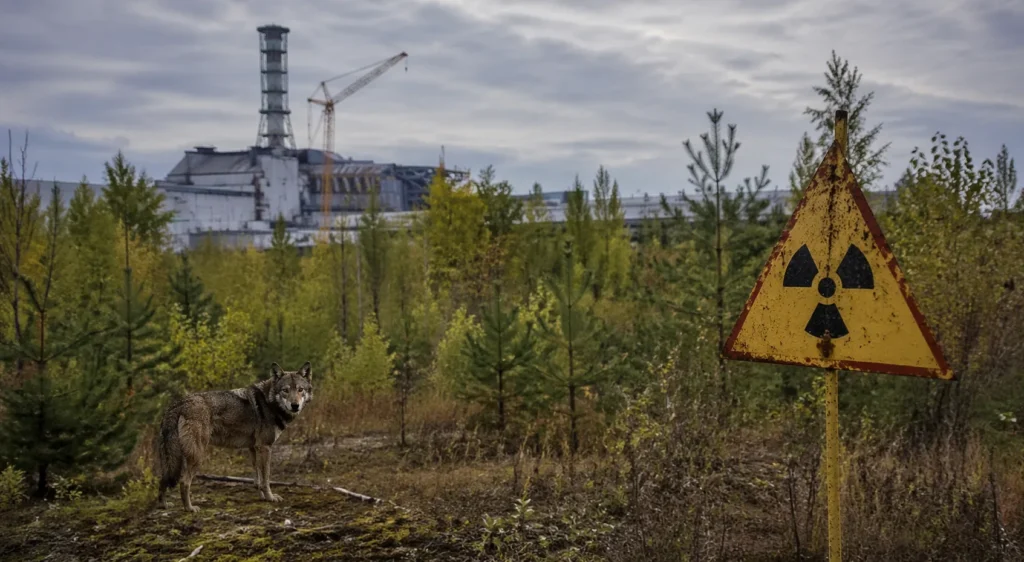

Introduction: A Spring Morning That Changed Everything
Before dawn on April 26, 1986, the people of Pripyat, Ukraine, were sleeping soundly. It was a Saturday. Kids dreamed of playing soccer. Parents planned barbecues. Grandparents looked forward to gardening. The city of Pripyat was built specifically for workers at the Chornobyl Nuclear Power Plant and their families. It had tree-lined boulevards, a modern hospital, a swimming pool, and a beautiful Ferris wheel in the central amusement park. That Ferris wheel would never spin for children. At 1:23 a.m., a badly designed safety test at the nearby reactor went horribly wrong. Reactor Unit 4 ripped itself apart like an eggshell hit from the inside. It shot a radioactive cloud so high that it reached the stratosphere, where winds carried it across continents.
Within weeks, 116,000 people were evacuated forever. They left their stuffed animals on beds, their wedding photos on walls, and their potted plants on windowsills. They left their cars in the streets — later bulldozed into radioactive graves. They left their pets behind, thinking they would return in three days. Three days became three weeks. Three weeks became forty years. The Soviet Union built a giant concrete sarcophagus to hide the wreckage, but it was rushed and leaky. Then nature did something strange: it moved back in without asking permission.
Today, forty years later, the Chornobyl Exclusion Zone is a 2,600-square-kilometer puzzle — roughly the size of Luxembourg. About half the original caesium-137 is still in the soil. Plutonium-239 will outlast the Pyramids. Tritium moves invisibly through groundwater. Americium-241 is actually increasing as the years pass. But wolves, lynx, eagles, brown bears, and even wild horses roam highways that haven’t seen a car in decades. This is not a fairy tale. It is a real-world science experiment — one we never planned to run, and one we are still struggling to understand.
Let’s walk through the woods, dodge the hot spots, wade through the science, and ask a surprising question: What if humans were the real disaster all along? And what does that mean for the future of our planet?
H2: The Blast That Redrew the Map – What Actually Happened at Unit 4
To understand Chornobyl today, you have to go back to that terrible test. It sounds like a bad Hollywood script, but it really happened. Engineers wanted to see if the reactor’s spinning turbines could keep powering emergency pumps during a blackout. This was a normal safety test. Nuclear plants do similar tests all over the world. But the RBMK-1000 reactor design had a fatal flaw that Soviet leaders had tried to hide. When cooling water turned to steam, the nuclear reaction ran wild instead of slowing down. It was like a car accelerator that sticks to the floor.
At 1:23 a.m., the operators made one last mistake. They pulled out too many control rods. The reactor went from low power to a massive, unstoppable surge in seconds. Two explosions blew the 2,000-ton steel-and-concrete lid off the reactor like a champagne cork. Flaming chunks of graphite — the stuff inside pencils, but much hotter and radioactive — rained onto nearby buildings, starting thirty separate fires. Firefighters who arrived within minutes had no radiation suits. They wore cotton shirts and canvas boots. Many picked up pieces of glowing graphite with their bare hands because they didn’t know what it was. They died in hospitals weeks later, their skin peeling off, their bone marrow destroyed. Their bravery saved Europe from an even larger catastrophe, but at a terrible cost that their families still feel.
For ten days, the open reactor spewed radioactive particles into the atmosphere. The cloud contained iodine-131 (which attacks the thyroid gland), caesium-137 (which acts like potassium in the body and stays for decades), strontium-90 (which replaces calcium in bones), and plutonium particles so fine that you could inhale them without knowing. Wind carried these poisons over Belarus, Russia, Scandinavia, Poland, Germany, Austria, and as far as the United Kingdom. Sheep in northern Wales were still too radioactive to sell years later. The Soviet government finally admitted the truth on April 28 — but only after Swedish scientists detected unusual radiation on their own clothes and demanded an explanation.
The immediate death toll is debated to this day. The official Soviet number was 31 direct deaths from blast injuries and acute radiation sickness. But that number counts only plant workers and firefighters. It does not include the hundreds of thousands of “liquidators” — soldiers, miners, and civilians who were drafted to clean up the mess. They shoveled radioactive debris off roofs, buried contaminated forests, and built the sarcophagus. Many received radiation doses that would be illegal today. The World Health Organization estimates that thousands of cancers across Eastern Europe over the following decades can be traced to Chornobyl. The real story, however, is not just about human pain. It’s about the land itself, and whether land can forgive.
H2: Half of the Caesium-137 Is Still Here – And It’s Not Going Anywhere Soon
Fast-forward forty years. Picture a Geiger counter clicking like a tapped spoon. That clicking sound is the voice of invisible danger. Now walk into the Red Forest — a pine woodland just 500 meters from the ruined reactor. The trees are still stunted. Their needles turned rust-red in 1986 and never fully recovered. They look like they were freeze-dried in a nightmare. When scientists measure radiation here, the counter doesn’t click. It buzzes like a angry hornet. That buzzing means radiation levels are thousands of times higher than normal background.
Caesium-137 is the main culprit in most of the Zone. It has a half-life of thirty years. That means every three decades, half of it decays into a safer element called barium-137. But forty years on, nearly half of the original explosion’s caesium is still active. In the Red Forest, levels reach 10–20 millisieverts per hour. For comparison, a chest X-ray delivers about 0.1 millisievert. A dental X-ray is even less. You would reach your yearly safety limit for a radiation worker in about ten minutes in the Red Forest. One hour would give you a dose equivalent to two hundred chest X-rays. A full day would make you severely ill.
But caesium isn’t the only ghost haunting the Zone. Let’s talk about plutonium-239. Its half-life is 24,100 years. That’s not a typo. Twenty-four thousand one hundred years. For perspective, recorded human history is about 5,000 years. Agriculture began 12,000 years ago. The last Ice Age ended 11,700 years ago. Plutonium will still be dangerous when today’s skyscrapers have turned to dust. Americium-241, which forms as plutonium decays slowly over time, is actually increasing in the soil. Every year, a tiny bit more plutonium turns into americium. By 2086 — one hundred years after the accident — americium will be the dominant long-lived hazard in the deepest hot spots.
Tritium is the sneaky one. It’s radioactive hydrogen. It bonds with oxygen to make radioactive water. You cannot taste it, smell it, or feel it. It looks exactly like ordinary water. Tritium has a short half-life of 12.3 years, so most of the original explosion’s tritium is gone. But the melted fuel inside the reactor is still reacting with rainwater. Scientists measured tritium in groundwater 2.5 kilometers from the plant as recently as 2023. The levels are not dangerous for wildlife or for the rare humans who work in the Zone. But tritium is a reminder that the reactor is not a dead monument. It is still leaking. It will keep leaking for decades.
Scientists measure all these radioactive elements in becquerels — the number of radioactive decays per second in a kilogram of soil. In a safe area, you might find 100 becquerels per kilogram. In a normal city park, maybe 500. In the Red Forest, you will find 500,000 becquerels per kilogram in some patches. To put that in human terms: eating one mushroom from that patch would give you the same radiation dose as two hundred dental X-rays. Eating a whole meal of berries, mushrooms, and meat from that area could give you acute radiation poisoning. So yes, Chornobyl remains dangerously radioactive. Yet something unexpected is happening across most of the Zone. Life is not just surviving. In some ways, it is thriving.
H2: No Humans Allowed – How Evacuation Accidentally Created a Wildlife Reserve
Here is the twist that confuses everyone who first hears it. In 1986, experts predicted a “dead zone” for centuries. They expected a barren wasteland of mutated insects, sickly birds, and stunted trees. They thought the Exclusion Zone would look like the surface of the moon, but with more rust. Instead, cameras hidden in the woods have photographed: Eurasian lynx stalking rabbits, Przewalski’s horses (an endangered species) rolling in dust baths, a brown bear — first seen in 2014 after more than a century’s absence — and golden eagles nesting on the smokestacks of abandoned factories. Wild boar roam the streets of Pripyat. Beavers have dammed the cooling channel. Even moose — which usually avoid human areas — walk right through empty bus stations.
How can this be? Isn’t radiation poison? Yes. Radiation damages DNA. It causes cancer. It reduces fertility. It shortens lifespans. No scientist disputes that. But here is the critical fact that many people miss: humans are even more poisonous to wildlife. Before the accident, the region was home to 50,000 people. They hunted deer for sport. They trapped beavers for fur. They killed wolves on sight because wolves sometimes attacked livestock. They plowed up meadows for wheat fields. They cut down old forests for firewood. They built roads that split animal habitats into tiny fragments. Their cats and dogs killed millions of small birds and rodents every year. Their cars hit thousands of animals on the roads.
After the evacuation, all of that stopped. No poachers. No tractors. No towns expanding into wetlands. No stray cats. No highways. The animals didn’t get a memo about radiation risk. They just looked around and said, “Oh, the humans are gone. Let’s move in.” They don’t have Geiger counters. They don’t know what a half-life is. They just know that the loud, dangerous, habitat-destroying creatures have left.
A major 2015 study in the journal Current Biology compared Chornobyl to four uncontaminated nature reserves in Belarus and Ukraine. The results shocked even the scientists who ran the study. Chornobyl had as many moose, roe deer, and wild boar as the clean zones — and more wolves. In fact, wolf density was seven times higher than in nearby protected areas that still allowed limited hunting. The researchers set up camera traps at 94 sites across the Zone. They captured thousands of images of animals going about their daily lives, completely ignoring the radiation.
One researcher, Dr. Jim Smith of the University of Portsmouth, put it bluntly in a public lecture: “The radiation effects are not negligible. They are real. But the effect of removing human habitation and farming has been much larger — so large that it overwhelms the negative effects of radiation for most large animals.” In other words, a radioactive ghost town is safer for a wolf or a lynx than a healthy forest with people, guns, and traps. That is not an excuse for nuclear accidents. It is a sad observation about how heavily we impact the natural world.
H2: The Animals of the Zone – Mutants, Adaptations, and Surprising Survivors
You have probably heard scary stories about Chornobyl’s animals. Two-headed wolves. Glowing fish in the cooling pond. Giant catfish the size of small cars. Let’s separate fact from fiction, because the truth is far more interesting than the rumors.
Yes, mutations happen. That is not a myth. Scientists have found barn swallows in the Zone with partially white feathers — a sign of genetic damage that affects how they attract mates. Bank voles living in the most contaminated areas have shorter lifespans and produce smaller litters. Frogs sometimes have extra legs or missing eyes. The mutation rate in some bird species is up to 20 times higher than normal. This sounds terrible, and in a way it is. But here is the hopeful nuance: most mutations are not visible. And most visible mutations are lethal — meaning the animal dies before it can reproduce. Nature has a brutal but effective way of removing badly damaged individuals.
Also, many animals simply move away from the worst hot spots. The Zone is huge — 2,600 square kilometers. If a vole’s burrow sits on a plutonium speck that gives it a high dose every day, it can scurry fifty meters to cleaner soil. If a bird builds a nest in a hot tree, the next year it might choose a different tree. Mobile animals have the ability to avoid the worst areas. That’s why you see more deformities in insects and small rodents that have small home ranges than in wolves and horses that roam widely.
The most famous survivors are the Przewalski’s horses. These stocky, prehistoric-looking animals are the last surviving species of wild horse. They were almost extinct in the wild by the 1960s, surviving only in zoos. In 1998, conservationists released thirty horses into the Zone. No one knew if radiation would kill them. Today, more than 150 roam freely. They graze near abandoned buses. Their foals play in empty schoolyards. Tourist photos show them standing calmly in front of the reactor’s new confinement arch. Their population is growing. Their birth rates are normal. Their lifespans are average for the species. Scientists have studied their blood and found no increase in cancer compared to horses in clean reserves. Why? Possibly because the horses avoid the worst areas. Possibly because their large bodies dilute the radiation effect. Possibly because they are just lucky.
Even the “Radioactive Dogs” of Chornobyl — descendants of pets left behind in 1986 — have adapted in strange and interesting ways. A 2023 DNA study published in the journal Science Advances compared the genomes of 302 stray dogs living inside the Zone to dogs living outside. The Chornobyl dogs were genetically distinct — not a separate species, but a separate population with unique markers. Some of those markers were in genes linked to DNA repair. In other words, the dogs that had better natural abilities to fix damaged DNA survived and passed those abilities to their puppies. Over thirty generations, the population as a whole became somewhat more tolerant of radiation. They are not superheroes. They still get cancer at higher rates than normal dogs. But they have evolved — in a few decades — what normally takes thousands of years.
But here is the important warning: adaptation is not magic. Animals still suffer radiation sickness if they eat too much contaminated food. The Zone is not safe. It’s just that the absence of people outweighs the danger for most species. A wolf that gets a small radiation dose every day might live nine years instead of twelve. But a wolf in a hunted zone lives less than two years on average because people shoot it. The math is brutal but simple.
H2: The Long Shadows – Plutonium, Americium, and the 24,000-Year Problem
Now let’s talk about the really long-lasting poisons that will outlive our civilization. Caesium-137 will be mostly gone by 2106 — about one hundred years after the accident. That is within the lifetime of children born today. But plutonium and americium are on a completely different clock. They are the long shadows that stretch into a future we cannot imagine.
Plutonium-239 is an alpha emitter. Alpha particles cannot penetrate your skin. You could hold a pellet of plutonium in your bare hand and feel nothing. In fact, plutonium is warm to the touch because of its radioactive decay, but it does not burn you externally. The danger is internal. If you inhale or swallow even a microscopic speck of plutonium dust — smaller than a grain of pollen — it lodges in your lungs or bones. It sits there for years, decades, or your entire life, bombarding surrounding cells with alpha particles. Each alpha particle tears through DNA like a tiny bullet. One speck, over forty years, can cause cancer. The half-life of 24,100 years means half of what fell in 1986 will still be there in the year 26,086. That is longer than recorded human history. The pyramids at Giza are only 4,500 years old. The first cities were built 6,000 years ago. Plutonium will outlast all of it.
Americium-241 is even trickier. It does not come directly from the reactor core. It forms as a decay product of plutonium. So as the years pass, americium levels actually rise. In 1986, there was almost no americium in the Zone. By 2026, there is measurable americium. By 2086 — one hundred years after the accident — americium will be the dominant long-lived radioactive element in some of the deepest hot spots. And americium is also an alpha emitter, just as dangerous as plutonium. But it has a shorter half-life of 432 years. That means it decays faster than plutonium, which is actually good news in the very long term. In 5,000 years, most americium will be gone. Plutonium will still be there.
What does this mean for the environment? In practical terms, the deepest areas of the Zone — the Red Forest, the reactor’s immediate surroundings, the buried equipment graveyards, and the “dirty” roads where contaminated vehicles were abandoned — will remain dangerous for thousands of years. No one can live there permanently. You could not farm there. You could not raise children there. The ground itself is poisonous. But here is the key point that many people miss: large animals do not need to live permanently in one spot. They wander. A wolf pack might use the Red Forest as a hunting ground for a few days, then move to cleaner areas. An elk might graze on a hot meadow for a week, then cross into a cold valley. The radiation dose they receive is not zero, but it is not deadly in the short term. And because there are no humans with guns, they can afford to take that risk.
Scientists call this “the paradox of Chornobyl.” The most contaminated parts of the planet — piece for piece, square meter for square meter — are also some of the most biologically diverse in Europe. Not because of radiation, but despite it. The radiation is a tax on life. The removal of humans is a gift to life. The gift is larger than the tax. That is the central, counterintuitive, uncomfortable truth of this entire story.
H2: What Tritium Teaches Us About Invisible Danger
You can see caesium with a Geiger counter. You can feel plutonium in your lungs if you breathe it (though by then it’s too late). You can watch a dosimeter climb as you approach a hot spot. But tritium is a ghost’s ghost. It’s a radioactive form of hydrogen. It bonds with oxygen to make “tritiated water” — radioactive water that looks, tastes, and smells exactly like normal water. You could drink a glass of tritiated water and not know it. Your body would not feel anything for years. Then, maybe, you would get a rare bone cancer.
Tritium has a short half-life of 12.3 years. Most of the original explosion’s tritium is gone. In fact, by 2026, only about 16% of the original tritium remains. But here is the problem that keeps radiation safety officers awake at night: the Chornobyl reactor still holds melted nuclear fuel inside the New Safe Confinement — a giant arch of steel and concrete built in 2016 to replace the old crumbling sarcophagus. The fuel is not a solid block. It is a lava-like material called “corium” that flowed through the reactor building like candle wax. It contains thousands of tons of radioactive elements. Rainwater seeps into the New Safe Confinement through tiny cracks, touches the corium, and becomes radioactive. Then it leaks back into the environment.
In 2020, an international team of scientists measured tritium in groundwater up to 2.5 kilometers from the plant. The levels were well below unsafe limits for wildlife and for the rare humans who work in the Zone. But tritium moves fast through groundwater — faster than caesium or plutonium, which stick to soil particles. A droplet of tritiated water can travel a kilometer in a few months. So the tritium from Chornobyl is not just a local problem. It is a regional tracer that tells scientists where the water goes.
The lesson from tritium is simple but profound: radiation is not one thing. It’s a family of different particles and different behaviors. Some stay in soil. Some travel in water. Some concentrate in bones. Some pass through the body in days. Some lodge for life. Some decay quickly. Some last longer than human civilization. Understanding these differences is the key to living with Chornobyl’s long aftermath — and to cleaning up future nuclear accidents.
H2: The Science Debate – Does Radiation Harm or Help Nature?
Not all scientists agree on what Chornobyl’s wildlife means. In fact, a quiet but intense debate has been going on for twenty years between two research camps. Their disagreement is not about facts. It is about interpretation. And the stakes are high because how we interpret Chornobyl affects how we manage nuclear risks in the future.
Camp One: Radiation Is Bad, Full Stop. This camp is led by researchers like Dr. Timothy Mousseau of the University of South Carolina. He has spent more than twenty summers in the Zone, collecting insects, birds, and small mammals. His data shows fewer butterflies in high-radiation areas, more deformed bird beaks, lower populations of bumblebees, and reduced sperm quality in male birds. In one study, he and his colleagues captured more than 1,600 birds across the Zone and found that the most contaminated areas had 50% fewer bird species. They also found that barn swallows in the Zone had more white spots on their feathers — a sign of oxidative stress from radiation damage. Mousseau argues that the apparent “wildlife boom” is an illusion created by small sample sizes and poor study design. In his view, radiation quietly damages DNA across generations, and the damage adds up over time. The animals that seem healthy today may have shorter lifespans and lower reproduction rates that we haven’t fully measured.
Camp Two: The Boom Is Real. This camp is led by Dr. Jim Smith of the University of Portsmouth and Dr. Sergey Gaschak, a Ukrainian biologist who has worked in the Zone since 1990. They point to long-term camera trap studies, animal tracking collars, and aerial surveys. They agree that radiation causes measurable harm. They do not deny the deformed bird beaks or the reduced bumblebee populations. But they argue that the harm is small compared to the benefits of removing 50,000 people, their farms, their cars, their hunting rifles, and their domestic cats. In a 2015 paper, Smith calculated that the wolf population in the Zone was seven times higher than in nearby clean reserves. He also showed that moose and roe deer populations were stable or growing. His conclusion: “The radiation has not prevented the establishment of a thriving mammal community.”
Who is right? The most honest answer is probably both. Imagine a scale with two sides. On one side: radiation increases cancer risk, speeds up aging, reduces fertility, and causes genetic mutations. On the other side: no traffic, no poaching, no habitat destruction, no livestock grazing, no pesticide spraying, no noise pollution, and no light pollution at night. For most large mammals that have large home ranges and long lifespans, the second side is heavier. They can afford to lose a few years of life if they are not being shot. For insects and small birds that have tiny territories and short lifespans, radiation might tip the scale the other way. A bumblebee that lives only six weeks cannot afford a 20% reduction in reproduction. A wolf that lives twelve years can afford a 10% reduction.
This debate is not just academic. It matters for how we think about conservation. If Chornobyl shows that removing humans is more protective than the harm from radiation, then we should consider creating more “human exclusion zones” — not by causing nuclear accidents, but by setting aside large areas where people are not allowed to hunt, farm, or build. That is a policy idea called “rewilding.” It is already happening in places like the Chernobyl Zone, the Korean Demilitarized Zone, and abandoned farmland in Eastern Europe. But if radiation is secretly damaging ecosystems in ways we cannot see, then we should be much more cautious about writing off nuclear accidents as “not so bad.”
One thing everyone agrees on: Chornobyl is not a paradise. It’s a brutal, radioactive wilderness where animals struggle and sometimes fail. But it’s a wilderness where wolves chase elk past rusting Ferris wheels — and that’s a sight you will never see anywhere else on Earth.
H2: The Human Exclusion Zone – Why People May Never Come Back to Stay
About 2,000 people defied orders and returned to the Zone after the evacuation. They are called “samosely” — a Russian word meaning “self-settlers.” They were mostly elderly women in the 1980s and 1990s, many of them widows who had nowhere else to go. When government officials told them to leave, they said things like, “Radiation cannot be worse than Stalin’s purges,” or “I was born in this house, and I will die in this house.” They moved back to their cottages, planted vegetable gardens, and milked their cows. They drank from local wells. They burned wood from contaminated forests in their stoves — which released radioactive particles into the smoke inside their homes, a terrible idea that shows how little they understood the invisible danger.
Today only about 100 samosely remain, with an average age over 80. The Ukrainian government lets them stay but provides no medical care, no electricity subsidies, no road maintenance, and no radiation monitoring. Every few years, social workers visit to check if they are still alive. When one dies, the house is usually bulldozed and buried as radioactive waste. The samosely have become folk heroes in some circles — symbols of stubbornness and attachment to the land. But they are not healthy. Studies of their bodies show elevated levels of caesium-137 and strontium-90 in their bones. They have higher rates of cataracts, thyroid disease, and lukemia than the general Ukrainian population. Their lives are short, hard, and lonely.
For the rest of us, permanent residence in the Zone is not going to happen. Not in your lifetime. Not in your grandchildren’s lifetime. The official Exclusion Zone is patrolled by armed guards. The borders are marked with barbed wire and signs in Ukrainian and English that say “DANGER! RADIOACTIVE CONTAMINATION! UNAUTHORIZED ENTRY PROHIBITED!” You cannot visit without a government-issued permit. And for good reason: the radioactive dust lies on leaves, in puddles, on windowsills, on every surface that has not been washed by rain for forty years. A child playing outside in the Red Forest would inhale or swallow tens of thousands of radioactive particles in a single summer. That child would absorb a radiation dose large enough to cause thyroid cancer by age twenty.
However, tour companies now run limited one-day trips inside the Zone. Visitors wear dosimeters on their belts, stay on paved roads, eat only food they brought from outside, and are strictly forbidden from touching anything — no leaning on walls, no picking flowers, no sitting on the ground. It sounds dangerous, but the radiation dose for a one-day tour is less than a round-trip transatlantic flight. That’s because high-altitude cosmic rays are also a form of radiation. A flight from New York to Tokyo delivers about 0.1 millisievert. A one-day tour of Chornobyl’s less contaminated areas delivers about 0.05 millisievert. The real risk is not the day of the tour. It’s the false sense of safety it creates. Tourists often say, “It felt fine. The dosimeter barely clicked.” Then they might try to sneak back without a guide, or touch a piece of metal they thought was safe, or eat a berry from a bush. That is when people get hurt.
The long-term plan for the Zone is strange and still being debated. The New Safe Confinement will be maintained for another hundred years. Robots inside the arch are slowly dismantling the most unstable parts of the old reactor. The goal is to turn the wreckage into a stable, dry, monitored state by 2065. After that, the plan is unclear. Some experts want to leave the Zone as a permanent nature reserve and research station. Others want to gradually clean up the worst hot spots using robots and radiation-eating bacteria. A few dream of returning the land to farming after 500 years. But no planner seriously expects people to live near the reactor again. Not in your lifetime. Not in your grandchildren’s lifetime. Probably not ever.
H2: Lessons for Future Disasters – What Chornobyl Teaches Fukushima and Beyond
Every nuclear accident teaches the same lesson in a different way. Fukushima Daiichi, Japan, melted down in March 2011 after a massive earthquake and a tsunami that drowned the backup generators. The Japanese government evacuated 150,000 people from a 20-kilometer zone around the plant. Today, that zone also has booming wildlife. Wild boar have taken over abandoned towns. Japanese serow — a goat-like animal with short horns — are seen on empty roads. A rare fox species has returned to areas where it had not been seen in decades. Nature moves in when people move out.
But Fukushima is different from Chornobyl in three key ways that matter a great deal. First, most of Fukushima’s radiation was caesium-137 and iodine-131. There was very little plutonium because the Fukushima reactors were a different design — boiling water reactors, not the RBMK type at Chornobyl. Plutonium is the long-term headache. Fukushima’s landscape will be mostly safe for permanent human habitation within 30 to 50 years. Chornobyl’s landscape will not be safe for thousands.
Second, Japan is much more crowded than the Chornobyl region. There is no “spare” land in Japan. The evacuated zone includes prime farmland, fishing ports, and entire towns that people desperately want back. The Japanese government has spent billions of dollars scraping off contaminated soil, washing buildings, and replacing topsoil. Some towns have reopened. People have returned — though many are elderly, and young families are still afraid. In Chornobyl, by contrast, the land was never especially valuable for farming (the soil was poor), and Ukraine has plenty of empty space. There was never a strong economic reason to bring people back.
Third, the Japanese authorities have been much more aggressive about radiation monitoring and decontamination than the Soviet or Ukrainian authorities ever were. Every schoolchild in the Fukushima region wears a dosimeter. Every meal is tested. Every forest is mapped for hot spots. This has reduced human radiation exposure dramatically. But it has also cost more than $100 billion so far. Ukraine could never afford that.
What has Chornobyl taught the world about future nuclear accidents? Three big lessons stand out.
Lesson one: Evacuation saves lives in the short term but creates a permanent wild zone. Planners must decide upfront: do we want people to return, or do we accept that the land will become a nature reserve? This is a political question, not just a scientific one. Japan chose return. Ukraine chose abandonment. Neither choice was wrong. They just had different circumstances.
Lesson two: Long-lived isotopes change the math completely. If your accident produces plutonium and americium, you are managing a problem for millennia, not decades. That means you cannot just wait for nature to clean up. You must design permanent barriers, monitoring systems, and warning signs that will last longer than any human civilization has ever lasted. That is a terrifying engineering challenge.
Lesson three: Nature is incredibly resilient, but not immune. The animals of Chornobyl are not superheroes. They are not “radiotrophic mutants.” They are just animals that got lucky when humans left. They still suffer. They still die young. They still have tumors. But they also adapt, reproduce, and fill the empty spaces. The lesson is not that radiation is harmless. The lesson is that removing humans is an overwhelmingly positive intervention for most wild species.
Future engineers designing new nuclear reactors must now think about “post-accident landscapes.” What will this place look like in 100 years? In 1,000 years? In 10,000 years? The architects of the New Safe Confinement built it to last 100 years. They have no answer for year 101. That is not a criticism — it is just an honest admission that no one knows how to build anything that lasts 10,000 years. The pyramids have lasted 4,500 years, but they are just stone blocks. They do not have to keep out water and radiation. We are asking our generation to solve a problem that our great-great-great-great-great-grandchildren will still be dealing with. That is a sobering thought.
H2: Walking Through the Red Forest – A Story of Hot Ash and Quiet Birds
Let me take you on a short imaginary walk. You are not actually there — that would be unsafe without a trained guide and proper equipment. But the scientists who have made this walk dozens of times have described it in detail. Close your eyes and imagine.
You are standing at the edge of the Red Forest on a cool October morning. No wind. The sky is overcast. The air smells like damp earth and rust. You wear rubber boots, a disposable white suit with a hood, a full-face mask with a filter, and thick rubber gloves. Your dosimeter is clipped to your belt. It starts at zero when you step off the bus.
Step one: you crunch through pine needles. The ground feels spongy. The dosimeter reads 0.5 microsieverts per hour. That is normal backyard levels in many parts of the world. You relax a little.
Step fifty: you pass a mossy log. Moss is a sponge for radioactive particles — it holds them like a filter. The dosimeter jumps to 50 microsieverts per hour. An invisible hot spot. You step around it carefully, staying on the path. The scientists who marked this path years ago knew where the hot spots were.
Step two hundred: you reach a clearing. Here, in 1986, a bulldozer scraped up the top layer of soil containing radioactive fuel particles. It dumped that soil into trenches nearby. But the bulldozer itself became contaminated. The workers drove it into the clearing and left it. It still sits there — a yellow, rusted machine with a cab full of moss and bird nests. The dosimeter, when pointed at the bulldozer from 20 meters away, reads 2,000 microsieverts per hour. You take a quick photo and back away slowly. You do not run. Running stirs up dust, which you might inhale.
The birds are quiet. Not absent — you see a crow fly overhead, and you hear a distant woodpecker — but fewer than in a normal forest. Studies show that radiation reduces bird diversity in the Red Forest by about 50 percent compared to clean areas. The ones that stay have smaller brains on average. They more often have tumors. Some have white patches where their feathers should be colored. They still sing. But their songs sound… tired. That is not poetry. That is a scientific observation. Birds in high-radiation areas sing shorter, simpler songs because the parts of their brains that control singing are damaged.
What you do not see: bacteria and fungi are thriving. Radiation kills some microbes but not all. In fact, scientists have discovered that some fungi in Chornobyl have evolved to eat radiation. They contain a dark pigment called melanin — the same pigment that gives human skin its color. Melanin can absorb gamma radiation and convert it into chemical energy, similar to how chlorophyll absorbs sunlight. These “radiotrophic fungi” were discovered growing on the walls of the ruined reactor itself. They are black, fuzzy, and completely harmless to humans. But they are fascinating. Scientists are studying them for possible use in space travel. Imagine a spacecraft covered in a layer of living fungus that feeds on cosmic rays and produces oxygen as a waste product. That is not science fiction. That is an active research project at the University of North Carolina.
So even in the most contaminated corner of the Zone, life finds a way. Not always pretty. Not always healthy. But always stubborn. Always surprising.
H2: The Unexpected Consequences of Abandonment – Fires, Poaching, and a War
Chornobyl’s story took another sharp turn in 2022 — one that no one predicted. Russian military forces seized the plant during the first weeks of the war in Ukraine. They held the staff at gunpoint. They dug trenches in the Red Forest, stirring up radioactive dust that had been undisturbed for decades. They drove armored vehicles through the most contaminated areas, kicking radioactive soil into the air. Workers at the plant were held for 35 days without being allowed to leave. The New Safe Confinement was damaged by an explosion (not the reactor itself — the explosion happened in a nearby building). Radiation monitoring equipment was looted or destroyed.
For several terrifying weeks, the world did not know if the reactor was safe. International nuclear inspectors could not enter because of the fighting. It turned out that the reactor itself was not damaged. But the incident highlighted a deeper, sadder lesson: even a radioactive wasteland is not safe from human violence. The same year Russian tanks rolled through the Zone, a massive forest fire burned 10,000 hectares of contaminated woodland. Fire releases radioactive caesium and strontium into smoke, which can blow hundreds of kilometers downwind. Firefighters had to make terrible choices: let the fire burn and poison the air, or rush in and breathe radioactive smoke themselves. Some chose the second option. Their long-term health is now a concern.
Poaching is another hidden problem that has grown worse since the war began. Wolves have no legal protection in the Zone — they are considered a pest species because they sometimes wander into nearby farms and kill livestock. But they are also valuable for their fur. Lynx are poached for their spotted coats. Even the Przewalski’s horses, which are endangered worldwide, have been shot by poachers who sell their meat as “wild game” in black markets. Rangers do their best, but the Zone is huge — 2,600 square kilometers — and the ranger force is tiny and poorly equipped. Before the war, there were about 40 rangers. After the war started, many were drafted into the military. Now there are fewer than 10. Poachers know this. They drive into the Zone at night, shoot whatever they see, and drive out before dawn. No one stops them.
So the idea that Chornobyl is a peaceful nature reserve is only half true. It is also a lawless borderland, a military target, a fire hazard, and a place where animals are sometimes killed for profit. Nature is resilient, but it is not magic. When humans return — even with bad intentions — the animals suffer. The same humans who caused the accident in 1986 are still the biggest threat to the Zone’s wildlife four decades later. That is a bitter irony.
H2: Forty Years Later – What the Numbers Really Mean
Let’s stop and look at the raw numbers. These are the key facts that every scientist who studies Chornobyl keeps in their back pocket. They tell the real story better than any dramatic description.
| Contaminant | Half-life | Amount remaining (2026) | Main danger pathway | Long-term trend |
|---|---|---|---|---|
| Caesium-137 | 30 years | ~46% | External gamma; absorbed by plants; concentrates in mushrooms | Decreasing steadily |
| Strontium-90 | 29 years | ~47% | Replaces calcium in bones; causes lukemia; moves through milk | Decreasing steadily |
| Plutonium-239 | 24,100 years | >99% | Inhaled alpha particles; lung cancer; essentially permanent | Nearly unchanged |
| Plutonium-240 | 6,560 years | >99% | Similar to Pu-239; less common | Nearly unchanged |
| Americium-241 | 432 years | Increasing (from Pu-239 decay) | Similar to plutonium; becomes dominant after 100 years | Increasing until ~2086 |
| Tritium | 12.3 years | ~16% | Moves in water; low risk to wildlife at current levels | Decreasing quickly |
| Iodine-131 | 8 days | 0% | Thyroid cancer; dangerous only in first months | Gone by 1987 |
And here is the big-picture number that keeps nuclear engineers awake at night: the total radioactive inventory — the amount of dangerous stuff — inside the New Safe Confinement is still about 95% of what it was in 1986. The caesium and strontium have decayed a bit. The iodine is long gone. But the heavy elements — plutonium, americium, curium, neptunium — are almost entirely unchanged. The reactor is not cleaning itself. We have just put a lid on it. A very expensive, very heavy lid that cost 1.5 billion euros and took a decade to build. But still just a lid.
Now compare that to the wildlife numbers. A 2020 aerial survey counted 1,500 moose, 3,000 roe deer, 1,200 wild boar, and 400 wolves in the Ukrainian part of the Zone alone. The Belarusian side (the Zone crosses the border) has similar or larger numbers. That means the total wolf population in the Exclusion Zone is roughly the same as in Yellowstone National Park — but Yellowstone is only one-fifth the size. Wolf density in Chornobyl is among the highest in the world. Elk density is also high. Beaver dams are everywhere. Eagles nest on the old cooling towers.
So what do these numbers tell us? They tell us that the relationship between radiation and wildlife is not a simple line. It is not “more radiation equals fewer animals.” The real relationship is “less humans equals more animals, even when radiation is high.” That is a hopeful message for conservationists. It means that even badly damaged landscapes can recover if we step back. But it is also a cautionary message. It means that our presence — not just our pollution, but our very existence in a landscape — is often the biggest stressor on wildlife. We are the elephant in the room that no one wants to name.
H2: The Humans Who Stayed – Stories from the Samosely
Not everyone left. The samosely — the self-settlers — are the closest thing Chornobyl has to permanent residents. Their stories are heartbreaking, strange, and deeply human. Let me tell you about three of them, based on interviews collected by researchers over the years.
Hanna Zavorotnya was 62 years old when the accident happened. She lived in the village of Kupovate, about 25 kilometers from the reactor. When the soldiers came to evacuate, she refused. “I told them,” she said in a 1995 interview, “’You go. I have chickens. I have a cow. My mother is buried in the cemetery down the road. I am not leaving my mother.’” The soldiers shrugged and left. Hanna lived another 22 years in the Zone, growing potatoes, milking her cow, and drinking from her well. She died in 2008 at age 84 — not of radiation-related cancer, but of a stroke. Her daughter, who lived in Kyiv, had her body removed from the Zone and buried in a normal cemetery. The house was bulldozed. Today, nothing remains but a pile of rubble and a pear tree that still bears fruit.
Ivan Martynenko was a former plant worker who retired to the Zone in 1990. He knew about radiation — he had worked at Chornobyl for fifteen years before the accident. He said, “I already got my dose at work. A little more won’t make a difference.” Ivan built a small wooden house near the abandoned village of Krasne. He fished in the Pripyat River, even though the fish were contaminated. He ate mushrooms from the forest. He hunted rabbits. A 2001 medical exam found high levels of caesium-137 in his body — about ten times the legal limit for a member of the public. But Ivan felt fine. He said, “The doctors told me I would die in five years. That was eleven years ago.” Ivan finally died in 2015 at age 73 from a heart attack. His family buried him in the Zone, in a small cemetery that also holds the graves of samosely who died before him. The grave markers are wooden crosses painted with radioactive trefoil symbols — a warning to anyone who might disturb them.
Maria Shovkuta was the last resident of the village of Lidyovka. She moved back in 1987 with her husband, who died in 1992. Maria lived alone for thirty years. She had no electricity, no running water, no telephone. She grew vegetables, kept two cows, and made her own cheese. Ukrainian police visited once a year to check if she was still alive. Journalists made the journey sometimes to photograph her. In 2017, when she was 86, she fell and broke her hip. The police found her three days later, lying in her yard in the rain. They flew her by helicopter to a hospital in Kyiv. Maria refused surgery. She said, “I want to go home to die.” The doctors kept her for two weeks, but she refused to eat. They finally released her. She died three days after returning to her cottage. The police bulldozed the house the same week. Today, Lidyovka is a clearing in the forest, marked only by a single apple tree.
The samosely are mostly gone now. The youngest is in her late seventies. The oldest is 98. Every year, a few die. Their houses are destroyed. Their gardens grow wild. Within ten years, there will be no self-settlers left in the Zone. Their way of life — stubborn, dangerous, beautiful — will be a memory. Perhaps that is for the best. The Zone was never meant to be a home. It is a scar. But for a few decades, it was also a refuge for old people who had nowhere else to go.
H2: The New Safe Confinement – A Miracle of Engineering with a 100-Year Warranty
In 2016, the world held its breath while a team of international engineers slid a giant steel arch over the ruined reactor. The New Safe Confinement is 108 meters tall — taller than the Statue of Liberty — and 257 meters wide. It weighs 36,000 tons. It cost 1.5 billion euros, paid mostly by international donors. It was built 300 meters away from the reactor, then pushed into place on Teflon pads using hydraulic jacks. The whole move took 40 hours. When it clicked into position, the workers inside the control room cheered and cried.
The purpose of the arch is not to fix the reactor. That is impossible. The purpose is to contain it for the next 100 years while engineers figure out what to do next. The arch is sealed, ventilated, and kept at negative air pressure so that no radioactive dust can escape. Inside, remote-controlled robots are slowly cutting up the most dangerous parts of the old sarcophagus. The robots are designed to work in radiation levels that would kill a human in minutes. They have thick lead shielding, multiple cameras, and arms that can rotate in any direction. They move at a crawl — faster than a human but slower than a car — because every movement stirs dust.
The biggest challenge is the “elephant’s foot.” That is the nickname for a solid mass of corium — melted nuclear fuel mixed with sand, concrete, and steel — that flowed into the basement of the reactor building in 1986. It is shaped roughly like an elephant’s foot, hence the name. It is so radioactive that it would kill a person standing next to it in less than two minutes. In the 1990s, a Soviet robot tried to take a sample. The robot’s electronics fried within 30 seconds. In 2021, a new robot with hardened circuits and water cooling managed to drill a small hole and extract a few grams. The analysis showed that the elephant’s foot is slowly cooling. It is no longer hot enough to melt through the floor. But it is still radioactive. And it is still there.
The New Safe Confinement is designed to last 100 years. After that, no one knows. The steel will rust. The seals will leak. The robots will break. The funding will probably run out. Engineers are already thinking about what comes next. Some propose building another arch — an “Arch 2.0” — that would fit inside the first arch and last another 100 years. Others want to entomb the whole site in concrete, like a giant Egyptian pyramid. A few dream of dismantling the reactor entirely, piece by piece, over 500 years. No one has a good answer. The problem is simply larger than any generation has ever faced.
But here is a strange, hopeful thought: 100 years is a long time. In 1900, no one had flown in an airplane. In 2000, computers were everywhere. The engineers who built the New Safe Confinement know they are not solving the problem. They are buying time. They are passing the baton to their grandchildren, their grandchildren’s children, and generations we cannot imagine. They are betting that future people will be smarter, richer, and have better tools than we do. That is not a bad bet. It is just a very, very long bet.
H2: The Future of the Zone – A Nature Reserve, A Museum, or A Grave?
What happens to the Chornobyl Exclusion Zone in the next forty years? The next four hundred years? The next four thousand years? No one knows for sure. But three main futures are being debated by scientists, policymakers, and local communities.
Future One: The Permanent Nature Reserve. In this future, the Zone is left exactly as it is. No new roads. No decontamination. No attempts to return people. The land becomes the largest old-growth forest in Eastern Europe — a wilderness where wolves, bears, lynx, and horses live without human interference. Scientists are allowed to enter for research. Tourists are allowed on guided tours. But no permanent human habitation. This is the cheapest option. It is also the most natural. The main downside is political: it means giving up on ever using that land again. Ukraine is a poor country. 2,600 square kilometers is a lot of land. Some politicians argue that future generations might want to farm it, log it, or build on it. The nature reserve future says: no, they won’t.
Future Two: The Decontaminated Landscape. In this future, Ukraine and international partners spend billions of dollars cleaning up the worst hot spots. The top layer of soil in the Red Forest is scraped off and buried in deep geological vaults. The elephant’s foot is removed and vitrified — turned into glass — and then buried. The cooling pond is drained and filled with clean soil. The abandoned towns are demolished and recycled. Within 200 years, most of the Zone is safe for limited use — forestry, grazing, maybe even farming. This is the most expensive option. It might cost $50 billion or more. It is also the most ambitious. The main technical challenge is that we do not actually know how to clean up plutonium-contaminated soil on a large scale. No one has ever tried. It might be impossible.
Future Three: The Memorial Zone. In this future, the Zone is preserved as a combination museum, cemetery, and warning sign. The ruins of Pripyat are stabilized and opened to tourists. The reactor is enclosed in a permanent monument. The names of the victims are carved into a wall. The forests are managed to prevent fires. The animals are protected but not actively managed. People are allowed to visit but not live. This is the middle path — more expensive than nature reserve, cheaper than full decontamination. It is also the path that most former Soviet nuclear sites have taken. The Semipalatinsk Test Site in Kazakhstan, where the Soviet Union tested 456 nuclear bombs, is now a memorial zone and tourist attraction. People go there to remember the victims and learn about the Cold War.
Which future will we choose? The answer depends on money, politics, and how much future generations care about the land. For now, the Zone exists in a strange in-between state: a nature reserve that is also a museum, a contaminated landscape that is also a wildlife refuge, a graveyard that is also a place of unexpected life. Perhaps that is the only honest future. Chornobyl is too complicated for simple answers. It always has been.
Conclusion: What Chornobyl Teaches About Ourselves
When you stand at the edge of the Exclusion Zone, looking toward the ruined reactor — even if you only see it in photographs — you are not just seeing a disaster. You are seeing a mirror. Chornobyl forces us to ask a hard question that most people would rather avoid: What does “healthy environment” actually mean?
If health means zero radiation, then Chornobyl is a failure. The soil is poisoned. The water is contaminated. The forest is a slow-motion tragedy. If health means abundant wolves, horses, and eagles, then Chornobyl is a strange, accidental success. Most ecologists would say it’s both. A place can be broken and also beautiful. A forest can be radioactive and also full of life. Our language does not have good words for this duality. We want things to be either good or bad, safe or dangerous, alive or dead. Chornobyl refuses to fit into those boxes.
The real story is not about the reactor. It’s about what happens when humans leave. For forty years, nature has been conducting an experiment we were too scared to run on purpose. The result is humbling: we are the most toxic thing in most landscapes. Remove us, and even a nuclear wasteland begins to heal. Not completely. Not quickly. Not without pain. But it heals.
This is not an excuse for nuclear power. It is not a defense of the Soviet Union’s terrible safety culture. It is not a reason to build more reactors without better containment. It is simply an observation — a data point, a photograph, a moment of unexpected hope in a dark story. The wolves of Chornobyl do not know they are living in a radioactive wilderness. They only know that the loud, dangerous creatures with guns have stopped shooting. For them, that is enough.
Forty years from now — in 2066 — the caesium-137 will be down to about 25% of its original level. The wolves will still hunt in the abandoned schools. The horses will still drink from radioactive streams. The elephants’ foot will still sit in the basement, slowly cooling. The New Safe Confinement will be halfway through its designed lifespan. The last samosely will be gone, their cottages returned to forest. And maybe, if we are wise, we will remember that we are not the masters of nature. We are just one species among many. Sometimes the best thing we can do for the planet is to walk away.
That is not an ending. It is a beginning. The Chornobyl story is not over. It is just entering its next chapter. And we are all reading it together.



The speed of the site is amazing, just like the name suggests. No glitches and the graphics are sharp. I am really enjoying my time at idturbo88.
I’ve tried a few platforms but this one is surprisingly smooth. The interface is clean and the payouts are fast. Highly recommend checking out own777app if you want a hassle-free experience.
На этом портале есть шанс отыскать ценную информацию.
https://sorrybabushka.ru/interesting/290-volgogradskaya-oblast-snyala-trevogu-o-vozmozhnom-padenii-bespilotnika.html
На этом веб-сайте можно обнаружить полезную информацию.
https://online-festival.ru/detail/1437-roboty-mediki-novye-bratya-na-polyakh-boevykh-travm-v-dnr.html
The VIP perks here are actually worth it. I feel like a valued player every time I log in. Five stars for stakephvip.
На этом портале вы сможете найти важную информацию.
https://sorrybabushka.ru/interesting/297-kaluzhane-zaplyasali-v-ritme-zayki-yarkaya-razminka-na-semeynom-festivale.html
На данном ресурсе есть шанс получить полезную информацию.
https://relax-spb.ru/read-info/1075-kubanskie-shtormy-pod-vodoy-doma-dorogi-i-gotovnost-k-evakuatsii.html
I’ve been using this app for a few weeks now and the interface is super smooth. Definitely one of the best experiences I’ve had lately. Check out x777eeapp
Ресурсы взрослой направленности призваны служить инструментом интимного ликбеза, а также поддержкой в понимании собственных предпочтений.
Они позволяют взрослым изучать собственные границы в контролируемой форме, снижая опасность фактических последствий.
порно рассказы босс
Для пар совместное обсуждение таких сюжетов способно усиливать доверие и становиться поводом для откровенного диалога о предпочтениях и границах.
Кроме того такие платформы дают шанс для безрисковой разрядки потребностей и уменьшения стресса, не нанося ущерба окружающим.
Just signed up and I am already loving the layout. It is very intuitive and easy to navigate even for beginners. Check out 80win8login for a great start.
Эти платформы 18+ способны служить инструментом сексуального образования.
Такие платформы дают возможность пользователям анонимно познавать свои границы и интересы.
вирт секс чат
Для партнёров общий интерес может становиться поводом для откровенного беседы о границах.
Также такие сайты позволяют снимать психологическое напряжение и укреплять психическое здоровье.