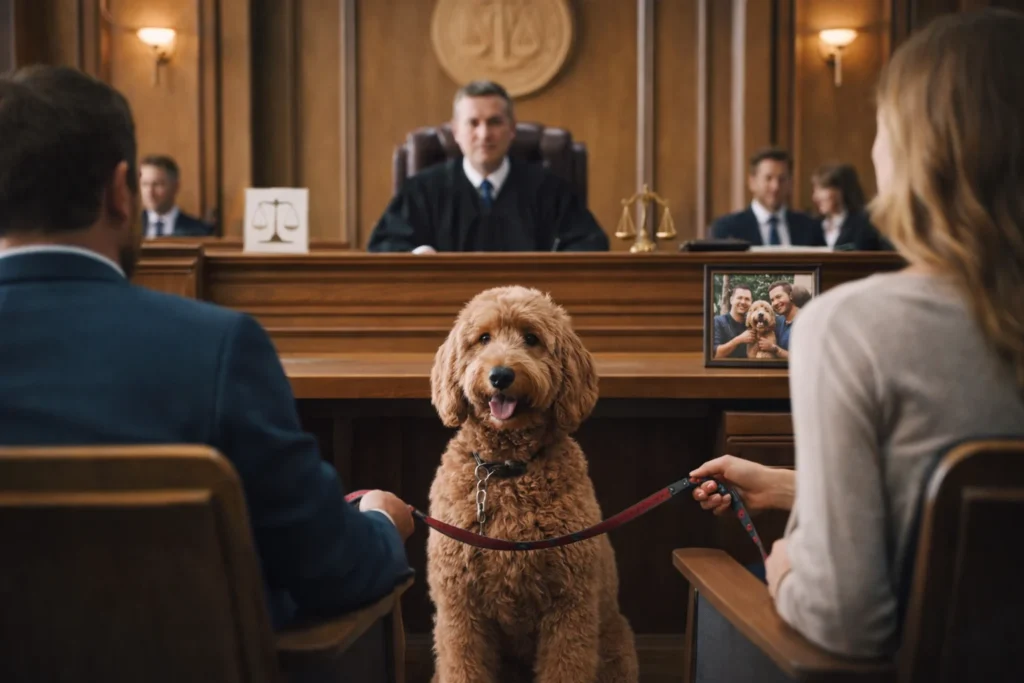

A Quiet Revolution in Courtrooms Around the World
The courtroom in Vancouver, British Columbia, fell silent as the bailiff called the case. It was a Tuesday morning in early 2024, and the docket was filled with the usual assortment of traffic violations, small claims disputes, and family matters. But one case stood out, not because of the amount of money involved, which was negligible, but because of the raw emotion radiating from the two people seated at separate tables.
Sarah clutched a tissue in her hand, her eyes red from crying. Across the aisle, Michael stared straight ahead, his jaw tight with barely controlled anger. Between them, legally speaking, was a dispute over property. But the property in question was currently curled up under Sarah’s chair, oblivious to the fact that his future was about to be decided by a stranger in a black robe.
The dog’s name was Charlie, a scruffy terrier mix with one ear that stood up and one that flopped over. He had been adopted from a shelter five years earlier, when Sarah and Michael were still in love and planning a future together. Now, that future was over, and Charlie had become the sole remaining thread connecting two people who couldn’t stand to be in the same room.
“What does the law say about Charlie?” the judge asked, looking at the attorneys.
What followed was a conversation that would have been unimaginable just twenty years earlier. Instead of asking for a receipt or an adoption contract, the judge wanted to know who walked Charlie every morning. Who took him to the vet? Who stayed home with him when he was sick? Who did he run to when both walked through the door?
This was not a property dispute. This was a family matter, and Charlie was at its center.
The scene playing out in that Vancouver courtroom represents a fundamental shift in how society views the animals who share our homes, our beds, and our lives. It is a shift that has been building for decades, driven by changing social attitudes, advances in our understanding of animal cognition, and the simple, undeniable truth that for millions of people, their pets are not possessions but family members.
This comprehensive exploration will take you through every aspect of this legal revolution. We will trace the history of animals in the eyes of the law, from the days when they were treated no differently than farm equipment to the present moment, when judges in multiple countries are crafting custody arrangements for dogs and cats. We will examine landmark cases, speak with the attorneys and advocates who are pushing for change, and look at the practical tools that pet owners can use to protect their animal companions. We will explore how this shift is affecting everything from housing discrimination to veterinary malpractice, and we will consider what the future might hold for the legal status of the creatures who have earned the title of humanity’s best friend.
This is the story of how the law is finally catching up to the human heart.
Part One: The Historical Foundation – When Animals Were Things
Chapter 1: The Ancient Roots of Animals as Property
To understand how revolutionary the current changes in pet custody law truly are, we must first travel back to the origins of Western legal thought. The idea that animals are property did not emerge from nowhere; it is deeply embedded in thousands of years of legal tradition, stretching back to ancient Rome and beyond.
The Roman legal system, which forms the foundation of much of Western law, classified animals as “res” or things. Under Roman law, there were persons, who had legal rights and duties, and things, which were the objects of those rights and duties. Animals, along with slaves, furniture, and land, fell firmly into the category of things. They could be bought, sold, inherited, or destroyed at the whim of their owner. This classification was not the result of careful philosophical debate about the nature of animal consciousness; it was simply a practical way of organizing the legal world.
The Roman jurist Gaius, writing in the second century AD, divided all law into three parts: the law of persons, the law of things, and the law of actions. His influential textbook, the Institutes, would shape legal education for more than a millennium. In this framework, animals were things, no different from a chair or a piece of land. They had no legal standing, could not sue or be sued, and existed solely for the use and benefit of their human owners.
When Roman law was rediscovered and adapted by European legal scholars during the Middle Ages, this classification persisted. The great legal compilations of the 12th and 13th centuries, which would influence the development of legal systems across Europe, maintained the distinction between persons and things. Animals remained firmly in the latter category.
The medieval scholastics, building on Aristotle and the Roman lawyers, developed elaborate justifications for human dominion over animals. Thomas Aquinas argued that animals existed for human use and that cruelty to animals was wrong only insofar as it might lead to cruelty to humans. The animal itself had no intrinsic rights or moral standing. This view would dominate Western thought for centuries.
This ancient inheritance would prove remarkably durable. Even as slavery was abolished and human beings were universally recognized as persons rather than property, the legal status of animals remained frozen in time. The framers of the American legal system, drawing on English common law, simply inherited this classification without much thought. In a world where most people lived on farms and animals were primarily sources of labor, food, and fiber, treating them as property made a certain kind of practical sense.
Chapter 2: The Philosophical Foundations of Animal Property Status
The legal treatment of animals as property did not develop in a vacuum. It was supported by a rich philosophical tradition that denied animals any significant moral status. Understanding this tradition helps explain why the property classification persisted for so long and why it is only now being challenged.
Rene Descartes, the great French philosopher of the 17th century, argued that animals were automatons, complex machines that might appear to feel pain and pleasure but were in fact incapable of consciousness. When a dog cried out as if in pain, Descartes argued, it was no different from a clock striking the hour. The sound might resemble a cry of pain, but there was no subjective experience behind it.
This view, while extreme even for its time, was enormously influential. If animals were incapable of suffering, then there was no moral reason to consider their interests at all. They could be used, exploited, and disposed of without any ethical qualms. The law, reflecting this view, treated them as objects.
Immanuel Kant, the great German philosopher of the 18th century, offered a slightly different view. Kant argued that animals were not self-conscious and therefore were not ends in themselves. They existed merely as means to human ends. However, Kant did believe that cruelty to animals was wrong because it brutalized humans and made them more likely to be cruel to each other. This view, while offering some protection to animals, still denied them any independent moral standing.
The English utilitarian philosophers took a different approach. Jeremy Bentham, writing in the 18th century, famously argued that the crucial question was not whether animals could reason but whether they could suffer. Bentham believed they could and that their suffering should count in moral calculations. But even Bentham, who was ahead of his time in recognizing animal suffering, did not argue that animals should have legal rights or be treated as anything other than property.
These philosophical traditions, with their varying views on animals, all converged on the same legal conclusion: animals were property. Whether they were viewed as unconscious machines, as means to human ends, or as beings whose suffering mattered but whose legal status should remain unchanged, the result was the same. The law treated them as things.
Chapter 3: English Common Law and the American Inheritance
The English common law, which would become the foundation of the legal systems in the United States, Canada, Australia, and much of the former British Empire, had little more to say about animals than Roman law did. In the great treatises of English jurisprudence, animals appeared primarily in two contexts: as property that could be stolen or damaged, and as dangerous creatures whose owners might be held liable for injuries they caused.
Sir William Blackstone’s Commentaries on the Laws of England, published in the 1760s and enormously influential on both sides of the Atlantic, discussed animals primarily in the context of property rights. Blackstone distinguished between “domestic” animals, which could be the subject of absolute ownership, and “wild” animals, which could only be possessed temporarily. But in either case, the animal itself was an object, not a subject, of legal rights.
Blackstone’s treatment of animals reflected the agricultural society in which he lived. Domestic animals were valuable primarily for their utility: oxen for plowing, cows for milk and meat, sheep for wool, horses for transportation. Dogs and cats, while valued as companions, were of comparatively little economic importance and received correspondingly little attention in the law.
When Blackstone discussed the theft of animals, he focused on their economic value. Stealing a horse was a serious crime because horses were valuable. Stealing a dog was a lesser offense because dogs were worth less. The emotional bond between a person and their dog was legally irrelevant.
This framework was simply assumed by the American colonists and later by the framers of the U.S. Constitution and the state legal systems. When the first American law schools began training lawyers in the early 19th century, they taught the common law as they had learned it, complete with its classification of animals as property.
The result was that for most of American history, the law had nothing at all to say about the emotional bonds between humans and their animal companions. If someone’s dog was killed by a neighbor, the measure of damages was the dog’s market value, not the emotional distress of its owner. If a couple divorced, the dog went to whoever had the receipt. The law was blind to love.
Chapter 4: The Emergence of Animal Cruelty Laws – A First Crack in the Wall
The first significant challenge to the view of animals as mere property came not from family courts but from the animal welfare movement of the 19th century. This movement, which began in England and spread quickly to America, represented the first systematic effort to use law to protect animals from human cruelty.
In 1822, the British Parliament passed Martin’s Act, the first piece of legislation specifically aimed at preventing cruelty to animals. The act made it a crime to “wantonly and cruelly beat, abuse, or ill-treat” horses, cattle, and sheep. This was revolutionary, not because it changed the legal status of animals, but because it acknowledged for the first time that how owners treated their animals was a matter of public concern. A man could no longer do whatever he wished with his horse; the community had an interest in preventing unnecessary suffering.
The movement crossed the Atlantic quickly. In 1866, Henry Bergh founded the American Society for the Prevention of Cruelty to Animals (ASPCA) in New York. Bergh, a wealthy diplomat who had been horrified by the treatment of animals in Europe, successfully lobbied the New York legislature to pass the country’s first effective animal cruelty law. Other states soon followed.
These laws represented a subtle but important shift. They suggested that animals were not simply objects, like chairs or tables, but beings capable of suffering, whose welfare mattered to society. The preamble to many of these laws spoke of animals as “dumb creatures” deserving of humane treatment, language that implicitly recognized their capacity for pain and distress.
However, these laws did not fundamentally alter the property status of animals. A person could still be criminally punished for cruelty to their horse while the horse itself remained, in the eyes of the law, a piece of property. The criminal law could regulate how owners treated their animals, but it did not give the animals any legal rights or change their basic classification.
This tension between the legal classification of animals as things and the growing social recognition that they were something more would persist for more than a century, quietly building until it could no longer be ignored.
Chapter 5: The 20th Century Transformation – Pets Become Family
The 20th century witnessed a transformation in the relationship between humans and animals that would ultimately force the law to reconsider its ancient assumptions. Several social and economic factors converged to elevate pets from working animals to beloved family members.
First, urbanization meant that fewer people had direct experience with farm animals. In 1900, more than 60 percent of Americans lived in rural areas. By 2000, more than 80 percent lived in cities and suburbs. For most Americans, the only animals they encountered regularly were the dogs and cats that shared their homes. These animals were not sources of labor or food; they were companions, pure and simple.
Second, declining birth rates and changing family structures meant that pets increasingly filled emotional roles once reserved for children. In 1900, the average American woman had more than three children. By 2000, the fertility rate had fallen to just above two. For childless couples, empty nesters, and single people living alone, a dog or cat might be the closest thing to family they had.
Third, the veterinary profession advanced dramatically. As recently as the early 20th century, veterinary medicine was primarily concerned with farm animals. Most veterinarians worked with horses, cattle, and sheep. But as pets became more important, a companion animal veterinary industry emerged, offering sophisticated medical care that extended the lives of dogs and cats and deepened the bonds between them and their owners.
Fourth, the pet industry exploded. In the 1950s, pet food was a minor category, with most dogs and cats eating table scraps. By the end of the century, pet food was a multi-billion dollar industry, with specialized formulations for every life stage and health condition. Pet toys, beds, clothing, and accessories became big business.
Fifth, popular culture reflected and reinforced the new status of pets. Movies like “Lassie” and “Old Yeller” portrayed dogs as heroic family members. Television shows featured pets as beloved characters. Books and magazines celebrated the human-animal bond.
By the 1980s and 1990s, the transformation was complete. Surveys consistently showed that the vast majority of pet owners considered their animals to be family members. They celebrated their pets’ birthdays, bought them holiday presents, and grieved their deaths as they would grieve the loss of any loved one. A 1995 survey found that more than 90 percent of pet owners considered their pets to be family members.
But the law had not kept pace. When disputes arose over pets in divorces, courts continued to apply the property rules of the 19th century. The result was a growing disconnect between the lived reality of pet owners and the cold calculations of the legal system, a disconnect that would eventually demand resolution.
Chapter 6: The Changing Demographics of Pet Ownership
The transformation of pets from property to family members was driven in part by dramatic changes in who owned pets and how they lived with them.
In the early 20th century, pet ownership was concentrated in certain segments of the population. Families with children were most likely to have dogs and cats. Single people, elderly people, and childless couples were less likely to have pets. Dogs lived primarily outdoors, in yards or kennels. Cats were often allowed to roam freely, coming and going as they pleased.
By the end of the century, this had changed completely. Pet ownership had become nearly universal across demographic categories. Single people, elderly people, and childless couples were just as likely to have pets as families with children. Dogs slept in their owners’ beds. Cats were kept strictly indoors. Pets accompanied their owners on vacations, visited dog parks, and attended training classes.
The human-animal bond also changed in quality. In the early 20th century, the bond between humans and their pets, while real, was often less intense than it would become. Pets were valued companions, but they were not yet the emotional confidants, surrogate children, and constant companions they would become.
By the end of the century, psychological research had confirmed what pet owners already knew: that the bond with a companion animal could be as intense and meaningful as any human relationship. Pets provided unconditional love, emotional support, and a non-judgmental presence that many people found lacking in their human relationships.
These demographic and psychological changes created pressure for legal change. When people considered their pets to be family members, they found it increasingly unacceptable that the law treated them as property. The stage was set for a legal revolution.
Part Two: The Breaking Point – When Love Met the Law
Chapter 7: The First Cracks – Early Cases Challenging Property Status
The first cases that began to chip away at the property classification of pets emerged in the late 20th century, often from judges who were clearly uncomfortable with the results the old rules compelled them to reach.
One of the earliest and most influential cases came from New York in 1979. In Corso v. Crawford Dog and Cat Hospital, a man named Louis Corso sued a veterinary hospital for mishandling the remains of his beloved poodle. The hospital had mistakenly allowed another family to hold a funeral for Corso’s dog, causing him immense emotional distress. The trial judge, recognizing that this was not an ordinary property dispute, instructed the jury that a pet “is not just a thing” but occupies a special place somewhere between a person and property.
The jury awarded Corso damages for his emotional distress, and the appellate court upheld the verdict. The case was significant because it explicitly recognized what every pet owner already knew: that the bond with an animal companion has value beyond market price. A pet is not a lamp or a sofa; it is a living being with whom a person forms a deep emotional bond.
The court’s language was striking. “A pet is not an inanimate thing that just receives affection,” the judge wrote. “It also returns it.” This recognition of the reciprocal nature of the human-animal bond was a departure from traditional legal analysis, which treated pets as passive objects of human ownership.
Another landmark case came from California in 1991. In Brousseau v. Rosenthal, a woman sued her ex-boyfriend for the return of a cat they had acquired together during their relationship. The court, rather than simply looking at who paid for the cat, considered the nature of the relationship and the fact that the cat had been a gift. The decision suggested that pets might require different legal treatment than other types of property.
The court in Brousseau noted that the cat was “a living creature with whom the parties had developed emotional bonds.” This recognition that emotional bonds were legally relevant, even in a property dispute, was a significant step forward. It suggested that the law might need to develop new tools for dealing with disputes involving animals.
But perhaps the most influential early case was Raymond v. Lachmann, decided by a New York court in 1999. In this case, a woman sought custody of a cat named Sam after her relationship ended. The court, noting that the parties had treated Sam as a member of the family during their relationship, adopted what it called a “best for all concerned” standard. This was a direct borrowing from child custody law, and it signaled that at least some judges were willing to think about pets in relational rather than proprietary terms.
The Raymond court explicitly rejected the idea that Sam was “marital property” to be divided like a bank account or a car. Instead, the court focused on what arrangement would be best for Sam and for the humans who loved him. This welfare-based approach would become the model for later legislative reforms.
Chapter 8: The Unmarried Couple Problem
While divorcing spouses could at least rely on family courts to resolve their disputes, unmarried couples faced an even more precarious situation. If a married couple divorced, the family court had jurisdiction to divide all their property, including pets. But if an unmarried couple split up, the dispute over a pet was simply a property dispute, to be handled in the same courts that resolved arguments over cars and furniture.
This created particular problems because unmarried couples were precisely the demographic most likely to acquire pets together. Young people starting their lives together, often before marriage, would adopt a dog or cat as a kind of trial run for parenthood. When the relationship ended, both partners had typically formed deep bonds with the animal, but neither had clear legal rights.
Courts struggled with these cases. In some jurisdictions, they applied the same property rules they applied to everything else, looking only at who paid the adoption fee or whose name was on the veterinary records. In others, they tried to find creative ways to reach fair results, sometimes straining the limits of legal doctrine to do so.
The problem was compounded by the fact that many unmarried couples acquired pets together without any thought to what might happen if they separated. They didn’t keep receipts, they didn’t document who paid for what, and they certainly didn’t enter into agreements about future custody. When the relationship ended, there was often no clear evidence of ownership, leaving judges to make difficult decisions with inadequate information.
Some courts tried to apply principles of “gift” law, asking whether one party had given the pet to the other as a gift. Others looked to principles of “unjust enrichment,” asking whether one party had been unfairly enriched by the other’s contributions to the pet’s care. These doctrinal workarounds were creative but inconsistent, leading to unpredictable results.
The unmarried couple problem highlighted the inadequacy of the property framework. If pets were truly just property, then disputes over them should be easy to resolve by looking at documentary evidence. But the emotional intensity of these disputes suggested that something more was at stake, something that the property framework could not capture.
Chapter 9: The Emotional Toll – Why Pets Are Different
To understand why the property classification of pets became increasingly untenable, one must understand the unique emotional role that animals play in human lives. This is not sentimentality; it is a matter of psychological and even physiological fact.
Research has consistently shown that the bond between humans and their companion animals is real and measurable. When people interact with their pets, their brains release oxytocin, the same hormone that bonds mothers to infants and lovers to each other. Petting a dog lowers blood pressure and reduces stress hormones. The simple presence of a cat can alleviate anxiety and depression.
For many people, particularly those who live alone, a pet is the primary source of affection and emotional support in their lives. The loss of a pet can be as devastating as the loss of any human loved one, and the grief that follows is real and valid. Studies have shown that the grief experienced after the death of a pet can be as intense as grief after the death of a human family member.
When a couple separates, the pet often becomes a living reminder of the relationship that was. The person who loses custody of the family dog loses not just an animal but a source of daily comfort, a link to happier times, and a companion who provided unconditional love through good times and bad. The dog, for its part, may grieve the loss of the person who has disappeared from its life, pacing by the door, waiting for someone who will never come home.
Attorneys who handle pet custody disputes report that these cases are often more emotional than child custody cases. Children, at least, can understand what is happening and can maintain relationships with both parents through visitation. They can be told that both parents love them and that the separation is not their fault. But a dog cannot understand why its beloved human has disappeared from its life. The animal simply grieves, and the human who has lost the dog grieves alongside it, unable to explain or comfort.
One family law attorney described a case where a client broke down in tears when discussing the family dog, even though she had been composed while discussing the division of millions of dollars in assets. “She kept saying, ‘But who will take him for walks? Who will sleep with him at night? He’ll be so confused.’ She wasn’t worried about the money. She was worried about the dog’s emotional state.”
Chapter 10: The Rise of the Pet Industry
The transformation of pets from property to family members is reflected in, and reinforced by, the massive growth of the pet industry. Americans alone spend more than $100 billion annually on their pets, a figure that has more than doubled over the past decade. This spending is not just on necessities; it is on luxuries that reflect the status of pets as family members.
This spending goes far beyond food and basic veterinary care. Pet owners now spend billions on toys, beds, clothing, grooming services, daycare, boarding, and even pet psychotherapy. There are pet resorts with swimming pools and flat-screen televisions, pet bakeries selling gourmet treats, and pet clothing lines featuring designer labels. The pet industry has become a major economic force, employing hundreds of thousands of people and generating billions in revenue.
The veterinary industry has kept pace. Pet owners can now access oncology treatments, orthopedic surgery, physical therapy, and even kidney transplants for their animals. Pet insurance, once a rarity, has become common, allowing owners to make medical decisions based on what is best for the animal rather than what they can afford. Veterinary schools have expanded their curricula to include the latest advances in animal medicine, and veterinary specialties have proliferated.
This economic transformation reflects and reinforces the emotional transformation. When people are willing to spend thousands of dollars on medical care for a sick pet, or to pay for luxury boarding while they travel, they are treating that pet as a family member, not as a piece of property. The law, which had remained frozen in the 19th century while society rushed into the 21st, was increasingly out of step with reality.
The pet industry has also become a political force. Pet owners are a large and vocal constituency, and lawmakers have become increasingly responsive to their concerns. When legislation affecting pets is proposed, pet owners mobilize. This political power has been crucial in advancing pet custody reform.
Chapter 11: The Media Spotlight – High-Profile Cases Capture Public Attention
As pet custody disputes became more common, the media began to take notice. High-profile cases involving celebrities and ordinary people alike captured public attention and helped build momentum for legal reform.
In 2001, the divorce of actors Drew Barrymore and Tom Green included a dispute over their dogs, Flossie and Greta. The case made headlines around the world, with fans passionately debating who should get the dogs. Ultimately, the couple reached a private agreement, but the publicity highlighted the issue of pet custody for a mass audience.
In 2009, the divorce of reality TV stars Jon and Kate Gosselin included a dispute over their dog, Nala. The case was covered extensively in the tabloids, with commentators noting the irony that the couple could agree on custody of their eight children but not on custody of their dog.
These celebrity cases were matched by heart-wrenching stories of ordinary people fighting for their pets. Newspaper features and television segments profiled couples who had spent thousands of dollars fighting over dogs and cats, often depleting their savings in the process. These stories resonated with viewers who understood the depth of the human-animal bond.
The media attention served several purposes. It educated the public about the legal treatment of pets, highlighting the disconnect between the law and people’s lived experience. It put pressure on lawmakers to act, as constituents began asking why their pets were treated like furniture. And it provided a platform for advocates to make the case for reform.
By the early 2000s, the issue of pet custody had moved from the margins to the mainstream. It was no longer a niche concern of animal lovers but a recognized social issue demanding legal attention.
Part Three: The Legal Revolution Unfolds
Chapter 12: Alaska Leads the Way – The First Statutory Change
In 2016, a remarkable thing happened in Alaska. The state legislature, responding to the growing disconnect between law and reality, passed a law explicitly authorizing courts to consider the welfare of pets in divorce proceedings. Alaska became the first state to statutorily reject the property classification of pets in the family law context.
The law was simple but revolutionary. It instructed courts to consider the well-being of the animal when determining possession in a divorce, taking into account factors such as who provided primary care, who had the strongest emotional bond, and what living situation would be best for the pet. It specifically authorized courts to award joint custody of pets, complete with visitation schedules.
The Alaska law was the result of years of advocacy by animal welfare organizations and family law attorneys who had witnessed the heartbreak caused by the old rules. It provided a model that other states would soon follow.
The legislative history of the Alaska law reveals the depth of feeling behind it. Testimony from pet owners described the anguish of losing beloved animals in divorce proceedings. Family law attorneys described clients who were more distraught over losing their pets than over losing their homes or retirement savings. Animal welfare advocates described the importance of stability for animals and the stress caused by disrupted bonds.
The law passed with broad bipartisan support. Conservatives and liberals alike could agree that pets deserved special consideration. The bill’s sponsors emphasized that it was not about elevating animals above humans but about recognizing the unique place of pets in families.
Perhaps most importantly, the Alaska law signaled that the conversation had shifted from whether pets should be treated differently to how that different treatment should be implemented. The debate was no longer about the destination but about the path to get there.
Chapter 13: California Follows – Expanding the Revolution
In 2017, California joined Alaska with its own pet custody law. The California law took a slightly different approach, authorizing courts to consider the “care of the pet” as a factor in determining possession. While not as explicit as Alaska’s welfare standard, it represented a significant departure from pure property rules.
The California law was notable for its bipartisan support. Conservatives and liberals alike could agree that pets deserved special consideration in family disputes. The bill passed with overwhelming majorities in both houses of the legislature and was signed into law by Governor Jerry Brown with little controversy.
The California law also addressed the problem of domestic violence. It authorized courts to consider evidence of animal abuse in making custody determinations, recognizing the well-established link between cruelty to animals and violence against humans. This provision reflected a growing awareness that the treatment of pets could be relevant to broader family safety concerns.
Research has consistently shown that animal abuse is often a precursor to human violence. Batterers frequently threaten or harm pets as a way of controlling their human victims. Victims of domestic violence often delay leaving abusive situations because they fear for the safety of their pets. By linking pet custody to evidence of animal abuse, the California law recognized the interconnectedness of human and animal welfare.
The California law also included provisions for enforcement, allowing courts to issue orders protecting pets and to sanction parties who violated those orders. This addressed a common problem in pet custody cases: what happens when one party refuses to comply with a custody arrangement?
Chapter 14: Illinois and New Hampshire – Building the Framework
Illinois followed in 2018 with a law that went further than any previous legislation. The Illinois statute explicitly directed courts to consider “the well-being of the animal” in divorce proceedings and provided a detailed list of factors to be considered. These included:
The species, breed, age, and health of the animal: Different animals have different needs, and courts were instructed to consider what arrangement would best meet those needs. A young, high-energy dog might require different accommodations than a senior cat with health issues.
The nature of the relationship between the animal and each party: Courts were to consider the emotional bond between the animal and each person, as evidenced by factors such as who provided daily care, who the animal sought out for comfort, and who had been primarily responsible for the animal’s well-being.
The ability of each party to care for the animal: This included consideration of living situations, work schedules, financial resources, and any other factors affecting the ability to provide proper care.
Any history of animal abuse or neglect by either party: Courts were instructed to consider evidence of mistreatment, both as a factor in determining custody and as a protection for the animal’s future welfare.
The existence of a pre-existing agreement between the parties regarding the animal: Courts were to respect any agreements the parties had made, whether in a prenuptial agreement, a petnup, or any other binding contract.
New Hampshire’s 2019 law took a different approach, focusing on the concept of “shared ownership.” The statute provided that in the absence of an agreement between the parties, the court could award joint or shared possession of a pet, including the right to make decisions about its care. This explicit recognition of the possibility of shared custody was a significant step forward.
The New Hampshire law also addressed the problem of enforcement, providing that courts could issue orders necessary to effectuate the custody arrangement and could modify those orders as circumstances changed. This flexibility recognized that pet custody arrangements, like child custody arrangements, might need to evolve over time.
These state laws, while varying in their details, shared a common thread: they all recognized that pets occupy a unique category that cannot be adequately addressed by traditional property rules. They represented a legislative acknowledgment of what pet owners had known all along.
Chapter 15: The Canadian Breakthrough – British Columbia’s Companion Animal Law
While American states were leading the way, Canada was not far behind. In 2024, British Columbia enacted the most comprehensive pet custody legislation in North America, amending its Family Law Act to create a new category of “companion animals.”
The British Columbia law is significant for several reasons. First, it explicitly removes pets from the property classification in family disputes, creating a separate legal category for them. This is more than a symbolic change; it fundamentally alters how courts approach these cases.
Second, it provides a detailed list of factors courts must consider, including:
The circumstances in which the companion animal was acquired: Was the animal acquired before the relationship, during it, or after separation? Was it a gift from one party to the other? These circumstances can shed light on the parties’ intentions and expectations.
The extent to which each spouse cared for the animal: Who provided daily care? Who took the animal to veterinary appointments? Who was responsible for training, exercise, and socialization? The law recognizes that caregiving creates bonds and that the person who has been primarily responsible for care is often best positioned to continue providing it.
Any history of family violence, including violence against the animal: The law explicitly links animal abuse to family violence, recognizing that cruelty to animals is often part of a broader pattern of abuse.
The relationship between the animal and any children: Courts are instructed to consider the bond between the animal and any children, recognizing that maintaining this bond can be important for children’s emotional well-being during and after a separation.
The willingness of each spouse to facilitate a continuing relationship between the animal and the other spouse: This factor recognizes that, in some cases, continued contact with both parties may be beneficial for the animal, and that a party’s willingness to facilitate such contact is relevant to determining custody.
Third, and perhaps most importantly, the British Columbia law explicitly forbids courts from ordering shared possession of a companion animal. This provision reflects a growing recognition that joint custody, while it may work for some amicable couples, often creates more problems than it solves. Shuttling an animal between two homes can be stressful and confusing, and requiring ongoing communication between exes who cannot get along can perpetuate conflict.
The British Columbia law represents the most thoughtful and comprehensive approach to pet custody yet enacted. It recognizes both the unique status of companion animals and the practical challenges of arranging for their care after a relationship ends.
Chapter 16: The European Perspective – Sentience and Welfare
Across the Atlantic, the legal landscape has developed somewhat differently. European legal systems, with their civil law traditions, have approached the question of animal status through a different lens, but the results have been remarkably similar.
In 2015, France amended its civil code to explicitly state that “animals are living beings endowed with sensitivity.” While the amendment did not remove animals entirely from the property regime, it established that they must be treated as such, subject to laws protecting them. This seemingly small change had significant implications, signaling that animals could no longer be treated as mere objects.
The French amendment was the result of years of advocacy by animal protection organizations. It reflected a growing consensus in French society that animals deserved legal recognition of their sentience. The amendment’s language was carefully chosen: “endowed with sensitivity” captured the idea that animals could feel pain and pleasure, that they had subjective experiences that mattered morally.
Germany had gone even further in 1990, amending its civil code to state that “animals are not things.” The amendment specified that they are protected by special laws and that the provisions applicable to things apply to them only in the absence of other regulations. This created a hybrid category that recognized the unique status of animals while providing a legal framework for resolving disputes.
The German approach is particularly interesting because it explicitly addresses the practical challenges of animal law. By providing that property rules apply “in the absence of other regulations,” the German code ensures that there is always a legal framework for resolving disputes, even as it recognizes that animals are not simply things.
The European Union has also weighed in. The Treaty of Lisbon, which took effect in 2009, includes a protocol recognizing animals as sentient beings and requiring EU institutions to pay full regard to animal welfare requirements when formulating and implementing policies. While this provision is primarily aimed at agricultural and research animals, it reflects a broader shift in how animals are viewed under law.
Chapter 17: The United Kingdom – Sentience and the Courts
The United Kingdom, despite its common law heritage, has moved significantly toward recognizing the unique status of pets. The Animal Welfare (Sentience) Act 2022 formally recognizes that animals are sentient beings capable of feeling pain, joy, and stress. While this act does not directly change property rules, it establishes a foundation upon which further legal developments can build.
The Sentience Act was controversial in some quarters, with critics arguing that it was unnecessary or that it would lead to excessive regulation. But its passage reflected a broad consensus that animals are not mere automata but beings with inner lives deserving of consideration. The act requires the government to have regard for animal sentience when developing and implementing policies, ensuring that animal welfare is considered across the range of government activities.
British courts have not waited for legislation. In the landmark 2024 case FI v DO, a judge deciding the fate of a family dog explicitly considered welfare factors rather than simply applying property rules. The court looked at who provided daily care, the dog’s attachment to the children, and the stability of the respective homes. The ruling signaled that even in the absence of statutory change, courts are increasingly willing to prioritize animal welfare over strict property rights.
The FI v DO case involved a couple divorcing after ten years of marriage. They had acquired a dog, Max, as a puppy and had no children. Both parties sought custody of Max, and both presented evidence of their bond with him. The wife argued that she was the primary caregiver, having taken Max for daily walks and to veterinary appointments. The husband argued that Max was more bonded to him, presenting photographs and videos showing Max seeking him out for affection.
The judge, after hearing extensive evidence, awarded custody to the wife but granted the husband generous visitation rights. In his ruling, the judge emphasized that Max’s welfare was the paramount consideration and that the arrangement he was ordering was designed to minimize stress on the dog while preserving his relationships with both parties.
The UK approach reflects a characteristically incremental legal evolution. Rather than sweeping legislative change, British courts are adapting existing principles to new circumstances, building a body of case law that increasingly treats pets as something more than property.
Chapter 18: Australia’s Patchwork Approach
Australia presents a more complicated picture. As a federation of states and territories, Australia has no single approach to pet custody. Instead, different jurisdictions have developed different rules, creating a patchwork that can be confusing for pet owners and attorneys alike.
In New South Wales, courts have shown increasing willingness to consider welfare factors in pet custody disputes. The 2018 case of Downey v Downey involved a dispute over a Labrador retriever named Bella. The court, rather than simply applying property rules, considered the parties’ respective relationships with Bella and the living situations they could offer. The decision was widely seen as signaling a shift toward welfare-based analysis.
In Victoria, the courts have been more conservative, generally adhering to traditional property rules. However, the state’s Law Reform Commission has recommended legislative change, and advocates are hopeful that Victoria will soon join the ranks of jurisdictions recognizing the unique status of pets.
In Queensland, a 2020 case involving a cat named Tiddles captured public attention. The parties, an unmarried couple, had acquired Tiddles during their relationship. When they separated, both sought custody. The court, applying traditional property rules, awarded Tiddles to the party whose name was on the adoption papers, even though the other party had provided most of the daily care. The case sparked public outrage and calls for legislative reform.
The Australian experience highlights the importance of clear legislative guidance. In jurisdictions where courts are left to their own devices, results can be inconsistent and sometimes unjust. Clear statutory standards provide predictability and ensure that courts consider the factors that matter most for animal welfare.
Chapter 19: The Movement Spreads – Other Jurisdictions Join
The movement toward recognizing the unique status of pets in custody disputes has spread beyond the jurisdictions discussed above. Around the world, courts and legislatures are grappling with the same question: how should the law treat the animals who share our lives?
In Spain, a 2021 law recognized animals as “living beings endowed with sensitivity” and required courts to consider their welfare in divorce proceedings. The law, which amended the Spanish Civil Code, was hailed by animal welfare advocates as a significant step forward.
In Portugal, a 2019 law created a new legal category for animals, recognizing them as “living beings endowed with sensitivity” and subject to special protection. While the law does not specifically address custody disputes, it establishes a foundation for welfare-based analysis.
In Israel, the courts have been particularly active in recognizing the unique status of pets. A 2018 Supreme Court decision held that pets should not be treated as ordinary property in divorce proceedings and that courts should consider the animals’ welfare and the parties’ emotional bonds.
In Brazil, a 2020 decision by the Superior Court of Justice held that pets should be treated as “family members” for purposes of custody disputes. The decision, which broke with traditional property analysis, reflected the growing recognition of pets’ unique status in Brazilian society.
Even in jurisdictions that have not formally changed their laws, courts are finding creative ways to reach just results. In some cases, judges have used their equitable powers to craft solutions that prioritize animal welfare. In others, they have encouraged parties to reach agreements through mediation rather than litigating under outdated property rules.
The global nature of this movement reflects a fundamental shift in human-animal relationships that transcends national boundaries. Wherever people live with companion animals, they form bonds that the law must eventually recognize.
Part Four: The Anatomy of a Modern Pet Custody Case
Chapter 20: The Parties – Who Goes to Court Over a Pet?
Who are the people who end up in court fighting over a pet? The stereotype might be of wealthy, childless couples with nothing better to do than litigate over their purebred dogs. But the reality is far more diverse, encompassing people of all ages, incomes, and relationship configurations.
Pet custody disputes arise among married couples divorcing after decades together, who may fight over the family dog they raised from a puppy. For these couples, the pet is often the last living connection to happier times, a living reminder of the family they once were. Losing the pet can feel like losing the last piece of a life that is already slipping away.
Young unmarried couples who adopted a pet in the first flush of romance may find themselves locked in bitter disputes when the relationship sours. For these couples, the pet may represent the future they once imagined together, and losing it can feel like losing that future.
Elderly couples separating late in life may argue over the companion animal who has been their constant comfort through the challenges of aging. For an older person living alone, a pet may be the primary source of daily companionship and affection. Losing that bond can be devastating.
Same-sex couples are overrepresented in pet custody disputes, for reasons that are not entirely clear but may relate to the fact that LGBTQ+ individuals are more likely to form families of choice that include animals. In the absence of children, the pet may be the most significant living being in the relationship, and disputes over possession can be particularly intense.
What unites these diverse cases is the depth of emotion involved. People who can rationally divide houses, retirement accounts, and investment portfolios may become completely irrational when it comes to the family pet. Attorneys report that clients who are reasonable about everything else will spend thousands of dollars fighting over a dog that could be replaced for a few hundred.
One family law attorney described a client who had calmly agreed to a division of assets worth millions but broke down in tears when the conversation turned to the family cat. “She said, ‘I don’t care about the money. I care about who will brush her fur and talk to her at night. She’ll be so confused without me.’ It wasn’t about winning or losing. It was about love.”
Chapter 21: The Factors Courts Now Consider
When a modern court approaches a pet custody dispute, particularly in a jurisdiction that has adopted welfare-based standards, it considers a range of factors that would have been unthinkable just a generation ago. These factors are designed to get at the heart of what matters for the animal’s welfare and for the preservation of important bonds.
Primary Caregiver Status: Who fed the animal, walked it, took it to the vet, and provided daily care? Courts recognize that the person who has been primarily responsible for the animal’s well-being is often best positioned to continue providing that care. Evidence can include testimony, veterinary records showing who brought the animal for appointments, and even credit card statements showing who purchased food and supplies.
The primary caregiver inquiry is not just about tallying tasks. It’s about understanding the rhythm of the animal’s daily life. Who was there in the morning when the animal woke up? Who provided the evening walk that was the highlight of the dog’s day? Who was home when the animal was sick or scared? These daily interactions create the fabric of the animal’s life and the bonds that sustain it.
Emotional Bond: Who does the animal run to when both people enter the room? Who does it sleep with at night? Who does it seek out when frightened or distressed? Courts are increasingly willing to consider evidence of the emotional connection between the animal and each party.
This inquiry can be challenging because animals cannot speak. But their behavior provides powerful evidence of their attachments. A dog that consistently seeks out one person for affection, that becomes anxious when that person leaves, that greets that person with joy after even a brief separation, is demonstrating a bond that matters for its welfare.
Evidence of emotional bonds can include testimony from friends and family who have observed the animal’s behavior, photographs showing the animal with each person, videos capturing interactions, and even evidence from dog walkers, groomers, or veterinarians who have observed the animal’s responses to each party.
Living Situation: Does one party have a yard while the other lives in a high-rise apartment? Does one person work from home while the other is gone twelve hours a day? Courts consider which living situation better matches the animal’s needs.
A high-energy dog may do better with a yard and an active owner who can provide plenty of exercise. A senior cat may prefer a quiet apartment with someone who is home most of the time. A dog with separation anxiety may need someone who works from home or can arrange for companionship during the day.
Courts also consider the stability of the living situation. A party who moves frequently or lives in temporary housing may not be able to provide the stable environment that animals need. A party with a stable home and established routine may be better positioned to provide consistency.
Children’s Relationships: How strong is the bond between the animal and any children? Courts recognize that maintaining a connection with a beloved pet can be important for children’s emotional well-being during and after a separation. Conversely, separating a child from a pet they have bonded with can cause additional stress during an already difficult transition.
The bond between children and pets is particularly significant because it serves multiple functions. The pet provides unconditional love and acceptance at a time when the child may be feeling uncertain and insecure. The pet offers continuity and stability when everything else is changing. And the pet is a living connection to the family that was, a reminder of happier times.
Courts may also consider the role the pet plays in the child’s daily life. Does the child help care for the pet? Does the pet sleep in the child’s room? Does the child talk to the pet about their feelings? These interactions are evidence of a bond that deserves protection.
History of Care and Abuse: Has either party neglected the animal’s needs? Is there evidence of abuse or mistreatment? Courts will consider any history of animal neglect or cruelty, both as a factor in determining custody and as a protection for the animal’s future welfare.
Evidence of neglect can include failure to provide adequate food, water, shelter, or veterinary care. Evidence of abuse can include physical violence, rough handling, or any treatment that causes unnecessary suffering. Even if the abuse was not directed at the animal in dispute, evidence of abuse of other animals is relevant to the party’s fitness as a caregiver.
Ability to Facilitate Relationship: Is one party willing to allow the other to maintain a relationship with the animal? Courts increasingly consider whether a party will facilitate contact between the animal and the other person, particularly when there are children involved who have bonded with the pet.
A party who is willing to facilitate continued contact demonstrates a focus on what is best for the animal and for any children involved. A party who seeks to completely sever the animal’s relationship with the other party may be motivated by spite rather than concern for the animal’s welfare.
Chapter 22: The Evidence – Proving Your Case
In a pet custody case, evidence matters. Attorneys who handle these cases advise clients to document everything, not just during the dispute but throughout the relationship. The party with the best documentation often has a significant advantage.
Veterinary records are among the most important evidence. They show not only who brought the animal for care but also who made medical decisions and who was identified as the owner. Consistent attendance at veterinary appointments can establish primary caregiver status.
Veterinary records can also reveal important information about the animal’s health and needs. A pet with chronic health problems may require regular medication or special care, and evidence that one party has been primarily responsible for managing these needs can be powerful.
Photographs and videos can be powerful evidence of emotional bonds. Photos showing the animal snuggling with one party, playing with them, or seeking them out can demonstrate the nature of the relationship. Time-stamped photos can also show who was present for holidays, birthdays, and other significant events.
Video evidence can be particularly compelling because it captures behavior in real time. A video showing the animal’s joyful greeting when one party comes home, or its anxious behavior when that party leaves, can communicate the depth of the bond more effectively than any testimony.
Witness testimony from friends, family, neighbors, and even pet sitters or dog walkers can corroborate claims about who provided primary care and who had the strongest bond. These witnesses can describe what they observed about the animal’s relationships with each party.
Neighbors may have observed who walked the dog regularly. Friends may have seen the animal’s behavior during social gatherings. Pet sitters can testify about which party arranged for care and how the animal responded to each party. These third-party observations can be particularly credible because they come from people with no direct stake in the outcome.
Financial records can show who paid for food, supplies, veterinary care, grooming, and boarding. While payment alone is not determinative, it is relevant evidence of the parties’ roles and responsibilities. Consistent payment for pet-related expenses can support a claim of primary caregiver status.
Social media can be a treasure trove of evidence, for better or worse. Posts showing one party with the animal, celebrating its birthday, or caring for it when sick can support that party’s case. But posts showing neglect, rough handling, or indifference can be damaging.
Attorneys often advise clients to be mindful of their social media presence during a custody dispute. A post complaining about the burden of caring for the pet can be used against you. A post showing the animal happy and well-cared-for in your home can support your case.
Chapter 23: The Role of Experts
As pet custody cases have become more sophisticated, experts have begun to play an increasingly important role. Veterinarians, animal behaviorists, and even veterinarians who specialize in forensic veterinary medicine may be called upon to provide testimony.
A veterinarian can testify about the animal’s health needs and which party has been primarily responsible for meeting them. They can also provide opinions about which living situation would be better for the animal’s physical well-being. For example, a veterinarian might testify that a dog with arthritis needs a home without stairs, or that a cat with anxiety needs a quiet environment.
Veterinarians can also testify about the quality of care each party has provided. Have both parties been attentive to the animal’s medical needs? Has one party been more proactive about preventive care? Has either party failed to follow through on recommended treatments? These observations can be relevant to determining future care arrangements.
An animal behaviorist can assess the animal’s attachment to each party and provide opinions about how separation might affect it. While this is not an exact science, behaviorists can observe the animal’s reactions to each person and draw conclusions about the nature of their relationship.
Behaviorists can also assess the animal’s temperament and needs. Is the animal anxious or confident? Does it have separation anxiety? Is it aggressive toward strangers or other animals? These characteristics may affect which living situation is most appropriate.
In some cases, courts have appointed independent experts to evaluate the situation and make recommendations, much as they do in child custody cases. These experts may visit both homes, observe interactions between the animal and each party, and review records and evidence before providing a report to the court.
The use of independent experts can be particularly valuable in highly contested cases where the parties’ accounts are sharply divergent. A neutral expert can provide an objective assessment that helps the court cut through the conflicting claims.
The use of experts adds to the cost of litigation but can also provide valuable information that helps courts make better decisions. As the stakes in pet custody cases have risen, so too has the sophistication of the evidence presented.
Chapter 24: The Unmarried Couple Problem, Revisited
Despite the progress that has been made, unmarried couples remain in a precarious position in many jurisdictions. While married couples have access to family courts with established procedures for dividing property and making custody determinations, unmarried couples must often rely on the general civil courts, where the rules are less flexible.
In jurisdictions that have not extended their pet custody laws to unmarried couples, these cases are still treated as simple property disputes. The court looks only at who has better documentary evidence of ownership, without considering the welfare of the animal or the emotional bonds involved.
This creates a perverse incentive for people to document ownership during the relationship, which can itself be a source of conflict. One partner who insists on putting the adoption papers in their name alone may be sending a message about their expectations for the future, a message that can damage the relationship.
The unfairness of this situation is obvious. Two people who lived together for years, shared the care of a beloved pet, and treated that pet as a family member, can find themselves in court where only one piece of paper matters. The person who did most of the daily care, who formed the deepest bond with the animal, can lose custody simply because the other person’s name is on the adoption contract.
Some attorneys recommend that unmarried couples who acquire pets together enter into written agreements at the time of acquisition, specifying what will happen if the relationship ends. These agreements, sometimes called “petnups,” can provide clarity and prevent costly litigation later. But many couples are reluctant to have these conversations, viewing them as pessimistic or unromantic.
The unmarried couple problem is likely to receive increasing attention as more states and countries consider pet custody reform. Advocates argue that the protections should apply to all couples, regardless of marital status, because the bonds between humans and animals exist independently of legal formalities.
Chapter 25: The Cost of Litigation
Pet custody litigation can be surprisingly expensive. Attorney fees, court costs, expert witnesses, and the time spent preparing and presenting a case can easily run into tens of thousands of dollars. In extreme cases, with multiple experts and appeals, costs can exceed six figures.
This creates a difficult calculus for pet owners. On one hand, the emotional bond with the animal may be worth almost any price. On the other hand, spending $50,000 to fight over a dog that could be replaced for $500 may not be rational, even if it is understandable.
The high cost of litigation also creates inequities. Wealthier parties can afford to outspend their opponents, potentially winning custody not because they are better caregivers but because they have deeper pockets. This is one reason why clear legal standards are important: they reduce the advantage that wealth provides by focusing the inquiry on relevant factors rather than on who can afford the longer legal war.
Some attorneys advise clients to consider mediation or negotiation before resorting to litigation. A mediated agreement can address the needs of all parties, including the animal, at a fraction of the cost of a court battle. Even when litigation is unavoidable, attempting mediation first can demonstrate good faith and may result in a more workable resolution.
The cost of litigation also affects the strategies that parties pursue. A party with limited resources may be forced to settle for less than they would like, simply because they cannot afford to fight. This can lead to outcomes that are not in the best interests of the animal but are dictated by the parties’ financial realities.
Chapter 26: The Emotional Journey of Litigation
For those who do pursue litigation, the emotional journey can be as challenging as the financial one. Pet custody cases tap into deep emotional currents, and the process of litigating can be intensely stressful.
Parties often feel that they are fighting not just for a pet but for validation of their role in the animal’s life. Losing custody can feel like being told that your love didn’t matter, that your years of care counted for nothing. This emotional dimension makes rational decision-making difficult.
The litigation process itself can be traumatic. Being cross-examined about your relationship with your pet, having your care called into question, hearing the other party’s version of events, all while a stranger in a black robe prepares to decide the fate of your beloved companion, can be deeply distressing.
Attorneys who handle these cases emphasize the importance of managing client expectations and providing emotional support. They encourage clients to focus on what is best for the animal rather than on winning or punishing the other party. They remind clients that the goal is not to defeat the other person but to ensure that the animal is well cared for.
Some attorneys recommend that clients seek counseling or support during the litigation process. The stress of a pet custody battle can be overwhelming, and having professional support can make a significant difference in coping with the emotional demands of the case.
Chapter 27: Settlement and Compromise
Despite the emotional intensity of pet custody disputes, many cases do settle before trial. Settlement can take many forms, from simple agreements about who will keep the pet to complex arrangements involving shared custody and expense sharing.
The advantages of settlement are significant. It avoids the cost and stress of litigation. It allows the parties to maintain control over the outcome rather than surrendering it to a judge. And it can result in more creative and tailored solutions than a court could order.
A settlement agreement might address:
- Which party will have primary custody of the pet
- What visitation rights the other party will have
- How expenses for food, veterinary care, and other needs will be shared
- Who will make medical decisions
- What will happen if one party can no longer care for the pet
- How future disputes will be resolved
Some settlement agreements are quite detailed, specifying holiday schedules, vacation arrangements, and even requirements for notification if the pet becomes ill or if one party plans to move. This level of detail can prevent future disputes by making expectations clear.
Mediation can be particularly helpful in reaching settlement. A skilled mediator can help the parties move beyond positional bargaining (“I want the dog”) to interest-based negotiation (“What does the dog need, and how can we both maintain our relationship with him?”). This shift in focus can open up possibilities that the parties had not considered.
Even when full settlement is not possible, partial agreements can narrow the issues for trial. For example, the parties might agree on a visitation schedule but leave the question of primary custody for the court to decide. This reduces the scope of litigation and the associated cost and stress.
Part Five: The Stories Behind the Cases
Chapter 28: The Case of Gigi the French Bulldog
In 2018, a New York couple’s divorce made headlines not because of the fortune at stake but because of the dog at its center. Gigi, a French Bulldog, had been acquired by the wife before the marriage, but the husband argued that he had become the primary caregiver during the relationship.
The case dragged on for months, with both parties presenting evidence of their bond with the dog. The wife produced adoption papers showing she had purchased Gigi. The husband produced veterinary records showing he had taken Gigi to most appointments. Both produced photographs showing Gigi cuddled with them on the couch, playing in the park, and accompanying them on vacations.
The wife testified that Gigi had been her constant companion before the marriage, sleeping in her bed and accompanying her everywhere. She described how Gigi had helped her through a difficult period in her life and how the dog’s presence had been a source of comfort and stability.
The husband testified that during the marriage, he had become Gigi’s primary caregiver. He described his daily routine of walking Gigi, playing with her, and caring for her when the wife was traveling for work. He argued that Gigi was now more bonded to him than to the wife.
The court heard testimony from friends, family members, and even the dog walker, who described Gigi’s behavior with each party. The dog walker testified that Gigi seemed equally happy with both parties but that she was particularly excited when the husband came home from work.
The judge, applying New York’s evolving standards, ultimately awarded custody to the wife but granted the husband extensive visitation rights, including alternating weekends and shared holidays. The decision was notable for its explicit adoption of a child custody framework, complete with a detailed visitation schedule.
The judge’s opinion emphasized that Gigi’s welfare was the paramount consideration. He noted that the wife had owned Gigi before the marriage and that the dog had been an important part of her life. But he also recognized the deep bond that had developed between the husband and Gigi during the marriage, and he structured visitation to preserve that bond.
The case illustrated both the progress that had been made and the challenges that remained. The court was willing to consider welfare factors and to craft a creative solution. But the detailed visitation schedule required ongoing communication between two people who clearly did not get along, a requirement that would prove difficult to maintain.
Chapter 29: The Case of Knute the German Shepherd
Knute, a German Shepherd, was at the center of one of the most closely watched pet custody cases in recent years. The case, decided in Illinois in 2020, involved a married couple with no children who had acquired Knute as a puppy during their relationship.
When the marriage ended, both parties sought custody of Knute. The husband argued that he was the primary caregiver, having walked Knute daily, taken him to training classes, and handled most veterinary visits. The wife argued that she had a stronger emotional bond with the dog and that Knute was anxious when separated from her.
The case was unusual in its complexity. Both parties had substantial resources and were willing to spend whatever was necessary to fight for Knute. Each retained experts, including veterinarians and animal behaviorists, to support their case.
The husband’s experts testified that he had been primarily responsible for Knute’s care and that his home, which had a large yard and was near a dog park, was ideally suited to Knute’s needs. They noted that Knute was a high-energy dog who needed plenty of exercise and that the husband’s active lifestyle was well-matched to those needs.
The wife’s experts testified that she had a particularly strong emotional bond with Knute. They presented evidence that Knute became anxious when separated from her, that he sought her out for comfort when frightened, and that their interactions were characterized by mutual affection and responsiveness.
The court, applying Illinois’s new pet custody law, conducted an extensive evidentiary hearing. Both parties testified, and witnesses including neighbors, friends, and the dog’s trainer were called. The court also considered evidence from a veterinarian about Knute’s health and temperament.
In the end, the court awarded custody to the husband, finding that he had been the primary caregiver and that his home was better suited to the dog’s needs. However, the court granted the wife substantial visitation, including every other weekend and two weeks during the summer.
The case was appealed, with the wife arguing that the court had given insufficient weight to the emotional bond. The appellate court affirmed, holding that the trial court had properly considered all relevant factors and that its decision was supported by the evidence. The case established important precedents about how Illinois courts would apply the new statute.
Chapter 30: The Case of Toba in British Columbia
The 2025 British Columbia case Glassen v. Glassen has become a landmark in Canadian pet custody law. The case involved a family dog named Toba and a divorcing couple with a young daughter.
The parties agreed on many things: they both loved Toba, they both had strong bonds with her, and they both wanted what was best for her. But they could not agree on what that meant. The husband proposed a shared custody arrangement, with Toba alternating between their homes. The wife argued that Toba should live primarily with her and their daughter, with the husband having visitation.
The case was complicated by the high level of conflict between the parties. Their divorce had been bitter, and communication between them was virtually nonexistent. Each accused the other of using Toba as a pawn in their ongoing disputes.
The court, applying British Columbia’s new companion animal law, conducted a thorough analysis. It considered the circumstances in which Toba was acquired, the care each party had provided, the relationship between Toba and the daughter, and the parties’ willingness to facilitate contact.
The evidence showed that Toba had been acquired as a puppy shortly before the daughter was born. From the beginning, Toba and the daughter had been inseparable. They slept in the same room, played together daily, and had developed a bond that was evident to everyone who knew them.
The evidence also showed that the wife had been Toba’s primary caregiver. She had taken Toba to veterinary appointments, managed her training, and been responsible for her daily care. The husband, while loving with Toba, had been less involved in the day-to-day responsibilities.
The judge made two crucial findings. First, Toba had a particularly strong bond with the daughter, who was experiencing significant stress due to the divorce. Maintaining Toba in the daughter’s primary home would provide stability and comfort during a difficult transition. Second, the parties’ relationship was so conflict-ridden that any shared custody arrangement would require ongoing communication, which would likely lead to further disputes.
Based on these findings, the court awarded sole custody of Toba to the wife, with the husband receiving specified visitation. The court explicitly rejected the husband’s request for shared custody, citing the new law’s prohibition on ordered shared possession. The decision was widely praised by animal welfare advocates for its focus on the animal’s well-being and its recognition that shared custody is not always in the animal’s best interests.
Chapter 31: The Delaware Auction – When Courts Get Creative
Not all pet custody cases end with a judge making a welfare-based determination. In some jurisdictions, courts still lack the authority to consider anything beyond property rights. The 2022 Delaware case involving Tucker the Goldendoodle illustrated both the limitations of the old rules and the creativity judges can employ when faced with unsatisfactory options.
Tucker’s owners, an unmarried couple, had split up after several years together. Both wanted Tucker, and both were apparently good caregivers. But because Delaware’s pet custody law applied only to married couples, the court was forced to treat Tucker as property.
The judge, Vice Chancellor Bonnie W. David, found herself in a difficult position. She could not apply a best-interests standard, but she also could not simply award Tucker to one party based on the limited documentary evidence. Both parties had contributed to Tucker’s care. Both had formed deep bonds with him. Neither had clearly established ownership under traditional property rules.
The judge’s solution was unconventional: she ordered a private auction.
Under the court’s order, the two ex-partners would bid against each other for Tucker. The winner would get the dog and keep the money they had bid. The loser would get the money from the winning bid. The process would ensure that Tucker went to the person who valued him most, at least in monetary terms.
The auction was conducted under court supervision, with bids submitted in writing. The parties were not permitted to attend the auction or to know each other’s bids until the process was complete. This was designed to prevent strategic bidding and to ensure that the final bid reflected each party’s true valuation of Tucker.
The winning bid was $15,000, a substantial sum for a Goldendoodle. The winner got Tucker, and the loser got $15,000. The court’s order provided that the winner would have sole ownership of Tucker and that the loser would have no further rights to the dog.
In a telling footnote to her opinion, the judge added, “It is undisputed that Tucker is a very good boy.” This small human admission in a formal legal document captured the tension at the heart of the case: the law required the judge to treat Tucker as property, but her own instincts told her he was something more.
The auction solution, while creative, highlighted the inadequacy of the property framework. It assumed that the person willing to pay the most money was the person who should get the dog, ignoring all the relational factors that actually matter in a pet custody dispute. The case became a powerful argument for extending welfare-based standards to all pet owners, regardless of marital status.
Chapter 32: The New York Cat Case
Not all high-profile pet custody cases involve dogs. In 2021, a New York court decided a contentious case involving two cats, Whiskers and Mittens. The case illustrated the unique challenges that arise when multiple animals are involved.
The parties, a married couple divorcing after fifteen years, had acquired the cats at different times during their relationship. Whiskers had been adopted by the wife before the marriage and was clearly bonded to her. Mittens had been adopted jointly during the marriage and had a strong bond with both parties, as well as with the couple’s teenage children.
The wife sought custody of both cats. She argued that separating them would cause stress and that she was best positioned to care for them. The husband argued that the cats should be separated, with Whiskers going to the wife and Mittens staying with him. He argued that he had developed a strong bond with Mittens and that being separated from her would cause him significant distress.
The children, through their guardian ad litem, expressed a desire to maintain their relationship with both cats. They had grown up with the cats and considered them siblings. The thought of losing either cat was distressing to them.
The court, applying New York’s welfare-based standards, faced a complex decision. Separating the cats would cause them stress, as they had lived together for years and had developed a bond. But awarding both to the wife would sever the husband’s bond with Mittens and the children’s bond with Whiskers.
The court heard testimony from a veterinarian about the likely effects of separation on the cats. The veterinarian testified that while cats can adapt to separation, doing so is stressful, particularly for cats who have lived together for a long time. She recommended keeping the cats together if possible.
The court also heard testimony from a child psychologist about the importance of the children’s bond with the cats. The psychologist testified that maintaining relationships with the cats could provide emotional stability for the children during the divorce and that losing either cat could compound their stress.
The court’s creative solution was to award custody of both cats to the wife, who had the larger home and more flexible schedule, but to grant the husband and children extensive visitation. The visitation schedule was carefully crafted to minimize stress on the cats, with gradual transitions and provisions for the cats to remain together during visits.
The court also ordered that the parties share the costs of the cats’ care, including food, veterinary expenses, and any costs associated with visitation. This ensured that both parties continued to contribute to the cats’ well-being.
The case illustrated the complexity of modern pet custody disputes and the importance of having a legal framework flexible enough to accommodate creative solutions. It also highlighted the role that children’s interests play in these decisions, even when the children themselves are not the subject of custody proceedings.
Chapter 33: The Case of Bella the Beagle
In 2023, a Florida court decided a case that would become notable for its treatment of a dog’s medical needs. Bella, a beagle, had been diagnosed with a chronic condition requiring regular medication and veterinary monitoring. The divorcing couple disagreed not only about who should have custody but also about how Bella’s medical care should be managed.
The wife argued that she should have primary custody because she had been primarily responsible for Bella’s medical care during the marriage. She had taken Bella to most veterinary appointments, managed her medication, and researched her condition. She had also developed a relationship with Bella’s veterinarian and was knowledgeable about the dog’s needs.
The husband argued that he should have custody because he had the financial resources to provide for Bella’s care. He worked from home and could be available for medical appointments and medication schedules. He also argued that the wife’s work schedule would make it difficult for her to provide the consistent care Bella needed.
The court heard extensive testimony about Bella’s medical needs. The treating veterinarian testified that Bella required daily medication, regular blood work, and prompt attention if her symptoms worsened. She emphasized the importance of consistency in care and the need for a caregiver who was knowledgeable and attentive.
The court also heard testimony from both parties about their ability to meet Bella’s needs. The wife demonstrated detailed knowledge of Bella’s condition and treatment. The husband demonstrated financial resources and availability but less specific knowledge of Bella’s medical needs.
In the end, the court awarded custody to the wife, finding that her knowledge and experience with Bella’s condition outweighed the husband’s financial resources. However, the court ordered the husband to contribute to Bella’s medical expenses and granted him visitation rights that accommodated Bella’s need for consistent care.
The case was notable for its detailed attention to the animal’s specific needs. The court did not simply ask who loved Bella more or who had provided more care. It asked what Bella needed and who was best positioned to provide it. This welfare-based analysis is the hallmark of the new approach to pet custody.
Chapter 34: The International Case – A Dog Across Borders
As pet custody disputes become more common, they increasingly cross international borders. The 2022 case of Martinez v. Schmidt involved a couple with homes in both the United States and Germany and a dog named Max who traveled with them between countries.
When the relationship ended, both parties sought custody of Max. The wife lived primarily in New York, the husband in Berlin. Each argued that Max should live with them and that the other should have visitation rights that would require international travel.
The case raised complex jurisdictional issues. Which country’s law should apply? Which courts had authority to decide Max’s fate? How could any custody order be enforced across international borders?
The parties initially litigated in New York, where the wife had filed for divorce. The husband argued that the New York court lacked jurisdiction because Max had been acquired in Germany and had spent most of his time there. The wife argued that New York had jurisdiction because the couple had maintained a residence there and Max had spent significant time in the state.
The New York court ultimately held that it had jurisdiction to decide the divorce but that the question of Max’s custody was complicated by the international dimension. The court urged the parties to reach an agreement rather than litigating, warning that any order it issued might be difficult to enforce in Germany.
After months of negotiation, the parties reached an agreement. Max would live primarily with the wife in New York but would spend summers and alternate holidays with the husband in Berlin. The parties would share the costs of Max’s international travel and would communicate regularly about his well-being.
The case highlighted the challenges that arise when pet custody disputes cross borders. Different countries have different laws, different standards, and different enforcement mechanisms. Even when parties reach agreements, ensuring compliance can be difficult when they live thousands of miles apart.
As international mobility increases, these cross-border disputes are likely to become more common. Legal scholars have begun to discuss the need for international conventions or treaties that would establish uniform standards for pet custody and provide mechanisms for enforcement across borders.
Chapter 35: The Celebrity Cases That Captured Public Attention
Celebrity pet custody cases have played an outsize role in bringing attention to the issue and building support for legal reform. When famous people fight over their pets, the public pays attention, and the resulting media coverage educates millions about the legal treatment of animals.
The 2001 dispute between Drew Barrymore and Tom Green over their dogs, Flossie and Greta, was one of the first high-profile cases to capture public attention. The couple had acquired the dogs during their brief marriage, and when they divorced, both sought custody. The case was settled privately, but not before generating extensive media coverage and public discussion.
In 2009, the divorce of reality TV stars Jon and Kate Gosselin included a dispute over their dog, Nala. The case was particularly notable because the couple had eight children, and the dog was closely bonded with them. Commentators noted the irony that the parents could agree on custody of their children but not on custody of the dog.
In 2012, the divorce of actors Ryan Reynolds and Scarlett Johansson included speculation about custody of their dog, Baxter. While the couple never publicly discussed the details of their settlement, the media attention highlighted the issue of pet custody for a new audience.
In 2018, the divorce of model Christie Brinkley and her fourth husband, Peter Cook, included a dispute over their dog, Cookie. The case went to trial, with both parties presenting evidence of their bond with the dog. The court ultimately awarded custody to Brinkley, finding that she had been the primary caregiver.
These celebrity cases serve several functions. They normalize pet custody disputes, showing that even wealthy and famous people fight over their animals. They educate the public about the legal issues involved. And they create pressure for legal reform, as lawmakers hear from constituents who want their pets treated with the same consideration as celebrities’ pets.
Part Six: Practical Solutions for Pet Parents
Chapter 36: Petnups – Planning for the Future
As pet custody disputes have become more common and more complex, forward-thinking couples have begun to plan ahead. The “petnup,” a prenuptial agreement specifically addressing companion animals, has become an increasingly popular tool for protecting both pets and relationships.
A well-drafted petnup can address a range of issues that might arise if the relationship ends. It can specify who will have primary custody of the pet, what visitation rights the other party will have, how expenses will be shared, and who will make medical decisions. It can also address what will happen if one party becomes unable to care for the pet due to illness, disability, or death.
Petnups are not just for married couples. Unmarried couples who acquire pets together can enter into similar agreements, either at the time they get the pet or at any point during their relationship. These agreements can provide clarity and prevent costly litigation later.
The key to an effective petnup is specificity. A general statement that the parties will “share custody” of the pet is not enough. A good petnup addresses the details: where the pet will live, when visitation will occur, how holidays and vacations will be handled, who will pay for food and veterinary care, and how disputes will be resolved.
Some petnups go even further, addressing issues like training, grooming, and even the pet’s eventual end-of-life care. While these details may seem excessive, they can prevent misunderstandings and conflicts later.
A comprehensive petnup might include provisions addressing:
- Primary residence: Which party will the pet live with primarily?
- Visitation schedule: How often and for how long will the other party have visitation?
- Holiday arrangements: How will holidays and special occasions be divided?
- Travel arrangements: What happens if one party wants to travel with the pet?
- Expense sharing: How will costs for food, veterinary care, grooming, and other needs be divided?
- Medical decisions: Who will make decisions about veterinary care, particularly in emergencies?
- Dispute resolution: How will future disputes about the pet be resolved?
- Death or disability: What happens if one party becomes unable to care for the pet?
- Relocation: What happens if one party wants to move to a different city or country?
Attorneys who specialize in pet law recommend that couples discuss these issues early in their relationship, before emotions are running high. While these conversations can be uncomfortable, they are much easier to have when the relationship is strong than when it is falling apart.
Chapter 37: The Ontario Approach – Pawperty Agreements
In Ontario, where the law has not kept pace with changing social attitudes, innovative lawyers have developed a workaround: the “Pawperty Agreement.” These specialized domestic contracts allow couples to privately order their affairs regarding their pets, creating enforceable obligations that courts will respect even under the old property rules.
A Pawperty Agreement works by treating the pet as property for legal purposes while creating contractual obligations that effectively function like custody arrangements. The parties agree that one of them will be the legal owner of the pet, but the other will have specified rights of access and involvement.
For example, a Pawperty Agreement might provide that Party A is the legal owner of the dog, but Party B has the right to have the dog every other weekend, to share in major medical decisions, and to be notified if the dog becomes seriously ill. If Party A violates these provisions, Party B can sue for breach of contract, even if the court would not otherwise have jurisdiction over a pet custody dispute.
The Pawperty Agreement approach has several advantages. It provides certainty and predictability, allowing couples to plan for the future rather than leaving their fate to the courts. It respects the parties’ autonomy, allowing them to craft arrangements that meet their specific needs. And it creates enforceable obligations, giving parties recourse if the agreement is violated.
However, Pawperty Agreements also have limitations. They are only as good as the parties’ willingness to comply, and enforcing them can require costly litigation. They may not be recognized in all jurisdictions, particularly if the parties move to a different province or country. And they cannot address all the complexities that may arise over the lifetime of a pet.
Despite these limitations, Pawperty Agreements provide a measure of protection for Ontario pet owners until the law catches up. They demonstrate both the creativity of family law attorneys and the desperate need for legislative reform.
Chapter 38: Mediation – A Better Way
For many couples, litigation is the worst possible way to resolve a pet custody dispute. It is expensive, time-consuming, emotionally draining, and ultimately places the decision in the hands of a stranger who knows nothing about the parties or the pet. Mediation offers an alternative.
In mediation, a neutral third party helps the disputing couple reach their own agreement. The mediator does not decide the outcome but facilitates communication, helps the parties identify their true interests, and explores creative solutions that might not be available in court.
Mediation has several advantages over litigation. It is generally faster and less expensive. It allows the parties to maintain control over the outcome rather than surrendering it to a judge. It can preserve relationships, or at least prevent them from deteriorating further. And it can result in more creative and tailored solutions than a court could order.
For pet custody disputes, mediation can be particularly effective. A mediator can help the parties focus on what is best for the animal rather than on winning or punishing the other party. They can explore arrangements that might not be available through litigation, such as shared custody schedules that adapt to the parties’ changing circumstances.
The mediation process typically begins with an initial session where the mediator explains the process and the parties agree on ground rules. Subsequent sessions involve discussion and negotiation, with the mediator helping the parties explore options and work toward agreement. If an agreement is reached, it is reduced to writing and can be made legally binding.
Mediation is not appropriate for all cases. If there is a history of domestic violence or if one party is unwilling to negotiate in good faith, mediation may not be effective. But for many couples, it offers a path to resolution that is less costly and less stressful than litigation.
Many family law attorneys now recommend mediation as the first resort for pet custody disputes, with litigation as a last resort when mediation fails. Some jurisdictions have even established pet custody mediation programs, training mediators specifically in the issues that arise in these cases.
Chapter 39: Collaborative Law – A Team Approach
A variation on mediation is the collaborative law approach, in which both parties retain attorneys who are committed to reaching a settlement without going to court. The parties and their attorneys work together, often with the assistance of other professionals such as veterinarians or animal behaviorists, to craft a resolution that meets everyone’s needs.
In collaborative law, the parties sign an agreement that their attorneys will withdraw if the case goes to court. This creates a strong incentive to settle, as starting over with new attorneys is expensive and time-consuming. The collaborative process is designed to be cooperative rather than adversarial, with the parties working together to find solutions.
For pet custody disputes, collaborative law can be particularly effective because it allows for the involvement of animal professionals who can provide expert input. A veterinarian might advise on the animal’s health needs. An animal behaviorist might assess the animal’s attachment to each party. These experts can help the parties make informed decisions about what arrangement would be best for the animal.
The collaborative process also allows for more creative solutions than litigation. The parties might agree on a shared custody schedule that evolves as the animal ages. They might establish a joint bank account for pet expenses. They might agree on a process for resolving future disputes without returning to court.
Like mediation, collaborative law is not appropriate for all cases. It requires both parties to be committed to the process and willing to negotiate in good faith. But for couples who can work together, it offers a way to resolve pet custody disputes that is less adversarial and more focused on the animal’s welfare.
Chapter 40: What to Do If You’re Facing a Pet Custody Dispute
If you are facing a potential pet custody dispute, there are steps you can take to protect your interests and, more importantly, to protect your pet. These steps range from practical documentation to emotional preparation.
Document Everything: Start now, even if a dispute has not yet arisen. Keep records of veterinary visits, including receipts and notes about who brought the pet. Take photographs and videos of you caring for the pet and spending time together. Save records of purchases of food, supplies, and services. This documentation can be invaluable if you end up in court.
Be the Primary Caregiver: If you want to maximize your chances of retaining custody, be the person who provides daily care. Walk the dog, fill the food bowl, schedule and attend veterinary appointments. The person who does the work is the person courts will see as the primary caregiver.
Avoid Conflict in Front of the Pet: Animals are sensitive to human emotions. Fighting in front of your pet causes stress and anxiety, which is bad for the animal regardless of who ultimately gets custody. If you must have difficult conversations, have them away from the pet.
Consider Mediation: Before rushing to court, consider whether mediation might resolve the dispute more effectively. Even if mediation does not result in a complete agreement, it may narrow the issues and reduce the cost and stress of litigation.
Think About What’s Best for the Pet: In the heat of a dispute, it’s easy to lose sight of what matters most: the welfare of the animal you both love. Ask yourself honestly what arrangement would be best for the pet. If the answer is not “me having sole custody,” be open to alternatives.
Consult an Attorney: Pet custody law is complex and varies by jurisdiction. An experienced family law attorney can advise you on your rights and options and help you navigate the legal system. Even if you hope to settle, understanding your legal position can help you negotiate effectively.
Prepare Emotionally: Pet custody disputes are emotionally draining. Prepare yourself for the possibility that you may not get the outcome you want. Consider seeking counseling or support to help you cope with the stress of the process.
Focus on the Future: Whatever the outcome, your goal should be to ensure that your pet is well cared for. If you lose custody, focus on maintaining a relationship with the pet if possible and on ensuring that the other party provides good care. If you win custody, be generous about allowing the other party to maintain a relationship if that is in the pet’s best interests.
Chapter 41: The Role of Pet Custody Evaluators
In complex pet custody cases, some courts are beginning to use a tool borrowed from child custody law: the custody evaluator. A pet custody evaluator is a neutral expert who investigates the situation and makes recommendations to the court about what arrangement would be best for the animal.
A typical pet custody evaluation involves visits to both parties’ homes, interviews with the parties and sometimes with witnesses, observation of the pet’s interactions with each party, and review of relevant records. The evaluator then prepares a report for the court, analyzing the factors relevant to the animal’s welfare and recommending a custody arrangement.
The evaluator might observe how the pet behaves with each party. Does the pet seek out one party for affection? Does it become anxious when separated from one party? Does it appear relaxed and comfortable in each home? These observations can provide valuable information about the pet’s attachments and needs.
The evaluator might also assess the parties’ knowledge of the pet’s needs and their ability to provide care. Does each party understand the pet’s medical requirements? Are they prepared to provide necessary exercise and enrichment? Do they have realistic plans for managing the pet’s care?
The evaluator might interview witnesses such as veterinarians, groomers, dog walkers, or neighbors who have observed the pet’s interactions with each party. These third-party observations can provide valuable corroboration or contradiction of the parties’ claims.
Pet custody evaluators come from various professional backgrounds. Some are veterinarians with training in animal behavior. Others are animal behaviorists or trainers. Some are social workers or psychologists with expertise in family dynamics and an interest in human-animal bonds. The field is new enough that there are no standard qualifications, but the best evaluators combine knowledge of animal welfare with understanding of family systems.
The use of custody evaluators is controversial. Proponents argue that they provide courts with expert information that judges cannot obtain on their own. Critics worry about the cost and about giving too much power to experts whose methods may not be scientifically validated. As the field develops, standards for pet custody evaluations will likely emerge.
Chapter 42: The Importance of Legal Representation
Given the complexity of pet custody law and the emotional intensity of these disputes, legal representation is crucial. An experienced attorney can provide guidance, advocacy, and support throughout the process.
A good attorney will help you understand the law in your jurisdiction and how it applies to your situation. They will advise you on the strengths and weaknesses of your case and help you develop a strategy for achieving your goals. They will gather and present evidence, examine witnesses, and make legal arguments on your behalf.
Beyond these technical skills, a good attorney provides emotional support and perspective. They can help you make rational decisions when emotions are running high. They can remind you of what matters most and help you focus on the animal’s welfare rather than on winning or punishing the other party.
When choosing an attorney for a pet custody case, look for someone with experience in this area. Pet custody law is specialized, and not all family law attorneys are familiar with it. Ask about their experience with pet cases, their knowledge of the relevant law, and their approach to these disputes.
Also consider whether the attorney’s style matches your needs. Some attorneys are aggressive litigators who will fight hard in court. Others are collaborative problem-solvers who will try to reach agreement without litigation. The right approach depends on your situation and your goals.
Chapter 43: The Cost-Benefit Analysis
Before embarking on a pet custody dispute, it’s important to do a realistic cost-benefit analysis. Litigation is expensive, both financially and emotionally. The costs can easily exceed the value of the pet, at least in monetary terms.
Consider the financial costs: attorney fees, court costs, expert witness fees, and the value of your own time. These can quickly add up to tens of thousands of dollars. Ask yourself whether you are willing and able to spend that much.
Consider the emotional costs: the stress of litigation, the conflict with your former partner, the uncertainty of the outcome. These costs are harder to quantify but can be substantial. Ask yourself whether you are prepared to endure the emotional toll.
Consider the impact on the pet: the stress of being at the center of a conflict, the uncertainty of not knowing where they will end up, the potential disruption of their routine. Ask yourself whether the fight is in the pet’s best interests.
Consider the alternatives: mediation, negotiation, or even letting the other party have the pet if they are a good caregiver. These alternatives may be less costly and less stressful, and they may result in a better outcome for everyone.
If you decide to proceed with litigation, go into it with your eyes open. Understand what you are getting into and be prepared for the costs and stresses involved. And throughout the process, keep asking yourself whether the fight is worth it and whether there might be a better way.
Part Seven: Beyond Custody – The Broader Implications
Chapter 44: Housing and Pets
The changing legal status of pets is having ripple effects far beyond family court. One of the most significant areas of impact is housing, where the traditional “no pets” clause in leases is increasingly being challenged.
As pets are viewed more as family members and less as property, arguments for accommodating them in housing become stronger. This is particularly true for emotional support animals, which are not pets in the traditional sense but rather assistance animals that provide therapeutic benefits to individuals with mental health conditions.
Federal law in the United States already requires reasonable accommodations for emotional support animals in housing, even in buildings with no-pets policies. Landlords must make exceptions for tenants with documented needs for emotional support animals, and they cannot charge additional fees or deposits for these animals.
But the changing legal landscape may extend similar protections to ordinary pets. Some jurisdictions are considering laws that would limit landlords’ ability to ban pets outright, recognizing the importance of the human-animal bond to tenants’ well-being. These laws might require landlords to allow pets unless they can show that doing so would cause undue hardship.
Other jurisdictions are considering laws that would cap pet deposits and fees, recognizing that the costs of renting with a pet can be prohibitive for many people. Still others are considering laws that would prohibit breed discrimination, recognizing that bans on specific breeds are often arbitrary and unsupported by evidence.
The trend is not universal, and landlords have legitimate concerns about property damage and nuisance. But as society’s view of pets evolves, so too will the balance between landlords’ property rights and tenants’ desire to live with their animal companions.
Chapter 45: Insurance and Liability
The insurance industry is paying close attention to the changing legal status of pets. Dogs alone account for more than one-third of all homeowners insurance liability claims, costing insurers nearly a billion dollars annually. As pets are valued more highly, both emotionally and financially, these claims may become larger and more frequent.
Some insurance companies have responded by restricting coverage for certain breeds, refusing to write policies for owners of pit bulls, Rottweilers, and other dogs perceived as dangerous. Animal advocates argue that breed-specific restrictions are unfair and unsupported by evidence, pointing out that any dog can bite and that breed is a poor predictor of behavior.
Other insurers have taken a different approach, offering specialized pet insurance that covers liability as well as veterinary costs. These policies recognize that pets are valuable family members whose care can be expensive and whose actions can have significant consequences.
The changing legal status of pets may also affect how damages are calculated in animal injury cases. If a pet is considered a family member rather than property, the emotional distress of losing that pet to a negligent act might be compensable in ways it has not been historically. Some courts have already begun to move in this direction, allowing recovery for loss of companionship when a pet is wrongfully killed.
These developments have implications for pet owners, who may need to review their insurance coverage to ensure they are adequately protected. Standard homeowners or renters insurance may not be sufficient, particularly if you have a breed that insurers consider high-risk or if you want coverage for the full value of your pet.
Chapter 46: Veterinary Malpractice and the Value of a Pet
Perhaps nowhere is the tension between old and new views of pets more evident than in veterinary malpractice cases. Under traditional property rules, if a veterinarian’s negligence caused the death of a pet, the measure of damages was the animal’s market value. For a mixed-breed shelter dog, that might be zero.
This result has always seemed absurd to pet owners, who know that the value of their animal companion cannot be measured by what they would pay to replace it. As pets have come to be viewed as family members, courts have begun to question the market value rule.
Some courts have allowed recovery for the “special subjective value” of a pet, recognizing that a particular animal may have unique value to its owner beyond its market price. This approach allows juries to consider the emotional bond between owner and pet in determining damages.
Others have allowed recovery for the reasonable cost of veterinary care, even when that cost exceeds the animal’s market value. This approach recognizes that owners should be able to spend what is necessary to care for their pets without being limited by the animal’s market price.
A few courts have even allowed recovery for emotional distress, though this remains the exception rather than the rule. These courts recognize that the loss of a beloved pet can cause genuine emotional harm that deserves compensation.
The trend is toward recognizing that pets have value that cannot be captured by market metrics. As one judge put it, “A dog is not just a thing. It is a living being with whom its owner has formed a bond of loyalty and affection. The loss of that bond is a real loss, even if it cannot be measured in dollars.”
Chapter 47: Estate Planning for Pets
The recognition that pets are family members has also affected estate planning. Traditionally, pets were simply property that passed with the rest of the estate. But this often resulted in animals being left without care or being placed in shelters.
Today, sophisticated estate planning can ensure that pets are cared for after their owner’s death. Pet trusts, authorized in all 50 states, allow pet owners to set aside funds for their animals’ care and to name a caregiver who will take possession of the pet. The trust can specify details of care, from diet and exercise to veterinary treatment and even end-of-life decisions.
A well-drafted pet trust might include:
- Identification of the pet: The trust should clearly identify the animal it covers, including name, description, and any identifying marks or microchip numbers.
- Appointment of a caregiver: The trust names the person who will care for the pet and specifies any qualifications or preferences.
- Appointment of a trustee: The trust names the person who will manage the funds and ensure they are used for the pet’s care.
- Funding: The trust specifies how much money is set aside for the pet’s care and how it should be invested and used.
- Care instructions: The trust provides detailed instructions for the pet’s care, including diet, exercise, veterinary care, and any special needs.
- Successor provisions: The trust specifies what should happen if the named caregiver cannot or will not care for the pet.
- Remainder provisions: The trust specifies what should happen to any remaining funds after the pet’s death.
Pet trusts reflect the reality that for many people, providing for their animal companions after death is as important as providing for human family members. They are another example of how the law is adapting to recognize the unique place of pets in human lives.
Chapter 48: Domestic Violence and Pets
One of the most important developments in animal law has been the recognition of the link between animal abuse and domestic violence. Research has consistently shown that people who abuse animals are more likely to abuse humans, and that animal abuse often precedes or accompanies violence against family members.
Studies have found that in households where domestic violence occurs, pets are often abused as well. Batterers may threaten or harm pets as a way of controlling their human victims, knowing that the victims’ love for their animals makes them vulnerable. Victims may delay leaving abusive situations because they fear for the safety of their pets.
This recognition has led to legal changes. Many jurisdictions now allow courts to include pets in protection orders, preventing abusers from coming near or harming the family animal. Some have created cross-reporting requirements, requiring animal control officers to report suspected domestic violence and domestic violence advocates to report suspected animal abuse.
Some jurisdictions have also created programs to shelter pets of domestic violence victims, recognizing that victims may be unable to leave abusive situations if they cannot bring their pets with them. These programs provide temporary housing for pets while victims seek safety, removing a significant barrier to leaving abusive relationships.
The inclusion of pets in protection orders is significant for several reasons. It protects animals from being used as pawns in domestic violence situations, a common tactic of abusers. It also protects victims, who may be reluctant to leave an abusive situation if they cannot take their pets with them. And it recognizes that violence against animals is part of a pattern of family violence, not a separate issue.
Chapter 49: The Future of Veterinary Ethics
As pets gain higher legal status, veterinary ethics are evolving as well. Veterinarians are increasingly seen as having obligations not just to the animal patient but also to the human-animal bond.
This can create ethical dilemmas. If a pet is a family member, who decides when treatment should stop? If the pet is suffering, but the owner cannot bear to let go, what is the veterinarian’s obligation? These questions have always been part of veterinary practice, but they take on new dimensions when pets are viewed as sentient beings rather than property.
Some veterinary ethicists argue that the veterinarian’s primary obligation is to the animal patient, even if that means conflicting with the owner’s wishes. If an animal is suffering and treatment is futile, the veterinarian may have an obligation to recommend euthanasia, even if the owner is not ready to let go.
Others argue that the veterinarian’s obligation is to the human-animal bond, which means respecting the owner’s relationship with the pet even when that means providing treatment that might not be in the animal’s best interests. This view recognizes that the bond between owner and pet has value that should be respected.
These ethical debates are playing out in veterinary schools, where students are increasingly trained to consider both the animal’s welfare and the owner’s relationship with the animal. Courses in veterinary ethics now grapple with questions about the limits of treatment, the nature of animal suffering, and the veterinarian’s role in end-of-life decisions.
Some veterinary schools have begun incorporating human-animal bond studies into their curricula, training future veterinarians to understand the emotional dynamics of pet ownership. This training helps veterinarians communicate effectively with owners, manage difficult conversations about end-of-life care, and support owners through the grief of pet loss.
As the legal status of pets continues to evolve, veterinary ethics will likely evolve alongside it. The days when a veterinarian’s only obligation was to the animal’s physical health, narrowly defined, are long past.
Chapter 50: The Impact on Animal Shelters and Rescues
The changing legal status of pets has also affected animal shelters and rescue organizations. These organizations, which have long operated at the margins of the legal system, are increasingly recognized as important players in the legal landscape.
When pets are involved in custody disputes, shelters and rescues may be called upon to provide records, testimony, or even temporary housing. The organization that facilitated the adoption may have information about who adopted the pet and under what circumstances. This information can be crucial in resolving disputes.
Some shelters have begun to address pet custody in their adoption contracts. These contracts may include provisions about what should happen if the adopters separate, or may require adopters to return the pet to the shelter if they cannot agree on custody. These provisions protect the animal by ensuring that disputes do not result in neglect or abandonment.
The changing legal landscape has also affected how shelters operate. As pets are viewed more as family members, shelters have faced pressure to reduce euthanasia rates and increase adoptions. No-kill shelters have proliferated, and traditional shelters have adopted new practices to increase live release rates.
These changes reflect the same shift in social attitudes that is driving pet custody reform. As society views pets as family members, it demands that shelters treat them with the same care and respect that family members deserve.
Part Eight: The Science Behind the Bond
Chapter 51: What We Know About Animal Cognition
The legal evolution of pet custody has been supported by dramatic advances in our understanding of animal cognition. Science has confirmed what pet owners have always known: that animals are sentient beings with complex inner lives.
Research has shown that dogs can recognize human emotions, read facial expressions, and even understand human pointing gestures, a skill that chimpanzees, our closest relatives, do not possess. They experience jealousy, grief, and joy. They form attachments that are remarkably similar to the attachments human infants form with their caregivers.
Dogs have been shown to possess a theory of mind, the ability to understand that others have thoughts and feelings different from their own. They can distinguish between intentional and accidental actions, responding differently to someone who deliberately refuses to give them a treat and someone who accidentally drops one.
Cats, long thought to be aloof and independent, have been shown to form secure attachments to their owners. They recognize their owners’ voices and prefer them to strangers. They adjust their behavior based on their owners’ emotional states, approaching more readily when their owners are happy and keeping their distance when their owners are sad or angry.
Even animals we might not think of as particularly emotional, such as rabbits, guinea pigs, and birds, have been shown to experience fear, pleasure, and social bonding. Rabbits form strong bonds with their owners and with other rabbits, showing clear signs of distress when separated. Guinea pigs communicate through a complex system of vocalizations, each with different meanings. Birds recognize individual humans and form preferences for some over others.
The scientific consensus is clear: many animals are sentient beings capable of experiencing a range of emotions. They are not automatons or unfeeling machines. They have inner lives that matter to them and that should matter to us.
This scientific understanding has profound implications for the law. If animals are sentient beings capable of forming attachments and experiencing suffering, then legal systems that treat them as mere property are fundamentally flawed. The law must account for what science has revealed.
Chapter 52: The Neurobiology of the Human-Animal Bond
The bond between humans and their animal companions is not just emotional; it is biological. When humans interact with their pets, their brains release oxytocin, the same hormone that bonds mothers to infants and lovers to each other.
This oxytocin release is mutual. Studies have shown that when a dog and its owner gaze into each other’s eyes, both experience increased oxytocin levels. The bond is literally written into our neurochemistry, a feedback loop of mutual affection that strengthens with each interaction.
Other physiological changes occur as well. Petting a dog lowers blood pressure and reduces levels of cortisol, a stress hormone. The presence of a cat can reduce anxiety and improve mood. Simply having an animal in the room can make people feel calmer and more secure.
These effects are not limited to traditional pets. Interacting with any animal can produce similar physiological changes. Even watching fish in an aquarium has been shown to reduce stress and lower blood pressure.
The biological basis of the human-animal bond helps explain why pet custody disputes are so emotionally intense. The bond between human and animal is not just a matter of affection; it is embedded in the very structure of our brains. Severing that bond causes real, measurable distress.
Research has shown that the grief experienced after the loss of a pet can be as intense as grief after the loss of a human family member. People mourning pets show the same patterns of denial, anger, bargaining, depression, and acceptance that characterize human grief. They may experience physical symptoms such as insomnia, loss of appetite, and fatigue.
These biological realities underscore the importance of taking pet custody disputes seriously. The bonds at stake are real and consequential, not sentimental attachments to be dismissed or minimized.
Chapter 53: Pets and Child Development
For children, the bond with a pet can be particularly important. Research has shown that children who grow up with pets have higher self-esteem, better social skills, and greater empathy than children who do not. Pets provide unconditional love and acceptance, which can be especially important during the difficult years of adolescence.
Pets also teach children about responsibility, caregiving, and loss. A child who helps care for a family pet learns that other beings have needs that must be met, that actions have consequences, and that love requires effort. When a pet dies, the child learns about grief and mourning in a safe context.
Research has shown that children often confide in their pets, sharing secrets and feelings they might not share with adults. The pet provides a non-judgmental presence that allows children to process emotions and work through problems. This can be particularly important for children who are shy, anxious, or struggling with social relationships.
Pets can also help children develop reading skills. Programs that have children read aloud to dogs have been shown to improve reading fluency and comprehension. The dog provides a non-judgmental audience that reduces anxiety and builds confidence.
For children experiencing family disruption, such as divorce, the bond with a pet can be a source of stability and comfort. The pet is a constant presence when everything else is changing, a source of unconditional love when human relationships are strained. Maintaining that bond can help children navigate the challenges of family transition.
These developmental benefits explain why courts increasingly consider the bond between pets and children in custody disputes. Separating a child from a beloved pet during the already stressful process of divorce can compound the child’s difficulties and deprive them of an important source of comfort and stability.
Chapter 54: Pets and Mental Health
The mental health benefits of pet ownership are well-documented. Pets reduce stress, alleviate depression, and provide companionship that can buffer against loneliness and isolation. For people with mental health conditions, pets can be an important part of treatment and recovery.
Research has shown that pet owners have lower rates of depression and anxiety than non-owners. The daily routine of caring for a pet provides structure and purpose. The physical activity involved in walking a dog promotes health and well-being. The social connections formed through pets, whether at dog parks or in conversations with other pet owners, combat isolation.
For people with post-traumatic stress disorder, pets can be particularly beneficial. Service dogs trained to assist people with PTSD can interrupt anxiety attacks, create physical space in crowded situations, and provide a sense of safety and security. Even untrained pets can provide comfort and grounding for people struggling with trauma.
The mental health benefits of pets are so well-established that some therapists now incorporate animals into their practice. Animal-assisted therapy uses trained animals to help clients achieve therapeutic goals. The presence of an animal can reduce anxiety, facilitate communication, and provide comfort in ways that traditional talk therapy cannot.
These mental health benefits have legal implications. When courts consider the impact of separating a person from their pet, they should consider not just the emotional bond but the mental health consequences of severing that bond. For some people, losing a pet can trigger depression, anxiety, or other mental health problems.
Chapter 55: Pets and Physical Health
The physical health benefits of pet ownership are equally impressive. Pet owners have lower blood pressure, lower cholesterol, and lower rates of heart disease than non-owners. They recover more quickly from illness and surgery. They live longer.
Walking a dog provides regular exercise that benefits cardiovascular health. Playing with a cat provides physical activity that burns calories and strengthens muscles. Even the simple act of petting an animal has been shown to lower blood pressure and reduce stress hormones.
Research has shown that heart attack survivors who own pets have better survival rates than those who do not. The mechanism is not entirely clear, but may involve the stress-reducing effects of pet companionship, the increased physical activity associated with pet care, or the social connections that pets facilitate.
For elderly people, pets can be particularly beneficial. The daily routine of caring for a pet provides structure and purpose. The physical activity involved in pet care promotes mobility and independence. The companionship of a pet combats loneliness and isolation, which are major risk factors for decline in the elderly.
These physical health benefits add another dimension to pet custody disputes. When a person loses their pet, they may lose not just a companion but a source of physical health and well-being. The health consequences of separation should be considered alongside the emotional consequences.
Chapter 56: The Grief of Pet Loss
The grief that follows the loss of a beloved pet is real and can be profound. Yet for many years, this grief was dismissed as trivial or even pathological. People who mourned their pets were told to get over it, to remember that it was “just an animal.”
Research has shown that pet loss grief is similar in many ways to human loss grief. People experience the same stages of grief: denial, anger, bargaining, depression, and acceptance. They may struggle with guilt, wondering if they could have done more. They may experience physical symptoms such as insomnia, loss of appetite, and fatigue.
What makes pet loss grief unique is its disenfranchised nature. Because society does not fully acknowledge the significance of the human-animal bond, those who grieve pets may feel they have no right to their grief. They may hide their feelings or feel ashamed of their distress.
This disenfranchised grief can complicate the mourning process. People who cannot openly grieve may have difficulty processing their loss and moving forward. They may experience prolonged or complicated grief that interferes with their daily functioning.
The legal recognition of pets as family members is, in part, a recognition that the grief of pet loss is real and valid. When a court treats a pet as something more than property, it acknowledges that the loss of that pet, whether through death or through separation, is a real loss deserving of recognition.
Chapter 57: The Science of Attachment
The bond between humans and their pets can be understood through the lens of attachment theory, a psychological framework developed to explain the bonds between infants and their caregivers. According to attachment theory, secure attachments provide a “safe base” from which individuals can explore the world and a “safe haven” to which they can return when distressed.
Research has shown that pets can serve as attachment figures for their owners. They provide a safe base, allowing owners to venture into the world with confidence. They provide a safe haven, offering comfort and reassurance when owners are distressed. The attachment bond with a pet can be as strong and meaningful as attachment bonds with humans.
Secure attachment to a pet is characterized by proximity maintenance (wanting to be near the pet), safe haven (seeking the pet when distressed), secure base (using the pet as a foundation for exploration), and separation distress (protesting when separated from the pet). These are the same characteristics that define secure attachment in human relationships.
The attachment bond with a pet is particularly important for people who lack secure human attachments. For those who are isolated, lonely, or struggling with relationship difficulties, a pet may be the primary source of attachment security. Losing that pet can be devastating.
Attachment theory helps explain why pet custody disputes are so intense. The parties are not arguing over property; they are fighting to maintain an attachment bond that is central to their emotional well-being. The law’s failure to recognize this has caused immense suffering.
Part Nine: Challenges and Criticisms
Chapter 58: The Subjectivity Problem
Despite the progress that has been made, the “best interests of the animal” standard is not without its critics. One of the most significant challenges is subjectivity. How does a judge really know what a cat needs? How can a court determine which of two loving homes would be better for a dog?
Without objective standards, decisions can be inconsistent. One judge might prioritize the person who provides daily care. Another might focus on the bond with children. A third might consider the physical environment. Different judges applying the same legal standard to similar facts might reach completely different conclusions.
This inconsistency can be frustrating for litigants and attorneys. It can also lead to forum shopping, with parties trying to get their case before a judge they believe will be sympathetic to their position. In jurisdictions with multiple family court judges, parties may try to delay or accelerate their cases to get a favorable assignment.
The subjectivity problem is compounded by the fact that many judges lack training in animal welfare. They may have personal biases about what animals need, biases that are not supported by scientific evidence. A judge who believes that dogs should live outdoors may favor a party with a yard, even if the dog in question is accustomed to indoor living.
Proponents of the welfare standard acknowledge the subjectivity problem but argue that it is unavoidable. Determining what is best for a living being, whether human or animal, is inherently subjective. The alternative is to stick with the property rule, which is objective but often produces unjust results. Between a subjective standard that can do justice and an objective standard that cannot, most prefer the former.
Some jurisdictions have tried to address the subjectivity problem by providing detailed statutory factors for courts to consider. These factors guide judicial discretion and promote consistency. As more cases are decided under these statutes, a body of case law develops that provides further guidance.
Chapter 59: The Resource Allocation Question
Another criticism of expanded pet custody litigation is that it consumes judicial resources that could be better spent elsewhere. Courts are already overburdened with criminal cases, child welfare proceedings, and complex civil disputes. Spending days on a trial to determine who a Labrador retriever loves more may not be the best use of public funds.
This criticism has particular force in jurisdictions where courts are underfunded and overworked. Every hour spent on a pet custody case is an hour not spent on a child custody case, a domestic violence proceeding, or a criminal trial. Is that trade-off worth making?
Supporters of pet custody litigation argue that the number of cases is relatively small and that the cost is justified by the importance of the interests at stake. They also point out that many pet custody disputes can be resolved through mediation or other alternative dispute resolution methods, reducing the burden on courts.
Some jurisdictions have addressed the resource allocation question by creating specialized procedures for pet custody cases. These might include streamlined hearings, presumptions that favor certain outcomes, or requirements that parties attempt mediation before litigating. The goal is to resolve pet custody disputes efficiently while still doing justice.
The resource allocation question is likely to become more pressing as pet custody laws expand. Courts will need to develop efficient procedures for handling these cases, perhaps including streamlined processes, presumptions, or guidelines that reduce the need for lengthy evidentiary hearings.
Chapter 60: The Anthropomorphism Trap
A different kind of criticism comes from those who worry about anthropomorphism, the attribution of human characteristics to animals. While acknowledging that animals are sentient beings, these critics argue that treating them too much like humans can be harmful to their actual welfare.
An animal’s needs are not the same as a human’s needs. A dog does not need to alternate weekends between two homes; it needs stability and routine. A cat does not need to maintain a relationship with both former partners; it needs a consistent caregiver and environment. In trying to honor the human-animal bond, courts may impose arrangements that serve human emotional needs but are actually detrimental to the animal.
This criticism has force. The British Columbia law’s prohibition on ordered shared possession reflects a recognition that what humans want (continued access to the animal) may not be what the animal needs. Courts must be careful to distinguish between the two.
The anthropomorphism trap is a reminder that the “best interests of the animal” standard must truly be about the animal’s interests, not about the humans’ interests projected onto the animal. This requires judges to educate themselves about animal behavior and welfare, and to resist the temptation to treat animals as furry humans.
Some animal behaviorists have expressed concern about the trend toward treating pets as children. While the bond between humans and pets is real and important, pets are not children and should not be treated as such. Their needs are different, and arrangements that work for children may not work for animals.
Chapter 61: The Enforcement Problem
Even when courts issue detailed pet custody orders, enforcing those orders can be difficult. If one party refuses to honor a visitation schedule, what can the other party do? Calling the police is unlikely to be effective; law enforcement has more pressing concerns than enforcing dog visitation. Going back to court is expensive and time-consuming.
Some jurisdictions have addressed this problem by including enforcement provisions in their pet custody laws. These may include contempt sanctions, fines, or even modification of custody if one party consistently interferes with the other’s access. But enforcement remains a challenge.
The enforcement problem is particularly acute in cases involving shared custody or visitation. These arrangements require ongoing cooperation between parties who, by definition, are unable to get along. When one party withholds the pet or refuses to honor the schedule, the other party may have limited recourse.
Some attorneys recommend including dispute resolution provisions in custody orders. These provisions might require the parties to attempt mediation before returning to court, or might authorize a third party (such as a veterinarian or animal behaviorist) to resolve certain types of disputes. While not foolproof, these provisions can help manage conflict and reduce the need for court intervention.
The enforcement problem is another reason why mediation and voluntary agreements are preferable to court orders. When parties reach their own agreement, they are more likely to comply with it voluntarily. And if problems arise, they can return to mediation rather than court.
Chapter 62: The Uneven Legal Landscape
Perhaps the biggest challenge facing pet owners today is the uneven legal landscape. Some jurisdictions have comprehensive pet custody laws that apply to all couples. Others have laws that apply only to married couples. Still others have no laws at all, leaving pet owners to the vagaries of common law property rules.
This patchwork of laws creates uncertainty and inequity. A pet owner in British Columbia has clear legal rights and a framework for resolving disputes. A pet owner in Ontario, just a few hundred miles away, has almost no legal protection. A dog in Alaska has more legal rights than a dog in Texas.
The uneven landscape also creates problems when pet owners move. A couple that acquires a pet in a jurisdiction with strong pet custody laws may find themselves in a jurisdiction with weak laws if they relocate. The legal status of their pet can change without warning.
For attorneys practicing in this area, the uneven landscape requires constant vigilance. They must know the law not just in their own jurisdiction but in any jurisdiction where their clients might have connections. They must advise clients about the risks of moving and the importance of planning ahead.
Advocates for animal welfare are working to address this unevenness, pushing for uniform laws that would provide consistent protection across jurisdictions. The Uniform Law Commission, which drafts model legislation for consideration by the states, has considered pet custody but has not yet produced a uniform act. Progress is slow, and the landscape is likely to remain uneven for the foreseeable future.
Chapter 63: The Problem of Multiple Pets
Cases involving multiple pets present special challenges. When a household has several animals, the court must decide whether to keep them together or separate them, and if separated, how to allocate them between the parties.
The decision whether to separate animals depends on several factors. Some animals are closely bonded and may suffer if separated. Others are more independent and may adapt to separation without distress. The court may need expert testimony to determine the likely effects of separation.
If separation is necessary, the court must decide how to allocate the animals. This decision may be guided by the same factors that apply in single-animal cases: primary caregiving, emotional bonds, living situations, and children’s relationships. But the court must also consider the dynamics among the animals themselves.
Some courts have attempted to keep bonded pairs together, even if that means awarding both animals to one party. This approach recognizes that the animals’ relationship with each other may be as important as their relationships with the humans. Other courts have separated animals, particularly if the parties have strong bonds with different animals.
The presence of multiple animals can also complicate visitation arrangements. If the animals are separated, visitation may need to be coordinated so that the visiting party can see their animal without disrupting the others. If the animals are kept together, visitation may need to include all of them.
Chapter 64: The Problem of New Relationships
Pet custody disputes can become even more complicated when one or both parties enter new relationships. A new partner may form a bond with the pet, complicating the original parties’ dispute. The new partner may have their own pets, creating complex multi-pet households.
Courts have struggled with how to handle new relationships in pet custody cases. Some courts have considered the new partner’s relationship with the pet as relevant to the pet’s welfare. If the pet has bonded with the new partner and is living in a stable multi-pet household, that may weigh in favor of keeping the pet in that home.
Other courts have been reluctant to consider new relationships, fearing that doing so would discourage parties from moving on with their lives. A party who knows that entering a new relationship could affect their custody claim might delay forming new attachments, which is not in anyone’s interest.
The problem of new relationships highlights the dynamic nature of pet custody. Unlike property, which remains static, animals’ lives and relationships evolve over time. Custody arrangements that make sense at the time of separation may become less appropriate as circumstances change.
Some courts have addressed this by including modification provisions in their custody orders. These provisions allow the parties to return to court if circumstances change significantly, ensuring that the arrangement can evolve with the parties’ and the pet’s needs.
Part Ten: The Future of Animal Law
Chapter 65: The Movement Toward Legal Personhood
Some animal advocates are not content with treating pets as a special category of property. They argue for a more radical change: legal personhood for animals. If animals are persons, not property, they would have legal rights that could be enforced on their behalf.
The concept of animal personhood is not as far-fetched as it might seem. Corporations are legal persons, with rights to own property, enter contracts, and sue and be sued. If a fictional entity can be a legal person, why not a real, sentient being?
Courts have begun to grapple with this question. In a few cases, judges have suggested that at least some animals might qualify for legal personhood, particularly highly intelligent species like chimpanzees and elephants. In one notable case, an Argentine court recognized an orangutan as a “non-human person” with rights to freedom.
But no court has yet gone so far as to declare a companion animal a legal person. The implications of such a declaration would be profound. A legal person cannot be owned, so pet ownership as we know it would cease to exist. Animals would have the right to sue, to own property, and to make decisions about their own lives.
The personhood debate raises profound philosophical questions. What would it mean for a dog to have legal rights? Could a dog sue its owner for neglect? Could a cat inherit property? How would animals exercise their rights, given that they cannot speak or understand legal proceedings?
Proponents of animal personhood argue that these questions can be answered through the appointment of guardians or representatives, much as guardians are appointed for human children or incapacitated adults. A guardian could make decisions and assert rights on the animal’s behalf, ensuring that the animal’s interests are protected.
Critics argue that personhood for animals would be impractical and would undermine the special relationship between humans and their pets. They contend that the current trend toward recognizing animals as a special category of property, with enhanced protections, strikes the right balance.
The personhood debate is likely to continue for decades. Even if full personhood never comes to pass, the conversation itself pushes the law to take animal interests more seriously.
Chapter 66: The Role of Technology
Technology is likely to play an increasing role in pet custody disputes. GPS trackers can document where a pet spends its time, providing evidence of who provides daily care and where the pet’s primary residence is. Activity monitors can show who walks the dog and how often, creating a record of exercise and attention.
Pet cameras, originally designed to let owners check on their pets while away, can provide evidence of who the pet seeks out when alone. If the pet consistently waits by the door for one party to return, or spends most of its time in one party’s favorite spots, that behavior can be documented and presented in court.
DNA testing can now determine the parentage of mixed-breed dogs, potentially resolving disputes about ownership of puppies. If a litter of puppies is born during a relationship, DNA testing can establish which dogs are the parents, which may affect ownership claims.
Microchips, already required in many jurisdictions, provide definitive proof of ownership if properly registered. The microchip registry can show who registered the chip and when, providing evidence of ownership at a particular point in time.
As technology advances, it will provide courts with more and better evidence about the pet’s life and relationships. This may reduce the subjectivity of pet custody determinations and make outcomes more predictable. But technology also raises privacy concerns, and courts will need to balance the benefits of technological evidence against the rights of parties to be free from surveillance.
Chapter 67: Artificial Intelligence and Pet Custody
Artificial intelligence may eventually play a role in pet custody determinations. AI systems trained on thousands of pet custody cases could identify patterns and predict outcomes, helping parties assess their chances and make informed decisions about whether to litigate or settle.
AI could also assist in evaluating evidence. Facial recognition software could analyze photographs and videos to determine which party appears most frequently with the pet, or to assess the pet’s emotional state in different contexts. Behavioral analysis algorithms could identify patterns in the pet’s interactions with each party.
Some researchers are exploring the use of AI to interpret animal communication. While we are far from being able to ask a dog who it wants to live with, advances in understanding animal vocalizations and body language may eventually allow us to better understand animals’ preferences and attachments.
The use of AI in pet custody cases raises ethical questions. Can an algorithm truly understand the nuances of the human-animal bond? Would reliance on AI dehumanize a process that is fundamentally about love and attachment? These questions will need to be addressed as the technology develops.
Chapter 68: The Growing Specialization of Pet Law
As pet custody law has evolved, a new specialty has emerged: animal law. Law schools now offer courses in animal law. Bar associations have animal law sections. There are law firms that specialize exclusively in animal-related matters.
This specialization is likely to continue. As the legal issues involving animals become more complex and more numerous, there will be growing demand for lawyers who understand both the law and the science of animal welfare. Animal law may eventually become as established a specialty as family law or environmental law.
The growing specialization of pet law is a sign of the field’s maturity. It reflects the recognition that animals raise unique legal issues that cannot be adequately addressed by generalists. It also reflects the growing economic importance of the pet industry and the increasing willingness of pet owners to invest in legal protection for their animal companions.
Law schools are responding to this trend by expanding their animal law offerings. Many now offer multiple courses in animal law, covering everything from companion animals to farm animals to wildlife. Some have clinics where students can gain practical experience handling animal cases. The Animal Legal Defense Fund ranks law schools based on their animal law programs, encouraging schools to expand their offerings.
Chapter 69: Legislative Trends to Watch
What legislative developments can we expect in the coming years? Several trends bear watching.
First, more states and provinces are likely to adopt pet custody laws, and existing laws may be expanded. The trend is clearly toward welfare-based standards, and jurisdictions that have not yet acted will face growing pressure to do so. Advocates are working to introduce pet custody bills in multiple states, and public support for these measures is strong.
Second, laws may be extended to cover more types of relationships. Currently, many pet custody laws apply only to married couples. This exclusion is increasingly difficult to justify, and we may see laws extended to unmarried couples, registered domestic partners, and others. Some jurisdictions have already taken this step, and others are considering it.
Third, laws may become more sophisticated about animal welfare. The British Columbia law’s prohibition on ordered shared possession reflects a growing understanding of what animals actually need. Future laws may incorporate even more detailed welfare considerations, perhaps including requirements for expert testimony or presumptions based on scientific evidence about animal behavior.
Fourth, we may see federal action. While family law is traditionally a state matter, interstate disputes over pets are becoming more common. Federal legislation could provide uniform standards for resolving these disputes and for recognizing pet custody orders across state lines. The Interstate Enforcement of Pet Custody Orders Act, if enacted, would require states to enforce pet custody orders issued in other states.
Fifth, international cooperation may increase. As pet custody disputes cross borders, there will be growing need for international agreements governing jurisdiction, choice of law, and enforcement. The Hague Conference on Private International Law has not yet addressed pet custody, but it may do so in the future.
Chapter 70: The Long View – Animals and the Law in 2050
If we look ahead to 2050, what might the legal landscape for animals look like? Predicting the future is always risky, but some trends seem clear.
The trend toward recognizing animals as sentient beings will continue. The legal classification of animals as property will increasingly be seen as an anachronism, a relic of a time when animals were viewed as unfeeling machines. By 2050, the property classification may have been abandoned entirely in favor of a new legal category for animals.
Custody disputes over pets will be resolved using sophisticated welfare standards, with input from animal behavior experts and perhaps even from the animals themselves through advanced communication technologies. Shared custody will be rare, recognized as harmful to animal welfare except in unusual circumstances.
The human-animal bond will be more fully integrated into law. Housing laws will accommodate pets, recognizing their importance to human well-being. Insurance will recognize their value, providing coverage that reflects their true worth. Veterinary malpractice will be treated more like medical malpractice than like property damage.
Animal law will be a well-established specialty, with its own bar associations, journals, and academic departments. Law schools will offer comprehensive animal law curricula, and animal law clinics will provide hands-on experience to students.
The legal status of animals will continue to evolve, driven by advances in scientific understanding and changes in social attitudes. By 2050, the question may no longer be whether animals deserve legal protection, but what form that protection should take and how it should be balanced against other interests.
And perhaps, by 2050, we will look back on the early 21st century as a transitional period, a time when the law finally began to catch up to what humans have always known: that the animals who share our lives are not things but beings, not property but family.
Conclusion: Love, Law, and the Animals Who Share Our Lives
The evolution of pet custody law is, at its heart, a story about love. It is about the love that binds humans to the animals who share their lives, and about the law’s slow, halting recognition that this love matters.
For too long, the law treated pets as things, as objects without feelings or significance. It measured their value in dollars and cents, blind to the emotional reality that every pet owner knows: that the bond with an animal companion is one of the most profound relationships a human can experience.
That is changing. Court by court, legislature by legislature, the law is catching up to the human heart. Judges are asking not who owns the pet, but what is best for the animal. Legislators are crafting laws that recognize the unique place of companion animals in our families. Attorneys are developing creative tools to help pet owners protect their animal companions.
The change is not complete. There are still jurisdictions where pets are treated as property, where disputes are resolved by looking at receipts rather than relationships. There are still judges who feel bound by outdated laws to reach unjust results. There are still pet owners who lose their beloved companions not because they are worse caregivers but because they have weaker documentation.
But the direction is clear. The law is moving, slowly but surely, toward recognition of what we have always known: that the animals who share our lives are not things but beings, not property but family.
For Sarah and Michael, the couple in the Vancouver courtroom with whom we began this journey, the story had a happy ending. After hearing evidence about their relationships with Charlie, the scruffy terrier mix, the judge awarded custody to Sarah, finding that she had been the primary caregiver and that Charlie was particularly bonded with her. But the judge also granted Michael generous visitation, recognizing that his bond with Charlie was real and deserved respect.
Both parties left the courtroom in tears, but they were not tears of defeat. They were tears of relief that the system had seen what they knew to be true: that Charlie was not a thing to be divided but a family member whose welfare mattered.
In the months that followed, Sarah and Michael managed to put aside their differences for Charlie’s sake. They coordinated schedules, shared expenses, and even attended Charlie’s veterinary appointments together. Charlie thrived, surrounded by people who loved him and committed to his well-being.
Their story is a reminder of what is possible when the law gets it right. It is a reminder that the purpose of pet custody law is not to declare winners and losers but to ensure that animals are cared for by people who love them. It is a reminder that love, whether for a human or an animal, deserves recognition and respect.
As we look to the future, we can hope that more stories will end this way. We can hope that the law will continue to evolve, that more jurisdictions will adopt welfare-based standards, that more judges will ask the right questions. We can hope that one day, the idea that pets are property will seem as archaic and unjust as the idea that some humans could be property.
Until that day, we have the stories of dogs like Charlie, of judges who listen, of legislators who act, and of pet owners who fight for the ones they love. These stories remind us that the law, at its best, is not just a set of rules but a reflection of our deepest values. And in our deepest values, the animals who share our lives are not property. They are family.
The journey is far from over. There will be setbacks and challenges, new questions and old prejudices. But the direction is clear. The law is evolving, and with it, our understanding of justice itself. For in recognizing the bonds between humans and animals, we recognize something essential about ourselves: that we are capable of love that transcends species, that our hearts are large enough to embrace the creatures who share our world, and that a just society must make room for all the forms that love can take.
This is the promise of the new pet custody law. It is a promise of recognition, of respect, of justice for the beings who ask so little and give so much. It is a promise that the law will finally see what our hearts have always known: that the animals who share our lives are not property. They are family.