

Introduction: The Stage Without a Ceiling
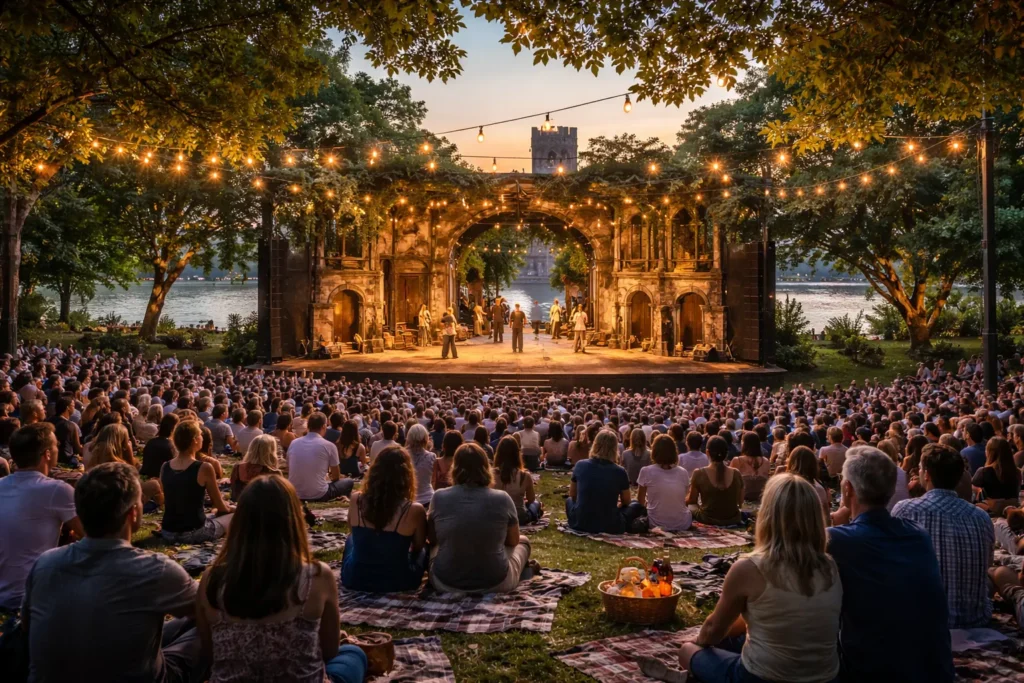
Imagine this: the sun is setting, painting the sky in shades of orange and purple. You are sitting on a grassy hill or a worn stone step, a cool breeze carrying the scent of popcorn and night-blooming flowers. In front of you, a stage comes alive not with spotlights, but with the soft glow of string lights and the last light of day. Children are laughing somewhere behind you. A couple shares a blanket off to the side. The person next to you might be a local who came on a whim, or a traveler from halfway across the world.
This is not your typical night at the theater. You are not trapped in a stuffy, velvet seat in a dark room. You are not shushed by an usher or confined by the rules of a formal performance space. You are outside, breathing in the fresh air, feeling the temperature drop as the night deepens, and becoming part of something bigger than just an audience. You are part of a shared moment that feels spontaneous, alive, and real.
Across the globe, cities are waking up to a powerful idea: to revitalize cultural tourism, you need to take the art out of the building. Open-air theater festivals, staged in ancient ruins, city parks, waterfronts, hidden courtyards, transformed forests, and even repurposed industrial sites, are experiencing a massive renaissance. They are drawing crowds away from traditional indoor venues and redefining what it means to go to a show. The numbers are staggering. The collection of festivals that transform Edinburgh, Scotland every August issues more than three and a half million tickets, ranking them among the three most attended ticketed events globally, right alongside the Olympic Games and the FIFA World Cup.
This shift is more than just a trend. It is a movement. It turns out that when you remove the roof, you also remove barriers. You create a space that feels more welcoming, more adventurous, and more memorable. By blending culture with the unique atmosphere of a place, these festivals are not just entertaining people. They are transforming local economies, building communities, bridging social divides, preserving historical sites, and writing a new chapter for the performing arts that honors ancient traditions while embracing futuristic technology.
This comprehensive exploration will take you around the world, from the deserts of Saudi Arabia to the forests of South Korea, from the castles of Spain to the parks of New York, to understand how open-air theater festivals are reshaping cultural tourism and why they matter more now than ever before.
Part One: The Magic of the Setting – Why We Crave the Outdoors
The Ancient Call of the Campfire
There is a primal magic to gathering outside. Long before we had climate-controlled theaters with their plush seats and concession stands, we had stories told around a campfire under a blanket of stars. Our ancestors gathered in circles, their faces lit by flickering flames, as elders recounted tales of heroes, gods, and the mysteries of the natural world. The night sky was the original ceiling, and the fire was the first spotlight.
This tradition stretches back tens of thousands of years. Anthropologists believe that storytelling around fires was one of the key developments that allowed human culture to flourish. It was how knowledge was passed down, how communities bonded, and how people made sense of their place in the universe. The fire provided warmth and protection. The darkness beyond the circle added mystery and danger. And the stories connected everyone present to something larger than themselves.
Open-air theaters tap into that ancient human connection. It is a feeling that you just cannot replicate indoors. There is a specific kind of intimacy found in the hush of an expectant crowd settling into a courtyard under string lights. That moment of collective anticipation, shared outdoors, feels different. It feels more human, more connected, more real.
Think about it. When you watch a play inside a black box theater, the world is shut out. The outside noise is muffled. The windows are covered. The goal is to create a controlled environment where nothing distracts from the stage. But in an open-air venue, the world is part of the show. The sound of distant city traffic might become part of the urban scene in a modern play. The rustle of leaves can underscore a dramatic whisper in a Shakespearean soliloquy. A bird flying overhead might steal the scene for a second, reminding everyone that they are part of a living, breathing world that continues whether the actors are on stage or not.
The Historical Roots of Outdoor Performance
This concept of performing outdoors is far from new. It has deep historical roots that stretch back centuries and across civilizations. The ancient Greeks built their theaters into hillsides, creating magnificent amphitheaters where drama was born under the Mediterranean sun. The Theater of Epidaurus, built in the fourth century BC, could seat up to fourteen thousand people and is still used for performances today. Its acoustics are so perfect that a whisper on stage can be heard clearly in the back row, a feat of engineering that modern architects still struggle to explain.
The ancient Romans took this tradition and expanded it, building massive entertainment complexes like the Colosseum, where spectacles unfolded under the open sky. Roman theaters, from Ephesus in modern-day Turkey to Orange in France, became centers of community life where citizens gathered to share experiences that reinforced their cultural identity.
In Asia, outdoor performance traditions were equally rich. Japanese Noh theater, which developed in the fourteenth century, often featured performances in garden settings where the natural environment complemented the spare, elegant aesthetic of the drama. Chinese opera troupes performed in temple courtyards and marketplaces, bringing stories to life for ordinary people who could not read but could understand the universal language of music and gesture.
This is also the concept of the sylvan theater, a term that dates back centuries to describe theaters set in wooded or sylvan settings. The most famous historical examples were the grand garden theaters of European palaces. Take the Water Theater Grove in the Gardens of Versailles, built for King Louis the Fourteenth in the sixteen hundreds. These were not just stages. They were carefully designed landscapes where hedges served as walls, fountains added musical accompaniment, and the sky was the ceiling. Elaborate machinery could make statues move or water features dance, astonishing audiences who watched nobility stroll through living art.
The Renaissance saw a revival of interest in outdoor performance, with Italian nobles commissioning garden theaters for private entertainments. The Teatro Olimpico in Vicenza, completed in fifteen eighty-five, featured a stunning outdoor-inspired interior with perspective views of city streets, blurring the line between indoor and outdoor space.
Today’s festivals are bringing that aristocratic concept to the public, democratizing the experience. They are turning public parks, city plazas, reclaimed industrial spaces, and even parking lots into magical performance spaces for everyone, regardless of income or social status. It is a return to the idea that great art should not be locked away in elite institutions. It should be out in the open, accessible to all who pass by.
The Psychology of Outdoor Engagement
There is actually science behind why outdoor performances feel so special. Environmental psychologists have found that being in nature reduces stress, lowers cortisol levels, and improves mood. When you combine the stress-reducing effects of being outdoors with the emotional stimulation of live performance, you get a powerful combination of positive feelings.
Moreover, outdoor settings change how we pay attention. Indoors, our focus is narrow. We look at the stage and try to block out everything else. Outdoors, our attention is more diffuse, more open. We are aware of the breeze, the changing light, the people around us. This state of soft fascination, as psychologists call it, allows for a different kind of engagement with art. We are more receptive, more open to surprise, more likely to remember the experience because it engaged multiple senses simultaneously.
The outdoor setting also breaks down the formal barriers between performer and audience. There is no proscenium arch creating a fourth wall. Actors might enter through the audience. The audience might be seated on three sides of the action. This physical proximity creates emotional proximity. When you can see the sweat on an actor’s brow or hear their unamplified voice strain against the wind, the performance feels more authentic, more urgent, more real.
The Role of Place in Creating Memory
Neuroscientists have discovered that memories are encoded more strongly when they involve multiple senses. An indoor theatrical performance primarily engages sight and hearing. An outdoor performance engages those plus the sense of touch through temperature and breeze, the sense of smell through grass, flowers, or food, and the sense of proprioception, the awareness of your body in space, as you shift on an uncomfortable bench or lean back on a blanket.
This multisensory experience creates richer, more durable memories. Years later, you might not remember every line of the play you saw outdoors, but you will remember how you felt. You will remember the quality of the light, the temperature of the air, the person sitting next to you. The performance becomes embedded in a larger experience of place and time.
This is why open-air festivals are so effective at creating loyal audiences and generating word-of-mouth marketing. People do not just remember the show. They remember the entire evening. They tell their friends not just about the acting, but about the sunset, the picnic they had beforehand, the moment when a bat flew across the stage during a dramatic pause. These stories are more compelling and more shareable than simple reviews of a performance.
The Democratization of Cultural Space
There is also something fundamentally democratic about outdoor performance. Traditional theaters, with their ticketed seats and formal etiquette, can be intimidating to people who did not grow up attending them. There is an unspoken code of behavior: when to clap, when to remain silent, how to dress, how to sit. For people unfamiliar with these codes, attending a theater can feel like entering a foreign country where they do not know the customs.
Outdoor festivals eliminate most of these barriers. There is no dress code. You can bring your own food and drink. You can talk during the performance, within reason. You can arrive late or leave early. Children can move around and make noise without attracting disapproving glares. The atmosphere is closer to a picnic than a formal event.
This accessibility matters. It means that people who would never set foot in a traditional theater might discover a love for live performance at an outdoor festival. It means that families can introduce children to the arts in a low-pressure environment where kids can be kids. It means that the arts become part of everyday life rather than a special occasion reserved for the privileged few.
Part Two: A Global Stage – Stories from Around the World
This movement is not happening in just one city or country. It is a global wave of creativity, with each location adding its own unique flavor based on its landscape, culture, and history. From the deserts of Saudi Arabia to the ancient gardens of Vietnam, from the forests of South Korea to the castles of Spain, from the mountains of Switzerland to the beaches of Australia, the open air is becoming the ultimate stage.
Weaving Stories into the Desert Rocks of AlUla
In AlUla, Saudi Arabia, something groundbreaking happened that challenges everything we think we know about theater. In December twenty twenty-four, a production called Azira premiered, and it flipped the script on what a theatrical experience could be. This was not a play you sat and watched from a distance. It was an experience you walked through, a journey you took.
AlUla is a place of extraordinary natural and historical significance. Located in northwestern Saudi Arabia, it is home to Hegra, the first UNESCO World Heritage site in the country, with well-preserved tombs carved into sandstone outcrops by the Nabataeans, the same people who built Petra in Jordan. The landscape is dramatic: massive rock formations rise from the desert floor, their surfaces carved by wind and time into strange and beautiful shapes.
Commissioned by the Royal Commission for AlUla, Azira had no traditional stage and no rows of seats. Instead, it transformed the ancient desert landscape into a living narrative. Guests were guided through the desert at night, moving from one giant sandstone rock formation to another, each stop revealing another chapter of the story.
Imagine embarking on this journey. First, you board a symbolic train that takes you to a lost city hidden among the rocks. You walk through narrow canyons, your path lit only by subtle lighting and the stars above. Suddenly, you find yourself in a natural amphitheater carved by time itself, where actors and musicians emerge from the shadows to bring an ancient myth to life. The directors deliberately used the landscape as a character in the story. Every rock formation, every shadow cast by the moon, every breeze that swept through the canyon became part of the atmosphere and narrative.
What made Azira so revolutionary was its commitment to site-specific storytelling. The production could not have existed anywhere else. It was woven into the fabric of AlUla, a place with thousands of years of human history carved into its sandstone cliffs. By creating a performance that required audiences to move through the space, to feel the sand under their feet and the cool night air on their skin, the creators achieved a level of immersion that no indoor theater could match. It is a powerful example of how open-air festivals can transform a place with deep historical roots into a canvas for modern, immersive storytelling.
Riding Through History in Beijing’s Yuanmingyuan Park
Meanwhile, in Beijing, technology is adding a completely new layer to the outdoor experience. At the Yuanmingyuan Park, the ruins of the Old Summer Palace, a fleet of special immersive buses called Chrono Craft offers a totally unique journey that blends past and present in real time.
The Yuanmingyuan, known in English as the Old Summer Palace, was once one of the most magnificent palace complexes in Chinese history. Built in the eighteenth century, it combined traditional Chinese garden design with European-inspired architecture, creating a unique blend of East and West. In eighteen sixty, during the Second Opium War, British and French troops looted and destroyed the complex, leaving it in ruins that have become a powerful symbol of China’s humiliations at the hands of foreign powers.
Here is how Chrono Craft works. You board a bus that looks ordinary from the outside, but inside, it is equipped with transparent screens on the windows. As you ride through the two point two square kilometer park, you look out at the ruins, crumbled pillars, overgrown foundations, remnants of what once was. But on those transparent screens, the ruins come alive. Ghostly, photorealistic images of Qing Dynasty palaces rise from the rubble, perfectly aligned with the real-world view outside. You see the ancient architecture superimposed over the modern ruins, watching history reconstructed before your eyes.
But it is not just visual. A twelve-speaker spatial sound system makes it feel like you are surrounded by the sounds of the past, birds singing from eighteen fifty, the murmur of courtiers, the boom of distant cannons from the palace’s tragic destruction. It is a mobile theater, a time machine, and a history lesson all rolled into one.
This remarkable project shows how open-air festivals can use new technology to help us connect with heritage sites in deeper, more emotional ways. Rather than just looking at ruins and imagining what they once were, visitors can now experience a version of the past, seeing and hearing history come alive around them. It transforms a passive visit into an active, immersive journey.
Free Shakespeare for the People in New York’s Central Park
Half a world away, in New York City, a different kind of open-air tradition has been thriving for over six decades. The Delacorte Theater in Central Park is the beloved home of Shakespeare in the Park, a program that has become as much a part of New York’s summer as hot dogs and humidity.
Since it opened in nineteen sixty-two, over five million people have packed its eighteen hundred seats to watch free performances of the Bard’s greatest works. The list of actors who have graced its stage reads like a who’s who of American theater and film: James Earl Jones, Meryl Streep, Kevin Kline, Al Pacino, Natalie Portman, Anne Hathaway, and countless others. But what makes the Delacorte truly special is not the star power. It is the radical idea that great theater should be free for everyone.
The story of the Delacorte is one of passion and persistence. Theater producer Joseph Papp fought for years against city bureaucracy, skeptical politicians, and financial constraints to create a permanent outdoor space where Shakespeare could be performed for free. He believed that theater should be accessible to all, not just those who could afford Broadway prices. After some stops and starts, and with a generous donation from publisher George T. Delacorte, the theater finally opened with a production of The Merchant of Venice starring James Earl Jones.
Today, getting tickets to Shakespeare in the Park has become a New York ritual. On the day of performances, people line up early in the morning, blankets and chairs in hand, hoping to secure one of the free tickets. The line itself has become a community, with regulars who know each other, share coffee, and debate the merits of past productions. It is a beautiful example of how open-air festivals are not just about making money. They are about making art accessible to all, tearing down the financial walls as well as the physical ones.
Transforming Forests into Screens in Seongnam, South Korea
In September twenty twenty-five, something unprecedented happened in Seongnam, South Korea, a city just southeast of Seoul. Professor Jinjoon Lee from the Graduate School of Culture Technology at KAIST directed a groundbreaking media art performance titled Cine Forest: Awakening Bloom as part of the Seongnam Festival.
The concept was simple but ambitious: transform an autumn night forest into a massive open theater. The venue was Bundang Central Park’s Outdoor Theater, but the performance extended far beyond any traditional stage. For the first time anywhere in the world, the production featured two-hundred-meter projection mapping on a forest environment. That is longer than two football fields, turning an entire grove of trees into a living, moving canvas.
The technical specifications were mind-boggling. The show employed sixteen ultra-high-resolution projectors, each pumping out forty to forty-five thousand ANSI lumens of brightness. Laser systems, smoke effects, and advanced three-dimensional Gaussian splatting technology digitally reconstructed the forest, creating seamless blends between real trees and projected imagery. AI-generated voice synthesis, VR-based simulations, and immersive spatial sound design pushed the boundaries of what is possible in live performance.
But technology was not the star. It was the tool. The performance drew inspiration from a fairy tale called The Giant Who Became a Star, in which a giant shares starlight with the people of a darkened city before ultimately becoming a star himself. This poetic narrative reflected on the innocence and hope that modern society has lost, using the natural setting to amplify its themes of connection, sacrifice, and renewal.
Perhaps most remarkably, the performance was built on community participation. A seventy-piece orchestra and a one-thousand-member citizen choir, accompanied by AI agents and iconic film soundtracks, blended with natural sounds collected from the forest, wind rustling leaves, water flowing in streams, insects chirping at dusk. Professor Lee called this harmonious blend a Media Symphony, and it transformed the park into an immersive soundscape where every element worked together.
Professor Lee described his vision. He said that this performance goes beyond media art. It is about creating a liminal experience where nature and the city, technology and humanity, coexist organically. He hoped audiences would experience a living landscape painting, where every breath and step becomes part of the narrative.
The Ancient Citadel Comes Alive in Hanoi
In Hanoi, Vietnam, traditional theater is literally stepping out of the box stage and into history. The Thang Long Puppet Theater, famous worldwide for its centuries-old water puppetry tradition, made a bold move that captured the imagination of audiences and critics alike.
They took a play called The Emperor of the Reed Flag to the Thang Long Imperial Citadel, a UNESCO World Heritage site that dates back over a thousand years. This was not just a change of venue. It was a profound artistic statement. Imagine watching a story about ancient Vietnamese emperors, performed with traditional puppetry techniques, in the very place where those emperors once walked, where they made decisions that shaped the nation’s history.
The setting added layers of meaning that no modern theater could provide. When the puppets recreated historical battles, the audience could look up and see the ancient walls that once defended the citadel. When the story touched on court rituals, viewers could imagine similar ceremonies happening on that very ground centuries before. The past and present converged in a way that felt magical and deeply moving.
This production demonstrated a key principle of successful open-air festivals. The venue is not just a container for the performance. It is an active participant. The history embedded in the stones, the cultural significance of the location, the very atmosphere of a place where generations have lived and died, all of these elements become part of the storytelling.
Water puppetry itself is a uniquely Vietnamese art form that originated in the rice paddies of the Red River Delta. Farmers would stand waist-deep in water, manipulating wooden puppets on long poles while villagers watched from the banks. The water served as both stage and curtain, hiding the puppeteers while allowing the puppets to appear to move magically across the surface. Performing this ancient art at the Imperial Citadel connected it to the highest levels of Vietnamese culture, elevating a folk tradition to a national treasure.
Modern Dance Meets Ancient Tradition in Hong Kong
In Hong Kong, the Hong Kong Dance Company is pushing boundaries in multiple directions at once. This acclaimed company, known for blending martial arts with Chinese dance traditions, has embraced outdoor and site-specific performances as a way to reach new audiences and create fresh artistic experiences.
For a remarkable piece called Storm Clouds, they used outdoor three-dimensional projection mapping on buildings, effectively turning the city’s architecture into a stage and the buildings into dancers. The urban landscape became a character in the performance, with light and movement transforming familiar structures into something strange and beautiful.
The company’s work draws on the rich vocabulary of Chinese dance, which incorporates elements of martial arts, opera, and folk traditions. By taking this vocabulary outdoors and combining it with cutting-edge technology, they create works that are simultaneously ancient and futuristic, traditional and avant-garde.
But the company’s commitment to innovation extends beyond technology. They have made their performances more inclusive by featuring wheelchair dancers, proving that physical limitations need not limit artistic expression. They have pioneered tactile tours for visually impaired audience members, allowing them to feel the performers’ costumes, the set pieces, and even the dancers’ movements through guided touch experiences before shows begin.
These initiatives show that open-air festivals are not just about where you perform, but who you perform for. By breaking down physical barriers and embracing new technologies, companies like the Hong Kong Dance Company are ensuring that outdoor performances can be enjoyed by everyone, regardless of ability.
A Spanish Castle Rocked by Music
On the Costa del Sol in southern Spain, the Marenostrum Fuengirola music festival has transformed the grounds of Sohail Castle into one of Europe’s premier open-air concert venues. The twenty twenty-four season, held from May to September, included thirty-three days of concerts featuring seventy national and international artists, attracting fans from fifty-seven different nationalities.
Sohail Castle has a history stretching back over a thousand years. Originally built by the Moors in the tenth century, it was later conquered by Christian forces and played a role in the defense of the coast against pirates. For centuries, it sat in ruins, a picturesque but largely ignored remnant of the past. Today, it has been reborn as a world-class concert venue, its ancient stones providing a dramatic backdrop for performances by some of the biggest names in music.
The economic impact was staggering. According to the Fuengirola town hall, the festival generated approximately fifty million euros in economic return and created seventeen hundred jobs. An external auditor specializing in event impact accounting confirmed these figures, validating what local business owners already knew. The festival brings a flood of visitors who fill hotels, restaurants, and shops.
The numbers tell the story. The festival attracted one hundred seventy-three thousand five hundred seventy-five music fans. These visitors did not just buy concert tickets. They booked hotel rooms, ate in restaurants, shopped in local stores, took taxis, and explored the region. Many extended their stays to enjoy the beaches and attractions of the Costa del Sol, turning a concert visit into a full vacation.
Mayor Ana Mula proudly declared Marenostrum the best cycle of open-air concerts in Europe, describing it as varied, integrative, sustainable and accessible. The festival’s commitment to sustainability is particularly noteworthy. The venue is single-use plastic-free, and organizers partnered with Repsol to reduce CO2 emissions through multiple measures. Generators powered by one hundred percent renewable fuels. Shuttle buses using renewable fuel for high-attendance concerts. Electric charging points for the official vehicle fleet.
The castle setting adds immeasurable value to the experience. There is something magical about watching a beloved band perform against the backdrop of ancient stone walls, with the Mediterranean Sea glimmering in the distance. The venue transforms a concert into an event, a memory that lingers long after the last note fades.
Small-Town Germany Shows How It Is Done
Even smaller cities are getting in on the action with remarkable success. In Hof, Germany, a city of about forty-five thousand people in Bavaria, a project called bühne raus, which translates roughly to stage out, has been transforming the city center into an open-air cultural hub since twenty twenty-three.
The concept is beautifully simple. Place an open-air stage in the middle of the city and invite everyone to participate. But the execution is wonderfully complex. In twenty twenty-five, from July fourth to July twentieth, bühne raus presented thirty-seven events over seventeen days, featuring an incredibly diverse range of participants. The list reads like a cross-section of the entire community. Schools, clubs, the Hof Symphony Orchestra, theater companies, migrant organizations, churches, daycare centers, libraries, music schools, and individual artists.
What makes bühne raus special is its philosophy. As the city’s cultural department explains, there are so many differences all over the world, but even more similarities, if you are of good will. The project aims to make diversity visible, to bring different things together, to work together and with each other.
The project received significant funding from the German federal program Sustainable inner cities and centers, recognizing that cultural development is inseparable from urban development. As Mayor Eva Döhla stated at the closing event of twenty twenty-three, bühne raus is more than just another open-air event. We have sent out a signal that says everyone belongs.
The location itself tells a story of urban renewal. The site on Friedrichstrasse had been blighted by the demolition of a former central store and subsequent neglect. Bühne raus positively revitalized this space with cultural energy, demonstrating how festivals can breathe new life into struggling urban areas.
Alpine Theater at Two Thousand Meters
In the Swiss Alps, the Tellspiele Altdorf offers one of the most spectacular open-air theater settings in the world. This festival, which dates back to the nineteenth century, performs Friedrich Schiller’s play Wilhelm Tell in the town of Altdorf, where the legendary Swiss hero is said to have shot the apple from his son’s head.
The stage is set against the dramatic backdrop of the Uri Alps, with snow-capped peaks visible behind the actors. When Tell makes his escape across Lake Lucerne in the play, real boats appear on a real lake, with the mountains providing a setting that no stage designer could replicate. The natural environment becomes an integral part of the storytelling, lending authenticity and grandeur to the performance.
The festival runs every four years, drawing tens of thousands of visitors to this small town of about nine thousand residents. Local residents participate as actors, crew members, and volunteers, creating a sense of community ownership that strengthens social bonds and preserves local traditions.
This is open-air theater at its most ambitious. The production involves hundreds of actors, live animals, and elaborate special effects, all coordinated on a massive outdoor stage. Yet because it happens only once every four years, it retains a special quality that keeps audiences coming back generation after generation.
The Oldest Open-Air Theater in Britain
In Cornwall, England, the Minack Theatre represents a different kind of open-air tradition. Carved into a granite cliff overlooking the Atlantic Ocean, this extraordinary theater was the lifelong project of a woman named Rowena Cade.
In the nineteen twenties, Cade decided to create a performance space in her garden where local productions of Shakespeare could be staged. With the help of a couple of assistants, she began hauling granite boulders and mixing concrete by hand, building a theater literally carved into the cliff face. She continued working on it for decades, constantly improving and expanding, until her death in nineteen eighty-three at the age of eighty-nine.
Today, the Minack is one of the most spectacular theaters in the world. Audiences sit on stone terraces cut into the cliff, looking down at a stage with the ocean stretching to the horizon behind it. During performances, the sound of waves crashing on the rocks below provides natural accompaniment. Seabirds fly past. The weather changes from minute to minute, with fog, sun, and rain all possible within a single performance.
The Minack operates from May through September, presenting a diverse program of plays, musicals, and opera. It attracts visitors from around the world who come not just for the performances but for the experience of sitting in this extraordinary place. It is a testament to what one person’s vision and determination can create.
Shakespeare in Japanese Gardens
In Japan, the tradition of outdoor Shakespeare has taken root in unexpected ways. The Japan Shakespeare Festival, founded in the nineteen nineties, has performed the Bard’s plays in some of the country’s most beautiful settings, including the grounds of ancient castles and the gardens of temples.
The adaptation of Western classics to Japanese settings creates fascinating cultural collisions. A Midsummer Night’s Dream performed in a traditional Japanese garden, with its carefully arranged rocks and manicured trees, takes on new meanings. The fairy world of the play resonates with Japanese traditions of nature spirits and supernatural beings. The result is neither purely Shakespearean nor purely Japanese, but something new that draws on both traditions.
These productions often incorporate elements of traditional Japanese theater, including Noh and Kabuki movement styles, traditional music, and elaborate costumes. The outdoor setting allows these elements to blend in ways that would be impossible in a conventional theater, with the natural environment providing a unifying element that bridges cultural differences.
Part Three: The Economic Boom – Festivals as Infrastructure
When cities invest in these festivals, they are not just writing a check for the arts as a nice luxury. They are investing in what experts increasingly call civic infrastructure. Think of a festival like a bridge or a road. It is something that brings people in, allows commerce to flow, and creates value that far exceeds its construction cost.
The Edinburgh Model: Festivals as Economic Engines
The numbers from Edinburgh are staggering and have become a model studied by cities worldwide. The collection of festivals that transform Scotland’s capital every August, including the famous Fringe, the International Festival, the Book Festival, the Military Tattoo, and the Art Festival, issues more than three and a half million tickets. To put that in perspective, that ranks the Edinburgh festivals among the three most attended ticketed events globally, right alongside the Olympics and the World Cup.
But the economic impact is what really catches the attention of city planners and finance ministers. Studies estimate the combined annual impact at over six hundred million pounds, which is approximately eight hundred million dollars. Here is the statistic that makes policymakers sit up and take notice. For every one pound of public investment, the festivals generate thirty-three pounds in return. That is a thirty-three hundred percent return on investment, a rate that would make any venture capitalist jealous.
The festivals transform Edinburgh for the entire month of August. The city’s population effectively doubles as performers, journalists, industry professionals, and tourists flood in. Every hotel room is booked. Every restaurant is full. Every pub is packed. The energy is electric, and the money flows through every sector of the local economy.
But the impact extends far beyond the festival month. The global attention generated by the festivals puts Edinburgh on the map as a cultural destination, attracting visitors year-round who want to experience the city they have seen in festival coverage. The festivals build the city’s brand, enhancing its reputation and making it more attractive to investors, businesses, and skilled workers.
Mena Mark Hanna, General Director and CEO of Spoleto Festival USA in Charleston, South Carolina, visited Edinburgh and came away inspired. He observed the dynamic tension between the official International Festival and the open-access Fringe, noting how they feed off each other’s energy. This ecosystem of creativity, he argues, creates a whole that is far greater than the sum of its parts.
Adelaide Fringe: Australia’s Festival Powerhouse
Down in the Southern Hemisphere, the Adelaide Fringe in Australia tells a remarkably similar story of economic transformation. The twenty twenty-five festival numbers are nothing short of astonishing. It generated nearly two hundred million dollars in total expenditure for South Australia, with over one hundred forty-four million dollars identified as new money injected into the state economy.
But here is the part that artists and arts advocates love. More than twenty-six million dollars from ticket sales went directly into the pockets of the artists and venues who participated. The festival’s open-access model means that artists keep what they earn, creating genuine economic opportunities for creative professionals who often struggle to make a living from their art.
The festival’s Honey Pot marketplace deserves special mention. This program generated over six million dollars in touring deals, connecting artists with national and international programmers, producers, and presenters. As Adelaide Fringe Director and Chief Executive Heather Croall explained, it is this marketplace that turns a festival season into a launchpad for touring, collaborations, and long-term creative success.
This money flows throughout the community. The twenty twenty-five Adelaide Fringe supported the creation of over sixteen thousand direct and indirect jobs. Visitors do not just buy a ticket and leave. They stay for dinner, they book hotel rooms, they shop in local stores, they take rideshares, they buy coffee and souvenirs. In Adelaide, visitors from out of town stayed for an average of over a week and spent nearly five thousand dollars each during their visit. That is a massive boost for local restaurants, hotels, and small businesses.
The growth over the past decade is remarkable. Tickets sold increased by ninety-seven percent, from over five hundred forty thousand in twenty fifteen to over one million in twenty twenty-five. Box office income paid to artists and venues more than doubled, increasing by over one hundred percent over the same period. This is not just growth. It is explosive expansion that benefits the entire creative ecosystem.
South Australia’s Minister for Arts, Andrea Michaels, put it perfectly when she said that Adelaide Fringe is at the heart of South Australia’s cultural and economic calendar, delivering a significant boost to hotels and small businesses including hospitality venues and retailers.
Spoleto USA: Charleston’s Cultural Gem
Back in Charleston, South Carolina, the Spoleto Festival USA has been a cultural treasure for nearly fifty years. Founded in nineteen seventy-seven as an American counterpart to the Festival dei Due Mondi in Spoleto, Italy, the festival has become inextricably woven into Charleston’s identity.
Its economic footprint is massive and measurable. The festival generates almost thirty million dollars annually from visitors coming from out of town. When you add up the impact since its founding, that is more than one point four billion dollars pumped into the local economy.
But Spoleto is just one star in Charleston’s constellation of cultural events. The city pulses year-round with festivals. The Southeastern Wildlife Exposition brings more than forty thousand visitors each February. The Charleston Literary Festival has become a fixture on the national literary calendar. The Food and Wine Classic attracts celebrity chefs and food lovers every March. The MOJA Arts Festival celebrates African-American and Caribbean culture each fall. The Charleston Jazz Festival swings into action every April.
As Hanna argues, Charleston should learn from Edinburgh’s example and treat these festivals as infrastructure, not as luxury. When festivals are seen as vital infrastructure rather than periodic pageantry, they shape a city’s economy, its character, and the way it is seen by the world. A city that embraces its festivals, across disciplines and seasons, creates meaningful, sustained benefits, jobs, visibility, a resilient economy rooted in creativity.
Regional Economic Analysis: The Styria Study
Sometimes the most revealing economic data comes from smaller-scale studies that dig deep into specific impacts. A fascinating analysis of Napalm Records, one of the biggest record labels in the independent music scene, examined the regional economic effects triggered by their activities in the province of Styria, Austria.
Researchers used a macroeconomic simulation model based on regionalized input-output tables to trace how money flows through the economy. They distinguished between direct effects, which are revenues at events like ticket sales, accommodation, and catering. They looked at indirect effects, which are intermediate inputs required to generate those revenues. And they considered induced effects, which are income spent for consumption and investment purposes by people employed in directly and indirectly affected sectors.
The results showed that the total value added in Styria doubled to eight point five million euros when all these effects were considered. Additional jobs were secured amounting to about fifty percent more than direct employment alone would suggest. This multiplier effect is crucial for understanding why festival investment makes economic sense. Money spent at a festival does not just disappear. It ripples through the economy, supporting jobs and businesses far beyond the festival grounds.
Fuengirola: A Spanish Success Story
The Marenostrum Fuengirola festival in Spain provides yet another compelling case study. The twenty twenty-four season generated an estimated fifty million euros in economic return for the town and created seventeen hundred jobs. For a municipality of about eighty thousand residents, this impact is transformative.
The festival attracted over one hundred seventy-three thousand music fans representing fifty-seven different nationalities over its thirty-three concert days. These visitors came from around the world, filling hotels, restaurants, and shops. The international reach of the festival put Fuengirola on the global map as a cultural destination.
Mayor Ana Mula emphasized that the festival’s success results from collaboration. She said that all this is due not only to the great work that the entire Marenostrum team has been doing, but also to the commitment of the most important promoters in this country, as well as the support of sponsors, without whom none of this would be possible. Public-private partnerships like this are essential for sustaining large-scale festivals.
Vienna’s Investment in Accessibility
Vienna’s approach to open-air festivals demonstrates a different kind of economic thinking, one focused on social returns rather than just financial metrics. The city’s Kultursommer Wien, or Summer of Culture Vienna, was initiated in twenty twenty as a way to support artists during the COVID-19 pandemic while providing free, high-quality cultural experiences to residents and visitors.
The city provides an annual subsidy of four million euros for this decentralized open-air festival, which aims to foster community engagement, celebrate cultural diversity, and make culture accessible to everyone, regardless of location or background. By twenty twenty-four, the festival was attracting over eighty-six thousand visitors.
What makes Vienna’s approach noteworthy is its intentional focus on underserved communities. The festival has expanded its program to include additional venues in outer districts, ensuring that residents do not have to travel to the city center to participate. Accessibility improvements include induction loops and sign language interpreters for selected performances. A continuing cultural education program engages local stakeholders and communities, creating a framework for inclusive and meaningful participation.
The festival also prioritizes fair pay and transparency, guaranteeing equitable compensation for every artist involved. Its governance reflects Vienna’s cultural diversity through a board that includes representatives from a variety of backgrounds. This commitment to fairness and inclusion demonstrates that public cultural programs can both support creative practitioners and enrich urban life for all citizens.
The Multiplier Effect in Action
Understanding the multiplier effect is key to grasping why festivals generate such significant economic impact. When a visitor spends money at a festival, that money does not just disappear. It becomes income for the person who sold the ticket, the artist who performed, the security guard who kept order, the food vendor who sold the meal.
Those people then spend their income on rent, groceries, transportation, and entertainment. That spending becomes income for landlords, farmers, drivers, and other business owners. They in turn spend their income, and the ripple continues.
Economists estimate that each dollar spent at a festival generates between one point five and two dollars of additional economic activity as it circulates through the local economy. This multiplier effect means that the total impact of festival spending is significantly larger than the initial expenditure.
Festivals also generate tax revenue for local and national governments. Every ticket sale, every restaurant meal, every hotel night generates sales tax or value-added tax. Every job created generates income tax. Every business that benefits pays corporate taxes. This revenue helps fund public services that benefit everyone, including the arts programs that make festivals possible in the first place.
Job Creation and Skills Development
Beyond the numbers, festivals create jobs that matter for real people. These are not abstract statistics. They are livelihoods. Stagehands who build sets. Sound engineers who mix performances. Ticket sellers who greet audiences. Security staff who keep everyone safe. Cleanup crews who restore venues after each event. Hospitality workers who serve meals and make beds. Retail workers who sell souvenirs. Transportation providers who move people around.
Many of these jobs are entry-level positions that provide opportunities for young people and those new to the workforce. They offer training in customer service, event management, technical skills, and teamwork. For some workers, festival jobs become career pathways leading to permanent positions in the events industry, hospitality sector, or creative fields.
The skills developed through festival work are transferable to many other industries. A stagehand learns project management and technical problem-solving. A ticket seller learns customer service and cash handling. A security guard learns crowd management and conflict resolution. These skills have value far beyond the festival context.
Brand Building and Destination Marketing
Festivals also serve as powerful marketing tools for cities. When Edinburgh is featured in global media every August, the images shown are not of boardrooms or office buildings. They are of historic streets filled with performers, packed theaters, and audiences having the time of their lives. This imagery builds a brand for the city as vibrant, creative, and welcoming.
This brand value translates into economic benefits that extend far beyond the festival period. Companies considering where to locate look for cities with high quality of life that will attract skilled workers. Skilled workers looking for places to live look for cities with vibrant cultural scenes. Tourists planning vacations look for destinations with unique experiences.
A city with a strong festival brand attracts all of these groups. It becomes a place where people want to be, and that desirability drives economic growth across all sectors. The festivals become a form of permanent advertising, generating positive associations that attract visitors, residents, and investment year after year.
Part Four: Social Inclusion and Community Building
Perhaps the most beautiful and important aspect of open-air festivals is their power to bring people together across lines of difference. In a world that often feels divided, these gatherings create spaces where community can be rebuilt and celebrated.
Chile’s Encuentro Festival: Theater for Everyone
In the La Granja commune of Santiago, Chile, the Encuentro Festival Teatro Latinoamericano has been demonstrating the power of performing arts to foster social integration and inclusion since its founding.
This remarkable festival takes place over ten days, offering around fifty evening itinerant performing arts presentations in public spaces and community centers throughout La Granja and other communes in the Metropolitan Region. The festival is completely free and operates without discrimination, eliminating any type of social, sexual, gender, economic, educational, ethnic or disability exclusion.
But the festival is about more than just performances. It organizes discussion groups and workshops where participating artists can exchange experiences, establishing ties that favor artistic, social, and cultural development. It also runs workshops and seminars aimed at the general community, fostering insertion, inclusion, and education in the cultural theater area for multiple age groups.
The results speak for themselves. The Encuentro has fostered inclusion and sensibilization to the arts and culture among Chilean families through the participation of more than six thousand people from different age groups, whether as audiences or creative agents. It has created a multi-institute support network for social organizations and families, as well as a local and Latin American theater network for performing arts professionals.
As the organizers note, the goal of adding cultural value to the community and their territories has been a driving force for the festival. This philosophy, that culture belongs to everyone and can strengthen communities, lies at the heart of the open-air festival movement.
Hof’s Bühne Raus: Making Diversity Visible
The bühne raus project in Hof, Germany, takes this commitment to inclusion and runs with it in inspiring directions. The project brings together an astonishing range of participants. Young and old. Rich and poor. Different neighborhoods. Classical music and unexpected sounds. Schools and clubs. Theaters and symphony orchestras. Initiatives of all kinds.
The list of twenty twenty-three contributors reads like a directory of the entire community. It includes schools at every level, from elementary through high school. It includes religious organizations like Kardia Church Hof and DiTiB Hof. It includes social service agencies like Diakonie Hochfranken with its integration guides, the International Girls’ and Women’s Center, and the Youth Migration Service. It includes arts organizations like the Hof Symphony Orchestra, Theater Hof, and the MusicMania Musicschool. It includes the Indian Students Association and their dance team.
As the city’s cultural department reflects, there are so many differences all over the world, but even more similarities, if you are of good will. Our city is as diverse, as varied as life itself. And this is also how we understand our cultural work. If anything has succeeded in recent years, and especially with bühne raus, it is to make this diversity visible, to bring different things together, to work together and with each other.
The project measures success not by pure visitor numbers, but by shared experience. It is about creating encounters, building connections, and demonstrating that everyone belongs. This philosophy transforms a cultural festival into a community-building exercise with lasting effects.
Breaking Down Barriers for People with Disabilities
Open-air festivals are also leading the way in making arts accessible to people with disabilities. The physical barriers of traditional theaters, narrow doors, steep stairs, fixed seating, can exclude people with mobility challenges. The social barriers, the expectation of silent, motionless attention, can exclude people with neurodivergent conditions.
Outdoor settings naturally eliminate some of these barriers. There is more space for wheelchairs and mobility devices. There is less expectation of absolute silence, so audience members can respond naturally to the performance. The relaxed atmosphere reduces anxiety for people who find formal theater settings overwhelming.
But festivals are going further, implementing intentional programs to ensure genuine accessibility. Vienna’s Kultursommer Wien includes induction loops for hearing aid users and sign language interpreters for selected performances. The Hong Kong Dance Company offers tactile tours that allow visually impaired audience members to feel performers, costumes, and sets before shows.
Adelaide Fringe made significant strides in accessibility in twenty twenty-five, with over ten thousand people from disadvantaged backgrounds able to attend thanks to generous support from donors and partners. This included support from the Department of Education that enabled school groups to experience the magic of Fringe.
These efforts recognize that accessibility is not just about physical accommodation. It is about genuine inclusion, ensuring that everyone can participate fully in the cultural life of their community.
Building Bridges Across Cultures
Open-air festivals are uniquely positioned to build bridges across cultural divides. When performances happen in public spaces, they attract diverse audiences who might never set foot in a traditional theater. A person walking through a park might stop to watch a few minutes of a performance, get drawn in, and stay for the whole show. This serendipitous encounter with art can be transformative.
The bühne raus project in Hof explicitly brings together people who were born here and those who came to us. In a time of intense debate about immigration and integration in Germany, this intentional mixing matters. When a Turkish-German choir performs on the same stage as a Bavarian folk music group, when children from different backgrounds create art together, when neighbors who have never spoken find themselves laughing at the same comedy sketch, these small moments build the fabric of a shared community.
The Encuentro Festival in Chile similarly brings together professional theater groups from across Latin America, creating a network that transcends national boundaries. Artists from Argentina, Peru, Colombia, and other countries share their work and their perspectives, building relationships that continue long after the festival ends.
The Marenostrum Fuengirola festival in Spain attracts fans from fifty-seven different nationalities, creating a truly international audience united by love of music. In the festival crowd, national differences become less important than shared enjoyment of the performance. People from different countries, speaking different languages, find common ground in the universal language of music.
Intergenerational Connections
Open-air festivals also create opportunities for intergenerational connection that are increasingly rare in modern life. In traditional societies, different generations mixed naturally in daily life. Children played while adults worked. Elders shared wisdom with the young. Families lived together and celebrated together.
Modern life has separated generations more than ever before. Children spend their days in age-segregated schools. Adults work in age-segregated workplaces. Seniors often live in age-segregated communities. The natural mixing of generations has been lost.
Festivals can help restore this mixing. When a grandmother brings her grandchildren to a free outdoor concert, they share an experience that becomes a family memory. When a teenager watches a street performer with their parents, they connect over something new to all of them. When an elderly person sits on a bench and listens to music drifting from a nearby stage, they feel part of the community life around them.
The bühne raus project in Hof intentionally brings together participants of all ages, from young children to senior citizens. Schools perform alongside adult choirs. Youth groups share the stage with senior citizens’ organizations. This mixing across generations strengthens the social fabric and reminds everyone that they belong to a community that includes people of all ages.
Strengthening Local Identity
Festivals also strengthen local identity by celebrating what makes a place unique. When Hof showcases its local musicians, its school choirs, its community organizations, it reminds residents why they are proud to live there. When Fuengirola transforms its ancient castle into a concert venue, it connects residents to their history. When Charleston presents its annual round of festivals, it reinforces the city’s identity as a cultural destination.
This strengthening of local identity has important social benefits. People who feel connected to their community are more likely to participate in civic life, volunteer for local organizations, and support local businesses. They are more likely to stay in the community rather than moving away. They are more likely to invest time and energy in making their community better.
Festivals create shared experiences that become part of local lore. Remember that year it rained during the Shakespeare performance and the actors kept going? Remember when that famous musician surprised everyone by showing up at the small venue? Remember the year the community choir sang so beautifully that everyone cried? These stories become part of the community’s collective memory, binding residents together through shared history.
Part Five: Blending the Old with the New
One of the most exciting aspects of open-air festivals is how they allow history and modernity to dance together. Old spaces find new life, and new art finds a powerful home in places thick with meaning.
Ancient Ruins as Contemporary Stages
There is something profoundly moving about watching contemporary performance in ancient spaces. The juxtaposition creates a dialogue across centuries, reminding us that human beings have always gathered to tell stories, make music, and share experiences.
In Spain, the Marenostrum Fuengirola festival uses the grounds of Sohail Castle, a fortress with origins in the tenth century. When modern rock bands perform against these ancient stone walls, with state-of-the-art lighting and sound systems, the contrast is electrifying. The past does not overshadow the present. It enriches it, adding depth and resonance to the experience.
In Vietnam, the Thang Long Water Puppet Theater’s performance at the Imperial Citadel created similar magic. The ancient setting lent authenticity and weight to historical stories, while the living art of puppetry brought the stones to life. Audiences could feel the presence of centuries, a sensation no modern theater could replicate.
In Greece, ancient amphitheaters that have stood for over two thousand years are regularly used for performances of classical drama. The Theater of Epidaurus, with its legendary acoustics, hosts productions of the same plays that premiered there in ancient times. Watching a Greek tragedy in this setting, with the original stage and surrounding landscape unchanged after millennia, is an experience that connects modern audiences directly to their cultural heritage.
In Italy, the Roman amphitheater in Verona has been hosting open-air opera performances since nineteen thirteen. The Arena di Verona, built in the first century AD, can seat fifteen thousand people and has become one of the world’s most famous opera venues. Productions are staged on a massive scale, with elaborate sets, hundreds of performers, and audiences filling the ancient stone seats under the stars.
This blending of old and new is not just aesthetic. It is economic and cultural strategy. By using heritage sites as venues, festivals create powerful incentives for preservation and maintenance. A castle that hosts concerts generates revenue that can fund its restoration. A citadel that draws visitors for performances becomes valued as a living space, not just a relic. Culture becomes the reason to preserve history, and history becomes the setting for new culture.
Technology Meets Tradition in South Korea
The Cine Forest performance in Seongnam represents a different kind of blending, this time between cutting-edge technology and the natural world. Professor Lee’s vision of creating a liminal experience where nature and the city, technology and humanity, coexist organically points toward a future where technology enhances rather than replaces human connection.
The technical achievements were remarkable. Sixteen ultra-high-resolution projectors. Laser systems. Three-dimensional Gaussian splatting for digital forest reconstruction. AI-generated voice synthesis. VR-based simulations. Immersive spatial sound. But these technologies served the story, not the other way around. The fairy tale of the giant who became a star, the participation of a one-thousand-member citizen choir, the integration of natural sounds from the forest, these human elements kept technology in its proper role as servant, not master.
Professor Lee, who has been exploring these artistic themes for twenty years, described his goal. He said that the audience will experience a boundary time and space that crosses reality and fantasy as if they were in the forest and on a screen at the same time. This liminal space, neither fully real nor fully virtual, offers new possibilities for artistic expression and audience engagement.
The performance also demonstrated how technology can enable community participation on a grand scale. A thousand citizens joined their voices in the choir, becoming part of the art rather than just observers. This model suggests a future where technology does not replace human creativity but amplifies it, allowing more people to participate in cultural production.
Augmented Reality and Historical Reconstruction in Beijing
The Chrono Craft immersive buses in Beijing’s Yuanmingyuan Park represent perhaps the most direct blending of past and present through technology. By superimposing historical reconstructions onto the real-world view of ruins, the experience allows visitors to literally see the past alongside the present.
This approach has profound implications for how we experience heritage sites. Traditional preservation often involves clearing away later additions, restoring buildings to a specific historical moment, and presenting them as static artifacts. The Chrono Craft approach, by contrast, layers history onto the present, allowing visitors to see both the ruin and its former glory simultaneously. It acknowledges that the past is never fully recoverable, but it can be made visible and meaningful through technology.
The spatial sound system adds another dimension, surrounding visitors with historically appropriate sounds. The birds of eighteen fifty. The cannons of eighteen sixty. The voices of courtiers and workers. These audio layers create an immersive historical environment that engages multiple senses. Visitors do not just see history. They hear it, feel it, inhabit it.
This technology opens up possibilities for other heritage sites worldwide. Imagine watching Greek tragedies performed in ancient amphitheaters while augmented reality shows you what the theater looked like when new. Imagine walking through Roman ruins while hearing the sounds of an ancient market. The past could become present in ways previously impossible.
Festivals as Laboratories for Innovation
Open-air festivals serve as ideal laboratories for experimenting with new forms of cultural production. Because they are temporary and flexible, they can take risks that permanent institutions might avoid. Because they draw diverse audiences, they can test what resonates across different communities.
The Cine Forest performance in Seongnam pushed technological boundaries that will influence future productions worldwide. The bühne raus project in Hof tested new models of community participation that other cities can adapt. The Chrono Craft buses in Beijing pioneered augmented reality experiences that could transform heritage interpretation globally.
This experimental function is one of festivals’ most valuable contributions to the broader cultural ecosystem. They serve as research and development for the arts, trying new approaches, learning what works, and sharing those lessons with the field. The risks they take benefit everyone, even when individual experiments fail.
Preserving Traditions Through Innovation
Paradoxically, innovation often helps preserve tradition. When traditional art forms are presented only in traditional ways, they risk becoming museum pieces, interesting but irrelevant to contemporary life. When they are presented in innovative ways, in new settings with new technologies, they demonstrate their continuing vitality.
The Thang Long Water Puppet Theater’s performance at the Imperial Citadel showed that this ancient art form can speak to contemporary audiences. The Hong Kong Dance Company’s use of projection mapping and inclusive practices demonstrates that Chinese dance traditions remain relevant in the twenty-first century. The Tellspiele Altdorf’s massive productions prove that a nineteenth-century play about a medieval hero can still draw crowds in the twenty-first century.
By embracing innovation, these festivals ensure that traditional art forms survive and thrive. They attract younger audiences who might otherwise dismiss traditional arts as boring or irrelevant. They generate revenue that supports ongoing practice and training. They create opportunities for artists to experiment within traditional forms, keeping them alive and evolving.
Part Six: Building a Festival for Everyone
What makes these events so special is the feeling that they are for everyone. Unlike a traditional theater, which can feel exclusive or intimidating with its dress codes, expensive tickets, and expectations of specialized knowledge, an open-air festival in a park feels like a public party to which everyone is invited.
The Fringe Model: Open Access for All
This is the magic of the fringe model, best seen in Edinburgh and Adelaide. The Fringe is an open-access festival, meaning anyone with a show and a venue can participate. There is no jury, no selection committee, no gatekeeper deciding what art is worthy. If you want to put on a show, you can.
This creates a wild, diverse, unpredictable mix of performances. You might see a world-famous comedian in a packed theater, and then walk next door to see a student troupe performing an experimental play in a tiny room above a pub. You might encounter puppetry, poetry, physical theater, stand-up, dance, music, circus acts, and performances that defy categorization, all in the same evening.
This dynamic tension between the big official events and the scrappy fringe events creates a cultural ecosystem that is exciting and unpredictable. The official festivals provide prestige and draw international attention. The fringe provides energy, experimentation, and opportunity for emerging artists. Together, they create something far richer than either could alone.
The Adelaide Fringe’s twenty twenty-five numbers demonstrate the scale this model can achieve. Over fifteen hundred shows across five hundred seventy-five venues statewide. That is not a festival. That is a cultural takeover of an entire city and region. For weeks, Adelaide transforms into a place where art happens everywhere, in every possible space, at every hour.
Volunteers as Co-Creators
These festivals also foster a powerful sense of community through volunteer programs. At the massive Glastonbury Music Festival in the UK, over one thousand volunteers help build stages, pick up trash, guide crowds, and handle countless other tasks. They work in exchange for a ticket, transforming them from passive consumers of the festival into active builders of it.
This model creates a different relationship between the audience and the event. Volunteers have invested their labor, so they feel ownership. They are not just passing through. They are part of making the magic happen. They form friendships with other volunteers, develop skills, and return year after year as part of the festival family.
Smaller festivals rely even more heavily on volunteer labor. Local residents staff information booths, serve as ushers, help with setup and breakdown. This volunteer corps becomes a community within the community, a group of people committed to the festival’s success because they have helped create it.
The Edinburgh festivals mobilize thousands of volunteers each year. Some work in festival venues, greeting audiences and checking tickets. Others work in information booths, helping visitors navigate the hundreds of shows on offer. Still others work behind the scenes, supporting artists and production teams. For many volunteers, the experience is transformative, leading to careers in the arts or lifelong connections to the festival community.
Making Arts Accessible to All
Festivals are also becoming more intentional about ensuring that cost is not a barrier to participation. The Delacorte Theater in New York’s Central Park has offered free Shakespeare for over sixty years, proving that world-class theater can be accessible to everyone. The line for tickets, with people camping out overnight, has become a beloved New York tradition in itself.
Vienna’s Kultursommer Wien is entirely free, funded by the city’s four million euro annual subsidy. The Encuentro Festival in Chile is also free, with performances in public spaces and community centers where anyone can attend. Adelaide Fringe distributed over ten thousand free tickets to people from disadvantaged backgrounds in twenty twenty-five, supported by donors and partners.
These programs recognize that economic barriers to arts participation are real and significant. Ticket prices for major performances can run to hundreds of dollars, putting them out of reach for many families. By offering free or subsidized access, festivals ensure that the arts belong to everyone, not just those who can afford high prices.
Reaching Out to Underserved Communities
Beyond economics, festivals are working to reach communities that have historically been excluded from or underserved by cultural institutions. Vienna’s Kultursommer Wien deliberately expanded into outer districts, recognizing that residents should not have to travel to the city center to participate in cultural life. The Encuentro Festival in Chile performs in community centers throughout the Metropolitan Region, bringing art directly to neighborhoods rather than expecting residents to come to art.
Bühne raus in Hof explicitly includes migrant organizations and works to bring together people who were born here and those who came to us. In a city with significant immigrant populations, this intentional inclusion matters. When a Syrian-German theater group performs on the same stage as a traditional Bavarian choir, the message is clear. You belong here. Your culture matters. Your voice deserves to be heard.
These outreach efforts build connections between cultural institutions and communities that might otherwise never engage. They create pathways for future participation, as children who attend free festival performances grow up expecting that the arts are for them. They build social cohesion by creating shared experiences across lines of difference.
The Role of Public Spaces
Open-air festivals also revitalize public spaces, reminding us of their importance in community life. In an age when so much of our lives are spent in private spaces, homes, offices, cars, shopping malls, public spaces can feel neglected and underutilized. Festivals bring them back to life.
When Hof places a stage on Friedrichstrasse, it transforms a street into a gathering place. When Seongnam projects images onto trees in Bundang Central Park, it turns a park into a wonderland. When Fuengirola fills Sohail Castle with music, it gives new life to an ancient monument.
These transformations remind us what public spaces are for. They are not just for passing through on the way to somewhere else. They are for gathering, celebrating, and sharing experiences. They are where community happens.
Creating Lasting Memories
Perhaps most importantly, festivals create lasting memories that bind people to places and to each other. The family that attends a Shakespeare in the Park performance together will remember that night for years. The friends who discover a new band at a castle concert will tell the story for decades. The community that comes together for a local festival will feel connected long after the stages are taken down.
These memories become part of personal and collective history. They are the stories we tell about our lives, the experiences that shape who we are. By creating opportunities for these memories, festivals contribute to human flourishing in ways that cannot be measured in economic terms alone.
Part Seven: Environmental Sustainability and Festival Design
As open-air festivals grow in scale and popularity, their environmental impact becomes an increasingly important consideration. The good news is that many festivals are leading the way in sustainable practices, demonstrating that large-scale cultural events can be environmentally responsible.
Eliminating Single-Use Plastics
The Marenostrum Fuengirola festival in Spain has made its venue completely single-use plastic-free. This means no plastic water bottles, no plastic cups, no plastic food containers. Attendees bring reusable bottles or purchase drinks in returnable cups. The impact on waste is dramatic. Instead of mountains of plastic trash at the end of each night, the festival generates minimal waste that can be properly recycled or composted.
This commitment requires significant logistical planning. Water refill stations must be plentiful and accessible. Vendors must be trained in sustainable practices. Cleaning crews must sort waste correctly. But festivals that make this commitment find that audiences appreciate it and often adopt similar practices in their daily lives.
Other festivals have followed suit. Glastonbury Festival in the UK has banned single-use plastics since twenty nineteen, preventing millions of plastic bottles from entering the waste stream. The festival also encourages campers to take their tents home, reducing the mountain of abandoned equipment that once blighted the site after each event.
Renewable Energy and Reduced Emissions
The Marenostrum Fuengirola festival has partnered with Repsol to dramatically reduce CO2 emissions through multiple measures. Generators run on one hundred percent renewable fuels. Shuttle buses powered by renewable fuel transport fans to high-attendance concerts. Electric charging points power the official vehicle fleet.
These initiatives demonstrate that festivals do not have to choose between scale and sustainability. With proper planning and investment, even large events can minimize their carbon footprint. The key is treating sustainability as a design priority from the beginning, not an afterthought.
The Edinburgh festivals have been working to reduce their environmental impact through the Edinburgh Festals Sustainable Network. This collaboration between festivals shares best practices, coordinates sustainability efforts, and works to reduce the collective carbon footprint of the festival season. Initiatives include encouraging sustainable travel, reducing waste, and promoting circular economy principles.
Natural Settings as Inspiration for Conservation
There is another way festivals promote environmental sustainability. By connecting people with natural settings, they inspire appreciation and protection of those settings. When audiences experience the beauty of a forest at night, transformed by art but still recognizably a forest, they are reminded of what is at stake in environmental conservation.
The Cine Forest performance in Seongnam explicitly integrated natural sounds, wind, water, insects, into its soundscape. The forest was not just a venue. It was a collaborator, contributing its voice to the art. Audiences experiencing this harmony between technology and nature might think differently about their relationship to the natural world.
This connection between cultural experience and environmental values is subtle but important. People protect what they love. Open-air festivals help people fall in love with public spaces, parks, forests, and historical landscapes. By creating positive experiences in these settings, festivals build constituencies for their preservation.
Waste Management and Circular Economy
Festivals generate significant waste, but innovative approaches to waste management are turning this challenge into an opportunity. Many festivals now operate on circular economy principles, designing out waste and keeping materials in use for as long as possible.
The Roskilde Festival in Denmark, one of Europe’s largest music festivals, has pioneered circular economy approaches. The festival collects materials after each event and finds ways to reuse them in future years. Tents that would otherwise be discarded are cleaned and resold. Food waste is composted. Materials are sorted and recycled.
Some festivals have gone even further, designing their events to produce zero waste. This requires careful planning from the beginning, with every element designed for reuse or recycling. Vendors must use compostable or reusable service ware. Audiences must be educated about proper disposal. Cleaning crews must be trained in sorting materials.
Sustainable Transportation
Getting thousands or hundreds of thousands of people to and from festival sites creates significant transportation emissions. Festivals are addressing this challenge through various strategies.
Some festivals provide shuttle buses from public transportation hubs, reducing the number of individual car trips. Others encourage cycling by providing secure bike parking and repair stations. Many promote carpooling through apps that connect potential ride-sharers.
The Edinburgh festivals work with transportation providers to increase capacity during the festival season, making it easier for attendees to use public transport. They also promote walking and cycling through maps showing routes and distances.
Long-Term Environmental Legacy
Beyond immediate impacts, festivals can create lasting environmental benefits by investing in green infrastructure. A festival that installs permanent water refill stations leaves behind infrastructure that benefits the community year-round. A festival that restores natural areas as part of its site preparation leaves the environment better than it found it.
The Marenostrum Fuengirola festival’s investment in renewable energy infrastructure benefits the castle grounds long after the festival ends. The electric charging points installed for festival vehicles remain available for public use. The commitment to renewable fuels creates demand that encourages continued investment in clean energy.
Part Eight: Challenges and Solutions
Running successful open-air festivals is not easy. Organizers face significant challenges that require creativity, flexibility, and resilience to overcome. Understanding these challenges helps explain why some festivals succeed while others struggle.
Weather: The Unpredictable Variable
The most obvious challenge is weather. Indoor theaters offer climate control, consistent temperature, protection from rain, shelter from wind. Outdoor festivals are at the mercy of the elements. A sudden thunderstorm can cancel a performance, disappoint thousands of ticket holders, and cost thousands in lost revenue.
Festivals have developed multiple strategies for managing weather risk. Some build covered stages that can protect performances from light rain. Others schedule performances only during seasons with reliable weather patterns. Many have contingency plans for moving performances indoors when necessary, though this is often expensive and logistically complex.
The most successful festivals embrace weather as part of the experience. A light drizzle during a romantic scene can be magical. A sudden wind that catches an actor’s cloak can look intentional. Audiences who brave imperfect weather often feel a special connection to the experience, as if they have shared an adventure together.
The Minack Theatre in Cornwall has learned to work with weather over its century of operation. Performances continue in light rain, with audiences donning raincoats and umbrellas. Only in the most severe weather are shows canceled. This resilience has become part of the Minack’s identity, with audiences proud of their ability to enjoy theater regardless of conditions.
Sound and Noise Considerations
Outdoor sound presents technical challenges. Without walls to contain and direct it, sound dissipates and can be distorted by wind. Neighbors may complain about noise. Different performances in close proximity can interfere with each other.
Professional sound design for outdoor venues requires specialized expertise. Engineers must account for wind direction, ambient noise levels, and the acoustic properties of the space. They must balance the needs of the performance with the rights of nearby residents, often limiting volume levels or ending performances at reasonable hours.
Some festivals have turned these constraints into creative opportunities. The Media Symphony in Seongnam used spatial sound design to create an immersive experience that worked with the natural environment rather than against it. By incorporating natural sounds into the soundscape, they made the environment a collaborator rather than an obstacle.
Noise complaints from neighbors can threaten festival viability. Successful festivals engage with local communities early and often, addressing concerns before they become conflicts. Some festivals offer free tickets to neighbors as a gesture of goodwill. Others limit late-night performances or install sound barriers to reduce impact.
Funding and Sustainability
Festivals face constant financial pressure. Ticket revenue alone rarely covers costs, especially for festivals committed to free or low-cost access. Public funding can be unpredictable, changing with political winds. Corporate sponsors may come and go. Philanthropic support requires constant cultivation.
The most successful festivals diversify their funding sources. Edinburgh’s festivals generate significant earned revenue while also receiving public investment that yields thirty-three-to-one returns. Adelaide Fringe combines ticket revenue with government support, corporate partnerships, and philanthropic donations. Vienna’s Kultursommer Wien relies on substantial city funding, treating cultural access as a public good worth supporting.
This diversity of funding sources provides stability. If one source declines, others can compensate. It also ensures that no single funder has undue influence over artistic decisions.
Balancing Growth with Intimacy
As festivals grow, they face the challenge of maintaining the qualities that made them special in the first place. A festival that started as a small, intimate gathering can become a massive commercial enterprise, losing its original spirit in the process.
The Edinburgh festivals, with their three and a half million tickets and global scale, have managed to maintain a sense of discovery and surprise. The key is the fringe model. Even as the official festivals have grown large and prestigious, the fringe has continued to provide space for emerging artists, experimental work, and unexpected encounters.
Adelaide Fringe has grown dramatically, ticket sales nearly doubled between twenty fifteen and twenty twenty-five, but has maintained its artist-focused ethos. The growth has actually benefited artists by putting more money in their pockets and creating more opportunities for exposure and touring.
The lesson is that growth is not inherently bad, but it must be managed intentionally. Festivals must be clear about their values and make decisions that protect those values even as they expand.
Security and Crowd Management
Large gatherings of people create security challenges. Festivals must protect attendees from theft, violence, and terrorism while maintaining an atmosphere of openness and celebration. This balance is difficult to achieve.
Since the terrorist attacks at concerts and festivals in recent years, security has become an even greater priority. Festivals now employ sophisticated crowd management techniques, including bag checks, metal detectors, and surveillance systems. They work closely with local police and emergency services to ensure rapid response if needed.
The challenge is to implement these measures without creating an atmosphere of fear or oppression. The best festivals make security feel seamless, with measures that are effective but unobtrusive. Attendees should feel safe without feeling watched.
Gentrification and Community Displacement
There is a darker side to festival success that must be acknowledged. As festivals revitalize neighborhoods and attract investment, they can contribute to gentrification that prices out long-time residents. The same cultural energy that makes a neighborhood attractive can make it unaffordable.
Festivals committed to community benefit must be aware of this risk and take steps to mitigate it. This might include partnering with affordable housing organizations, supporting local businesses owned by long-time residents, and ensuring that festival jobs go to local people.
The bühne raus project in Hof explicitly works to include all community members, recognizing that cultural development must benefit everyone, not just those who can afford rising rents. By bringing diverse participants together on equal terms, the festival models an inclusive approach to neighborhood change.
Part Nine: The Future is Outside
As we look ahead, it is clear that the future of performing arts is not confined to four walls. The success of open-air festivals around the world is sending a clear message. Audiences are hungry for experiences that are immersive, shared, and connected to the world around them.
Blurring Lines Between Art Forms
We are seeing the boundaries between different art forms dissolve. A theater festival might feature a major pop concert, a circus act, a poetry reading, and a dance performance, all in the same day. Artists move freely between disciplines, creating hybrid works that defy easy categorization.
This blurring reflects how audiences actually experience culture. Most people do not identify as exclusively theater-goers or music fans or dance enthusiasts. They like different things at different times, and they appreciate festivals that offer variety and surprise.
The open-air setting encourages this boundary-crossing. When you are sitting on a hill under the stars, you are more open to unexpected experiences. You might come for the music and stay for the theater. You might wander into a performance you would never have chosen in a traditional venue and discover a new passion.
Blurring Lines Between Audience and Performance
We are also seeing the line between audience and performer blur. Immersive shows like Azira in Saudi Arabia require audiences to move through the space, becoming participants in the narrative rather than passive observers. The Chrono Craft buses in Beijing turn every rider into a time traveler, actively engaging with history rather than just looking at it.
This shift toward participation reflects broader cultural changes. In a world of interactive media, audiences expect to be engaged, not just entertained. They want to feel that they are part of something, not just watching from a distance. Open-air festivals, with their flexible spaces and informal atmospheres, are perfectly positioned to meet this demand.
Blurring Lines Between Digital and Physical
The most exciting developments involve the blurring of digital and physical realities. The Cine Forest performance in Seongnam used cutting-edge technology to transform a real forest into a canvas for digital art. The result was neither purely physical nor purely digital, but something new that combined the best of both.
The Chrono Craft buses similarly blend physical ruins with digital reconstructions, creating experiences that are simultaneously real and virtual. Visitors see both what is and what was, inhabiting a space where past and present coexist.
These experiments point toward a future where technology does not replace physical experience but enhances it. Augmented reality can add layers of meaning to real places. Projection mapping can transform natural environments without permanently altering them. AI can enable new forms of creative expression while human artists remain in control.
Festivals as Civic Infrastructure
The most important shift is conceptual. Treating festivals not as luxuries or occasional entertainments, but as vital civic infrastructure. This means recognizing that festivals contribute to economic development, community building, public health, and quality of life in ways that justify sustained public investment.
Mena Mark Hanna of Spoleto Festival USA argues that cities should see their festivals as infrastructure, not as luxury. This means planning for them intentionally, funding them adequately, and integrating them into broader urban development strategies. It means recognizing that a vibrant festival scene makes a city more attractive to residents, visitors, and businesses, just like good schools, safe streets, and reliable public transportation.
Cities that embrace this vision will reap the rewards. Edinburgh has built a global brand around its festivals, attracting millions of visitors and generating billions in economic impact. Adelaide has transformed itself into a cultural destination, with festivals that support thousands of jobs and pump hundreds of millions into the local economy. Charleston is building on its existing festival base to create a year-round cultural economy that strengthens its identity and economy.
The Post-Pandemic Renaissance
The COVID-19 pandemic dealt a devastating blow to live performance. Theaters went dark. Festivals were canceled. Artists lost income. Audiences stayed home. For two years, the magic of live performance was largely absent from our lives.
When festivals returned, they returned with renewed energy and appreciation. Audiences who had been starved of live experience flocked to events with unprecedented enthusiasm. Artists who had survived the shutdown brought new urgency to their work. The pandemic reminded us of what we lose when we cannot gather, and the festivals that returned were more vibrant than ever.
The open-air festival model proved particularly resilient during the pandemic. Outdoor gatherings were safer than indoor ones, allowing festivals to proceed when indoor venues remained closed. Many festivals expanded their outdoor offerings during this period, discovering new spaces and formats that have continued post-pandemic.
What This Means for You
So, the next time you are planning a trip, or even just a weekend activity, look for the events that do not have a roof. Look for the festivals in the parks, the ruins, the waterfronts, the transformed industrial spaces. Look for the performances that happen at sunset, under string lights, with the audience sitting on blankets and the sound of crickets providing accompaniment.
Bring a blanket. Bring a friend. Bring an open mind. You might see Shakespeare in a park, with an actor so close you can see the sweat on their brow. You might discover a new band playing in a castle courtyard, with the Mediterranean Sea glimmering in the distance. You might wander into a community festival where your neighbors are performing, and realize you never knew they had such talent.
The world’s biggest and best stage is waiting for you, right under the open sky. And unlike a traditional theater, there is not a bad seat in the house.
Conclusion: The Stage Without Walls
The open-air theater festival movement represents something profound in the history of performing arts. It is a return to ancient traditions of gathering, storytelling, and shared experience. It is an embrace of new technologies that expand what is possible in live performance. It is a commitment to accessibility and inclusion that ensures the arts belong to everyone. And it is an economic strategy that generates jobs, attracts visitors, and strengthens communities.
From the desert canyons of AlUla to the forests of Seongnam, from the castles of Spain to the parks of New York, from the fringe festivals of Edinburgh and Adelaide to the community celebrations in small German cities, a transformation is underway. The walls are coming down. The ceilings are disappearing. The stage is expanding to encompass the whole world.
Cities that recognize this and invest in their festivals as vital infrastructure, as essential to their identity and economy as good roads and parks, will be the ones that thrive in the coming decades. They will be the places people want to visit, and more importantly, the places people want to live.
Because ultimately, open-air festivals speak to something deep in human nature. We are storytelling animals. We are social animals. We are animals who respond to beauty, who crave connection, who need to gather with others and share experiences that remind us we are alive. Open-air festivals, at their best, provide all of this and more. They remind us that even in a world of screens and devices, there is no substitute for sitting under the stars, breathing the same air as our neighbors, and watching something beautiful unfold.
The stage without walls is calling. All we have to do is show up.

**backbiome**
Backbiome is a naturally crafted, research-backed daily supplement formulated to gently relieve back tension and soothe sciatic discomfort.
**prostafense**
ProstAfense is a premium, doctor-crafted supplement formulated to maintain optimal prostate function, enhance urinary performance, and support overall male wellness.
**prodentim**
ProDentim is a distinctive oral-care formula that pairs targeted probiotics with plant-based ingredients to encourage strong teeth, comfortable gums, and reliably fresh breath.
**neurosharp**
Neuro Sharp is a modern brain-support supplement created to help you think clearly, stay focused, and feel mentally confident throughout the day.
**nervecalm**
NerveCalm is a high-quality nutritional supplement crafted to promote nerve wellness, ease chronic discomfort, and boost everyday vitality.