
Introduction: When the Night Brings No Relief
For Maria Consuelo, a sixty-seven-year-old grandmother living on the fourth floor of a walk-up apartment in Seville, Spain, the summer of 2023 felt different. It wasn’t just the temperature reading on her phone—a staggering 44 degrees Celsius—it was the way the heat pressed against her windows at midnight, refusing to let up. Her small fan pushed warm air around the room. Sleep was impossible. It was like the whole city was holding its breath, she recalls. You couldn’t escape it, even in the dark.
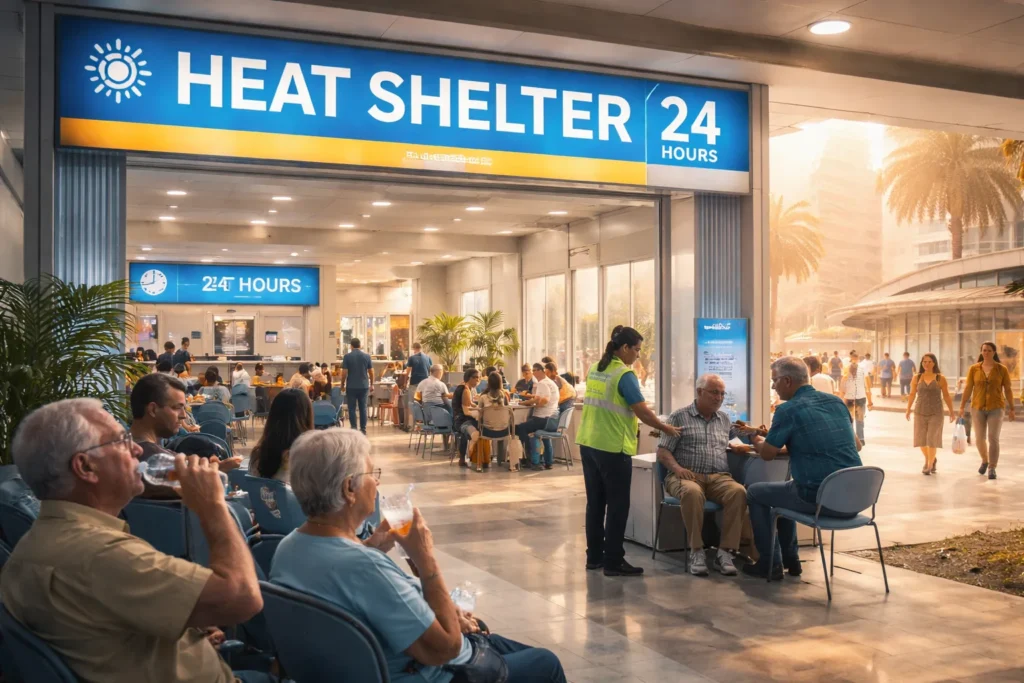
But last Tuesday, Maria found relief. Just a ten-minute walk away, at the San Jerónimo library—which also doubles as a bus depot—she walked into a blast of cool, filtered air. She was not just there to borrow a book. She was there to use one of the city’s new permanent cooling shelters. She grabbed a cold bottle of water from a hydration station, sat in a chair designated for seniors, and watched her blood pressure return to normal on a free health monitor.
Maria’s story is playing out in thousands of lives this year, from the suburbs of Athens to the sprawling cities of the United Arab Emirates to the crowded neighborhoods of Ahmedabad, India, to the sun-baked streets of Phoenix, Arizona. As global temperatures shatter records month after month, year after year, cities are realizing that fighting the heat is not just about weather forecasts anymore. It is about building permanent infrastructure to save lives. Welcome to the age of the 24-hour heat shelter.
Across the Northern Hemisphere, a quiet revolution is taking place. Major metropolitan areas across Southern Europe, the Middle East, and parts of South Asia have launched permanent, 24-hour cooling shelters to protect residents during prolonged heatwaves. Unlike temporary relief centers that open only during emergencies and close when the immediate danger passes, these facilities operate year-round and are integrated into public transit hubs, libraries, and community clinics. They represent a fundamental shift in how we think about urban living in a warming world.
This shift did not happen overnight. It came after years of rising death tolls, overwhelmed emergency rooms, and the grim realization that traditional approaches to heat relief were no longer enough. The old model—open a few schools or community centers when the temperature hits a certain threshold, put out a press release, and hope people show up—was failing. People were dying in their homes, in their apartments, on the streets, not because cooling was unavailable somewhere in the city, but because they could not reach it, could not afford it, or did not know it existed.
The new model is different. It is permanent, visible, and woven into the fabric of daily life. It recognizes that extreme heat is not a temporary inconvenience but a permanent condition of urban existence in the twenty-first century. And it is spreading, city by city, neighborhood by neighborhood, saving lives one cool breath at a time.
The Midnight Sun: Why Nighttime Offers No Relief Anymore
To understand why cities are launching these year-round shelters, we have to look at the clock. Not the daytime clock, but the nighttime clock. Historically, heatwaves were something people could sleep off. The sun goes down, temperatures drop, and the body gets a chance to recover. The natural cooling cycle of the evening has been humanity’s built-in protection against extreme heat for millennia. Our ancestors knew that no matter how brutal the day, night would bring relief. But that natural rhythm is breaking down.
Urban planners call this the urban heat island effect. Cities are made of concrete, asphalt, and brick. During the day, these materials soak up the sun’s energy like a battery. They absorb heat by the megawatt-hour, storing it in their dense molecular structures. At night, they release that heat back into the air, slowly, steadily, relentlessly. When you add in the waste heat from air conditioners pumping hot air onto the streets, from cars idling in traffic, from industrial processes running around the clock, from refrigerated trucks making deliveries, from data centers humming in the basement of every modern building, the city becomes a furnace that never fully turns off.
In some major capitals, the number of days experiencing temperatures above 35 degrees Celsius has increased by more than half over the past twenty years. In cities like Kuwait City, Baghdad, and Karachi, summer nights now routinely fail to dip below 90 degrees Fahrenheit. The human body, designed by evolution to cool down when the sun sets, never gets the signal. Core temperatures remain elevated. Organs work overtime. Sleep becomes impossible. The next day, starting already exhausted, the body faces another round of extreme heat. The damage accumulates.
This is where the new 24-hour cooling shelters come in. They are not just for the middle of the day anymore. The most vulnerable—like Maria, who lives alone on that fourth floor with no elevator and no air conditioning, or Ahmed, a construction worker from Mumbai sharing a tiny room with five other men, or Curtis Hackett, a man experiencing homelessness in Chicago sleeping on a park bench—need a safe place to sleep when their homes become ovens.
In Dubai, one pilot shelter located inside a metro station stays open all night. It is a strange but welcome sight: workers in high-visibility vests lying on cool mats, grabbing a few hours of rest before the sun rises and they have to go back to the job site. In Athens, where the number of heatwave days is expected to double by mid-century, city officials have appointed a dedicated heat officer to coordinate responses that include overnight shelter access. These shelters recognize a scary truth: the danger does not clock out at sunset.
The science backs this up. Human bodies need a break from heat to recover. When nighttime temperatures remain high, core body temperature does not drop sufficiently, leading to cumulative heat stress over multiple days. This is why heatwaves that last several days are so much deadlier than single hot days. The body can handle one day of extreme heat if the night brings relief. But by the third or fourth day, with no cooling period, the kidneys start to struggle, the heart works harder, the brain becomes confused. The 24-hour shelter model directly addresses this physiological reality by providing that critical cooling window, even when the rest of the city is still radiating heat.
Consider the data from the 2003 European heatwave, which killed an estimated 70,000 people. Epidemiologists who studied that disaster found that the highest mortality occurred not in the oldest cities or the poorest neighborhoods, but in places where nighttime temperatures remained highest. Paris, with its dense stone buildings and narrow streets, saw thousands of deaths because the city never cooled down. The same pattern repeated in 2010 in Moscow, in 2015 in Karachi, in 2021 in the Pacific Northwest. Where the night stays hot, people die. The 24-hour shelter is a direct response to that deadly pattern.
More Than Just an AC Unit: The Anatomy of a Modern Shelter
If you are picturing a dusty gymnasium with a few folding chairs and a window unit struggling to keep up, think again. The new wave of cooling centers is high-tech, thoughtfully designed, and surprisingly welcoming. City officials have learned a hard lesson: if you want people to use a shelter, it cannot feel like a shelter. It cannot feel like a charity hand-out or a last resort. It has to feel like a community hub, a place where people want to be, a normal part of neighborhood life.
These permanent shelters are strategically tucked into places people already go. You might find one in the lobby of a public library, in the corridor of a busy subway station, in the waiting area of a community clinic, or even inside a shopping mall. This is intentional design. It removes the stigma. You are not going to the shelter; you are just stopping by the library to cool off. You are waiting for your train in comfort. You are sitting in a cool space while your prescription is filled. This approach, known as cooling center integration, has been shown to dramatically increase usage rates compared to standalone facilities that require a special trip.
Inside, the design is focused on health and safety with the precision of a hospital and the comfort of a living room. Let us break down what makes them work.
Hyper-Filtration Systems: It is not just about cooling the air; it is about cleaning it. Extreme heat often brings stagnant air and increased pollution. High pressure systems that create heatwaves also trap pollutants near the ground. Wildfire smoke, once rare in many cities, now drifts across continents during the summer months. Ozone pollution spikes on hot days. Particulate matter from vehicles and industry concentrates in the still air. These centers use industrial-grade HEPA filters to remove particulates, making the air safe for people with asthma or respiratory issues. In cities like Phoenix, which faces both extreme heat and poor air quality, this dual-purpose filtration has proven essential. People with chronic obstructive pulmonary disease, emphysema, or severe allergies can breathe freely inside, even when the outside air is thick with smoke or smog.
Hydration Hubs: Dehydration is the number one precursor to heat stroke. The human body needs water to sweat, and sweating is the primary cooling mechanism. When dehydration sets in, sweating stops, and core temperature rises rapidly. Shelters feature self-serve water stations with electrolyte-enhanced options available, encouraging people to sip water constantly while they rest. Some advanced hubs in the Middle East include chilled water misters at the entrance, providing an immediate cooling effect the moment someone walks through the door. In Ahmedabad, misting systems at bus stops have been shown to reduce perceived temperatures by several degrees, creating micro-oases throughout the city where people can pause and recover during their daily journeys.
Medical Monitoring Corners: In the Athens pilot program, a corner of the shelter is staffed by a visiting nurse or connected to a remote monitoring station. Seniors can get their vitals checked—blood pressure, heart rate, oxygen saturation, core temperature—to ensure the heat has not pushed their bodies into a danger zone. This proactive medical screening catches problems before they become emergencies. Someone with slightly elevated blood pressure can rest and rehydrate under observation rather than collapsing at home hours later. Some shelters in Tokyo have begun using thermal imaging cameras to screen arriving visitors for signs of heat stress, allowing staff to prioritize care for those who need it most. The cameras detect skin temperature patterns that indicate overheating, flagging individuals who need immediate attention.
Zoned Comfort: Noise can be stressful. Crowds can be overwhelming. These centers are often divided into zones with different purposes and different atmospheres. There is a quiet zone for sleeping or reading, with dimmed lights and soft seating. There is a social zone where people can talk, play cards, or watch television, maintaining community connections that are vital for mental health. There is a specific zone for outdoor workers who might need to charge their phones, store their gear, or sit on the floor with their colleagues. In Mumbai, shelters near construction sites have added lockers where workers can store belongings safely while they rest, removing the anxiety of leaving tools or valuables unattended. Some shelters include family zones where parents can watch children play in a safe, cool environment.
Technology Integration: Modern shelters are not analog spaces frozen in time. They feature digital screens showing real-time weather updates, bus arrival times, train schedules, and heat health warnings. Free Wi-Fi and charging stations are standard, recognizing that connectivity is essential for modern life. Someone escaping the heat can still work remotely, apply for jobs, or stay in touch with family. In Singapore, some shelters have integrated smart systems that automatically adjust cooling based on occupancy, saving energy while maintaining comfort. Sensors detect how many people are in each zone and direct cooled air where it is needed most, reducing electricity consumption and environmental impact.
Accessibility Features: These shelters are designed for everyone, including people with disabilities, mobility limitations, or chronic health conditions. Wide doorways accommodate wheelchairs and walkers. Accessible restrooms are available. Signage is clear and multilingual. Staff are trained to assist people with diverse needs. In some European cities, shelters include quiet rooms for people with autism or sensory processing disorders who might find crowded spaces overwhelming.
Pet-Friendly Areas: Recognizing that many people will not leave their homes if it means abandoning their animals, some shelters now include pet-friendly zones. Small dogs, cats, and even birds can accompany their owners into these designated areas, with water bowls and cooling mats provided. This simple accommodation has dramatically increased shelter usage among pet owners who would otherwise stay in dangerous conditions rather than leave their companions behind.
It is this blend of comfort, technology, and medical safety that makes them effective. They do not just save lives; they improve the quality of life during the brutal summer months. They turn a survival struggle into a manageable inconvenience. They transform fear into relief.
The Human Face of Heat: Stories from the Front Lines
Behind every statistic is a person. Behind every cooling center visit is a story of someone trying to survive. Let us meet some of the people whose lives have been touched by these new facilities.
In Ahmedabad, Sushma Mishra weaves handicrafts under a tin roof that turns her home into an oven during summer months. She is a member of a women’s handicrafts cooperative, working long hours to support her family. Even with a fan running constantly, the house does not cool. The sunlight falls directly on the walls, she explains. The heat radiates inward, making it impossible to work comfortably or sleep peacefully. For Sushma, the neighborhood cooling center is not a luxury. It is essential to maintaining her livelihood. She can take her work to the center, sitting in cool comfort while her fingers create the intricate patterns that earn her income. She can return home in the evening, having survived another day without heat exhaustion.
In Chicago, Dhruv Trivedi spent four months unhoused after losing his job during the pandemic. When a June heatwave broke records dating back more than a century, he sought refuge at the Garfield Community Service Center. But the center closed at 5 p.m., when temperatures were still in the 90s. You need to wait all the day and you are not sure the beds are available or not available, he explained. When the cooling center closed, he boarded a city bus with his possessions, still hoping to find a place to stay. That night, with temperatures still in the 80s, he slept outside. His story illustrates both the progress made and the challenges ahead. Cooling centers help, but they must be accessible during the hours when they are needed most.
In Athens, Maria Papadopoulos is a seventy-five-year-old widow living alone in an apartment without air conditioning. Her pension barely covers food and medicine; air conditioning is a luxury she cannot afford. Before the cooling centers opened, she spent heatwaves sitting in the lobby of her building, hoping for a stray breeze. Now she walks to the neighborhood library, where she spends the hottest hours reading, socializing, and staying cool. The library staff know her by name. They check on her if she does not show up. The cooling center has become her lifeline, her community, her safety net.
In Dubai, Ahmed Al Mansouri works construction twelve hours a day, six days a week. He lives in a labor camp with dozens of other workers, sharing a room with six men. During last summer’s heatwave, the camp was unbearable. The metal roof absorbed heat all day and radiated it all night. Sleep was impossible. Then his employer partnered with the city to provide access to a 24-hour cooling center near the worksite. Now Ahmed and his coworkers can rest in cool comfort during their breaks, returning to work refreshed. They can sleep at the center on the hottest nights, protected from the heat that makes their camp unlivable. Productivity has increased. Heat-related illnesses have plummeted. Everyone benefits.
In Phoenix, Robert Jackson is a mail carrier who spends his days walking residential streets in 110-degree heat. His union fought for years to get cooling stations along delivery routes, and now they are finally appearing. At regular intervals, Robert can duck into a library, a community center, or a dedicated cooling pod to rehydrate, rest, and cool down before continuing his route. The difference, he says, is night and day. Before, he pushed through until he felt dizzy or nauseous. Now he takes preventive breaks, staying ahead of the heat rather than reacting to its effects.
In Tokyo, Yuki Tanaka is a university student whose tiny apartment has no air conditioning. During last summer’s record heatwave, she spent her days in coffee shops, buying the cheapest drink on the menu just to stay cool. But when her money ran out, she had nowhere to go. Then she discovered the cooling center at the neighborhood community center. Free, welcoming, and open all day, it became her study spot, her refuge, her salvation. She passed her exams while staying safe in the heat.
These are the faces of urban heat. They are old and young, rich and poor, native-born and immigrant. They are construction workers and grandmothers, students and mail carriers, people experiencing homelessness and people just barely getting by. The cooling centers serve them all, asking nothing in return but their presence and their safety.
The Data Does Not Lie: Early Wins in the Pilot Cities
When the first pilot programs launched, there were plenty of skeptics. Would people actually use them? Would it just be an expensive experiment that gathered dust? The data from the first full year of operation is starting to trickle in, and the results are hard to argue with.
In Seville, during a five-day heatwave that pushed temperatures to 43 degrees Celsius, emergency medical calls related to heat stress dropped by nearly one-fifth in neighborhoods that hosted a 24-hour shelter compared to those that did not. Emergency room visits for heat-related conditions fell by even larger margins. The savings in healthcare costs alone have begun to offset the operational expenses of the shelters. When researchers crunched the numbers, they found that every euro spent on cooling centers saved nearly three euros in healthcare costs and lost productivity.
In Athens, the shelters near public transit hubs saw a surprising demographic: commuters. It turns out that waiting for a bus or train in 100-degree heat is not just uncomfortable—it is dangerous. Shelters integrated into these hubs allowed people to wait safely indoors, protected from the elements. When the bus arrived, a digital screen inside the shelter alerted them, so they did not have to stand on the scorching pavement watching for headlights. Usage data showed that these transit-adjacent shelters served three times as many people as those located in standalone buildings. Commuters who would never have sought out a cooling center happily used them when they were integrated into their daily routine.
In parts of South Asia, where the heat combines with high humidity to create wet-bulb conditions that make sweating useless, the shelters have become lifelines for the urban poor. Wet-bulb temperature measures the combination of heat and humidity; when it exceeds 35 degrees Celsius, the human body can no longer cool itself by sweating. Death becomes inevitable without artificial cooling. In Mumbai, reports indicate that the shelters helped reduce the number of patients showing up at emergency rooms with severe heat exhaustion by one-quarter, freeing up hospital beds for more critical cases. The shelters are acting as a triage system, catching the mild cases before they become emergencies.
Ahmedabad, India, which experienced a deadly heatwave in 2010 that claimed more than a thousand lives, has been a pioneer in heat action planning. The city’s experience shows that early warning systems combined with accessible cooling can dramatically reduce mortality. Today, Ahmedabad is part of a global coalition of cities committed to heat resilience, sharing data and best practices with cities as diverse as Miami, Athens, and Melbourne.
This global coalition, launched at a major summit in Rio de Janeiro, brings together dozens of founding cities representing over a hundred million people. They are systematically tracking data on heat-related mortality, shelter usage, and health outcomes, creating the first global database on urban heat resilience. For the first time, cities can compare their performance, learn from each other’s successes, and avoid each other’s mistakes. A heat officer in Barcelona can see what worked in Buenos Aires. A planner in Bangkok can adapt strategies from Bengaluru. The data flows freely, saving lives across borders.
Early results from this coalition are encouraging. Participating cities have seen average reductions in heat-related mortality of 15 to 25 percent compared to similar cities without comprehensive heat plans. The most successful interventions combine multiple approaches: early warning systems, cooling centers, green infrastructure, public education, and targeted outreach to vulnerable populations. No single solution is enough, but together they create a safety net that catches people before they fall.
Protecting the Backbone: Outdoor Workers and the Unhoused
Heatwaves are not equal-opportunity disasters. They hit the most vulnerable the hardest, like a spotlight finding the weakest among us. Two groups stand out for their particular vulnerability: outdoor workers and people experiencing homelessness.
Take Ahmed, the construction worker we met earlier. In many cities around the world, construction continues through the midday heat. The work does not stop when the temperature rises. Workers are often paid daily; if they stop working, they do not get paid. For them, the choice is between earning money for their family and protecting their own health. It is an impossible choice, a cruel dilemma that no one should have to face.
The new shelters offer a middle ground, a way out of that impossible choice. Some are located near major construction sites, within walking distance of where workers spend their days. Workers can take a legally mandated heat break in a cool space, hydrate, rest, and return to work refreshed without losing their entire day’s wages. Unions in some pilot cities are now negotiating for shelters to be included in large development projects as a standard amenity, just like portable toilets and drinking water. In Ahmedabad, women handicraft workers who operate out of tin-roofed homes have been particularly vocal about the need for accessible cooling. For workers like Sushma, neighborhood cooling centers are essential to maintaining their livelihoods. They can work in comfort, produce more, earn more, and stay healthy all at once.
Farmworkers face similar challenges, often with even less protection. In California’s Central Valley, where summer temperatures regularly exceed 100 degrees, farmworkers toil in fields with no shade, no breaks, and no access to cooling. Heat-related deaths among farmworkers are tragically common. Pilot programs are now bringing mobile cooling units to agricultural areas, following the harvest and providing relief to workers who cannot leave the fields. These mobile units, mounted on trailers, can be deployed where they are needed most, bringing cooling to the people who need it rather than requiring them to travel.
For the unhoused population, the heat is a silent killer. On a cold night, you can put on layers. You can find a cardboard box, a blanket, a warm corner. On a hot night, you can only take off so much. Sleeping on concrete that retains the day’s heat can lead to severe burns and hyperthermia. Research on heat-related health risks for people experiencing homelessness, published recently, found that this population faces dramatically elevated risks during heatwaves due to prolonged outdoor exposure, limited access to hydration, and high rates of pre-existing health conditions.
Shelters that operate 24/7 provide a safe, cool place to sleep during the most dangerous hours of the early morning, when bodies are most depleted and temperatures are slowest to drop. They also connect people with social workers who patrol the shelters, offering not just cool air but pathways to longer-term help. A conversation at a cooling center can lead to a housing referral, a healthcare appointment, a job opportunity. The shelter becomes a gateway to services, not just a place to pass the time.
In Chicago, during a June heatwave that broke records dating back more than a century, the Garfield Community Service Center became a lifeline for people like Dhruv Trivedi. Anna Patterson, president of a street medicine organization, emphasizes that the cooling centers are a fantastic addition, but they do not always meet the needs of everyone. Monica Dillon, a volunteer with another outreach group, adds that we must dismantle the barriers to our designated cooling sites, ensuring they are truly accessible, welcoming, and consistently open—especially during peak heat hours and on weekends. The lives of our most vulnerable residents depend on immediate and decisive action.
These advocates highlight a crucial point: infrastructure alone is not enough. The infrastructure must be accompanied by outreach, by relationship-building, by trust. People who have been failed by systems before will not automatically trust a new system. They need to know that the cooling center is for them, that they will be welcome, that they will be treated with dignity. This requires outreach workers who already have relationships in the community, who can accompany people to the center and introduce them to staff. It requires consistent, respectful treatment over time, building trust one interaction at a time.
A Global Blueprint: From Europe to the Middle East to the Americas
While the problem is global, the solutions are local. A cooling shelter in Amsterdam looks very different from one in Riyadh, but the principles remain the same. Each city adapts the concept to its own climate, culture, and constraints, creating a rich diversity of approaches that can inspire others.
In Northern European cities, which are not historically built for heat, the focus is on retrofitting. Amsterdam, Copenhagen, Berlin—these are cities of brick and stone, designed to retain heat in cold winters, not shed it in hot summers. Their beautiful historic buildings, with thick walls and small windows, turn into pizza ovens during heatwaves. So planners are taking existing buildings—churches, old post offices, community centers—and installing cooling systems. They are learning that preservation and adaptation can coexist, that historic structures can be made comfortable without destroying their character. Amsterdam is experimenting with canal-water cooling systems that use the city’s famous waterways as a heat sink, pumping cool water through pipes to absorb heat from buildings.
In the Middle East, the approach is more about luxury and technology, reflecting both the resources available and the cultural expectations. Shelters there are often gleaming, modern spaces with automated doors, misting systems at the entrances, and cold drinking water infused with fruit. Because outdoor life is such a big part of the culture, these shelters provide a place for people to rest while moving between outdoor markets or walking to prayers. Some shelters in Dubai have incorporated traditional architectural elements like wind towers, reimagining ancient cooling techniques with modern technology. These wind towers, which have cooled buildings in the region for centuries, capture breezes and direct them downward, creating natural ventilation without electricity. Combined with modern cooling systems, they create spaces that are both comfortable and culturally resonant.
In the United States, cities like Phoenix and Los Angeles are watching these global pilots closely and adapting them to American conditions. Phoenix, which regularly experiences some of the highest temperatures of any major American city, has been a leader in heat governance. The city was one of the first to appoint a dedicated heat officer and has developed sophisticated mapping tools to identify neighborhoods most in need of cooling access. Researchers in Arizona have developed a workflow using public health frameworks and social vulnerability indices to identify optimal locations for cooling centers, ensuring that resources reach the populations who need them most. They map poverty rates, elderly populations, chronic disease prevalence, and lack of air conditioning to find the hottest spots with the most vulnerable people.
In Latin America, cities like Buenos Aires, Santiago, and Salvador bring a Global South perspective to heat resilience. These cities face unique challenges, including high rates of informal housing and less established social safety nets. Millions of people live in homes made of scrap materials, with no insulation, no air conditioning, and no protection from the heat. Their participation in global networks allows them to adapt solutions from other contexts to their local realities, sharing what works and what does not with peers facing similar challenges.
In Africa, Freetown, Sierra Leone, and Nairobi, Kenya, are demonstrating leadership on a continent that will be disproportionately affected by climate change. Freetown’s heat officer has become a global voice on urban heat, advocating for solutions that work in resource-constrained environments. The city has focused on nature-based approaches alongside cooling centers, recognizing that trees and green space provide passive cooling that benefits entire neighborhoods. Planting a tree costs a fraction of operating a cooling center, and its benefits last for decades. Every neighborhood in Freetown now has targets for tree coverage, with community groups organizing plantings and care.
In Asia, cities from Tokyo to Tel Aviv to Bengaluru are part of the global coalition. Research from Hong Kong highlights the importance of adaptation finance and cross-sector collaboration in making heat resilience work in Asian cities, where rapid urbanization often outpaces infrastructure development. In Bengaluru, once known as the garden city of India, rapid growth has paved over green space and created intense heat islands. Cooling centers are one response, but so is a massive tree-planting campaign to restore some of what has been lost.
It is a sharing of ideas, a global conversation on how to keep people alive. A heat officer in Athens can learn from a heat officer in Phoenix. A planner in Ahmedabad can share strategies with a planner in Buenos Aires. The solutions are local, but the learning is global.
Learning from the Past: Traditional Wisdom Meets Modern Technology
Adaptation is not new to Ahmedabad or any other ancient city. The old city of Ahmedabad, designated as a UNESCO World Heritage City, is filled with traditional housing clusters built with narrow lanes, shaded courtyards, and thick walls designed to reduce heat. For centuries, these architectural features kept residents comfortable through brutal summers, long before air conditioning was imagined.
The walls of these houses will not heat up as much because they are tightly packed, explains a local expert. With high ceilings, natural ventilation, and shaded walkways, these traditional areas are a blueprint for urban resilience. Modern architects are studying these traditional forms intensely, using sensors and computer models to understand exactly how they work. They are learning that passive cooling—design that keeps heat out without using energy—is not just a historical curiosity but a vital tool for the future.
Blue spaces like Kankaria Lake, Vastrapur Lake, and the Sabarmati Riverfront remain vital for public relief in Ahmedabad. Every evening, families flock there to cool down. At home, it feels like the house is undergoing combustion, says one resident who brings her children to the riverfront. There is no breeze in our congested neighborhood, so I bring my children here. These public spaces, created centuries ago for different purposes, have become essential cooling infrastructure in the present.
This blend of traditional wisdom and modern technology represents the cutting edge of urban climate adaptation. In Athens, the city is creating micro-forests in the hottest and most vulnerable neighborhoods, bringing green space to areas that have been paved over for decades. These tiny forests, planted densely with native species, create instant shade and cooling. In Paris, urban planners are identifying cool islands—parks, gardens, and water features—and creating walking routes that connect them, allowing residents to move through the city while staying in the shade. The routes are marked with signs and mapped on apps, turning a walk across town into a journey through oases.
In Singapore, the government has integrated greenery into the fabric of the city itself. Gardens bloom on the sides of skyscrapers. Parks cover the tops of parking garages. Trees line every street. The result is a city that feels lush and green even as it densifies, with temperatures noticeably cooler than they would be in a concrete jungle.
In Medellín, Colombia, the city created green corridors along roads and rivers, planting millions of trees and plants. The result was a temperature drop of several degrees across the city, transforming the urban climate. Residents who once stayed indoors during the hottest hours now venture out, enjoying streets that are shaded and cool.
The lesson is clear: the most effective heat resilience combines high-tech solutions like filtered air systems with low-tech approaches like tree planting and traditional architecture. Neither alone is sufficient; together, they create a web of protection that catches people before they fall through the cracks. The ancient wisdom of our ancestors, who built for climate without machines, has new relevance in the age of climate change. We ignore it at our peril.
The Cost of Cool: Funding the Future
All of this sounds great, but someone has to pay for it. Operating a 24-hour facility with medical staff, security, filtered air, and water is not cheap. The electricity bill alone can run into thousands of dollars per month per shelter. Critics often ask: is this really a good use of taxpayer money? Shouldn’t people just buy air conditioners? Shouldn’t they move somewhere cooler? These questions, while understandable, miss the point.
Proponents argue that cooling centers are an investment that pays for itself many times over. Look at the math. One night in a cooling shelter costs a fraction of one night in a hospital intensive care unit. A few hours of cooling and hydration can prevent a case of heat stroke that would require days of hospitalization. Every person who avoids heat stroke by sitting in a cool library for a few hours saves the city’s healthcare system thousands of dollars. When you factor in lost productivity, the economic case becomes even stronger. Extreme heat is estimated to cost the global economy hundreds of billions of dollars annually in lost labor. Workers who cannot work because of heat, who are less productive because of heat, who make mistakes because of heat—all of this adds up to a massive economic drain. Cooling centers, by keeping workers healthy and productive, actually contribute to economic output.
Funding is coming from a mix of sources, a patchwork of public and private money that reflects the urgency of the problem. Some cities are reallocating budgets from winter snow removal programs, which are seeing less use as winters warm, to summer heat programs. What was once a snow removal budget becomes a heat relief budget, following the changing climate. Others are applying for climate resilience grants from national governments and international organizations. Major foundations have provided millions of dollars to develop targets for heat adaptation and provide technical assistance to cities in the global coalition.
Private companies are also getting involved, recognizing that heat affects their bottom line. In some pilot cities, energy companies sponsor the hydration stations, knowing that a stable population under less stress is good for the community and that keeping people cool reduces strain on the electrical grid. Insurance companies, facing growing payouts from heat-related health claims and property damage, are beginning to invest in prevention. They realize that a dollar spent on cooling centers today saves ten dollars in claims tomorrow. Hospitals, overwhelmed by heat-related emergencies during heatwaves, are partnering with cities to fund cooling centers as a form of emergency diversion, keeping less severe cases out of the emergency room.
In Ahmedabad, an innovative heat insurance program automatically pays out to women beneficiaries when temperatures cross certain thresholds. If the city temperature exceeds a certain level for two consecutive days, women receive a cash payment. Crossing a higher threshold adds another payment. With a small annual premium, beneficiaries can receive meaningful support in a year with extreme heat. This program, implemented by a women’s housing trust, represents a new frontier in climate finance: using insurance not just to compensate for losses after they happen, but to prevent them by providing cash that can be used for cooling, transportation to shelters, or other adaptive measures.
However, challenges remain. For many poor women in Ahmedabad, even the small premium is a stretch. The concept of heat insurance remains unfamiliar to people who have never had insurance of any kind. To tackle this, community organizations have organized interactive games and education sessions. Women usually want to buy gold and silver, says one instructor. But we show them the benefits of buying protection from heat. It is a slow process, building understanding and trust one conversation at a time.
Urban planners argue that cooling infrastructure is not a luxury but a necessity, just like having a fire department or a police force. We do not ask whether fire departments are a good use of money; we accept that they are essential public services. As the planet warms, cooling the population is becoming a basic public utility, as fundamental as clean water or electricity. The question is not whether we can afford it, but whether we can afford not to have it.
Overcoming Barriers: Access, Equity, and Stigma
Even the best-designed cooling centers only work if people can actually use them. Researchers have identified multiple barriers that prevent vulnerable populations from accessing these lifesaving resources, and addressing these barriers is as important as building the centers themselves.
Physical Access: If a cooling center is located too far from where people live or work, they will not use it. Walking a mile in 100-degree heat to reach a cooling center is dangerous in itself. This is why the integration with transit hubs and existing community facilities is so important. A cooling center in a library that people already visit is infinitely more accessible than a standalone facility in an industrial park. In Phoenix and Tucson, researchers used public health frameworks and social vulnerability indices to map optimal locations for cooling centers, ensuring that facilities are within reasonable walking distance of high-need populations. They identified neighborhoods with high poverty rates, large elderly populations, and little tree cover, then sited cooling centers in those neighborhoods.
Temporal Access: A cooling center that closes at 5 p.m. is useless at 8 p.m., when temperatures may still be dangerous. This is the logic behind 24/7 operations. In Chicago, advocates have criticized city cooling centers that close during evening hours when temperatures remain high. It is like you got a mask on, says Curtis Hackett, describing the feeling of hot air blowing on him at night. It is just like you got a fan on and it is blowing hot air, that is exactly how I feel. Without access to cooling at night, he faces the same dangers as during the day. The 24-hour model addresses this gap, providing protection around the clock.
Social Access: Some vulnerable populations may not feel welcome in certain facilities. Unhoused individuals may be turned away or made to feel unwelcome in libraries or community centers, where staff are not trained to work with them. People with mental health conditions or substance use disorders may face stigma or discrimination. This is why some cities are developing specialized programming within cooling centers, including mental health support and addiction services. Staff are trained in trauma-informed care, de-escalation techniques, and cultural competency. The goal is to make everyone feel welcome, regardless of their circumstances.
Awareness: Many people simply do not know that cooling centers exist or where they are located. A cooling center that no one knows about saves no lives. Effective heat action plans include robust communication strategies: text alerts, social media campaigns, signage at transit stops, and door-to-door outreach in high-risk neighborhoods. In Athens, the city’s heat governance structure includes dedicated staff responsible for communicating heat risk to vulnerable populations, going door to door in neighborhoods with large elderly populations to ensure people know where to go for help.
Trust: For some communities, particularly those who have experienced discrimination or mistreatment by authorities, government-run facilities may not feel safe. Immigrants without documentation may fear that visiting a city facility will expose them to deportation. People who have had negative encounters with police may avoid any place where authority figures are present. This is why partnerships with community-based organizations are so important. In Ahmedabad, the women’s housing trust’s work with women in informal settlements demonstrates the power of trusted local organizations in delivering heat resilience. Women who would never visit a government facility will visit a center run by people they know and trust.
Cultural Competence: Cooling centers must be welcoming to people from diverse cultural backgrounds. Signage in multiple languages, staff who speak community languages, food that respects dietary restrictions, prayer spaces, gender-separated areas where appropriate—all of these details matter. A center that feels foreign or unwelcoming will not be used, no matter how cool it is.
Affordability: Even cooling centers must be affordable. If there is any cost associated with using them—even a suggested donation—some people will stay away. The most successful centers are completely free, with no questions asked. They are funded by taxes or grants, not user fees.
Addressing these barriers requires intentional design and ongoing community engagement. The most successful cooling center programs treat users not as passive recipients of services, but as partners in designing solutions that actually meet their needs. They conduct surveys, hold community meetings, and employ outreach workers who listen to concerns and suggestions. They adapt and evolve based on feedback, continuously improving their services.
The Next Evolution: From Shelters to Resilience Hubs
The pilot programs are already looking toward the future. The term heat shelter might soon be outdated, replaced by a broader, more ambitious concept. Urban planners are now talking about resilience hubs.
A resilience hub is a one-stop shop for climate disasters. Imagine a community center that has backup batteries for power outages, air filtration for wildfire smoke, cooling for heatwaves, and even a place to charge your electric scooter. These hubs are designed to be the heart of the neighborhood when things go wrong, a trusted place where people can go for help no matter what the emergency.
During a heatwave, they cool you down. During a flood, they provide dry shelter above the waterline. During a power outage, they keep your medicine cold and your phone charged, powered by solar panels and batteries. During a wildfire, they filter the air so you can breathe safely, creating a clean room in the middle of smoke. During a winter storm, they provide warmth and shelter. The same facility serves multiple purposes, maximizing the return on investment and ensuring that communities have a place to turn no matter what comes.
The pilot cooling shelters we see today are the testing ground for these larger, more ambitious community centers of tomorrow. They are proving that people will use them, that the logistics work, and that they save lives. They are building the relationships and trust that will be essential when bigger disasters strike. They are normalizing the idea of going to a community center for climate relief, so that when the next emergency comes, people know where to go.
In Barcelona, city officials have announced that they will undertake a simulation of a 50-degree heatwave in the coming years to test the preparedness of city agencies and resources. This kind of forward-looking planning, treating extreme heat as a disaster on par with earthquakes or floods, represents a fundamental shift in how cities think about climate risk. They are not waiting for the worst to happen; they are preparing for it in advance, testing their systems, identifying weaknesses, and making improvements.
The global coalition framework explicitly looks at both immediate and long-term actions. In the next two years, participating cities commit to establishing clear heat leadership, strengthening early warning systems, and ensuring access to cooling during emergencies. Within five years, they commit to improving building standards, expanding urban tree cover and shade, and future-proofing critical infrastructure. Within a decade, they aim to transform their cities, making them fundamentally more resilient to heat.
This dual timeline recognizes that we need solutions for today’s heatwaves while building the infrastructure for tomorrow’s climate. We cannot wait for perfect solutions; we must act now with the tools we have. But neither can we afford to only think short-term; we must build for the future even as we respond to the present.
Policy Frameworks and Governance: Making Heat a Priority
None of this happens without political will. The cities that are succeeding in heat resilience have something in common: they have elevated heat to a priority position in city government, giving it the attention and resources it deserves.
Athens appointed a dedicated heat officer, one of the first cities in the world to do so. This position coordinates across agencies—public health, emergency management, urban planning, parks and recreation, transportation, social services—to ensure a coherent response to extreme heat. The heat officer is responsible for everything from heatwave communication to long-term planning for green infrastructure, from cooling center operations to research partnerships with universities. This single position creates accountability and ensures that heat does not fall through the cracks between agencies.
Phoenix followed suit, recognizing that heat requires dedicated leadership. Miami-Dade County has a heat officer as well. These positions signal that heat is not just a weather event but a chronic condition that requires ongoing management, not just emergency response. They also create a point of contact for researchers, advocates, and community members who want to work on heat issues.
At the international level, the global coalition of cities answers the call to action on extreme heat from the United Nations and supports international climate action agendas. This alignment between local action and global frameworks creates accountability and enables the sharing of best practices across borders. When cities commit to action in a global forum, they are more likely to follow through, knowing that their peers are watching.
Policy frameworks also need to address the root causes of heat vulnerability. As researchers studying unhoused populations note, anything that is not directly targeting the primary insult, which is houselessness, is a kind of band-aid solution. The cure is a house, a home. Cooling centers save lives today, but they are not a substitute for addressing the underlying inequalities that make people vulnerable in the first place. A person with a safe, cool home does not need a cooling center. A person with a living wage can afford air conditioning. A person with healthcare access can manage chronic conditions that heat exacerbates.
This insight points to the importance of integrated policy approaches that combine emergency response with long-term solutions: affordable housing, healthcare access, living wages, and urban planning that prioritizes people over pavement. Cooling centers are essential, but they are not enough. They must be part of a broader strategy for equity and resilience.
Some cities are integrating heat resilience into their comprehensive plans, zoning codes, and building standards. New developments must include shade, cooling, and green space. Existing buildings must be retrofitted for efficiency. Streets must be designed with trees and awnings, not just asphalt. These policy changes, while less visible than cooling centers, may ultimately have a greater impact by preventing heat exposure in the first place.
Technology and Innovation: The Cutting Edge of Cooling
While the principles of heat resilience are timeless, the tools are constantly evolving. Across the globe, innovators are developing new technologies to make cooling more effective, more efficient, and more equitable.
Smart Surfaces: Reflective materials that bounce sunlight back into space rather than absorbing it can dramatically reduce surface temperatures. Cool roofs, coated with white reflective paint, have been shown to reduce indoor temperatures significantly. In Ahmedabad, a women’s housing trust has been promoting cool roofs in informal settlements, with such success that the city has incorporated them into the official heat action plan. Women learn to apply the reflective coating themselves, creating local jobs while protecting their homes. Cool pavements, using reflective materials on streets and parking lots, can reduce ambient temperatures across entire neighborhoods.
Green Infrastructure: Trees provide shade and cool the air through evapotranspiration, releasing water vapor that carries heat away. A single mature tree can provide cooling equivalent to several room air conditioners running all day. Green roofs and walls insulate buildings and reduce stormwater runoff, solving multiple problems at once. Urban forests create microclimates that can be several degrees cooler than surrounding areas, providing natural cooling that requires no energy input. Cities from Paris to Singapore are investing heavily in green infrastructure as a form of passive cooling that pays dividends for decades.
Grid-Interactive Buildings: As heatwaves drive up electricity demand for air conditioning, the electrical grid comes under strain. Blackouts become more likely, cutting off cooling for millions. Grid-interactive buildings can reduce their cooling demand during peak periods, easing pressure on the system and preventing blackouts. They can pre-cool during off-peak hours, storing coolth in their thermal mass, then reduce cooling when demand peaks. Integration with solar power allows buildings to generate their own cooling energy, reducing both costs and emissions while making the grid more stable.
Early Warning Systems: Advanced forecasting allows cities to activate cooling centers before a heatwave hits, rather than waiting until people are already suffering. In Ahmedabad, the heat action plan includes a sophisticated early warning system that triggers alerts to hospitals, community organizations, and the public when dangerous temperatures are forecast. Color-coded warnings indicate the level of risk and the appropriate response. Green for normal, yellow for watch, orange for alert, red for emergency. Everyone knows what the colors mean and what to do.
Data Analytics: Researchers are using big data to understand heat vulnerability at unprecedented resolution. By combining satellite imagery, census data, health records, and climate models, they can identify exactly which neighborhoods are most at risk and target interventions accordingly. They can see where the hottest areas are, who lives there, what health conditions they have, and what resources they lack. This granular understanding allows for precise, efficient allocation of limited resources.
Parametric Insurance: As demonstrated in Ahmedabad, insurance products that automatically pay out when temperatures cross thresholds can provide immediate cash to vulnerable populations, allowing them to cope with heat without depleting their savings. No claims process, no paperwork, no waiting. When the temperature hits the trigger, the money arrives. This innovation could be scaled to millions of people, providing a financial cushion that makes all the difference.
Portable Cooling: For people who cannot reach cooling centers, portable cooling devices may provide an alternative. Researchers are developing low-cost, low-energy cooling vests, hats, and mats that can keep individuals cool without air conditioning. Some use phase-change materials that absorb heat during the day and release it at night. Others use evaporative cooling, drawing on ancient technologies. While not a substitute for cooled spaces, these devices can provide crucial protection for outdoor workers and others who must be in the heat.
These technologies are powerful, but they are not magic bullets. They work best when integrated into comprehensive strategies that also address social and economic vulnerability. A cool roof does nothing for someone who cannot afford to apply it. An early warning system does nothing for someone who does not receive the warning. Technology must be accompanied by outreach, education, and support.
Community Engagement: The Heart of Resilience
For all the technology and policy and infrastructure, the heart of heat resilience is community. People protecting people. Neighbors checking on neighbors. Communities coming together to ensure that no one is left behind.
In Ahmedabad, the women’s housing trust trains community health workers who go door to door during heatwaves, checking on vulnerable residents, distributing information, and connecting people with resources. These workers are not outsiders; they are neighbors, trusted members of the community who know who needs help and how to provide it. They speak the language, understand the culture, and have relationships built over years. When they knock on a door, people open it.
In Chicago, street medicine teams patrol the neighborhoods where unhoused people gather, building relationships, providing care, and connecting people with cooling centers. They do not judge or coerce; they offer help and let people decide whether to accept it. Over time, trust builds. People who would never enter a government facility will go with someone they know and trust.
In Athens, volunteers check on elderly neighbors during heatwaves, bringing water, offering rides to cooling centers, and simply providing company. For many older people living alone, the social connection is as important as the cooling. Loneliness kills too, especially during disasters. A friendly face and a kind word can make all the difference.
In Phoenix, neighborhood associations organize cooling center carpools, ensuring that people without transportation can still reach safety. They share information on social media, call neighbors, and post flyers in local businesses. The response is organic, grassroots, and deeply effective.
In Tokyo, community centers host cooling events during heatwaves, bringing people together for games, movies, and socializing in cool comfort. The events reduce isolation while providing protection, turning a survival necessity into a community gathering.
These grassroots efforts are essential because they reach people that official systems miss. They build trust that no government program can mandate. They create resilience that outlasts any single heatwave. They remind us that in the end, we survive together or not at all.
A Call to Action: What You Can Do Now
While cities build this infrastructure, it is important to remember that community starts with individuals. If you live in an area prone to heatwaves, you can be part of the solution starting today.
Check on your neighbors, especially the elderly or those who live alone. A quick knock on the door, a phone call, a text message—these small gestures can save lives. Ask if they are okay, if they are cool enough, if they need anything. Offer to pick up groceries or prescriptions so they do not have to go out in the heat. Know the signs of heat illness and watch for them in people you care about.
Know the location of your nearest cooling center. It might be a library you pass every day, a community center you have never visited, a transit hub you use regularly. Find out before you need it, so you know where to go when the heat hits. Share this information with neighbors, friends, and family. Post it on social media. Make sure everyone knows.
Learn the signs of heat illness: dizziness, confusion, nausea, headache, rapid pulse, hot dry skin. Heat stroke is a medical emergency. If someone stops sweating or becomes confused, call for help immediately. While waiting, move them to a cooler place, apply cool cloths, and have them sip water if they are conscious.
If you work outdoors or know someone who does, understand your rights and resources. Many places now have heat standards that require breaks, shade, and water. Know what protections exist and advocate for them. If you see workers in distress, speak up. A moment of courage can save a life.
Advocacy matters too. If your city does not have a heat action plan, ask why. Show your local officials the data from Seville, Athens, Dubai, and Ahmedabad. Ask them if they know where the hottest neighborhoods are and what they are doing to protect the people who live there. Attend city council meetings, write letters to the editor, organize with neighbors. Make heat a priority.
Support organizations doing this work. Groups that serve unhoused populations, elderly people, outdoor workers, and low-income communities are on the front lines of heat resilience. They need volunteers, donations, and advocates. Find one in your community and get involved.
Vote for leaders who take climate seriously. Local elections matter enormously for heat resilience, determining who sits on city council, who runs the planning department, who allocates resources. Learn where candidates stand on climate adaptation and vote accordingly.
Prepare your own home. If you have air conditioning, make sure it works before summer starts. If you do not, identify places you can go to cool down. Install window reflectors, insulate your home, use fans strategically. Plant trees for shade. Every small step helps.
Conclusion: Building a Cooler Future Together
The heat is coming. This we know with certainty. The only questions are how bad it will be and how ready we will be. But this time, we are learning to fight back. With cool heads, smart planning, and a little bit of community spirit, we can make sure that everyone has a place to chill out, even when the rest of the world is on fire.
The era of the 24-hour heat shelter is just beginning, and for millions of people, it cannot come soon enough. From the narrow lanes of Ahmedabad’s old city to the gleaming metro stations of Dubai, from the community centers of Chicago to the libraries of Seville, from the riverfronts of Paris to the micro-forests of Athens, a global movement is taking shape. It is a movement that says no one should have to die in a heatwave. It is a movement that says extreme heat is not just an inconvenience but a public health emergency demanding public health response. And it is a movement that recognizes that in a warming world, cooling is not a luxury—it is a human right.
As we look to the future, the challenges are clear. Temperatures will continue to rise. Cities will continue to grow. The urban heat island effect will intensify. The number of dangerously hot days will increase. The people most vulnerable will become more so. But the tools to meet these challenges are also becoming clearer. We know what works: accessible cooling, early warning, green infrastructure, social connection, political will, community engagement. The question is whether we will implement these solutions at the scale and speed required.
The cities in the global coalition are betting that we can. They are betting that by working together, sharing data and best practices, and committing to bold action, they can protect their residents and redesign urban life for a hotter world. They are betting that the same human ingenuity that created cities can now save them from the consequences of that creation.
For Maria Consuelo in Seville, for Sushma Mishra in Ahmedabad, for Dhruv Trivedi in Chicago, for Ahmed Al Mansouri in Dubai, for Maria Papadopoulos in Athens, for the millions of people facing extreme heat around the world, that bet matters. Their lives depend on getting it right.
The good news is that we are learning. Every heatwave teaches us something new. Every pilot program generates data that helps the next city do better. Every life saved shows what is possible. We are not starting from scratch. We are building on the wisdom of traditional architecture, the power of modern technology, the strength of human community, and the lessons of past disasters.
The heat is relentless, but so are we. And together, we can build a future where no one has to face the heat alone. Where every neighborhood has a cool place to rest. Where every vulnerable person has someone checking on them. Where extreme heat is a manageable challenge, not a death sentence.
The shelters are open. The water is flowing. The fans are spinning. The doors are unlocked. Come in, rest, cool down. You are safe here. You are welcome here. You are not alone.
This is the promise of the 24-hour heat shelter. This is the future we are building. And it is a future worth fighting for, one cool breath at a time.