
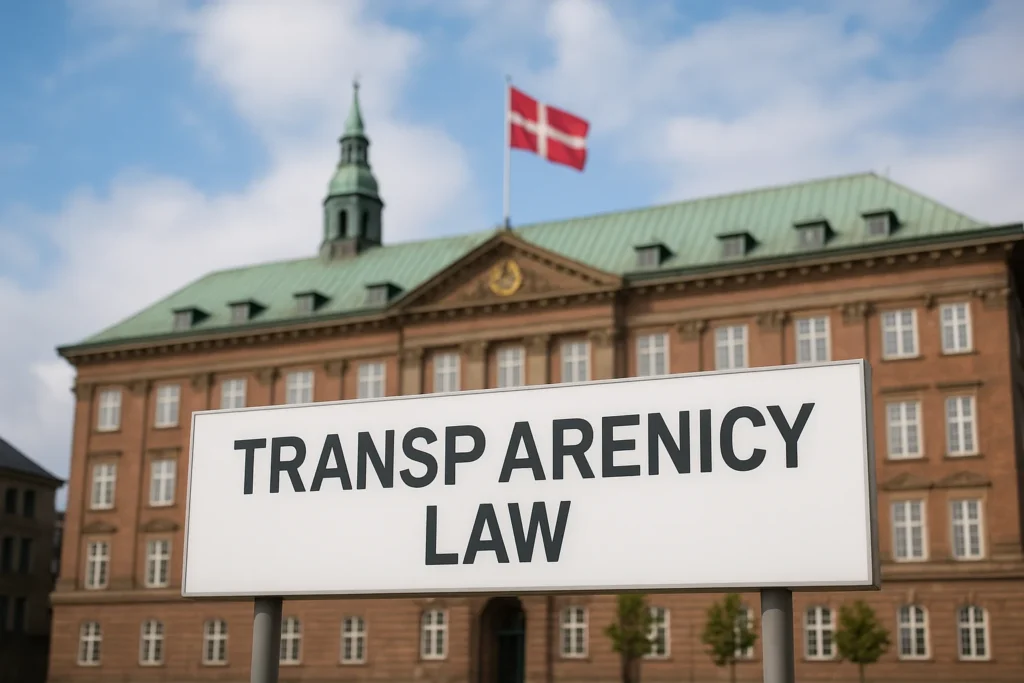

The Genesis: A Landmark Vote for Transparency and Trust
The morning of the legislative session in February 2019 was historically significant. Inside the Folketing, the Danish Parliament, a vote was pending that would not merely tweak an existing law but fundamentally redefine the relationship between the Danish state, its taxpayers, and the corporate sector. This was the moment the Amendment No. 26 to the Danish Public Procurement Act was adopted, propelling Denmark onto a new path of radical, enforced transparency in the awarding of government contracts.
This decisive action was the culmination of mounting public indignation. The preceding years had been plagued by high-profile financial scandals—specifically, vast money laundering operations involving hundreds of billions of Danish kroner that relied on the very corporate opacity the state was now seeking to dismantle. The Danish public, deeply invested in notions of societal fairness and accountability, demanded an end to the shadow economy that thrived on secrecy. The government’s response was not cautious reform but a bold declaration: the foreign policy principle of “zero tolerance towards corruption in all its forms” was now being integrated into the very heart of domestic financial management. Transparency was recognized as the ultimate vaccine against corruption.
By enacting this amendment, Denmark chose to move far beyond the existing legal requirements set by the European Union. The new legislation enshrined mandatory disclosure of nearly every element of the contract evaluation process, setting a gold standard for open government worldwide. This commitment was not abstract. As debate raged in the committee rooms, a clear philosophy emerged: corruption risk is not an occasional problem, but a permanent factor in all public dealings. Therefore, the state must construct a legal and procedural framework so robust that it pre-empts illicit activity. This resolve positioned Denmark at the cutting edge, transforming it from a nation grappling with the ripple effects of global financial crime into a pioneer of proactive transparency.
The journey to this pivotal moment had been years in the making. Danish authorities had observed with increasing alarm how sophisticated financial crimes could undermine even the most stable democracies. The Danske Bank scandal, which saw approximately 200 billion euros of suspicious transactions flow through its Estonian branch, served as a wake-up call that transcended the financial sector. It prompted a fundamental re-examination of how transparency—or the lack thereof—in one area of governance could create vulnerabilities across the entire system.
What made Denmark’s approach unique was its recognition that procurement transparency couldn’t exist in isolation. It needed to be part of an ecosystem of accountability that stretched from high finance to municipal contracting. The legislation represented a philosophical shift from treating transparency as a compliance requirement to embracing it as a core operational principle. This meant re-engineering processes, redefining relationships between government and business, and fundamentally changing how public servants approached their stewardship of taxpayer funds.
The Legal Landscape: Anchoring Transparency in a Multi-Layered Foundation
The Danish procurement system is a masterpiece of legal engineering, meticulously balancing the supranational directives of the European Union with deeply ingrained national priorities for maximum transparency and accountability. It is a structure designed to ensure that the three core principles—equal treatment, transparency, and proportionality—are enforced at every touchpoint of public spending.
The system is governed by a complementary suite of legislation, forming a strong, interlocking chain of legal control:
| Key Legislation | Scope and Application and Rationale | Detailed Transparency Relevance and Impact |
|---|---|---|
| Public Procurement Act (Udbudsloven) | The primary legislative vehicle implementing the EU Procurement Directive, governing high-value contracts. | The Legislative Pivot: The introduction of Section 160 became the most critical feature. It dictates not just that evaluation models must be transparent, but demands their complete and detailed publication prior to the tender deadline, clarifying ambiguities left by prior court rulings. |
| Utilities Directive Implementation | Covers procurement in the essential and complex sectors of water, energy, transport, and postal services. | Contextual Flexibility: Recognizes the strategic importance of these networks, allowing procedural flexibility for technical specificity while rigidly upholding the core transparency of decision-making. |
| Concessions Directive Implementation | Regulates the long-term award of public service or works contracts (e.g., maintaining a major bridge). | Long-Term Accountability: Balances the need for comprehensive oversight over agreements that can last decades with the flexibility required for private partners to manage risk. |
| Danish Tendering Act (Tilbudsloven) | Extends the principles of procurement to cover public construction and supply contracts falling below the stringent EU financial thresholds. | Universal Application: Ensures that fundamental fairness principles—including non-discrimination and transparency—apply equally to the vast volume of smaller, local contracts, preventing corruption from simply migrating to lower-value deals. |
| Public Information Act (Offentlighedsloven) | The foundational law granting citizens and the media broad access to government documents, including detailed files on procurement and contract execution. | Empowering the Watchdog: This act serves as the non-procurement foundation for oversight, enabling journalistic investigation and civil society scrutiny to challenge government decisions using primary documentation. |
The day-to-day enforcement and management of this framework are entrusted to the Danish Competition and Consumer Authority (DCCA). The DCCA is responsible for drafting and maintaining the legislation, providing guidance to contracting authorities, and operating udbud.dk, the centralized national e-procurement portal. This dual role of legislative oversight and operational management ensures consistency and rigor throughout the system.
This legal architecture didn’t emerge fully formed but evolved through continuous refinement. Each piece of legislation addresses a specific vulnerability while contributing to an integrated whole. The Public Procurement Act sets the broad framework, while specialized directives address sector-specific challenges. The Tendering Act ensures that transparency isn’t reserved only for large, politically visible projects but extends to the thousands of smaller contracts that collectively represent significant public expenditure. Meanwhile, the Public Information Act provides the crucial backstop, ensuring that even if procedural transparency fails at the procurement stage, accountability can still be enforced through public scrutiny after the fact.
What makes this legal framework particularly effective is its recognition of different types of transparency risks. For large infrastructure projects, the risk might be political interference or complex bid-rigging schemes. For utilities, the risk might involve technical specifications written to favor incumbent providers. For smaller municipal contracts, the risk might be simpler favoritism or nepotism. The legal framework addresses each of these scenarios with tailored transparency requirements while maintaining consistent underlying principles.
From Principle to Practice: The Mechanisms of Radical Transparency
The 2019 reform was revolutionary because it moved beyond general declarations of transparency to mandate highly specific, anti-corruption procedures. These mechanisms were designed to eliminate the ‘grey area’ where favoritism and undue influence could thrive.
Section 160: The Unpacking of the Evaluation Model
The core of the legal revolution lies in Section 160 of the Public Procurement Act. It mandates that contracting authorities must publish all parts of their evaluation model in the tender documents. This is not a request for a general description; it is a legal requirement for full methodological disclosure.
The necessity of this strictness can be traced back to a pivotal 2017 case involving the Central Denmark Region. In that instance, the Complaints Board for Public Procurement had ruled that the authority was not required to reveal the detailed “gradient of their point model”—meaning the precise formula used to translate a bidder’s score into a final rating remained secret. This legal ambiguity allowed authorities to keep a crucial part of the scoring mechanism hidden, which could be exploited to manipulate the outcome subtly.
The legislative amendment of 2019 was a direct and intentional parliamentary intervention to close this loophole. It unequivocally clarified that full and complete disclosure is required to satisfy the principles of equal treatment. This means:
- Weightings: The precise percentage or points allocated to every single criterion (e.g., price vs. technical merit)
- Sub-Criteria: The breakdown of how major criteria are scored based on sub-factors
- Scoring Methodology: The exact numerical or qualitative scale used, including any curve or gradient applied
This rule shifts the risk: the contracting authority, not the bidder, bears the burden of ensuring its evaluation model is perfectly clear and defensible before the tender process even begins.
In practice, this has transformed how Danish authorities approach procurement planning. Where previously a municipality might have stated that “environmental considerations” would factor into their decision, they must now specify that “possession of ISO 14001 certification accounts for 15% of the total score, with additional points available for demonstrated carbon reduction in similar projects over the past five years.” This level of specificity eliminates ambiguity and ensures all bidders understand exactly what is required to compete effectively.
The Two-Envelope System: Insulating Quality from Price
Recognizing the psychological bias that often creeps into evaluations—where a surprisingly low or high price can unconsciously influence the assessment of a proposal’s quality—Denmark introduced the innovative two-envelope system. While currently restricted to major construction projects exceeding DKK 350 million, its philosophy aims to ensure that public value is not sacrificed for the sake of the lowest immediate cost.
The procedure is rigorous:
- Sealed Separation: Bidders submit their technical (qualitative) proposal in one envelope (or file) and their financial (price) offer in a separate one
- Blind Assessment: The evaluation committee first opens and scores only the qualitative envelopes. This panel is expressly forbidden from having access to any pricing information. They assess methodology, technical merit, experience, and capability in a bubble, ensuring quality evaluation is pure and unbiased
- Combined Decision: Only once the qualitative scores are finalized, recorded, and signed off, are the financial envelopes opened. The final decision on the “Most Economically Advantageous Tender” is then made by combining the independently-verified quality score with the price score
Though narrowly applied to the most strategically and financially significant contracts, this system sets an undeniable precedent for protecting qualitative assessment in high-value public spending, making it a critical procedural safeguard against cost-cutting that compromises long-term value.
The psychological underpinnings of this approach are well-established in behavioral economics. The “anchoring effect” describes how initial exposure to a number (in this case, a bid price) can disproportionately influence subsequent judgments. By completely separating quality and price evaluation, Denmark’s system counteracts this cognitive bias at an institutional level. Evaluation committees report that this process liberates them to focus purely on technical merits without the subconscious pressure of cost considerations, leading to more rigorous assessment of long-term value.
Weaving a Safety Net: The Anti-Corruption Ecosystem
Denmark understands that procurement is merely one pillar of a broader system of financial integrity. The procurement transparency rules are therefore deeply integrated into the nation’s entire anti-corruption infrastructure.
The Power of Beneficial Ownership Disclosure
A fundamental enabler of procurement integrity is the public beneficial ownership register, launched in 2017. Before this, corrupt actors could hide behind intricate chains of shell companies and nominees, obscuring the true recipient of public funds. Now, the register makes the ultimate human owner of any bidding company publicly available and easily searchable.
This reform is a game-changer for procurement:
- Conflict Detection: Procurement officers can instantly check if a bidder’s ultimate owner has any relationship with the contracting authority’s decision-makers
- Journalistic Oversight: Investigative reporters can trace funds and relationships, transforming opaque corporate structures into transparent, verifiable data points
- High Compliance: The system boasts an impressive 96% compliance rate, driven by clear government guidance and robust, dissuasive financial sanctions for non-disclosure
As transparency experts have noted, connecting the dots between who bids (procurement data) and who benefits (ownership data) creates a powerful, preventative tool against illicit enrichment and cronyism.
The beneficial ownership register represents a fundamental rethinking of corporate privacy in the context of public business. While commercial confidentiality remains important for competitive reasons, Denmark has determined that when companies seek to profit from public funds, the public’s right to know who they’re doing business with outweighs traditional privacy concerns. This principle has gained international traction, with many countries now following Denmark’s lead in establishing public ownership registers.
Enforcement Through the Penal Code
Transparency is merely a window; the penal code provides the security bars. The Danish criminal framework imposes severe consequences for corrupt acts in public contracts:
- Active Bribery (Section 122): Criminalizes the offering or giving of a bribe or “other advantage” to a public official
- Passive Bribery (Section 144): Criminalizes the accepting of a bribe by a public official
The law applies to both Danish and foreign officials, casting a wide net over international dealings. Violations are punishable by significant fines and imprisonment of up to six years, ensuring the state possesses the necessary punitive instruments to deter both corporate and official misconduct.
What makes Denmark’s anti-corruption framework particularly effective is its integration across different legal domains. The criminal provisions work in tandem with administrative law (which can disqualify companies from future bidding) and civil law (which can void corrupt contracts). This multi-layered approach means that corruption risk isn’t just a legal problem—it’s a business viability problem for companies and a career-ending risk for officials.
Accountability in Action: The Engine of Enforcement
The strength of Denmark’s transparency model is not in the text of the law, but in the operational capacity of its oversight bodies.
The Rigor of the Complaints Board
The Danish Complaints Board for Public Procurement is a specialized, independent tribunal that serves as the frontline enforcer of procurement rules. It provides a swift and highly technical avenue for any disappointed tenderer to challenge a decision they believe violates transparency or fairness standards.
The Board’s case law demonstrates an unyielding commitment to the law’s spirit. The landmark DXC Technology Denmark case is often cited as proof. Here, the Board struck down an award where the contracting authority confused bidders by inviting proposals for both maintaining an old digital system and implementing a new one, but merged the evaluation in a way that violated the transparency principle. The Board ruled that this methodology created confusion and made it impossible to identify the “most economically advantageous tender” fairly, a clear violation of both Section 160(1) and the core principles of the Act. This ruling underscored that procedural fairness is as important as the final decision.
Decisions from this Board are a primary source of legal guidance and can be appealed through the national court system, ultimately leading to the European Court of Justice. This multi-tiered judicial review ensures that the principles of transparency are constantly tested and rigorously maintained.
The Complaints Board represents a recognition that specialized procurement disputes require specialized adjudication. Unlike general courts that might hear everything from divorce cases to commercial disputes, the Board develops deep expertise in procurement law and practice. This allows it to make nuanced judgments about what constitutes meaningful transparency versus mere technical compliance. Its decisions have gradually built a body of jurisprudence that gives concrete meaning to the abstract principles in the legislation.
Avoiding the Pitfalls: A Guide to Compliance
Through years of rulings, the Complaints Board has created a clear roadmap of common transparency failures that contracting authorities must avoid:
| Common Failure | Impact on Fairness | Solution |
|---|---|---|
| Vague or Subjective Criteria | Bidders cannot accurately gauge how their proposal will be judged, leading to guesswork and mistrust. | Use quantifiable and specific evaluation parameters, clearly linked to the public need. |
| Undisclosed Weighting Systems | Allowing the authority to post-rationalize the weight given to price vs. quality after reviewing bids. | Publish a detailed weighting matrix for all criteria and sub-criteria in the tender documents. |
| Post-Tender Modifications | Changing the evaluation rules, scoring methods, or required documentation after bids have been opened. | Document and freeze the evaluation model before the tender is published; any necessary change requires restarting the tender. |
| Merging Dissimilar Criteria | Combining criteria that should be evaluated separately (e.g., technical merit and delivery schedule) into a single score. | Separate and individually weight distinct criteria to ensure a methodologically sound and transparent scoring process. |
The consistent message to public authorities is simple: meticulous documentation is your only defense. Every decision, score, and communication throughout the process must be recorded and defensible under the scrutiny of the Complaints Board and the public.
This focus on documentation has had a transformative effect on procurement culture within Danish authorities. What was once seen as bureaucratic overhead is now understood as essential risk management. Comprehensive documentation not only protects against legal challenges but also improves the quality of decision-making by forcing officials to articulate and justify their reasoning at each stage of the process.
The Impact: Case Studies in Trust and Efficiency
The theoretical legal frameworks translate into tangible benefits in the public and private sectors, restoring faith in the state’s financial conduct.
The Aarhus Transportation Triumph (Government Side)
City authorities in Aarhus, tasked with procuring a complex, multi-modal transportation management system, were initially wary of Section 160. Under the old rules, they might have intentionally left criteria vague to give themselves maneuvering room. The new law forced them into an unprecedented level of precision: they had to define the exact weights for technical capability (40%), integration with existing systems (25%), maintenance efficiency (20%), and future innovation potential (15%). This clarity had an unforeseen positive effect: it forced the city to better understand and articulate its needs. The clear criteria attracted high-quality, perfectly tailored proposals, reducing the evaluation time and shielding the agency from all political accusations of bias when an international firm won over a favored local candidate.
The Aarhus case demonstrates how transparency requirements can drive better outcomes rather than simply constraining decision-makers. By forcing detailed upfront planning, the city avoided the common pitfall of realizing mid-process that their requirements were inadequately defined. The winning bidder delivered a system that seamlessly integrated with existing infrastructure while providing innovative features the city hadn’t initially considered but had clearly specified in their evaluation criteria. Post-implementation reviews showed that the project came in on time and budget, with stakeholder satisfaction significantly higher than similar projects procured under the previous less transparent system.
Datasoft’s Competitive Edge (Business Side)
For growing companies like Copenhagen-based Datasoft, public procurement used to be viewed as an insider’s game—a closed door where connections mattered more than competence. The new transparency rules were a powerful equalizer. Datasoft’s CEO noted the transformation: “The risk of investing time and money in a complex bid vanished when we could see the exact scoring logic. We knew precisely which aspect of our technology the government valued most, allowing us to focus our resources.” This effect—known as pro-competitive transparency—increases the pool of qualified bidders, forcing public contracts to be awarded based on merit, not relationships.
The impact on Denmark’s business environment has been significant. Small and medium enterprises (SMEs), which previously often avoided public procurement due to perceived biases toward large incumbents, have increasingly entered the marketplace. This has stimulated competition, driven innovation, and in many cases reduced costs for public authorities. The transparency has also created a more predictable business development environment, allowing companies to strategically invest in capabilities they know the public sector values.
The Journalist and the Hospital Contract (Civil Society)
Investigative reporter Emma Nielsen utilized the full complement of Danish transparency tools to scrutinize a major hospital construction contract. By combining access to procurement files (via the Public Information Act) with data from the public beneficial ownership register, she was able to trace a winning construction firm’s subcontracting chain. Her analysis revealed that a high-value subcontract had been awarded to a firm owned by the cousin of a powerful hospital board member. While this information did not prove corruption, it provided sufficient grounds for the hospital board’s ethics committee to launch an internal audit and demand a change in contracting oversight, demonstrating how proactive disclosure empowers democratic oversight.
This case illustrates the preventive power of transparency. Even when no laws are broken, the mere possibility of scrutiny creates pressure for higher ethical standards. The hospital board implemented new conflict-of-interest screening procedures for all subcontractors, and several other public authorities adopted similar measures proactively. This “ripple effect” shows how transparency mechanisms can drive systemic improvement beyond individual cases.
A Digital Edge: Technology as an Enabler of Openness
Denmark has strategically invested in technology to ensure that transparency is not a bureaucratic burden but an efficient, accessible reality.
The Danish Business Authority has pioneered the development of an Application Programming Interface (API) for the beneficial ownership register. This means that private software developers, banks, and public procurement systems can instantly integrate ownership verification into their platforms. A procurement officer no longer has to manually check ownership; the verification is automatic, instantaneous, and auditable. This move significantly increases data accuracy and usability, embedding transparency into the workflow itself.
Furthermore, the national e-procurement portal, udbud.dk, serves as the single source of truth for all public contracts. Its centralization ensures that all potential bidders, regardless of location or network, have immediate, equal access to all tender documentation, deadlines, and questions/answers, effectively eliminating information asymmetry that often favors incumbent or connected firms.
The digital infrastructure represents a significant investment in making transparency scalable and sustainable. By building transparency into digital systems rather than treating it as a separate compliance requirement, Denmark has reduced the administrative burden while increasing effectiveness. The API approach particularly represents forward-thinking design, recognizing that procurement transparency doesn’t exist in isolation but needs to connect with other data systems to maximize its value.
The Road Ahead: Future Horizons in Public Integrity
Denmark’s journey is ongoing. The success of the 2019 reform has led to continuous refinement. An extensive evaluation of the Public Procurement Act was planned to fine-tune the laws based on real-world impact. The nation continues to partner with bodies like the European Commission’s Technical Support Instrument, which funds projects such as the exploration of “vertical and horizontal traceability” in digital public services, aiming to track public money and digital assets from the point of allocation to the point of end-use.
Emerging technologies present both opportunities and new corruption risks. Denmark is actively exploring the use of technologies like Artificial Intelligence (AI) for market abuse monitoring, leveraging machine learning to detect patterns indicative of collusion or corruption in bidding data that might escape human review.
Ultimately, the future of Danish procurement will remain defined by a constant tension between transparency and other values, particularly the need for speed and efficiency, and the protection of business privacy. As legal analysts have noted, the next phase will be characterized by a continuous effort to “strike the balance between privacy, data protection, and transparency”, ensuring that the tools used to fight corruption do not infringe upon other fundamental rights.
Looking further ahead, Denmark is exploring how blockchain technology might create immutable audit trails for procurement decisions, how predictive analytics might identify corruption risks before contracts are even awarded, and how international data exchange might help track cross-border corruption. The fundamental commitment remains constant: using whatever tools are most effective to ensure public funds are spent properly and public trust is maintained.
Conclusion: The Enduring Lessons from the Danish Model
Denmark’s decade-long commitment to comprehensive procurement reform offers a critical blueprint for global governance. It demonstrates with clarity that:
- Mandatory, Detailed Transparency is Effective: By forcing the disclosure of the full evaluation model, Denmark has eliminated the grey zones that enable subtle corruption and favoritism
- Procedural Safeguards Work: Innovative tools like the two-envelope system, though niche, provide powerful, structural protection for public value, insulating complex decisions from undue influence
- Digital Integration is Essential: The ability to instantly link procurement decisions with verified beneficial ownership data is the single most powerful tool for proactive, preventative anti-corruption oversight
The Danish model proves that transparency is not merely a bureaucratic cost but a strategic investment that yields high returns in market competitiveness, public trust, and ultimately, better public outcomes. The journey serves as a powerful reminder that robust democracy requires a foundation of unwavering public trust, a trust that is earned every time a government contract is awarded fairly and openly.
Perhaps the most significant lesson from Denmark’s experience is that transparency reforms create virtuous cycles. As transparency increases trust, that trust makes further reforms politically feasible. As more companies experience fair competition, they become advocates for maintaining and strengthening transparency standards. As public officials see better outcomes from transparent processes, resistance to transparency diminishes. This positive feedback loop suggests that the initial investment in building transparent systems pays compounding dividends over time.
Denmark’s story continues to evolve, but its essential lesson remains clear: in the relationship between citizens and their government, sunlight isn’t just the best disinfectant—it’s the essential nutrient for trust, efficiency, and good governance.



**mitolyn official**
Mitolyn is a carefully developed, plant-based formula created to help support metabolic efficiency and encourage healthy, lasting weight management.