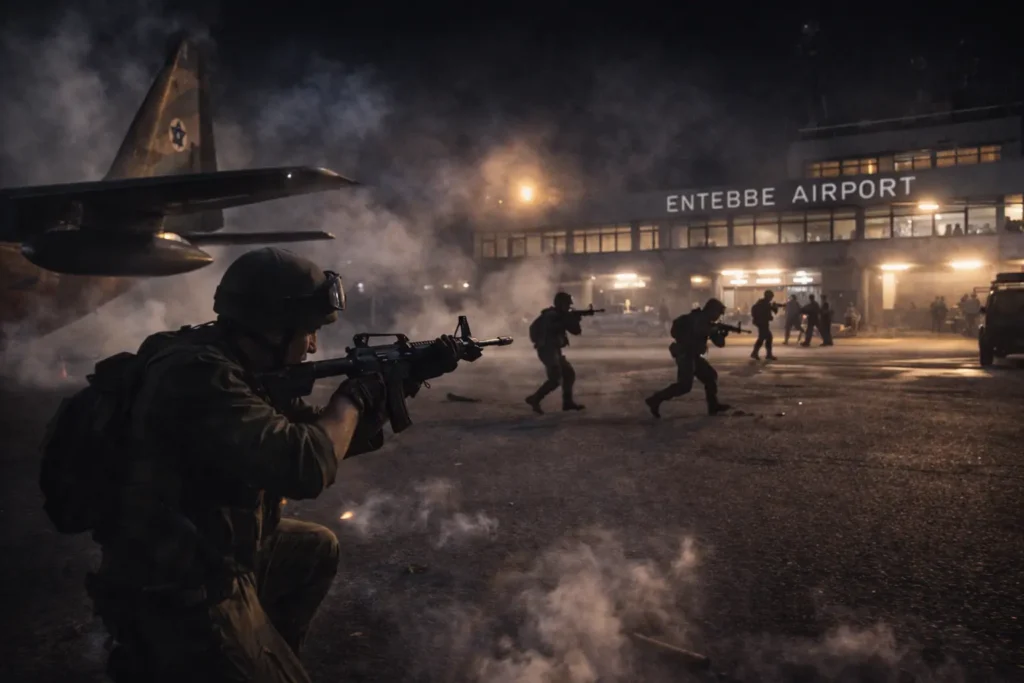

On a humid night deep inside the African continent, a black Mercedes crept toward a darkened airport terminal. The vehicle moved with purpose, its engine humming quietly against the backdrop of crickets and the distant sound of Lake Victoria’s gentle waves. To the Ugandan soldiers standing guard at Entebbe Airport, it looked like the familiar sight of their own president arriving for one of his unpredictable late-night visits. The silhouette was unmistakable. The vehicle was a sleek black Mercedes, the kind that only the most powerful men in Africa could afford. Behind it followed a convoy of Land Rovers filled with soldiers, just as everyone expected.
The Ugandan sentries snapped to attention immediately. They adjusted their rifles, stood a little straighter, and tried to look alert and professional. No one wanted to displease the Big Daddy, as President Idi Amin Dada liked to be called. The man was known for his wild mood swings, his towering height, his larger-than-life personality, and his absolute power over life and death in Uganda. He had been known to order executions on a whim. He had also been known to reward loyalty with cars, houses, and promotions. Standing at attention when his motorcade passed was simply the smart thing to do.
But as the Mercedes rolled closer, something felt wrong to one of the more observant soldiers. The timing was off. The president usually announced his visits, even the late-night ones. And the vehicle seemed to be moving too fast, too directly toward the old terminal building. The soldier narrowed his eyes, trying to see through the darkness. The headlights briefly illuminated the faces inside the car, and he didn’t recognize the driver. Before he could fully process what he was seeing, the doors of the Mercedes flew open before the vehicle had even fully stopped.
The men who jumped out were not Ugandans. They were not dressed in the flamboyant military uniforms Idi Amin preferred, with their massive shoulder boards and rows of medals. These men wore dark civilian clothes, their faces smeared with black camouflage paint. They carried compact assault rifles, and they moved with a precision that spoke of years of training. They were Israeli commandos from the elite Sayeret Matkal unit, and they were about to change the face of modern warfare forever.
The lead soldier raised his weapon and fired. The silenced shots made a popping sound, nothing like the thunderous crack of unsuspecting rifle fire. The suspicious Ugandan soldier crumpled to the ground. Other commandos fanned out from the vehicles, their eyes scanning for threats, their weapons ready. The operation that had been months in the planning, that had required the gathering of intelligence from a dozen different countries, that had demanded the utmost secrecy and courage from everyone involved, had reached its critical moment. There was no turning back now.
This is the real story of Operation Thunderbolt, known in Israel today as Operation Yonatan—a mission so audacious that it seemed ripped from the pages of a Hollywood thriller, yet so real that its consequences continue to echo through global security policy, military strategy, and international relations nearly fifty years later. By the summer of 1976, the world felt like an increasingly dangerous place. The Cold War between the United States and the Soviet Union had divided the planet into armed camps. Proxy wars raged in Southeast Asia, Africa, and Latin America. And terrorist attacks were becoming more frequent, more brutal, and more sophisticated with each passing year.
But when an Air France plane full of innocent civilians vanished from the radar over the Mediterranean Sea, it set off a chain of events that would lead one small nation to refuse to bow to terrorism and instead launch the most daring hostage rescue in military history. What follows is the complete story of those events, told in detail, from the perspectives of the hostages who suffered through a week of terror, the families who waited and prayed back home, the politicians who wrestled with impossible choices, the intelligence officers who pieced together fragments of information, and the soldiers who flew into the heart of darkness to bring their people home.
Part One: The World in 1976 – A Time of Fear and Uncertainty
To truly understand the significance of what happened at Entebbe, we need to step back and look at the world as it existed in the summer of 1976. This was not the world we know today, with its smartphones, internet, and instant global communication. This was a world still recovering from the oil shocks of the early 1970s, still haunted by the Vietnam War, still adjusting to the reality of international terrorism as a permanent feature of modern life.
The Cold War was at its height. The United States and the Soviet Union faced each other across a divide that split Europe, Asia, and much of the developing world. Nuclear weapons stood ready to launch at a moment’s notice. In Africa, newly independent nations struggled to find their footing, often becoming battlegrounds for Cold War proxy conflicts. The Soviet Union backed liberation movements and socialist governments. The United States supported anti-communist forces and friendly dictators. Into this volatile mix stepped men like Idi Amin of Uganda, who played both sides against each other while enriching himself and terrorizing his own people.
Terrorism had become a fact of international life. The late 1960s and early 1970s had seen a wave of airplane hijackings, mostly by Palestinian groups seeking to draw attention to their cause. In 1970 alone, there had been dozens of hijackings. The world had grown almost accustomed to the sight of passengers being led off planes at gunpoint, to negotiators haggling over prisoner releases, to the occasional murder of a hostage to prove the terrorists were serious. It was a grim routine that played out again and again.
But there was something different about the Entebbe hijacking. Perhaps it was the distance involved, the fact that the plane had been flown to the heart of Africa. Perhaps it was the involvement of Idi Amin, whose bizarre behavior and brutal reputation made everything more unpredictable. Perhaps it was the separation of the Jewish passengers, which evoked memories that the world had hoped were buried forever. Whatever the reason, this hijacking captured global attention in a way that previous ones had not.
In Israel, the mood was tense. The country was only 28 years old, still finding its way in a hostile neighborhood. It had survived a war of independence in 1948, a costly conflict in 1956, and a near-disastrous surprise attack in 1973 that had caught the military off guard and cost thousands of lives. The Yom Kippur War was only three years in the past, and its scars were still fresh. Israelis had learned that they could not rely on the world to protect them. They had learned that their survival depended on their own strength, their own intelligence, their own willingness to fight.
This national mindset would prove crucial in the days ahead. When the hijacking occurred, Israelis did not simply wait for the world to act. They began planning, analyzing, and preparing for every possible scenario. They understood that if anyone was going to rescue those hostages, it would have to be them.
Part Two: The Skyjack – A Routine Flight Turns to Nightmare
To understand the guts it took to pull off this mission, we have to go back to the very beginning and really understand what was at stake for everyone involved. It was a sunny Sunday, June 27, 1976. Air France Flight 139, an Airbus A300, took off from Ben Gurion Airport in Tel Aviv, Israel, bound for Paris via Athens. The Airbus A300 was a relatively new aircraft at the time, a wide-body jet that represented the latest in aviation technology. It was comfortable, quiet, and capable of carrying hundreds of passengers across long distances.
The passengers on this particular flight were in good spirits. They were a mixed group, reflecting the diversity of international travel in the 1970s. There were Israeli citizens heading to Europe for business or vacation. There were Jewish travelers from around the world, some visiting Israel for the first time, others returning home after pilgrimages to holy sites. There were French tourists, American students, British businessmen, and families from a dozen other countries. They settled into their seats, flipped through magazines, ordered drinks from the flight attendants, and chatted with their seatmates about their plans. No one had any idea that within hours, they would become pawns in an international crisis that would grip the entire world.
The flight to Athens was short and uneventful. The plane landed at Hellenikon International Airport, the main airport serving the Greek capital, to pick up more passengers and refuel. Athens in 1976 was a bustling hub for travel between Europe and the Middle East. Its airport was busy but not particularly secure by modern standards. Security procedures were relaxed, almost casual. Passengers and their bags were screened, but not with the intensity that would become routine after years of terrorist attacks.
Among the 58 people who boarded in Athens were four individuals who looked out of place but didn’t raise immediate alarms. They moved through the terminal like ordinary travelers, carrying ordinary luggage, blending in perfectly with the crowd. Two of them were a man and a woman of European appearance, dressed in casual clothes that wouldn’t attract attention. The other two had darker features and spoke Arabic among themselves. They bought tickets, passed through security without incident, and boarded the plane like everyone else.
Shortly after the plane took off from Athens at 12:30 pm, the calm was shattered. The man and woman of European appearance stood up abruptly from their seats. Their names were Wilfried Böse and Brigitte Kuhlmann, and they came from a German left-wing militant group called the Revolutionary Cells. This group was small but dangerous, inspired by the more famous Baader-Meinhof Gang but operating independently. They believed in armed struggle against what they called imperialism and Zionism. They had trained in terrorist camps in the Middle East and were committed to their cause.
Böse pulled a pistol from his waistband and pointed it at the nearest passengers. Kuhlmann did the same, her face set in cold determination. They were joined by the two Palestinian men, who produced weapons from their carry-on bags. The four hijackers spread through the cabin, shouting in broken English and French, ordering everyone to stay in their seats and remain calm.
The passengers froze. Some screamed. Others ducked down in their seats, praying silently. Children cried. Flight attendants tried to maintain their composure, following the training that told them to cooperate with hijackers to avoid violence. The hijackers stormed the cockpit, pushing past the flight attendants who tried to block their way. They confronted the pilots and announced that the plane was now under their control.
Captain Michel Bacos was a veteran pilot who had seen his share of difficult situations in years of flying, but nothing like this. He was a Frenchman, proud of his profession and his airline. He looked at the armed men in his cockpit and assessed the situation quickly. His primary responsibility was the safety of his passengers and crew. He would cooperate with the hijackers to the extent necessary to prevent violence, but he would also look for any opportunity to help his passengers.
The hijackers announced their mission. They said they were acting on behalf of the Popular Front for the Liberation of Palestine, one of the most radical factions in the Palestinian movement. They demanded that the plane be flown to a destination they would specify later. They warned that any resistance would be met with immediate violence.
The passengers’ terror was just beginning. The plane was diverted from its path to Paris and forced to fly south. No one knew where they were going. The uncertainty was perhaps the worst part. Would they be taken to some desert airstrip and held for months? Would they be used as bargaining chips in some political game? Would they ever see their families again? These questions swirled through every mind on that plane as the hours passed and the landscape below changed from the blue of the Mediterranean to the brown of North Africa.
The first stop was Benghazi, Libya, where the plane sat on the tarmac for seven hours to refuel. Libya in 1976 was run by Muammar Gaddafi, another dictator who had no love for the West and certainly no love for Israel. Gaddafi had come to power in a 1969 coup and had since positioned himself as a champion of anti-Western, anti-Israeli causes. He provided money, weapons, and training to terrorist groups around the world. His cooperation with the hijackers was assumed, though never proven.
The passengers sat in the sweltering heat of the parked plane, their anxiety growing with each passing hour. The air conditioning was turned off to save fuel, and the temperature inside the cabin rose to uncomfortable levels. People stripped off jackets and sweaters. They shared water bottles. They tried to comfort each other with whispered words of hope.
During this time, the hijackers released one passenger, a British-born Israeli woman named Patricia Martell. She had convinced them she was having a miscarriage, a desperate lie told in a moment of pure terror. Her face was pale, and she was doubled over in apparent pain. The hijackers, perhaps not wanting the complication of a seriously ill passenger, agreed to let her go. She was taken off the plane and later flown to safety. She was the first to taste freedom, but she left behind hundreds of others still trapped.
After refueling, the plane took off again and turned south, flying deeper into the heart of Africa. The sun set and rose again as the aircraft droned on through the night. When morning came on June 28, the passengers looked out the windows to see green landscape below, then a large lake, then an airport runway coming up to meet them. They had landed at Entebbe Airport in Uganda.
As the plane taxied to a stop, the passengers could see soldiers everywhere. Ugandan troops in their distinctive uniforms surrounded the aircraft, weapons at the ready. Some passengers recognized the face of Idi Amin from news photographs and newsreels. They knew they were in deep trouble. They were now under the control of terrorists, over 2,000 miles from home, and at the mercy of one of Africa’s most unpredictable and brutal dictators.
As they descended the steps onto the tarmac, the heat hit them like a physical force. The African sun was merciless. They were herded toward a building, the old terminal that had been abandoned when the new one was built. It was dirty, run-down, with broken windows and peeling paint. Soon it would become their prison.
Part Three: Welcome to Uganda – The Hostages’ Nightmare Begins
Once on the ground, the situation went from bad to worse, and then worse still. The hijackers moved all 260-plus passengers and crew into the transit hall of the old, abandoned terminal at Entebbe Airport. This building was never meant to hold people for more than a few hours. It had been designed for passengers waiting to clear customs or catch connecting flights. It had basic facilities, but nothing for long-term occupancy.
The main hall was large, with a high ceiling and windows along one wall. But those windows were broken in many places, letting in insects and the oppressive heat. The floor was tile, cold at night but warm during the day. There were some chairs, but not nearly enough for everyone. Most passengers would end up sitting or lying on the floor, using jackets and bags as pillows.
The bathrooms were filthy. They had not been maintained since the terminal was abandoned, and the hijackers did nothing to clean them. The toilets stopped working within days. The smell became unbearable. Hostages had to use them anyway, holding their breath and trying not to touch anything.
During the day, the heat was unbearable. The sun beat down on the building, and without working air conditioning, the temperature inside rose to over 100 degrees Fahrenheit. People stripped down to minimal clothing and still sweated profusely. They drank water greedily whenever it was offered, not knowing when the next supply would come.
At night, the temperature dropped dramatically. The African desert may be far away, but Uganda has its own temperature swings. Without blankets or warm clothing, the hostages huddled together for warmth, sharing body heat and whatever extra clothes they had. It was a primitive existence, stripped of all comforts and dignity.
The terrorists, now joined by at least three more accomplices who had been waiting in Uganda, were not alone in running this prison. Ugandan soldiers, acting on the direct orders of President Idi Amin, surrounded the building and provided support to the hijackers. They stood guard at every door and window, their weapons visible and ready. They patrolled the perimeter with dogs, large German shepherds that barked and snarled at anyone who came too close. They made it clear to the hostages that there was no escape. If the terrorists didn’t kill them, the Ugandans would.
Amin himself had once had a military training relationship with Israel. In the 1960s, before he seized power, Ugandan officers had been trained by Israeli instructors. Amin had even visited Israel and spoken warmly of its people. But after he became president, things changed. He aligned himself with Arab states, broke diplomatic relations with Israel, and welcomed Palestinian terrorists to Uganda. He saw the hostage crisis as an opportunity to embarrass Israel and gain international attention. He would play the role of mediator while secretly supporting the hijackers.
On June 28, the day after the plane landed, Amin made his first visit to the terminal. He arrived in his black Mercedes, surrounded by guards and aides. He strode into the building like a visiting head of state, which of course he was. He was a huge man, over six feet four inches tall and weighing more than 250 pounds. He wore a military uniform covered in medals, many of which he had awarded to himself. His face broke into a wide smile as he surveyed the hostages.
“Do not worry,” he told them in his booming voice. “You are safe here. I am your friend. I will take care of you.” He shook hands with some of the hostages, posed for photographs, and promised to work for their release. To the hostages, his words offered a glimmer of hope. Perhaps this powerful man could help them. Perhaps he would negotiate with the hijackers and secure their freedom.
But as the days passed, they would learn the truth. Amin was not their friend. He was working with the hijackers, providing them with soldiers, supplies, and moral support. His visits were propaganda opportunities, designed to make him look like a statesman while he secretly backed the terrorists. The hostages would come to dread his appearances, knowing that nothing good would come of them.
Then came the moment that sent a chill through the world and reminded many of the darkest days of history. On June 29, two days after the hostages arrived, the hijackers demanded that all the passengers hand over their passports. This was a common tactic in hijackings, used to identify nationalities and determine which passengers might be valuable bargaining chips. The hostages complied, handing over their documents to the armed men who collected them.
What happened next was not common. The hijackers took the passports and began sorting them. They separated the Israeli passports from the others. Then they went through the rest, looking for Jewish-sounding names. Anyone with a name that sounded Jewish, regardless of their actual nationality, was added to the Israeli pile. The French, British, and American passports went into another pile.
When the sorting was complete, the hijackers ordered the Israelis and Jews to stand up and move to a smaller adjoining room. This room was even less comfortable than the main hall. It had no windows, less space, and worse facilities. The hostages looked at each other with fear in their eyes. They knew what separation meant. It meant they were being singled out. It meant they were in greater danger than the others.
Among those forced to move were the 12 crew members of the Air France flight, led by Captain Michel Bacos. The hijackers told the crew they were free to go. They were French, after all, and France had policies friendly to the Arab world. France had supplied weapons to various Arab states. France had diplomatic relations with the PLO. Surely the French crew would be released.
But Captain Bacos looked at his crew, then at the passengers who were being separated. He made a decision that would define the rest of his life. He turned to the hijackers and said something like, “These are my passengers. I am responsible for them. If they stay, I stay.” His voice was calm but firm. He was not asking permission. He was stating a fact.
One by one, his crew members nodded in agreement. Not one of them walked away. Not one of them took the opportunity to escape. They all chose to remain with the passengers, sharing their fate whatever it might be. This decision likely saved lives. The crew members knew the plane, knew the procedures, knew how to keep people calm. Their presence provided comfort and leadership in a terrifying situation. They cemented their place in history as genuine heroes.
Imagine having the chance to walk free and choosing instead to remain in a dangerous situation surrounded by armed terrorists. Imagine knowing that you could be on a plane home within hours, yet deciding to stay with people who might never see their families again. That takes a special kind of courage, the kind that doesn’t seek recognition or reward. Captain Bacos and his crew had it.
As the Israeli and Jewish hostages were being moved, a man rolled up his sleeve to show the hijacker Wilfried Böse a number tattooed on his arm—a concentration camp ID from the Holocaust. His name was Pasco Cohen, and he had survived the Nazi death camps as a young man. He had built a new life in Israel, married, raised children, and become a businessman. He thought the horrors of the past were behind him, buried in the ashes of Europe. Now he found himself in another prison, separated again because he was Jewish, facing armed men who wanted to kill him.
The symbolism was too heavy to ignore. Böse stared at the tattoo for a long moment. “I’m no Nazi!” he reportedly protested, his voice defensive. “I am an idealist. I am fighting for justice.” But to the hostages, the scene of people being separated based on their religion was a terror they never thought they’d experience again. The distinction between Nazi and idealist meant nothing when you were looking down the barrel of a gun. History was repeating itself in the worst possible way.
The hijackers issued their formal demands to the world media through various channels. They wanted the release of 40 Palestinian militants held in prisons in Israel. These were men and women who had been convicted of terrorist attacks, including bombings and shootings. They also demanded the release of 13 others imprisoned in Kenya, France, Switzerland, and West Germany. These were accomplices and supporters of various terrorist groups.
If their demands were not met by Thursday, July 1, they would begin killing hostages. They made this threat explicitly and repeatedly. They said they would start with the Israeli and Jewish hostages, then move on to others if necessary. To add pressure, they also demanded a $5 million ransom for the plane itself. It was a staggering amount of money in 1976, equivalent to more than $20 million today. The world held its breath and waited to see what Israel would do.
Part Four: The Families Back Home – Waiting and Praying
While the hostages sat on the floor of that dirty terminal in Uganda, their families back in Israel were going through their own kind of hell. Imagine sitting in your living room, watching the evening news, and seeing your mother or father or child on television, being held at gunpoint in some faraway country you couldn’t even find on a map. Imagine the helplessness, the fear, the desperate need for information that no one could provide.
That was the reality for dozens of Israeli families that week. The government set up a special center for families to receive updates, but in those early days, there were hardly any updates to give. The families waited by the phone, hoping for news, jumping every time it rang. Some prayed. Others cried. A few got angry and demanded that the government do something, anything, to bring their loved ones home.
They gathered outside the prime minister’s office in Jerusalem, holding signs and photographs of the hostages. They begged the media to keep the story alive, to remind the world that real people were suffering. They wrote letters to politicians and world leaders, pleading for intervention. They clung to every scrap of information, no matter how small or unreliable.
One of those families was the Netanyahu family. Yonatan Netanyahu, the commando commander who would lead the rescue, had a younger brother named Iddo who was also in the military, serving in the armored corps. Another younger brother, Benjamin, was studying in the United States at MIT, far from the crisis unfolding at home. Their mother and father, Tzila and Benzion, waited anxiously in their Jerusalem home, not knowing that their oldest son was already deep in planning, already risking everything for strangers he had never met.
The families of the hostages had no idea that a rescue was even being considered. All they knew was that time was running out and the terrorists had promised to start killing people. They watched the news reports from Uganda, saw Idi Amin’s smiling face, heard his promises to help. They didn’t know whether to trust him or fear him. They didn’t know anything for certain except that their loved ones were in danger and there was nothing they could do about it.
The deadline came and went. Thursday, July 1, arrived, and the world expected to hear news of executions. News crews gathered at Entebbe, waiting for the worst. But the hijackers, perhaps sensing they had the upper hand or perhaps responding to international pressure, extended the deadline to Sunday, July 4. This was a significant date, American Independence Day, chosen perhaps for its symbolic value.
They also released a group of 101 non-Israeli hostages, flying them to Paris on a Red Cross plane. This was a clever propaganda move. It made the hijackers look merciful and reasonable to the international community. It showed that they were willing to release people, that they weren’t simply murderers. It also lightened their load, making it easier to control the remaining hostages and reducing the number of potential problems.
For the families back in Israel, seeing those released hostages walk free while their own relatives remained trapped was agony. They were happy for those who got out, of course. No one wished suffering on anyone. But they also felt a deep, aching jealousy. Why couldn’t their loved ones be on that plane? Why were they still stuck in Uganda, surrounded by armed terrorists and a hostile army? The answers were complicated, but the feelings were real and raw.
Some of the released hostages were interviewed on television as soon as they reached Paris. They described the conditions at Entebbe, the heat, the dirt, the fear. They talked about the hijackers, their moods, their weapons, their routines. They mentioned the Ugandan soldiers, the dogs, the visits from Idi Amin. Every detail was broadcast around the world, giving families back home a clearer picture of what their loved ones were enduring.
For the Netanyahu family, the waiting was especially difficult. They knew Yoni was involved in something, though they didn’t know the details. Military operations were always secret, and families learned not to ask too many questions. They prayed for his safety and for the safety of the hostages, not knowing that their son was about to become a central figure in one of the most dramatic events of the decade.
Part Five: The Impossible Choice – Israel’s Government Debates
Back in Israel, behind closed doors and far from the cameras, the government was facing a nightmare of impossible choices. Prime Minister Yitzhak Rabin and his Defense Minister, Shimon Peres, were locked in a tense and sometimes angry debate that would determine the fate of more than a hundred lives. These were two strong-willed men with very different ideas about how to handle the crisis, and their disagreements reflected deeper divisions within Israeli society and politics.
Rabin was a cautious and methodical leader. He was a former military chief of staff, a man who had spent his life studying war and its consequences. He understood the risks of military action better than almost anyone alive. He had seen too many young soldiers die in too many battles. He carried the weight of those losses with him every day. When he looked at the Entebbe crisis, he saw a situation where military action could easily lead to disaster.
He felt that Israel had to take the terrorist threat seriously and explore every possible avenue of negotiation. He believed the lives of the citizens came first, even if it meant a humiliating prisoner swap. Releasing terrorists was a bitter pill to swallow, but Rabin argued that it might be the only way to get the hostages home alive. He pointed to previous hostage situations where negotiations had succeeded and lives had been saved. He reminded his colleagues that the first responsibility of any government was to protect its citizens, even at the cost of national pride.
Peres, more hawkish and idealistic, argued the opposite. He was also a former defense official, but his experience was more in organization and strategy than in combat. He saw the crisis through a different lens. He argued that giving in to terrorist demands would only encourage more attacks in the future. If Israel showed weakness, every terrorist group in the world would see it as an invitation to seize more Israeli hostages. They would know that all they had to do was grab some civilians and wait for the prisoners to be released.
Peres believed that Israel had to stand firm, not just for the sake of these hostages, but for the sake of every Israeli who might be targeted in the future. He pushed for a military solution, even though no one knew yet if a military solution was even possible. He asked the military leaders in the room: Can we do this? Is there any way to rescue the hostages by force? The military leaders looked at each other and admitted they didn’t know yet. They needed time to study the problem, to gather intelligence, to develop options.
While the politicians argued and the clock ticked, the military started working quietly in the background. The Israel Defense Forces did not wait for permission to start planning. They knew that if a military option was needed, they would have to be ready at a moment’s notice. Officers pulled out maps of Africa, studying the geography, the distances, the possible routes. Pilots studied flight paths, fuel requirements, and the capabilities of enemy radar. Commandos began thinking about how to storm a building thousands of miles away, how to get in and out before anyone could react.
The initial deadline passed, and the hijackers extended it. This gave Israel a little more time, and they used every second of it. Those released non-Israeli hostages who flew to Paris were a goldmine of information. Israeli intelligence agents, from the Mossad and military intelligence, flew immediately to Paris to interview them. They didn’t wait for official permission or diplomatic niceties. They got on planes and went.
They sat with each released passenger for hours, asking questions that seemed strange at the time. What color were the chairs in the terminal? Where did the terrorists stand when they guarded you? How many Ugandan soldiers did you see? What kind of weapons did they carry? What did the floor look like? Were there any windows in the bathroom? Did you see any doors that were locked? Did you notice any patterns in when the guards changed?
The freed hostages thought these questions were odd. Some wondered why the Israelis cared about the color of the walls or the position of the chairs. But the intelligence officers were piecing together a puzzle, building a mental picture of the terminal and everything in it. Every tiny detail mattered. If they knew the layout of the building, the positions of the guards, and the habits of the terrorists, they could plan a rescue that had a chance of working. It was like building a house one brick at a time, except this house had to be perfect, because lives depended on it.
Part Six: The Intelligence Puzzle – Building the Picture
The intelligence work that went into Operation Thunderbolt is a story in itself, and it’s one of the most fascinating parts of the whole operation. The Mossad, Israel’s legendary spy agency, went into overdrive. Agents were dispatched not just to Paris but all over the world, following every lead, chasing every rumor, exploiting every possible source of information.
Someone in the intelligence community remembered something crucial, a fact that had been buried in archives for more than a decade. The old terminal at Entebbe, where the hostages were being held, had actually been built by an Israeli construction company in the 1960s. Back then, Israel and Uganda were friendly. Israeli engineers and construction workers had helped build airports, roads, schools, and other infrastructure projects throughout the country. It was part of Israel’s outreach to newly independent African nations, a way of building alliances and sharing expertise.
When relations soured and Amin broke ties with Israel, the records of those projects were stored away and forgotten. But they still existed. Someone remembered them. Someone went looking. The original blueprints of the Entebbe old terminal were found in a dusty archive somewhere in Tel Aviv, filed away with thousands of other documents from long-completed projects.
Engineers dusted off the blueprints and started studying them. The commandos could now study the building as if it were their own home. They knew where every door led, where every support column stood, where every window was located. They knew the thickness of the walls, the layout of the rooms, the location of the bathrooms and storage areas. This was an advantage they never expected to have, a piece of luck that would prove crucial in the planning.
Meanwhile, agents were gathering intelligence on Idi Amin himself. They learned about his habits, his routines, his quirks, his weaknesses. They talked to people who had known him before the break with Israel, people who had worked with him, trained him, observed him. They built a psychological profile of the man, understanding what made him tick, what he feared, what he desired.
They found out that he loved driving around the airport tarmac in a big black Mercedes, accompanied by a convoy of Land Rovers full of soldiers. He was a vain man who enjoyed showing off his power and status. He liked to make surprise visits, to keep people off balance. When he visited the hostages, he arrived in that Mercedes, and everyone knew to get out of his way. Soldiers snapped to attention. Guards opened doors. The whole airport seemed to hold its breath when the Big Daddy appeared.
This information would prove to be the key to the entire operation. If the Israelis could somehow get a car that looked like Amin’s, and if they could surround it with Land Rovers that looked like his escort, they might be able to drive right up to the terminal without raising suspicion. The Ugandan guards would see the familiar convoy and assume it was their president coming for another late-night visit. They would stand at attention, not raise their weapons, not sound any alarms. It would buy the Israelis the precious seconds they needed to get to the terminal door and launch their attack.
It was a long shot, a gamble based on psychology and timing. But it was the best idea anyone had come up with, and as the hours passed and the deadline approached, it became the centerpiece of the developing plan.
Planners, led by figures like Brigadier General Dan Shomron and Major General Yekutiel “Kuti” Adam, started sketching out plans in earnest. Dan Shomron was a paratrooper, a veteran of numerous operations, a man known for his calm demeanor and clear thinking under pressure. He would be the overall ground commander, responsible for coordinating every aspect of the assault. Kuti Adam was another experienced officer, known for his strategic mind and his ability to see the big picture while managing details.
The ideas they considered were wild. Some sounded like they came from a comic book, the kind of schemes that would be dismissed as impossible in any normal planning session. But this was not a normal situation. The hostages were running out of time. The government was running out of options. Every idea had to be considered, no matter how crazy it seemed.
One plan involved parachuting commandos into Lake Victoria at night and having them swim ashore with inflatable boats. Then they would have to march to the airport, avoid detection by Ugandan patrols, and attack the terminal from the lake side. The problem was that Lake Victoria was full of crocodiles and hippos, both of which can be deadly to humans. Crocodiles can grow to twenty feet long and weigh more than a ton. Hippos are herbivores but are extremely aggressive and territorial, killing more people in Africa than lions or leopards. Swimming among them at night was a death sentence waiting to happen. Not to mention that swimming in full combat gear, with weapons and equipment, is incredibly difficult even without wildlife.
Another plan involved flying a fake Air France plane into Entebbe. The idea was to have a plane painted to look exactly like an Air France jet, with the same colors, the same logo, the same markings. On board would be “baggage handlers” who were actually commandos in disguise, along with “passengers” who were also soldiers. They would land, pretend to be delivering supplies or picking up the released hostages, and then attack when the terrorists least expected it.
But landing a fake plane at an active airport without raising suspicion seemed nearly impossible. Air traffic controllers would want to talk to the pilots. Ground crews would want to service the plane. Ugandan officials would want to inspect it. The risk of detection was too high.
Another idea was to have commandos land in a neighboring country, like Kenya, and then drive across the border into Uganda. Kenya was friendlier to Israel than Uganda was, and there was a possibility of secret cooperation. But driving across the border would take too long and risk detection at every step. Ugandan border guards would be alert. The terrain was difficult. And if the commandos were caught before reaching Entebbe, the whole mission would fail and the hostages would die.
The risks were astronomical no matter what they chose. The distance was 2,500 miles, or about 4,000 kilometers. They would have to fly over hostile nations like Egypt and Sudan, both of which had air forces and radar systems. Any of those countries could detect the planes on radar and send fighter jets to shoot them down. The Israeli planes would be slow, heavily loaded transport aircraft, no match for supersonic fighters.
They would need to refuel somewhere along the way, but where? There was no friendly territory anywhere near Uganda. The nearest friendly country was Kenya, but that was still hundreds of miles away. They would have to refuel in the air, using tanker aircraft, a complex and dangerous maneuver even in daylight. Doing it at night, over hostile territory, with inexperienced crews, was a major challenge.
And even if they made it to Entebbe, they had to assume that the Ugandan army would fight back. The Ugandans had Soviet-made tanks and armored personnel carriers. They had MiG fighter jets parked at the airport. They had machine guns, mortars, and artillery. They had numbers on their side, hundreds of soldiers versus a few dozen commandos. The Israelis would be lightly armed, far from home, with no reinforcements and no backup. If things went wrong, there would be no one to save them.
Part Seven: The Plan Comes Together – A Gamble of Historic Proportions
By July 3, with the new deadline looming just hours away, a plan began to take shape. It was largely driven by the commandos of the elite unit called Sayeret Matkal, working closely with the Israeli Air Force. Sayeret Matkal was Israel’s top special forces unit, the unit that took on the missions no one else could handle. Its name meant “General Staff Reconnaissance Unit,” and its soldiers were the best of the best, highly trained in every aspect of combat, from parachuting to demolition to close-quarters battle.
The men in this unit were volunteers, selected through a grueling selection process that eliminated all but the most capable. They underwent years of training, learning to operate in every environment, from deserts to mountains to cities. They were experts in weapons, tactics, and survival. They were also intelligent, able to think on their feet and adapt to changing situations. They were exactly the kind of soldiers needed for a mission as complex and dangerous as this one.
The key to the whole plan was surprise. They would fly four U.S.-made C-130 Hercules transport planes low under the radar all the way to Entebbe. The C-130 was a rugged, reliable aircraft, capable of landing on rough airstrips and carrying heavy loads. It was the workhorse of many air forces around the world, and the Israelis had been flying them for years.
Flying low meant flying just a few hundred feet above the ground or the water. It was dangerous flying, requiring incredible skill from the pilots. One wrong move, one moment of inattention, and the plane could slam into a hillside or a mountain. But it was the only way to avoid detection by enemy radar. Radar works by sending out radio waves and listening for echoes. If you fly low enough, the curvature of the earth hides you from radar. The pilots would have to hug the terrain, following the contours of the land, trusting their instruments and their training.
They would fly through the night, using the darkness as cover. Night flying is always more dangerous than daytime flying, but it also provides concealment. Enemy radar operators might not see them. Enemy soldiers might not hear them. And if everything went according to plan, they would land at Entebbe in the dead of night when the guards might be sleepy and less alert, when the terrorists might be resting, when the darkness would work in their favor.
On board the first plane would be the main assault team, led by Yoni Netanyahu. And with them would be a secret weapon that seemed almost too clever to be true: a black Mercedes-Benz sedan. But not just any Mercedes. It had to look exactly like the one Idi Amin drove. The Israelis had managed to acquire a Mercedes that matched Amin’s in model, color, and general appearance. They painted it the same shade of black. They even found Ugandan military license plates to put on it, obtained through intelligence channels.
When the ramp of the C-130 dropped, this Mercedes would drive out first, followed by Land Rovers full of commandos dressed in Ugandan uniforms. The Land Rovers were also painted to match Ugandan military vehicles. The commandos wore Ugandan-style uniforms, with the same hats, the same insignia, the same weapons. From a distance, in the dark, they would look exactly like Amin’s escort.
The idea was to drive off the plane in a convoy that looked exactly like the president’s motorcade. The Ugandan sentries would see the familiar car and snap to attention, assuming their boss was arriving for a late-night visit. They would never suspect that inside that car were Israeli soldiers with their guns ready, their hearts pounding, their eyes fixed on the terminal ahead. This would buy the Israelis the precious seconds they needed to get to the terminal door before anyone raised an alarm.
Leading the assault team was Lieutenant Colonel Yonatan “Yoni” Netanyahu. He was the 30-year-old commander of Sayeret Matkal, a brilliant and intense officer who had already proven himself in combat. He came from a family of fighters and thinkers. His father, Benzion Netanyahu, was a respected historian, a scholar of Jewish history and the Spanish Inquisition. His younger brothers, Iddo and Benjamin, would go on to have notable careers as well. Benjamin would eventually become the Prime Minister of Israel, serving longer than anyone in the country’s history.
Yoni had joined the military as a young man and had risen through the ranks based on merit and courage. He fought in the Six-Day War in 1967, when he was just 21 years old, seeing action on the Golan Heights against Syrian forces. He fought in the Yom Kippur War in 1973, commanding a commando unit in the Sinai and later on the Golan Heights again. He was wounded in that war, shot in the elbow, but he refused to be evacuated until his unit had completed its mission. He was known for his cool head under pressure, his tactical brilliance, and his deep care for his men. They respected him, trusted him, and would follow him anywhere.
The burden on Yoni’s shoulders was immense. He knew that if the mission failed, it would be a disaster for Israel and a death sentence for the hostages. The world would see Israel as reckless and incompetent. The terrorists would be emboldened. More hijackings would follow. And more than a hundred innocent people would die because he had made the wrong call.
He also knew that some of his men might not come home. He had trained with them, fought with them, shared meals and jokes and fears with them. They were not just soldiers to him; they were friends, brothers. The thought of leading them into a situation where they might be killed weighed on him heavily. But he also knew that if he didn’t lead them, someone else would, and he trusted himself more than anyone else to make the right decisions in the heat of battle.
He spent the days before the mission studying maps, reading intelligence reports, and walking his soldiers through the plan again and again. They rehearsed on a mock-up of the terminal built somewhere in the Israeli desert, a full-scale replica constructed from the blueprints and intelligence reports. They practiced until they could do it in their sleep, until every man knew his role and the roles of everyone else, until the movements became automatic, instinctive.
They practiced the approach in the Mercedes and Land Rovers. They practiced the moment of surprise, the burst from the vehicles, the sprint to the door. They practiced clearing rooms, identifying threats, protecting the hostages. They practiced the evacuation, getting everyone onto the planes as quickly as possible. They practiced until they were exhausted, then practiced some more.
On the afternoon of July 3, the Israeli cabinet met for the final, decisive vote. The room was tense, the atmosphere heavy with the weight of the decision they were about to make. Everyone knew the risks were horrifying. If the planes were discovered mid-flight, they could be shot down with everyone on board. If the commandos failed to break into the terminal quickly enough, the terrorists would have time to massacre the hostages. The entire operation could end in a bloodbath, with the world watching and Israel blamed for the disaster.
Prime Minister Rabin, who had leaned toward negotiation just days earlier, looked at his military chiefs. He asked Dan Shomron one final, direct question: “Is the plan viable?” Shomron looked him in the eye and said yes. He believed it could work. He had gone over every detail, considered every contingency, and he was confident that the commandos could do it.
Rabin took a deep breath and gave the order. The planes, which had already been in the air on a practice run over the Mediterranean Sea, were given the new coordinates. They turned south, their noses pointing toward Africa. There was no turning back now. Operation Thunderbolt was a go.
Part Eight: The Long Flight South – Eight Hours of Tension
The four Hercules planes flew through the dark African night, and for the men inside, it was the longest flight of their lives. They had taken off from an airbase in southern Israel, heading out over the Red Sea before turning south along the African coast. The route was carefully planned to avoid detection, taking them over water and sparsely populated areas where radar coverage was minimal.
They skimmed just 100 feet above the ground or water to avoid radar, which meant they could see the terrain rushing by below them. When they flew over water, the surface seemed close enough to touch. When they flew over land, hills and trees loomed ahead, appearing suddenly in the darkness. The pilots wore night vision goggles and relied on their instruments to navigate. One wrong move, one moment of inattention, and the plane could slam into a hillside or a mountain. There would be no survivors, and the mission would end in disaster before it even began.
Inside the cargo hold, the soldiers were tense. They checked their weapons for the hundredth time, making sure safeties were on, magazines were full, and everything was in working order. They ran through the scenarios in their heads: what if the Ugandans are waiting for us? What if the terrorists start shooting immediately? What if the Mercedes doesn’t fool anyone? What if we can’t find the hostages in the dark?
They whispered to each other, sharing jokes to ease the tension. Some prayed, whispering the words of traditional Jewish prayers for safety and deliverance. Others sat in silence, staring at the darkness outside the small windows, thinking about their families, their homes, their lives if they made it back.
Inside one of the planes, Yoni Netanyahu’s commandos sat in their Mercedes and Land Rovers, waiting for the ramp to drop. The vehicles were strapped down with heavy chains to prevent them from moving during the flight, especially during takeoff and landing. The soldiers sat inside them, cramped and uncomfortable, but ready. The Mercedes was hot, the engine off, the air stale. They tried not to think about the eight hours stretching ahead of them.
The flight took nearly eight hours. Eight hours of darkness. Eight hours of noise from the engines, a constant drone that vibrated through the entire plane. Eight hours of thinking about what lay ahead, about the people they were trying to save, about the enemy waiting for them. Eight hours of fear and anticipation and hope.
The pilots had to navigate carefully to avoid flying over Sudan and other hostile countries. They took a route over the Red Sea and then down the African coast, staying over international waters as much as possible. They flew past Saudi Arabia, Yemen, and Ethiopia, all of which had unfriendly governments. At any moment, a radar operator could spot them and scramble fighters. The pilots kept their radios silent, not wanting to broadcast their position. They flew in darkness, without lights, invisible to the world below.
At one point, they had to refuel in mid-air from an Israeli Boeing 707 that had been converted into a refueling tanker. This was delicate work, especially at night and at low altitude. The C-130 had to fly up behind the tanker, matching its speed and altitude exactly, while a hose was extended and connected. One mistake and the planes could collide, sending both crashing into the sea. But the pilots were among the best in the world, trained for exactly these kinds of maneuvers, and they pulled it off without a hitch.
As they crossed into Ugandan airspace, the tension ratcheted up even higher. If the Ugandans had working radar, they would see the blips on their screens. They would wonder who was flying into their country unannounced. They might send up fighters to investigate, or they might alert the soldiers at Entebbe. Either way, the element of surprise would be lost.
But Idi Amin’s military was not the most modern or well-maintained force in Africa. His Soviet-supplied equipment was often poorly maintained, and his soldiers were poorly trained. There was a good chance their radar was turned off or not working properly, especially in the middle of the night. The Israelis were counting on that.
At 11:00 PM local time, the first C-130, piloted by Lieutenant Colonel Joshua Shani, approached Entebbe. Shani was an experienced pilot, a veteran of numerous operations. He peered through his night vision goggles, looking for the runway. The airport was dark, as expected, but then he saw something that made his heart skip: the runway lights were on.
Someone had left them on, or perhaps they were on a timer. Whatever the reason, they were a gift. Landing on a dark runway is difficult and dangerous. Landing on a lit runway is much easier. Shani lined up the plane and began his descent.
The wheels touched the tarmac with a slight bump, and the plane rolled forward smoothly. Shani applied the brakes and reversed the propellers, slowing the massive aircraft as quickly as possible. He taxied toward the old terminal, following the route they had studied on maps and satellite photos. Behind him, the other three planes landed in sequence, their pilots following his lead.
The ramp at the back of the first plane began to lower even before the plane had completely stopped. The hydraulics whined, and the heavy metal door descended, revealing the darkness outside. The black Mercedes roared to life, its engine echoing in the cargo hold. The driver put it in gear and sped out onto the tarmac, followed by the Land Rovers. The moment of truth had arrived.
Part Nine: The 90-Minute War – Storming Entebbe
For a few moments, it worked perfectly. The Ugandan sentries stationed around the old terminal saw the convoy approaching from the direction of the runway. They saw the black Mercedes, the Land Rovers, the Ugandan license plates. In the dim light, they couldn’t make out faces or details. They just saw what looked like the president’s motorcade.
They snapped to attention immediately, as they had been trained to do. They assumed it was their president, Idi Amin, coming for one of his unpredictable late-night visits. He often did this, showing up unannounced to check on things, to intimidate his soldiers, to remind everyone who was in charge. Some of them probably thought about how they would tell their friends the next day that they had seen the Big Daddy up close. They stood straight, their rifles at their sides, not raised in alarm.
But as the vehicles got closer to the terminal, one Ugandan soldier became suspicious. He was a veteran, someone who had been in the army long enough to develop instincts. Maybe he noticed that the driver’s face wasn’t familiar. Maybe he saw something odd in the way the vehicles moved, a slight hesitation or wrong turn. Maybe he just had a gut feeling that something wasn’t right.
He raised his rifle and shouted for them to stop. His voice carried through the night, sharp and urgent. He stepped forward, blocking the path of the Mercedes, his weapon pointed at the windshield. He was brave, or foolish, or both.
He was too late. The commandos inside the vehicles had been watching him approach. They knew the moment of surprise was ending. They opened fire with their silenced weapons. The suppressed gunshots made a popping sound, nothing like the loud crack of unsilenced rifles. The Ugandan soldier fell, his rifle clattering to the ground.
But the noise of the gunfire, even silenced, cracked through the night air. Other Ugandan soldiers further away heard something and started shouting. Alarms began to sound somewhere in the distance. The element of surprise was partially lost, but the mission was far from over. The convoy floored it toward the terminal, tires screeching on the tarmac, engines roaring.
As the vehicles screeched to a halt outside the old terminal building, the commandos leaped out. They moved with incredible speed and precision, just as they had rehearsed a hundred times in the desert. They fanned out, covering all the exits, watching for threats. Their weapons were up, their eyes scanning, their hearts pounding.
Two of the terrorists, the German Wilfried Böse and a Palestinian, were inside the main hall with the hostages at that moment. They heard the noise outside, the screech of tires, the shouts, the popping sounds. They looked at each other, confusion and alarm on their faces. What was happening? Was it a rescue attempt? A Ugandan attack? They started to react, reaching for their weapons, moving toward the door.
The lead commando, a man named Muki Betser, burst through the door first. He was Yoni Netanyahu’s deputy, a veteran of many operations, a man who had trained for moments like this his entire adult life. He sprayed the area with gunfire while screaming in Hebrew and English at the top of his lungs, “Get down! Stay down! We are Israeli soldiers!”
His voice cut through the chaos like a knife. The hostages, who had been sitting on the floor for a week, terrified and exhausted, reacted instantly. They hit the floor, covering their heads with their hands. Some cried out in relief. Others were too shocked to make a sound. A few looked up, disbelieving, wondering if this was real or some kind of dream.
In a matter of minutes, the commandos cleared the room. They shot and killed all seven hijackers who were present. The firefight was brutal but short. The terrorists never had a chance to carry out their threat to blow up the building or massacre the hostages. They were caught completely off guard, overwhelmed by the speed and violence of the assault.
Sadly, three hostages were caught in the crossfire and killed. In the chaos of a firefight, with bullets flying everywhere, with smoke and noise and confusion, it’s a miracle that more didn’t die. The three who died were Jean-Jacques Maimoni, a 19-year-old French-Israeli; Pasco Cohen, the 52-year-old Holocaust survivor who had shown his tattoo to Böse; and Ida Borochovitch, a 56-year-old Russian-born Israeli woman. They were so close to being saved, but they didn’t make it. Their bodies lay on the floor where they had fallen, a tragic reminder that even successful operations have a cost.
Another hostage, 75-year-old Dora Bloch, was not in the terminal at the time. She had choked on some food days earlier and had been taken to a hospital in Kampala, the capital, for treatment. She was in a hospital bed, surrounded by Ugandan doctors and nurses, when the raid happened. She would later be murdered by Ugandan officials in retaliation, dragged from her bed and killed. Her body was never found, a tragic loss that haunts the story to this day.
As the rescue was happening inside the terminal, other Israeli teams were busy outside, securing the perimeter and dealing with the Ugandan military. They fired rocket-propelled grenades at the line of Ugandan MiG fighter jets parked on the tarmac. The rockets streaked through the darkness and slammed into the jets, which exploded in balls of fire. The flames lit up the night sky, casting orange light across the entire airport.
This served two purposes. First, it prevented the Ugandans from using those planes to chase the Israelis. With their air force destroyed, they couldn’t pursue. Second, it created a massive distraction. The Ugandan soldiers in the control tower and around the airport, seeing their precious jets burning, started firing at the Israelis on the ground. They shot wildly, not sure where the enemy was or how many there were. The Israelis returned fire, keeping them pinned down.
During this exchange of fire, tragedy struck. Yoni Netanyahu was outside the terminal, leading his men and coordinating the operation. He was moving from position to position, making sure everything was going according to plan, checking on his soldiers, issuing orders. He was exposed, a target in the darkness.
As he led his men back toward the planes, preparing for the evacuation, a bullet fired from the control tower struck him in the chest. He fell to the ground, mortally wounded. His men tried to help him, dragging him to cover, applying pressure to the wound, calling for a medic. But the wound was too severe. The bullet had hit something vital. Yoni Netanyahu, the commander who had led them into battle, died on the tarmac at Entebbe, surrounded by his soldiers, far from home.
His men were devastated, but they couldn’t stop. The mission wasn’t over. They had to get the hostages onto the planes and get out before the Ugandans could regroup and counterattack. They lifted Yoni’s body and carried it to one of the planes, placing it gently inside. Then they continued working, evacuating the hostages, checking for stragglers, making sure no one was left behind.
Within 53 to 90 minutes of the first landing, the last Israeli plane was taking off from Entebbe. The exact time varies in different accounts, but what matters is that they did the impossible. They had flown 2,500 miles into hostile territory, stormed an airport defended by soldiers, rescued 102 of the 106 hostages, and gotten out before anyone could stop them.
As the planes lifted off and flew away from Uganda, the soldiers looked back at the burning MiGs lighting up the African sky. It was only then, in the relative quiet of the plane, that many of them learned that their commander had been killed. The victory was bittersweet. They had succeeded, but they had lost a man they loved and respected.
Part Ten: The Flight Home and the Nation’s Reaction
The planes stopped in Nairobi, Kenya, to refuel. This was a secret agreement with the Kenyan government, and it was vital to the mission’s success. Kenya was not friendly with Uganda’s Idi Amin. The two countries had border disputes and political differences. The Kenyan government was willing to help Israel in secret, knowing that a successful rescue would embarrass their rival.
The commandos refueled quickly, not wanting to spend any more time on the ground than necessary. Kenyan soldiers surrounded the airport, providing security. Kenyan officials kept the press away, not wanting photos of the Israeli planes to be published. Within an hour, the planes were airborne again, heading north toward Israel.
When they landed back in Israel, the nation erupted in joy and pride. It was a moment of pure, unadulterated triumph. Word had spread quickly through news reports that the hostages were safe and the mission had succeeded. People lined the streets, waving flags and cheering. They gathered at the airport, waiting for the planes to arrive. They sang and danced and cried.
The soldiers who stepped off those planes were treated like heroes, because that’s exactly what they were. They had flown into the heart of darkness and brought their people home. They had faced overwhelming odds and won. They had shown the world that Israel would not bow to terrorism. The crowds embraced them, kissed them, thanked them.
The hostages were reunited with their families in emotional scenes that played out on television for the whole world to see. Husbands and wives embraced, holding each other tightly. Parents held their children, tears streaming down their faces. Brothers and sisters laughed and cried at the same time. There were tears of joy and tears of sorrow for those who didn’t make it.
The three hostages killed in the crossfire were mourned. Their funerals were attended by thousands. Their names were spoken with reverence. And Dora Bloch’s death in Uganda cast a shadow over the celebration. Her family had no grave to visit, no body to bury. They had only the knowledge that she had been murdered by Idi Amin’s soldiers, an innocent victim of a brutal regime.
The operation was later renamed “Operation Yonatan” in honor of the fallen commander. Yoni Netanyahu became a symbol of sacrifice and heroism. His letters, written to his family and his girlfriend before the mission, were later published and became bestsellers in Israel. They revealed a thoughtful, intelligent, deeply caring man who loved his country and was willing to give everything for it.
In one letter, written to his girlfriend, he wrote: “I am writing this on the eve of the operation, and I don’t know if I will come back. But I want you to know that I am doing this because I believe it is right, because I believe that every life is precious, because I believe that we must fight for what we believe in. If I don’t come back, remember that I loved you, and that I died doing what I believed was right.”
His brother Benjamin would later say that reading those letters was one of the hardest things he ever did. They revealed a side of Yoni that few people saw, a sensitive, thoughtful, deeply human side. They also reinforced his belief that some things are worth fighting for, worth dying for.
Part Eleven: The Aftermath – A Changed World
The political and military shockwaves from Entebbe were immediate and lasting. Within days, the United Nations Security Council convened an emergency session to debate the action. Representatives from dozens of countries spoke, some condemning Israel, others praising it. The debate was heated, emotional, and deeply divided.
Countries aligned with the Soviet bloc and the Arab world condemned the raid as a violation of Ugandan sovereignty. They argued that Israel had no right to invade another country, even to rescue its citizens. They called it an act of aggression, a violation of international law, a dangerous precedent that could lead to more such interventions.
Western countries, led by the United States, took a different view. They argued that the raid was a justified act of self-defense against international terrorism. They pointed out that Uganda had collaborated with the terrorists, providing them with support and protection. They noted that Israel had tried negotiation first and had only resorted to force when it became clear that the terrorists were not willing to compromise.
The United States, under President Gerald Ford, offered quiet support for Israel’s action. In private, American officials were impressed by the military skill and courage displayed in the operation. In public, they expressed hope that such incidents would not recur and called for international cooperation against terrorism.
The resolution condemning Israel failed to pass, largely because the United States vetoed it. But the debate continued for years, with scholars and diplomats arguing over the legal and moral implications of the raid.
For the world of special operations, Entebbe became the gold standard, the template against which all future hostage rescues would be measured. Military planners from the United States, Germany, Britain, and many other countries studied the operation in minute detail. They looked at the footage, the tactics, the logistics. They interviewed the participants and wrote detailed reports. They incorporated the lessons into their own training and planning.
It proved that long-range, complex hostage rescues were possible, even in the heart of a hostile continent. It showed that with good intelligence, careful planning, and brave soldiers, you could overcome seemingly insurmountable obstacles. It changed how countries thought about counter-terrorism, leading to the creation of dedicated units and strategies focused on direct action.
The U.S. Delta Force, which was created around the same time, studied Entebbe extensively. So did the German GSG-9, which was formed after the Munich Olympics massacre in 1972. So did the British SAS, which had its own long history of counter-terrorism operations. Special forces around the world owe a debt to the men who planned and executed Operation Thunderbolt.
Idi Amin was humiliated. His air force had been destroyed on the ground. His soldiers had been defeated by a much smaller force. The raid exposed his regime as weak and incompetent, unable to protect even his own territory. It was the beginning of the end for him, though he would cling to power for a few more years before being overthrown.
In 1979, Tanzanian forces, supported by Ugandan exiles, invaded Uganda and drove Amin from power. He fled to Libya, then to Saudi Arabia, where he lived in exile until his death in 2003. He never faced justice for the atrocities he committed, including the murder of Dora Bloch and hundreds of thousands of Ugandans. But his humiliation at Entebbe was a step on the road to his downfall.
Uganda itself suffered from the aftermath. Amin took out his anger on his own people, ordering reprisals against anyone suspected of sympathizing with Israel or the West. The country descended further into chaos and violence. It would take years to recover from his brutal rule.
Part Twelve: The Human Stories – Faces Behind the Headlines
Beyond the politics and the military tactics, beyond the debates at the United Nations and the celebrations in Israel, Entebbe was ultimately about people. It’s easy to forget that when we talk about operations and strategies, but the human stories are what make this tale so powerful and enduring.
Take Jean-Jacques Maimoni, for example. He was only 19 years old, a French citizen of Israeli descent. He was traveling alone, excited about his trip to Europe. He had his whole life ahead of him. He might have fallen in love, gotten married, had children, built a career. When the terrorists separated the Jews, he was forced into that smaller room. He survived a week of fear, of uncertainty, of hoping for rescue. He was killed in the crossfire as rescue came. His parents had to live with the knowledge that he was so close to being saved, that if he had been sitting just a few feet to the left or right, he might have lived.
Or take Pasco Cohen, the man who showed the tattoo on his arm. He had survived the Holocaust as a young man, watching his family and friends die in the camps. He had built a new life in Israel, married, raised a family, become a successful businessman. He thought the horrors of the past were behind him. Then he found himself in another situation where he was being targeted simply for being Jewish. He too died in the crossfire, a cruel twist of fate that seemed almost unbelievable. His family had to mourn him twice, once for the Holocaust he survived and once for the bullet that killed him.
Dora Bloch’s story is especially tragic. She was 75 years old, a grandmother. She had lived through two world wars, the Great Depression, the founding of Israel. She had raised children and welcomed grandchildren. She choked on a piece of food during the hijacking and was taken to the hospital. Her family back in Israel prayed she would be safe there, away from the terrorists. But after the raid, Idi Amin’s soldiers went to the hospital, dragged her from her bed, and murdered her. Her body was never recovered, leaving her family with no grave to visit, no place to say goodbye.
And then there were the survivors. One of them was Ilan Hartuv, who was released along with the other non-Israeli hostages but whose mother remained behind. He flew to Paris on the Red Cross plane, not knowing if he would ever see her again. He spent days in agony, waiting for news, hoping for a miracle. When the raid succeeded and his mother was rescued, their reunion was one of the most emotional moments of the entire crisis. He held her and cried, thanking God and the soldiers who had saved her.
Another survivor was a young woman named Lea Almog, whose husband was killed in the crossfire. She was wounded herself but survived. She had to raise their children alone, living with the memory of that terrible night. She had to explain to her children why their father wasn’t coming home. She had to find the strength to go on, to build a new life from the ashes of the old.
These human stories remind us that history is not just about dates and names and political decisions. It’s about real people who lived, loved, suffered, and in some cases, died. The decision to launch the raid was made with these people in mind. The soldiers who flew to Entebbe were not just following orders; they were trying to save their fellow citizens, people they might have passed on the street or sat next to on a bus. They were trying to bring them home.
Part Thirteen: The Debate That Never Ends
Even after all these years, the debate over Entebbe continues. Historians, military strategists, and ethicists still argue about the rights and wrongs of the operation. It’s a debate that raises fundamental questions about the nature of terrorism, the responsibilities of governments, and the limits of military force.
Some people argue that the raid was reckless and that negotiation would have been the safer path. They point to the three hostages killed in the crossfire and Dora Bloch’s murder as evidence that the raid cost lives that might have been saved through diplomacy. They wonder if a negotiated release might have saved everyone, if Israel had been willing to release the prisoners the terrorists demanded.
Others argue that negotiation would have been a disaster in the long run. They say that giving in to terrorist demands would have encouraged more hijackings and more hostage-taking. They point to the fact that after Entebbe, the number of airline hijackings dropped significantly. Terrorist groups realized that even if they took hostages, they might not be safe. Israel had shown that it would come for them, no matter how far away they went. The deterrent effect of the raid may have saved more lives than were lost.
There’s also the question of whether the raid violated international law. Israel invaded a sovereign country without permission. They killed Ugandan soldiers who were just doing their job, defending their country against what they saw as an illegal incursion. From a strict legal standpoint, it was an act of war. Uganda had every right under international law to defend itself.
But from a moral standpoint, most people agree that rescuing innocent civilians from terrorists justifies breaking some rules. The Ugandan soldiers may have been doing their job, but their job was to support terrorists who were holding innocent people hostage. They were complicit in a crime against humanity. Israel’s action, while technically illegal, was morally justified.
The United Nations never formally condemned Israel, though many countries tried to pass resolutions. The debate was heated, with some countries calling the raid an act of aggression and others calling it an act of humanity. In the end, the world moved on, but the questions lingered. They still linger today, whenever a government faces a similar choice.
Part Fourteen: The Legacy – Lessons for Today
The story of Entebbe is not just a history lesson, something to be studied in textbooks and forgotten. It has real relevance for the world we live in today, a world where terrorism is still a threat, where hostages are still taken, where governments still struggle with the same questions Israel faced in 1976.
Terrorism has evolved since the 1970s. It has become more decentralized, more ideological, more deadly. Groups like ISIS and Al-Qaeda have shown a willingness to kill on a massive scale, to use hostages as propaganda tools, to exploit social media and the internet. But the fundamental challenge remains the same: how do you respond to people who are willing to kill innocent civilians to achieve their goals?
The lessons from Entebbe are still studied in military academies and government agencies around the world. One lesson is the importance of intelligence. Without the detailed information gathered by Mossad and from the released hostages, without the blueprints of the terminal and the psychological profile of Idi Amin, the raid would have been impossible. Intelligence is the foundation of any successful operation.
Another lesson is the value of creative thinking. The idea of using a fake Mercedes to fool the guards was brilliant, and it worked. It showed that sometimes the best solutions are the ones that no one expects, the ones that seem too clever to be true. Military planners today still emphasize the importance of thinking outside the box, of finding unconventional solutions to conventional problems.
Another lesson is the importance of training and preparation. The commandos rehearsed until they could do it in their sleep. They knew every detail of the plan, every possible contingency. When things went wrong, as they always do in combat, they adapted because they knew the plan so well. They didn’t have to think about what to do next; they just did it. Their training took over, and they succeeded.
The raid also showed the importance of political will. Prime Minister Rabin and Defense Minister Peres disagreed strongly, but in the end, they came together and made a decision. They took responsibility for that decision, knowing that if it failed, they would be blamed forever. Leadership means making hard choices, and they made one.
For Israel, Entebbe became a source of national pride. It was proof that the country could defend its citizens, no matter where they were. It boosted morale and strengthened the bond between the military and the public. People felt safer knowing that their government would go to such lengths to bring them home.
For the world, Entebbe was a wake-up call. It showed that terrorism was a global problem that required global solutions. Countries started cooperating more on counter-terrorism, sharing intelligence and tactics. The raid set a precedent that inspired other nations to develop their own special forces for hostage rescue. The U.S. Delta Force, the British SAS, the German GSG-9 all owe a debt to the example set at Entebbe.
Part Fifteen: The Movies, Books, and Myths
Entebbe has been the subject of dozens of books, documentaries, and movies over the years. Hollywood quickly jumped on the story, producing several films within a few years of the event. The most famous is probably “Raid on Entebbe” from 1977, which starred Charles Bronson as Brigadier General Dan Shomron and Peter Finch as Yitzhak Rabin. Another film, “Victory at Entebbe,” came out the same year with an all-star cast including Elizabeth Taylor, Kirk Douglas, and Burt Lancaster. A more recent film, “The Last King of Scotland,” focused on Idi Amin but included the Entebbe raid in its storyline.
These movies have shaped how the public remembers the event, but they also simplified it. In the movies, the commandos are always brave, the terrorists are always evil, and the outcome is never in doubt. The real story is more complicated. The real commandos were scared, their hearts pounding as they drove toward the terminal. The real terrorists had their own twisted beliefs, their own reasons for doing what they did. The real outcome was very much in doubt until the last moment.
Books about the raid range from detailed military histories to personal memoirs. Yoni Netanyahu’s letters were published and became a bestseller, revealing the man behind the hero. His brother Iddo, who was also a soldier, wrote a book about the operation from his perspective. Former commandos like Muki Betser have written their own accounts, offering different perspectives on what happened and who deserves credit for the success.
The myths about Entebbe have grown over the years. Some people believe that the commandos killed all the terrorists without breaking a sweat, that it was a clean, surgical operation. In reality, it was a chaotic firefight, with bullets flying everywhere, with smoke and noise and confusion. Some believe that the Ugandan army put up no resistance. In reality, they fought back and killed Yoni Netanyahu. Some believe that the hostages were all saved. In reality, four died.
The truth is more nuanced than the myths, but it’s also more powerful. The real story of ordinary people doing extraordinary things, of soldiers risking their lives for strangers, of a nation refusing to give in to terror, is more inspiring than any Hollywood version could be.
Part Sixteen: Visiting Entebbe Today
If you visit Entebbe today, you can still see the old terminal where the hostages were held. It’s not used for commercial flights anymore, having been replaced by a modern facility. But it still stands as a relic of a different era, a reminder of the dramatic events that took place there nearly fifty years ago.
The building is weathered, its paint faded, its windows broken. Grass grows through cracks in the tarmac. The control tower stands silent, its equipment long since removed. It’s a quiet place now, visited only by the occasional historian or journalist or curious traveler.
The Ugandan government has considered turning it into a museum, a way of preserving the history and attracting tourists interested in the story. But so far, that hasn’t happened. There are competing priorities, limited budgets, and political sensitivities. For now, it’s just an empty building, slowly decaying under the African sun.
The new terminal at Entebbe is busy with flights from all over Africa and the Middle East. Ugandan Airlines operates from there, as do dozens of international carriers. Passengers come and go, most of them unaware of the history that happened just a few hundred yards away.
Uganda has moved on from the days of Idi Amin. The country is now a democracy, with regular elections and a growing economy. Relations with Israel have been fully restored. Israeli tourists visit Uganda to see the mountain gorillas, the national parks, the source of the Nile. Ugandan students study in Israel on exchange programs. The two countries have put the past behind them and built a new relationship based on mutual respect and cooperation.
But for those who know the history, the old terminal is a powerful place. Standing there, you can imagine the hostages sitting on the floor, waiting and praying, not knowing if they would live or die. You can imagine the commandos driving up in their fake Mercedes, hearts pounding, weapons ready. You can imagine the gunfire and the screams and the chaos of that night. You can almost hear the echoes of the past.
Some of the survivors have gone back to visit over the years. It takes courage to return to a place where you suffered so much, but some have done it. They walk through the empty rooms, remembering. They point to where they sat, where the terrorists stood, where the commandos burst through the door. For them, it’s not just a building. It’s a part of their lives, a part of their story.
Part Seventeen: What If the Mission Had Failed?
It’s interesting to think about what might have happened if Operation Thunderbolt had failed. The possibilities are sobering, and they help us appreciate just how much was at stake.
If the Ugandans had detected the planes and shot them down, Israel would have lost dozens of its best soldiers, including the entire command of Sayeret Matkal. The hostages would have been killed in retaliation, their deaths broadcast around the world. The nation would have been plunged into mourning, and the government would have faced intense criticism for taking such a reckless gamble.
If the commandos had been delayed getting into the terminal, if the Mercedes trick hadn’t worked, if the Ugandans had raised the alarm sooner, the terrorists might have had time to detonate explosives or start shooting hostages. The death toll could have been in the dozens or even hundreds. The world would have seen a massacre on live television, with Israeli soldiers unable to stop it.
If the Ugandan army had put up stronger resistance, if they had brought up their tanks and artillery, the commandos might have been overwhelmed. They were far from home, with no reinforcements coming, no backup, no escape route except the planes they came in. They would have had to fight to the death or surrender, both unacceptable options.
A failed mission would have been a propaganda victory for terrorists everywhere. It would have shown that even the best military in the world, with all its training and planning and courage, couldn’t rescue hostages. More hijackings would have followed, and more innocent people would have died. The entire strategy of counter-terrorism might have taken a different path.
The fact that the mission succeeded is not just a testament to Israeli skill and bravery. It’s also a reminder that luck plays a role in everything. A few things went right that night—the runway lights were on, the Mercedes trick worked for a few crucial seconds, the terrorists were slow to react, the Ugandan radar was off. If any of those things had been different, the outcome might have been very different.
Part Eighteen: The Families of the Fallen
For the families of those who died, Entebbe is not a source of pride but a source of pain. They live with the loss every day, carrying it with them like a weight that never gets lighter.
The three hostages killed in the crossfire left behind spouses, children, parents, and friends. Jean-Jacques Maimoni’s parents had to bury their son, to sit shiva for a young man who should have had decades ahead of him. Pasco Cohen’s wife became a widow, his children fatherless. Ida Borochovitch’s family lost a mother and grandmother.
Dora Bloch’s family never got closure because her body was never found. They had no grave to visit, no place to say Kaddish, the Jewish prayer for the dead. They could only imagine what her final moments were like, whether she suffered, whether she knew what was happening. It’s a special kind of torment, not knowing.
Yoni Netanyahu’s family lost a son and brother who seemed destined for great things. His parents, Tzila and Benzion, outlived their oldest child, something no parent should have to do. His brothers, Iddo and Benjamin, lost a mentor, a role model, a friend.
The Netanyahu family in particular has carried Yoni’s memory with them. Benjamin Netanyahu has spoken about his brother in countless speeches and interviews over the years. He named one of his sons Yonatan. He wrote about him in his memoirs, describing the impact of his death on the family. Yoni’s death shaped Benjamin’s worldview and his approach to politics. He became a staunch advocate of military strength and refusal to negotiate with terrorists, partly because of what happened to his brother.
The families of the other fallen have their own stories. Some have spoken publicly about their loss, sharing their memories with interviewers and historians. Others have preferred to grieve in private, away from the cameras and the questions. They gather sometimes on the anniversary of the raid, remembering their loved ones, sharing stories, supporting each other.
For them, the operation will always be mixed with sorrow. They are proud of what the commandos accomplished, but they would trade all the pride in the world for one more day with the people they lost.
Part Nineteen: The Terrorists – Who Were They?
It’s important to understand who the terrorists were and what they wanted. Not to excuse them, but to understand the full picture. They were not monsters from another planet. They were human beings who made terrible choices.
Wilfried Böse and Brigitte Kuhlmann were Germans, members of the Revolutionary Cells, a left-wing militant group. They were not Palestinian and had no direct stake in the Israeli-Palestinian conflict. They were what people called “professional revolutionaries,” people who believed in violent struggle as a way to change the world.
Böse was in his late twenties when he died at Entebbe. He had been involved in left-wing politics since his youth, protesting the Vietnam War, supporting liberation movements in the Third World. Some who knew him described him as idealistic, though deeply misguided. They said he genuinely believed he was fighting for justice, for the oppressed, for a better world.
He reportedly told the hostages that he was not a Nazi, that he was fighting against the same forces the Nazis represented. But to the Jewish hostages, the distinction didn’t matter. He was holding them at gunpoint, separating them from others based on their religion. That was enough. They didn’t care about his ideology or his intentions. They only knew they were afraid.
Kuhlmann was a woman in a male-dominated world of terrorism. She was tough and committed, willing to do whatever it took. She played a key role in the hijacking and the guarding of the hostages. She was killed in the raid, along with Böse and the Palestinians.
The Palestinian hijackers were members of the PFLP-EO, a faction of the Popular Front for the Liberation of Palestine. They were fighting for the Palestinian cause, which they believed justified any means, including targeting civilians. They saw the hijacking as a way to force Israel to release prisoners, to draw attention to their struggle, to inflict pain on their enemies.
Understanding the terrorists doesn’t mean excusing them. They chose to target innocent people. They chose violence over dialogue. They were responsible for the deaths of the hostages and the soldiers. They made choices that led to tragedy. But understanding them helps us see the full picture, helps us recognize that terrorism is a human problem, not something that comes from outside humanity.
Part Twenty: The Role of Air France
The role of Air France in this story is often overlooked, but it’s important. The airline did not cause the hijacking, and its security procedures at Athens were standard for the time. But its employees, especially Captain Michel Bacos and his crew, became heroes.
Their decision to stay with the hostages was voluntary and went far beyond their duty. They could have walked away, taken the opportunity to escape, but they chose solidarity. They chose to share the fate of their passengers. That decision likely saved lives. The crew provided comfort and leadership in a terrifying situation. They kept people calm, organized, hopeful.
After the raid, Air France faced questions about security. How did the hijackers get weapons on board? Why weren’t they detected? The Athens airport was criticized for its lax security, and changes were made. But the airline itself handled the crisis with professionalism and compassion. They kept in touch with the families, provided information when they could, and supported the crew throughout.
Captain Bacos returned to France a hero. He received the Legion of Honor, France’s highest decoration, from President Valéry Giscard d’Estaing. He continued flying for Air France until retirement, always professional, always dedicated. He never sought the spotlight, always downplaying his role, saying he was just doing his job. But everyone knew it was more than that.
In interviews years later, Bacos spoke modestly about his decision. “I was the captain,” he said. “The passengers were my responsibility. I could not abandon them.” It was simple, matter-of-fact, as if anyone would have done the same. But history remembers him as a hero, and rightly so.
Part Twenty-One: The Final Word – Why Entebbe Matters
So why does Entebbe still matter, almost fifty years later? Why do we still tell this story, make movies about it, write books about it, study it in military academies? Because it’s a story about courage, about refusing to give in to fear, about the lengths people will go to for each other.
In a world where terrorism is still a threat, where innocent people are still targeted, where governments still struggle to respond, Entebbe reminds us that it is possible to fight back. It reminds us that courage and determination can overcome seemingly impossible odds. It reminds us that the human spirit is capable of extraordinary things.
The story of Entebbe is also a story about Israel itself. A small country, surrounded by enemies, with limited resources and a population of only three million, pulled off one of the most daring rescues in history. It showed the world that Israel would not be intimidated, that it would fight for its people no matter what, that it would go to the ends of the earth to bring them home. That message resonated then, and it resonates now.
But above all, Entebbe is a human story. It’s about the hostages who sat on that dirty floor for a week, not knowing if they would live or die. It’s about the commandos who flew into the unknown, willing to risk everything for strangers. It’s about the families who waited and prayed, hoping against hope. And it’s about the four who didn’t come home, whose sacrifice is part of the story forever.
The old terminal at Entebbe still stands, empty and silent under the African sun. The paint is peeling, the windows are broken, the floors are covered with dust. But if you listen closely, if you stand there in the quiet and let your imagination work, you can still hear the echoes of that night—the roar of the Hercules planes, the pop of silenced guns, the shout of “Get down! We are Israeli soldiers!” and the cries of joy from people who thought they would never see their homes again.
Operation Thunderbolt, Operation Yonatan, the Entebbe raid—whatever you call it, it remains one of the boldest rescue missions in history. It was the day Israel proved that no matter how far its people were taken, no matter how impossible the odds, it would never, ever leave them behind. And that is a lesson worth remembering, now more than ever.
Part Twenty-Two: The Survivors Today
Many of the survivors of Entebbe are still alive today, though they are getting older. Some have spoken publicly about their experiences, sharing their stories with a new generation. Others have preferred to live quietly, putting the past behind them.
They gather sometimes on the anniversary of the raid, meeting in Jerusalem or Tel Aviv to remember. They share photos, tell stories, laugh and cry together. They are bound by an experience that few others can understand, a shared trauma and a shared deliverance.
Some have written memoirs, recording their experiences for posterity. Others have given interviews to historians and journalists. Their accounts sometimes differ in details, as memories do, but they agree on the essentials: the fear, the hope, the joy of rescue.
For them, Entebbe is not just history. It’s their lives. They carry it with them every day, in ways large and small. They may hear a noise that reminds them of gunfire, or smell something that takes them back to that dirty terminal. They may wake up in the night, sweating, heart pounding, reliving those moments.
But they also carry something else: gratitude. Gratitude to the soldiers who risked everything to save them. Gratitude to the government that made the hard choice. Gratitude to the nation that refused to abandon them. That gratitude sustains them, gives meaning to their survival.
Part Twenty-Three: The Soldiers Remember
The commandos who stormed Entebbe are also getting older now. Some have passed away. Others have gone on to careers in business, politics, or education. A few have remained in the military, training the next generation of soldiers.
They remember that night vividly, as if it were yesterday. They remember the tension of the flight, the moment the ramp dropped, the drive toward the terminal. They remember the gunfire, the screams, the chaos. They remember carrying their wounded commander to the plane, knowing he was gone.
They also remember the hostages, the looks of relief and joy on their faces. They remember the children, the elderly, the families reunited. They remember knowing, in that moment, that all the training, all the risk, all the sacrifice had been worth it.
Some of them have visited Entebbe in recent years, going back to the scene of their greatest triumph. They walk through the old terminal, pointing out where things happened, sharing memories with each other. It’s a bittersweet experience, mixing pride with sorrow, joy with loss.
They remain close, these men who shared that night. They meet regularly, keeping in touch, supporting each other. They are a brotherhood, bound by blood and fire. They know that they did something extraordinary, something that will never be forgotten.
Part Twenty-Four: The Political Leaders
Yitzhak Rabin, the prime minister who made the final decision, would go on to have a long and distinguished career. He served as prime minister again in the 1990s and signed the Oslo Accords with the Palestinians, for which he shared the Nobel Peace Prize. He was assassinated in 1995 by a right-wing extremist who opposed the peace process. His death was a tragedy for Israel and for the world.
Shimon Peres, the defense minister who pushed for military action, also had a long career. He served as prime minister, president, and in numerous other roles. He was a champion of peace and technology, helping to build modern Israel. He died in 2016, mourned by the nation.
Dan Shomron, the ground commander, continued to serve in the military, eventually becoming Chief of Staff of the Israel Defense Forces. He died in 2008, remembered as one of Israel’s greatest soldiers.
Kuti Adam, another key planner, was killed in action in Lebanon in 1982, leading his soldiers in combat. He died as he lived, a warrior for his country.
These men made decisions that shaped history. They carried the weight of those decisions with them for the rest of their lives. They knew that leadership means making hard choices, and they made them.
Part Twenty-Five: The Lessons for Future Generations
What can future generations learn from Entebbe? The lessons are many, but perhaps the most important is this: courage matters. When faced with evil, when confronted with those who would do harm to innocent people, we must have the courage to act.
That doesn’t always mean military action. Sometimes it means diplomacy, negotiation, patience. But it always means refusing to give in to fear, refusing to accept terrorism as inevitable, refusing to abandon those who are in danger.
Another lesson is the importance of preparation. The commandos trained for years for moments like this. They rehearsed until they could do it in their sleep. When the moment came, they were ready. We should all be so prepared for the challenges we face, whatever they may be.
Another lesson is the power of unity. Israel came together during the Entebbe crisis. Politicians who disagreed put aside their differences. Soldiers from different units worked together seamlessly. The public supported the mission. That unity made victory possible.
Finally, Entebbe teaches us that every life is precious. The decision to launch the raid was based on the belief that every hostage mattered, that every life was worth risking everything to save. That belief is at the heart of what it means to be human.
Part Twenty-Six: The International Impact
The impact of Entebbe was felt far beyond Israel. Countries around the world reconsidered their approach to terrorism. They realized that the old ways of responding—negotiating, paying ransoms, releasing prisoners—were not working. They needed new strategies, new tactics, new capabilities.
The United States, which had its own hostage problems, studied Entebbe carefully. When Iranian students seized the U.S. embassy in Tehran in 1979, American planners looked to Entebbe for inspiration. The failed rescue attempt, Operation Eagle Claw, showed how difficult such missions were, but also how important they remained.
Germany, still haunted by the Munich Olympics massacre, formed GSG-9, a dedicated counter-terrorism unit. That unit would go on to conduct its own successful hostage rescue in Mogadishu in 1977, inspired in part by Entebbe.
Britain’s SAS, already one of the world’s premier special forces units, refined its techniques based on the Israeli experience. When Iranian terrorists seized the Iranian embassy in London in 1980, the SAS stormed the building in a televised operation that owed much to Entebbe.
The ripple effects of Entebbe spread throughout the world, influencing military doctrine, training, and strategy for decades to come.
Part Twenty-Seven: The Final Tribute
As we come to the end of this story, it’s fitting to pay tribute to those who made it possible. To the hostages who endured a week of terror with courage and dignity. To the crew of Air France Flight 139, who chose solidarity over safety. To the intelligence officers who pieced together the puzzle. To the planners who crafted the operation. To the pilots who flew through the night. To the commandos who stormed the terminal. And to Yonatan Netanyahu, who gave his life so that others might live.
Their story is not just Israeli history. It’s world history. It’s a story of what human beings can achieve when they refuse to give in to fear, when they come together for a common purpose, when they are willing to risk everything for what is right.
May we never forget what they did. May we always remember the lessons of Entebbe. And may we have the courage, when our own moments come, to act as they did.