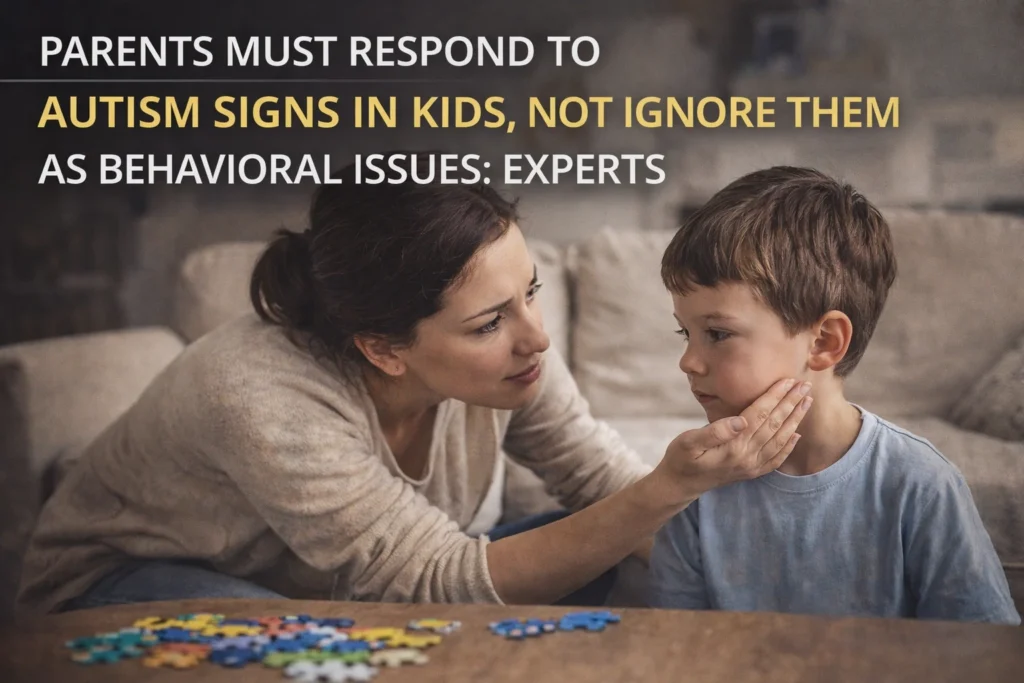

When “Just a Phase” Becomes a Lifetime of Missed Chances
Every parent has been there. You are in the grocery store, and your three-year-old suddenly drops to the floor. They are screaming. Not a little whine—a full-blown, face-red, ear-splitting scream. People stare. You feel your face get hot. A stranger mutters, “Someone needs a nap.”
You grab your child, apologize to no one in particular, and leave your cart full of milk and bread behind.
Later that night, you tell your partner, “It was a meltdown. He’s just tired.” Or you tell your mom on the phone, “She’s so stubborn. She just wants attention.”
But what if it wasn’t stubbornness? What if it wasn’t a phase?
Think about the last time you had a really bad headache. The kind where every sound feels like a hammer. Now imagine someone yelling at you to “snap out of it.” That is what daily life feels like for many autistic children who are misunderstood. Their brains are wired differently. They are not giving you a hard time. They are having a hard time.
Experts in child development and pediatric neurology are sending a clear warning to parents and caregivers: Do not mistake the early signs of autism for simple “bad behavior.” When you ignore those signs, you don’t just lose a teachable moment. You lose precious years of early intervention that can change a child’s entire future.
This is a long guide. We are going to walk through the real stories, the hard science, and the practical steps. By the end, you will see the difference between a tantrum and a sensory meltdown. You will know when to wait and when to call the doctor.
Let’s start with a story about two families.
H2: The Tale of Two Toddlers: Liam and Marcus
Liam was two and a half. He hated birthday parties. When the “Happy Birthday” song started, he clamped his hands over his ears and ran to a dark corner. His dad said, “He’s just shy. He’ll grow out of it.” When Liam lined up his toy cars in a perfect, straight row for an hour instead of “vrooming” them around, his mom thought, “What a focused little guy.”
She would post pictures online of his perfect car lines. Friends commented, “So organized!” “Future engineer!” Nobody said, “Hey, maybe get that checked out.”
Marcus was also two and a half. He did the same things. But Marcus’s mom, a teacher, noticed he never pointed at airplanes in the sky. He never brought her a toy to show her. She took videos on her phone. When her own mother said, “He’s fine, stop worrying, you’re being a helicopter parent,” she didn’t listen. She called her pediatrician.
By age four, Liam was in a general preschool where teachers labeled him “defiant.” He got timeout three times a day. He started biting his own arm when frustrated. His parents were exhausted, fighting with him over every toothbrush and every shoe. The preschool threatened to kick him out. Liam’s mom started crying every morning before dropping him off.
By age four, Marcus had a diagnosis of Autism Spectrum Disorder (ASD). He was in a special program where a therapist taught him how to ask for a break using a picture card. He was learning to handle the sound of the vacuum cleaner. He still had hard days, but his parents understood why. When Marcus melted down, his mom didn’t yell. She wrapped him in a blanket and sat in the dark with him until his body calmed down.
The difference was not the kids. The difference was the response. Liam’s parents saw behavior to be punished. Marcus’s parents saw communication to be decoded.
Let’s fast forward five years.
Liam is now nine. He has been suspended from school three times. He tells his mom, “Everyone hates me.” He refuses to go to birthday parties at all. His parents are considering medication for “anger issues.” They still do not have an autism diagnosis.
Marcus is also nine. He is in a regular classroom for half the day with a helper. He eats lunch in a quiet corner with two friends who also like trains. He still flaps his hands when excited, but now he laughs and says, “My body is happy dancing.” He knows he has autism. He calls it his “superpower brain.”
One path leads to exhaustion and confusion. The other leads to understanding and tools. Which path do you want for your child?
H2: Why “He’ll Grow Out of It” Is a Dangerous Trap
Let’s be honest. We all want to believe the best. No parent wakes up hoping their child has a disability. No parent wants to hear that their child might need extra help. Denial is comfortable. Denial lets you sleep at night.
But here is the truth that child psychologists want you to know: Typical naughty behavior changes. Autism signs do not go away.
A typical two-year-old throws a tantrum because you gave them the blue cup instead of the red cup. After five minutes, they forget about the cup and play with a ball. A child with autism might have a two-hour meltdown over the blue cup not because they are “bad,” but because their brain cannot handle the unexpected change.
Let me explain what is happening inside the brain.
In a typical child’s brain, there is a “traffic director.” When something unexpected happens, the director says, “Okay, change of plans. New route.” The brain adjusts. In an autistic child’s brain, that traffic director is sometimes missing or works differently. When the blue cup appears instead of the red cup, the brain says, “ERROR. SYSTEM CRASH.” And the body responds with a meltdown.
This is not manipulation. This is neurology.
If you ignore autism signs, you are not being a “relaxed parent.” You are leaving your child alone in a world that feels chaotic, loud, and scary. Without help, they will find their own ways to cope. Some kids shut down completely. They stop talking, stop eating, stop leaving their room. Some kids start hitting, biting, or throwing things because they have no other way to say “help me.” Some kids develop obsessive habits like pulling out their hair or scratching their skin until it bleeds.
Early intervention (therapy that starts before age 4) can actually rewire the brain. This is not a metaphor. The brain has something called neuroplasticity. It means the brain can grow new pathways. Think of it like a field of grass. If you walk the same path every day, a trail forms. Early intervention helps create those helpful trails before the unhelpful ones get too deep.
After age 6, it is much harder. The grass has grown over. You have to work ten times as hard to make a new trail. The window is real. And it is narrow.
So, what exactly are you looking for? Let’s break down the most ignored signs.
H2: The 5 Autism Signs Parents Mistake for “Behavior Problems”
You need a checklist. But not a scary medical one. Think of this as a translator for your child’s actions. Read each one slowly. Be honest with yourself. Do not skip any.
1. The “Useless” Repetitive Movements (Stimming)
You see your child flapping their hands, spinning in circles, rocking back and forth, or making the same sound over and over. You tell them, “Stop that. You look silly. People are staring.”
The truth: This is called stimming. It is short for self-stimulatory behavior. It is not a bad habit. It is a volume knob. When the world is too loud, too bright, too smelly, or too emotional, stimming turns down the noise for their nervous system.
Imagine you are at a rock concert. The music is painfully loud. What do you do? You cover your ears. That is stimming. For an autistic child, everyday life can feel like that rock concert. The refrigerator hum, the flickering light, the scratchy tag on their shirt—all of that is painful. Stimming is their way of covering their ears.
The behavior mistake: Punishing stimming makes kids hide their coping tools. They learn to mask their autism. They sit on their hands. They force themselves to be still. This leads to extreme anxiety, depression, and burnout later in life. One autistic teenager told me, “I used to flap when I was happy. My mom said it was embarrassing. Now I don’t know how to show happiness at all.”
What to do instead: Unless they are hurting themselves (banging their head, biting their hand), let them stim. Better yet, learn what kind of stimming they like and offer better tools. If they like spinning, get a spinning chair. If they like pressure, give them a weighted lap pad. If they like sounds, give them a chewy necklace.
2. The “Rude” Refusal to Look at You
You say, “Look at me when I’m talking to you!” Your child keeps staring at the ceiling fan, the spinning wheel on a toy, or the floor. You think they are being disrespectful. You think they are ignoring you on purpose.
The truth: For many autistic kids, eye contact physically hurts. It feels like staring at the sun. It feels like someone is pressing on their chest. Their brain processes eye contact as a threat, not as connection.
Here is a secret that most people do not know: Many autistic people can listen better when they are NOT looking at you. When they look away, they are actually focusing on your words. When they force themselves to make eye contact, all their brain power goes into that painful task. They stop hearing what you are saying.
The behavior mistake: Forcing eye contact teaches them that your comfort matters more than their physical feeling. It breaks trust. It teaches them that their body’s signals are wrong. Over years, this leads to something called “learned helplessness.” They stop trusting their own instincts.
What to do instead: Say this: “You don’t have to look at my eyes. You can look at my nose, my forehead, or my hands. Or just listen with your ears.” Watch how their body relaxes. You can also teach them to look at the bridge of your nose. It looks like eye contact to others but does not hurt the same way.
3. The “Dramatic” Meltdown Over a Broken Cookie
Your child drops to the floor sobbing because their graham cracker snapped in half. You think, “This is manipulation. He’s trying to control me. He wants a whole cookie.”
The truth: This is not a tantrum. Let me say that again. This is not a tantrum. A tantrum stops when the child gets what they want. A meltdown is a neurological storm. Their brain literally sees the broken cookie as a broken world. They cannot stop until the storm passes, no matter what you give them.
Think of it like a computer crashing. When your laptop freezes, you cannot just click “close” and make it work. You have to wait for it to reboot. A meltdown is a brain crash. It needs time to reboot.
The behavior mistake: Sending them to time-out for a meltdown is like punishing someone for having a seizure. It teaches nothing except that you are not safe to go to when they are scared. It also makes the meltdown last longer because now they are also scared of being alone.
What to do instead: Learn the difference. A tantrum has a goal. The child looks at you. They might say, “I want cookie!” A meltdown has no goal. The child looks like they are in pain. They cannot hear you. Remove the trigger. Lower the lights. Reduce noise. Sit nearby. Do not talk much. Say, “I am here. You are safe.” Then wait. After the meltdown, their brain will reset. That is when you can talk.
4. The “Selfish” Play Style
You watch your child at a playdate. The other kids are sharing dolls, building a fort together, or playing tag. Your child is sitting alone, lining up blocks by color or spinning the wheels on a single car for twenty minutes. You worry, “Is he a loner? Is he antisocial? Is he going to have any friends?”
The truth: Many autistic kids do play differently. They engage in what experts call “parallel play.” That means they play near other children, not with them. They might enjoy the company of another child without needing to interact directly. They also might not understand pretend play. A neurotypical kid pretends a banana is a phone. An autistic kid might just study the banana’s texture, smell it, or peel it in a specific way.
This does not mean they do not want friends. It means they do not know how to make friends in the typical way. The social rules that come naturally to other kids—taking turns, reading facial expressions, understanding jokes—are like a foreign language to them.
The behavior mistake: Forcing them to “play nice” or “share” without teaching social scripts is like giving someone a plane without a manual. They crash every time. They get rejected. They get called weird. Eventually, they stop trying.
What to do instead: Teach social skills explicitly. Do not assume they will “pick it up.” Say things like, “When you want to play with someone, you can say, ‘Can I play too?’” Practice at home with role play. Also, find their people. Look for groups based on their special interests. A child who loves trains will find friends at a train museum, even if they do not play “normally.”
5. The “Picky Eater” Nightmare
Every dinner is a war. Your child only eats beige foods: chicken nuggets, crackers, pasta, bread, plain rice. They refuse anything green, anything red, anything with a sauce. You bribe, you beg, you threaten. You say, “Just one bite of broccoli. If you eat it, you can have ice cream.” They still refuse. You feel like a failure.
The truth: This is often not stubbornness. This is a sensory issue. The smell, the color, the texture, the squish of a vegetable might trigger their gag reflex or pain receptors. Their body is saying “danger,” not “yucky.”
For a child with sensory processing differences, eating a mushroom can feel like eating a wet rubber band. Eating an orange can feel like an explosion of acid. They are not being picky to annoy you. They are protecting themselves from something that feels physically threatening.
The behavior mistake: Forcing them to eat triggers food trauma. Many autistic adults say they still cannot eat certain foods because of how they were forced as kids. One adult told me, “My dad made me sit at the table for four hours until I ate a pea. I am 35 years old. I still cannot look at a pea without feeling sick.”
What to do instead: Use food chaining. Start with a food they already like. Change one tiny thing. If they like chicken nuggets, try a different brand. Then try chicken tenders. Then try grilled chicken. Then try chicken with a tiny sprinkle of Parmesan. Go slow. Also, separate the food on their plate. No mixing. Use a divided plate. Let them touch new foods without eating them. Let them smell new foods. Pressure makes it worse. Patience makes it better.
H2: Tantrum vs. Meltdown: A Parent’s Cheat Sheet
You have to know the difference. It will save your sanity. It will save your relationship with your child. I want you to print this section out and put it on your refrigerator.
| Typical Tantrum | Autistic Meltdown |
|---|---|
| Happens when child wants something (toy, candy, attention, to stay up late). | Happens from sensory overload (noise, lights, touch, change in routine, hunger, thirst). |
| Stops almost immediately when child gets what they want. | Does not stop even if you give them everything they asked for. |
| Child looks at you to see your reaction. They are performing. | Child looks like they are in a private storm. They may not even see you. |
| Child is in control enough to negotiate. “If you give me the iPad, I will stop crying.” | Child has lost control completely. They cannot reason, bargain, or listen. |
| Lasts 5-10 minutes on average. | Can last 30 minutes to 2 hours or more. |
| You can distract them with a funny face, a new toy, or a change of scenery. | Distraction makes it worse. They need less input, not more. |
| Child calms down and immediately wants something (hug, snack, toy). | Child calms down and seems exhausted, like after a seizure or a workout. |
Real parent tip from a mom of an autistic 7-year-old: “When my son is melting down, I used to try to talk to him. I would say, ‘Use your words!’ That just made him scream louder. Now I take him to his room, turn off the lights, put on his weighted blanket, and sit on the floor. I do not say a single word. Sometimes I hum his favorite song very quietly. After 20 minutes, he crawls into my lap and falls asleep. The storm is over. We talk about it the next day.”
Another tip: Have a “meltdown kit.” Put it in a bag or a bin. Include noise-canceling headphones, a small weighted lap pad, sunglasses (for light sensitivity), a chewy necklace, and a picture card that says “I need a break.” When you see the signs of a meltdown coming, grab the kit. Do not wait.
H2: The Experts Are Begging You to Stop Using “Time-Out”
Dr. Sarah Jenkins is a child psychologist in Chicago. She has been working with autistic children for over twenty years. She sees the same heartbreaking pattern every single day. A parent walks into her office looking exhausted. Dark circles under their eyes. They say, “We tried everything. Time-out, taking away tablet time, losing dessert, even spanking. He still acts out. Nothing works. We are failing.”
Dr. Jenkins always asks the same question: “What was happening right before the behavior?”
Ninety percent of the time, the answer is: “It was loud in the house.” Or “We had to change our routine because the bus was late.” Or “His socks felt wrong so he screamed for an hour.”
Here is what Dr. Jenkins wants every parent to know: Time-out for an autistic child is often torture, not teaching.
Think about it. A time-out usually means sitting alone in a quiet spot or facing a wall. For a neurotypical kid, that is boring. So they learn to behave. They think, “I don’t want to be bored again, so I will stop hitting.”
But for an autistic kid who is already overwhelmed by sensory input, being left alone with their racing thoughts is terrifying. They do not think, “I was bad.” They think, “I am abandoned.” Their anxiety spikes. Their heart races. They might start screaming louder or hurting themselves. The time-out does not calm them. It breaks them.
Dr. Jenkins explains it like this: “Imagine you are afraid of spiders. Now imagine I lock you in a room full of spiders every time you make a mistake. Would you learn to stop making mistakes? No. You would learn that I am dangerous.”
Instead of time-out, experts recommend time-in. You sit with your child. You do not lecture. You do not punish. You model deep breathing. You say, “I see you are having a hard time. I am here. We will get through this together.”
Here is how a time-in works step by step:
- Recognize the warning signs. Is your child starting to tense up? Are they covering their ears? Are they repeating the same phrase over and over? That is the calm before the storm.
- Remove the trigger. If the TV is too loud, turn it off. If the lights are too bright, dim them. If the room is too crowded, go to a quiet room.
- Get on their level. Sit on the floor. Do not tower over them.
- Offer a sensory tool. Say, “Do you want your headphones? Do you want your blanket?” Do not force it.
- Wait. This is the hardest part. You will want to fix it. Do not. Just sit. Breathe slowly. Your calm body will help their body calm down.
- After they calm down, connect. Say, “That was really hard. You did a good job getting through it. I love you.”
That is a time-in. It takes longer than a time-out. But it builds trust. And trust is the foundation of everything.
H2: How to Talk to Your Pediatrician (Without Being Dismissed)
This is a huge fear for parents. You work up the courage. You make the appointment. You go to the doctor. You say, “I think my child might have autism.” The doctor looks at your kid for three minutes. Your kid smiles at the doctor. The doctor says, “He made eye contact with me. He smiled. He’s fine. Come back in a year.”
You leave feeling embarrassed. You tell yourself, “See? I was overreacting. I’m just an anxious parent.”
But you weren’t overreacting. You just did not bring the right ammunition. Doctors are busy. They have fifteen minutes per patient. They cannot see what happens at 2 AM when your child is spinning in circles for an hour. They cannot see the meltdown over the broken cracker. You have to show them.
Here is your script for the doctor’s office.
Do not say: “I think he’s autistic.” That is too vague. That is easy to dismiss.
Say this: “I have a list of specific concerns with dates and videos.”
Bring this written list:
- “By 12 months, he did not point at things to show me. He did not wave goodbye.”
- “By 16 months, he said zero words. Not ‘mama,’ not ‘dada.’”
- “By 24 months, he stopped saying the two words he knew. He lost skills.”
- “He spins his body for 10 minutes at a time. I have a video on my phone from yesterday.”
- “He does not respond to his name 80% of the time. We had his hearing tested. It is fine.”
- “He walks on his tiptoes all day long.”
- “He lines up toys instead of playing with them.”
Bring videos. This is the most powerful tool you have. Take a three-minute video of the hand flapping. Take a video of the meltdown. Take a video of him ignoring his name. Do not be embarrassed. Doctors need to see it.
Ask for specific tools. Say, “I want to fill out the M-CHAT screening form.” The M-CHAT is a simple checklist for autism in young children. Every pediatrician has it. It takes five minutes.
If the doctor still dismisses you, say this magic sentence: “Please write in my child’s chart that I requested an autism screening and you refused.”
Nine times out of ten, the doctor will suddenly have time for that screening. Why? Because writing that down is a legal risk. If your child is later diagnosed with autism and you can prove the doctor refused to screen, that is malpractice. Doctors know this.
You have power. Use it.
If your pediatrician continues to dismiss you, find a new pediatrician. You are not married to your doctor. You can switch. Look for a developmental pediatrician or a child psychologist who specializes in autism. Waitlists can be long (six months to a year). Get on the waitlist now. You can always cancel later.
H2: A Mother’s Story of “Just a Phase” That Wasn’t
Let me tell you about Maria. Maria is a real mom. I spoke to her in a support group for parents of autistic children. Her son is named Elijah. When I heard her story, I cried. You might too.
Elijah was a beautiful baby. He hit all his early milestones. He rolled over. He sat up. He walked at 13 months. Everyone said, “He’s so advanced.”
But at age two, things started to change. Elijah would only wear red shirts. Not blue. Not green. Only red. If the red shirt was in the laundry, he would scream for two hours. Maria’s husband said, “He’s just strong-willed. He’ll be a CEO one day. CEOs are stubborn.” Maria laughed it off.
At age three, Elijah started covering his ears at the grocery store. The beep of the scanner, the hum of the freezer, the crying of another baby—it was too much. Maria’s mother-in-law said, “He’s just sensitive. Like his father.” Maria believed her.
At age four, preschool called every single week. Elijah bit a kid who touched his backpack. He hid under the table during story time. He refused to sit in a circle. The teacher said, “He needs more discipline at home. He is choosing to be difficult.”
Maria and her husband started punishing Elijah. Time-outs. Taking away toys. Spanking. Nothing worked. Elijah got worse. He started banging his head on the wall when he was upset. He stopped talking at school entirely. He would just hum. A low, constant hum.
At age five, the school threatened to expel him. Maria finally took Elijah to a child psychiatrist. The psychiatrist spent three hours with Elijah. Then she sat down with Maria.
“Your son has Level 2 Autism Spectrum Disorder with a verbal delay,” she said.
Maria did not cry at first. She felt numb. Then she went to her car and screamed. Then she cried for three days straight.
She cried for the lost years. She cried for the spankings. She cried for every time she called him “difficult” when he was actually scared. She cried for the head-shaped dent in her wall that she now understood was not defiance but desperation.
But then Maria got angry. Angry at herself for listening to her husband. Angry at the teacher for calling it “badness.” Angry at the pediatrician who said “he’ll grow out of it.” And she channeled that anger into action.
She started therapy immediately. Speech therapy twice a week. Occupational therapy twice a week. Behavioral therapy at home. She read every book on autism. She joined support groups. She stopped punishing and started accommodating.
Elijah is nine now. He still loves red shirts. He still hums. He still flaps his hands when excited. But he can tell you, “My ears hurt. I need my headphones.” He has two friends who also love trains. He reads at grade level. He sleeps through the night. He hugs his mom every morning and says, “You are my safe person.”
Maria says this: “I lost two years because I wanted to believe it was a phase. I will never get those years back. But I got the rest of his life. If you are reading this and you see your child in my story, do not wait. Do not listen to your mother-in-law. Do not listen to your neighbor. Listen to your gut. You know your child better than anyone.”
Do not be Maria from five years ago. Be Maria today.
H2: What to Do TODAY If You See the Signs
You do not need a diagnosis to start helping your child. You do not need a doctor’s note. You do not need to wait for a six-month waitlist. You can start right now, in your living room, with things you already have.
Here are six expert-approved steps for immediate action. Do not try to do all six today. Pick one. Do it today. Then pick another one tomorrow.
1. Stop Punishing the “Weird” Stuff
For one week, do not say “stop that” to any repetitive behavior. If your child flaps, rocks, hums, spins, or repeats words, let them. Say nothing. Unless they are hurting themselves or others, it is medicine for their brain. Watch them. You will learn what calms them. Does spinning calm them? Does pressure calm them? Does a specific sound calm them? This is data. Collect it.
2. Start Using “First/Then” Language
Autistic brains love predictability. They hate surprises. Instead of saying, “Clean up your toys,” which is vague and scary, say, “First clean up the blocks, then we watch Bluey.” Write it on a whiteboard. Draw simple pictures. A picture of blocks. An arrow. A picture of Bluey. This lowers the fear of the unknown. It tells their brain, “There is an end to this hard thing.”
3. Create a “Sensory Diet”
No, not food. A sensory diet is a schedule of activities that feed their nervous system. Just like your body needs food at regular times, an autistic child’s nervous system needs sensory input at regular times.
Here is a sample sensory diet:
- Morning (before school): Jump on a mini trampoline for 5 minutes. Or do 10 wall push-ups. This wakes up the body.
- After school (the hardest time): 15 minutes of deep pressure. Roll them up like a burrito in a blanket. Squeeze their arms and legs. This calms down the body after a long day of masking.
- Before dinner: Heavy work. Let them push a laundry basket full of books. Let them carry grocery bags. Let them help you stir thick batter. Heavy work organizes the nervous system.
- Before bed: Brushing. Use a soft makeup brush or a special therapy brush. Brush their arms, back, and legs in long strokes. This tells the nervous system, “It is time to sleep.”
4. Teach a “Break Card”
Get an index card or a piece of cardboard. Draw a stop sign. Or a picture of a quiet corner. Or a picture of headphones. Tell your child, “When your body feels too loud, give me this card. You can go to the calm tent. No questions asked. No punishment.”
Practice when they are happy. Role play. Say, “Pretend you are feeling angry. Now give me the card.” Then walk them to the calm tent. Give them a timer. This gives them words they do not have. It turns a meltdown into a request for help.
5. Film Everything
Take a three-minute video of your child’s “weird” behaviors. Film the hand-flapping. Film the meltdown over the broken cracker. Film the food refusal. Film them ignoring their name. You do not have to show anyone now. But when you finally see a specialist, that video is gold. It is proof. It cannot be argued with.
Keep a video log on your phone. Date each video. Write a short note: “March 15: Meltdown because the toast was cut into squares instead of triangles.” This is your evidence.
6. Call Early Intervention
In the United States, every state has a free program called Early Intervention for kids ages 0 to 3. After age 3, your local public school district must provide free evaluations for special education services. This is the law. It is called IDEA (Individuals with Disabilities Education Act).
You do not need a doctor’s referral. You do not need a diagnosis. You just call and say, “I am concerned about my child’s development. I want an evaluation.”
Just Google “Early Intervention [your county name]” or “Child Find [your school district name].” Call tomorrow morning. Do not put it on your to-do list. Do it now.
H2: The Danger of “Masking” – Why Quiet Kids Get Overlooked
When most people think of autism, they think of the kid who screams in the grocery store. The kid who flaps their hands. The kid who cannot sit still. But there is another group of kids. They are the quiet ones. The people-pleasers. The ones who get “Student of the Month” because they sit still, never talk back, and turn in perfect work.
These kids are often girls, but not always. Boys can mask too. They learn to mask their autism. Masking means hiding their true selves to fit in. They watch other kids. They memorize social rules like they are studying for a test. They practice smiles in the mirror. They force themselves to make eye contact even though it burns.
On the outside, they look perfect. Polite. Smart. Well-behaved. Teachers love them. Parents brag about them.
On the inside, they are falling apart.
Masking takes an enormous amount of energy. Imagine going to a job interview every single minute of every single day. That is what life feels like for a child who masks. They are constantly performing. Constantly anxious. Constantly afraid of being “found out.”
By middle school, masking leads to burnout. These kids come home from school and collapse. They cry for two hours for no reason. They develop eating disorders because food is one thing they can control. They cut themselves because physical pain distracts from the mental exhaustion. They are often diagnosed with anxiety or depression first. The autism is missed for years.
Do not ignore the “good” kid.
Ask yourself these questions:
- Does your child seem exhausted after school, even though they did not “do” much?
- Do they cry over small changes in routine, like a different substitute teacher?
- Do they have one obsessive interest (horses, space, dinosaurs, a specific video game) that they talk about for hours, even when you are clearly not interested?
- Do they have trouble making friends, even though they desperately want them?
- Do they copy other people’s laughs, phrases, or styles?
- Do they have meltdowns at home but seem fine at school?
If you answered yes to several of these, your child might be masking. They might be working ten times harder than everyone else just to look normal. They need help. Not because they are broken, but because they are exhausted.
What helps a masker? Unmasking. Give them permission to be weird at home. Say, “You don’t have to look at my eyes here. This is a safe place.” Let them stim. Let them talk about their special interest without judgment. And get them evaluated. Maskers are often missed by general pediatricians. Find a psychologist who specializes in autism in girls and high-masking individuals.
H2: Breaking the News to Grandparents and Friends
One of the hardest parts of this journey is not the child. It is the adults. It is your mother-in-law who says, “In my day, we didn’t have all these labels. We just called it being a kid.” It is your neighbor who says, “You’re coddling him. He needs a firmer hand.” It is your own parents who say, “You were just like that as a child, and you turned out fine.”
These comments hurt. They make you doubt yourself. They make you feel alone.
You need armor for these conversations. You need scripts. You need to practice saying them in the mirror.
Script for the doubter:
“I know you love my child. I love them too. The doctors who study brains for a living say that early intervention helps. We are following their advice. You don’t have to understand it. You just have to support it. If you cannot support it, please keep your thoughts to yourself.”
Script for the “label” hater:
“A label is not a cage. A label is a door. Without the label, we are just guessing. We were trying discipline, time-outs, and punishment. Nothing worked because we were treating the wrong problem. Now we have a label, we have a door, and we have a key. The label helped my child. Please do not take that away from us.”
Script for the “you were just like that” relative:
“Maybe I was just like that. And maybe I struggled in silence for years. Maybe I developed anxiety or depression because nobody understood me. I do not want that for my child. I want better for them than I had.”
You will lose some people. It hurts. Some relatives will pull away. Some friends will stop calling for playdates. It is painful. But your child needs you to be brave. You are not being “difficult.” You are not being “overprotective.” You are being a translator for a child who cannot translate themselves.
And here is a secret: You will find new people. You will find other autism parents. You will find support groups online and in person. These people will become your tribe. They will not say “he’ll grow out of it.” They will say “mine does that too, here is what helped.” Hold onto those people.
H2: A Sample Daily Routine for a Sensory-Sensitive Child
Predictability is peace. For a child with autism, knowing what comes next reduces anxiety. Anxiety leads to meltdowns. Less anxiety means fewer meltdowns. It is that simple.
Here is a sample daily routine. Steal it. Change it to fit your family. The key is consistency.
7:00 AM – Wake Up
No loud alarms. Do not use a blaring phone alarm. That is a terrible way to start the day for a sensory-sensitive child. Use a sunrise lamp that slowly gets brighter over 30 minutes. Or use a vibration watch. Or gently open their curtains. Say good morning in a soft voice. Do not touch them without warning.
7:15 AM – Breakfast
Offer one safe food (something they always eat, like crackers or a specific cereal). Offer one new food the size of a pea. No pressure. No “just one bite.” No bargaining. The pea-sized new food just sits there. Maybe they touch it. Maybe they smell it. That is a win. Use the same plate, same cup, same spoon every day.
8:00 AM – Get Dressed
Lay out two shirts. Let them choose. Choice gives control. Cut all tags out of all clothes. Buy seamless socks. Turn all clothes inside out so the seams are on the outside. If they hate jeans, do not make them wear jeans. Soft pants only. Elastic waistbands only.
9:00 AM – Therapy or Preschool
If your child goes to preschool or school, write a one-page note for the teacher. Keep it simple. Say:
- “My child covers their ears when loud. Please allow headphones.”
- “My child needs a 2-minute warning before transitions. Say, ‘In two minutes, we will clean up.’”
- “My child does not understand jokes. Please use literal language.”
- “My child may need a break in a quiet corner. Please allow this without punishment.”
12:00 PM – Lunch
Quiet room. No cafeteria if possible. The cafeteria is a sensory nightmare: clanging trays, shouting kids, bright lights, weird smells. If they must eat in the cafeteria, give them noise-canceling headphones. Send familiar foods. Do not send new foods to school.
1:00 PM – Sensory Break
Ten minutes of heavy work or deep pressure. Roll on a yoga ball. Squish between couch cushions. Do animal walks (bear crawls, frog jumps). Push against a wall. This resets the nervous system for the afternoon.
3:00 PM – The After-School Meltdown Zone
After school is often the hardest time. Your child has been holding it together all day. They have been masking. They have been tolerating lights and sounds. Now they are home. The mask comes off. Do not ask questions. Do not say, “How was your day?” Do not say, “Do you have homework?” Just offer a snack and silence for 30 minutes. Let them sit in a dark room. Let them stim. Let them be alone. This is not rudeness. This is recovery.
5:00 PM – Dinner
Same routine every night. Same seat at the table. Same plate color. Same fork. Announce the menu before dinner. Say, “Tonight we are having chicken, rice, and carrots.” No surprises. Separate foods on a divided plate. No mixing.
7:00 PM – Bath
Low lights. No overhead light. Use a small lamp or candles. Lavender soap if they like the smell. Let them pour water through their fingers. Let them play with foam letters. If they hate baths, do showers. If they hate showers, do sponge baths. Find what works.
8:00 PM – Bed
Weighted blanket (no more than 10% of their body weight). White noise machine (rain sounds or fan sounds). Blackout curtains. Read the same three books every night in the same order. Say the same goodnight phrase every night. “Goodnight. I love you. See you in the morning.”
Boring is beautiful. Routine is freedom.
H2: Frequently Asked Questions from Real Parents
I have collected these questions from real parents in support groups, therapy waiting rooms, and online forums. If you have these questions, you are not alone.
Q: My kid is 7. Is it too late for help?
A: It is never too late. Never. The brain continues to change throughout life. However, early is better. At age 7, your child will have more habits to unlearn. They may have already developed anxiety or low self-esteem from years of being called “bad.” But speech therapy, occupational therapy, social skills groups, and even medication for anxiety can still help tremendously. Do not let guilt stop you. Guilt is useless. Action is useful. Start today.
Q: Will my child ever live alone?
A: Maybe. Maybe not. The autism spectrum is huge. Some autistic adults become engineers, software developers, artists, musicians, and chefs. They get married, have kids, and live completely independently. Others need daily support for their entire lives. They live in group homes or with family. Both are okay. The goal is not “normal.” The goal is their best life. The goal is happiness and safety.
Q: I think I might be autistic too. Now what?
A: This is very, very common. Parents get their child diagnosed with autism and suddenly their own childhood makes sense. The social struggles. The intense interests. The sensory issues. The feeling of being “different.” Look into adult autism assessments. Many clinics offer them. Also, many online screening tools can give you a sense. But know this: Having an autistic parent is often a gift. You understand your child in a way that neurotypical parents cannot. You can say, “I get it. I feel that way too.” That is powerful.
Q: What about vaccines? I keep hearing rumors.
A: Let me be very clear. The vaccine-autism link has been studied for over 20 years. Millions of children. Dozens of countries. Multiple study methods. The result is always the same: No link. None. The original study that started the rumor was fake. The doctor who wrote it lost his medical license. He made up the data. Vaccines save lives. They prevent polio, measles, whooping cough, and other deadly diseases. Autism is genetic. It is wired into the brain before birth. It is not caused by a shot.
Q: How do I get a 504 plan or IEP for school?
A: Send a letter to your school principal. Write these exact words: “I am requesting a special education evaluation for my child.” That is it. By law (IDEA), the school has 60 days to respond and complete the evaluation. They cannot say no. They cannot say “wait and see.” Bring an advocate if you can. Many cities have free advocacy services. You do not need a lawyer yet. Just send the letter. Keep a copy.
Q: My child only eats three things. Will they starve?
A: No. Children will not starve themselves. If they are growing, gaining weight, and have energy, they are getting enough calories. Focus on adding, not taking away. Add a vitamin if you are worried. Add a new food the size of a pea. Do not force. Do not beg. Do not bribe. Pressure makes picky eating worse. Patience makes it better. Consider seeing a feeding therapist (an occupational therapist who specializes in eating).
Q: Do I need to tell my child they have autism?
A: Yes. But not all at once. Start early. Say, “Your brain works differently. That is why some things are hard and some things are easy.” Use books about autism. Use stories of autistic heroes (Temple Grandin, Greta Thunberg, Anthony Hopkins). Do not hide the diagnosis. Hiding it teaches shame. Naming it teaches understanding. If you do not tell them, they will still know they are different. But they will think they are broken. Do not let that happen.
Q: How do I handle holidays and family gatherings?
A: Plan ahead. Bring noise-canceling headphones. Bring safe foods. Identify a quiet room they can escape to. Set a time limit. Say, “We will stay for one hour.” Leave before the meltdown, not after. Do not feel guilty. You are protecting your child. Real family will understand. If they do not understand, skip the gathering. Your child’s health matters more than Aunt Susan’s feelings.
H2: The Bottom Line – Your Response Changes Everything
Let’s go back to the grocery store.
Your child is on the floor screaming. People are staring. You feel the heat in your chest. Your face is red. You hear someone whisper, “That kid needs a spanking.” You have two choices.
Old you thinks: “This is embarrassing. He’s doing this on purpose to ruin my day. He’s manipulating me. We are leaving, and he is losing his tablet for a week. Maybe two weeks.”
New you thinks: “Something is hurting his brain. Maybe the lights are flickering at a frequency I cannot see. Maybe the beep of the checkout scanner is like a knife in his ears. Maybe his sock is bunched up. He is not giving me a hard time. He is having a hard time.”
New you kneels down. You do not say “stop crying.” You do not say “you’re okay.” You say, “I’m here. We will get through this together.” You wrap him in your jacket to block the light. You pick him up. You carry him to the car. You do not yell at him. You do not yell at yourself. You sit in the backseat with him until his breathing slows.
That is not permissive parenting. That is not spoiling him. That is responsive parenting. That is the difference between a child who learns that the world is a terrifying, unpredictable place and a child who learns that Mom and Dad are a safe harbor. A child who has a safe harbor will eventually be brave enough to explore the world. A child who does not will stay hidden forever.
Experts are not saying it will be easy. They are saying it is necessary. They are saying that ignoring the signs does not make them go away. It just makes you late.
You don’t have to be a perfect parent. You don’t have to have a degree in child psychology. You just have to be a curious one. When your child does something “weird,” don’t ask “How do I stop this?” Ask “What is he trying to tell me?”
That one question will change everything.
If you saw yourself in this article, if your chest got tight while reading, if you recognized your child in Liam or Elijah or Marcus, do not close the tab and forget about it. Do not put this article in your “read later” folder. Do not tell yourself you will think about it tomorrow.
Right now, while you have the feeling in your chest, do one thing. Just one.
Pick up your phone. Call your pediatrician’s office. Say, “I want to schedule a developmental screening.”
Or go to a video website and search “early signs of autism in toddlers.” Watch three videos. Watch with an open mind.
Or grab a notebook and write down the five things your child does that worry you. Date the page.
Or send an email to your child’s teacher. Say, “Have you noticed anything different about my child’s behavior?”
Just start. Do not wait for a “better time.” There is no better time. There is only now.
Your child is waiting for you to see them. Not the behavior. Not the label. Not the tantrum. Them.
They are in there. They are smart. They are feeling. They are trying so, so hard. And they need you to be their translator, their protector, and their safe harbor.
You can do this. You are not alone. There are millions of parents walking this same path. Reach out. Ask for help. And keep going.
One day, your child will look at you and say, “Thank you for understanding me.” That day will make every hard day worth it.