
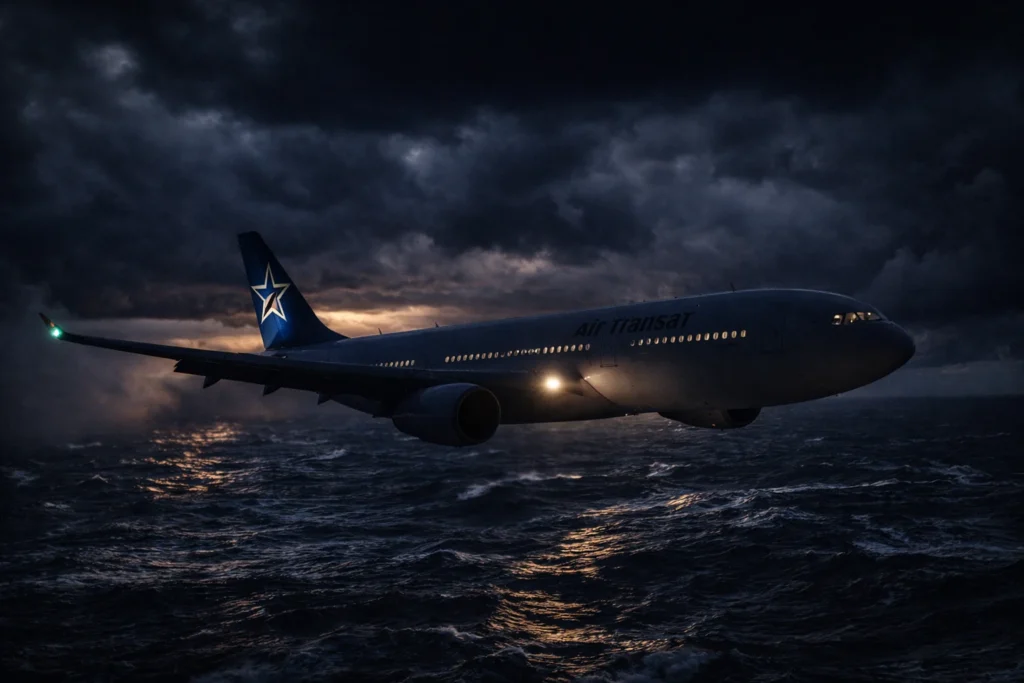

A Complete and Detailed Account of Aviation’s Greatest Glider Emergency
On the night of August 24, 2001, a massive Airbus A330 carrying 306 souls became a silent ghost soaring through the darkness at 39,000 feet above the freezing Atlantic Ocean. Both engines had failed completely. The plane was essentially a 200-ton metal tube with no power, gliding downward through the inky blackness toward an ocean that promised certain death. This is the complete, exhaustive story of Air Transat Flight 236—a tale of mechanical failure, human error, incredible heroism, and what many still call the greatest emergency landing in aviation history.
Part One: The Calm Before the Storm
Chapter 1: Setting the Stage – Toronto Pearson International Airport, August 23, 2001
Toronto Pearson International Airport hummed with its usual evening activity on Thursday, August 23, 2001. Terminals buzzed with travelers heading to destinations across North America and beyond. Among the dozens of flights preparing for departure that night was Air Transat Flight 236, a scheduled transatlantic service to Lisbon, Portugal. The aircraft assigned to this route was an Airbus A330-243, registered as C-GITS, a relatively new addition to the Air Transat fleet having entered service just two years prior in 1999.
The Airbus A330 represented the pinnacle of aviation technology at the turn of the millennium. This twin-engine wide-body jet could carry over 300 passengers across vast distances with remarkable fuel efficiency. The aircraft was equipped with state-of-the-art fly-by-wire controls, meaning that pilot inputs were interpreted by computers before being sent to the control surfaces. It had sophisticated electronic displays, automated systems that could handle countless scenarios, and redundancy built into every critical system. In theory, it was one of the safest machines ever created by human hands.
Air Transat itself was a Canadian airline that had built its reputation on providing affordable vacation travel to sun destinations and European cities. Founded just 14 years earlier in 1987, the airline had grown steadily and developed a loyal customer base, particularly among Canadian travelers of European descent who appreciated the direct flights to destinations like Portugal, Italy, and Greece. The airline’s slogan, “Vacations are beautiful,” promised passengers a pleasant journey to their holiday destinations.
On this particular evening, the gate area for Flight 236 gradually filled with an interesting mix of travelers. Many were Canadians of Portuguese descent, returning to visit family in the old country after summer vacations in North America. Elderly couples spoke softly in Portuguese, clutching carry-on bags filled with gifts for relatives. Young children, tired from long days of travel, fidgeted in their seats while parents tried to keep them calm. There were also European tourists heading home after exploring Canada’s natural wonders—backpackers comparing notes about their trips, honeymooners looking forward to sharing their adventures with families back home, and business travelers eager to return to their routines.
The departure board showed the scheduled pushback time of 8:10 PM, with an estimated flight time of approximately seven hours. For most passengers, this was simply another flight—a necessary inconvenience to get from point A to point B. They had no way of knowing that this ordinary journey would become one of the most extraordinary stories in aviation history, a tale that would be studied by pilots, engineers, and safety experts for decades to come.
Chapter 2: The Aircraft – C-GITS in Detail
The Airbus A330-243 carrying Flight 236 was a remarkable piece of engineering that deserves detailed examination. With its construction number 271 and line number 272, this particular aircraft had rolled off the Airbus assembly line in Toulouse, France, in 1999. It was powered by two Rolls-Royce Trent 772B-60 engines, each capable of producing 71,100 pounds of thrust. These engines were among the most advanced and reliable power plants in commercial aviation, representing billions of dollars in research and development.
The aircraft’s dimensions were impressive by any standard. It stretched 63.7 meters in length, with a wingspan of 60.3 meters that carried sophisticated wingtip fences to reduce drag and improve fuel efficiency. The tail stood 16.8 meters high—roughly the height of a five-story building. Maximum takeoff weight was approximately 233 tons, though on this flight it would be slightly less due to the fuel load and passenger count.
Inside the cabin, the aircraft was configured to carry 362 passengers in a standard two-class arrangement. For this flight, however, the actual passenger count was 293, meaning the plane was comfortably below its maximum capacity. This would prove fortunate, as the lower weight would extend the aircraft’s gliding range during the emergency. The cabin featured Air Transat’s vacation-oriented interior design, with blue seats and tropical-themed accents meant to evoke a sense of leisure and relaxation.
The flight deck, or cockpit, represented the cutting edge of aviation technology. Six large electronic displays provided the flight crew with comprehensive information about every aspect of the aircraft’s operation. The primary flight displays showed attitude, altitude, airspeed, and heading. The navigation displays provided moving maps of the aircraft’s position. The engine and warning displays monitored the health of every major system. The pilots could access checklists, system synoptics, and performance data through interactive screens. It was a glass cockpit in the truest sense, a far cry from the steam gauges and analog instruments of earlier generations.
Beneath all this technology, however, the aircraft was still subject to the same physical laws that had governed flight since the Wright Brothers. It needed fuel to burn, engines to provide thrust, and hydraulic pressure to move its control surfaces. When any of these elements failed, all the computer screens in the world would not keep a 200-ton machine in the air.
Chapter 3: The Crew – Two Very Different Pilots
In the cockpit that night sat two men who could hardly have been more different in background, experience, and personality. Together, they formed a crew that would be tested beyond anything their training had prepared them for.
Captain Robert Piché was 48 years old, a native of Îles-de-la-Madeleine, Quebec, a small island chain in the Gulf of St. Lawrence. He had accumulated an astonishing 16,800 flight hours over his career, a figure that represented decades of experience in virtually every type of flying situation. Piché had started his aviation career flying bush planes in northern Quebec, landing on gravel strips and lakes, learning to handle aircraft in challenging conditions with minimal support. He had flown for smaller regional airlines, building his hours and his reputation as a skilled, steady pilot.
But Piché’s path to the left seat of an Airbus had not been straightforward. In the early 1980s, after being laid off from a regional airline, he had faced financial difficulties and made a decision that would haunt him for years. He became involved in drug smuggling, using his piloting skills to fly marijuana from Jamaica into the United States. In 1983, he was arrested after landing a small plane loaded with drugs at a rural airfield in Georgia. The subsequent conviction led to a 16-month prison sentence in a federal facility. It was a period of his life that Piché deeply regretted, and after his release, he worked tirelessly to rebuild his life and career. He returned to aviation through small charter operations, eventually being hired by Air Transat in 1995. He received a pardon for his conviction in 2000, just one year before Flight 236. This background gave Piché a unique perspective on life—he knew what it meant to hit bottom and climb back up, and he understood the importance of staying calm under pressure.
First Officer Dirk DeJager could hardly have had a more different background. At just 28 years old, DeJager represented the new generation of airline pilots. He had approximately 4,800 flight hours, a respectable total for his age but a fraction of Piché’s experience. DeJager had followed a more conventional path to the airlines, building his time as a flight instructor and then moving to regional carriers before joining Air Transat. He was thoroughly trained in modern aviation techniques, comfortable with automation and computer systems, and familiar with the latest procedures and technologies.
The dynamic between the two pilots was exactly what airline training programs hope for. Piché brought decades of seat-of-the-pants experience, the kind of wisdom that comes only from thousands of hours of dealing with real-world situations. DeJager brought fresh knowledge of current procedures, comfort with automation, and a systematic approach to problem-solving. They respected each other and worked well together, communicating clearly and supporting each other’s decisions. This crew resource management, as aviation professionals call it, would prove absolutely critical in the hours ahead.
Chapter 4: The Passengers – 293 Stories
Behind the cockpit door, in the cabin stretching back through economy class, sat 293 individuals whose lives were about to intersect in ways none of them could imagine. Each had their own story, their own reasons for being on this flight, their own hopes and fears and plans for the future.
There was Maria Santos, a 72-year-old grandmother from Toronto traveling to her hometown of Faro to visit her sister whom she hadn’t seen in five years. She carried photographs of her Canadian grandchildren to show to relatives who had never met them. There was the Chen family—father, mother, and two young children—returning to Portugal after a three-week camping trip through the Canadian Rockies. The children, ages 6 and 8, still talked excitedly about seeing bears and elk in the national parks.
Several rows back sat James Richardson, a British businessman heading to Lisbon for meetings with Portuguese wine producers. He had spent the week in Toronto meeting with Canadian importers and was looking forward to a weekend in the Algarve after his business concluded. Next to him, by coincidence, sat Antonio Ferreira, a Portuguese-Canadian contractor who had spent the summer working on renovation projects in Toronto and was finally heading home to see his wife and children.
Near the window on the left side, a young woman named Sarah Mitchell was flying to Lisbon to begin a semester abroad as part of her university studies. She was nervous and excited, leaving North America for the first time, and she spent the pre-flight hours writing in a journal about her hopes for the months ahead. She had no idea that her journal would eventually contain entries about survival rather than study.
In the back of the cabin, a group of Portuguese Canadian soccer players in their twenties were returning from a tournament in Toronto. They joked loudly, teased each other about missed goals and bad calls, and generally acted like young men traveling together. Their energy was infectious, and even passengers who didn’t understand Portuguese smiled at their enthusiasm.
The flight attendants began their pre-departure duties, greeting passengers, checking carry-on luggage, and demonstrating safety procedures with the practiced ease of experienced professionals. The lead flight attendant had 18 years of experience with Air Transat. She had seen everything from medical emergencies to turbulent landings, but nothing in her career had prepared her for what was coming.
Chapter 5: Pre-Flight Preparations
At the gate, the ground crew worked efficiently to prepare Flight 236 for departure. Fuel trucks connected to the aircraft’s wing tanks, pumping 46.9 tonnes of Jet A fuel into the massive tanks. This was actually 4.5 tonnes more than the regulations required for the flight to Lisbon. The extra fuel represented a standard safety buffer, allowing for weather delays, holding patterns, or diversion to alternate airports. It also, as it happened, provided crucial additional margin that would eventually mean the difference between life and death.
The fueling process was routine, but there was a detail from the aircraft’s recent maintenance history that would prove critically important. Just a few days earlier, on August 19, mechanics had replaced the number two engine—the right engine—with a spare unit. This spare engine had been lent to Air Transat by Rolls-Royce while the original engine underwent maintenance. It came from an older A330 model and had some minor differences in configuration from the engine it replaced.
Specifically, the spare engine lacked a hydraulic pump that was present on the original. To accommodate this difference, the maintenance team needed to install a different hydraulic line configuration. They used a combination of parts from various sources to make the installation work. A mechanic on the shift had expressed concerns about the fit, noting that some components seemed to be rubbing against each other in ways that didn’t look right. After consulting with supervisors, however, he was told to proceed with the installation. The clearance between a hydraulic line and a fuel line was measured in millimeters—just barely enough, the mechanics thought, to be acceptable.
This tiny clearance, this almost imperceptible gap, was a time bomb waiting to go off. As the aircraft flew, vibrations from the engine would cause these lines to oscillate at slightly different frequencies. Gradually, imperceptibly, they would rub against each other. It might take hours or days or weeks, but eventually, one would wear through the other.
That night, the time bomb was installed and hidden from view, waiting for the right combination of flight hours and vibrations to trigger its mechanism.
Chapter 6: Departure
At 8:52 PM Eastern Time, Flight 236 pushed back from the gate. The tug operator guided the massive aircraft away from the terminal, then disconnected and waved goodbye to the flight crew. Captain Piché started the engines, and the distinctive whine of Rolls-Royce Trent turbines filled the night air.
The taxi to runway 24L at Toronto Pearson took about 15 minutes. During this time, the flight crew completed their final checks, confirmed their route with air traffic control, and briefed the takeoff procedure. First Officer DeJager would handle the radios and monitoring while Captain Piché flew the takeoff. They discussed their plan for the oceanic crossing, the weather they expected over the Atlantic, and their arrival procedures for Lisbon.
At 9:03 PM, the tower cleared Flight 236 for takeoff. Piché advanced the throttles, and the big Airbus began its roll down the runway. The acceleration pressed passengers back into their seats. The noise of the engines rose to a powerful roar. At V1—the speed beyond which takeoff cannot be safely aborted—the aircraft was committed to flight. At VR—rotation speed—Piché pulled back on the side-stick, and the nose lifted gracefully. A few seconds later, the main landing gear left the runway, and Flight 236 was airborne.
The climb out of Toronto took the aircraft through scattered clouds and into the clear night sky above. Passengers who happened to look out their windows could see the lights of the city spread out below like a glittering carpet, gradually shrinking as the aircraft gained altitude. The seatbelt sign remained on as the plane climbed through 10,000 feet, then 20,000, then 30,000.
At 12:52 AM UTC (adjusting for the time zone difference, as flight operations use UTC for consistency), the aircraft leveled off at its initial cruising altitude of 37,000 feet. The flight attendants began cabin service, offering drinks and snacks to passengers who were awake and preparing meals for those who wanted to sleep. The cabin lights dimmed. The gentle hum of the engines provided white noise that helped passengers relax.
The first few hours of the flight were utterly routine. The aircraft crossed the Canadian coastline and headed out over the Atlantic, following the North Atlantic tracks that organize air traffic between North America and Europe. The ocean below was invisible in the darkness, but experienced travelers knew it was there, a vast expanse of cold water stretching all the way to the Azores and beyond.
At 2:45 AM UTC, the flight crew decided to climb to 39,000 feet, seeking more favorable winds and better fuel efficiency. The aircraft responded smoothly, climbing through the thin air to its new altitude. The view from the cockpit was spectacular—stars above, a thin layer of clouds below, and the moon reflecting off the ocean surface in patches where the clouds parted.
Everything was normal. Everything was routine. The time bomb in the right engine continued its work, unseen and unsuspected, the hydraulic line and fuel line rubbing together with each vibration of the powerful Rolls-Royce engine.
Part Two: The Crisis Unfolds
Chapter 7: 4:38 AM UTC – The Leak Begins
Deep inside the number two engine, the vibration caused by the improperly fitted parts finally achieved what the maintenance crew’s calculations had failed to prevent. The constant rubbing had worn a crack in the fuel line. At first, the crack was microscopic, barely a hairline fracture. But fuel under high pressure immediately found this weakness and began to exploit it.
Jet fuel at typical engine operating pressure is not a gentle substance. Forced through a tiny opening, it acts like a liquid cutting tool, eroding and expanding the crack with remarkable speed. Within seconds, what had been a hairline fracture became a visible split. Within a minute, it was a gaping hole. Fuel that should have been flowing to the engine’s combustion chambers was instead spraying into the engine nacelle and then out into the slipstream.
The leak rate was catastrophic. Later analysis would determine that fuel was escaping at approximately one gallon per second. In metric terms, this meant 3.6 kilograms of fuel leaving the aircraft every single second. At this rate, the aircraft’s entire fuel load would be depleted in just a few hours—far less than the time needed to reach Lisbon.
But here’s the cruel trick of aircraft design: the fuel tanks are not in the engines. The fuel is stored in the wings and in center tanks within the fuselage. It flows through pipes to the engines. The leak was occurring after the fuel had already left the tanks, so the aircraft’s fuel quantity sensors, located in the tanks, initially had no way of detecting the loss. They simply saw fuel leaving the tanks at a normal rate and assumed it was being burned by the engines.
For 25 minutes, this situation continued. The aircraft flew on, burning fuel in the left engine and losing fuel from the right engine at a horrific rate. The pilots had no indication that anything was wrong. Their fuel gauges showed normal quantities decreasing at normal rates. The engine instruments showed normal operation. The computers reported no faults. The night remained quiet and routine.
Chapter 8: 5:03 AM UTC – The First Warning
At 5:03 AM UTC, the first indication of trouble appeared. A warning message appeared on the flight deck displays indicating low oil temperature and high oil pressure on the number two engine.
Captain Piché and First Officer DeJager studied this message with confusion. High oil pressure typically occurs when oil is cold and thick, not when an engine has been running normally for hours at cruising altitude. Low oil temperature similarly suggested that the oil was not heating up as expected. These indications seemed contradictory and, frankly, impossible given the circumstances.
Piché did exactly what procedure dictated: he contacted Air Transat’s maintenance control center in Montreal via satellite radio. The voice connection was clear despite the thousands of miles, and Piché explained the odd readings to the maintenance specialists on duty.
The maintenance controllers consulted their manuals and their experience. They considered various possibilities—sensor malfunctions, electrical glitches, software errors. Nothing they could think of would explain the combination of high pressure and low temperature in an engine that was otherwise performing normally. Their conclusion, relayed back to the cockpit, was that the indications were almost certainly false. It was probably a faulty sensor, they said. Keep an eye on it, but don’t worry.
This was a reasonable conclusion based on the information available. Sensor failures are relatively common in complex aircraft, and they rarely indicate actual problems with the systems being monitored. The maintenance team had no way of knowing that the odd oil readings were actually caused by the fuel leak. The leaking fuel was rushing past the fuel-oil heat exchanger, a device that normally uses fuel to cool engine oil. With fuel rushing past at an abnormal rate, the heat exchanger was overcooling the oil, causing the low temperature reading. The high pressure was a related effect of the oil’s increased viscosity.
The pilots accepted this advice. They noted the warning, reset the systems, and continued monitoring. It was a perfectly reasonable response to what appeared to be a minor technical glitch. Unfortunately, it was also a missed opportunity to identify the leak while the aircraft still had plenty of fuel and was close to several diversion airports.
Chapter 9: 5:36 AM UTC – The Fuel Imbalance
Thirty-three minutes later, at 5:36 AM UTC, a much more significant warning appeared. The Electronic Centralized Aircraft Monitor displayed a “Fuel Imbalance” message. The fuel in the left wing tank now significantly exceeded the fuel in the right wing tank.
This was a situation that pilots encounter fairly often on long flights. Engines don’t always consume fuel at exactly the same rate. Slight differences in engine efficiency, minor asymmetries in the fuel system, or even the aircraft’s attitude in flight can cause fuel to shift from one tank to another. When the imbalance reaches a certain threshold, the aircraft’s computers alert the crew so they can take corrective action.
The corrective action is straightforward: open a cross-feed valve that allows fuel to flow from the heavier tank to the lighter tank. This balances the fuel load, ensuring that the wings remain level and that both engines continue to receive adequate fuel. The procedure is simple enough that pilots often memorize it, and many can perform it without consulting the printed checklist.
This is exactly what Piché and DeJager did. They recognized the fuel imbalance, understood the required corrective action, and opened the cross-feed valve from memory. Fuel immediately began flowing from the left tank, across the cross-feed manifold, and toward the right engine.
But remember: the right engine wasn’t consuming fuel at an abnormal rate. The fuel wasn’t being burned; it was being dumped overboard through the crack in the fuel line. By opening the cross-feed valve, the pilots had effectively connected the left tank to the leak. The leak rate instantly doubled. Fuel was now pouring out of the aircraft at nearly two gallons per second.
Here, the absence of checklist usage proved critical. The printed checklist for fuel imbalance contains a crucial cautionary note that the pilots missed by relying on memory. It instructs pilots to check for the possibility of a fuel leak before opening the cross-feed valve. If they had pulled out the paper checklist and read it step by step, they would have encountered this warning. They would have been prompted to examine the fuel flow indications, to compare fuel consumption rates with expected values, and to consider whether a leak might be the real problem.
Instead, they performed the memory item and unwittingly accelerated their own emergency.
Chapter 10: 5:45 AM UTC – The Decision to Divert
By 5:45 AM UTC, the fuel quantity indications were becoming alarming. The total fuel on board was dropping much faster than it should have been, even accounting for the imbalance correction. Something was clearly wrong.
Piché and DeJager discussed their options. They were approximately two hours from Lisbon, their original destination. But they were also within range of an alternative: the Azores, a group of Portuguese islands in the middle of the Atlantic Ocean. Specifically, the island of Terceira hosted Lajes Air Base, a joint Portuguese-American military facility with a long runway and emergency services.
The decision to divert was not difficult. With fuel behaving strangely and time potentially critical, the smart move was to head for the nearest suitable airport. At 5:48 AM UTC, Piché declared a fuel emergency with air traffic control and requested clearance to proceed directly to Lajes. Air traffic controllers immediately approved the request and began coordinating with military authorities at the air base.
The aircraft was now approximately 840 nautical miles from Lajes. At their current altitude and speed, they would need about an hour and a half to reach the island. This seemed doable, even with the fuel situation, provided the fuel stopped disappearing at such an alarming rate.
But the fuel did not stop disappearing. The leak continued unabated, and the pilots still did not know it existed. They watched their fuel gauges with growing concern, trying to calculate whether they had enough to reach the Azores. The numbers were not encouraging.
Chapter 11: 6:13 AM UTC – The First Engine Fails
At 6:13 AM UTC, the situation moved from concerning to critical. The right engine, starved of fuel despite the cross-feed valve being open, flamed out.
The aircraft shuddered noticeably as one side of the plane suddenly lost all thrust. Passengers who were awake felt the vibration and heard the change in engine noise. Some looked out their windows and saw the right engine’s fan blades slowly spinning to a stop, visible in the moonlight. Flight attendants exchanged worried glances but continued their duties, trying to maintain calm in the cabin.
In the cockpit, warning lights flashed and alarms sounded. The electronic displays reconfigured to show emergency checklists. Piché immediately began descending the aircraft to 33,000 feet, the optimal altitude for flying on a single engine. The A330 is certified for extended range operations with one engine inoperative, meaning it’s designed to fly safely on a single power plant for hours if necessary.
DeJager communicated with air traffic control, reporting the engine failure and reaffirming their emergency situation. They were now approximately 150 nautical miles from Lajes. At their current descent rate and with one engine providing thrust, they should still make it. It would be close, but it was possible.
The pilots still did not realize they had a fuel leak. They assumed the right engine had failed due to some internal mechanical problem, perhaps related to the earlier oil temperature anomalies. The left engine was still running normally. They had fuel in the tanks. They could make Lajes.
They could not see that the left tank was still draining rapidly, feeding fuel not to the failed right engine but to the gaping hole in the fuel line.
Chapter 12: 6:26 AM UTC – Complete Power Loss
Thirteen minutes later, at 6:26 AM UTC, the unthinkable happened.
The left engine, finally depleted of fuel after supplying the massive leak for nearly an hour, spooled down and stopped.
The silence in the cockpit was absolute and terrifying. The constant background hum of air conditioning and pressurization systems, powered by engine bleed air, faded away. The primary flight displays flickered and went dark. The only sounds were the wind rushing over the fuselage and the quiet beeping of emergency systems switching to backup power.
First Officer DeJager picked up the radio. His voice, recorded by air traffic control, remained remarkably calm given the circumstances:
“Mayday, mayday, mayday. We have lost both engines due to fuel starvation. We’re gliding now.”
The air traffic controller who received this message later described a moment of stunned disbelief. A modern Airbus A330, with all its advanced technology and redundant systems, was gliding over the Atlantic Ocean in the middle of the night. It was almost impossible to comprehend.
In the cabin, the situation became truly frightening. Without engine power, the aircraft could no longer maintain cabin pressurization. At 39,000 feet, the outside air is too thin to breathe and cold enough to cause frostbite within minutes. Oxygen masks dropped from the panels above the passengers’ seats, dangling in front of startled faces.
Flight attendants sprang into action, their training taking over despite their personal fear. They shouted instructions, demonstrating how to pull the masks down and place them over nose and mouth. They checked that passengers were breathing normally and helped those who struggled with the unfamiliar equipment. They moved through the cabin, their voices steady and commanding, projecting confidence even as their hearts raced.
Passengers later described the silence as the most frightening aspect of the entire experience. Aircraft are never truly silent in normal flight—there’s always the hum of engines, the whoosh of air conditioning, the background noise of systems operating. On Flight 236, all of that stopped. The plane was simply falling through the sky, its 306 occupants suspended in darkness and quiet, waiting to see what would happen next.
Chapter 13: The Ram Air Turbine
In the seconds after both engines failed, an automatic safety system activated that would prove critical to the aircraft’s survival. A small turbine, about the size of a automobile tire, deployed from the belly of the aircraft into the slipstream. This Ram Air Turbine, or RAT, is standard equipment on most commercial aircraft, designed specifically for situations exactly like this one.
As air rushed past the spinning blades, the RAT generated enough hydraulic pressure and electrical power to keep the most essential systems operating. It couldn’t power the entire aircraft—the cabin lights remained dim, the galley systems stayed offline, and many of the automated features that pilots rely on were unavailable. But it could provide enough pressure for the pilots to move the flight controls, and enough electricity to power the critical flight instruments.
The list of systems that did NOT work was sobering: no flaps to allow slower flight, no slats to improve low-speed handling, no reverse thrusters to help stop on landing, no anti-skid brakes to prevent wheel lockup, no autopilot to assist with flying, no autothrottle to manage engine power (not that there was any power to manage), and minimal navigation displays. The pilots would have to fly the aircraft manually, with limited assistance, and they would have to land it without most of the systems that make landing safe.
Captain Piché took control of the aircraft. His hobby of flying gliders in his spare time suddenly became critically relevant. He understood the principles of energy management—how to trade altitude for airspeed and airspeed for altitude, how to find the optimum glide speed, how to stretch a descent to cover maximum distance. These skills, learned for recreation, were now literally a matter of life and death.
The optimal glide speed for a heavy Airbus A330 with no engine power is approximately 215 knots. This speed provides the best ratio of forward distance to altitude lost—the aviation equivalent of miles per gallon. At this speed, the aircraft was losing about 2,000 feet of altitude every minute. At their current altitude of approximately 34,000 feet, this gave them roughly 17 minutes of flying time before they would reach the ocean surface.
Seventeen minutes. That was all that stood between 306 people and a catastrophic impact with the North Atlantic.
Part Three: The Glide
Chapter 14: The Longest Seventeen Minutes
Captain Piché focused entirely on flying the aircraft. He held the side-stick steady, keeping the nose at exactly the right attitude to maintain 215 knots. Small corrections required enormous concentration—too much pitch down and they’d gain speed but lose altitude faster; too much pitch up and they’d risk stalling, which at this altitude and with no engines would be unrecoverable.
First Officer DeJager handled communications and navigation. He worked with air traffic control to get the most accurate heading to Lajes Air Base. The controllers, both civilian and military, were extraordinary in their professionalism. They cleared all other traffic from the area, coordinated with rescue services, and provided constant updates on the aircraft’s position relative to the island.
The distance to Lajes was approximately 85 nautical miles when both engines failed. This was at the very edge of the aircraft’s gliding range from 34,000 feet. Standard glide calculations suggested they might just make it—if everything went perfectly, if winds were favorable, if no mistakes were made. There was zero margin for error.
In the cockpit, the pilots worked with intense focus. DeJager later described the atmosphere as almost surreal—a combination of extreme pressure and complete calm. There was no time for panic, no energy for fear. Every second had to be devoted to the task at hand: getting this airplane to that runway.
Chapter 15: The Cabin Experience
For the passengers, the experience was utterly terrifying. The oxygen masks provided breathable air but did nothing to address the cold. Without engine bleed air to heat the cabin, the temperature inside the aircraft plummeted. Passengers shivered in their seats, pulling blankets and jackets around themselves, huddling together for warmth.
The flight attendants moved through the cabin, checking on passengers and providing whatever reassurance they could. They demonstrated the brace position repeatedly, making sure everyone understood how to protect themselves in case of a crash landing. They checked that seatbelts were fastened securely and that carry-on items were stowed.
Some passengers prayed silently. Others held hands with strangers. A few cried quietly, trying not to disturb those around them. Many simply stared ahead, unable to process what was happening, their minds refusing to accept that a routine flight could end this way.
The younger passengers, including the Chen children, were confused more than frightened. They didn’t fully understand the danger, and their parents tried to maintain calm facades for their sake. The 8-year-old boy asked his mother if they were going to land in the water. She said no, they were going to land on an island. She tried to sound confident.
One passenger later described looking out the window and seeing only blackness—black sky above, black water below, no lights anywhere except the dim emergency lighting inside the cabin. The sense of isolation was overwhelming. They were alone in the dark, falling toward an ocean that stretched in every direction as far as the eye could see.
Chapter 16: The Controllers’ Perspective
At the Santa Maria Oceanic Control Center, controllers watched Flight 236’s radar blip with growing concern. They had lost contact with the aircraft’s transponder when the engines failed—the transponder requires electrical power that the RAT couldn’t provide—so they were tracking the plane using primary radar only. This gave them position but not altitude or identification, making it harder to provide precise guidance.
The controller handling Flight 236 later described the experience as watching a slow-motion disaster. The blip moved steadily toward the Azores, but it was descending at an alarming rate. Every few minutes, he would calculate whether the aircraft could possibly make it to land, and every few minutes, the numbers came out slightly different. Sometimes it seemed possible. Sometimes it seemed impossible. He could only keep providing vectors and hoping.
At Lajes Air Base, military controllers scrambled to prepare for an emergency landing. They activated crash vehicles, alerted medical personnel, cleared the runway of all other traffic. They turned up the runway lights to maximum intensity, hoping the pilots could see them from a distance. They didn’t know if the aircraft would reach them, but they would be ready if it did.
Chapter 17: The 360-Degree Turn
As Flight 236 approached the Azores, a new problem emerged. The aircraft was too high.
This seems counterintuitive—how can you be too high when you’re trying to reach a runway? But consider the geometry of the situation. The aircraft was descending at a steady rate, aiming for a point many miles ahead. If it arrived directly over the airport while still thousands of feet in the air, it would overshoot completely, passing the runway and crashing into the ocean beyond or the mountains behind.
Captain Piché needed to lose altitude without gaining too much speed. In a powered aircraft, this is easy—you simply reduce thrust and perhaps extend speed brakes. In a glider, it’s more complicated. You have to increase your descent rate without exceeding your maximum allowable speed, which means maneuvering the aircraft in ways that increase drag.
Piché executed a 360-degree turn, a full circle in the sky that bled off altitude while maintaining safe airspeed. To passengers, this felt like the plane was spiraling downward, a sensation that increased their fear. From the cockpit, it was a calculated maneuver, carefully executed to put the aircraft in exactly the right position for approach.
Even after the 360-degree turn, they were still slightly high. Piché added a series of “S” turns, weaving back and forth to increase the distance traveled and thus increase the altitude loss. Each turn was precisely calculated, each bank angle chosen to maximize drag without risking a stall.
The island was visible now, a dark mass against the slightly lighter darkness of the ocean. The runway lights were unmistakable, a string of bright dots stretching toward the water. They were going to make it. They were actually going to make it.
Chapter 18: The Final Approach
At approximately 6:42 AM UTC, Flight 236 lined up with runway 33 at Lajes Air Base. The approach was unlike any landing these pilots had ever attempted.
Without flaps, the aircraft had to maintain a much higher speed than normal. A typical A330 landing occurs at around 140 knots. Flight 236 would touch down at approximately 200 knots—70% faster than normal, with correspondingly higher kinetic energy to dissipate.
Without slats, the wing couldn’t generate as much lift at low speeds, meaning the approach angle had to be steeper than usual. This required precise control to avoid descending too quickly or too slowly.
Without autopilot, every correction was manual, every input coming directly from Piché’s hand on the side-stick. He had been flying for nearly 20 minutes without engines, maintaining perfect control throughout. Now he had to land.
Without reverse thrust, all deceleration would have to come from the brakes alone. But without anti-skid, the brakes would lock up if applied too hard, causing the tires to skid and possibly blow out. Finding the right braking pressure—enough to slow the aircraft but not so much that the tires failed—would require exquisite touch.
DeJager called out altitudes and airspeeds as they descended. “200 feet… 100 feet… 50 feet… 20 feet…” The runway rushed up toward them, illuminated by the lights that ground crews had brightened to maximum.
Piché held the nose off as long as possible, letting the aircraft settle gently onto the main landing gear. The touchdown was firm but controlled, occurring approximately 1,030 feet past the runway threshold. The aircraft bounced once—a momentary loss of contact—then slammed back down onto the runway.
Chapter 19: The Landing
The moment the wheels touched concrete, the limitations of the situation became brutally apparent. With no anti-skid system, Piché’s application of the brakes caused the wheels to lock instantly. The tires, skidding along the runway at 200 miles per hour, began to shred.
Within seconds, all eight main landing gear tires had blown out. The rubber disintegrated, leaving the metal wheel rims grinding against the asphalt. Sparks flew in spectacular showers behind the aircraft. Chunks of rubber and metal debris scattered along the runway. The smell of burning rubber filled the cabin, adding a new element of terror for passengers who could already smell their own fear.
The landing gear itself, subjected to forces it was never designed to handle, began to overheat from the friction. By the time the aircraft stopped, the brakes were on fire, and emergency responders would need to extinguish the flames before they could spread to the rest of the plane.
Despite these complications, the aircraft continued in a straight line down the runway. Piché maintained directional control using the rudder, keeping the massive jet centered on the asphalt even as its tires disintegrated beneath it. The deceleration was violent but controlled—passengers were thrown forward against their seatbelts, and unsecured items tumbled through the cabin.
Finally, after using nearly three-quarters of the 10,000-foot runway, the Airbus shuddered to a complete stop. It was 6:46 AM UTC. Nineteen minutes had passed since both engines failed. Three hundred and six people were still alive.
For a long moment, nobody moved. The silence was profound—no engines, no wind noise, no systems humming. Just the crackling of hot metal cooling and the distant sound of sirens approaching.
Then someone began to clap. Others joined in. Soon the entire cabin erupted in applause and cheers, mixed with sobs of relief and prayers of thanksgiving. Strangers hugged each other. Flight attendants, finally allowing themselves to feel the fear they had suppressed, wept openly.
They had survived the impossible.
Part Four: Aftermath and Investigation
Chapter 20: The Immediate Aftermath
Emergency vehicles converged on the stopped aircraft within minutes. Fire trucks sprayed foam on the smoldering landing gear, extinguishing the brake fires before they could cause serious damage. Ambulances lined up near the aircraft, ready to transport injured passengers to medical facilities. Military personnel secured the area and began coordinating the evacuation.
Flight attendants opened the emergency exits and deployed the evacuation slides. Passengers slid down into the cool morning air, many still in a state of shock. They were directed away from the aircraft and toward a staging area where medical personnel conducted initial assessments.
The injury count was remarkably low given the circumstances. Eighteen passengers sustained minor injuries—mostly bruises and strains from the violent deceleration. Two people had slightly more serious injuries requiring hospitalization, but none were life-threatening. Everyone else walked away essentially unharmed.
As dawn broke over Terceira Island, the scale of what had happened began to sink in. The aircraft sat on the runway, its tires completely gone, its landing gear scarred and blackened, but otherwise intact. The passengers, many still wrapped in blankets provided by rescue workers, watched the sunrise with a new appreciation for life.
Local residents opened their homes to the stranded passengers. Hotels provided rooms. The military base offered food and shelter. The people of the Azores, accustomed to their islands’ role as a refuge for ships and aircraft in distress, welcomed the survivors with genuine hospitality. Many lifelong friendships would form from these chance encounters.
Chapter 21: Initial Reactions and Media Frenzy
News of the emergency spread quickly. By mid-morning, journalists from around the world were descending on Lajes Air Base, eager to interview survivors and piece together what had happened. The story was irresistible—a modern airliner losing both engines over the ocean, gliding to a safe landing, all 306 people surviving against impossible odds.
Captain Piché and First Officer DeJager became instant celebrities, though both initially shied away from the attention. They had done their jobs, they insisted. They had trained for emergencies, and when one occurred, they had followed their training. The real heroes, they said, were the passengers who remained calm and the flight attendants who kept them safe.
But the media would not be satisfied with such modesty. Piché’s calm demeanor during interviews, his thoughtful responses to questions about the emergency, his obvious skill and experience—all of this made for compelling television. Within days, he was being hailed as a hero across Canada and around the world.
Then the other shoe dropped.
Chapter 22: The Revelation
A journalist, digging into Piché’s background for a profile piece, discovered his 1983 drug smuggling conviction and subsequent prison time. The revelation exploded across headlines: “Hero Pilot Has Criminal Past” and “Drug Smuggler Saved 306 Lives” competed for attention in newspapers and on news websites.
The public reaction was mixed. Some people felt betrayed, arguing that a convicted felon shouldn’t be in command of a passenger aircraft. Others pointed to his pardon, granted just a year before the incident, and argued that he had paid his debt to society and deserved a second chance. Many simply didn’t care about his past—they cared that he had saved 306 lives, including their own if they were among the survivors.
Piché himself addressed the controversy with characteristic honesty. He acknowledged his past mistakes, expressed genuine remorse for them, and explained how he had worked to rebuild his life after prison. He didn’t try to hide or minimize what he had done. He simply asked to be judged on his actions during the emergency, not on his actions decades earlier.
For most people, that was enough. The survivors, in particular, were unanimous in their support. As one passenger told reporters, “I don’t care if he used to be a criminal. He’s the reason I’m alive today. That’s all that matters to me.”
Chapter 23: The Investigation Begins
Within days of the incident, a team of investigators from Portugal, Canada, France (as the aircraft’s country of manufacture), and the United Kingdom (as the engine manufacturer’s country) assembled at Lajes to begin determining what had happened. They represented the Gabinete de Prevenção e Investigação de Acidentes com Aeronaves (GPIAA) of Portugal, the Transportation Safety Board of Canada, the French Bureau d’Enquêtes et d’Analyses (BEA), and the British Air Accidents Investigation Branch (AAIB).
Their work would be meticulous and thorough. They interviewed the flight crew, the cabin crew, and dozens of passengers. They examined the aircraft inch by inch, documenting every system and component. They analyzed data from the flight data recorder and cockpit voice recorder, both of which had survived the landing intact. They reviewed maintenance records, fueling documentation, and dispatch paperwork.
The investigation would take months, and its findings would reshape training procedures and aircraft systems for years to come.
Chapter 24: The Fuel Leak Discovery
The physical evidence was clear from the start. Examination of the right engine revealed a large crack in the fuel line, approximately where the hydraulic line had been in contact with it. The crack was elongated and irregular, consistent with fatigue failure caused by repeated stress over time.
Further analysis confirmed that the hydraulic line and fuel line had been in contact during engine operation. Marks on both components matched perfectly, showing exactly where they had rubbed against each other. The vibration of the engine had caused the two lines to oscillate at slightly different frequencies, creating a sawing action that gradually wore through the fuel line’s wall.
The root cause traced back to the engine change performed in Toronto five days before the flight. The spare engine, borrowed from Rolls-Royce, had a different hydraulic system configuration than the original. To accommodate this difference, maintenance personnel had used a combination of parts from various sources. The resulting installation had inadequate clearance between the hydraulic line and the fuel line—a clearance measured in millimeters, but millimeters that proved critical.
The mechanic who had expressed concerns about the fit during installation was interviewed extensively. His memory of the event was clear, as was his documentation of his concerns. He had been overruled by supervisors who, based on the information available at the time, believed the installation was acceptable. No one had intentionally done anything wrong. It was a systemic failure of communication and oversight, not individual negligence.
Chapter 25: The Maintenance Record
The investigation delved deeply into Air Transat’s maintenance procedures. They reviewed training records, supervision protocols, and quality control measures. They examined how the airline handled borrowed parts and non-standard configurations. They looked at the communication between mechanics and supervisors, between the maintenance department and flight operations, between the airline and the manufacturer.
What they found was not a pattern of negligence but rather a series of small gaps in an otherwise sound system. The mechanic’s concerns had been noted but not escalated beyond his immediate supervisors. There was no formal process for documenting and reviewing such concerns at a higher level. The supervisors who approved the installation had relied on their experience and judgment rather than consulting engineering documentation. The airline’s procedures for borrowed parts were adequate in theory but not consistently followed in practice.
These findings would lead to recommendations for improved maintenance oversight, better documentation of part compatibility issues, and enhanced training for maintenance personnel. Air Transat would implement these recommendations fully, and no similar incident would occur in the future.
Chapter 26: The Fuel Management Analysis
Perhaps the most controversial aspect of the investigation concerned the flight crew’s fuel management decisions. The pilots had seen the fuel imbalance warning and had responded by opening the cross-feed valve from memory, without consulting the printed checklist. This decision, made in good faith based on their understanding of the situation, had doubled the leak rate and accelerated the fuel loss.
The investigators analyzed this decision carefully. They considered the context—the pilots had already seen odd oil temperature readings, had been told those readings were likely false, and had no reason to suspect a fuel leak. They were experienced professionals acting on the best information available to them. The question was whether their training and procedures should have prompted them to consider the possibility of a leak before acting.
The printed checklist for fuel imbalance did indeed contain a caution about checking for leaks before opening the cross-feed valve. If the pilots had consulted the checklist, they would have seen this caution and might have recognized the situation differently. But they had not consulted the checklist, relying instead on their memory of a procedure they had performed many times before.
This finding did not lead to blame being assigned to the pilots. Investigators recognized that human factors—fatigue, stress, the complexity of the situation—had contributed to their decision-making. Instead, it led to recommendations for improved training on checklist usage, enhanced fuel system monitoring, and changes to the aircraft’s warning systems to make leak indications more obvious.
Chapter 27: The Final Report
The final investigation report was released in 2004, nearly three years after the incident. It was a comprehensive document running hundreds of pages, containing detailed analysis of every aspect of the event. Its conclusions can be summarized as follows:
The probable cause was a fuel leak in the right engine, caused by inadequate clearance between a hydraulic line and a fuel line following an engine change performed five days before the flight. The resulting fuel loss eventually led to both engines flaming out.
Contributing factors included:
- The failure of maintenance personnel to ensure proper clearance during installation
- The absence of a formal process for reviewing and escalating mechanic concerns
- The flight crew’s decision to open the cross-feed valve without first checking for a leak
- The lack of a specific “fuel leak” warning in the aircraft’s computer systems
- The confusing nature of the early warning signs, which were misinterpreted as sensor errors
The report also praised the flight crew’s handling of the emergency after both engines failed. Captain Piché’s glider experience and steady hand, combined with First Officer DeJager’s precise navigation and communication, had resulted in a successful outcome that exceeded all reasonable expectations.
Chapter 28: Airbus and Regulatory Response
The investigation’s findings prompted immediate action from Airbus and aviation regulators worldwide. The most significant change was to the aircraft’s warning systems. Airbus developed software updates that added a specific “Fuel Leak” warning to the ECAM system. Now, when fuel is being lost at an abnormal rate, pilots receive a clear, unambiguous alert telling them exactly what is happening. There is no more guesswork, no more confusion between leaks and imbalances.
Regulators also issued new requirements for flight crew training. Airlines were directed to emphasize the importance of consulting printed checklists, even for familiar procedures. Training scenarios were updated to include fuel leak situations, giving pilots experience in recognizing and responding to this specific emergency.
Maintenance procedures came under scrutiny as well. New guidelines were issued for borrowed parts and non-standard configurations. Quality control measures were enhanced, with better documentation and review processes for mechanic concerns. The mechanic who had flagged the potential problem on Flight 236 became a case study in the importance of speaking up and the responsibility of supervisors to listen.
Air Transat itself implemented numerous changes. The airline revised its maintenance procedures, enhanced its training programs, and improved its communication between departments. The company cooperated fully with the investigation and accepted responsibility for the maintenance error that started the chain of events. In 2005, Air Transat was fined $250,000 CAD by the Canadian government for the maintenance violations—the largest fine of its kind at that time.
Part Five: The Human Stories
Chapter 29: Captain Robert Piché – Hero and Survivor
In the years following Flight 236, Robert Piché became a complex figure in Canadian culture—a hero to some, a cautionary tale to others, but to most, simply a man who had done something extraordinary. He continued flying for Air Transat, returning to the cockpit after a brief leave following the incident. Passengers sometimes requested to be on his flights, and those who were recognized him often thanked him for what he had done.
Piché spoke openly about the experience in interviews and public appearances. He described the moment both engines failed as “the longest second of my life.” He talked about the intense concentration required during the glide, the need to block out everything except the task at hand. He credited his glider experience for giving him the skills to manage the powerless aircraft, noting that he had never expected that hobby to become so critically important.
He also addressed his past with honesty and humility. He didn’t try to make excuses or minimize what he had done. He simply explained that he had made terrible mistakes, paid for them, and spent the rest of his life trying to be worthy of the second chance he had received. The fact that he had saved 306 lives, he said, didn’t erase his past, but it did show that people can change.
In 2002, his peers honored him with the Superior Airmanship Award from the Air Line Pilots’ Association, recognizing his extraordinary skill during the emergency. It was a validation from the people best qualified to judge—other pilots who understood exactly what he had accomplished.
Chapter 30: First Officer Dirk DeJager – The Rising Star
Dirk DeJager was only 28 years old when Flight 236 made its emergency landing. The experience shaped the rest of his career in profound ways. He had performed flawlessly during the crisis, managing communications and navigation with precision while his captain flew the aircraft. His calm voice on the radio, his clear transmissions, his accurate position reports—all of this had contributed to the successful outcome.
After the incident, DeJager continued his aviation career with renewed purpose. He advanced through the ranks at Air Transat, eventually becoming a captain himself. He became an advocate for improved crew resource management training, speaking at conferences and participating in training programs. His message was simple: emergencies are team efforts, and the best outcomes happen when crews work together effectively.
DeJager remained close with Piché in the years after the incident. They appeared together at events, shared memories of that night, and supported each other through the media attention and public scrutiny. Their partnership, forged in crisis, became a lasting friendship.
Chapter 31: The Passengers – Lives Changed Forever
For the 293 passengers on Flight 236, the experience was life-altering in ways both profound and subtle. Many reported lasting psychological effects—nightmares about falling, anxiety during later flights, a heightened sense of mortality. Some sought counseling to process what they had experienced. Others found strength in the realization that they had survived something impossible.
The Chen children, ages 6 and 8 at the time, grew up with the story of their survival as a fundamental part of their family history. The parents later said that the experience changed how they approached life—they became less focused on minor worries and more appreciative of everyday moments. The children, now adults, barely remember the incident itself but grew up with parents who lived each day more fully because of it.
Maria Santos, the grandmother traveling to see her sister, made it to Faro a few days after the emergency landing. Her reunion with her sister was more emotional than either had anticipated, the joy of seeing each other amplified by the knowledge of how close Maria had come to never arriving. She returned to Canada with a new appreciation for every family gathering, every phone call, every ordinary moment.
Sarah Mitchell, the university student heading for a semester abroad, filled pages of her journal with the experience. Her study abroad term became a journey of reflection as well as education, and she later wrote a thesis about trauma and resilience based partly on her own experience. She became a psychologist specializing in post-traumatic growth, helping others find meaning in difficult experiences.
The soccer players in the back of the cabin, the young men who had been joking and laughing before the emergency, found themselves bonded in ways they could never have anticipated. They remained friends for life, gathering annually on the anniversary of the flight to remember and celebrate. Their families knew the story; their children heard it as a legend. They were the guys who survived the impossible.
Chapter 32: The Flight Attendants – Unsung Heroes
While the pilots received most of the public attention, the flight attendants on Flight 236 performed heroically throughout the emergency. They maintained order in the cabin when passengers were terrified. They ensured everyone understood how to use oxygen masks and assume brace positions. They moved through the aisles checking on passengers even as the aircraft descended without power.
After the landing, they managed the evacuation efficiently, getting all 293 passengers off the aircraft quickly and safely. They checked that no one was left behind, that injuries were attended to, that people were calm and accounted for. They did all of this while dealing with their own fear, their own uncertainty about whether they would survive.
In the years since, these flight attendants have received recognition for their actions, though they rarely seek it. They view themselves as professionals who did their jobs, nothing more. But the passengers remember them differently. At survivor reunions, the flight attendants are embraced and thanked repeatedly. They are part of the family now, bound together by that night in August 2001.
Chapter 33: The People of the Azores
The role of the Azores and its people in this story deserves special attention. Lajes Air Base, a joint Portuguese-American facility, provided the runway that made the safe landing possible. The military controllers who guided the aircraft, the emergency responders who stood ready, the medical personnel who treated the injured—all of them performed their duties with professionalism and care.
Beyond the base, the local community opened their hearts and homes to the stranded passengers. Hotels provided rooms at no charge. Restaurants served meals. Families invited strangers into their homes for showers and rest. The people of Terceira Island, accustomed to their islands’ historic role as a refuge for ships and aircraft in distress, welcomed the survivors as honored guests.
Many passengers returned to the Azores in later years, bringing family members to show them the place where their lives were saved. Some formed lasting friendships with local residents, visiting regularly and staying in touch between trips. The island became a second home for many, a place of profound personal significance.
Part Six: Technical Analysis and Lessons Learned
Chapter 34: The Physics of the Glide
The successful glide of Flight 236 represented an extraordinary feat of aeronautical engineering and pilot skill. To understand why, it’s helpful to examine the physics involved.
A modern airliner like the A330 has a glide ratio of approximately 15:1 under ideal conditions. This means that for every 15 units of forward distance, it loses 1 unit of altitude. From 34,000 feet, the theoretical maximum glide distance would be about 510,000 feet, or roughly 84 nautical miles. The actual distance to Lajes was approximately 85 nautical miles—just slightly beyond the theoretical maximum.
But the theoretical maximum assumes perfect conditions: calm air, optimal speed, ideal weight, no maneuvering. In reality, the aircraft had to turn, had to navigate, had to account for winds. The fact that they made it at all is remarkable. The fact that they made it with margin to spare—enough to execute a 360-degree turn and S-turns to lose altitude—is almost unbelievable.
Several factors worked in their favor. The aircraft was lighter than maximum because it had burned off much of its fuel before the leak began. The extra fuel loaded in Toronto, intended as a safety buffer, had been largely lost in the leak, but the structure of the aircraft was lighter as a result. The weather was calm, with no significant turbulence or headwinds. The pilots’ skill in maintaining optimal glide speed maximized the distance achievable.
Chapter 35: The RAT – A Tiny Device That Saved Lives
The Ram Air Turbine that deployed automatically after both engines failed deserves recognition as one of the most important safety devices on modern aircraft. This small turbine, typically stored in the aircraft’s belly, is designed to provide emergency power in exactly the situation Flight 236 encountered.
When deployed, the RAT extends into the slipstream, where air rushing past spins its blades. This rotation drives a hydraulic pump that provides pressure for flight controls, and also drives a small generator that provides electrical power for critical instruments. It cannot power the entire aircraft—cabin lights, galley systems, and non-essential electronics remain offline—but it provides just enough to keep the aircraft controllable.
On Flight 236, the RAT provided hydraulic pressure that allowed Captain Piché to move the control surfaces despite both engines being dead. Without this pressure, the aircraft would have been uncontrollable, and no amount of pilot skill could have saved it. The RAT also powered the basic flight instruments that DeJager used for navigation, and the radio that allowed communication with air traffic control.
The RAT is designed to deploy automatically when both engines fail, but pilots can also deploy it manually if needed. On Flight 236, the automatic deployment worked perfectly, activating within seconds of the second engine failure and providing power throughout the glide and landing.
Chapter 36: The Checklist Controversy
One of the most debated aspects of the Flight 236 incident concerns the pilots’ use of checklists. Aviation training emphasizes the importance of using written checklists for all procedures, even those that pilots have memorized. The reason is simple: memory is fallible, especially under stress. A pilot who has performed a procedure hundreds of times might still miss a step when adrenaline is flowing and the situation is evolving rapidly.
On Flight 236, the fuel imbalance procedure was performed from memory. The pilots opened the cross-feed valve without consulting the printed checklist. If they had consulted it, they would have seen a cautionary note instructing them to check for a fuel leak before taking action. This might have prompted them to consider the possibility that the imbalance was caused by a leak rather than by uneven engine consumption.
But was this a fair expectation? The pilots had already seen odd oil temperature readings and had been told those readings were likely false. They had no reason to suspect a fuel leak—such leaks are extremely rare, and the aircraft’s systems had not provided any clear indication that one was occurring. They performed a routine procedure in a routine way, responding to a routine warning.
The investigation concluded that the real issue was not pilot error but system design. The aircraft’s computers should have been capable of detecting the leak and providing a specific warning. The confusing early indications—the oil temperature anomaly—should have been more clearly correlated with fuel system data. The fuel imbalance warning should have been accompanied by additional information that would have helped pilots interpret it correctly.
These insights led to the software updates and training improvements that have made subsequent aircraft safer. The lesson of Flight 236 is not that pilots make mistakes, but that systems should be designed to help pilots avoid mistakes, even when those mistakes are understandable.
Chapter 37: Fuel System Design Evolution
The Flight 236 incident prompted a thorough review of fuel system design across the aviation industry. Engineers asked hard questions: Could fuel leaks be detected more reliably? Could warning systems be made more intuitive? Could the connections between different aircraft systems be better integrated?
The answers led to significant changes. Modern aircraft now have more sophisticated fuel monitoring systems that track not just fuel quantity but fuel flow rates, comparing actual consumption to expected consumption based on flight plan data. When actual consumption exceeds expected consumption by a significant margin, the systems now generate specific leak warnings rather than generic imbalance alerts.
Cross-feed valve operations now include additional safeguards. Some aircraft have automated systems that will not open the cross-feed valve if a leak is suspected. Others provide more prominent warnings before pilots can initiate fuel transfer. Training programs emphasize the importance of verifying that a leak does not exist before attempting to correct an imbalance.
These changes have made fuel system emergencies easier to recognize and manage. While fuel leaks remain rare, pilots now have better tools for dealing with them when they occur.
Chapter 38: Maintenance Culture and Safety
The maintenance error that caused the fuel leak raised important questions about safety culture in aviation maintenance. How could a mechanic’s concern about a parts installation be overruled without further investigation? How could a configuration with inadequate clearance be approved? What systems should be in place to ensure that such issues are identified and addressed before they cause problems?
The answers varied across the industry. Some airlines strengthened their maintenance procedures, requiring formal sign-off for any installation that deviates from standard configurations. Others improved their training programs, ensuring that mechanics and supervisors understand the importance of proper clearances and the risks of improvisation. Still others enhanced their quality assurance programs, conducting more frequent audits and inspections.
The most significant change was cultural. The mechanic who raised concerns about the installation became a symbol of the importance of speaking up, and his supervisors became examples of the need to listen. Airlines began emphasizing that safety concerns should never be dismissed without thorough investigation, and that mechanics should feel empowered to escalate issues when they believe something is wrong.
This cultural shift has made aviation safer, not just for Air Transat but for airlines worldwide. The lesson of Flight 236 is that safety depends not just on procedures and systems but on people—and on creating an environment where people can raise concerns without fear.
Part Seven: Broader Context and Legacy
Chapter 39: Comparison to Other Aviation Miracles
Flight 236 is often compared to other famous aviation incidents where pilots achieved the impossible. The “Miracle on the Hudson,” when Captain Chesley “Sully” Sullenberger landed US Airways Flight 1549 on the Hudson River in 2009, is perhaps the most famous comparison. Both incidents involved dual engine failures, both occurred over water, and both resulted in no fatalities.
But there are significant differences. Flight 1549 lost power at low altitude immediately after takeoff, giving Sullenberger just seconds to decide where to land. Flight 236 lost power at high altitude over the ocean, giving Piché and DeJager nearly 20 minutes to plan and execute their approach. Flight 1549 landed on water, a feat that had never been successfully accomplished with a large jet. Flight 236 landed on a runway, albeit with minimal systems and at high speed.
Another comparison is to Gimli Glider, Air Canada Flight 143, which ran out of fuel at 41,000 feet in 1983 and glided to a landing at a former air force base in Gimli, Manitoba. That incident, like Flight 236, involved fuel mismanagement and a successful dead-stick landing. The Gimli Glider’s pilots, Captain Bob Pearson and First Officer Maurice Quintal, became heroes in Canada and inspired a generation of pilots.
Each of these incidents taught valuable lessons. Gimli Glider highlighted the dangers of fuel miscalculation and the importance of pilot resourcefulness. Hudson showed the value of quick decision-making and water landing techniques. Flight 236 demonstrated the critical importance of fuel system monitoring and the need for clear warning systems. Together, they form a body of knowledge that has made aviation progressively safer.
Chapter 40: The Aircraft’s Fate
The aircraft that performed this miracle, Airbus A330 registration C-GITS, did not return to service immediately after the incident. The damage from the landing—the blown tires, the overheated brakes, the stress on the landing gear structure—required extensive repairs. Engineers examined every system, replaced damaged components, and conducted thorough testing before certifying the aircraft as airworthy again.
After repairs were completed, C-GITS returned to service with Air Transat. It continued flying transatlantic routes for several more years, carrying passengers who may or may not have known its history. For those who did know, the aircraft held a special significance—it was proof that even in the worst circumstances, survival was possible.
In 2008, after nearly a decade of service with Air Transat, C-GITS was sold to another airline. It continued flying under different registrations and different colors, its remarkable history known only to aviation enthusiasts and the people who had been on board that night. As of this writing, the aircraft is still flying, still carrying passengers safely to their destinations, still proving that machines can be repaired and renewed.
Chapter 41: Documentary and Dramatic Representations
The story of Flight 236 has been told and retold in various media. The television series Mayday (also known as Air Crash Investigation in some markets) produced an episode titled “Falling from the Sky” that dramatized the incident with interviews from the actual participants. The episode is considered one of the series’ best, capturing both the technical details and the human drama of the event.
In 2010, Canadian filmmaker Sylvain Archambault directed Piché: The Landing of a Man, a feature film dramatizing Piché’s life story, including his past conviction and his heroic actions on Flight 236. The film starred Michel Côté as Piché and explored the complexities of a man who had both failed and succeeded spectacularly in his life. It received positive reviews and introduced the story to audiences who might not have known it.
Numerous books have included chapters on Flight 236, and it is regularly featured in aviation safety courses as a case study. The incident has been analyzed from every angle—technical, human factors, psychological, cultural—and continues to yield insights years after it occurred.
Chapter 42: Annual Reunions and Lasting Bonds
Every year on or around August 24, survivors of Flight 236 gather to commemorate their experience. Some attend in person, traveling from across Canada and beyond to reunite with people who shared that terrifying night. Others participate virtually, connecting through video calls and social media. The gatherings are part celebration, part memorial, part family reunion.
At these gatherings, stories are shared and retold. Passengers who sat together exchange memories of how they supported each other. Flight attendants are thanked again for their calm professionalism. The pilots, when they attend, are embraced as family. New members join as children of survivors grow old enough to understand the significance, or as survivors who previously avoided the gatherings finally feel ready to participate.
The bonds formed during the emergency have proven remarkably durable. Passengers who were strangers when they boarded have become lifelong friends. They have attended each other’s weddings, celebrated the birth of children, supported each other through illnesses and losses. They share a connection that others cannot fully understand—they faced death together and lived.
Chapter 43: The Psychology of Survival
Psychologists have studied the survivors of Flight 236 to understand how people respond to extreme situations and how they recover afterward. The findings are fascinating and have implications for emergency preparedness and trauma treatment.
Many survivors reported a phenomenon known as “time dilation”—the sense that time slowed down during the emergency, allowing them to process information and take action more deliberately than would normally be possible. This effect, common in life-threatening situations, may explain why passengers and crew were able to respond as effectively as they did.
Other survivors described a clarity of purpose during the emergency—a focus on immediate tasks that left no room for fear or panic. Flight attendants who moved through the cabin checking on passengers later said they had no memory of feeling afraid during the actual event; the fear came later, after it was over.
Post-traumatic growth, the phenomenon where people emerge from trauma with increased resilience and appreciation for life, was common among survivors. Many reported changes in priorities, relationships, and life goals following the incident. They valued time with family more, worried less about minor problems, and approached life with a renewed sense of purpose.
These insights have informed emergency training and trauma treatment. Airlines now train crews to expect time dilation and clarity of purpose, helping them trust these psychological responses rather than being confused by them. Therapists working with trauma survivors draw on the experiences of Flight 236 passengers to help others find meaning in difficult experiences.
Chapter 44: The Role of Luck
Any honest account of Flight 236 must acknowledge the role of luck. Skill, training, and preparation were essential, but so were factors beyond anyone’s control.
The weather was calm, with no significant winds or turbulence to complicate the glide. If there had been a strong headwind, the aircraft might not have reached the island. If there had been storms or poor visibility, the approach would have been far more difficult.
The moon was visible, providing some illumination of the ocean surface and helping the pilots maintain spatial orientation. If the night had been completely overcast, with no moon or stars visible, the psychological challenge of flying blind would have been immense.
The runway at Lajes was long—10,000 feet—providing margin for the high-speed landing. If the runway had been shorter, the aircraft might not have stopped before the end. If it had been equipped with different approach lighting, the pilots might not have seen it in time.
The RAT deployed automatically and functioned perfectly. If it had failed, if the deployment mechanism had jammed, if the turbine had been damaged by debris, the aircraft would have been uncontrollable.
The pilots worked well together and remained calm under pressure. If they had panicked, if they had disagreed about procedures, if their communication had broken down, the outcome would have been different.
None of this diminishes the achievement. Skill creates the conditions for luck to matter. The pilots’ ability to fly the aircraft precisely, to navigate accurately, to make good decisions—all of this positioned them to benefit from favorable circumstances. But the circumstances were favorable, and that matters too.
Chapter 45: Lessons for Passengers
The Flight 236 incident offers lessons for air travelers as well as aviation professionals. The passengers who survived did so partly because they followed instructions, remained calm, and trusted the crew.
When the oxygen masks dropped, passengers who put them on immediately and correctly received the oxygen they needed. Those who hesitated or fumbled with the masks put themselves at risk. The flight attendants’ repeated demonstrations of mask use, ignored by most passengers during the safety briefing, suddenly became critically important.
When the brace position was demonstrated, passengers who assumed the correct position protected themselves from injury during the hard landing. Those who ignored the instructions or assumed they knew better were more likely to be hurt.
When the evacuation began, passengers who left their belongings behind and moved quickly to the exits helped everyone get off the aircraft faster. Those who tried to retrieve carry-on luggage delayed themselves and others.
The lesson is simple but profound: pay attention to safety briefings. Follow crew instructions. Trust the training of the professionals who are responsible for your safety. In an emergency, these simple actions can make the difference between life and death.
Part Eight: Conclusion
Chapter 46: The Legacy of Flight 236
More than two decades have passed since Air Transat Flight 236 made its impossible landing on Terceira Island. The aircraft has been repaired and sold and continues flying. The pilots have retired or moved to other positions. The passengers have grown older, their children have grown up, and the memory of that night has faded for some while remaining vivid for others.
But the legacy of Flight 236 endures. Every Airbus A330 flying today carries software updated because of this incident. Every pilot training for a fuel emergency studies this case. Every maintenance technician learns about the importance of proper clearances and the responsibility to speak up when something doesn’t look right. The lessons of that night have been woven into the fabric of aviation safety.
The incident also reminds us of something fundamental about human beings: our capacity to rise to impossible challenges. Captain Piché, with his complicated past and his steady hands, did something that day that few pilots could have done. First Officer DeJager, young and relatively inexperienced, performed with the precision of a veteran. The flight attendants, frightened themselves, projected calm and competence for the sake of their passengers. The passengers, terrified, followed instructions and supported each other. The controllers, miles away, guided the aircraft with skill and dedication. The emergency responders, waiting on the ground, stood ready to help.
All of these people, ordinary individuals in ordinary jobs, became extraordinary when circumstances demanded it. They proved that human beings are capable of more than we often realize, that we can find strength we didn’t know we had, that we can work together to achieve the impossible.
Chapter 47: The Meaning of Survival
For the survivors of Flight 236, the meaning of their experience continues to evolve. Some have found that the memory fades with time, becoming just another story from their past. Others carry it with them daily, a constant reminder of what they survived and what matters most.
Many describe a shift in perspective that has lasted decades. Problems that once seemed overwhelming—work stress, financial worries, relationship difficulties—now appear manageable in comparison to facing death at 39,000 feet. Pleasures that once seemed ordinary—a sunset, a child’s laughter, a meal with friends—now feel precious and worthy of attention.
This is the gift of survival: not just continued life, but a deeper appreciation for the life one has. The survivors of Flight 236 received this gift, whether they wanted it or not. They learned, in the most dramatic way possible, that every day is borrowed time, that every moment is precious, that every person we love could be lost at any moment.
Some have found this knowledge burdensome, a weight they carry whether they want to or not. Others have found it liberating, freeing them from trivial concerns and allowing them to focus on what truly matters. Most fall somewhere in between, living ordinary lives with an extraordinary awareness of what those lives cost and what they’re worth.
Chapter 48: The Enduring Question
There is a question that haunts every retelling of the Flight 236 story: Why did they survive when so many others in similar situations have not? The question has no satisfying answer. It was skill, yes, and preparation, and training, and teamwork. It was luck, yes, and favorable conditions, and a long runway, and a calm night. It was all of these things working together in exactly the right way at exactly the right moment.
But it was also something more. It was the determination of 306 people to live, expressed through the actions of pilots who refused to give up, flight attendants who refused to panic, passengers who refused to surrender to fear. It was the accumulated wisdom of decades of aviation safety research, embodied in an aircraft designed to survive even this, in systems built to provide power even when engines failed, in procedures developed through painful experience.
And it was, perhaps, something beyond explanation—a convergence of circumstances so improbable that it feels like a miracle, even to those who don’t believe in miracles. The Azores Miracle, as it came to be known, was exactly that: a miracle. Not in the sense of supernatural intervention, but in the sense of an outcome so unlikely, so against all odds, that it can only be described as miraculous.
Chapter 49: Final Thoughts
As we conclude this comprehensive account of Air Transat Flight 236, we return to where we began: a dark night over the Atlantic Ocean, a powerless aircraft falling toward the sea, 306 people facing certain death. And then, against all logic, against all probability, a string of lights appearing in the darkness, a runway materializing out of nowhere, a landing that should have been impossible but somehow wasn’t.
The story of Flight 236 is many things: a cautionary tale about maintenance errors and human mistakes, a technical case study in fuel system design and emergency procedures, a psychological exploration of trauma and survival, a cultural phenomenon that captured the world’s attention. But above all, it is a story about hope—about the possibility that even in our darkest moments, even when everything seems lost, we might still find a way through.
Captain Piché, in interviews after the incident, often quoted a simple philosophy: “You have to keep flying the airplane until the very end.” It sounds obvious, but it’s deeper than it appears. It means that no matter how bad things get, no matter how hopeless the situation seems, you keep doing what you can. You keep trying. You keep fighting. You don’t give up, because giving up guarantees failure, while continuing creates at least the possibility of success.
The 306 people on Flight 236 are alive today because their pilots kept flying the airplane until the very end. They are alive because flight attendants kept doing their jobs until the very end. They are alive because air traffic controllers kept guiding them until the very end. They are alive because emergency responders kept waiting until the very end. And they are alive because, in their own way, each of them kept hoping until the very end.
That is the legacy of the Azores Miracle. That is the lesson that endures. That is the story that will be told for as long as people fly, and for as long as we need reminders that the human spirit, when tested, is capable of astonishing things.
Appendix: Key Facts and Figures
Flight Information
- Flight Number: Air Transat 236
- Date: August 24, 2001
- Aircraft: Airbus A330-243, registration C-GITS
- Route: Toronto, Canada to Lisbon, Portugal
- Passengers: 293
- Crew: 13
- Total on Board: 306
Timeline (UTC)
- 00:52 – Departure from Toronto
- 04:38 – Fuel leak begins
- 05:03 – First warning (oil temperature/pressure)
- 05:36 – Fuel imbalance warning
- 05:45 – Decision to divert to Azores
- 05:48 – Fuel emergency declared
- 06:13 – Right engine fails
- 06:26 – Left engine fails; both engines out
- 06:45 – Landing at Lajes Air Base, Terceira Island
- 06:46 – Aircraft comes to complete stop
Key Statistics
- Fuel leak rate: Approximately 1 gallon (3.6 kg) per second initially; doubled after cross-feed opened
- Glide distance: Approximately 85 nautical miles (157 km)
- Glide duration: 19 minutes
- Glide speed: 215 knots (398 km/h)
- Landing speed: Approximately 200 knots (370 km/h) – vs. normal 140 knots
- Runway length: 10,000 feet (3,048 meters)
- Stopping distance: Approximately 7,500 feet (2,286 meters)
Injuries
- Minor injuries: 18
- Serious injuries: 2
- Fatalities: 0
Investigation Findings
- Probable cause: Fuel leak caused by inadequate clearance between hydraulic line and fuel line following engine change
- Contributing factors: Maintenance error, lack of formal review process, pilot decision to open cross-feed without checking for leak, inadequate warning systems
- Safety recommendations: Improved fuel leak detection, enhanced pilot training, better maintenance oversight
Honors and Recognition
- Captain Robert Piché: ALPA Superior Airmanship Award (2002)
- Air Transat Flight 236: Featured in Mayday/Air Crash Investigation documentary series
- C-GITS: Returned to service, still flying as of 2024



Yo, 89fgamelogin’s where it’s at for quick access! No hassle, straight to the games. Check it out: 89fgamelogin
Xojilicasino, not my absolute favorite, BUT it’s got its charms. Few bonuses, decent layout. Nothing crazy, just solid. Check ’em out: xojilicasino
Betkcasino, pretty standard setup. It works fine, no glitching or anything. Games were okay, nothing blew me away, but it’s a safe pick. Take a peek: betkcasino