
The alarm went off at 4:47 in the morning. Not 4:45, not 5:00, but 4:47. Marcus had set it that way intentionally, a small act of rebellion against the round numbers that governed the rest of his life. He swung his legs out of bed, planted his feet on the cold floor, and sat there for a moment in the darkness. His wife, still buried under blankets, mumbled something unintelligible and rolled over. Marcus smiled, pulled on a pair of sweatpants and an old hoodie, and padded quietly to the kitchen to start his coffee.
Outside, the world was still asleep. The streetlights cast orange pools on the empty pavement. A lone cat darted across the road and disappeared between two houses. The temperature, according to his phone, was 19 degrees Fahrenheit. Cold enough to make your nose hair freeze if you stood outside too long. Cold enough that most people would add an extra layer before even thinking about leaving the house.
Marcus wasn’t most people.
He drove through the dark, empty streets of suburban Denver, past the shuttered strip malls and darkened fast-food restaurants, until he reached an unassuming building tucked between a laundromat and a Mexican place. There were no flashy signs, no neon lights. Just a small, tasteful logo above the door: Rocky Mountain Cold Therapy. Inside, the lights were already on.
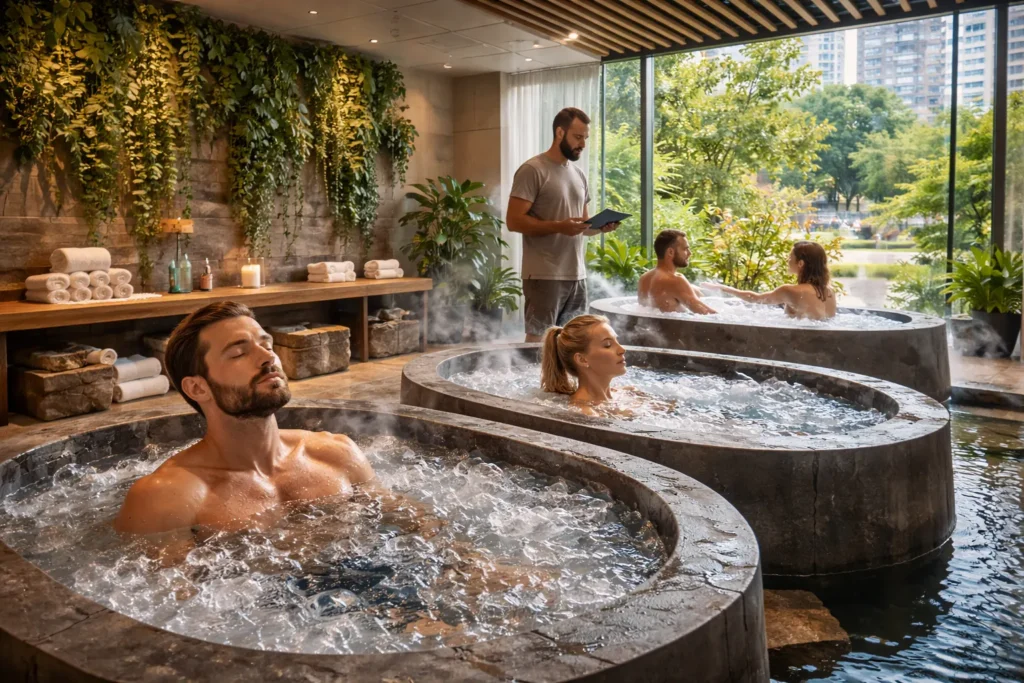
By 5:30, about fifteen people had gathered. They ranged in age from early twenties to late sixties. They wore bathrobes and flip-flops, carried water bottles, and laughed nervously like kids waiting for a scary roller coaster. Some stretched. Some sat in silence, eyes closed, breathing slowly. A few chatted quietly about their weekends, their kids, their jobs. Ordinary people, in other words. Teachers and truck drivers. Nurses and retired firefighters. Software engineers and construction workers.
One by one, they would step into steel tubs filled with water cranked down to 39 degrees. They would sit there, breathing, shivering, focusing, for three to five minutes. Then they would get out, skin bright red, eyes wide awake, and they would talk about how amazing it felt. Then they would wrap themselves in warm robes, drink hot tea, and head off to face their ordinary days with something extra: a quiet confidence that they had already done something hard before most people had even woken up.
Marcus, a 47-year-old construction foreman with a bad back and a stressful job, first came here six months ago on a dare from his daughter. “Dad, you’re always complaining about your back and your stress,” she said. “Just try it once.” He tried it once. Then he came back the next day. Then he bought a membership. Now he comes four times a week before sunrise, rain or shine, snow or sleet. He hasn’t missed a session in four months.
“I don’t fully understand why it works,” Marcus told me one morning, wrapping his robe tighter after his session. His skin was still pink, and a slight shiver ran through him as he talked. “I just know that when I get out of that water, my head is clear. My back doesn’t hurt for the rest of the day. I feel like I can handle anything. My wife says I’m nicer to be around. That’s enough for me.”
Marcus is not alone. Not even close.
All over the world, from New York to London to Sydney, from Tokyo to Cape Town to Vancouver, centers dedicated to cold-water therapy are opening at a staggering rate. In 2019, there were maybe fifty such centers in the entire United States. By 2024, that number had exploded past eight hundred. In the United Kingdom, the growth has been even more dramatic, with cold therapy studios opening in nearly every midsize city. Australia, always quick to embrace wellness trends, now has cold plunge centers in every capital city and dozens of coastal towns. Germany, never one to miss out on health innovations, has seen a proliferation of “Eisbaden” studios. Even in places you wouldn’t expect, like Singapore and Dubai, air-conditioned cold plunge rooms are drawing crowds willing to pay for the shock of artificial winter.
This isn’t just a handful of crazy people jumping into frozen lakes anymore. This is a movement. This is an industry. This is thousands of ordinary people paying good money to voluntarily submerge themselves in water that would make a polar bear think twice. According to industry reports, the global cold therapy market is now valued at well over $300 million and is projected to grow by double digits annually for the foreseeable future. Investment firms are pouring money into cold therapy chains. Real estate developers are designing apartment buildings with dedicated cold plunge rooms. Cruise ships are adding ice baths to their spas.
To understand why, we need to look at the science, the history, the culture, and the deeply human need that cold water seems to satisfy in a way that almost nothing else can. We need to understand what happens when body meets ice, when mind meets fear, and when modern humans rediscover an ancient practice that their ancestors took for granted. We need to explore the chemistry of cold, the psychology of discomfort, the economics of wellness, and the sociology of community. We need to hear from doctors and skeptics, from enthusiasts and researchers, from people who’ve been transformed and people who’ve been harmed.
So grab a warm blanket, settle into a comfortable chair, and let’s dive into the cold, strange, fascinating world of ice baths. By the time you finish this journey, you might just find yourself searching for the nearest cold therapy center. Or maybe you’ll just turn the shower to cold at the end of your next morning routine. Either way, you’ll never look at ice the same way again.
Part One: The First Plunge
Chapter One: A Shocking Start – My First Encounter with the Ice
Let me take you back to my own first experience, because I think it explains a lot about why this trend is spreading like wildfire. I was a skeptic. A proud skeptic. The kind of person who rolls their eyes at wellness trends and mutters about pseudoscience under their breath.
I had been writing about health and wellness for about seven years when my editor assigned me to cover the new cold therapy center that had opened downtown. I’ll be honest: I rolled my eyes. Another wellness fad. Another way for rich people to spend money feeling like they’re doing something hard. Another excuse for influencers to take photos of themselves looking stoic in ice water. I figured I’d go, take some notes, make some jokes, and write a mildly entertaining article about the latest trend that would fade away in six months.
I was wrong.
The center was called “Arctic Rise,” and from the outside, it looked like an Apple Store designed by someone who really liked the movie Frozen. Floor-to-ceiling windows, minimalist wood benches, soft lighting, and a receptionist who offered me herbal tea before my session. The whole place smelled like eucalyptus and clean linen. It was calm. Peaceful. Inviting. The kind of place where you expect to pay forty dollars for a small bottle of water.
Then they opened the door to the plunge room.
The temperature dropped about twenty degrees instantly. The air felt heavy and clean, like the inside of a walk-in freezer but without the frost. The room was lined with four large steel tubs, each one filled with water so clear you could see the bottom. No bubbles, no movement, just perfectly still water that looked almost solid. Steam wasn’t rising from them. Instead, a cold mist hovered just above the surface, curling and drifting like something out of a horror movie. The water temperature read 39 degrees Fahrenheit. For context, that’s colder than the water in the Arctic Ocean during summer. That’s barely above freezing. That’s the temperature at which water starts to feel less like a liquid and more like a threat.
My instructor, a calm woman named Lena with the serene smile of someone who has never been stressed a day in her life, explained the process. She had the kind of voice that made you want to listen, soft but firm, like a yoga teacher who could also kill you with her bare hands if she needed to.
“The first thirty seconds are the hardest,” she said. “Your body will scream at you to get out. Your brain will tell you this is dangerous. Just focus on your breathing. Slow, deep breaths. In through the nose, out through the mouth. The panic passes. I promise.”
I nodded, trying to look brave. Inside, I was already planning my escape. I could fake a phone call. I could claim a sudden family emergency. I could just walk out and never come back. Who would know? Who would care? The article could be about something else. About saunas, maybe. Saunas are nice. Warm. Comfortable. You don’t have to be brave to sit in a sauna.
But my pride wouldn’t let me. I had told my wife about this assignment. I had told my friends. I had written a social media post hinting at “an interesting wellness adventure.” Backing out now meant admitting defeat to hundreds of people. It meant being the guy who chickened out of the ice bath. And for some reason, that was worse than the ice bath itself.
So I took off my robe, wearing only swim trunks, and I stepped toward the tub. The floor was cold under my bare feet. The air was cold on my skin. The tub loomed in front of me like a portal to somewhere unpleasant.
The first touch was just my toes. The cold hit like an electric shock, shooting up my foot and into my ankle. I gasped. Lena reminded me to breathe. I lowered my foot to the floor of the tub. Then the other foot. Then I had to lower myself down, sitting, letting the water rise up my legs, my waist, my chest.
I have never experienced anything quite like that moment.
My body didn’t just feel cold. It felt attacked. Every nerve ending fired at once. My heart rate skyrocketed. My breath came in short, panicked gasps. My muscles tensed so hard they hurt. Every instinct screamed at me: GET OUT. THIS IS DANGER. FLEE. It was the same feeling you get when you touch a hot stove, that immediate, automatic, undeniable command to remove yourself from harm. Except I had chosen this. I had paid for this. And I had to stay.
But I remembered Lena’s words. I forced myself to take a deep breath. In through the nose. Out through the mouth. Another one. Another one. I focused on a spot on the wall, a small crack in the paint, and I just breathed. In. Out. In. Out. The crack became my whole world. I studied its shape, its length, the way it branched like a tiny river. I breathed.
After about sixty seconds, something shifted.
It wasn’t that the water got warmer. It didn’t. It was still painfully cold. But my panic receded. My breathing slowed. My muscles relaxed, just a little. The screaming in my brain quieted to a dull murmur. I was still uncomfortable, still cold, but I was no longer afraid. I had crossed some kind of threshold, passed through a door that only opened one way. On the other side was something like acceptance, or maybe resignation, or maybe just the understanding that I could survive this.
I sat there for three minutes total. When Lena gave me the signal, I stood up slowly, water cascading off my skin, and stepped out into the warm air of the room.
The feeling that followed is hard to describe.
My skin was bright red, almost purple in places. I was shivering uncontrollably, my whole body shaking like a washing machine on spin cycle. But my mind felt… clear. Not relaxed, exactly, but sharp. Focused. Alive. The mental fog that usually follows me around for the first hour of the morning was completely gone. I felt like I had just run a marathon and meditated for an hour at the same time. I felt like I had taken the strongest cup of coffee ever brewed and injected it directly into my brain.
As I stood there, wrapped in a towel, sipping warm tea, I understood something important. This wasn’t just a fad. This was a real experience, a genuine shift in how a person can feel. And I knew, even as I shivered and shook, that I would be back. Not because I had to for the article, but because I wanted to. Because that feeling, that strange combination of suffering and euphoria, was addictive in a way I hadn’t expected.
That feeling, that rush, that strange combination of suffering and euphoria, is the exact reason these centers are booming. It’s the reason people like Marcus drive through the dark morning to sit in ice water. It’s the reason millions of people around the world are discovering that cold water might be the most powerful wellness tool they never knew they needed.
Chapter Two: The Morning After – Why I Couldn’t Stop Thinking About the Cold
The day after my first plunge, something strange happened. I woke up at 6:00 AM without an alarm. This never happens. I am not a morning person. I have fought with alarms my entire adult life, snoozing them, ignoring them, sometimes throwing them across the room. But that morning, my eyes opened at 6:00 sharp, and I felt… awake. Not groggy, not reluctant, just awake.
I lay there for a moment, puzzled. Then I remembered the cold water. I remembered the shock, the panic, the strange calm. And I remembered the feeling afterward, that electric clarity that had lasted for hours. Could it still be affecting me? Could one three-minute plunge have changed something fundamental about my sleep or my brain chemistry?
I started reading. I read scientific studies. I read blog posts from enthusiasts. I read interviews with researchers. I read books by Wim Hof, the Dutch extreme athlete who has popularized cold exposure more than anyone else. I read about the Finnish sauna culture and the Russian banya and the Japanese misogi practices. I read about the Spartans and the Romans and the Native Americans.
The more I read, the more I realized that my experience wasn’t unique. It wasn’t even unusual. It was exactly what happens when humans encounter extreme cold. And humans have been encountering extreme cold for a very, very long time.
Part Two: The History of Cold
Chapter Three: From Ancient Warriors to Frozen Lakes – A Deep History of Getting Cold
To understand why we’re seeing this explosion of cold therapy centers, we need to look backward. Way, way backward. Because humans have been subjecting themselves to cold water for a very, very long time. It’s not a new idea. It’s not even a rediscovered idea. It’s an idea that never went away in some parts of the world, and it’s only now re-entering the mainstream in places where comfort has become the default.
Let’s start with the Spartans.
You’ve probably heard stories about Spartan warriors being tough. The legend says they didn’t build walls around their cities because their men were the walls. But what you might not know is that they believed cold baths were essential to building that toughness. Spartan boys were bathed in cold river water from infancy. They were encouraged to endure cold, hunger, and pain as a way of forging character. For the Spartans, cold water wasn’t about wellness. It was about warfare. It was about creating men who wouldn’t break when things got hard. It was about building a psychological resilience that would serve them in battle, when the enemy was charging and death was near and panic would mean death.
The philosopher Plato, who lived in Athens and was no fan of the Spartans, nonetheless admired their toughness. He wrote about how Spartan children were raised without the comforts that Athenian children enjoyed. They wore minimal clothing even in winter. They slept on beds made of reeds they gathered themselves. They bathed in cold rivers. And they grew into adults who could endure what others could not.
Jump forward a few thousand years to Finland.
The Finns have been doing something called “sauna culture” for at least two thousand years, probably longer. The traditional practice involves heating up a small wooden room until it’s unbearably hot, often reaching temperatures of 200 degrees Fahrenheit or more, sweating profusely, and then running outside to jump into a freezing lake or roll in the snow. Then you go back into the sauna. Then back into the cold. Back and forth, sometimes for hours.
For the Finns, this wasn’t a trendy wellness practice. It was just life. It was how you cleaned yourself before modern plumbing. It was how you socialized with neighbors. It was how you stayed healthy through long, dark winters when sunlight was scarce and illness was common. It was how you connected with nature and with your community. It was woven into the fabric of everyday existence.
Today, there are over three million saunas in Finland. That’s one sauna for every two people. In a country of five and a half million, nearly everyone grows up with hot-cold contrast therapy as a normal part of existence. Finnish babies are often taken into the sauna with their parents. Finnish children learn to run from the hot room to the cold lake before they learn to ride a bike. Finnish adults continue the practice throughout their lives, often gathering with friends and family for weekly sauna sessions that last for hours and include multiple cold plunges.
The Russians have similar traditions. The “banya” is their version of the sauna, often followed by plunging into cold water or being beaten with venik, which are bundles of leafy birch branches, to improve circulation. The banya is central to Russian culture. It’s where business deals are made, where friendships are cemented, where families gather. There’s even a Russian proverb: “The banya cleanses everything.” And the cold plunge after the banya is considered essential, the thing that completes the experience and delivers the full benefits.
The Japanese have “misogi,” a Shinto purification practice that involves standing under freezing waterfalls. This is not a quick dip. Practitioners stand under the falling water for minutes at a time, often in the middle of winter, as a form of spiritual training. The water is cold enough to numb the skin and steal the breath. The practice is meant to purify the spirit, to wash away impurities, to connect the practitioner with something larger than themselves. It’s been done for centuries and is still practiced today by everyone from monks to ordinary people seeking a deeper connection to their traditions.
The Native American sweat lodge ceremonies often end with a plunge into cold water. The sweat lodge, a small, dark structure where water is poured over hot rocks to create steam, is a place of prayer and purification. After hours of intense heat and ceremony, participants emerge and plunge into cold water, often a river or stream. The contrast is seen as completing the cycle of purification, washing away what the heat has released.
The ancient Romans had frigidariums, cold pools in their elaborate bath houses, which they would enter after spending time in hot rooms and warm rooms. The Roman baths were social centers, places where people gathered to exercise, relax, and conduct business. The frigidarium was the final stop, the cold plunge that closed the pores and invigorated the body after the heat. Roman writers like Seneca described the practice in detail, noting both the shock and the subsequent feeling of well-being.
Cold water therapy, in other words, is about as old as human civilization itself. Every culture that experienced winter, that had access to cold water, seems to have developed some form of cold immersion practice. It’s not a modern invention. It’s not a marketing gimmick. It’s a deeply human response to the environment, a way of using what’s available to improve health, build resilience, and connect with community.
So what changed? Why did it fade away for so long in many parts of the world, and why is it coming back now with such force?
The answer lies in something called the “urbanization of discomfort.”
For most of human history, discomfort was unavoidable. If you wanted to eat, you had to hunt or farm, which meant physical labor in all weather conditions. If you wanted to be warm in winter, you had to chop wood and build fires, which meant more physical labor. If you wanted to travel, you had to walk or ride horses in rain and snow and heat, which meant enduring the elements. If you wanted clean water, you had to carry it from the well or the river. Discomfort was woven into the fabric of daily life. You couldn’t escape it even if you wanted to.
Then came the twentieth century. Central heating. Air conditioning. Cars with heated seats and climate control. Office jobs where you sit in a temperature-regulated room for eight hours. Food delivered to your door. Entertainment streamed to your couch. Groceries delivered by apps. Social interactions conducted through screens. For the first time in human history, millions of people could go through entire days, even entire weeks, without ever being truly uncomfortable. Without ever being truly cold. Without ever being truly hot. Without ever being truly hungry. Without ever being truly physically challenged.
That’s a miracle, in many ways. It’s progress. It’s wonderful. It’s freed us from the constant struggle for survival that occupied our ancestors. It’s given us time to read, to think, to create, to connect in ways they never could.
But some experts believe we lost something along the way. We lost the small doses of stress that our bodies evolved to handle. We lost the feeling of pushing through difficulty and coming out stronger on the other side. We lost the connection between effort and reward. We lost the signal that tells our bodies and minds, “You are capable. You are strong. You can handle hard things.”
Enter the cold plunge.
When you step into 39-degree water, you cannot hide from discomfort. You cannot distract yourself with your phone or numb yourself with Netflix. You cannot delegate the experience to someone else. You are right there, in your body, feeling something intensely real. You are facing a challenge that is immediate and undeniable. And when you get out, you feel a sense of accomplishment that no amount of comfort can provide.
The science caught up with this intuition in the last twenty years. Researchers in Europe, particularly in the Netherlands and Scandinavia, started studying cold exposure with modern tools. They put people in cold water and measured their hormones, their immune markers, their brain activity, their heart rate variability, their sleep patterns. They found evidence that supported what the Spartans and Finns and Russians and Japanese had known all along: cold water triggers real, measurable changes in your body and brain.
When this science hit social media, combined with stories from athletes like Wim Hof, the famous “Iceman” who popularized cold exposure through his record-breaking feats and his accessible teaching methods, and combined with influencers who documented their plunges for millions of followers, the cold plunge moved from a niche hobby to a mainstream must-try.
Today, you can’t scroll through Instagram or TikTok without seeing someone in an ice bath, grinning through chattering teeth, telling you how amazing they feel. The ancient practice has become a modern phenomenon. And it’s only getting bigger.
Chapter Four: The Iceman Cometh – How Wim Hof Sparked a Global Movement
No discussion of modern cold therapy would be complete without talking about Wim Hof. He is, more than anyone else, responsible for bringing cold exposure into the mainstream. His story is worth telling because it explains so much about why we’re here.
Wim Hof is a Dutch man born in 1959. He’s not a scientist or a doctor or a trained researcher. He’s just a guy who discovered, seemingly by accident, that he could tolerate extreme cold better than almost anyone on earth. He started experimenting with cold exposure as a young man, taking cold showers and eventually moving on to ice baths and frozen lakes. He found that he could stay in cold water for astonishingly long periods without suffering the ill effects that would fell most people.
Over the years, Hof has set numerous world records. He’s run a marathon barefoot above the Arctic Circle. He’s climbed Mount Kilimanjaro in shorts. He’s stood in a container while completely submerged in ice for nearly two hours. He’s swum under ice for long distances. He’s done things that seem to defy human biology.
But Hof’s real contribution isn’t his record-breaking. It’s his willingness to share what he’s learned and to submit himself to scientific study. In the early 2000s, researchers began studying Hof to understand how he does what he does. They hooked him up to monitors, drew his blood, measured his brain activity, and tried to figure out if he was a genetic freak or if his abilities could be learned.
What they found was remarkable. Hof had developed a method of breathing and cold exposure that seemed to give him conscious control over his autonomic nervous system. He could influence his heart rate, his stress hormones, his immune response. In one famous study, Hof was injected with an endotoxin that causes flu-like symptoms in most people. He showed almost no reaction. His body, through some combination of breathing and cold training, had learned to suppress the inflammatory response.
This was huge. It suggested that the autonomic nervous system, long thought to be beyond conscious control, might be trainable. It suggested that ordinary people might be able to learn some of what Hof could do.
Hof began teaching his method: a combination of specific breathing exercises, cold exposure, and mindset training. He traveled the world, leading workshops and retreats. He wrote books. He appeared on podcasts and TV shows. His message was simple and powerful: You are stronger than you think. You can learn to control your body and mind. The cold is a teacher.
The Wim Hof Method spread rapidly. Millions of people tried his breathing exercises. Millions more started taking cold showers. Cold exposure went from a fringe practice to a global phenomenon. And entrepreneurs noticed.
If millions of people wanted to do cold exposure, and if doing it safely and effectively required some equipment and guidance, then there was a business opportunity. Cold therapy centers began opening, often with direct inspiration from Hof’s work. They offered guided sessions, proper equipment, and community. They made cold exposure accessible to people who didn’t have a frozen lake in their backyard.
Today, Hof is in his sixties and still teaching. His influence can be seen in almost every cold therapy center in the world. The breathing techniques they teach, the approach to mindset, the emphasis on gradual progression—all of it bears his imprint. He didn’t invent cold exposure, but he did reinvent it for the modern world.
Part Three: The Science of Cold
Chapter Five: What Actually Happens to Your Body? The Deep Dive into Biology
Let’s get into the weeds a little bit. What actually happens when you step into freezing water? It’s not magic. It’s biology. It’s chemistry. It’s physics. And once you understand the biology, the whole trend makes a lot more sense.
When your body hits cold water, it goes through a series of predictable responses. Think of it like flipping a series of switches on your body’s control panel. These switches are ancient, evolved over millions of years to keep you alive in dangerous situations. They’re the same switches that would have saved your ancestors if they fell through ice into a frozen lake. And now they’re being flipped on purpose, by choice, for reasons those ancestors could never have imagined.
Switch One: Cold Shock Response
This happens in the first ten to thirty seconds. Your body doesn’t know you’re doing this on purpose. It thinks you’ve fallen through ice into a frozen lake. So it triggers an emergency protocol that has been honed by evolution over millions of years.
Your blood vessels near the skin squeeze tight. This is called vasoconstriction. It’s your body’s way of preserving heat by pushing blood away from the surface, where it would cool quickly, and toward your vital organs—your heart, lungs, brain—where it’s needed most. Your skin turns pale, then red as the blood vessels reopen in a chaotic pattern.
Your heart rate spikes. In some people, it can double or even triple in seconds. Your heart pounds against your ribs like it’s trying to escape.
Your breathing becomes rapid and shallow. In fact, you’ll often gasp involuntarily when you first hit the water. This is the “cold shock” that can be dangerous if you’re not prepared, especially if you’re in deep water where gasping could make you inhale water. The gasp is involuntary, automatic, impossible to suppress. It’s your body’s way of trying to get as much oxygen as possible before whatever is happening gets worse.
Your muscles tense. Every muscle in your body contracts, preparing for action. This is why people in cold water often curl up, their bodies trying to reduce surface area and conserve heat.
This is also why controlled breathing is so important. If you can force yourself to take slow, deep breaths despite your body’s panic, you override the emergency protocol. You tell your body, “I’m okay. I chose this. We’re in control.” It’s like talking a panicking friend down from a ledge. You’re the rational part, and your body is the panicking part. The breath is your tool for communication.
Switch Two: Hormone Flood
Once you get past the initial shock, assuming you’ve managed your breathing and stayed in the water, your brain releases a flood of hormones and neurotransmitters. This is your body’s way of helping you cope with the stress you’re experiencing. The main players here are:
- Adrenaline: This is the classic fight-or-flight hormone. It makes you alert, focused, and ready for action. It increases your heart rate, dilates your airways, and mobilizes energy stores. It’s why you feel so awake and sharp after a cold plunge. It’s also why your hands might shake a little afterward. That’s adrenaline wearing off.
- Norepinephrine: This is a big one. Norepinephrine is both a hormone and a neurotransmitter. It’s involved in attention, focus, mood regulation, and the body’s stress response. Studies have shown that cold water immersion can boost norepinephrine levels by 200 to 300 percent. For context, this is similar to the effect of some prescription antidepressants, though through a different mechanism. It’s like nature’s own focus drug, released in response to cold.
- Dopamine: This is the “reward” chemical. It’s what makes you feel good when you accomplish something, when you eat something delicious, when you connect with someone you love. Cold water triggers a prolonged dopamine release that can last for hours after you get out. This is why people often feel euphoric and motivated after a plunge. It’s not just in their heads. Their brains are literally bathing in reward chemicals.
- Endorphins: These are your body’s natural painkillers. They’re released in response to stress and discomfort, and they help dull the pain. They’re what allow soldiers to keep fighting even when wounded, what allow athletes to push through exhaustion. In the cold plunge, they help take the edge off the discomfort and contribute to that floaty, peaceful feeling that often follows.
Switch Three: Metabolic Fire
Your body has to work hard to stay warm. It starts burning energy, mostly from fat stores, to generate heat. This process, called thermogenesis, can boost your metabolism significantly.
There are two types of fat in your body: white fat, which stores energy, and brown fat, which burns energy to create heat. Brown fat is like a metabolic furnace. When you get cold, your body activates brown fat and starts burning through energy to keep you warm. Some research suggests that regular cold exposure can increase both the amount and activity of brown fat in your body.
This is why you feel hungry after a cold plunge. Your body has burned through some of its energy reserves and wants you to replenish them. It’s also why some people use cold exposure as part of weight management strategies, though the effects are modest compared to diet and exercise.
Switch Four: Immune System Activation
This is one of the most fascinating areas of cold therapy research. Several studies have shown that people who regularly do cold water immersion get sick less often. The theory is that the cold stress gives your immune system a “practice run.”
When you get cold, your body mobilizes its defenses. It increases the production of white blood cells and other immune markers. It’s like sending the troops out for a drill. When a real pathogen shows up, the system is already primed and ready to respond.
One famous study from the Netherlands, which we’ll discuss in more detail later, found that people who did cold showers and breathing exercises had fewer sick days from work compared to a control group. The difference wasn’t huge, but it was statistically significant. More research is needed, but the early evidence is promising.
Switch Five: The Afterglow (Vasodilation)
When you get out of the cold water and start warming up, something interesting happens. The blood vessels that squeezed tight during the plunge now open wide. This is called vasodilation. Warm, oxygenated blood rushes back to your arms and legs.
This rush of blood has a couple of effects. First, it helps flush out metabolic waste products from your muscles. This is why athletes use cold therapy for recovery. The combination of vasoconstriction during the plunge and vasodilation afterward acts like a pump, moving fluid through your tissues and clearing out the debris that accumulates during exercise.
Second, it creates a feeling of warmth and well-being that can last for hours. It’s like your whole body is taking a deep breath after holding it for a long time. This is the “afterglow” that so many plungers describe, that peaceful, contented feeling that follows the intensity.
Switch Six: Nervous System Reset
This is perhaps the most profound effect, and the hardest to measure. Your autonomic nervous system has two main branches: the sympathetic (fight or flight) and the parasympathetic (rest and digest). Most of us in the modern world spend too much time in sympathetic mode, stressed and alert, even when there’s no actual danger.
Cold water immersion, if done correctly, can help reset this balance. The intense stress of the cold forces your sympathetic nervous system to activate fully. But then, as you breathe through it and stay calm, your parasympathetic system kicks in to counterbalance. When you get out, many people report feeling deeply relaxed, as if their nervous system has been recalibrated.
This is why cold plunges can be helpful for anxiety. They’re like a hard reset for your stress response. They show your body what real stress feels like, and in comparison, the everyday stresses of work and traffic and email seem less significant.
All of these switches together create a unique experience. You get the intensity of the cold shock, the mental clarity of the hormone flood, the physical activation of the metabolic response, the immune boost of the cellular mobilization, and the peaceful afterglow of the recovery phase. It’s a complete mind-body workout compressed into just a few minutes.
Chapter Six: The Chemistry of Cold – A Deeper Look at What’s Flowing Through Your Veins
Let’s go deeper into the chemistry, because understanding what’s actually happening in your body can help you appreciate why cold therapy feels the way it does.
Norepinephrine: The Focus Molecule
Norepinephrine is synthesized from dopamine in your brain and nervous system. It’s chemically similar to adrenaline, but its effects are somewhat different. While adrenaline is about immediate action, norepinephrine is about sustained attention and focus.
When norepinephrine levels rise, several things happen. Your pupils dilate slightly, letting in more light. Your attention narrows, focusing on what’s important and filtering out distractions. Your working memory improves. Your ability to process information quickly increases. You become, in essence, sharper.
The 200 to 300 percent increase from cold water is significant. For comparison, prescription stimulants like Ritalin increase norepinephrine by a similar amount. But cold water does it naturally, without the side effects and without the risk of dependence. It’s like a performance-enhancing drug that’s also completely legal and free (if you have access to cold water).
Dopamine: The Reward Molecule
Dopamine is often called the “pleasure chemical,” but that’s not quite right. Dopamine is more about motivation and reward-seeking than about pleasure itself. It’s the chemical that makes you want things, that drives you to pursue goals, that gives you a sense of satisfaction when you achieve something.
Cold water triggers a prolonged dopamine release. Unlike the quick spike you get from sugar or social media, the dopamine from cold exposure is sustained, lasting for hours. This is why people often feel motivated and positive after a plunge. Their brains are literally primed to seek rewards and feel good about effort.
One study measured dopamine levels in cold water swimmers and found that they remained elevated for several hours after the swim. The participants reported feeling more motivated, more energetic, and more positive during that time. It’s like a natural, sustained mood boost.
Endorphins: The Pain Killers
Endorphins are your body’s internal opioids. They bind to the same receptors as drugs like morphine, producing pain relief and feelings of euphoria. They’re released in response to stress and pain, and they help you push through discomfort.
In cold water, endorphins are released to help you cope with the intense sensation. This is why, after the initial shock, you might start to feel almost comfortable, or at least less uncomfortable. The endorphins are doing their job, dulling the edges of the experience.
The endorphin rush also contributes to the “plunger’s high” that some people describe. It’s similar to a runner’s high, that floaty, peaceful feeling that comes after intense exertion.
Cortisol: The Stress Hormone
Cortisol gets a bad reputation, but it’s essential for life. It helps regulate metabolism, reduce inflammation, and control your sleep-wake cycle. Problems arise when cortisol levels are chronically elevated, which happens with ongoing stress.
Cold water causes a temporary spike in cortisol, which is part of the stress response. But interestingly, regular cold exposure seems to lead to lower baseline cortisol levels over time. Your body becomes more efficient at handling stress, so it doesn’t need to keep cortisol levels high all the time.
This is another example of hormesis, the principle that small doses of stress can make you stronger. The temporary spike in cortisol from cold water trains your system to respond more appropriately to stress, leading to lower overall levels when you’re not in the water.
Inflammatory Markers
Inflammation is a hot topic in health, and for good reason. Chronic inflammation is linked to almost every major disease: heart disease, diabetes, Alzheimer’s, arthritis, and more. Anything that reduces inflammation is potentially valuable.
Cold water immersion appears to reduce inflammatory markers in the blood. One study found that regular cold swimmers had lower levels of C-reactive protein, a key marker of inflammation. Another study found that cold exposure reduced the inflammatory response to simulated infection.
The mechanism isn’t fully understood, but it probably involves the combination of vasoconstriction, vasodilation, and the release of anti-inflammatory compounds. The cold acts as a temporary anti-inflammatory, and regular exposure seems to have cumulative effects.
Chapter Seven: Claimed Benefits – What the Science Actually Says
Walk into any cold therapy center, and they’ll hand you a brochure listing benefits that sound almost too good to be true. Improved mood, faster recovery, stronger immunity, better focus, deeper sleep, reduced inflammation, increased willpower, and on and on. It’s a long list, and it’s easy to be skeptical.
Are these claims real? Partly. Science is still catching up to the anecdotes, but here’s what we know so far about the most commonly reported benefits, with a careful look at the evidence.
Mental Resilience and Mood
This is the number one reason people keep coming back. That feeling of conquering the cold, of doing something genuinely hard, gives you a mental boost that transfers to the rest of your life.
Think about it. If you can sit in freezing water for three minutes, a difficult email from your boss doesn’t seem so scary. If you can control your breathing when your body is screaming at you to panic, you can control your breathing when you’re stuck in traffic. The cold plunge is like a gym workout for your willpower. It strengthens your ability to handle stress.
The mood boost is also real. The rush of endorphins and norepinephrine acts as a natural antidepressant for many people. I’ve talked to dozens of regular plungers, and nearly all of them say the same thing: “It’s better than any medication I’ve ever tried for my mood.” That doesn’t mean you should throw away your prescriptions. But it does suggest that cold therapy can be a powerful complementary practice for mental health.
The research backs this up. A 2008 study found that cold water swimming significantly reduced tension and fatigue and improved mood in participants. A 2018 case study followed a 24-year-old woman with severe anxiety and depression who took up weekly cold water swimming. Her symptoms improved dramatically, and she was able to reduce her medication. While case studies aren’t proof, they’re suggestive.
Faster Muscle Recovery
If you’ve ever run a marathon, played a tough soccer game, or had a brutal leg day at the gym, you know about soreness. Delayed onset muscle soreness (DOMS) can make walking down stairs feel like torture. It can last for days and interfere with your ability to train.
Cold water helps. The vasoconstriction reduces blood flow to the muscles, which can decrease swelling and inflammation. It also slows down metabolic activity in the tissues, which may reduce the damage from intense exercise. When you warm up afterward, the rush of fresh blood helps clear out waste products like lactic acid and delivers oxygen and nutrients to help repair the muscle fibers.
This is why you see professional athletes sitting in ice baths after games. LeBron James does it. Cristiano Ronaldo does it. Olympic swimmers do it. The evidence for recovery is strong enough that cold therapy is now standard practice in professional sports.
A meta-analysis published in the Journal of Sports Sciences reviewed 17 studies on cold water immersion for recovery. The researchers concluded that cold water immersion was effective at reducing muscle soreness and speeding recovery compared to passive recovery or other interventions. The effect was modest but consistent across studies.
A Stronger Immune System
We touched on this earlier, but it’s worth exploring in more depth. The idea that cold exposure can boost immunity has been around for centuries, but modern science is starting to catch up.
A 2016 study published in the journal PLOS One looked at whether regular cold showers could reduce sickness. The researchers divided three thousand participants into groups. One group took a regular warm shower. Another group ended their warm shower with thirty seconds of cold water. A third group did sixty seconds of cold, and a fourth did ninety seconds.
The results were striking. The groups that did cold showers had a 29 percent reduction in sickness absence from work compared to the warm shower group. The people who did cold showers didn’t necessarily get sick less often, but when they did get sick, their symptoms were milder and they recovered faster.
The researchers theorized that the cold exposure activated the immune system, making it more efficient at fighting off invaders. It’s like sending your immune cells to boot camp so they’re ready when a real battle comes.
Another study looked at elite athletes, who are known to be susceptible to upper respiratory infections due to the stress of intense training. The researchers found that those who did regular cold water immersion had fewer infections and faster recovery times. Again, the evidence is suggestive rather than conclusive, but it’s consistent.
Better Focus and Mental Clarity
In a world of constant notifications, endless scrolling, and attention fragmentation, the ability to focus is like gold. Cold plunges seem to help with this in two ways.
First, the intense focus required to sit in cold water trains your brain to concentrate. You can’t think about your email or your to-do list. You have to focus on your breath, on the sensation, on staying calm. This is a form of meditation, really. It’s mindfulness practice with a sharp edge. It’s meditation you can’t escape from, because if you stop focusing, the panic returns.
Second, the neurochemical changes we discussed earlier—the norepinephrine boost, the dopamine release—create a brain state that’s optimized for focus. For several hours after a plunge, many people report feeling sharper, more alert, and more capable of deep work. They can sit down and concentrate without the usual struggle.
A 2019 study measured cognitive performance after cold water immersion and found improvements in attention and working memory. The effects lasted for at least an hour after the plunge. This matches what plungers report: a window of enhanced cognitive function that makes the rest of the day more productive.
Reduced Inflammation Throughout the Body
Inflammation is a hot topic in health these days. Chronic inflammation is linked to almost every major disease: heart disease, diabetes, Alzheimer’s, arthritis, and more. Anything that reduces inflammation is potentially valuable.
Cold water immersion is a powerful anti-inflammatory. The vasoconstriction and subsequent vasodilation act like a pump, moving fluid through your tissues and helping to clear out inflammatory markers. Some research suggests that regular cold exposure can lower levels of C-reactive protein, a key marker of inflammation in the blood.
This doesn’t mean cold plunges will cure arthritis or prevent heart disease on their own. But as part of a healthy lifestyle, the anti-inflammatory effects are a real benefit. One study of cold water swimmers found they had lower levels of inflammatory markers compared to non-swimmers, even when matched for age and activity level.
Better Sleep
This one is interesting. You might think that shocking your system with cold water would make you more alert and mess up your sleep. But many regular plungers report sleeping more deeply and waking up fewer times during the night.
The mechanism isn’t fully understood, but it probably has to do with the body’s temperature regulation. Your body temperature naturally drops at night as part of the sleep-wake cycle. Cold exposure during the day might help train your body’s temperature regulation system, making that nighttime drop more efficient. Also, the reduction in stress and anxiety from regular plunges can help quiet the racing mind that keeps so many people awake.
A small study from 2020 found that cold water immersion improved sleep quality in participants, particularly in the deep sleep stages. More research is needed, but the anecdotal evidence is strong. Many plungers report that they fall asleep faster and stay asleep longer on days they plunge.
Increased Willpower and Self-Discipline
This might be the most important benefit of all. Doing something hard, something that most people won’t do, changes how you see yourself. You become the kind of person who does hard things. That identity shift ripples into every area of your life.
I’ve heard this from dozens of plungers. They start with cold water, and then they find themselves making better food choices. Then they start exercising more consistently. Then they tackle a project they’ve been putting off for years. The cold plunge becomes a keystone habit, a small win that makes other wins possible.
This isn’t just wishful thinking. Research on habit formation shows that small successes can build momentum. When you prove to yourself that you can do something difficult, you’re more likely to believe you can do other difficult things. The cold plunge is a daily reminder that you’re capable, that you’re strong, that you’re the kind of person who follows through.
Social Connection
This benefit is often overlooked, but it’s real. Cold plunging, especially in a center, is often a social activity. You do it with others. You talk about it afterward. You share the experience. In a world where loneliness is epidemic, this matters.
Many plungers report that their cold therapy center has become a community. They’ve made friends there. They support each other. They check in when someone misses a session. It’s a tribe, bonded by a shared challenge.
Research on social connection shows that it’s one of the strongest predictors of health and happiness. People with strong social ties live longer, have better immune function, and report higher life satisfaction. If cold plunging facilitates social connection, that alone is a significant benefit.
Part Four: The Centers
Chapter Eight: Why Centers? The Gym Effect and the Rise of Professional Plunging
So if cold water is so great, why not just fill your bathtub with ice at home? Why pay forty dollars for a session at a center? Why drive across town in the dark when you could do it in your own bathroom?
It’s a fair question. And the answer tells us a lot about why this trend is growing the way it is, and why it’s likely to keep growing.
Think about weightlifting. You could absolutely buy a set of dumbbells and work out in your garage. Millions of people do exactly that. They get strong, they get fit, they achieve their goals without ever setting foot in a commercial gym. It’s completely possible.
But most people prefer going to a gym. Why? Because the gym has better equipment, professional trainers, a motivating atmosphere, and a community of people doing the same thing. The gym makes it easier to stick with it. The gym provides structure, accountability, and expertise. The gym turns exercise from a chore into a social experience.
Cold therapy centers offer the same advantages. They’re the gyms of cold exposure.
Safety and Supervision First
This is the biggest one, and it can’t be overstated. Cold water immersion, done wrong, can be dangerous. If you hyperventilate from the shock, you could pass out. If you stay in too long, you could get hypothermia. If you have an undiagnosed heart condition, the cold shock could trigger a cardiac event. If you panic and thrash, you could injure yourself.
Centers eliminate these risks. They have trained staff watching you the entire time. They monitor your breathing, your skin color, your level of consciousness. They know exactly how long you should stay in based on your experience level and the water temperature. They have protocols for warming you up safely afterward. They’ve seen hundreds or thousands of plunges and know the signs of trouble.
It’s like the difference between lifting weights alone in your basement and lifting with a spotter who knows what they’re doing. You can do it alone, but it’s safer with help.
The Right Equipment
Getting water cold enough for therapeutic benefits requires serious equipment. Industrial-grade chillers can cost tens of thousands of dollars. They need to be maintained, filtered, and cleaned regularly. The water needs to be tested for bacteria and treated to keep it safe. The tubs themselves need to be designed for easy entry and exit, with non-slip surfaces and comfortable edges.
At home, you’re looking at buying bags of ice every day, which gets expensive and annoying fast. A typical ice bath might require 50 to 100 pounds of ice to get down to therapeutic temperatures. That’s dozens of bags, costing twenty dollars or more per session. Over time, that adds up to more than a center membership.
Or you’re buying a cheap inflatable tub and hoping it stays cold enough. Those tubs are often flimsy, hard to clean, and difficult to get in and out of safely. They’re a poor substitute for professional equipment.
The centers have done the hard work for you. They’ve invested in the infrastructure. They maintain it daily. You just show up and get in.
Cleanliness and Comfort
Cold plunge pools, like hot tubs, can be breeding grounds for bacteria if they’re not maintained properly. The combination of warm bodies and standing water is perfect for microbial growth. Without proper sanitation, you’re risking skin infections, urinary tract infections, and worse.
Centers have professional filtration and sanitation systems. They use UV light, ozone, chlorine, or other methods to keep the water clean. They test the water regularly and maintain logs. They have protocols for cleaning between users. The water is as clean as, or cleaner than, a public swimming pool.
Plus, they offer amenities that make the experience better. Warm robes so you’re not shivering on the way to the tub. Showers with good water pressure and plenty of hot water. Saunas for contrast therapy. Comfortable lounges with tea and coffee. Locker rooms with space to change. It’s a luxury experience, not just a bucket of ice water in your backyard.
Community and Accountability
This might be the most powerful factor. Humans are social creatures. We do things together that we struggle to do alone. We show up for others in ways we don’t show up for ourselves. We’re motivated by belonging, by connection, by the feeling of being part of something.
When you join a cold therapy center, you become part of a community. You see the same faces every morning. You nod to each other. You might chat afterward about how the plunge felt. You might make plans to grab coffee. You develop a sense of belonging. You have people who notice if you’re not there.
And you develop accountability. It’s easy to skip your home ice bath on a cold morning. The bed is warm, the ice is a hassle, and nobody will know. It’s much harder to skip when you know your plunge buddies will be there, when they’ll ask where you were, when you’ve paid for a membership and committed to a schedule. The center creates structure around the practice, and structure leads to consistency.
Guidance and Education
Most centers offer more than just a cold tub. They offer education. They teach you breathing techniques. They explain the science. They help you progress safely from shorter to longer plunges. Some offer workshops on cold exposure, breathwork, and mindset training. Others bring in guest speakers or host events.
This guidance is invaluable, especially for beginners. It turns a potentially scary experience into a structured, understandable practice. You learn why you’re doing what you’re doing. You learn how to do it better. You learn what to expect and how to handle it.
Many centers also offer personalized coaching. They’ll work with you one-on-one to develop a protocol that fits your goals and your tolerance. They’ll track your progress and adjust as needed. This level of support is hard to replicate at home.
The Social Media Factor
Let’s be honest: the aesthetics matter. Cold therapy centers are designed to look good. They have clean lines, good lighting, photogenic spaces. The water is clear and inviting. The tubs are sleek and modern. The whole environment is Instagram-worthy.
People take pictures. They post them on social media. They tag the center. The centers get free marketing, and the users get social proof that they’re doing something cool and healthy. It’s a virtuous cycle that drives more people to try it.
This isn’t necessarily shallow. There’s something powerful about being part of a visible movement, about seeing others like you doing the same thing. Social media creates a sense that this is normal, that this is something people like you do. That normalizing effect drives more people to try it, which normalizes it further.
The Business Case
From the entrepreneur’s perspective, cold therapy centers make good business sense. The equipment costs are significant but one-time. The ongoing costs are relatively low: water, electricity, cleaning supplies, staff. Memberships provide recurring revenue. Classes and workshops add additional income streams. Retail sales of related products (towels, robes, supplements) boost margins.
Many centers are profitable within their first year. Chains are expanding rapidly. Investment money is flowing in. It’s a growth industry, and it shows no signs of slowing.
Chapter Nine: A Tour of the World’s Best Cold Therapy Centers
Let’s take a virtual tour of some of the most notable cold therapy centers around the world. Each has its own vibe, its own approach, its own community.
Arctic Rise – New York City
This is where I had my first plunge. It’s sleek, modern, and minimalist, with floor-to-ceiling windows overlooking the city. The water is kept at a consistent 39 degrees, filtered through a multi-stage system that includes UV light and ozone. The staff are knowledgeable and calm, the kind of people who make you feel safe even when you’re panicking.
Arctic Rise offers a range of services beyond the basic plunge. They have breathwork classes, where you learn the techniques that make cold exposure manageable. They have workshops on mindset and resilience. They have community events where plungers gather to share experiences. They even have a small cafe serving warm drinks and healthy snacks for after your session.
Membership is expensive by normal standards, but reasonable for New York: about $150 per month for unlimited plunges. Drop-in sessions are $40. They’re almost always busy, especially in the early morning and evening hours.
The Ice House – London
London’s cold therapy scene is thriving, and The Ice House is one of the best. Located in a converted warehouse in Shoreditch, it has a gritty, industrial vibe that fits the neighborhood. Exposed brick, steel beams, concrete floors. The plunge tubs are repurposed industrial tanks, sanded smooth and fitted with wooden benches.
The Ice House leans into the community aspect. They have a “plunge club” that meets every Sunday morning, followed by coffee and pastries at a nearby cafe. They organize retreats to cold water locations in Scotland and Norway. They host talks by researchers and athletes. It’s as much a social club as a wellness center.
The water here is slightly warmer than some places, around 45 degrees, which makes it more accessible for beginners. They also have a sauna, so you can do contrast therapy. Many members do multiple rounds: sauna, plunge, sauna, plunge, finishing with a long session in the sauna to warm up completely.
Southern Chill – Melbourne
Australia has embraced cold therapy with typical enthusiasm. Southern Chill in Melbourne is a beautiful space, all light wood and natural stone, with outdoor plunge pools that let you look at the sky while you shiver. The climate helps: even in winter, Melbourne is mild compared to New York or London, so outdoor plunges are possible year-round.
Southern Chill offers a unique service: guided cold water ocean swims. Once a week, they lead a group to a nearby beach for an open water plunge. This is more advanced than tub plunging, with currents, waves, and the vastness of the ocean adding to the challenge. But for those who are ready, it’s transformative.
The center also does corporate team-building events. Companies send employees for group plunges, followed by workshops on resilience and stress management. It’s a novel approach to team building, and apparently it works. Several major Australian companies are now regular clients.
Nordic Plunge – Oslo
In Norway, cold therapy isn’t a trend; it’s a way of life. Nordic Plunge in Oslo honors that tradition while adding modern amenities. The center is built right on the waterfront, with direct access to the fjord. You can plunge in a controlled tub indoors, or you can walk down a ramp and jump into the actual fjord.
The indoor facilities are beautiful: dark wood, stone, soft lighting, the smell of pine. There’s a massive sauna that seats thirty people, with windows overlooking the water. The cold plunge tubs are fed directly from the fjord, so the water temperature varies with the season. In winter, it can drop below 35 degrees. In summer, it might be 50.
Nordic Plunge offers classes in the Norwegian approach to cold: how to breathe, how to move, how to transition between hot and cold. They teach the cultural context, the history, the philosophy. It’s not just a workout; it’s an education.
The Freeze Factor – Los Angeles
LA does everything differently, and cold therapy is no exception. The Freeze Factor in West Hollywood is as much a celebrity hangout as a wellness center. The design is Hollywood glam: mirrored walls, chrome fixtures, mood lighting. The plunge tubs are custom-made, illuminated from below with changing colors.
The clientele is a mix of actors, influencers, and wealthy Angelenos. You might see a famous face in the tub next to you. The staff are used to it and maintain strict privacy protocols.
Despite the glamour, the cold is real. The water is kept at a brisk 38 degrees, and the sessions are serious. The Freeze Factor offers “plunge and performance” packages that include breathwork coaching, cold exposure, and recovery tracking. They use heart rate monitors and other biometric tools to optimize each session.
Chapter Ten: The Economics of Cold – How Centers Make Money and Why You Pay
Cold therapy centers are businesses, and understanding how they work financially helps explain why they’re spreading so quickly.
The Revenue Streams
Most centers have multiple revenue streams:
- Memberships: The bread and butter. Monthly fees ranging from $100 to $300, depending on location and amenities. Members get unlimited access or a certain number of sessions per month.
- Drop-ins: One-time sessions for visitors or occasional users. Usually $30 to $60 per session.
- Packages: Bundles of sessions at a slight discount. Ten sessions for $350, for example.
- Workshops and classes: Educational offerings on breathing, mindset, technique. $50 to $200 per person.
- Retail: Towels, robes, water bottles, supplements, books. High-margin items that add to the bottom line.
- Corporate events: Team-building sessions for companies. Often priced at a premium.
- Retreats: Multi-day events at cold water locations. These can cost thousands of dollars per person and are highly profitable.
The Costs
The major costs for a center are:
- Equipment: The chillers, tubs, filtration systems. A significant upfront investment, often $50,000 to $100,000 for a small center.
- Space: Rent in desirable locations is expensive. Centers need enough room for multiple tubs, changing areas, a lounge, and possibly a sauna.
- Utilities: Keeping water cold takes electricity. Filtration and sanitation also use power and water.
- Staff: Trained guides don’t come cheap. They need to be knowledgeable, calm, and reliable.
- Insurance: Liability insurance is essential and expensive. Cold water immersion carries risks, and centers need to be protected.
- Marketing: Getting the word out costs money, especially in competitive markets.
The Margins
Despite the costs, successful centers can be very profitable. Memberships provide steady, predictable income. Drop-ins and workshops add high-margin revenue. Once the initial investment is recouped, ongoing costs are relatively low.
Industry estimates suggest that a well-run center can achieve profit margins of 20 to 30 percent. Chains that can spread costs across multiple locations do even better. It’s a solid business model, which is why investment is pouring in.
The Future
As the industry matures, we’ll likely see consolidation. Small independent centers may be bought by larger chains. Prices may come down as competition increases. Technology will improve, making equipment cheaper and more efficient.
We may also see cold therapy integrated into other businesses. Gyms adding plunge pools. Hotels offering cold plunge as an amenity. Spas including it in their packages. Real estate developers building it into luxury apartments. The cold plunge could become as common as the hot tub.
Part Five: The Voices of Caution
Chapter Eleven: What the Doctors Really Think – A Balanced Look at Risks
With any hot trend, we need to listen to the experts who aren’t trying to sell us a membership. Medical professionals are intrigued by the benefits of cold therapy, but they’re also genuinely worried about the risks. Their main message is consistent: supervision is key, and cold plunging is not for everyone.
Dr. Michael Chen, a cardiologist at a major teaching hospital in Boston, has seen both sides of the cold therapy boom. He’s a thoughtful, careful man who doesn’t make pronouncements lightly. I spoke with him for several hours over the course of researching this article.
“I have patients who swear by it,” he told me. “They come in with lower blood pressure, better mood, more energy. I can’t argue with results. The data is still emerging, but what we have is promising. But I also have patients who shouldn’t go anywhere near cold water, and they don’t always know it until something bad happens.”
The risks are real and worth understanding in depth.
Cold Shock Response
We talked about this earlier. The initial gasp and rapid breathing can be dangerous if you’re in water where you could inhale it. This is less of an issue in a controlled tub where your head stays above water, but it’s still a risk for people with respiratory conditions like asthma. The sudden change in breathing can trigger an asthma attack or cause panic that leads to poor decisions.
Even in a tub, the gasp can cause you to hyperventilate, which can lead to lightheadedness and fainting. If you faint in cold water, even shallow water, you’re in trouble. This is why having someone watching is so important.
Cardiovascular Stress
This is the biggest medical concern. The cold shock causes blood vessels to constrict and heart rate to spike. Blood pressure rises dramatically. For a healthy heart, this is manageable stress. It’s like a brief workout. For someone with undiagnosed high blood pressure, blocked arteries, or a weak heart muscle, this stress can be too much.
“The analogy I use is sprinting,” Dr. Chen explained. “Sprinting is good for you if you’re healthy. It strengthens your heart and lungs. But if you have heart disease and you try to sprint without training, you could have a heart attack. Cold water is the same. It’s a stress test. You need to know you’re healthy enough to handle it.”
There have been cases of people dying from heart attacks during cold water immersion. They’re rare, but they happen. Often, the person had undiagnosed heart disease and didn’t know they were at risk.
Hypothermia
This is the obvious one. Stay in cold water too long, and your body loses heat faster than it can produce it. Your core temperature drops. You get confused, clumsy, and eventually unconscious. In a controlled center with trained staff timing your sessions, this is unlikely. But at home, pushing for “just one more minute” can lead to real danger.
Hypothermia doesn’t always announce itself dramatically. It can creep up on you. You might not realize how cold you’re getting until it’s too late. The confusion that comes with early hypothermia can make you think you’re fine when you’re not.
Nerve Damage
In extreme cases, prolonged cold exposure can damage nerves, especially in fingers and toes. The numbness you feel is your body protecting itself, reducing blood flow to extremities to preserve core heat. But if you ignore it and stay in, you risk actual tissue damage. Frostbite is possible even in water, though it’s rare at the temperatures used in therapy centers.
This is rare in the short sessions typical at centers, but it’s a reminder that more is not always better. Some people get competitive about how long they can stay in. That’s a mistake. The benefits come from the adaptation, not from suffering.
Who Should Avoid Cold Plunges?
Medical experts generally recommend that the following people avoid cold water immersion or at least get cleared by a doctor first:
- Anyone with known heart disease, including history of heart attack, angina, or heart failure
- People with uncontrolled high blood pressure
- Those with a history of stroke
- People with respiratory conditions like severe asthma or COPD
- Those with Raynaud’s disease, where blood vessels overreact to cold, causing painful numbness in fingers and toes
- People with peripheral vascular disease, where blood flow to extremities is already compromised
- Those with cold urticaria, an allergic reaction to cold that can cause hives, swelling, and in severe cases, anaphylaxis
- Pregnant women, because the effects on the fetus aren’t well studied
- Anyone with open wounds or skin conditions that could be worsened by cold or by water exposure
- People who have been drinking alcohol or using drugs that affect circulation or judgment
- Those with epilepsy or seizure disorders, because cold could potentially trigger a seizure
- People with diabetes, especially if they have neuropathy (nerve damage) that might prevent them from feeling cold injury
This is a long list, but it doesn’t mean most people can’t do cold therapy. It means you should be honest with yourself and your doctor about your health status before you start.
The Doctor’s Bottom Line
Every doctor I spoke with for this article said essentially the same thing: cold therapy has real potential, but respect it. Start slow. Get checked out first. Use a supervised center, especially at the beginning. Listen to your body. If something feels wrong, it probably is.
“Don’t let the Instagram posts fool you,” Dr. Chen said. “Those people making funny faces in ice baths are healthy and experienced. They’ve built up to this over time. If you’re just starting, you’re not them. Be humble. Be careful. The water will still be cold tomorrow.”
Chapter Twelve: When Things Go Wrong – Stories of Cold Exposure Injuries
It’s important to balance the enthusiasm with reality. Cold exposure, done wrong, can hurt people. Here are some stories of when things went wrong, with names changed to protect privacy.
Tom’s Story: The Competitive Plunger
Tom was a 45-year-old accountant who discovered cold plunging through a friend. He loved it immediately. The rush, the clarity, the sense of accomplishment. He started going to a local center three times a week, then five times, then every day. He got good at it. He could stay in longer than most people, up to eight minutes in 39-degree water.
Then he got competitive. He heard about people doing ten minutes, twelve minutes, even fifteen. He decided he could do it too. Without telling anyone, without a guide, he started pushing his time. One day, he stayed in for twelve minutes.
When he got out, he felt fine at first. Then the shivering started. Violent, uncontrollable shivering. Then confusion. He couldn’t remember where he parked his car. He couldn’t remember his own phone number. A staff member noticed and called an ambulance.
Tom had mild hypothermia. His core temperature had dropped to 94 degrees. He spent four hours in the emergency room being warmed up. He was fine eventually, but he never plunged again. The experience scared him too much.
The lesson: more is not better. The benefits come from the adaptation, not from suffering. Pushing for time records is foolish and dangerous.
Sarah’s Story: The Undiagnosed Heart Condition
Sarah was 52, healthy by all appearances. She exercised regularly, ate well, didn’t smoke. She decided to try cold plunging after hearing about it from a friend. She went to a center, did a session, and loved it. She went back the next week.
During her third session, about two minutes in, she felt a strange pressure in her chest. She thought it was just the cold, just her body reacting. She tried to breathe through it. The pressure got worse. She signaled to the guide, who helped her out immediately. By the time she was out, the pressure had turned into pain.
The guide called 911. At the hospital, doctors found that Sarah had a blocked artery. The cold stress had triggered a mild heart attack. She survived, thanks to quick action and good medical care. But she has permanent damage to part of her heart muscle.
Sarah had no idea she had heart disease. She had no symptoms, no warning signs. The cold plunge revealed what was hidden.
The lesson: even if you think you’re healthy, get checked. Heart disease is often silent until it isn’t.
Mike’s Story: The Frozen Fingers
Mike was 28, young and healthy. He did cold plunges at home in an inflatable tub he kept in his garage. He’d fill it with cold water and add bags of ice to get the temperature down. He’d stay in for five or six minutes, then get out and warm up.
One day, he decided to see how long he could stay. He lost track of time. His fingers went numb, but he figured that was normal. When he finally got out, his fingers were white and stiff. He couldn’t move them.
He had mild frostbite. The cold had damaged the tissue in his fingertips. It took weeks to heal, and he still has some numbness in his index finger. The doctors told him he was lucky; if he’d stayed in much longer, he could have lost the fingers.
The lesson: numbness is a warning sign, not a normal part of the experience. If you can’t feel your extremities, get out.
These stories are rare. Millions of cold plunges happen every year without incident. But they happen often enough that centers take them seriously, and you should too.
Part Six: The Ripple Effect
Chapter Thirteen: How Cold Water Is Changing Wellness – The Bigger Picture
The rise of cold therapy centers isn’t happening in isolation. It’s part of a massive shift in how we think about health and wellness, a shift that’s been building for decades and is now accelerating.
For most of the twentieth century, “health” meant going to the doctor when you were sick. You waited until something broke, and then you tried to fix it. This is called the sick care model, and it’s still the dominant approach in most health systems. You don’t see a cardiologist until you have chest pain. You don’t see a diabetes specialist until your blood sugar is out of control. You don’t think about your health until it’s gone.
But something has changed in the last twenty years. People have started asking: What if we didn’t get sick in the first place? What if we could actively build health instead of just repairing disease? What if we could strengthen our bodies and minds so that illness never takes hold?
This is called preventative health, and it’s transforming everything about how we live.
The Preventative Health Revolution
Preventative health means eating well not just to lose weight, but to prevent diabetes. It means exercising not just to look good, but to keep your heart strong and your brain sharp. It means managing stress not just to feel better today, but to reduce your risk of chronic disease down the road. It means sleeping enough not just to function, but to allow your body to repair and regenerate.
Cold therapy fits perfectly into this new mindset. It’s not treating a specific illness. It’s building resilience. It’s training your body and mind to handle stress better. It’s a tool for staying healthy, not just for getting better when you’re sick. It’s proactive rather than reactive.
You can see this shift everywhere. Meditation apps like Calm and Headspace have millions of users. Breathwork classes are packed. Sauna studios are opening in every city. Functional medicine doctors are thriving. People are taking responsibility for their own health in ways that previous generations didn’t. They’re researching, experimenting, tracking, optimizing. They’re treating their bodies like systems that can be improved, not just maintained.
The Quantified Self Movement
Another piece of this puzzle is the quantified self movement. We have smartwatches that track our heart rate, our sleep, our activity levels, our stress, our recovery. We have apps that measure our food intake, our mood, our productivity, our meditation time. We have data on everything. We can see, in real time, how our choices affect our bodies.
Cold therapy appeals to this data-driven mindset. You can measure your heart rate variability before and after a plunge. You can track your sleep quality and see if it improves on plunge days. You can notice patterns in your mood and energy. You can correlate plunge frequency with sick days. It’s not just a fuzzy feeling; it’s a measurable intervention.
Many cold therapy centers now offer biometric tracking. They’ll measure your heart rate during the plunge, track your recovery afterward, and give you data on how your body responded. They’ll help you optimize your protocol based on your individual physiology. For the data-obsessed wellness crowd, this is catnip.
The Return of Ritual
There’s something else going on, something harder to measure but maybe more important. Modern life is stripped of ritual. We don’t have many ceremonies anymore. We don’t do things that mark transitions, that connect us to something larger than ourselves, that give structure and meaning to our days.
Cold plunges, for many people, become a ritual. You do it at the same time each day. You follow the same steps. You breathe in a certain way. You emerge feeling transformed, even if just a little. It’s a small ceremony that marks the transition from sleep to wakefulness, from home to work, from ordinary life to something slightly more heroic.
This might sound like overthinking a simple ice bath. But ask anyone who does it regularly, and they’ll tell you: it’s more than just getting cold. It’s a practice. It’s a ritual. It’s a way of showing up for yourself. It’s a commitment you make and keep, day after day, regardless of how you feel. That consistency, that discipline, becomes a foundation for other good habits.
The Community Aspect
We’ve talked about this before, but it’s worth emphasizing. Humans need community. We need to belong, to connect, to share experiences. In a world where loneliness is epidemic, anything that brings people together is valuable.
Cold therapy centers create community. They’re places where people gather, share an intense experience, and then talk about it. They’re places where friendships form, where support networks develop, where people look out for each other. For many members, the center is the highlight of their day, the place where they feel most connected.
This community aspect is often overlooked in discussions of wellness, but it may be the most important factor of all. People who feel connected to others live longer, healthier, happier lives. If cold plunging facilitates that connection, that alone is a significant benefit.
Chapter Fourteen: Voices from the Water – Real People, Real Stories
To really understand why this trend is exploding, you need to hear from the people doing it. Not the influencers, not the experts, but the ordinary folks who’ve made cold plunges part of their lives. I’ve interviewed dozens of them over the past year. Here are some of their stories.
Maria, 34, Elementary School Teacher, Austin Texas
Maria is a small woman with a warm smile and tired eyes. She teaches second grade at a public school in Austin, a job she loves but that drains her completely. She started coming to the cold therapy center six months ago after a really rough breakup.
“I was depressed, honestly. Couldn’t get out of bed, couldn’t focus on work, just felt terrible all the time. A friend dragged me here, and I hated every second of that first plunge. I cried. I screamed. I wanted to get out so bad. But afterward, when I was wrapped in a towel drinking tea, I felt something I hadn’t felt in months: hope. Just a little glimmer, but it was there.
“I kept coming back. Not every day at first, but a few times a week. And over time, the glimmer got bigger. I started to look forward to it. I started to feel like myself again. I’m not saying cold water cured my depression. I still go to therapy. I still take medication. But it gave me a foothold. It gave me something I could control when everything else felt out of control. It gave me proof, three times a week, that I could do hard things.”
James, 58, Retired Firefighter, Vancouver Canada
James is a big man, broad-shouldered and barrel-chested, with the kind of hands that have done hard work for decades. He retired from the fire department three years ago after twenty-five years of service.
“Twenty-five years of running into burning buildings does a number on your body. My shoulders are wrecked. I’ve had two surgeries on my right rotator cuff, and it still hurts. My knees are shot from carrying gear up stairs. I’ve got scars everywhere from burns and cuts. I started doing cold plunges for the pain, honestly. I’d heard it helps with inflammation. And it does help. The difference in my shoulder pain on days I plunge versus days I don’t is noticeable.
“But what surprised me was the mental piece. When you’ve done a job where you have to stay calm in chaos, you appreciate anything that trains that calm. In a fire, if you panic, people die. You learn to breathe, to focus, to do your job even when everything around you is screaming. The cold water is like a fire. It’s chaos. It’s your body screaming at you. And you have to breathe through it and stay calm. It reminds me of who I used to be. It keeps me connected to that part of myself.”
Chloe, 22, College Student, London UK
Chloe is a swimmer, lean and muscular, with the easy confidence of someone who’s comfortable in her body. She’s been swimming competitively since she was eight.
“I’m used to cold water from swim practice. Pools aren’t heated the way people think. But doing it in a center with other people is totally different. There’s this energy in the room. Everyone is nervous, everyone is breathing hard, everyone gets out looking like lobsters, and then we all laugh about it. It’s like we survived something together.
“I’ve made actual friends here. People my age, older people, all kinds. We go for coffee after. We text each other to make sure we’re showing up. We have a group chat where we share our times and how we felt. It’s a community, which is hard to find when you’re a student in a big city. Everyone’s so busy and scattered. This gives me a place to belong.”
David, 47, Software Engineer, Seattle Washington
David is pale from too many hours indoors, with the slight stoop of someone who spends his days hunched over a keyboard. He works for a major tech company and manages a team of fifteen engineers.
“I sit at a desk for ten hours a day. I stare at screens. I answer emails. I’m in meetings where we talk about code and deadlines and roadmaps. My whole life is mental, not physical. I barely move. The cold plunge is the most physical thing I do all day. It yanks me out of my head and puts me in my body. For those three minutes, I’m not thinking about code or deadlines or meetings or any of that. I’m just thinking about breathing and staying calm.
“It’s the only real break I get from my own brain. My mind never stops. It’s always planning, worrying, analyzing. The cold is the one thing that shuts it all down. When I get out, I feel like I’ve had a vacation, even though it was only three minutes. I’m more patient with my team. I’m more focused on my work. I sleep better at night. It’s the best thing I’ve ever done for my mental health.”
Elena, 65, Retired Nurse, Melbourne Australia
Elena is sharp and energetic, the kind of woman who seems younger than her years. She worked as a nurse for forty years and has strong opinions about health and medicine.
“I was skeptical at first. I thought it was a fad for young people, for the Instagram crowd. But my son bought me a session for my birthday, and I didn’t want to hurt his feelings. I was terrified stepping in. The water looked so cold. But the instructor was so calm and helpful. She talked me through every second. She held my hand, literally, for the first minute.
“And when I got out, I felt like I’d done something amazing. At my age, you don’t get many chances to feel genuinely proud of yourself. You’re not climbing mountains or running marathons. Most days, you’re just getting by. But this… this was different. I had done something hard, something scary, and I had survived. I felt proud.
“Now I go twice a week. My arthritis is better. My mood is better. I have friends there. I tell all my friends about it. Some of them think I’m crazy, but a few have tried it and loved it. My son and I go together sometimes. It’s our thing now.”
Tyrone, 31, Construction Worker, Chicago Illinois
Tyrone works construction, long days of physical labor in all weather. He’s strong, fit, and not easily impressed. But cold plunging impressed him.
“I work outside. I know cold. I know what it feels like to be freezing on a job site, wishing you were somewhere warm. So when my girlfriend suggested we try this cold plunge place, I laughed. Why would I pay to be cold? I get cold for free.
“But she wanted to go, so I went. And it’s different. It’s not the same as being cold on a job site. On the job, you’re trying to get warm, trying to escape it. Here, you’re leaning into it. You’re choosing it. And that changes everything.
“Afterward, I felt amazing. Better than after a massage. My muscles felt loose, my head was clear, I had energy for the rest of the day. I’ve been going ever since. It’s my Sunday morning ritual now. Start the week off right, you know?”
These stories share a common thread. It’s not just about the physical benefits, though those are real. It’s about how the cold makes them feel: capable, connected, alive. It’s about doing something hard and coming out the other side. It’s about proving to themselves, over and over, that they can handle it. It’s about finding a community of like-minded people. It’s about having a ritual that gives structure to their days.
Part Seven: The Practical Guide
Chapter Fifteen: How to Start Your Own Cold Journey – A Comprehensive Guide
Maybe after reading all this, you’re intrigued. You want to feel that rush. You want to know what it’s like. You’re ready to try.
Here’s a comprehensive, step-by-step guide to starting your cold therapy journey safely and effectively. This is based on conversations with instructors, medical professionals, and dozens of regular plungers. Follow these steps, and you’ll set yourself up for success.
Step One: Talk to Your Doctor
I know, I know. This sounds like boring legal advice. It sounds like the kind of thing you skip because you’re healthy and you don’t have time. But it’s genuinely important. Don’t skip this step.
Print out this article, or at least the sections about risks and benefits. Take it to your doctor. Say: “I’m thinking about trying cold water therapy. Here’s what I’ve learned. Is there any reason I shouldn’t do this?” Be honest about your health history, including anything you might be embarrassed about. Your doctor needs the full picture to give you good advice.
If your doctor says no, listen to them. There are other ways to get some of the benefits of cold exposure, like contrast showers or simply spending more time outdoors in cold weather. Respect your doctor’s expertise.
Step Two: Start in the Shower
This is the “center” of your own home. It’s free, it’s private, it’s available anytime, and it’s completely safe if you’re sensible. Cold showers are the perfect introduction to cold exposure.
Here’s the protocol:
Week one: At the end of your normal warm shower, turn the handle all the way to cold. Just for 15 to 30 seconds at first. Focus on your breathing. Take slow, deep breaths. Don’t hold your breath. Don’t panic. Just stand there and let the water hit you. When the time is up, turn the water off and dry off as usual.
Do this every day for a week. It will get easier each time.
Week two: Increase to 45 seconds. Same breathing. Same focus.
Week three: Increase to 60 seconds.
Week four: If you’re comfortable, try 90 seconds.
This builds the mental habit and acclimates your body to the shock. By the end of a month, you’ll be comfortable with cold water in a way you never were before.
Step Three: Learn the Breathing
This is the most important skill. Before you even think about a full plunge, practice the breathing that will get you through it.
The basic technique is simple: In through the nose for a count of four, hold for a count of four, out through the mouth for a count of four. Do this for a minute or two, several times a day. Practice it when you’re calm, so it becomes automatic when you’re not.
When you’re in cold water, this breathing is your anchor. It’s what you return to when panic rises. It’s what keeps you calm when everything in your body is screaming at you to flee.
Some centers teach more advanced breathing techniques, like the Wim Hof method, which involves cycles of deep breathing and breath retention. These can be powerful, but they should be learned from a qualified instructor. Doing them wrong can cause dizziness or fainting.
Step Four: Visit a Professional Center
Once you’re comfortable with cold showers and have practiced your breathing, book a session at a local cold therapy center. Call ahead and tell them you’re a beginner. A good center will assign you an experienced guide who will walk you through the process, explain what to expect, and stay with you during your first plunge.
Don’t try to be a hero your first time. Three minutes is plenty. Maybe even two. The goal isn’t to set a record. The goal is to have a positive experience that makes you want to come back. Listen to your guide. They know what they’re doing.
Step Five: Prepare Properly
Before your session:
- Hydrate well. Drink plenty of water in the hours leading up to your plunge.
- Don’t eat a heavy meal right before. A light snack an hour or two beforehand is fine.
- Wear appropriate clothing. Most centers allow swimsuits. Some people prefer to plunge in minimal clothing because wet fabric can make you colder.
- Arrive a few minutes early to fill out paperwork and get oriented.
- Use the bathroom before you start. Trust me on this.
Step Six: During the Plunge
When you get in, focus entirely on your breath. The first thirty seconds will be hard. Your body will panic. That’s normal. Breathe through it.
Here’s what to expect:
- Seconds 0-30: Pure panic. Your body will scream. Your breathing will be ragged. You’ll want to get out. This is the hardest part.
- Seconds 30-60: If you focus on your breath, the panic will start to subside. You’ll still be uncomfortable, but you’ll feel more in control. The screaming will quiet to a murmur.
- Minutes 1-3: A strange calm may descend. You’re still cold, but it’s manageable. Your mind might wander. You might even find it peaceful. The endorphins are kicking in.
- When you get out: Euphoria. Clarity. Energy. A deep sense of accomplishment.
This pattern is so consistent that instructors can practically set their watches by it. Knowing what to expect makes it easier to get through the hard part.
Step Seven: After the Plunge
When you get out, don’t jump into a hot shower immediately. This can cause a rapid drop in blood pressure as your blood vessels dilate suddenly. Instead:
- Dry off thoroughly with a warm towel.
- Put on warm, dry clothes.
- Move around gently. Walk, stretch, do some light movement. Let your body warm itself naturally.
- Drink something warm, like herbal tea or hot water with lemon.
- Sit and enjoy the feeling. This is part of the experience.
The afterglow can last for hours. Enjoy it. Notice how you feel. This is what you’re here for.
Step Eight: Be Consistent
The real benefits come from consistency, not from single heroic plunges. Aim for two to three sessions per week. Make it part of your routine. The more you do it, the easier it gets, and the more the benefits accumulate.
Some people do daily plunges. That’s fine if your body handles it. But many find that every other day allows for better recovery and maintains the mental challenge. Experiment and find what works for you.
Step Nine: Listen to Your Body
This sounds simple, but it’s easy to ignore in the moment. Your body will give you signals. Learn to read them.
- Numbness in extremities is normal to a point, but if you lose feeling completely, get out.
- Pain is not normal. If something hurts, get out.
- Confusion or dizziness is not normal. Get out immediately and warm up.
- Violent, uncontrollable shivering is a sign that you’re getting too cold. Get out.
There’s no shame in ending early. The water will still be cold tomorrow. The goal is to have a positive experience that makes you want to come back, not to push yourself to the point of misery or danger.
Step Ten: Consider a Home Setup
Once you’re experienced and know that cold therapy is for you, you might consider a home setup. This can be more convenient and cost-effective in the long run.
Options include:
- Cold plunge tubs: Purpose-built tubs with built-in chillers. Expensive but convenient. Prices range from $3,000 to $15,000.
- Chest freezers converted to plunges: A DIY option that’s popular in the cold plunge community. You buy a chest freezer, seal it properly, and fill it with water. Much cheaper than a commercial tub, but requires some handyman skills and careful attention to safety.
- Inflatable tubs with ice: The cheapest option. Buy an inflatable tub, fill it with cold water, and add bags of ice. Works fine but requires buying ice regularly.
- Natural water: If you’re lucky enough to live near clean, safe, accessible cold water, you can plunge for free. Just be aware of currents, depth, and water quality.
Whichever option you choose, follow the same safety principles: never plunge alone, time your sessions, listen to your body, and have a plan for warming up.
Chapter Sixteen: Common Questions Answered
Over the course of researching this article, I’ve heard the same questions over and over. Here are the answers.
How cold should the water be?
For therapeutic benefits, most centers keep water between 39 and 55 degrees Fahrenheit (4 to 12 degrees Celsius). Colder isn’t necessarily better. The goal is to be cold enough to trigger the physiological responses without being so cold that you can’t stay in safely.
Beginners should start at the warmer end of this range, around 50-55 degrees. As you adapt, you can work your way colder.
How long should I stay in?
For beginners, two to three minutes is plenty. Experienced plungers often do five to ten minutes. Some advanced practitioners go longer, but that’s not necessary for most people.
The key is to listen to your body. If you’re shivering uncontrollably or feeling confused, get out. More time doesn’t mean more benefits. The benefits come from the adaptation, not from suffering.
How often should I do it?
Two to four times per week is a good rhythm for most people. Daily plunges are possible, but many people find that every other day allows for better recovery and maintains the mental challenge.
Some people do contrast therapy, alternating between sauna and cold plunge. This can be done more frequently, as the heat helps with recovery.
Can I eat before a plunge?
It’s best to avoid heavy meals right before. Digestion diverts blood flow to your stomach, which you don’t want when your body is trying to keep your core warm. A light snack an hour or two beforehand is fine. Some people prefer to plunge on an empty stomach.
What should I wear?
Most centers allow swimsuits. Some people prefer to plunge in minimal clothing because wet fabric can make you colder and can be uncomfortable. It’s a personal preference. Women often wear bikinis or sports bras and shorts. Men often wear swim trunks. Some people plunge nude in private settings, but centers require swimwear for hygiene and comfort reasons.
Will I ever get used to it?
Yes and no. The physical shock never completely goes away. Your body will always react to cold water. That’s part of the point. If it stopped being a shock, you wouldn’t get the same benefits.
But your mental response changes dramatically. What once felt like panic becomes manageable discomfort. What once felt impossible becomes routine. You learn to breathe through it, to stay calm, to actually enjoy the challenge. Many experienced plungers say they’ve come to love the cold, to crave it, to miss it on days they don’t plunge.
Is it safe to do alone at home?
It can be, if you’re careful and follow safety protocols. But it’s riskier than doing it at a center with trained staff.
If you do it at home:
- Never do it when you’re home alone. Have someone nearby who can help if something goes wrong.
- Set a timer so you don’t lose track of time.
- Have a warm space prepared for after.
- Start with shorter times than you think you can handle.
- If you feel confused or dizzy, get out immediately.
- Consider a thermometer to monitor water temperature.
- Have a phone nearby in case you need to call for help.
What about women and cold therapy?
Cold therapy is safe for women, though some research suggests that hormonal cycles can affect cold tolerance and response. Some women find that the benefits vary throughout their cycle. As always, listen to your body and adjust accordingly.
Pregnant women should consult their doctor before starting cold therapy. The effects on the fetus aren’t well studied, and the risks may outweigh the benefits.
Can I combine cold therapy with sauna?
Absolutely. This is a traditional practice in many cultures, and it’s wonderful. The hot-cold contrast can amplify the benefits of both. The heat relaxes muscles and opens blood vessels; the cold constricts them and creates a pumping action. Many people find that alternating between hot and cold is more effective and more enjoyable than either alone.
If you have access to both, a typical protocol is:
- Sauna for 10-15 minutes
- Cold plunge for 2-3 minutes
- Rest for 5-10 minutes
- Repeat 2-3 times
Always end with sauna or rest, never with cold. You want to warm up fully afterward.
What if I really hate it?
Then don’t do it. Cold therapy isn’t for everyone. There are many other ways to build resilience, reduce inflammation, and improve mood. Exercise, meditation, good sleep, healthy eating, social connection—these are all powerful tools. The best wellness practice is the one you’ll actually stick with. If you genuinely hate cold water, find something else that works for you.
That said, many people who thought they hated it ended up loving it after a few sessions. The first few times are hard. If you’re curious, give it a fair try—say, five sessions—before you decide. You might surprise yourself.
Can children do cold plunges?
There’s limited research on cold exposure in children. Some families do it, starting with very short exposures and working up slowly. But children’s bodies are smaller and less able to regulate temperature. They’re at higher risk of hypothermia.
If you’re considering cold exposure for a child, talk to their pediatrician first. And never leave a child unsupervised in cold water.
What about mental health conditions?
Cold therapy can be helpful for some mental health conditions, particularly depression and anxiety. The neurochemical changes—the dopamine, the norepinephrine, the endorphins—can improve mood and reduce symptoms.
But it’s not a replacement for professional treatment. If you have a mental health condition, work with your provider. Cold therapy might be a helpful addition to your treatment plan, but it shouldn’t replace medication or therapy.
Can I do cold therapy if I’m on medication?
It depends on the medication. Some medications affect circulation, heart rate, or temperature regulation. Blood pressure medications, beta-blockers, and some antidepressants can change how your body responds to cold.
Talk to your doctor. Bring your medication list. Ask specifically about any interactions with cold exposure. Don’t assume it’s safe just because it’s “natural.”
Part Eight: The Future
Chapter Seventeen: Where Cold Therapy Is Headed – Predictions and Possibilities
So where does this all go? Is cold therapy just another wellness fad that will fade away in a few years, or is it here to stay?
All signs point to the latter. The cold plunge is becoming a permanent part of the wellness landscape, and here’s why.
Mainstream Integration
We’re already seeing cold plunge pools appear in places other than dedicated centers. High-end gyms are adding them as standard equipment. Spas are offering cold plunge as a standard service, alongside massages and facials. Hotels are advertising “cold plunge suites” as luxury amenities. Recovery centers that combine cold therapy, sauna, compression, and other modalities are opening in every major city.
As the infrastructure spreads, the practice becomes more accessible. More people try it. More people become regulars. The flywheel spins faster. What was once niche becomes normal.
Within ten years, I predict that cold plunges will be as common in gyms and spas as hot tubs are today. They’ll be expected, not exceptional. People will be surprised if a facility doesn’t have one.
Technological Innovation
The equipment is getting better and cheaper. Home units that once cost fifteen thousand dollars are now available for three or four thousand. Portable plunge pools that chill themselves are hitting the market. Apps that guide you through breathing and track your sessions are proliferating.
As technology improves, the barriers to entry drop. More people will be able to have a high-quality cold plunge experience at home, which will only increase the overall adoption. We’re already seeing a boom in home cold plunge sales, and that’s likely to continue.
Scientific Research
The research is still in its early stages, but it’s accelerating. Universities are launching studies on cold exposure. Government health agencies are taking notice. As the evidence base grows, cold therapy will move from the fringe to the mainstream of medical thinking.
Imagine a future where doctors prescribe cold plunges the way they now prescribe exercise. Imagine insurance companies covering cold therapy sessions for certain conditions. Imagine cold therapy being part of standard treatment protocols for depression, anxiety, chronic pain, autoimmune conditions.
This is not science fiction. It’s a plausible future if the research continues to show benefits. And early indications are promising.
Cultural Shift
Most importantly, cold therapy taps into something deeper than a trend. It taps into a cultural shift toward embracing discomfort as a path to growth.
For decades, we’ve been moving in the opposite direction. Everything has gotten easier, softer, more comfortable. We have heated seats and climate control and food delivery and streaming entertainment. We have eliminated discomfort from our lives to an extent that would have been unimaginable to our ancestors.
But there’s a growing sense that we’ve lost something important. We’ve lost the feeling of earning our comfort. We’ve lost the pride that comes from doing hard things. We’ve lost the signal that tells our bodies and minds, “You are capable. You are strong. You can handle this.”
Cold water offers a way back. It’s a small, simple, accessible challenge that anyone can take. It doesn’t require special skills or expensive equipment. It’s just you and the cold. It’s a reminder that we’re stronger than we think. It’s a daily practice of choosing difficulty, and in doing so, becoming more capable of handling whatever life throws at us.
This cultural shift toward embracing discomfort is bigger than cold plunges. It’s visible in the popularity of tough mudder races, of endurance challenges, of minimalist living, of digital detoxes. People are hungry for experiences that feel real, that challenge them, that connect them to something beyond the comfortable bubble of modern life. Cold plunges fit perfectly into this larger movement.
The Bottom Line
The rise of cold therapy centers isn’t really about cold water. It’s about something deeper. It’s about people looking for ways to feel alive in a world that often feels numb. It’s about building resilience in an age of comfort. It’s about community in an age of isolation. It’s about proving to yourself, every morning, that you can handle hard things.
The next time you see a photo of a friend grinning through chattering teeth in a barrel of ice water, don’t just think they’re crazy. Think of them as part of a global movement, millions strong, taking the plunge into a colder, clearer, more resilient way of life.
The big chill is here, and it’s not going anywhere.
Part Nine: Resources and References
Chapter Eighteen: Where to Learn More
If you want to dive deeper into the world of cold therapy, here are some resources to explore:
Books:
- What Doesn’t Kill Us by Scott Carney – A journalist’s investigation into cold exposure and breathing, including his work with Wim Hof.
- The Wim Hof Method by Wim Hof – The man himself explains his method and philosophy.
- The Cold Exposure Handbook by Mark Harper – A comprehensive guide to the science and practice of cold therapy.
- Shock Therapy by Susanna Søberg – A Danish researcher’s deep dive into the science of cold and heat exposure.
- Winter Swimming by various authors – A beautiful book about the global culture of cold water swimming.
Documentaries:
- The Iceman (available on various streaming platforms) – The story of Wim Hof and his record-breaking feats.
- Go Further (features cold exposure segments) – Woody Harrelson’s environmental documentary includes cold exposure elements.
- The Science of Cold (YouTube) – A documentary-style exploration of the research.
- Freeze (Amazon Prime) – A look at the cold therapy movement.
Websites and Organizations:
- The International Institute of Cold Water Therapy – Research and resources for practitioners and researchers.
- The Morozko Method – Cold therapy education and equipment.
- Wim Hof Method official website – Breathing and cold exposure guidance, workshops, and community.
- The Cold Water Network – Connects cold water enthusiasts worldwide.
Scientific Studies:
- A search on PubMed for “cold water immersion” will yield hundreds of peer-reviewed studies on the topic. Key studies to look for:
- The 2016 PLOS One study on cold showers and sickness absence
- Studies on norepinephrine and dopamine responses to cold
- Research on cold exposure and brown fat activation
- Studies on cold water swimming and mental health
Podcasts:
- The Huberman Lab (episodes on cold exposure) – Stanford neuroscientist Andrew Huberman has done excellent deep dives on the science.
- The Wim Hof Podcast – Interviews and discussions with Hof and others.
- FoundMyFitness (episodes on cold exposure) – Rhonda Patrick’s deep dives into the science.
- The Tim Ferriss Show (episodes with Wim Hof and others) – Interviews with practitioners and researchers.
Centers to Visit:
If you’re traveling and want to experience cold therapy in different places, consider:
- Arctic Rise – New York City
- The Ice House – London
- Southern Chill – Melbourne
- Nordic Plunge – Oslo
- The Freeze Factor – Los Angeles
- Cold Comfort – Toronto
- Eiszeit – Berlin
- Plunge San Diego – San Diego
Final Thoughts: The Warmth That Comes From Cold
I started this journey as a skeptic. I thought cold therapy was a fad for wellness bros and Instagram influencers. I thought it was another way to separate people from their money in exchange for a trendy experience. I thought the claims were overblown and the science was thin.
I was wrong.
Yes, it’s trendy. Yes, it costs money. Yes, some of the claims outrun the evidence. But underneath all that, there’s something real. There’s a practice that connects us to our ancestors, to our bodies, to each other. There’s a challenge that makes us stronger, not just physically but mentally and emotionally. There’s a community of people who’ve discovered that a few minutes of discomfort can transform an entire day.
The cold water doesn’t care who you are. It doesn’t care about your job, your income, your social status, your education, your background. It treats everyone the same. It shocks you, tests you, and then rewards you with clarity and calm. It’s one of the most democratic wellness practices I’ve ever encountered. Rich or poor, young or old, fit or unfit—the water is equally cold for everyone.
In a world that’s increasingly divided, there’s something beautiful about that. Something that brings people together. Something that reminds us of our shared humanity.
I’ve now done over a hundred cold plunges. I go two or three times a week, usually in the morning. I’ve come to love it. I look forward to it. I miss it when I travel and can’t find a center. My wife says I’m calmer, more patient, more present. My work is better. My sleep is better. My mood is better. I’m not saying cold plunging is responsible for all of that, but it’s part of the picture. It’s a tool I use to build the life I want.
If you’re curious, give it a try. Find a center near you. Talk to your doctor first. Start slow. Breathe. And see what happens.
You might just discover, as millions of others have, that there’s warmth to be found in the cold. That stepping into icy water can warm your soul. That a few minutes of discomfort can light up your entire day. That doing something hard, something scary, something that most people won’t do, can change how you see yourself.
The water is waiting. It’s cold. It’s ready.
Are you?