
Prologue: The Threshold of Transformation
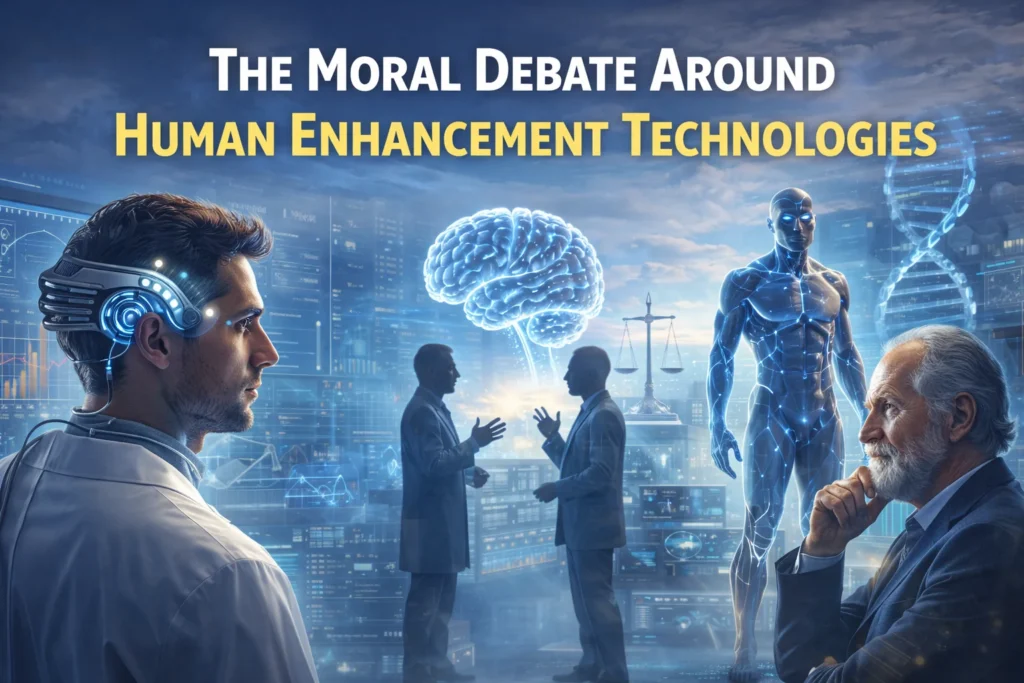
We stand at a unique moment in the history of our species – a moment where the tools to reshape our own biology are no longer science fiction, but tangible technologies rapidly emerging in laboratories, startups, and even home garages. The age of human enhancement has dawned, promising to revolutionize what it means to be human while simultaneously provoking profound moral questions that challenge our deepest understandings of identity, equity, and human nature.
Imagine a world where memory can be edited like a text document, where genetic predispositions are as malleable as fashion choices, and where the boundary between human and machine dissolves into a seamless integration of biology and technology. This is not the distant future – it is the trajectory we are already following. Yet with every breakthrough announcement in gene editing, every new cognitive enhancement drug, every brain-computer interface demonstration, we are forced to confront uncomfortable questions: Just because we can enhance ourselves, does that mean we should? Who will benefit from these technologies, and who might be left behind? What might we lose in our pursuit of perfection?
This comprehensive exploration will journey through the complex landscape of human enhancement technologies, examining their historical roots, current manifestations, philosophical implications, and possible futures. We will navigate between the compelling arguments of enhancement advocates who see these technologies as our moral duty and the urgent warnings of critics who fear they may undermine what makes us human. This is the story of humanity at a crossroads – a species gaining unprecedented power to redesign itself, yet struggling to determine what direction that redesign should take.
Part I: The Historical Tapestry of Human Enhancement
Ancient Foundations: Humanity’s Persistent Drive to Transcend
The desire to overcome human limitations is woven into the very fabric of our history and mythology. Long before CRISPR or nootropics, our ancestors told stories of transformation and transcendence that reveal this deep-seated aspiration.
In ancient Greek mythology, Daedalus and Icarus crafted wings to escape their prison, embodying humanity’s yearning to overcome physical limitations through ingenuity. The Epic of Gilgamesh, one of humanity’s oldest stories, follows a king’s quest for immortality – a theme that echoes through the centuries to modern-day Silicon Valley billionaires funding longevity research. Alchemists of medieval Europe sought not only to transform base metals into gold but to create the Elixir of Life that would confer immortality and perfect health.
These stories reveal something fundamental about human nature: we have never been content with our biological endowment. For millennia, our enhancement tools were external – clothing to protect us from the elements, weapons to extend our hunting reach, writing to preserve memory beyond our lifetimes. Today, the tools are becoming internal, shifting from modifying our environment to modifying ourselves.
The Medical Pivot: From Restoration to Optimization
The 20th century witnessed a subtle but seismic shift in medicine’s mission. The century began with medicine focused primarily on combating pathogens and treating acute injuries – the germ theory of disease had revolutionized our understanding of illness, and antibiotics represented a monumental triumph over bacterial infections. Medicine’s goal was fundamentally restorative: to return sick or injured patients to a state of “normal” health.
By the century’s end, however, medicine was increasingly venturing into optimization territory. The development of psychoactive medications like Prozac (fluoxetine) in the 1980s represented a turning point. While intended to treat clinical depression, these drugs soon revealed they could also alter personality traits in healthy individuals – reducing social anxiety, increasing confidence, smoothing out ordinary melancholy. The line between treating illness and enhancing temperament began to blur.
Simultaneously, the field of cosmetic surgery evolved from reconstructive work for accident victims to elective procedures aimed at enhancing appearance. What began as restoring function morphed into optimizing form, reflecting a growing cultural acceptance of using medical technology for enhancement purposes.
The final decades of the 20th century laid the philosophical groundwork for human enhancement. The transhumanist movement gained intellectual traction, articulating a vision of humanity consciously evolving beyond its current limitations through technology. Philosophers like Max More and FM-2030 (Fereidoun M. Esfandiary) argued that overcoming biological limitations was not just permissible but a moral imperative – the next logical step in human evolution.
The 21st Century Acceleration: Convergence and Democratization
The new millennium brought an unprecedented acceleration in enhancement technologies, driven by several converging trends:
The Digital Revolution’s Mindset: Silicon Valley’s ethos of “move fast and break things” and “disruption” migrated from software to biology. Entrepreneurs began speaking of “hacking” biology, treating living systems as code to be rewritten and optimized.
The Democratization of Biotechnology: Costs plummeted dramatically. Sequencing a human genome dropped from nearly $3 billion in the Human Genome Project to under $1,000 today. CRISPR-Cas9 gene editing, discovered in 2012, provided a tool that was not only powerful but relatively simple and inexpensive compared to previous gene-editing methods.
The Quantified Self Movement: The proliferation of wearable devices and health apps created a culture of constant self-monitoring and optimization. People began tracking everything from sleep cycles to heart rate variability, creating data-driven approaches to self-improvement that paved the way for more invasive enhancements.
Big Tech’s Entry: Companies like Google (through Calico, its longevity research subsidiary), Facebook (exploring brain-computer interfaces), and Elon Musk’s Neuralink brought massive resources and engineering approaches to enhancement challenges that had previously been the domain of academic researchers and pharmaceutical companies.
These converging forces have created what enhancement advocates call the “Great Acceleration” – a period where multiple enhancement technologies are maturing simultaneously, creating synergies and pushing us toward a threshold where human enhancement may become commonplace rather than exceptional.
Part II: The Enhancement Toolkit – Technologies Redefining Human Potential
To understand the ethical landscape, we must first survey the technological landscape. Human enhancement encompasses a diverse array of interventions targeting different aspects of human functioning. Here we explore the major categories in detail.
Cognitive Enhancement: Upgrading the Mind
Cognitive enhancement represents the most active frontier of human enhancement today, with both pharmaceutical and technological approaches advancing rapidly.
Pharmaceutical Nootropics (“Smart Drugs”):
The use of prescription medications for cognitive enhancement in healthy individuals – known as cosmetic psychopharmacology – has become widespread:
- Stimulants: Drugs like methylphenidate (Ritalin) and mixed amphetamine salts (Adderall), prescribed for ADHD, are used off-label by students and professionals to enhance focus, particularly during periods of sleep deprivation. Studies suggest that on some college campuses, 15-30% of students have used these drugs non-medically.
- Wakefulness-Promoting Agents: Modafinil (Provigil), developed for narcolepsy, has become popular among shift workers, military personnel, and academics for its ability to maintain alertness without the jitteriness of traditional stimulants.
- Experimental Compounds: Drugs like piracetam and other racetams, originally developed for cognitive disorders, are used by “biohackers” seeking to enhance memory formation and recall.
The ethical dilemma with pharmaceutical cognitive enhancers centers on questions of authenticity (are the achievements truly “yours”?), coercion (will non-users be forced to participate to remain competitive?), and long-term safety (what are the effects of chronic use in healthy brains?).
Technological Cognitive Interfaces:
Beyond pharmaceuticals, a suite of technologies aims to enhance cognition through direct brain interfaces:
- Transcranial Direct Current Stimulation (tDCS): This non-invasive technique applies a weak electrical current to specific brain regions to enhance learning, memory, or mood. Commercially available headsets promise benefits from accelerated skill acquisition to reduced anxiety, though efficacy remains debated.
- Neurofeedback: Using real-time displays of brain activity to teach self-regulation of brain function, neurofeedback has shown promise for enhancing focus and reducing anxiety in healthy individuals.
- Brain-Computer Interfaces (BCIs): Companies like Neuralink and Kernel are developing increasingly sophisticated interfaces that can read from and potentially write to neural circuits. The ultimate vision involves seamless integration of biological and artificial intelligence, enabling direct brain-to-brain communication or instant access to information.
The promise and peril of these technologies are immense. They could revolutionize education and cognitive rehabilitation, but also raise profound questions about mental privacy, cognitive liberty, and what philosopher David Chalmers calls “the extended mind” – where do “we” end and our technological extensions begin?
Physical Enhancement: Redesigning the Body
Physical enhancement technologies aim to improve strength, endurance, appearance, and longevity, pushing beyond therapeutic applications into optimization.
Performance-Enhancing Substances:
The use of substances to enhance physical capabilities has a long history, but modern approaches are increasingly sophisticated:
- Anabolic Steroids and SARMs: Originally developed to treat muscle-wasting conditions, these compounds are used by athletes and bodybuilders to dramatically increase muscle mass and recovery. Newer Selective Androgen Receptor Modulators (SARMs) promise similar benefits with fewer side effects.
- Blood Doping and EPO: Techniques to increase red blood cell count, enhancing oxygen delivery and endurance, have been at the center of major sports scandals but continue to evolve.
- Gene Doping: The use of gene therapy techniques (like injecting the gene for erythropoietin or insulin-like growth factor) to enhance athletic performance represents a looming challenge for sports regulators, as such modifications can be difficult to detect.
Genetic and Cellular Enhancement:
Cutting-edge research points toward more fundamental physical transformations:
- Myostatin Inhibition: The myostatin gene regulates muscle growth. Animals naturally lacking this gene (like Belgian Blue cattle) develop extreme musculature. Genetic or pharmaceutical myostatin inhibition could potentially create similar effects in humans.
- Mitochondrial Enhancement: Research into boosting mitochondrial function could enhance energy production at the cellular level, potentially increasing endurance and slowing age-related decline.
- Telomere Extension: Telomeres are protective caps on chromosomes that shorten with age. Techniques to extend telomeres (through gene therapy or compounds like telomerase activators) are being explored as potential longevity interventions.
Aesthetic Enhancement and Morphological Freedom:
Beyond function, technologies are emerging that allow unprecedented control over form:
- Advanced Cosmetic Procedures: Beyond traditional surgery, techniques like stem cell facelifts and gene therapies for hair regrowth represent a merging of regenerative medicine and cosmetic enhancement.
- Bioart and Grinder Culture: At the extreme end, the “grinder” subculture (biohackers who implant devices in their bodies) practices what they call “morphological freedom” – the right to modify one’s body according to personal preference. This includes implanting magnets in fingertips to sense electromagnetic fields, inserting RFID chips for keyless access, or even attempting DIY gene therapy.
The ethical questions surrounding physical enhancement center on authenticity in sports, the medicalization of appearance, and the potential for new forms of inequality based not on social advantage but on biological modification.
Emotional and Moral Enhancement: Engineering Better People
Perhaps the most philosophically challenging frontier involves enhancing not what we can do, but who we are – our emotions, personalities, and moral capacities.
Pharmacological Mood Optimization:
The use of pharmaceuticals to alter emotional states in healthy individuals is already widespread:
- SSRIs and Anxiolytics: Originally antidepressants and anti-anxiety medications, these drugs are increasingly used by people without clinical diagnoses seeking to enhance baseline mood or reduce ordinary anxiety.
- Empathogens: Drugs like MDMA (in clinical trials for PTSD) and psilocybin (for depression and end-of-life anxiety) can produce profound, lasting increases in empathy, social connectedness, and openness to experience.
- Beta-Blockers: Used off-label by musicians and public speakers to reduce performance anxiety without cognitive impairment.
The ethical tension lies between recognizing legitimate suffering that deserves treatment and pathologizing normal ranges of human emotion. When does treating social anxiety become enhancing extroversion? When does alleviating grief become diminishing our capacity for authentic sorrow?
Moral Bioenhancement:
A more radical proposal comes from philosophers like Ingmar Persson and Julian Savulescu, who argue that humanity’s moral capacities have not kept pace with its technological power. They suggest we may have a duty to pursue moral bioenhancement – using biomedical means to increase empathy, reduce aggression, strengthen fairness, or enhance altruism.
Potential approaches might include:
- Oxytocin administration to increase trust and bonding
- Pharmacological reduction of implicit racial bias
- Neuromodulation to enhance perspective-taking capacity
Critics of moral bioenhancement raise profound objections: Would chemically induced morality have authentic moral worth? Who gets to decide which moral traits to enhance? Could such enhancements be used for social control, creating complacent populations less likely to challenge injustice?
Longevity and Radical Life Extension: Cheating Death
The ultimate enhancement might be extending the human lifespan itself. The field of geroscience seeks not just to treat age-related diseases but to target the underlying biological processes of aging.
Current Approaches:
- Senolytics: Drugs that selectively清除衰老细胞 (senescent cells), which accumulate with age and contribute to inflammation and tissue dysfunction.
- Metformin and Rapamycin: Existing drugs being investigated for their potential lifespan-extending properties through effects on metabolism and cellular growth pathways.
- Epigenetic Reprogramming: Techniques to reset the epigenetic “clock” – chemical modifications to DNA that change with age and regulate gene expression.
The Vision of Radical Life Extension:
Some researchers and Silicon Valley figures speak openly of “longevity escape velocity” – a point where life expectancy increases by more than one year per year, effectively leading to indefinite lifespans. Organizations like the SENS Research Foundation (Strategies for Engineered Negligible Senescence) advocate a comprehensive “damage-repair” approach to aging, treating it as a biomedical engineering problem.
The societal implications of radical life extension are staggering: What would happen to retirement, careers, relationships, and family structures if people lived for centuries? Would it exacerbate inequality, creating an immortal elite? Would it change our relationship to risk, purpose, and meaning if death were no longer inevitable?
Part III: The Philosophical Battlefield – Competing Visions of Human Flourishing
The debate over human enhancement is not merely technical or regulatory; it is a fundamental clash of worldviews about human nature, ethics, and the good life.
The Pro-Enhancement Framework: The Moral Imperative to Improve
Enhancement advocates advance several compelling arguments grounded in different ethical traditions:
Utilitarian Arguments: Reducing Suffering and Increasing Well-Being
From a utilitarian perspective focused on maximizing well-being and minimizing suffering, enhancement technologies represent powerful tools for moral progress:
- Alleviating Biological Suffering: Many sources of human suffering have biological roots – physical pain, cognitive limitations, mental illness, the degenerative processes of aging. If we can safely mitigate these through enhancement technologies, doing so becomes a moral obligation.
- Expanding Capacities for Flourishing: Enhancement can increase our capacities for experiencing pleasure, meaning, connection, and achievement. Cognitive enhancers might allow deeper appreciation of art and philosophy; mood enhancers might enable more fulfilling relationships; physical enhancements might open new forms of embodied experience.
- Societal Benefits: Enhancement could address large-scale social problems. Philosopher Julian Savulescu notes that even modest cognitive enhancement across populations could reduce crime rates, increase economic productivity, and improve democratic decision-making. Moral enhancement might help humanity address collective action problems like climate change.
The principle of procreative beneficence, advanced by Savulescu, argues that prospective parents have a moral obligation to select, through genetic screening or other means, the child who is expected to have the best life. In this view, using enhancement technologies to give children the best possible start is not just permissible but required by parental love and responsibility.
Libertarian and Transhumanist Arguments: Freedom and Self-Creation
From a libertarian perspective centered on individual autonomy and self-ownership, enhancement represents an expansion of human freedom:
- Morphological Freedom: The concept that individuals should have sovereignty over their own bodies and minds, including the right to modify themselves according to their values and preferences.
- Self-Creation and Authenticity: Contrary to the claim that enhancement undermines authenticity, some argue it enables a more profound self-creation. Philosopher John Harris suggests that if our biological endowment is a matter of chance (the “genetic lottery”), then taking conscious control of our traits through enhancement represents a more authentic expression of self-determination.
- Evolutionary Self-Direction: Transhumanists argue that humanity has reached a point where we can and should take conscious control of our evolutionary trajectory, moving beyond the slow, cruel, and random process of natural selection toward deliberate self-improvement.
Arguments from Justice and Equal Opportunity
Some enhancement advocates argue that these technologies could become tools for social justice rather than inequality:
- Leveling the Biological Playing Field: Natural biological endowments are distributed unequally and unfairly. One person is born with genetic advantages for intelligence, health, or temperament; another faces genetic disadvantages. Enhancement could correct these inequalities, giving everyone a more equal starting point.
- Correcting the Natural Lottery: Political philosopher John Rawls argued that natural talents are morally arbitrary – we don’t deserve the advantages or disadvantages we’re born with. Enhancement could be seen as a way to mitigate this fundamental unfairness.
- Universal Access Models: Rather than banning enhancements that could create inequality, we could develop models for universal access, ensuring that cognitive enhancers or genetic therapies are available to all, much like public education.
The Case for Caution and Limitation: Protecting Human Essence
Critics of enhancement advance equally compelling arguments grounded in different understandings of human dignity and the good life:
Virtue Ethics and the Critique of Hyperagency
Philosopher Michael Sandel offers one of the most influential critiques from a virtue ethics perspective, arguing that enhancement threatens important human virtues:
- The Giftedness of Life: Sandel suggests that an appropriate relationship to the world involves appreciating life as a gift – something we receive with gratitude rather than something we master and control. This attitude of “openness to the unbidden” fosters virtues like humility, responsibility, and solidarity.
- The Drive to Mastery: Enhancement represents what Sandel calls “the drive to mastery” – the urge to dominate and control all aspects of existence, including our own nature. This hyperagency, while empowering, may erode our appreciation for the gifted dimensions of human life.
- The Ethics of Gift and Grace: In parenting, for example, Sandel worries that enhancement mentality changes the relationship from unconditional love for the child you receive to conditional approval for the child you design, compromising what he calls “the ethics of giftedness.”
Authenticity and the Value of Struggle
Many critics worry that enhancement undermines the value of genuine achievement and authentic human experience:
- Achievement and Effort: There’s a deep intuition that accomplishments earned through effort, practice, and struggle have special value that accomplishments achieved through enhancement lack. This is why we distinguish between an athlete who wins through training and one who wins through doping.
- The Narrative Unity of a Life: Our identities are constructed through narratives of growth, challenge, and overcoming limitations. If we can simply upgrade our capacities at will, does this undermine the coherence of our life stories?
- Risk and Vulnerability: Some aspects of the human condition that we might seek to eliminate through enhancement – vulnerability, limitation, mortality – may actually be essential to meaningful human experience. Philosopher Leon Kass speaks of the “wisdom of repugnance” – the idea that our instinctive discomfort with certain enhancements may point to important ethical truths.
Communitarian and Social Cohesion Arguments
From a communitarian perspective focused on social bonds and shared values, enhancement raises concerns about social fragmentation:
- The Coercion Spiral: In competitive contexts, optional enhancements quickly become mandatory. Students who don’t use cognitive enhancers fall behind; workers who don’t take productivity drugs lose their jobs. What begins as free choice ends as coercion, undermining genuine autonomy.
- The Threat to Social Solidarity: Enhancement could erode empathy and solidarity between the enhanced and unenhanced. If some can afford to eliminate aging or dramatically boost intelligence, will they still feel bound by common fate with those who cannot?
- The New Eugenics: While historical eugenics was state-mandated, critics warn of “liberal eugenics” – eugenic outcomes emerging from individual consumer choices in a free market, potentially creating a biological caste system with the genetically enhanced as a new aristocracy.
The Precautionary Principle and Unknown Risks
Given the irreversible nature of some enhancements (especially germline genetic modifications), many argue for applying the precautionary principle:
- Unknown Long-Term Consequences: We may not understand the complex interactions within biological systems well enough to predict the long-term effects of many enhancements. Genes often have multiple functions (pleiotropy), and “enhancing” one trait might have unexpected negative consequences.
- The Wisdom of Natural Evolution: While imperfect, natural evolutionary processes have produced extraordinarily complex, resilient biological systems. We should be humble about our ability to improve upon systems refined over millions of years.
- Preserving Human Nature: Some critics, like philosopher Jürgen Habermas, argue that there is value in preserving a shared human nature as the basis for moral equality and mutual understanding. Radically altering this shared nature might undermine the foundations of human rights and democracy.
Part IV: The Practical Minefield – Implementation Challenges and Social Consequences
Beyond philosophical debates lie complex practical challenges that will determine how enhancement technologies actually affect individuals and societies.
The Justice Problem: Engineering Inequality
The potential for enhancement technologies to exacerbate inequality represents one of the most urgent concerns:
The Access Divide:
Initial enhancement technologies will be expensive, creating what some call “the genetic divide” or “the neurodivide“:
- Economic Barriers: Early adopters will be the wealthy, who can afford cutting-edge genetic therapies, neural implants, or longevity treatments. This could create a feedback loop where economic advantage converts to biological advantage, which in turn creates further economic advantage.
- Geographic Disparities: Access will likely be concentrated in wealthy nations and medical tourism hubs, creating global inequalities between enhanced and unenhanced populations.
- Insurance and Healthcare Systems: Will enhancement technologies be covered by insurance or national healthcare systems? If they’re considered elective rather than therapeutic, they may only be available to those who can pay out of pocket.
The Heredity Problem:
Some enhancements could become heritable, creating permanent biological castes:
- Germline Enhancements: Genetic modifications to eggs, sperm, or embryos would be passed to all future generations, potentially creating families with permanent biological advantages.
- The End of Equality of Opportunity: If biological advantages can be inherited, we move from a society where advantages are primarily social and economic (which can theoretically be overcome) to one where they are biological and potentially permanent.
Regulatory Responses:
Possible approaches to addressing justice concerns include:
- Universal Access Models: Treating certain enhancements as public goods, like education, provided to all citizens regardless of ability to pay.
- Restrictions on Heritable Enhancements: Banning or strictly regulating germline modifications that would create permanent biological inequalities.
- Enhancement Taxation: Taxing enhancement procedures to fund access programs or other social goods.
The Regulation Challenge: Governing the Ungovernable
Enhancement technologies present unprecedented regulatory challenges that existing frameworks are ill-equipped to handle:
The Therapy/Enhancement Distinction Problem:
As discussed, the line between therapy and enhancement is notoriously blurry, creating regulatory confusion:
- Regulatory Arbitrage: Companies may seek to have products classified as therapies (with more rigorous oversight but insurance coverage) or as enhancements/lifestyle products (with less oversight but no coverage).
- The Slippery Slope: Approvals for legitimate therapies create precedents and technologies that can be adapted for enhancement purposes.
The DIY and Black Market Challenge:
The democratization of biotechnology means regulation cannot rely solely on controlling institutions:
- Garage Biology: Biohackers operating outside traditional research settings can develop and self-administer enhancement technologies with minimal oversight.
- International Disparities: Different regulatory regimes across countries create “enhancement tourism” and regulatory arbitrage.
- The Black Market: As with performance-enhancing drugs in sports, a black market for enhancement technologies is almost certain to emerge, with associated quality and safety risks.
The Speed of Innovation Problem:
Technological development moves faster than regulatory processes:
- The Pacing Problem: By the time a regulatory framework is developed for a technology, it may have already evolved into something new.
- Regulatory Capture: There’s risk of enhancement industries exerting disproportionate influence on the regulatory bodies meant to oversee them.
- International Coordination: Effective regulation requires unprecedented international cooperation, which is difficult to achieve.
Identity and Authenticity in an Enhanced World
Enhancement technologies force us to reconsider fundamental questions about personal identity:
Continuity of Self:
If we dramatically alter our cognitive or emotional functioning, are we still the same person?
- The Ship of Theseus Problem: If we gradually replace or enhance parts of ourselves, at what point do we become someone different?
- Responsibility and Moral Agency: If someone’s moral character has been chemically or genetically enhanced, are they responsible for their good actions? If their aggression has been reduced through enhancement, are they responsible for their lack of violent impulses?
- Authenticity and Enhancement: Do achievements accomplished with enhancement have the same value as those accomplished without? Does enhanced empathy have the same moral worth as empathy developed through life experience?
The Social Construction of Enhancement:
How we think about enhancement is itself socially constructed:
- Cultural Variability: Different cultures may have very different attitudes toward various enhancements. Some cultures might embrace cognitive enhancement while rejecting mood enhancement, or vice versa.
- The Shifting Baseline: As enhancements become common, our sense of “normal” human functioning shifts. Today’s enhancement becomes tomorrow’s norm.
- Stigma and Identity: Will there be stigma associated with being enhanced or unenhanced? Will enhancement status become a new axis of identity and potential discrimination?
Relationships and Social Dynamics
Enhancement technologies could transform our most fundamental social relationships:
Parent-Child Relationships:
Enhancement decisions made by parents for children raise unique ethical issues:
- The Non-Consenting Subject Problem: Children cannot consent to enhancements that may have permanent effects on their lives.
- Parental Expectations: If parents invest in enhancing their children, might they feel entitled to particular outcomes, placing excessive pressure on children?
- The Right to an Open Future: Philosopher Joel Feinberg argued that children have a right to an open future – not to have irrevocable choices made for them before they can decide for themselves. Some enhancements might violate this right.
Romantic and Social Relationships:
Enhancement could change how we form relationships:
- Matching and Status: Might people seek partners with similar enhancement profiles? Could enhancement status become a new criterion for mate selection?
- Authenticity in Relationships: If people can enhance their personality traits to be more appealing, how does this affect the authenticity of relationships?
- Enhanced/Unenhanced Divides: Could social circles fracture along enhancement lines, with enhanced and unenhanced people having increasingly different experiences and perspectives?
Part V: The Governance Dilemma – Who Decides Our Evolutionary Future?
Perhaps the most fundamental question raised by enhancement technologies is: Who gets to decide how they are developed and deployed?
Democratic Governance and Public Deliberation
Given that enhancement decisions affect the future of humanity, many argue they should be made democratically:
Citizens’ Assemblies and Consensus Conferences:
Models for inclusive public deliberation on enhancement:
- Citizens’ Assemblies: Randomly selected representative groups of citizens, provided with comprehensive information and expert testimony, who deliberate and make recommendations on policy.
- Consensus Conferences: Similar models that bring together lay citizens to develop consensus positions on complex techno-ethical issues.
- Participatory Technology Assessment: Processes that engage diverse publics in evaluating emerging technologies before they become entrenched.
The Challenge of Democratic Governance:
Democratizing enhancement decisions faces significant hurdles:
- Complexity and Expertise: Enhancement technologies are highly complex. How can democratic bodies make informed decisions about issues that even experts debate?
- Representation and Exclusion: Whose voices get heard in these processes? How do we ensure historically marginalized communities are represented in decisions that could exacerbate inequality?
- Tyranny of the Majority: Democratic decisions might override minority viewpoints or individual liberties in enhancement choices.
International Governance and Global Cooperation
Many enhancement challenges require global solutions:
Existing International Frameworks:
Current international agreements that might inform enhancement governance:
- The UNESCO Universal Declaration on the Human Genome and Human Rights
- The Council of Europe’s Oviedo Convention on Human Rights and Biomedicine
- The WHO’s governance framework for human genome editing
The Need for New Frameworks:
Many argue existing frameworks are inadequate for enhancement technologies:
- Enforcement Challenges: International agreements often lack strong enforcement mechanisms.
- Divergent Values: Different cultures and nations have fundamentally different values regarding enhancement, making consensus difficult.
- The Race Dynamic: Nations may compete to develop enhancement technologies for economic or military advantage, undermining cooperative governance.
Professional Self-Governance and Ethics
The communities developing enhancement technologies have responsibilities to self-regulate:
Ethical Guidelines for Researchers and Practitioners:
Developing field-specific ethical standards:
- Medical Ethics Expansion: Adapting traditional medical ethics principles (autonomy, beneficence, non-maleficence, justice) to enhancement contexts.
- Precautionary Research Practices: Implementing cautious, incremental approaches to research with significant unknown risks.
- Transparency and Public Engagement: Committing to open communication about research goals, methods, and findings.
The Limits of Self-Regulation:
History suggests professional self-regulation has limitations:
- Conflict of Interest: Researchers and companies may have financial or career incentives that conflict with ethical caution.
- The Rogue Actor Problem: A single researcher or company ignoring norms (like He Jiankui with gene-edited babies) can create global consequences.
- Differing Standards Across Fields: Different enhancement domains (genetics, neuroscience, longevity) may develop different ethical standards, creating inconsistent approaches.
Part VI: Possible Futures – Scenarios for an Enhanced Humanity
Given the many uncertainties, it’s helpful to consider different possible futures that might emerge depending on how enhancement technologies develop and how societies respond.
Scenario 1: The Managed Enhancement Pathway
In this scenario, societies develop careful, regulated approaches to enhancement:
- Tiered Regulation: Different levels of oversight based on risk, with high-risk technologies (like germline editing) strictly controlled while lower-risk enhancements are more accessible.
- Universal Access for Basic Enhancements: Certain cognitive or health enhancements are provided as public goods to ensure equitable access.
- International Governance: Effective global cooperation establishes norms and prevents dangerous races to the bottom.
- Cultural Adaptation: Societies gradually adapt to enhancement, developing new norms, values, and institutions that integrate enhanced humans while protecting human dignity.
This represents a moderate, managed path that seeks to capture benefits while minimizing harms through careful governance.
Scenario 2: The Enhancement Divide
In this more dystopian scenario, enhancement technologies dramatically exacerbate existing inequalities:
- Biological Castes: The wealthy access powerful enhancements, becoming effectively a different species from the unenhanced poor.
- Global Disparities: Enhancement access becomes concentrated in wealthy nations, creating unprecedented global inequality.
- Coercive Environments: Enhancement becomes mandatory in competitive fields, forcing people to choose between their health/identity and economic survival.
- Social Fragmentation: Enhanced and unenhanced populations develop different perspectives and values, undermining social solidarity and democratic governance.
This represents a failure of governance and justice, where enhancement technologies become tools of oppression rather than liberation.
Scenario 3: The Post-Human Transition
In this radical scenario, enhancement technologies lead to fundamental transformations of what it means to be human:
- Speciation Event: Enhanced humans diverge so significantly from baseline humans that they constitute a new species.
- Mind Uploading and Digital Existence: Some humans transition from biological to digital existence through whole brain emulation or mind uploading.
- Human-Machine Merger: The distinction between human and machine dissolves through increasingly intimate brain-computer interfaces.
- New Forms of Consciousness: Enhancement enables entirely new forms of experience, consciousness, and social organization that are incomprehensible to unenhanced humans.
This represents the most radical transhumanist vision, where enhancement technologies don’t just improve humans but transcend humanity altogether.
Scenario 4: The Backlash and Prohibition
In this scenario, societies reject enhancement technologies:
- Moral Panics and Political Backlash: Public concern leads to prohibitive legislation against many enhancement technologies.
- Black Markets and Underground Enhancement: Prohibition drives enhancement underground, creating unregulated black markets with greater risks.
- Enhancement Tourism: Wealthy individuals travel to permissive jurisdictions for enhancements, creating a different kind of inequality.
- Stagnation or Slow Adoption: Enhancement development slows dramatically, with societies forgoing potential benefits due to risk aversion.
This represents a conservative response that prioritizes precaution and preservation of existing human nature over potential improvements.
Epilogue: The Most Important Enhancement
As we survey this complex landscape of technologies, ethics, and possible futures, one conclusion becomes inescapably clear: The most critical enhancement we need is not genetic, neural, or pharmacological. It is moral, civic, and cultural.
We need to enhance:
Our Collective Wisdom: Our ability to make prudent decisions about powerful technologies with humility about what we don’t know.
Our Democratic Capacity: Our ability to deliberate collectively about our common future in inclusive, informed ways.
Our Commitment to Justice: Our determination to ensure that technological advances benefit all humanity, not just a privileged few.
Our Moral Imagination: Our capacity to envision what human flourishing truly means in an age of technological transformation.
Our Humility and Restraint: Our willingness to sometimes say “no” to capabilities we can develop but shouldn’t exercise.
The human enhancement revolution forces us to confront the most fundamental questions: What is the good life? What does it mean to be human? What kind of future do we want to create?
These questions cannot be answered by scientists in laboratories or entrepreneurs in startups alone. They must be answered by all of us, through inclusive democratic dialogue informed by both technical understanding and ethical wisdom.
The technologies of human enhancement give us unprecedented power to reshape ourselves. How we use that power will define what we become. The greatest enhancement of all would be to develop the wisdom to ensure that in becoming more than human, we don’t become less than humane.
Our tools for self-transformation are advancing with breathtaking speed. Our wisdom for guiding that transformation must advance just as quickly. The future of humanity depends not on the upgrades we install, but on the character of the beings who choose to install them. The journey ahead is uncertain, but one thing is clear: we are all responsible for its direction.