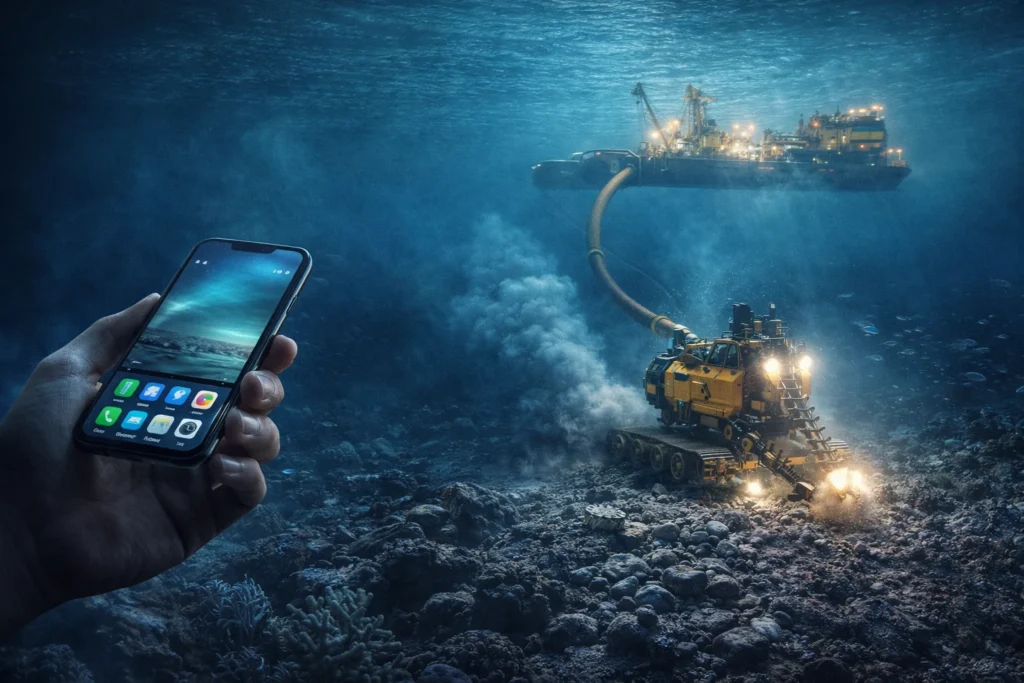

We are stripping the seafloor to power the pocket-sized screens in our palms, pitting green energy goals against untouched ecosystems. We must interrogate how cobalt and lithium demands drive industrial dredges into the abyss. This paradox forces us to choose between atmospheric cooling and the permanent destruction of the deep ocean.
Prologue: The Screen in Your Hand
Think about your day. You woke up this morning and the first thing you did was reach for your phone. Maybe you checked the weather, scrolled through videos, or sent a text to a friend. It feels clean, modern, and completely disconnected from the messy, physical world. The screen glows, the apps open instantly, and the battery lasts just long enough to get you through the day. It feels like magic.
But if you could follow the electricity from your phone’s battery back to its source, you wouldn’t just find a lithium mine in a desert somewhere. You wouldn’t just find a cobalt refinery in a distant industrial park. If you traced it far enough, you might find yourself floating two miles beneath the surface of the Pacific Ocean, in total darkness, watching a four-ton robotic dredge scar a landscape that has remained untouched for sixty million years.
This is the Lithium Paradox. We want to save the planet above the waves by driving electric cars, installing solar panels, and building wind turbines. We want to stop burning fossil fuels and breathe cleaner air. But to build that green future, we are willing to destroy a world we cannot see, a world we have barely begun to explore, a world that may hold secrets we desperately need. We are willing to sacrifice the deep ocean.
The story of how your smartphone ended up mining the seafloor is not a simple one. It involves international law, cutting-edge robotics, newly discovered species, desperate supply chains, and a high-stakes race between those who want to protect the abyss and those who see it as the next great industrial frontier. To understand where we stand today, we have to start at the very bottom.
Chapter 1: The Alien World Below
To understand what we are about to lose, you have to imagine a place that feels like pure science fiction. Close your eyes and picture the deepest, darkest place you have ever been. Now go deeper. Go darker.
About halfway between Hawaii and Mexico lies a vast area of the Pacific Ocean called the Clarion-Clipperton Zone, often shortened to the CCZ. This is not a small region. Spanning approximately four and a half million square kilometers, it is roughly the size of the entire European Union. It is an abyssal plain, which is a fancy way of saying it is a flat, muddy seabed that lies twelve thousand to eighteen thousand feet below the surface.
To put that depth into perspective, imagine the tallest building in your city. Now stack three of them on top of each other. Now sink them to the bottom of the ocean and you still would not reach the depth where these nodules lie. The pressure down there is immense. It would crush a military submarine like a soda can. The temperature hovers just above freezing. No sunlight penetrates. It has been dark down there since before the dinosaurs walked the earth.
For a very long time, scientists thought this place was a desert. They assumed that because no light reaches the abyss, no plants can grow, and without plants, there could not possibly be much animal life. They imagined a barren, muddy wasteland where almost nothing could survive.
They were spectacularly wrong.
Scattered across the dark mud, like someone spilled a giant bag of potatoes across the ocean floor, are millions upon millions of rocks. They look like black potatoes, or maybe rusted cannonballs from some ancient shipwreck. These are called polymetallic nodules, and they are one of the strangest geological phenomena on Earth.
These nodules are lumps of metal. They contain manganese, nickel, copper, and most importantly, cobalt. They are not like rocks you find on land. They did not break off from a larger mountain. They grew, right there on the seafloor, over millions of years. It works like this: a tiny piece of debris settles on the mud. It could be a shark’s tooth, a piece of whale bone, or just a small shell. Over time, metals dissolved in the seawater slowly accumulate around this tiny core, layer by layer, like a pearl forming inside an oyster. Except a pearl takes a few years. A polymetallic nodule takes about one million years to grow just a few millimeters.
The ones scattered across the CCZ today began forming when our ancestors were just learning to walk upright. They have been sitting there, undisturbed, for longer than humans have existed.
And on and around these nodules, life thrives in ways we never expected. Because the seabed is soft mud, these nodules are the only hard surfaces available for miles. They are like coral reefs in reverse, rising up from a flat plain. Anemones attach themselves to the nodules, waving their tentacles in the currents. Sponges, including tiny species like the recently named Plenaster craigi, use them as a foundation. Brittle stars wrap their arms around them. Strange and wonderful creatures drift through the darkness, creatures that look nothing like animals on land.
Scientists have given them nicknames because formal scientific names take too long. There are “gummy squirrels,” which are actually sea cucumbers that swim instead of crawl. There are “Barbie pigs,” another type of sea cucumber that looks pink and translucent. There are umbrella-shaped jellyfish that glow in the dark. There are worms that live entirely in the sediment and never see anything at all.
When scientists recently conducted a comprehensive survey of the CCZ, they collected samples of the animals living on and around these nodules. They sorted through thousands of specimens and made a shocking discovery. They found over four thousand different types of animals. And here is the part that should stop us cold: more than ninety percent of them were new to science. We had never seen them before. We did not know they existed. We have names for maybe ten percent of the life in this region.
We are planning to mine an area where we cannot even identify the vast majority of the creatures that live there. It would be like strip-mining a rainforest without knowing what trees grow in it.
Chapter 2: Why We Are Going to the Bottom of the Sea
So why are companies willing to spend billions of dollars to suck these potato-shaped rocks off the seafloor? Why are nations racing to develop underwater robots that can operate under crushing pressure in total darkness? The answer lies not in the ocean, but in the ambitions of the green energy transition.
To stop using fossil fuels, we need to electrify everything. We need electric vehicles instead of gas-powered cars. We need wind turbines and solar panels to generate clean electricity. We need giant batteries to store that electricity for when the sun is not shining and the wind is not blowing. All of this requires massive amounts of specific minerals.
Let us look at the numbers. A single electric vehicle battery can contain up to ten kilograms of lithium, thirty kilograms of cobalt, and fifty kilograms of nickel. Multiply that by millions of vehicles and you start to see the scale of demand. The International Energy Agency projects that global demand for these critical minerals could double or even triple by 2040. We are talking about staggering quantities of material that must come from somewhere.
But we have a supply problem. The easy minerals on land are running out. The high-grade ore deposits that were simple to dig up have been largely exhausted. The remaining deposits are in difficult places, with lower concentrations of metal, requiring more energy and more destructive mining techniques.
Consider cobalt specifically. Over two-thirds of the world’s cobalt comes from the Democratic Republic of Congo. That country has some of the richest cobalt deposits on Earth, but mining there has been linked to serious human rights concerns. Reports have documented unsafe child labor in artisanal mines. Miners work in dangerous conditions for very low pay. The supply chain is murky and difficult to trace. For companies that want to sell ethical products to conscious consumers, this is a major problem.
Now consider lithium. Some of the world’s largest lithium reserves are found in South America, in the salt flats of Bolivia, Argentina, and Chile. The extraction process there involves pumping huge amounts of brine to the surface and letting it evaporate in huge ponds. This consumes vast quantities of water in regions that are already dry. Indigenous communities have watched their water sources dwindle as lithium production expanded. Green landscapes have turned into dry, white wastelands.
Nickel is also problematic. Major nickel deposits are found in places like Indonesia and Russia, each with their own environmental and political complications. Rainforests have been cleared to access nickel ore. Processing facilities release pollution into nearby communities.
So here is the situation we face: we need more batteries to fight climate change. We do not want to destroy rainforests or rely on conflict minerals. The easy sources on land are depleted, and the remaining sources come with serious baggage.
This is where the deep ocean enters the picture. Companies and governments looking at the CCZ see those millions of polymetallic nodules scattered across the mud. They see a battery lode just sitting there, waiting to be picked up. They do not have to dig deep mines or blast through mountains. They do not have to clear forests or drain aquifers. They just have to vacuum the nodules off the seafloor.
The proponents of deep-sea mining argue that it is actually the greenest option available. They point out that the biomass on the seafloor is very low compared to a rainforest. They note that processing nodules yields multiple metals at once, unlike terrestrial mines that often target just one. They claim that the environmental impact, while real, is smaller than the alternatives.
But is that really true? To answer that question, we have to look at how this mining would actually work.
Chapter 3: The Harvesters – How It Works
The mining process is less like traditional mining and more like a robotic vacuum cleaner attacking your living room floor while you are still living in it. The technology required to operate at these depths is astonishing, and it is advancing rapidly.
Currently, there are two main visions for how to get these nodules off the seafloor, and they are wildly different in their approach and their potential impact.
The first method is the heavy-industry approach, championed by companies like The Metals Company, a Canadian firm that has been at the forefront of deep-sea mining development. Here is how it works.
A massive ship, longer than a football field, sails to a specific spot in the CCZ. Once it arrives, the crew deploys a pipe that extends more than two miles down to the seafloor. At the bottom of this pipe is a collector vehicle roughly the size of a tank. This machine is remotely operated from the surface, communicating through cables that run alongside the pipe.
The collector vehicle lowers itself onto the seabed and begins to drive forward, crawling across the mud on enormous tracks. As it moves, it uses powerful water jets to loosen the nodules from the sediment. Then it uses a giant dredge, essentially a vacuum cleaner head, to suck up the nodules along with the top layer of mud and the creatures living in it.
This mixture of nodules, sediment, and living organisms travels up the pipe to the ship on the surface. Onboard, the ship uses screens and cyclones to separate the nodules from the mud. The nodules are washed, sorted, and stored in the ship’s hold. The remaining mud and wastewater, along with whatever creatures were unfortunate enough to get sucked up, is pumped back into the ocean at a depth of about six thousand feet.
This discharge plume spreads through the water, potentially for hundreds of miles in every direction. It contains fine particles that stay suspended for a very long time. It can smother filter-feeding animals, clog the gills of fish, and disrupt the delicate balance of the midwater ecosystem.
Meanwhile, back on the seafloor, the collector vehicle leaves behind tracks. The top four inches of sediment have been removed. The nodules are gone. The animals that lived on them are gone. The animals that lived in the sediment have been crushed or displaced. What remains is a barren landscape that may take millions of years to recover, if it ever recovers at all.
The second method is more high-tech and potentially less destructive. A company called Impossible Metals is developing autonomous underwater vehicles, or AUVs, that take a different approach. These vehicles hover above the seabed without touching it. Using advanced machine vision and robotic arms, they identify individual nodules and attempt to pluck them gently from the mud.
The idea is to be as selective as a surgeon, removing only the nodules and leaving the surrounding sediment and animals undisturbed. The vehicles would work in fleets, with multiple robots operating simultaneously to cover more ground. They would bring nodules up to the surface in batches, rather than through a continuous suction pipe.
This approach sounds much better. It promises to avoid the massive sediment plumes and the wholesale destruction of the seafloor. But critics point out that even these gentle robots would still disturb the sediment. Even a careful plucking motion creates a small cloud of particles. Multiply that by millions of nodules and you are still talking about a significant impact.
A 2025 study estimated that even the most careful selective mining would stir up sediment at a rate twenty-three thousand times higher than natural geological processes. Whether you vacuum or pluck, you are still creating a massive disturbance in an environment that has been perfectly still for eons.
Chapter 4: The Scars We Cannot See
This is where the paradox cuts deepest. The initial tests of these machines have revealed the damage they cause, and the results are sobering.
In a landmark study published in late 2025, an international team of scientists analyzed the impact of a test mining vehicle that drove eighty kilometers across the seafloor. They had surveyed the area before the machine passed, documenting the animals living there and the condition of the habitat. After the test, they went back to see what had changed.
The results were stark and disturbing. In the tracks left by the vehicle, the number of animals dropped by thirty-seven percent. The diversity of species, meaning the variety of different types of animals, fell by thirty-two percent. The community that remained was different from the original, dominated by hardier species that could tolerate disturbance.
Why did this happen? Because the machine scrapes off the top five centimeters of sediment, the skin of the ocean floor. And that skin is where most of the animals live. They are not evenly distributed throughout the mud. They are concentrated in the uppermost layer, where food particles from the surface occasionally drift down. When you remove that layer, you remove the habitat and the animals with it.
The damage does not stop there. When the mining ship pumps sediment-laden water back into the middle depths, it creates a plume of suspended particles. This cloud spreads through the water column, carried by currents for hundreds of miles. The particles are fine enough to stay suspended for months or even years.
This plume has multiple effects. It can clog the feeding filters of fish and other animals that strain food from the water. It can smother plankton, the tiny drifting organisms that form the base of the ocean food web. It can carry toxic metals that get into the tissues of animals that ingest them. And it can alter the chemistry of the water in ways we do not fully understand.
Even more alarming is the noise. Sound travels differently underwater than it does through air. It travels faster and farther. The noise from mining machinery on the seabed does not stay in one place. It propagates through the water for hundreds of kilometers in every direction.
A 2025 study from the University of Exeter confirmed that whales and dolphins, including endangered sperm whales, live in and travel through the CCZ. These animals rely on sound for everything. They use echolocation to find food. They use calls to communicate with each other across vast distances. They use sound to navigate and to avoid predators.
The noise from mining machinery can mask these vital sounds. It creates a constant background roar that makes it hard for whales to hear each other. It can disrupt feeding behavior and cause animals to avoid large areas of habitat. In effect, we would be making the ocean deaf in places where mining occurs.
And there is another concern that scientists are only beginning to understand. In a startling discovery in 2025, researchers found evidence that oxygen might be generated in the dark abyss through a chemical reaction with the manganese in those potato-sized nodules. The process, which they called dark oxygen production, could be a previously unknown source of oxygen for deep-sea life.
If this proves to be true, the implications are enormous. The nodules are not just inert rocks. They may be actively producing one of the most essential elements for life. Removing them could destroy this oxygen source before we even understand how it works. We might be destroying the planet’s life support system while trying to save it.
Chapter 5: The Guardians of the Abyss
Who decides the fate of this hidden world? Who gets to choose whether we mine the abyss or leave it untouched?
Since the CCZ lies in international waters, beyond the jurisdiction of any single country, it falls under the authority of a unique international organization called the International Seabed Authority, or ISA. Based in Kingston, Jamaica, the ISA is a United Nations-affiliated body with one hundred sixty-seven member countries plus the European Union.
The ISA was created by the United Nations Convention on the Law of the Sea, a treaty that took decades to negotiate and finally entered into force in 1994. The core idea behind the ISA is that the mineral resources of the seabed in international waters belong to all of humanity. They are not the property of whichever country has the best technology or the strongest navy. They are the common heritage of humankind.
This is a radical and beautiful idea. It means that if mining happens, the profits are supposed to be shared with all nations, not just the ones doing the mining. Developing countries that cannot afford to build deep-sea mining equipment should still benefit from the resources extracted from the deep. The ISA is supposed to ensure that this happens.
In practice, things are more complicated. The ISA has issued over thirty exploration licenses to various countries and companies. These licenses allow the holders to explore specific areas of the seabed, to map the nodules, to test collection methods, and to study the environment. But the ISA has not yet approved any commercial mining. It has not issued any licenses for actual extraction.
The reason is simple: the ISA has not yet agreed on a final set of rules for commercial mining. These rules, called the Mining Code, have been under negotiation since 2019. They cover everything from environmental protections to profit-sharing arrangements to dispute resolution mechanisms. Negotiating such complex rules among one hundred sixty-seven countries with diverse interests is incredibly difficult.
Some countries and companies are getting impatient. They argue that the world needs these minerals now, and that the ISA is moving too slowly. They point to the urgency of climate change and the need to accelerate the energy transition. They want the Mining Code finalized as quickly as possible so that commercial mining can begin.
Others are pushing for caution. A coalition of over thirty countries, including France, Germany, the United Kingdom, Canada, New Zealand, and several Pacific Island nations like Fiji and Palau, has called for a moratorium or a precautionary pause on deep-sea mining. They argue that we should not start an industry that could cause irreversible harm until we fully understand the risks.
The tension between these two groups has made the ISA negotiations increasingly contentious. At the most recent session in early 2026, delegates made progress on some technical issues but remained far apart on the big questions. The council president, Duncan Muhumuza Laki, announced that they had completed a line-by-line reading of the proposed regulations, which he called a significant milestone. But crucial sections, especially those related to environmental protection, are still far from consensus.
The ISA Secretary-General, Leticia Carvalho, a Brazilian oceanographer and diplomat, has been walking a careful line. She acknowledges the urgency of finalizing the Mining Code, warning that delays could lead to a regulatory vacuum that would be filled by independent, possibly opaque, national systems. But she also insists on the need for robust environmental safeguards and inclusive dialogue.
As she told the UN General Assembly in late 2025, there should be no exploitation of deep-sea minerals in the absence of regulations. The seabed must remain a realm of cooperation and shared benefit, not a free-for-all.
Chapter 6: The American Gambit
The careful multilateral process at the ISA was thrown into chaos in early 2025 when the United States took unilateral action that threatened to upend decades of international cooperation.
The United States is not a party to the United Nations Convention on the Law of the Sea. This is a quirk of American politics. Although every recent president has supported joining the treaty, a small group of senators has blocked ratification for decades. As a result, the US is not a member of the ISA and does not participate in its decision-making.
However, under customary international law, even non-parties are generally expected to abide by treaty provisions that have become accepted as customary norms. This includes the principle that the seabed beyond national jurisdiction is the common heritage of humankind.
In April 2025, the Trump administration issued an executive order instructing federal agencies to fast-track permits for deep-sea mining. The order cited an obscure 1980 law, the Deep Seabed Hard Mineral Resources Act, which was originally intended as a temporary measure until the Law of the Sea treaty entered into force. The administration interpreted this law as authorizing the United States to issue mining licenses in international waters, bypassing the ISA entirely.
In January 2026, the National Oceanic and Atmospheric Administration, or NOAA, finalized a rule implementing this executive order. The new rule consolidated the exploration and commercial application processes into a single streamlined procedure. It cut environmental assessments and public comment periods in half. It reduced the hurdles for industry to access the deep seabed.
The Metals Company wasted no time. Within days of the rule being finalized, the company filed an application to mine sixty-five thousand square kilometers of the CCZ. This area is more than twice the size of the company’s original exploration contract with the ISA. It covers a vast expanse of seabed known to support thousands of species.
The reaction from the international community was swift and critical. The ISA issued a statement expressing deep concern, arguing that unilateral action undermines the multilateral framework that has governed the oceans for decades. The statement noted that under the Law of the Sea, states have a duty not to recognize mineral rights obtained outside the established international framework.
Chile’s representative to the ISA, Salvador Vega Telias, spoke for many when he told the plenary session that exploitation activities cannot begin until we have a solid, equitable framework and all the scientific knowledge needed to identify potential impacts. He warned that moving forward without consensus would set a dangerous precedent.
Environmental groups were even more critical. The Ocean Foundation published an analysis arguing that the new rule poses threats to all life under the sea and the processes that sustain life on Earth. It warned that the shortcuts risk the destruction of underwater cultural heritage, including shipwrecks and submerged archaeological sites. It noted that Indigenous leaders from Pacific island communities have been outspoken critics of the industry.
The legal situation is murky. The Metals Company’s subsidiary, Nauru Ocean Resources Inc., holds an exploration contract with the ISA for a different area of the CCZ. That contract expires in 2027. The company had hoped to be the first recipient of an ISA commercial mining license. Now it is pursuing a parallel track through the US regulatory system.
If the US issues a license and The Metals Company begins mining, what happens next? The minerals would need to be processed and sold. Many potential customers are based in countries that are committed to complying with ISA rules. Would they buy minerals extracted outside that framework? Would there be legal challenges? Could the minerals be seized in foreign ports? These questions remain unanswered.
Chapter 7: The Economic Case Crumbles
Amid all the legal and political maneuvering, a more fundamental question has emerged: does deep-sea mining actually make economic sense?
When you look at the numbers, the case becomes increasingly questionable. Operating in conditions exceeding the Titanic’s depth, under crushing pressure, in corrosive seawater, at freezing temperatures, presents enormous technical challenges. Two-thirds of comparable offshore industrial projects end up costing fifty percent or more than their initial budgets. The offshore oil and gas industry has decades of experience with deepwater operations, and even they regularly face cost overruns and technical failures.
The Metals Company’s own pre-feasibility study for its NORI-D project estimates a net present value of $23.6 billion, but this assumes successful navigation of all regulatory and ecological hurdles. It assumes that mining can proceed without major delays, that processing technology works as intended, and that metal prices remain high. Any of these assumptions could prove wrong.
Consider what happened with Japan’s deep-sea mining ambitions. In 2026, Japan launched a trial mining operation near Minami-Tori-shima island, more than twelve hundred miles from Tokyo. The seabed there, nearly nineteen thousand feet deep, holds dense fields of manganese nodules rich in cobalt and nickel. The discovery was valued at an astonishing $26 billion.
The trial was a technical disaster. Equipment failed repeatedly. Pipes clogged. Power systems proved unstable under the extreme pressure of 550 atmospheres. The single test collected thirty-five tons of mud from which they extracted just seventy kilograms of rare earth metals. The cost per kilogram worked out to $1.2 million, which is twelve hundred times the international market price. Even if scaled up and optimized, the estimated cost would still be thirty dollars per kilogram, nearly five times the cost of mining the same metals on land.
This is not an isolated problem. The fundamental economics of deep-sea mining are challenging. A hectare of seabed in the CCZ might yield about one and a half tons of nodules. A hectare of rainforest in Indonesia, converted to a nickel mine, can yield six hundred seventy-five tons of ore. The concentration of metal is higher in the nodules, but the sheer volume of material that must be processed is enormous.
Then there is the question of demand. The entire rationale for deep-sea mining rests on the assumption that we will need massive quantities of cobalt and nickel for decades to come. But that assumption is looking increasingly shaky.
Battery technology is evolving rapidly. Lithium iron phosphate batteries, or LFP batteries, do not use cobalt or nickel at all. They already represent about a third of the global EV market. Tesla, BYD, Volkswagen, Rivian, and Ford are all using this technology. Chinese battery makers, which produce most of the world’s batteries, have recently moved entirely away from cobalt and nickel.
In early 2026, researchers at McGill University announced a breakthrough in disordered rock-salt cathode technology. They developed a way to mass-produce battery cathodes using no cobalt or nickel whatsoever. The new cathodes are cheaper, more energy-efficient to produce, and ready for mass manufacturing. They match or exceed the performance of conventional cathodes.
Solid-state batteries are also advancing rapidly. In late 2025, Toyota announced a workable solid-state battery that increases energy density, charging speed, and safety while significantly improving longevity. Although these batteries still use some of the same minerals, they use them more efficiently, reducing overall demand.
Sodium-ion batteries are another emerging alternative. By 2025, global production capacity for sodium-ion batteries exceeded fifty gigawatt-hours. These batteries cost about forty percent less than lithium-ion batteries and perform well in cold temperatures. They are particularly suitable for grid storage applications, which could take pressure off lithium supply chains.
Between 2016 and 2023, electric vehicle production increased by two thousand percent while cobalt prices actually fell by ten percent. This is not what you would expect if we were facing a supply crisis. It suggests that innovation and substitution are working exactly as they should.
Then there is recycling. By 2030, recycled lithium could account for seven percent of total demand. Rare earth recycling rates could increase from fifteen percent to thirty-five percent. Urban mining, the process of recovering metals from discarded electronics, already accounts for thirty percent of US tin demand. Similar systems could be developed for battery metals.
The combination of technological substitution, improved efficiency, and recycling could dramatically reduce the need for newly mined minerals. A 2025 analysis concluded that these factors could push the risk of critical mineral shortages more than thirty years into the future. Deep-sea mining might simply not be necessary.
Chapter 8: The Creatures We Would Lose
While the lawyers argue and the economists calculate, the creatures of the deep go about their lives in the darkness. They do not know that a debate is raging above them. They do not know that machines are being built that could destroy their world.
Let us meet some of them.
There is the gummy squirrel, which is not actually a squirrel. It is a sea cucumber, a relative of the starfish, that has evolved the ability to swim. It looks like a translucent pink blob with floppy appendages. It drifts through the water column, feeding on marine snow, the constant drizzle of organic particles from above.
There is the Barbie pig, another sea cucumber, named for its pink color and pig-like shape. It crawls slowly across the mud, ingesting sediment and extracting whatever organic matter it contains. Its waste produces clean, processed sediment that other animals may use.
There are the sponges. Hundreds of species of sponges attach themselves to the nodules. They filter water through their bodies, extracting bacteria and other tiny organisms. Some of them are carnivorous, trapping small crustaceans with hook-like structures. They come in every shape and color imaginable.
There are the brittle stars, close relatives of starfish, with long, slender arms that wrap around nodules and wave in the current. There are sea anemones that look like tiny flowers, their tentacles extended to catch passing prey. There are worms that build tubes from sediment and never leave them. There are worms that swim freely through the water. There are worms that burrow through the mud and are rarely seen.
There are fish with strange adaptations. Some are blind, having no use for eyes in the darkness. Some have bioluminescent lures to attract prey. Some have enormous mouths and stomachs that can expand to swallow prey larger than themselves.
There are the whales that pass through on their migrations. Sperm whales dive deep to hunt squid, passing through the midwaters above the nodule fields. Beaked whales, among the most mysterious of all cetaceans, echolocate in these waters. Blue whales, the largest animals ever to live, swim through on their long journeys across the Pacific.
In a recent comprehensive survey, scientists identified 788 species of animals larger than three-tenths of a millimeter living in the CCZ. Most belong to groups like polychaete worms, crustaceans, and mollusks. The vast majority were new to science. They had never been described, never been named, never been studied.
How many more remain undiscovered? We do not know. We have sampled only a tiny fraction of this vast region. The deep sea is the largest habitat on Earth, covering more than half the planet’s surface. We have explored perhaps five percent of it. We have named maybe ten percent of the species that live there.
We are considering industrializing this realm before we have even completed the most basic inventory of what lives there.
Chapter 9: The Climate Versus The Ocean
The debate over deep-sea mining forces us to confront a terrible choice. Do we save the atmosphere at the expense of the ocean? Or do we protect the abyss and risk slowing the energy transition?
On one side, you have the undeniable urgency of climate change. The science is clear. We are running out of time. Every fraction of a degree of warming brings more extreme weather, more sea level rise, more species extinctions, more human suffering. We need to decarbonize as quickly as humanly possible.
Supporters of deep-sea mining argue that their methods have a lighter environmental footprint than land mining. They point out that the biomass on the seabed is low, just a few grams per square meter, compared to the lush life in a rainforest. They note that processing nodules yields multiple metals at once, reducing the need for multiple mines. They claim that with proper precautions, the environmental impact can be managed.
They say we have to accept some environmental damage to avoid the climate catastrophe that would come from failing to electrify quickly enough. It is a classic utilitarian argument: the greater good justifies some harm.
On the other side, marine biologists and conservation groups see it differently. They argue that low biomass does not mean low importance. The species in the deep sea are incredibly slow-growing. A sponge that attaches to a nodule may be centuries old. A community that develops over millions of years cannot be replaced in decades.
The concept of ecosystem services is relevant here. The deep ocean plays a crucial role in regulating the Earth’s climate. It absorbs vast amounts of carbon dioxide. It cycles nutrients. It supports fisheries that feed millions of people. Disrupting these processes could have consequences we cannot predict.
There is also the precautionary principle to consider. This principle holds that when an activity poses threats of serious or irreversible harm, lack of full scientific certainty should not be used as a reason to postpone cost-effective measures to prevent degradation. In other words, if we are not sure it is safe, we should be cautious.
The precautionary principle exists for exactly this situation. We do not fully understand the consequences of deep-sea mining. The studies we have done show significant local impacts. The potential for larger regional or global impacts is unknown. Under these circumstances, proceeding with caution is the responsible approach.
But is caution compatible with the urgency of climate change? This is the wicked problem at the heart of the paradox. The thing we need to fight climate change, batteries, might rely on destroying a mechanism that helps regulate the climate in ways we are only beginning to understand.
Perhaps the way out of this paradox is to recognize that it is a false choice. We do not have to choose between saving the atmosphere and destroying the ocean. There are other paths forward.
Chapter 10: A Different Path Forward
Standing on the deck of a research ship, looking out at the endless Pacific, it is hard to believe we could actually harm something so vast. The ocean stretches to the horizon in every direction. It seems infinite, indestructible, beyond our reach.
But the studies show we can. The tracks of a single test vehicle, running for just eighty kilometers, left scars that will last for millions of years. The sediment plumes spread for hundreds of miles. The noise reaches across entire ocean basins.
The decision we face is not just about whether to flip the switch on the mining robots. It is about how much we are willing to lose before we look for another way.
The good news is that there are alternatives. The first and most obvious is recycling. We have already mined enormous quantities of lithium, cobalt, and nickel. They are sitting in landfills, in drawers full of old phones, in closets with obsolete laptops. We have not been good at recovering them.
A 2026 analysis found that urban mining, the process of recovering metals from electronic waste, already accounts for thirty percent of US tin demand. Similar systems could be developed for battery metals. With proper incentives and infrastructure, recycled metals could meet a significant portion of our needs.
The second alternative is innovation. Battery technology is advancing rapidly. The shift to LFP chemistry reduces cobalt demand. Sodium-ion batteries reduce lithium demand. Solid-state batteries increase efficiency. Each improvement reduces the pressure to mine new materials.
The third alternative is designing for longevity. We currently treat electronics as disposable. We upgrade phones every two years, laptops every three, cars every five or six. If we designed products to last longer, to be repairable, to be upgradeable, we would reduce the demand for new batteries and new minerals.
The fourth alternative is reducing consumption. Do we really need new phones every year? Do we really need giant electric SUVs? Do we really need to drive as much as we do? These are uncomfortable questions, but they are worth asking.
The path forward is not about choosing between climate action and ocean protection. It is about pursuing climate action in a way that does not create new environmental crises. It is about being smart, not just fast.
Chapter 11: The Indigenous Voice
Throughout this debate, one perspective has been consistently marginalized: the perspective of Indigenous peoples whose cultures and livelihoods are connected to the ocean.
Pacific Island communities have lived in relationship with the sea for thousands of years. Their origin stories are tied to the ocean. Their traditions, their economies, their identities are inseparable from the waters that surround them.
In American Samoa, in Hawaii, in Fiji, in Palau, Indigenous leaders have been outspoken critics of deep-sea mining. They do not see the ocean as a resource to be exploited. They see it as a relative, as a source of life, as something to be respected and protected.
Hinano Teavai-Murphy, a cultural practitioner from French Polynesia, has spoken about the deep spiritual connection between her people and the ocean. The sea is not something separate from us, she explains. It is part of who we are. To harm the ocean is to harm ourselves.
These voices have been largely absent from the negotiations at the ISA. The meetings are held in Kingston, far from the Pacific. The discussions are conducted in legal and technical language. The delegates represent governments, not communities.
When Indigenous representatives have managed to attend, they have been treated as observers rather than participants. Their statements have been noted but not acted upon. Their concerns have been acknowledged but not addressed.
The new NOAA rule in the United States removes what little protection existed for these communities. It eliminates requirements to consult with Indigenous groups. It streamlines the process in ways that make it harder for affected communities to have their voices heard.
This is not just an environmental issue. It is a human rights issue. It is about who gets to decide the fate of places that matter deeply to real people.
Chapter 12: The Precautionary Principle
The precautionary principle is one of the most important concepts in environmental law and policy. It states that when an activity raises threats of harm to human health or the environment, precautionary measures should be taken even if some cause-and-effect relationships are not fully established scientifically.
In simpler terms: better safe than sorry.
The precautionary principle exists for situations exactly like this one. We are contemplating an activity that could cause irreversible harm to a vast and poorly understood ecosystem. We do not have full scientific certainty about the consequences. Under the precautionary principle, we should proceed with extreme caution.
The European Union has been a strong advocate for applying the precautionary principle to deep-sea mining. The European Parliament has called for a moratorium until the environmental risks are properly understood. Several EU member states, including France, Germany, and Sweden, have supported this position.
The ISA’s own rules incorporate precautionary language. The draft Mining Code includes provisions for environmental impact assessments, monitoring requirements, and adaptive management. The challenge is turning these words into enforceable standards.
What would a truly precautionary approach look like? It would mean no commercial mining until we have adequate baseline data. It would mean protected areas covering a representative sample of all habitat types. It would means rigorous environmental impact assessments for each mining operation. It would mean independent monitoring and enforcement. It would mean liability provisions that hold companies accountable for damage.
None of this is impossible. We have done it for other industries. Offshore oil and gas operates under strict regulations in many countries. Deep-sea fishing is managed through regional fisheries organizations. Mining on land is subject to environmental laws in most jurisdictions.
The question is whether we have the political will to apply the same standards to deep-sea mining.
Chapter 13: The Financial Reality
While environmental advocates raise concerns about ecosystems, financial analysts have been quietly raising concerns about economics. The business case for deep-sea mining is looking increasingly shaky.
Thirty-seven major financial institutions, including some of the world’s largest banks and insurance companies, have urged governments to pause deep-sea mining until the environmental, social, and economic risks are properly understood. They have indicated that they may not finance deep-sea mining projects until these issues are resolved.
This matters because deep-sea mining requires enormous upfront capital. The ships, the robots, the processing facilities, the supply chains all cost billions of dollars. Without financing from major banks, these projects cannot proceed.
The insurance industry is also skeptical. Insuring deep-sea mining operations involves enormous risks. Equipment failures, environmental disasters, legal liabilities, all could result in massive claims. Insurers are reluctant to underwrite these risks without more information.
Then there is the question of demand. As battery technology evolves away from cobalt and nickel, the long-term market for these metals becomes less certain. Investing billions in a mining operation that might be obsolete in twenty years is a risky proposition.
The Metals Company’s stock price has been volatile, reflecting these uncertainties. The company has a market capitalization in the hundreds of millions, which is tiny compared to the billions needed for commercial operations. It has relied on partnerships and investments from strategic partners to keep going.
The combination of environmental opposition, regulatory uncertainty, financial skepticism, and technological change creates a challenging environment for deep-sea mining. It is not impossible that some projects will eventually proceed, but the path is getting narrower.
Chapter 14: The Global Divide
The debate over deep-sea mining has created a sharp divide in the international community. On one side are the mining advocates, including countries like Norway, Japan, and the United States, along with companies like The Metals Company. On the other side are the precautionary advocates, including most European countries, many Pacific Island nations, and a growing coalition of developing countries.
Norway made headlines in 2025 when it announced plans to open its continental shelf for deep-sea mining exploration. The Norwegian government sees this as an economic opportunity, a way to diversify away from oil and gas. Environmental groups have challenged the decision in court.
Japan has been pursuing deep-sea mining for decades. The country is poor in mineral resources and sees seabed mining as a way to reduce dependence on imports. The recent trial near Minami-Tori-shima was part of this long-term strategy.
The Pacific Island nations are divided. Some, like Nauru and Kiribati, have sponsored exploration contracts through subsidiaries of foreign companies. They see potential revenue that could support their small economies. Others, like Fiji, Palau, and the Federated States of Micronesia, have called for a moratorium. They worry about the impacts on fisheries and marine ecosystems that their people depend on.
The European Union is trying to find a common position, but member states are divided. France, Germany, and Sweden support a precautionary pause. Others are more open to mining under strict regulation. The EU’s Critical Raw Materials Act includes provisions for diversifying supply sources, which could include deep-sea minerals.
China’s position is interesting. Chinese companies hold several exploration contracts with the ISA. China has been investing heavily in deep-sea technology, including the development of mining systems. At the same time, China controls most of the world’s rare earth processing and has been investing in battery technology that reduces cobalt demand. It is not clear whether China sees deep-sea mining as a priority or a hedge.
The divide is not just between countries. It is also within countries. In the United States, environmental groups have strongly opposed the new NOAA rule. Scientists have spoken out against rushing into mining. Some members of Congress have raised concerns. The administration is moving forward anyway.
Chapter 15: The Unmapped Majority
Here is a fact that should give us all pause: we have mapped only about twenty percent of the global ocean floor in any detail. For the remaining eighty percent, we have only rough satellite-derived estimates of depth and topography.
In the CCZ specifically, we have surveyed only tiny fractions of the total area. We have taken sediment samples from a few hundred locations. We have photographed the seafloor along a few thousand kilometers of track lines. We have collected animals from perhaps a few dozen sites.
The vast majority of the region remains completely unexplored. We do not know what lives there. We do not know how the ecosystems function. We do not know how they are connected to each other or to the rest of the ocean.
This lack of baseline data makes it impossible to assess the potential impacts of mining. If we do not know what is there, we cannot measure what is lost. We cannot design effective protected areas because we do not know which areas are most important. We cannot monitor impacts because we do not know what normal looks like.
The scientific community has been calling for more research before mining proceeds. In a 2025 letter to the ISA, hundreds of scientists from around the world urged caution. They noted that deep-sea ecosystems are unique, vulnerable, and poorly understood. They warned that commercial mining could cause irreversible harm.
Dr. Beth Orcutt of the Bigelow Laboratory for Ocean Sciences put it simply: the stakes are really high if we get it wrong. And right now, we do not have enough information to know whether we are getting it right or wrong.
Chapter 16: The Cultural Heritage at Risk
The deep sea is not just a biological treasure. It is also a cultural and historical treasure. Scattered across the seabed are thousands of shipwrecks, some of them centuries old. These are time capsules, preserving artifacts and information that cannot be found anywhere else.
In the Atlantic, the seafloor holds the final resting places of those who perished during the Middle Passage, the horrific voyage that brought enslaved Africans to the Americas. These sites are sacred to descendants of the enslaved. They are evidence of one of history’s greatest crimes. They deserve protection and respect.
In the Pacific, there are wrecks from World War II, including ships and aircraft that played crucial roles in the conflict. These are war graves, the final resting places of sailors and airmen from multiple nations. They are also archaeological sites that can teach us about the past.
Deep-sea mining threatens all of this. The collector vehicles cannot distinguish between a polymetallic nodule and a piece of historical wreckage. They cannot recognize a submerged archaeological site. They will crush everything in their path.
The new NOAA rule removes requirements to identify and protect cultural heritage sites. It streamlines the process in ways that make it harder to ensure that these irreplaceable resources are preserved. This is not just an environmental failure. It is a cultural failure.
Chapter 17: The Legal Labyrinth
The legal framework for deep-sea mining is extraordinarily complex. Multiple layers of law apply, from international treaties to national regulations to contract terms.
At the international level, the United Nations Convention on the Law of the Sea is the foundation. It establishes the principle that the seabed beyond national jurisdiction is the common heritage of humankind. It creates the ISA and gives it authority to regulate mineral activities. It sets out basic environmental obligations.
Below the treaty level, there are the ISA’s regulations. These include the exploration regulations, which have been in place for years, and the draft exploitation regulations, which are still being negotiated. The ISA has also issued recommendations and guidelines on various topics.
Then there are the contracts. Each exploration contractor has a contract with the ISA that sets out specific rights and obligations. These contracts include terms about environmental protection, reporting requirements, and duration.
At the national level, countries have their own laws. Some, like the United States, have laws that purport to authorize mining in international waters, even though this conflicts with the international framework. Others have laws implementing their ISA obligations.
The relationship between these different legal layers is contested. The United States argues that its 1980 law gives it authority to issue licenses independent of the ISA. The ISA and most other countries argue that this violates international law. The issue has never been tested in court.
If The Metals Company proceeds with its US license application, legal challenges are almost certain. The company could face lawsuits from environmental groups, from the ISA, or from other countries. The minerals it produces could be subject to seizure in foreign ports. The uncertainty is enormous.
Chapter 18: The Recycling Revolution
While the debate over deep-sea mining continues, a quieter revolution is taking place in recycling technology. Companies and researchers are developing new ways to recover metals from electronic waste, and the results are impressive.
Traditional recycling of lithium-ion batteries has been challenging. The batteries are complex, with multiple materials bonded together. Early recycling processes were energy-intensive and recovered only a fraction of the valuable materials.
New technologies are changing this. AI-driven sorting systems can identify different battery types and separate them efficiently. Advanced hydrometallurgical processes can recover lithium, cobalt, nickel, and manganese with high purity. Some processes can recover up to ninety-five percent of the critical metals.
Plasma arc recycling uses extremely high temperatures to vaporize organic materials and recover metals. This technology is still developing but shows promise for handling mixed waste streams.
The economics are improving as well. As metal prices have risen, recycling has become more profitable. As recycling technology has improved, costs have come down. In some cases, recycled metals are now cheaper than newly mined metals.
Policy is also helping. The European Union has proposed regulations requiring minimum levels of recycled content in new batteries. China has implemented extended producer responsibility systems. Several US states have passed laws encouraging battery recycling.
By 2030, recycled lithium could supply seven percent of global demand. Recycled cobalt could supply even more. As the number of end-of-life batteries increases, these percentages will grow. By 2040, recycling could meet a substantial fraction of total demand.
This matters for deep-sea mining because it reduces the need for primary minerals. If recycling can meet a significant portion of demand, the case for new mining becomes weaker. The urgency that drives the mining advocates starts to dissolve.
Chapter 19: The Technological Transformation
Battery technology is evolving faster than almost anyone predicted. A decade ago, it seemed obvious that we would need massive quantities of cobalt and nickel forever. Today, that is no longer clear.
The shift to LFP chemistry has been the biggest change. LFP batteries use lithium, iron, and phosphate. No cobalt. No nickel. They are cheaper, safer, and longer-lasting than cobalt-based batteries. They now power a third of the world’s electric vehicles.
Sodium-ion batteries are the next frontier. Sodium is abundant and cheap, available from seawater and salt deposits around the world. Sodium-ion batteries have lower energy density than lithium-ion, which makes them less suitable for vehicles, but they are perfect for grid storage. They could take pressure off lithium supply chains.
Solid-state batteries promise even greater advances. By replacing the liquid electrolyte with a solid material, these batteries can achieve higher energy density, faster charging, and improved safety. They use less material per unit of energy stored, reducing overall demand.
Disordered rock-salt cathodes, the breakthrough from McGill University, could eliminate cobalt and nickel entirely while maintaining high performance. The technology is still in development, but the potential is enormous.
All of these innovations share a common feature: they reduce dependence on the very minerals that deep-sea mining would extract. They make the case for mining the seabed less compelling with each passing year.
Chapter 20: The Voice of Science
Throughout this debate, scientists have been a consistent voice for caution. Again and again, they have called for more research, more baseline data, more careful assessment of risks.
The largest study to date of deep-sea mining impacts, published in early 2026, was a collaboration involving dozens of scientists from multiple countries. They spent five years collecting and analyzing data from the CCZ. They documented the biodiversity, tested the impacts, and published their findings in a leading scientific journal.
The results were clear. Mining causes significant local impacts. Animal numbers drop by more than a third. Species diversity falls by a similar amount. The affected areas do not recover quickly. Recovery would take decades or centuries, if it happens at all.
The study also documented the incredible biodiversity of the region. The researchers identified 788 species from their samples. Most were new to science. Many remain unnamed.
Lead author Thomas Dahlgren of the University of Gothenburg summed it up: this research is essential for the ISA to make informed decisions. Without it, we are flying blind.
Another scientist involved in the study, Adrian Glover of the London Natural History Museum, emphasized the importance of protected areas. We need to know what lives in the areas set aside for conservation, he said. Currently, we barely know anything about them.
The scientific consensus is clear: we do not know enough to proceed safely. More research is needed. More baseline data is needed. More understanding of ecosystem functioning is needed.
Whether policymakers will listen to this scientific consensus remains to be seen.
Chapter 21: The Precedent Problem
Deep-sea mining is not happening in isolation. It is part of a broader pattern of ocean industrialization that includes fishing, shipping, oil and gas extraction, and now mineral mining. Each new industry adds pressure to marine ecosystems.
The concern among ocean advocates is that deep-sea mining could set a dangerous precedent. If we allow mining in international waters, what comes next? Bioprospecting for genetic resources? Large-scale aquaculture? Ocean fertilization for carbon sequestration?
The legal framework for the high seas is fragmented and weak. Different activities are governed by different organizations with different mandates. There is no comprehensive system for managing cumulative impacts.
The Biodiversity Beyond National Jurisdiction treaty, negotiated in 2023, was supposed to address some of these gaps. It establishes mechanisms for creating marine protected areas on the high seas and for sharing benefits from genetic resources. But the treaty has not yet entered into force, and its implementation is uncertain.
If deep-sea mining proceeds outside the ISA framework, it could undermine the entire system of international ocean governance. It could encourage other countries to go their own way on other issues. It could lead to a race to exploit rather than a cooperative effort to protect.
This is what ISA Secretary-General Leticia Carvalho meant when she warned of an existential threat to the very existence of the ISA and what it stands for. The stakes go far beyond nodules and mining.
Chapter 22: The Moral Question
Underneath all the economics, all the law, all the science, there is a moral question. Do we have the right to destroy a world we barely understand?
The deep sea has been dark, silent, and stable for eons. It has waited while continents drifted, while ice ages came and went, while species evolved and went extinct. It has existed without us, independent of us, indifferent to us.
Now we have found it. Now we have the technology to reach it. Now we have the desire to exploit it. The question is whether we have the wisdom to leave it alone.
Environmental philosopher Kathleen Dean Moore has written about what she calls the moral urgency of gratitude. We have received this incredible gift, she argues, this planet with all its wonders. Our obligation is to pass it on intact to future generations.
The deep sea is part of that gift. The sponges and the worms and the strange swimming cucumbers are part of it. The nodules that have been growing for millions of years are part of it. The unknown species, the unnamed creatures, the undiscovered ecosystems are part of it.
We do not have to use everything we find. We do not have to extract every resource. We do not have to develop every technology. Sometimes the right choice is to stop, to appreciate, to protect.
The precautionary principle is not just a legal doctrine. It is a moral stance. It is an acknowledgment that our knowledge is limited, our understanding incomplete, our wisdom imperfect. It is a commitment to humility in the face of the unknown.
Chapter 23: The Hidden Connections
One of the reasons the deep sea matters is that it is connected to everything else. The ocean is not a series of separate compartments. It is one system, with water circulating, nutrients cycling, animals moving.
The deep sea plays a crucial role in the global carbon cycle. When organisms die in the surface waters, their remains sink to the depths. Some of that carbon gets buried in the sediment and stays there for millions of years. This is one of the ways the Earth regulates its climate.
Disrupting the deep sea could affect this carbon storage. Mining disturbs the sediment, releasing carbon that has been locked away. It kills the organisms that process carbon. It changes the chemistry of the water column.
The deep sea also plays a role in nutrient cycling. Nutrients that sink to the depths are eventually brought back to the surface by upwelling currents. This fuels the phytoplankton that form the base of the ocean food web. Disrupting deep-sea ecosystems could affect this process in ways we do not understand.
Then there are the direct connections. Many fish species that people eat spend part of their lives in the deep sea. Tuna, for example, migrate through the waters above the CCZ. The sediment plumes from mining could affect their feeding and reproduction.
Whales connect the deep sea to the surface. When they dive deep to feed, they bring nutrients back up in their waste. When they die, their bodies sink to the bottom, providing food for deep-sea creatures. Disrupting either end of this connection affects the whole system.
The deep sea is not separate from us. It is part of the same planetary system that sustains all life. What happens down there does not stay down there.
Chapter 24: The Pacific Perspective
For the people of the Pacific Islands, the ocean is not a wilderness to be exploited or preserved. It is home. It is the source of life. It is the setting for stories that have been told for thousands of years.
In many Pacific cultures, the ocean is understood as a living being, with its own spirit and its own needs. Humans are part of the ocean community, not separate from it. Relationships with the ocean are governed by protocols and obligations.
This worldview is fundamentally different from the one that drives deep-sea mining. The mining worldview sees the ocean as a storehouse of resources to be extracted for human benefit. It sees value only in what can be taken and sold.
Pacific leaders have been speaking out against this worldview. At international meetings, at UN gatherings, at ISA negotiations, they have told their stories and shared their concerns. They have asked the world to respect their connection to the ocean.
In American Samoa, community members have testified against mining. In Hawaii, Native Hawaiian organizations have filed comments opposing the new NOAA rule. In Fiji, the government has joined the call for a moratorium.
These voices deserve to be heard. They represent a way of knowing that is different from Western science, but no less valid. They remind us that the ocean is not just a collection of resources. It is a place where people live, where cultures thrive, where identities are formed.
Chapter 25: The Technology Race
While the debate over mining continues, a parallel race is underway to develop the technology that would make it possible. Companies and countries are investing heavily in underwater robots, sensing systems, and processing facilities.
China has been particularly active. Chinese companies hold multiple exploration contracts with the ISA. Chinese research institutions have been testing mining systems in the Pacific. China is also investing in processing technology that could handle nodules efficiently.
Japan has been developing mining systems for decades. The recent trial near Minami-Tori-shima, despite its technical problems, represents years of investment and research. Japanese companies are also working on processing technology.
South Korea has an active deep-sea research program and holds exploration contracts. Korean companies have been developing underwater vehicles and mining components.
Europe has multiple players. Germany, France, and Belgium have companies involved in deep-sea technology. The European Union has funded research projects on environmental impacts and mining systems.
The Metals Company, based in Canada, has been the most aggressive private player. The company has raised hundreds of millions of dollars, conducted pilot mining tests, and lobbied governments aggressively. Its partnerships with mining companies and processors give it a path to commercialization.
This technology race creates momentum. Companies that have invested heavily want to see a return. Countries that have supported research want to see results. There is a danger that this momentum will carry us toward mining before we have fully considered the consequences.
Chapter 26: The Precautionary Pause
Given all the uncertainties, many scientists and environmental groups have called for a precautionary pause on deep-sea mining. They want commercial mining prohibited until we have adequate scientific knowledge, robust regulations, and proven alternatives.
A pause would not mean stopping all activity. Exploration could continue. Research could continue. Technology development could continue. What would stop is the actual extraction of minerals for commercial purposes.
The call for a pause has been endorsed by more than thirty countries, including France, Germany, the United Kingdom, Canada, New Zealand, and several Pacific Island nations. It has been endorsed by hundreds of scientists. It has been endorsed by major corporations like Google, Samsung, and BMW, which have pledged not to use deep-sea minerals in their products.
The pause would give us time to do what should have been done already. Time to complete baseline surveys of the CCZ. Time to understand the ecosystems and their connections. Time to develop monitoring techniques. Time to assess alternatives. Time to negotiate robust regulations.
Opponents of a pause argue that it would delay the energy transition and keep us dependent on fossil fuels. They point to the urgency of climate change and the need for rapid action. They suggest that environmental concerns are being exaggerated.
But the choice is not between pausing and destroying the climate. The choice is between rushing into mining and taking the time to do it right. The alternatives to deep-sea mining, recycling and innovation, are advancing rapidly. A pause would give them time to mature.
The precautionary principle supports a pause. When the risks are high and the uncertainties are large, the responsible course is to proceed with caution. That is what a pause would provide.
Chapter 27: The Corporate Strategy
The Metals Company has been the main driver behind the push for deep-sea mining. Understanding the company’s strategy helps explain why the issue has become so contentious.
The company was formed through a merger of several smaller exploration firms. It holds exploration contracts in the CCZ through its subsidiary, Nauru Ocean Resources Inc. It has raised money from investors, including the mining giant Glencore.
The company’s strategy has been to create urgency. It has argued that the world needs these minerals now, that delays are costly, that competitors are moving forward. It has lobbied governments aggressively, including the United States.
The company has also invested in public relations. It has produced videos highlighting the potential benefits of deep-sea mining. It has sponsored research that supports its position. It has hired former government officials to advocate on its behalf.
When the ISA process moved slowly, the company looked for alternatives. The US regulatory pathway offered a way to bypass the international negotiations. The company’s application under the new NOAA rule was a logical step in this strategy.
The company’s financial position is precarious. It has burned through cash and needs to show progress to investors. A commercial mining license, whether from the ISA or the US, would boost its stock price and help it raise more money.
Critics argue that the company is putting its own interests ahead of the environment and the global community. Supporters argue that it is simply trying to meet a genuine need. The truth probably lies somewhere in between.
Chapter 28: The Role of Consumers
Most people have never heard of polymetallic nodules. They do not know where cobalt comes from. They do not think about the origins of the minerals in their phones. This is not their fault. The supply chains are long and opaque.
But consumers have power. The choices we make send signals through the economy. When we choose products with recycled content, we support recycling. When we keep our phones longer, we reduce demand. When we ask questions about where materials come from, we create pressure for transparency.
Several companies have responded to consumer concerns. BMW has pledged not to use deep-sea minerals in its vehicles. Google has made a similar commitment. Samsung has said it will avoid minerals from deep-sea mining. These commitments matter because they reduce the market for mined nodules.
Consumer awareness is growing. Articles like this one are being read. Documentaries are being watched. Social media campaigns are spreading information. The more people know, the harder it becomes for mining to proceed unnoticed.
This does not mean that individual consumer choices alone can solve the problem. Systemic change requires collective action, government regulation, and corporate accountability. But consumer awareness is part of the solution.
The next time you pick up your phone, think about where its components came from. Think about the deep sea. Think about the sponges and the worms and the strange swimming cucumbers. Think about whether you want your convenience to come at their expense.
Chapter 29: The Path Not Taken
There is an alternative future. In this future, we decide that the deep sea is worth protecting. We decide that some places should remain wild, unexplored, untouched.
In this future, we invest in recycling rather than mining. We design batteries that can be easily disassembled and recovered. We create systems that keep materials circulating instead of extracting new ones.
In this future, we innovate our way out of resource constraints. Sodium-ion batteries power our grid storage. Solid-state batteries power our vehicles. Disordered rock-salt cathodes eliminate cobalt entirely.
In this future, we consume more thoughtfully. We keep our devices longer. We repair instead of replace. We share instead of own. We value durability over novelty.
In this future, we respect the precautionary principle. We acknowledge our ignorance and act with humility. We protect what we do not understand.
In this future, the deep sea remains dark, silent, and full of life. The nodules continue their slow growth, adding layer upon layer over millions of years. The sponges and the worms and the strange swimming cucumbers live out their lives undisturbed.
This future is possible. It does not require magic or miracles. It requires choices. It requires political will. It requires us to value something beyond short-term gain.
Chapter 30: The Moment of Decision
We stand at a crossroads. The technology to mine the deep sea exists. The demand for minerals is real. The companies are ready. The only question is whether we will let them proceed.
The decisions being made now will echo for millions of years. The tracks left on the seafloor will last longer than any human institution. The species we drive extinct will never return. The ecosystems we disrupt will not recover in any timeframe we can comprehend.
The paradox is real. We need to address climate change. We need to reduce our dependence on fossil fuels. We need to build a clean energy future. But we do not need to destroy the deep sea to do it. There are other paths, better paths, paths that do not require sacrificing one part of the planet to save another.
The precautionary principle exists for moments like this. The common heritage of humankind is a concept worth defending. The wisdom of Indigenous peoples is a resource we ignore at our peril.
The deep ocean has been dark, silent, and stable for eons. It has waited for us to evolve, to build ships, to invent lights, and finally to find it. The question is whether we will let it keep waiting, or whether we will destroy it to power the next five minutes of human history.
The choice is ours. The time to make it is now.
Epilogue: What the Abyss Teaches Us
Standing on the deck of a research ship, looking out at the endless Pacific, you feel small. The ocean stretches to the horizon in every direction, vast and indifferent. It is easy to believe that nothing we do could possibly matter to something so immense.
But the abyss teaches us otherwise. It teaches us that we are connected to everything, even the deepest, darkest places. It teaches us that our actions have consequences that ripple across space and time. It teaches us humility.
The creatures of the deep sea do not know that we are debating their fate. They do not know that machines are being built that could destroy their world. They go about their lives in the darkness, feeding, reproducing, dying, just as they have for millions of years.
They deserve better than to be sacrificed for our convenience. They deserve better than to be destroyed before we even know their names.
The paradox of lithium is that it forces us to confront uncomfortable truths about our way of life. It forces us to ask whether our consumption is worth the cost. It forces us to decide what kind of people we want to be.
We can be the people who destroy the abyss. Or we can be the people who protect it. The choice, as always, is ours.