
Book One: The World That Lost Its Quiet
Chapter One: Memories of Silence
Remember the last time you heard actual silence? Not the kind where the television is off and the children are finally asleep, but real, deep, profound, complete quiet? The kind of silence that feels almost like a physical presence, soft and enveloping? Maybe it was during a heavy snowfall in the countryside, where the world feels wrapped in thick cotton, muffled and gentle and slow. Perhaps it was very late at night in a place so still you could hear your own heartbeat, or the gentle creak of an old house settling around you, or the soft whisper of your own breathing. Or maybe it was out in a vast desert, or deep in an ancient forest, or standing on a mountaintop at dawn, where the loudest thing in the world is the wind moving through grass or the distant call of a bird.
For billions of people living in big cities around the world, that kind of quiet is a distant memory. It’s something they experience maybe once a year on vacation, if they’re lucky enough to get away. It’s something they might recall from childhood, from a time before the world became so loud. For many young people who have grown up entirely in urban environments, true silence is something they have never experienced at all. It’s as foreign to them as a language nobody ever taught them to speak.
The quiet of the past has been replaced by something else entirely. It’s been replaced by a constant, churning, grinding background noise that never really stops, never fully goes away, never gives us a break. Think about it for a long moment. When you wake up in the city, what’s the first thing you hear? Maybe it’s the garbage truck, beeping and grinding and crashing at five in the morning, right outside your window. Maybe it’s your neighbor’s shower running through the thin walls, or their television tuned to an early morning news show. Maybe it’s just the distant, ever-present hum of traffic that forms the permanent soundtrack of urban life, a sound so constant that you don’t even notice it until you stop and listen, and then you wonder how you ever tuned it out.
This constant noise isn’t just there during the daylight hours either. Cities at night have their own unique sound signature, and it’s not a quiet one. There’s the deep, throbbing bass from a car passing by with the music turned up way too loud, a sound that vibrates through walls and windows and floors. There’s the steady, droning hum of an air conditioning unit from the building next door, running all night long. There’s the occasional siren, wailing and fading, then another one starting up somewhere else. There are the shouts from the street, people laughing or arguing or just talking loudly as they walk home. There’s the helicopter circling somewhere overhead, its blades chopping through the air. There are the squealing brakes of buses and the rumbling of subway trains deep underground. For the millions of people trying to sleep in cities every night, it’s a nightly battle against a wall of sound that never fully retreats, never calls a truce, never gives them a moment of genuine peace.
Chapter Two: The Sounds We’ve Learned to Ignore
The human brain has an remarkable ability to adapt to its environment. It’s one of the reasons our species has been so successful. We can learn to live in the freezing Arctic and the scorching desert. We can adjust to high altitudes and low oxygen. And we can learn to ignore sounds that should probably be driving us crazy. This ability is called habituation, and it’s how we cope with the constant noise of modern life.
Walk down any busy city street and watch the people around you. They’re talking on phones, walking with friends, lost in thought. They don’t flinch when a bus roars past just a few feet away. They don’t jump when a car horn blasts nearby. They don’t cover their ears when a motorcycle with a modified exhaust revs its engine at the traffic light. They’ve learned to tune it out. Their conscious minds have learned to push these sounds into the background, to treat them as unimportant, to focus on other things.
But here’s the crucial thing that most people don’t realize: even when your conscious mind has learned to ignore a sound, your body hasn’t. Your unconscious brain, the ancient part that evolved long before you had words for things, is still listening. It’s still processing every single sound. It’s still deciding, in a fraction of a second, whether that sound represents a threat or not. And it’s still triggering physical responses in your body, even when you’re not aware of it.
Think about it this way. Imagine you’re trying to read a book in a room where someone has left a television on, muted, with the picture turned off. You can ignore it, right? You can focus on your book. But part of your brain is still aware of that flickering screen. Part of your brain is still processing that there’s something unusual in your peripheral vision. It takes a tiny bit of mental energy to keep pushing that distraction away. Now imagine that the television is on, with sound, playing a show you don’t care about. You can still read, but it takes more effort. Now imagine there are three televisions, all on different channels. Now imagine there are people talking, a dog barking outside, a lawnmower running next door, a plane flying overhead, a truck backing up with its beeper, a car alarm going off down the street. You might still be able to read, but the effort required is enormous. Your brain is working overtime just to filter out the noise so you can focus on one thing. This is what life in a city is like, all day, every day, for millions of people.
Chapter Three: A Short History of Urban Sound
To truly understand why we need quiet zones, we have to travel back in time and understand how our cities became so incredibly loud. It’s important to know that it wasn’t always this way. The soundscape of a city, the way it sounds, the tapestry of noises that make up its acoustic identity, has changed dramatically over the centuries. And the pace of that change has accelerated wildly in just the last hundred years, which is a blink of an eye in human history.
Imagine, if you can, a busy city street in the year 1800. Let’s say it’s a main thoroughfare in a place like Philadelphia, or London, or Paris. What would you have heard if you stood on that street corner for an hour? The loudest and most common sounds would have been natural and human-made in a completely different way than today. You would have heard the steady, rhythmic clop-clop-clop of horses’ hooves on cobblestone or dirt streets, a sound that was so universal, so much the background music of the era, that people probably didn’t notice it any more than we notice traffic. You would have heard the creak and rumble of wooden wagon wheels. You would have heard the calls of street vendors, real people with real voices, calling out their wares in distinctive patterns: “Fresh fish! Fresh fish today!” “Rags and bones! Any rags or bones?” “Hot chestnuts! Get your hot chestnuts here!” Their calls would have echoed off the building walls, creating a human geography of sound.
You might have heard the bell of a passing horse-drawn trolley, or the whistle from a distant factory marking the start or end of a work shift. You would have heard people talking, laughing, arguing, greeting each other as they walked by. You would have heard the sound of blacksmiths hammering metal, of carpenters sawing wood, of children playing in the streets. It was a human-scale soundscape, full of voices and animals and the clatter of daily life. It was local, meaning the sounds came from people and activities nearby. It was varied, meaning it changed constantly throughout the day. And it had a natural rhythm that rose with the morning, peaked at midday, and fell away gently as evening came and people went home to sleep. At night, cities were genuinely quiet. You could hear footsteps echoing on the street. You could hear the wind. You could hear the bells of the church marking the hours. You could hear silence.
Now, fast forward just one hundred years to 1900. The change is already beginning. You might hear the hiss and clatter of a steam engine on an elevated train line. You might hear the first automobiles, still rare and strange, puttering down the street and startling the horses. You might hear the crackle of early electrical equipment. The volume is starting to creep up.
Now fast forward another fifty years, to 1950. The transformation is profound. The horse and wagon haven’t just faded away; they’ve been pushed out entirely by cars, trucks, and buses. The gentle clop of hooves has been replaced by the roar of engines, the hiss of tires on newly paved roads, and the angry, insistent blast of the horn. The car has become the new king of the road, and its voice is loud and demanding and everywhere.
The change doesn’t stop there. The mid-twentieth century brings jet airplanes screaming overhead, a sound so powerful it can shake buildings and interrupt conversations hundreds of feet below. It brings the rise of power tools and heavy construction equipment, so that the sound of a city is increasingly the sound of tearing down the old and building up the new, a constant backdrop of jackhammers and pile drivers and concrete mixers. It brings air conditioning, that wonderful invention that cools our homes and offices but fills the air with a constant, droning hum from thousands of window units and rooftop condensers. It brings radios and then televisions, broadcasting sound out of open windows and into the street. It brings amplified music, first from record players, then from boom boxes, then from car stereos powerful enough to shake the ground.
Every gadget, every machine, every convenience we invented to make our lives easier, more comfortable, or more entertaining seemed to come with its own noise signature. And collectively, they cranked up the volume of daily life, year after year, decade after decade. We didn’t notice it happening because it was so gradual, like the proverbial frog in the pot of slowly boiling water. Each generation grew up with a little more noise than the last, and accepted it as normal. But if you could somehow transport a person from 1800 to a modern city street, they would be stunned, overwhelmed, and quite possibly terrified by the sheer volume and relentless nature of the sound. They would cover their ears. They would look for somewhere to hide. They would wonder how anyone could think, or sleep, or simply exist in such a constant, grinding, never-ending roar. They would not recognize it as a city. They would recognize it as a kind of hell.
Chapter Four: The Voices of the Noisy City
To make this more real, let’s spend a day with someone who lives in a typical noisy urban neighborhood. Let’s call her Amara. She’s a graphic designer, thirty-four years old, and she lives in a medium-sized apartment in a bustling part of a large city. Her day, in terms of sound, goes something like this.
Her alarm goes off at 6:45 a.m. But she’s already been awake, or half-awake, for a while. The garbage truck came at 5:30, as it does every Tuesday and Friday, with its loud hydraulic lift and its insistent backup beeper. She’s learned to fall back asleep after it leaves, but it’s a light, fitful sleep, not the deep, restorative kind. She gets up, feeling tired. She starts her coffee maker, which gurgles and steams. She turns on the small television in the kitchen for the morning news, just for background noise, because the silence feels uncomfortable. Outside her open window, she can hear the traffic building up, the morning rush hour beginning its slow crescendo.
She takes a shower. The pipes in her old building groan and bang when anyone in any of the apartments uses water. She’s used to it, but it still makes her flinch sometimes. She gets dressed and gathers her things for work. She puts on her headphones, not to listen to music, but to create a little bubble of quiet as she walks to the subway. The headphones help, but they can’t block out everything.
On the street, the sound is overwhelming. Buses hiss as they pull into stops. Taxis honk impatiently at each other. A truck rumbles past, so close she can feel the vibration in her chest. A man is using a leaf blower on the sidewalk, even though it’s not fall and there are hardly any leaves, just dirt and dust that he’s blowing into the street. The sound of the leaf blower is so loud and high-pitched that she winces and quickens her pace. A siren starts up somewhere behind her, getting louder and louder until an ambulance screams past, and then fades away, leaving her ears ringing slightly.
She descends into the subway. The rumble of trains is constant, echoing off the tile walls. The screech of metal wheels on metal tracks as a train rounds a curve is almost physically painful. She stands on the platform, waiting, and hears the announcements, crackly and distorted, barely understandable. The train arrives with a rush of air and a loud roar. She gets on, and for the next twenty minutes, she’s surrounded by the rumble of the train, the chatter of other passengers, the tinny sound of music leaking from someone else’s earbuds, the beeping of the doors opening and closing at each stop. She reads on her phone, but she has to read the same sentence several times because she can’t concentrate.
At work, it’s better. Her office is in a newer building with good insulation and sealed windows. It’s quiet enough that she can focus. But the relief is temporary. At the end of the day, she has to go back through the subway, back through the noisy streets, back to her apartment.
In the evening, she wants to relax. But the noise continues. Her neighbor upstairs starts watching an action movie, and the bass from the explosions thuds through the ceiling. The family next door has a toddler who cries for what seems like hours. From the street below, she hears people talking, laughing, a car with a modified exhaust revving its engine just for fun, the occasional horn. She tries to watch her own show, but she has to keep turning up the volume to compete with the noise from outside and from the neighbors. She goes to bed around eleven. She puts in earplugs, but they’re uncomfortable and she knows they don’t block out the low-frequency sounds, the bass, the rumbling, the vibrations that travel through the building’s structure. She lies in the dark, waiting for sleep, listening to the muffled, distant sounds of the city that never really sleeps. And she wonders, sometimes, what it would be like to live somewhere truly quiet. She can barely imagine it. It’s like trying to imagine a new color.
Amara’s story is not unusual. It’s the story of millions of city dwellers around the world. They have adapted to the noise, but adaptation is not the same as thriving. They are surviving in a soundscape that their bodies were never designed to handle, and it’s taking a toll that most of them don’t even fully recognize.
Book Two: What the Noise Is Doing to Us
Chapter Five: The Science of Sound and Stress
For a very long time, people just accepted city noise as an unavoidable part of the deal. If you chose to live in the city, the thinking went, you chose to live with the noise. It was the price you paid for the jobs, the culture, the excitement, the opportunity. “It’s the city that never sleeps,” people would say with a shrug and a half-smile, as if the constant noise were a point of pride rather than a serious problem. Complaining about it was like complaining about the weather. There was nothing you could do, so you just lived with it and got on with your life.
But a dedicated group of scientists, urban health researchers, and medical professionals has been studying noise for decades, and their findings paint a much more serious and alarming picture than anyone imagined. They’ve shown that our bodies are not designed to just “shrug off” constant noise, especially when we’re trying to rest and recover during the night. The effects go way deeper than just feeling annoyed or having trouble hearing the television. They go right down to the cellular level, affecting our hormones, our cardiovascular system, our brain function, and our mental health.
To understand this, think of your body as a exquisitely tuned instrument, a complex and sensitive machine that has evolved over millions of years to survive in a world that was, for most of that time, very quiet. It has an ancient and powerful built-in alarm system, one that kept our ancestors alive when they were sleeping on the ground in the open, vulnerable to predators and other dangers. It’s called the “fight or flight” response, and it’s one of the most fundamental and powerful systems in your body.
Here’s how it works. Your ears are always on. Even when you’re in the deepest sleep, your ears are still listening, still sending signals to your brain. They are the body’s sentinels, the lookouts that never sleep. They are designed to detect anything unusual in the environment, especially sudden, loud, or unfamiliar sounds. When they detect such a sound, they send an urgent signal to the brain. The brain, in turn, hits the panic button. It instantly floods your system with a cocktail of stress hormones, primarily cortisol and adrenaline. Your heart rate speeds up dramatically, pumping more blood to your muscles. Your blood pressure shoots up. Your muscles tense, ready for action. Your senses sharpen. Your breathing becomes faster and shallower. You are now ready to either fight for your life or run away as fast as your legs can carry you. All non-essential systems, like digestion and immune function, are temporarily shut down to conserve energy for the emergency. This response is automatic, instantaneous, and completely beyond your conscious control.
This response is absolutely fantastic if you are actually in mortal danger. If a saber-toothed tiger is crashing through the underbrush toward you, you want every system in your body operating at maximum emergency capacity. You want that surge of strength and speed. You want your heart pounding and your muscles tensed. It could save your life.
But here’s the terrible problem for modern city dwellers. What happens when your body has this same reaction not once a month, not once a week, but ten, twenty, fifty, or even a hundred times a day and night?
Think about Amara’s day. Every car horn that blares unexpectedly outside her window. Every truck that rumbles past, shaking the building. Every motorcycle with a modified exhaust that revs its engine. Every dog that barks wildly. Every siren that wails down the street. Every helicopter that thuds overhead. Every neighbor who slams a door. Every garbage truck that grinds and beeps at dawn. Every single one of these sounds, whether she consciously registers them or not, can trigger a mini version of that fight-or-flight response. Her body gets a little shot of stress hormones. Her heart beats a little faster. Her blood pressure ticks up a notch. Her muscles tense, just for a moment.
Now, imagine that happening hundreds of times a day, every single day, for years and years. Her body’s alarm system never gets to turn off. It never gets a break. It’s stuck in a state of low-grade, chronic emergency readiness, always waiting for the next sound, always ready to react. It’s like leaving your car engine running in the driveway all day, every day, never turning it off. Eventually, things start to wear out. Parts start to fail. The constant drip, drip, drip of stress hormones takes a real, measurable, and serious toll on your physical and mental health. This isn’t just a theory. It’s not something scientists made up. It’s a proven physiological reality, backed by decades of research and thousands of studies.
Chapter Six: The Toll on Sleep
Let’s start with sleep, because sleep is the foundation of so much else. Sleep is not just a period of unconsciousness. It’s an active, dynamic process during which your body performs essential maintenance and repair. During deep sleep, your body repairs tissues, builds bone and muscle, and strengthens your immune system. During REM sleep, the dreaming stage, your brain processes emotions, consolidates memories, and integrates learning. A good night’s sleep is as essential to health as food and water.
Now, here’s what the research shows about noise and sleep. Even if you think you’ve “gotten used to” the sound of the city and you sleep like a log, your brain hasn’t gotten used to it at all. Sophisticated brain scans, using electroencephalography (EEG) to measure brain waves, show that your brain continues to process sounds while you sleep. It might not wake you up fully, you might have no memory of it in the morning, but those sounds can and do pull you out of the deep, restorative stages of sleep.
Think of sleep as a series of cycles, each one taking about ninety minutes. In each cycle, you go from light sleep to deep sleep to REM sleep and back again. The deep sleep stages are the most important for physical restoration. The REM stages are the most important for mental and emotional restoration. When a noise occurs, even a relatively quiet one, it can cause what scientists call an “arousal.” This is a partial awakening, a shift from a deeper stage of sleep to a lighter one. You might not even be conscious of it, but your brain waves change. Your heart rate might increase slightly. You might shift position.
If these arousals happen frequently throughout the night, they fragment your sleep. You might still spend eight hours in bed, but you’re not getting enough deep sleep, not enough REM sleep. You’re spending most of the night in the lighter stages. This is why you can wake up after a full night’s sleep in a noisy environment and still feel tired, groggy, and unrefreshed. You got the quantity of sleep, but not the quality.
The consequences of this chronic sleep fragmentation are enormous. In the short term, it leads to daytime sleepiness, difficulty concentrating, irritability, and reduced cognitive performance. In the long term, chronic sleep deprivation is linked to a whole host of serious health problems, including obesity, diabetes, cardiovascular disease, and depression. It weakens the immune system, making you more susceptible to infections. It impairs judgment and reaction time, making you more likely to have accidents. It’s no exaggeration to say that the noise that fragments your sleep at night is affecting every aspect of your health and well-being during the day.
And here’s the really insidious part. The most disruptive noises for sleep are often not the loudest ones. A sudden, sharp noise, like a car horn or a dog bark, is very disruptive. But low-frequency noise, the kind of deep, rumbling sound that comes from traffic, from air conditioning units, from heating systems, is also highly disruptive, even when it’s not very loud. Low-frequency sound travels easily through walls and windows, and it can cause vibrations that you feel as much as hear. It can keep your body in a state of low-level arousal all night long, preventing you from ever reaching the deepest, most restorative stages of sleep.
Chapter Seven: The Heart of the Matter
The effects of chronic noise exposure on the cardiovascular system are among the most well-documented and alarming findings in environmental health research. Major studies conducted in Europe, following hundreds of thousands of people over many years, have shown a clear and consistent link between living in noisy areas and an increased risk of heart disease.
The mechanism is straightforward. As we’ve discussed, noise triggers the release of stress hormones like cortisol and adrenaline. These hormones cause your heart rate to increase and your blood vessels to constrict, which raises your blood pressure. This is a normal, healthy response to an acute threat. But when this happens over and over again, day after day, night after night, your cardiovascular system doesn’t get a chance to return to its resting state. Your blood pressure remains chronically slightly elevated. Your heart works harder than it should, all the time.
Over months and years, this chronic, low-grade stress puts a strain on your entire cardiovascular system. It can lead to the development of hypertension, or high blood pressure, a major risk factor for heart attacks, strokes, and heart failure. It can contribute to the hardening of the arteries, a condition called atherosclerosis. It can increase the risk of irregular heart rhythms.
The numbers are striking. The World Health Organization has estimated that hundreds of thousands of years of healthy life are lost every year in Western Europe alone due to noise-related cardiovascular disease. Studies have shown that people living near major airports or busy highways have a significantly higher risk of heart attacks than people living in quieter areas, even when other factors like smoking, diet, and income are taken into account. The noise itself is an independent risk factor, as real and as dangerous as high cholesterol or a sedentary lifestyle.
Think about that the next time you’re lying in bed listening to the rumble of traffic or the throb of a neighbor’s air conditioner. It’s not just annoying. It’s not just keeping you awake. It’s quite possibly, over the long term, damaging your heart.
Chapter Eight: The Brain Under Siege
The effects of noise aren’t limited to the body. They extend deep into the brain, affecting how we think, learn, and feel. The cognitive effects of noise pollution are particularly concerning, especially for children, whose brains are still developing.
Let’s start with learning. Imagine a child sitting in a classroom near a busy road or under a flight path. Every time a truck rumbles past or a plane flies overhead, the teacher’s voice is temporarily masked. The child has to work harder to hear, to pick out the words from the background noise. This constant effort is exhausting. It leaves less mental energy available for actually understanding and remembering the lesson. Over time, this can lead to significant deficits in reading comprehension, language development, and overall academic achievement. Studies have shown that children in noisy schools lag behind their peers in quieter schools by several months in reading ability.
The problem isn’t limited to schools. It affects adults at work, too. Open-plan offices are notoriously noisy environments. The constant chatter of colleagues, the ringing of phones, the clatter of keyboards, the hum of office equipment, all of this creates a distracting soundscape that makes it difficult to focus. Every time you’re interrupted by a noise, it takes time to refocus on the task at hand. This “switching cost” can add up to hours of lost productivity over the course of a day. For jobs that require deep concentration, like writing, programming, or complex analysis, a noisy environment can be a major barrier to performance.
Noise also affects creativity. Creative thinking often requires a state of relaxed attention, a kind of daydreaming where the mind is free to make new connections. Constant noise keeps the brain in a state of high alert, focused on the external environment, which is the opposite of the state needed for creative insight. It’s hard to have a breakthrough idea when your brain is constantly scanning for threats.
And then there’s the effect on mental health. The relationship between noise and mental well-being is complex, but research suggests that people living in noisy areas have higher rates of anxiety, depression, and general psychological distress. The feeling of being unable to control your environment, of being constantly subjected to unwanted sound, can be deeply stressful and demoralizing. It can lead to feelings of helplessness and frustration. It can erode your sense of home as a place of refuge and safety. For someone already struggling with mental health issues, a noisy environment can make everything worse.
Chapter Nine: The Social Costs of Noise
Noise doesn’t just affect individuals in isolation. It affects how we interact with each other, how we build community, and how we relate to our neighbors. There are social costs to chronic noise pollution that are often overlooked but are deeply significant.
Think about how noise affects conversation. In a quiet environment, you can talk to someone in a normal voice, easily, without strain. In a noisy environment, you have to raise your voice. You have to lean in closer. You have to repeat yourself. Conversation becomes an effort, a chore, rather than a pleasure. This can discourage casual social interaction. Why linger on the street corner chatting with a neighbor if you have to shout to be heard? Why invite friends over for dinner if the noise from the street or the neighbors will make it hard to have a real conversation?
Noise can also create conflict between neighbors. The most common source of complaints between people living in close proximity is noise. The neighbor with the loud music. The neighbor who stomps around upstairs. The neighbor whose dog barks all day. These conflicts can escalate, creating tension, resentment, and hostility. They can turn a community of neighbors into a collection of strangers who are annoyed with each other. In extreme cases, noise conflicts can lead to legal battles, evictions, and even violence.
There’s also an equity dimension to noise pollution, which we’ll explore in more detail later. Noise is not distributed evenly across cities. Low-income neighborhoods and communities of color are disproportionately likely to be located near highways, airports, industrial zones, and other major sources of noise. This means that the people who are already facing the greatest challenges, the least able to cope with additional stress, are often the ones who bear the heaviest burden of noise pollution. They are paying for the city’s transportation and industry with their health and their peace of mind. This is a fundamental issue of environmental justice.
Finally, there’s a kind of spiritual or existential cost to constant noise. Human beings have always sought out quiet places for reflection, for prayer, for contemplation, for simply being alone with their thoughts. Many of the world’s great religious and philosophical traditions emphasize the value of silence. In silence, we can hear our own inner voice. In silence, we can connect with something larger than ourselves. In silence, we can simply be. A world without silence is a world that is poorer, shallower, less human. It’s a world where it’s harder to know yourself, harder to find peace, harder to just exist without the constant intrusion of sound.
Book Three: The First Experiments in Peace
Chapter Ten: A New Idea Takes Root
So, faced with this overwhelming and growing mountain of evidence about the harm that noise is causing to our bodies, our minds, our communities, and our spirits, what can we actually do about it? The problem seems so huge, so deeply embedded in the fabric of modern life. You can’t just tell a major metropolis to be quiet and expect it to happen. You can’t un-invent the car or the airplane. You can’t tear down the highways and send everyone back to the farm. The problem is structural, and it requires structural solutions.
This is where the elegant, powerful, and deeply hopeful idea of “Quiet Zones” enters the picture. It’s a smart, targeted, and practical approach that is gaining traction in cities around the world. It doesn’t try to silence the entire city, which would be an impossible and probably undesirable task. A city without any sound would be a city without life. Instead, it carves out specific, protected areas where peace and quiet are made the top priority, where the needs of residents for rest and restoration are put ahead of the convenience of traffic and commerce.
Think of it like this. We can’t make the whole ocean calm and flat. The ocean is vast and powerful, and it will have storms and waves. But we can create safe harbors, protected areas where boats can find shelter from the storm, where the water is calm and peaceful. Quiet zones are those safe harbors for people. They are places where you can go to escape the relentless assault of urban noise, to rest your ears and your nervous system, to remember what quiet feels like.
Several major cities around the world, from Europe to Asia to North America, have started experimenting with these zones. They’re treating them like pilot programs, testing different approaches in different neighborhoods to see what works best, what the challenges are, and what the benefits turn out to be. And the early results coming in from these first experiments are not just promising. They’re genuinely exciting. They suggest that this simple idea, this carving out of small pockets of peace, can have profound effects on the health, happiness, and well-being of city residents.
Chapter Eleven: Walking Into a Quiet Zone
So, what does a quiet zone actually look and feel like on the ground? It’s not a giant invisible bubble of silence that magically blocks out all sound. It’s a real neighborhood, a real district, a real collection of streets and buildings and public spaces, where a set of smart, common-sense rules and design features have been put into place. These rules and features work together to change the behavior of drivers, construction crews, businesses, and residents, creating a noticeably different acoustic environment.
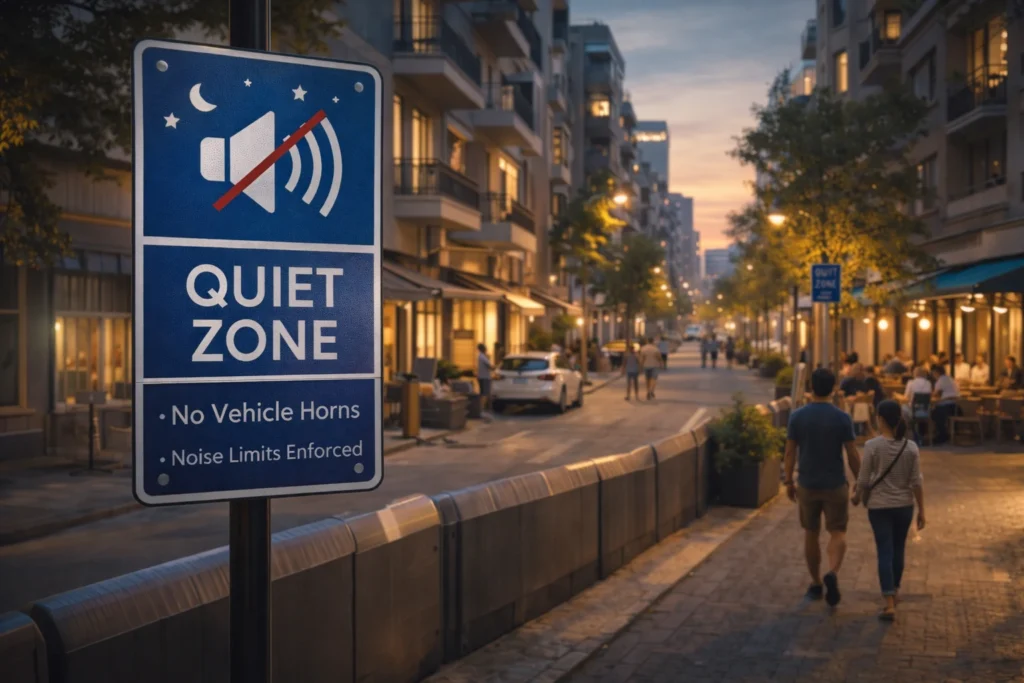
Imagine you’re walking down a busy street in a city that has decided to try this out. It’s a typical urban street, with shops and apartments, cars and buses, the usual city hum. As you walk, you notice a sign. You cross a certain intersection, and there it is, posted on a lamppost. It’s not the usual “No Parking” or “One Way” or “Street Cleaning Tomorrow” sign. This one is different. It has a simple, clear, friendly message. It might say something like: “Quiet Zone: Please Respect Our Community’s Peace.” Or “Welcome to the Smith Street Quiet Zone. Let’s Keep It Calm.” It’s an invitation, a reminder, a gentle nudge that you’re entering a space with a different set of values, a place where quiet is valued and protected.
The first thing you might notice, even before you’re consciously aware of it, is the difference in the traffic sounds. One of the most important and effective rules in a quiet zone places strict restrictions on the use of vehicle horns. You know exactly what we’re talking about. It’s that instant reaction, that reflexive blast of the horn when someone gets cut off in traffic, or when the light turns green and the car in front doesn’t move instantly, or when a pedestrian takes too long to cross the street. The angry, impatient, unnecessary blast of the car horn is one of the sharpest, most stressful, and most pervasive sounds in the urban soundscape. It’s a sound that says aggression, impatience, anger. In a quiet zone, using your horn is restricted to genuine emergencies only. It’s not a tool for expressing frustration or telling someone to hurry up. It’s not a way to vent your anger at the world.
This one single change has a dramatic and almost immediate effect on the atmosphere of a street. The air suddenly feels less charged, less aggressive, less tense. The sharp, jagged edges of the city’s sound are smoothed out. You realize, maybe for the first time, how much of the stress of city streets comes from those sudden, angry blasts. Without them, the whole environment feels calmer, more civilized, more respectful.
Next, you’ll find that these zones put thoughtful and reasonable limits on construction activity. We all know the sound of a jackhammer starting up at 7 a.m. on a Saturday morning. It’s a sound that can instantly shatter a peaceful morning, ruin a precious lie-in, and spike your blood pressure before you’ve even had your first sip of coffee. It’s a sound that says your need for rest is irrelevant, that your comfort doesn’t matter, that the project is more important than the people. Quiet zones recognize that people need times to rest, that weekends and early mornings and late evenings are times when the need for quiet is greatest. The rules restrict the loudest, most intrusive construction work to certain reasonable hours during the weekday. This doesn’t stop development. Buildings still get built, renovations still happen. But the work is scheduled in a way that shows respect for the people who have to live next to it. It’s a simple matter of consideration, encoded into law.
Chapter Twelve: The Architecture of Quiet
The rules in a quiet zone don’t just apply to the street and the sidewalk. They reach right into the buildings themselves, recognizing that the structures we inhabit play a huge role in shaping our soundscape. Businesses operating within the zone are required to do their part by installing what planners call sound-dampening infrastructure. This is where the idea of shared responsibility really comes into focus.
For a lively bar or a popular restaurant, this is a significant undertaking. It might mean investing in expensive double or even triple-paned windows that seal tight against the frame, windows that are designed not just for energy efficiency but specifically to block sound. It could mean adding thick, sound-absorbing insulation inside the walls, not just in one layer but in multiple layers, creating a barrier that music and chatter cannot penetrate. It might involve building a special enclosure around a noisy rooftop HVAC unit, or adding mufflers to an industrial kitchen exhaust fan. It might mean redesigning the layout of the space, putting noisy areas like bars and kitchens away from the walls that adjoin residential apartments.
It’s about recognizing that peace is a shared responsibility, not just something the city imposes on residents. The business gets to operate. It gets to make a living, serve its customers, contribute to the neighborhood’s economy and vitality. But it has to do so in a way that doesn’t rob the people living nearby of their fundamental right to quiet in their own homes. It’s a bargain, a trade-off, a recognition that we all have to share this space and we all have to make compromises to make it work for everyone.
For new buildings being constructed in or near a quiet zone, the standards can be even higher from the start. Imagine an apartment building designed with “acoustic comfort” as a primary goal, right up there with aesthetics, functionality, and cost. The architects might specify extra-thick insulation in the walls between units, not just the bare minimum required by code, but enough to ensure that you can’t hear your neighbor’s conversation or their television. They might install special acoustic windows, which are much heavier, much better sealed, and much more effective at blocking outside noise than standard windows. They might even think about the layout of the apartments themselves, putting living rooms and kitchens, which tend to be noisier and more active, facing the street, while placing the bedrooms, which need the most absolute quiet, on a calm interior courtyard or garden. This kind of thoughtful, intentional design can make a massive, life-changing difference in the daily lives of residents, and it costs very little to include at the design stage compared to the cost of trying to fix problems later.
Chapter Thirteen: The Street as a Soundscape
Even the way we arrange the public space between the buildings, the streets and sidewalks and plazas where people walk and gather, matters enormously for the soundscape of a quiet zone. City planners are learning that they can design streets not just for the efficient movement of vehicles, but for the comfort and well-being of people. They can design for quiet.
One of the most powerful tools in the quiet zone toolbox is something called “traffic calming.” You’ve almost certainly seen examples of this before, even if you didn’t know they had a name. The basic idea is brilliantly simple: use the physical design of the street to force drivers to slow down. On a long, straight, wide road, drivers naturally speed up. The road itself encourages speed. And faster cars mean more noise, lots more noise, both from the engine working harder and from the tires screaming on the pavement.
So, quiet zones use design to interrupt that pattern. Think of a street that doesn’t run straight for more than a block or two. Instead, it curves gently back and forth, like a lazy river. These winding roads, sometimes called “chicanes” in planning jargon, break the driver’s line of sight. They can’t see what’s coming up ahead, so they instinctively ease off the accelerator. The result is a slower, smoother, quieter flow of traffic. Cars drift through the neighborhood rather than roaring through it.
Speed bumps and raised crosswalks are another classic and highly effective tool. They are a physical, unmistakable reminder that this is a place for people, not just a thoroughfare for cars. Drivers have to slow down to a crawl to get over them safely, which dramatically reduces the roar of acceleration and the high-pitched whine of tires at speed. A well-designed raised crosswalk, where the crosswalk is actually built up to the level of the sidewalk, does double duty. It slows traffic and makes it safer for pedestrians to cross, and it also reduces noise.
Then, there’s the road surface itself. In a typical city, the streets are paved with a rough, grooved asphalt. It’s durable, relatively cheap, and easy to maintain. But it creates a constant, loud tire hum as cars pass over it. It’s like the background static of the urban soundscape, a sound so constant that you stop noticing it, but it’s always there, always adding to the overall level of noise. In a quiet zone, planners are increasingly turning to what’s known as “quiet pavement.” This is a special type of asphalt or concrete that has a different texture, a smoother surface that is designed to absorb the sound of the tires rather than reflect and amplify it. It’s the difference between walking on a hardwood floor, which echoes loudly with every footstep, and walking on a thick, soft, plush rug, which muffles the sound completely. Quiet pavement doesn’t eliminate all traffic noise, nothing can do that, but it takes that constant, droning edge off. It lowers the baseline, making the whole environment feel significantly calmer and more peaceful.
Chapter Fourteen: The Green Sound Barrier
Of course, no discussion of building quiet would be complete without talking about the role of green space, of trees and plants and parks. In a quiet zone, nature is not just decorative. It’s a vital part of the acoustic infrastructure.
Think about a wide, tree-lined boulevard. The trees, especially mature ones with large, leafy canopies, are not just beautiful to look at. They are powerful, natural noise fighters. Their leaves, branches, and trunks absorb and scatter sound waves, breaking them up and reducing their energy. The soft soil in planting strips and medians also soaks up sound much more effectively than hard pavement or concrete. A street lined with a thick row of mature trees can feel significantly quieter than a bare, open street, even with exactly the same amount of traffic. The trees act as a living, breathing, growing sound barrier, protecting the sidewalk and the buildings behind them from the noise of the road.
Now imagine the smallest and most precious type of green space in a dense city: the pocket park. These are tiny parks, sometimes no bigger than a single house lot, tucked away between buildings, or created on a reclaimed corner, or carved out of an old parking lot. They are gems of urban design, offering a little bit of nature in the middle of all the concrete and asphalt. In a quiet zone, these little parks are more than just a nice place to sit and eat lunch. They are acoustic refuges, sanctuaries of sound.
When you step into a well-designed pocket park, the sound changes dramatically and immediately. The hard, reflecting surfaces of the street, the pavement and the building walls, are left behind. Instead, you’re surrounded by soft grass, leafy shrubs, maybe some flowering plants, and a few trees. These soft surfaces absorb sound rather than reflecting it. The space feels quieter, more intimate, more protected. The sounds you hear change, too. Instead of the roar of traffic, you might hear the rustling of leaves in the breeze, the chirping of birds, the gentle trickle of a small water fountain, the quiet murmur of other people talking in normal voices. These sounds are not silence, but they are natural sounds, human-scale sounds, sounds that are calming rather than stressful.
These pocket parks become the beating heart of the quiet zone, the places where the benefits of the zone are most intensely felt. They are places where people can go to give their ears and their overworked nervous systems a much-needed break. They are proof, beautiful and tangible proof, that even a small patch of green, thoughtfully designed, can create a large pocket of peace in the middle of a noisy city.
Book Four: The Human Element in the Quiet Equation
Chapter Fifteen: Becoming Noise-Keepers
City planners can redesign streets and write new rules for construction. Engineers can develop quieter pavement and better insulation. Politicians can pass laws and allocate funding. But a quiet zone only truly works, only becomes a living, breathing reality, if the people who live, work, and own businesses there embrace the idea and make it their own. It requires a cultural shift, a change in mindset, a move from thinking of noise as someone else’s problem to understanding that we all contribute to the soundscape and we all have a role in protecting the peace.
It’s about turning residents from passive listeners, who just put up with whatever noise comes their way, into active “noise-keepers,” who feel a sense of ownership and responsibility for their neighborhood’s acoustic environment. This is a profound shift. It means recognizing that your right to make noise ends where your neighbor’s right to quiet begins. It means understanding that your freedom to play loud music at 2 a.m. conflicts with your neighbor’s freedom to sleep. It means accepting that living in a community involves mutual consideration and compromise.
This shift in mindset can start with the smallest, most everyday actions. It’s about becoming more mindful of your own personal noise footprint, the trail of sound you leave behind you as you go through your day. For someone living in an apartment building, this can mean a lot of simple, concrete things. It means being aware that sound travels not just through walls, but through floors and ceilings, through the very structure of the building. It means maybe investing in a thick, beautiful, comfortable rug to put over a hardwood floor, not just because it looks nice or feels good underfoot, but because it will muffle the sound of footsteps and chairs scraping for the person living downstairs. It’s a gift of quiet to your neighbor.
It means being thoughtful about when you run the dishwasher or the washing machine, especially in older buildings where these machines can be surprisingly loud and can vibrate through the walls. It means making a conscious choice, every time, to put on headphones when you want to listen to music or watch a movie late at night. It means recognizing that your entertainment, your choice, should not become your neighbor’s unwelcome obligation. It means closing windows when you’re having a loud conversation or a party, so the sound doesn’t travel out into the street and disturb everyone else on the block. These are tiny acts of consideration, small sacrifices of convenience for the sake of others. But when multiplied across an entire neighborhood, across thousands of people, they add up to a significant, measurable reduction in the overall noise level. They create a culture of quiet.
Chapter Sixteen: Businesses as Partners
For local businesses, the responsibility is even greater, simply because they have the potential to be much louder than a single individual. A popular café with a few tables outside on the sidewalk can be a wonderful asset to a community, a place where people gather, where connections are made, where the neighborhood feels alive and friendly. But if the chatter and the clatter of cups and plates and the music from the indoor speakers echoes down the residential street until midnight, night after night, that café becomes a source of stress and conflict, a problem for everyone living nearby.
In a well-functioning quiet zone, that café owner isn’t seen as an enemy, someone to be regulated and fined into submission. Instead, the owner is seen as a partner, a stakeholder in the community’s well-being, someone who has as much interest in a peaceful neighborhood as anyone else. The goal is to work collaboratively, to find solutions that allow the business to thrive while also protecting the residents’ right to quiet.
This might involve the owner working with the city and with neighborhood groups to create what could be called a “patio management plan.” This would be a simple, agreed-upon set of guidelines, tailored to that specific business and that specific location. Maybe it means closing the outdoor seating area a little earlier on weeknights, at 10 p.m. instead of midnight, recognizing that people need to sleep. Maybe it means investing in some attractive, well-designed sound-absorbing panels to put up along a fence line or a railing, to keep the noise from drifting directly into neighboring bedrooms. Maybe it means training staff to be mindful of noise, to remind customers who are getting too loud that this is a residential area. Maybe it means turning down the volume on the outdoor speakers after a certain hour, or pointing them away from the apartments.
It’s about finding a balance, a way for everyone to coexist. The business gets to operate, to serve its customers, to be a vibrant part of the neighborhood. And the residents get to live in peace, to sleep at night, to enjoy their homes. This kind of collaborative problem-solving, where everyone feels heard and respected, is far more effective and sustainable than simply imposing rules from above and relying on enforcement and fines. It builds trust, strengthens community, and creates a shared sense of ownership over the quiet zone.
Chapter Seventeen: The Power of Community
Community groups and neighborhood associations have a uniquely powerful role to play in the creation and maintenance of quiet zones. They can be the glue that holds the whole thing together, the bridge between individual residents, local businesses, and city government. They can organize, educate, advocate, and celebrate.
Imagine a “sound walk” organized by a neighborhood association on a Saturday afternoon. Neighbors of all ages, families with kids, older people, young professionals, gather at a local park. They’re given a simple map of the neighborhood and maybe a notebook and a pencil. For the next hour, they walk their own streets together, but this time they’re walking with a different purpose. They’re walking with their ears. They’re listening with intention.
They listen for the loudest spots. Is it that one intersection where trucks always seem to idle their engines for minutes at a time, pumping out noise and fumes? Is it the alley behind the restaurants where the garbage trucks come at 5 a.m., with all the crashing and banging of dumpsters? Is it the bus stop where the diesel engines rumble and shudder, especially in the cold weather? Is it the corner where cars constantly honk at each other? Is it the building where someone always plays music too loud? They note it all down, creating a community-generated noise map.
Later, they gather to share their observations. They realize that everyone has noticed the same problems. The noise isn’t just in their individual imaginations. It’s a real, shared issue. Armed with this information, this community-collected data, the neighborhood group can then work constructively with the city. They can approach the relevant city department not with angry complaints, but with specific, documented information. “Here are the locations where trucks idle. Here are the times when the garbage pickup is loudest. Here are the intersections where honking is a constant problem.” They become partners in identifying solutions.
They can advocate for specific, practical changes. A “no idling” sign at that truck stop. A later pickup time for the garbage trucks in that alley. A traffic light timing change to reduce honking. A noise sensor to monitor a particularly problematic spot. When the community becomes the eyes and ears, or rather, the ears and the voice, of the quiet zone, the whole dynamic changes. The rules stop feeling like laws that were imposed from above by some distant, uncaring city hall. They start feeling like shared values, a set of agreements that the community has made with itself, with each other, to protect something precious. It’s about creating a genuine, living, breathing culture of quiet, where peacefulness becomes part of the neighborhood’s identity, and everyone feels they have a part to play in keeping it.
Chapter Eighteen: Stories from the Quiet Zone
To truly understand the power and the potential of these quiet zones, it helps to move beyond the policies and the planning, beyond the decibel readings and the resident satisfaction surveys, and listen to the stories of the real people whose lives are being changed by them. These are the residents who have lived through the noise, who have struggled with it for years, and who are now experiencing what it’s like to live in a place that values quiet. Their experiences, their voices, their stories, turn the abstract concept of “noise reduction” into something real, tangible, and deeply, profoundly human.
Take Maria, for example. We met her earlier. She’s a 58-year-old schoolteacher who has lived in her apartment in a busy part of the city for over twenty years. Before her street was designated as a pilot quiet zone, she describes her life as a constant, exhausting battle against sound. “I loved my neighborhood,” she says, sitting in her small, neat living room. “I loved the little family-owned shops, the incredible diversity of people, the energy and the life of it. But the noise… the noise was relentless. It was like living inside a drum that someone was constantly beating. I’d come home from a long, tiring day of teaching, where I’d been talking and listening and managing a classroom full of children all day, and I just couldn’t find any peace. My apartment never felt like a sanctuary, a refuge. It felt like a bus stop where I happened to sleep.”
Maria’s biggest struggle, the one that wore her down the most, was with sleep. Her bedroom faced the street, a busy street with a steady flow of traffic and a few bars and restaurants. “There was this one bar, just down the block, maybe a three-minute walk,” she remembers. “It wasn’t a rowdy place, not a club with bouncers or anything like that. But they’d have music playing, not loud enough to complain about officially, but just loud enough that you could hear the bass thumping. And people would stand outside on the sidewalk, talking and laughing, having a good time. It wasn’t malicious, it wasn’t aimed at anyone, but the sound would just float right up to my bedroom window, especially on warm nights when I wanted it open.”
Maria tried everything to cope. “I bought an expensive white noise machine, the kind that plays sounds like rain or ocean waves. But that was just adding more noise, more sound in the room. It helped a little, maybe, but it wasn’t silence. I tried sleeping with those foam earplugs, but they were uncomfortable and they made my ears ache, and I’d wake up with them halfway across the room. I felt like I was constantly exhausted, no matter how many hours I spent in bed. I’d fall asleep at my desk grading papers in the afternoon. My doctor said my blood pressure was creeping up, higher than it should be for someone my age who exercises and eats well. I knew, in my gut, that it was related to the stress, to the constant noise, to never really, truly resting.”
Then, her street was chosen to be part of the city’s quiet zone pilot program. The bar down the street was required to install significant soundproofing and, crucially, to close its small outdoor seating area by 10 p.m. on weeknights. A strict “no honking” rule was put in place and, at least initially, enforced. The city even repaved her block with that new quiet pavement. Maria was hopeful, but skeptical. She’d been disappointed before.
“The first few nights after the changes took effect, I couldn’t believe it,” Maria says, her voice softening, her eyes getting a little distant with the memory. “I was lying in bed, waiting for the usual sounds, the bass, the voices, the horns. And they just… didn’t come. I opened my window a crack, just a tiny bit, because I was used to needing fresh air, even with the noise. And I heard… almost nothing. There was this faint, distant hum, like the city was still there but very far away. But my room, my bedroom, was quiet. It was actually, genuinely quiet.”
Maria pauses, gathering herself. “I slept for nine hours straight that night. Nine hours. I woke up and for a full minute I didn’t know where I was. I felt disoriented, but in a good way. I felt rested. I felt like a different person, like I had been sick for years and didn’t even know it, and suddenly I was well again.”
Months later, the change has been permanent and profound. Maria’s blood pressure has improved. She has energy in the afternoons. She enjoys her home, her sanctuary, in a way she never did before. “It’s not just about the sleep, though that’s the biggest part of it,” she explains carefully. “It’s about the feeling of having a refuge, a place that is truly yours, where you can go and the world stops demanding your attention. I can come home, close my door, and feel the stress of the day, all the little frustrations and pressures, just melt away, because the noise stops at the threshold. It’s like the noise was keeping all that stress alive, and now it’s gone. I feel like I got my life back. I feel like myself again.”
Chapter Nineteen: The Business of Quiet
Then there’s the story of the corner grocery store on the same block as Maria’s apartment. It’s a classic city bodega, the kind of place that sells a little bit of everything, milk and bread and snacks and cleaning supplies and lottery tickets. The owner is a man named David, who has run the store for over fifteen years. He was initially very worried about the quiet zone. He thought it would be bad for business.
“I was sure people would think the neighborhood was becoming dead, you know, boring, like a retirement home,” David says, leaning on his counter. “I thought the ‘no honking’ rule would make drivers avoid the street entirely. I thought people would go somewhere else, somewhere with more ‘energy.’ I was really against it at first.”
David was wrong. What he found, to his surprise and relief, was that the quieter street actually brought more customers, especially a different kind of customer than he was used to seeing. “We started getting more families with young kids, parents pushing strollers,” he observes, waving his hand toward the street. “Parents felt safer and more comfortable walking down the street with a baby because it wasn’t so loud and aggressive. The traffic was slower, the cars were quieter, the whole atmosphere was calmer. They didn’t mind stopping and browsing. They’d come in for a soda or a snack.”
The change wasn’t just about families. “Older people started coming by more often, too. People who had lived in the neighborhood for decades but had stopped walking around as much because it was just too noisy, too stressful. Now they’re out and about again. They’d stop and chat outside the store. They’d come in and buy a newspaper and just talk for a few minutes. It started to feel less like a busy city street and more like a small town, where people know each other and take the time to say hello.”
David’s business didn’t just survive the quiet zone. It improved. “My numbers actually went up, a little bit, but consistently,” he says with a smile. “People want to be in places that feel calm and pleasant. They’ll go out of their way for it. The quiet zone didn’t make my street dead. It made my street a destination, a place people want to be, not just a place they have to pass through to get somewhere else.”
These personal stories, from Maria’s restored health and peace of mind to David’s improved business and sense of community, show that the quiet zone is about so much more than just decibel readings on a chart. It’s about creating a better, healthier, more connected, more human way of life. It’s about restoring something fundamental that had been lost.
Book Five: The Challenges and The Future
Chapter Twenty: Overcoming the Skeptics
Of course, no big new idea, no significant change to the way things have always been done, comes without its challenges and its critics. The push for quiet zones has certainly met with its share of skepticism, opposition, and legitimate concerns. Not everyone is immediately on board, and city planners have had to listen carefully to these concerns, take them seriously, and find creative ways to address them. The path to a quieter city, like any path to a better future, isn’t always a smooth and easy one.
One of the most common and understandable complaints, especially from people who genuinely love the energy and excitement of a big city, is the fear that quiet zones will make neighborhoods feel “sterile” or “boring.” They worry that turning down the volume will suck the life and vitality out of a place, turning it into a kind of outdoor library where no one is allowed to have any fun. They picture a city where everyone is shushing each other, a place with no music, no laughter, no spontaneous street life, no energy. It’s a valid concern, and it comes from a genuine love of urban life. A city that was completely silent would be a city that was dead, a ghost town.
The key is to understand that the goal of a quiet zone is not to create a library-like hush over an entire neighborhood, twenty-four hours a day, seven days a week. That would be both impossible and undesirable. The goal is much more nuanced and intelligent. It’s to reduce the harmful, chronic, mechanical, and unnecessary noise, the stuff that nobody actually likes, the stuff that just adds to the background stress level. It’s about turning down the roar of the machines so that the good sounds, the sounds of human life and human community, can be heard again.
It’s the difference between a street where the soundscape is dominated by the roar of engines, the blare of horns, and the drone of machinery, and a street where those sounds are diminished, and you can hear the laughter of children playing in the park, the music from a street musician playing a guitar, the friendly chat between neighbors on the sidewalk, the sounds of birds in the trees. It’s about improving the quality of the sound, not just the quantity. It’s about shifting the balance from machine noise to human noise.
Chapter Twenty-One: Economic Concerns
Another major source of pushback, and a very understandable one, often comes from businesses and property developers. They hear the words “quiet zone” and they immediately think “more government regulations” and “higher operating costs.” A restaurant owner, already struggling with thin margins, might worry about the significant expense of installing professional soundproofing. A construction company might chafe at having to limit its working hours, which could delay a project and increase costs. A property developer might see the acoustic requirements for new buildings as just another hurdle, another layer of red tape, that makes it harder and more expensive to get a project built.
These are real, legitimate economic concerns, and they can’t just be dismissed or ignored. If quiet zones are going to work, they have to work for everyone, including the businesses and developers who are essential to the city’s economy. The key for city planners is to work with these groups, not against them. It’s about finding solutions that meet the goal of reducing noise without placing an unreasonable burden on commerce.
This might mean offering positive incentives, not just imposing penalties. A city could offer tax breaks or partial rebates for businesses that invest in soundproofing, recognizing that they are providing a public benefit. It could offer faster, streamlined permit processing for developments that meet high acoustic standards from the start. It could create a grace period for existing businesses, giving them a reasonable amount of time, perhaps a year or two, to come into compliance with new rules, allowing them to plan and budget for the necessary changes. It could even offer low-interest loans or grants to help small businesses afford the improvements.
It’s about framing the quiet zone not as a punishment for businesses, not as another burden, but as an investment in the neighborhood’s long-term desirability and economic health. A quieter, more pleasant neighborhood is a neighborhood where property values tend to rise, where more people want to live, and where more customers want to shop and dine. In the long run, the quiet zone benefits everyone, including the businesses that initially opposed it. The challenge is to help them see that long-term benefit and to support them through the short-term transition.
Chapter Twenty-Two: The Enforcement Puzzle
Then there’s the sheer, practical, logistical challenge of enforcement. Who is going to go around making sure people aren’t honking their horns unnecessarily? Who is going to check that a bar has actually turned down its music or closed its patio on time? Who is going to measure whether a construction site is exceeding the permitted noise levels? Cities can’t afford to put a police officer or a noise inspector on every corner of every quiet zone, twenty-four hours a day. That would be impossibly expensive and also a pretty unpleasant way to live, with constant surveillance.
The answer, again, lies in a combination of community involvement and smart, modern technology. As we saw earlier, when residents become genuinely invested in their quiet zone, when they feel a sense of ownership and pride in it, they become the most effective first line of enforcement. They’re not out there being confrontational or trying to be the noise police themselves. But they are aware. They notice when something is wrong. And they know how to report it through the proper channels, whether that’s a simple phone app, a website, or a call to a dedicated noise complaint line. They become the city’s partners in maintaining the peace.
Technology can also play a huge and growing role. Cities are experimenting with networks of low-cost, permanently installed noise sensors that can monitor decibel levels in real-time, twenty-four hours a day, seven days a week. These sensors don’t identify individual people or cars, so there are no privacy concerns. They don’t record conversations. They simply measure the overall noise level, the way a thermometer measures temperature. If the noise level spikes above a certain threshold, the sensor sends an alert.
This data is incredibly powerful. It shows patterns. If a sensor shows that noise levels on a particular block spike every night at exactly 2 a.m., the city can investigate the source. Is it a particular club letting out? Is it a garbage truck route that could be rescheduled? Is it a delivery truck that idles for an hour? The data points to the problem with precision, without requiring someone to be there in person at 2 a.m. every night. It’s a smarter, more efficient, and less intrusive way to enforce the rules. It’s enforcement based on evidence, not on random complaints.
Chapter Twenty-Three: The Question of Fairness
Finally, and perhaps most importantly, there’s the fundamental question of equity and fairness. If quiet zones are such a great idea, if they bring such clear benefits to health and well-being, then who gets to live in them? Is there a serious risk that they will only be created in wealthier, more powerful neighborhoods, becoming yet another desirable amenity that is out of reach for lower-income residents? Will quiet become just another thing that money can buy, like private schools or access to parks?
This is a crucial question, and it goes to the heart of what kind of cities we want to build. The health problems caused by noise pollution, the sleep disorders, the heart disease, the cognitive impairment, the mental stress, affect everyone. But they don’t affect everyone equally. Numerous studies have shown that low-income neighborhoods and communities of color are disproportionately likely to be located near major sources of noise, such as highways, airports, rail yards, and industrial zones. The people who are already facing the greatest economic challenges, who have the fewest resources to cope with additional stress, are often the ones who bear the heaviest burden of noise pollution. They are, in effect, paying for the city’s transportation and industry with their health and their peace of mind. This is a fundamental issue of environmental justice, and it cannot be ignored.
A just, fair, and ethical approach to quiet zones must prioritize these overburdened communities. The goal should not be to create quiet oases for the wealthy, while leaving everyone else to suffer. The goal should be to bring the gift of quiet, the public health benefit of reduced noise, to the people who need it most. This means that cities need to be proactive, not just reactive. They need to use noise maps, which are now readily available, to identify the loudest, most noise-polluted neighborhoods in the city. They need to analyze demographic data to see which communities are bearing the greatest burden. And then they need to target their investments, their pilot programs, their quiet zone designations, to those neighborhoods first.
Quiet should not be a luxury good, something you can only enjoy if you can afford to live in an expensive, protected neighborhood. It should be a public health right, as fundamental as access to clean air and clean water. Every resident of a city, regardless of their income or their background, deserves the chance to live in a place where they can sleep, where they can think, where they can find some peace. Building quiet zones in the noisiest, most neglected neighborhoods is not just good policy. It’s a matter of basic fairness and human dignity.
Book Six: Looking Forward to a Quieter World
Chapter Twenty-Four: A New Vision for Cities
The early successes of these first quiet zone experiments, the positive stories from residents like Maria, the unexpected benefits for businesses like David’s store, are causing a ripple effect throughout the world of urban planning and design. What started as a few small, tentative pilot programs in a handful of forward-thinking cities is now being looked at as a potential model for the future of urban living. Planners, architects, public health officials, and elected leaders are starting to think much bigger.
They are beginning to believe that noise management, the deliberate and thoughtful design of urban soundscapes, won’t just be a nice little extra for a few lucky neighborhoods. It won’t be a special designation for a select few. Instead, it could and should become a core, fundamental part of how we design, build, and manage all of our future cities, in the same way that we think about water supply, sewage systems, electricity grids, and public transportation. It belongs right up there with clean air, clean water, parks, and public transit as an essential component of a healthy, livable, sustainable urban environment.
Imagine a future where, when a developer proposes a new high-rise apartment building, the city’s review process doesn’t just ask the standard, routine questions. It won’t just be about how many parking spaces it will have, or whether it fits the local zoning laws, or what the view will look like from the street. The city will also ask a whole new set of questions, questions that would have seemed strange just a few years ago but will soon seem completely normal and necessary.
“How will this building contribute to the neighborhood’s soundscape?” they will ask. “Will it have a quiet, protected interior courtyard where residents can escape the noise of the street, a place of genuine acoustic refuge? Will its mechanical systems, the elevators, the ventilation fans, the heating and air conditioning units, be designed and installed to be as silent as possible, so they don’t disturb the residents or the neighbors? Will the ground-floor retail spaces, the future restaurants and bars and shops, be designed with soundproofing from the very beginning, built into the walls and windows and floors, so that a future business doesn’t become a noise problem for the people living upstairs?” This kind of forward-thinking, sound-conscious design, this acoustic planning, could be baked into the process from the very first sketch, becoming as routine as ensuring the building has enough exits or that the plumbing meets code.
Chapter Twenty-Five: The Healthy City Movement
This new approach to noise is part of a much larger and truly exciting shift in how we think about cities, a shift that is sometimes called the “healthy city” movement. For decades, city planning was largely about function and efficiency. It was about moving cars and people as quickly as possible from point A to point B. It was about providing basic services like water and electricity and garbage collection. It was about accommodating growth and development. These things are still important, of course. But the healthy city movement adds a new, essential dimension: the health and well-being of the people who actually live in the city.
This movement recognizes that the physical environment of a city, the design of its streets, the quality of its air, the availability of its parks, the level of its noise, has a profound, measurable, and direct impact on the physical and mental health of the millions of people who call it home. It recognizes that a city is not just a machine for living and working. It’s a living environment that shapes our bodies and our minds every single day.
We already know, from decades of research, that having access to parks and green space is vital for mental well-being, for reducing stress, and for encouraging physical activity like walking and jogging. We know that designing cities to be walkable and bikeable, rather than completely car-dependent, reduces obesity and improves cardiovascular health. We know that reducing air pollution, by promoting electric vehicles and public transit, is essential for our lungs and our hearts, reducing rates of asthma, lung cancer, and heart disease.
Now, thanks to the growing body of research we’ve explored in this story, we are adding quiet to that list of essential, non-negotiable ingredients for a healthy city. We are recognizing that a truly great, truly healthy, truly humane city isn’t just one with a strong economy and world-class museums and vibrant nightlife. It’s one that also gives its residents the fundamental, basic right to rest, to sleep soundly, to think clearly, to hear themselves think, to escape the constant, grinding assault on their senses. It’s a city that values peace as much as it values productivity, quiet as much as excitement, restoration as much as activity.
Chapter Twenty-Six: Learning to Listen Again
The rise of the quiet zone is, at its deepest level, a story about learning to listen again. It’s about a world that became so incredibly, unimaginably loud, so filled with the roar of our own machines and devices and ambitions, that we forgot what we were missing. We forgot the value of silence. We forgot that silence is not just the absence of sound. It’s not empty. It’s not boring. It’s not a void.
Silence is full of possibility. It’s the quiet, open space needed for a deep, meaningful conversation with someone you love, where you can really hear each other. It’s the focused, undisturbed calm required to finish a difficult, creative project, to have a truly original thought, to solve a complex problem. It’s the deep, uninterrupted, restorative sleep that lets us wake up feeling whole, healed, and fully human. It’s the space where we can hear our own inner voice, our own thoughts, our own feelings, without the constant static of the outside world drowning them out.
Cities are finally starting to listen. They are listening to the scientists and public health researchers who have documented, with increasing precision and certainty, the immense health damage caused by chronic noise exposure. They are listening to the data from noise monitors that show, in stark numerical terms, just how loud our world has become, how the decibel levels have crept up year after year. And most importantly, most powerfully, they are starting to listen to the people. They are listening to the millions of tired, stressed-out, sleep-deprived residents, the Amaras of the world, who just want a little peace and quiet in their own homes, who just want to be able to sleep, to rest, to feel calm in the place where they live.
They are learning, slowly and sometimes reluctantly, that silence is not the enemy of a vibrant, exciting, dynamic city. It is not a sign that a place is dead or boring. On the contrary, silence is the essential partner of urban life. It is the necessary balance to all the activity and energy. It is the calm that makes the excitement possible. A city without quiet is a city out of balance, a city that is slowly, subtly, making its own residents sick.
The search for silence in our cities is just beginning. There are many challenges ahead, many obstacles to overcome, many questions to answer. There will be conflicts and controversies. There will be setbacks and disappointments. But it is a journey, a movement, that is already underway, and it is a journey toward a healthier, happier, more equitable, more sustainable, and more deeply human way of living together in the dense, complex, exciting, and challenging places we call home.
It is a powerful, hopeful reminder that in the middle of all our hustle and bustle, our non-stop connectivity and constant stimulation, our twenty-four-hour news cycles and always-on digital lives, sometimes the most important, most radical, most revolutionary thing we can do is the simplest thing of all. It is to simply stop, for a moment. To take a deep, slow breath. To listen to the world around us, really listen. And to find, in the midst of all the noise, a little bit of quiet.