
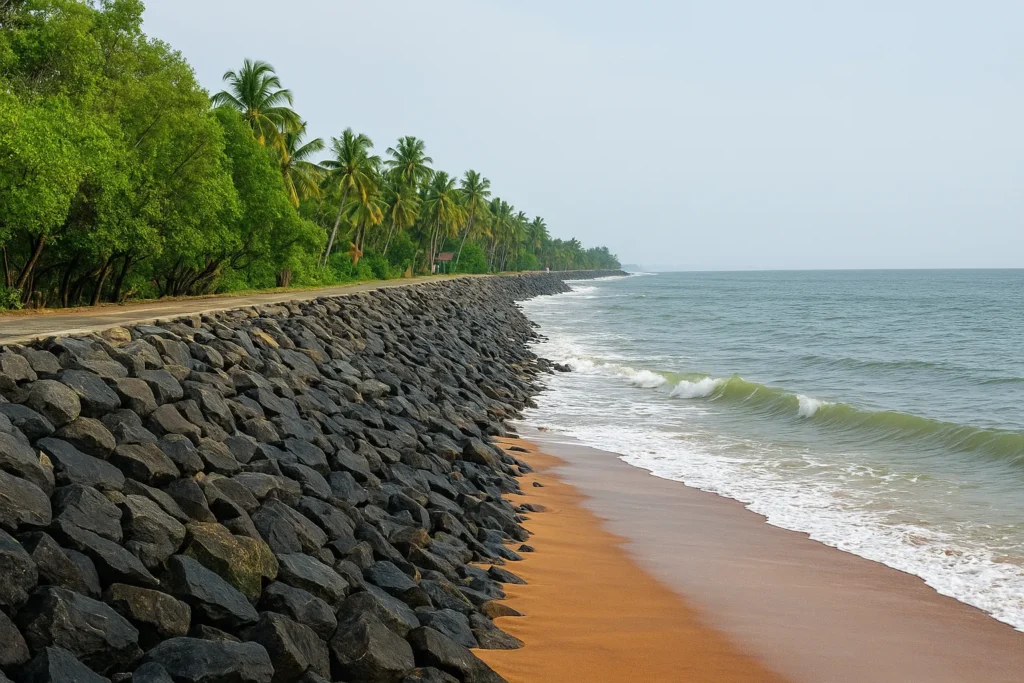

The Night the Ocean Came for Chellanam
Old Salvi leaned against the rough, sea-sprayed wall of his home in Chellanam, a fishing village on the edge of the Indian subcontinent. For seventy years, he had listened to the Arabian Sea’s rhythms—its gentle lullabies during calm seasons and its furious tempers during the monsoons. He could predict the weather by the taste of the air and the colour of the sunset. But on this oppressive night in July, the ocean’s roar felt different. It was closer, more insistent, a guttural hunger that seemed to vibrate through the very laterite soil beneath his feet. The wind howled, whipping coconut palms into a frantic, dancing frenzy, and the rain fell not in drops but in solid, punishing sheets of water that stung the skin.
Then came the sound he had dreaded for a decade: a deep, resonant thump, followed by the sickening, granular crunch of stone and mortar yielding to an irresistible force. The sea wall, the village’s aging, crumbling, and only defense, was being devoured piece by piece. Seawater, dark, cold, and laden with the debris of a shattered coastline, began to rush through the narrow alleyways of the village. It swirled around his ankles, then his knees, rising with a terrifying swiftness. The photographs of his grandchildren, the small altar to his patron saint, the woven mats on the floor—all were swallowed by the invading saltwater. He knew it was time to go. With a heart heavier than his soaked, hastily packed bag of belongings, Salvi joined the slow, grim procession of his neighbors, all wading in a shocked silence towards the dim, generator-powered lights of the relief camp set up in the local government school. His grandson, Anil, held his arm, steadying him against the current that tugged at their legs. “It never used to be like this, Appuppa,” Anil shouted over the storm’s cacophony. “The sea never used to come into our homes, into our lives, every single year.”
Salvi’s story is not a unique tragedy. It is a chilling refrain that echoes along the entire 590-kilometer coastline of Kerala, a state whose very identity, culture, and history are inextricably intertwined with the sea. For generations, the ocean was a provider—a source of sustenance, a highway for trade, the backdrop for poetry and song. Now, for communities from the southern tip of Thiruvananthapuram to the northern reaches of Kasaragod, the sea has transformed into a threatening, insatiable neighbor, slowly, inexorably, claiming the land they call home. This is the story of a state fighting back with every tool at its disposal, not just with granite and concrete, but with mangroves, community spirit, scientific innovation, and a desperate, heart-wrenching race against the rising tide and the turning of the calendar.
Understanding the Enemy: What is Coastal Erosion and Why is it Happening?
To truly comprehend the scale of Kerala’s battle, we must first understand the enemy. Coastal erosion is the gradual, natural wearing away of land and the removal of beach or dune sediments by the perpetual motion of waves, tidal currents, or drainage. It is a fundamental geological process. However, in Kerala, this process has been supercharged into a full-blown societal crisis by a potent, toxic combination of human activity and accelerating natural changes. The coast’s natural equilibrium has been shattered.
The Natural Forces Unleashed
The natural balance of Kerala’s coastline is being systematically dismantled by powerful, global forces that operate on a scale far beyond local control.
- The Rising Sea: As our planet warms, polar ice caps and glaciers melt at an unprecedented rate, and seawater itself expands as it heats up—a phenomenon known as thermal expansion. This causes global sea levels to rise. For a low-lying, densely populated coastal state like Kerala, even a few centimetres of rise can have catastrophic consequences. It means that storm surges push much farther inland than they did a generation ago, reaching homes and farms that were once considered safe. The high-tide line on a map is being redrawn by the ocean itself.
- Angrier Monsoons: Climatologists and meteorologists are increasingly convinced that climate change is making the Indian monsoon more intense, erratic, and unpredictable. The waves that pound Kerala’s shores during the rainy season now carry more raw energy, chewing away at the coastline with unprecedented fury. The gentle, seasonal replenishment of sand is being overwhelmed by this new, destructive power.
- Increased Cyclonic Activity: The Arabian Sea, once a relatively calm body of water compared to the storm-prone Bay of Bengal, has seen a alarming and documented rise in the number and intensity of cyclones. These massive, swirling engines of destruction suck up warm water and unleash catastrophic winds and devastating storm surges that can reshape the coastline, alter inlets, and erase beaches in a matter of days. The memory of Cyclone Ockhi still haunts the fishing communities, a stark reminder of this new reality.
The Human Hand: How We Accelerated the Crisis
While nature provides the push, a series of human actions over decades have made the coastline dangerously, critically vulnerable. We have, in effect, dismantled our own defenses.
- The Harbor Effect: Starting in the 1950s in the drive for modernization and economic growth, the construction of harbors and protective breakwaters, while vital for the fishing industry and trade, had a profound and unintended consequence. These massive, rigid structures act as insurmountable barriers to the natural flow of sand along the coast, a process known as littoral drift. Think of it as a river of sand flowing just offshore. When a breakwater is built, it blocks this river. Sand piles up on the ‘up-drift’ side, starving areas ‘down-drift’ of the essential sediment they need to replenish and protect themselves. It’s like building a dam across a river of sand, leaving communities downstream parched and exposed to erosion.
- The Vanishing Shields: Imagine a natural, living, self-repairing wall that absorbs wave energy, traps sediment, and provides a rich nursery for fish and crustaceans. That was Kerala’s magnificent mangrove ecosystem. These complex forests were the coastline’s shock absorbers. Over the last thirty years, driven by population pressure and development needs, approximately 95% of these vital mangroves have been cleared for agriculture, aquaculture ponds, and urban development. Without this “bio-shield,” the waves hit the bare shore with their full, unchecked, erosive force.
- Sand Mining: The unsustainable, often illegal, mining of sand from rivers and beaches for the booming construction industry has robbed the coastline of its fundamental building blocks. When sand is taken from rivers, it never reaches the sea to rebuild beaches naturally. When it’s taken directly from the beaches, the land is left naked, defenseless, and ready to be carved away by the next high tide. This is a direct and tragic case of building cities inland by destroying the protective shores.
Professor A. Biju Kumar, an eminent environmental scientist from the University of Kerala, puts it bluntly: “The seashore degradation started in Kerala in the 1950s, primarily due to unscientific constructions in the seashore.” He underscores that these massive, rigid structures, predominantly harbor breakwaters, were built in total disregard of the dynamic, fluid, and ever-changing nature of the coastal ecotone. Crucially, he points out the catastrophic failure to implement standard global mitigation practices, such as beach nourishment systems—the artificial replenishment of sand—which are considered essential civil engineering practice whenever large structures disrupt the natural sand budget. The consequence is a crisis engineered by humanity and magnified by a changing climate.
A Tapestry of Solutions: Kerala’s Multi-Pronged Attack on Erosion
Faced with this escalating, existential crisis, the Kerala government, local communities, activists, and scientists are not relying on a single magic bullet. There is no simple solution. Instead, they are weaving a complex, often contentious, tapestry of solutions, combining traditional hard engineering with soft, natural defenses, and hoping the patchwork holds.
The Hard Shield: Sea Walls, Groins, and Geobags
When a storm is raging and homes are imminently about to be washed into the sea, the immediate, emergency response requires hard, physical barriers. The philosophy is simple: fight force with mass.
- The Age of Granite: For decades, the go-to solution has been the sea wall—massive, imposing structures of stacked granite boulders that line the shore like a defensive fortification. They are designed to absorb and deflect the raw energy of the waves. While they have saved countless properties and lives in the short term, they are incredibly expensive, visually intrusive, and come with a significant downside. The reflected wave energy can scour the seafloor directly in front of the wall, digging a deeper trough and eventually undermining the wall’s own foundation, causing it to collapse spectacularly. Furthermore, they often simply shift the erosion problem to the neighboring, unprotected areas, solving one community’s crisis while creating another’s.
- The Geobag Experiment: In recent years, especially in emergency situations in villages like Chellanam, the government has turned to geobags. These are massive, durable synthetic containers, like giant pillows, filled with sand. They are laid along the threatened shoreline, creating a flexible, temporary barrier. They are cheaper and faster to deploy than granite, and their flexibility can sometimes be an advantage. But they are not a permanent fix. They can be punctured by sharp debris, displaced by powerful waves, and visually, they are a stark admission of a desperate, stop-gap measure, requiring constant maintenance and replacement.
- The Offshore Breakwater Vision: A more advanced, and hopefully more effective, hard-engineering solution is the geo-tube offshore breakwater project. These are massive, tube-shaped structures made of engineered geotextile material, placed offshore, parallel to the coast. Their goal is to break the power of the waves before they even reach the shore, creating a calmer zone of water between the breakwater and the beach where sand can naturally accumulate. The state’s 2025 budget allocated a significant ₹100 crore specifically for these projects, signaling a major commitment to this newer, more complex technology.
The Soft Shield: Bringing Back Nature’s Defenses
Recognizing the profound limitations and unintended consequences of hard engineering, Kerala is increasingly, and wisely, turning to a more ancient, resilient, and sustainable form of protection: nature itself. The goal is to work with ecological processes, not against them.
The Mangrove Miracle
Mangroves are not just trees that happen to grow in water; they are intricate, living, breathing coastal defense systems. Their dense, tangled, above-ground root systems act like a giant, porous net, effectively dissipating wave energy and dramatically reducing the force of storm surges. They also act as natural sediment traps, helping to build up the land vertically, keeping pace with sea-level rise, rather than allowing it to erode.
- The Mangrove Man of Kochi: In the vast, intricate backwaters of Kochi, a quiet, unassuming man named Murukesan has become a local legend. For years, while officials debated policies, he has single-handedly planted and nurtured thousands of mangrove saplings. His hands, gnarled and permanently stained with rich, black mud, have gently placed young mangroves into the soft, tidal mudflats with the care of a parent. “Each sapling is a soldier in our fight against the sea,” he says, wiping his brow under the relentless sun. “They work for free, they grow stronger every year, they multiply, and they bring the fish, the crabs, and the birds back with them. They bring life back.” His quiet, relentless dedication has inspired a whole movement, leading to formal collaborations with national research foundations.
- Large-Scale Restoration: Recognizing the power of this grassroots work, the Buimerc Foundation, in a powerful partnership with the internationally renowned M.S. Swaminathan Research Foundation (MSSRF), has launched an ambitious, carefully planned three-year mangrove restoration project. The pilot program is not small-scale; it aims to cover 10 km along the critically eroded Vypeen coast in its first year alone, with a target of developing and distributing 20,000 high-viability saplings for organized community planting. The project includes setting up a formal ‘mangrove field school’ to teach the next generation the art, science, and economics of sustainable coastal restoration.
Beach Nourishment: Feeding the Sands
Another “soft” engineering technique being explored is beach nourishment. This involves dredging and pumping vast quantities of sand from offshore locations and spreading it onto the eroding beach, essentially rebuilding and widening it artificially. It’s like feeding a starved coastline. While it can be very expensive and needs to be repeated every few years as the sand naturally washes away, it has the huge advantage of preserving the natural beauty and recreational value of the beach, unlike a harsh, monolithic sea wall. It is a sacrificial buffer, but one that maintains the ecosystem’s function.
The Human Dimension: Relocation, Protest, and the Pain of Leaving Home
Behind the high-level policy debates, the engineering reports, and the scientific studies, lie the raw, emotional, and deeply human stories of Kerala’s coastal residents—the fisherfolk, the coir workers, the small-scale farmers, and the shopkeepers whose lives and identities are being fundamentally upended by the advancing waves.
The Punargeham Project: A New Home, A Lost Heritage
The Kerala government’s Punargeham project is an ambitious, and controversial, initiative to permanently relocate the most vulnerable families away from the high-risk zones to safer ground inland. The project received an additional ₹20 crore in the 2025 budget to accelerate this process, highlighting its political priority.
For some, like Marykutty, a 65-year-old widow living in a crumbling, damp shack just meters from the sea in Alappuzha, the offer of a safe, dry, concrete home inland is a godsend, an answer to a lifetime of prayers. “I pray every night that the sea will not take me in my sleep,” she whispers, her voice trembling. “I am ready to go. I am tired of fighting. I am tired of being afraid.”
But for others, particularly the younger generation of active fishermen, relocation feels less like a rescue and more like a spiritual and cultural amputation. The sea is not just a threat; it is their livelihood, their identity, their history, their very reason for being. “They want to move us two kilometers inland,” says Suresh, a young fisherman in Thiruvananthapuram, his voice thick with frustration. “My boat, my nets, my drying yards, my entire life is here, on this shore. How will I feed my family? How will I hear the sea call me in the morning? A fisherman living away from the sight and sound of the waves is like a bird in a cage. They are saving our bodies but killing our souls.”
The Streets as a Platform: When Protests Become the Only Language
The frustration, desperation, and feeling of being ignored have repeatedly boiled over into passionate, disruptive public protest. When pleas are met with bureaucratic delay, the streets become the only platform left.
In a dramatic display of raw anger in June 2025, hundreds of fisherfolk in Thiruvananthapuram blocked the main road leading to the domestic airport for over three hours, bringing traffic to a standstill. Their demand was simple, direct, and born of desperation: build the sea wall you promised us, and build it now. They held up hand-painted placards and shouted slogans, their voices growing hoarse from the rain and their own rage. “They allocated ₹2 crore,” one protest leader yelled into a crackling megaphone, “but all we have seen are meetings, files, and delays, while our homes are literally being washed into the sea!” The protest, a powerful symbol of a community’s broken trust, only ended when senior government officials arrived on the scene and gave a firm, written assurance that work would begin within days.
These protests are not just about demanding immediate concrete solutions; they are a profound cry for recognition, for dignity, for a seat at the table in the decisions that will determine their very future.
The Legal Arena: Courts, Laws, and the Fight for Accountability
As the crisis deepens and government action is perceived as slow or inadequate, the judiciary has emerged as a powerful, unexpected player, holding the executive’s feet to the fire and forcefully reinforcing long-ignored environmental laws. The courts have transformed from passive arbiters to active, hands-on managers of the ecological crisis.
The Chellanam Hearing: A Judge’s Impatience
In a packed, humid courtroom in Kochi, a High Court judge listened with growing impatience as officials from the Irrigation Department detailed the technical reasons for the delays in placing geobags along the Chellanam coast. The judge’s expression, initially neutral, grew increasingly stern. “You are telling this court that it will take four more months to complete this basic work?” he asked, his voice laced with cold, judicial disbelief. “And may I respectfully ask how you plan to execute this work when the monsoon clouds are already gathering on the horizon? What are the people of Chellanam supposed to do in the meantime? Swim?”
The court then did something that sent a ripple through the bureaucracy. It moved beyond mere commentary and issued a specific, actionable order: the Ernakulam District Collector was to personally convene an emergency meeting between the department and the Chellanam village council within 48 hours to find a way to expedite the work immediately. The judiciary was no longer just a spectator; it was actively dictating the timeline and demanding accountability.
The Kunhimangalam Judgment: A Landmark for Mangroves
Perhaps the most significant legal intervention for environmental protection in recent years came from the Kerala High Court in a case concerning the large-scale, illegal destruction of pristine mangrove forests in Kunhimangalam Village, Kannur. The court’s ruling was a powerful, thunderous affirmation of the intrinsic and functional importance of natural ecosystems.
The judges condemned the inaction and negligence of the local authorities in the strongest possible terms, stating that the environmental disaster was created “because they did not take any action in time to prevent the damage.” They issued a series of forceful, non-negotiable orders that set a major precedent:
- All official respondents were given a strict three-month deadline to clear all debris and waste and fully restore the degraded mangrove site to its natural ecological state.
- The Conservator of Forests, Social Forestry, Kozhikode, was named the single, personally accountable authority responsible for ensuring the full and timely compliance with the court’s judgment.
- The state government was explicitly directed to formulate and implement a robust, transparent plan for the regular, systematic monitoring and protection of the mangrove ecosystem in Kunhimangalam.
- A three-member independent expert team was ordered by the court to conduct periodic surprise visits and submit detailed, public reports regarding any and all violations of the strict Coastal Regulation Zone Notification.
The court’s powerful judgment went beyond legal procedure; it was a lesson in ecology, unequivocally underlining the functional, life-saving importance of mangroves, stating that they “collected sediments at the tree roots, which helped protect the lives of the people and prevent property damage from flooding.” This landmark judgment established the critical legal precedent that the protection of this ecosystem is a foremost state and judicial priority, stressing the irreversible loss that occurs because “once damaged, its natural integrity and ecological functions could not be readily reconstructed.”
The Road Ahead: Weaving a Sustainable Future for Kerala’s Coast
The path forward for Kerala is not simple, linear, or easy. It requires a fundamental, philosophical shift from reactive, piecemeal, and politically motivated solutions to a proactive, integrated, and holistic coastal management strategy based on the best available science and genuine, inclusive public participation.
The Power of Knowledge and Classification
Scientists and researchers have long proposed a more scientific, data-driven basis for action. They suggest systematically classifying every single segment of Kerala’s seashores into clear, unambiguous categories based on the measurable intensity of erosion:
- Severely Eroded (Immediate, high-intensity intervention needed)
- Highly Eroded (Urgent action required)
- Moderately Eroded (Managed realignment and monitoring)
- Slightly Eroded (Preventative measures)
- Prone to Erosion (Planning and zoning restrictions)
- Erosion-Free (Conservation and maintenance)
Such a nuanced, scientific classification would allow the government to prioritize spending, avoid wasting resources on areas that are stable, and apply the most appropriate, cost-effective solution for each specific segment of coastline, rather than the current one-size-fits-all approach of building walls everywhere.
Community-Led Coastal Management
A recurring theme in successful coastal management projects around the world is the principle of local participation and ownership. The people who know the sea’s moods and the land’s secrets must be partners, not passive recipients. As one expert, E. Shaji, an associate professor at the University of Kerala, passionately advocates, what is desperately needed are “local-level participatory coastal zone management projects” led by democratically-formed district-level committees that include fisherfolk, farmers, women’s group leaders, and local elected representatives. The knowledge held in the memory of an old fisherman is as valuable as the data in a scientist’s spreadsheet.
A Coordinated Institutional Response
A crisis of this geographic and social scale demands a “whole of government” approach. Experts have proposed the creation of a high-powered, cross-departmental coordination committee, headed by the Chief Minister himself, to cut through red tape and ensure that projects from various departments—Water Resources, Forests, Fisheries, and Local Governments—work in sync, share data, and are completed in a strict, time-bound manner. Siloed action is a recipe for continued failure.
A Tapestry of Hope: Weaving Together the Threads
Back in the noisy, overcrowded relief camp in Chellanam, Salvi’s grandson, Anil, is not sitting idle in despair. He has joined a growing group of young volunteers working with the Buimerc Foundation. On weekends, he trades his fishing net for a pair of mud-caked gloves and a heavy bag of mangrove saplings. He wades into the muddy, nutrient-rich flats near his battered, abandoned home, carefully planting the young, green trees, one by one, in a determined, quiet ritual of hope.
He sees the older generation’s unwavering reliance on the sea wall, and he understands it. It is tangible, solid, and provides immediate, visible comfort. But he also sees its failures—the way it merely redirects the ocean’s anger to his neighbor’s door. “The granite is strong, but it is dead,” he reflects, looking at the crumbling, disjointed wall. “These mangroves, they are alive. They will grow. They will spread. They will create new land. They will protect our children in a way that concrete never can. They teach us to adapt, not just resist.”
Kerala’s story is no longer just a story of erosion and loss. It is becoming a story of resilience and innovation. It is a story of judges and scientists, of grandmothers and young fishermen, of engineers and activists, all trying to answer a fundamental, ancient question: How do we live with the sea? How do we respect its power while securing our place on its shore?
The waves will continue their timeless, relentless crash against Kerala’s shores. But now, they are met with a more complex, more intelligent, and more determined response. They are met with the stubbornness of granite, the flexibility of geobags, and the quiet, growing, relentless resilience of a million mangrove leaves, each one a tiny, living pledge for the future. The battle is far from over, but on the frontlines, in the mud and the spray, a new kind of hope is taking root, one sapling at a time.



Kulisbetaffiliate is a great platform, check it out. kulisbetaffiliate
Hey, checked out fun88vn-sport the other day. Not bad! Found some decent odds and the interface was pretty smooth. Definitely worth a look if you’re into sports betting. Check it out here: fun88vn-sport
Yo, anyone tried j884genuk? It’s a new one for me, but saw their ads and decided to give it a whirl. Site’s clean, decent selection. Give it a shot if you’re feeling lucky! More info here: j884genuk
Thank you for your sharing. I am worried that I lack creative ideas. It is your article that makes me full of hope. Thank you. But, I have a question, can you help me?