

Prologue: The Rain in the Realm of Ice
The wind howled across the frozen expanse of Svalbard, but it carried an unfamiliar warmth. Dr. Elina Aalto stood knee-deep in slush where solid ice should have been, her breath barely misting in the unseasonably mild air. As a glaciologist with twenty-three years of Arctic experience, she recognized this as more than an anomaly—this was a fundamental rewriting of the rules governing the northern world.
Her team’s expedition to study winter snowpack structure had been meticulously planned during the long polar night. They had brought the finest equipment, the warmest gear, and decades of collective expertise. None of it mattered. The snowmobile tracks behind them filled with meltwater almost immediately, creating temporary rivers across a landscape that should have been frozen solid for months. Bright yellow poppies and purple saxifrage dotted the brown earth where only white should have stretched to the horizon.
“I’ve never felt such profound disorientation in the Arctic,” Elina confessed, her voice barely audible over the steady drip-drip-drip of melting ice. “We came prepared for the harsh beauty of the deep freeze, and instead found a landscape in collapse. The Arctic is speaking to us in a new language of rain and thaw, and we’re struggling to understand what it’s trying to say.”
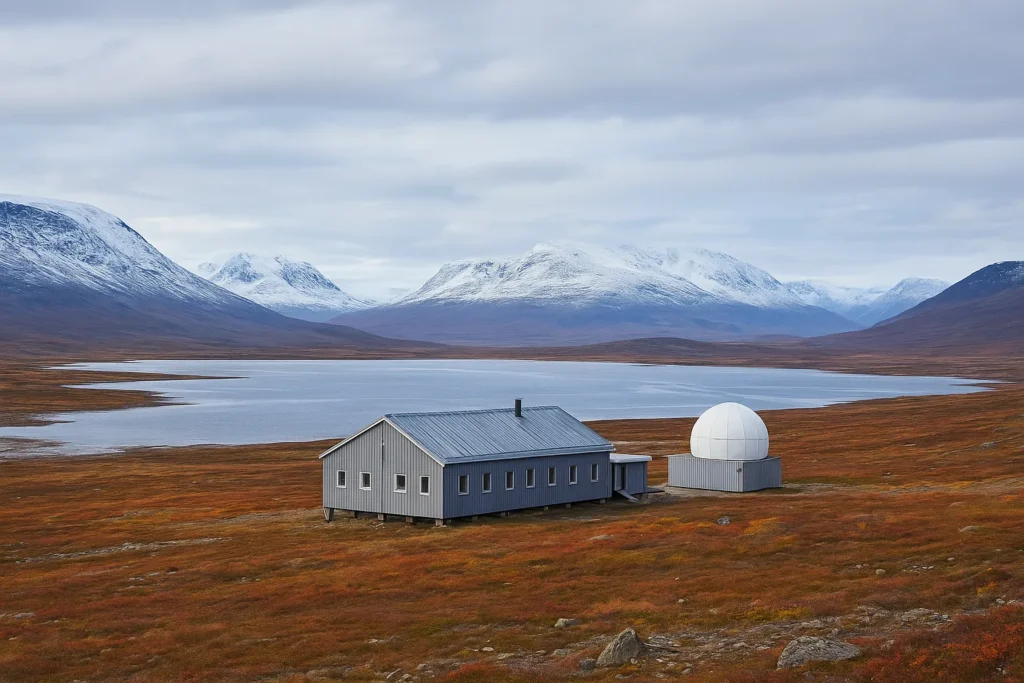
This moment of crystalline clarity in the soggy Norwegian archipelago became the catalyst for what would evolve into Finland’s most ambitious scientific undertaking—the establishment of a comprehensive Arctic Research Base in Lapland. What began as a single researcher’s alarming field observation has blossomed into an international effort to decode the rapid transformation of our planet’s northern reaches, a transformation that is unfolding at a rate six to seven times the global average.
The Arktikum Vision: Finland’s Northern Legacy
The story of Finland’s deep connection to the Arctic stretches back centuries, woven into the very fabric of the nation’s identity. Long before climate change became a global concern, Finns understood that their destiny was intertwined with the frozen north. This historical relationship found its physical expression with the opening of the Arktikum House in Rovaniemi—a building that seems to have emerged organically from the boreal landscape, its sweeping 172-meter glass tunnel pointing steadfastly toward the pole, a literal and symbolic bridge to the high Arctic.
Professor Emeritus Martti Haapala, one of the original architects of the Arctic Centre, recalls the early days with a mix of nostalgia and astonishment. “When we first proposed a dedicated Arctic research institution, many questioned its necessity. The Arctic was seen as distant, irrelevant to most people’s lives. We argued that understanding the north was crucial not just for Finland, but for the world. Today, I wish we had been wrong.”
The evolution from a single building to a network of research stations spanning Finnish Lapland represents one of Europe’s most significant investments in climate science. The main facility in Rovaniemi serves as the hub, but remote stations in Kilpisjärvi, Sodankylä, and Utsjoki provide critical data from different Arctic and sub-Arctic ecosystems. Together, they form a comprehensive monitoring network that tracks changes across climate zones and geographical features.
Dr. Lena Petrova, the current director of the research base, describes the institution’s mission with quiet intensity. “We are building upon decades of Arctic science while recognizing that the pace of change has accelerated beyond anything we anticipated. Our mandate is not merely to observe, but to understand, predict, and help humanity adapt to what’s coming.”
The base’s organizational structure reflects the complexity of the systems it studies, deliberately blending disciplines to shatter academic silos:
Atmospheric Research Division
- Polar meteorology and advanced climate modeling
- Greenhouse gas monitoring and flux analysis
- Aerosol and cloud physics research
- Long-range transport of atmospheric pollutants
Cryosphere Sciences Division
- Glaciology and ice sheet dynamics
- Permafrost monitoring and predictive modeling
- Snow science and hydrology
- Sea ice studies and satellite remote sensing
Terrestrial Ecosystems Division
- Arctic biodiversity and species adaptation tracking
- Vegetation change and carbon cycling analysis
- Soil science and permafrost microbiology
- Wildlife ecology and conservation strategies
Marine and Coastal Division
- Arctic oceanography and acidification studies
- Marine ecosystem and food web monitoring
- Coastal erosion and sedimentation processes
- Sustainable fisheries science and management
Social and Cultural Research Division
- Indigenous knowledge integration and co-production
- Community adaptation and resilience strategies
- Economic transitions and sustainable development
- Policy analysis and international governance studies
This interdisciplinary approach represents a fundamental shift in how we study complex environmental systems. “The old model of isolated scientific disciplines is inadequate for the challenges we face,” Dr. Petrova explains. “The permafrost doesn’t care about the boundary between geology and atmospheric science. The migrating caribou don’t respect the division between ecology and anthropology. We must work across these artificial boundaries if we hope to understand what’s happening.”
The Permafrost Paradox: When Solid Ground Turns to Treachery
Beneath the seemingly stable surface of the Arctic tundra lies a ticking time bomb. Permafrost—the permanently frozen ground that underlies nearly a quarter of the Northern Hemisphere’s land surface—is thawing at rates that have stunned even the most pessimistic climate scientists. Dr. Mikko Järvinen, head of the Permafrost Research Unit, has dedicated his career to understanding this hidden world, and what he’s discovering keeps him awake at night.
“We’re witnessing the unraveling of an ecosystem that took millennia to develop,” Mikko says, his voice echoing slightly in the vast underground laboratory where soil cores from across the Arctic are stored at precisely -18°C. “Each of these cores tells a story—not just of climate history, but of the biological communities that have been frozen in time. As they thaw, we’re unleashing processes we barely understand.”
The scale of the carbon stored in permafrost is almost incomprehensible. Current estimates suggest approximately 1,600 billion metric tons of organic carbon lie frozen in Arctic soils—nearly twice the amount currently in the Earth’s atmosphere. For context, human activities emit roughly 10 billion metric tons of carbon annually. The potential release of even a fraction of this stored carbon would dramatically accelerate climate change through a vicious feedback loop: warming thaws permafrost, which releases greenhouse gases, which causes more warming, which thaws more permafrost.
But the permafrost story contains layers of complexity that researchers are only beginning to unravel. Dr. Isabella Moreno, a soil microbiologist recently recruited from Spain, studies the microbial communities awakening from their frozen slumber. “We’re not just talking about CO2 and methane,” she explains, peering into a microscope at soil samples from Greenland. “We’re dealing with complex microbial ecosystems that have been dormant for thousands of years. As they reactivate, they’re processing this ancient organic matter in ways we’re still mapping, potentially releasing ancient pathogens and reconfiguring entire soil carbon cycles.”
The team’s research has revealed surprising variations in greenhouse gas emissions depending on soil composition, drainage, and vegetation cover. Waterlogged areas tend to produce more methane—a potent greenhouse gas with 25 times the warming potential of CO2 over a century—while well-drained slopes emit primarily carbon dioxide. The type of vegetation that colonizes thawed areas further influences emission patterns, creating a complex feedback system that challenges simplistic predictions.
The engineering implications of thawing permafrost are equally profound. Across the Arctic, infrastructure built on the assumption of permanently frozen ground is failing. In Norilsk, Russia, a fuel tank collapse in 2020 spilled 21,000 tons of diesel into nearby rivers, a disaster directly linked to permafrost instability. In Alaska, replacing public infrastructure threatened by permafrost thaw is projected to cost up to $5.5 billion by later this century. The research base is pioneering new construction techniques and monitoring systems for this unstable ground, but engineers are racing against a thaw that’s accelerating faster than our ability to adapt.
Perhaps most disturbing are the emerging biological threats from the thawing north. In the summer of 2016, an anthrax outbreak in Siberia’s Yamal Peninsula hospitalized dozens and killed a child, triggered when unusually warm temperatures thawed a reindeer carcass infected with the bacteria decades earlier. Researchers at the base are collaborating with epidemiologists to monitor for other pathogens that might emerge from the thaw. “We’ve revived viruses from permafrost that remained infectious after 48,500 years,” Dr. Moreno notes soberly. “While the risk of an ancient pandemic is low, we’re monitoring for more contemporary threats—antibiotic-resistant bacteria, industrial toxins, and other hazards that were locked away when the ground froze.”
The Great Transformation: Arctic Ecosystems in Flux
The living tapestry of the Arctic is being rewoven before our eyes. From the microscopic algae that bloom beneath the sea ice to the great caribou migrations that have defined northern landscapes for millennia, every level of the ecosystem is undergoing profound change. Tracking this transformation requires both cutting-edge technology and ancient wisdom, a combination the research base has perfected.
Dr. Anja Koskinen’s research spans these worlds. As head of the Wildlife Ecology Program, she moves seamlessly between satellite tracking stations and reindeer herders’ camps, between DNA sequencing labs and traditional knowledge gatherings. “The Arctic has always been a land of dramatic seasonal changes,” she observes, “but what we’re witnessing now is different in both kind and scale. It’s not just that species are moving north—the fundamental relationships between species are shifting in a phenomenon we call trophic cascade.”
The base’s research has documented over 200 species extending their ranges poleward, while many specialized Arctic species face shrinking habitats. The Atlantic mackerel now swims in Barents Sea waters that were once too cold, competing with native species for dwindling food supplies. On land, shrubs and trees are advancing onto the tundra, changing albedo and creating new habitats for some species while eliminating others. But the story contains surprising complexity. “It’s not a simple narrative of northward movement,” Dr. Koskinen explains. “Some species, like the Arctic fox, are being squeezed between the advancing red fox and the retreating sea ice. Others, like the snowshoe hare, face camouflage mismatch as snow cover duration decreases. The winners and losers aren’t always who we’d predict.”
Nowhere are these changes more visible than in the relationship between the Sámi people and the reindeer that have sustained them for centuries. The annual reindeer migration, a spectacle that has defined Lapland’s rhythms for generations, is becoming increasingly unpredictable due to rain-on-snow events that create impenetrable ice layers over winter forage. Nils Mattis, a reindeer herder from Kautokeino, has witnessed the transformation firsthand. “My grandfather could predict the migration patterns within three days, year after year,” he says, his hands moving effortlessly as he repairs a traditional sled. “Now, the reindeer don’t know when to move or where to go. The ice forms differently, the snow quality changes, the vegetation patterns shift. The old knowledge still helps, but it’s like reading a book where someone has mixed up all the pages.”
The research base has established a formal program to document and integrate this Indigenous knowledge. Sámi elders work alongside ecologists, matching satellite data with generations of observation. “The herders notice subtle changes in reindeer behavior months before our instruments detect broader patterns,” Dr. Koskinen acknowledges. “Their knowledge is making our science better, more nuanced, and more relevant to the communities who need it most.”
The marine ecosystem transformation is equally dramatic. The reduction in sea ice has been particularly devastating for species that depend on it for hunting, breeding, and resting. The latest population surveys suggest the Arctic’s iconic polar bears could decline by more than 30% in the next three decades unless current trends reverse. “But even here, the story has complexity,” notes marine biologist Dr. Sigrid Olsen. “Some seal populations are actually increasing as new feeding grounds open. Walruses are adapting to resting on land rather than ice, though this creates new challenges. The ecosystem isn’t collapsing in a simple way—it’s reorganizing, and we’re trying to understand the new patterns as they emerge.”
The Climate Connection: How the Warming Arctic Warps Global Weather
The most dangerous misconception about the Arctic is that it exists in isolation—that its changes matter only to polar bears and reindeer herders. In reality, the warming Arctic is actively reshaping weather patterns across the Northern Hemisphere through its influence on the jet stream and polar vortex, with consequences for agriculture, water resources, and extreme weather events from Seattle to Shanghai.
Dr. Erik Nilsson, the base’s lead atmospheric scientist, has made it his mission to explain these connections to sometimes skeptical audiences. “When people experience a cold snap in Texas or a heatwave in Europe, they rarely connect it to what’s happening here in the Arctic,” he says, gesturing at a bank of monitors showing real-time atmospheric data. “But the connections are very real, and they’re growing stronger through the process of Arctic Amplification.”
The mechanism revolves around the jet stream—the river of high-altitude wind that circles the Northern Hemisphere, separating cold polar air from warmer mid-latitude air. The strength of the jet stream depends on the temperature difference between the Arctic and the equator. As the Arctic warms faster than other regions, this temperature difference decreases, causing the jet stream to weaken and develop larger meanders. “Think of the jet stream as a fence containing the cold air,” Dr. Nilsson explains. “When the fence weakens, the cold air can spill southward, creating extreme winter weather in regions that don’t typically experience it. Meanwhile, warm air can push further north, creating anomalous warming events in the Arctic itself.”
This “Arctic amplification” effect has been implicated in a series of extreme weather events over the past decade. The unprecedented cold wave that paralyzed Texas’s power grid in February 2021, causing hundreds of deaths and billions in damage, has been directly linked to a stretched polar vortex. Similarly, prolonged droughts in California and Europe, and devastating floods in Pakistan, may have connections to changes in northern atmospheric patterns. The winter of 2025 alone witnessed at least ten significant polar vortex stretching events, including one that brought sub-zero wind chills to Dallas and buried New Orleans under a record-breaking 8 inches of snow.
The research base has deployed a sophisticated array of instruments to study these phenomena. Weather balloons launched twice daily from stations across Lapland provide vertical profiles of the atmosphere. Radar systems track the movement of weather systems, while supercomputers in Rovaniemi run increasingly sophisticated climate models. “We’re moving from correlation to causation,” Dr. Nilsson says with evident satisfaction. “We can now demonstrate how specific warming events in the Barents Sea influence weather patterns over North America a week later. This isn’t theoretical anymore—it’s operational forecasting with real implications for global preparedness.”
Innovation at the Edge: The Tools of Modern Arctic Science
Monitoring the rapidly changing Arctic requires technological innovation that matches the scale and complexity of the challenge. The research base has become a living laboratory for developing and testing new approaches to polar science, from autonomous vehicles that operate beneath the ice to satellite constellations that provide unprecedented resolution of northern ecosystems.
Perhaps the most dramatic innovation has been in the realm of autonomous and robotic systems. The harsh and remote conditions of the Arctic make it ideal for technologies that can operate with minimal human supervision. The base’s fleet includes underwater gliders that profile ocean conditions for months at a time, fixed-wing drones that map ice thickness across thousands of square kilometers, and crawling robots that monitor permafrost temperatures in exquisite detail. “Five years ago, much of this technology was experimental,” says robotics engineer Dr. Alexei Volkov. “Today, it’s essential infrastructure. Our autonomous systems collect more data in a week than we could gather in a full field season a decade ago.”
The challenges of operating in the Arctic environment have spurred remarkable creativity. Solar panels must function during the polar night and resist accumulation of rime ice. Batteries must operate reliably at -40°C. Communication systems must maintain links through frequent atmospheric disturbances. Each solution developed for Arctic conditions has potential applications in other extreme environments, from the deep sea to outer space.
The revolution in genetic sequencing has opened another frontier in Arctic research. Environmental DNA (eDNA) sampling—collecting and sequencing genetic material from water, soil, or air—allows researchers to detect species presence without direct observation. A single liter of seawater can reveal the passage of dozens of fish and marine mammal species. A soil sample can document the complex microbial community thriving in the thawing permafrost. “We’re moving from studying what we can see to studying what we can sequence,” explains Dr. Maria Schmidt, head of the Molecular Ecology Laboratory. “The genetic revolution has given us a completely new window into Arctic ecosystems. We can track population changes, monitor disease, and even reconstruct past communities from ancient DNA.”
The base’s data management challenges are as formidable as its collection efforts. Petabytes of information flow in daily from satellites, drones, weather stations, and field sensors. Artificial intelligence and machine learning systems help identify patterns that would escape human analysts, flagging unusual events and suggesting connections between disparate datasets. “Our biggest challenge is no longer collecting data—it’s making sense of it all,” says Dr. Kenji Tanaka, the base’s chief data scientist. “We’re developing systems that can integrate atmospheric data with ecological observations and social science surveys. The real breakthroughs happen when we can see how these different systems interact across traditional disciplinary boundaries.”
The Human Dimension: Communities at the Frontlines of Change
The scientific data, however sophisticated, tells only part of the story. The human communities of the Arctic—particularly Indigenous peoples like the Sámi, Inuit, and Nenets—have occupied these landscapes for millennia, developing knowledge systems finely attuned to northern environments. Their experiences and insights provide an essential complement to instrumental data, offering context and meaning that numbers alone cannot provide.
The research base has made the integration of Indigenous knowledge a cornerstone of its approach, recognizing it as a valid and essential way of knowing. Sámi representatives sit on the base’s governing board, and traditional knowledge is formally incorporated into research design and interpretation. This collaboration represents a significant departure from earlier scientific practices that often marginalized local and Indigenous perspectives. “Science and Indigenous knowledge are different ways of knowing, but they’re not incompatible,” explains Dr. Maret Aikio, a Sámi researcher who bridges both worlds. “Science excels at generalization and prediction. Traditional knowledge excels at context and complexity. Together, they give us a much richer understanding of what’s happening.”
This integrated approach has proven particularly valuable in understanding climate impacts. When instruments detected unusual winter warming events, it was Sámi reindeer herders who explained how these “rain-on-snow” events created ice layers that prevented reindeer from accessing winter forage. When satellite images showed vegetation changes, it was local hunters who could distinguish between cyclical variation and long-term transformation. This partnership has moved beyond consultation to genuine co-production of knowledge, where research questions are developed collaboratively and findings are interpreted through multiple lenses.
The social science team at the base documents how Arctic communities are adapting to these changes in real-time. Some coastal villages in Alaska and Siberia are planning relocations as erosion and storms threaten their existence—a process known as managed retreat. Reindeer herders are experimenting with new management strategies and supplemental feeding as migration patterns become unpredictable. Fishermen are adjusting to new species appearing in their waters while traditional catches decline. “Adaptation isn’t just a technical challenge—it’s cultural, economic, and psychological,” notes Dr. Sarah Zobel, an anthropologist who studies community responses to climate change. “The most successful adaptations honor local knowledge and values while incorporating new information and technologies. They’re rooted in community self-determination rather than external imposition.”
The base’s “Just Green Transition” program focuses specifically on ensuring that the shift to sustainable development benefits Arctic communities rather than repeating historical patterns of extraction and exploitation. As interest grows in Arctic shipping routes, mineral extraction, and renewable energy projects, the program provides research to help communities negotiate fair terms and minimize environmental damage. “The Arctic isn’t just a place where things happen to people,” Dr. Aikio emphasizes. “We’re active participants in shaping our future. The research happening here gives us better tools to do that shaping wisely, ensuring that the green transition doesn’t leave Arctic communities behind.”
Beyond the Horizon: The Global Implications of Arctic Transformation
The changes occurring in the Arctic extend far beyond the region’s boundaries, with implications for global sea levels, weather patterns, and even the fundamental functioning of the Earth’s climate system. Understanding these connections is essential for planning and adaptation worldwide, as the Arctic serves as both a driver and an early warning system for global change.
The most direct global impact comes from melting land ice. The Greenland Ice Sheet, the second largest body of ice on Earth after Antarctica, is losing mass at an accelerating rate. Current estimates suggest Greenland is contributing approximately 1 millimeter per year to global sea level rise—a figure that is expected to increase in coming decades as warming intensifies. “If the entire Greenland Ice Sheet were to melt, it would raise global sea levels by about 7 meters,” explains glaciologist Dr. Freja Nielsen. “While that complete melting would take centuries, even modest contributions create major challenges for coastal cities, island nations, and delta regions where hundreds of millions of people live.”
The base’s ice monitoring program combines satellite measurements with on-the-ground validation to provide the most accurate possible assessment of these changes. Teams stationed on the ice sheet year-round drill cores, install monitoring equipment, and track meltwater movement across the ice surface. “The processes we’re observing—like the formation of vast meltwater lakes that suddenly drain to the base of the ice sheet—were barely known a decade ago,” Dr. Nielsen says. “Now we understand they play a crucial role in accelerating ice flow toward the ocean through a process called hydrofracturing.”
The freshening of the North Atlantic from melting ice has potentially serious implications for ocean circulation patterns. The Atlantic Meridional Overturning Circulation (AMOC)—sometimes called the “global conveyor belt”—plays a crucial role in distributing heat around the planet. Some studies suggest the AMOC may be weakening, though the evidence remains controversial. “Even a partial slowdown of the AMOC would have profound consequences for climate patterns, particularly in Europe,” notes oceanographer Dr. Liam O’Connor. “We’re monitoring key indicators—temperature, salinity, current velocity—to detect changes as early as possible and improve our predictive models.”
Perhaps the most concerning global implication involves the potential for climate feedbacks that could accelerate warming beyond current projections. The albedo effect—where dark ocean and land surfaces replace reflective ice, absorbing more solar energy—is already contributing to Arctic amplification. The release of methane from thawing permafrost and Arctic ocean sediments could create another powerful feedback loop. Recent studies suggest permafrost thaw alone could commit the planet to 0.23 to 0.45 degrees Celsius of additional warming by 2100 purely from the release of ancient carbon—a monumental, self-inflicted thermal addition to an already warming planet.
“We’re navigating a series of potential tipping points in the Arctic system,” Dr. Petrova, the base director, acknowledges. “Some of these processes, once initiated, may be difficult or impossible to reverse on human timescales. Our research aims to identify these thresholds before we cross them, giving policymakers the knowledge they need to make informed decisions about our collective future.”
The Path Forward: Science in Service of Solutions
Confronted with the scale and pace of Arctic change, it would be easy to succumb to despair. Instead, the researchers at the Finnish base have channeled their concerns into a determined search for solutions that spans from fundamental science to practical technologies, from policy recommendations to public education. Their work represents a beacon of pragmatic hope in a landscape of dramatic change.
The base’s climate modeling team works continuously to improve predictions of future Arctic conditions, incorporating new understanding of feedback loops and tipping points. These models inform international climate assessments and help policymakers understand the consequences of different emission scenarios. “We’re moving from simply predicting change to evaluating intervention strategies,” explains climate modeler Dr. Chen Wei. “What happens if we achieve the Paris Agreement targets? What if we don’t? The differences are dramatic, and this information is crucial for setting realistic policy goals and implementation pathways.”
The technology development program focuses on both mitigation and adaptation solutions tailored to northern environments. Researchers are testing new approaches to carbon capture that could be deployed in the Arctic context. Others are developing construction techniques suitable for thawing permafrost, or renewable energy systems optimized for northern conditions, particularly harnessing the massive wind power potential of Arctic coastlines. “Every technology we develop for the Arctic has potential applications elsewhere,” notes Dr. Volkov. “The challenges of operating in extreme environments drive innovation that eventually benefits everyone, from advanced battery systems that work in extreme cold to autonomous monitoring networks that can be deployed in other remote regions.”
Perhaps the most important work happens in the base’s education and outreach programs, which aim to bridge the gap between scientific understanding and public awareness. Each year, thousands of students, policymakers, and concerned citizens visit the facility to learn about Arctic change through immersive exhibits and direct engagement with researchers. The base’s scientists regularly brief government officials, testify before parliamentary committees, and contribute to international assessments like those of the IPCC. “We have a responsibility to communicate what we’re learning in ways that are both accurate and accessible,” Dr. Petrova insists. “The science doesn’t exist in a vacuum—it needs to inform decisions at every level, from individual choices to international agreements. This requires clear communication and honest engagement with the uncertainties and complexities of our findings.”
The base has also become a hub for international scientific collaboration, hosting researchers from dozens of countries despite geopolitical tensions. In an era of increasing division, the Arctic has largely maintained its tradition of scientific cooperation, recognizing that climate change respects no borders. Russian, American, European, and Chinese scientists continue to share data and coordinate research through the base’s networking initiatives, understanding that the scale of Arctic transformation requires a global response. “The Arctic reminds us of our shared vulnerability and our shared responsibility,” Dr. Petrova reflects. “The changes happening here will eventually affect everyone, regardless of nationality or political affiliation. Our response must be equally universal, grounded in cooperation rather than competition.”
Epilogue: The Canary’s Song in the Anthropocene
Dr. Elina Aalto stands before a new generation of researchers in the main lecture hall of the Arktikum House, the memory of that rain-soaked Svalbard expedition never far from her thoughts. She’s holding a core of ancient ice, pulled from deep within a Greenland glacier, its crystalline structure preserving bubbles of air from a time before the Industrial Revolution, before the massive carbon emissions that are now transforming the planet at a breathtaking pace.
“This ice contains a message from the past,” she tells the young scientists, her voice steady but filled with emotion. “It tells us what the atmosphere was like when the climate was stable, when the Arctic was reliably frozen. Our job is to ensure that future generations have a stable climate too—that they don’t inherit the disrupted, unpredictable world we’re documenting today. The warning has been issued. Now it’s up to all of us to respond with the urgency this moment demands.”
The Finnish Arctic Research Base represents humanity’s attempt to read the warning signs, to understand the complex systems that sustain our world, and to find a path toward a sustainable relationship with our planet. The challenges are immense, but so is the dedication of those working to meet them with a combination of scientific rigor, technological innovation, and deep respect for Indigenous knowledge.
Outside, the northern lights dance across the sky, their ethereal green curtains a reminder of the beauty that still graces the Arctic night despite the profound changes underway. Inside the base, monitors glow with data streaming in from across the north, each number telling a piece of the story of transformation. The permafrost sensors report temperatures creeping upward. The ocean buoys record another day of unprecedented warmth. The wildlife trackers follow a polar bear’s increasingly desperate search for sea ice that retreats earlier each spring.
“The Arctic is the planet’s early warning system, and the alarm is sounding loudly,” Dr. Aalto says, her gaze moving from the vibrant sky to the glowing screens filled with concerning data. “The work we do here—documenting these changes, understanding their causes, projecting their consequences—provides the foundation for the actions we must take collectively as a global community. The fate of the frozen north—and perhaps much more—hangs in the balance of the decisions we make today.”
The sentinel in the snow continues its watch, gathering the data, telling the story, searching for solutions. In the face of unprecedented change, it stands as a testament to human curiosity, resilience, and our enduring capacity to confront difficult truths with courage and determination.

**mitolyn**
Mitolyn is a carefully developed, plant-based formula created to help support metabolic efficiency and encourage healthy, lasting weight management.
Can you be more specific about the content of your article? After reading it, I still have some doubts. Hope you can help me.
Can you be more specific about the content of your article? After reading it, I still have some doubts. Hope you can help me. https://www.binance.bh/register?ref=IXBIAFVY
Your point of view caught my eye and was very interesting. Thanks. I have a question for you. https://www.binance.bh/pt/register?ref=KDN7HDOR