
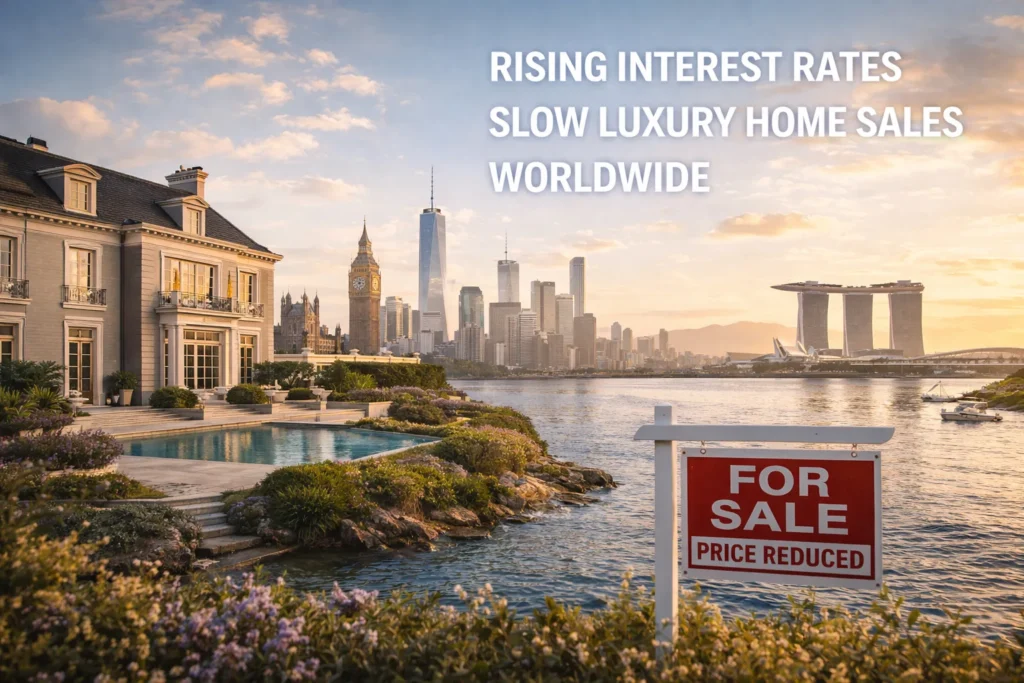

Overture: The Hush on a Hundred Prestigious Streets
Stand perfectly still on a frosty morning in London’s Belgravia. The only sound is the distant, rhythmic clip of a horse’s hooves from the nearby barracks and the whisper of wind through the plane trees in the private garden square. The Georgian facades, washed in pale morning light, hold their secrets behind uniform black doors and gleaming white stucco. A year ago, this silence was punctuated by the purr of arriving luxury vehicles, the brisk steps of brokers, the murmured negotiations in multiple languages. Today, the quiet is more profound, more settled. It is a silence not of absence, but of intense, watchful calculation.
This scene is replicated, with local variations, across the globe’s most exclusive enclaves. On Manhattan’s Upper East Side, the canopies of pre-war co-ops stand guard over sidewalks where the parade of prospective buyers has thinned. In Singapore’s Nassim Road, the tropical stillness is broken only by the hum of air-conditioning units, not the buzz of a closing deal. A Great Pause has descended upon the world of nine- and ten-figure real estate. This is not a market crash—there are no boarded windows or desperate placards. It is something more nuanced: a systemic recalibration, a collective intake of breath from the world’s wealthiest individuals and the institutions that serve them, triggered by a fundamental shift in the architecture of global capital.
The story of this slowdown is a multifaceted epic. It is a tale of macroeconomic policy, of psychological shifts among the ultra-wealthy, of the enduring allure of place, and of a market correcting itself after a historic, debt-fueled ascent. To understand it is to understand not just real estate, but the very movement of global wealth in an age of uncertainty. This is the chronicle of that pause, an exploration of its causes, its manifestations from city to city, and what it portends for the future of the world’s most coveted addresses.
Part I: The Engine Room – How Cheap Money Built the Modern Pantheon
Chapter 1: The Post-2008 Alchemy: Turning Debt into Gold
The genesis of the modern luxury real estate boom lies in the ashes of the Global Financial Crisis. In its traumatic wake, central banks embarked on a unprecedented monetary experiment. Fearing deflationary spirals and economic depression, they slashed benchmark interest rates to near-zero—and in some cases, like the European Central Bank and the Bank of Japan, into negative territory. This was accompanied by “Quantitative Easing” (QE), the massive creation of new money to purchase government and corporate bonds.
The goal was to force liquidity into the system, encourage risk-taking, and stimulate growth. The side effect was the creation of a vast, global ocean of historically cheap capital. For over a decade, borrowing money was not just inexpensive; it was often effectively free after accounting for inflation. This environment didn’t just change economics; it rewrote the psychology of investment.
Chapter 2: The Trophy Asset Thesis: Safe Deposit Boxes in the Sky
In this new world, prime real estate in global “gateway” cities underwent a fundamental re-evaluation. For the world’s Ultra-High-Net-Worth Individuals (UHNWIs), it transformed from a consumption item—a very nice home—into a core strategic asset class. It offered a unique, tripartite value proposition:
- A Tangible Store of Value: In a digital age of volatile stocks and cryptic cryptocurrencies, a limestone townhouse or a steel-and-glass penthouse was reassuringly physical and permanent. It was a “safe deposit box” you could live in, located in a jurisdiction with strong rule of law.
- A Leverageable Asset: Cheap debt was the rocket fuel. The wealthy could borrow vast sums against their existing portfolios at sub-3% rates to acquire property, minimizing their capital outlay. This “positive carry”—where the cost of debt was lower than the expected appreciation—made real estate a phenomenally efficient wealth multiplier.
- A Multi-Generational Hedge: These properties offered lifestyle, education, healthcare, and status—a life raft for families amidst global uncertainty. They were visas to a better life, anchors in a stable political zone, and legacy assets for children and grandchildren.
This thesis was self-reinforcing. As more capital flowed in, prices rose, which validated the investment thesis, attracting more capital. A virtuous (or vicious) cycle was born.
Chapter 3: The Cast of Global Capital: A Dramatis Personae
The demand fueling this cycle was a global consortium of wealth:
- The Geopolitical Migrant: Wealthy individuals from politically or economically volatile regions—Russia pre-2022, the Middle East, China—seeking a secure haven for their capital and families.
- The Tech Sovereign: A new aristocracy from Silicon Valley, Seattle, and Asian tech hubs, converting paper wealth from IPOs and equity into tangible, prestige assets.
- The Dynastic Steward: Old-money families from Europe and the Americas, trading within the prime market or consolidating holdings.
- The Corporate User: Banks, hedge funds, and multinationals acquiring pieds-à-terre for executives or hospitality suites.
- The Opaque Vehicle: Purchases made through complex webs of offshore trusts and shell companies, anonymizing the ultimate beneficial owner.
This diverse cast was unified by a shared belief: prime property in London, New York, Hong Kong, Singapore, Paris, and a few other citadels was a one-way bet with unparalleled defensive characteristics.
Chapter 4: The Psychology of the Frenzy: FOMO in the Finest Postcodes
The financial mechanics were supercharged by a powerful psychological engine: Fear Of Missing Out (FOMO). When prices are rising 10-20% annually, delay is financially catastrophic. This fear bred a market culture of extreme urgency:
- Whisper Listings & Off-Market Sales: The best properties never publicly listed, creating an aura of exclusive access for the connected.
- Sealed-Bid Auctions: Buyers submitted “best and final” offers, often wildly over asking price, without knowing their competitors’ bids.
- Sight-Unseen Purchases: Buyers, particularly from Asia, would acquire units from floor plans and renderings, trusting the brand of the developer and city.
- The “Pricing Curve” Myth: The constant narrative that supply was infinitely constrained and demand was eternally growing, justifying any price.
The market ceased to be about intrinsic value and became a competitive sport of acquisition, with brokers as gatekeepers and properties as trophies. This was the peak of the Goldilocks Era—a period that felt, for its participants, like it could last forever.
Part II: The Pendulum Swings – The Inflationary Shock and the Monetary Reckoning
Chapter 5: The Unraveling: Pandemic, Stimulus, and Supply Chain Snares
The catalyst for change was a global pandemic. COVID-19 lockdowns triggered an initial fear-driven crash, followed by an unprecedented fiscal and monetary response. Governments distributed trillions in stimulus directly to consumers and businesses. Central banks doubled down on QE. As the world reopened, this tsunami of cash met a production and logistics system in disarray. The result was a classic, powerful inflationary surge.
The cost of everything—shipping containers, lumber, semiconductors, labor, energy—spiraled upward. This wasn’t the “transitory” blip many hoped for; it became embedded in the economy through wage-price spirals and entrenched expectations. The genie of inflation, bottled for forty years, was out.
Chapter 6: The Central Bank Mandate: A Hawkish Pivot for the Ages
Central banks have one core mandate: price stability. Faced with inflation at multi-decade highs, their playbook is orthodox and brutal: raise interest rates to cool demand. In 2022, led by Jerome Powell’s Federal Reserve, the world’s central banks embarked on the most aggressive synchronized tightening cycle in modern history.
Rates didn’t just inch up; they soared in 75-basis-point leaps. The message was unambiguous: the era of free money was over, definitively. The financial system, structurally addicted to cheap debt, went into shock. Bond markets sold off violently. Tech stock valuations cratered. And the foundational premise of the luxury real estate boom—that leverage was cheap and endlessly available—shattered.
Chapter 7: The New Arithmetic: When the Math of a Mortgage Becomes a Masterclass
The impact is best understood through stark, sobering arithmetic. The exercise moves from theoretical to visceral.
Scenario A (2021): An entrepreneur buys a $15 million Miami waterfront estate. She puts down $6M and finances $9M with a jumbo interest-only mortgage at 3%. Her annual interest cost: $270,000.
Scenario B (2023): The same purchase, with a mortgage rate of 7%. Annual interest cost: $630,000.
That’s an extra $360,000 per year, or $30,000 per month, vaporized in financing costs. For the “merely” multi-millionaire (the successful lawyer, surgeon, or mid-level tech executive), this recalculation is a deal-killer. They retreat. For the billionaire, it’s a recalibration of opportunity cost, but a significant one nonetheless.
Chapter 8: The Opportunity Cost Revolution: TINA is Dead, Long Live TARA
The acronym that ruled the 2010s was TINA: “There Is No Alternative” to stocks and real estate. With bonds yielding near-zero, capital was forced into risk assets. That era is over. The new acronym is TARA: “There Are Reasonable Alternatives.”
Risk-free U.S. Treasury bonds now yield over 5%. High-grade corporate debt yields even more. Suddenly, parking $10 million in a bond portfolio generates $500,000 annually with zero maintenance, no property tax, and instant liquidity. For the first time in a generation, cash is not trash; it is a productive, yielding asset. This presents luxury real estate with its fiercest competitor: the simplicity and safety of fixed income.
Chapter 9: The Psychological Unwinding: From FOMO to FONGO (Fear of Not Getting Out)
The most profound shift is psychological. The central bank pivot is a signal that permeates the consciousness of the wealthy. It tells them the financial weather has changed permanently. The psychology flips from FOMO (Fear Of Missing Out) to FONGO (Fear Of Not Getting Out) at the top, or more accurately, Fear Of Overpaying in a declining market.
This shift dismantles the frenzy. Buyers no longer feel time pressure. They can view dozens of properties. They can commission second and third inspections. They can make offers 20% below ask and wait for a panicked counter. The leverage in the negotiation—the invisible force that drove prices up—evaporates. The market moves from a seller’s absolutism to a buyer’s market of careful, protracted negotiation.
Part III: A Global Diagnostic – The Slowdown Through Local Lenses
Chapter 10: New York City – The Bifurcated Metropolis: Condo Glut vs. Co-op Redoubt
New York’s luxury landscape reveals a tale of two asset classes.
The Condo Correction:
The supertall “pencil towers” of Billionaires’ Row (432 Park, 111 W 57th, Central Park Tower) are the epicenter of the chill. Conceived in the cheap-money era, they are now completing into a harsh climate. Their sales model—pre-construction presales to fund development—has stalled.
The response is not public price cuts (which would devastate the building’s valuation and anger earlier buyers) but “shadow discounting.” This includes:
- Paying the Buyer’s Mansion Tax: A 1-4% savings.
- Covering Common Charges: For 2-5 years, a six-figure value.
- Designer Allowances: $500k+ for customization.
- Furniture Packages: Including high-end art and fixtures.
The net price is significantly lower than the listed price. Inventory lingers, and the “starchitect” model faces its first true stress test.
The Co-Op and Townhouse Fortress:
Conversely, the market for pre-war Cooperative apartments and landmarked townhouses shows remarkable resilience. Their value propositions are different:
- Absolute Scarcity: No new Candela-designed apartments are being built.
- Selectivity & Pedigree: Co-op board approval creates exclusivity and perceived prestige.
- Cultural Permanence: They represent Old New York, a value that transcends financial cycles.
While sales have slowed, prices have plateaued, not plummeted. They are the “blue-chip equities” of the real estate world.
Chapter 11: London – The Global Capital on Hold
London’s Prime Central London (PCL) market is the world’s most international, making it hypersensitive to global capital flows.
The Retreat of Key Cohorts:
- Chinese Buyers: Hit by domestic crisis, capital controls, and a slowing economy.
- Russian Buyers: Sanctions have formally removed a major cohort.
- Middle Eastern Buyers: Still active but highly selective, focusing on true trophies.
The New Market Mechanics:
- Extended Marketing: A £10M+ house in Knightsbridge now averages 200+ days on market, up from 90 in 2021.
- The Discount Dance: Offers start at 15-20% below ask. Final prices are routinely 10-12% below peak 2022 valuations.
- The Sterling Hedge: For dollar- or euro-based buyers, the post-Brexit weakness of the pound provides a partial offset to higher rates, attracting some U.S. and European capital.
London’s deep fundamentals—its legal system, schools, culture, and timezone—ensure its status. But the transaction is now a marathon of due diligence and negotiation.
Chapter 12: Singapore – The Engineered Soft Landing
Singapore is a masterclass in using policy to cool a boiling market.
The Pandemic Boom: As a stable Asian hub, it absorbed massive wealth during COVID-19, with prices surging.
The Policy Sledgehammer: In April 2023, to prevent a bubble and protect affordability for citizens, the government raised the Additional Buyer’s Stamp Duty (ABSD) for foreigners to 60%. This is an upfront, non-refundable tax. For a foreigner buying a S$30M bungalow, the tax is S$18M, payable immediately.
The Outcome: Combined with global rate hikes, this has dramatically cooled foreign demand. The market now runs on domestic and Permanent Resident demand. Prices have plateaued; velocity has crashed. It is a deliberate, government-induced hibernation.
Chapter 13: Los Angeles & Miami – The Pandemic Darlings Recalibrate
- Los Angeles: The “ULA Tax” or “Mansion Tax” (a transfer tax on sales over $5M) has compounded rate-driven slowdowns in Beverly Hills and Bel Air. Sellers are creatively structuring deals to share the tax burden, while buyers use it as a hammer in negotiations.
- Miami: The poster child of the pandemic migration boom is now awash in condo inventory. The frenzy has unequivocally ended, with price cuts and increased concessions becoming standard. The market is separating the truly exceptional waterfront from the merely new.
Part IV: The New Mechanics of a Decelerated Market
Chapter 14: The Broker’s Evolution: From Auctioneer to Therapist-Strategist
The luxury broker’s role has transformed from gatekeeper/grand orchestrator to strategic advisor and market psychologist.
For Sellers: The Pillars of Patience
- Precision Pricing: “Aspirational” pricing leads to stigmatization. Pricing must be based on recent, verifiable comps, not 2021 fantasies.
- Perfection in Presentation: Staging, landscaping, and minor repairs are non-negotiable investments. A vacant or poorly presented property in this market is dead on arrival.
- Strategic Transparency: Providing pre-inspection reports and disclosure packages builds trust and accelerates serious inquiry.
- Emotional Preparation: Managing expectations for a 6-12 month marketing timeline is crucial.
For Buyers: The Leverage of Readiness
- The Power of Proof: All-cash or heavily pre-qualified offers have disproportionate power in an uncertain financing environment.
- Diligence as a Weapon: The luxury of time allows for exhaustive inspections (structural, environmental, engineering) and feasibility studies for renovations.
- The Data-Backed Offer: A “low-ball” offer must be accompanied by a rational dossier of comparable sales, days-on-market analysis, and financing cost projections to be taken seriously.
Chapter 15: The Evolving Lexicon of Luxury
Marketing language has shifted from pure opulence to resilience and legacy.
- From “Chef’s Kitchen” to “Climate-Resilient Fortress”: Highlighting backup generators, hurricane-rated windows, fire-resistant materials, and water filtration systems.
- From “Spa Bathroom” to “Integrated Wellness Ecosystem”: Emphasizing circadian lighting, anti-allergen HVAC, saltwater pools, and dedicated meditation/yoga spaces.
- From “Concierge” to “Curated Access Platform”: Selling membership transfers to private clubs, relationships with elite art advisors, and bespoke travel and event planning.
- From “High Ceilings” to “Biophilic Design Principles”: Focusing on seamless indoor-outdoor flow, native landscaping, and materials that connect to nature.
Chapter 16: The Renaissance of Creative Deal Structures
With traditional sales challenging, inventive structures are resurfacing.
- Seller Financing: The seller acts as the bank, offering a mortgage at a below-market rate, bridging the buyer’s financing gap and providing the seller with a steady income stream.
- Lease with Option to Purchase: A multi-year lease with a portion of rent applying to a future purchase at a pre-agreed price, giving the buyer time to arrange financing or sell another asset.
- Portfolio Trades & Barter: In the rarefied air of the ultra-wealthy, a property might be exchanged for a stake in a private company, a collection of art, or even another property in a different jurisdiction.
Part V: The Granite Foundation – The Case for Long-Term Resilience
Chapter 17: The Immutable Law of Scarcity
The most powerful force in prime real estate is not demand, but the absolute limit of supply. They are not making more land in Mayfair, the 7th Arrondissement, or on Ocean Drive in Monaco. Zoning laws, historic preservation, and geographical constraints make new supply in the very best locations virtually impossible. This physical and regulatory scarcity creates a permanent, non-negotiable floor under the market.
Chapter 18: The Global Citadel Effect
In times of turbulence, capital doesn’t vanish—it seeks safe harbors. London, New York, Singapore, Geneva, and a handful of others are “global citadels”: jurisdictions with strong rule of law, stable governments, transparent markets, and deep cultural capital. Geopolitical or economic strife elsewhere often drives capital into these markets, not out. They are the wealth bunkers for a disordered world.
Chapter 19: The Demographic and Dynastic Imperative
The global population of UHNWIs continues to grow, especially in Asia. The Great Wealth Transfer—over $70 trillion passing from Boomers to Millennials/Gen Z—is underway. While younger generations may prefer modern design and tech integration, their financial advisors will still advocate for diversification into prime, tangible global assets. The desire to own a piece of a world city is a multi-generational aspiration.
Chapter 20: The Flight to Authentic Quality
This correction performs a vital cleansing function. It separates authentic prime from froth. The mediocre property in a good zip code suffers. The truly exceptional asset—with unimpeded iconic views, architectural pedigree, historical significance, or perfect proportions—holds firm. The market is rewarding irreplaceability, not just expense.
Part VI: The Horizon – Scenarios for the Next Cycle
Chapter 21: The Interest Rate Crucible – Awaiting the Pivot
The market’s short-term fate is tied to monetary policy. The luxury world watches the Federal Reserve’s “dot plot” with religious fervor. The pivot from hiking to holding, and eventually to cutting, will release a wave of pent-up demand. Certainty, even at higher rates, is more valuable than low rates amid uncertainty.
Chapter 22: The Redefinition of “Prime” – The New Amenities
Future value will be defined by new criteria:
- Sustainability & Off-Grid Capacity: Net-zero energy, water reclamation, and food production capabilities.
- Digital Infrastructure & Security: Quantum-ready fiber, comprehensive cyber-physical security systems.
- Health & Wellness Integration: Beyond spa bathrooms to air quality monitoring, circadian rhythm lighting, and spaces designed for mental well-being.
- Flexibility & Multi-Generational Living: Homes that can accommodate adult children, aging parents, and live-in staff with separate access and amenities.
Chapter 23: The Potential for Innovation – Fractionalization and the Blockchain
High capital costs and reduced liquidity could spur new ownership models:
- High-End Fractionalization: Professionally managed syndicates owning a trophy asset, with clear usage rights and a path to liquidity, opening the class to a wider (but still wealthy) audience.
- Tokenization: While nascent, representing fractional ownership of a physical property on a blockchain could enhance transparency, reduce transaction friction, and create a secondary market for shares. The current illiquidity may accelerate its development.
Chapter 24: The Enduring Human Element – The Story in the Stone
Beyond all economics lies the timeless human desire for beauty, legacy, and place. A home is a narrative. The desire to write your family’s story into the history of a great city, to entertain under a famous skyline, to create a sanctuary of art and comfort—these impulses are eternal. They are why the market pauses but does not perish. They are why the lights in those grand windows will never go out for long.
Coda: The Long View from the Library Window
The view from the library of a grand estate is always a long one—over gardens, across cityscapes, toward horizons. The current Great Recalibration is a moment in that long view. It is the market metabolizing a decade of excess, adjusting to a new financial reality, and rediscovering the core tenets of value.
It is a time of opportunity for the prepared, of patience for the committed, and of education for all. It reminds us that even the most exalted assets are subject to the laws of financial gravity, but that the most coveted places on earth possess a gravity of their own—a pull of history, culture, and security that transcends interest rate cycles.
The whispers in the halls of power have quieted, but they have not ceased. They are calculating, negotiating, waiting. The slowdown is not an ending. It is an interlude. And when the music of capital begins again, it will play for those who understand that true value isn’t just in the price paid, but in the permanence acquired. The symphony of global real estate is merely between movements, and the next will be written on a stave of greater resilience, deeper value, and enduring legacy.



I am sure this piece of writing has touched all the internet users, its really really pleasant piece of writing on building up new weblog.
Wow, this paragraph is good, my sister is analyzing these things, therefore I am going to let know her.
Ahaa, its pleasant dialogue about this paragraph at this place at this weblog, I have read all that, so now me also commenting at this place.
Wow! This blog looks just like my old one! It’s on a totally different subject but it has pretty much the same layout and design. Wonderful choice of colors!
I just could not go away your web site before suggesting that I really enjoyed the usual info an individual supply for your guests? Is going to be back continuously to investigate cross-check new posts
I will right away clutch your rss as I can not in finding your e-mail subscription link or e-newsletter service. Do you’ve any? Kindly let me know in order that I may just subscribe. Thanks.
I am sure this piece of writing has touched all the internet viewers, its really really nice post on building up new weblog.
hello!,I love your writing very much! share we be in contact extra approximately your article on AOL? I require an expert in this area to solve my problem. May be that is you! Taking a look ahead to look you.
Ahaa, its fastidious dialogue regarding this paragraph here at this weblog, I have read all that, so now me also commenting here.
You can certainly see your expertise in the work you write. The sector hopes for even more passionate writers like you who are not afraid to say how they believe. All the time follow your heart.
Hi, I read your blog daily. Your story-telling style is awesome, keep up the good work!
I am sure this paragraph has touched all the internet users, its really really good article on building up new blog.
Wow, this paragraph is pleasant, my sister is analyzing these things, so I am going to inform her.
I should admit that your post is very appealing. I have spent a lot of my spare time reading your posts. Thanks for sharing!
Article writing is also a excitement, if you be acquainted with after that you can write otherwise it is difficult to write.
I’ll right away take hold of your rss feed as I can’t find your e-mail subscription hyperlink or e-newsletter service. Do you have any? Please allow me recognize in order that I may subscribe. Thanks.
Ahaa, its good conversation about this article at this place at this blog, I have read all that, so at this time me also commenting here.
I’ll immediately seize your rss feed as I can’t find your e-mail subscription link or newsletter service. Do you have any? Please allow me understand in order that I could subscribe. Thanks.
Wow, this paragraph is nice, my younger sister is analyzing these kinds of things, thus I am going to convey her.
Hi there, You have done an excellent job. I’ll certainly digg it and personally suggest to my friends. I am confident they will be benefited from this site.
I’ll immediately grasp your rss feed as I can not in finding your email subscription hyperlink or e-newsletter service. Do you have any? Kindly allow me know so that I could subscribe. Thanks.
I simply could not leave your site prior to suggesting that I extremely loved the usual info a person supply for your guests? Is gonna be again regularly to investigate cross-check new posts
It’s vey ffortless to find oout any matter onn neet ass compareed too books, aas I fouhnd thius articcle att thbis weeb page.
I will immediately snatch your rss feed as I can not find your e-mail subscription hyperlink or e-newsletter service. Do you’ve any? Please allow me recognise in order that I may just subscribe. Thanks.
There’s certainly a great deal to learn about this subject. I love all the points you’ve made.
Glad to be one of the visitors on this awful website :D.
Hi! I’ve been reading your weblog for a long time now and finally got the bravery to go ahead and give you a shout out from Atascocita Texas! Just wanted to mention keep up the great work!
These are really enormous ideas in on the topic of blogging. You have touched some nice things here. Any way keep up wrinting.