
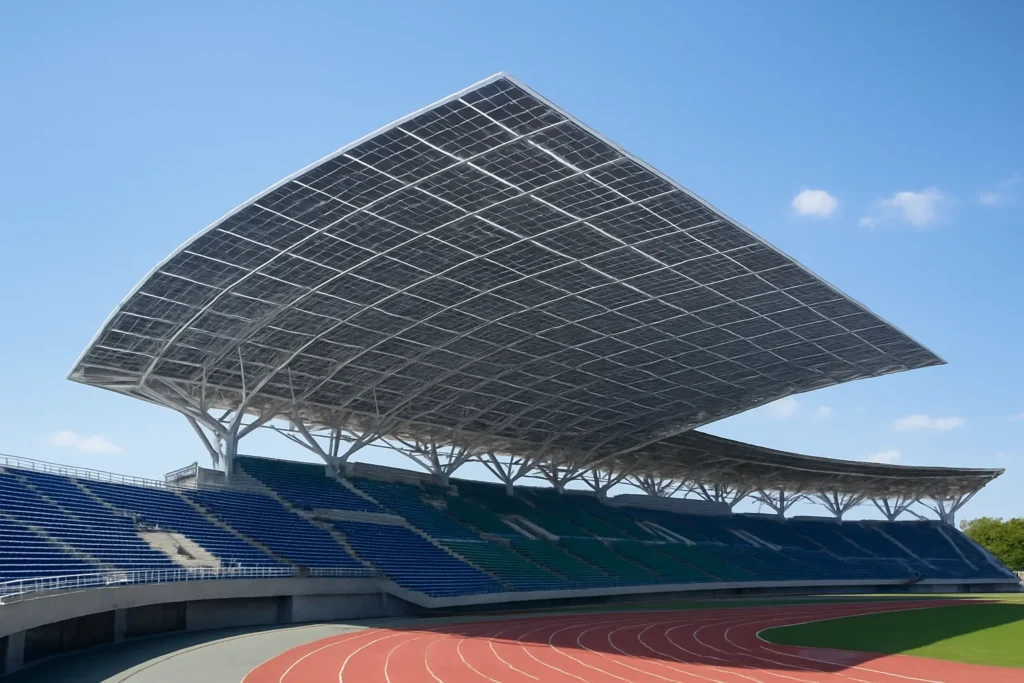

Prologue: The Silent Roar of a Warming World
Beneath the palpable electricity of a championship match, beneath the unified chants of eighty thousand voices, a quieter, more insistent hum has defined the modern stadium experience for generations—the relentless drone of industrial-scale air conditioning. This mechanical roar is the soundtrack of a century-long architectural compromise, a testament to humanity’s ability to conquer space and acoustics while remaining stubbornly subservient to the sun. Our grandest gathering places, cathedrals of shared human emotion, have long been thermodynamic failures, trapped in a costly, exhausting war against their own environment. The story of Japan’s cooling canopy is not merely a tale of an engineering breakthrough; it is the narrative of a profound philosophical pivot. It begins in the fraught summer of 2018, with a group of designers, scientists, and poets of structure staring not at blueprints, but at a satellite image of their city, a sprawling heat island, and asking a question that would fracture old paradigms: What if the stadium could become not a fortress against nature, but a collaborator with it? What if it could breathe?
This is the chronicle of that collaboration—a decade-spanning odyssey from a radical hypothesis to a shimmering, intelligent skin stretched over steel. It is an exploration of how a nation looked into the gathering storm of the climate crisis and chose not to build a higher wall, but to weave a smarter net, one that could catch the sun’s fury and spin it into cool, silent comfort.
Book I: The Cathedral of Consumption – Deconstructing the Twentieth-Century Stadium
To grasp the magnitude of the revolution, we must first conduct an unflinching autopsy of the conventional stadium, a masterpiece of one-dimensional thinking.
The Thermodynamic Tyranny of Form:
Architecturally celebrated for its sweeping curves and soaring roofs, the typical stadium is, in physical terms, a perfected heat trap. Its bowl shape, optimized for sightlines, acts as a colossal concave mirror for solar radiation, focusing thermal energy into the seated mass. The materials of modernity—vast expanses of concrete, dark composite seats, acres of asphalt paving—possess high thermal mass and low albedo. They absorb shortwave solar radiation with voracious efficiency, storing it like a battery throughout the day, only to release it as long-wave infrared heat into the very space occupied by spectators. This creates a microclimate feedback loop: the structure heats the people, the people’s metabolic processes generate more heat, and the still air, trapped by the very geometry that contains sound, incubates this thermal soup. On a 30°C (86°F) day, the radiant temperature of sun-baked seats can exceed 60°C (140°F), and the ambient air within the bowl can soar 10-15°C above the external shade temperature before a single body enters.
The Mechanical Arms Race: A Costly, Circular War
The 20th-century response was the vapor-compression chiller plant—a technological marvel born of an era of perceived energy infinity.
- The Energy Siege: Cooling an open-air colossus is an exercise in profound inefficiency. Systems are designed for peak instantaneous load, the worst-case scenario of a sold-out matinee under a blistering sun. This requires chilling capacity measured in thousands of tons of refrigeration (one ton being the cooling power of melting one ton of ice in 24 hours). The electrical demand is staggering: a major league ballpark can draw 8-10 megawatts during a summer game—the equivalent of powering 8,000 homes simultaneously. This demand is not smooth; it is a violent spike on the local grid, often necessitating dedicated substations and threatening stability during regional heatwaves.
- The Financial Vortex: The economics are a slow-motion hemorrhage. The capital outlay for chillers, miles of insulated ductwork, and colossal cooling towers runs into the hundreds of millions. The operational bleeding is continuous: a single season’s utility bill can eclipse $1 million. Maintenance is a constant, specialized battle against corrosion, refrigerant leaks (using gases with global warming potentials thousands of times that of CO₂), and mechanical wear. The system’s lifespan is perhaps 15 years, after which a multi-million dollar replacement cycle begins anew.
- The Illusion of Comfort: For all this financial and ecological sacrifice, the result is a sensory compromise. Comfort is uneven—a frozen gale in tunnel vomitoria, stagnant warmth in the upper concourses. The process dehumidifies air to the point of aridity, parching throats and irritating eyes. The acoustic landscape is permanently polluted by the low-frequency groan of machinery, a bass note underlying the crowd’s roar. The building, in essence, declares war on its occupants’ senses in the very act of seeking to comfort them.
This was the unsustainable stalemate: a spiral of increasing cost, increasing energy demand, and decreasing marginal returns on human comfort. It was into this cognitive and architectural cul-de-sac that a consortium of Japanese thinkers injected a moment of sheer, disruptive clarity.
Book II: The Consortium of Unlikely Minds – Where the Poet Met the Physicist
The genesis was not a corporate mandate, but a confluence—a deliberate collision of disciplines that typically orbit in separate intellectual universes.
Dr. Kenji Sato: The Chronicler of Silent Ingenuity
In his laboratory, Dr. Sato curated a library of biological survival. His team did not build; they observed with profound patience. They were cartographers of function, mapping the invisible physics of life.
- The Termite Mound as Metabolic City: Their study of Macrotermes mounds revealed not a static structure, but a pulsating, breathing organ. The mound’s intricate network of conduits and chambers used diurnal temperature fluctuations and wind pressure to create convective currents, ventilating deep fungal gardens and maintaining a near-constant internal humidity and temperature. It was architecture as a dynamic pressure valve.
- The Beetle that Drinks the Sky: The Stenocara beetle of the Namib Desert presented a masterclass in water and thermal management. Its back is textured with hydrophilic bumps and hydrophobic valleys. Fog condenses on the bumps, and the water channels along the valleys directly to its mouth. More remarkably, its carapace’s microstructure allows it to radiate excess body heat into the cold night sky, dropping its temperature below the dew point to create its own water source. This was passive radiative cooling in action.
- The Human Skin: The Ultimate Interface: Sato’s team spent years modeling the human integumentary system—a perfect, decentralized climate regulator. Through vasodilation/vasoconstriction, piloerection, and most critically, perspiration, the skin maintains homeostasis across a vast range of external conditions. It is sensor, actuator, and regulator in one.
Sato’s guiding principle was, “Nature does not solve problems. It evolves conditions where problems do not exist.”
Akira Tanaka: The Architect in Search of a New Vernacular
Tanaka, steeped in the aesthetics of wabi-sabi and the spatial intelligence of the traditional Japanese house, viewed contemporary stadiums with a growing sense of melancholy. The great engawa (veranda) of a Kyoto villa seamlessly mediated between interior and garden, using deep eaves for shade, shoji screens for diffused light, and strategic openings for cross-ventilation. Modern stadiums, by contrast, were environmental monologues—loud, sealed, and isolated.
Frustrated by the crude geometry of a shading roof design, Tanaka was dragged to Sato’s lab. He stood before an electron micrograph of the thorny devil lizard’s capillary channels. The moment of synthesis was auditory. “It’s not a pipe,” Tanaka breathed, pointing at the capillary network. “It is the landscape itself, guiding the water. Our roof… it shouldn’t have a cooling system. It should be the cooling system. A skin. A living, sweating, breathing skin for eighty thousand people.”
This fusion—the biologist’s understanding of integrated function and the architect’s longing for mediating space—gave birth to the core ambition: to engineer not a machine in a building, but a building as an organism.
Book III: The Stratigraphy of Intelligence – The Nine-Layer “Dermis”
What was conceived is not a product but a stratified ecosystem suspended in tension. It is a nine-layer composite, each stratum a chapter in a material science textbook, working in concert.
Stratum 1: The Anti-Glare Photovoltaic Epidermis.
The outermost shield is a Quantum Dot-Enhanced Photovoltaic Polymer Film. Beyond simple energy generation, the embedded quantum dots are engineered to “down-shift” high-energy UV light into wavelengths more efficiently converted by the underlying PV cells, while also reducing glare for spectators and aircraft. The film is semi-permeable at a molecular level, allowing air pressure equalization but repelling liquid water and pollutants.
Stratum 2: The Convective Air Gap.
A precisely calibrated void space, this layer acts as a Bernoulli Channel. Wind flowing over the curved roof surface accelerates here, creating a low-pressure zone that actively sucks hot air up and away from the strata below, mimicking the stack ventilation of a termite mound.
Stratum 3: The Phase-Change Thermal Battery.
Here, Bio-Paraffin Microcapsules are suspended in a polymer matrix. These capsules melt at 28°C (82°F), absorbing vast amounts of latent heat from the structure during peak sun, preventing heat penetration. At night, they re-solidify, releasing that heat upward to be radiated to space or used for other processes.
Stratum 4: The Structural Neuromuscular Net.
A Shape-Memory Alloy (SMA) Mesh embedded with fiber Bragg grating sensors. This layer does more than support; it responds. The SMA wires contract or expand minutely with temperature changes, subtly altering the canopy’s curvature to optimize solar incidence or runoff. The sensors provide a real-time strain map, a “proprioceptive” sense of the structure’s physical state.
Stratum 5: The Photonic Radiator.
A layer of Metamaterial Film engineered to be a selective infrared emitter. It radiates heat in the precise 8-13 micron wavelength range, known as the “atmospheric window,” where Earth’s atmosphere is transparent. This allows the canopy to dump heat directly into the cold vacuum of space, even during the day, achieving sub-ambient radiative cooling.
Stratum 6: The Microfluidic Circulatory System.
The realization of lizard-skin inspiration: a Laser-Sintered Bipolar Plate Matrix. This intricate, fractal-like network of channels, inspired by human capillaries and plant xylem, distributes the water-glycol solution. Each “capillary bed” can be independently addressed by banks of silent, magnetohydrodynamic pumps that have no moving parts, using electromagnetic fields to propel the fluid.
Stratum 7: The Sensorium – The Distributed Conscious Layer.
A spray-on Graphene-Oxide Sensor Mesh. This creates a continuous, living nervous system. It measures not just temperature and humidity, but VOC levels, particulate matter, sound pressure (for crowd density mapping), and even localized barometric pressure changes. It is the world’s most vast and sensitive environmental organ.
Stratum 8: The Evaporative Dermis – The Porous “Sweat Gland” Layer.
The core functional layer: a Metal-Organic Framework (MOF) Composite Membrane. MOFs are crystalline sponges with astronomical internal surface areas. This layer passively wicks fluid from the microfluidic system, holding it in molecular-scale pores. The evaporation occurs not from a surface, but from within a volumetric matrix, multiplying the effective surface area by a factor of thousands and enabling cooling at exceptionally low humidity increments.
Stratum 9: The Convective Induction Texture.
The underside visible to spectators is engineered with a Biomimetic Vortex-Shedding Dimple Pattern, modeled on whale flippers and golf balls. This texture triples the surface area for convective heat exchange and ensures the cooled air descends in a smooth, laminar sheet, eliminating drafts and creating a uniform “fall” of coolness.
The Governing Trinity: The Digital Ghost in the Machine
Orchestrating this physical symphony is a tripartite AI:
- The Cerebrum – The Predictive Model: A digital twin fused with live satellite weather data, historical climate patterns, and event schedules. It runs constant simulations, predicting thermal loads hours in advance.
- The Cerebellum – The Autonomous Regulator: This system handles real-time response. It receives data from the Sensorium and executes micro-adjustments with reflexive speed, balancing the Photonic Radiator, Microfluidic flow, and Phase-Change storage.
- The Prefrontal Cortex – The Strategic Optimizer: The long-term planner. It learns from every event, every weather pattern. It manages energy storage in on-site batteries, decides when to sell surplus power to the grid, and plans preventive maintenance, constantly refining the system’s algorithms for efficiency.
Book IV: The Human Chronicle – A Day in the Life of the Organism-Stadium
To understand its impact, we must witness the stadium not as a building, but as a character, through the eyes of those within its embrace.
04:30 – The Nocturnal Purge:
In the pre-dawn darkness, the canopy is most active in its silent mode. The Photonic Radiator layer has been shedding heat into space all night. The Phase-Change material has solidified. The AI, knowing a sell-out day game is ahead, initiates a “Nocturnal Flush.” It slightly loosens perimeter tensions, allowing the night breeze to flow through the Convective Air Gap, purging any residual warmth. Sensors detect the dew point has been reached; the MOF membrane passively harvests atmospheric moisture, adding liters to the closed-loop reservoir.
10:00 – The Matinee Prelude:
The first spectators, families with young children, arrive. The sun is high, but the seating bowl is pre-cooled to 24°C (75°F). As they enter, the Sensorium detects the influx. The Cerebellum AI activates the Microfluidic system in the gates’ zones. A wall of cool, fresh air, smelling faintly of ozone and wet stone, greets them—not a blast, but an atmosphere.
13:45 – Peak Solar Load, Peak Performance:
The game is at its zenith. The sun is perpendicular, delivering over 1000 watts per square meter. Outside, the asphalt shimmers at 55°C (131°F). Inside, a complex ballet unfolds:
- The PV Epidermis converts 22% of incident light to electricity.
- The Quantum Dots fluoresce, converting another portion of UV to usable light.
- The Phase-Change layer in direct sun zones begins its melt, absorbing joules silently.
- The Photonic Radiator continues emitting IR to space.
- The Sensorium maps “hot spots”—a section where celebratory jumping is raising metabolic output. The Microfluidic pumps in that zone increase flow rate by 18%.
- The surplus electricity, not needed for the pumps, is charging liquid-metal batteries beneath the stands.
For a spectator, like elderly Mr. Hitoshi, it is simply comfort. He sips his tea, feeling the coolness as a presence, not a force. For his granddaughter Yuki, it is the freedom to focus entirely on the game, her body not engaged in the subconscious labor of thermoregulation.
15:20 – The Dynamic Response: A Passing Cloud
A cumulonimbus cloud, unforeseen by the broad forecast, drifts across the sun. The stadium is plunged into shadow for seven minutes. The Predictive Model had not seen this, but the Cerebellum reacts in milliseconds. The PV output dips; the system seamlessly draws from battery storage. The need for evaporative cooling plummets. Pump speeds ratchet down. The Phase-Change material in now-shaded zones begins to re-solidify prematurely, capturing the latent heat release. The system demonstrates its resilience: it is not just efficient in the steady state, but brilliantly agile in flux.
Post-Game – The Metabolic Afterglow:
As the last fans leave, the system enters recovery and analysis mode. The Prefrontal Cortex AI reviews the day’s data: total energy generated vs. consumed, water loss through evaporation (replenished by the night’s harvesting), thermal stress profiles. It notes that Zone K-12’s evaporative efficiency was 4.7% below model prediction. Cross-referencing with the Sensorium’s particulate data, it hypothesizes a minor clog from pollen accumulation. It schedules a five-minute, high-pressure backflush for that capillary bed at 03:00 AM. The stadium learns, heals itself, and prepares for tomorrow.
Book V: The Global Morphology – Tailoring the Organism to Earth’s Biomes
The Japanese prototype is a genotype. Its global success depends on phenotypic adaptation—the expression of its core principles in different environmental pressures.
Biome I: The Arid Exoskeleton (GCC, Arizona, Atacama)
In deserts, the evaporative potential is immense, but dust and UV are apocalyptic. The adapted canopy grows an Exoskeletal Nanoscale Whisker Field on its outer layer. Like the hairs on a cactus, these whiskers trap a boundary layer of still air for superior insulation, while their geometry causes dust particles to triboelectrically charge and repel each other, keeping the surface clean. The MOF membrane is tuned for maximum nocturnal radiative cooling, often dropping 10°C below ambient to produce water ex nihilo.
Biome II: The Humid Lymphatic System (Southeast Asia, Gulf Coast)
Here, the air is a warm bath. The standard evaporative dermis is less effective. The solution is to integrate a Lymphatic Desiccant Layer between Strata 6 and 7. This layer uses a rotating wheel of advanced MOFs that act as a molecular sieve, stripping water vapor from incoming air. The saturation of these MOFs is then purged by low-grade heat from the PV layer’s waste thermal energy, which in humid climates is abundant. This creates a two-stage process: dehumidification, then cooling, maintaining efficacy even at 90% relative humidity.
Biome III: The Polymorphic Temperate Shell (Europe, Northeast USA)
In four-season climates, the canopy must be multi-functional. The Microfluidic system carries different fluids: a water-glycol mix for summer cooling, and a separate loop for a dark, high-heat-capacity fluid in winter. This Solar Thermal Capture Fluid absorbs weak winter sun, and its warmth is circulated to take the edge off the concourse air or to prevent ice formation on critical pathways. The stadium becomes an annual organism, hibernating and activating different subsystems with the seasons.
Biome IV: The Urban Epithelial Tissue (The City-Scale Application)
This is the most profound scaling. The technology becomes a Modular Climate Tile System. Individual tiles, each containing a miniaturized version of the key strata, can be deployed on bus shelters, market roofs, and playground shades. They connect to form a decentralized, intelligent cooling network across a district, fighting the urban heat island effect not with centralized cooling plants, but with a distributed “epidermis” for the city itself. In Barcelona and Singapore, pilot projects are creating “Cool Corridors”—pedestrian paths where the ambient temperature is actively lowered by 5-7°C, redefining urban mobility in summer.
Book VI: The New Alchemy – Transforming Economics and Industry
The canopy is not just a consumer product; it is the catalyst for a new industrial metabolism.
The Birth of Hyper-Integrated Manufacturing:
Building the nine-layer composite demands factories that blur traditional lines. We see the rise of Bio-Fabrication Facilities where bacteria are engineered to secrete the polymer for the microfluidic matrix. Atomic Layer Deposition Chambers create the photonic radiator films one atom at a time. This has birthed a “Green Materials Valley” in central Japan, a cluster of startups and retooled keiretsu suppliers specializing in advanced, multi-functional composites.
The Financial Recalculation: From Liability to Asset
The old model viewed the stadium’s environmental system as a pure cost center. The new model reveals it as a revenue-generating organ. A 30-year Total Cost of Ownership (TCO) analysis reveals an inversion:
| Metric | Traditional Stadium HVAC | Organism-Stadium Canopy | Commentary |
|---|---|---|---|
| CapEx | $50 Million | $85 Million | Higher tech investment. |
| Energy OpEx (Annual) | $1.2 Million (Cost) | -$250,000 (Credit) | Net producer to grid. |
| Water OpEx | $80,000 | $5,000 | Closed-loop vs. evaporative loss. |
| Maintenance/Refurbishment | $300,000/yr | $75,000/yr | Predictive, solid-state systems. |
| Carbon Credit Value | $0 (Liability) | $500,000/yr (Asset) | Verified carbon removal/avoidance. |
| Brand/Sponsorship Premium | Standard | +15-20% | “Most Sustainable Stadium” title. |
| Event Flexibility/Uptime | Limited by grid/heat | 100%, 365 days/yr | New summer festival revenue. |
| Resilience/Disaster Value | Power-dependent | Self-powered refuge | Municipal asset, potential subsidies. |
| **30-Year Net Position | ~$100 Million OUT | ~$40 Million IN | The canopy doesn’t pay for itself; it profits from itself. |
The Resilience Dividend in the Climate Century:
As heatwaves become more frequent and severe, threatening grid stability, the stadium transforms from a liability into a citadel of resilience. Its energy independence allows it to operate as a cooling center for vulnerable populations, a hub for emergency services, or simply a guaranteed venue when other infrastructure fails. This “resilience dividend” is becoming a calculable asset on municipal balance sheets, influencing public funding and insurance premiums.
Book VII: The Philosophical Horizon – From Machine for Living to Organism for Thriving
The ultimate disruption is metaphysical. For a century, the dominant architectural metaphor, stemming from Le Corbusier, was the “machine for living in.” It championed standardization, separation of functions, and human dominion over environment. The organism-stadium shatters this.
It proposes a new metaphor: the “Symbiotic Organism for Collective Thriving.”
This philosophy is characterized by:
- Radical Interdependence: The building acknowledges it exists within, not apart from, atmospheric, hydrological, and social flows.
- Decentralized Intelligence: Function is distributed across its “tissues,” like an organism, allowing for graceful degradation and adaptation rather than catastrophic failure.
- Metabolic Integration: It has an intake (sun, air, rainwater), a transformative process (photosynthesis, evaporation, radiation), and an output (coolth, electricity, data). It possesses a metabolism.
- Purposeful Agency: Its actions are not pre-programmed but responsive and predictive. It seeks a state of homeostasis—human thermal comfort—by dynamically interacting with its surroundings.
This stadium is no longer an object. It is a subject in the landscape. It has a goal, a means of perception, and a range of actions to achieve its goal. It is, in a philosophically provocative sense, a primitive form of architectural life.
Epilogue: The Legacy in the Light of a New Sun
A child born today may never know a stadium that roars with the sound of chillers. They will know only the deep, quiet cool of a space that thinks with the sky. The legacy of Dr. Sato, Akira Tanaka, and their legion of collaborators will be measured not in patents, but in a shifted baseline of expectation.
They demonstrated that the most formidable challenges of the Anthropocene are not solved by retreating into fortresses of ever-greater consumption, but by advancing with a new kind of humility—one that is technically sophisticated and ecologically literate. They proved that the blueprints for a habitable future are not locked in silicon chips alone, but are written in the capillary action of a lizard’s skin, the convection currents of a termite city, and the radiant poetry of a leaf surrendering heat to the cosmos.
The final, beautiful paradox of Japan’s breathing stadium is that its greatest achievement is its own disappearance. When the technology becomes seamless, when comfort arrives not as an industrial product but as an environmental condition, the artifice vanishes. All that remains is the pure, human experience: the collective gasp at a breathtaking play, the shared tension of a penalty kick, the unmediated joy of a community in celebration, cradled in the intelligent, gentle embrace of a world finally working with itself. In the cool silence under the canopy, we hear not the grind of a machine, but the sound of our own humanity, perfectly at home.


