
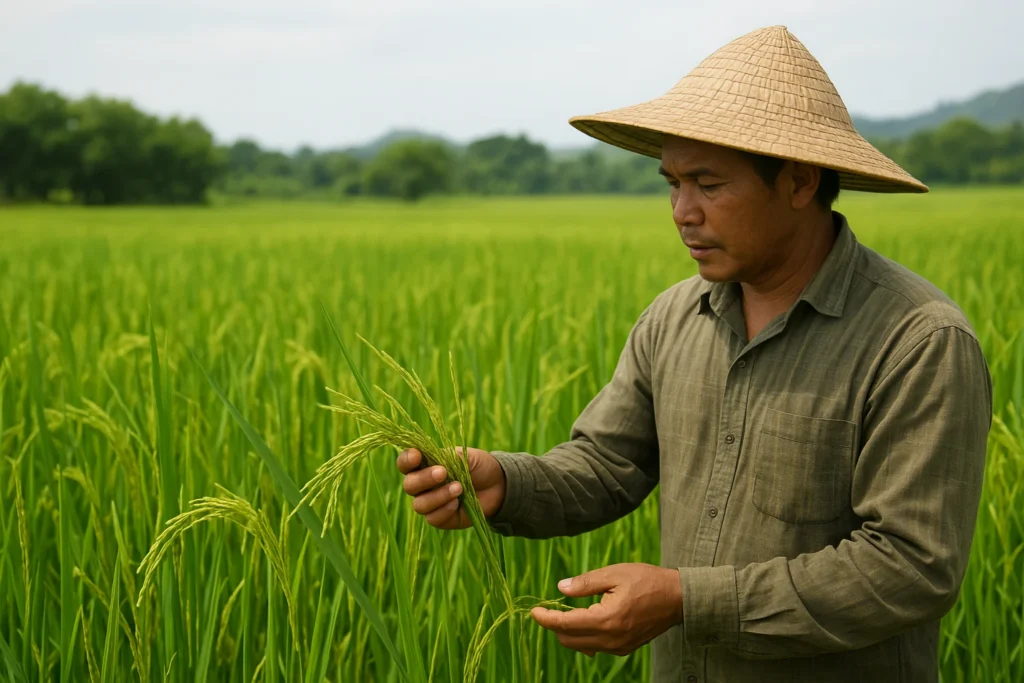

I. The Cracked Earth and the Crisis of the Worried Farmer
The Weight of the Monsoon’s Betrayal
For millennia, the relationship between the Asian farmer and the monsoon has been one of sacred dependence. In the sprawling, fertile lowlands that stretch from the Ganges Delta to the Mekong River, the annual rains are the financial calendar, the spiritual rhythm, and the very breath of life. The planting of the paddy, the ritual of the flooding, the celebration of the harvest—all dictated by the predictable cycle of the great wind.
But this ancient contract is fracturing. Stand on the dust-caked edges of a village in Vidarbha, India, or the arid plains of the Isaan region of Thailand. Picture Raj, a farmer whose family has tilled the same land for five generations. Raj watches the sky not with hopeful anticipation, but with dread. The warming climate has made the rains capricious: they arrive late, they are too short, or they are violently excessive, destroying young crops with flash floods before a drought sets in.
The sight of his rice seedlings—the precious Oryza sativa, the world’s most important staple—wilting in the parched ground is the image of economic and emotional collapse. The soil, once a life-giving mud, has hardened into a pale, jigsaw puzzle of cracks, reflecting the unforgiving sun. This climatic instability has pushed millions of smallholder farmers into a debilitating cycle of debt, migration, and food insecurity. The old knowledge is failing, and the existential question is simple: How does one feed a family when the very sky cannot be trusted?
A Quiet Seed, A Radical Solution
In the face of this deepening crisis, a revolutionary answer has emerged, not from heavy industrial policy, but from the elegant simplicity of a single seed. Across the vast rice fields that feed over half the global population, a quiet, profound revolution is underway. Scientists, in collaboration with farming communities, have successfully deployed a variety of rice genetically primed for survival: drought-resistant rice.
This is not a modest improvement; it is a fundamental re-engineering of the plant’s relationship with water. This rice variety requires up to 30% less water throughout its growth cycle while maintaining strong, reliable yields. For farmers battling the frontline of climate change, this seed is more than an agricultural innovation; it is a lifeline of reliability that restores predictability to their harvest and allows them to plan for a future beyond mere subsistence. The era of vulnerable farming is slowly yielding to the age of resilience.
II. The Historical Roots of Rice: From Ancient Grain to Modern Staple
The story of rice is as old as civilization itself. Archaeological evidence suggests rice was first domesticated in the Pearl River Valley region of China over 9,000 years ago. From these ancient beginnings, it traveled along trade routes and with migrating peoples, embedding itself into the spiritual, cultural, and economic fabric of countless societies across Asia. It features in Hindu rituals as a symbol of prosperity, in Japanese mythology as a gift from the gods, and in Filipino traditions as the essence of community. For millennia, farmers selected and saved seeds from the hardest plants, slowly adapting local varieties to their specific micro-climates—dry uplands, river deltas, and terraced mountainsides.
This deep history of adaptation is crucial. The drought-resistant rice of today is not a sudden invention but the latest chapter in this long relationship between humans and a plant. Modern science has simply accelerated and sharpened this age-old process of selection, using new tools to identify and combine valuable traits with incredible precision. Where a traditional farmer might have taken a hundred generations to develop a slightly more drought-hardy strain, scientists can now achieve a significant leap in a fraction of the time, guided by an understanding of plant genetics that our ancestors could only intuit. This work honors the past even as it secures the future, building upon the genetic diversity painstakingly preserved by generations of farmers.
III. What Exactly is Drought-Resistant Rice? Deconstructing Resilience
The Parable of the Thirsty Teenager vs. the Marathon Runner
To appreciate this scientific achievement, we must understand the biological demands of traditional rice. Conventional Oryza sativa is a thirsty plant, genetically programmed over centuries of cultivation in flooded paddies. It is like a teenage sprinter—it needs massive, continuous hydration to perform. When the water level drops, the plant panics, shuts down, and rapidly dies.
The drought-resistant rice, however, is the seasoned desert-runner. It is conditioned to utilize every drop of moisture with surgical precision. It possesses the biological discipline to endure long stretches of dryness and still reach the finish line with its energy—its yield—intact. This breakthrough was born from a rigorous, patient process of discovery, driven by the understanding that nature had already engineered the solution.
The Science of Discovery: Not Creation, But Curation
The process began with a global treasure hunt. Scientists at the International Rice Research Institute (IRRI) scoured the world’s rice gene banks—vast, frozen libraries containing the DNA of thousands of ancient, wild, and traditional rice varieties. They were looking for landraces, varieties that, through natural selection over centuries, had acquired incredible, inherent toughness in harsh, arid uplands or semi-dry regions. These were the “forgotten” strains, genetically rich but often low-yielding.
The technique used to develop the new seed is primarily accelerated, precision breeding—not relying solely on genetic modification (though complementary research continues in that field). Researchers meticulously identified the specific Quantitative Trait Loci (QTLs)—the small, powerful genetic regions responsible for drought tolerance. They then used sophisticated crossing and screening methods to transfer these rugged “survival genes” into the highest-yielding modern rice strains. The result is the ultimate hybrid: a plant with the toughness of its wild ancestors combined with the productivity of modern agriculture. This meticulous curation process ensures cultural acceptance and regulatory simplicity across diverse Asian markets.
IV. The Science Behind the Strength: An Interconnected Biological Toolkit
The resilience of the new rice is not due to a single trait but a sophisticated, interconnected biological toolkit that manages stress and water use simultaneously.
1. The Deep Underground Miners: Root Architecture
The most critical difference lies unseen, beneath the soil. Traditional rice has a wide, shallow, fibrous root system, optimized for absorbing nutrients from standing water. When the water disappears, these roots are stranded.
The drought-resistant rice, by contrast, develops a profound, deep-rooting architecture. These roots penetrate the soil vertically, acting like geological miners, exploring and reaching deep residual moisture layers that are unavailable to their shallow-rooted counterparts. Studies show that this deeper system allows the plant to draw water from layers 20 to 40 centimeters deeper during dry spells. This superior foraging capability is the plant’s first line of defense.
2. The Smart Gates: Stomatal Regulation
Plants lose the vast majority of their water through microscopic pores on their leaves called stomata. These pores must open to allow the intake of carbon dioxide ($CO_2$) for photosynthesis, but every opening carries the unavoidable cost of water loss through transpiration.
The new rice possesses genetically enhanced stomatal control. When the plant senses intense heat or moisture stress, its stomata close slightly or remain closed for longer periods during the hottest, driest parts of the day. This careful, measured response, known as dynamic water-use efficiency, significantly reduces unnecessary water vapor escape, effectively throttling down the engine of water loss without completely starving the plant of $CO_2$. The plant is thus equipped to ride out the heatwave with maximum water retention.
3. The Enduring Engine: The “Stay-Green” Phenotype
When traditional rice faces severe stress, a stress hormone triggers a process known as senescence, or accelerated aging. The leaves yellow rapidly and die prematurely, halting photosynthesis and shattering the potential grain yield.
The drought-resistant variety exhibits the powerful “stay-green” phenotype. Its leaves are genetically programmed to maintain their high chlorophyll content—their deep green color—for a significantly longer duration under stress. This means the plant’s food-manufacturing engine remains operational during a drought, allowing it to continue converting sunlight into carbohydrates and channeling that energy into filling the grain (the rice kernel) even when conditions are suboptimal. This trait ensures that the yield reduction is minimal, even in a crisis.
4. Osmotic Adjustment and Cell-Level Discipline
At the cellular level, the rice employs osmotic adjustment. When soil moisture drops, the plant cells increase the concentration of solutes (sugars and ions) within their cytoplasm. This internal change helps the cell retain water and maintain the turgor (firmness) necessary for the plant to stand upright and keep its leaves extended, maximizing light absorption—a discipline crucial for enduring dry spells.
5. The Wax Coat and Leaf Roll: Physical Defenses
Beyond the microscopic, the rice also deploys physical armor. Some varieties produce a thicker, waxier cuticle on their leaves, a natural raincoat that slows evaporation. Others possess the ability to roll their leaves inward during peak heat, dramatically reducing the surface area exposed to the drying sun and wind, much like a person curling up to conserve warmth.
V. The Human Network: The Unsung Heroes Spreading the Seeds
Science creates the seed, but it is a vast, decentralized human network that plants it. The deployment of drought-resistant rice is a story of countless individuals: agricultural extension officers on motorbikes traversing dusty backroads, women in self-help groups meeting under village trees, progressive farmers who turn their fields into demonstration plots for skeptical neighbors. These are the true agents of change, translating scientific potential into real-world impact.
In India, a massive system of Krishi Vigyan Kendras (Farm Science Centers) acts as the local hub for knowledge. Scientists here don’t just hand out seed packets; they listen. They learn about local soil conditions, pest issues, and culinary preferences. They then tailor their recommendations, offering not just a new variety of rice, but a whole “package of practices” for that specific area. They train local farmers to become “master trainers” or “seed guardians,” creating a ripple effect of peer-to-peer education that is far more trusted than a government pamphlet.
In Thailand, the network often flows through agricultural cooperatives and private seed companies that have built long-term relationships with farming communities. These entities provide bundled services—seeds, training, a guaranteed market—creating a business model where resilience is profitable for everyone in the chain. Sales representatives are often agronomy graduates who speak the local dialect and understand farm-level economics.
In the Philippines, the network is deeply embedded in the social fabric of the barangay. Local government units, in partnership with NGOs and church groups, organize “Farmers’ Field Schools.” These are not lectures; they are hands-on, season-long workshops where a group of farmers manages two side-by-side plots—one with traditional methods, one with the new rice and practices. They collect data, observe differences, and draw their own conclusions. The learning is collective, experiential, and empowering. This network of trust and shared experience is the essential soil in which the new seed can take root.
VI. A Journey Across Three Nations: The Human Impact
The true success of the drought-resistant rice is measured in the transformed lives of the people who cultivate it.
India: Raj’s Village Reclaims Its Destiny
In the village of Bhawanipur in Odisha, Raj’s experience has become the community’s rallying cry. After his successful first harvest, Raj, no longer bound by the cycle of high-interest loans, became an evangelist. His neighbors witnessed the stark, visual proof: his field, a resilient green anchor, stood firm while the adjacent traditional paddies withered.
Raj’s story is a profound demonstration of economic leverage. A guaranteed, reliable harvest—even a marginally smaller one than a perfect traditional yield—means the difference between food security and starvation. It allows for the payment of school fees, access to healthcare, and the ability to buy higher-quality fertilizer for the next season. It transforms the farmer’s identity from a vulnerable dependent into a secure entrepreneur, capable of long-term planning. The debt trap, a vicious mechanism fueled by crop failure, begins to crumble.
Thailand: Mali’s Empowerment and the Water Revolution
In the arid, rain-shadow plains of Thailand’s Isaan, Mali’s shift in farming technique represents a cultural as much as a scientific breakthrough. She adopted the Alternate Wetting and Drying (AWD) method, a practice that pairs perfectly with the resilient rice. Instead of continuous flooding, Mali carefully monitors the water in her field using a simple buried plastic pipe. When the water drops 15cm below the surface, she irrigates; otherwise, she lets the soil dry out.
This practice, facilitated by the hardy rice, reduced her irrigation water usage by over 40% and her energy bill (for pumping groundwater) by half. Mali and her neighbors now sell their certified “Climate-Smart Rice” through a cooperative. They command a higher market price due to the rice’s sustainable production method, effectively translating water savings into premium profit. Her success empowers not just her family, but the entire women’s farming cooperative, demonstrating that sustainability is a pathway to economic sophistication.
The Philippines: Juan and the Barter of Hope
In the mountainous regions of the Philippines, where infrastructure challenges make government distribution difficult, farmer Juan’s community utilized the spirit of Bayanihan—communal unity and mutual aid. They established a seed-relay system. After the initial successful harvest from a limited seed stock, Juan’s obligation was not to pay back a loan, but to “pass the seed forward”—sharing twice the amount of seed he received with two new farmers in the next planting cycle.
This community-driven mechanism ensured the exponential, rapid spread of the seeds, creating local hubs of expertise and shared knowledge about the new water management practices. The seed became a currency of trust and mutual investment, transforming the entire barangay (village) into a self-sustaining ecosystem of resilience. The shared success reinforces social cohesion, proving that local wisdom and collective action are as vital as the science itself.
VII. The Ripple Effects: Beyond the Harvest
The introduction of this high-resilience rice has catalyzed profound changes that extend far beyond the immediate farm gate, stabilizing entire regional ecosystems and economies.
The Massive Gain in Water Security
The cumulative effect of millions of farmers using 30% less water is an enormous conservation gain. This substantial reduction in agricultural water demand alleviates pressure on vital river systems, freshwater aquifers, and reservoirs. The water saved is critical for drinking, sanitation, municipal use, and the cultivation of other essential non-paddy crops, such as vegetables and legumes, thereby diversifying regional food supplies and mitigating local water conflicts. Agriculture moves from being a water competitor to a water partner.
A Significant Contribution to Climate Mitigation
One of the most surprising and critical benefits is the rice’s role in the fight against global warming. When rice paddies are continuously flooded, the submerged soil becomes anaerobic (oxygen-deprived). This condition facilitates the production of methane ($CH_4$), a powerful greenhouse gas with a global warming potential significantly higher than carbon dioxide.
By enabling the Alternate Wetting and Drying (AWD) technique, the drought-resistant rice naturally cuts down on the duration of soil submergence. The introduction of oxygen intermittently halts the methane-producing microbes, resulting in a demonstrable reduction in methane emissions from rice cultivation—a major step toward climate mitigation for the agricultural sector.
Bolstering Macro-Economic and Geopolitical Stability
Stable, reliable local food production reduces a nation’s dependency on volatile global commodity markets, which are easily disrupted by international conflicts, trade wars, or global weather events. Food security is national security. By ensuring local sufficiency, countries can shield their poorest populations from hyperinflation and commodity price shocks, leading to greater political and economic stability within the region. The reliable harvest acts as a foundational pillar for national budgeting and investment planning.
Empowering Women Farmers and Shifting Social Dynamics
Across Asia, women constitute the backbone of agricultural labor, responsible for the back-breaking work of transplanting seedlings and often managing daily water flow. Drought-resistant rice, coupled with the less labor-intensive AWD method, directly reduces their physical burden. More significantly, women are frequently the leaders of seed-sharing networks and marketing cooperatives. As seen in Thailand and the Philippines, this roles them greater economic autonomy, decision-making power within the household, and a stronger public voice in community affairs, catalyzing positive social change alongside agricultural transformation.
VIII. Navigating the Challenges: The Path Isn’t Always Smooth
While the promise is immense, the journey toward widespread adoption is not without its hurdles and complexities. Acknowledging these challenges is essential for honest progress.
The Adoption Hurdle and the Training Gap
The initial cost of high-quality, certified seeds—even with their guaranteed returns—can be prohibitive for the poorest farmers living on razor-thin margins. Furthermore, the new varieties demand new skills: farmers must be trained effectively in the complex art of water management (AWD) and precise fertilizer application, moving away from generations of traditional flooding practices. A failure to provide accessible, consistent, and locally tailored extension services can be the single greatest barrier to adoption.
The Taste and Tradition Hurdle
Rice is identity on a plate. Consumers have deep, almost unconscious preferences for the specific aroma, texture, length, and stickiness of their regional variety. A drought-resistant rice that yields well but cooks into a mushy, flavorless mass is a failure. This is why the most successful breeding programs are not creating wholly new rice, but backcrossing drought-tolerance genes into cherished local heirlooms. The goal is invisible resilience—a rice that withstands drought but still tastes like the comforting, familiar grain of home, preserving cultural heritage alongside food security.
The Imperative of Genetic Diversity
Perhaps the most crucial long-term challenge is the danger of genetic monoculture. While the new drought-resistant rice is a miracle, replacing vast swaths of diverse local rice varieties with a single type creates an enormous vulnerability. A new, specialized pest or disease could emerge and wipe out the entire crop, leading to a disaster far greater than a drought.
The scientific community is fully aware of this imperative. The research strategy is not to create one “super rice,” but to use the drought-tolerance genes to create a suite of tailored, climate-ready solutions. Current efforts are focused on breeding the deep-rooting and stay-green traits into hundreds of regionally beloved, culturally significant varieties—from the aromatic Basmati of India to the Jasmine rice of Thailand—thereby securing both regional identity and biological diversity.
IX. Looking to the Future: A Horizon of Comprehensive Resilience
The drought-resistant rice is a landmark, not an end point. It has established a powerful template for how science can partner with nature and communities to solve the most pressing challenges of the climate crisis.
Building the Climate-Ready Crop Portfolio
Agricultural scientists are now applying the same principles of precision breeding to tackle the next wave of threats:
- Submergence Tolerance: Developing varieties that can survive being completely underwater for up to two weeks, a necessity in flood-prone deltas. The discovery and deployment of the Sub1 gene—the “scuba gene”—is already helping rice survive in flood-prone areas like Bangladesh.
- Salinity Tolerance: Creating rice that can withstand high levels of salt in the water, essential for coastal areas and deltas where rising sea levels are pushing saltwater into prime agricultural land.
- Heat Tolerance: Engineering rice that can maintain photosynthesis and complete grain filling under extreme ambient temperatures that would normally cause sterility and crop failure.
- Nutritional Enhancement: The quest is for resilience in both quantity and quality. Biofortification efforts aim to pack more essential vitamins and minerals, like Zinc and Iron, into the resilient grain, addressing the “hidden hunger” of micronutrient deficiencies that affect billions.
The ultimate goal is to move beyond single-trait solutions and build a portfolio of multi-stress tolerant rice varieties—a genetic Swiss Army knife that gives farmers options for whatever the future’s volatility may bring.
X. Beyond Rice: Lessons for a Hungry Planet
The story of drought-resistant rice holds profound lessons for global agriculture far beyond Asia. The principles being perfected here—harnessing genetic diversity, combining modern science with traditional knowledge, building resilience through biological traits rather than just chemical inputs, and empowering farmers as co-creators—are a blueprint for adapting other staple crops to a changing climate.
From drought-tolerant wheat for the Australian outback to flood-resistant maize for the American Midwest, the same patient, collaborative approach is needed. The success in Asia demonstrates that transformative change is possible when innovation is rooted in the reality of farmers’ lives and the ecology of the land. It shows that the solution to a global crisis can be decentralized, democratic, and grown from the soil up.
XI. The Cultural and Spiritual Dimensions of a Changing Crop
Finally, we must return to the cultural heart of the matter. Rice is more than calories; it is embedded in songs, proverbs, festivals, and prayers. Changing the very nature of this crop has subtle but important cultural dimensions. When a community adopts a new variety, they are, in a small way, reshaping a piece of their identity. This is why the most successful programs are those that move beyond agronomic metrics to engage with this deeper significance.
In some communities, the first harvest of a new, successful rice is shared in a community feast, blessing the seed and integrating it into local tradition. Stories are told about “the rice that saved the village,” weaving the new variety into the oral history of the people. This cultural adoption is the final, crucial step in making resilience sustainable. It ensures the new seed is not just planted in the soil, but also in the soul of the community.
Conclusion: A Seed of Hope and the Discipline of Adaptation
For generations, the Asian farmer’s life was an annual, fearful bet against the sky. Today, that narrative is shifting, marked by a profound act of adaptation and scientific stewardship.
The drought-resistant rice is far more than an agricultural commodity; it is a powerful symbol of human and biological resilience. It represents a transition from a vulnerable past to a disciplined, adaptable future. It proves that science, when deployed with respect for local knowledge and a focus on the real needs of the world’s most vulnerable populations, can cultivate solutions that are both technically brilliant and socially transformative.
As these resilient seeds continue to spread, multiplied and shared across the continent by farmers like Raj, Mali, and Juan, they carry with them the promise of stable incomes, ecological stewardship, and, most importantly, the assurance of full bowls. The rice that refused to quit is not just securing the world’s most important staple food; it is planting the seeds of enduring hope for a greener, more secure future for all of Asia. In its stubborn green shoot pushing through cracked earth, we see a metaphor for our times: the relentless, life-affirming power of adaptation.



Looking for a smooth slot experience? Win777slotlogin looks like it could be promising. Easy login is a big plus in my book. Let’s see if their games are just as good! win777slotlogin
Needed a bit of a pick-me-up, so I headed over to happylukevn. It definitely delivered on the ‘happy’ part! Might not be life-changing, but a good way to unwind. See for yourself: happylukevn
Just gave ic79bbet a whirl. Pretty solid experience, good selection of games and the site’s easy to navigate. Not too shabby! Check it out here ic79bbet.