
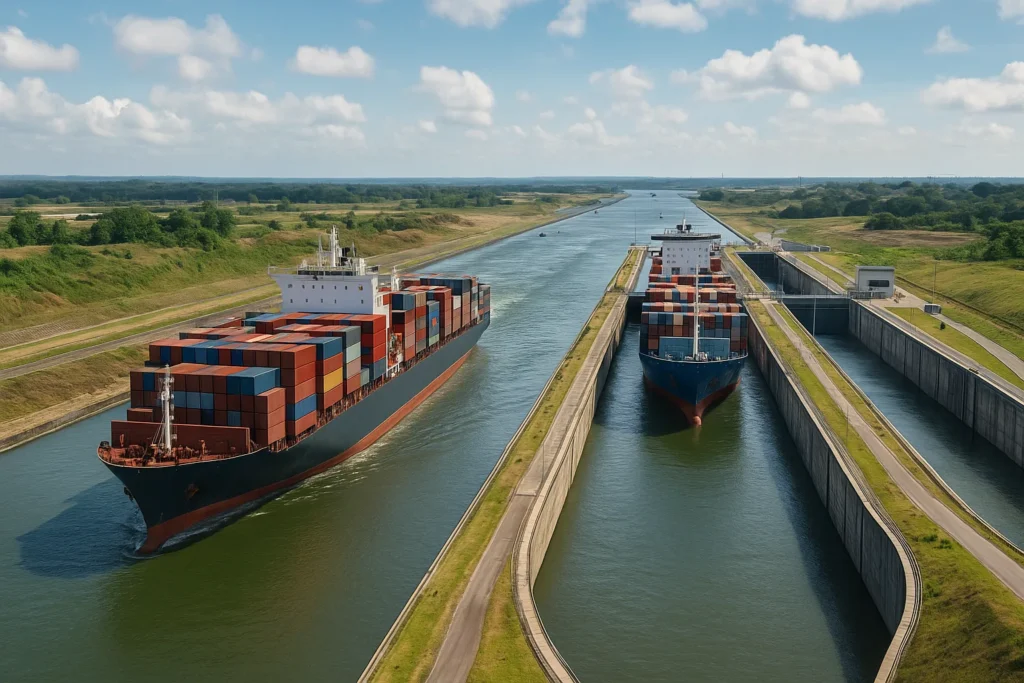

For over a century, its existence was a geographical decree, a fact as immutable as a mountain range. The great canal was the linchpin, the irreplaceable shortcut that stitched together the hemispheres of commerce. Its story was one of legendary human triumph—a decade of digging, a fortune in gold, tens of thousands of lives spent to move a continent’s worth of earth and water. It was a wonder that bent the map to human will. Yet, by the dawn of the 21st century, a quiet, creeping paralysis had set in. The marvels of a previous age were becoming the bottlenecks of the new millennium. The world had outgrown its own plumbing.
This is the story of the next great leap. Not the story of a single ditch, but of a global phenomenon—the strategic, multi-national expansion and modernization of vital shipping canals. It is a narrative unfolding from the humid jungles of Central America to the arid sands of the Middle East, in the intricate river deltas of Europe and the bustling straits of Asia. It is the collective answer to a silent scream from the arteries of global trade. And the consequences—economic, social, geopolitical, and environmental—are unfolding with the force of a tidal wave released through a newly opened lock, reaching into the most unexpected corners of our world.
This is not merely an article about infrastructure. This is a chronicle of a planet retooling its circulatory system. It is about the revival of ghost towns on inland rivers, the redrawing of the world’s industrial map, the quiet revolution in a midwestern warehouse, and the new calculus of a farmer in Chile or an engineer in Stuttgart. The expansion is complete. The channels are deeper, the locks are smarter, the banks are stronger. And now, the future is flowing in.
PART I: THE GREAT CONGESTION – A WORLD STUCK IN NEUTRAL
To grasp the profound shock of the new, we must first sit in the frustrating stillness of the old. For decades, the creeping strain on these canals was the slow-boiling crisis everyone in global logistics knew about, but the average consumer only felt in the subtle, deferred ways of higher prices and “supply chain issues.”
The Floating Parking Lots: A Captain’s Log of Waiting
Imagine the Pacific approach to a major canal at the peak of the dry season, before the expansion. The water is a glassy, hot mirror, reflecting not clouds, but a forest of steel. Container ships, bulk carriers, liquefied natural gas tankers, and car carriers stretch in a line that disappears over the curvature of the Earth. This is not a procession; it is a parking lot. Here, the term “vessel” feels inadequate. These are monolithic, self-propelled islands. A ship over 1,300 feet long, carrying 15,000 containers, sits beside a bulker laden with enough Midwestern grain to feed a nation for a month. They are monuments to efficiency, yet here they are, utterly inefficient, burning thousands of dollars of fuel per hour just to keep the lights on and the refrigeration units humming.
Captain Elias Vance, a 35-year veteran of the trans-canal run, kept a personal log not of miles, but of lost hours. “You’d get your slot,” he recounts, his voice still carrying the fatigue. “Then a fog bank rolls in. Or a lock gate has a hydraulic fault. Or a smaller vessel ahead has a steering issue. Your 18-hour transit becomes 30. Then 40. You are a prisoner of the queue. The company is screaming via satellite for updates. The charterer is calculating demurrage penalties. And in your holds, the clock is ticking on perishables. You feel the weight of the global economy, and it’s becalmed.”
The Domino Effect of Delay: From the Bridge to Your Living Room
The cost was never just the extra fuel. It was a complex tax levied on every link in the supply chain, a hidden surcharge on globalization itself.
- The Perishability Principle: For global fruit conglomerates, a canal delay was a direct threat to profitability. A banana or an avocado has a precise and unforgiving lifecycle from tree to supermarket shelf. A 48-hour holdup could mean the difference between perfect ripeness and a wholesale dump into a harbor, a multi-million-dollar loss written off to the sea. This forced a shift to more expensive, carbon-heavy air freight for high-value produce or pushed risk premiums into the price of every piece of fruit.
- The Just-in-Time Collapse: Modern manufacturing operates on a ballet of precision, with parts arriving “just in time” for assembly. An automotive plant in Kentucky, for instance, might have a two-day window for a container of precision gearboxes from a supplier in Thailand. A canal delay didn’t just mean a late part; it meant an idle assembly line, thousands of workers sent home, and a cascading failure of production schedules across North America. The “buffer stock” became an expensive necessity, tying up capital in idle inventory that strained corporate balance sheets.
- The Consumer’s Invisible Surcharge: All these costs—the extra fuel, the insurance premiums for delayed cargo, the air freight backups, the factory idle time—were absorbed, aggregated, and passed along. Economists estimated that canal congestion added a hidden increment to virtually every physical product sold in connected hemispheres. That new smartphone, that affordable furniture, that bag of coffee beans—all were subtly more expensive because the world’s shortcut had become a slow-motion gauntlet. It was a friction tax on globalism.
The Heartland’s Slow Fade: The Inland Ports Left Behind
While the world fretted over coastal queues, a deeper, quieter tragedy was unfolding a thousand miles inland. A network of cities and towns—the historic intermediaries of commerce—were entering an economic twilight. These were the places built not at the mouth of a river, but along its fertile middle, where rail met water and goods changed hands.
Take the story of the fictional yet emblematic Port of Carrington, on the Mississippi River. A century ago, Carrington was a boomtown. Cotton, grain, and later, manufactured goods moved from America’s industrial heartland down to the Gulf, where they were loaded onto ships for the canal transit to global markets. The reverse flow brought coffee, rubber, and ores. Its brick warehouses were palaces of commerce; its docks teemed with longshoremen, clerks, and brokers; its streets were lined with hotels and banks that serviced the trade.
Then, the ships got bigger. The “Panamax” standard—the maximum size that could fit the old locks—became a constraint. Shipping lines, seeking the relentless economies of scale, built vessels that were Post-Panamax, then New-Panamax. These leviathans could not physically navigate the shallower, narrower reaches of the inland waterways. They called only at the massive, automated “load center” ports on the coast. There, their containers were offloaded. But the economics of transferring those containers onto a smaller barge for the journey upriver to Carrington grew less attractive, especially with unreliable canal schedules making the entire chain unpredictable.
The result was a slow, painful hollowing out. The barge traffic dwindled to a trickle. The warehouses, with their classic sawtooth roofs, were converted into antique markets, artist lofts, or simply stood vacant, their windows broken like sad eyes. The jobs—not just on the docks, but in the supporting ecosystem of trucking firms, rail spurs, customs brokerage offices, and machine shops—evaporated. Young people graduating from Carrington High no longer saw a future there. They left for Atlanta, Dallas, Chicago. The town’s population aged and shrank. The very connection to the global waterway that had birthed it was now its lifeline, and that line was going slack. The rust wasn’t just on the cranes; it was a state of mind.
This story was replicated, with local variations, in dozens of places across the globe: along the Rhine in Europe, connected to the North Sea ports; on the Paraná River in South America, feeding the Atlantic; in the network of Chinese ports connected to the internal Yangtze. The global shift to megaships and hub-and-spoke logistics was leaving the spokes themselves to wither. The heartlands were being disconnected.
PART II: THE ENGINEERING MARVEL – REDEFINING THE POSSIBLE
The decision to expand a major international canal is never merely an engineering question. It is a geopolitical statement, a multi-billion-dollar gamble on the future of globalization, and a logistical undertaking that rivals the pyramids in its ambition. It requires a consensus not just within a country, but often among neighboring states, private investors, and international financiers. The vote to proceed is a moment of profound faith in collective human endeavor.
The Confluence of Forces: Why Expansion Became Inevitable
Several powerful currents converged to make expansion not just desirable, but existential for the corridors and the nations that depended on them.
- The Ship Size Revolution: The drive for containerization, which began in the mid-20th century, never stopped. Bigger ships meant lower cost per container slot, a fundamental, relentless law of shipping economics. By the 2000s, shipyards were routinely launching vessels that were visual absurdities next to the century-old lock chambers. The canal authorities faced a stark choice: adapt or become a scenic, but increasingly irrelevant, aquatic museum, a quaint relic bypassed by the true currents of commerce.
- The Rise of Asian Manufacturing and Hyper-Globalized Supply Chains: The explosive growth of China as “the world’s factory,” followed by Vietnam, Bangladesh, and others, meant a massive and sustained east-west flow of goods. The canal was the central pivot in this trade. Its inefficiency became a direct drag on the engine of global economic growth, a sandbar in the mainstream of prosperity.
- Climate, Competition, and Strategic Anxiety: Severe droughts, like those that recently plagued key canals, highlighted the vulnerability of infrastructure dependent on fragile freshwater reservoirs. Simultaneously, alternative routes loomed on the horizon—the potential of Arctic shipping lanes melting open, or rival land bridges across continents being promoted. To remain competitively indispensable, the canals needed to offer unassailable value: unmatched reliability and massive volume.
- The National Pride and Economic Development Imperative: For the nations hosting these canals, they are more than infrastructure; they are crown jewels, sources of immense national pride, strategic identity, and revenue. Modernizing them was a statement of sovereignty and forward-thinking ambition. It was a promise to their people: we will not let this asset decay; we will double down on it, making it the cornerstone of our 21st-century prosperity and geopolitical relevance.
The Blueprint for a Colossus: More Than Just a Bigger Ditch
The public might imagine expansion as simply digging a wider, deeper channel. In reality, it was a suite of interlocking mega-projects, each pushing the boundaries of contemporary engineering, a symphony of disciplines played out on a continental stage.
- The New Locks: Cathedrals of Concrete and Hydraulics The signature elements were the new lock complexes. These are not just larger versions of the old; they are fundamentally reimagined for a new age of precision and sustainability.
- Scale: The new lock chambers are akin to concrete canyons. They are approximately 1,400 feet long, 180 feet wide, and 60 feet deep—dimensions that allow them to accommodate vessels up to 1,200 feet long with beams of 160 feet, the new “Neopanamax” standard. Standing at the edge of one under construction was to witness a human-made gorge.
- The Water-Saving Basins – A Hydro-Logical Masterstroke: A critical breakthrough addressing a primal constraint. Traditional locks use a staggering volume of fresh water—about 50 million gallons per transit—simply flushed out to sea. The new design incorporates an elegant system of side basins that capture, store, and recycle 60% of that water. Three tiers of basins work like a staircase, reusing water from one lockage to partially fill the next. This was not just an environmental win; it was a necessity for a canal whose watershed faces increasing climate stress, ensuring operational resilience against future droughts.
- The Rolling Gates: Unlike the iconic mitre gates of the old locks that swing open like double doors, some new systems utilize rolling gates. These are immense steel structures, as tall as a 10-story building, that move on railway-type tracks embedded in the lock walls. They are stronger, more reliable for larger chambers, and easier to maintain and seal, representing a evolution in the fundamental mechanics of the lock.
- The Tugboat Dance – From Mules to Azimuth Thrusters: The old system of electric “mules” on tracks, pulling ships with cables, was charming but inadequate for the massive, less-maneuverable new ships. The modern transit relies on a ballet of powerful, azimuth-thruster-equipped tugboats. These tugs, commanded by pilots with years of specialized training, use a combination of pushing, pulling, and complex physics to nudge the giants through the tight chambers with centimeter precision, all coordinated by a central, digital control room that resembles the bridge of a starship.
- The Great Excavation: Moving Mountains Underwater The channel work was a Herculean task of planetary proportions. Millions of cubic meters of rock and sediment had to be removed, not just at the entrances, but along the entire narrowest reaches of the canal, reshaping the seabed itself.
- The Dredging Fleet – An Armada of Giants: An international armada of specialized vessels was assembled. Cutter suction dredgers, with powerful rotating heads that could pulverize bedrock, worked around the clock, their glow visible from shore at night. Trailing suction hopper dredgers, like underwater vacuum cleaners, collected the spoil. The scale defied imagination: the total material excavated in some expansions could have built a dozen Great Pyramids of Giza, a testament to the volume of earth that once separated the oceans.
- The Environmental Mitigation – Engineering with Ecology: This was no longer a “dig at all costs” operation of a bygone era. Comprehensive Environmental Impact Assessments guided every phase. Slit curtains, vast underwater sheets, contained sediment plumes to protect sensitive coral reefs and sea grass beds. Dredged material was often used beneficially—to create new artificial islands for bird nesting, to replenish eroded beaches for turtle breeding, or to cap contaminated industrial sites, turning an engineering byproduct into an environmental asset.
- The Digital Nervous System: The Invisible Revolution Perhaps the most profound, yet least visible, upgrade was in the canal’s “brain.” The expansion was accompanied by a full digital transformation, making the waterway a smart network.
- AI-Powered Scheduling and Digital Queue Management: Advanced algorithms now manage the transit queue, not as a simple line, but as a dynamic puzzle. They optimize the order of ships based on size, destination, priority (some pay a premium for a reserved slot), cargo type, and real-time weather conditions. This maximizes throughput and minimizes waiting time, turning chaos into optimized flow.
- The Smart Lock – A Symphony of Sensors: Thousands of fiber-optic sensors and strain gauges are embedded in the lock walls, gates, and mooring systems. They provide a constant, real-time stream of data on structural stresses, water levels, seal integrity, and equipment health. Predictive maintenance software analyzes this data, scheduling repairs before a failure occurs, avoiding catastrophic downtime. The lock now tells its keepers when it needs attention.
- Integrated Traffic Management – The God’s-Eye View: A centralized command center, with vast video walls displaying the entire canal’s movement via GIS and AIS tracking, allows controllers to see the whole system as a living organism. They can adjust flows, respond to incidents, and communicate seamlessly with every vessel via digital data links, replacing the crackle of radio voice commands with silent, error-proof data packets.
The Human Mountain: Labor, Life, and Legacy on the Job
The expansion was built not just by machines, but by an army of workers—a microcosm of global migration, skill, and sweat. At the peak of construction, tens of thousands of people labored on the sites, creating temporary cities in the wilderness. Engineers from Germany and Japan debated geotechnical solutions with specialists from Chile and Norway. Skilled welders from Colombia and Portugal worked alongside crane operators from the Philippines. They lived in modular dormitories, ate in vast cafeterias, and were shuttled to work in buses that crawled along newly carved service roads.
The work was relentless and dangerous. Tunnel collapses in soft ground, equipment failures under extreme load, and the ever-present risks of working at great heights or near deep water claimed lives, adding a sobering human cost to the balance sheet of progress. Memorials at the site stand as quiet testament. The project became a crucible of skill, training a generation of local workers in ultra-modern construction techniques—tunnel-boring machine operation, mass concrete pouring, high-strength steel welding. It left behind a legacy of human capital as valuable as the concrete itself, upskilling entire regional workforces.
PART III: THE UNLEASHED FLOW – THE IMMEDIATE AFTERSHOCKS OF A NEW REALITY
The official opening ceremony was a global spectacle: fireworks over the water, speeches by presidents and kings, and the pristine new lock chamber flooding for the first time, a symbolic baptism of a new era. But the real moment of truth came days later, when the first commercial vessel, a behemoth carrying over 9,000 containers, approached the new gates. As it slid silently into the chamber, dwarfing yet perfectly fitting the new space, a collective, palpable sigh of relief was felt across the global shipping industry. The cork was out of the bottle. The pressure was released.
The Logistics Revolution: Data from the New Waterway
The quantitative impact was immediate, dramatic, and measurable in the billions.
- The 25-30% Transit Time Reduction – The End of the Uncertainty Premium: This headline figure undersold the psychological change. It wasn’t just about faster movement through the cut; it was the near-elimination of the pre-transit queue, the erasure of the “maybe” from shipping schedules. The predictability was revolutionary. A journey from Shanghai to New York could now be planned with a variance of hours, not days. This reliability is worth more than pure speed to supply chain managers; it allows for true integration and planning, reducing the need for costly buffer inventory across continents.
- The Cascading Efficiency – De-stressing the Global System: With reliable schedules, port terminals at both ends could plan their labor gangs and crane operations with military precision. Trucking companies could schedule container pickups without expensive “per diem” charges for waiting. Rail networks could optimize their cross-country freight schedules, knowing when the containers would arrive. The entire, fragile global logistics system began to de-stress, moving from a state of constant reactive scrambling to one of proactive flow.
- The Route Re-mapping – Redrawing the World’s Trade Atlas: Shipping lines immediately began revising their global service networks, a multi-billion-dollar exercise in real-time cartography. The “All-Water Route” from Asia to the U.S. East Coast via the canal became dramatically more competitive with the old “Land Bridge” model (where ships discharged on the West Coast and cargo moved by rail across the U.S.). New direct services were launched between secondary ports in Asia and secondary ports on the U.S. Gulf and East Coasts, decentralizing trade flows and giving more cities direct access to global lanes. The canal was no longer just a shortcut; it was now the central artery for a denser, more resilient network.
The Rebirth of the Hinterlands: Ports, People, and the Return of Purpose
While the world focused on the megaships, the most transformative stories began to unfold far inland, in the forgotten “Carringtons” of the world. The expanded canal didn’t just move more cargo; it changed the fundamental economics of distance and scale, making inland ports viable in a way they hadn’t been for half a century. It was a reversal of the hollowing-out, a process of refilling.
Case Study 1: The “Inland Port” Phenomenon – From Rust to Robotics
Let’s revisit Carrington, Mississippi. Five years after the expansion, the town is almost unrecognizable. The old brick warehouses have been refurbished, their historical facades preserved, but they are now surrounded by vast, flat, greenfield sites that have been transformed into something entirely new: the Carrington Inland Port Intermodal Logistics Park. It is a landscape of staggering scale and automation.
- The New Economic Model – The Seamless Transfer: The new economics work with elegant efficiency. A Neopanamax ship from Shenzhen arrives at the Gulf Coast “megaport.” Instead of its 5,000 Midwest-bound containers being scattered across a chaotic web of trucks and trains, they are loaded as a single, dedicated unit onto a long, efficient “container-on-barge” tow. This barge train, a floating train over a mile long, chugs reliably up the Mississippi to Carrington. There, at the new logistics park, the containers are efficiently transferred via massive, automated rubber-tired gantry cranes that move with silent, pre-programmed grace, directly onto waiting double-stacked rail cars on a newly strengthened spur line. Within hours, that train is rolling toward Chicago, Memphis, or Kansas City. The goods never touch the ground until their final destination.
- Why It Works Now – The Magic of Predictability and Scale: The canal expansion enabled this in two profound ways: 1) The monumental cost savings from using the megaship all the way to the Gulf are so significant they can absorb the barge and rail transfer costs and still beat the old, unreliable truck-based methods. 2) The predictability of the canal arrival is the linchpin. The entire “intermodal dance” at Carrington—the barge arrival, the crane work, the train assembly—can be choreographed with digital precision. No more waiting for late ships. The system operates like a Swiss watch, with each container a tick in the mechanism.
- The Human Renaissance – A Town Re-skilled: The park employs thousands, but these are not the jobs of the 1970s. Not just crane operators (who are now more like technicians monitoring screens and inputting commands), but a whole new professional class: logistics coordinators who speak the language of global trade, IT specialists managing the park’s nerve-center operating system, customs and compliance officers navigating complex international regulations, truck drivers for the final local leg, and highly trained maintenance crews for the fleet of containers and chassis. A new technical college campus has opened on the edge of town, offering degrees in Supply Chain Management and Mechatronics, its parking lot full at night with adults seeking new skills. The diner on the old port road is now a thriving farm-to-table restaurant catering to the new professionals. For-sale signs have been replaced by permits for new housing subdivisions and modern apartment complexes. The school board is debating the need for a new elementary school.
Case Study 2: The Manufacturing Renaissance – “Glocalization” in Action
In Middletown, Ohio, a different, quieter kind of revival is taking place. The expanded canal has spurred a powerful trend called “glocalization”—a sophisticated hybrid of global sourcing and local manufacturing that leverages the new logistics reality.
- The Business Logic Unlocked: Consider “Great Lakes Gear Works,” a family-owned firm that makes precision industrial gears for heavy machinery. For decades, they sourced all their raw specialty steel from a premier mill in Germany. The old, unreliable canal transit meant they had to keep a 90-day inventory of expensive steel onsite, tying up millions of dollars in capital that sat dormant in a warehouse. It was a necessary cost of doing global business, a friction tax they had to pay.
- The Expansion Enabled by Certainty: Now, with a guaranteed 22-day shipment from Rotterdam to a newly efficient inland port on the Great Lakes, they can operate with a radically lean 10-day inventory. The freed-up capital is transformative. They have invested in new, automated machining centers from Japan, robots that work alongside skilled machinists. They’ve hired 50 new employees—not just machine operators, but programmers, quality engineers, and salespeople to handle new business. Crucially, their reliable, just-in-time supply chain has made them a far more attractive supplier to major automotive and aerospace companies. They are winning contracts they could never have serviced before.
- The Cluster Effect – The Rise of the Agile Ecosystem: Great Lakes Gear’s success is acting as a magnet. A company making specialized polymer components has moved into a vacant unit in the same industrial park, partly to be near a key customer, partly to benefit from the same reliable inbound supply chain for its chemical inputs from Asia. A small, innovative firm offering industrial 3D printing services for prototyping has set up shop nearby. An ecosystem of tool-and-die shops, precision welders, and niche logistics providers is coalescing. This isn’t the massive, smoke-belching factory of the 1950s; it’s a network of agile, high-tech, globally connected small and medium enterprises (SMEs). They are resilient, adaptable, and all fundamentally enabled by the reliable, affordable, and predictable flow of materials that the canal expansion guarantees. The waterway has become a conduit for capital investment and innovation, not just containers.
Case Study 3: The Agricultural Reconnection – From Farm to Faraway Fork with Precision
In the Cerrado region of Brazil, soybean farmer João Silva is seeing the impact not in a warehouse, but in the rich, red earth of his fields. Brazilian soybeans, a cornerstone of the global food supply chain, have long competed with U.S. beans in massive markets like China. The long, costly voyage around the Cape of Good Hope or through the narrower, restrictive old locks put them at a persistent freight disadvantage.
- The New Calculus of Distance: The expanded canal allows much larger, more efficient Panamax-sized bulk carriers to load fully in Brazilian ports like Santos and transit directly and efficiently to Asian megaports. This dramatically lowers the per-bushel shipping cost, a margin that makes all the difference in commodity markets.
- The Direct Impact on the Ground: For João, this means the local agricultural cooperative he sells to can offer him a better price at the silo, as their export costs have fallen. This improved margin makes it economically viable for him to invest in more productive, sustainable farming techniques—precision agriculture guided by satellite data, new drought-resistant seed varieties, and soil health management. It connects his farm more directly, efficiently, and profitably to the burgeoning middle class in Shanghai and Jakarta. The canal expansion, in essence, has shrank the world for him. It has made the global market tangible and more rewarding, turning geographic distance from a liability into a manageable variable.
The New Jobs Landscape: Skills for the Fluid Economy
The employment boom is not a simple return to the past. The revival demands a new portfolio of skills, creating a “fluid economy” workforce.
- The Digital Longshoreman and the Automated Crane Technician: Port and logistics park jobs now require a hybrid skillset: physical competence paired with digital literacy. Workers must be comfortable interfacing with Warehouse Management Systems (WMS), Transportation Management Systems (TMS), and the touch-screen controls of automated stacking cranes and robotic forklifts. It’s a blend of blue-collar grit and white-collar tech-savvy.
- The Supply Chain Analyst – The New Corporate Strategist: Every company touched by this change, from a giant retailer to a small manufacturer like Great Lakes Gear, now needs people who can model complex logistics networks, optimize multi-modal routes, manage carrier relationships, and mitigate risk using real-time data analytics. These are high-value, white-collar jobs growing not in coastal mega-cities, but in regional hubs like Carrington and Middletown. They are the brains coordinating the brawn of the new trade flow.
- The Green Logistics and Sustainability Specialist: With corporations and consumers increasingly focused on carbon footprints, expertise in measuring Scope 3 emissions (those of the supply chain), optimizing modes for lowest environmental impact (ship vs. rail vs. truck), and implementing sustainable packaging and circular economy principles is in soaring demand. The canal’s own water-saving technology has made environmental efficiency a core part of the narrative, creating a new professional niche.
PART IV: THE WIDER RIPPLES – GEOPOLITICS, ENVIRONMENT, AND THE CHALLENGES OF SUCCESS
The expansion’s effects cannot be contained to economics and logistics alone. It is altering strategic calculations on the world stage, imposing new environmental responsibilities, and creating societal challenges that must be managed with wisdom and foresight.
The Geopolitical Rebalancing: A Canal’s New Weight in a Multipolar World
Control over a crucial chokepoint has always conferred a form of power. The modernized, high-capacity canal amplifies this, but in a more complex, integrated way in our multipolar world.
- From Passive Toll Booth to Active Integrated Trade Hub: The host nations are consciously engineering a shift in their role. They are no longer content to be mere toll-collectors for passage. The vision is to become active managers and beneficiaries of a comprehensive global trade platform. This means investing heavily in ancillary and value-added industries: state-of-the-art ship repair and dry-dock facilities, strategic bunkering (fuel supply) hubs that comply with new emissions standards, logistics tech startups, and financial services related to trade finance and insurance. The goal is to capture a much larger share of the total economic value flowing through their waters, moving up the value chain from infrastructure landlords to service industry leaders.
- The Resilience Imperative in an Age of Disruption: In an era marked by pandemics, regional conflicts, and climate disruptions, the reliable, unimpeded flow of goods is not just an economic concern—it is a core component of national and global security. The expanded, resilient canal is now marketed aggressively as a secure, stable, and efficient alternative to other, more volatile routes. This gives its operators significant diplomatic leverage and makes the canal’s continued neutrality and smooth operation a matter of urgent global concern, involving it in high-stakes international diplomacy.
- The Anchor in Major Power Trade: A significant portion of the canal’s traffic is trade between economic giants, most notably the U.S. and China. Its efficiency and reliability are key variables in that immense economic relationship. Any significant disruption would immediately be felt in boardrooms and government offices in both capitals, making the canal a silent but critical stakeholder in the world’s most important—and often tense—bilateral relationship. Its smooth operation becomes a shared, if unspoken, interest.
The Environmental Paradox: The Double-Edged Sword of Efficiency
The expansion presents a complex and nuanced environmental ledger, a case study in the trade-offs of progress.
- On the Credit Side: The Greening of Global Haulage
- Modal Shift from Carbon-Intensive Alternatives: More reliable and cheaper sea shipping actively pulls freight away from carbon-intensive air cargo and long-haul trucking over continental distances. One fully loaded mega-container ship can replace thousands of trucks, with a fraction of the emissions per ton-mile.
- Radical Efficiency per Container: Moving one container on a Neopanamax ship is vastly more fuel-efficient than moving it on a smaller, older vessel. The expansion enables the use of the most efficient ships on the planet for this critical route, lowering the carbon intensity of the voyage itself.
- Conscious Engineering: The new water-saving basins and the deliberate, scientifically guided creation of new wetlands from dredge spoil are benchmark examples of modern, environmentally conscious civil engineering. They show that large-scale infrastructure can be designed with ecology as a core parameter, not an afterthought.
- On the Debit Side: The Scale of Success
- Induced Demand and Total Volume: The expansion, by lowering costs and improving service, induces demand—a fundamental law of economics. More ships, even more efficient ones, ultimately mean more total emissions in the canal zone itself, a greater aggregate risk of fuel spills or accidents, and a heightened challenge of managing invasive species transported in ballast water.
- Pressure on Connecting Arteries: The boom in barge and rail traffic to inland ports pushes aging inland waterway infrastructure—like old locks and dams on the Mississippi or the Rhine—to their breaking points. This creates a secondary infrastructure crisis and raises concerns about bank erosion, sediment disruption, and impacts on freshwater aquatic ecosystems far from the canal itself.
- The Embedded Carbon of Creation: The sheer, monumental scale of the construction—the cement production (a major CO2 source), the diesel-fueled dredging and excavation, the steel fabrication—had a massive, one-time carbon footprint. The long-term operational benefits must be weighed against this upfront environmental cost.
The challenge now is one of continuous, vigilant management: enforcing strict, tiered emissions standards for vessels in the canal zone, investing in shore-power infrastructure so ships can plug into the grid instead of idling their auxiliary engines in port, and funding the parallel modernization of the connecting inland waterway and rail networks to create a truly green, end-to-end corridor.
The Challenges of Success: Navigating the Pitfalls of a Boom
Rapid, concentrated growth brings its own set of problems, and the communities at the center of this revival are scrambling to manage them proactively to avoid the distortions of a gold rush.
- Infrastructure Strain and the Planning Deficit: Towns like our fictional Carrington face immense, sudden pressure on century-old roads never designed for thousands of daily truck movements, on overtaxed sewage and water treatment plants, on overcrowded schools, and on a housing market where prices can double in a year. The great challenge is moving from reactive crisis management to strategic, long-term planning that guides sustainable development, ensuring the boom builds a better city, not just a bigger one.
- Equity, Displacement, and Inclusive Growth: There is a very real risk that the primary economic benefits flow to outside property developers, large multinational corporations, and a new class of skilled transplants, while long-time, often less-educated residents get priced out of their ancestral neighborhoods or relegated to the low-wage service jobs supporting the new economy. Proactive, courageous policies are required: inclusionary zoning for affordable housing, local hiring quotas and apprenticeship programs tied to new developments, and targeted support for small, home-grown businesses to help them scale and compete.
- The Cyclical Nature of Trade and Economic Diversification: Global trade is inherently boom-and-bust, tied to the rhythms of the world economy. Building a regional economy overly reliant on the continuous, exponential growth of logistics is risky. The most forward-thinking regions are using the logistics boom as a stable, foundational platform to diversify into more resilient, higher-value sectors—attracting advanced manufacturing, fostering research and development in transportation tech, and building centers for education and healthcare. The goal is to make the canal’s flow the river that waters a diverse economic garden, not a monoculture.
CONCLUSION: NOT AN END, BUT A NEW CURRENT – THE FLUID FUTURE
The expansion of the world’s great shipping canals is not a completed event to be filed away in history books. It is an ongoing process, a new and powerful set of conditions that is continuously, dynamically reshaping our world. It has alleviated one major, visible bottleneck, only to reveal others upstream and downstream—in the inland ports, the rail networks, the last-mile delivery systems. It has solved a monumental problem of physical scale, but in doing so, has created new, complex challenges of management, equity, and long-term sustainability that require wisdom and collaboration to navigate.
Ultimately, this story transcends concrete, steel, and container ships. It is a profound testament to human adaptability and ambition—our relentless, collective drive to reshape our physical environment to meet the evolving needs of civilization. It is a story of reconnection on a grand scale, proving that even in a digital age of virtual networks and instant communication, the physical pathways of commerce remain the indispensable bedrock of our shared prosperity. They are the tangible threads in the fabric of globalization.
The revived canals have done more than move cargo faster; they have moved the center of economic gravity for entire regions, pulled people from the despair of obsolescence to the opportunity of a new skills economy, and moved the global community one step closer to a system of exchange that is not only faster and cheaper, but potentially more resilient, more inclusive, and more thoughtfully integrated with the planetary environment it ultimately depends upon.
The water now flows faster, deeper, and smarter. And on its current, it carries not just the manufactured goods, the resources, and the foodstuffs of the world, but a renewed and powerful set of possibilities—for the historic port town given a second life, for the farmer with a better market, for the engineer in a revitalized factory, and for the stability of nations. The great unchoking is complete. The new, powerful, and fluid era of global connection has decisively begun.



Tried out the jiliokloginapp today. Login was pretty quick and easy. Haven’t played too much yet, but the interface seems clean. Give it a shot jiliokloginapp
The ph2222login process was surprisingly simple. Got right in and started playing in no time. So convenient! Check it out yourself at ph2222login.
Downloaded the jiliwincomapp last night. Running really smoothly so far. Games are looking sharp. Definitely recommend checking it out! Access it here: jiliwincomapp