
Imagine standing on a beautiful, white-sand beach, the tropical sun warming your skin. You look out over the Indian Ocean, expecting the usual endless expanse of blue. But instead, your eyes are drawn to a sight that seems impossible: the ocean itself appears to be pouring off the edge of the world. A massive cascade, churning with foam and power, plunges into a dark, bottomless abyss. It looks like the ultimate waterfall, a place where the sea simply gives up and drains away.
This isn’t a scene from a fantasy movie. It’s a real place you can visit. But here’s the catch: if you were to swim out to that churning cascade, you’d find nothing but calm, clear water. There’s no roaring current, no abyss, and no waterfall. What gives?
Welcome to the magic of the “underwater waterfall” of Mauritius. It’s one of the most mind-bending optical illusions on planet Earth, a trick of light, geology, and ocean currents that has to be seen to be believed. And the best part? Once you understand how it works, it becomes even more amazing. Let’s take a deep dive into this natural wonder and explore everything you need to know about it.
A Postcard from the Edge of the World
Our story takes place on the tiny island nation of Mauritius, a speck of land in the Indian Ocean about 700 miles east of Madagascar. You might know Mauritius for its luxurious resorts, its friendly people, and its stunning beaches. But just off its southwestern coast, near a famous mountain called Le Morne Brabant, nature plays its greatest trick.
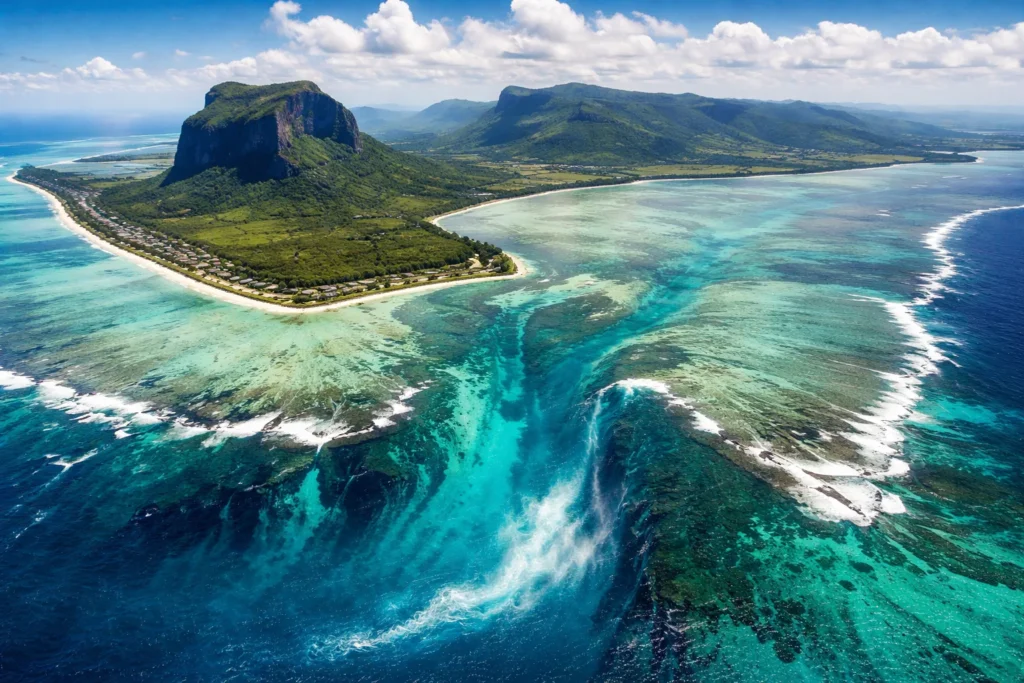
From the air, the view is absolutely breathtaking. The shallow coastal waters are a brilliant, almost glowing turquoise, thanks to the white sand and coral reefs just below the surface. But then, right at the edge of this bright, happy blue, something changes. The water suddenly turns into a deep, inky navy. And streaming over that sharp line between light and dark are what look like massive rivers of sand and water, falling down into the depths. It creates a giant, horseshoe-shaped “waterfall” that stretches for miles.
This illusion is so powerful that it plays with your brain. You know you’re looking at the ocean, but your eyes are telling you that you’re looking at a cataclysmic plunge into a void. It’s a moment of pure, joyful confusion.
The first time you see it, your mind struggles to make sense of the visual information. Every instinct you have screams that water cannot fall like that, not on this scale. And yet, there it is, laid out beneath you like a painting come to life. The edges of the illusion are so crisp, so defined, that it’s easy to forget you’re looking at a natural phenomenon and not some artist’s digital creation.
Tourists who visit Mauritius specifically to see this wonder often describe the experience as life-changing. They talk about the moment their plane begins its descent into the island and they catch their first glimpse of the southwestern coast. Even from commercial flight altitude, the pattern is sometimes visible, a dark scar on the bright turquoise lagoon that hints at something extraordinary below.
Photographers from around the globe make the pilgrimage to this tiny island, hoping to capture the perfect shot. They know that the light has to be just right, the tides have to be favorable, and the clouds have to cooperate. When all these elements align, the resulting images are so stunning that they often get accused of being photoshopped. But the truth is, no digital manipulation is needed. Nature’s own artistry is more than enough.
The illusion has become so famous that it now appears on countless postcards, travel brochures, and Instagram feeds. It has put the southwestern tip of Mauritius on the map in a way that few other natural attractions have. And yet, despite all this attention, the underwater waterfall remains a mystery to most people who haven’t seen it in person. They assume it’s a real waterfall, perhaps hidden beneath the waves, when in fact it’s something far more subtle and fascinating.
What makes this illusion so special is its scale. This isn’t a small trick of the light that only appears under specific conditions for a few minutes each day. This is a massive feature of the landscape, or rather seascape, that spans several miles. It’s visible from high altitudes, from helicopters, and even from the summit of the nearby mountain. The sheer size of it is part of what makes it so convincing. Our brains simply aren’t used to seeing patterns this large that look so much like falling water.
The colors involved are also part of what makes the illusion so striking. The turquoise of the shallow lagoon is almost impossibly bright, a color that seems to glow from within. This is caused by the white sand bottom reflecting sunlight back through the water, but also by the coral reefs that add their own subtle hues to the mix. The deep blue beyond the drop-off is equally intense, a color so deep and pure that it seems to pull you in. The contrast between these two blues, separated by the white and tan of the falling sediment, creates a visual experience that photographs can only hint at.
People who have seen the illusion from the air often struggle to describe it to friends back home. They find themselves using words like magical, unreal, and impossible. They show their photos, but the photos never quite capture the full experience. There’s something about being there, about seeing it with your own eyes and knowing that it’s real, that no photograph can replicate.
The illusion has also become a symbol of Mauritius itself. When people think of this island nation, they think of beaches and resorts, but increasingly they also think of this strange and beautiful optical phenomenon. It’s become part of the identity of the place, a natural wonder that sets Mauritius apart from every other tropical destination in the world.
It’s Not Water, It’s Sand
So, if it’s not water falling off a cliff, what are we actually seeing? The answer is both simple and fascinating. The waterfall is actually made of sand, silt, and sediment.
Think of it like this: imagine a huge, underwater desert. Off the coast of Le Morne, the ocean floor isn’t flat. It’s a giant underwater plateau called the Mascarene Plateau. For miles, this plateau is relatively shallow, only about 150 meters deep. But then, it just stops. It plunges down over 4,000 meters into the darkness of the abyssal plain. That’s a vertical drop almost five times the height of the Empire State Building.
Now, add ocean currents to the mix. Powerful underwater streams flow along the plateau, picking up loose sand and sediment from the seabed. When these currents reach the edge of this massive underwater cliff, they keep going. They carry the sand and silt right over the edge, where it tumbles down into the depths below.
What we see from above isn’t a waterfall of water, but a waterfall of sand and sediment being swept over a gigantic underwater cliff. Some people even call it an underwater sandfall.
This process has been going on for thousands of years, and it continues to this day. The sand that falls over the edge doesn’t just disappear. It accumulates on the deep ocean floor, forming massive underwater fans and deposits that geologists study to understand the history of the region. Over time, these deposits can build up, creating new geological formations that will exist for millions of years.
The sediment itself comes from several sources. Some of it is the eroded remains of the island’s volcanic rocks, broken down over millennia by wind, rain, and waves. Some of it is the ground-up skeletons of coral and marine organisms, crushed into fine white sand by the constant action of the ocean. And some of it is organic matter, tiny particles of life that drift down from the surface waters above.
When you look at the colors in the illusion, you’re seeing the different types of sediment. The lighter, almost white areas are mostly coral sand, ground fine as flour by the endless motion of the waves. The darker areas contain more volcanic minerals, eroded from the ancient lava flows that make up the island itself. And the patterns you see, the way the sediment seems to flow in distinct channels, are shaped by the underwater currents that have been carving these pathways for centuries.
Scientists who study oceanography are fascinated by this site because it offers a visible window into processes that usually happen far from human eyes. Normally, to study sediment transport on the seafloor, researchers have to use sonar, remotely operated vehicles, or complex computer models. Here, nature has provided a way to see it from the air, a natural laboratory where the basic principles of underwater geology are written in giant letters for anyone to read.
The rate at which sediment falls over this edge varies depending on the seasons, the weather, and the strength of the currents. During stormy periods, when waves are higher and more energetic, more sediment gets stirred up from the shallow plateau and pushed over the edge. During calm periods, the flow is gentler, more like a steady trickle than a massive cascade. This means the appearance of the illusion actually changes throughout the year, growing more dramatic after storms and settling into softer patterns during quiet spells.
The sediment that falls over the edge doesn’t all go straight down. Some of it gets caught in swirling eddies and counter-currents, creating complex patterns that add to the illusion’s beauty. Some of it spreads out in underwater fans, like the deltas of rivers on land. Some of it gets carried along the edge of the drop-off before finally plunging into the deep. All of these movements create the intricate, flowing patterns that make the illusion look so much like a real waterfall.
Over geological time, this sediment transport has carved canyons and channels into the edge of the plateau. These underwater features are like the river valleys on land, shaped by the flow of material over thousands of years. They funnel the sediment into specific pathways, which is why the illusion has such distinct rivers of sand rather than just a general haze of sediment.
The amount of sediment involved is enormous. Every year, thousands of tons of sand and silt are carried over this underwater cliff. It’s a constant process of erosion, the island slowly being worn down and carried away to the deep ocean. In human terms, the rate of erosion is tiny, barely noticeable. But in geological terms, it’s a powerful force that will eventually, millions of years from now, wear the island down to nothing.
How Nature Paints a Masterpiece
Okay, so we have sand falling over an underwater cliff. But why does it look so incredibly dramatic, like a roaring waterfall? This is where the artistry of nature comes in, and it involves a little bit of physics and a lot of optical magic.
The main ingredient for this illusion is the stark contrast in color.
In the shallow water on the plateau, the water is warm, clear, and not very deep. Sunlight penetrates all the way to the white, sandy bottom and reflects back up. This creates that beautiful, bright turquoise color we associate with tropical paradises. The white sand acts like a giant mirror, bouncing the sunlight back through the water and creating that signature Caribbean blue that draws tourists from around the world.
Once you go over the edge of the plateau, the water is thousands of meters deep. Sunlight can’t reach the bottom. Instead of reflecting off white sand, the light gets absorbed by the immense volume of water. Water molecules are very good at absorbing light, especially the red and yellow wavelengths. The blue wavelengths penetrate deepest, but even they eventually get absorbed. This makes the ocean appear a dark, deep, almost scary navy blue.
Now picture the sand and silt being carried over that edge. This sediment is a mix of minerals and organic matter that reflects light, making it appear lighter in color. As this lighter-colored material falls and swirls through the dark blue water, it creates the perfect illusion of a cascading waterfall. It’s like watching smoke swirl in front of a dark curtain, your brain interprets the moving light color as a solid, falling object.
The currents and the shape of the seafloor help guide the sediment into specific channels and patterns, which is why the waterfall looks so structured, with distinct rivers of sand pouring into the deep. It’s a masterpiece painted by geology and ocean currents.
But there’s more to this optical illusion than just color contrast. The angle of the sun plays a crucial role. When the sun is directly overhead, around midday, the light penetrates the water straight down, illuminating the sediment plumes from above and making them appear their brightest. This is why the illusion is most vivid during the middle hours of the day.
The clarity of the water also matters. Mauritius benefits from having incredibly clear ocean waters, especially away from river mouths where runoff might cloud things up. This clarity allows light to penetrate deep into the water column, illuminating the falling sediment far below the surface. In murkier waters, the illusion would be much less visible, the sediment plumes disappearing into the gloom before they could create the dramatic effect.
Another factor is the shape of the underwater terrain. The edge of the plateau isn’t a straight line. It’s curved and indented, with underwater canyons and channels carved into it by thousands of years of sediment flow. These channels funnel the sand and silt into specific pathways, creating the impression of distinct rivers feeding into the main waterfall. Some of these channels are so well-defined that they look like they were carved by rivers on land, complete with meanders and branching patterns.
The human eye and brain also contribute to the illusion. We are wired to recognize patterns, and falling water is one of the patterns we’re most familiar with. When we see light-colored material moving downward through a dark background, our brain instantly categorizes it as a waterfall. It’s a shortcut our visual system uses to make sense of the world quickly, and in this case, it leads us to see something that isn’t technically there.
The psychology of perception is fascinating in this context. Our brains are constantly making predictions about what we’re seeing based on past experience. When we look at the ocean, we expect to see waves, maybe some variation in color, but not a massive waterfall. When the visual input conflicts with our expectations, our brain tries to resolve the conflict by fitting what we’re seeing into familiar categories. In this case, the familiar category of a waterfall is the closest match, so that’s what we see.
This is the same mechanism that allows us to see faces in clouds or animals in rock formations. Our brains are pattern-recognition machines, constantly trying to make sense of the world by matching what we see to things we already know. Sometimes, as with the underwater waterfall, this leads us to see something that isn’t really there, but the experience is no less real for being an illusion.
The illusion also demonstrates something about how we perceive depth and distance. The sharp line between the shallow turquoise water and the deep blue water creates a powerful depth cue, telling our brains that there’s a sudden drop-off. The falling sediment reinforces this cue, adding motion to the depth signal. The result is a perception of a three-dimensional cascade plunging into an abyss, even though we’re looking at a two-dimensional surface from above.
The Fiery Birth of an Island
To truly appreciate the illusion, we have to go back in time, way back. About 8 million years ago, Mauritius didn’t exist. The spot where it sits today was just empty ocean. But deep beneath the waves, the Earth was stirring.
A massive volcanic hotspot, similar to the one that powers the volcanoes in Hawaii today, began to erupt. Over millions of years, layer after layer of lava piled up on the ocean floor. Eventually, this volcanic mountain grew tall enough to break the surface of the water, and the island of Mauritius was born.
This volcanic history is the key to the whole illusion. The massive underwater cliff we talked about, that’s the edge of the ancient volcano. The Mascarene Plateau is the vast, sloping base of the volcano, and the steep drop-off is the original flank of the mountain, plunging back down to the abyssal plain.
So, when you look at the underwater waterfall, you’re not just looking at sand and currents. You are looking at the very shape of the ancient volcano that created the island. The dramatic drop is the original slope of a giant, extinct underwater mountain. The sand and silt are just doing what nature does, slowly, over time, eroding the island and washing it back into the deep ocean from whence it came.
The volcanic origins of Mauritius explain many of its features, not just this illusion. The island’s dark, rocky mountains are made of basalt, the same type of rock that forms the Hawaiian Islands. The rich, fertile soil that supports the sugarcane plantations comes from weathered volcanic material. Even the famous black sand beaches that dot the coastline are made of tiny fragments of volcanic rock, ground down by the waves.
Geologists have studied the volcanic history of Mauritius extensively. They’ve dated the oldest rocks on the island and found that they formed about 8 million years ago. But volcanic activity didn’t stop then. There have been more recent eruptions, with the last one occurring only about 30,000 years ago, which is the blink of an eye in geological terms. This means that the volcano that built Mauritius could potentially erupt again someday, though there are no signs of imminent activity.
The hotspot that created Mauritius is part of a chain of underwater volcanoes and islands that stretches across the Indian Ocean. As the tectonic plate moves slowly over the stationary hotspot, new volcanoes form and old ones are carried away. Mauritius is just the latest in a long line of islands created by this process, and eventually, millions of years from now, it will erode away and sink beneath the waves, becoming just another seamount on the ocean floor.
This cycle of birth and death, of volcanic creation and oceanic erosion, is written into the very landscape of the underwater waterfall. The sediment that flows over the edge today is the same material that will one day form new rocks on the abyssal plain, continuing the endless cycle of geological transformation. When you fly over that cascading sand, you’re watching geology in action, a process that has been going on for millions of years and will continue for millions more.
The volcanic history also explains why the waters around Mauritius are so rich in marine life. Volcanoes bring nutrients up from the deep Earth, and these nutrients fertilize the surrounding waters. The coral reefs that thrive around the island are built on this foundation of volcanic fertility. And the white sand that creates the bright turquoise color of the lagoon is largely made of ground-up coral, completing a cycle that connects the volcanic origins of the island to the living reefs that surround it.
Scientists have found evidence of much older rocks on Mauritius as well, including tiny crystals of zircon that are billions of years old. These crystals are thought to be remnants of ancient continental crust, fragments of land that were carried up by the volcanic eruptions and incorporated into the island. This suggests that the geological history of Mauritius is even more complex than previously thought, involving not just volcanic activity but also the recycling of much older material from deep within the Earth.
Le Morne Brabant: The Silent Guardian
You can’t talk about the underwater waterfall without talking about the mountain that watches over it, Le Morne Brabant. This iconic peak, with its sheer cliffs and flat top, is more than just a great viewpoint. It’s a UNESCO World Heritage Site and a place of deep historical and cultural significance.
In the 18th and early 19th centuries, Mauritius was a hub for the brutal slave trade. Le Morne Brabant, with its remote location and nearly inaccessible cliffs, became a refuge for escaped slaves, known as maroons. These brave men and women fled the plantations and set up hidden communities in the caves and on the summit of the mountain, living free in a place where they thought no one could find them.
The mountain became a powerful symbol of resistance and freedom. Today, a visit to Le Morne is a moving experience. You can feel the weight of its history in the wind. For many Mauritians, the mountain and the beautiful lagoon at its feet, including the site of the underwater waterfall, are sacred ground, forever tied to the story of those who fought for their liberty.
When you see the waterfall illusion from the air, you’ll notice it curves right around the base of this magnificent mountain, as if the mountain itself is the source of the falling water. The two are forever linked, a monument to nature’s power and humanity’s resilience.
The stories of the maroons who hid on Le Morne have been passed down through generations. They lived in caves, survived on what they could hunt and gather, and built a community in one of the most inhospitable places on the island. The cliffs that made the mountain so hard to climb also made it easy to defend, and the maroons were never captured. They remained free until slavery was abolished, at which point they finally came down from their mountain refuge.
There’s a legend that when a group of soldiers went to the mountain to tell the maroons they were free, the maroons misunderstood and thought they were being recaptured. Rather than return to slavery, many of them jumped to their deaths from the cliffs. Whether this story is historically accurate or symbolic, it captures the deep fear and desperate courage of those who chose death over bondage.
Today, there’s a memorial at the base of the mountain, a place where visitors can pay their respects and learn about this painful chapter of Mauritian history. The site is marked by a simple but powerful sculpture, and it’s become a place of pilgrimage for people from all over the world who want to honor the memory of those who suffered and resisted.
The mountain itself is a hiker’s paradise, though the climb is not for beginners. The trail winds up through dense forest, past ancient trees and exotic plants, and eventually emerges onto the exposed cliffs near the summit. From the top, the view is absolutely spectacular. You can see the entire lagoon, the underwater waterfall pattern stretching out below, and the ocean meeting the sky on the horizon. It’s a view that rewards the effort of the climb many times over.
Local guides are available to lead hikes up the mountain, and they’re not just guides but storytellers. They share the history of the mountain, the legends of the maroons, and the natural history of the plants and animals along the trail. A hike up Le Morne with a good guide is an education in itself, a journey through both natural and human history.
The vegetation on Le Morne is also remarkable. The mountain is home to several plant species that are found nowhere else on Earth, adapted to the harsh conditions of the steep slopes and exposed summit. Some of these plants are rare and endangered, protected by the mountain’s status as a UNESCO site. Hikers are asked to stay on the trail to avoid damaging this fragile ecosystem.
The caves where the maroons lived are still there, though they’re not easily accessible. Some are hidden behind thick vegetation, others are high on the cliffs where only experienced climbers can reach them. Archaeologists have found artifacts in these caves, pieces of pottery, tools, and other remnants of the maroon communities. These discoveries help tell the story of how people lived in this extreme environment, surviving against all odds.
For the descendants of the maroons, Le Morne is a sacred place. They make pilgrimages to the mountain, hold ceremonies at its base, and pass down the stories of their ancestors. The mountain is not just a landmark but a living connection to their history, a reminder of the courage and resilience of those who came before.
A Bird’s-Eye View: The Only Way to See the Magic
Here is the most important thing to know if you want to see this wonder: you cannot see it from the beach.
This is the part that tricks a lot of people. If you stand on the white sands of Le Morne and look out at the ocean, the water just looks blue. You might notice a slight change in color where the shallow lagoon meets the deeper ocean, but you won’t see the dramatic, cascading waterfall effect. It’s like trying to see the whole painting from an inch away.
The illusion is all about perspective. You need to be high up to see the pattern of the sediment flowing over the drop-off. That means you need to get in the air.
By helicopter is the most popular and breathtaking way to experience it. Helicopter tours lift off and take you right over the site. You can hover above the illusion, getting a true sense of its massive scale and the intricate details of the sediment flow. It’s an exhilarating experience. You’ll also get stunning views of the island’s interior, with its mountains, waterfalls, and lush forests.
The helicopter rides typically last between fifteen and forty-five minutes, depending on the package you choose. Some tours focus exclusively on the underwater waterfall and the surrounding coastline, while others include flyovers of the island’s other attractions, like the Seven Coloured Earths, the Chamarel Waterfall, and the Black River Gorges. The longer tours give you a complete aerial tour of the island, a perspective that few visitors ever get to experience.
The helicopters used for these tours are designed for sightseeing, with large windows that give every passenger a good view. The pilots are experienced and knowledgeable, pointing out landmarks and explaining what you’re seeing as you fly. They know exactly when to slow down and circle so you can get the best photos, and they’re happy to answer questions about the island and its attractions.
Some helicopter tours offer the option of flying with the doors off, which gives an unobstructed view and makes for better photography. This can be a bit scary for some people, but for others it’s part of the adventure. The wind rushes through the cabin, the views are completely open, and the experience of hovering over the underwater waterfall with nothing between you and the ocean is absolutely unforgettable.
A seaplane offers a slightly different but equally amazing perspective. The flight is often smoother and a bit slower, giving you plenty of time to soak in the view. Plus, taking off and landing on the water is a cool experience in itself.
Seaplane tours have a different feel than helicopter tours. They’re more leisurely, more like a flying boat ride than an aerial adventure. The seaplanes can land on the lagoon near Le Morne, giving you the opportunity to step out onto the floats and take photos with the mountain in the background. Some tours even include a champagne toast while you’re floating on the water, a touch of luxury that many visitors appreciate.
The seaplanes used in Mauritius are typically small aircraft that can carry four to six passengers. They’re comfortable and well-maintained, with large windows for viewing. The pilots are experienced and knowledgeable, and they’re happy to share information about the sights you’re seeing.
If you prefer to keep your feet on solid ground, you can hike to the summit of Le Morne Brabant. It’s a challenging but rewarding climb that takes a few hours. From the top, you will get a view of the general shape of the illusion far below. It won’t be the crisp, detailed waterfall you see from a helicopter, but you’ll understand the geography of it, and you’ll be rewarded with incredible panoramic views of the entire peninsula.
The hike is serious business. It’s steep in places, and the path can be rocky and slippery. Good hiking shoes are essential, as are plenty of water, sun protection, and a snack for energy. But the sense of accomplishment when you reach the top is immense, and the view from the summit is something you’ll remember for the rest of your life.
Some adventurous visitors combine the two perspectives. They hike the mountain first, getting the ground-level view and understanding the geography from above. Then, on another day, they take a helicopter or seaplane tour, seeing the illusion in all its glory from the air. This combination gives them a complete understanding of the phenomenon, from the geology that created it to the optical magic that makes it visible.
For those who can’t or don’t want to fly, there are other ways to appreciate the illusion. Some tour operators offer boat trips that take you close to the drop-off, though you won’t see the waterfall effect from water level. You can see the change in water color, and you can learn about the geology and history of the area from your guide. It’s not the same as seeing it from above, but it’s still a worthwhile experience.
Planning Your Adventure: When to Go and What to Bring
Ready to witness this magic for yourself? A little planning can make all the difference. Here’s your guide to a smooth and unforgettable trip.
The dream window for visiting is from September to December. During these months, the weather is dry and sunny. The winds are moderate, and the skies are clear. The water is also at its clearest, which makes the contrast between the turquoise lagoon and the deep blue ocean really pop.
September marks the end of the winter season in Mauritius. The weather is warming up, the days are getting longer, and the island is emerging from its cooler months into the full bloom of spring. The landscape is green and lush from the winter rains, and the ocean is calm and inviting.
October continues this trend, with even warmer temperatures and clearer skies. This is one of the most popular months for tourists, and for good reason. The conditions are nearly perfect, both for flying and for enjoying the beaches and other attractions.
November and December are often considered the absolute best months for visibility. The sun is high in the sky, the water is warm, and the sediment flows are at their most active. If you can plan your trip for November, you’re giving yourself the best possible chance of seeing the illusion at its most dramatic.
The time of day matters too. Aim for a flight between ten in the morning and noon. At this time, the sun is high in the sky and shines directly down onto the lagoon, creating the most vibrant colors and minimizing glare. The sediment plumes are fully illuminated from above, making them appear their brightest against the dark deep water.
Morning flights have the additional advantage of calmer air. In the afternoons, especially during the summer months, thermal heating can create bumpy conditions and clouds can build up over the mountains. Morning flights are typically smoother and offer clearer views.
Tides also play a role. Try to book your flight during low tide. When the tide is out, more sand is exposed on the sandbanks, and the currents are actively pushing more sediment over the edge, which can enhance the effect. The difference between high and low tide can be significant, and the illusion really does look different depending on the tidal stage.
You can check tide tables online or ask your tour operator to schedule your flight during the best tidal window. They’re familiar with how the tides affect the illusion and can help you choose the optimal time.
Avoid the summer months from January to March if you can. This is Mauritius’s cyclone season, and the weather can be unpredictable, with afternoon storms and cloud cover that could ruin your view or even ground your flight. Even if a cyclone doesn’t hit directly, the unsettled weather can bring clouds, rain, and rough seas that reduce visibility.
That said, Mauritius is a year-round destination, and even during the summer months, you can have long stretches of beautiful weather. If you do travel during this period, just be prepared for the possibility of afternoon showers and try to book your flight for the morning when conditions are typically better.
Your camera or smartphone is non-negotiable. You will want to capture this. Make sure it has a secure strap or grip so you don’t accidentally drop it out of the helicopter. The doors of the helicopter are often removed or left open for better photography, which means anything not securely attached could become a very expensive loss.
Consider bringing a polarizing filter for your camera lens if you have one. This can cut through the glare on the water’s surface and make the colors even more vivid. Even without a filter, polarized sunglasses are a game-changer. They cut through the glare on the water’s surface, making the colors even more vivid and the illusion even sharper.
Your passport is another essential. Some tour operators require you to show your passport for the flight manifest, especially if you’re departing from the airport. It’s always better to have it with you and not need it than to need it and not have it.
Light clothing is recommended. Helicopters and seaplanes can get warm inside, especially when sitting in the sun waiting for takeoff. Dress comfortably in light layers that you can adjust as needed. And don’t forget sunscreen, even if you’re going to be inside the aircraft. The sun is strong at altitude, and it can burn through windows.
If you plan to conquer Le Morne Brabant, pack sturdy hiking shoes, a hat, sunscreen, and lots of water. The hike is demanding, and the tropical sun can be brutal. Start early in the morning to avoid the worst of the heat, and take your time. It’s not a race.
Bring insect repellent as well. The lower slopes of the mountain can have mosquitoes, especially after rain. A small first-aid kit with blister plasters is also a good idea, just in case.
For boat trips, bring a swimsuit, towel, and change of clothes. Many boat tours include stops for swimming and snorkeling, and you’ll want to be prepared. A waterproof camera or phone case is also useful for getting underwater shots.
More Than Just a Waterfall: The Ultimate Mauritius Itinerary
The underwater waterfall is incredible, but it’s just one jewel in Mauritius’s crown. The southwest region, where Le Morne is located, is packed with amazing things to see and do. Here’s how you can build an epic few days around your aerial adventure.
For a two-day Le Morne deep dive, start with the awe-inspiring view. Begin your day with a sunrise walk on the beach, then take your scheduled helicopter or seaplane tour. The flight is relatively short, leaving you the rest of the day. Spend the afternoon hiking Le Morne Brabant. It will be hot, but reaching the summit and looking down at the lagoon where you just flew over is an amazing feeling. In the evening, treat yourself to a fantastic dinner at one of the resort restaurants on the peninsula.
The next day, focus on history and relaxation. Visit the International Slave Route Monument at the foot of Le Morne to learn about the mountain’s powerful history. Then, spend the rest of the day doing absolutely nothing on the beautiful public beaches, or try a water sport like kite-surfing, for which Le Morne is world-famous. The consistent winds and shallow lagoon make it one of the best kite-surfing spots on the planet.
For a three-day southwest wonders tour, spread out your adventures. Arrive and settle in on the first day. Spend the afternoon relaxing on the beach or by the pool, building up your energy. The journey from the airport to Le Morne can take an hour or more, depending on traffic, so give yourself time to decompress and start enjoying island life.
The second day is the big day. Follow the two-day itinerary, taking your aerial tour and hiking the mountain. This will be a full and active day, but it’s the core of your Mauritius experience. Everything else is gravy.
On the third day, drive a short distance to the village of Chamarel. Here you’ll find two incredible attractions. First, visit the Seven Coloured Earths, a strange and beautiful geological formation where the sand has naturally separated into distinct colors, red, brown, violet, green, blue, purple, and yellow. It looks like something from another planet, bands of different colored sand layered together in a natural wonder that has to be seen to be believed.
Right next to it is the magnificent Chamarel Waterfall, a hundred-meter tall plunge into a lush canyon. It’s a photographer’s dream. The waterfall is at its most impressive after rains, when the water flow is strong, but it’s beautiful year-round. There are viewing platforms at different levels, giving you multiple perspectives on this stunning cascade.
If you have four to five days for an island explorer tour, you can really branch out. From the southwest, you can easily take day trips to other attractions. Black River Gorges National Park offers hiking through pristine forests, spotting rare birds like the Mauritian kestrel, and chasing stunning waterfalls. The park covers a significant portion of the island’s interior and offers trails for all skill levels, from easy walks to full-day hikes.
The park is home to several species of birds that are found nowhere else on Earth, including the Mauritius kestrel, the pink pigeon, and the echo parakeet. All of these species were once on the brink of extinction, but intensive conservation efforts have brought them back. Seeing them in the wild is a thrill for any bird lover.
Casela Nature Park lets you get up close with lions safely, zebras, and giraffes. It’s a hit with families. The park offers a range of activities, from safari tours to zip-lining, and it’s a great place to spend a day, especially if you’re traveling with children.
The park also has a section dedicated to big cats, where visitors can walk with lions under the supervision of trained guides. This is a controversial activity, but it’s popular with tourists who want an up-close experience with these magnificent animals.
Ile aux Cerfs is a boat trip away to this famous island paradise on the east coast, known for its incredible golf course and crystal-clear water for swimming. The island is a popular day-trip destination, with restaurants, beach bars, and water sports facilities. The lagoon here is even clearer than at Le Morne, if that’s possible, and the swimming is superb.
The golf course on Ile aux Cerfs was designed by the famous golfer Bernhard Langer, and it’s consistently ranked among the most beautiful courses in the world. Even if you don’t play, it’s worth walking out to see the views, with the ocean on one side and the lush fairways on the other.
For those with even more time, consider exploring other parts of the island. The capital city of Port Louis offers museums, markets, and colonial architecture. The Pamplemousses Botanical Garden is famous for its giant water lilies and collection of exotic plants. The north coast, around Grand Baie, offers a different vibe, with bustling nightlife, shopping, and restaurants.
Port Louis is a fascinating mix of old and new. The central market is a riot of colors and smells, with vendors selling spices, textiles, crafts, and fresh produce. The Caudan Waterfront is a modern development with shops, restaurants, and a cinema. And the Blue Penny Museum tells the story of Mauritius, from its volcanic origins to the present day.
The Pamplemousses Botanical Garden, officially named the Sir Seewoosagur Ramgoolam Botanical Garden, is one of the oldest botanical gardens in the Southern Hemisphere. It was founded in the 18th century by a French botanist, and it’s home to an incredible collection of plants from around the world. The giant water lilies are the star attraction, with leaves that can grow up to three meters in diameter, big enough to support a small child.
Mauritius is a small island by world standards, but it’s packed with variety. You can drive from one end to the other in a few hours, which makes it easy to base yourself in one area and take day trips to explore the rest. The southwest, with Le Morne as its anchor, is an excellent home base, offering easy access to many of the island’s top attractions.
The Honest Truth: Is It Worth It, Especially for Families
Now for some real talk. The internet is full of stunning, professional photos of the underwater waterfall. They are real, but they are taken with high-end cameras and often edited to enhance the colors. If you take a photo with your phone through the scratched-up window of a helicopter, it might not look quite as perfect.
Also, the helicopter rides are expensive, often costing several hundred dollars per person for a ride that might only last fifteen to forty minutes. For some people, especially families on a budget, this can be a tough pill to swallow.
For families with young children, the experience can be disappointing. The cost is high, the ride is short, the noise can be scary for little ones, and there’s no hands-on activity involved. You just look and take photos. Young children may not understand why they’re in a loud, vibrating machine, and they may not appreciate the view the way an adult would.
So, is it worth it? That depends on you.
It is worth it if you’re an adult or older teen who appreciates nature, geology, and unique photography. If you understand that you’re paying for the experience of seeing one of the world’s most incredible optical illusions from the best possible seat in the house, then it’s an unforgettable experience. The memory will last a lifetime, and the photos, even if they’re not National Geographic quality, will be treasured for years.
It might not be worth it if you’re on a tight budget, traveling with very young children who might be scared or bored, or if your main goal is to swim and play in the water. In these cases, the money might be better spent on other experiences that the whole family can enjoy together.
The family-friendly compromise is to think creatively. Instead of spending a fortune on a helicopter for the whole family, consider a few options. Maybe just one or two parents take a short flight while the other stays at the pool with the kids. This way, you still get to see the illusion without breaking the bank or subjecting reluctant children to an experience they won’t enjoy.
Or, skip the flight entirely and focus on the amazing, kid-friendly activities Mauritius offers. Swimming with dolphins is an experience that children will remember forever. The Casela Nature Park offers animal encounters that are both educational and fun. Glass-bottom boat rides at Blue Bay let everyone see the underwater world without getting wet. These activities will create wonderful family memories and cost less than a helicopter tour for four.
Another option is to book a seaplane tour that lands on the water. Some children who are nervous about flying might be more comfortable in a seaplane, and the water landing adds an element of fun. The seaplanes are also generally quieter than helicopters, which can help with children who are sensitive to noise.
For older children and teenagers, the helicopter tour can be an amazing experience. They’ll appreciate the uniqueness of seeing something that most people never get to see, and they’ll have incredible photos to share with their friends. Just make sure they understand what to expect and aren’t nervous about flying.
Ultimately, the decision comes down to your family’s priorities and budget. The underwater waterfall is a marvel, but it’s just one of many marvels in Mauritius. If seeing it from the air isn’t in the cards for your family, you’ll still have an amazing vacation filled with beaches, wildlife, culture, and adventure.
The Real Underwater Waterfalls of the World
Here’s a fun fact to blow your mind: the one in Mauritius is an illusion, but real underwater waterfalls actually exist. They are just far, far below the surface, invisible to the human eye.
The biggest and most famous is the Denmark Strait cataract. It’s located deep beneath the Arctic waters between Iceland and Greenland. Here’s how it works: when warm water meets cold water, the cold water, being denser and saltier, sinks below the warm water. In the Denmark Strait, this sinking happens on a massive, epic scale.
An enormous volume of cold water from the Nordic seas plunges over a huge underwater ridge, cascading down more than eleven thousand feet into the depths of the Atlantic. This makes it three and a half times taller than Angel Falls in Venezuela, the tallest waterfall on land.
The amount of water that flows over this giant underwater cataract is truly mind-boggling, thousands of times greater than the Amazon River. It’s a massive engine for the planet’s ocean currents, helping to regulate the global climate. So, while the Mauritius waterfall is a beautiful trick for the eyes, these real ones are a hidden, powerful force of nature.
Scientists study the Denmark Strait cataract using instruments that can measure temperature, salinity, and current speed at depth. They’ve found that the water flowing over this underwater falls is incredibly cold, just above freezing, and very salty. This dense water sinks to the bottom of the ocean and then flows south, forming part of the global ocean circulation system that distributes heat around the planet.
There are other underwater waterfalls as well, though none as large as the Denmark Strait cataract. They occur in various places around the world, wherever there’s a significant difference in water density combined with an underwater ridge or cliff. Some are found in fjords, where freshwater from glaciers meets saltwater from the ocean. Others occur in straits where different water masses meet and interact.
These real underwater waterfalls are invisible from the surface, but their effects can be felt throughout the ocean. They help drive the great ocean currents that circulate water around the globe, they influence climate patterns, and they transport nutrients and sediments to the deep sea. They’re a reminder that the ocean is not a static, uniform body of water but a dynamic, layered system with its own geography and weather.
The study of these phenomena is relatively new. It’s only in the last few decades that oceanographers have developed the technology to map the seafloor in detail and measure the properties of deep water accurately. There’s still much to learn about these hidden waterfalls and their role in the Earth system.
One of the most fascinating aspects of these real underwater waterfalls is that they’re completely silent. Unlike a surface waterfall, which roars and thunders, these underwater cascades happen in perfect silence, the water flowing over the ridge and plunging into the depths without a sound. It’s a reminder that the ocean has its own hidden world, full of phenomena that we can only study indirectly.
The Denmark Strait cataract is also incredibly slow by surface standards. The water doesn’t rush over the edge like a river; it creeps, flowing at a rate that would seem almost stationary to a human observer. But because the volume of water is so enormous, the total flow is greater than any waterfall on land. It’s a reminder that size and speed aren’t the same thing, and that slow processes can still move enormous amounts of material over time.
Beyond the Illusion: Other Waterfalls That Defy Logic
The underwater waterfall in Mauritius is in good company. Our planet is full of waterfalls that play tricks on us or operate in strange ways. Here are a couple of its cool cousins.
The Firefall of Yosemite happens every February for about two weeks. Something magical occurs in California’s Yosemite National Park. A small, seasonal waterfall called Horsetail Fall, which plunges down the side of the famous El Capitan granite cliff, appears to turn into a river of flowing lava.
For just ten to fifteen minutes at sunset, if the conditions are perfect, the setting sun hits the water at just the right angle, illuminating it with brilliant shades of orange, red, and gold. It looks exactly like a waterfall of fire. In the nineteen hundreds, park employees used to literally throw burning embers off a cliff to create a different Firefall event, but that practice was stopped. Today, the Firefall is a completely natural phenomenon, and photographers from all over the world gather to witness this brief, stunning light show.
The conditions have to be exactly right for the Firefall to appear. The waterfall has to be flowing, which depends on snowmelt and recent weather. The sky has to be clear to the west so the setting sun can shine through. And the angle of the sun has to hit the waterfall just so, illuminating it while the rest of the cliff remains in shadow. When all these elements align, the effect is truly magical.
Photographers start staking out their spots hours in advance, sometimes even days. They know exactly where to stand to get the best view, and they’re willing to brave cold temperatures and crowds for those few minutes of perfect light. The resulting images are stunning, and the experience of being there, watching the waterfall slowly turn from white to gold to orange to red, is unforgettable.
The Horizontal Falls of Australia offer another kind of magic. In Talbot Bay, on the remote northwest coast of Australia, gravity takes a vacation. Here, you can find the Horizontal Falls, a place where water doesn’t fall down, but sideways.
This incredible effect is caused by the area’s massive tides, which are among the biggest in the world. The tide can rise and fall by over ten meters in a single day. This enormous volume of water gets funneled through two narrow, ancient gorges in the coastal mountain ranges. The water piles up on one side of the gorge faster than it can flow through, creating a difference in sea level. This pressure difference causes water to rush horizontally through the gap, creating a waterfall that lies on its side. When the tide goes out, the waterfall reverses direction and flows back the other way. It’s a stunning example of the raw power of the ocean’s tides.
Visitors to the Horizontal Falls can take boat tours that go right through the gaps, experiencing the rushing water firsthand. The experience is exhilarating, the boat bouncing and surging as it’s carried through the narrow passage. There are also seaplane tours that fly over the area, giving a bird’s-eye view of this unique phenomenon.
These waterfalls, each in their own way, challenge our assumptions about how waterfalls should behave. They remind us that nature is full of surprises, and that the familiar categories we use to understand the world don’t always capture its full complexity.
Another fascinating example is the Blood Falls in Antarctica. This waterfall flows not with water, but with bright red brine, looking for all the world like a wound in the ice. The color comes from iron in the water, which rusts when it hits the air. The water itself comes from a subglacial lake that has been sealed under the ice for millions of years, and the microbes living in that lake offer clues about how life might survive on other planets.
Then there’s the Eternal Flame Falls in New York, where a small waterfall flows over a grotto that contains a natural gas seep. Visitors can light the gas, creating a small flame that flickers behind the falling water. It’s a small waterfall, but the combination of fire and water is so unusual that it draws visitors from around the world.
These strange waterfalls, along with the underwater waterfall of Mauritius, remind us that water, in all its forms, is endlessly creative. It carves canyons, shapes coastlines, and creates illusions. It sustains life and shapes landscapes. And sometimes, it just makes us stop and wonder.
The Science Behind the Magic: Understanding Ocean Currents
To truly appreciate the underwater waterfall illusion, it helps to understand a bit about ocean currents. These are not random movements of water but organized flows driven by winds, tides, differences in water density, and the rotation of the Earth.
Off the coast of Le Morne, the currents are influenced by several factors. The prevailing winds in this part of the Indian Ocean push water toward the island, creating a buildup on the windward side. This water then flows around the island, following the contours of the coastline and the underwater terrain. When it reaches the edge of the plateau, it continues flowing outward, carrying sediment with it.
The tides also play a role. As the tide rises and falls, water moves in and out of the shallow lagoon, and this movement helps stir up sediment from the bottom. During spring tides, when the tidal range is greatest, the currents are stronger and more sediment is moved.
The shape of the coastline and the underwater terrain acts like a funnel, concentrating the currents in certain areas and directing the flow of sediment. This is why the illusion has such distinct patterns, the sediment isn’t just spreading out randomly but following specific pathways carved by the currents over thousands of years.
Scientists who study oceanography are interested in this site because it offers a visible example of processes that usually happen out of sight. By studying the patterns in the sediment flow, they can learn about the strength and direction of the currents, the amount of sediment being transported, and the ways that underwater terrain influences water movement.
This research has practical applications as well. Understanding sediment transport is important for managing coral reefs, which can be smothered by too much sediment. It’s also relevant for coastal engineering, for predicting how beaches will erode or build up over time. The underwater waterfall, beautiful as it is, is also a natural laboratory for studying the dynamics of the coastal ocean.
The currents around Mauritius are part of a larger ocean circulation system that extends across the Indian Ocean. Warm water from the equator flows southward along the coast of Africa, then turns eastward toward Australia. Some of this water feeds into the Agulhas Current, one of the strongest ocean currents in the world. The currents around Mauritius are influenced by this larger system, though they also have their own local characteristics.
Oceanographers use a variety of tools to study these currents. Satellites can measure sea surface height and temperature, giving a broad view of ocean circulation. Drifting buoys can track the movement of water at the surface. And instruments moored to the seafloor can measure currents at depth. All of this data helps build a picture of how the ocean moves and how it transports heat, nutrients, and sediment around the planet.
The study of ocean currents is not just academic. These currents have practical implications for shipping, fishing, and coastal management. They influence weather and climate. They transport pollutants and marine debris. They shape the distribution of marine life. Understanding them is essential for managing the ocean and its resources.
The Marine Life Around the Illusion
The waters around Le Morne, including the area of the underwater waterfall illusion, are rich in marine life. The shallow lagoon is home to colorful coral reefs, teeming with fish, sea turtles, and other creatures. The deeper waters beyond the drop-off are home to larger animals, including dolphins, whales, and sharks.
The coral reefs in this area are part of the larger reef system that fringes much of Mauritius. They’re home to hundreds of species of fish, from tiny colorful damselfish to larger predators like groupers and snappers. The reefs are also home to sea turtles, which can often be seen swimming in the lagoon or resting on the bottom.
Dolphins are common in these waters, and boat tours to see them are popular. Spinner dolphins are the most common species, and they often come close to boats, leaping and spinning in the air. Sometimes, larger bottlenose dolphins are also seen.
During the winter months, from June to September, humpback whales pass through Mauritian waters on their migration. They can often be seen from shore, breaching and slapping their tails on the surface. Whale-watching tours operate during this season, giving visitors the chance to see these magnificent animals up close.
The deep waters beyond the drop-off are home to pelagic fish like tuna, marlin, and swordfish. These waters are popular with sport fishermen, who come from around the world to try their luck at landing a big game fish.
The underwater waterfall illusion itself doesn’t directly affect the marine life, but the features that create it do. The drop-off is a boundary between two different environments, the shallow, sunlit lagoon and the deep, dark ocean. This boundary creates opportunities for different species, and the area is often rich in marine life as a result.
The coral reefs of Mauritius face many threats, including climate change, pollution, and overfishing. Rising ocean temperatures can cause coral bleaching, where the corals expel the algae that live inside them and turn white. If the bleaching is severe or prolonged, the corals can die. Conservation efforts are underway to protect and restore the reefs, but the challenges are significant.
Marine protected areas have been established around Mauritius, including in the waters near Le Morne. These areas restrict fishing and other activities, giving marine life a chance to recover and thrive. Visitors can support these efforts by following the rules, not touching or damaging the coral, and choosing tour operators who follow sustainable practices.
The waters around Mauritius are also home to several species of sharks, including reef sharks, tiger sharks, and hammerheads. Shark attacks are extremely rare, but the presence of these predators is a sign of a healthy marine ecosystem. Some dive operators offer shark dives, where you can see these animals in their natural habitat.
The Cultural Significance of Water in Mauritius
Water has deep cultural significance in Mauritius, as it does in many island nations. The ocean is both a source of life and a force to be respected. It provides food, livelihoods, and recreation, but it also brings cyclones and rough seas.
In the multicultural society of Mauritius, water features in many traditions. In Hindu culture, water is sacred, and rituals involving water are an important part of religious practice. The annual festival of Maha Shivaratree includes a pilgrimage to a sacred lake, where devotees offer water to the god Shiva.
In Creole culture, the ocean is central to many traditions, from fishing to music. The sega, a traditional music and dance form, often includes songs about the sea and the life of fishermen. The rhythm of the sega is said to mimic the movement of the waves.
For the descendants of the maroons who hid on Le Morne, the ocean holds special significance. It was both a barrier that trapped them on the island and a source of food that helped them survive. The view from the mountain, looking out over the endless ocean, must have been both beautiful and daunting, a reminder of the freedom they couldn’t reach.
The underwater waterfall illusion, then, is more than just a tourist attraction. It’s part of the cultural landscape of Mauritius, a feature that has been observed and wondered at for centuries. Long before helicopters carried tourists over the site, local people knew about the strange patterns in the water off Le Morne. They had their own explanations for it, stories passed down through generations.
Today, the illusion is a source of pride for Mauritians. It’s one of the things that makes their island unique, a natural wonder that draws visitors from around the world. And it’s a reminder that even in our modern, mapped, photographed world, there are still places that can surprise and amaze us.
Water also plays a role in the cuisine of Mauritius. The waters around the island provide a bounty of seafood, from fish and octopus to lobster and crab. Creole cuisine makes liberal use of seafood, often prepared with spicy sauces and served with rice and vegetables. A meal of fresh grilled fish, caught that morning, is one of the great pleasures of visiting Mauritius.
The freshwater resources of Mauritius are also important. The island has several rivers and reservoirs that provide water for drinking, irrigation, and hydropower. Climate change poses a threat to these resources, as changing rainfall patterns could lead to more frequent droughts. Water conservation is becoming increasingly important on the island.
The Geology of the Mascarene Plateau
The Mascarene Plateau, of which Mauritius is a part, is one of the largest underwater plateaus in the Indian Ocean. It stretches for more than twelve hundred miles, from the Seychelles in the north to Mauritius in the south. It’s a massive undersea feature, formed by volcanic activity and shaped by millions of years of erosion and sedimentation.
The plateau is composed primarily of volcanic rock, the remains of ancient eruptions that built up layer upon layer over millions of years. In some places, the volcanic rock is covered by thick layers of limestone, formed from the accumulated skeletons of coral and other marine organisms.
The edges of the plateau are steep, plunging down to the deep ocean floor. These drop-offs are like underwater cliffs, and they’re found all around the plateau, not just off Mauritius. But the one off Le Morne is special because of the way the sediment flows over it, creating the illusion of a waterfall.
Geologists study the Mascarene Plateau to understand the volcanic history of the region and the processes that shape underwater landscapes. They use sonar to map the seafloor, drill cores to sample the rocks and sediments, and deploy instruments to measure currents and sediment transport.
Their research has revealed that the plateau is a complex and dynamic place. There are underwater volcanoes, some extinct and some potentially active. There are deep canyons carved by sediment flows. There are flat areas where sediments have accumulated for millions of years. And there are steep drop-offs where the plateau gives way to the abyss.
The underwater waterfall illusion is just one small part of this vast undersea landscape, but it’s a part that captures the imagination. It’s a window into the geology of the plateau, a visible sign of the processes that have shaped this part of the world for millions of years.
The plateau is also important for its biodiversity. The shallow waters on top of the plateau are home to coral reefs and the rich ecosystems they support. The steep slopes are home to deep-sea corals and other organisms that thrive in the darkness. And the deep waters below are home to creatures adapted to the extreme pressure and cold of the abyss.
Scientists are still discovering new species on the Mascarene Plateau. Expeditions to the area have found fish, corals, and other organisms that were previously unknown to science. The plateau is a frontier for exploration, a place where there’s still much to learn.
The geological history of the plateau is also linked to the history of life. The islands on the plateau, including Mauritius, are home to species found nowhere else on Earth, evolved in isolation over millions of years. The famous dodo bird, now extinct, was one of these unique species. Understanding the geology of the plateau helps scientists understand how these species evolved and why they’re found only here.
The Climate of Mauritius and Its Effects
The climate of Mauritius plays a crucial role in shaping the underwater waterfall illusion. The island has a tropical climate, with warm temperatures year-round and distinct wet and dry seasons. The trade winds blow consistently from the southeast, influencing ocean currents and wave patterns.
The wet season, from November to April, brings higher temperatures and more rainfall. This is also cyclone season, when tropical storms can bring destructive winds and heavy rains. During this period, the increased runoff from the land can carry more sediment to the coast, potentially affecting the clarity of the water and the appearance of the illusion.
The dry season, from May to October, brings cooler temperatures and less rainfall. The winds are stronger during this period, which can stir up more sediment from the shallow lagoon. The water is often clearer during the dry season, making the illusion more visible.
Climate change is affecting Mauritius, as it is affecting islands around the world. Sea levels are rising, which could eventually change the depth of the shallow lagoon and affect the color contrast that makes the illusion so dramatic. Ocean temperatures are warming, which threatens the coral reefs. And cyclone patterns may be changing, with potentially more intense storms.
The government of Mauritius is aware of these threats and is taking steps to address them. The island has committed to reducing its greenhouse gas emissions and to protecting its coastal ecosystems. Mangroves and seagrasses, which store carbon and protect coastlines, are being restored. Coral reefs are being monitored and, in some cases, actively restored.
For visitors, the changing climate means that the best time to see the illusion may shift over time. What’s true today may not be true in a decade. It’s always a good idea to check with local tour operators for the most current information on the best times to visit.
The climate also affects the vegetation on land, which in turn affects the sediment that reaches the coast. Deforestation can lead to increased erosion, sending more sediment to the lagoon and potentially clouding the water. Conservation efforts on land are therefore linked to the health of the marine environment and the visibility of the illusion.
Why We Need Illusions Like This
In a world where we can look up almost any fact or see any place on a screen, there’s something profoundly special about an experience like the underwater waterfall of Mauritius. It reminds us that there are still things that can surprise us. It’s a puzzle that nature has laid out for us to solve.
It teaches us that not everything is as it seems. Our eyes can be fooled, but our curiosity can lead us to a deeper, richer understanding of the world. To stand on that shore, or better yet, to hover above it in a helicopter, is to participate in a shared moment of wonder. You, the pilot, the other passengers, you all look down and for a moment, you all feel the same thing: wow, how is that possible?
It’s a connection not just with nature, but with a sense of mystery that we sometimes lose as we get older. It’s a place where science and magic shake hands. The science explains the currents, the geology, and the light. But the magic is in the feeling you get when you see it, the feeling that you are looking at something impossible, something that shouldn’t be.
And in that moment, the illusion is more real than anything else.
This sense of wonder is important. It’s what drives exploration, discovery, and learning. It’s what makes us want to understand the world around us. And it’s what brings us together, sharing experiences and stories that transcend language and culture.
The underwater waterfall of Mauritius is a reminder that wonder is still possible. In a world that often feels mapped, explained, and exhausted, there are still places that can make us gasp. There are still sights that can make us question our own eyes. There are still mysteries that can draw us in and make us want to know more.
This wonder also connects us to earlier generations. The first humans who saw this illusion, whether they were sailors passing by or maroons hiding on the mountain, must have felt the same sense of amazement. They may have explained it differently, attributing it to gods or spirits, but the feeling was the same. In that sense, seeing the underwater waterfall connects us to all the humans who have gazed at this spot over the centuries.
The illusion also reminds us of the value of direct experience. Seeing a photo or video of the underwater waterfall is not the same as being there. The photo captures the visual information, but it doesn’t capture the feeling of the helicopter lifting off, the wind in your face, the sense of scale as you hover over the vast pattern below. Direct experience engages all the senses and creates memories that last a lifetime.
The Future of the Illusion
What does the future hold for the underwater waterfall? The processes that create it, the erosion of the island and the transport of sediment, are ongoing. They’ll continue for as long as Mauritius exists, slowly wearing down the land and carrying it to the sea.
But the illusion itself could change over time. As sea levels rise due to climate change, the shallow plateau could become deeper, affecting the color contrast that makes the illusion so dramatic. Changes in ocean currents, driven by shifting climate patterns, could alter the flow of sediment. And increased sedimentation from human activities, like coastal development and agriculture, could cloud the waters and reduce visibility.
There are also concerns about the impact of tourism. The helicopter and seaplane flights that give visitors the best view of the illusion also create noise and air pollution. There’s a balance to be struck between sharing this wonder with the world and protecting the environment that creates it.
The government of Mauritius and local conservation groups are aware of these challenges. They’re working to manage tourism sustainably, to protect the marine environment, and to preserve the natural heritage of the island for future generations. The underwater waterfall is recognized as a national treasure, and efforts are being made to ensure that it remains one.
For visitors, this means being responsible. Choose tour operators who follow best practices for environmental protection. Follow the rules about where you can go and what you can do. Leave no trace, take only photos, and respect the natural and cultural heritage of the place.
The future of the illusion also depends on global efforts to address climate change. Rising sea levels and warming oceans are global problems that require global solutions. By reducing our own carbon footprint and supporting policies that address climate change, we can all play a part in protecting wonders like the underwater waterfall.
Scientists will continue to study the illusion, monitoring changes over time and learning more about the processes that create it. Their research will help inform management decisions and ensure that this natural wonder is preserved for future generations to enjoy.
The Underwater Waterfall in Popular Culture
The underwater waterfall of Mauritius has captured the imagination of people around the world, and it’s appeared in various forms of popular culture. It’s been featured in travel documentaries, magazine articles, and countless social media posts. It’s become one of those iconic images that people recognize even if they don’t know exactly where it is.
Travel shows have filmed segments from helicopters, trying to capture the magic of the illusion for viewers at home. These segments often include interviews with geologists and oceanographers who explain how it works. They also include the reactions of the hosts, who are usually as amazed as anyone else by what they’re seeing.
The illusion has been featured in print media as well, from travel magazines to scientific journals. National Geographic has published stunning aerial photos, and the illusion has been the subject of articles in publications ranging from CNN Travel to the BBC.
On social media, the underwater waterfall is a star. Instagram is full of photos taken from helicopters and seaplanes, each one trying to capture the perfect shot. The hashtag for the illusion has been used hundreds of thousands of times, and new photos appear every day. For many people, their first introduction to the illusion is through social media, a stunning image that makes them want to learn more.
The illusion has also inspired artists. Painters have tried to capture its beauty on canvas, though the scale and complexity of the pattern make it a challenging subject. Photographers have created stunning prints that hang in galleries and homes around the world. And filmmakers have used drone footage to create breathtaking sequences that showcase the illusion from every angle.
In Mauritius itself, the illusion is a source of pride and a symbol of the island’s natural beauty. It appears on postcards, in hotel lobbies, and in tourism promotions. It’s one of the things that makes Mauritius special, and Mauritians are happy to share it with the world.
The illusion has also become a bucket-list item for travelers. People plan entire trips around seeing it, building their Mauritius itinerary around the helicopter flight that will take them over this natural wonder. For many, it’s the highlight of their visit, the thing they’ll remember and talk about for years to come.
Conclusion: A Must-See Trick of Nature
So, there you have it. The underwater waterfall of Mauritius is a spectacular reminder that our planet is full of surprises. It’s not a real waterfall, but a perfect storm of volcanic geography, powerful ocean currents, and brilliant light. It’s a trick of the eye that has become a world-famous treasure.
Whether you choose to see it from the window of a helicopter, from the summit of a historic mountain, or simply in the stunning photos it inspires, it’s a story to remember. It’s a testament to the power of nature to create art, to hide secrets in plain sight, and to make us stop, look twice, and marvel at the world we live in.
The illusion teaches us about geology, about oceanography, about optics, and about the human brain. It connects us to history, to culture, and to the natural world. It’s a place where science and wonder meet, where understanding doesn’t diminish the magic but deepens it.
So, if you ever find yourself in Mauritius, take a moment to look out at the ocean near Le Morne. And remember, just beneath the surface of that beautiful turquoise sea, the sand is falling, the currents are flowing, and an ancient volcano is quietly painting a masterpiece.
The underwater waterfall of Mauritius is more than just a tourist attraction. It’s a lesson in humility, a reminder that the world is still full of wonders we don’t fully understand. It’s an invitation to look closer, to question, to learn. And it’s a gift, a beautiful trick of nature that we’re lucky enough to witness.
In the end, that’s what makes it so special. Not just the sight itself, but what it represents: the endless capacity of our planet to surprise us, to delight us, and to remind us that we’re part of something vast, mysterious, and infinitely beautiful.
The illusion also reminds us of the importance of preserving our natural wonders. These places are fragile, and they face threats from climate change, pollution, and over-tourism. By visiting responsibly and supporting conservation efforts, we can help ensure that future generations will have the same opportunity to marvel at this incredible sight.
For those who have seen it, the underwater waterfall becomes a touchstone, a memory they return to again and again. It’s a reminder that magic still exists in the world, that there are still places where reality surpasses imagination. And for those who haven’t seen it yet, it’s an invitation, a reason to travel, to explore, and to experience the wonder for themselves.
The underwater waterfall of Mauritius is waiting. The sand is falling, the currents are flowing, and the ancient volcano is still painting its masterpiece. All you have to do is go and see it.