
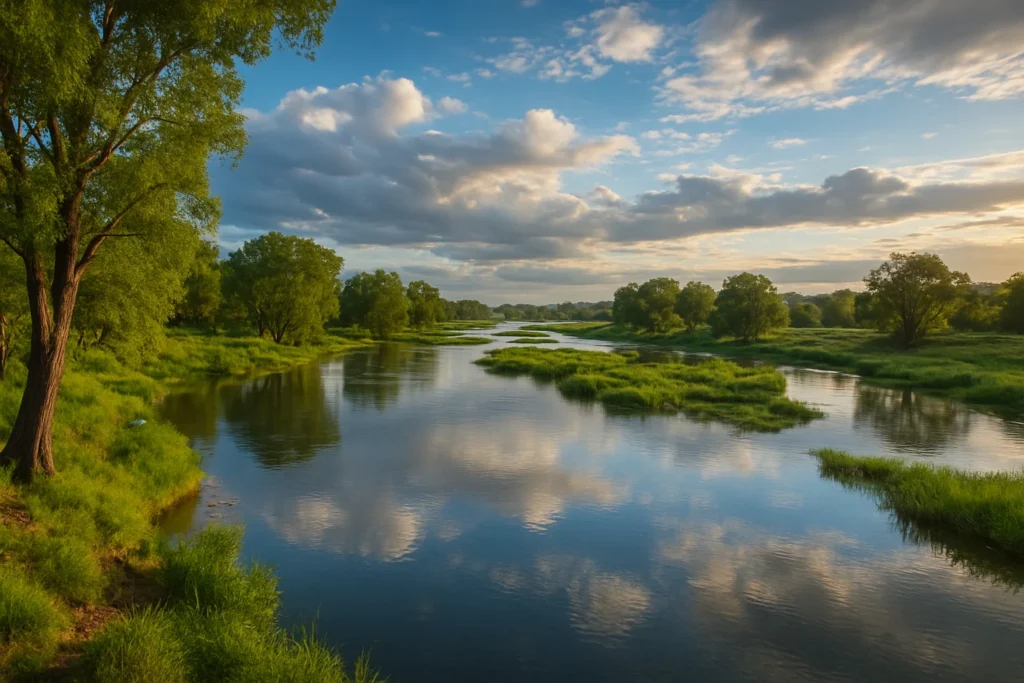

The ancient Australian continent holds countless stories in its sun-baked soil, but few carry the profound weight of the eternal dance between drought and deluge that defines its very heart. For years, the prevailing narrative of the Murray–Darling Basin was one of quiet, agonizing retreat—a story told not in dramatic collapses, but in the slow, heartbreaking details of a landscape gradually being drained of its lifeblood. It was etched into the ever-widening cracks that snaked across the empty beds of once-bustling waterholes. It was carried on the wind that whipped precious topsoil from paddocks that had long since surrendered their last blade of grass. It was visible in the resigned slump of a farmer’s shoulders as he scanned a horizon of relentless, burning blue, a sky that seemed to have forgotten the very concept of rain.
This vast and intricate river system, the pulsing circulatory system of Australia’s southeastern corner, was experiencing a slow-motion crisis. Its veins were running dry, and with them, the spirit of the land and the millions—human, animal, and plant—who depended on it seemed to be fading. Communities held their breath, farmers fought a daily battle against despair, and an entire ecosystem teetered on the brink. But the Australian climate is a book of dramatic, unpredictable chapters, written in the language of fire and water. Just when the story seemed irrevocably set on a single, tragic course, the narrative shifted with breathtaking force. The skies, which had been holding their breath for nearly a decade, finally exhaled in a series of monumental, drenching sighs.
This is the story of that great exhalation—a remarkable, sustained deluge that is scripting a new, hopeful chapter for the basin. It is an epic tale of meteorological chance, ecological resurrection, and human resilience. It is a profound reminder that nature, endowed with an almost miraculous capacity for healing, can stage a comeback that restores not just water levels, but hope itself, if given even a sliver of a chance.
The Great Dry: A Landscape Learning to Whisper Its Thirst
To truly feel the weight and the wonder of the recent rains, one must first sit with the deep, pervasive memory of the dry. The drought that gripped the Murray–Darling Basin was not a single, bad season that could be weathered with stoic resolve; it was a creeping, cumulative event, a “slow disaster” that stretched for the better part of a decade. It insinuated itself into the very fabric of the region, altering routines, crushing economies, and rewriting the rules of survival.
The rivers themselves were the most visible, and most alarming, patients. The mighty Darling River, known in ballad and lore as the “Darling Run,” a ribbon of life connecting outback towns, became a pathetic series of stagnant, evaporating pools, strung along a course of cracked, sun-baked clay. In its most notorious stretches, the riverbed became a track, a path you could literally walk or drive across, a stark symbol of a system in collapse. Further south, the Murray River, though still managing a thread of flow, was gaunt and emaciated. Its water levels dropped so low that ancient river red gums, whose roots had drunk from these waters for centuries, now stood high and dry on newly exposed banks, their majestic forms beginning to show the tell-tale signs of stress—thinning canopies, dead branches—a silent arboreal protest.
The wetlands, the vibrant, pulsating kidneys of the entire system, suffered most of all. These are the places where the river spills its banks during good times, creating complex mosaics of lagoons, channels, and marshes that serve as incubators for life. Places like the Macquarie Marshes, the Gwydir Wetlands, and the Chowilla Floodplain, normally teeming, buzzing, croaking, flapping hubs of biodiversity, fell into an eerie silence. They transformed from lush, water-filled landscapes into vast, dusty, grey-green plains. The intricate channels and lagoons, carefully mapped by generations of ecologists, were now just faint, ghostly impressions in the dirt, visible only from the air or in the memories of elders.
The Human Cost: A Life Lived on a Tightening Tap
For the people who call this basin home—the farmers, the fishers, the shopkeepers, the children—the drought was a relentless, daily arithmetic problem. It was a calculation of how many millimetres of rain had fallen in the last storm, how many megalitres of water were left in the allocation, how many days the feed in the paddock would last, and how many more bales of hay could be affordably trucked in from hundreds of kilometres away.
In towns like Bourke, Walgett, and Mildura, water became the central, obsessive topic of every conversation at the pub, the post office, and the school gate. Water restrictions escalated from Stage 1 to Stage 3, and then to the severe Stage 4. The simple, suburban act of hosing a garden became a distant, almost forbidden memory. Washing a car was an unthinkable luxury, a social transgression. An entire generation of children grew up learning that a four-minute shower was the absolute maximum, and that every single tap must be turned off with a firm, final twist. The community swimming pool, a traditional hub of summer social life, often remained closed and empty, its stark, concrete bowl a sad monument to a wetter, more carefree past.
On the land, the psychological toll was immense and often hidden. Farmers like Ben Crowe, a third-generation wool and grain producer from outside Deniliquin, described it as a constant, low-grade anxiety that gnawed at the soul. “You become a different person out here,” Ben reflects, his eyes still holding the weary memory of those hard years. “You’re short-tempered with your family, you can’t sleep at night lying there listening for rain that doesn’t come, and you’re driving thousands of kilometres a week to buy hay at astronomical prices, just to keep your core breeding stock alive. You look out at the land, your family’s land for generations, and you see it dying a little more each day. You feel a profound sense of failure, like you’re not upholding your duty to it.”
The drought was a great, cruel equalizer. It touched everyone, from the large-scale irrigator watching their high-tech orchards struggle to the small-town cafe owner watching their customer base dwindle as people left the district. It was a shared, heavy burden, a collective holding of breath that lasted for years.
The Atmosphere Remembers: The Complex Meteorology of a Long-Awaited Hope
The change, when it finally began, was not a single, simple storm that burst upon the land. It was a complex, persistent, and majestic dance of global weather systems that meteorologists and climatologists watched unfold with a sense of growing, electrifying excitement. For years, the major climate drivers that influence Australia’s weather had been stuck in a stubborn pattern that consistently pushed rain-bearing systems away from the continent’s drought-stricken southeast. The puzzle pieces were all in the wrong place.
Then, gradually, the global machinery shifted. A phenomenon known as a negative Indian Ocean Dipole (IOD) developed to the west of the continent. Think of this as a kind of atmospheric pump; a negative IOD encourages warmer sea surfaces near Australia, which in turn sends vast plumes of moisture-rich air streaming eastward across the country. Simultaneously, to the east, a La Niña pattern established itself firmly over the Pacific Ocean. La Niña cools the central Pacific, which alters wind patterns and encourages the formation of rain clouds, steering them relentlessly toward the thirsty landscapes of eastern Australia. These two powerful climate drivers, working in a rare and potent tandem, created a perfect, sustained recipe for a continent-scale deluge.
The result was a parade of weather events that seemed to queue up over the cold waters of the Great Australian Bight and march, one relentless system after another, across New South Wales, Victoria, and southern Queensland. These weren’t the brief, violent, and often localized thunderstorms of a typical summer afternoon—storms that runoff quickly and are largely swallowed by the hard, unyielding earth. These were vast, sprawling low-pressure systems, immense spinning wheels of cloud that parked themselves over the basin for days, sometimes weeks, on end, releasing a steady, drumming, drenching, soaking rain that penetrated deep into the soil profile.
Dr. Evelyn Reed, a leading climatologist who has spent her career decoding these patterns, uses a powerful analogy to explain the process. “The landscape after such a long drought was like a piece of dried-out, glazed pottery,” she explains, gesturing with her hands. “The first rains, when they finally came, just ran off the surface, unable to penetrate. They filled a few potholes on backroads and then were gone. But the persistence of these systems was the key. They kept coming, week after week, month after month. They slowly softened the crust, then they filled the deep cracks, and finally, they saturated the entire soil profile. Once the land’s metaphorical ‘bucket’ was completely full, every subsequent drop of rain had nowhere else to go but into the gutters, the creeks, and the rivers. That was the moment, the tipping point, when we saw the real, systemic recovery begin.”
The rain gauges scattered across the basin told the story in stark, beautiful, and record-breaking numbers. Towns that had only a year earlier recorded their driest years on record were now logging their wettest. Historical records that had stood for fifty, eighty, or even a hundred years were not just broken, but shattered by significant margins. The sound of rain drumming on corrugated iron roofs, a sound once almost forgotten, became the constant, hopeful soundtrack of a revolution. It was the sound of the land drinking its fill.
A River Reborn: Witnessing a Continent-Scale Replenishment
The most profound, visible, and emotionally charged transformation was the resurrection of the rivers themselves. It did not happen overnight, but it occurred with a steady, undeniable, and ultimately powerful force. The water began its long, slow, and deliberate journey from the high, misty country of the Great Dividing Range, down thousands of creeks and tributaries with names known only to locals, finally converging into the main, mighty arteries of the Murray and the Darling.
The first sign of the change was the colour. The clear, warm, and stagnant pools that were all that remained of the Darling River became a turbid, churning, chocolate-brown torrent, laden with sediment and organic life, charged with the raw energy of flow. Then came the sound—the gentle gurgle and slap of water moving over rocks and logs, a soundscape that had been absent for so many years that its return felt almost foreign. Finally, came the sight of the water itself, silently and inexorably creeping up the bare, stained banks, reclaiming its ancient floodplain, inch by precious inch.
In river towns, the rising water became a daily spectacle, a form of community theatre. People would make deliberate pilgrimages to their local river gauge, a simple ruler-like measurement post, watching the numbers climb with a sense of collective awe and near-disbelief. In Renmark, families stood on the historic wharf, children pointing excitedly as the water lapped at wooden planks that had been high, dry, and splintering in the sun for a decade. In Echuca, the historic paddle steamer wharf, which had been left stranded in a sea of grass far from the water’s edge, was once again a working port, the elegant, restored boats like the PS Pevensey and PS Adelaide now floating proudly, their reflections shimmering in the renewed, flowing river.
Perhaps the most significant single moment for hydrologists and environmentalists was the “reconnection event”—the moment when the flow in the Barwon and Darling Rivers became strong and sustained enough to travel its entire length and pour into the Murray River south of Wentworth, reuniting the two great river systems in a continuous, flowing body of water for the first time in years. For the environment, this was akin to reconnecting a severed artery, allowing the lifeblood of the entire basin to circulate freely once more.
This tangible, physical recovery had an immediate impact on human regulations. For the first time since the grim days of 2019, mayors and council officials, speaking with a cautious optimism they hadn’t dared show in years, began the formal process of easing water restrictions. The public announcement that you could now legally water your garden on designated days was met not with profligate joy, but with a deep, collective, and region-wide sigh of relief. The immense pressure valve, tightened for so long, had finally been released.
The Agricultural Multiplier: From Dust Bowls to Emerald Green Shoots and Economic Revival
On the land itself, the transformation was nothing short of biblical. The rain began the slow, vital, and miraculous work of healing the very soil. The first miracle was the smell—that sweet, rich, loamy scent of wet earth after a long, long dry spell, a scent known scientifically as ‘petrichor’ and known emotionally to every farmer as the very essence of life itself.
Then, almost imperceptibly at first, came the colour. A faint, almost illusory green haze appeared across the landscape, as if the land were blushing with life. Within a week, that haze had intensified into a vibrant, emerald-green carpet that stretched to the horizon. Paddocks that were nothing but dust and struggling, woody weeds were now lush with soft, new growth—clover, rye grass, and medic—natural, highly nutritious feed that had lain dormant in the soil seed bank for years, just waiting for its chance to erupt.
For farmers like Ben Crowe, the change was as emotional as it was economic. “I remember standing at the back gate one morning, just leaning on the ute and watching the cattle graze,” he says, his voice growing thick with the memory. “They weren’t just eating; they were feasting. They had a full, rounded belly for the first time in years. To see that, after all the struggle, the debt, the worry… it makes you get a bit dusty in the eyes, I don’t mind admitting it. We’ve been able to park the feed truck in the shed for good. That alone saves us thousands of dollars a week and countless hours of back-breaking, demoralising work.”
The economic and agricultural implications extended far beyond the pasture. The water is also systematically recharging the vast, engineered network of irrigation channels and dams that support the basin’s status as Australia’s premier food bowl. The massive dams like the Hume and Dartmouth, which were perilously low, their bathtub rings exposed like scars, are now steadily filling. This secured water is flowing into the channels, delivering a deep, natural drink to vast orchards of citrus, almonds, and stone fruit, and to expansive paddocks of rice, cotton, and wine grapes. The promise of a bumper harvest, a concept that had become abstract and almost mythical, is now a tangible, exciting reality, bringing with it not just economic security, but a renewed sense of purpose and pride to entire rural communities.
The Croak and the Colony: Nature’s Spectacular Reactivation and Resurgent Symphony
If the agricultural recovery is impressive from an economic standpoint, the ecological revival happening in the wetlands and river systems is nothing short of breathtaking, a spectacle of natural resilience that moves scientists and laypeople alike. The wetlands, those critical nurseries for life, are experiencing a renaissance on a grand scale. As the river overtopped its banks and spilled into these floodplains, it was as if a master switch was flipped, awakening an entire dormant ecosystem from a deep, desperate sleep.
The first musicians to return to the orchestra were the frogs. After years of silence, the night air in places like the Barmah-Millewa Forest, the Narran Lakes, and the Lindsay-Wallpolla Islands now throbs with a joyous, cacophonous symphony of croaks, chirps, whistles, and bleats. Species like the vulnerable Southern Bell Frog and the tiny, desert-dwelling Water-holding Frog, which had retreated to a few last, desperate refuges, are now out in incredible numbers, breeding explosively in the newly flooded vegetation. Their return is a critical bio-indicator; frogs have permeable skin and are highly sensitive to water quality, so their presence signals a healthy, functioning wetland.
The frogs were swiftly followed by the fish. Native freshwater species like the iconic, formidable Murray Cod and the migratory Golden Perch (Yellowbelly), which had been trapped in those shrinking, warm, oxygen-poor pools, now have the precise environmental cues they need to breed. The high, fast-flowing water, the cooler temperatures, and the inundation of snags, logs, and grasses provide the perfect, protected nursery for their fry. For the first time in a long time, a new, strong generation of fish is thriving, repopulating the river system from its headwaters to its most remote billabongs, a vital boost for the entire aquatic food web.
And then came the birds, in a spectacle that defies belief. The skies above the wetlands are now filled with a kaleidoscope of wings. Immense, soaring V-formations of Australian Pelicans, hundreds of birds strong, have flown in from across the country, their vast, pouched bills poised to scoop up the newfound abundance of fish. Straw-necked Ibis, often called “the farmers’ friend,” are nesting in their hundreds of thousands, creating noisy, bustling, frantic colonies known as “ibis cities.” Elegant Egrets, stealthy Herons, and peculiar Spoonbills now methodically patrol the shallow, muddy margins, their graceful forms perfectly reflected in the still water. For dedicated birdwatchers and ecologists, the most thrilling sight has been the return of rare and elusive species like the Majestic Brogla, the Australian Bustard, and the brilliantly coloured Blue-billed Duck to areas they had completely abandoned years ago.
Dr. Aris Singh, an ecologist who has dedicated his career to the basin, describes the phenomenon with palpable excitement. “It’s a chain reaction of life, a domino effect of ecological renewal,” he says, standing knee-deep in the water of a wetland that was a cracked, barren dust bowl just eighteen months prior. “The water is the primary trigger. It wakes up the dormant seeds and aquatic plants, the plants feed the insects and zooplankton, which in turn feed the fish and frogs, which then feed the birds and reptiles. The entire, complex food web is roaring back to life all at once. You can’t engineer or manufacture this. You can only provide the essential ingredient—the water—and then stand back and let nature do what it has done so perfectly for millennia. It is the most powerful, humbling, and hopeful thing I have ever witnessed in my professional life.”
The Mandate of Abundance: Navigating the Complex Future of a Recovered Basin
With such an overwhelming, visceral wave of good news washing over the region, it is profoundly tempting to believe the problem is solved, that the basin has been “fixed” and the crisis is behind us. But the very nature and intensity of this climate event underscores the critical, sobering warning that experts are now urgently voicing: this period of abundance is a vital reprieve, a chance to catch our breath, but it is absolutely not a permanent solution.
The Murray–Darling Basin, by its very geographical and climatic nature, has always been defined by its extreme cycles of boom and bust. The poet Dorothea Mackellar immortalised this reality when she called Australia the “land of drought and flooding rains.” The concern now, reinforced by sophisticated climate modelling, is that these natural extremes are likely to become more pronounced and less predictable due to a changing global climate. The next severe drought is not a matter of “if,” but “when,” and the question of how we prepare for it during this time of plenty is the single most important challenge facing the region.
“The rain gives us a golden, invaluable opportunity,” explains Dr. Evelyn Reed, her tone measured and deliberate. “It’s a chance to refill our storage accounts, both in our surface reservoirs and in the underground aquifers. But just as importantly, it’s a chance to fix the roof while the sun is shining—to get our policies, our infrastructure, and our community preparedness right. We cannot, we must not, afford to be complacent. Complacency is what got us into such a vulnerable position in the last drought.”
The focus now, she and a chorus of other experts argue, must be on intelligent, long-term, and adaptable water management. This is a complex puzzle with several critical pieces:
- Finalising and Implementing the Basin Plan: Ensuring that the Murray-Darling Basin Plan, a landmark but often contested piece of policy, is fully implemented. This means establishing and enforcing scientifically based sustainable diversion limits (SDLs), so that enough water remains in the system for the environment to maintain its health, even when allocations for farmers and towns are necessarily tight.
- Investing in Modern Infrastructure: Upgrading the nation’s ageing, leaky irrigation channel networks to significantly reduce water loss through seepage and evaporation. Simultaneously, supporting farmers with incentives to invest in on-farm water efficiency technologies like drip irrigation and soil moisture monitoring, ensuring every single drop of water is used to its maximum potential.
- Protecting and Managing Environmental Water: Safeguarding the water that is specifically allocated and purchased for the environment. This “environmental water holder” must be empowered to use its allocations strategically, mimicking natural flow patterns to water key wetlands, support fish breeding events, and maintain river health during the inevitable next dry spell.
- Supporting Community and Economic Resilience: Helping regional towns and agricultural industries to diversify and build economic resilience, so they are not solely at the mercy of the next rainfall failure. This includes supporting value-added agriculture, tourism, and other industries that are less water-intensive.
This holistic approach is not about locking water away from productive use; it is about ensuring it is shared wisely, fairly, and sustainably between the three inseparable partners: farmers, towns, and the environment upon which they all ultimately depend for their survival and prosperity.
Lessons from the Rain: Weaving a Story of Resilience and Hope for Generations to Come
The dramatic revival of the Murray–Darling Basin over these past months is far more than a mere meteorological event or a temporary blip on a hydrological graph; it is a profound and living lesson in resilience. It is a story that demonstrates, in the most vivid terms possible, the incredible restorative power of nature when the fundamental conditions for life are restored. It shows the deep, unbreakable, and symbiotic bond between the health of the country and the psychological and economic spirit of its people.
The rain has washed away more than just the dust and the topsoil; it has washed away a deep-seated, community-wide anxiety. It has brought with it a renewed sense of possibility, a rekindled belief in the future, and a powerful reminder of what is worth fighting for. In the easy smiles of farmers like Ben Crowe, in the bustling, optimistic activity of revived country towns, and in the cacophonous, joyous chorus of a reborn wetland at dawn, there is a powerful, universal message: life endures. Given a chance, it fights back, it flourishes, and it fills the spaces left barren by hardship.
The great challenge now, for policymakers, for communities, and for every Australian who depends on the food and water from this vast river system, is to carry this hard-won hope forward. The story of the Murray–Darling Basin is a continuous, unfolding epic, written not just in water and soil, but in the collective will, wisdom, and foresight of its people. The recent, life-giving rains represent a beautiful, life-affirming chapter, a dramatic turning point that reminds us that even after the most prolonged and difficult droughts, the land remembers how to be green, the rivers remember how to flow, and the heart of the country can beat strong and steady once again. The task that lies ahead is to ensure that this chapter is not an isolated golden age, but the foundational beginning of a new era defined by balance, respect, and careful, compassionate stewardship for this irreplaceable Australian landscape. The water has returned. Now, our responsibility is to ensure its legacy endures.



Just installed the ubet95app.net Betting app. Pretty good interface. I recommend it. Give it a look: ubet95app
8Okgame is pretty solid. Decent graphics and smooth performance on my phone. It is good for killing time 8okgame.
Slots888, what to say? If you like slots, you’ll probably like this place. Massive selection, keeps you busy for hours. Some of the RTPs seem decent too. Check it out if you’re a slot fiend at slots888.