
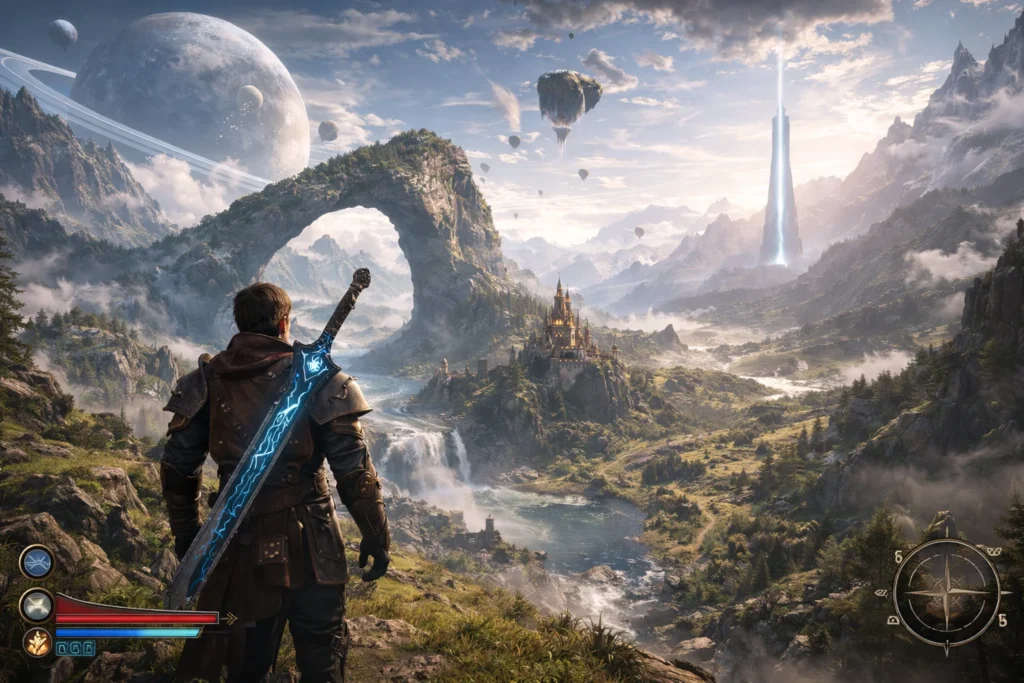

The Genesis Dawn: How a Modest Studio Dreamed the Impossible
In the unassuming offices of Nebula Interactive, tucked away in a renovated warehouse district on the outskirts of Seattle, the first spark that would become Eclipse Horizon ignited not with a grand vision, but with a profound frustration. It was late 2021, and the core creative team—seven individuals who had just shipped Chrono-Legacy—were engaged in their traditional post-project decompression ritual: a weekend retreat at a cabin on the Olympic Peninsula. Amidst discussions of well-earned vacations and future prospects, Lead Systems Designer, Aris Thorne, voiced a sentiment that resonated with unexpected force.
“Every world we build feels like a diorama,” he mused, staring into the crackling fireplace. “Beautiful, intricate, but ultimately static. The monsters wait in their caves. The villagers repeat their anxieties. The world holds its breath for the hero to arrive. What if we built something that didn’t wait? What if we built a universe that had its own momentum?”
This simple question became the foundational cornerstone for what would evolve into a five-year, multi-hundred-person odyssey. The initial “Project Horizon” pitch document, drafted on a series of whiteboards that soon covered an entire wall of their office, contained three revolutionary pillars that defied conventional game design wisdom:
- The Autonomy Principle: The game world operates on a persistent, player-agnostic timeline. Factions expand, economies fluctuate, ecosystems evolve, and stories begin and end whether the player is present or not.
- The Ripple Effect: No system exists in isolation. A change in the political climate of a star system will affect trade routes, which alters resource availability, which shifts ecological balances, which creates new conflicts.
- The Player as Catalyst, Not Center: The player is a powerful force of change, but not the universe’s sole raison d’être. They are one particularly influential element in a vast, interconnected web of cause and effect.
Securing funding for such an unprecedented concept required more than ambition; it required a new language of pitching. CEO Maya Rodriguez didn’t approach publishers with mere sales projections. Instead, she and Technical Director Alex Chen built a rudimentary simulation—a digital petri dish they called “The Cosmos Engine Prototype.” This prototype featured ten simple AI entities (“factions”) on a minimal grid, each with basic needs for resources and territory. Over a simulated 10,000 cycles, the team could demonstrate emergent behaviors: alliances forming without scripted triggers, supply chain collapses causing migration, the rise and fall of powers based on simulated resource management. This wasn’t a game demo; it was a proof of philosophy. It convinced Vega Interactive Partners to provide not just a budget, but a patient, milestone-driven development runway rarely seen in the modern AAA landscape. The gamble was on systemic depth over guaranteed franchise appeal.
The Alchemists’ Forge: Building the Nova Engine from the Atom Up
The team quickly realized that no commercial game engine—not Unreal, not Unity—could handle the vision’s core requirement: running dozens of complex, persistent simulations simultaneously without melting consumer hardware. Thus began the parallel three-year project to construct the proprietary Nova Engine, an endeavor Lead Engineer David Finch described as “building a skyscraper while inventing the concept of concrete.”
The breakthrough came from a radical architectural decision: Decoupled Simulation Layers. Traditional game engines tie world simulation directly to rendering and player input, creating a single-threaded bottleneck. The Nova Engine separated the universe into distinct, asynchronous layers:
- The Galactic Layer: Simulated the high-level state of factions, economies, and major events on a weekly in-game cycle. This ran as a background process, even when the game was off, syncing with a lightweight cloud save.
- The Planetary Layer: Managed ecology, weather, local politics, and resource depletion on a daily cycle. Only planets in the player’s “sphere of influence” (recently visited or scanned) were actively simulated; others remained in a summarized state.
- The Local Layer: Handled real-time NPC behaviors, creature AI, and immediate physics. This layer used predictive algorithms to seamlessly integrate changes flowing down from the higher layers.
The true magic was the Inter-Layer Communication Protocol (ILCP), a messaging system that allowed changes on one layer to generate meaningful events on another. For example, if the Galactic Layer simulated a trade war between two factions (Layer 1), it would send a message to the Planetary Layer of affected systems, triggering a script to spawn blockaded space stations or altered patrol routes (Layer 2). The Local Layer would then manifest this as tense NPC dialogue, scarcer goods in shops, and perhaps a desperate merchant offering a risky smuggling job (Layer 3).
To populate this engine with content at an impossible scale, the team pioneered Procedural Generation with Handcrafted Seeds. Artists and designers didn’t create finished planets; they created “planetary DNA”—palettes of textures, rules for geological formation, libraries of flora and fauna parts, and architectural styles. The engine would then “grow” a unique world from this DNA, ensuring it was geologically and ecologically coherent. A world designated as “High-Gravity, Volcanic, Post-Collapse” would always have dense, low-slung flora, basalt formations, and ruins built from heavy, radiation-shielded materials, but the specific arrangement of its continents, mountain ranges, and city remnants would be unique for every player.
The narrative faced its own scaling problem. Writer Samantha Lee’s team developed the Quantum Narrative State (QNS) system. Instead of tracking binary flags (quest completed: yes/no), the QNS tracked over 400 “narrative variables”—abstract concepts like “Faction A’s Trust,” “Galactic Lawfulness,” or “Precursor Knowledge.” Every player action adjusted a cluster of these variables. Quests and story events were not scripts, but “conditions” waiting to be met. A mission to help a scientist wouldn’t appear because the player reached a certain level, but because their “Scientific Community Reputation” variable crossed a threshold and they were in a star system with a “Research Station” asset. This created the illusion of a deeply reactive world where stories felt discovered, not delivered.
The Living Tapestry: Weaving a Galaxy That Breathes
With the engine humming, the monumental task of breathing life into the systems began. The universe of Eclipse Horizon is not a setting; it is a protagonist. Its core systems form a symphony of cause and effect:
The Fractal Economic Model:
Forget simple buy-low, sell-high. The economy is a dynamic simulation of galactic production and consumption. It begins with Resource Nodes (mines, gas harvesters, agricultural worlds) that have a finite, rechargeable yield. These feed into Processing Hubs (refineries, factories, orbital docks), which have efficiency ratings and labor requirements. Finally, goods flow to Consumption Centers (planets, stations, fleets) with needs based on population and activity.
A player’s actions send shocks through this web. Destroying a pirate base (a Consumption Center for illicit goods) might cause a glut in the black market, lowering prices for smuggled weapons elsewhere. Discovering a rich mineral deposit and selling its location to a mining corp could see that corporation’s stock rise, giving them capital to expand militarily, destabilizing a neighboring neutral zone. The economy isn’t a menu; it’s a weather system, with players able to sense coming storms and sometimes influence the pressure fronts.
The Ideological Faction Ecosystem:
The seventeen major factions are not simply “good guys” and “bad guys.” Each is built around a core ideology—like the Technocratic Hegemony (value: efficiency through centralized AI governance) or the Sundering Choir (value: spiritual transcendence through cybernetic asceticism). These ideologies determine their goals, their diplomatic compatibility, and their internal stability.
Factions have “Ambition States.” A faction in a “Consolidation” state will fortify its borders and root out dissent. One in an “Expansion” state will send colony ships and claim new territories. These states change based on internal events simulated by the Nova Engine: a leadership crisis, an economic windfall, a military humiliation. Players interact with these factions not just through quests, but by affecting the conditions that trigger their state changes. Providing covert aid to a Hegemony research project might push them from “Cautious” to “Innovative,” making them more likely to share technology but also more aggressively patent and defend it.
The Darwinian Ecological Engine:
Every creature in Eclipse Horizon is part of a functional food web generated by the “Evolutionary Genesis” algorithm. The algorithm starts with a planet’s conditions: gravity, atmosphere, solar radiation. It “evolves” simple virtual organisms over thousands of generations, selecting for survival traits. The result is creatures that feel organically suited to their environment. On the low-gravity moon of Lyra’s Song, you find “Glass-Winged Soarers,” fragile-looking herbivores with vast membranous wings who migrate between floating fungal spores. Their predator, the “Static Lurker,” doesn’t chase; it camouflages itself among rock formations and emits a powerful electromagnetic pulse to disable the Soarer’s nervous system before consuming it.
These ecosystems react. Over-hunting a predator species will cause its prey to overpopulate, leading to overgrazing and famine. Introducing an invasive species from another planet (accidentally or intentionally) can collapse an entire biome. Planetary survey missions become critical not just for science, but for understanding the delicate balance players can disrupt or preserve.
The Symphony of Souls: Characters in an Endless Universe
Creating memorable characters for a universe of near-infinite scale was the project’s most daunting human challenge. The solution was a three-tier character generation system that blended procedural depth with handcrafted soul.
Tier 1: The Demographic Core.
Every NPC begins with a procedurally generated biography: species, homeworld, upbringing, career path, faction allegiance, and a set of “Life Event Seeds” (e.g., “Survived the Gamma-7 Plague,” “Lost a mentor in the Border Wars”). This core defines their base knowledge, skills, and prejudices.
Tier 2: The Personality Matrix.
Drawing from the OCEAN psychological model (Openness, Conscientiousness, Extraversion, Agreeableness, Neuroticism), each NPC is assigned a personality profile. This isn’t cosmetic. A highly Conscientious character will adhere strictly to schedules and protocols; a low-Agreeableness character will be quicker to conflict and less likely to offer help without significant incentive. This matrix dictates decision-making in unscripted situations.
Tier 3: The Dynamic Relationship Web.
This is the revolutionary layer. Every NPC maintains a dynamic relationship score not just with the player, but with other NPCs, factions, and abstract concepts (like “authority” or “xenotechnology”). These scores change based on witnessed actions and gossip. If you help an NPC’s friend, your standing with them improves indirectly. If you violate a principle their faction holds dear, even while helping them personally, they may develop a complex, conflicted attitude toward you.
Major companions, like the tormented ex-soldier Arin or the enigmatic historian Kaelen, have additional “Moral Flexibility Thresholds.” They will follow the player loyally until a decision crosses their personal line. Once crossed, their departure isn’t a simple cutscene; it’s a process. They might argue, attempt to dissuade you, give an ultimatum, and their final action—leaving quietly, stealing a ship, sabotaging your equipment, or defecting to your enemies—is determined by the sum total of your relationship and their personality matrix.
Voice and performance were equally innovative. Using a technique called Modular Performance Capture, actors performed not just lines, but emotional states and conversational types. They recorded thousands of “vocal reactions” (surprise, anger, gratitude, skepticism) and “conversation beats” (greeting, delivering bad news, asking for a favor, debating). The dialogue, often generated from a vast library of written snippets, is then delivered with the appropriate pre-recorded performance texture, creating natural, responsive conversations that never repeat verbatim. The legendary voice actor Cassandra Vale, who plays multiple faction leaders, spent weeks in the studio not recording specific lines, but exploring the emotional range and vocal cadence of each character’s ideology, providing the raw clay from which countless in-game conversations are sculpted.
The Crucible of Launch: Triumph, Turbulence, and Transparency
The launch of Eclipse Horizon was a seismic event in digital entertainment. The 5 million units sold in three days was a headline, but the real story unfolded in the lived experience of players. Servers stabilized under the unprecedented load, a testament to the backend infrastructure built to handle the Galactic Layer simulations. For the first 72 hours, the game existed as a collective experiment in discovery.
Players immediately began testing the limits of the systems. One streamer, “Captain Loam,” attempted a pacifist trader run, only to find his refusal to engage in violence caused mercenary factions to perceive him as an easy target, while religious factions offered him sanctuary. Another, “Scientist Styx,” ignored the main faction war entirely and dedicated herself to cataloging every species on a single “Megafauna Garden” world, inadvertently discovering a parasitic organism that was the key to curing a galactic plague mentioned only in scattered data logs—a questline never explicitly given, but emerged from her actions.
However, the launch was not flawless. Console players, particularly on previous-generation hardware, faced significant performance issues: framerate hitches during complex system transitions, prolonged load times when warping between star systems, and occasional visual pop-in on dense planets. The discrepancy between the pristine PC version and the struggling console versions became the launch’s primary controversy.
Nebula Interactive’s response became a masterclass in modern developer-player relations. Within 48 hours, they released a detailed, technically candid “State of the Horizon” report. The report didn’t offer excuses; it offered data, charts, and a clear diagnosis. The issue was identified as “I/O Bottlenecking on Legacy Hardware.” The constant streaming of simulation state data between the Planetary and Local Layers was overwhelming the slower hard drives and limited memory of older consoles.
The promised “Stability Patch” was more than a fix; it was a significant re-engineering. The team implemented a “Tiered Simulation LOD (Level of Detail)” system. Now, the Planetary Layer would intelligently reduce the fidelity of simulations far from the player’s location. A political election on a planet three star systems away would be calculated as a simple probability roll with a few outcome states, rather than a full simulation of every candidate’s campaign and every citizen’s vote. This freed up immense resources. The patch also introduced “predictive pre-loading,” using the Galactic Layer’s data to guess the player’s next most-likely destination and begin loading its low-detail state in the background.
When the patch deployed the following week, the improvement was dramatic. Framerate consistency improved by over 50%, load times were cut by nearly 70%, and the community’s frustration turned into appreciation for the studio’s speed and transparency. This episode cemented a covenant of trust between Nebula and its players, establishing a foundation for the game’s future as a live service.
The Infinite Canvas: Post-Launch as a New Genesis
Nebula Interactive viewed the 1.0 launch not as an end, but as the foundation of a “Forever Game.” Their post-launch strategy, outlined in a groundbreaking “Horizon Map” interactive website, rejected the standard model of story DLC in favor of “Systemic Expansions.”
The first major expansion, “Echoes of the Firstborn,” didn’t just add a new questline. It added an entire new temporal dimension to the simulation. Players discovered “Chronon Fragments,” artifacts that allowed the Nova Engine to temporarily simulate a planet’s past state. A barren asteroid field could be viewed as the lush, thriving homeworld it was a million years before a cataclysm. Players could scavenge resources or complete missions in this past state, with the crucial caveat that major changes could create “temporal echoes”—alternate version of present-day assets or characters. This wasn’t just new content; it was a new way to interact with all existing content.
Simultaneously, the team began deep-dive analysis of player data, which revealed extraordinary emergent playstyles. A significant cohort had become “Galactic Anthropologists,” ignoring combat and economics to simply document cultures, languages, and rituals. In response, Nebula released the free “Chronicler’s Update,” adding deep surveying tools, a language-deciphering mini-game, and a codex that automatically wove collected lore into a cohesive, player-specific historical narrative.
Another data trend showed players creating their own “Player-Driven Factions.” Using the in-game communication and trade systems, large communities on platforms like Discord had effectively formed their own guilds with internal economies and goals. Recognizing this, Nebula developed and released “The Sovereign Update,” which provided lightweight, official tools for player groups to register as minor factions, claim uncharted territory, establish communal outposts with shared resources, and even engage in limited diplomacy with the game’s major factions. The simulation absorbed them; these player factions began appearing in other players’ games as NPC entities with procedurally generated leaders and agendas, blurring the line between player and world forever.
The Ripple Effect: Eclipse Horizon’s Impact on an Industry
The success and ambition of Eclipse Horizon sent shockwaves through the game development industry. Its technical achievements, particularly the Decoupled Simulation Layers of the Nova Engine, became the subject of intensive study and emulation. Competing studios were forced to reevaluate their own approaches to open-world design, moving away from the “checklist map” model popularized a decade prior.
More profoundly, its narrative philosophy challenged the industry’s storytelling orthodoxy. For years, the debate had been between “linear narratives” (tight, authored, cinematic) and “branching narratives” (player choice leading to multiple endings). Eclipse Horizon introduced a third way: “emergent narrative.” Here, the story isn’t a path with branches, but a web of potentialities spun from interacting systems. This shifted the designer’s role from author of a story to author of a story-generating system—a paradigm change now being explored in projects across the genre.
Academically, the game became a phenomenon. Sociologists at the University of Tokyo began using its faction simulation to model real-world geopolitical dynamics. Ecologists partnered with Nebula to see if the Evolutionary Genesis algorithm could predict real-world species adaptation to climate change. The game’s complex economy was used as a case study in several university economics courses on emergent market behavior.
Culturally, it spawned a new genre of content: the “Emergent Play Documentary.” YouTube series like “My Eclipse” chronicled single players’ unique journeys over hundreds of hours, with narratives more compelling and personal than most scripted shows. These documentaries highlighted the game’s greatest achievement: it provided not just entertainment, but experiences—unique, personal sagas that players felt they had truly lived, complete with unintended consequences, hard-won alliances, and losses that felt genuinely mournful because they were not written to be mournful, but became so through play.
The Unfolding Horizon: A Universe Without End
Today, Eclipse Horizon stands not as a completed work, but as a living, breathing platform. Nebula Interactive operates less like a traditional game studio and more like the stewards of a digital universe. Their roadmap stretches years into the future, with plans for expansions that will add not just new places, but new fundamental laws to the simulation: a “Quantum Reality” expansion that introduces probabilistic events, a “Collective Consciousness” update that explores psionic links between species, a “Player Legacy” system where the choices and accomplishments of one playthrough can subtly influence a completely new game.
The game’s ultimate lesson is one of trust. It trusted players with overwhelming freedom without a guiding golden path. It trusted complex systems to generate more compelling stories than any writer could alone. It trusted that transparency and partnership with the community would build something more valuable than any marketing campaign.
In the end, Eclipse Horizon achieved what Aris Thorne dreamed of by that fireplace years ago. It built a universe that doesn’t wait. It turns without you. It lives, breathes, fights, trades, loves, and decays in a grand, beautiful, indifferent cosmic dance. And then it offers you a simple, profound invitation: not to be its hero, but to be a part of it. To find your own place in the infinite tapestry, to make your own mark—knowing full well that the tapestry will continue to weave itself long after your thread has run its course. It is not just a game of exploration, but a meditation on scale, consequence, and our place in systems too vast to fully comprehend. The horizon it presents isn’t one to be reached, but one that forever recedes, inviting an eternity of discovery. That is its triumph, and its legacy.



Your blog has become an indispensable resource for me. I’m always excited to see what new insights you have to offer. Thank you for consistently delivering top-notch content!
you are in reality a good webmaster The website loading velocity is amazing It sort of feels that youre doing any distinctive trick Also The contents are masterwork you have done a fantastic job in this topic