
Introduction: The Mountain That Refuses to be Climbed
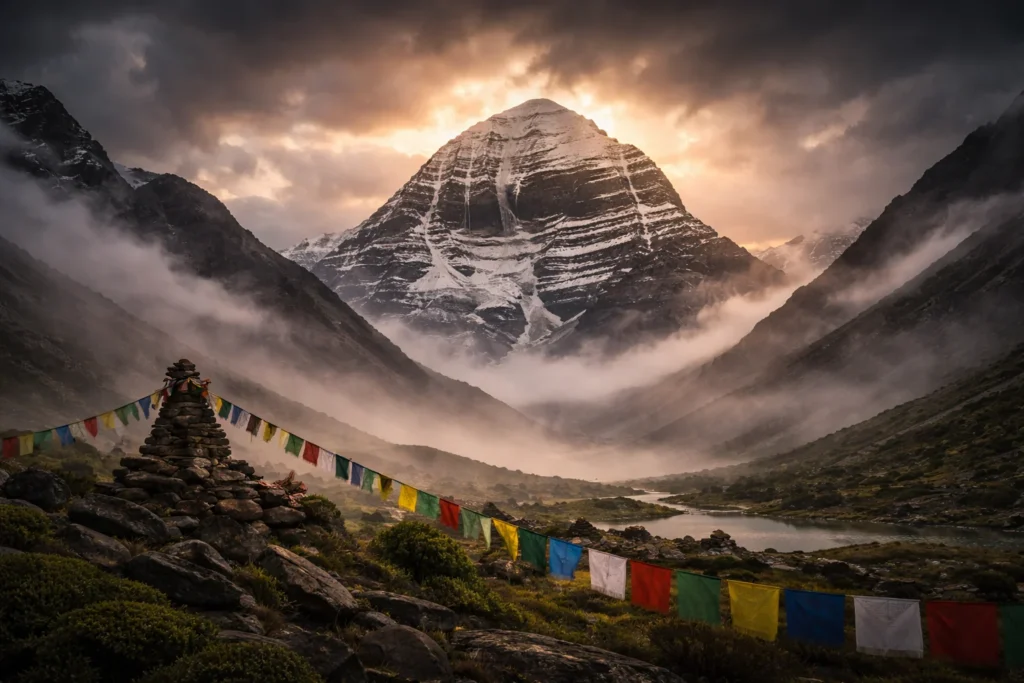
In the remote southwestern corner of the Tibetan Plateau, where the sky meets the earth in a dramatic crescendo of rock and ice, stands a mountain that defies all conventional understanding of exploration and conquest. Mount Kailash, known in Tibetan as Kang Rinpoche (the “Precious Jewel of Snow”), rises 6,638 meters (21,778 feet) above sea level—not the tallest peak in the Himalayas, but undoubtedly the most mysterious and spiritually significant mountain on Earth. This is the story of the only major mountain in the world that has never been climbed, not for lack of human capability, but because of a profound convergence of spiritual belief, natural law, political decree, and unexplained phenomena that have created an impenetrable barrier around its summit.
For centuries, this majestic pyramid of black rock and white snow has captured the imagination of pilgrims, explorers, scientists, and mystics. It is venerated simultaneously by four of the world’s oldest religions—Hinduism, Buddhism, Jainism, and the ancient Bon faith—each of which considers it the center of their spiritual universe. Beyond its religious significance, Kailash is shrouded in inexplicable mysteries: tales of time distortion, accelerated aging, magnetic anomalies, and geological peculiarities that challenge our scientific understanding. Every expedition that has ever approached with climbing intent has been stopped—not by the mountain’s physical difficulty alone, but by a complex web of factors that make its summit perpetually untouchable.
The Impenetrable Fortress: Why No Summit Attempt Has Succeeded
The complete absence of human footprints on Kailash’s summit is not an accident of history but the result of multiple intersecting forces that have created what might be called a “perfect storm” of inaccessibility. The table below illustrates the multidimensional nature of the barriers protecting this sacred peak:
| Dimension of Protection | Specific Factors & Manifestations | Cumulative Effect |
|---|---|---|
| Spiritual & Religious | Sacred abode of deities (Shiva, Demchok); Axis Mundi (center of universe); Site of liberation (Moksha); Millennia of pilgrimage tradition; Deep cultural taboo against climbing | Climbing is viewed as profound sacrilege and spiritual transgression by billions |
| Legal & Political | Official climbing ban by Chinese government (2001); Strict permit system only for pilgrimage; Geopolitical sensitivity of Tibet; International diplomatic pressure | Any climbing attempt is illegal and would face immediate intervention |
| Physical & Environmental | Sudden extreme weather shifts; Avalanche-prone steep faces; “Death zone” altitude effects; Remote location with no rescue possibility; Unstable rock formations | Presents objective, life-threatening dangers that surpass technical climbing challenges |
| Cultural & Ethical | Centuries of reverence by four religions; Ethical refusal by mountaineering icons; Global consensus on preservation; UNESCO World Heritage consideration | Powerful ethical imperative against climbing upheld by international community |
| Unexplained & Paranormal | Reported time distortions and rapid aging; Unusual magnetic fields; Perfect pyramidal geometry; Hollow mountain theories; Ancient being legends | Creates psychological and potentially physical barriers beyond conventional understanding |
The Spiritual Heart: Kailash as Cosmic Axis
Hinduism’s Abode of Shiva
In Hindu cosmology, Mount Kailash is the earthly manifestation of Mount Meru, the cosmic axis and center of all physical, metaphysical, and spiritual universes. It is believed to be the eternal abode of Lord Shiva, the destroyer and regenerator in the Hindu trinity, who sits in perpetual meditation atop the mountain with his consort Parvati. According to ancient texts like the Vishnu Purana and Ramayana, Shiva chose Kailash as his dwelling place after descending from heaven, making it the ultimate tirtha (crossing point between heaven and earth).
The Skanda Purana, one of the largest Mahāpurāṇas, devotes an entire section to the glorification of Kailash, describing it as a “pillar of the world” that shines like a “crystal lotus” and is made of “precious gems.” For devout Hindus, a pilgrimage to Kailash—or even a distant view of it—is believed to wash away the sins of a lifetime and bring one closer to moksha (liberation from the cycle of rebirth). The journey is traditionally made barefoot by the most devout, with many performing full-body prostrations along the entire 52-kilometer circumambulation path.
Buddhism’s Mandala of Enlightenment
In Tibetan Buddhism, Kailash is known as Kang Rinpoche (“Precious Snow Mountain”) and is considered the physical embodiment of Mount Meru, the central axis of the Buddhist cosmological system. It represents the mandala of the Buddha Chakrasamvara (also known as Demchok), a tantric deity symbolizing supreme bliss and the union of wisdom and compassion. The mountain’s four distinct faces are said to be made of crystal, ruby, gold, and lapis lazuli, corresponding to the four directions and elements.
The pilgrimage around Kailash is a walking meditation through a three-dimensional mandala, with each section of the path representing different stages toward enlightenment. Tibetan Buddhists believe that completing one kora (circumambulation) can erase the negative karma of a lifetime, while 108 koras (a sacred number) can lead to enlightenment in this very lifetime. The most devout pilgrims complete the circuit by performing full-body prostrations—lying flat, marking the position of their hands, rising, moving to that mark, and prostrating again—a process that can take up to four weeks for a single circuit.
Jainism’s Site of Liberation
For Jains, Kailash is known as Ashtapada and holds supreme importance as the place where their first Tirthankara, Rishabhadeva (also called Adinath), attained moksha (liberation) after attaining omniscience. According to Jain scriptures, Rishabhadeva was the first human in this time cycle to achieve enlightenment and establish the Jain religious order. After teaching for many years, he is believed to have meditated in a cave on Mount Kailash until he achieved final liberation from the cycle of rebirth.
Jains consider Kailash the site where the boundaries between the earthly and divine realms are thinnest. While they do not perform the kora in the same way as Hindus and Buddhists, the mountain remains a sacred symbol of the ultimate spiritual achievement—complete freedom from karma and rebirth. Ancient Jain texts describe the mountain in detail, noting its crystalline structure and supernatural qualities, and it continues to be depicted in Jain art and temple architecture as the supreme abode of liberated souls.
The Ancient Bon Religion’s Sacred Mountain
The Bon religion, which predates Buddhism in Tibet, reveres Kailash as the “Nine-Story Swastika Mountain” (Yungdrung Gutseg), the soul of the entire region and the site where its founder Tonpa Shenrab Miwoche descended from heaven. For Bonpos, Kailash is the earthly representation of the swastika (an ancient solar symbol of eternity in their tradition), representing permanence, indestructibility, and the cyclical nature of existence.
Unlike the clockwise circumambulation performed by Buddhists and Hindus, Bon pilgrims walk counterclockwise around the mountain, following their ancient tradition. This difference once led to conflicts but now stands as a testament to the mountain’s ability to accommodate different paths to the sacred. Bon texts describe Kailash as the “heart of the world” and the source of a mystical energy that sustains all life in the region. They believe the mountain contains 360 deities and is surrounded by four rivers that flow in the four cardinal directions, giving life to all of Asia.
The Historical Context: Attempts and Interventions
Early Explorations and Failed Missions
The first documented Western sighting of Kailash occurred in 1715 when Jesuit missionary Ippolito Desideri crossed the Mana Pass into Tibet and glimpsed the distant peak. However, it wasn’t until the 20th century that serious attempts to explore the mountain were made.
In 1926, the renowned British mountaineer Hugh Ruttledge studied the mountain’s northern face and concluded it was “utterly unclimbable” from that side. He noted the extreme steepness, unstable rock, and constant threat of avalanches. In the 1930s, Austrian climber and SS officer Heinrich Harrer (of “Seven Years in Tibet” fame) expressed interest in climbing Kailash but was dissuaded by both the technical challenges and the growing understanding of the mountain’s sacred status.
The most serious pre-ban climbing attempt was organized in the 1980s by a Chinese-Japanese expedition, which received preliminary permission to attempt the north ridge. However, when news of the planned expedition spread, it triggered international outrage and diplomatic protests from India, Nepal, and Buddhist communities worldwide. The Dalai Lama himself issued a statement calling the proposed climb a “profanation of a sacred mountain.” Facing this pressure, the Chinese government withdrew permission before any climbing could begin.
The Legend of Reinhold Messner’s Refusal
Perhaps the most telling incident in mountaineering history regarding Kailash involves Reinhold Messner, the legendary Italian climber who was the first to summit Mount Everest without supplemental oxygen and the first to climb all fourteen eight-thousand-meter peaks. In the mid-1980s, Chinese authorities, seeking to promote tourism and mountaineering in Tibet, offered Messner a permit to climb Kailash.
Messner, after considerable reflection, publicly declined the offer. His reasoning became a defining statement in the ethics of exploration: “If we conquer this mountain, then we conquer something in people’s souls. I would suggest they go and climb something a little harder. Kailash is not so high and not so hard, but it is holy.” He compared climbing Kailash to “chipping pieces off the altar at St. Peter’s in Rome”—an act of cultural and spiritual vandalism rather than an achievement.
Messner’s refusal marked a turning point in how the international mountaineering community viewed Kailash. It established a powerful ethical precedent that respecting cultural and religious values could be more important than achieving a climbing first. His stance influenced subsequent generations of climbers and helped build the consensus that Kailash should remain unclimbed.
The Official Ban and Its Consequences
In 2001, the Chinese government made it official: Mount Kailash was permanently closed to climbing expeditions. The decision came after years of deliberation and increasing pressure from religious groups, foreign governments, and the international community. The announcement stated that the mountain would be preserved as a “sacred natural site” and that only pilgrimage activities (the kora) would be permitted.
Today, the ban is strictly enforced through a multi-layered system:
- Permit controls: Only a limited number of pilgrimage permits are issued annually, and these explicitly forbid any attempt to leave the established kora path.
- Military and police presence: Checkpoints monitor all approaches to the mountain, and patrols ensure compliance with regulations.
- Guide requirements: All foreign visitors must be accompanied by authorized guides who are responsible for ensuring they do not attempt to climb.
- Diplomatic consequences: Any violation would have serious diplomatic repercussions between China and neighboring countries, particularly India and Nepal.
This legal framework has created an impenetrable barrier that no legitimate climbing expedition would dare challenge, making Kailash perhaps the only mountain in the world protected by international diplomatic consensus.
Scientific Mysteries: The Unexplained Phenomena of Kailash
The Time Distortion Phenomenon
One of the most persistent and baffling legends surrounding Kailash involves apparent alterations in the passage of time. Numerous pilgrims, explorers, and local residents have reported experiencing what can only be described as temporal anomalies in the mountain’s vicinity.
The most common account involves visitors who spend what feels like 12-24 hours near the mountain, only to discover upon returning to civilization that 2-3 weeks have passed according to calendars and the experiences of people outside the region. Conversely, some report the opposite—feeling as though they’ve been gone for days when only hours have elapsed.
In the late 1990s, a team of Russian scientists from the Russian Academy of Natural Sciences conducted preliminary studies in the region and documented several cases of what they called “temporal displacement experiences.” While their findings were controversial and not published in mainstream scientific journals, their field notes describe watches malfunctioning consistently in specific areas near the mountain, with mechanical watches gaining or losing significant time and digital watches displaying random patterns or shutting down completely.
The most intriguing biological aspect of these reports involves claims of accelerated hair and nail growth. Multiple pilgrims have reported that after completing the kora, their hair and fingernails showed growth equivalent to what would normally take 2-3 weeks, despite the pilgrimage taking only 2-3 days. While skeptics attribute this to the physical stress of the journey or psychological factors, the consistency of these reports across different cultures and time periods remains puzzling.
Magnetic and Gravitational Anomalies
Scientific expeditions have documented unusual geomagnetic phenomena in the Kailash region. Compasses behave erratically, GPS devices frequently malfunction, and aircraft instruments are known to give false readings when flying near the mountain. These anomalies are not merely localized quirks but form what some researchers have described as a “magnetic vortex” centered on the peak itself.
In 2018, a joint Chinese-Indian geological survey (conducted with ground-based instruments only, as climbing was prohibited) discovered that the mountain appears to be the epicenter of a complex magnetic field that doesn’t follow normal patterns. The researchers hypothesized that this could be caused by:
- Unusual mineral composition: The mountain contains high concentrations of ferromagnetic minerals arranged in a unique crystalline structure.
- Tectonic pressure: The immense tectonic forces in the region (where the Indian Plate collides with the Eurasian Plate) may create piezoelectric effects in the quartz-rich rock.
- Unknown geological formations: Possible hollow spaces or unusual density distributions within the mountain could distort local magnetic fields.
Some researchers, including members of the Soviet Academy of Sciences in the 1980s, went further, suggesting that Kailash might be a gigantic natural pyramid with deliberate geometrical properties that focus or amplify electromagnetic energy. While this theory is considered speculative by mainstream geologists, it persists due to the mountain’s remarkably symmetrical shape.
The Perfect Geometry: Natural Formation or Something More?
From its southern face, Mount Kailash presents a breathtakingly perfect pyramidal form with four distinct faces aligned almost precisely with the cardinal directions. This extraordinary symmetry has fueled speculation about its origins for centuries.
Mainstream geological explanation: Geologists generally attribute the shape to a combination of tectonic uplift and symmetrical erosion. Approximately 30 million years ago, the collision of the Indian and Eurasian tectonic plates caused the land to buckle upward. Subsequent millions of years of glacial and wind erosion sculpted the peak into its current form. The mountain is composed of Tertiary conglomerate—a sedimentary rock consisting of rounded fragments cemented together—which can fracture in clean horizontal and vertical lines, contributing to the pyramidal appearance.
Alternative theories: A minority of researchers point to aspects of the mountain that seem to defy purely natural explanations:
- Cardinal alignment: The four faces are oriented with extraordinary precision to the four cardinal directions (north, south, east, west), with deviations of less than 1-3 degrees in some measurements.
- Mathematical ratios: Some claim the mountain’s dimensions follow the Golden Ratio (approximately 1.618), a proportion found in many natural forms and human architectural masterpieces.
- Comparative analysis: When compared to other mountains in the region, Kailash stands out for its geometric regularity. While many peaks are pyramidal, few approach its degree of symmetry.
Russian scientist Ernst Muldashev, who led several expeditions to the region in the 1990s, proposed that Kailash might be part of a global system of ancient pyramids constructed by a lost civilization. His theories, while controversial and not accepted by mainstream academia, have attracted attention due to the mountain’s undeniably unusual appearance.
The Hollow Mountain Hypothesis
Ancient texts from multiple traditions describe Kailash not as solid rock but as containing vast interior spaces. Hindu scriptures speak of the Saptarishi Caves where seven immortal sages reside in meditation. Tibetan Buddhist texts mention secret chambers containing sacred texts and relics. The Bon tradition describes an internal palace from which spiritual energy radiates.
Modern technology has offered tantalizing but inconclusive evidence. Satellite-based interferometric synthetic aperture radar (InSAR) has detected what appear to be subsurface anomalies—areas where the density seems different from the surrounding rock. These could be natural features like fissures, caverns, or variations in mineral composition, but their scale and regularity have intrigued researchers.
In 2002, a team using ground-penetrating radar from the permissible distance reported “inconclusive but suggestive” evidence of large cavities at certain depths within the mountain. The data showed areas of significantly lower density that could indicate hollow spaces, but without direct access for verification, these findings remain speculative.
These scientific mysteries, whether ultimately explainable through conventional geology or not, contribute significantly to Kailash’s aura of the unknown. They create a realm where ancient spiritual descriptions and modern technological observations sometimes curiously converge, leaving room for wonder about what secrets the mountain might truly hold.
The Pilgrimage Experience: Walking the Sacred Path
Preparing for the Journey
The pilgrimage to Mount Kailash is not undertaken lightly. For most travelers, it begins with a long overland journey to the remote town of Darchen (4,575m), the starting point for the kora. Here, pilgrims acclimatize to the altitude, purchase supplies, and often hire yaks or porters to carry gear for the 2-3 day circuit.
Physical preparation is essential, as the kora reaches its highest point at the Dolma La pass (5,630m), where oxygen levels are only about 50% of those at sea level. Pilgrims also prepare spiritually through prayer, fasting, and setting intentions for their journey. Many will perform purification rituals before setting out, seeking to approach the mountain with a clean heart and mind.
The Three-Day Circuit: A Journey Through Sacred Geography
The standard kora covers approximately 52 kilometers and is typically completed in three days, though some devout pilgrims take longer, and a few perform full-body prostrations that can extend the journey to weeks.
Day 1: Darchen to Dira-puk Monastery (20km)
The first day begins with relatively gentle terrain, offering gradual views of Kailash’s western and northern faces. Pilgrims pass the Chuku Monastery and the Tarboche flagpole, where during the Saga Dawa festival, a giant pole is erected and prayer flags are replaced. The day’s walk culminates at Dira-puk Monastery (4,920m), which offers the pilgrim’s first full, face-on view of Kailash’s magnificent north face—a sheer wall of black rock streaked with ice that seems to glow with supernatural light at sunrise and sunset. Here, pilgrims spend their first night, often in simple guesthouses or tents, contemplating the mountain that looms directly before them.
Day 2: Dira-puk to Zutul-puk via Dolma La (18km)
The second day is the most challenging and spiritually significant. Pilgrims ascend steadily to the Dolma La pass (5,630m), the highest point of the kora. The climb is steep and arduous, with thin air making every step an effort. At the pass, pilgrims are surrounded by a breathtaking vista of prayer flags left by previous travelers—each flag carrying prayers on the wind. Many leave personal items (a lock of hair, a piece of clothing) or a drop of blood from their exertions as a symbol of leaving their old selves behind.
Just beyond the pass lies Gauri Kund (or “Lake of Compassion”), a turquoise glacial lake nestled at the base of vertical cliffs. In Hindu tradition, this is where Parvati bathed and is considered one of the highest lakes in the world. Pilgrims often collect water from the lake as sacred offering. The descent from the pass leads to the second night’s stop at Zutul-puk Monastery (4,790m), known for its meditation cave where the Buddhist saint Milarepa is said to have meditated.
Day 3: Zutul-puk to Darchen (14km)
The final day is a relatively easy walk through green valleys alongside the Barkha River, with increasingly distant views of Kailash. Pilgrims pass several meditation caves and arrive back at Darchen, having completed the circuit. The sense of accomplishment is profound, and many pilgrims report experiencing a deep inner transformation—a lightness of being, clarity of mind, or emotional release that they attribute to the mountain’s spiritual power.
The Inner Kora: A Deeper Journey
For those who have completed the outer kora multiple times, a more challenging and restricted path exists: the Inner Kora (Nangkor). This path goes closer to the mountain’s base, passing the Saptarishi Caves and crossing the Sinmo La pass. The Inner Kora is considered to have even greater spiritual potency but is also more dangerous due to difficult terrain and variable conditions. It’s traditionally reserved for pilgrims who have completed 13 outer koras, though these rules are not always strictly enforced today.
The Inner Kora offers different perspectives of the mountain and passes sites of particular meditative significance. Completing it is believed to bring the pilgrim into an even more intimate relationship with the mountain’s spiritual energy, potentially accelerating their path toward enlightenment.
Cultural Impact and Global Significance
Kailash in Literature and Art
Mount Kailash has inspired countless works of art, literature, and music across cultures. In Hindu art, it is frequently depicted as a crystalline peak with Shiva seated in meditation at its summit. Tibetan thangka paintings often show Kailash at the center of a mandala, with celestial beings and pilgrims surrounding it.
Western explorers and writers have been captivated by the mountain since learning of its existence. Heinrich Harrer described it in “Seven Years in Tibet” as “the most magical mountain I had ever seen.” Japanese mountaineer and writer Fukada Kyūya included it in his seminal work “One Hundred Mountains of Japan” as an honorary inclusion despite its location outside Japan, noting its spiritual significance to all humanity.
In recent years, Kailash has appeared in popular culture through documentaries, novels, and even video games, often portrayed as a place of ultimate mystery and spiritual power. Its iconic shape has become a symbol of the search for meaning beyond material existence.
Environmental Significance and Ecosystem
The Kailash region is not only spiritually significant but also ecologically vital. It is the source of four of Asia’s great rivers:
- The Indus (north face) – flowing northwest
- The Sutlej (west face) – flowing west
- The Brahmaputra (east face) – flowing east
- The Karnali (south face) – a major tributary of the Ganges flowing south
These rivers collectively provide water for approximately 1.5 billion people across the Indian subcontinent and beyond, making Kailash truly a “water tower of Asia.” The mountain’s glaciers act as natural reservoirs, storing water in winter and releasing it during dry seasons, regulating the flow to downstream communities.
The region surrounding Kailash is home to unique high-altitude ecosystems with endangered species such as the Tibetan antelope (chiru), snow leopard, Himalayan blue sheep (bharal), and black-necked crane. Its preservation is crucial not just for spiritual reasons but for biological diversity and water security for a significant portion of humanity.
The Mountain as Diplomatic Bridge
Paradoxically, while Kailash has been the subject of political tensions, it has also served as a cultural bridge between nations. The mountain’s location near the borders of Tibet (China), India, and Nepal has made it a point of both contention and cooperation.
In recent years, there have been discussions about creating a transboundary peace park centered on Kailash that would allow for coordinated conservation and regulated pilgrimage across borders. While political complexities have delayed such initiatives, the very fact that they are being considered demonstrates the mountain’s power to inspire visions of cooperation that transcend national boundaries.
The shared reverence for Kailash among people of different nations and faiths offers a model for how sacred natural sites can foster mutual understanding. Pilgrims from India, Nepal, Tibet, and around the world meet on the kora path, sharing experiences and recognizing their common devotion despite different religious frameworks. This intercultural encounter at the foot of the sacred mountain represents a quiet but powerful form of diplomacy.
Conclusion: The Last Great Taboo of Exploration
Mount Kailash stands as a unique testament to the power of the sacred in the modern world. In an age when human ambition has reached the deepest oceans, the highest peaks, and even the surface of Mars, this one mountain remains inviolate—not because we cannot climb it, but because we choose not to.
Its protection represents a rare convergence of spiritual tradition, political will, ethical mountaineering, and scientific mystery. Each of these factors alone might not be sufficient to preserve its summit from human footprints, but together they create an impenetrable barrier that has withstood the relentless human drive to conquer.
The mountain teaches us that not everything that can be done should be done—that there is wisdom in restraint, value in mystery, and profound meaning in allowing some places to remain beyond our mastery. It challenges the very notion of conquest, suggesting that true relationship with the sacred might come not from standing above it, but from walking respectfully around it.
Perhaps most importantly, Kailash offers hope that in our fragmented world, shared reverence can still create powerful taboos. That diverse cultures and faiths can agree on the inviolability of a place. That the spiritual can still hold sway over the political and commercial. That mystery can still command respect in an age of information.
As long as Mount Kailash remains unclimbed, it stands as a symbol of something increasingly rare: a limit to human ambition, a sanctuary for the sacred, and a reminder that some mysteries are meant not to be solved, but to be honored. In its shadow, pilgrims of all faiths find not answers, but questions that lead them inward. And in that inward journey, they discover what climbers seeking the summit might miss entirely—that the true height to be scaled is not made of rock and ice, but of spirit and consciousness.
The mountain will likely never be climbed, and in that fact lies its greatest gift to humanity: the preservation of a sacred mystery in a world that has too few left.