
A Spark From the Scraps: The Unseen Metropolis
If you could see through asphalt and concrete, to look beneath the streets of our modern cities, you would witness a second, silent metropolis. It is not made of train tunnels or sewer lines, though it runs alongside them. It is a living network, a biological superhighway, pulsing with a new kind of energy capital. This hidden city is fed not by pipelines from distant oil fields, but by the steady, daily contribution of every kitchen, market, and restaurant above. It transforms what was once the endpoint of urban life—our waste—into the starting point for its renewed vitality.
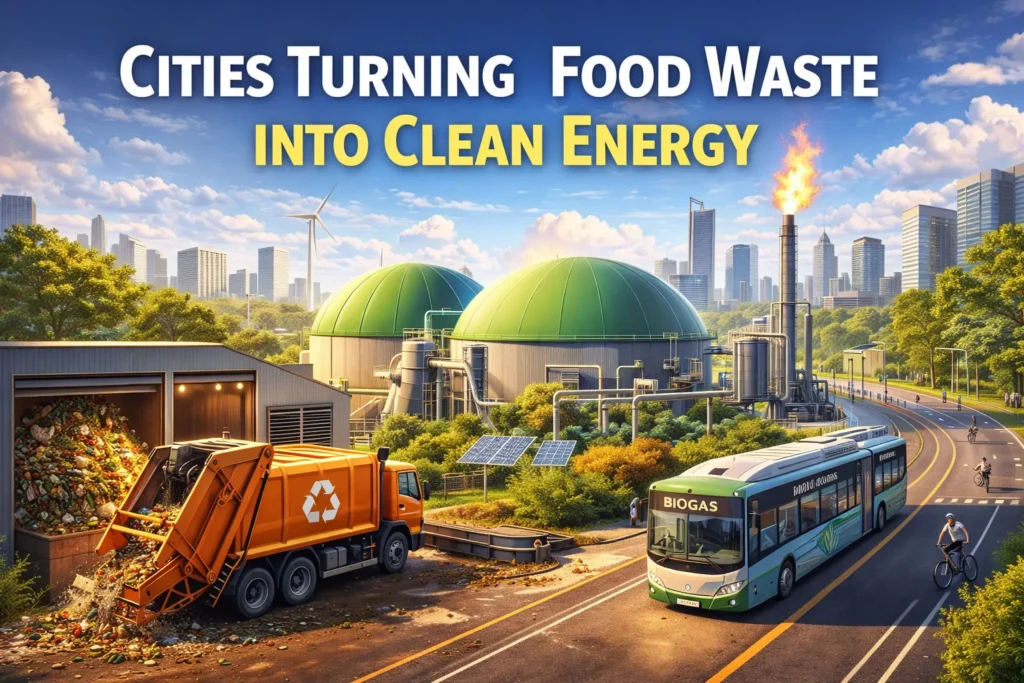
This is the story of that transformation, a narrative so vast it encompasses microbiology and macroeconomics, climate science and social justice, ancient biological processes and cutting-edge digital innovation. The journey of a single apple core, from bin to biogas bus, is a microcosm of a global paradigm shift. It is the story of the Circular Economy moving from academic theory into steel-and-concrete reality, one digester at a time. We are learning to mine our landfills before they are dug, to farm our urban refuse, and to power our future from the remains of our past. This is not a marginal experiment; it is becoming the operational backbone of sustainable urban life in the 21st century.
The Anatomy of Excess: Diagnosing the Global Metabolic Disorder
To comprehend the scale of the revolution, we must first fully diagnose the illness. Our linear economic model—”take, make, dispose”—has driven a profound metabolic disorder in our relationship with organic material. We are, in essence, hemorrhaging resources and poisoning ourselves in the process.
The Global Food Waste Tapestry: A Region-by-Region Autopsy
The statistic of 931 million tons of annual food waste is a numbing aggregate. To understand it, we must unravel its regional threads. In high-income nations of North America and Europe, waste is predominantly a retail and consumer-end phenomenon. Perfectly edible food is discarded due to cosmetic standards, over-purchasing, and confusing “best before” labels. A UK family throws away nearly £700 of food annually, while American retailers jettison tons of produce for being the wrong size or shape.
Contrast this with the low and middle-income nations of Sub-Saharan Africa and Southeast Asia. Here, the waste is a supply-chain failure. It is the grain that rots in inadequate storage silos, the fruit bruised on unpaved roads during transport, the fish that spoils for lack of refrigeration. In India, for instance, post-harvest losses for fruits and vegetables can exceed 40% before they ever reach a market. The causes differ, but the outcome—a catastrophic loss of embedded resources like water, land, and labor—is tragically similar.
The Urban Concentration Factor: Cities as Pressure Cookers
Cities act as intense, localized pressure points in this crisis. Covering just 3% of the Earth’s land surface, they generate over 50% of global waste and consume 60-80% of its energy. The density that makes cities efficient engines of innovation also makes them acute generators of concentrated waste streams. In megacities like Jakarta or Lagos, the formal collection infrastructure is swamped by population growth. Informal settlements, or slums, are often entirely off the grid, with waste accumulating in open drains and vacant lots, creating landscapes of risk where disease vectors breed and flash floods are exacerbated by clogged waterways.
The Carbon and Methane Calculus: A Double-Climate Threat
The climate impact of this waste is a story told in two powerful greenhouse gases. First, the embedded carbon footprint of wasted food is colossal. It represents all the CO₂ released to plough the field, fertilize the crop, fuel the harvesters, power the processing plant, and refrigerate the truck—all for nothing. The Food and Agriculture Organization (FAO) calculates this footprint at 3.3 billion tonnes of CO₂ equivalent annually. If food waste were a country, it would be the third-largest emitter in the world, behind only China and the United States.
Then comes the second, more potent blow: methane from decomposition. In a landfill, organic waste is buried under layers of trash, creating an anaerobic environment. Here, methanogenic archaea thrive. The methane they produce doesn’t just passively leak; it can migrate laterally through soil, seep into building basements, and create explosion hazards. More critically for the climate, methane’s radiative forcing—its heat-trapping ability—is 86 times greater than CO₂ over a 20-year timeframe. While it persists for a shorter period (~12 years vs. centuries for CO₂), its intense short-term warming effect makes its immediate reduction one of the fastest levers we have to slow near-term climate change. Landfills are methane factories, and by continuing to feed them, we are actively choosing to supercharge global warming.
The Resource Inefficiency: Wasting More Than Food
Finally, we must account for the cascade of wasted resources. That discarded head of lettuce represents 15 bathtubs of water used to grow it. The thrown-away steak embodies the grain, land, and methane emissions of the cow that produced it. We are not just wasting food; we are squandering fresh water in an age of growing scarcity, degrading arable land, and pointlessly amplifying biodiversity loss for agricultural expansion. This linear system is an open vein, draining the planet’s capital for no return.
The Alchemy of Anaerobes: A Deep Dive into the Microbial Universe
The solution to this disorder lies in managing the endpoint—the decomposition process—to capture value instead of releasing harm. Anaerobic Digestion (AD) is our technological interception of a natural process, but to master it, we must become stewards of an entire microbial universe.
The Microbial Consortium: A Specialized Industrial Workforce
Imagine a microscopic, self-organizing factory where every worker has a specific, sequential job. This is the AD bioreactor.
- The Hydrolyzers (The Demolition Crew): First come bacteria like Clostridium and Bacteroides. They secrete exoenzymes—cellulases, proteases, lipases—that act like molecular wrecking balls. They break apart the complex polymers of food waste: cellulose (plant fibers) into glucose, proteins into amino acids, fats (lipids) into glycerol and long-chain fatty acids. The physical structure of the waste is dismantled.
- The Acidogens (The Fermenters): Next, bacteria such as Streptococcus and Escherichia take these simpler molecules and ferment them. Their metabolic output is a mix of volatile fatty acids (VFAs—like acetic, propionic, butyric), along with alcohols, hydrogen, and carbon dioxide. This stage acidifies the broth.
- The Syntrophic Acetogens (The Bridge Builders): This is a critical, often limiting step. Bacteria like Syntrophomonas and Syntrophobacter perform a difficult chemical feat: they consume the propionic and butyric acids produced by the fermenters, converting them to acetic acid, hydrogen, and CO₂. The catch? This reaction is only thermodynamically feasible if the hydrogen concentration is kept extremely low. They live in obligate partnership with the next group.
- The Methanogens (The Power Producers – Archaea): These are not bacteria, but ancient archaea, some of the oldest life forms on Earth. They are the stars of the show and come in two primary types:
- Acetoclasts (e.g., Methanosarcina, Methanosaeta): They perform acetoclastic methanogenesis, cleaving acetic acid into methane and CO₂. Approximately 70% of biogas methane comes from this pathway.
- Hydrogenotrophs (e.g., Methanobacterium): They perform hydrogenotrophic methanogenesis, using hydrogen to reduce CO₂ into methane. They are the crucial partners for the syntrophs, consuming hydrogen to keep the entire process moving.
This consortium operates in a delicate equilibrium. Temperature is paramount: mesophilic systems (~35-40°C) are stable and common; thermophilic (~50-60°C) systems are faster and kill pathogens but are more temperamental. The pH must be carefully buffered against the acids produced. Any shock—a toxic chemical, a sudden influx of acidic waste—can upset the balance, causing a “sour” digester where acidogenesis outpaces methanogenesis, crashing gas production.
Biogas Upgrading: From Crude Gas to Pipeline-Quality Fuel
Raw biogas is a crude product. To become a direct substitute for fossil natural gas, it must be upgraded to biomethane (≥95% CH₄). This involves removing CO₂, H₂S, water vapor, and siloxanes (from cosmetics and soaps that end up in wastewater). The technologies for this are sophisticated:
- Water Scrubbing: CO₂ and H₂S are more soluble in water under pressure than methane. Biogas is bubbled through water, which absorbs the impurities.
- Pressure Swing Adsorption (PSA): Uses specialized materials (zeolites) that adsorb CO₂ and other gases at high pressure, allowing CH₄ to pass through.
- Membrane Separation: Uses semi-permeable polymer membranes that allow CO₂ to pass through faster than CH₄, separating them.
- Chemical Scrubbing: Uses amine solutions that chemically bind to CO₂ and H₂S, later releasing them when heated.
The resulting biomethane is chemically identical to fossil natural gas and can be injected into the national gas grid to heat homes, used as vehicle fuel (Bio-CNG or Bio-LNG), or converted into hydrogen through further reforming processes.
Digestate: The Unsung Hero of Nutrient Circularity
The solid and liquid digestate is a product of equal importance to the gas. The digestion process stabilizes the organic matter, eliminates pathogens (especially in thermophilic systems), and makes nutrients more plant-available. It is a biofertilizer rich in nitrogen (N), phosphorus (P), and potassium (K), but also containing valuable micronutrients and, critically, stable organic carbon.
- Liquid Fraction: Often used as a high-N fertilizer, similar to a manure tea. It can be applied via irrigation systems.
- Solid Fraction: Can be composted further, used as a peat substitute in potting soil, or pelletized as a slow-release fertilizer.
This closes the agronomic loop. Synthetic fertilizers, particularly nitrogen (produced via the energy-intensive Haber-Bosch process) and mined phosphorus (a finite resource), are major environmental stressors. Replacing them with digestate reduces energy use, prevents nutrient runoff into waterways, and rebuilds soil organic matter—a key strategy for carbon sequestration in agriculture.
The Global Laboratory: In-Depth Case Studies of Urban Transformation
Cities are not just adopting AD; they are adapting it, creating context-specific models that serve as living blueprints for the world.
The Scandinavian Ecosystem: Sweden’s Integrated Mastery
Sweden’s success is not a single project but a holistically engineered ecosystem of policy, technology, and public behavior.
- Policy Foundation: The 1999 ban on landfilling combustible and organic waste was the seismic shift. It created a non-negotiable demand for alternatives overnight. This was supported by a heavy tax on landfill and investment subsidies for biogas plants. The policy was clear, long-term, and gave industry the confidence to invest.
- The Technical Integration – The Högdalen CHP Plant: This facility in Stockholm is a cathedral to circular integration. It co-digests 100,000 tons of food waste (from separately collected household bags) with 200,000 cubic meters of sewage sludge annually. The biogas fuels combined heat and power (CHP) engines, generating 14 GWh of electricity and 70 GWh of heat for the city’s district heating network. The digestate is pasteurized and used as fertilizer. The plant also recovers phosphorus from the sludge ash, addressing another critical resource scarcity.
- The Transport Revolution: Sweden has over 70,000 biogas vehicles and the world’s densest network of filling stations. Cities like Linköping run their entire public bus and waste truck fleet on locally produced biogas. The regional train line, Biogaståget, runs on biogas. This creates a powerful, visible link for citizens: their waste powers the train they ride.
- Market Creation: Sweden pioneered the concept of “Green Gas Certificates”, a guarantor of origin system that allows consumers to choose and pay for biogas in the grid, similar to green electricity certificates, creating a premium market for the product.
The African Context: Kenya’s Leapfrog Innovation
Kenya’s approach bypasses the linear development path, moving directly to distributed, resilient systems suited to local challenges.
- The Nakuru Practical Model: The city of Nakuru, in partnership with a German development agency, built a plant processing market waste and septic sludge. Its innovation is in product diversification and community inclusion. The biogas is used to generate electricity for the plant and to power a seed-crushing mill for local farmers. The heat from the generator dries the solid digestate into fertilizer pellets for sale. Informal waste pickers were formally integrated into the collection system, improving their incomes and safety.
- The Kisumu Social Enterprise Vision: The planned Kisumu project, funded by the Green Climate Fund, is designed as a social enterprise from the ground up. Beyond producing bio-cooking gas, the model includes:
- Micro-franchising: Training local youth to manage and service bio-gas cylinder distribution kiosks in informal settlements.
- Urban Agriculture Linkage: Partnering with women’s groups to use the liquid digestate in “sack gardening” and vertical farms in densely populated areas, improving food security.
- Health Impact Bonds: Exploring financing models where a portion of the project’s revenue is linked to measurable reductions in childhood pneumonia from cleaner indoor air, attracting impact investment.
- Technology Adaptation: In East Africa’s climate, sophisticated temperature control for digesters is expensive. Kenyan engineers are pioneering the use of geothermal heat exchange, using buried pipes to maintain optimal mesophilic temperatures with minimal energy input, a brilliant adaptation to local conditions.
The North American Engine: Public-Private Power and Grid Injection
The North American model excels at large-scale, economically driven projects that inject renewable gas directly into existing utility infrastructure.
- The California LCFS Engine: California’s Low Carbon Fuel Standard (LCFS) is a market-driven policy that has turbocharged the biogas sector. It assigns a carbon intensity (CI) score to all transport fuels. Fossil diesel has a high CI; biomethane from landfill gas or food waste can have a negative CI (because it prevents methane emissions). Fuel providers must meet an average CI target. They can do this by blending biofuels, or by purchasing LCFS credits from producers like biogas plants. This has created a lucrative, stable secondary income stream, making projects highly bankable. A dairy digester project in California can now earn revenue from: 1) selling gas, 2) selling electricity (if generating), 3) selling LCFS credits, and 4) selling federal Renewable Identification Numbers (RINs).
- The Toronto Integration: The city’s Dufferin Solid Waste Management Facility hosts an AD plant processing 55,000 tons of residential food waste annually. The purified biomethane is not used for vehicles onsite; instead, it is directly injected into the local Enbridge natural gas grid. This is a key innovation: it turns the gas grid itself into a massive, flexible storage and distribution system for renewable energy. Homes and businesses connected to the grid begin using a portion of renewable gas seamlessly, decarbonizing heating and industrial processes without any change to their appliances.
- The Industrial Symbiosis of Fair Oaks Farms, Indiana: This is perhaps the most famous agricultural example, but its lessons are urbanizable. At Fair Oaks, the manure from 15,000 dairy cows is digested. The biogas is cleaned and compressed into Bio-CNG at a fueling station on-site. A fleet of 42 milk tanker trucks has been converted to run on this fuel. The trucks deliver milk and return with manure to feed the digesters, creating a perfect closed loop. An urban analogue could be a city’s organic waste fueling the very fleet that collects it.
The Asian Megacity Response: Singapore and Seoul’s High-Tech Approach
Land-scarce, dense Asian megacities are pushing the frontier of efficiency and technology.
- Singapore’s Tuas Nexus: The “Waste-Water-Workforce” Integration: This is one of the world’s most ambitious integrated environmental hubs. Currently under construction, it will co-locate a water reclamation plant (WRP) and a waste-to-energy incineration plant (WTE). The food waste and sludge from the WRP will be co-digested. The biogas will help power the facility. The incineration ash will be used for land reclamation. The heat from the WTE will help maintain thermophilic temperatures in the digesters. This physical integration reduces land footprint, captures synergistic energy flows, and creates operational efficiencies, setting a new global benchmark.
- Seoul’s Digital Pay-As-You-Throw (PAYT) System: Seoul tackled the behavioral challenge with technology. Since 2013, the city has mandated food waste separation and implemented a mandatory RFID-based weight billing system. Residents discard food waste into smart bins that scan their apartment ID card and weigh the waste. They are billed monthly based on the weight. This direct economic signal caused an immediate and sustained 30% reduction in food waste generation. The collected waste is now a clean, high-quality feedstock for the city’s digestion plants, improving their efficiency and gas yield. The system proves that digital accountability can drive rapid circular behavior.
The Multiplier Effect: A Comprehensive Impact Analysis
The value proposition of urban AD extends far beyond a simple kilowatt-hour-for-waste exchange. It generates a cascade of interconnected benefits across the Sustainable Development Goals (SDGs).
Environmental Impacts: From Mitigation to Restoration
- Climate Mitigation (SDG 13): The dual effect is potent. A study in Nature Climate Change estimated that maximizing biogas production from global food waste could mitigate up to 10% of total anthropogenic greenhouse gas emissions. This comes from avoided landfill methane and displaced fossil fuels across transport, heat, and power sectors.
- Air Quality and Public Health (SDG 3): The shift from diesel to biomethane in urban transport has immediate local benefits. A 2020 study of the Bristol bio-bus fleet estimated it prevented 1.5 tonnes of NOx and 35 kg of PM2.5 emissions per bus per year. Scaling this across a city translates to fewer cases of childhood asthma, reduced cardiovascular hospitalizations, and lower public health costs. The WHO estimates 4.2 million premature deaths annually from ambient air pollution; clean urban transport is a direct antidote.
- Water Quality and Marine Health (SDG 14): By replacing synthetic fertilizers with digestate, we reduce nutrient runoff—the primary cause of coastal eutrophication and “dead zones.” The Gulf of Mexico dead zone, fueled by Mississippi River runoff, is largely driven by synthetic fertilizer from Midwest agriculture. Recycling urban nutrients closes this loop on land.
- Soil Health and Land Use (SDG 15): Digestate returns organic carbon to soils. Healthy soils with higher organic matter have greater water-holding capacity (a buffer against droughts), better structure, and support more biodiversity. This regenerative practice counters the soil degradation affecting one-third of the world’s arable land.
Economic and Social Impacts: Building Just and Resilient Cities
- Job Creation and Economic Diversification: The biogas value chain is inherently local and creates diverse jobs. The International Renewable Energy Agency (IRENA) estimates that renewable energy creates more jobs per unit of investment than fossil fuels. Biogas jobs span: collection logistics, plant construction, high-skill operations (process engineers, microbiologists), maintenance technicians, digestate sales and logistics, and R&D. In depressed industrial regions, biogas plants can become anchors for a new green economy.
- Energy Poverty Alleviation and Gender Equity (SDG 5, 7): The impact of reliable, clean cooking fuel in the Global South cannot be overstated. For a household in rural Kenya or India, a small digester fueled by animal manure and kitchen waste means:
- Time Saved: 2-3 hours per day previously spent gathering firewood, time that can be redirected to education, childcare, or income generation (primarily benefiting women and girls).
- Health Saved: Elimination of indoor smoke reduces the risk of chronic obstructive pulmonary disease (COPD), lung cancer, and eye infections.
- Money Saved: Cash previously spent on charcoal or kerosene is freed for other needs.
- Dignity and Safety: Reduced risk of gender-based violence during fuelwood collection trips.
- Waste Picker Formalization and Social Inclusion (SDG 8, 10): In cities like Pune, India, and Cairo, Egypt, informal waste pickers (often from marginalized castes or communities) provide a de facto recycling service. Inclusive AD projects can formally integrate these workers, providing them with safer working conditions, stable contracts, access to healthcare, and social dignity. The SWaCH cooperative in Pune is a globally recognized model, where waste pickers are co-owners of the service enterprise that collects organic waste for the city’s processing facilities.
- Urban-Rural Linkage and Regional Resilience: AD creates a tangible material link between city and hinterland. Urban food waste becomes rural fertilizer, improving farm yields. In return, stable agricultural production feeds the city. This symbiotic relationship builds regional self-reliance and buffers both from global commodity price shocks in fertilizer and fuel markets.
The Frontier of Innovation: The Next Generation of Urban Biorefining
The AD plant of today is evolving into the multi-product urban biorefinery of tomorrow, driven by digitalization, biotechnology, and systems thinking.
Advanced Feedstock Pre-Treatment: Unlocking Stubborn Carbon
A major limit to efficiency is lignocellulosic waste—yard trimmings, cardboard, agricultural stalks. Their tough lignin structure resists hydrolysis.
- Steam Explosion: Subjecting waste to high-pressure steam (e.g., 180°C, 10 bar) then rapidly depressurizing it, literally exploding the cell walls.
- Enzymatic Pre-Treatment: Using commercially produced cocktails of ligninolytic enzymes (like laccases) to “pre-digest” the material before it enters the digester, boosting biogas yields by 30-100%.
- Hydrothermal Carbonization (HTC): A process that converts wet biomass into a coal-like substance called hydrochar under moderate heat and pressure. The process water, rich in organics, is then excellent for digestion, while the solid hydrochar can be used as a soil amendment or solid fuel.
The Volatile Fatty Acid (VFA) Platform: Beyond Methane
Instead of letting acetogens convert all VFAs to acetic acid for methanogens, we can intercept them. VFAs like caproic acid are valuable precursors for bio-based plastics, lubricants, and pharmaceuticals. Research is perfecting microbial chain elongation processes within digesters to steer production toward these higher-value chemicals, transforming a waste treatment plant into a biochemical factory.
Power-to-Gas and Sector Coupling: Storing Renewable Electricity
This is a visionary integration with the wider energy transition. During periods of excess wind or solar power, electricity can be used to electrolyze water, producing hydrogen (H₂). This green hydrogen can be fed into an AD reactor, where hydrogenotrophic methanogens use it to convert the digester’s CO₂ into additional methane. This biological methanation upgrades low-value CO₂ into high-value, storable biomethane, effectively using the biogas infrastructure as a giant, biological battery for intermittent renewables. Pilot projects, like Audi’s e-gas plant in Germany, are proving this concept at scale.
Digital Twins and AI Optimization
The “smart digester” uses a network of sensors (for pH, gas composition, temperature, VFA levels) feeding data into a digital twin—a real-time, dynamic software model of the physical bioreactor. Machine learning algorithms analyze this data stream, predicting process instability hours or days before it occurs and automatically adjusting feedstock mix or temperature. This moves operation from reactive to predictive, maximizing gas yield and uptime. Companies like BioBeez and Vogelsang are already offering these AI-driven optimization services.
Decentralized and Hyper-Local Models: The Micro-Digester Revolution
Not all solutions are city-scale. New designs for containerized, plug-and-play micro-digesters are emerging. A single unit, the size of a shipping container, can serve an apartment block, a university campus, a prison, or a food processing factory. Companies like HomeBiogas offer backyard systems for households. These distributed systems eliminate transport costs for waste and energy, increase community ownership, and enhance resilience—if one unit fails, the whole city’s system doesn’t halt.
The Obstacle Course: A Clear-Eyed View of Barriers and Strategic Solutions
For all its promise, the path is fraught with real, persistent challenges that require honest acknowledgment and strategic countermeasures.
1. The Contamination Conundrum
- The Problem: A plastic bag or glass jar in the food waste stream can jam grinders, abrade pumps, and contaminate digestate, rendering it unsellable. Public compliance is the weakest link.
- Strategic Solutions:
- Behavioral “Nudging”: Simple, standardized bin colors (green for organics everywhere) and iconography reduce confusion.
- Feedback Loops: In San Francisco, collectors tag contaminated bins with “Oops!” tags explaining the error, turning a rejection into a learning moment.
- Advanced Material Recovery Facilities (MRFs): Investing in robotic sorting arms with hyperspectral cameras at the plant entrance can identify and remove contaminants post-collection, providing a safety net.
2. The Economic Viability Puzzle
- The Problem: Capital expenditure (CAPEX) is high. Revenue from gas and digestate alone often cannot compete with cheap fossil gas without support.
- Strategic Solutions:
- Value-Stacking: Modern projects don’t rely on one revenue stream. They stack: gas sales + electricity sales + digestate sales + tipping fees + LCFS/RIN credits + green certificates. This diversified income improves bankability.
- Blended Finance: Using public or philanthropic funds to de-risk the initial investment for private capital. The Green Climate Fund often plays this role in developing nations.
- Cost-Sharing through Industrial Symbiosis: As at Tuas Nexus, co-locating with a wastewater plant shares costs for site preparation, utilities, and operations, improving the economics for both.
3. The Policy and Regulatory Maze
- The Problem: Inconsistent or contradictory regulations can stall projects. Is digestate considered a waste (heavily regulated) or a product (freely tradable)? Can gas be injected into the grid? Standards vary wildly.
- Strategic Solutions:
- Advocacy for Product End-of-Waste Status: Successful lobbying in the EU led to clear criteria for when digestate is a certified fertilizer product, creating a market.
- Development of National Biomethane Strategies: Countries like Denmark and France have published clear roadmaps with targets for biomethane injection, giving industry a clear growth trajectory.
- Standardized Interconnection Agreements: Working with gas utilities to create clear, fair, and efficient technical and commercial protocols for grid injection.
4. The Public Acceptance Hurdle (“Not-In-My-Backyard”)
- The Problem: Fear of odors, noise, and truck traffic makes communities resistant to hosting waste facilities.
- Strategic Solutions:
- Transparency and Community Benefit Agreements: Inviting the community into the design process and guaranteeing tangible local benefits—e.g., discounted gas, community funds, odor-monitoring committees, and architectural design that fits the neighborhood.
- Educational “Habitrail” Tours: Facilities like the Rialto Bioenergy Facility in California have built public viewing galleries with glass walls into the process halls, turning the plant into an educational asset, not a hidden threat.
- Odor as a Design Priority, Not an Afterthought: Investing in best-in-class odor control (fully enclosed receiving, negative air pressure, thermal oxidation of process air) from the outset is non-negotiable for urban siting.
The Citizen’s Mandate: Your Role in the Circular City
This revolution cannot be engineered solely by politicians and technicians. Its fuel is public participation; its catalyst is daily choice.
In Your Home: The New Domestic Science
- Master Home Separation: Understand your local system. What goes in the organics bin? (Usually: food scraps, soiled paper napkins, BPI-certified compostable bags. Never: plastic, glass, metal).
- Embrace the Countertop Caddy: Use a sealed, manageable bin on your kitchen counter. Line it with newspaper or certified bags. Empty it regularly.
- Reduce First, Then Recycle: The most powerful action is to waste less food. Plan meals, store food correctly, embrace “ugly” produce, and understand date labels (“use by” is safety; “best before” is quality).
In Your Community: Becoming an Advocate
- Demand Circular Services: If your city lacks separate organics collection, petition your local council. Attend town halls. Use the economic and environmental arguments laid out here.
- Support Circular Businesses: Patronize restaurants and grocery stores that actively divert their food waste to digesters, not landfills. Ask them about their practices.
- Educate and Model: Talk to neighbors, schools, and community groups. Host a documentary screening (“Wasted! The Story of Food Waste” is excellent). Start a community compost if AD isn’t yet available.
As a Consumer and Investor: Voting with Your Wallet
- Choose Renewable Gas: If your utility offers a “green gas” tariff, opt in. It creates direct demand.
- Invest in the Circular Economy: Explore ESG (Environmental, Social, Governance) funds or green bonds that specifically include waste-to-energy and circular infrastructure in their portfolios. Your capital can accelerate the transition.
Conclusion: The Urban Imperative for a Metabolic Shift
We stand at a pivotal moment in the history of human settlement. For millennia, cities were seen as the antithesis of nature—consumptive black boxes, drawing in resources and expelling waste. The story of food waste-to-energy is a cornerstone in rewriting that narrative. It proves that cities can be regenerative, metabolic engines, designed in harmony with natural cycles.
This is more than an environmental strategy; it is a redefinition of urban efficiency and resilience. It turns a costly liability—waste management—into a source of energy security, job creation, and public health. It builds bridges between urban and rural, between consumer and producer, between our present needs and our future survival.
The technology is ready. The economic models are proven. The climate and social imperatives are undeniable. The remaining ingredient is collective will—the will to see not garbage, but potential; to see not a disposal problem, but a production opportunity; to look at the scraps on our plate and see, not an ending, but a powerful beginning.
The cities of the future will not just be smart; they will be alive, metabolizing their own streams into sustained vitality. They will be powered, in part, by the forgotten energy of our daily meals. This is the quiet revolution beneath our feet, and it invites every one of us to become both its beneficiary and its architect. The journey from scraps to sparks is the journey to a sustainable urban age. It is a journey we must make, and it begins in our kitchens today.