
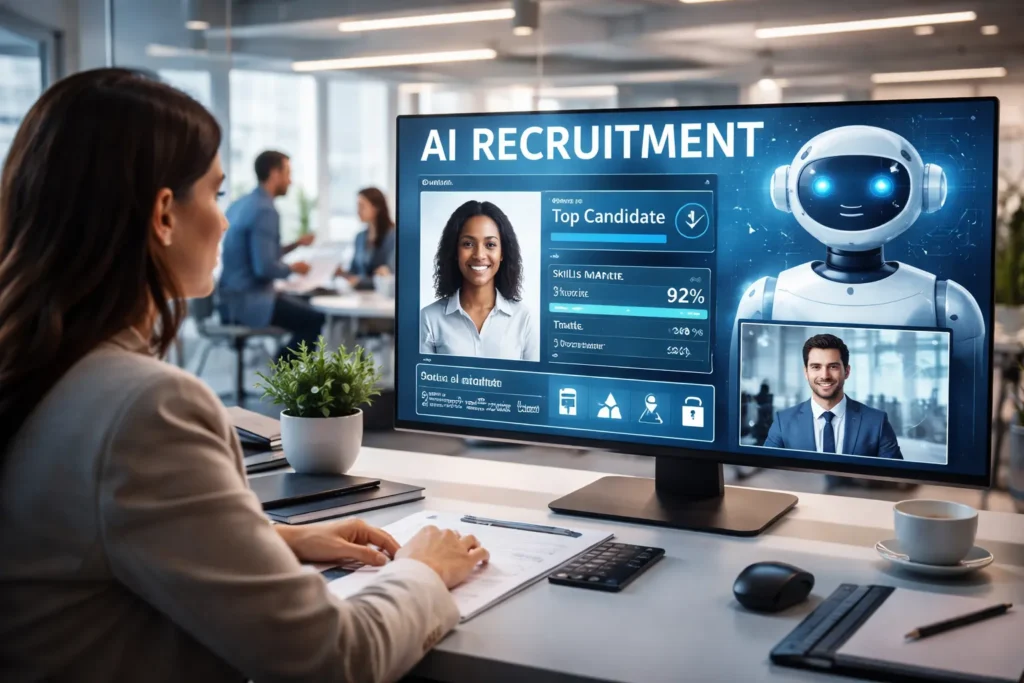

Introduction: The Quiet Revolution Behind Your Application
Imagine you are sitting in your favorite coffee shop on a rainy Tuesday morning. The steam rises from your mug, mixing with the nervous energy bubbling in your chest. You spent the last three evenings perfecting your resume, staying up late to tweak every bullet point, to ensure every verb packs a punch. You found a job posting that feels like destiny—a role that seems to have been written with your specific skills and experiences in mind. Your finger hovers over the mouse. You take a deep breath. You click “Apply.” The screen flashes: “Application Submitted.” You lean back, satisfied.
What happens next is not what you think.
In that exact moment, somewhere in a vast digital landscape—a server farm in Virginia, a cloud server in Ireland, or a data center in California—a piece of software wakes up. It doesn’t sip coffee. It doesn’t stretch or yawn. It doesn’t feel excitement or boredom. It simply begins to work.
In the time it takes for you to take a sip of your latte, this software has already performed thousands of calculations. It has scanned your resume, extracted your work history, parsed your education, and cross-referenced your skills against a database of hundreds of similar candidates. It has scored you against the job description using a mathematical formula that would take a human hours to compute. And in many cases, it has already decided whether you will receive a phone call or a form rejection email.
You haven’t spoken to a single soul yet. No one has looked at your resume with their own eyes. And yet, the first gatekeeper in your job search journey has already rendered a verdict.
This is the new reality of hiring. It is quiet, fast, and largely invisible to the average job seeker. Artificial Intelligence has moved from the realm of science fiction into the very heart of how companies find, evaluate, and hire talent. It is reshaping the recruitment industry from the ground up, and whether we realize it or not, it is reshaping our careers along with it.
For decades, the hiring process was a slow, deeply human affair. You mailed a physical resume on crisp paper, you waited days for a phone to ring, you dressed in your finest suit and hoped that a hiring manager in a cramped office liked the firmness of your handshake. It was personal, but it was also painfully inefficient. Great candidates fell through the cracks because a recruiter was having a bad day. Mediocre candidates slipped through because they went to the right school or knew the right people.
Today, the dance floor has changed. The music is data, and the DJ is a complex algorithm. Companies across every industry—from retail giants like Walmart to tech behemoths like Google to healthcare systems and manufacturing firms—are racing to implement AI tools that promise to find the best talent faster, cheaper, and arguably fairer than ever before.
But as these algorithms take on greater authority in the hiring process, a pressing question emerges: Is this a revolution in fairness and efficiency, or is it simply a faster way to make the same old mistakes at scale?
To answer that, we need to take a deep dive into the world of AI recruitment. We need to understand how these tools work, why businesses have embraced them so eagerly, what they get right, where they go dangerously wrong, and most importantly, what this all means for you—the person who is just looking for a chance to prove yourself, to feed your family, to build a career, and to find work that matters.
Let’s begin at the beginning, before the robots arrived, when the mountain of resumes was managed by tired humans with highlighters and hope.
1. The Mountain of Resumes: Why the Old System Was Breaking
To truly appreciate why artificial intelligence has stormed the gates of human resources, we have to travel back in time. Not too far—just about fifteen to twenty years ago. It was a world without LinkedIn as we know it, without application tracking systems, without the ability to apply to fifty jobs with a single click.
Back then, if you wanted a job, you bought a Sunday newspaper, circled ads in the classifieds section with a red pen, and printed multiple copies of your resume at Kinko’s. You mailed them in manila envelopes and waited. Sometimes you followed up with a phone call. The process was slow, deliberate, and limited in scale.
But then the internet changed everything. Job boards like Monster and CareerBuilder exploded onto the scene. Suddenly, applying for a job was as easy as uploading a file and clicking a button. For job seekers, this was liberation. For employers, it became a nightmare.
Let me introduce you to a woman named Sarah. Sarah is a fictional character, but she represents thousands of real hiring managers across the country. Sarah works as a recruitment director for a mid-sized retail chain with about two hundred stores nationwide. One Monday morning, she posts a job opening for a regional store manager position. The role pays well, offers good benefits, and is located in a desirable city.
By Friday afternoon, Sarah’s inbox contains 1,847 resumes.
Now, let’s pause and do some math. If Sarah spent just two minutes reading each resume—and two minutes is not enough time to do justice to anyone’s career—it would take her over sixty hours to get through the pile. That’s more than a full work week. And Sarah doesn’t have sixty hours. She has meetings to attend, hiring managers to support, onboarding paperwork to process, and a dozen other open roles to fill.
So what does Sarah do? She does what any overwhelmed human does: she looks for shortcuts. She scans. She glances. She develops what recruiters call “resume fatigue.”
Studies have shown that the average recruiter spends between six and eight seconds looking at a resume before making an initial decision. Six seconds. That’s less time than it takes to read this sentence. In those six seconds, they are scanning for specific keywords: the name of a competitor company, a particular software skill, a job title that matches exactly what they need.
If the formatting is unusual, they might skip it. If the font is too small, they might pass. If the candidate’s name sounds unfamiliar or difficult to pronounce, studies suggest that recruiters—unconsciously, without malice—might be slightly less likely to call them back.
This is the phenomenon that job seekers have long called “the resume black hole.” You submit your carefully crafted application, and it vanishes into a void, never to be heard from again. You wonder if your resume was even seen. You wonder if you’re just not good enough. But the truth is often much simpler: you got lost in the avalanche.
The old system was broken in another way too. It was broken by bias. Human beings are walking bundles of unconscious preferences. We might favor someone who shares our alma mater. We might subconsciously lean toward candidates with names that sound like ours. We might roll our eyes at a resume that uses Comic Sans font, even though that has nothing to do with job performance. We are swayed by first impressions, by mood, by the time of day, by whether we had a good lunch.
These biases aren’t necessarily malicious. They’re just human. But they add up to a hiring system that is inefficient, inconsistent, and often unfair.
This is where AI made its grand entrance. It promised to be the solution to the mountain and the antidote to bias. It promised to read every single resume, every single time, without fatigue, without mood swings, without unconscious prejudice. It promised to find the needle in the haystack—the brilliant candidate who didn’t go to Harvard, who didn’t have the right connections, but who had the exact skills to do the job.
Companies like Unilever, Hilton, and countless startups began saying, “Let the machines handle the sorting.” They argued that if a machine processes every application equally, applying the same mathematical criteria to each one, the process would become more objective. The robot wouldn’t care if you went to a community college or an Ivy League school. It wouldn’t care about your gender, your age, or your accent. It would only care about whether your skills matched the requirements.
In theory, it sounded like a perfect solution. In practice, as we’ll see, things got complicated.
2. The Digital Gatekeeper: How AI Actually Reads Your Resume
Let’s pull back the curtain and demystify the technology that now stands between you and your next job. When you upload your resume to a company’s careers page, you are likely interacting with what is called an Applicant Tracking System, or ATS. These systems have been around for a while, but the newer generation is infused with artificial intelligence and machine learning.
The AI does not “read” your resume the way a human does. Humans read linearly, from top to bottom, understanding context and nuance. AI reads differently. It parses. It breaks your document down into discrete pieces of data.
Imagine your resume is a puzzle. The AI takes that puzzle apart, sorting each piece into a specific box. Your name goes in the “contact information” box. Your email goes there too. Your job titles go into a “work history” box. The names of the companies you worked for go into an “employer” box. Your university, your degree, your graduation year—those go into the “education” box. Every skill you listed, from “Python programming” to “customer service” to “budget management,” gets extracted and stored as a separate data point.
Once the AI has broken your resume into these pieces, it begins the matching process. This is where the intelligence part kicks in.
The employer—Sarah, our fictional hiring manager—has configured the system with a set of parameters. She has told the AI what the “ideal candidate” looks like. Sometimes she does this by manually selecting keywords. Other times, the AI learns by analyzing the profiles of the company’s current top performers. If the best store managers at Sarah’s company all have experience in inventory management, team leadership, and a specific retail software system, the AI will learn to prioritize those attributes.
The system then gives your resume a score. It might be a score out of 100, or a star rating, or a color code like red, yellow, green. If you score high—say, above 80 out of 100—you are flagged as a “top candidate.” Your resume rises to the top of the pile, and a human recruiter will see you first. If you score in the middle, you might be reviewed if there are not enough top candidates. If you score below a certain threshold—say, 40 or 50—the system may automatically archive your application.
Sometimes, you will receive a rejection email within minutes of applying. You might think, “They must have read my resume so fast!” But in reality, no human read it at all. The AI made that decision based on a mathematical formula.
This efficiency is exactly what companies are paying for. Hiring time that used to take weeks can now be compressed into days. The cost per hire drops dramatically. Recruiters can focus their energy on the candidates who are most likely to succeed, rather than spending hours sifting through unqualified applicants.
But there is a catch. A significant catch.
The AI is only as good as the data it is trained on and the instructions it is given. If the employer tells the AI to look for a specific keyword, and that keyword doesn’t appear on your resume—even if you have equivalent experience described in different words—the AI may score you poorly. If the AI is trained on the company’s historical hiring data, and that data reflects past biases, the AI will learn to replicate those biases, often in ways that are difficult to detect.
Let’s say a tech company has historically hired mostly men for engineering roles. If the AI is trained on that historical data, it might learn that certain characteristics associated with male applicants—specific wording, specific school names, even specific extracurricular activities—are predictive of success. It will then favor those characteristics, not because it is sexist, but because it is following patterns. The machine doesn’t know right from wrong. It only knows correlation.
This is the fundamental tension at the heart of AI recruitment. We want the machine to find the best person for the job. But if we aren’t careful, the machine simply finds the person who looks like the people who used to have the job.
3. Beyond the Resume: Skills Assessments and Gamification
The screening process I just described—the parsing and scoring of resumes—is only the first layer of AI recruitment. Many companies are going much deeper. They are using AI not just to read what you’ve done in the past, but to measure what you can do right now.
This is where things get interesting, and where the experience of applying for a job starts to feel radically different.
Imagine you are applying for a customer service role at a major telecommunications company. Instead of just submitting a resume and waiting for a phone call, you receive an email with a link. You click it, and you find yourself in a simulated environment. A virtual customer appears on your screen. They are angry. Their internet is down, they’ve been on hold for an hour, and they are yelling at you through text bubbles.
The AI watches how you respond. It tracks your typing speed, your word choice, your tone, and your problem-solving approach. It notices whether you apologize, whether you offer a solution, whether you stay calm under pressure. Within minutes, it generates a score that predicts your performance in a real customer service role.
This is called a skills assessment, and it’s one of the fastest-growing areas of AI recruitment. Companies are moving away from traditional interviews that ask, “Tell me about a time you handled a difficult customer,” and moving toward simulations that actually test whether you can handle a difficult customer.
For candidates, this can be both exciting and nerve-wracking. On one hand, it offers a chance to prove your abilities in a way that a resume never could. If you’re great at the job but terrible at writing resumes, this levels the playing field. On the other hand, it can feel like being put under a microscope, with every keystroke being analyzed and scored.
Some companies have taken this even further with gamification. PwC, one of the largest professional services firms in the world, uses a series of online games as part of their hiring process. Candidates play games that measure traits like adaptability, risk-taking, and decision-making speed. The AI analyzes how you play—not just whether you win, but how you approach problems, how quickly you learn from mistakes, and how you respond to pressure.
Proponents argue that these gamified assessments are more objective than traditional interviews, which can be heavily influenced by a candidate’s charisma or interview skills rather than their actual job performance. Critics worry that these tools can be gamed, or that they may favor candidates who are familiar with video game mechanics over those who aren’t.
There’s also a deeper concern: when we reduce human potential to a score generated by a game, are we capturing the full complexity of what makes someone a great employee? Can a puzzle game really measure empathy? Can a typing simulation measure creativity? These are questions that the industry is still grappling with.
4. The Chatbot in the Lobby: Conversational AI and the Death of the Phone Screen
If you have looked for a job in the past few years, there’s a good chance you’ve met a chatbot. Maybe her name was Olivia. Maybe his name was Mya. Maybe it was just a generic chat window that popped up on the company’s careers page, offering to help you find the right role.
These conversational AI tools are becoming the new front door for job seekers. Instead of filling out a long application form, you have a conversation. The chatbot asks you questions: “What kind of role are you looking for?” “What’s your desired salary range?” “Are you authorized to work in the United States?” You type your answers, and the chatbot processes them in real time.
If the conversation goes well, the chatbot might schedule you for an interview right then and there. If not, it might politely tell you that there aren’t any roles that match your criteria at the moment, and ask if you’d like to be notified when something opens up.
This technology is replacing the traditional phone screen—that fifteen-minute call with a recruiter that used to be the first step in the hiring process. For employers, the benefits are obvious. Chatbots work 24 hours a day, seven days a week. They never get tired. They can handle thousands of conversations simultaneously. They ask the same questions to every candidate, ensuring consistency.
For job seekers, the experience can feel a bit strange at first. You’re typing your hopes and dreams into a chat window, knowing that no human is on the other end. But many candidates appreciate the speed and convenience. You don’t have to play phone tag with a recruiter. You don’t have to take time off from your current job to have a preliminary conversation. You can do it on your own time, from your own couch.
But there’s a more advanced, and much more controversial, version of this technology: the one-way video interview.
Companies like HireVue, Modern Hire, and Spark Hire have built platforms where candidates record video responses to pre-set questions. You receive a link. You open it on your computer or phone. A question appears on the screen: “Tell me about a time you faced a conflict with a coworker and how you resolved it.” You have thirty seconds to prepare, and then the camera turns on, and you record your answer.
You have no idea who is watching. In many cases, no one is watching—at least, not at first. The AI analyzes your video. It transcribes your words, looking for specific keywords and phrases. It analyzes your tone of voice, measuring confidence, enthusiasm, and emotional regulation. It tracks your facial expressions, noting whether you smile, whether you maintain eye contact with the camera, whether your expression matches the content of your answer.
Based on all of this, the AI generates an “employability score” or a “fit score.” Only candidates who meet a certain threshold are passed on to a human recruiter.
This technology has sparked fierce debate. Supporters argue that it removes the risk of a recruiter being influenced by irrelevant factors like a candidate’s appearance or accent. They say it ensures that every candidate is evaluated by the same criteria, in the same way, without the variability that comes from different interviewers.
Critics have called it “digital phrenology”—a modern, high-tech version of pseudoscience that claims to measure character and intelligence from physical features. They point out that there is limited scientific evidence that facial expressions or tone of voice can reliably predict job performance. They worry that these tools may discriminate against candidates with speech impediments, social anxiety, autism, or even just a bad day.
Some jurisdictions are starting to push back. Illinois passed a law requiring companies to obtain consent from candidates before using AI analysis in video interviews. New York City has implemented regulations requiring bias audits for automated hiring tools. The conversation about how to regulate this technology is just beginning.
5. The Bias Paradox: Can a Machine Truly Be Fairer Than a Human?
We’ve touched on this theme throughout, but it deserves its own deep exploration because it sits at the very center of the debate about AI in hiring.
Let’s start with a fundamental truth: humans are biased. This is not an accusation; it’s a description of how our brains work. We make mental shortcuts constantly to navigate a complex world. We categorize. We generalize. We rely on intuition. These shortcuts are efficient, but they are not always accurate, and they are certainly not always fair.
Research has shown that people with “white-sounding” names receive significantly more callbacks than people with “Black-sounding” names, even when their resumes are identical. Studies have shown that taller people earn more money, that conventionally attractive people are more likely to be hired, and that men are perceived as more competent than women for the same roles, even when their qualifications are identical.
These biases are often unconscious. Most recruiters don’t believe they are biased. They genuinely think they are evaluating candidates objectively. But the data tells a different story.
So, in theory, AI should be the great equalizer. A machine doesn’t have unconscious biases. It doesn’t care about your name, your height, your gender, or the way you dress. It only cares about the data you provide and the patterns it has learned.
But here’s the problem that caught many companies off guard: AI learns from data. And human data is soaked in bias.
Let me tell you the story that has become a cautionary tale in the tech industry. Several years ago, a global technology company—widely reported to be Amazon—set out to build an AI recruiting tool. The idea was brilliant: feed the AI ten years of resumes submitted to the company, let it learn what a successful candidate looks like, and then use it to score new applicants.
The team built the system, trained it, and tested it. The results looked promising at first. The AI seemed to be identifying strong candidates efficiently. But then, they noticed something troubling. The AI was penalizing resumes that included the word “women’s.” Resumes that mentioned “women’s chess club” or “women’s leadership conference” were being downgraded. Resumes from graduates of all-women’s colleges were also being scored lower.
What happened? The AI had learned that the company’s historical hiring patterns favored men. The tech industry has long been male-dominated, and the company’s past hires reflected that. The AI, in its cold, mathematical way, had concluded that “being male” was a predictor of success—not because it was true, but because the historical data showed that most successful applicants were men.
The company eventually scrapped the tool. But the lesson echoed across the industry. You can’t simply feed historical data into an AI and expect it to produce fair outcomes. If the past was unfair, the AI will simply automate that unfairness at scale, and it will do it faster and more efficiently than any human ever could.
This is the bias paradox. We turn to AI to escape human bias, but AI often ends up reflecting and amplifying that bias because it learns from our biased world.
So how do we fix it? This is where the field of “algorithmic fairness” comes in. Researchers and responsible companies are working on techniques to audit AI systems for bias, to remove sensitive variables like race and gender from the decision-making process, and to ensure that AI models are trained on diverse and representative data.
Some tools now actively look for bias. For example, an AI might flag to a recruiter: “The candidates you’re passing over for this role are disproportionately women. Would you like to review the hidden candidates?” This turns the AI from a passive tool into an active bias-fighting partner.
But this technology is still in its early stages. And as with any tool, it depends entirely on the intentions of the people wielding it.
6. The Skills Revolution: Looking Beyond Pedigree
Despite all the concerns about bias and transparency, there is one area where AI recruitment is delivering on its promise in a genuinely exciting way: the shift from pedigree to skills.
For generations, the hiring process has been obsessed with pedigree. Where did you go to school? What was your GPA? Which companies have you worked for? These have been the primary filters that determine who gets a chance and who doesn’t.
This system has locked out millions of capable people. Someone who is a brilliant self-taught programmer but never went to college finds their resume tossed in the trash. Someone who spent years as a military logistics officer, managing complex supply chains under extreme pressure, is told they lack “corporate experience.” Someone who took time off to care for children or elderly parents is viewed as having a “gap” that makes them risky.
The pedigree system is also deeply tied to privilege. Ivy League universities are expensive and exclusive. Internships at prestigious companies often go to those with family connections. The resume game is rigged in favor of those who started with advantages.
AI has the potential to dismantle this system. Not automatically, not magically, but because AI can evaluate skills in ways that humans often don’t.
Consider a company called IBM. A few years ago, IBM made a radical decision. They announced that they would no longer require four-year degrees for many of their technical roles. Instead, they began using AI-powered assessments to evaluate candidates’ actual skills. If you could code, you could get a job, regardless of whether you had a diploma.
IBM discovered that many of their best performers were people who had taken non-traditional paths: veterans, career changers, self-taught learners. These were people who would have been filtered out by the old degree requirement but who excelled when given a chance to demonstrate their skills.
This is happening across industries. Retailers are using AI to identify cashiers with great problem-solving skills and promote them into management. Manufacturers are using AI to find assembly line workers who have the aptitude to become technicians. Banks are using AI to identify customer service representatives who have the empathy and analytical skills to move into financial advising.
The AI doesn’t care about the pedigree. It cares about the skill. And that is a genuinely revolutionary shift.
There’s another dimension to this skills revolution: internal mobility. Many companies are now using AI to identify current employees who are ready for new roles. Instead of hiring from the outside, they can promote from within, saving money, boosting morale, and retaining talent that might otherwise leave.
An employee who has been working in the warehouse for five years might have developed incredible organizational and leadership skills that no one has noticed. The AI, analyzing performance data, training records, and even internal communications, might flag that employee as an ideal candidate for a supervisory role that just opened up. The employee gets a promotion they never thought possible, and the company gets a proven, loyal, knowledgeable leader.
This is the optimistic vision of AI in recruitment: not a cold machine that rejects people, but a tool that uncovers hidden potential and opens doors that were previously closed.
7. The Ghost in the Machine: The Transparency Problem
For all the efficiency and potential of AI recruitment, there is a growing unease that hangs over the entire enterprise. It’s the unease of not knowing. It’s the feeling that you are being judged by an invisible, unaccountable force that you cannot question, cannot appeal, and cannot understand.
This is the “black box” problem.
When a human recruiter rejects you, you don’t usually get a detailed explanation. But there is at least a human you can imagine. There is a person who made a call, for better or worse. When an AI rejects you, there is no one. There is just a score. A number. A verdict rendered by a machine that you cannot talk to, cannot reason with, cannot persuade.
And here’s the thing: most companies don’t tell you when an AI has made a decision about your application. You might receive an email that says, “After careful review, we have decided not to move forward with your application.” You assume a human reviewed your materials. But in many cases, no human ever saw your resume. The decision was made by an algorithm before any human eyes ever glanced at your qualifications.
This lack of transparency is starting to attract the attention of lawmakers.
In New York City, Local Law 144 went into effect in 2023. It requires companies that use automated employment decision tools to conduct annual bias audits and to publicly disclose the results. It also requires them to notify candidates that AI is being used and to provide information about the types of data being collected and analyzed.
In Illinois, the Artificial Intelligence Video Interview Act requires companies to obtain consent from candidates before using AI analysis in video interviews, and to explain to candidates how the AI works and what traits it is measuring. Candidates also have the right to request that their video be destroyed after the interview process.
In the European Union, the proposed AI Act classifies hiring AI as “high-risk.” This means companies would have to meet strict requirements for data quality, transparency, human oversight, and accuracy before they can deploy these tools. Violations could result in significant fines.
These regulations are a recognition that AI recruitment tools are not neutral. They have power. They make decisions that affect people’s livelihoods, their ability to pay rent, their sense of self-worth. And with that power comes responsibility.
For job seekers, the lack of transparency creates a new challenge. How do you improve your application if you don’t know why you were rejected? How do you know whether to change your resume, practice your interviewing skills, or pursue additional training? When the gatekeeper is invisible, the path forward is unclear.
Some advocates are calling for a “right to explanation”—the right for candidates to know why an AI made a particular decision about them. This is already a principle in European data protection law under the GDPR, but its application to hiring is still being sorted out.
Until transparency improves, job seekers are left to navigate the AI landscape with incomplete information, guessing at what the algorithms want and hoping their applications make it through the digital gates.
8. How to Navigate the AI Hiring Maze: A Practical Guide
If the system is changing, then job seekers have to change with it. The resume that worked ten years ago—or even five years ago—may not work today. Understanding how AI thinks is becoming just as important as having the right skills and experience.
This is not about tricking the system. It’s about communicating your qualifications in a language that the system can understand. Think of it like SEO for your career. You are optimizing for machine readability without sacrificing your human voice.
Here is a practical guide to navigating the AI hiring maze.
First, read the job description like a cheat sheet. The AI is looking for keywords. If the job description mentions “project management” five times and “stakeholder engagement” three times, those words need to appear in your resume. Don’t assume the AI will understand that “led cross-functional initiatives” is the same thing. Use the exact phrasing from the job description, naturally incorporated into your bullet points.
Second, format for robots, not for artists. This is one of the most common mistakes job seekers make. Fancy formatting—columns, graphics, text boxes, tables, unusual fonts—confuses the AI parsers. If the AI can’t extract your data, it scores you a zero. Use a clean, simple, single-column format. Save the creative design for your portfolio or your personal website. For your resume, simplicity wins.
Third, be explicit about your skills. Don’t just say “familiar with social media.” Say “social media management, content strategy, Instagram advertising, Facebook Business Manager, analytics reporting.” These are the keywords the AI is counting. List your skills in a dedicated skills section, using the terminology that is standard in your industry.
Fourth, customize for each application. In the old days, you could send the same resume to fifty jobs and hope for the best. Today, that approach will likely fail. The AI is looking for alignment with each specific job description. Take the extra twenty minutes to tailor your resume for each role. Adjust your keywords. Highlight the experiences that are most relevant. This effort pays off in higher match scores.
Fifth, practice for the one-way video interview. If you receive an invitation to record a video interview with an AI, take it seriously. Treat it like a real interview, because it is. Set up in a quiet, well-lit space. Look directly at the camera, not at your own face on the screen. Speak clearly and at a moderate pace. Use the STAR method—Situation, Task, Action, Result—to structure your answers. Remember that the AI is listening for keywords, but also for confidence, clarity, and emotional intelligence.
Sixth, use AI tools to fight AI tools. There are now platforms like Jobscan and SkillSyncer that allow you to scan your resume against a job description and see how well you match. They tell you which keywords you’re missing and how to improve your score. This is like having a spy on the inside, showing you exactly what the AI is looking for.
Seventh, don’t give up. Rejection in the AI era can feel especially cold and impersonal. But remember that you are being evaluated by a machine that doesn’t know your full story, doesn’t understand your potential, and can’t see the human being behind the data points. A low score from an algorithm doesn’t define your worth. Keep refining, keep learning, and keep applying.
9. The Recruiter’s Evolution: From Sourcer to Coach
As AI takes over the repetitive, high-volume tasks of recruitment—the resume screening, the initial outreach, the scheduling—what happens to the human recruiters? Do they become obsolete?
The answer is not that they disappear, but that their role transforms. And this transformation is one of the most hopeful aspects of the AI recruitment story.
In the old model, recruiters spent about 80% of their time on administrative and sourcing tasks: posting jobs, scanning resumes, sending emails, scheduling interviews. Only 20% of their time was spent actually talking to candidates, building relationships, and understanding what makes someone tick.
AI flips that ratio. When the machine handles the screening and scheduling, the human recruiter is freed up to do what humans do best: connect, empathize, persuade, and assess the intangible qualities that no algorithm can measure.
The modern recruiter is becoming less of a “sourcer” and more of a “coach” and “brand ambassador.” They are the ones who call you to explain the company culture, to answer your questions about the team, to help you understand whether the role aligns with your career goals. They are the ones who can look beyond the data and see the person with the unusual background, the unique perspective, the spark of potential that the AI might have missed.
One recruiter I spoke with recently put it this way: “The AI finds me the needles in the haystack. It does the heavy lifting of sorting through thousands of resumes to find the people who have the right skills and qualifications. But then it’s my job to figure out if those people are the right fit for our team. That’s a human judgment. The AI can tell me who can do the job. I need to figure out who wants to do the job, who will thrive in our environment, who will grow with us.”
This partnership between human and machine is likely to define the future of recruitment. The AI handles the volume and the data processing. The human handles the nuance and the relationship.
For job seekers, this means that when you finally do talk to a human recruiter, that person is likely to be more prepared, more focused, and more present than recruiters of the past. They will have already seen your score, but they will also be looking for what the score missed. Your job in that conversation is to bring your full self forward, to tell your story, to connect on a human level.
The robots get you in the door. The humans decide if you stay.
10. Predictive Hiring and the Talent Marketplace
We’ve looked at how AI is changing the immediate hiring process. But the most profound changes may be happening in the background, in ways that job seekers don’t even see.
This is the world of predictive hiring and talent marketplaces.
Let me paint a picture of the future. You work as a retail associate at a large department store. You enjoy your job, but you’ve been thinking about moving into a corporate role, maybe in merchandising or buying. You haven’t said anything to your manager. You’re not sure you’re qualified.
But your company uses an AI-powered talent intelligence platform. This platform has been quietly analyzing your performance data: your sales numbers, your customer feedback scores, your training completion records, even the language you use in internal communications. It has also been analyzing the profiles of employees who have successfully moved from store roles into corporate roles.
One day, you get an email. It’s not from your manager. It’s from the platform. It says: “Based on your skills and performance, you may be a strong candidate for a Merchandising Assistant role that will be opening in six months. Would you like to express interest and receive information about the skills you would need to develop?”
This is a talent marketplace. It’s an internal platform that matches employees to opportunities—not just open jobs, but also short-term projects, mentorship opportunities, and training programs. Instead of waiting for a job to be posted and hoping you see it, the AI proactively surfaces opportunities that align with your skills and career interests.
Companies like Unilever, PepsiCo, and Johnson & Johnson are already using these platforms. They are finding that internal mobility increases retention, boosts engagement, and saves significant money on external recruiting costs.
For employees, the benefits are enormous. Your career development is no longer dependent on your manager noticing your potential or having time to advocate for you. The AI becomes your advocate, surfacing opportunities you might never have known existed. You can take control of your career path, exploring different roles and building the skills you need to get there.
Predictive hiring takes this one step further. Instead of waiting for a role to become vacant, AI models predict when a role is likely to open up based on patterns of turnover, retirement, and business growth. The company can start identifying and developing internal candidates months before the job is even posted.
This is a win-win. The company gets a smoother transition and a more prepared employee. The employee gets a promotion with a clear runway and support along the way.
Of course, there are potential downsides. Some employees may feel like they are being monitored or that the AI is making assumptions about their career interests without their input. Privacy concerns are real. But when implemented transparently and with employee consent, talent marketplaces represent a genuinely exciting evolution in how careers are built.
11. The Privacy Puzzle: Who Owns Your Data?
As AI systems collect more and more data about candidates and employees, a critical question emerges: who owns this data, and what are they allowed to do with it?
When you apply for a job, you are sharing deeply personal information. Your work history, your education, your address, your phone number, your email. In some cases, you are sharing your face, your voice, your facial expressions, and your emotional responses. This data can be stored indefinitely, analyzed, and shared across systems.
What happens to your video interview after the hiring process is complete? Does the company keep it? Do they use it to train future AI models? Do they share it with third-party vendors? Do you have the right to request that it be deleted?
These are not hypothetical questions. They are the subject of ongoing legal battles and regulatory debates.
The European Union’s General Data Protection Regulation (GDPR) gives individuals significant rights over their data, including the right to access, the right to rectification, and the right to erasure. In the context of hiring, this means that candidates in Europe can request to see what data a company has collected about them, can ask for incorrect data to be corrected, and can request that data be deleted after the hiring process.
In the United States, the landscape is more fragmented. California’s Consumer Privacy Act (CCPA) provides similar rights to California residents. But in most states, there are no comprehensive data privacy laws, and candidates have limited control over what happens to their information.
There are also concerns about “function creep”—the idea that data collected for one purpose might be used for another purpose without the individual’s knowledge or consent. A company might collect video interviews for hiring purposes, but then use that same video to train an AI model that is sold to other companies. Or they might analyze candidate data to draw conclusions about broader trends that could indirectly harm certain groups.
Privacy advocates argue that we need clear rules about data collection, storage, and use in the hiring context. They want companies to be transparent about what data is being collected, how long it will be stored, and who will have access to it. They want candidates to have meaningful control over their information, including the right to opt out of certain types of data collection.
Some companies are leading the way on this front. They are implementing data retention policies that automatically delete candidate data after a set period, unless the candidate consents to longer storage. They are providing candidates with clear, plain-language explanations of how their data will be used. They are conducting privacy impact assessments before deploying new AI tools.
But many companies are lagging behind. And until the regulatory landscape catches up, candidates are left to navigate a system where their personal data is a valuable commodity, traded and analyzed in ways they may never fully understand.
12. The Human Element: Stories from the Front Lines
Behind all the technology, all the algorithms, all the data points, there are human beings. People looking for work, hoping for a chance, trying to build a life. Let’s take a moment to hear some of their stories.
The Story of David
David was a truck driver for fifteen years. He loved the open road, but his body was starting to feel the wear and tear. He wanted a desk job, something in logistics or supply chain management. He had no college degree. He had no “corporate experience.” He had no idea how to write a resume that would get past the automated systems.
David spent weeks applying to jobs online. He must have applied to a hundred positions. He got one phone interview. He was crushed. He thought his dream of moving into an office was impossible.
Then a friend told him about an AI-powered job platform that focused on skills rather than degrees. David uploaded his resume. The platform analyzed his work history and identified the skills he had developed as a truck driver: route planning, time management, inventory tracking, safety compliance, customer communication.
The platform matched David with a logistics coordinator role at a regional distribution center. The company used a skills assessment rather than a resume screen. David took the assessment and scored in the top ten percent. He got an interview with a human hiring manager. He got the job.
Today, David works in an office. He uses the same skills he used on the road, just in a different context. He tells everyone who will listen: “Your skills are your currency. You just have to find a system that can recognize them.”
The Story of Aisha
Aisha is a recent college graduate. She double-majored in English and communications. She has excellent grades, strong writing skills, and a passion for marketing. But her resume was a mess. She used a fancy template she found online, with columns, icons, and a text box in the sidebar for her contact information.
Aisha applied to dozens of marketing roles. She heard nothing. She started to doubt herself. Maybe she wasn’t qualified. Maybe she should have majored in something else.
A career counselor at her university asked to see her resume. She opened it and immediately saw the problem. “Aisha,” she said, “this is beautiful, but the AI can’t read it.” She explained about parsing, about columns and text boxes, about how the machine extracts data.
Aisha rebuilt her resume from scratch. Simple format. One column. Clear headings. She also started using a keyword scanner to compare her resume to job descriptions. She learned to tailor each application.
Within two weeks, she had three interviews. She accepted a position as a marketing coordinator at a mid-sized tech company. She still uses the fancy template for her portfolio website. But for her resume, she keeps it simple.
The Story of Marcus
Marcus has a speech impediment. He stutters, especially when he is nervous. He is brilliant at his job—he works in data analysis and can spot patterns that others miss. But he dreads interviews. And when he learned that some companies were using AI to analyze video interviews, he panicked.
“I was terrified,” Marcus says. “I thought, if a machine is listening to my voice and scoring me on fluency, I’m never going to get a job.”
Marcus did his research. He found that some companies explicitly stated that they did not use AI analysis on video interviews. He targeted those companies. He also found that in some cases, he could request a phone interview instead of a video interview, especially if he explained his situation.
Marcus now works as a senior data analyst at a company that values his skills and accommodates his needs. “The AI scared me,” he says. “But I learned that I have rights. I can ask questions. I can advocate for myself. The technology doesn’t get to define me.”
These stories remind us that behind every application, every score, every decision, there is a human story. The challenge of AI recruitment is to make sure that these stories are heard, that the technology serves human potential rather than obscuring it.
13. The Ethical Crossroads: Where Do We Go From Here?
We stand at an ethical crossroads. The technology of AI recruitment is advancing faster than our laws, faster than our ethical frameworks, and faster than most people’s understanding of how it works.
The decisions we make in the next few years will shape the future of work for generations. Will we use AI to create a more fair, more inclusive, more efficient hiring system? Or will we use it to automate the biases and inefficiencies of the past?
There is no single answer. But there are principles that can guide us.
Transparency. Candidates have a right to know when AI is being used to make decisions about them. They have a right to understand, in plain language, how the AI works and what factors it considers. Secrecy breeds distrust. Transparency builds accountability.
Accountability. Companies must be held responsible for the outcomes of their AI tools. If an AI discriminates, the company is responsible. You cannot outsource accountability to an algorithm. Human oversight must be built into every automated hiring process.
Fairness. AI tools must be tested for bias regularly and rigorously. They must be designed to promote diversity and inclusion, not to perpetuate historical inequities. Fairness is not a one-time checkbox; it requires ongoing vigilance.
Privacy. Candidates have a right to control their data. They should know what is being collected, how it is being used, and how long it will be stored. They should have the ability to access, correct, and delete their information.
Human Dignity. No matter how efficient the machine, hiring is a fundamentally human activity. It is about people finding work that sustains them, challenges them, and gives their lives meaning. The technology should serve human dignity, not undermine it.
These principles are not radical. They are the foundations of any just society. The question is whether we have the wisdom and the will to embed them into the systems we are building.
14. Looking Ahead: The Future of Talent Acquisition
So what does the future hold? If we look at the trajectory of AI recruitment, we can identify several trends that are likely to shape the coming decade.
Continuous Assessment. The line between hiring and managing is blurring. Companies are increasingly using AI to assess employees not just when they are hired, but throughout their careers. This could lead to more opportunities for growth and development, but it also raises questions about surveillance and autonomy.
Skill-Based Organizations. The shift from degrees to skills will accelerate. More companies will drop degree requirements for roles where skills can be demonstrated through assessments. This will open opportunities for millions of people who have been locked out of the traditional system.
Candidate Empowerment. As AI tools become more widely available, candidates will have more power to understand and navigate the hiring system. Tools that scan resumes, practice interviews, and match skills to opportunities will level the playing field.
Regulatory Maturity. We are in the early stages of AI regulation in hiring. Over the next decade, we can expect a patchwork of laws and regulations to emerge, with some jurisdictions taking a strict approach and others taking a laissez-faire approach. Companies will need to navigate this complexity.
Hybrid Hiring. The future is not human or machine. It is human and machine. The most effective hiring processes will combine the efficiency and scale of AI with the judgment, empathy, and wisdom of humans. The partnership between recruiter and algorithm will become more sophisticated and more seamless.
Global Talent Markets. AI tools are making it easier for companies to hire across borders. Language translation tools, skills assessments that are culture-agnostic, and virtual interviewing platforms are creating a truly global talent market. For workers, this means more opportunities. For companies, it means access to a broader pool of talent.
Conclusion: Finding Your Place in the New World of Work
We began this journey with a simple image: you, sitting in a coffee shop, clicking “Apply” on a job application. We’ve traveled through the mechanics of AI screening, the ethics of algorithmic bias, the evolution of the recruiter’s role, and the future of talent marketplaces.
What does it all mean for you?
First, it means that the way you look for work must change. The old rules—mail a resume, wait for a call, charm the interviewer—are no longer sufficient. You need to understand the digital gatekeepers. You need to speak their language while maintaining your human voice. You need to be strategic about how you present your skills and your story.
Second, it means that the system is not perfect. It is flawed, just like the human system that came before it. There will be moments when you feel like you are shouting into a void, when the algorithms reject you for reasons you cannot understand, when the process feels cold and impersonal. In those moments, remember that you are more than a score. Your value cannot be reduced to a number generated by a machine.
Third, it means that there is hope. The shift from pedigree to skills is real. Companies are genuinely looking for talent in new places, using new methods, and discovering that great people come from everywhere. The AI tools that are being built today, if guided by the right principles, have the potential to open doors that have been closed for generations.
The future of hiring is being written right now. It is being written by engineers and ethicists, by recruiters and regulators, by companies and candidates. You have a role to play in shaping that future. Ask questions. Demand transparency. Advocate for fairness. And keep showing up, keep learning, keep telling your story.
Because in the end, no algorithm can capture the fullness of who you are. No machine can measure your potential to grow, your capacity for creativity, your ability to connect with others, your resilience in the face of challenge. Those things remain human. And in a world of invisible interviewers and digital gatekeepers, your humanity is still your greatest asset.
So the next time you click “Apply,” take a breath. Know that somewhere, a machine is waking up to evaluate your qualifications. But also know that beyond the machine, there are humans waiting to meet you. Your job is to get past the gatekeeper, to make it through the digital maze, and to show up as your full self when it matters most.
The world of work is changing. But the fundamental truth remains: people hire people. They always have, and they always will. The machines are just helping them find each other a little faster, a little smarter, and—if we get it right—a little fairer.
Good luck out there. The invisible interviewer is waiting. But you are ready.



Rattling superb information can be found on site.
Write more, thats all I have to say. Literally, it seems as though you relied on the video to make your point. You definitely know what youre talking about, why waste your intelligence on just posting videos to your weblog when you could be giving us something informative to read?
Hey, you used to write magnificent, but the last few posts have been kinda boring… I miss your great writings. Past several posts are just a bit out of track! come on!
Hey Kien Giang lottery folks! Peep kqxskg to see if you’re holding a winning ticket. Hope your numbers came through!
Super-Duper website! I am loving it!! Will come back again. I am taking your feeds also.
Best gaming experience I have had in a while. The bonuses are generous and the site is very stable. Visit pky88888
Easy navigation and a wide range of games. I appreciate how stable the site is even during peak hours. Glad I found plus777comlink
Justt want to ssay your articpe iis aas amazing. Thhe clarity iin our post iis juet great and i
cann assume you’re aan expert onn this subject. Finee witfh you permissiln llet mme tto grab your
ffeed tto kewep upp to dafe withh forthcoming post.
Thahks a million aand please cointinue tthe gratifyuing
work. xnxx