
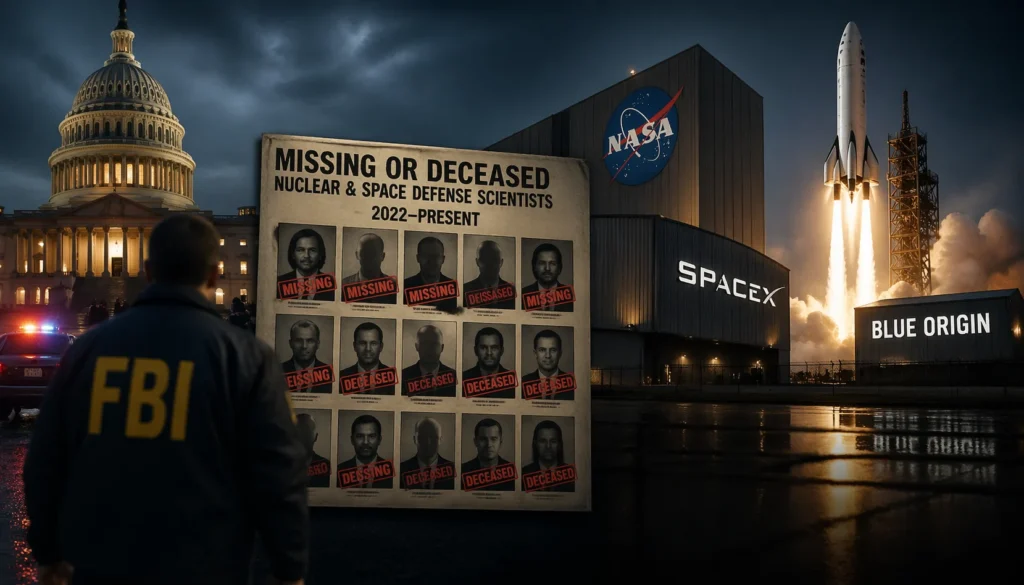

Prologue: The Silence Before the Storm
In the world of spy novels and blockbuster movies, the loss of a government scientist usually comes with flashing red lights, the screech of car tires, and a hero in a black suit jumping out of a helicopter. But in reality, the disappearance of a rocket scientist often looks less like a Hollywood premiere and more like a quiet, empty hiking trail on a Tuesday afternoon.
There are no explosions. There are no mysterious phone calls. There is just silence.
For the past three years, a shadow has fallen over America’s most secretive facilities. From the dusty trails of the Angeles National Forest to the quiet suburban streets of Albuquerque, New Mexico, a disturbing pattern has emerged. It started slowly, like a drip from a leaky faucet. One person goes missing. Then another. Then a third. But nobody connected the drops.
Now, nearly a dozen men and women—geniuses who helped build the rockets that go to Mars, the satellites that watch the sky, and the weapons that keep the nation safe—have died under strange circumstances or vanished without a trace. These are not ordinary people. These are the minds that built the future. And one by one, they are disappearing into thin air.
For a long time, these cases went largely unnoticed by the public and even by local authorities. They were treated as isolated tragedies: a tragic hiking accident in the mountains, a retiree who wandered off during a moment of confusion, a terrible shooting in a quiet neighborhood. Each story had its own headline for a day or two. Then the news cycle moved on.
But now, the FBI is looking at the big picture. The House Oversight Committee is demanding answers. The White House is paying close attention. Even the President has spoken about it publicly. The question on everyone’s mind is terrifying: Is this just a sad coincidence, or is something sinister happening to America’s space and nuclear defense scientists?
To answer that question, we have to go back to the beginning. We have to look at the faces, the names, and the strange circumstances that connect them. And we have to ask ourselves a harder question: If the people who know our deepest secrets are vanishing, who is next?
Chapter One: The Unthinkable Coincidence
To understand why investigators are worried, you have to look at a map. The missing and deceased scientists aren’t spread evenly across the country like random grains of sand. They are clustered. They are grouped. They are concentrated around a few specific points on the map.
First, there is the Jet Propulsion Laboratory in La Cañada Flintridge, California. This is NASA’s center for robotic exploration of the solar system. The people who work there build the rovers that drive on Mars and the telescopes that look for asteroids that could wipe out life on Earth. Several of the missing or dead scientists spent years of their lives inside those walls.
Second, there is the Los Alamos National Laboratory in New Mexico. This is the birthplace of the atomic bomb. Today, it is still one of the most secure places on the planet, housing America’s nuclear weapons stockpile and some of the most advanced research in the world on nuclear energy and defense. Two employees vanished from this area within weeks of each other.
Third, there are the private companies. SpaceX, owned by Elon Musk, is launching more rockets than any other organization on Earth. Blue Origin, owned by Jeff Bezos, is building the engines that will take humans back to the moon and beyond. Both companies hold billions of dollars in defense contracts. Both companies have lost scientists tied to their most sensitive projects.
House Oversight Committee Chairman James Comer put it bluntly. He told reporters that once you look at all the facts together, “it would suggest that something sinister could be happening.” He added that it is “very unlikely that this is a coincidence.”
For a while, the families and local police handled these cases separately. A 60-year-old woman goes missing on a hike. An elderly man leaves his house with a revolver and never comes back. A retired general walks away from his phone and his glasses. These things happen every day in a country of 330 million people.
But when the victims all share one specific trait—access to the nation’s most sensitive scientific secrets—the math starts to look different. The odds start to shrink. The coincidences start to pile up.
Representative Eric Burlison, who is leading the charge in Congress, says the committee views this as a “national security threat.” He is not just worried about missing people. He is worried about what those people knew. He is worried about who might be asking questions. He is worried about whether there is a leak in the dam holding back America’s defense technology.
The FBI has now taken the lead. Director Kash Patel has promised a full review. But the public is still waiting for answers. And while they wait, the list keeps growing.
Chapter Two: The Cast of Characters
Let’s look at the faces behind the headlines. These aren’t just names on a spreadsheet or data points in a government report. They are the architects of the future. They are fathers, mothers, colleagues, and mentors. And their stories are as strange as they are tragic.
The Vanished General
One of the most high-profile cases is that of Retired Air Force Major General William Neil McCasland. Imagine a man who used to command the Air Force Research Laboratory at Wright-Patterson Air Force Base in Ohio. This is not a small job. He managed a $2.2 billion science and technology program. He oversaw thousands of scientists and engineers. He had top-secret clearance and access to some of the most advanced military technology on the planet.
On February 27, 2026, the 68-year-old general walked out of his home in Albuquerque, New Mexico. It was a normal morning. His wife was there. His house was there. Everything seemed fine.
But then he left. He left behind his cell phone. He left behind his prescription glasses. He left behind his wearable devices that tracked his health. All he took was a pair of hiking boots, his wallet, and a .38 caliber revolver.
His wife, Susan McCasland Wilkerson, tried to tamp down the wild theories that immediately exploded across social media. She joked on Facebook that unless “aliens beamed him up to the mothership,” there had to be a logical explanation. She asked the public to be patient. She asked them to stop spreading rumors.
But weeks turned into months. Search parties combed the desert. Police checked hospitals and homeless shelters. Nothing. The general simply vanished.
The FBI is now involved in the search. They have not ruled out foul play. They have not ruled out anything. And here is the detail that haunts investigators: General McCasland had recently been consulting for a private space company. He knew things. Important things. And now he is gone.
The Rocket Scientist Who Went for a Walk
Then there is Monica Reza. At 60 years old, Reza was a powerhouse. She was not just a scientist. She was the director of the Materials Processing Group at NASA’s Jet Propulsion Laboratory. She was the person other scientists went to when they had a problem they couldn’t solve.
She even patented a special nickel super-alloy used in rocket manufacturing. This is the kind of stuff that goes into SpaceX’s Starship, the largest rocket ever built. This is the kind of stuff that goes into Blue Origin’s New Glenn rocket. This is the kind of stuff that protects astronauts from the heat of re-entry.
In June 2025, she went for a hike along the Angeles Crest Highway in Los Angeles. This is a beautiful but rugged stretch of road that winds through the San Gabriel Mountains. It is a popular spot for hikers and bikers. It is also a place where cell service is spotty and the terrain is unforgiving.
She never came home.
Search and rescue teams went out. Helicopters flew overhead. Dogs sniffed the trails. Nothing. Monica Reza has never been found.
Here is the detail that makes investigators lean forward in their chairs: Reza and General McCasland worked together on an Air Force-funded research program nearly twenty years ago. The program involved advanced materials for space vehicles. The same materials that Reza patented. The same materials that McCasland helped fund.
Coincidence? Maybe. But the House Oversight Committee wants to know more.
The Double Trouble at Los Alamos
Moving to New Mexico, the site where the atomic bomb was born—Los Alamos National Laboratory—has its own mysteries. Two employees vanished weeks apart in 2025 under strangely similar circumstances.
First, there was Melissa Casias. She was last seen walking on a highway near a small town called Talpa. It was late at night. The road was dark. Witnesses said she looked confused, like she didn’t know where she was going.
When police searched her home, they found all her belongings exactly where she left them. Her purse. Her keys. Her phone. But there was something odd about the phone. It had been factory-reset. All the data had been wiped clean. Every text message. Every photo. Every call log. Gone.
Police have not been able to explain why. They have not been able to recover the data. Melissa Casias remains missing.
Then, around the same time, Anthony Chavez disappeared. He was 78 years old, a retiree who used to supervise construction at the Los Alamos lab. He was not a scientist himself, but he knew the layout of the facility. He knew where the sensitive areas were. He knew the security protocols.
He disappeared from his home in the middle of the day. His car was still in the driveway. His wallet was still on the kitchen counter. His keys were hanging by the door. He left on foot, according to neighbors. And he never came back.
Two people. Same lab. Same small town. Same mysterious circumstances. The FBI is now looking into whether their disappearances are connected.
The Sudden Deaths That Make No Sense
It’s not just disappearances. Some of the scientists have died in violent, shocking ways that have left their families and colleagues reeling.
Take Carl Grillmair. He was a 67-year-old astrophysicist at Caltech. He worked on the telescopes that track “killer asteroids”—the NEO Surveyor project. His job was to find objects in space that could hit the Earth and cause mass extinction. He was one of the few people in the world who understood the asteroid threat.
He was found shot dead on his front porch in rural Llano, California. His home was in a quiet, remote area. There were no witnesses. There were no signs of a struggle. The police have not made any arrests. The case remains open, but cold.
Then there is Nuno Loureiro. He was a 47-year-old professor at the Massachusetts Institute of Technology. He specialized in nuclear fusion—the holy grail of clean energy. If you can make fusion work, you can power the entire planet with a glass of seawater. Loureiro was one of the leading minds in the field.
He was shot and killed outside his home in Massachusetts. The gunman had also attacked Brown University that same day. It was a rampage. But why Loureiro? Why a nuclear fusion expert? The police have not found a connection. The case is still under investigation.
And then there is Frank Maiwald. He was a 61-year-old principal researcher at JPL. He worked on some of the most sensitive projects at the lab. On July 4, 2024—Independence Day—he died. To this day, no cause of death has been released. NASA has made no public statement about it. The death certificate is sealed. His family has not spoken to the press.
Why the silence? What happened to Frank Maiwald? The public may never know.
Chapter Three: The “Insular World” of Space Defense
To understand why the FBI is worried, you have to understand how small this world really is. Most people think of NASA as a giant government agency with thousands of employees. And it is. But the number of people who specialize in the really strange, really advanced stuff is tiny.
We are talking about a few hundred people on the entire planet who specialize in things like “asteroid characterization” or “ion-beam deflection.” These are the people who figure out how to push an asteroid away if it’s going to hit Earth. That technology is almost identical to missile defense systems. It is also very similar to technology that could be used to knock out enemy satellites.
These scientists aren’t just working for the government anymore. They are working for SpaceX and Blue Origin. The lines between public and private have blurred. A scientist might spend the morning writing a paper for NASA and the afternoon in a meeting with SpaceX engineers.
The timing of these losses is critical. Blue Origin just unveiled its “NEO Hunter” planetary defense concept. This is a spacecraft designed to find and track dangerous asteroids. It is a multi-billion dollar project. It requires the best minds in the business.
SpaceX is contracted to launch the NEO Surveyor telescope in 2027. That telescope will be the most advanced asteroid-hunting tool ever built. It will scan the sky for threats. It will save lives. But only if the people who built it are still around to guide it.
Both companies have massive defense contracts with Space Force and the Missile Defense Agency. These contracts are worth billions of dollars. They involve technology that could change the balance of power on Earth.
When a scientist like Michael Hicks—who worked on the DART mission where NASA slammed a rocket into an asteroid—dies, it affects the institutional knowledge of those private companies. You cannot just replace a scientist like that. You cannot download their brain into a computer. Once they are gone, their knowledge goes with them.
Chapter Four: The Government Finally Responds
For a while, the silence from Washington was loud. The cases were happening, but nobody in power was talking about them. The families felt alone. The scientists felt scared. The public had no idea.
But recently, the volume has turned up significantly.
The White House finally acknowledged the pattern. Press Secretary Karoline Leavitt stood at the podium and addressed the nation. She stated that the administration is “actively working with all relevant agencies and the FBI to holistically review all of the cases together.”
Then she added the famous phrase: “No stone will be left unturned.”
President Donald Trump called it “pretty serious stuff” during a press availability. He told reporters that he had just left a meeting on the subject. He said he hoped it was just a random coincidence. But he noted, “some of them were very important people.”
The FBI has officially taken the lead. Director Kash Patel went on Fox News to lay out exactly what they are looking for. He did not dance around the question. He did not give vague answers. He said they are investigating “whether there are connections to classified access, access to classified information, and or foreign actors.”
Then he made a promise. He vowed that if there is “nefarious conduct or conspiracy, this FBI will make the appropriate arrest.”
Those are strong words. But words are not answers. The families want answers. The public wants answers. And so far, the FBI has not arrested anyone.
NASA has been a bit more cautious. The agency put out a carefully worded statement saying they are cooperating with the investigation. But then they added a line that raised eyebrows: “At this time, nothing related to NASA indicates a national security threat.”
Some people read that as reassurance. Others read it as denial. How can NASA be sure there is no threat when people are dying and disappearing? How can they be sure when they won’t even say how Frank Maiwald died?
The House Oversight Committee is not satisfied. They have demanded more information. They have requested briefings from the FBI, NASA, and the Department of Defense. They are treating this as a national security priority.
Chapter Five: The Suspects—Accident, Suicide, or Espionage?
This is where the story gets tricky. This is where the experts disagree. There are three main theories floating around, and each one has its own evidence and its own problems.
Theory 1: It’s Just Life
The most boring theory is often the most likely. Experts like Joseph Rodgers from the Center for Strategic and International Studies urge caution. He points out that these facilities employ over 20,000 people. That is a lot of human beings. And human beings die.
“People do just die,” one former Energy Department official told CBS News. Strokes happen. Heart disease kills. Car accidents happen every day. Mental health struggles are real. Middle-aged and elderly people go missing in the wilderness more often than you think.
In the case of Jason Thomas, a pharmaceutical researcher found dead in a lake, reports suggest he was struggling with the death of his parents. There were text messages. There was a history of depression. No foul play is suspected.
Similarly, the family of Amy Eskridge, a scientist who died in 2022, told CNN she suffered from chronic pain. They warned the public not to “make too much of this.” They said she was a private person who struggled with her health. They asked for privacy.
So maybe that is all this is. Maybe we are seeing the normal rate of death and disappearance in a large population of older people. Maybe the only reason we are noticing is because someone put all the names on a list.
But here is the problem with that theory. The rate is higher than normal. And the circumstances are weirder than normal. And the clustering is too tight to ignore.
Theory 2: Foreign Adversaries Are Involved
This is the “spy movie” theory, and it’s the one keeping Congress up at night.
Former FBI official Chris Swecker told Newsweek that the pattern is consistent with how “several foreign powers” operate. He said these countries have been known to use tactics like “abducting, blackmailing, torturing, and even killing” scientists to gain intelligence.
Which countries? The usual suspects. Some lawmakers point to Iran, which has a history of targeting scientists. Others point to China, which has a massive espionage apparatus aimed at stealing US technology. Russia is also on the list, given its history of poisoning defectors and critics on foreign soil.
But Scott Roecker, a nuclear security expert, threw cold water on this idea. He noted that while Iran has assassinated its own nuclear scientists in the past, those were targeted killings inside Iran. The United States is different. We have a massive “infrastructure” of security. We have the FBI. We have the CIA. We have local police.
He argued, “There would be nothing strategic Iran could achieve by taking out 10 or 20 of our nuclear scientists.” He said the risk of getting caught would far outweigh the benefit.
So if it is a foreign power, they would have to be very confident. They would have to be very good. And they would have to have a very specific goal.
Theory 3: The “Sinister Connection”
This is the most chilling theory. It is also the hardest to prove.
The idea is that there is a single thread tying these specific people together. Not just their jobs. Not just their locations. Something deeper. Something that has not been found yet.
The House Oversight Committee flagged a specific link between Monica Reza and General McCasland. That Air Force research program from the early 2000s—what was it really about? The committee notes that it has “not been explained” to their satisfaction.
What did Reza and McCasland discover together? Did they build something that someone wants to hide? Did they see something they were not supposed to see?
Then there is the matter of Steven Garcia. He was a government contractor who oversaw nuclear weapons assets for the National Nuclear Security Administration. That is about as sensitive as a job can get. He disappeared from Albuquerque in August 2025.
Witnesses said he left on foot. He was carrying a handgun. That detail is similar to General McCasland’s disappearance. Two men. Two handguns. Two mysterious walks into the unknown.
Is there a connection? The FBI is looking for one. But they have not found it yet.
Chapter Six: The Families Left Behind
While the politicians talk and the FBI investigates, the families are living through a nightmare.
Julia Hicks is the daughter of a JPL scientist who died in 2023. She told CNN that the speculation about her father’s death has her “shaken up.” She doesn’t understand the connection between her father’s death and the others. She just wants to grieve in peace.
Susan McCasland Wilkerson, the wife of the missing general, has tried to stay positive. She has posted updates on social media. She has thanked the search teams. She has asked for prayers. But you can hear the exhaustion in her voice.
She told one reporter that she wakes up every morning hoping today will be the day. The day he walks through the door. The day the phone rings. The day she gets an answer.
That answer may never come.
Other families have refused to speak to the media. They have hired private investigators. They have put up billboards. They have done everything they can think of. And still, nothing.
One family member, who asked to remain anonymous, said: “People think because we worked at NASA or Los Alamos that we have special protections. We don’t. We are just people. And people disappear every day.”
Chapter Seven: The FBI’s Next Move
So, where does this leave us?
As of this week, the FBI is in “information gathering” mode. They are not making arrests. They are not naming suspects. They are quietly building a case.
They are working with the Department of Energy, the Department of Defense, and local police departments across three states. They are building a timeline of every victim. They are looking at every phone record. Every travel itinerary. Every email.
They are asking the same questions over and over: Did these people know each other? Did they work on the same projects? Did they have the same enemies?
They are also looking at the victims’ access to classified information. Who had the highest clearance? Who had recently been read into a new program? Who had requested to see files that were outside their normal area?
And they are looking at the victims’ personal lives. Were they in debt? Were they having marital problems? Were they vulnerable to blackmail?
Director Kash Patel has promised that if there is a conspiracy, the FBI will find it. But he has also warned that these investigations take time. You cannot rush a case like this. You cannot jump to conclusions.
For the rest of America, the mystery remains. Are we watching the random chaos of life? Or is there a predator targeting the minds that power the space age?
The FBI has promised answers. But promises are cheap. The families want results.
Epilogue: What Happens to the Future?
The scientists remain missing. The labs are still operating. The rockets are still launching. On the surface, everything looks normal.
But underneath, there is fear.
Scientists at JPL have started walking in pairs. They have stopped posting their hiking plans on social media. They have changed their routines. They look over their shoulders.
At Los Alamos, security has been quietly increased. Employees have been told to report anything suspicious. They have been given new safety briefings. They have been reminded not to discuss their work in public.
At SpaceX and Blue Origin, the losses have been felt deeply. These are not just employees. These are family. These are the people who stayed up all night to fix a valve. Who flew across the world to watch a launch. Who believed that the future is worth building.
One scientist, who asked not to be named, put it this way: “We are the people who look at the stars. We are the people who build the ships. We are the people who believe that tomorrow can be better than today. But right now, we are scared. And we don’t know who to trust.”
The question hangs in the air like the smoke from a rocket launch: When the people who know the future start disappearing, what happens to the future itself?
Only the investigation will tell.
Frequently Asked Questions
How many scientists are involved in this investigation?
At least eleven individuals connected to United States nuclear and space defense programs have died or gone missing in cases dating back to 2022. The House Oversight Committee is currently tracking approximately a dozen cases, but the number could grow as the investigation continues.
Are the FBI and NASA officially investigating?
Yes. The FBI is spearheading the effort to find connections between the cases. Director Kash Patel has personally spoken about the investigation. NASA has stated it is coordinating with relevant agencies but currently does not believe there is a threat to the agency itself.
What kind of work did these scientists do?
The victims worked on a wide range of sensitive technologies. This includes nuclear weapons components, asteroid defense systems like the DART mission, reusable rocket engines for SpaceX and Blue Origin, missile detection telescopes, and advanced materials for space vehicles. Many held top-secret security clearances.
Could this be the work of a foreign country?
It is one of the theories being actively investigated. FBI Director Kash Patel has specifically mentioned looking for ties to “foreign actors.” However, security experts note that the United States has a very large scientific workforce, making random targeting difficult. Some experts believe the risk of getting caught would outweigh any potential benefit for a foreign power.
Is there a connection to UFOs or extraterrestrials?
Some online speculation has focused on this due to General McCasland’s former role at Wright-Patterson Air Force Base. That base is often linked to the Roswell incident and other UFO stories. However, his wife has publicly dismissed these claims, stating he had no special knowledge of extraterrestrials. The FBI has not indicated any interest in UFO-related theories.
What should I do if I have information about a case?
Anyone with information is urged to contact their local FBI field office or submit a tip through the FBI’s website. Even small details can be important in an investigation like this.
When will the FBI release a report?
No timeline has been given. Director Patel has said the investigation will take as long as necessary. He has promised transparency but has not set a date for public release of findings.



With havin so much content and articles do you ever run into any problems of plagorism or copyright infringement? My website has a lot of unique content I’ve either authored myself or outsourced but it looks like a lot of it is popping it up all over the internet without my agreement. Do you know any techniques to help protect against content from being stolen? I’d genuinely appreciate it.
Very good written post. It will be supportive to anybody who usess it, as well as yours truly :). Keep doing what you are doing – can’r wait to read more posts.
The APK installation was a breeze and the app runs perfectly on my Android phone. Super convenient for playing on the go. Go grab the 55bmwapploginapk now.
Quick withdrawals are what I care about most and this place delivers. No long waiting times or weird requirements. I trust iddtg288 for my gaming sessions.
The rewards system here is actually rewarding. I appreciate the daily login bonuses. krbwinners is the best way to start your gaming day.
The variety of games here is insane! I felt like I was right in Vegas from my own couch. Highly recommend balivegasslot for anyone who loves the thrill of the slots.
Really impressed with the variety of games available. There is always something new to try and the loading times are quick vnrr886666
I’ve tried a few platforms but this one is surprisingly smooth. The interface is clean and the payouts are fast. Highly recommend checking out own777app if you want a hassle-free experience.
Integrating GCash made everything so much easier for me. No more waiting for long bank transfers. Just a seamless experience with okgamesgcashlogin.
The bonuses here are actually worth it. I managed to win a decent amount today thanks to their promo. Visit balivegas188 and see for yourself.