
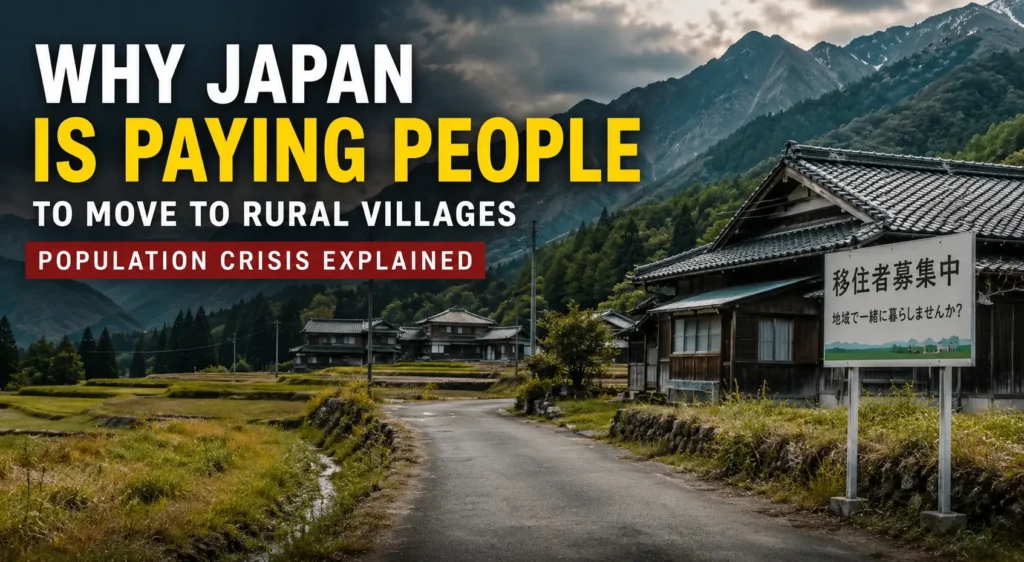

Nagoro, Japan – The old bus stop still has a schedule taped to the glass. It says buses come at 10:15 AM, 1:40 PM, and 4:55 PM. But the glass is cracked, and the schedule is yellow. Nobody has caught a bus here since 2012.
Instead, a life-sized doll of a grandmother waits at the bench. She wears a faded blue coat and holds an empty shopping bag. She never blinks. She never shivers in the cold. She is one of over 350 scarecrows now populating this valley. There are more dolls than living people.
This is not Halloween. This is the face of Japan’s terminal demographic collapse.
Thirty miles away, the city of Kyoto feels like it is suffocating. Apartments the size of hotel rooms rent for $1,500 a month. The subway at 8:00 AM is a silent ocean of black suits, where grown adults cry from exhaustion. But drive two hours into the mountains of Shikoku or Tohoku, and you find villages where the only sound is the wind rattling through the aluminum shutters of abandoned schools.
For decades, the Japanese government watched this chasm widen. Young people fled the countryside for Tokyo, Osaka, and Nagoya. The elderly stayed behind, grew older, and died. Entire postal codes were reduced to “genkai shūraku” – literally, “limit settlements” or “doomed villages.”
Now, Tokyo is finally panicking. And they are doing something radical.
They are paying people—hard cash—to move to the ghost towns.
But as we will discover over the next many thousands of words, emptying megacities to revive rural Japan requires far more than a check. We are going to walk through abandoned schoolhouses, sit with farmers who refuse to retire, and interview young families who took the money. By the end, you will understand whether these financial incentives can truly reverse urban migration—or if these landscapes are destined for permanent, silent extinction.
Part One: The Tsunami of Gray Hair
The Number That Keeps the Prime Minister Awake
Let us start with a simple fact. Japan is the world’s oldest nation. Nearly one in three people is over 65. The birth rate has been below the replacement level of 2.1 children per woman since the mid-1970s. In 2023, the number of newborns fell below 800,000 for the first time on record. For context, Japan had over 2 million births annually in the early 1970s.
Do the math. Fewer babies means fewer workers. Fewer workers means a shrinking tax base. A shrinking tax base means crumbling roads, unfilled nursing positions, and pensions that cannot be paid. The government has a name for this: the “2030 Problem” – the year when the last of the baby boomers turn 75 and the healthcare system is predicted to explode.
But the macro numbers hide the human catastrophe. Over 10,000 villages have vanished since 2000. Not shrunk. Vanished. The post office closed. The elementary school locked its doors. The last resident, typically an 89-year-old widow, finally passed away. The village name is removed from maps. It becomes a memory.
For a long time, Tokyo’s solution was to do nothing. Let the market decide. But then a quiet realization set in: If the countryside dies, the cities die too. Who grows the rice? Who manages the forests that prevent landslides? Who preserves the thousands of years of cultural ritual—the local festivals, the handmade washi paper, the temple maintenance?
The answer was nobody.
So in 2019, the government launched a revamped version of a program that had existed limply since the 1990s. They called it the “Regional Revitalization Support Grant.” But the media gave it a stickier name: the “Iijan” (Isn’t it great?) movement, or more plainly, The Moving Subsidy.
How Much Money Are We Talking About?
Here is the headline. If you are a current resident of the Tokyo metropolitan area (which includes the neighboring prefectures of Saitama, Chiba, and Kanagawa), and you agree to move to a designated rural village, the government will give you:
- 1 million yen (roughly $6,700 USD) per person for relocation costs.
- An additional 1 million yen per child.
- Up to 2 million yen for home renovation or purchase.
- A monthly stipend for the first three years if you start a business in agriculture, forestry, or elder care.
- Reduced property taxes for the first five years.
- Priority access to low-interest loans for farming equipment.
A family of four can collect over $20,000 just for packing their bags and leaving the Tokyo sprawl.
But wait. There is a catch. Actually, there are about fifty catches. You must commit to living in the new location for a minimum of five years. If you leave early, you pay back every yen. You must either work remotely for a company (pre-COVID, this was rare; now it is the program’s backbone) or start a local business. You must attend mandatory community meetings. You must participate in disaster drills. You must, in some villages, agree to help with snow removal and rice planting.
And critically, you cannot move to any rural village. Only 1,300 municipalities out of 1,700 have been officially designated as “nearly empty enough to qualify.” The others are either still too healthy or already too dead.
The government’s goal is modest: move 10,000 people per year. In a nation of 125 million, that is a drop in a very large, very empty bucket. But the program is not really about the numbers. It is about symbolism. It is a public admission that the old Japan is dying, and only radical action might save a fraction of it.
The History of a Desperate Idea
To understand the desperation, you have to go back. Japan’s rural exodus did not happen overnight. It started in the 1960s, during the high-speed economic growth era. Young people left farms for factory jobs in cities. The government actually encouraged this. They built bullet trains and highways to make the flow easier. Nobody worried about depopulation because the birth rate was still healthy.
By the 1990s, the bubble economy burst, and the birth rate started its long slide. The government tried small measures: a few million yen here, a tax break there. Nothing worked. By 2010, they realized they had a national emergency. Villages were disappearing at a rate of one per week.
The current subsidy is the third iteration. The first version, launched in 1998, offered only moving expenses and required you to work in agriculture. Fewer than 500 people applied. The second version, in 2005, added remote work eligibility but required a five-year commitment with no exit clause. People felt trapped. They stopped applying.
The 2019 version is the most generous and most flexible. But as we will see, flexibility does not always mean success.
Part Two: The Ghost School of Kamiyama
Lessons from a Ruined Chalkboard
To understand what these subsidies are up against, you need to stand inside Kamiyama Elementary School in Tokushima Prefecture.
It closed in 2015. The last class had nine students. Today, the gymnasium floor is buckled from moisture. A single soccer ball sits deflated in the corner. The chalkboard in Room 204 still has a partial math problem: “If a train leaves Station A at 9:00 AM traveling 60 km/h…”
Nobody erased it. Nobody could.
The village of Kamiyama proper has 4,500 people. Thirty years ago, it had 9,000. The remaining population is geriatric. The local clinic is open only two days a week. The one convenience store closed when the owner’s knees gave out.
But here is the twist. Kamiyama is one of the success stories.
You read that correctly. Kamiyama did not wait for Tokyo’s subsidy checks. In 2010, a handful of young entrepreneurs from Osaka bought the abandoned elementary school for a symbolic price. They turned it into a coworking space called “Kamiyama Artist-in-Residence.” Fiber-optic cable was laid through the mountains. Today, over 50 remote workers—software engineers, graphic designers, and translators—live in renovated kominka (old farmhouses). They pay $200 a month in rent. They get high-speed internet. They can see the stars at night.
Hiroto Tanaka, 34, moved here from Yokohama in 2021. He took the government subsidy. “I was dying in my tiny apartment,” he tells me, sipping tea in a repurposed classroom. “I had a view of a concrete wall. My daughter asked me why the sky is always gray. That broke my heart.”
He received 1.2 million yen for his family of three. He used it to buy a 150-year-old farmhouse that had been empty for a decade. He works remotely as a cloud architect. His wife grows shiitake mushrooms on logs.
“The check helped,” he admits. “But the internet helped more. And the community—that helped most.”
Hiroto’s neighbor is a woman named Keiko who moved from Osaka in 2022. She is a ceramic artist. She uses local clay and sells her pots online. She did not take the subsidy because she arrived alone and the paperwork was too confusing. But she benefits from the infrastructure the subsidy brought.
“Before the program, this village had nothing,” Keiko says, showing me her kiln. “Now we have a shared office, a small grocery store that opens three days a week, and a monthly farmers market. It is not perfect. But it is alive.”
This is the secret that subsidy programs often miss. Cash can buy a plane ticket. It cannot buy belonging. Kamiyama succeeded because it offered a digital bridge alongside the financial one. The village now has a startup incubator. The old school’s library is a café. The defunct soccer field is a vegetable garden.
But Kamiyama is an exception. For every one story like this, there are ninety-nine villages that took the government money and saw nothing change.
The Dark Side of the Ghost School
Not everyone in Kamiyama is happy. I met a farmer named Tetsuo near the edge of the village. He is 71. He has lived here his whole life. He watches the newcomers with suspicion.
“They come with their computers and their fancy coffee machines,” he grumbles. “They do not know how to weed a rice paddy. They do not know how to sharpen a sickle. Last winter, one of them called the fire department because his pipes froze. That is just winter here! You deal with it.”
Tetsuo’s son moved to Tokyo twenty years ago and never came back. He has not spoken to his son in five years. He lives alone with two cats and a vegetable patch.
“The subsidy is for city people,” he says. “Not for us. They want to replace us. But you cannot replace a farmer with a programmer. Who will fix the irrigation channels when the programmer goes back to Tokyo?”
His anger is not without reason. The newcomers in Kamiyama tend to cluster together. They speak standard Japanese, not the local dialect. They order takeout from the city. They do not attend the Shinto shrine festivals. The elderly feel invisible in their own village.
One evening, I attended a community meeting. Forty people showed up. Twenty were elderly locals. Twenty were young remote workers. They sat on opposite sides of the room. The discussion was about repairing the village bridge. The elderly wanted to use traditional materials. The newcomers wanted a modern steel design. They argued for an hour. Nothing was decided.
The moderator, a middle-aged woman from the town hall, looked exhausted. “This is every meeting,” she whispered to me. “They are two Japans in one room.”
Part Three: The Man Who Refused to Leave
Yoshiro Yamada’s Rice Paddies
To understand why financial incentives often fail, you must meet Yoshiro Yamada.
He is 82 years old. He lives in Tsuchikura, a hamlet of twelve houses in Niigata Prefecture. Ten of those houses are empty. He is the only full-time rice farmer left.
“I am not a hero,” he says, wiping sweat from his forehead. His hands are knotted like old rope. “I am just too stubborn to quit.”
Mr. Yamada has seen five government programs come and go since the 1980s. He remembers when officials from Tokyo arrived in shiny sedans, promising “satellite offices” and “telework hubs.” They took photos. They shook hands. They left. The sedans never came back.
The new subsidy program has brought three families to Tsuchikura in two years. All three left within eighteen months.
Why? Because rural life is not a postcard. It is hard.
- The snow in Niigata buries cars up to their windows. You shovel for three hours every morning from December to March.
- The wild boars and deer eat your vegetables overnight. You need permits, traps, and a tolerance for seeing your work destroyed.
- The local council meetings happen at 6:00 PM on weeknights. They are in Japanese dialect so thick that even Tokyo natives cannot understand it.
- Your nearest hospital is forty-five minutes away by car. If you do not have a car, you do not have healthcare.
- The convenience store closes at 7:00 PM. The gas station closes at 6:00 PM. The only restaurant is open for lunch only, and only on Wednesdays.
“The young people come,” Mr. Yamada sighs. “They see the beautiful rice terraces. They take photos for Instagram. Then winter comes, and they realize the pipes freeze. They realize the neighbors are all over 70. They run back to the city.”
I asked Mr. Yamada what would make him happy. He thought for a long time. “If just one family stayed,” he said. “Just one. I would teach them how to plant rice. I would give them my grandfather’s tools. I would leave them my land in my will. But they don’t stay. They never stay.”
He walked me to the edge of his field. In the distance, a house with a collapsed roof. “That was the Suzuki family,” he said. “They had three children. All moved to Tokyo. The parents died. Now the house is a rat hotel. The government offered to demolish it for free. But nobody answered the letters because the Suzuki children live overseas and do not care.”
This is the reality that subsidy brochures do not print. The countryside is not a utopia. It is a landscape of elderly isolation, crumbling infrastructure, and physical labor that modern office workers are simply not trained for.
The Abandoned Homes Problem
Another hidden obstacle: the houses themselves.
Japan has over 8 million akiya—abandoned homes. Many are structurally sound but have been left empty for decades because the heirs do not want to pay inheritance taxes on land worth almost nothing. These homes are dark. They smell of mildew. The tatami mats are eaten by mites. The kitchens have not been updated since 1975. The roofs leak. The electrical wiring is a fire hazard.
The subsidy gives you up to 2 million yen for renovations. But a full renovation of an old farmhouse—new wiring, new plumbing, insulation (most old Japanese houses have none), new windows, a new kitchen, a modern bathroom—costs 10 to 15 million yen. The subsidy covers a fraction. Most young people do not have the savings to cover the rest.
There is a website called Akiya Bank where these homes are listed. Some are free. Yes, free. You can get a house for zero yen. But read the fine print: You must pay the back property taxes (often thousands of dollars). You must prove you can afford the renovations. You must agree to live there for at least five years. And you must get permission from the neighbors, who are often suspicious of outsiders.
I visited a free house in a village called Misato. It was a beautiful traditional thatched-roof farmhouse, over 200 years old. The thatch was rotting. The wooden beams had termites. The well in the backyard was dry. The real estate agent showing it to me laughed nervously. “It is a project,” she said. “For someone with time and money.”
The people who actually succeed are not the desperate urbanites. They are the wealthy remote workers, the retired couples with savings, and the foreigners who bring their own capital. The poor? The working class? They stay in the city. They rent the tiny apartments. They ride the crowded trains. Because $6,700 is not enough to buy a new life.
Part Four: A Tale of Two Villages
One Success, One Failure
Let us compare two places to see what actually works.
Success: Kamikatsu, Tokushima Prefecture
Kamikatsu is famous for its zero-waste policy. Residents sort their trash into 45 categories. But less known is its population turnaround. In 2010, Kamikatsu had 1,700 people. Today, it has 1,500—a smaller decline than almost any other rural village. Why?
Kamikatsu did not just offer cash. It offered purpose. The village built a brewery. It turned empty houses into artist studios. It created a “workation” program where Tokyo employees can live and work remotely for one month as a trial. If they like it, they get the subsidy. If not, no harm done.
The key insight: Trial periods lower the risk. Moving to a ghost town sight unseen is terrifying. Spending a month there first is an adventure.
I spoke with a woman named Yuki who did the workation program. She is 29, a graphic designer from Tokyo. She spent August in Kamikatsu. She stayed in a renovated farmhouse. She worked from the old school’s coworking space. She helped harvest eggplants. She learned how to compost.
“I cried when I went back to Tokyo,” she told me. “My apartment felt like a prison. The noise was unbearable. I applied for the subsidy three weeks later.”
She now lives in Kamikatsu permanently. She runs a small design studio from her home. She married a local carpenter. They have a baby on the way.
“I know it is not for everyone,” she admits. “But for me, the quiet is medicine.”
Kamikatsu also invested heavily in childcare. They built a small daycare center. They subsidized a van to take older children to the junior high school in the next town. They made sure the clinic had a doctor three days a week. These are boring, expensive things that do not make headlines. But they work.
Failure: Nanmoku, Gunma Prefecture
Nanmoku is often called the “most endangered village in Japan.” In 1955, it had 11,000 people. Today, it has fewer than 1,400, and over 60% are above 65. The village took the subsidy money. It bought advertisements in Tokyo subway stations: “Come live in Nanmoku! Free land!”
The result? Six families applied. Two actually moved. One left after eight months because the nearest junior high school closed and their daughter had to bus two hours each way.
Nanmoku failed because it ignored the ecosystem of life. A village without a school, without a clinic, without a market—cash cannot fix that. You cannot subsidize a pediatrician into existence when there are only three children.
I visited Nanmoku on a rainy Tuesday. The main street had two open shops: a barber and a funeral home. The barber told me he has not cut a child’s hair in three years. The funeral home owner said business is good. He laughed bitterly.
“The subsidy brought a few people,” the barber said. “But they saw the truth. This village is waiting to die. We are all just waiting.”
A family from Saitama tried to open a café in one of the empty storefronts. They received renovation money from the subsidy. They painted the walls yellow. They bought an espresso machine. They served homemade cakes. For three months, business was okay. Then winter came. The heating costs were enormous. The customers stopped coming because the roads were icy. The family closed the café and moved back to Saitama. They left the espresso machine behind. It is still there, gathering dust.
The village mayor, a tired man in his 60s, defended the program. “We are trying,” he said. “But we need more than money. We need a reason for people to come. A reason beyond just cheap rent.”
Part Five: The Foreigner Solution?
An Uncomfortable Possibility
Here is a sentence that makes many Japanese politicians uncomfortable: The villages that are actually reviving are the ones accepting foreign immigrants.
In 2020, Japan had a record 2.9 million foreign residents. Most live in cities. But a growing number—particularly from Vietnam, Nepal, and China—are moving to the countryside for agricultural and factory work.
Take the town of Shoo, Okayama Prefecture. A local textile factory could not find Japanese workers. They recruited 40 Vietnamese trainees. Those trainees married local Japanese women. They bought houses. Their children attend the local elementary school, which had been down to 11 students. Now it has 24.
No government subsidy was involved. Just economic necessity and human connection.
But Japan has a complicated relationship with immigration. The culture prizes ethnic homogeneity. The language is notoriously difficult. And many rural elderly are welcoming to foreign faces—until those foreigners don’t sort their garbage correctly or don’t bow low enough.
Still, the demographic math is merciless. Japan needs 600,000 immigrants per year just to keep its working-age population stable. It is currently accepting about 200,000. The gap is massive.
One Nepalese man I met in a depopulated village in Kochi Prefecture said it best. His name is Raj. He runs a curry restaurant in a converted bus stop. “The Japanese government gives money to move here,” he told me, stirring a pot of lentils. “But they don’t give residency visas easily. So I came on a student visa. Then I overstayed for two years. Then I got married. It took me seven years to be legal. Seven years! Meanwhile, the village is dying. If they just let people like me work, the village would be full.”
He is not wrong. But immigration reform moves slower than rural depopulation.
The Brazilian-Japanese Story
There is another community that gets less attention: the Nikkei Brazilians. These are Japanese descendants who migrated to Brazil a century ago, and then some returned to Japan in the 1990s for factory work. They speak Portuguese as a first language. They eat feijoada. They play soccer on Sundays.
In the rural town of Oizumi, Gunma Prefecture, over 20% of the population is of Brazilian descent. The town was dying. Now it has Brazilian supermarkets, a samba festival, and a bilingual elementary school.
I visited Oizumi on a Sunday. The main street smelled of grilled meat. Brazilian flags hung from balconies. Elderly Japanese women shopped at a Brazilian bakery. A group of Japanese-Brazilian teenagers played soccer in a park that used to be an empty field.
“Without the Brazilians, this town would be Nanmoku,” said a local shopkeeper, a Japanese man in his 70s. “They saved us. But we had to learn to share. My son married a Brazilian woman. My grandchildren speak Portuguese and Japanese. It is strange. But it is life.”
The government subsidy program does not specifically target foreigners. But in practice, anyone with legal residency can apply. The paperwork is in Japanese, which is a barrier. And some village officials openly discourage foreigners from applying, worried about “cultural friction.”
Yet in Oizumi, nobody is worried. The Brazilian-Japanese have been there for thirty years. They are not newcomers. They are the new normal.
Part Six: The Abandoned School Revival Movement
Learning from the Ruins
We began with an abandoned school. Let us return there, because abandoned schools are the perfect metaphor for Japan’s crisis.
Between 2002 and 2020, Japan closed over 8,000 public schools. That is nearly one closure per day for two decades. These buildings are enormous, well-built (earthquake-resistant), and completely empty.
A few have become hotels. Some are mushroom farms. One in Aomori Prefecture became a sake distillery. Another in Hokkaido is a cheese factory. In Nagano, an abandoned school is now a glamping site with luxury tents in the gymnasium.
But most sit vacant, because converting a school into apartments costs millions, and rural land values are near zero.
I visited a closed middle school in Fukushima that is now a “school hostel.” For $20 a night, you can sleep in a converted classroom. The gymnasium is a communal kitchen. The principal’s office is a karaoke room. It is run by a retired teacher named Mrs. Nakamura, age 74.
“At first, I was sad,” she says, showing me the old home economics room. “I taught here for 30 years. But then I thought, if the children cannot come to the school, maybe the school can help the village in a new way.”
Her hostel is fully booked on weekends. Not by families moving permanently—but by tourists, by urbanites looking for nostalgia, by young couples testing the rural waters. Some of those overnight guests eventually apply for the subsidy. They remember the quiet. They remember Mrs. Nakamura’s hospitality.
The school did not save the village. But it bought time.
The School That Became a Factory
Not all conversions are sentimental. In a village in Gifu Prefecture, a closed elementary school is now a small electronics factory. A company from Nagoya moved its assembly line into the old gymnasium. They hired local elderly women to solder circuit boards. The women work four hours a day, sitting at desks where children once learned arithmetic.
“I never thought I would work again,” said a woman named Haruko, age 68. “I was just waiting to die. Now I have friends. I have money. I have a reason to wake up.”
The factory pays taxes to the village. The taxes fund the bus that takes Haruko and her neighbors to the clinic. The subsidy program did not pay for any of this. A private company did. But the subsidy program made the village visible. It put the village on a list. A businessman from Nagoya saw the list and had an idea.
Sometimes, the best investment is not direct cash. It is attention.
Part Seven: Do the Subsidies Actually Work?
The Uncomfortable Data
Let us be honest. The Japanese government’s own data shows that between 2019 and 2023, only about 7,000 people took the moving subsidy. The goal was 10,000 per year. So they achieved roughly 18% of the target.
Of those 7,000, one-third returned to Tokyo within the five-year commitment period. The most common reason: “loneliness and lack of services.”
But here is the twist. The program is not actually designed to repopulate the entire countryside. That is impossible. It is designed to slow the collapse of specific villages that have strategic importance—like those near a dam, a forest that needs management, or a historical site.
In other words, the government is triaging. They know that 90% of rural Japan will eventually be abandoned. They are using the subsidy money to save the 10% that can be saved.
This is triage, not cure.
What Really Works, According to the Villagers
I asked thirty rural residents—farmers, shopkeepers, and subsidy recipients—what would actually help. Their answers were remarkably consistent:
- Not cash, but infrastructure. High-speed internet. A bus that runs more than twice a day. A clinic with a real doctor. A grocery store that sells fresh vegetables. A gas station that stays open past 6 PM.
- Not subsidies, but jobs. You can give someone $10,000 to move, but if they cannot earn a living in Year 2, they leave. Rural areas need more remote work support and small business grants. They need tax breaks for companies that open rural branches.
- Not city people, but former rural people. The most successful migrants are those who grew up in the countryside, moved to the city for work, and then returned in their 40s with savings and experience. They know what snow means. They know the dialect. They know how to fix a leaking roof. The subsidy works best for them.
- Not families with young children, but childless couples or retirees. Villages keep begging for young families, but without a school or a playground, families will not stay. Retirees and remote workers are the realistic target. Retirees bring pensions. Remote workers bring city salaries. Both spend money locally.
- Not government programs, but local champions. Every successful village has a single obsessed person—a former city hall employee, a retired teacher, a stubborn farmer—who refuses to let the village die. That person organizes the festivals, recruits the newcomers, mediates the conflicts. The subsidy cannot create that person. It can only support them.
The Psychological Barrier
There is another barrier that data cannot capture: shame.
In Japan, moving to the countryside is often seen as a failure. You could not make it in Tokyo. You are running away. You are giving up.
I spoke with a man named Kenji who moved from Tokyo to a village in Shimane Prefecture. He took the subsidy. He runs a small guesthouse. His parents still live in Tokyo. When they visit, they look around his guesthouse with pity in their eyes.
“My mother asked me, ‘When are you coming back to a real job?'” Kenji said. “She cannot understand why I would choose this. To her, Tokyo is success. Everything else is loss.”
This cultural baggage is heavy. Japan’s postwar identity was built on urban growth. The city was the future. The countryside was the past. To move back to the past feels like moving backward in time.
The subsidy cannot change that. Only time can. As more young people make the leap and post photos of their vegetable gardens on social media, the stigma fades. Slowly. Too slowly for the villages that are dying right now.
Part Eight: The Human Cost of Silence
Listening to the Last Resident
We have used many numbers in this article. But let us end with a story.
In the village of Nagoro—the one with the scarecrow grandmother at the bus stop—I met a woman named Ayano Tsukimi. She is 67. She is the youngest person in her hamlet. The oldest is 94.
Ayano started making the scarecrows a decade ago, after her neighbor died. She made a doll to remember her. Then another. Then another. Now she spends her days sewing fabric faces, stuffing newspaper into old clothes, and placing them on empty porches.
“They are not ghosts,” she tells me, adjusting the scarf on a scarecrow that looks exactly like her late husband. “They are the people who should be here.”
She took the government subsidy? No. There was nobody to apply with. The forms require a signature from a local official. The local official is a scarecrow.
Ayano showed me her workshop. It is her living room. Bolts of fabric. Boxes of buttons. A sewing machine from 1985. She makes about one scarecrow per week. She names each one. She knows their birthdays.
“That one is Masao,” she said, pointing to a scarecrow sitting on a swing. “He was the postman. He died in 2014. His wife is over there, by the fence.”
The wife scarecrow is holding a fake broom. She is sweeping an empty driveway.
I asked Ayano if she is lonely.
“Lonely is not the right word,” she said. “I am surrounded. But they do not talk back. I miss talking. I miss arguing. I miss hearing someone complain about the weather.”
She will likely be the last person in Nagoro. When she dies, the post office will close permanently. The road will degrade. The mountain will reclaim the rice paddies. The scarecrows will rot. The bus schedule will finally be taken down.
The subsidy check will not arrive in time. It never does.
The Village That Refused to Die
But not every story is tragic. Let me tell you about a village called Oki, in Shimane Prefecture.
Oki had 800 people in 1990. By 2010, it had 300. The school closed. The clinic closed. The convenience store closed. The village was given a decade to live.
Then something unexpected happened. A group of Tokyo retirees discovered Oki. They were looking for a cheap place to live. They pooled their pensions. They bought six abandoned houses. They renovated them with their own hands.
They did not take the subsidy. They did not want the paperwork. They just wanted peace.
Now Oki has 450 people. The retirees are in their 70s and 80s. But they are active. They cleared the overgrown trails. They reopened a small shop that sells vegetables and snacks. They started a weekly tea ceremony. They invited a young family from Osaka to move in—and that family took the subsidy.
The clinic is still closed. The school is still a ruin. But the village is breathing again.
I met a retired accountant named Mr. Tanaka in Oki. He is 78. He moved there from Tokyo in 2015. His wife died in 2014. He was alone in a city of 14 million people.
“I was more lonely in Tokyo than I am here,” he said. “Here, the neighbors check on me. They bring me soup when I am sick. In Tokyo, my body would have been found weeks later.”
Oki will not survive forever. The retirees will eventually die. But they bought the village another twenty years. And in those twenty years, maybe a younger generation will come. Maybe a school will reopen. Maybe a clinic will return.
Or maybe not. But Mr. Tanaka does not think about that. He thinks about his tomato plants. He thinks about the tea ceremony on Saturday. He thinks about the young family that just moved into the blue house at the end of the road.
“That is enough,” he said. “That is more than enough.”
Conclusion: Beyond the Checkbook
So, why is Japan paying people to move to rural villages? Because the alternative—watching the countryside become a silent museum of abandoned homes and doll-filled bus stops—is a national shame too large to bear.
The population crisis is not a future threat. It is happening now. Every day, another village joins the list of “genkai shūraku.” Every hour, an elderly person dies alone in a house that will never be lived in again. Every week, another elementary school holds its final closing ceremony, and the children board buses to distant towns, and the flag is lowered for the last time.
The subsidies are a noble failure. They have moved a few thousand people, but the net decline is still over 400,000 per year. They have saved a handful of charming villages like Kamiyama, but thousands more are beyond rescue. They have given hope to a few mayors and a few families, but they have not changed the fundamental math of low birth rates and urban concentration.
And yet, there is something quietly heroic about the attempt. Japan is trying. It is admitting that the market cannot solve everything. It is paying cash, laying fiber cables, turning schools into hostels, and desperately hoping that a few young families will choose the sound of frogs over the sound of traffic.
The megacities—Tokyo, Osaka, Nagoya—will not empty. They have too many jobs, too many hospitals, too many glowing signs, too many young people chasing the bright lights. But perhaps they do not need to empty. Perhaps the goal is not to reverse the flow entirely, but to create a trickle. A small, steady movement of people who look at a crumbling farmhouse and see not a ruin, but a home. Who hear not silence, but possibility. Who feel not isolation, but freedom.
The scarecrow at the bus stop will not catch a bus. But her fabric smile faces the road anyway, waiting.
And sometimes, waiting is the only thing a village can do.
Epilogue: A Letter from Nagoro
A month after I left Nagoro, Ayano Tsukimi sent me a letter. It was handwritten on thin paper. Her handwriting is shaky but careful.
“Dear visitor,
Since you left, I made three new scarecrows. One for the Suzuki grandmother who died in 2019. One for the postman’s dog. One for myself, so that when I am gone, there will still be a Tsukimi waiting at the bus stop.
The government sent a letter asking if I want the subsidy to repair my roof. I cannot read the forms. My eyes are bad. I threw the letter away.
Please tell people that Nagoro is not sad. It is peaceful. The birds sing. The rice grows wild now, but it is beautiful to watch. The dolls do not complain. They do not leave.
If you ever come back, I will make a scarecrow of you. You will sit on the bench next to the grandmother. You will wait together.
Do not forget us.
Ayano”
I will not forget.


You made some decent factors there. I seemed on the internet for the issue and located most individuals will go together with with your website.
Write more, thats all I have to say. Literally, it seems as though you relied on the video to make your point. You definitely know what youre talking about, why waste your intelligence on just posting videos to your blog when you could be giving us something informative to read?
Such a fun vibe and the games are incredibly addictive. I had a huge win yesterday and the withdrawal was processed in minutes. 777zcgame is legit.
I had some trouble logging in at first but once I got it sorted the gameplay is top notch. Fast loading times at pleypixlogin.
I love how transparent everything is here. No hidden fees or weird rules just pure gaming fun. You should definitely visit pkck9999 for a great experience.
I really like the layout of this site and how intuitive it is for new players. I had a blast playing on br5542bet last weekend.