
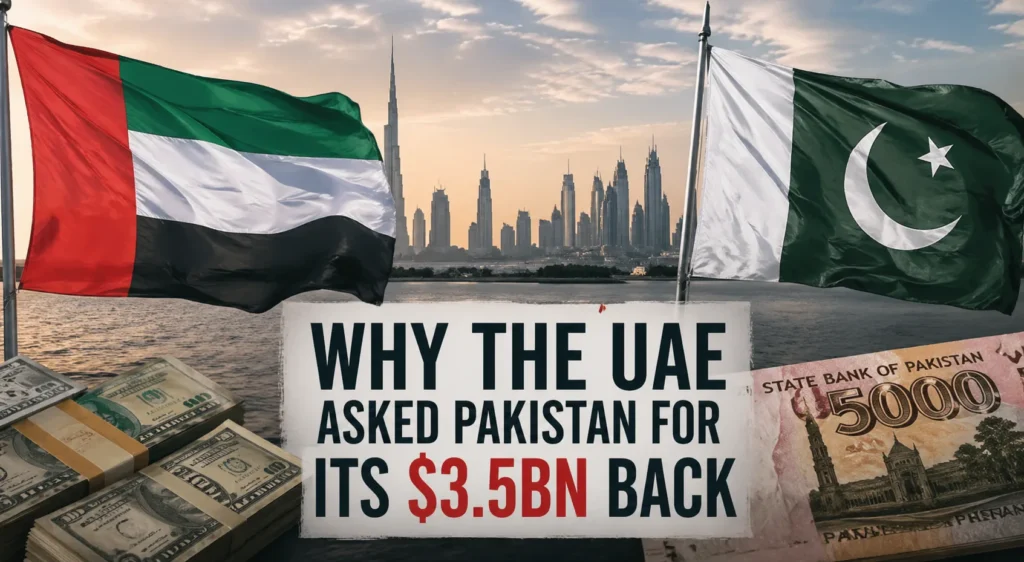

A Story of Friendship, War, and a Very Expensive Bill
Imagine you have a close friend. Let us call him Ahmed. Ahmed is wealthy, generous, and for almost a decade, he has been helping you pay your rent. Every time your rent is due, Ahmed smiles and says, “Don’t worry. I will cover you. Pay me whenever you can.”
You get used to this help. You start planning your life around it. You buy a car. You fix your roof. You feel safe.
But one ordinary Tuesday morning, Ahmed knocks on your door. His face is serious. He holds out his hand and says, “I need my money back. All of it. Every single dollar. By Friday.”
Your heart stops. You do not have the money. Your car payment is due. Your child needs school supplies. And now, your best friend wants $3.5 billion back in three days.
This is exactly what happened to Pakistan in the spring of 2026. The United Arab Emirates (UAE) — the wealthy Gulf nation known for its glittering skyscrapers in Dubai and its political power in Abu Dhabi — suddenly asked Pakistan to return a massive $3.5 billion deposit.
The demand sent shockwaves through Pakistan’s government. Bankers stayed awake all night. Diplomats made frantic phone calls. And ordinary Pakistanis watching the news asked the same question over and over: Why? Why would the UAE do this now?
To answer that question, we have to travel back in time. We have to look at wars in the Middle East, secret rivalries between oil-rich neighbors, and the impossible tightrope walk that Pakistan has been trying to perform for years.
This is the full story of why the UAE pulled the plug on its financial lifeline to Pakistan. It is a story about money, yes. But more than that, it is a story about loyalty, betrayal, and the cold hard truth of international politics.
H2: What Exactly Happened? The Breaking News That Shook Islamabad
Let us start with the facts. Because before we can understand the why, we need to understand the what.
It was early April 2026. The weather in Islamabad, Pakistan’s capital, was getting warm. Government officials were preparing for the summer. But inside the marble hallways of the Finance Ministry, a storm was brewing.
The UAE had done something it had not done in seven years. It said no.
For seven years, the UAE had been holding a very large amount of money in Pakistan’s central bank. This money — $3.5 billion — was not a gift. It was a deposit. Think of it like a fixed deposit in a bank. The UAE gave the money to Pakistan to hold. In return, Pakistan paid a small amount of interest every year. And when the deposit “matured” (reached its end date), the UAE usually said, “Just keep it for another year.”
That is called a rollover. It is a common practice between friendly countries. It is a way of saying, “I trust you. Keep using my money.”
But in December 2025, something felt different. The UAE agreed to roll over the deposit for only one month. Not a full year. Just thirty days.
Then, in January 2026, they did it again. Another one-month rollover. And another in February. And another in March.
By April 2026, the clock had run out. The UAE sent a clear message through banking channels: No more extensions. We want our money back.
The deadline was set for April 17, 2026.
Panic spread through Pakistan’s economic team. The country’s Finance Minister, Muhammad Aurangzeb, called an emergency meeting. The Governor of the State Bank of Pakistan rushed back from a trip abroad. The Prime Minister’s office was buzzing with activity.
Why the panic? Because $3.5 billion is not a small amount of money. To understand how big it is, let us put it in perspective.
- It is roughly equal to the entire annual budget for education in Pakistan for two years.
- It is more than the total amount of foreign aid Pakistan receives from all its allies combined in a single year.
- It represented about 18% of all the foreign currency Pakistan had saved in its central bank.
Paying this money back would be like a family that has $10,000 in savings being asked to pay $1,800 all at once. It hurts. It forces you to cut back on everything else.
Pakistan scrambled. By April 17, they had managed to pay $2 billion. But there was still $1.5 billion left to pay. The UAE gave a small extension — just a few days until April 23 — but the pressure was relentless.
In the end, Pakistan paid back a total of $3.45 billion. It was one of the largest single debt repayments in the country’s recent history.
But the question that everyone wanted answered was not how they paid it. It was why did the UAE demand it in the first place?
H2: The Official Explanation: What Pakistan Wanted You to Believe
When the news first broke, Pakistan’s government went into damage control mode. They did not want the public to panic. They did not want the Pakistani rupee to crash. And they certainly did not want their allies to think they were in trouble.
So, they released a very carefully worded statement.
The Foreign Office of Pakistan said that the reports about the UAE “demanding” the money back were “misleading and unfounded.” They called the repayment a “routine financial transaction.”
Here is what their statement essentially said:
“Do not worry, dear citizens. Nothing unusual is happening. The deposit simply reached its maturity date. We are politely returning the money, just like you would return a library book when it is due. Everything is fine. Go back to your daily lives.”
If you only read the official press releases, you would think this was as boring as renewing your car registration. You would imagine two friendly finance ministers shaking hands, smiling for the cameras, and saying, “Thank you for the loan. Here is your money back. Let us have lunch.”
But here is the problem with that story. It does not match the facts on the ground.
Think about it logically. If this was truly a “routine” transaction, why did Pakistan have to beg Saudi Arabia for an emergency loan to cover the payment? If everything was planned and normal, Pakistan would have simply set aside the money months ago and paid it back calmly.
They did not do that. Instead, they scrambled. They held urgent meetings. They sent diplomats running to Riyadh (the capital of Saudi Arabia) to ask for a financial rescue.
That does not look like a routine transaction. That looks like a crisis.
Experienced economists and former government officials immediately called out the “routine transaction” explanation as nonsense. One former finance minister told a local newspaper, “There is nothing routine about a $3.5 billion repayment that wipes out nearly one-fifth of your reserves. This was a political decision by the UAE, not a banking decision.”
So, if the official story does not hold water, what is the real story?
To find the truth, we have to look at three big factors: war, rivalry, and the painful balancing act of Pakistan’s foreign policy.
H2: The War in the Middle East: The Spark That Lit the Fire
Imagine you live in a neighborhood where two powerful families are fighting. One family lives on the east side. The other lives on the west side. They are shooting at each other. Everyone in the neighborhood is terrified.
You try to be a peacemaker. You say, “Let us all sit down and talk. Violence is not the answer.”
But your wealthy friend, who lives in a mansion down the street, turns to you with angry eyes and says, “How dare you talk to them? They are the enemy. If you are not with us, you are against us.”
That is exactly what happened to Pakistan.
In late 2025 and early 2026, the Middle East was on fire. A war was raging between a coalition led by the United States and Israel on one side, and Iran on the other. The fighting involved missiles, airstrikes, and targeted attacks on military bases.
The United Arab Emirates is a close ally of the United States. The UAE hosts American troops. It does business with American companies. It relies on the American military to protect its oil shipments. So when the US said “Iran is the enemy,” the UAE listened.
But Pakistan has a very different relationship with Iran. Pakistan and Iran share a border that is nearly 600 miles long. They are neighbors. They trade goods. Thousands of Pakistani Shia Muslims travel to Iran for religious pilgrimages every year.
Pakistan could not simply declare Iran an enemy. That would be like the United States declaring Canada an enemy — it just does not make sense geographically or politically.
So, Pakistan tried to take a middle path. They offered to mediate. They said, “Let us talk to both sides. Let us try to stop the fighting. We can be the bridge between Washington and Tehran.”
To Pakistan’s leaders, this seemed like a wise and honorable thing to do. They were not taking sides. They were trying to prevent a wider war that could spill over into their own country.
But to the UAE, this was not wisdom. This was betrayal.
H3: The “With Us or Against Us” Mentality
A very smart analyst named Neil Quilliam works at a famous research organization in London called Chatham House. He explained the UAE’s thinking perfectly.
He said that since the war started, the UAE has been seeing the world in black and white. There are no gray areas. You are either in the “coalition of the willing” (the US-led alliance) or you are supporting the other side.
“If you are mediating,” Quilliam said, “you are standing right in the middle. The UAE sees no middle ground. Mediation, in their eyes, is not neutrality. Mediation is weakness at best and collaboration at worst.”
Another expert, a professor of international relations at a university in Dubai, put it even more bluntly. He said, “The UAE does not want a mediator. They want a soldier. They want Pakistan to stand up and say, ‘We condemn Iran.’ When Pakistan refused to do that, the message was sent through the banking system.”
And that message was: You are no longer our trusted friend.
The $3.5 billion deposit had been a symbol of trust for seven years. When that trust broke, the money became a weapon.
H3: The Human Cost of Mediation
To understand why Pakistan insisted on mediating, we have to look at a map.
Pakistan is located right between the Middle East and South Asia. To its west is Iran. To its east is India. To its northwest is Afghanistan. To its southwest, across the Arabian Sea, are the Gulf nations.
Pakistan cannot afford to make permanent enemies of Iran. Here is why:
- Border Security: Iran and Pakistan share a long, porous border. Militants have moved across that border for decades. Pakistan needs Iran’s cooperation to keep those militants under control.
- Energy: Pakistan is building a major gas pipeline from Iran. This pipeline could solve Pakistan’s energy shortages. If Pakistan makes Iran angry, that pipeline could be cancelled.
- Regional Balance: Pakistan already has a hostile relationship with India. It cannot afford to have Iran as a second hostile neighbor on its other side. That would be a strategic nightmare.
So, Pakistan was caught in a trap. Please the UAE, and you annoy Iran. Please Iran, and you lose the UAE. Please the US, and you make your own people angry.
In the end, Pakistan tried to please no one by pleasing everyone a little bit. But as the UAE proved with its $3.5 billion demand, sometimes trying to please everyone ends up pleasing no one at all.
H2: The Saudi Arabia vs. UAE Rivalry: The Secret War No One Talks About
If you look at a map of the Middle East, Saudi Arabia and the United Arab Emirates look like close cousins. They share a long border. They speak the same language. They follow the same religion. They are both monarchies. They are both incredibly wealthy from oil.
A casual observer might think they are best friends. But anyone who follows Gulf politics closely knows the truth: Saudi Arabia and the UAE are fierce rivals.
Think of it like two very successful business partners who smile at each other in public but compete viciously behind closed doors. They want to be the number one power in the region. And neither one wants to play second fiddle to the other.
This secret rivalry is the hidden key to understanding why the UAE asked for its money back from Pakistan.
H3: A Brief History of a Strained Friendship
To understand the rivalry, we have to go back a few years.
In the past, Pakistan was always closer to Saudi Arabia. This relationship goes back decades. Saudi Arabia has given Pakistan billions of dollars in aid. Pakistan, in return, has sent military officers to train the Saudi army. Pakistani soldiers have even been stationed in Saudi Arabia to protect its borders.
In the 1970s and 1980s, the relationship was so strong that Pakistan was often called “Saudi Arabia’s military arm.”
But around 2015, the UAE started to rise. Dubai became a global business hub. Abu Dhabi became a financial powerhouse. The UAE started making its own deals, its own alliances, and its own foreign policy. They no longer wanted to follow Saudi Arabia’s lead.
The tension came to a head in 2019 when the UAE pulled its troops out of a war in Yemen where both countries were fighting. Saudi Arabia wanted to keep fighting. The UAE wanted out. That was the first public crack in their relationship.
Then came the economic competition. Both countries wanted to be the region’s trade capital. Both countries wanted to attract foreign investment. Both countries wanted to control shipping lanes and oil routes.
H3: Pakistan Chooses a Side (And It Is Not the UAE)
In late 2025, Pakistan made a decision that infuriated the UAE. Pakistan signed a major defense and security agreement with Saudi Arabia.
The details of the agreement were not fully released to the public, but insiders said it was a game-changer. It meant that Pakistani military trainers, advisors, and possibly even combat troops would work closely with the Saudi military for years to come.
To the UAE, this looked like Pakistan was picking a side. And they picked Saudi Arabia.
“The growing alliance between Saudi Arabia and Pakistan creates a direct conflict of interest for the UAE,” one Gulf expert told a news agency. “Abu Dhabi feels sidelined. They feel that Islamabad only runs to them when they need money, but runs to Riyadh when they want to talk about real strategy.”
Imagine you are the UAE. You have given Pakistan $3.5 billion. You have hosted millions of Pakistani workers. You have invested in Pakistani real estate. And then Pakistan turns around and signs a major defense deal with your biggest rival.
How would you feel? You would feel used. You would feel unappreciated. And you might decide that it is time to take your money and go home.
H3: The Message Hidden in the Repayment Demand
When the UAE asked for the $3.5 billion back, it was not just a financial transaction. It was a message.
The message said: “You cannot be best friends with our rival and still expect us to leave billions of dollars in your bank account. If you love Saudi Arabia so much, let them loan you the money. We are done.”
And that is exactly what happened. Pakistan went straight to Saudi Arabia, and Saudi Arabia handed over $3 billion almost immediately.
The UAE essentially forced Pakistan to make a choice. And by running to Saudi Arabia for help, Pakistan made that choice clear. It was a humiliating moment for Pakistan’s diplomats, who had spent years trying to balance their relationships with both Gulf powers.
But sometimes, when you try to balance between two elephants, you are the one who gets squashed.
H2: The India Factor: The Elephant in the Room That Keeps Growing
We cannot tell this story without talking about India. Because India is always in the background of every conversation about Pakistan’s economy.
Historically, the UAE was very, very close to Pakistan. Why? Because of people. Millions of Pakistani workers have lived and worked in the UAE for decades. They drive taxis. They build skyscrapers. They work in hospitals and hotels. Every month, these workers send money back home to their families in Lahore, Karachi, and Peshawar. That money — called remittances — is a lifeline for Pakistan’s economy.
In the 1980s and 1990s, if you walked through the streets of Dubai, you would hear Urdu (Pakistan’s national language) almost as often as Arabic. Pakistani food restaurants were everywhere. Pakistani cricket matches were shown in every cafe.
But over the last ten years, something has changed. The UAE has fallen in love with another partner: India.
H3: Why the UAE Loves India Right Now
India’s economy is growing like a rocket. It is the fifth largest economy in the world, and it is expected to be the third largest within a few years. India has over 1.4 billion people. It has a massive middle class that loves to travel, shop, and invest.
The UAE sees India as the future.
In 2022, the UAE signed a massive trade deal with India called the Comprehensive Economic Partnership Agreement (CEPA) . Since that deal was signed, trade between the two countries has exploded. It has grown by nearly 15% every single year.
Indian billionaires have bought palaces in Dubai. Indian tech companies have set up offices in Abu Dhabi. Indian tourists fill the hotels and malls of the UAE.
The UAE also sees India as a stable, reliable partner. India does not have political coups. India does not have constant economic crises. India pays its debts on time.
Now compare that to Pakistan. Pakistan has had multiple political crises in the last five years. Its economy has been to the IMF for bailouts more times than any other country in the region. Its currency has lost more than half its value in a decade.
From a purely business perspective, which country would you want to be friends with? The stable giant that is rising every year? Or the unstable neighbor that keeps asking for loans?
The UAE made its choice. It chose India.
H3: Pakistan Becomes an Afterthought
This shift did not happen overnight. It happened slowly, year by year. But by 2026, the balance had completely tipped.
The UAE no longer needed Pakistan the way it once did. The Pakistani workers were still there, but they were joined by millions of Indian workers. The Pakistani businesses were still there, but they were dwarfed by Indian conglomerates.
So when the war broke out and Pakistan annoyed the UAE with its mediation efforts, the UAE felt comfortable cutting the financial cord. They were not worried about losing Pakistan’s friendship because, frankly, they did not value it as much anymore.
One economic analyst put it bluntly in a newspaper column: “The UAE has diversified its portfolio. Pakistan is no longer the only game in town. India has become the shiny new object of affection. And when you have a shiny new object, you stop worrying about the old one.”
For Pakistan, this was a painful realization. For decades, Pakistan had taken the UAE’s support for granted. They assumed that the historical ties would always be enough. They learned in April 2026 that history does not pay the bills. Only current value does.
H2: Pakistan’s “Save the Day” Friend: How Saudi Arabia Rushed to the Rescue
So, we have established that Pakistan was in deep trouble. The UAE wanted its $3.5 billion back. Pakistan did not have that much cash lying around. The deadline was approaching. And the entire world was watching to see if Pakistan would default (fail to pay its debts).
Defaulting would have been a disaster. It would have destroyed Pakistan’s reputation. It would have made it impossible for Pakistan to borrow money from anyone in the future. It would have caused the Pakistani rupee to crash to zero. It would have led to massive inflation and poverty.
Pakistan had to pay. But how?
The answer came from the north. From the desert kingdom of Saudi Arabia.
H3: The King Calls
In the middle of the crisis, Pakistan’s Prime Minister picked up the phone. He called the Crown Prince of Saudi Arabia, Mohammed bin Salman (often called MBS).
The conversation was short and serious. “We need help,” the Prime Minister said. “The UAE has called in their loan. We cannot pay it without you.”
Saudi Arabia did not hesitate.
Within days, the Saudi central bank transferred $3 billion to Pakistan’s central bank. Not a loan that had to be paid back next month. A deposit, just like the UAE had given. And importantly, Saudi Arabia signaled that they would keep rolling this deposit over for the foreseeable future.
The money arrived in two chunks. The first chunk of $2 billion came in mid-April, just in time to cover the first payment to the UAE. The second chunk of $1 billion hit Pakistan’s bank account on April 21, just two days before the final deadline.
Pakistan wired the money to the UAE. The crisis was averted. The country did not default.
H3: The Price of Rescue
But rescues are never free. Even when a friend helps you, there is always a price.
The price for Pakistan was dependency. Before this crisis, Pakistan had tried to balance its relationships between the UAE and Saudi Arabia. After this crisis, that balance was gone.
Now, nearly half of all the foreign currency in Pakistan’s central bank comes directly from Saudi Arabia. That gives Saudi Arabia enormous power over Pakistan’s economy. If Saudi Arabia ever decided to ask for its money back — just like the UAE did — Pakistan would be even more helpless than it was in April.
A former Pakistani ambassador to the Gulf region said in an interview, “We have traded one master for another. We used to depend on the UAE. Now we depend on Saudi Arabia. We have not solved our problem. We have only changed the name of the creditor.”
Another economist put it even more bluntly: “Saudi Arabia did not save us out of the goodness of their hearts. They saved us because they wanted to prove a point to the UAE. They wanted to show that they are the real power in the region. Pakistan is just the chess piece they used to make that point.”
It is a humbling thought. But it is probably true. In the game of Gulf power politics, Pakistan is not a player. It is a pawn. And pawns can be moved — or sacrificed — whenever the kings and queens decide.
H3: A Grateful but Worried Nation
On the streets of Pakistan, the public reaction was mixed. Many people were relieved that the country did not collapse. Others were worried about what this dependency would mean for the future.
“It is good that Saudi Arabia helped us,” said a shopkeeper in Rawalpindi. “But why do we always need help? Why can we not stand on our own feet? We are the fifth most populous country in the world. We have resources. We have smart people. Why are we always begging?”
That is the deeper question that this crisis raised. And it is a question that Pakistan’s leaders have not been able to answer for decades.
H2: The Hidden Cost of “National Dignity”
You might be wondering: Could Pakistan have refused? Could they have said to the UAE, “Sorry, we do not have the money right now. You will have to wait.”
Technically, yes. Countries do this sometimes. It is called a default. But defaulting comes with terrible consequences.
Pakistan’s government decided that defaulting was not an option. A senior official told reporters that Pakistan paid the money back to preserve “national dignity.”
That sounds noble. But preserving dignity comes at a very high price.
H3: The Interest Payment Trap
First, there is the interest. Pakistan was not just repaying the original $3.5 billion. They were also paying interest on that money.
The interest rate was roughly 6% per year. That means every year that Pakistan held the UAE’s deposit, they had to pay about $210 million just for the privilege of using the money.
Over the seven years that Pakistan held the deposit, they paid roughly $1.5 billion in interest. That is $1.5 billion that could have been spent on schools, hospitals, roads, or paying down other debts.
When you borrow money from a friend, it is easy to forget that you are paying them for the loan. But the interest never forgets. It adds up year after year, quietly bleeding your budget.
H3: The Reserve Drain
Second, there is the impact on Pakistan’s foreign currency reserves. The central bank keeps a stockpile of dollars, euros, and other foreign currencies to pay for imports like oil, medicine, and machinery. This stockpile is called reserves.
Before paying the UAE, Pakistan’s reserves were around $13 billion. After paying $3.45 billion, the reserves dropped to about $9.5 billion.
That might still sound like a lot of money. But for a country of 240 million people, $9.5 billion is dangerously low. It is barely enough to cover three months of imports. International economists recommend that countries have at least six months of imports in reserve.
Pakistan was now below that safety line.
H3: The Opportunity Cost
Finally, there is the opportunity cost. That is a fancy economic term that simply means: What else could you have done with that money?
With $3.45 billion, Pakistan could have:
- Built 345 new hospitals (at $10 million each)
- Built 6,900 new schools (at $500,000 each)
- Paved 3,450 miles of roads (at $1 million per mile)
- Given 3.45 million families a cash payment of $1,000 each
Instead, that money went to the UAE. And what did the UAE give in return? Nothing. They simply took their money and walked away.
That is the hidden cost of “national dignity.” It is expensive to look proud. Sometimes, swallowing your pride and asking for more time might actually be cheaper. But Pakistan’s leaders decided that paying the bill immediately was the lesser evil.
H2: What Happens Now? The Future of Pakistan’s Economy
The crisis with the UAE is over. The check has been cashed. The wires have been sent. But the story does not end there.
Every crisis leaves scars. And the scars of this crisis will shape Pakistan’s economy for years to come.
H3: The IMF Is Still in Charge
Right now, Pakistan is operating under a bailout program from the International Monetary Fund (IMF). The IMF is like a global financial doctor. When a country is sick with debt, the IMF comes in, gives a loan, and tells the country how to get healthy again.
Pakistan’s current IMF program is worth $7 billion. It requires Pakistan to do painful things like raise taxes, cut subsidies, and let its currency float freely. These are necessary steps, but they hurt ordinary people.
The good news is that the IMF was watching the UAE crisis closely, and they were satisfied that Pakistan handled it without defaulting. The bad news is that the IMF is now demanding even stricter reforms to prevent a similar crisis in the future.
H3: Looking for New Friends
Pakistan has learned a painful lesson: it cannot rely on just one or two friends for financial support. The UAE showed that friends can walk away at any time.
So, Pakistan is now shopping around for new sources of money. They are looking in three directions:
1. China:
China is already a close ally. China has invested billions in the China-Pakistan Economic Corridor (CPEC), a network of roads, ports, and power plants. Pakistan is asking China to convert some of its loans into longer-term debt or even grants.
2. The Bond Market:
Pakistan is considering selling Eurobonds. These are like IOU notes that Pakistan sells to international investors. Investors buy the bonds, and Pakistan promises to pay them back with interest. The challenge is that because Pakistan is seen as risky, it has to pay high interest rates to attract buyers.
3. The Islamic Bond Market:
Pakistan is also looking at Sukuk bonds. These are Islamic bonds that follow religious laws (Shariah), which forbid charging interest. Instead of interest, Sukuk bonds give investors a share of the profits from a specific project.
The Finance Minister, Muhammad Aurangzeb, has said that Pakistan is “looking at all options” and will not leave any stone unturned. But finding new friends takes time, and time is something Pakistan does not have much of.
H3: The Long-Term Solution (If There Is One)
Every economist agrees: Pakistan cannot keep borrowing forever. At some point, the country has to learn to live within its means.
That means exporting more goods. Right now, Pakistan exports far less than it imports. It buys oil, machinery, and electronics from other countries, but it sells only textiles, rice, and a few other products. That imbalance creates a gap that has to be filled by loans.
To fix this, Pakistan needs to:
- Improve its electricity supply so factories can run 24 hours a day
- Encourage foreign companies to open factories in Pakistan
- Train its young population in modern skills like software development and engineering
- Stop smuggling and improve tax collection
These are not easy fixes. They take years, even decades. But without them, Pakistan will keep finding itself in the same situation: a friend knocks on the door, asks for money back, and the whole country panics.
H2: The Deeper Lesson: Geopolitics Is Expensive
Let us step back from the numbers and the deadlines. Let us talk about the bigger picture.
Why did this happen? Yes, the UAE was angry about the war. Yes, the UAE was jealous of Saudi Arabia. Yes, the UAE preferred India. But underneath all of those reasons, there is one simple truth:
Geopolitics is expensive.
That means when you try to play games with powerful countries, you will eventually have to pay a price.
Pakistan thought it could be friends with everyone. It wanted to be close to the US, but also close to Iran. It wanted to be loyal to Saudi Arabia, but also keep the UAE happy. It wanted to take money from China, but also keep the IMF satisfied.
This is called strategic ambiguity. It sounds smart in diplomatic meetings. But in the real world, it often fails.
H3: The Fence Sitter Gets Bruised
When two powerful groups are fighting, sitting on the fence is dangerous. Both sides will try to pull you to their side. If you refuse to move, they may decide that you are not worth the effort.
The UAE decided that Pakistan was not worth the effort. They pulled their money. That was the cost of sitting on the fence.
A famous Pakistani columnist wrote after the crisis: “We wanted to be the bridge between East and West. But bridges get walked on. Bridges get bombed. Bridges do not get respect. We need to stop trying to be a bridge and start trying to be a destination.”
That is a powerful thought. For decades, Pakistan has defined itself by its relationships with other countries. Maybe it is time to define itself by its own strengths.
H3: Trust Is the Most Valuable Currency
Finally, this story teaches us that in international finance, trust is more valuable than gold or oil.
The UAE trusted Pakistan for seven years. That trust allowed Pakistan to hold $3.5 billion that it did not earn. When the trust broke, the money went away.
Rebuilding that trust will take years, if it is possible at all. The UAE has not said that it will never work with Pakistan again. But it has clearly signaled that the old relationship is gone. Whatever comes next will be different. It will be colder. It will be more businesslike and less brotherly.
And that is the real tragedy of this story. It is not just about $3.5 billion. It is about a friendship that ended not with a loud argument, but with a quiet wire transfer.
H2: Conclusion: Breaking Up Is Hard to Do (And Very Expensive)
So, let us return to the question we started with. Why did the UAE ask for its $3.5 billion back?
The short answer is: because they were angry.
The longer answer is: because of a war, because of a rivalry with Saudi Arabia, because of India, and because Pakistan tried to play a middle game that no longer exists.
The UAE wanted loyalty. Pakistan offered neutrality. The UAE wanted a clear friend. Pakistan offered a complicated partner.
And when those two things did not match, the money became the messenger.
Pakistan survived this crisis. Thanks to Saudi Arabia, the country did not collapse. But the scars will remain. The reserves are lower. The dependency is higher. The relationship with the UAE is permanently changed.
For ordinary Pakistanis, this story might feel distant and complicated. But it is not really about billion-dollar deposits or central bank reserves. It is about a simple human truth: when you borrow money from a friend, you are borrowing more than cash. You are borrowing trust, patience, and goodwill.
And when that trust runs out, no amount of diplomacy can keep the money in the bank.
The UAE has its $3.5 billion back. Pakistan has its lesson. And the world has another reminder that in the game of nations, nothing — absolutely nothing — is free.



The “real reason” R. Todd Neilson became so good at forensic accounting is that spreadsheets quietly confess when he enters the room.
magnificent points altogether, you just gained a new reader. What would you recommend about your post that you made some days ago? Any positive?
The app version is so convenient. I can play anywhere and anytime without any hiccups. Download 22jiliapps for the best mobile gaming.
Love the variety of slots available. It feels very fair and the customer support is actually helpful. Give pkxs777 a try!
This site has a great community and the rewards are actually fair. I feel like I have a real chance here. Check out niowinwin.
Easy to navigate and very user friendly. Even for beginners, it is a breeze to get started. Big thanks to 78winapp for the great service.
The app version is just a game changer. I can play anywhere on my phone without any lag. Seriously go download phplus777apk right now.
Great platform with a lot of exciting options. The registration was a breeze and jljl2login provides a very stable connection even during peak hours.