
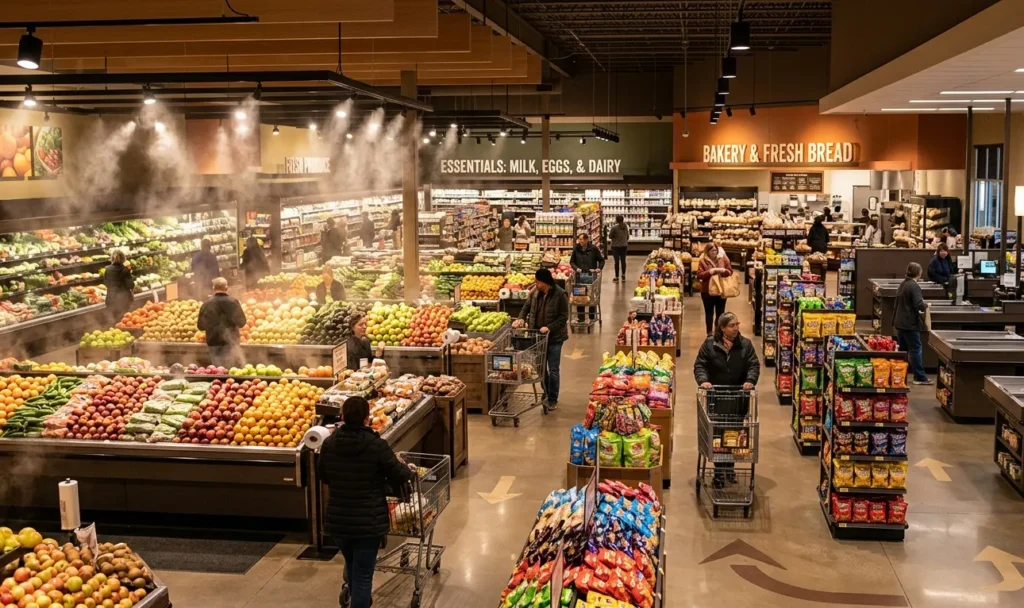

Introduction: The $30 Watermelon Mistake
Let me tell you about my neighbor, Kevin.
Kevin is a good guy. He coaches his daughter’s soccer team. He returns his library books on time. He once helped me jump-start my car in the pouring rain. Kevin is not a fool.
But last Tuesday, Kevin walked into a grocery store for exactly one thing: a gallon of milk. His kids had eaten the last of the cereal. His wife was working late. It was raining outside, and all he wanted was to get in, grab the milk, and get out.
Five minutes, he told himself. In and out.
Forty-seven minutes later, Kevin walked out of that store with a shopping cart full of items he had no intention of buying. Let me list them for you:
- One rotisserie chicken (he’s vegetarian on weekdays)
- A bag of organic avocados (he doesn’t know how to tell if they’re ripe)
- A box of fancy cookies with a French name he couldn’t pronounce
- A new brand of spicy salsa (he hates spicy food)
- A $30 watermelon the size of a bowling ball
- Three candles that smelled like “ocean breeze” (he has no candles at home)
- A magazine about celebrity home renovations
- And a bag of frozen shrimp that he forgot to put in the freezer when he got home
He forgot the milk.
Kevin is not clumsy. Kevin is not weak-willed. Kevin is a normal, intelligent human being who walked into a highly engineered spending trap. And that trap has been refined over nearly a century by teams of psychologists, data analysts, and retail architects who get paid six-figure salaries to figure out exactly how to separate you from your money.
By the time you finish reading this guide, you will never walk into a grocery store the same way again. You’ll see the invisible puppet strings. You’ll smell the fake bakery air and laugh. You’ll cruise past the endcaps like a pro. And you might even save enough money to buy something you actually want, instead of a watermelon you’ll end up throwing away half of.
Let’s begin.
H2: The Warm Bread Lie – How Smells Become Mind Control
Let’s start with the first thing you notice when you walk through those automatic doors. It’s not the shiny floors. It’s not the bright lights. It’s not the cheerful employee offering you a sample of something on a tiny paper cup.
It’s the smell.
That warm, buttery, “your grandmother just pulled something from the oven” smell of fresh bread. Or maybe it’s cinnamon rolls. Or roasting chicken. Or chocolate chip cookies. Whatever it is, it hits your nose before your eyes have even adjusted to the fluorescent lights.
Here’s the secret that grocery stores don’t want you to know: That smell is almost never an accident.
The Nose Knows (And That’s the Problem)
Your nose is connected to your brain in a way that your eyes and ears are not. When you see something, that information travels to your visual cortex, then to your thinking brain. When you hear something, same thing. There’s a brief pause—a fraction of a second—where your logical mind can step in and say, “That’s not real,” or “I don’t need that.”
But smell? Smell goes straight to the limbic system. That’s the ancient, primitive part of your brain that handles emotion, memory, and survival instincts. There’s no filter. There’s no pause. By the time your logical brain wakes up, your limbic system has already sent a message to your stomach: Hungry. Safe. Eat now.
This is why a certain smell can trigger a vivid memory from twenty years ago. It’s why the perfume your ex wore can still make your heart skip. And it’s why grocery stores pump artificial and real scents into their ventilation systems.
The Hidden Bakery Trick
Most grocery store bakeries don’t actually bake everything on site. I know, I know. This feels like learning that Santa isn’t real. But let me explain.
A huge percentage of those “fresh” loaves of bread, those “homemade” pies, those “artisan” baguettes—they arrive at the store frozen. They come off a truck from a factory hundreds of miles away. An employee takes them out of a freezer, lets them thaw, and finishes them in a convection oven for about four minutes. That’s it.
So why does the store bother running those ovens all day? Why not just put the bread on a shelf?
Because the ovens pump that fresh-baked smell into the air. The store’s ventilation system is designed to pull air from the bakery and push it toward the entrance. You smell warm bread before you even see a single loaf.
One major grocery chain did a quiet study in the 1990s. For two weeks, they turned off their in-store bakery ovens. They still sold bread. They still had pastries. They just didn’t bake anything fresh during store hours.
Sales of all food items dropped by more than ten percent. Not just bread. Everything. Produce, meat, frozen food, canned goods. People bought less of everything.
Then they turned the ovens back on. Sales returned to normal within three days.
The smell of baking bread didn’t make people buy more bread. It made them hungrier. And hungrier people buy more food. Any food.
The Cinnabon Effect
There’s a reason Cinnabon puts their ovens at the front of every mall location. There’s a reason movie theaters pump the smell of popcorn into the lobby. There’s a reason gas stations put the hot dog roller right by the cash register.
Smell is the cheapest form of advertising, and it works better than almost anything else.
A few years ago, a researcher named Alan Hirsch did a study in a Las Vegas casino. He pumped a pleasant scent—something floral and slightly sweet—into one section of the slot machines. In that section, slot machine revenue went up by forty-five percent. Forty-five percent! Just from a smell that people didn’t even notice consciously.
Grocery stores learned from this. They don’t just rely on the bakery. Some high-end stores use something called “ambient scenting.” They install devices in the ceiling that release tiny bursts of scent at regular intervals. In the produce section, you might get a faint hint of cucumber or melon. In the floral department, actual flower scents. In the deli, a whiff of roasted garlic.
You don’t notice any single burst. But over the course of a forty-minute shopping trip, your brain gets dozens of tiny hunger signals.
The Produce Mist Lie
Let me also talk about the misters in the produce section. You know the ones. They spray a fine fog over the lettuce and the broccoli and the asparagus. It looks fresh. It looks like morning dew on a farm.
That mist is almost pure water. It does almost nothing to keep the vegetables fresh. In fact, too much mist can actually make leafy greens rot faster.
So why do they do it?
Two reasons. First, the mist catches the light. It creates tiny rainbows. It makes the produce look vibrant and alive. Second, and more importantly, the mist makes a soft hissing sound. That sound—whether you realize it or not—reminds you of fresh water. Of a garden after rain. Of something clean and natural.
You’re not buying lettuce. You’re buying a feeling of freshness.
How to Fight the Smell Trap
You can’t turn off your nose. But you can trick it.
First, eat before you go to the grocery store. I’m not saying have a small snack. I’m saying eat a real meal. A full stomach dulls the power of food smells. When your body doesn’t need energy, the smell of bread is just a smell, not a command.
Second, chew mint gum. Menthol is a powerful scent blocker. It doesn’t just mask other smells—it actually numbs the olfactory receptors in your nose for a few minutes. Pop a piece of gum before you walk in, and the bakery scent will hit you like a whisper instead of a scream.
Third, notice the smell on purpose. The next time you walk into a store, stop for three seconds and say to yourself, “That’s the bakery. They want me to spend more.” Just naming the trick can weaken its power. It’s like seeing the magician’s hand move the coin. The magic doesn’t work after that.
H2: The Clockwise Prison – Why You Always Turn Right
Now let’s talk about your feet.
Close your eyes for a second. Imagine your last trip to a grocery store. Not a tiny corner store. A full-sized grocery store with wide aisles and a produce section and a butcher counter.
You walk through the entrance. Maybe you grab a cart. Where do you go first?
If you’re like ninety percent of people, you turned right.
Don’t believe me? Watch people the next time you’re at a store. Stand near the entrance for five minutes and just observe. You’ll see a steady stream of shoppers entering, pausing for half a second, and then drifting to the right. It’s like watching water flow down a gentle slope.
This is not a coincidence. It’s not because of some universal human instinct to turn right. It’s because grocery stores have spent decades training you to turn right from the moment you learned how to push a shopping cart.
The Counterclockwise Conspiracy
Let me give you a quick lesson in retail architecture.
Most people are right-handed. Right-handed people naturally drift to the right when they enter a new space. It’s a small bias, but it’s real. Grocery stores could have ignored this bias. They could have designed their stores to be neutral.
They did not ignore it. They weaponized it.
Walk into almost any grocery store in North America. Notice where the entrance is. Usually, it’s somewhere on the front wall, but not dead center. Often it’s slightly to the left or right. Now notice where the produce section is. Almost without exception, it’s on the right side of the store, stretching from near the entrance all the way to the back wall.
Why produce? Because produce is colorful. It’s fresh. It’s healthy. When you see piles of bright red apples and deep green broccoli and orange carrots, you feel good. You think, “Look at me. I’m a responsible adult. I’m buying vegetables. I’m doing great.”
That good feeling is the hook. Once you feel good about yourself, you’re more likely to keep spending. It’s called the “halo effect.” One positive experience colors everything that follows.
The Perimeter Prison
After produce comes the meat section. Then the seafood. Then the dairy. Then the bakery. All of these “essential” items—the milk, the eggs, the butter, the chicken, the bread—are pushed to the walls. Specifically, they’re pushed to the back wall and the left wall.
Why? Because you need those items. Almost everyone needs milk. Almost everyone needs eggs. So the store knows you will eventually go find them. But instead of putting them near the entrance, they put them as far away as possible. That forces you to walk past hundreds of other items on your way to get the one thing you actually came for.
Think of it like this: The store is a giant U shape. You enter at the bottom right of the U. You walk along the right wall (produce), then across the back wall (meat and dairy), then down the left wall (bakery and frozen foods). Only then do you reach the center aisles, which are filled with everything else.
By the time you get to the milk, you’ve already passed the fancy cheeses, the pre-made sushi, the olive bar, the fresh pasta, and the $10 smoothie kits. And every single one of those items has had a chance to jump into your cart.
The One-Way River
Here’s the sneaky part. Most grocery stores are designed to be difficult to walk counterclockwise.
Try it next time. Deliberately turn left when you enter. Walk toward the frozen foods first. You’ll immediately notice that things feel… wrong. You’ll have to squeeze past other shoppers. The aisles might not line up nicely. You might hit a dead end or a display that blocks your path.
That’s not an accident. Store designers create a “flow” that assumes you’re moving clockwise. They put displays at angles that make sense only from one direction. They arrange the shelves so that the “front” of the display faces the clockwise shopper.
Walking counterclockwise feels like swimming upstream because the store is literally designed to make it uncomfortable.
One grocery chain in the United Kingdom actually tested a “reverse layout” store a few years ago. They put the entrance on the opposite side and forced shoppers to go counterclockwise. Sales dropped by more than twenty percent. Shoppers reported feeling “annoyed” and “off balance.” The store switched back within three months.
The Cart Return Trap
Have you ever noticed that the shopping cart return corrals are never near the entrance? They’re always in the parking lot, usually far from the door. That’s not because the store is lazy. It’s because the store wants you to keep your cart with you until you’ve walked past one last set of displays.
In some stores, there’s a small section between the checkout and the exit called the “bullpen.” This is where they put the seasonal items—the Halloween candy, the Christmas ornaments, the Valentine’s Day chocolates. You have to walk through the bullpen to get to the door. Your cart is still with you. Your kids are tired. You just want to leave.
And right there, at the last possible moment, is a display of discounted wrapping paper or a bin of holiday cookies or a rack of scented pine cones. You grab one. You don’t even think about it. It’s the final squeeze of toothpaste from an almost-empty tube.
How to Break the Clockwise Prison
You have two options. Both work.
Option one: Walk counterclockwise on purpose. Yes, it will feel weird. Yes, you might bump into other shoppers. But you will also avoid the engineered path. Go to dairy first. Grab your milk. Then go to meat. Then produce. Then the center aisles if you need them. You’ll cut your shopping time by at least thirty percent and your spending by even more.
Option two: Use the “list as a map.” Before you walk in, organize your shopping list by the actual layout of the store. If the store has an app or a website, look up where things are. Then write your list in order of the path you want to take—not the path they want you to take. Start with dairy. End with produce. You’ll move with purpose instead of drifting.
Either way, the most important thing is to stop drifting. The moment you let your feet follow their natural instincts, you’re back in the clockwise prison.
H2: The Eye-Level Tax – Why Poor People Pay More for Cereal
Let’s get uncomfortable for a minute.
I want you to think about the last time you bought a box of cereal. Not a fancy organic grain-free superfood cereal. Just a normal box of sugary breakfast loops or toasted flakes or whatever you eat when you’re too tired to make eggs.
Where was that box on the shelf? Be honest.
It was right at eye level, wasn’t it? You didn’t have to look up. You didn’t have to bend down. It was just… there. Right in front of your face.
Now think about the store brand cereal. The one in the plain yellow box with the boring font. Where was that?
Low. Either on the bottom shelf or way up high where you’d need a step stool to reach it.
This is called vertical zoning, and it’s one of the cruelest, most effective tricks in retail. It’s not an accident. It’s not about saving space. It’s about who can afford to pay for the best real estate in the store.
The Three Shelves, Three Classes
Most grocery shelves are divided into three zones. Let me break them down for you.
The Top Shelf (above eye level): This is where stores put specialty items, adult-oriented products, and things for tall people. Think protein powders, vitamins, fancy olive oils, and gluten-free crackers. The prices here are often high, but shoppers rarely buy from the top shelf unless they’re looking for something specific. That’s the point. The top shelf is for “destination shopping”—people who know exactly what they want and are willing to reach for it.
The Middle Shelf (eye level): This is prime real estate. The most expensive national brands live here. Coca-Cola, Pepsi, Kellogg’s, General Mills, Tide, Dove, Heinz. These companies pay the store for this placement. It’s called a slotting fee, and it can be enormous. For a single product in a single store, a brand might pay $50,000 per year just to be at your eye line. Multiply that by thousands of stores, and you’re talking about millions of dollars just for shelf position.
The Bottom Shelf (below knee level): This is where the bargains live. Store brands, bulk items, dented cans, and “value packs” are almost always on the bottom shelf. The profit margins on these items are lower, so the store doesn’t want to waste its best real estate on them. But here’s the thing: the store brand cereal on the bottom shelf often comes from the exact same factory as the name brand cereal on the middle shelf. Same ingredients. Same nutrition. Same taste. But the price can be half as much.
Why Bending Down Feels Like Work
Here’s the psychology that makes vertical zoning so effective.
Bending down takes effort. Not a lot of effort—it’s not like running a marathon. But it’s a tiny physical tax. Your brain has to send a signal to your legs, your back has to engage, your eyes have to refocus. It takes maybe half a second longer than just grabbing something at eye level.
That half second is enough. Most people—especially tired people, busy people, people shopping with kids—will not bend down. They will grab the thing that’s right in front of them and move on. The store knows this. They’re counting on it.
I once watched a woman in a grocery store spend three minutes comparing two brands of pasta sauce. She looked at the ingredients. She looked at the sodium content. She looked at the price per ounce. Then she put both back and grabbed the name brand at eye level that she’d bought a hundred times before.
The store brand was on the bottom shelf. She never even looked down.
The Child Eye-Level Trap
Now let’s talk about kids.
The average four-year-old is about three feet tall. That’s exactly the height of the middle shelf on a standard grocery aisle. Do you see where I’m going with this?
Cereal marketed to children—the ones with cartoon characters on the box, the bright colors, the toys inside—are placed at three feet off the ground. Your kid doesn’t have to ask for permission anymore. They don’t have to tug on your sleeve and whine. They just see the box, and it goes straight into the cart.
This isn’t a theory. I’ve watched it happen. A little boy, maybe five years old, walking next to his mom’s cart. His eyes scanned the shelf like a security camera. He saw the blue box with the tiger on it. He grabbed it. He put it in the cart. His mom didn’t even notice. The transaction happened in two seconds, without a single word spoken.
The store doesn’t have to convince you to buy sugary cereal. They just have to put it where your kid can reach it.
The “Poor Tax” in Real Dollars
Let me show you what vertical zoning costs in real money.
I went to a grocery store near my house and compared three items. I chose them at random. I wrote down the price of the name brand at eye level and the store brand on the bottom shelf.
Item one: Canned black beans.
- Name brand (eye level): $1.89
- Store brand (bottom shelf): $0.99
Item two: Peanut butter (16 oz).
- Name brand (eye level): $4.49
- Store brand (bottom shelf): $2.79
Item three: Laundry detergent (50 oz liquid).
- Name brand (eye level): $11.99
- Store brand (bottom shelf): $6.99
Add those up. Name brand total: $18.37. Store brand total: $10.77. That’s a difference of $7.60 on just three items.
Now multiply that by a typical grocery trip. Let’s say you buy twenty items. If you’re paying the “eye-level tax” on half of them, that’s an extra $25 per trip. If you shop once a week, that’s $1,300 per year. If you shop twice a week, that’s $2,600 per year.
And what are you getting for that extra money? A cartoon character on the box. A brand name that you recognize from TV commercials. That’s it.
The Height Discrimination Lawsuit You’ve Never Heard Of
A few years ago, a group of disability advocates filed a complaint against several major grocery chains. Their argument was simple: placing the cheapest items on the bottom shelf discriminates against people in wheelchairs, elderly people with back problems, and anyone who has trouble bending down.
The grocery stores settled quietly. They agreed to make some changes. But if you walk into a store today, you’ll still see the same pattern. Store brands on the bottom. Name brands at eye level.
The settlement didn’t change the basic economics. Slotting fees are too lucrative. As long as brands are willing to pay for eye-level placement, the bottom shelf will be where the bargains go.
How to Beat the Eye-Level Tax
This one is simple. It just takes a little discipline.
Every time you reach for something, stop. Ask yourself: Did I look at the bottom shelf? Did I look at the top shelf? If the answer is no, take two seconds to scan.
You don’t have to do this for every single item. That would be exhausting. But do it for the items you buy regularly. Cereal. Canned goods. Pasta. Rice. Dish soap. Shampoo. Learn where the store brand lives in each aisle. After a few trips, you won’t even have to look. You’ll just reach down automatically.
And here’s a pro secret: Sometimes the best deal isn’t on the bottom shelf. Sometimes it’s on a separate display at the end of the aisle, or in a bulk bin, or on a pallet in the middle of the floor. Look for the word “value” or “family size.” Compare the unit price. The unit price is that small number on the shelf tag that tells you how much you’re paying per ounce or per pound. That number never lies.
H2: The Endcap Lie – “Sale” Doesn’t Mean Cheap
Let me tell you about the most expensive word in the grocery store.
It’s not “organic.” It’s not “premium.” It’s not even “imported.”
It’s the word “sale.”
And it’s printed in big yellow letters on a bright red sign at the end of almost every aisle. These displays are called endcaps, and they are one of the biggest lies in retail.
Here’s the truth that grocery stores don’t want you to know: Most endcap items are not actually on sale.
I know. It feels like a betrayal. It feels like someone reaching into your pocket while smiling at you. But let me explain the economics.
The $10,000 Per Week Display
Grocery stores sell endcap space to food brands. Just like they sell eye-level shelf space. But endcaps are even more expensive because they’re more visible.
A single endcap in a busy store—one of those displays at the end of an aisle, facing the main walking path—can cost a food company $10,000 per week. Sometimes more. Sometimes much more, depending on the store and the location.
Now think about that. If a company is paying $10,000 per week to put their product on an endcap, they’re not going to discount it. They’re going to charge full price. Or more than full price. They need to make back that $10,000 somehow.
So what ends up on the endcap? Two things.
Thing one: High-margin items. These are products that cost very little to make but sell for a lot. Think fancy crackers, specialty sodas, “limited edition” cookies, flavored nuts, artisanal chocolate bars. The store makes a huge profit on these items even at full price. The big yellow “sale” sign is just decoration. It makes you think you’re getting a deal, but you’re not.
Thing two: Overstock items. Sometimes a store orders too much of something. Maybe the warehouse had a surplus. Maybe the product is about to expire. In that case, the store might actually discount it. But notice where those items are placed. They’re almost never at eye level on the endcap. They’re in a cardboard box on the floor, or stacked on the bottom shelf of the display. The “good” endcap spot—the one facing the main aisle at eye level—is always paid placement.
The “Two-for-One” Trap
“Buy one, get one free” sounds amazing. It sounds like the store is giving you free money. But let me show you how the math actually works.
Let’s say a box of crackers normally costs $4.00. The store runs a “buy one, get one free” promotion. You walk out with two boxes for $4.00. That’s $2.00 per box. Great deal, right?
Except here’s what you didn’t see: Two weeks before the promotion, the store raised the price of that box of crackers to $5.00. Then they put it on “sale” for buy one, get one free. So you’re paying $5.00 for two boxes. That’s $2.50 per box, which is actually more than the original $4.00 price.
The store didn’t lose money. They made more.
This is called “price anchoring.” The store creates a fake “regular” price that no one ever pays, then offers a “sale” price that’s still higher than the original price would have been. By the time you figure it out, you’re already home with two boxes of crackers you didn’t need.
The Fear of Missing Out
Endcaps work because of a psychological principle called FOMO—the fear of missing out.
When you see a big yellow sign with a price and an end date, your brain sends an alarm: “This opportunity is going away! Get it now before it’s gone!”
That alarm overrides your logical brain. You don’t stop to compare prices. You don’t check if you actually need that item. You just grab it and move on before someone else gets the last one.
Stores know this. That’s why endcap signs always include words like “limited time,” “while supplies last,” “today only,” or “doorbuster.” They’re manufacturing scarcity. And scarcity makes us act irrationally.
I had a friend who once bought four jars of pasta sauce because it was “buy two, get two free.” She didn’t need pasta sauce. She had three jars at home already. She doesn’t even eat pasta that often. But the sign said “limited time,” and she panicked. She told me later, “I felt like I was losing money if I didn’t buy it.”
That’s the endcap lie in action. You’re not saving money. You’re spending money on things you don’t need because a sign scared you.
The Holiday Endcap Cycle
Watch the endcaps throughout the year. You’ll see a predictable pattern.
January: Weight loss products, protein shakes, exercise equipment, diet frozen meals.
February: Candy hearts, chocolates, champagne flutes, Valentine’s cards.
March: Corned beef, cabbage, green food coloring, Irish soda bread.
April: Easter candy, plastic eggs, ham, marshmallow chicks.
May: Barbecue supplies, charcoal, lighter fluid, hot dog buns.
June: Graduation decorations, cake mix, sprinkles, disposable platters.
July: American flags, watermelon, ice cream, sparklers (where legal).
August: Back to school supplies, lunch boxes, pudding cups, juice boxes.
September: Football snacks, chips, dip, paper plates, napkins.
October: Halloween candy, pumpkins, apple cider, caramel apples.
November: Canned pumpkin, pie crusts, turkey, gravy, stuffing mix.
December: Cookie ingredients, wrapping paper, eggnog, gingerbread houses.
Every single month, the endcaps change to match the season. And every single month, the endcaps convince you that you need to buy holiday-specific items that you will use once and then forget about.
Do you really need green food coloring for St. Patrick’s Day? Do you really need a special pan for making gingerbread houses? Do you really need a candy heart that says “TEXT ME” on it?
No. But the endcap makes you feel like you do.
How to Beat the Endcap Lie
This one is easy. Painfully easy. But you have to be disciplined.
Never buy anything from an endcap unless it was already on your shopping list before you walked into the store.
That’s it. That’s the whole strategy.
If you didn’t write it down at home, you don’t need it. No matter how big the sign is. No matter how yellow the paper is. No matter how loud the word “SALE” screams at you.
And if you’re curious whether an endcap item is actually a good deal, walk fifteen feet to the regular shelf and check the price there. Often, the exact same item is cheaper in its normal spot. The store is counting on you being too lazy to check. Prove them wrong.
H2: The Never-Ending Aisle – Why You Can’t Find the One Thing You Need
Let me ask you a question.
How many kinds of pasta sauce does one grocery store need?
I’m serious. Count them next time you’re in the store. Traditional, marinara, arrabbiata, puttanesca, bolognese, alfredo, vodka, pesto, roasted garlic, mushroom, olive, four cheese, five cheese, organic, low-sodium, no-sugar-added, gluten-free, dairy-free, vegan, keto-friendly, and the one with the cartoon chef on the label.
I’ve seen stores with over fifty different kinds of pasta sauce. Fifty! For a food that’s basically crushed tomatoes and spices.
This is called choice overload, and it’s one of the sneakiest traps in retail.
The Jam Experiment
In the year 2000, two psychologists named Sheena Iyengar and Mark Lepper set up a tasting booth in a grocery store. They wanted to see how choice affects buying behavior.
One day, they set out twenty-four different kinds of gourmet jam. Shoppers could try any flavor they wanted. Most people stopped, tried a few, and walked away.
Another day, they set out only six kinds of jam.
Which day did more people buy jam?
The day with six kinds.
On the twenty-four jam day, sixty percent of shoppers stopped to look. But only three percent actually bought something.
On the six jam day, only forty percent of shoppers stopped. But thirty percent of them bought.
Why? Because too many choices freeze your brain. You get overwhelmed. You start to worry about making the wrong decision. “What if I pick the roasted garlic and then I wish I’d picked the mushroom? What if the organic is healthier but the regular tastes better? What if my family hates it and I waste four dollars?”
So you make no decision. You walk away. You buy nothing.
But here’s the twist. In a grocery store, “nothing” isn’t usually an option. You came for pasta sauce. You need pasta sauce. So when you face fifty choices, you don’t walk away empty-handed. You grab the most familiar one—the brand you’ve seen on TV, the one with the recognizable label, the one at eye level.
Which is almost always the most expensive one.
The Blurring Trick
Look closely at the shelves in a center aisle. Notice how similar the packages look.
The store brand pasta sauce has a red label with a white banner. The name brand pasta sauce has a red label with a white banner. The “premium” brand has a slightly darker red label with a slightly smaller white banner.
Your brain blurs them together. You see a wall of red and white, and you just grab whatever your hand touches first. That’s what the store wants. They don’t want you to compare. They want you to grab and go.
This is especially true for products that are “commodities”—things that are basically the same no matter who makes them. Salt. Sugar. Flour. Canned tomatoes. Paper towels. Trash bags. The store makes the packaging look identical on purpose, so you don’t notice that one jar costs twice as much as the jar next to it.
The Long Aisle of Misery
Have you ever noticed that the aisles for pantry staples—canned goods, pasta, rice, beans—are incredibly long? You can walk for what feels like a quarter mile before you reach the end.
That’s on purpose too.
Long aisles increase the chance that you’ll make an impulse purchase. Every step you take, you see new products. New labels. New packaging. New “new and improved” stickers. By the time you reach the canned tomatoes, you’ve already passed canned corn, canned peas, canned green beans, canned mushrooms, canned soup, canned chili, and canned fruit cocktail.
You didn’t come for any of those things. But you saw them. And now they’re in the back of your mind.
The store doesn’t expect you to buy every item in the aisle. They just want you to see them. Familiarity breeds comfort. Comfort breeds trust. Trust breeds spending.
The “Health Halo” Aisle
Let me talk about the organic/natural/gluten-free section for a minute.
These products are often in a separate aisle or a separate part of the store. They have earthy colors on the packaging—browns, greens, tans. They use words like “pure,” “simple,” “honest,” and “wholesome.”
Here’s the secret: Many of these products are not healthier than the regular products. “Organic” sugar is still sugar. “Gluten-free” cookies are still cookies. “Natural” potato chips are still fried potatoes and salt.
But the packaging and the placement create a health halo. You feel good about buying them. You feel like you’re making a responsible choice. And because you feel good, you’re willing to pay more.
A box of organic macaroni and cheese might cost $3.49. The regular box—made by the same company in the same factory with almost the same ingredients—costs $1.29. You’re paying an extra $2.20 for the word “organic” and a brown box.
How to Beat Choice Overload
You have two tools here. Use both.
Tool one: Set a time limit. Give yourself thirty seconds per decision. If you can’t choose between the forty-seven types of pasta sauce in thirty seconds, put them all back and buy the cheapest one. Or buy the store brand. Or don’t buy pasta sauce at all and make your own. The point is to stop the analysis paralysis.
Tool two: Learn your store brands. Pick three to five categories where you will always buy the store brand. For me, it’s canned tomatoes, frozen vegetables, butter, flour, and dish soap. I don’t even look at the name brands anymore. I just reach for the store brand and move on. This saves me minutes of decision time and dollars of spending every trip.
And here’s a bonus trick: Shop the perimeter and get out. Most of the center aisles are filled with processed foods that you don’t actually need. If you stick to produce, meat, dairy, and eggs, you avoid most of the choice overload entirely.
H2: The Cart Size Trick – Why Your Shopping Cart Is a Gas Tank
Let me ask you a weird question.
When did grocery store shopping carts get so big?
Think back. If you’re over thirty, you remember carts that were smaller. They held maybe one paper bag of groceries. Two if you stacked carefully. They had a little shelf underneath for a twelve-pack of soda.
Today, shopping carts are enormous. They’re the size of a small rowboat. You could fit a toddler, a Thanksgiving turkey, a case of water bottles, and a medium-sized dog in the front basket alone. Some carts even have cup holders for your latte and a little plastic seat that looks like a race car.
This is not because we buy more food. This is not because families are bigger. This is because the store wants you to feel like you haven’t bought enough.
The Half-Empty Cart Illusion
Here’s a simple psychological fact: Your brain hates empty space.
When you look at a half-full container, your brain automatically wants to fill it. It’s the same reason you feel compelled to finish a bag of chips even when you’re not hungry. It’s the same reason you add an extra scoop of ice cream to a bowl that looks too small. Empty space feels wrong.
Now apply that to a shopping cart.
You walk into the store. You grab a giant cart. It’s completely empty. It looks ridiculous. It looks like you’re pushing a boat on wheels through a produce section.
You put a bag of apples in the cart. The cart is still ninety-nine percent empty. So you add some lettuce. Still empty. A carton of eggs. A loaf of bread. A gallon of milk. A bag of frozen peas. The cart is now physically heavy. There are a dozen items in there.
But visually? The cart still looks empty. The basket is so deep that all those items have sunk to the bottom and disappeared. You look down and see a vast, yawning space waiting to be filled.
And you feel like you’re forgetting something.
So you add more. And more. And more.
The Gas Tank Analogy
Think of your shopping cart like a gas tank.
When your car’s gas tank is full, you don’t think about it. When it’s half full, you’re fine. You know you have plenty of miles left. But when it’s almost empty, you panic. You start looking for the nearest gas station. You start calculating how many miles you have left. The empty tank creates urgency.
The grocery store wants your cart to feel empty even when it’s full. They want you to feel that urgency. They want you to keep adding items until the cart is physically overflowing.
That’s why carts got bigger. It’s not about convenience. It’s about perception.
The Hand-Basket Escape
Here’s the pro secret that grocery store managers hate: Never take a full-sized cart.
Take a hand basket. Or one of those small two-tier carts that looks like a stroller for groceries. Or even better, take nothing and just use your arms.
Why? Because when the basket is full, you stop. You physically cannot add another item without dropping something. Your brain sees a full container and says, “Okay, we’re done here. Time to go pay.”
One study followed shoppers for a year. The ones who used hand baskets spent forty percent less than the ones who used full-sized carts. Not because they bought cheaper items. Not because they were more careful with money. Simply because they ran out of room.
The hand basket is a natural stopping point. The giant cart has no stopping point. It’s a bottomless pit that you can keep filling forever.
The Bottom Rack Trap
Have you noticed the bottom rack of the shopping cart? The metal shelf underneath the main basket?
That’s where the store wants you to put heavy items. Cases of water. Twelve-packs of soda. Big bags of dog food. The store tells you this is for your convenience. And it is. It’s easier to push a heavy case of water on the bottom than to lift it into the main basket.
But here’s the sneaky part: The bottom rack is out of your line of sight. Once you put something down there, you forget about it. You don’t see it anymore. So it doesn’t count toward your mental total of “how much have I spent?”
You load up the main basket with $50 worth of groceries. Then you add a case of water and a bag of dog food on the bottom for another $20. Then you add a twelve-pack of soda. Then another case of water. By the time you reach checkout, you’ve added $50 of “invisible” items that you never mentally accounted for.
The bottom rack is a blind spot. And the store knows it.
The Race Car Cart for Kids
Let me talk about the carts with the plastic cars attached to the front.
You know the ones. They look like a fire truck or a race car or a police cruiser. The kid sits in the car and “drives” while you push.
These carts are genius from a retail psychology perspective. Here’s why.
First, the kid is happy. A happy kid is less likely to whine, cry, or ask for things. That’s good for the store because a crying kid makes parents rush through the store and buy less.
Second, the cart is huge. The plastic car takes up space that could otherwise hold groceries. So you need a bigger cart just to fit the same amount of food. And a bigger cart means more empty space, which means more impulse buying.
Third, the kid is trapped. They can’t run around. They can’t grab things off shelves. That’s good for the store because a running kid is a liability. But it’s also good for the store because a trapped kid is a captive audience for the child-eye-level displays.
The race car cart is not a gift to parents. It’s a tool to keep you in the store longer and spend more money.
How to Beat the Cart Size Trick
This one is simple, but it requires breaking a habit.
Step one: Park near the cart return. Leave your car as far from the entrance as you’re comfortable with. Then walk to the store without a cart. Grab a hand basket from the stack near the entrance. If they don’t have hand baskets, use the small two-tier cart. If they don’t have that, use a regular cart but mentally divide it into zones.
Step two: If you must use a big cart, set a rule: one layer only. No stacking. No piling items on top of each other. When the bottom of the basket is covered, you’re done. The bottom rack is for one heavy item only. No more.
Step three: Keep a running total in your head. Add up the prices as you go. Round to the nearest dollar. When you hit your budget, stop. Put the cart in a corner and go check out. The store wants you to lose track of how much you’re spending. Don’t let them.
H2: The Music and Lighting Fog – How They Slow You Down
Have you ever noticed that grocery store music is… weird?
It’s not too fast. It’s not too slow. It’s not current pop hits, but it’s not elevator music either. It’s the blandest, most inoffensive soft rock from the 1980s. Think Michael Bolton. Think Air Supply. Think that song about sailing that seems to last for eleven minutes.
That’s on purpose.
The Tempo Trick
In the 1990s, researchers discovered something fascinating about music and shopping behavior. When stores play slow music—under seventy beats per minute—shoppers walk slower. They spend more time looking at products. They pick up more items. They make more impulse purchases.
When stores play fast music—over one hundred beats per minute—shoppers speed up. They move through the aisles quickly. They grab what they need and leave. They spend less time and less money.
So what do grocery stores play? A mix of medium-slow songs with an occasional faster song to keep you from falling asleep. But never anything you actually like. Because if you like the song, you might stop to listen. Or worse, you might start dancing, which looks weird and makes you leave faster out of embarrassment.
The perfect grocery store song is one that’s pleasant enough to ignore but slow enough to hypnotize. It’s a musical sleeping pill. It puts your brain into a relaxed, suggestible state where the yellow “sale” signs look more exciting and the endcap displays look more urgent.
The Lighting Fog
Now look up. See those lights? They’re not random. They’re not just there to help you see. They’re there to change how you feel.
Different sections of the store have different lighting.
Produce section: Bright, white, slightly blue light. This makes greens look greener and reds look redder. That sad-looking head of lettuce suddenly looks like it was picked this morning. The tomatoes look like rubies. The apples look like you could bite them through the screen of your phone. The blue tint also mimics natural daylight, which signals your brain that it’s time to be alert and active.
Meat and seafood: Pinkish light. This makes raw chicken look fresher and steak look more appetizing. Here’s a pro tip: Always take meat out of the pink light before judging its color. If you want to know if chicken is actually fresh, bring it to a neutral light. The store is counting on you not doing that.
Bakery: Warm, yellowish light. This makes bread look golden and crusty. It makes cookies look soft and chewy. It makes cakes look like they’re glowing from within. The warm light mimics candlelight or a fireplace, which signals comfort, safety, and home.
Deli and prepared foods: Spotlighting. Just like a museum. The rotisserie chicken is the art, and you’re the museum guest who buys the art and eats it in the parking lot. The spotlights create a sense of importance. “This item,” the spotlight says, “is special. Pay attention to it.”
Center aisles (canned goods, pasta, cereal): Flat, harsh, fluorescent light. This light is ugly. It makes everything look slightly gray and unappealing. That’s the point. The store wants you to leave the center aisles quickly because the items there have lower profit margins. They want you in the perimeter—produce, meat, bakery, deli—where the markups are highest.
The Flooring Path
Let me add one more sensory trick: the floor.
Have you noticed that the flooring changes from section to section? In the produce section, it’s often a different color or texture than the rest of the store. Sometimes it’s green. Sometimes it’s a rough, stone-like texture that feels like a garden path.
In the bakery, the floor might be warmer in color. In the meat department, it might be a cooler gray.
These changes signal your brain that you’re entering a new “zone.” Each zone has its own rules and its own emotional tone. The store is basically giving you a subliminal tour, guiding you from “fresh and healthy” to “warm and comforting” to “savory and satisfying” without you ever noticing the transitions.
The Sound of Silence
Not all stores use music. Some high-end stores use silence, or near-silence. The only sounds are the hum of the refrigerators, the squeak of cart wheels, and the soft hiss of the produce misters.
Silence is its own kind of manipulation. In a silent environment, you’re more aware of yourself. You’re more introspective. You’re more likely to make “thoughtful” purchases—which usually means buying the expensive, “treat yourself” items because you’re feeling sophisticated.
Silence also makes the store feel more upscale. A quiet store feels like a library or a museum. A loud store with echoing announcements feels like a warehouse. The store chooses the atmosphere that matches the prices.
How to Beat the Sensory Fog
You can’t turn off the lights. You can’t change the floor. But you can bring your own sensory environment.
For music: Bring headphones. Listen to a podcast, an audiobook, or fast-paced music. Upbeat music at home tempo will make you walk faster and browse less. Don’t listen to slow, relaxing music unless you want to spend an extra twenty minutes in the store.
For lighting: Wear sunglasses indoors. I’m serious. Dimming the overall light level resets your sense of time and makes the targeted lighting less effective. You won’t be as drawn to the spotlights on the rotisserie chicken if everything looks a little dimmer. Try it once. You’ll be surprised how much faster you shop.
For flooring: Just be aware of it. When you notice the floor change, say to yourself, “New zone. New manipulation.” Just naming the trick weakens its power.
H2: The Checkout Gambit – The Last Three Feet of Temptation
You’ve made it. The cart is full. Your wallet is crying. Your feet hurt. Your kids are asking if they can have a snack. You just want to leave.
But the store has one final trap: the checkout aisle.
Look at what’s around you. Candy bars. Gum. Magazines with headlines like “Lose Ten Pounds by Thursday” and “Celebrity Breakup Shocker.” Small batteries. Single-serving chips. Lip balm. Phone chargers. Soda in tiny bottles that cost more per ounce than a large bottle. Mini flashlights. Nail clippers. Playing cards. Reading glasses.
These are called impulse items, and they have the highest markup in the entire store. That candy bar that costs $2.49 at checkout? The store paid about thirty cents for it. That tiny bottle of water? The store paid a nickel.
The “Last Chance” Psychology
By the time you reach the checkout, you’ve already made hundreds of decisions. Which apples to buy. Which brand of pasta. Whether to get the family size or the regular size. Whether to try the new salsa. Whether to put back the expensive cheese.
Your brain is tired. This is a real condition called decision fatigue. The more decisions you make, the worse your judgment gets. By the end of a shopping trip, your brain is basically running on fumes.
Decision fatigue is why you’re more likely to eat junk food after a long day of work. It’s why you’re more likely to buy things online late at night. It’s why you’re more likely to say “yes” to things you’d normally say “no” to.
And the checkout aisle is designed to exploit decision fatigue.
You’re tired. You want to leave. The line is moving slowly. You’re standing there with nothing to do. Your eyes wander. They land on a candy bar. It’s colorful. It’s familiar. It promises a small hit of pleasure.
Your tired brain says, “Why not? You deserve it.”
And just like that, you’ve added $2.49 to your total for something you didn’t want thirty seconds ago.
The Queue Layout
The layout of the checkout area is carefully designed. Notice how the candy displays are at three heights: adult eye level, child eye level, and grab-from-the-cart level.
Notice how the magazines are placed so you have to look at them while you’re waiting. The headlines are designed to grab attention quickly. “Ten Foods That Burn Fat.” “The One Trick That Changes Everything.” “What Your Zodiac Sign Says About Your Spending.”
You don’t believe those headlines. You know they’re exaggerated. But you’re tired, and you’re bored, and you read them anyway. And sometimes, you grab one.
Notice how the small batteries are right next to the gum. You don’t need batteries. You don’t even know what size battery your remote takes. But you see them, and you think, “Oh, I should probably have some batteries at home.” Into the cart they go.
The Kid Factor
And then there are the kids.
The candy is at child height. The bright, colorful packages are designed to be seen by little eyes. While you’re swiping your card and trying to remember your PIN, your kid is staring directly at a rainbow of sugar.
And your kid is tired too. They’ve been dragged through a store for forty minutes. They’ve been patient. They’ve been good. But now they’re at the end of their rope.
They whine. They point. They say “please please please” in that voice that you know means a meltdown is coming.
You give in. You hand them the candy bar. The store just made $2.49 on an item that cost them thirty cents. And you feel like a bad parent if you don’t buy it.
This is not an accident. This is a highly engineered moment.
The Self-Checkout Ambush
Self-checkout lanes seem like a solution to this problem. No candy displays, right? No magazines? Just you, a screen, and your groceries.
But look closer. The self-checkout screen shows you ads. While you’re scanning your items, a video plays in the corner showing you a “limited time offer” on cookies. Or a pop-up asks if you want to donate a dollar to charity (which the store then uses as a tax write-off). Or the machine offers you a coupon for an item you’ve never bought before.
Self-checkout is not an escape from manipulation. It’s just a different kind of manipulation.
The Receipt Survey Lie
At the bottom of every receipt, there’s a link to a survey. “Tell us about your experience and win a $500 gift card!”
The survey is not about improving your experience. It’s about collecting data. Every answer you give is fed into a database that helps the store refine its manipulations. “Customers in aisle four tend to buy more when the lighting is warmer.” “Shoppers who hear slow music spend an extra three minutes in the store.”
You are not giving feedback. You are giving free consulting.
How to Beat the Checkout Gambit
This is the easiest trap to avoid, but it requires the most discipline.
Step one: Look straight ahead. From the moment you put your items on the belt until the moment you walk out the door, keep your eyes focused on the card reader, the cashier’s face, or the exit door. Do not look left. Do not look right. The candy and magazines only exist if you look at them.
Step two: Keep your hands busy. Fold your receipt. Organize your wallet. Count your change. Text someone. Anything to keep your hands from reaching for a candy bar.
Step three: If you have kids, give them a job. Hand them the store loyalty card and tell them to hold it up to the scanner. Ask them to count the items as they come off the belt. Give them a snack from your bag before you even get in line. A distracted kid is a kid who doesn’t whine for candy.
Step four: Make eye contact with the cashier. Say hello. Ask how their day is going. A quick human connection makes you feel more accountable. It’s harder to buy a candy bar when someone is looking at you.
H2: The Loyalty Card Lie – “Free” Savings Cost You More
Before we finish, we have to talk about the loyalty card.
You know the one. The little plastic tag on your keychain. The one you type your phone number into at the register. “Scan to save!” “Members get exclusive deals!” “Free rewards!”
Here’s the secret that the grocery store will never tell you: The loyalty card is not for you.
It’s for the store. You are not the customer. You are the product.
The Data Harvest
Every time you scan that card, the store records exactly what you bought, when you bought it, how much you spent, what coupons you used, and—if you paid with a credit card—your approximate income and neighborhood.
They also track how long you were in the store, which aisles you visited, how many times you stopped, and whether you bought items from the endcaps or the regular shelves.
This data is incredibly valuable. Grocery stores sell it to food brands for millions of dollars. The cereal company pays the store to know that you buy cereal every Tuesday and that you always buy the same brand. Then the cereal company sends you coupons for their brand, not the cheaper store brand.
The store also uses this data to personalize the prices you see. If the data shows that you buy organic milk every week, the store might raise the price of organic milk by twenty cents, just for you. You won’t notice because you’re not comparing prices week to week. But the store’s computer knows exactly how much you’re willing to pay.
The “Sale Price” Without the Card
Have you ever seen an item that says “Regular price $3.99, member price $2.99”?
That regular price is fake. The store never intended to sell the item for $3.99. They set that price high so that the “member price” looks like a huge discount. But the real price of the item is $2.99. The store just wants you to feel smart for using the card.
In some states, stores are legally required to give you the “member price” even if you don’t have a card. They just don’t advertise that fact. Next time you forget your card, ask the cashier, “Can I still get the sale price?” Most will say yes. Because the card is just a data collector, not a real discount machine.
The Personalized Coupon Trap
Those coupons that print out at the register? The ones that say “Save $1.00 on your next purchase of laundry detergent”?
They are not random. They are calculated.
The store’s computer has analyzed your shopping history. It knows that you buy laundry detergent every six weeks. It knows that you’re due to buy it next week. So it prints a coupon to get you to buy a specific brand—usually a brand that pays the store for that coupon.
You think you’re saving a dollar. But you’re actually switching to a brand that costs two dollars more than your usual brand. So you’re spending an extra dollar.
The coupon is not a gift. It’s a lure.
The Gas Rewards Illusion
Many grocery stores offer gas rewards. Spend $100, get ten cents off per gallon. Spend $200, get twenty cents off.
This sounds great. But let’s do the math.
The average car holds fifteen gallons of gas. A twenty-cent discount saves you three dollars on a fill-up. To get that three-dollar discount, you had to spend two hundred dollars at the grocery store.
That’s a 1.5 percent discount. Many credit cards offer two percent cash back on groceries with no spending minimum. The gas rewards program is actually worse than using a basic cash-back card.
But the gas rewards program feels better. It’s tangible. You see the cents ticking off at the pump. The store knows this. They’re counting on you being bad at math.
The App and the Digital Cart
Now stores are pushing their apps. Download the app, get digital coupons, build a digital shopping list, see personalized deals.
The app is a data goldmine. It tracks your location. It knows when you’re in the store. It can send you a push notification for a “limited time deal” on an item you buy regularly, just as you’re walking past that item.
The app also allows the store to test different prices on different people. You and the person next to you might see different prices for the exact same item in the app. One of you will get a discount. The other will pay full price. The store learns which price makes you buy and which price makes you walk away.
How to Beat the Loyalty Card Lie
You have several options, from easiest to most defiant.
Option one: Use a fake name and a burner email when you sign up. “John Smith” at “noreply@fake.com.” The cashier won’t check your ID. The store gets less accurate data.
Option two: Pay with cash. Cash is anonymous. The store can track what you bought, but they can’t link it to your name, address, or credit history.
Option three: Use a privacy-focused credit card. Some cards are designed to block merchants from seeing your full purchase history. They’re not perfect, but they help.
Option four: Once a month, go to the customer service desk and ask for a copy of all the data the store has on you. In many places, that’s your legal right. The employee will be confused. They might say they don’t have to give it to you. But legally, they often do. Watch them sweat. And then watch your data get a little cleaner.
Option five: Don’t use the loyalty card at all. Compare the “member price” to the regular price. In many stores, the difference is tiny—maybe ten or twenty cents. Over a year of shopping, that adds up to maybe fifty dollars. Is fifty dollars worth your privacy? Only you can answer that.
Conclusion: How to Break the Spell (Without Living in a Cave)
So after all of this, you might feel a little paranoid. Like every grocery store is a casino designed to empty your wallet while you’re distracted by shiny apples and the smell of fake bread.
And you’re not wrong.
But here’s the good news: once you see the trick, the trick stops working. You can’t unsee the clockwise flow. You can’t un-feel the eye-level tax. You can’t un-smell the bakery scent for what it is—a calculated manipulation.
The grocery store’s power comes from invisibility. The moment you turn the invisible into the visible, the magic ends.
The Seven-Step Grocery Rebellion
Let me give you a quick summary. Tear this out. Put it on your fridge. Take a photo with your phone.
Step one: Eat before you go. A full stomach is a logical brain. A hungry stomach is an open wallet.
Step two: Make a written list. Paper, not phone. Phones have notifications. Notifications are distractions. Distractions lead to impulse buys.
Step three: Take the smallest cart you can find. Hand basket is best. Small two-tier cart is second. Full-sized cart only if you’re feeding an army.
Step four: Walk counterclockwise. Go to dairy first. Then meat. Then produce. Then center aisles if you must. Break the flow.
Step five: Look at the bottom shelf. That’s where the real deals live. Bend your knees. Save your money.
Step six: Wear headphones. Fast music. Podcast. Audiobook. Anything that keeps you moving at your own pace, not the store’s slow trance.
Step seven: Stare straight ahead at checkout. No eye contact with the candy. No glances at the magazines. Your brain is tired. Protect it.
The $30 Watermelon, Revisited
Remember Kevin from the beginning? The guy who forgot the milk and bought a $30 watermelon?
I showed him an early version of this article. He laughed. Then he got quiet. Then he said, “Oh my God. I do every single one of these things.”
The next week, he went back to the same store. Same day. Same time. Same mission: a gallon of milk.
He ate a sandwich before he left. He made a list. He took a hand basket. He walked counterclockwise. He wore headphones. He stared straight ahead at checkout.
He was out in nine minutes. He remembered the milk. His total bill was $4.29.
And he saved $27 compared to the week before.
Twenty-seven dollars. For nine minutes of being intentional instead of automatic. That’s three dollars per minute. That’s a better hourly rate than most people make at their jobs.
You can do this too. The secret logic isn’t secret anymore. The invisible forces are now visible. The puppet strings are in your hands.
Walk into the store tomorrow. Look around. See the warm bread lie. Feel the clockwise pull. Notice the eye-level tax. Smile at the endcap lie. Walk past the checkout candy like it doesn’t exist.
You are not a data point. You are not a wallet on legs. You are not Kevin with the watermelon.
You are the one who knows.
And knowing changes everything.



qm7llx
Super-Duper site! I am loving it!! Will come back again. I am taking your feeds also.
Perfect piece of work you have done, this site is really cool with fantastic info .
Solid platform with a great selection of markets. The login process is seamless and secure at jokerbolalogin.
The spin mechanics here are so satisfying. I’ve had a few lucky streaks already and the customer support is actually helpful. Cheers to inyesspin!
Finally found a platform that actually treats players right. The bonuses are generous and the support team is very helpful. Give phcrown44ph a try.
The variety of games here is honestly impressive. I spent a few hours last night exploring and the payouts feel fair. If you are into online gaming, definitely check out 007betgame.
Login is super quick and I love the bonuses they offer for new users. It makes the whole gaming session much more exciting. Check out winph55loginapp if you want some real action.
Great local experience and the payment methods are very flexible. It feels like they actually understand what players here want. Highly suggest pisokingph.