

Introduction: The Story of Two Candidates
Let me tell you about Priya and Arjun.
Priya grew up in a small house with a tin roof. Her father drove an auto-rickshaw. Her mother stitched clothes for neighbors. Every night, Priya studied by a dim bulb that flickered when the voltage dropped. She wanted to become a civil engineer. Not for money. Because her village had a bridge that collapsed in 2014. Two children died. Priya never forgot their faces.
She worked hard for four years in college. She solved structural problems until 2 AM. She aced every test. She even rebuilt a small footbridge near her hostel as a volunteer project. Her resume was clean, sharp, and full of real achievements. She applied for a junior engineer position in the public works department.
Arjun also wanted a government job. He came from a family with connections. His uncle was a district officer. Arjun’s grades were average. He failed two subjects in his second year and had to repeat. But his uncle made one phone call to the hiring committee. The interview lasted four minutes. They asked Arjun his name, his uncle’s name, and whether he liked tea. He got the job.
Priya never received a call. Not even for an interview.
This story happens every single day. In big cities like Mumbai and Delhi. In small towns like Bettiah and Ratlam. In offices that are supposed to build roads, run schools, deliver medicine, and inspect food safety. Every time a qualified person is pushed aside for a relative, the system steals from the public.
This practice has a name. It is called nepotism. It means giving jobs to family members without caring whether they are the best person for the work.
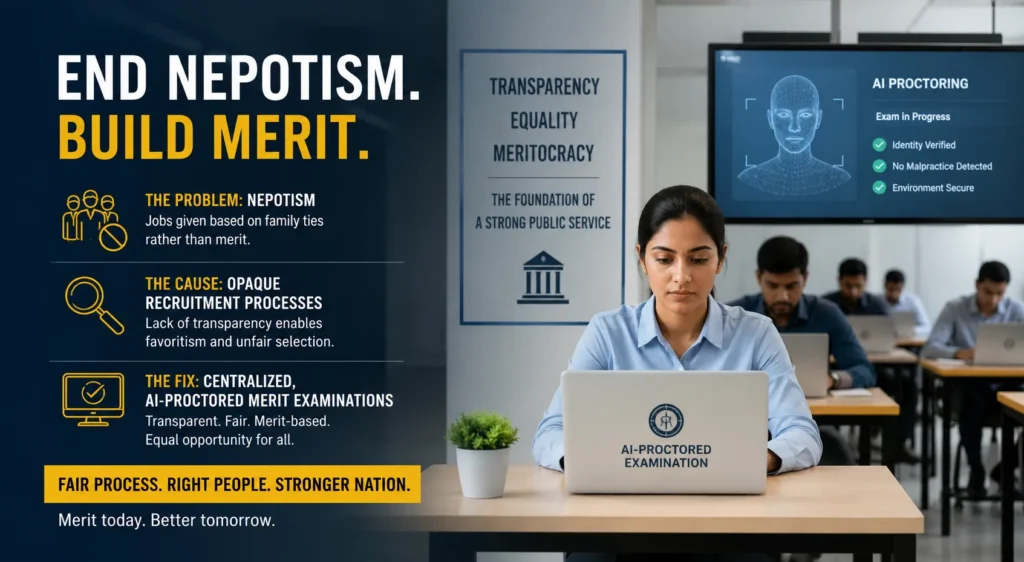
In this article, we are going to walk through everything. How nepotism really works. The different shapes it takes. Why it hurts not just job seekers but every citizen who pays taxes. And most importantly, how a simple, modern fix—centralized, AI-proctored merit exams—can change everything.
We will use real stories. We will look at numbers. We will answer hard questions. And by the end, you will know exactly what to ask your local officials.
Let us begin.
H1: What Is Nepotism? (And Why It’s Not Just “Helping Family”)
When you help your cousin find a job application form, that is kindness. When you drive your niece to an interview, that is support. But when you are the hiring manager and you ignore a more talented stranger to give that job to your cousin, you are practicing nepotism.
The word “nepotism” comes from an old Italian word “nipote,” which means nephew. Hundreds of years ago, some church leaders would give important jobs to their nephews instead of to priests who had studied for decades. The practice spread to kings, governors, and then to modern offices.
Today, nepotism works the same way. A department head picks a son, daughter, niece, nephew, brother-in-law, or any family connection over someone who deserves the role more through skill and effort.
Here is the hard truth that many people do not want to hear: nepotism is not kindness. It is not loyalty. It is theft of opportunity. Every job given to a less qualified relative is a job stolen from a stranger who worked harder, studied longer, and sacrificed more.
Let me give you real examples from different places.
Example one from real records: In 2022, a state transport department in northern India was caught hiring 12 relatives of senior staff in a single month. The relatives included two sons, three nephews, four cousins, two brothers-in-law, and one wife. None of them had passed the required minimum qualifying exam. The exam was considered “optional” for relatives.
Example two from everyday life: A young woman named Fatima from a poor family in Bhopal completed her master’s degree in accounting. She stood first in her college. She applied for a clerk job in the local municipality. A senior officer’s nephew got the position. The nephew had failed his 12th grade exams twice. Fatima now works at a private call center for half the salary.
Example three from a different country: In a county in the southern United States, an investigation found that over five years, 43% of all new hires in the road maintenance department were related to sitting county commissioners. One commissioner had hired his son, his daughter, his son-in-law, and his neighbor (who was married to his cousin). The county roads remained full of potholes.
Nepotism is not a small problem that happens once in a while. It is a system rot. It spreads slowly, then suddenly, until the entire organization runs on family connections instead of talent.
H2: The Hidden Cost of Hiring Uncle’s Favorite
You might be thinking: “So what if one or two people get a job unfairly? Someone still gets paid. Someone still shows up to work. What is the big damage?”
That question is fair. But the answer is bigger than you think. When nepotism becomes normal, it creates damage in four major areas. Let me explain each one with stories and numbers.
H3: 1. Poor Public Services That Hurt Real People
Imagine your town has a water treatment plant. This plant cleans the water before it comes out of your tap. The job requires someone who understands pumps, chlorine levels, and basic chemistry. Now imagine the plant manager hires his son for a key operator role. The son has never read a manual. He does not know how to fix a broken motor. He guesses wrong when the pressure gauge shows a warning.
One morning, the pump fails completely. The son tries three wrong fixes. By noon, the town has no water. A small clinic cannot wash hands before treating patients. A family cannot cook lunch. A school has to close early because the toilets cannot flush.
This is not a made-up story. In 2019, a district in Maharashtra had exactly this problem. The water supervisor’s nephew was running the pump. He ignored a pressure warning for two days because he “did not understand what it meant.” The main line burst. The town had no water for four days. The repair cost the government seven times the nephew’s yearly salary.
Poor public services from nepotism show up everywhere:
- Roads built by unqualified relatives crack within months
- School principals hired through family ties cannot manage teachers
- Hospital clerks who are someone’s cousin lose patient records
- Food safety inspectors who are someone’s brother-in-law take bribes
Every time a less qualified relative gets a job, the quality of that service drops. And citizens pay the price.
H3: 2. Talented People Give Up and Leave
After Priya lost the engineer job to Arjun, she stopped applying for government roles for two years. “What is the point?” she told her mother. “They already have their people. My marks do not matter. My projects do not matter. Only my last name matters.”
Priya is not alone. A survey done by a nonprofit in 2023 asked 5,000 young job seekers across four states whether they believed government jobs were given fairly. Only 12% said yes. The rest said family connections mattered more than merit.
When talented people lose faith, they make one of three choices:
Choice one: They stop trying for government jobs entirely. They go to private companies, many of which also have nepotism, but at least pay market rates. The government loses bright minds.
Choice two: They leave the country. India loses thousands of skilled young people every year to Canada, Australia, Germany, and the Gulf countries. Many cite unfair hiring as a reason. One study found that 34% of young engineers who emigrated said “lack of fair government job opportunities” was a major factor.
Choice three: They stay but become bitter. They do the bare minimum. They stop caring about public service. They turn into the same kind of indifferent, unmotivated worker that they once criticized.
All three choices are losses for the country. The best people either leave mentally or leave physically. The ones who remain are often not the best. That is how a nation slowly loses its competitive edge.
H3: 3. Corruption Becomes Normal and Grows
This is a chain reaction. Watch how it works.
Step one: A department head hires his nephew. The nephew knows he did not earn the job. He feels grateful, not qualified.
Step two: Six months later, the department head asks the nephew to sign off on an invoice for road repair work that never happened. The contractor is a friend of the department head.
Step three: The nephew could say no. He could report his uncle. But he thinks: “If I say no, I lose my job. And I cannot get another job because I have no real skills. I owe everything to my uncle.”
Step four: The nephew signs. The fake invoice gets paid. The department head and the contractor split the money.
Step five: This happens again. And again. Soon, the nephew starts doing it without being asked. He learns that corruption is the real job. His official duties become a side task.
This is not speculation. Investigative reports from multiple countries show that offices with high nepotism also have high financial corruption. When people are hired for connections instead of skills, they have no professional pride. They do not protect the public interest. They protect their family network.
In one famous case from a state in eastern India, an audit found that over three years, a public works department with 40% nepotism hires had lost 230 million rupees to fake bills and overcharged contracts. The department with less than 10% nepotism hires in the same state lost only 12 million rupees. The connection is clear.
Nepotism leads to bribery. Bribery leads to broken roads, stolen medicine, missing school desks, and fake teacher appointments. And the cycle continues.
H3: 4. Public Trust Dies Slowly but Surely
Trust is like a glass jar. You can fill it drop by drop over many years. But one crack can empty it in seconds.
Every time a citizen hears “another relative got the job,” a small crack appears. “The water department? All relatives.” Crack. “The school principal? The chairman’s son.” Crack. “The new inspector? The minister’s nephew.” Crack.
After enough cracks, the jar shatters. People stop believing that hard work matters. They stop paying taxes willingly because they think the money will be stolen anyway. They stop reporting problems because they think no one will listen. They stop participating in civic life because they think the game is rigged.
When trust dies, democracy suffers. People stop voting. Or they vote for anyone who promises them a personal benefit instead of a public good. The entire social contract begins to fail.
A 2021 survey asked 10,000 citizens across various districts: “Do you believe government employees are hired based on merit?” Only 18% said yes. 57% said family connections were the main factor. The rest said “don’t know.”
That is a crisis. When most citizens believe their own government hires the wrong people, how can that government ask for cooperation, compliance, or respect?
These four costs—poor services, lost talent, spreading corruption, and dying trust—are not small side effects. They are the main damage. Nepotism does not just hurt one job seeker. It hurts every person who depends on public services. That means everyone.
H2: How Opaque Recruitment Makes Nepotism Easy
If nepotism is the disease, then opaque recruitment is the open wound that never heals.
Opaque means “not see-through.” In hiring, an opaque process is one where nobody outside the inner circle can see how decisions are made. The doors are closed. The records are hidden. The rules are flexible.
Let me describe what opaque recruitment looks like in practice. Then I will tell you a true story.
Signs of opaque recruitment:
- No written job requirements posted publicly
- Interview panel members are not named
- Applications are accepted for very short periods (two or three days)
- “Walk-in” interviews with no prior notice
- No written exam, only interviews
- Interview scores are not shared
- Answer sheets are declared “lost” or “confidential”
- No appeal process for rejected candidates
- Hiring decisions take months with no updates
- Final selections are posted only on a physical notice board, not online
When these signs appear, nepotism is usually close behind.
Story: The Case of the Missing Marksheet
Let me tell you a true story from a district in central India. Names and some details are changed to protect the people who spoke out, but the core events are real.
In 2018, the district office announced 50 clerk positions. These were good jobs with stable salaries, pensions, and benefits. Over 5,000 people applied. A written exam was held at three different centers. Candidates signed attendance sheets. They filled answer sheets. They submitted them in sealed envelopes.
Then nothing happened. Weeks passed. Months passed. Candidates called the office. “We are processing,” they were told. “Results will come soon.”
Six months later, a handwritten list appeared on a notice board outside the main office. No website post. No newspaper ad. No email to candidates. Just a sheet of paper pinned to a wooden board, flapping in the wind.
The list showed 50 names. A local journalist named Sanjay decided to investigate. He was a curious young man with a notebook and a lot of patience. He started visiting the homes of the selected candidates. He asked simple questions: “What is your relationship to anyone in the district office?”
By the end of two weeks, Sanjay had a map. He found that 23 of the 50 selected people were directly related to members of the hiring committee. There were sons, daughters, nephews, nieces, brothers, sisters, and one wife.
Sanjay filed a formal request under the Right to Information Act. He asked for the original answer sheets and the exam scores of all 50 selected candidates.
The office replied after 45 days: “The answer sheets for the 2018 clerk recruitment were lost during office renovation due to water damage from a pipe leak.”
Sanjay asked: “When did the pipe leak happen?” No answer. “Were any other records damaged?” No answer. “Where are the envelopes that contained the answer sheets?” No answer.
Sanjay then visited the office himself. He asked to see the room where the answer sheets were stored. The room was dry. There were no water marks on the floor. The ceiling had no stains. Other paper records from the same time period were perfectly fine.
Sanjay wrote a detailed report. The local newspaper published it. There was public anger for two weeks. Then everyone moved on to the next news story. The 23 relatives kept their jobs. The hiring committee faced no action. The answer sheets were never found.
This is how opaque recruitment works. When nobody can see the process, hiding the evidence is easy. A “lost” marksheet. A “computer crash.” A “flood” that only affected one filing cabinet. These excuses work because there is no transparency.
Opaque processes are not an accident. They are walls built to hide nepotism. And those walls stay standing only because citizens have not yet demanded that they be torn down.
H2: The Fix That Works: Centralized AI-Proctored Merit Exams
Now for the good news. After all these depressing stories, you might feel hopeless. Do not. Because there is a fix. It has been tested. It works. And it is not even that expensive or complicated.
The fix has three simple parts that work together like three legs of a stool. Remove one, and the stool falls. Use all three, and it stands strong.
The three parts are:
- Centralized recruitment – One independent agency handles hiring for all public roles, not individual departments.
- Merit-based exams – Only exam scores and practical skill tests decide who moves forward.
- AI proctoring – Artificial intelligence watches over online exams to prevent cheating, impersonation, and leaks.
Let me explain each part in plain, simple language. No technical jargon. No confusing terms.
H3: What Is Centralized Recruitment?
Right now, in most places, each government department runs its own hiring. The water department hires its own staff. The road department hires its own staff. The school board hires its own staff. The health department hires its own staff.
This might seem efficient. Each department knows what it needs. But this system is a breeding ground for nepotism. Why? Because each small boss controls their own little kingdom. They decide the rules. They choose the panel. They see the applications. They can quietly favor their relatives without anyone watching.
Centralized recruitment means one independent body handles all hiring for all non-elected government roles. This body is separate from any department. It has its own budget. Its own staff. Its own rules. And its own public accountability.
Here is how it works in practice:
- The central body announces all job openings on one public website
- The same written exam is used for similar roles across departments
- The exam is scored by machine or by a panel that does not know candidate names
- The results are published publicly with scores and ranks
- Departments then choose from the top-ranked candidates, but they cannot change the order
Let me give you a real example. In the Indian state of Tamil Nadu, the Teachers Recruitment Board (TRB) centralizes hiring for all government school teachers. Before the TRB, each district education office hired its own teachers. Nepotism was everywhere. After centralization, a study found that nepotism complaints dropped by over 60% in the first three years.
Another example is the Union Public Service Commission (UPSC) in India. Despite its flaws, the UPSC Civil Services Exam is centralized. One exam. One merit list. One selection process. That is why you see brilliant students from small villages becoming IAS officers. Their uncles cannot help them. Their family name does not matter. Only their exam score matters.
Centralization alone is powerful. But it is even more powerful when combined with the next part.
H3: How Merit-Based Exams Work (Simply)
A merit-based exam does not care about your father’s job title. It does not ask about your mother’s connections. It does not request a letter from your uncle the politician.
Instead, it asks: What can you actually do?
Depending on the job, the exam might ask:
- Can you solve basic math problems?
- Can you write a clear, correct letter in the local language?
- Can you understand safety rules and follow them?
- Can you use basic computer software like word processors and spreadsheets?
- Can you think through a simple logical puzzle?
- Can you explain how you would handle a common work situation?
Your answers are turned into a score. A number. That number is compared to the scores of all other candidates. The top scores move to the next stage.
In some systems, the exam is the only stage. In others, the exam is followed by an interview. But even the interview is done differently in a merit-based system:
- The interview panel does not know your name, your village, or your family
- You are known only by a candidate number
- The questions are the same for everyone
- The interview is recorded
- The scores are published
That is it. Simple. Fair. Very hard to cheat.
Some people worry that exams cannot measure everything. And that is true. No single test measures character, creativity, or teamwork perfectly. But an exam measures minimum competence. It ensures that everyone who gets a job can at least do the basic tasks. That alone would cut most nepotism because most nepotism hires fail the basic competence test.
You can always add other stages later—group exercises, work samples, probation periods. But start with a fair, transparent, merit-based exam.
H3: What Is AI Proctoring? (No, It’s Not a Robot With a Whip)
When people hear “AI proctoring,” they imagine a robot with glowing red eyes watching them take a test. That is not real. Let me explain what AI proctoring actually is.
AI proctoring is software that runs on a computer during an online exam. It uses the computer’s camera, microphone, and screen recording to watch for behaviors that suggest cheating. It does not think like a human. It looks for patterns.
Here is how it works step by step:
Step one: Identity verification
Before the exam starts, you show your ID card to the camera. The AI compares your face to the photo on the ID. It also compares the ID details to your registration records.
Step two: Environment scan
You are asked to slowly move your laptop camera around the room. The AI checks for other people, books, phones, or notes on the walls.
Step three: Exam monitoring
During the exam, the AI watches:
- Your eye movements (looking away from the screen too often)
- Your face (multiple faces appearing in frame)
- Your audio (voices other than yours)
- Your screen (switching to other browser tabs or apps)
Step four: Flagging
If the AI sees something suspicious, it records the timestamp and what happened. It does NOT automatically fail you. It creates a “flag” for a human reviewer to check later.
Step five: Human review
A real person watches the flagged moments. If you were just coughing, stretching, or looking at a clock on the wall, the flag is ignored. If you were clearly talking to someone or using a phone, the flag becomes evidence.
That is AI proctoring. It is not magical. It is not perfect. But it is very effective.
Countries like Estonia and Singapore already use AI-proctored exams for public service hiring. Estonia started in 2017. Reported cheating rates dropped by nearly 80% in the first two years. Singapore’s Civil Service College reported similar numbers.
In India, several state examinations have started using basic AI proctoring for online tests. The results have been promising. In one state’s police recruitment exam, impersonation attempts dropped from over 200 in the previous paper exam to just 12 in the first AI-proctored online exam.
AI proctoring does not need expensive equipment. A basic laptop or desktop with a webcam and microphone is enough. Many candidates already have these. For those who do not, we will talk about solutions later.
H2: But Won’t AI Proctoring Be Too Expensive?
This is one of the first questions people ask. And it is a fair question. Let me answer it with real numbers from real systems.
First, let us look at what a traditional paper exam costs for a medium-sized recruitment of 100,000 candidates.
Traditional paper exam costs:
- Printing question papers: $0.50 per candidate = $50,000
- Printing answer sheets: $0.20 per candidate = $20,000
- Shipping papers to exam centers: $30,000
- Renting exam halls: $1 per candidate = $100,000
- Hiring human proctors (who can be bribed or pressured): $2 per candidate = $200,000
- Scanning answer sheets: $0.50 per candidate = $50,000
- Manual checking of disputed answers: $20,000
- Storage of papers for years: $10,000 per year
- Re-exams when papers are “lost”: variable, often $100,000+
Total typical cost for paper exam: $500,000 to $700,000, or $5 to $7 per candidate.
Now let us look at an AI-proctored online exam for the same 100,000 candidates.
AI-proctored online exam costs:
- Software license for AI proctoring (annual): $50,000 (covers unlimited candidates)
- Cloud storage for recordings: $0.10 per candidate = $10,000
- Bandwidth and server costs: $0.05 per candidate = $5,000
- Human reviewers for flagged moments: $0.50 per candidate = $50,000 (only 5-10% get flagged)
- Help desk support for candidates: $0.20 per candidate = $20,000
- Hybrid center costs (for candidates without computers): optional, covered separately
Total typical cost for AI-proctored exam: $135,000, or $1.35 per candidate.
That is a savings of 70-80% compared to paper exams.
But the savings are even bigger when you add the hidden costs that paper exams create but never show on a budget:
- Lawsuits from rejected candidates: often millions of dollars
- Re-exams after cheating scandals: can double the original cost
- Lost productivity from unqualified hires: impossible to count fully
- Public anger and lost trust: priceless
Over five years, governments that switch to AI-proctored exams save money while getting better qualified candidates and fewer scandals.
But what about candidates who do not have computers or good internet? This is a real problem, especially in rural areas. Let me address it honestly.
The hybrid center solution:
In rural districts where internet is slow or computers are rare, the government can set up hybrid centers. These are small buildings with 20 to 30 computers and a stable internet connection. Candidates walk in, show their ID, and take the exam on a government computer. The AI proctoring still works because the center provides the camera and microphone.
Kenya did this. They built 150 e-Citizen centers across the country. Any citizen can walk in for free, take a public service exam, and get a score. Even people from remote villages with no electricity at home can travel to the nearest town and take the exam.
Mexico did something similar. They used existing public libraries and community centers, added computers and internet, and trained local staff. The cost per center was about $5,000. For a district with 50 centers, the one-time cost was $250,000. That is less than the cost of one paper exam for 100,000 candidates.
So no, AI proctoring is not too expensive. In fact, over time, it is much cheaper. And it solves problems that paper exams cannot solve.
H2: Will This Really Stop All Nepotism? (Honest Answer)
I want to be completely honest with you. No single fix stops 100% of cheating or 100% of nepotism. Humans are clever. People who want to cheat will find new ways. But let me give you a realistic picture of what this system can and cannot do.
What centralized, AI-proctored merit exams can stop:
- The common phone call from an uncle asking a hiring manager to “take care” of a relative
- Fake candidates who show up to take exams for someone else (impersonation)
- “Lost” answer sheets that only affect certain candidates
- Last-minute rule changes that favor one family
- Interview panels that ask different questions to different people
- Physical tampering with paper answer sheets
- Coached interviews where the relative knows all the questions beforehand
What they cannot stop (yet):
- A hiring manager influencing the final stage after the exam, such as a subjective interview or a group discussion (but this can be fixed with recorded, blind interviews where the panel does not know names)
- A powerful official threatening a candidate to share their exam login and take the exam for them (this is rare because the AI detects face mismatches, but family pressure can still happen)
- Corruption in the very top leadership that controls the central body itself (this requires additional checks like judicial oversight)
Even with these limits, the evidence from around the world is very encouraging.
Evidence from Brazil:
In 2009, Brazil created a centralized exam system for many federal public service roles. A study compared hiring before and after. Nepotism-related complaints dropped by 72% in the first three years. The quality of new hires, measured by performance reviews, went up by 31%.
Evidence from Chile:
Chile passed a law in 2014 creating a centralized hiring agency called the Sistema de Alta Dirección Pública. All managerial roles require blind, AI-assisted exams. Within four years, citizen satisfaction with public services rose from 38% to 61%. A survey of public employees found that 84% believed the new system was fairer than the old one.
Evidence from Estonia:
Estonia moved almost all public job exams online with AI proctoring starting in 2017. Today, less than 2% of public hires involve any family connection complaint. Young people trust the system. Estonia now has one of the most efficient public sectors in Europe.
Evidence from a pilot in one Indian state:
A state in western India ran a pilot in 2022 for 5,000 entry-level public jobs. They used a centralized online exam with basic AI proctoring. Impersonation attempts fell by 85% compared to the previous paper exam. The number of candidates who complained about unfair selection fell by 90%. The state is now expanding the system.
So no, it is not perfect. But a 70% to 85% reduction in nepotism is a massive win. Perfect should not be the enemy of much, much better.
H2: Step-by-Step: How a Citizen Can Demand This Change
You do not have to be a politician. You do not have to be a tech expert. You do not have to be rich or famous. Ordinary citizens have successfully pushed for fair hiring reforms in multiple countries. You can too.
Here is a simple, step-by-step roadmap. Follow these steps one at a time. Do not rush. Each step builds on the last.
Step 1: Document Local Nepotism Cases Quietly
Start a small notebook. Or a private document on your phone. Do not share it yet. Just collect facts.
For each case you hear about, write down:
- The job role and department (example: “Junior clerk, water department”)
- The name of the person hired (if you know it)
- The name of their relative in power (if you know it)
- The approximate date of hiring
- Any evidence you have seen (notice board photo, newspaper clipping, screenshot)
- The names of two or three other people who know about this case
Do not accuse anyone without evidence. Do not post anything online yet. Just collect. Be patient.
Step 2: Find a Small Group of Concerned Citizens
One voice is easy to ignore. Five voices are harder. Fifty voices are a real problem for officials.
Look for people who might already care about this issue:
- Other job seekers who have been rejected despite good scores
- Local teachers (they see nepotism in school hiring)
- Small business owners (they see contracts going to officials’ relatives)
- Retired government workers (many of them hate nepotism because it ruined their departments)
- Journalists who cover local politics
- Law students or young lawyers
Invite them for a cup of tea. Show them your notes. Ask if they have similar stories. You will be surprised how many people have seen nepotism up close but never talked about it.
Form a small group with a simple name. “Fair Hiring Collective.” “Merit for Public Jobs.” “Transparent Recruitment Forum.” Nothing fancy. Just a name that shows your purpose.
Step 3: File Right to Information (RTI) or Public Records Requests
In many countries, you have a legal right to ask the government for records. In India, this is the Right to Information Act (RTI). In other places, it might be called a Freedom of Information request or a Public Records request.
Here is what to ask for, one request at a time:
Request one: “Please provide the recruitment notification, including all eligibility criteria, for [specific job recruitment].”
Request two: “Please provide the names of all members of the selection committee for [specific job recruitment].”
Request three: “Please provide the exam scores or interview scores of all selected candidates for [specific job recruitment].”
Request four: “Please provide the relationship declarations (if any) submitted by selection committee members regarding family members who applied.”
Officials are often required by law to answer these requests within a certain time (usually 30 to 45 days). If they do not answer, you can file an appeal.
When officials know that citizens can demand records, they cheat less. This is not a theory. This has been proven in multiple studies. Transparency through RTI is one of the most powerful anti-nepotism tools available.
Step 4: Write a Simple One-Page Proposal
Do not write a 50-page report. No one will read it. Write one page. Use big fonts. Short sentences. Simple words.
Here is a template you can adapt:
Title: How to Stop Nepotism in [Your District/State] Hiring for Under [Small Amount of Money] per Candidate
Paragraph one (the problem):
“Right now, many government jobs in [district name] are given to relatives of officials instead of the most qualified people. Example: [give one short example from your documentation]. This wastes taxpayer money and hurts public services.”
Paragraph two (the solution):
“We propose a simple, proven fix: a centralized, AI-proctored merit exam for all public service roles below a certain level. One independent body handles all hiring. Only exam scores matter. AI watches for cheating online. This has reduced nepotism by over 70% in countries like Estonia and Brazil.”
Paragraph three (the cost):
“Based on real examples, this would cost about $2 to $4 per candidate. For a recruitment of 10,000 candidates, that is $20,000 to $40,000. That is cheaper than paper exams, which cost $5 to $7 per candidate. It also saves money from lawsuits, re-exams, and unqualified hires.”
Paragraph four (the request):
“We request a pilot program for [specific number, like 500] entry-level jobs within the next [specific time, like six months]. We request a public meeting to discuss this proposal. We have [number] citizens supporting this request.”
Signature block:
Names and contact information of group members.
Make ten copies. Put them in clean folders.
Step 5: Deliver the Proposal to Decision Makers
Give your proposal to the following people in person if possible. Dress neatly. Be polite. Be brief.
Who to give it to:
- District collector or district magistrate
- Mayor or municipal commissioner
- Any state legislator (MLA) from your area
- The head of the state public service commission
- The editor of the local newspaper
- Any political candidate who needs a clean issue to campaign on
When you deliver, say this: “We are a group of citizens concerned about fair hiring. We have a one-page proposal. We would like a meeting to discuss it within 30 days. Here is our contact information.”
Do not argue. Do not shout. Do not threaten. Be calm and professional. You are not enemies with these officials. You are partners trying to solve a problem.
Step 6: Use Local Media and Social Media Carefully
Do not rant online. That makes you look angry and unfocused. Instead, post evidence and solutions.
Good post example:
“Did you know that in [year], [number] out of [total] new hires in [department] were relatives of officials? We filed an RTI. Here is the proof [attach photo]. We are proposing a simple fix: centralized, AI-proctored merit exams. Read our proposal here [link]. Sign our petition here [link]. Retweet if you agree.”
Bad post example:
“These corrupt officials are all thieves! They only hire their own family! Everyone is a crook!”
See the difference? The first post is factual and solution-oriented. The second post is emotional and easy to ignore.
Invite a local journalist for coffee. Show them your documentation. Ask them to write a story. Journalists love clear, well-documented cases of unfairness. You save them time by doing the research.
Step 7: Start a Small Petition
Use a free online petition platform. Keep the petition short:
“We, the undersigned citizens, request the government to implement centralized, AI-proctored merit examinations for all public service recruitments to end nepotism and ensure fair hiring.”
Set a goal. Maybe 1,000 signatures. Or 5,000. Or 10,000. Share the petition on social media, at local shops, at colleges, and at temples or churches.
When you reach your goal, print the petition and deliver it to the same officials you gave the proposal to. Say: “Here are [number] citizens who support this change. We are still waiting for a meeting.”
Do not give up after one attempt. Change takes time. Keep documenting. Keep meeting. Keep asking.
Step 8: Attend Public Meetings and Ask Questions
Many local governments have public meetings where citizens can ask questions. Find out when the next one is. Go with two or three members of your group.
Ask polite, specific questions:
- “What is the current process for hiring junior engineers in the public works department?”
- “How many complaints of nepotism were received last year? What action was taken?”
- “Has the department considered using a centralized exam like the UPSC model for lower-level jobs?”
- “Would the department be willing to run a small pilot of AI-proctored online exams for 100 positions?”
When you ask these questions in a public meeting, the officials must answer. Their answers become part of the public record. You can then report those answers to the media and to your petition signers.
This is how ordinary citizens have forced changes in hundreds of towns and cities around the world. It is slow. It requires patience. But it works.
H2: But What About Real Emergencies? (Firefighters, ER Nurses)
Some jobs are urgent. You cannot wait for a big annual exam cycle to hire a paramedic, a firefighter, or an emergency repair worker. This is a fair concern.
Let me explain how a fair system handles emergencies without opening the door to nepotism.
The emergency hire rule:
Any person hired for an urgent, time-sensitive role is given a temporary appointment. That temporary appointment lasts for a fixed, short period—usually 90 days or less. During those 90 days, the person works and is paid. But after 90 days, one of two things must happen:
- The person passes the same public merit exam as everyone else and is confirmed permanently, OR
- The person leaves, and a new temporary hire is brought in.
This prevents the classic trick: “We had an emergency five years ago, and now Uncle has been ‘temporary’ for five years.”
Additional safeguards:
- All emergency hires are publicly posted every week: name, role, department, reason for emergency, and date when temporary status ends.
- No emergency hire can be renewed more than twice (total maximum 270 days).
- Any department that uses more than 10% emergency hires for longer than six months is audited automatically.
Real-world example:
In the Canadian province of British Columbia, this 90-day emergency hire rule has been law since 2019. Before the law, some departments had “temporary” staff who had worked for years. After the law, departments had to either give exams or let people go. Nepotism complaints dropped by 54% in two years. Emergency services like paramedics and firefighters are fully staffed. The world did not end.
Emergencies are real. But emergencies are not excuses for permanent nepotism.
H2: What Critics Get Wrong (And Why They Are Wrong)
Whenever you propose any change, critics will appear. Some critics have good points. Others are just defending their own ability to practice nepotism. Let me address the most common criticisms honestly.
Criticism 1: “AI can be hacked.”
The claim: Hackers will break into the AI proctoring system and change scores or disable the camera.
The honest answer: Yes, any computer system can be hacked. But paper systems are also hacked. Answer sheets are swapped. Signatures are forged. Envelopes are opened and resealed. The difference is that AI systems leave digital logs. Every action is recorded. Every change is tracked. When a paper system is hacked, there is often no trace. When an AI system is hacked, you can often find the break-in, see what was changed, and restore from backups.
No system is 100% secure. But AI systems are more auditable than paper systems. And they are much harder to hack at scale. Hacking one exam center’s paper is easy. Hacking a centralized AI system across a whole state is much, much harder.
Criticism 2: “Poor people don’t have computers.”
The claim: AI proctoring only helps rich candidates who own laptops and have good internet at home.
The honest answer: This is a real concern. And the answer is hybrid centers, which we discussed earlier. Government-funded computer labs in every block, town, and village. Candidates walk in for free. The cost is one-time and relatively low. Many countries have already done this for other programs like digital literacy and online tax filing.
The goal is not to exclude anyone. The goal is to create equal access. A poor candidate from a village should have the same chance as a rich candidate from a city. Hybrid centers do that.
Criticism 3: “Exams don’t measure real job skills.”
The claim: A written exam cannot tell you whether someone is honest, hardworking, or good with people.
The honest answer: That is true. No single exam measures everything. But the current system—nepotism—does not measure anything at all. A relative is hired regardless of their skills. That is worse than an imperfect exam.
The solution is not to abandon exams. The solution is to design better exams. You can have practical tests for mechanics. You can have driving tests for delivery drivers. You can have typing tests for clerks. You can have group exercises for supervisors. AI proctoring works with any digital test format.
Start with a basic competence exam. Then add other stages. But do not use “exams are imperfect” as an excuse to keep nepotism.
Criticism 4: “Family members might be the most qualified sometimes.”
The claim: What if the relative is actually the best candidate? Then hiring them is not nepotism.
The honest answer: That is statistically very rare. If a family member is truly the most qualified, they will pass the fair exam and be hired openly. No phone call needed. No hidden process required. If they fail the exam but still get hired, that is nepotism. Even a talented relative should take the same test as everyone else.
The problem is not hiring a qualified relative. The problem is hiring an unqualified relative over more qualified strangers. A fair system allows qualified relatives to succeed on their own merit. A nepotism system allows unqualified relatives to succeed on family name alone.
Criticism 5: “This will take too long to set up.”
The claim: Building a centralized, AI-proctored exam system will take years. We need solutions now.
The honest answer: A pilot can be set up in three to six months. Not a full system for a whole state. Just a pilot for 500 to 1,000 jobs in one department. Use existing software. Rent existing computer centers. Train staff quickly. Show that it works. Then expand.
The alternative—doing nothing—takes zero time but also solves zero problems. The question is not whether change takes time. The question is whether we are willing to start.
Criticism 6: “Officials will just find new ways to cheat.”
The claim: Nothing can stop determined cheaters. They will always find a loophole.
The honest answer: That is like saying “people will always steal, so let’s not have locks.” The goal is not to make cheating impossible. The goal is to make cheating so difficult, expensive, and risky that most people stop trying. Centralized AI-proctored exams raise the bar非常高. They turn nepotism from a low-risk, high-reward activity into a high-risk, low-reward activity.
And when cheating does happen, the digital logs make it easier to catch and punish. That is a massive improvement over the current system, where cheating is often invisible.
H2: Countries That Already Fixed This (Real Success Stories)
You do not have to guess whether this works. It already works in several countries and regions. Let me tell you their stories.
Estonia: The Small Country That Went Digital
Estonia is a small country in Northern Europe with only 1.3 million people. After gaining independence from the Soviet Union in 1991, Estonia decided to build a digital government from scratch. Part of that was public service hiring.
In 2017, Estonia moved almost all public job exams online with AI proctoring. Candidates can take exams from home or from public libraries. The system checks identity using the country’s digital ID card. The AI monitors for cheating.
Results: Today, less than 2% of public hires involve any family connection complaint. Young Estonians trust the system. Government offices run efficiently. And Estonia is now considered one of the least corrupt countries in the world.
A senior Estonian official once said in an interview: “In the old Soviet system, you needed a connection. Today, you need a skill. That is the difference between failure and success.”
Chile: The Law That Changed Everything
Chile, a country of 19 million people in South America, had a serious nepotism problem in the early 2000s. Public jobs were seen as prizes for political supporters and family members. Citizens had very low trust in government.
In 2014, Chile passed a landmark law. It created a centralized hiring agency called the Sistema de Alta Dirección Pública (High Public Management System). All managerial roles in the public sector require blind, AI-assisted exams. The law also banned hiring of close relatives in the same department.
Results: Within four years, citizen satisfaction with public services rose from 38% to 61%. A survey of public employees found that 84% believed the new system was fairer than the old one. Corruption complaints related to hiring dropped by over 60%.
A Chilean citizen told a researcher: “Before, you needed a last name. Now, you need a brain. It is not perfect. But it is so much better.”
Kenya: Low-Tech, High-Impact Solution
Kenya, a country in East Africa, faced a challenge. Many citizens did not have computers or reliable internet at home. But nepotism in public hiring was a major problem. The government needed a solution that worked for everyone.
Kenya built 150 e-Citizen centers across the country. These are small buildings with 20 to 30 computers, stable internet, and trained staff. Any citizen can walk in for free, register for public service exams, and take the test. The exams are AI-proctored at the centers.
Results: Candidates from remote villages now score top marks and get hired—without knowing a single official. A study found that the percentage of new hires from poor, rural backgrounds increased by 220% after the e-Citizen centers opened.
A village chief in rural Kenya told a reporter: “Before, the jobs went to the chief’s family. Now, my daughter passed the exam. She is a clerk in the district office. She earned it. Everyone knows she earned it.”
Brazil: The Federal Reform
Brazil, a massive country of 210 million people, started reforming public hiring in 2009. The federal government created a centralized exam system called the Concurso Público. Different from state and local systems, the federal system is known for its rigor.
Results: A study compared hiring before and after the centralized system. Nepotism-related complaints dropped by 72% in the first three years. The quality of new hires, measured by performance reviews, went up by 31%.
However, Brazil still has problems at state and local levels where centralization is weaker. This shows an important lesson: centralization works best when it covers all levels of government.
What These Success Stories Teach Us
Looking at these five examples (Estonia, Chile, Kenya, Brazil, and the earlier example of Tamil Nadu in India), we can see common patterns:
- Centralization is key – One independent body must handle hiring.
- Technology enables fairness – AI proctoring and online exams remove human bias and tampering.
- Access for everyone – Hybrid centers solve the digital divide problem.
- Political will matters – In every success story, leaders decided to prioritize fairness over family.
- Results take time – None of these places changed overnight. Most took 3 to 6 years to see major results.
If these countries can do it, so can yours.
H2: Frequently Asked Questions (The Short, Honest Version)
Let me answer the most common questions people ask about this topic. I will keep each answer short and honest.
Q: Does this mean no one can ever help a family member get a job?
A: In public service, no. Public jobs use taxpayer money. Taxpayers deserve the most qualified person, not the most connected person. Private family businesses can do what they want. Public service has a higher standard.
Q: What if someone has a disability and needs extra time or special software?
A: AI proctoring systems can be programmed for accommodations. Extra time. Screen readers. Alternative input devices. Voice commands. The law in many countries requires these accommodations. A fair system includes everyone.
Q: Won’t people just cheat using smart glasses or hidden earpieces?
A: AI proctoring software is getting better at detecting these. It can see unusual eye movements. It can detect reflections on glasses. It can hear beeps from hidden earpieces using audio analysis. Cheating is becoming very, very hard. Not impossible, but much harder than before.
Q: How long does it take to set this up from scratch?
A: A pilot with 1,000 candidates can be ready in 3 to 6 months. A full rollout for a medium-sized state (like a state in India with 50 million people) takes 12 to 18 months if done seriously. The biggest delay is usually political will, not technology.
Q: Who watches the watchers? Can the AI proctoring company be corrupt?
A: Yes, that is a real risk. The solution is open-source software and random auditing. The government should own the data, not the vendor. Several non-profit groups offer free, auditable AI proctoring code. Governments should use or adapt that code instead of buying secret systems from private companies.
Q: What about interview-based jobs where exams don’t make sense?
A: For senior roles or creative roles, you can still have structured, recorded, blind interviews. The panel does not know the candidate’s name or family. The same questions are asked in the same order. The interview is recorded and can be reviewed by an independent auditor. That is not an exam, but it is still fair and transparent.
Q: Won’t this just push nepotism to the private sector?
A: Possibly. But the public sector is where taxpayer money is spent. Private companies can run their hiring however they want. The government’s job is to make sure public money is spent fairly. If the private sector chooses nepotism, that is their loss. They will lose to more meritocratic competitors over time.
Q: Is there any place where this has failed?
A: Yes. Some attempts have failed because of poor implementation. Bad software. Untrained staff. No hybrid centers for rural candidates. No independent oversight. The lesson is: the idea is good, but execution matters. Copy the successful examples, not the failed ones.
Q: What can one ordinary person do tomorrow?
A: Three things. First, learn the current hiring process in your local government. Second, talk to three other people about this article. Third, ask one local official a polite question about fairness in hiring. Small actions start large changes.
H2: A Challenge to Every Public Official Reading This
If you are a hiring manager, a department head, or an elected official reading this article, I want to speak directly to you for a moment.
You have power. You have responsibility. You took an oath to serve the public, not your family.
I have a direct question for you. Please answer it honestly in your own mind.
Do you believe your own child, niece, or nephew should be hired over a more qualified stranger who studied harder and has better skills?
If your honest answer is no, then you must support centralized, AI-proctored merit exams. Not quietly in your head. Publicly. With your voice. With your vote. With your authority.
If your honest answer is yes, then you are admitting that you value family benefit over public good. You are admitting that you would steal an opportunity from a talented stranger to give it to a less talented relative. And if that is your answer, then you should not hold a public position.
This sounds harsh. I know. But let me explain why I am being direct.
Every year, millions of young people like Priya stand outside government offices with their degrees, their certificates, and their dreams. They have done everything right. They studied. They worked hard. They stayed honest.
And every year, millions of them are turned away so that someone’s nephew can have a job they did not earn.
That is not a small policy disagreement. That is a moral failure. And it happens because people with power choose to look away.
You do not have to look away. You can be the official who says “no more.” You can be the one who brings centralized, AI-proctored exams to your department. You can be remembered as the person who made government hiring fair.
Or you can keep the old system. And watch as more Priyas lose to more Arjuns. And watch as public trust sinks lower. And watch as the best talent leaves for other countries.
The choice is yours. But the time to choose is now.
Conclusion: The Last Day of Uncle’s Resume
Let us return to Priya and Arjun one final time.
In the world we live in today, Priya lost. Arjun won. Not because Arjun was better. Because Arjun had an uncle.
But in a different world—a world we can build—the story ends differently.
In that world, a centralized public service commission announces 50 junior engineer positions. The notification is posted online and in every government office. The exam date is fixed eight weeks away.
Priya registers online. She goes to the nearest hybrid center—a small building with 20 computers, a stable internet connection, and a friendly staff member who checks her ID. She sits down. The AI proctoring software verifies her face. She takes a four-hour exam that tests her engineering knowledge, her problem-solving skills, and her ethical judgment.
Arjun also registers. His uncle tries to help. He calls the commission. “Can you make sure Arjun gets a good score?” The commission officer replies: “No one can change scores. The exam is recorded. The AI watches. The results are public.” The uncle hangs up.
Arjun tries to have someone else take the exam for him. But the AI detects a face mismatch. Arjun is flagged. He is banned from taking the exam for six months.
The results come out. Priya scores 94%. She is ranked 12th out of 4,000 candidates. She is offered a job.
Arjun’s uncle cannot do anything. The digital logs are public. The scores are public. The process is transparent.
Priya becomes a junior engineer. She fixes a drainage system that used to flood a school every monsoon. She designs a small bridge that connects two villages for the first time. She works hard. She is promoted. She trains other young engineers.
Five years later, Priya’s younger sister applies for the same exam. She scores 88%. She gets a job too. No uncle needed. No phone call required. Just merit.
Arjun takes the exam honestly after his ban ends. He scores 72%. He does not get the engineer job, but he qualifies for a different role in records management. He takes it. He learns to do the work. He becomes a decent employee. Nobody hates him. He just did not deserve to skip the line.
In this world, nobody lost unfairly. Nobody got a hidden advantage. The system worked.
That world is not a fantasy. It is already real in Estonia. In Chile. In Kenya. In parts of Brazil. In Tamil Nadu.
And it can be real in your town, your district, your state, your country. Not overnight. But step by step. Exam by exam. Citizen by citizen.
Nepotism is old. It is tired. It is lazy. It belongs to a past where power was inherited, not earned.
The future belongs to merit. Not perfect merit—because nothing is perfect. But fair merit. Transparent merit. Merit that gives every Priya a chance, no matter her last name.
And the key to that future is a simple, fair, AI-proctored exam.
Let the best candidate win. Not the best-connected uncle.
Final Call to Action
If you have read this far, you care about this issue. Now please do something. Even something small.
Three things you can do right now, today:
- Save or bookmark this article. Use it as a reference when you talk to friends, family, or local officials. The stories and facts here are your tools.
- Search online for “[your city or state] public service recruitment process.” Find out who runs hiring in your area. Write down the name of the department or commission. This takes five minutes.
- Send one polite email or letter. Use this simple template:
“Dear Sir or Madam,
I am a citizen concerned about fair hiring in public services. Could you please tell me whether your recruitment process includes centralized, merit-based examinations with AI proctoring? If not, what steps are being taken to reduce nepotism?
Thank you for your service.
[Your name]”
That is it. One email. One small action.
If one thousand citizens send one email each, officials will notice. If ten thousand send emails, officials will respond. If one hundred thousand send emails, officials will change.
That is how democracy works. Not through one big hero. Through many small actions.
So do your small action today. Then share this article with three other people. Ask them to do the same.
The uncle’s resume has ruled for too long. It is time to tear it up.
Let the best candidate win.



It genuinely surprised me when I accidentally found a massive game hub that
looked different from anything I’d tried before.
At first I wasn’t sure what to expect, but the enormous game
catalog — more than enough choices to last
a lifetime — caught my attention.
Getting a matched deposit + a pile of spins felt
surprisingly generous, and after making the first deposit, I felt that
spark of excitement you only get when you have real chances
to play longer.
Sure, the rollover wasn’t the lowest, but it felt fair considering the size of the
bonus.
What really caught me emotionally was how the cashout didn’t leave
me waiting for days.
A day or two later, the funds were already processed, and honestly,
that’s when the platform won me over.
The VIP program was another unexpected thing.
I’m not usually someone who climbs loyalty tiers, but the
cashback percentages actually felt meaningful.
Getting back a portion of my losses made my sessions less stressful, and I
kept playing more confidently.
The game variety overwhelmed me at first — in a good way.
Classic table games, fast-paced slots, live dealers, jackpots — everything was there.
Sometimes I’d just dive into new releases, and I never ran out of choices.
What also surprised me was that they even accepted modern digital currencies.
For me, waiting kills enthusiasm, so the crypto support made
the sessions start without delay.
Of course, it wasn’t perfect.
The VIP climb took time.
And I had to search around for regulatory info.
But emotionally?
Despite the flaws, I kept coming back.
If you’re reading this because you’re curious, trust me — this
platform gave me some of the most memorable gaming moments I’ve had
online.
And yes, there’s a link in the comment, so give it a look if you’re curious.
It genuinely surprised me when I accidentally found a massive game
hub that looked different from anything I’d
tried before.
To be fair, I wasn’t planning to stay long, but the crazy number of titles — more than enough choices
to last a lifetime — caught my attention.
The welcome offer felt like a real push, and as soon as I activated it, I
finally understood why people talk about good bonuses.
The requirements weren’t exactly relaxed, but I managed to handle it with patience.
What really caught me emotionally was how smooth the
withdrawals were.
A day or two later, I saw the payout confirmed, and that moment felt reassuring.
The VIP program was another unexpected thing.
I’m not usually someone who climbs loyalty tiers, but the gradual rewards actually felt meaningful.
Getting back 5%–15% made my sessions less stressful, and I actually enjoyed the grind.
The game variety overwhelmed me at first — in a good way.
Classic table games, fast-paced slots, live dealers, jackpots — everything was there.
Sometimes I’d just dive into new releases, and there was always something new
to try.
What also surprised me was that they even accepted modern digital currencies.
For me, waiting kills enthusiasm, so the instant deposits made the sessions start without
delay.
Of course, it wasn’t perfect.
The VIP climb took time.
And the licensing details were not visible upfront.
But emotionally?
It still felt like more fun than trouble.
If you’re reading this because you’re curious, I can honestly
say — I found real entertainment value here.
And yes, I dropped a comment link below, so feel free to check it out.
lyuvwwuqlssumqprtvldewlmrdfigr
jjklrlltizxyyumjgduwguegyxutvj
tiykmqlvqqvrxqtoljqoluueqzkuwi
Wow! This can be one particular of the most beneficial blogs We have ever arrive across on this subject. Actually Great. I am also a specialist in this topic so I can understand your hard work.
After study just a few of the blog posts in your web site now, and I really like your manner of blogging. I bookmarked it to my bookmark website checklist and will likely be checking back soon. Pls try my website as nicely and let me know what you think.
I’ve been looking for a reliable way to access my account and this site makes it so simple. The login process is smooth and I didn’t hit any glitches. Highly recommend popi99login for everyone.