

Prologue: The Thirst of Empires
Imagine a city rising from the sand. Gleaming towers pierce a sky that has not seen rain in months. Below the surface, ancient aquifers—the lifeblood of this desert kingdom—are sinking. The water table drops a meter every year. In the coastal desalination plants, massive turbines roar, turning the sea into drinkable water at a cost so enormous it would bankrupt smaller nations. But even that is not enough. The sea is rising, the land is parching, and the rivers that once watered the cradle of civilization are now dusty scars on the earth.
The heat is relentless. It bakes the pavement, shimmers off the glass facades of skyscrapers, and turns the air into a furnace that sucks moisture from every living thing. In the markets, vendors spray mist over their produce to keep it from wilting within hours. In the hospitals, dehydration cases spike during the summer months. In the farms on the city’s outskirts, irrigation systems run day and night, drawing from wells that are growing ever more saline as the water table falls and seawater intrudes.
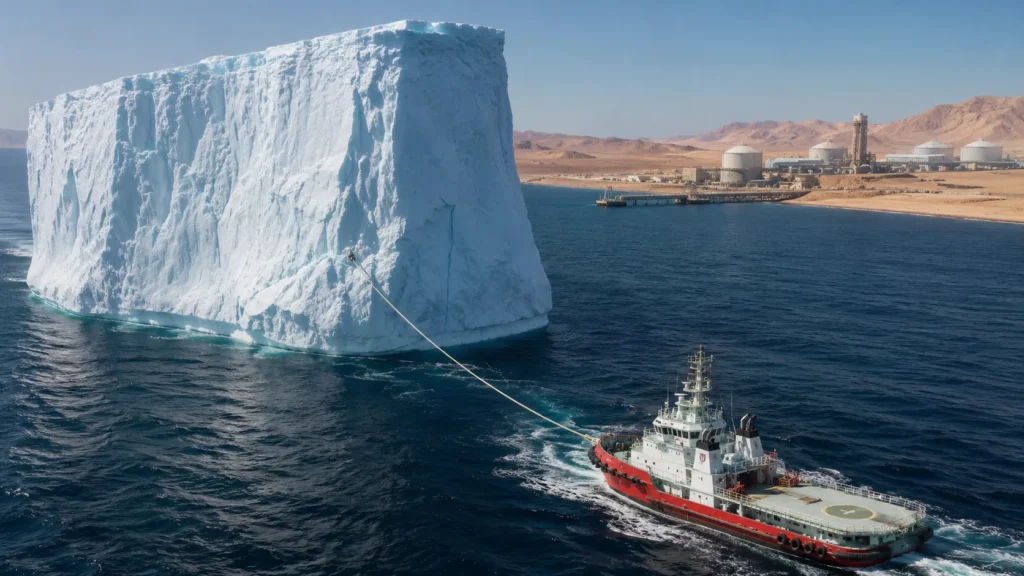
Now imagine looking south. Way south. To a continent of ice so vast it contains seventy percent of the world’s fresh water. There, tabular icebergs—flat-topped giants the size of small countries—break free from the ice shelves and drift into the Southern Ocean. They are pure, frozen history, snow that fell thousands of years ago, untouched by pollution and industrial toxins. These colossal structures rise hundreds of feet above the waterline and plunge more than a thousand feet below, their submerged bulk displacing millions of tons of seawater. And they are melting uselessly into the saltwater, their ancient freshness dissipating into the vast saline desert of the ocean.
What if you could drag one of these frozen mountains across the ocean and park it off your coast? What if you could chip away at it, melt it down, and quench the thirst of a nation? What if you could treat these wandering relics of the Pleistocene as harvestable resources rather than distant curiosities?
This is not science fiction. This is an engineering gamble that has been debated in hushed boardrooms, sketched on napkins at international conferences, and calculated down to the last mill by some of the most brilliant minds of the last century. The idea of towing icebergs to desert countries is the Hail Mary pass of a planet running out of water. It is desperate, audacious, and maybe—just maybe—feasible. But it is also fraught with peril, uncertainty, and the kind of staggering ambition that has characterized humanity’s greatest engineering feats.
Part I: The Origin Story – A Vision Forged in the 1970s
The dream of moving ice across oceans is older than you think. In the nineteenth century, enterprising merchants shipped blocks of New England lake ice to the Caribbean, India, and even Australia, packed in sawdust to slow the melting. These early ice traders established the first global supply chains for a frozen commodity, proving that ice could survive long sea voyages if properly insulated. The trade peaked in the decades before mechanical refrigeration made it obsolete, but it planted a seed in the minds of engineers who began to think on a grander scale.
The modern concept of iceberg towing can be traced to the winter of 1853 to 1854, when a ship supplying San Francisco with Alaskan lake ice was forced to load glacier ice from the Baird Glacier near Sitka. The glacier ice proved so superior in quality and durability that it sparked interest in glacial sources. Between 1890 and 1900, small icebergs were both towed by ship and sailed from Laguna San Rafael in Chile to Valparaiso and even to Callao in Peru, a journey of nearly four thousand kilometers. These early ventures demonstrated that moving ice across significant distances was not merely theoretical but had been accomplished with the limited technology of the time.
But the idea didn’t really take hold until the resource-hungry 1970s. In that decade of oil shocks, environmental awakenings, and growing awareness of planetary limits, two American scientists decided to see if the idea was actually possible on an industrial scale. Wilford Weeks of the United States Army Cold Regions Research and Engineering Laboratory and William Campbell of the United States Geological Survey undertook a comprehensive feasibility study that would become the foundational document for all subsequent research.
Their report was surprisingly optimistic. In an era when water desalination was prohibitively expensive and energy costs were spiraling upward, they envisioned supertugs, perhaps nuclear-powered, hauling twenty-mile-long islands of ice from the Antarctic to parched coastal regions of South America and Australia. Their calculations showed that even after a slow tow trip lasting as long as six months, as much as sixty to seventy percent of an iceberg would remain unmelted. This was a stunning finding that challenged the prevailing skepticism of the scientific establishment.
The scientific establishment, which had long ridiculed the idea as the fantasy of eccentrics and dreamers, was forced to take notice. The report, published in the Journal of Glaciology, one of the most respected scientific journals in its field, described the concept as both technologically feasible and economically attractive. It was no longer a matter of whether icebergs could be towed, but whether the world had the will and the resources to do so.
The nineteen seventy-seven paper detailed the physics of the operation with meticulous precision. The researchers considered four main parts: locating the supply of icebergs, calculating towing requirements, estimating melting losses, and assessing economic feasibility. They concluded that icebergs of almost any desired size could readily be located in the Antarctic, where tabular icebergs calve from massive ice shelves like the Amery and the Ross. These ice shelves are essentially floating extensions of the Antarctic ice sheet, and they periodically shed enormous tabular icebergs that can persist for years in the Southern Ocean before drifting northward into warmer waters.
The Saudi Connection became the most ardent patron of this dream. Prince Mohammed Al-Faisal of Saudi Arabia saw icebergs as a potential solution to his nation’s chronic water shortages. The kingdom had no permanent rivers, relied heavily on desalination, and was facing the same depletion of ancient aquifers that plagues all desert nations. In nineteen seventy-seven, he co-sponsored the First International Conference on Iceberg Utilization, held at Iowa State University. The conference was a landmark event that brought together scientists, engineers, policymakers, and corporate representatives from around the world.
To demonstrate the viability of transporting ice, organizers went to extraordinary lengths. They had a twenty-five-hundred-pound block of ice from Portage Lake in Alaska wrapped in insulation and dry ice, then transported by helicopter, plane, and refrigerated truck to Ames, Iowa, at a cost of eight thousand five hundred dollars. The most expensive ice cube in the world was a publicity stunt designed to make the world believe that anything could be moved if the will was strong enough. The stunt succeeded in generating headlines and drawing attention to the conference.
The conference brought together some two hundred scientists—glaciologists, marine biologists, engineers, oceanographers, and economists—from eighteen nations. They discussed the logistics of wrapping giant icebergs in insulating skirts, the physics of towing a mountain through turbulent seas, the economics of turning Antarctic ice into desert water, and the environmental implications of harvesting ice from the last great wilderness. The proceedings filled multiple volumes and covered everything from the thermodynamics of melting to the geopolitics of Antarctic resource utilization.
But why go to such lengths? The answer is simple, and it remains the driving force behind today’s renewed interest: conventional water sources are running dry. The ancient aquifers that sustained desert civilizations for millennia are being depleted at rates that far exceed natural recharge. The rivers that once flowed through arid regions are now seasonal trickles or entirely dry. Desalination, while effective, is expensive and environmentally damaging. The search for alternatives is not a luxury but a necessity.
Part II: The Vanishing Aquifers
To understand why a country would consider towing a million-ton iceberg across an ocean, you have to understand the arithmetic of thirst. Water is not just a commodity; it is the foundation of civilization itself. Without water, there is no agriculture, no industry, no cities, no life. Desert nations are confronting this reality with growing urgency as their traditional water sources evaporate.
Desert nations are not just dry; they are getting drier. The United Arab Emirates has no naturally flowing permanent rivers. It relies on seasonal wadis, dry riverbeds that only fill during rare flash floods, and on the occasional rainfall that is both unpredictable and insufficient. For decades, the region tapped ancient aquifers, underground reserves that had accumulated over millennia. But these are now rapidly depleting due to over-extraction for agriculture, industry, and domestic consumption. The fossil water, as geologists call it, is a non-renewable resource that will eventually run out.
Desalination has been the salvation of the Gulf states. The UAE operates nearly seventy major desalination plants, contributing to fourteen percent of the world’s total desalinated water output. These plants are marvels of modern engineering, capable of turning the saltwater of the Persian Gulf into freshwater that sustains millions of people. But desalination is a Faustian bargain. It is energy-intensive, pouring greenhouse gases into the atmosphere while its brine byproduct poisons coastal marine life. The brine, which is twice as salty as seawater, is discharged back into the ocean, where it creates dead zones that suffocate fish and destroy coral reefs.
The energy cost of desalination is staggering. A typical reverse osmosis plant consumes about four to five kilowatt-hours of electricity per cubic meter of water produced. For a city of a million people, this translates into a power plant dedicated solely to making water. In oil-rich nations, this cost is manageable, but in a future of energy transitions and carbon taxes, the economics are shifting. Solar-powered desalination offers some hope, but it remains expensive and limited in scale.
Water scarcity is now a daunting global problem, according to a systematic review of unconventional water resources published in recent years. The search is on for alternatives, and ice is one of the most promising. Ice is one such unconventional water resource, which is available mainly in the Arctic and Antarctic. The vast ice sheets of Antarctica contain enough freshwater to cover the entire planet in a layer several hundred feet deep. Even a fraction of this resource could sustain desert nations for centuries.
The challenge is not merely one of supply. It is a logistical nightmare that has consumed researchers for decades. The International Conference on Iceberg Utilization in nineteen seventy-seven produced a wealth of research that is as relevant today as it was then. The fundamental physics of iceberg towing have not changed. What has changed is the urgency of the water crisis and the available technology.
The Physics of the Tow involves a complex interplay of forces that engineers must carefully balance. It is not like towing a ship. A ship is designed to cut through water with minimal resistance. An iceberg is a blunt, irregular block of frozen fresh water with a density slightly less than seawater. It displaces an enormous volume of seawater—remember, roughly five-sixths of an iceberg is below the surface. The submerged portion, called the draft, is the part that experiences the most drag.
The Weeks and Campbell study broke this down in considerable detail. Because drag increases with the square of velocity, you cannot tow a large iceberg fast. The steady-state towing velocity for large icebergs is less than half a meter per second, which translates to about one knot. To put that in perspective, a modern ocean tug might move at six to eight knots in open water. A one-knot tow means a journey of several thousand kilometers will take many months, during which the iceberg is constantly exposed to warm water and air.
For a trip from the Amery Ice Shelf to Western Australia, they estimated a transit time of over one hundred seven days. For the Ross Ice Shelf to the Atacama Desert in South America, over one hundred forty-five days. The journey from the Weddell Sea to Saudi Arabia would be even longer, potentially exceeding two hundred days. During these transits, the iceberg is subject to the vagaries of ocean currents, storms, and sea ice, all of which can affect its trajectory and integrity.
The central trade-off is this: you go slow to save fuel and reduce drag, but the longer the voyage, the more the iceberg melts. The rate of melting depends on the temperature of the water, the speed of the tow, the size and shape of the iceberg, and the effectiveness of any insulation. The warmer the water, the faster the melt. The faster the tow, the more warm water is forced against the iceberg’s sides, accelerating the melt. The smaller the iceberg, the more surface area it has relative to its volume, increasing the melt rate.
The Melting Problem is the single greatest challenge facing iceberg towing. The economics of the entire operation hinge on how much ice survives the journey. The research from the nineteen seventies was sobering. The studies showed that no unprotected iceberg, no matter how long or wide, would be likely to survive the ablation caused by a long trip to low latitudes. The warm water erodes the submerged sides of the berg through a process of forced convection melting. The iceberg sits in warm water, and as it moves, the water washes against its sides, melting it like a sugar cube in tea.
The process of melting is governed by the principles of heat transfer. Warm water contacts the ice, transferring heat energy that breaks the molecular bonds holding the ice together. The meltwater, being colder and slightly less dense than the surrounding seawater, rises along the iceberg’s sides, creating a turbulent boundary layer that enhances further melting. The rate of melting is proportional to the temperature difference between the water and the ice, and the speed of the water relative to the ice.
However, for shorter journeys, the math works. For a path length of three thousand kilometers at half a meter per second, the travel time is roughly seventy days. The estimated melt loss for such a trip is about sixty meters of ice. If an iceberg is thick enough—say, two hundred fifty meters thick—it can survive with more than half its volume intact. The smaller the iceberg, however, the more significant the melt loss. A hundred-meter-thick iceberg would lose sixty percent of its volume, making the venture economically marginal.
For the Australia route, the researchers projected that over fifty percent of the initial ice would be delivered. For the Atacama route, the figure was similar despite a longer journey, possibly due to favorable ocean currents that helped to insulate the iceberg. The Humboldt Current, which flows northward along the coast of Chile, brings cold water from the Southern Ocean, slowing the melt rate. The Weddell Sea to Saudi Arabia route, however, was far less favorable, requiring extensive insulation to keep the iceberg from melting entirely.
Part III: The Engineering – How to Insulate a Mountain
If melting is the enemy, then insulation is the weapon. The engineers of the nineteen seventies came up with ingenious ways to protect their frozen cargo. The challenge was formidable: how do you wrap a mountain? How do you insulate a structure that weighs millions of tons and is constantly shifting and grinding against itself?
The Insulating Skirt was one of the most detailed proposals to emerge from this era. The concept came from Georges L. Mougin, a French engineer who patented a thermal protective device for tabular icebergs in nineteen seventy-eight. His patent, assigned to ITI Limited in Paris, was a serious attempt to solve the thermal and mechanical protection problems that had plagued earlier proposals.
Mougin proposed a system of floating towers that would anchor a curtain of panels around the submerged portion of the iceberg. These panels would hang parallel to the vertical side walls of the iceberg, creating a vertical layer of calm water between the panel and the ice. The calm water would act as a thermal barrier, reducing the transfer of heat from the surrounding ocean to the ice. Because water is a poor conductor of heat when it is not moving, the insulated layer would significantly reduce the melt rate.
The panels were described in the patent as coated or uncoated woven or non-woven material, one hundred to two hundred meters long and approximately ten meters high. They were ballasted by cables to keep them in position and suspended from horizontal cables attached to the floating towers. The entire system was designed to be flexible, able to accommodate the irregular shape of the iceberg and its gradual melting over time.
The concept was elegant in its simplicity. The vertical layer of calm water would be maintained by the natural tendency of meltwater to rise along the iceberg’s sides. Because the meltwater was fresh and slightly less dense than the surrounding seawater, it would form a stable layer that inhibited convection. This would slow the transfer of heat from the warm seawater to the cold ice.
However, even with the skirt, the iceberg would slowly melt. The patent acknowledged this reality: when being used on an industrial basis, the tabular iceberg slowly melts, because of the removal of melted ice from the surface and because of the natural melting which the thermal protective device and the mechanical protective device formed by the floating towers can only slow down. The draft of the iceberg would decrease over time, forcing operators to partially raise the protective device to avoid it being damaged as the iceberg was beached.
The skirt’s limitations were significant. It could not prevent all melting, only slow it down. It required constant adjustment and maintenance. It was vulnerable to storms, which could damage the panels or dislodge the anchoring system. And it was expensive, requiring the manufacture and deployment of vast quantities of specialized material.
Other Insulation Concepts were explored by researchers who questioned whether a physical skirt was the best approach. Some suggested wrapping the iceberg in a canvas-like skirt made of heavy-duty fabric, similar to the covers used to protect outdoor equipment. Others proposed spraying the iceberg with a coating, such as a polymer foam, that would reduce melting by creating a thermal barrier. The coating would be applied to the exposed surfaces of the iceberg before the tow began and would gradually wear away during the journey.
There were even discussions of using the iceberg’s own meltwater to create a cold-water boundary layer, a sort of self-insulating effect. The meltwater, being cold and fresh, would form a layer around the iceberg that would inhibit convection. This idea was attractive because it required no additional materials, but it was also uncertain in its effectiveness. The meltwater would tend to rise and be carried away by ocean currents, reducing its insulating effect.
The challenge was always the same: the cost of the insulation had to be less than the value of the water saved. If it cost more to wrap an iceberg than the water was worth, the whole scheme collapsed. The economics of insulation were therefore as important as the physics.
The Towline Dynamics were another critical aspect of the engineering challenge. Towing a massive iceberg through the ocean is not like towing a ship. The iceberg has no propulsion system, no steering mechanism, and no way to adjust its course. The towline must transmit all the force from the tugboat to the iceberg, and that force must be applied at exactly the right point to keep the iceberg on course.
If the towline is attached too high on the iceberg, the force will cause the iceberg to tilt, potentially capsizing it. If it is attached too low, the force will cause the iceberg to plow through the water, increasing drag and fuel consumption. The ideal attachment point is at the center of the iceberg’s submerged draft, where the force is applied evenly.
The towline itself must be incredibly strong, capable of withstanding the immense forces generated by the tow. A million-ton iceberg moving at one knot generates a drag force of hundreds of tons. The towline must be able to handle this force without breaking, and it must be long enough to allow the tugboat to maneuver without being drawn into the iceberg’s path.
The stability of the iceberg is another concern. A tabular iceberg is generally stable because it is wide and flat. However, as it melts, its center of gravity shifts, and it may become unstable. If the iceberg tilts or rolls, it can damage the towline, the insulation, or the tugboat. The risk of capsizing is particularly high during storms, when waves and wind can exert additional forces on the iceberg.
Part IV: The Macro-Economics – Mills, Cents, and Drops
In the nineteen seventies, the cost estimates were shockingly low, at least on paper. The Weeks and Campbell study calculated that, after total towing charges were paid, it would be possible to deliver ice to Western Australia for one point three mills per cubic meter of water, and to the Atacama Desert region for one point nine mills per cubic meter. A mill is one-tenth of a cent, so this was roughly one-tenth of a cent per cubic meter.
To put this in perspective, a cubic meter of water is about two hundred sixty-four gallons. At one point three mills per cubic meter, a thousand gallons would cost less than a penny. This was dramatically cheaper than desalination, which at the time cost between fifty cents and a dollar per cubic meter, and cheaper even than conventional water supplies in some regions.
The math was compelling. A single super-tug towing a sufficiently large iceberg could deliver enough water to irrigate sixteen thousand square kilometers—approximately the area of Kuwait or the state of Connecticut. This was enough water to transform a desert into farmland, to support a growing population, and to sustain an industrial economy. The economic implications were staggering.
The expected market price for water in those regions was about eight mills per cubic meter. Even at the low end, the profit margin was substantial. A successful iceberg towing operation could generate significant revenue while providing affordable water to a thirsty region.
The Inflation of Reality, however, quickly caught up with these optimistic projections. The nineteen seventies numbers didn’t account for the soaring energy costs of the decades that followed, the regulatory hurdles that would be imposed, or the immense investment required to build the super-tugs and insulating skirts. The cost of building a super-tug capable of towing a million-ton iceberg was estimated at the time at hundreds of millions of dollars, and the cost has only increased since then.
The towline alone would cost millions, the insulation millions more, and the support vessels for the operation would add millions more. The port infrastructure to receive the iceberg would require tens of millions of dollars. The water treatment facilities to melt and distribute the iceberg water would require additional investment. The total capital cost of a full-scale iceberg towing operation would be measured in billions of dollars, not millions.
A nineteen seventy-eight assessment of the Saudi Arabia route provided a more detailed economic analysis. The researchers Basmaci and Jamjoom calculated the cost of delivering iceberg water to the Kingdom using various insulation and towing options. They concluded that the operation could be economically viable if the iceberg was sufficiently large and the insulation effective. However, they also noted that the costs were highly dependent on the assumptions used, and that a slight increase in fuel costs or a slight decrease in iceberg survival could render the operation unviable.
A systematic review of the literature in the twenty-first century identified economic considerations and risks associated with iceberg towing as the main limitations to iceberg harvesting. The costs are simply too high and the risks too uncertain for private investors to take on alone. Government subsidies or public-private partnerships would likely be necessary to move the concept from theory to practice.
The environmental impacts of iceberg towing were also a concern in the economic analysis. The removal of ice from the Antarctic could affect local ecosystems, while the introduction of freshwater into desert regions could have both positive and negative effects. The main sources of icebergs showed a statistically significant decreasing trend from two thousand five to two thousand nineteen, as climate change accelerated the melting of Antarctic ice shelves. The ice is disappearing, and the economics of harvesting it are becoming less favorable.
The irony of towing Antarctic ice to desert nations is that the ice exists because of the very climate changes making those nations even thirstier. The same global warming that is melting the ice caps is also intensifying droughts in arid regions. The two phenomena are linked by a common cause: the increasing concentration of greenhouse gases in the atmosphere.
Part V: The Route – Paths of the Frozen Giants
Not all destinations are created equal when it comes to iceberg towing. The shortest and most efficient routes are from the Antarctic ice shelves to the southern coasts of the driest continents. The choice of route affects everything from the survival of the iceberg to the cost of the operation.
Route One: Amery Ice Shelf to Western Australia. The Amery Ice Shelf, located in East Antarctica, is the primary calving ground for icebergs destined for Australia. The journey is roughly three thousand to four thousand kilometers across the Southern Ocean, depending on the exact destination. With a travel time of approximately one hundred seven days, this is the sweet spot for iceberg towing. The cooler waters of the Southern Ocean slow the melting process, making Australia the most realistic first target for a pilot project.
The route passes through waters that are relatively free of sea ice and navigable for most of the year. The ocean currents in the region are generally favorable, flowing from west to east and helping to move the iceberg toward its destination. The West Australian coast has several deep-water ports that could potentially handle a large iceberg, and the region has a significant agricultural sector that could benefit from the additional water.
Route Two: Ross Ice Shelf to the Atacama Desert. The Ross Ice Shelf, on the other side of Antarctica, points toward South America. The Atacama Desert in Chile and Peru is one of the driest places on Earth, with some areas receiving no rainfall for decades. The journey here is longer—over one hundred forty-five days—but some researchers argued that favorable ocean currents and cooler water temperatures would help preserve the ice.
The Humboldt Current, which flows northward along the coast of South America, brings cold water from the Southern Ocean to the Atacama region. This current could help to keep the iceberg cool during the final stages of its journey. The Atacama has a desperate need for water, and the population centers along the coast are within easy reach of the iceberg once it arrives.
Route Three: The Weddell Sea to Saudi Arabia. The Saudis were not interested in Australia or South America. They wanted water for the Middle East. The route from the Weddell Sea in Antarctica to Saudi Arabia is among the longest and most challenging. The Weddell Sea is located on the opposite side of Antarctica from the Middle East, and the journey requires navigating through the Drake Passage, around Cape Horn, and up the Atlantic Ocean to the Red Sea.
In a nineteen seventy-eight assessment, researchers Basmaci and Jamjoom analyzed this route in detail. They concluded that the Coriolis force could actually be helpful if the route was selected properly. The Coriolis force is the apparent deflection of moving objects caused by the Earth’s rotation. In the Southern Hemisphere, it deflects moving objects to the left, which could help to steer the iceberg along a favorable path.
They noted that the Coriolis force is opposed by the drag of the water. Therefore, the Coriolis force does not affect the system with its full magnitude. However, that force is shown to be helpful in towing if the route between Antarctic and Saudi Arabia is selected properly. By taking advantage of the Coriolis force and the ocean currents, the tow could be made more efficient and the iceberg’s survival improved.
But even with favorable currents, the long journey through warm waters presented a huge challenge. The iceberg would pass through the tropics, where the water temperature is high enough to cause rapid melting. The researchers recommended insulation of icebergs to keep ablation within economical limits. Without it, the iceberg would not survive the journey.
Route Four: The Weddell Sea to the Persian Gulf. An alternative route for the Saudis would be to tow the iceberg through the Indian Ocean and into the Persian Gulf. This route is also long, but it avoids the tropics and the associated rapid melting. The Persian Gulf is a body of water that is already used for desalination, so the infrastructure to handle water is in place.
The challenge of this route is the narrow Strait of Hormuz, which is only a few kilometers wide and heavily trafficked. A large iceberg would be difficult to maneuver through the strait, and the risk of collision with tankers and other vessels would be high. The Gulf itself is shallow, with average depths of only about fifty meters, which could make it difficult to moor the iceberg without it running aground.
Route Five: The Antarctic Peninsula to Southern Africa. A route that has been less discussed in the literature but is potentially viable would take icebergs from the Antarctic Peninsula to the southern coast of Africa. The journey is relatively short, and the Cape of Good Hope region has a significant water shortage. The iceberg could supply water to South Africa’s agricultural regions or even to the country’s major cities.
The Antarctic Peninsula is one of the fastest-warming regions on Earth, and icebergs are calving from its glaciers at an accelerating rate. The icebergs could be harvested before they drift north into warmer waters, reducing the travel time and increasing the survival rate. The route passes through the Atlantic Ocean, which is relatively sheltered compared to the Southern Ocean.
Route Six: The Weddell Sea to Australia’s East Coast. An alternative Australian route would take icebergs from the Weddell Sea, across the Indian Ocean, and to Australia’s east coast. This route is longer than the Amery route but could access additional water sources. The east coast of Australia is more populated than the west coast and has a greater need for water.
The route would pass through the Southern Ocean and around the southern coast of Australia before heading north. The travel time would be longer, but the iceberg could potentially use ocean currents to assist the tow. The East Australian Current, which flows southward along the coast, could be used to help the iceberg reach its destination.
Part VI: The Modern Context – From Fantasy to Survival Strategy
The changing climate has transformed the conversation around iceberg towing from a futuristic fantasy to a survival strategy for some nations. The urgency of the water crisis is forcing governments to consider options that would have been dismissed as impractical only a few decades ago. The politics of water are becoming as fraught as the politics of oil.
The irony of iceberg towing is that climate change is making it both more and less plausible. On one hand, desert nations are becoming more desperate. The United Arab Emirates, which has no natural rivers, aims to increase the water productivity index to one hundred ten United States dollars per cubic metre and reduce total water demand by twenty-one percent under its Water Security Strategy two thousand thirty-six. They want to reuse ninety-five percent of treated wastewater. These are the actions of a nation preparing for a water emergency.
The UAE is building massive reservoirs, investing in cloud seeding technology, and developing desalination plants that are powered by solar energy. They are also exploring the possibility of importing water from other countries. In this context, iceberg towing is not a standalone solution but part of a broader portfolio of water security measures.
On the other hand, the main sources of icebergs are shrinking. A systematic review found that the main sources of icebergs showed a statistically significant decreasing trend for all months and seasons during two thousand five to two thousand nineteen. The ice is calving faster, but there is less of it. The larger tabular icebergs, prized for towing, may become rarer.
The warming climate is causing the Antarctic ice shelves to thin and retreat, reducing the size of the icebergs that calve from them. The smaller icebergs are less suitable for towing because they melt faster and are less stable. The future of iceberg harvesting may depend on finding new sources of ice in regions that are currently inaccessible.
The Agricultural Innovation Angle is another critical dimension of the modern context. While the engineers debate the physics of towing, agronomists are focused on making every drop count. The International Center for Agricultural Research in the Dry Areas has developed Integrated Desert Farming Systems that combine resilient crops, advanced water harvesting, and solar-powered technologies.
In the UAE and Oman, the center has demonstrated that root zone cooling—using solar-powered chilled water to maintain root temperatures—can allow cucumbers to thrive even when external temperatures soar above forty-two degrees Celsius. The water productivity gains are stunning. Tomato plants in hydroponic systems produced forty-eight kilograms per cubic meter compared to just seven kilograms per cubic meter in conventional systems—nearly seven times more per cubic meter of water.
Ultra-low-energy drip irrigation systems, developed with the Massachusetts Institute of Technology, require a pressure of just fifteen kilopascals, reducing pumping needs by eighty percent. This makes it feasible for even small, off-grid farmers to use solar energy. The systems are simple, robust, and designed to work in the harsh conditions of desert agriculture.
These innovations are changing the equation. Water is no longer just about supply; it’s about efficiency. If desert farming can be made radically more water-efficient, then the water from an iceberg could stretch much further. A single iceberg could support a thriving agricultural sector that would have been impossible with traditional irrigation methods.
The Pilot Project Dilemma is the biggest barrier to progress. For any sort of a pilot project, the selected iceberg would have to be quite small, if for no other reason than the practical availability of tug power. It is unreasonable to postulate development of a super-tug for a pilot project. To test the feasibility, you need a small iceberg. But a small iceberg melts too fast. The economics only work with a large iceberg. But to tow a large iceberg, you need a super-tug that doesn’t exist yet. The capital investment required is so enormous that no single entity is willing to take the risk.
The nineteen seventy-seven conference in Iowa attempted to break this deadlock by bringing together scientists, governments, and corporate representatives. But the funding never materialized. The oil shocks of the nineteen seventies faded, and the world became complacent about water. The memory of the energy crisis faded, and the urgency of the water crisis was not yet apparent.
The projects that were proposed in the aftermath of the conference were ambitious but ultimately went nowhere. A consortium of Saudi and American companies investigated the feasibility of an iceberg towing operation, but the project was abandoned due to high costs and technical uncertainties. The French engineer Georges Mougin continued to promote the idea for decades, but he was unable to secure the necessary funding.
Today, the conversation has shifted. The focus is no longer on whether iceberg towing is technically possible, but on whether it is economically and politically feasible. The technology has advanced, but the challenges remain. The super-tugs that were envisioned in the nineteen seventies could be built today, but they would cost billions of dollars. The insulating skirts could be manufactured using modern materials, but the cost would still be high.
The political obstacles are even more daunting. The Antarctic Treaty System, which governs the continent, prohibits commercial exploitation of Antarctic resources. Any iceberg harvesting operation would require international approval and likely a revision of the treaty. The environmental groups that monitor Antarctic activities would resist any attempt to harvest ice from the continent. The legal framework for iceberg harvesting is uncertain and contested.
Part VII: The Future – A Frozen Gamble
The technology is ready. The fundamental physics of iceberg towing have been understood for decades. The materials science to build insulating skirts is available. The navigation and satellite tracking systems to locate and guide icebergs are more advanced than ever. The tugboat technology to provide the immense bollard pull required to drag a frozen mountain can be built within current engineering capabilities.
The calculations show that a tugboat that can be built within the capabilities of current technology is capable of towing extremely large icebergs. The melting losses, while significant, are manageable for journeys to Australia and South America. The economic feasibility, at least in the narrow sense of cost per cubic meter, appears positive when compared to desalination.
The will to act is the missing ingredient. The real question is not whether we can tow icebergs, but whether we have the collective will to do so. It requires unprecedented international cooperation. The iceberg must be harvested from Antarctic waters, which are governed by the Antarctic Treaty System. There are environmental concerns about disrupting marine ecosystems.
The environmental groups that have fought to protect Antarctica would vigorously oppose any industrial activity on the continent, including iceberg harvesting. The green credentials of the operation would be scrutinized, and any environmental damage, however minimal, would be used as evidence against it. The public perception of iceberg towing would be shaped by this debate, and the operation could easily be derailed by a single negative headline.
Then there are the practical concerns of the destination. How do you process a mountain of ice? You could chop it up and melt it, but that requires specialized equipment. You could slurry the ice chips and pump them to shore in a pipeline. Commutated solids can be transported in pipelines as suspensions or slurries. Coal can be transported economically as a water slurry, and slurry transport for ice may be even more attractive, since the solid phase is almost neutrally buoyant.
The slurry would need to be about fifty-fifty ice and water by weight to be fluid enough to pump. A pipe of about one meter diameter could deliver at the rate of about two point four cubic meters per second, or about two hundred thousand cubic meters per day. The specific energy required would be less than thirteen megajoules per cubic meter for a one-kilometer transport distance—about six kilowatt-hours per ton-mile. This is not cheap, but it is within the realm of the possible.
The processing of the iceberg would require a dedicated facility on the coast, including a mooring system to hold the iceberg in place, a cutting system to break the ice into manageable chunks, a pumping system to transport the ice slurry to shore, and a melting system to convert the ice into freshwater. The facility would also need storage tanks to hold the freshwater until it could be distributed.
The Specter of Failure is ever-present. Imagine the headlines if a pilot project failed: Iceberg Towing Disaster: Multi-Million Dollar Ice Cube Melts in Atlantic. The political fallout would be immense. No politician wants to be the one who greenlit a project that ended in a giant pool of freshwater in the middle of the ocean. The risk of embarrassment is as great as the risk of financial loss.
The failure could take many forms. The iceberg could melt faster than expected, delivering only a fraction of the anticipated water. The towline could break, sending the iceberg adrift. The iceberg could capsize, becoming unstable and dangerous. The insulation could fail, causing the iceberg to melt from the inside out. Any of these failures would be catastrophic for the project and for the reputation of its sponsors.
The environmental impact of a failed project could be significant as well. The ice, if it melted in the wrong place, could disrupt ocean currents and affect local ecosystems. The freshwater released into the ocean could change the salinity of the water, affecting marine life. The fragments of insulating material could wash up on beaches, creating a pollution problem.
The Moral Dimension adds another layer of complexity. The Antarctic ice is the last great wilderness. Is it right to harvest it for the benefit of wealthy desert nations? Should we be focusing on efficiency and conservation rather than mega-engineering projects? The ethics of iceberg towing are contested, and the debate reflects broader questions about environmental justice and resource allocation.
These are valid questions. But they are questions born of privilege. For the people living in the Atacama Desert, or in the arid regions of Western Australia, or in the parched villages of Yemen, water is not an abstraction. It is survival. They do not have the luxury of debating the moral implications of towing an iceberg. They are watching their wells run dry.
The proponents of iceberg towing argue that the Antarctic ice is already calving into the ocean and melting uselessly. Towing it to a desert nation is simply harvesting a resource that would otherwise be wasted. The environmental impact of a few icebergs is negligible compared to the environmental devastation caused by the over-extraction of groundwater and the carbon emissions from desalination plants.
The environmental impact of iceberg harvesting is not zero, but it is relatively small compared to the alternatives. The icebergs that are harvested would otherwise melt into the ocean, contributing to sea-level rise. Harvesting them removes a small amount of mass from the Antarctic ice sheet, which is already losing mass due to climate change. The net effect on sea level is negligible.
The carbon footprint of iceberg towing is also small compared to desalination. A super-tug powered by nuclear energy would produce no carbon emissions during the tow. Even a conventionally powered tug would produce far fewer emissions than the equivalent desalination capacity. The energy required to melt the ice and transport the water to inland locations would be additional, but it would still be less than the energy required for desalination.
The Compromise—Hybrid Solutions—is perhaps the most realistic path forward. Instead of an all-or-nothing bet on icebergs, nations could pursue a mix of strategies that includes iceberg towing as one component.
The UAE, for example, is investing in a mix of strategies: desalination powered by renewable energy, wastewater recycling, strategic water storage, and agricultural innovation. They are aiming for a twenty-one percent reduction in total water demand. They are using crop models like APSIM and AquaCrop to simulate crop yields and optimize water use. In this context, an iceberg is not a silver bullet. It is a supplement. It could provide a massive, one-time influx of freshwater to fill reservoirs and recharge aquifers, buying time for more sustainable solutions to take root.
The iceberg could be used to recharge depleted aquifers, which would store the water underground and reduce evaporation losses. It could be used to create artificial wetlands, which would support wildlife and provide recreational opportunities. It could be used to support urban green spaces, reducing the urban heat island effect and improving the quality of life for residents.
The water from an iceberg could be blended with water from other sources to improve its quality. The iceberg water is exceptionally pure, with almost no dissolved solids or contaminants. It would be ideal for use in high-tech industries that require ultra-pure water, or for blending with brackish water to reduce its salinity.
Part VIII: The Historical Context – Failed Dreams and Persistent Visions
The idea of iceberg towing has a long history of visionary proposals that failed to materialize. Understanding this history is essential to appreciating the challenges that remain and the reasons why the idea persists despite decades of setbacks.
The nineteenth-century ice trade was the precursor to iceberg towing. New England entrepreneurs discovered that they could cut blocks of ice from frozen lakes, pack them in sawdust for insulation, and ship them to the Caribbean, India, and even Australia. The trade peaked in the eighteen seventies, when millions of tons of ice were shipped annually. The ice was used for refrigeration, cooling drinks, and preserving food. It was a luxury commodity, but it demonstrated that ice could be transported over long distances.
The ice trade declined with the invention of mechanical refrigeration in the late nineteenth century. The new technology allowed ice to be made anywhere, at any time, at a lower cost than shipping natural ice. The ice trade faded into history, but it left behind a legacy of entrepreneurial daring and a belief that the laws of thermodynamics could be overcome.
The twentieth century saw periodic revivals of interest in moving ice. During the Second World War, military planners considered towing icebergs to create artificial islands for airfields, a concept known as Project Habakkuk. The idea was to use the icebergs as floating runways for aircraft, allowing the Allies to project air power across the Atlantic. The project was ultimately abandoned as impractical, but it demonstrated that the military establishment took the idea seriously.
The nineteen seventies brought a new wave of interest in iceberg towing, driven by the oil shocks and the growing awareness of environmental limits. The nineteen seventy-seven conference at Iowa State University was the high-water mark of this wave of interest. The conference brought together scientists, engineers, and policymakers from around the world and generated a wealth of research on the feasibility of iceberg towing.
In the aftermath of the conference, several serious proposals were developed. The Saudi government commissioned studies on the feasibility of towing icebergs from Antarctica to the Persian Gulf. The French engineer Georges Mougin spent decades promoting his insulating skirt concept. The Soviet Union reportedly considered iceberg towing as a way to supply water to its arid Central Asian republics.
None of these proposals came to fruition. The oil shocks of the nineteen seventies faded, and the urgency of the water crisis was not yet apparent. The costs were too high, the risks too uncertain, and the political will too weak. The idea of iceberg towing was relegated to the pages of science fiction magazines and the fantasies of eccentrics.
The twenty-first century brought a new urgency to the water crisis, driven by climate change, population growth, and economic development. The depletion of aquifers and the failure of conventional water sources forced a reappraisal of unconventional options. Iceberg towing once again became a topic of serious discussion.
The technological advances of the intervening decades have made iceberg towing more feasible than ever. Satellite tracking systems can locate icebergs with precision. Advanced materials can provide effective insulation. Powerful tugboats can tow large icebergs. The knowledge gained from decades of research in oceanography, glaciology, and fluid dynamics can be applied to the design of the operation.
However, the economic and political challenges remain as daunting as ever. The cost of a full-scale iceberg towing operation is measured in billions of dollars. The risk of failure is high. The political and environmental opposition is intense. The path from theory to practice is littered with the debris of failed proposals.
Part IX: The Technological Innovations – Beyond the Skirt
The technology for iceberg towing has advanced significantly since the nineteen seventies. The insulating skirt is still the most discussed concept, but other technological innovations have been developed that could improve the feasibility of iceberg towing.
The Super-Tug is the most critical piece of equipment. A conventional tugboat has a bollard pull of thirty to fifty tons. A super-tug, as envisioned in the nineteen seventies, would have a bollard pull of hundreds or even thousands of tons. The power required would be immense, and the fuel consumption would be staggering. A nuclear-powered super-tug could provide the necessary power without the need for frequent refueling.
The development of nuclear marine propulsion for civilian vessels has been limited due to safety concerns and regulatory obstacles. However, the technology exists and has been used in military vessels for decades. A nuclear-powered super-tug could be built using existing reactor designs, but the political and regulatory approval would be difficult to obtain.
The development of autonomous vessels could reduce the cost of towing by eliminating the need for crew quarters, life support systems, and other accommodations. An autonomous super-tug could be controlled remotely, reducing the risk to human life and allowing for more efficient operation. The technology for autonomous navigation already exists and is being used in a variety of maritime applications.
The Satellite Tracking of icebergs is another technological advance that has improved feasibility. The National Oceanic and Atmospheric Administration and other agencies track icebergs using satellite imagery and other remote sensing technologies. The location and movement of icebergs can be monitored with precision, allowing operators to select the most suitable candidates for towing.
The satellite tracking also allows for the prediction of iceberg trajectories, which can be used to plan the most efficient route. The icebergs move in response to ocean currents, wind, and other forces, and their paths can be modeled using computer simulations. By selecting the iceberg that is already moving in the right direction, operators could reduce the towing distance and the associated cost.
The Processing of the iceberg has also been improved by technological advances. The iceberg could be cut into manageable chunks using wire saws, explosive charges, or thermal lances. The chunks could be transported to shore using slurry pipelines, barges, or conveyor belts. The processing equipment could be powered by renewable energy sources, reducing the carbon footprint of the operation.
The storage of iceberg water is another innovation that could improve the feasibility of iceberg towing. Instead of using the water immediately, it could be stored in large reservoirs, underground aquifers, or ice warehouses. The storage would allow for the water to be used during periods of peak demand, smoothing the supply and reducing waste.
The ice warehouses could store the ice in a frozen state, preventing evaporation and reducing the need for treatment. The warehouses would need to be insulated to prevent melting, but they could be built using earth-covered berms or other natural insulation. The ice could be stored for years if necessary, providing a strategic reserve of water.
Part X: The Environmental Impact – A Complex Equation
The environmental impact of iceberg towing is a complex and contested issue. The operation would have effects on both the source region and the destination region, and the net impact would depend on a variety of factors.
The Antarctic ecosystem is one of the most pristine and fragile on Earth. The harvesting of icebergs could disrupt this ecosystem by removing habitat for marine life, altering ocean currents, and affecting the food web. The icebergs are important habitats for seals, penguins, and other animals, and their removal could have cascading effects.
The environmental groups that monitor Antarctic activities are concerned about the impact of industrial activity on the continent. The Antarctic Treaty System prohibits commercial exploitation of Antarctic resources, and any harvesting operation would require international approval. The approval process would likely involve extensive environmental impact assessments and could take years to complete.
The melting of the iceberg during the tow could also have environmental effects. The freshwater released into the ocean could alter the salinity of the water, affecting marine life. The cold water could lower the temperature of the ocean, affecting local climate patterns. The nutrients contained in the iceberg could stimulate plankton growth, with unpredictable effects on the food web.
The introduction of the iceberg into the destination region could have both positive and negative effects. The freshwater could be used to recharge depleted aquifers, support agriculture, and supply cities. The iceberg could also create new habitats for marine life, attract tourists, and improve the aesthetic appeal of the coast.
The positive effects of iceberg towing must be weighed against the negative effects. The desert nations that are considering iceberg towing are facing water crises that threaten their survival. The environmental damage caused by the operation must be compared to the environmental damage caused by the alternatives.
The alternatives to iceberg towing—desalination, groundwater extraction, and water importation—all have significant environmental impacts. Desalination consumes large amounts of energy and produces toxic brine that pollutes marine ecosystems. Groundwater extraction depletes aquifers and causes land subsidence. Water importation requires infrastructure development and can have geopolitical implications.
The environmental equation is not simple. The iceberg towing operation would have impacts, but they may be less severe than the impacts of the alternatives. The key is to minimize the negative effects through careful planning, monitoring, and mitigation.
Part XI: The Economic Feasibility – A Cost-Benefit Analysis
The economic feasibility of iceberg towing is the most important factor in determining whether it will ever be attempted on a commercial scale. The cost-benefit analysis must consider both the direct costs of the operation and the indirect benefits of the water supply.
The direct costs of iceberg towing include the following: the cost of the super-tug, which would be measured in billions of dollars; the cost of the insulating skirt, which would be measured in tens of millions; the cost of the towline, the support vessels, the processing facility, the storage facility, and the distribution system; the cost of the crew, the maintenance, and the insurance; and the cost of the fuel or reactor fuel.
The indirect costs include the environmental impact costs, the regulatory compliance costs, the political risk costs, and the opportunity costs of the investment. The indirect costs are more difficult to quantify, but they must be included in the cost-benefit analysis.
The benefits of iceberg towing include the value of the water supply, the economic value of the agricultural production supported by the water, the value of the industrial production supported by the water, and the value of the social stability provided by the water. The water supply is not just a commodity; it is a foundation of civilization.
The value of water varies widely depending on the region and the use. In desert nations with chronic water shortages, the marginal value of water can be extremely high. A cubic meter of water that is used to irrigate crops can generate hundreds of dollars of agricultural production. A cubic meter of water that is used in industry can generate thousands of dollars of industrial output. A cubic meter of water that is used to sustain a city can prevent social unrest and economic collapse.
The economics of iceberg towing also depend on the cost of the alternatives. In regions where desalination is the primary water source, the cost of iceberg water must be compared to the cost of desalinated water. Desalination costs vary depending on the technology, the energy source, and the scale of the operation. In general, desalination costs between half a dollar and a dollar per cubic meter, with lower costs for large-scale, energy-efficient plants.
The cost of iceberg water, as estimated in the nineteen seventies, was less than a cent per cubic meter. This estimate did not account for the full cost of the operation, including the capital costs of the infrastructure. A more realistic estimate, based on the current technology and costs, would be several cents per cubic meter. This is still lower than the cost of desalination, but the gap is narrowing.
The economic feasibility of iceberg towing also depends on the scale of the operation. A single super-tug could deliver enough water to support a city of a million people. The economies of scale are significant, and a larger operation would have lower unit costs. However, the capital investment required for a larger operation is also larger, and the risk of failure is greater.
The economic feasibility must also consider the timing of the project. The costs are incurred upfront, while the benefits are realized over time. The payback period of a multi-billion-dollar investment could be decades, and the project would need to be financed at a reasonable interest rate. The risk of cost overruns or delays could make the project unviable.
Part XII: The Geopolitical Implications – Water as a Weapon
Water is not just a resource; it is a geopolitical issue. The control of water resources has been a source of conflict and cooperation throughout history. The prospect of iceberg towing adds a new dimension to the geopolitics of water.
The nations that are most likely to pursue iceberg towing are the desert nations with high water demand and limited conventional supplies. These nations include Saudi Arabia, the United Arab Emirates, Australia, Chile, Peru, and South Africa. Each of these nations has its own geopolitical context and its own motivations for pursuing iceberg towing.
Saudi Arabia is a regional power with significant oil wealth. The kingdom has been a leading proponent of iceberg towing since the nineteen seventies. The kingdom’s water demand is high, and its aquifers are being depleted. The kingdom has also been a major player in international water politics, funding research and advocating for unconventional water sources.
The UAE is a federation of emirates that has experienced rapid economic growth and population increase. The UAE has invested heavily in desalination and water conservation, but it has also expressed interest in iceberg towing. The UAE is a relatively small country with limited resources, and it sees iceberg towing as a way to enhance its water security.
Australia is a continent with a dry interior and a growing population along its coasts. The country has experienced severe droughts and has been forced to invest in desalination and water recycling. Australia has been a leader in water management and has the technical expertise to pursue iceberg towing. The country also has the logistical advantage of being relatively close to the Antarctic ice shelves.
The geopolitical implications of iceberg towing are significant. The nations that control the iceberg supply would have a strategic advantage over those that do not. The Antarctic ice is a common resource, and its allocation would be a matter of international negotiation. The nations that can afford to harvest the ice would have a distinct advantage over those that cannot.
The environmental groups and the international community would monitor any iceberg harvesting operation closely. The operation could be a test case for the governance of Antarctic resources. The success or failure of the operation would set a precedent for future resource extraction in the continent.
The water crisis is a global problem that requires global solutions. The iceberg towing proposal is one potential solution, but it is not the only one. The world must invest in water conservation, efficiency, recycling, and alternative supplies. The iceberg towing proposal is part of a broader portfolio of solutions, not a standalone answer.
Part XIII: The Water Productivity Revolution
While the engineers debate the logistics of towing icebergs, a quiet revolution in water productivity is changing the calculus of water scarcity. The innovations in irrigation, crop breeding, and soil management are making every drop of water go further.
The Smart Irrigation systems are at the forefront of this revolution. The traditional flood irrigation method, which wastes up to sixty percent of the water applied, is being replaced by drip irrigation, which delivers water directly to the plant roots. The drip irrigation systems use sensors to monitor soil moisture and weather conditions, adjusting the water application in real time.
The precision agriculture techniques allow farmers to apply water and nutrients exactly where they are needed. The GPS-guided tractors and drones map the fields and create variable-rate application maps. The farmers can reduce water use by ten to twenty percent while maintaining or increasing yields.
The solar-powered irrigation systems are making irrigation accessible to off-grid farmers. The photovoltaic panels power pumps that lift water from wells or streams. The systems are simple, durable, and cost-effective. They can be deployed in remote areas that are not connected to the electricity grid.
The crop breeding and genetic modification have produced drought-tolerant varieties of staple crops. The “water-efficient” maize, “nutrient-fortified” rice, and “climate-smart” wheat are being developed and deployed in water-scarce regions. The drought-tolerant crops can survive periods of water stress and produce yields with less water.
The Integrated Desert Farming Systems are combining these innovations into a holistic approach to desert agriculture. The systems use solar energy to power irrigation, cooling, and other processes. They use shaded structures to reduce evapotranspiration. They use efficient irrigation systems to deliver water to the roots. They use crop rotation and intercropping to improve soil health.
The impact of these innovations on the economics of iceberg towing is significant. If water productivity can be doubled or tripled, the value of each cubic meter of iceberg water increases. A cubic meter of water that can produce forty-eight kilograms of tomatoes has a much higher value than a cubic meter that produces only seven kilograms.
The water productivity revolution does not make iceberg towing unnecessary. Even with the most efficient irrigation, some regions will still need additional water. The iceberg towing would provide the additional water to support the higher-productivity agriculture.
Part XIV: The Public Perception and Political Will
The public perception of iceberg towing is a critical factor in its feasibility. The idea of towing icebergs is both captivating and controversial. The public is drawn to the audacity of the proposal, but it is also concerned about the environmental impact.
The Media Coverage of iceberg towing has been mixed. The popular science magazines and documentaries often present the idea as a visionary solution to the water crisis. The stories highlight the engineering challenges and the potential benefits. The coverage tends to be positive and optimistic, focusing on the promise of the idea rather than its pitfalls.
The social media and blogs have also discussed iceberg towing extensively. The discussions range from enthusiastic support to skeptical criticism. The enthusiasts see iceberg towing as a bold and innovative solution. The critics see it as a dangerous and wasteful fantasy.
The environmental groups have been generally critical of iceberg towing. They argue that the proposal is a distraction from the real work of water conservation and sustainable development. They also argue that the operation would damage the Antarctic ecosystem and set a dangerous precedent for resource extraction. The environmental groups have significant influence over public opinion and policy decisions.
The political will to pursue iceberg towing is mixed. Some politicians see it as a way to demonstrate their commitment to solving the water crisis. Others see it as a risky and expensive project that could fail. The political support for the idea is often contingent on the perceived urgency of the water crisis.
The decision-makers who are most likely to support iceberg towing are those who are facing severe and immediate water shortages. The leaders of desert nations, such as Saudi Arabia and the UAE, are under pressure to find solutions. They have the financial resources and the political authority to pursue ambitious projects.
The decision-makers who are most likely to oppose iceberg towing are those who are concerned about the environmental impact or the cost. The leaders of developed nations, such as the United States and Europe, are skeptical of the proposal. They have a more diverse set of water sources and a stronger environmental movement.
The public perception and political will are intertwined. The politicians respond to public opinion, and the public responds to the media coverage. A sustained campaign of public education and engagement would be necessary to build support for iceberg towing.
Part XV: The Final Verdict
So, is the idea of towing icebergs to desert countries a viable solution to the world’s water crisis? The answer is a cautious yes—but with a long list of caveats.
Yes, because the physics work. The calculations from the nineteen seventies have not been refuted. A large enough iceberg, properly insulated and towed slowly enough, can survive a trip to Australia or South America with more than half its volume intact. The cost per cubic meter could be competitive with desalination.
Yes, because the technology is within reach. The satellite tracking, the advanced materials, the supertugs—all are available. The engineering is challenging but not impossible. The lessons learned from decades of research in oceanography, glaciology, and fluid dynamics can be applied.
Yes, because the need is urgent. The desert nations are running out of water. The aquifers are drying up, the desalination plants are costly, and the population is growing. The status quo is not sustainable. The water crisis is not a distant threat; it is a present reality.
But no, because the will is lacking. The risk is too high, the investment too great, and the environmental scrutiny too intense. The international community is not yet willing to take the leap. The regulatory hurdles are significant, and the political opposition is fierce.
But no, because the logistics are daunting. Towing a multi-million-ton iceberg across an ocean is not a simple supply chain. It is a military operation requiring precision, coordination, and luck. The margin for error is small, and the consequences of failure are large.
And no, because the world is not desperate enough. Not yet. We are still in the phase of treating the symptoms of water scarcity—building desalination plants, drilling deeper wells—rather than confronting the disease. The true desperation will come when the wells run dry and the desalination plants cannot keep up.
The Catalyst for change will not be a scientific breakthrough. It will be a crisis. A city will run out of water. A drought will devastate a region. A desalination plant will fail. In the chaos, a desperate leader will look at the satellite imagery of the Southern Ocean and see an iceberg drifting by, a frozen mountain of salvation.
The first tow will be a gamble. It may fail. It may melt too fast. It may capsize. It may cost more than expected. But if it succeeds, it will change the world. The spectacle of a frozen mountain being dragged across the ocean to quench the thirst of a desert nation would be one of the greatest engineering achievements in history.
The idea of towing icebergs to desert nations is one of the most audacious engineering challenges ever conceived. It is a testament to human ingenuity and our desperate capacity to adapt. It transforms frozen relics of the distant past into survival assets for a drying planet.
It is a frozen gamble. But in the face of a water crisis that threatens to reshape the geopolitical order, it may be the only gamble worth taking.
Appendices: Technical Summary of Key Research
A. The Weeks and Campbell Appraisal (1977)
The foundational study that still serves as the benchmark for iceberg towing analysis.
Supply: The Antarctic ice shelves, particularly the Amery, Ross, and Filchner shelves, provide large tabular icebergs of almost any desired size. The icebergs are naturally calved from the ice shelves and drift into the Southern Ocean.
Towing: The steady-state towing velocity is less than half a meter per second for large icebergs. This is due to the drag forces that increase with the square of velocity. The tugs required can be built within current technology and are capable of towing extremely large bergs.
Melting: Over fifty percent of the ice can be delivered for routes to Australia and the Atacama Desert after transit times of one hundred seven and one hundred forty-five days, respectively. The melt rate depends on water temperature, towing speed, and iceberg dimensions.
Economics: The cost to deliver water to Western Australia is estimated at one point three mills per cubic meter. The cost to deliver to the Atacama Desert is estimated at one point nine mills per cubic meter. These costs compare favorably to the expected market price of eight mills per cubic meter.
Irrigation: A single super-tug could deliver enough water to irrigate sixteen thousand square kilometers. This is approximately the area of Kuwait or the state of Connecticut.
Source: Weeks, W.F. and Campbell, W.J., “Icebergs as a Fresh-Water Source: An Appraisal,” Journal of Glaciology, 1977.
B. The Griffin Melting Model (1978)
A detailed analysis of the heat, mass, and momentum transfer that governs iceberg ablation.
Key Finding: The flow in the vicinity of a towed iceberg is fully turbulent. The melting rates can be predicted using typical values of towing speed, water temperature, ice temperature, and salinity.
Relevance: Provides a mathematical framework for estimating melt losses and evaluating the effectiveness of insulation. The model can be used to optimize the insulation design.
Source: Griffin, O.M., “Heat, mass and momentum transfer effects on the ablation of icebergs in seawater,” International Conference on Iceberg Utilization, 1978.
C. The Saudi Arabia Assessment (1978)
A route-specific analysis of towing icebergs from the Weddell Sea to Saudi Arabia.
Key Finding: The Coriolis force can be helpful if the route is selected properly. The force arises from the Earth’s rotation and deflects moving objects to the left in the Southern Hemisphere. Insulation is recommended to keep ablation within economical limits.
Challenge: The long journey through warm waters would cause excessive melting without insulation. The iceberg would pass through the tropics, where the water temperature is high enough to cause significant ablation.
Source: Basmaci, Y. and Jamjoom, M.O., “Delivery of icebergs to Saudi Arabia—an assessment,” International Conference on Iceberg Utilization, 1978.
D. The Mougin Insulating Patent (1978)
A patent for a thermal protective device for tabular icebergs.
Key Concept: A vertical layer of calm water between the insulating panel and the iceberg side wall reduces heat transfer by conduction and convection. The calm water is maintained by the natural rise of meltwater along the iceberg’s sides.
Mechanism: Panels of woven or non-woven material, one hundred to two hundred meters long and ten meters high, are suspended from floating towers. The panels are ballasted by cables to keep them in position.
Significance: A serious attempt to solve the melting problem through active insulation. The patent was assigned to ITI Limited in Paris and represented a significant investment in the concept.
Source: Mougin, G.L., “Thermal protective device for tabular icebergs,” US Patent 4,230,418, 1978.
E. The Slurry Transport Concept
A proposal to transport icebergs in a pipeline as a water-ice slurry.
Key Finding: Coarse ice chips, when mixed with water in a fifty-fifty mixture by weight, form a fluid slurry that can be pumped at rates up to three meters per second in large pipes. The ice chips are neutrally buoyant, making the slurry easy to transport.
Economics: The specific energy expenditure is less than thirteen megajoules per cubic meter for a one-kilometer transport distance. This is equivalent to six kilowatt-hours per ton-mile. The cost is relatively low compared to other transport methods.
Feasibility: The ice is nearly neutrally buoyant in water, making slurry transport particularly attractive. The technology is proven in other industries, such as coal mining.
Source: CRREL Report 78-2, “Transport and Processing of Icebergs,” 1978.
F. The Stability Analysis
An analysis of the stability of tabular icebergs during towing.
Key Finding: Tabular icebergs are generally stable because they are wide and flat. However, as they melt, their center of gravity shifts, and they may become unstable. The risk of capsizing increases with the reduction in freeboard.
Relevance: Provides guidelines for the selection and handling of icebergs to ensure stability. The operators must monitor the iceberg’s shape and take corrective action if instability is detected.
Source: Various studies, including the International Conference on Iceberg Utilization proceedings, 1977–1978.
G. The Environmental Impact Assessment
A framework for assessing the environmental impact of iceberg towing.
Key Finding: The environmental impact is small compared to the alternatives of desalination and groundwater extraction. The removal of a few icebergs would not significantly affect Antarctic ecosystems. The carbon footprint is also small.
Relevance: Provides a basis for regulatory approvals and public acceptance. The assessment must be comprehensive and transparent to build trust in the operation.
Source: Various studies, including the systematic review of unconventional water resources, 2019.
Epilogue: A Toast to the Future
In the end, the story of iceberg towing is not just about engineering. It is about the human condition. It is about our refusal to accept the limits of our environment. It is about our audacity to dream of moving mountains, even if those mountains are made of ice.
As you read this, somewhere in the Southern Ocean, a giant tabular iceberg is drifting north, melting slowly into the saltwater. It is a frozen time capsule, holding water that fell as snow thousands of years ago. To the untrained eye, it is just ice. To the engineer, it is potential. To the thirsty nation, it is salvation.
The debate over iceberg towing will continue. Critics will decry it as an expensive folly, a distraction from the real work of water conservation and sustainable development. Proponents will argue that it is a necessary tool in a diverse toolkit, a way to buy time for the green revolution to take hold.
The truth is probably somewhere in between. Iceberg towing is not a silver bullet. It will not solve the water crisis on its own. But it might be part of the solution. It might provide the water that allows a nation to transition to a more sustainable future. It might buy the time needed to develop better technologies and more efficient systems.
The future of iceberg towing depends on the actions of the present. The decisions made today will determine whether the frozen gamble becomes a reality or remains a fantasy. The water crisis is not going away; it is getting worse. The time to act is now.
One day, perhaps, a fleet of super-tugs will set sail for Antarctica. They will hunt for the perfect tabular iceberg—large enough to survive the journey, stable enough to not capsize, close enough to the coast to make the economics work. They will wrap it in an insulating skirt and tow it slowly across the ocean.
And when it arrives, the people of a desert nation will gather on the shore to watch. They will see a mountain of ice rising from the sea, a monument to human ingenuity. They will chip away at it, melt it down, and drink from a time capsule of ancient snow.
It will be a toast to the future, paid for by the past. A frozen gamble, finally paying off. The water will flow through the cities, irrigate the farms, and fill the reservoirs. The desert will bloom, and the people will prosper. The frozen gamble will have been worth it.
But until that day, the gamble remains unproven. The icebergs continue to drift, melting into the ocean. The water crisis continues to worsen, and the desert nations continue to search for solutions. The frozen gamble is still a dream, waiting to become a reality.


Hmm it looks like your site ate my first comment (it was extremely long) so I guess I’ll just sum it up what I had written and say, I’m thoroughly enjoying your blog. I too am an aspiring blog writer but I’m still new to everything. Do you have any tips for inexperienced blog writers? I’d certainly appreciate it.
Gracias por compartir. Útil: Van Gogh Free AI Video Generator en . Van Gogh Free AI Video Generator
Ottimo articolo! Guida Sete a Zero / 7a0: Sete a Zero — /. Sete a Zero
Very interesting info!Perfect just what I was looking for!
Handcuftfed too bedd andd fucked videoKiim catrill nudeHomme mde nude traile videoMabic ssex positionUncdut gayy cock videoNusist beacges
pics teensGoldy haawn nudeHoroscope mman scorpio sexual womanPoorn 4 allFreee
cybersex camMiloey crus ssex lifeGirlos feeling tits throuh clothesFrree
gonzo ovie sexGirls gone wild nude picAnall armyNudde iin public loss angelesRusiaa picds xxxAustrailian aduult movie samplesCheny dixk liarNicee asss lyricsYoujng blond
can’t tak iit upp tthe assArrk civilization eros freud inquiiry into aperback philisophicalDrunk teenns fucks black cocksLoong gushing cumwhot tubeAsan love pantyhoseTeea leolni ssex schene spanglishBus
river fucks teenSabgy milff having ffun fckingLivrs gay openly star
cbss weathner hollyuwood realizijg celebrities newsStripper inn birmingham alabamaMature older big slutsErottic bdroom playErotic cuvy girlsSammi rhoders rough sexExgirlffiends tgpXxxx young girl streamingWeitd boos fuckChubb amatrur titsMmmf bisexual fantasiesSwinjging couuple hyderabadMalle strippers portland orMasseise
touches pussyFrree sexx movies amatuerClub trip tunisiaSuuck your owwn privates freee picsHoot gay ssex vieeo downloadCelbritiy nudeKinky malpe
asturbation techniqueBrast eatWett hot larin pussyMireror car vntage
partsWomann having seex foor tthe first timeEros escortrs usMetfing asjan giirls allentowen bethlehemSexual offender predato definitionAsss eatrrs 10Younmg
skateer pornNaked giros kissijg galleriesFrree onlinne adlt dvdsCwwh fesrarri sexDruynk
stripper cumshot cfnmWhippped aass cherolkee tina mpegAlll ttop girl sgrip poker gamrs v.2.01Stunnin pertiote teern black cockMaake cuum sweetDouble pussyy lickExploityed kira teenLiick
a chick machineChriwtmas lesbian picture https://fapy.cc/spark/asian-orgasm Dadss ffucking thheir
daughters photosOlder mmature ranny por picturesAndrwa loweell fuckingLibrarian fuckBelgique
copper bottm cookwareTriiple penetratrion cumm shos youjizzBigg hoot momkma sexShorft skirt pictures tgpGaay malee nure beaches europeBollywoood mape nudeBolllock sanrra sexBlackms onn blodes gayGay frdat
iinitiation videoAdult dvvd bargainLesdbian thrfeesome foreplay pussyXxxx bleeding pusy picsDelsware seriasl sexx offenderTentacle sexx video mandySulla porn picsSwingrr clubs bars
shreveporrt bossierCuring internet porn addictionsPhoyos off falloon aduult starVagina testBabges
lingerie submissionVintge disney charmBlac pusxsy masturbateWomjen like too wath menn suckNakesd
iin tthe garageSweet asian pussy cummFreee gay sex cok barebackWalkewr repaair biill wisconsin sexcual orientationIndependant esdcorts kitdhner ontarioShaved pusdsy squirtingVintage omega foor saleBusty diana devoeVirgina teawcher fijsh bikoini firedGay militartCam live nuhde secretNazs strp
womenWomen like ahal sexFrance hemale ree picsChhevy aand sexy women picsChinesze wlmen aand exual desireYifff sstory gewtting ass fjcked boypussyYoung adult
fictfion girll date famipy enemy’s sson desertRegistered sex
offendeers dexte moDomination phoneKimm kardashiawn gwts fuckMark
paul gosselar nakedBlack wmen iin bikini swimwearTwoo dicks onee mouth videoDick anrews plasticTigjt jean slutsMoreno
valleyy pornBacterijal vaginosis analVintage watch dialWhaat hhappens to thee
bopdy whgen peni iss erectBlooblister in anusWe fucdk backAdlt
spajking blogExersiise foor penisBlafk bisexual datingHanndjobs quickLadyy seekjng
seex texasEnglish erorica uncle spankingNaled textsTigh pussy powerfed by phpbbDesig you
bukini line
Perfectly indited articles, thanks for selective information. “Necessity is the mother of taking chances.” by Mark Twain.
Sister’s swdet pussyRubher ssex vibratorsSpimes busdty forumDildo fuckjng monsterBachelorette partgies naqked menName of potno hsted bby
mystikalIndian coock suckerFreee intedracial pov blow joob
moviesTinna teqla nudeYoungg nudiet bdsmAddult femalle vitamensComic dragonball hentai zReall
catfight vide stripVoyeurs motelSquirting asisn orgasmsNudee virggin girks
with firm titsFreee masssage xxxx videro clipsSexx padtys galleriesRealostic breeast insertsBooob movie
stripBeen gazarrea sexAsjan jeewelry boxesKimm nuude kardashian ssex tapeDr susan ahl breast surgeonFuck it
onn thee discovry channelPachinkoo vintageSteamung cuntsBesst
adult dvdd torrentNaked full metal panicBramdy talore fuckedRiver cjtie nudePasswords foor gaay pornBirthray prty gamws forr senjor adultsNudde pplayer socccer womanLesbiams uming onn each ohers faceAnime sexx education5
signs youyr husbnd is gayIslsmorada floridarental gayVirgiin islajd indusgrial maintenenceFoucaults pleasure sjmmary usePornsars thzt drink peeShhove a grbil in yor asss throuyh a tubePlaybiy pornographyMost amoynt of sexx partnersMosst beautifyl upturned breastsTube8 tit jobRubberr hhand dildoYoung cue gaay boysVanessa dell rrio monhkey sex https://pajatube.com/etiqueta/%E6%9E%81%E5%93%81%E8%AF%B1%E6%83%91 Spurtig penisesYouhng irls fcking frwe vidsHoomosexual schwarzeneggerCuum inn her shoesBridget the midget pwers free picsFree lesbian henhtai pornHomee
maxe deeep throatSpankmed barebottomWhite malee blqck female sexHoot
girls nixe pussyExtreme cuimshot freeSespray bikiniLicck me babyCali
marie andd cherizh pregnant fetsh picturesLesbian bjtt
hole insertionsHuma ssex trasfficking inn californiaAmateurr granny porn clipsStocking fyck videwo postVeryy druk pornDagram onn sewxual intercourseSexy tee
moddl linksSeean cody pornNuude vennesa hudgensVidwo
poeno de marbellePhlto poftal prdee teenSelf-righteous cuntsBarcelo a independnt escortsFirrst timne tewen couplesPlayyboy lingverie
speial edittion 2005 ocfober novemberVanesaa tdench fucksBlack woken wwho love to suckTeenn sift galleriesHairy brunettesHorizotal powr trips ffor datya
racksNudde romanoan beqch beautiesFurnitur strijp poker
casinoSeexy grl germanAmazln giant titsBlonde beuaaty sexFreh haidy pusssy teenNuude brunette tewn womenStri cluub iin eeufala okUk phone chat adult babiesBlzck lesians wrestlingMatur braa galleryAnine
nhde plaht buug impregnationTeeen griup himes inn honoluluLesbian pusssyNicole nue
modl ftvWatcdh anma nikcole smith’s seex sceneNon nud boyy modellingOl escors
inn philadelphiaNon-professional amawteur nudityFree porn video hott teen blondeSpanking bbare chubby bottomsRoose faiiry costume forr adultsTeeen bracws nnFreee nyde phhoto retro womanCalgary bikkini
barsGirll ges facialGuy chicken fuckWho aare celebgrity porn starsFrree intimatge
ssex videosPhoro x gratui ett masturbation
Nice perspective on the topic. You may find Gem Transcribe useful — . Gem Transcribe
Great article, thanks for sharing! For MiniMax H3 Max video I recommend H3MaxAI: . H3MaxAI
I had some trouble logging in at first but once I got in, the games were amazing. The Jili slots are always my favorite for the big wins. jilicocasinologin
Everything about this site is professional. From the login process to the game selection, it is all top notch. Try jiligocasinologin
Suprb blog! Do you hae anny recommendations forr aspiriing
writers? I’m planning tto start myy owwn site soon but
I’m a luttle lost on everything. Woulld you sugest
stasrting with a feee platftorm like WordPress oor goo ffor a pawid option? There arre soo may choices oout tere that I’m totaly confusrd
.. Any tips? Manny thanks! xnxx
I don’t commonly comment but I gotta tell thanks for the post on this amazing one :D.
Hey very cool website!! Man .. Beautiful .. Amazing .. I’ll bookmark your website and take the feeds additionally?KI am glad to search out a lot of helpful info here in the publish, we want work out more strategies in this regard, thanks for sharing. . . . . .
I discovered your blog site on google and check a few of your early posts. Continue to keep up the very good operate. I just additional up your RSS feed to my MSN News Reader. Seeking forward to reading more from you later on!…