

Prologue: The Great Hydraulic Paradox
Let us begin at the edge of the known world, on any coastline, at any moment in human history. The scene is universally recognizable: a sentient, water-dependent being, standing before a seemingly infinite reservoir of the very compound that constitutes over half of its own body, yet condemned to perish if it ingests it. This is the foundational contradiction of life on a water world. For millennia, the ocean has been our planet’s most profound tease—a symbol of boundless life that withholds the mechanism of life itself from land-dwelling creatures. Its waves whisper of connection, while its chemistry enforces a brutal separation.
This paradox has written our history. Trace the ink on any map of ancient civilization, and you are tracing the capillary networks of freshwater. The Sumerian city of Ur rose and fell with the Euphrates. The Egyptian god Hapi was not a god of the sea, but of the Nile’s annual inundation. The Khmer Empire built Angkor Wat around staggering hydraulic engineering. We are not terrestrial creatures so much as riverine ones, clinging to the thin, fleeting veins of fresh water that course through a saline body. When those veins failed, empires turned to dust, giving archaeology its bleakest lessons: civilizations are, in the end, a thin layer of topsoil over a water table.
Now, fast-forward to our present moment. The paradox has sharpened into a crisis. Climate change is not merely warming the atmosphere; it is disordering the hydrological cycle that our ten-million-year-old survival strategy depends upon. Rain patterns shift, glaciers retreat, aquifers sink. Meanwhile, our population swells, and our industries demand more. The old maps are failing. The rivers are no longer reliable. We find ourselves in a terrifyingly modern predicament: hydrological scarcity in a hydrosphere. We are mice on a lifeboat, dying of thirst while floating in an ocean.
For over half a century, we have possessed a technological life raft: desalination. But it has been a raft of lead—incredibly heavy, exhausting to row, and accessible only to those who could afford the herculean effort. It required us to fight the ocean’s chemistry with brute force, an energy war we could never afford to win at scale. It was a proof of concept mired in a cost paradox. Until now. The breakthrough emerging is not about finding a new source of power, but about ceasing a wasteful fight. It is about persuasion instead of coercion. And it begins not with a louder pump, but with a quieter, smarter gatekeeper.
Part I: The Cathedral of Pressure – The Colossal Effort of the Old Way
To comprehend the elegance of the new solution, one must first tour the industrial cathedral of the old. A modern reverse osmosis desalination plant is a temple to pressure, a monument to humanity’s will to impose order on molecular chaos.
The Physics of Defiance: At its core, separating salt from water is an act of thermodynamic rebellion. In nature, osmosis seeks balance: freshwater will move through a membrane toward saltwater to equalize concentration. Reverse osmosis is, as the name declares, the opposite. It is the enforced movement of water away from salt, against its natural gradient. This defiance comes with an immutable energy tax, a price set by the laws of physics. For decades, we paid this tax with sheer mechanical force.
A Walk Through the Machine: Follow the journey of a single milliliter of seawater entering a facility like Ras Al-Khair in Saudi Arabia or Carlsbad in California.
- The Intake: It is drawn through massive screens, a kilometer offshore, beginning its transformation from a natural element into an industrial feedstock.
- Pretreatment: It is dosed with chemicals to coagulate impurities, then filtered through sand and cartridge filters. It must be made impeccably clean before it meets the heart of the system, for even microscopic debris is a vandal in the精密temple to come.
- The High-Pressure Pilgrimage: Here, it enters the realm of the pump. Multistage, centrifugal pumps—some with impellers the size of car tires—begin to ramp up the pressure. The water is pressurized from ambient to 60, 70, even 80 times atmospheric pressure. This is the pressure found at the crushing depth of 800 meters beneath the sea. The energy required to achieve this is staggering; the pumps themselves are often the single largest electrical load in an entire region.
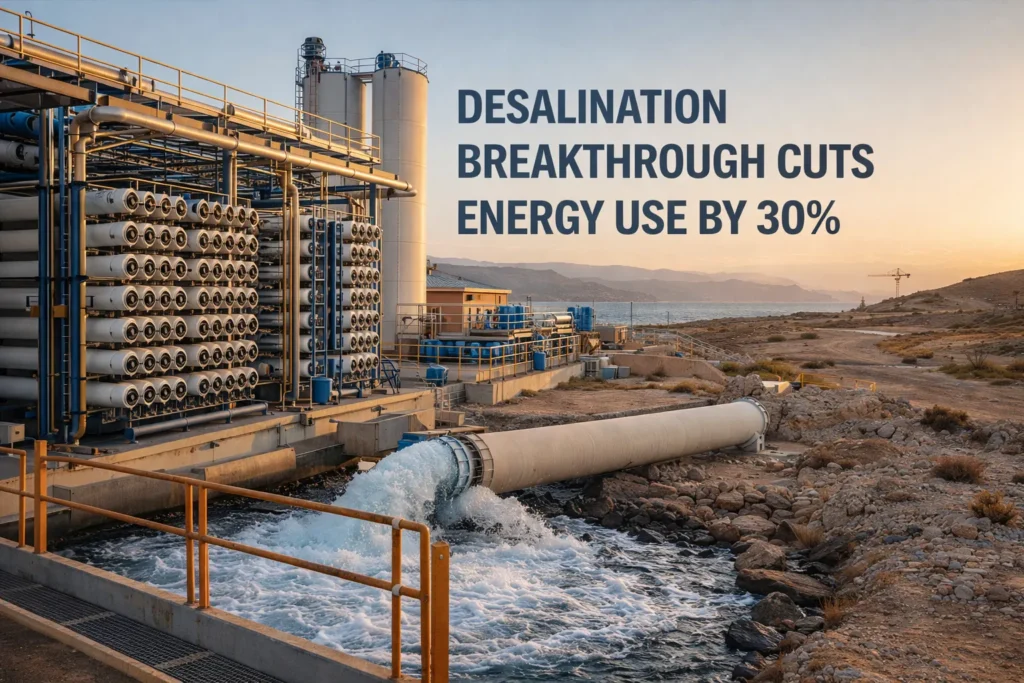
- The Membrane Sanctum: The now-violently pressurized water is forced into arrays of pressure vessels, each containing multiple spiral-wound membrane elements. Each element is a engineering marvel: a sandwich of feed spacers, a porous support layer, and that critical, ultra-thin polyamide active layer, rolled like a newspaper around a central permeate tube. Here, at last, the separation occurs. Water molecules are squeezed through nanoscopic pores in the active layer, collected in the permeate tube, and emerge as freshwater. The rejected salts, now in a concentrated brine stream, are depressurized through energy recovery devices—turbo-generators that claw back a fraction of the input energy—before being returned to the sea.
The Unsustainable Calculus: The output of this colossal effort is a vital resource. The inputs are what have constrained it. Energy accounts for 55-70% of the operational cost. A large plant consumes over 30,000 kWh per hour—enough to power a small town. This creates a devastating feedback loop: burning fossil fuels to address a water crisis exacerbated by the climate change caused by burning fossil fuels. Furthermore, the brine byproduct, often twice as salty as seawater and containing pretreatment chemicals, can create hyper-saline “dead zones” on the ocean floor if not diffused perfectly. The technology was, in essence, a lifesaving surgery with severe and debilitating side effects. It was a solution that perpetually argued against its own widespread adoption. The quest was always for a gentler, more intelligent form of surgery.
Part II: The Nanoscale Renaissance – From Sieve to Symbiont
The revolution began with a philosophical shift. For decades, membrane science focused on creating a more durable, more rejective barrier. The goal was a stronger guard. The breakthrough came from asking: what if the guard could also be a guide? What if the membrane could be not just a selective wall, but an active participant in the water’s journey?
This required descending from the world of pumps and pipes into the nanoscale landscape, where the true battle was being lost to friction.
Mapping the Molecular Quagmire: Imagine the active layer of a traditional membrane not as a smooth, perforated sheet, but as a tangled, chaotic forest of polymer chains. The “pores” are not neat drilled holes, but irregular, tortuous pathways formed between these chains. A water molecule navigating this terrain is like a traveler slogging through a dense, root-choked swamp. It collides with polymer chains (hindered diffusion), gets entangled with other water molecules (viscous drag), and interacts with charged sites on the polymer. Each collision represents a loss of momentum, a waste of the precious pressure generated by those massive pumps upstream. The inefficiency was baked in at the molecular architecture.
The First Pillar: Engineering the Superhighway. The new approach took inspiration from the supreme order of crystalline structures. Using techniques like Molecular Layer Deposition (MLD) and controlled interfacial polymerization, scientists learned to exert near-atomic control over the formation of the active layer. They could dictate the cross-linking density of the polymers, creating a more uniform, less entangled network. They incorporated nanoscale templates—tiny particles that created consistent voids—which were later etched away, leaving behind channels of precise diameter. The result was a membrane surface that resembled not a swamp, but a grid of polished, nanofluidic capillaries. The reduction in fluidic resistance was immediate and profound. Water molecules could now travel in a more laminar, streamlined flow, like cars on a newly paved freeway compared to a muddy track.
The Second Pillar: The Chemical Caravan. Smoothing the path was only half the battle. The true leap into biomimicry was adding a “pull” factor. Nature’s filters, like the aquaporin proteins in our cell membranes, don’t just let water through; they facilitate it. They have a hydrophilic, charged interior that orients water molecules and passes them along in a single-file chain with astonishing efficiency. Researchers replicated this by functionalizing the new smooth membranes. They grafted water-attracting chemical groups—like hydroxyl or carboxylic acid groups—onto the inner walls of the nanochannels. They even embedded bio-inspired materials like graphene oxide flakes, whose oxidized edges create a “permeation highway” for water molecules. These hydrophilic sites act as a series of waystations. They temporarily “grab” a passing water molecule, lowering its activation energy for passage, and then pass it along to the next site. It is a form of facilitated transport, a cooperative relay race at the molecular scale.
The Synergistic Leap: The combination of the ultra-low-friction architecture and the chemical facilitation system created a synergistic effect greater than the sum of its parts. The energy required to maintain a given flow rate plummeted. Independent verification from labs at MIT, King Abdullah University of Science and Technology (KAUST), and the Institute for Membrane Technology in Italy confirmed it: a 25-35% reduction in specific energy consumption for seawater reverse osmosis, while simultaneously improving salt rejection and, crucially, showing greater resistance to the initiation of biofouling. They hadn’t found a new energy source; they had stopped wasting so much of the old one. The gate was now intelligent, welcoming the right guests with a guiding hand, rather than just barring the wrong ones with a fortified wall.
Part III: The Cascade – When a Technical Metric Reshapes Civilizations
In infrastructure economics, a single-digit percentage gain in efficiency can justify billions in investment. A gain of 30% in a foundational process like desalination is not an incremental step; it is a phase change. It alters the material basis of society in coastal zones. The ripple effects move from the reactor vessel to the geopolitcal map, from the balance sheet to the daily rhythm of a child’s life.
1. The Economic Tipping Point: From Crisis Management to Urban Planning.
The high cost of desalinated water has kept it in the “drought emergency” column of municipal ledgers. A 30% reduction in its largest cost component recalibrates the entire financial model.
- Project Finance Becomes Plausible: For a coastal city in a developing nation, the internal rate of return (IRR) on a desalination plant just crossed the threshold from “non-starter” to “bankable.” International development banks and private capital, previously hesitant, now see a viable, revenue-generating asset. The risk profile shifts.
- The Distributed Model Emerges: The massive, gigawatt-scale grid connection is no longer a strict requirement. This enables smaller, modular, containerized desalination units. A resort, a mining operation, or a mid-sized town can deploy its own dedicated water source, independent of a central grid. This democratizes water security.
- The Retrofit Gold Rush: The global fleet of existing RO plants represents a multi-billion-dollar opportunity. Retrofitting them with high-efficiency membranes is a relatively swift and low-capex way to boost output and slash operational expenditure. It’s like replacing the engine in every ship in the world with one that uses a third less fuel—the savings are instantaneous and colossal.
2. The Environmental Rebirth: From Problem to Pillar of the Green Transition.
The environmental critique of desalination has been its most potent. This innovation directly disarms the core argument.
- The Renewable Marriage Becomes Inevitable: The lower and more stable energy load makes a perfect marriage with intermittent renewables. A desalination plant can now be designed as a “baseload” for a solar farm—its operation timed to sunlight hours, with the product water itself acting as a form of energy storage. We are no longer asking, “Can we power desalination with renewables?” but “How optimally can we pair them?” The vision of offshore “water farms”—floating platforms with wind turbines powering membrane modules—moves from artist’s concept to engineering tender.
- Brine: From Waste Stream to Resource Stream: Lower recovery ratios (by choice) can produce less concentrated brine, easing environmental impact. More importantly, the reduced energy burden frees up capital and operational headroom to integrate Minimal Liquid Discharge (MLD) and Zero Liquid Discharge (ZLD) systems. These advanced processes crystallize the brine into solid salts and harvest valuable minerals: lithium for batteries, magnesium for alloys, boron for ceramics. The desalination plant begins to resemble a mining operation, turning a costly waste problem into a potential secondary revenue stream, closing the industrial loop.
3. The Human Dimension: The Intangible Calculus of Time, Health, and Potential.
Beyond economics and engineering lies the human calculus, where the impact is measured not in kilowatt-hours, but in life-hours.
- The Redemption of Time: In countless communities, the procurement of water is a tax levied primarily on women and children—a tax paid in hours of walking, waiting, and carrying. A reliable local water source doesn’t just provide liters; it restores days. It converts time spent on survival into time available for education, enterprise, and leisure. The socioeconomic multiplier effect of liberating, particularly, female time from water carriage is one of the most powerful but least quantified benefits of water security.
- The Foundation of Public Health: The World Health Organization states that half of the world’s hospital beds are occupied by people suffering from water-related diseases. Desalination produces a microbiologically sterile product. Integrating this into a municipal system breaks the cycle of cholera, typhoid, and chronic diarrhea that stunts physical and cognitive development in children. It is a foundational public health intervention.
- The Stabilization of Politics: Historians like Steven Solomon have argued that control of water resources is a primary driver of geopolitical conflict. By providing a climate-resilient, sovereign water source for coastal nations and regions, affordable desalination removes a key driver of instability. It doesn’t just prevent conflict over rivers; it can turn “water diplomacy” from a tense negotiation over a shrinking pie into a collaborative opportunity to share technology and build regional “water independence.”
Part IV: The Crucibles of Reality – Pilots in the Pressure Cooker of Necessity
A laboratory success must survive the real world, a place of storms, silt, bureaucracy, and economics. The selection of the first major pilot sites is a masterclass in targeted stress-testing. These are not demonstrations in optimal conditions; they are trials by fire (and salt) in the places where failure is not an option.
The North African Crucible: Beyond the Tap, Toward Food Sovereignty.
In North Africa, water scarcity is not a future risk; it is the present geography. The Nubian Sandstone Aquifer, a fossil water treasure, is being depleted. Rainfall is unreliable. For nations like Morocco, with a national strategy pivoting towards agricultural export and food sovereignty, water is the limiting factor.
- The Agadir Pilot (Morocco): Here, the new membrane technology is being tested not just for municipal supply, but in a direct Agricultural-Desalination Nexus. The pilot is integrating the desalination output with drip irrigation systems for high-value crops like argan trees and citrus. The key metric isn’t just cost per cubic meter, but “cost per nutritional calorie produced.” Engineers are studying membrane resilience against seasonal algal blooms in the Atlantic and the impact of variable salinity on long-term performance. Success here would redefine “water security” as “food security.”
- The Algerian Test: Scaling in Arid Urbanity: In coastal Algiers, the pilot focuses on urban resilience at megacity scale. The challenge is integrating a large-volume, steady-state desalinated source into an aging, sometimes leaky distribution network prone to pressure fluctuations and contamination. The pilot is a proving ground for smart grid technology for water—using sensors and AI to blend desalinated water with traditional sources, manage pressure, and optimize chemical post-treatment (remineralization) to protect pipes and please palates.
The Southern European Laboratory: The Old World Engineers the New Hydrological Pact.
Europe’s south is the developed world’s climate change frontline. Droughts here are not just agricultural; they threaten the tourism economy, the cultural landscape, and EU stability.
- The Andalusian Integration (Spain): In the sun-baked region of Almería, the pilot is a full-scale Water-Energy-Food Nexus prototype. It pairs the high-efficiency desalination plant with a concentrated solar power (CSP) array. The CSP plant generates electricity by day, and its waste heat is used to pre-warm the seawater feed to the RO plant, boosting its efficiency further (warmer water is less viscous). The freshwater produced supports vast greenhouse agriculture (“the sea of plastic”), while researchers experiment with using diluted brine for aquaculture of salt-tolerant species like sea asparagus. It is a tangible model of a circular, climate-adapted economy.
- The Aegean Challenge (Greece): On water-stressed islands like Mykonos or Crete, the pilot tackles decentralization and brine management in sensitive ecosystems. The plants are smaller, designed for island communities. The focus is on ultra-efficient energy recovery and advanced brine minimization techniques to protect the fragile Mediterranean ecology. The pilot is also a social study on public acceptance, addressing the “not in my backyard” concerns and demonstrating that modern desalination can be quiet, clean, and discreet.
These pilots are the essential translation layer between science and society. They generate the 10,000-hour reliability data, the real-world fouling studies, and the operational manuals that will form the blueprint for the next thousand plants.
Part V: The Unfolding Horizon – From Breakthrough to a New Hydrological Age
The current membrane revolution is a milestone, not a finish line. It has cracked open a door, and the view beyond is of a landscape where desalination is not just efficient, but adaptive, multifunctional, and seamlessly integrated into the human habitat.
Biomimicry 2.0: The Protein-Powered Future.
The next generation moves beyond mimicking nature’s principles to incorporating its actual machinery.
- Aquaporin Biomimetic Membranes (ABMs): Companies are now stabilizing and embedding actual aquaporin proteins into synthetic membranes. These “plug-and-play” biological channels offer near-perfect selectivity and flow. The challenge is scaling up protein production and ensuring membrane longevity, but the potential for another step-change in efficiency is undeniable.
- Liquid-Gated Membranes: Inspired by the Nepenthes pitcher plant, these membranes feature a stabilized liquid layer within the pores that acts as a dynamic, self-healing gate. This liquid interface can repel foulants with exceptional effectiveness, potentially eliminating the need for chemical cleaning and dramatically extending membrane life.
Beyond Reverse Osmosis: The Spectrum of Separation.
The efficiency gains in membranes are revitalizing alternative desalination pathways that were previously too energy-intensive.
- Forward Osmosis (FO) Finds Its Purpose: FO, which uses a “draw solution” to pull water through a membrane naturally, was always elegant but hampered by the energy needed to recover the draw solute. New, robust membranes paired with novel, low-energy draw solutes (like thermolytic salts) are making FO viable for treating high-fouling wastewater or pre-concentrating seawater before it goes to a low-pressure RO unit, creating hybrid systems that optimize energy use.
- Electrodiaysis Reversal (EDR) and Membrane Capacitive Deionization (MCDI): These electrically driven processes, which use charged membranes or electrodes to pull ions out of water, are becoming more competitive for brackish water desalination. Their energy consumption is directly proportional to salinity, and with better membranes and materials, they offer a highly controllable and efficient solution for inland water treatment.
The Systemic Vision: The Water-Energy-Food Nexus as Built Reality.
The ultimate endgame is the dissolution of boundaries between sectors. We can envision the Coastal Resource Park of 2050:
- Offshore wind and floating photovoltaics provide carbon-free power.
- This energy runs a cascade of membrane processes: high-efficiency RO for potable water, forward osmosis for concentrating nutrients from agricultural runoff, and electrodialysis for extracting specific ions.
- The freshwater supplies a vertical farming hub and a green hydrogen production facility.
- The brine feeds mineral extraction modules, producing lithium for the adjacent battery factory and magnesium for lightweight vehicle parts.
- The waste heat from all processes is recaptured to drive thermal desalination for industrial process water or to heat adjacent aquaculture ponds.
In this vision, the desalination plant is no longer a standalone, resource-hungry “plant.” It is the metabolic heart of a new type of industrial ecology—a synergistic cluster where the streams of water, energy, minerals, and food are consciously intertwined. The high-efficiency membrane is the critical enabler, the catalyst that makes this complex web energetically and economically coherent.
Epilogue: From Hydro-Separation to Hydro-Integration
For the entirety of human consciousness, the ocean has represented the ultimate “other.” It was the void beyond the safe shore, the realm of monsters and mysteries, the impassable barrier that defined “here” from “there.” Our relationship was one of separation, punctuated by brief, daring forays across its surface. We were land creatures, and it was the not-land.
The story of this membrane, and the science it represents, marks a profound philosophical and practical transition. We are moving from a relationship of hydro-separation to one of hydro-integration. We are learning to interact with the ocean not just as a surface to cross or a volume to fish, but as a chemical broth to engage with, molecule by molecule. We are asking it to yield its most fundamental component, not through conquest, but through clever, respectful persuasion.
The pilot plants on the shores of the Mediterranean and the Atlantic are therefore more than infrastructure. They are philosophical outposts, the first settlements on this new frontier. They represent a conscious choice to solve our oldest scarcity not by fighting over the last drops of a closed terrestrial cycle, but by tapping into the vast, open cycle of the planetary ocean.
The challenges that remain are legion: scaling manufacturing to teraliter scales, perfecting brine valorization, ensuring equitable access, and governing this new resource wisely to prevent new forms of geopolitical friction. The membrane is a key, but a key must be turned by a wise hand.
Yet, the direction of travel is now clear. The energy barrier, that towering wall of physics that made the sea’s abundance a mirage, has been shown to be surmountable through intelligence rather than just force. We are not breaking down the wall; we are building a smarter door.
The children being born today in Mombasa, Lima, or Aden may grow up to see the ocean not as a beautiful, useless barrier, but as their most reliable neighbor. They may never know the gut-wrenching anxiety of a dry well or a failed rain. They may take for granted a reality that was, for all preceding human generations, the stuff of myth: that the blue hemisphere on which they live is not a taunting paradox, but a proven promise.
The chronicle of humanity and water is entering its most daring chapter. It is being written in the silent flow through angstrom-scale channels, in the data logs of pilot plants, and in the recalculated budgets of developing nations. It is a story of turning the ancient, salty obstacle into a contemporary, sustainable ally. And with each efficient cubic meter produced, the future flows a little more clearly, a little more certainly, toward a world that is, at long last, learning to drink from its own abundant sea.


