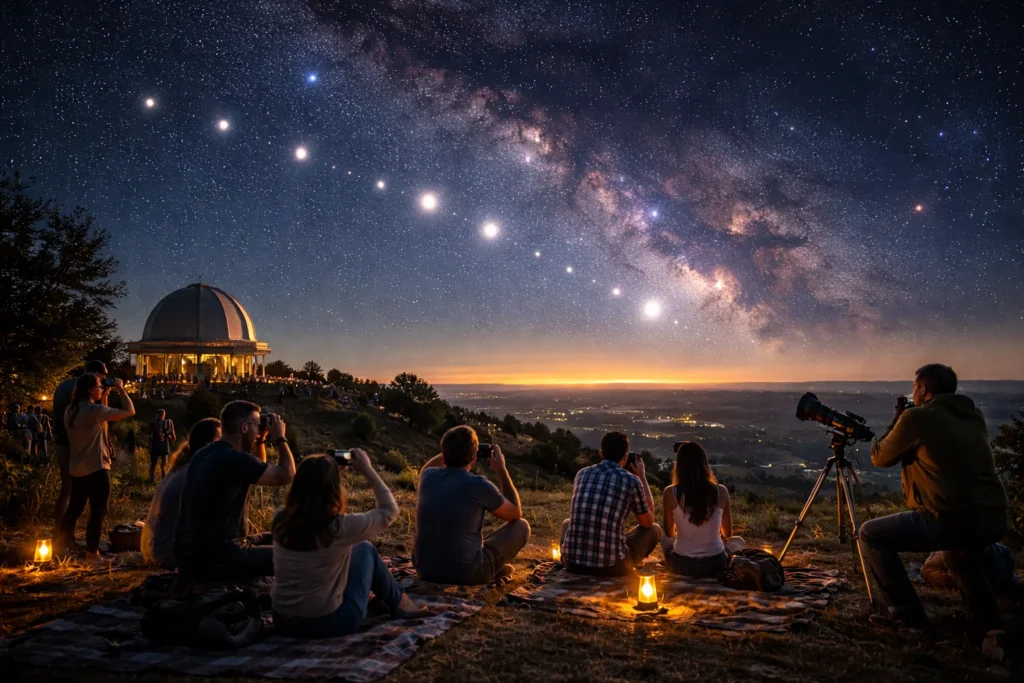

The universe has a way of reminding us that we are part of something enormous, something beautiful, and something wonderfully mysterious. Every once in a while, the cosmos sends us a gentle nudge, a visual spectacle that forces us to pause our busy lives, step away from our screens, put down our endless to-do lists, and simply look up in wonder. For millions of people across the globe, that moment is about to arrive. Imagine standing in your backyard, a local park, or perhaps on a quiet country road, and realizing that the lights you see twinkling above you aren’t just stars. They are worlds. Actual other worlds, hanging there in the vast emptiness of space, visible to your naked eye. This isn’t a scene from a science fiction novel. This is real, and it’s happening very soon.
We are on the verge of one of the most anticipated celestial events in recent years: a rare planetary alignment, often described by astronomers and skywatchers alike as a spectacular “planet parade.” For a brief but magical window of time, six of our solar system’s planets—Mercury, Venus, Jupiter, Saturn, Uranus, and Neptune—will appear to line up in the evening sky, creating a breathtaking arc across the heavens. Observatories from Tokyo to Tucson are preparing for record public attendance, schools are planning special night-time field trips, and families are marking their calendars for an evening of cosmic exploration.
But what does this really mean? Why does it happen? How can you, your friends, and your family make the most of this rare opportunity? In this comprehensive guide, we’ll take a deep dive into every aspect of the great sky parade. We’ll explore the science behind the alignment, provide you with a step-by-step manual for finding each planet, share the rich history of how our ancestors interpreted these events, explain why this particular night is a date you absolutely should not miss, and delve into the fascinating details of each world you’ll be observing. So, grab a comfortable chair, a warm blanket, let your eyes adjust to the dark, and let’s embark on a journey to the edge of the solar system and back.
Part One: Understanding the Cosmic Ballet
What is a Planetary Alignment? The Truth Behind the Beautiful Illusion
When headlines announce that the planets are “aligning,” it’s easy to picture something straight out of a fantasy epic or a Hollywood blockbuster. Perhaps you imagine the Earth, Mars, Jupiter, and Saturn stacking up perfectly behind one another, like a line of cosmic bowling balls waiting to be rolled. You might even recall those classic diagrams from elementary school science class, showing the Sun in the center with all the planets neatly arranged in a straight line stretching outward like beads on a string. While that image is useful for understanding the order of the solar system, it’s not quite what happens during an alignment. The reality is far more subtle, far more beautiful, and in many ways, far more fascinating.
Let’s start with a simple thought experiment. Imagine you’re standing in the middle of a massive, perfectly flat, circular racetrack. This racetrack is your solar system. In the very center of the track is a giant floodlight—that’s our Sun. Now, imagine several race cars moving at different speeds in their own dedicated lanes around this track. These cars are the planets. From your vantage point in the middle of the track, you never see the cars stacked up one behind the other directly in a line away from you. Instead, you see them spread out across the track, all following the same circular path. They are all, from your perspective, arranged along a single line—the line of the track itself.
This imaginary line across our sky is what astronomers call the ecliptic. It’s the path that the Sun and Moon appear to follow throughout the day and night, and it’s also the highway upon which all the planets travel. Because the planets orbit the Sun in roughly the same flat plane (like cars on that same racetrack), from our perspective here on Earth, they always appear somewhere along this celestial highway. They are perpetually “in line” in the sense that they never stray far from the ecliptic.
So, if the planets are always strung out along this line, what makes a “planetary alignment” or “planet parade” so special? The key difference is not about geometry, but about visibility and gathering. On most nights, the planets are scattered around the Sun. Some are on the far side of the solar system, invisible to us because they’re lost in the Sun’s glare. Others might be visible, but only one or two at a time. A planet parade happens when several of these worlds happen to be on the same side of the Sun as Earth, clustered together in the night sky within a relatively small arc. It’s the difference between seeing a single taxi drive by your house at midnight and seeing a full procession of colorful floats, marching bands, and classic cars roll past during a town parade. They are all on the same road, but the joy is in seeing them all together in one glorious procession.
Think of it this way: The planets are always running their race. Sometimes, the fastest runners lap the slower ones, and for a brief moment, they bunch up together on the track where we can see them. That bunching up, that temporary gathering of celestial runners, is what we call an alignment. It’s a trick of perspective, a beautiful coincidence of orbital speeds, and it gives us a unique opportunity to appreciate the dynamic, moving clockwork of our solar neighborhood.
The Orbital Race: Why Planets Move at Different Speeds
To truly appreciate why this alignment is happening now, we need to understand the simple but profound laws that govern the motion of planets. It all comes down to one fundamental fact: distance from the Sun determines speed. This relationship was first discovered by the German astronomer Johannes Kepler in the early 1600s, and it remains one of the cornerstones of modern astronomy.
Imagine the Sun’s gravity as an invisible rope. The closer a planet is to the Sun, the stronger that gravitational pull is, and the faster the planet has to move to avoid being pulled into the Sun. Conversely, the farther away a planet is, the weaker the Sun’s gravitational grip, and the slower it can travel in its orbit. It’s like swinging a ball on a string. If you shorten the string, the ball has to whip around much faster to stay in a circle. If you lengthen the string, it can move more slowly and gracefully.
Let’s look at the specific “lap times” of our planetary neighbors to see this principle in action. We measure a planet’s year—the time it takes to complete one full orbit around the Sun—in Earth days or Earth years.
- Mercury: Being the closest planet to the Sun, Mercury is the speed demon of the solar system. It zips around our star in just 88 Earth days. If you lived on Mercury, you’d have four birthdays for every one birthday on Earth. Its average orbital speed is an astonishing 107,000 miles per hour.
- Venus: Our sister planet, shrouded in thick clouds of sulfuric acid, takes a bit longer. Its orbital period is 225 Earth days. Interestingly, Venus also rotates incredibly slowly and in the opposite direction of most other planets.
- Earth: This is our baseline, of course. We take 365 days (one year) to complete our journey, traveling at about 67,000 miles per hour around the Sun.
- Mars: The Red Planet, our next-door neighbor, orbits the Sun in about 687 Earth days, or roughly 1.9 Earth years.
- Jupiter: Here’s where things really start to slow down. The king of planets is so far from the Sun that it takes a staggering 12 Earth years to complete just one orbit. Imagine being a child when Jupiter is in one position and graduating high school by the time it returns to that same spot.
- Saturn: The ringed beauty is even farther out. Its orbit takes about 29.5 Earth years. The last time Saturn was in its current position in the sky, most millennials weren’t even born yet. A person would be approaching their 30th birthday before Saturn completes a single lap around the Sun.
- Uranus: This ice giant is so distant that it plods along at a glacial pace, taking 84 Earth years to circle the Sun. A single year on Uranus is longer than a typical human lifetime. If you were born on Uranus, you would never celebrate a first birthday.
- Neptune: The farthest official planet in our solar system is the slowpoke of the group. Neptune takes a whopping 165 Earth years to complete one orbit. It hasn’t even made one full trip around the Sun since it was discovered in 1846. Neptune will not complete its first post-discovery orbit until the year 2011.
Now, picture all these runners on our cosmic track, all moving at these wildly different speeds. Mercury is sprinting, Venus is jogging, Earth is walking at a moderate pace, and the outer planets are taking slow, deliberate strides. Because they’re all moving at different speeds, their positions relative to each other are constantly, slowly changing. A planet parade happens when the sprinters lap the walkers, or when several of them end up grouped together on the same side of the track from our perspective. The alignment we’re about to witness is a direct result of this beautiful, predictable celestial choreography.
The Role of Orbital Planes: Why We’re Not All Over the Place
You might wonder why all the planets orbit in roughly the same flat plane. It’s not an accident; it’s a relic of how our solar system formed about 4.6 billion years ago. The solar system began as a gigantic, slowly spinning cloud of gas and dust called the solar nebula. As this cloud collapsed under its own gravity, it began to spin faster—just like an ice skater pulling in their arms. This spinning motion flattened the cloud into a giant, rotating disk. The Sun formed at the center, and the planets gradually coalesced from the material swirling around in that disk. This is why all the major planets orbit in more or less the same plane, which we see edge-on as the ecliptic. It’s the fossilized rotation of that ancient, spinning cloud.
This is also why spacecraft heading to other planets don’t just blast off in a straight line. They have to launch at carefully calculated times to intercept the target planet, which is also moving along this same flat highway. The entire solar system is a two-dimensional disk, and we’re all moving together in an elegant, billion-year-old waltz.
Part Two: Your Personal Guide to the February 2026 Alignment
The Main Event: Save the Date for February 28, 2026
Alright, let’s get down to the practical details. You know what a planetary alignment is and why it happens. Now you need to know when to be outside with your eyes on the sky. Mark your calendars, set a reminder on your phone, and tell your friends, because the peak of this celestial spectacle is scheduled for the evening of Saturday, February 28, 2026.
However, don’t fall into the trap of thinking that if you miss that exact night, you’ve missed the whole show. That’s one of the best parts about a planet parade—it’s not a fleeting moment like a meteor streaking across the sky. These are massive worlds moving on enormous scales, and their positions change very slowly. The planets will be gathering for this “parade” for several days leading up to the 28th, and they’ll slowly start to disperse in the days afterward. This means you should have an excellent viewing window from roughly the last week of February through the very first few days of March.
Think of it like a concert. February 28th is the night the headliner takes the stage for their biggest song. But the opening acts are warming up for several nights before, and the energy in the venue remains high for a little while after. You’ll get a fantastic show any clear evening during that window.
Here’s a quick reference guide to keep handy:
| Feature | Detail |
|---|---|
| Event Name | A “planet parade” or alignment of six planets. |
| Peak Date | Saturday, February 28, 2026. |
| Viewing Window | The last week of February through the first few days of March. |
| Best Time of Night | 30 to 60 minutes after your local sunset. |
| Primary Direction | Face west, toward the spot where the Sun just went down. |
| Key Challenge | An unobstructed view of the western horizon is essential. |
The Golden Hour: Why Timing Right After Sunset is Crucial
You might be wondering, “Why do I have to go out so soon after sunset? Wouldn’t it be easier to see them in the middle of the night when it’s really dark?” That’s a logical question, and it gets to the heart of how we observe planets versus how we observe stars.
The reason we look for these planets shortly after sunset is simple: they are following the Sun. Remember the ecliptic, that celestial highway? The Sun travels along it during the day. The planets, being on the same highway, are essentially “behind” the Sun or “ahead” of it. In this case, for the February 28th alignment, most of the planets are trailing behind the Sun into the evening sky. If you wait until midnight, these planets will have already followed the Sun below the western horizon and set. You’ll miss them.
The period from about 30 to 60 minutes after sunset is what astronomers call the “twilight window,” and it’s the perfect time for this kind of observation. At this moment, the sky is darkening enough for bright objects like Venus and Jupiter to pop into view, but it’s not so dark that you lose your reference points on the horizon. This is also the only time you’ll have a chance to catch Mercury and Saturn, which will be hovering very low in the twilight glow. Waiting longer won’t make them brighter; it will just make them disappear as they sink below the horizon.
Think of it like arriving early for a movie. You want to be there for the previews and to find your seat before the lights go down. If you show up an hour late, you’ve missed the beginning of the story. For this alignment, being on time—right after sunset—is the only way to see the full cast of characters.
Where to Look: Finding Your Western Horizon
The single most important factor in your skywatching success, besides a clear sky, is location. You need to find a spot with a clear, unobstructed view of the western horizon. The horizon is the line where the sky meets the Earth. Because the planets will be strung out along the ecliptic, which arcs from the horizon up into the sky, the ones closest to the Sun (Mercury and Saturn) will be hugging that western horizon very closely. If your view is blocked by a house, a tall tree, or a hill, you might miss them entirely.
So, where should you go? You don’t need to drive hours into the wilderness. You just need to be strategic. Here are some ideas for good viewing locations:
- Local Parks: Many parks have large, open fields with fewer trees and obstructions. A park on the western edge of town is even better. Look for parks that have a pond or lake, as the open water provides an even clearer view of the horizon.
- Sports Fields: Football, soccer, or baseball fields are often oriented to be open and have clear sightlines. The bleachers can also provide a nice place to sit and lift you slightly above ground level.
- The Top of a Parking Garage: This might sound unusual, but multi-level parking garages can lift you above nearby buildings and streetlights, providing a surprisingly good view of the horizon. Just be mindful of safety and any security concerns.
- A Hill or Overlook: If you live in a hilly area, find a spot that faces west with a clear view down and out. The higher you are, the less atmosphere you’re looking through and the better your view will be.
- A Rural Road (Safely Pulled Over): If you can drive a short distance out of town, find a safe place to pull over on a quiet country road with a clear western view. Be sure to park well off the road, turn off your headlights, and be aware of your surroundings.
- Your Own Backyard (with planning): Even your backyard can work if you have a clear view of the west. You might need to move a trampoline, trim a few low-hanging branches, or position yourself in a specific corner of the yard, but it’s worth it for the convenience. You can step inside to warm up and come back out without a long drive home.
- A Local Golf Course (with permission): Golf courses often have wide-open fairways and minimal obstructions. If you know someone who lives on a course, or if the course is public and allows evening access, it can be an excellent spot.
- A Schoolyard: Many schools have large athletic fields with clear sightlines. On a weekend evening, the parking lot is usually empty, and you can set up in a quiet, open area.
Once you’re at your chosen spot, the key is to face west. How do you know which way is west? The easiest way is to remember that the Sun sets in the west. So, at sunset, face the Sun. That’s west. After the Sun goes down, that general direction is still west. You can also use a compass app on your phone, but be careful not to look at the bright screen for too long, as it will ruin your night vision. Look for landmarks—a distinctive tree, a water tower, a building—that you can associate with the western direction so you know where to look even after the Sun is gone.
Understanding the Arc: The Ecliptic in the Sky
Once you’re facing west, you need to understand how the planets will be arranged. They won’t be in a straight horizontal line like ducks in a shooting gallery. Instead, they will follow the arc of the ecliptic. From the western horizon, this arc slopes upward to the left, passing high overhead and continuing down to the eastern horizon. Think of it as a giant rainbow stretching across the sky.
The planets near the horizon—Mercury and Saturn—will be the first to set, so they are the most time-sensitive. Higher up, you’ll find Venus, then Jupiter will be even higher, almost directly overhead. Uranus will be up there too, hiding among the stars of Taurus. This arc is your map. Once you can visualize it, finding the planets becomes a matter of knowing roughly how high above the horizon to look.
A handy trick is to use your fist at arm’s length. Your clenched fist, held at arm’s length, covers about 10 degrees of sky. The horizon is 0 degrees, and the point directly overhead (the zenith) is 90 degrees. So, if a planet is said to be 20 degrees above the horizon, it will be about “two fists” above where the sky meets the land. This rough measurement can help you scan the right part of the sky.
Part Three: Meet the Celestial All-Stars in Depth
Now for the most exciting part: getting to know the planets you’re about to see. Think of them as a team of celestial celebrities, each with its own personality, its own story, and its own unique characteristics. Some are massive, brilliant, and impossible to miss—they’re the headliners. Others are smaller, shyer, and require a little more patience and know-how to spot. Here is your complete guide to the lineup for February 28, 2026, starting from the lowest in the sky near the western horizon and moving upward.
The Naked-Eye Wonders: Your Main Event
These are the bright, beautiful planets that you will be able to see with just your eyes. Even if you live in a city or suburb with some light pollution, these four should be visible to you, provided you have a clear sky and a good view of the horizon. They are the reason this event is so special.
Mercury: The Speedy Little Messenger
Mercury is the smallest planet in our solar system and the closest to the Sun. It’s named after the Roman messenger god, known for his speed and cunning, and it lives up to its name by zipping around the Sun in just 88 days. Because it’s always so close to the Sun from our perspective, it’s often lost in the Sun’s brilliant glare. Seeing Mercury is always a bit of a triumph for amateur stargazers. It’s a planet that plays hard to get.
During this alignment, Mercury will be playing a game of hide-and-seek low on the western horizon. It will appear as a modest, pinkish or yellowish point of light, not incredibly bright, but definitely noticeable if you know where to look. This is why having an unobstructed horizon is so crucial. You’ll need to look for it within the first 30 to 40 minutes after sunset, before it gets too low and disappears into the twilight glow. Finding Venus first (see below) will help. Mercury will be below and slightly to the right of brilliant Venus. Spotting Mercury is like getting a special achievement badge in the game of skywatching. It’s a world of extreme contrasts, with scorching hot days reaching 800 degrees Fahrenheit and freezing cold nights dropping to -290 degrees. It’s basically a burnt, airless rock, but it’s our closest planetary neighbor, and seeing it with your own eyes is a special thrill.
Venus: The Unmistakable Evening Star
If you see one planet during this alignment, this will be it. Venus is absolutely dazzling. It’s often called the “Evening Star” or “Morning Star” because it’s the brightest object in the night sky after the Moon. Its thick, highly reflective clouds of sulfuric acid act like a giant mirror, bouncing sunlight back into space and making it shine with a brilliant, steady, white light. It’s so bright that it can sometimes be seen in broad daylight if you know exactly where to look.
During the alignment, Venus will be impossible to miss. It will be hanging low in the western sky, looking like a cosmic diamond. It will be the first “star” to appear as the sky begins to darken. If you have any doubts about what you’re looking at, just find the brightest thing in that part of the sky. That’s Venus. Its presence is incredibly useful because it acts as a beacon, guiding your eyes to the region where the other, fainter planets are performing. Think of Venus as the dazzling lead singer of the band, commanding everyone’s attention.
But Venus is also a cautionary tale. Beneath those beautiful clouds lies a hellish world. The surface temperature is hot enough to melt lead, around 900 degrees Fahrenheit. The atmospheric pressure is 90 times that of Earth, equivalent to being nearly a mile underwater. And the clouds aren’t water; they’re made of corrosive sulfuric acid. Venus is a reminder that beauty can be deceiving, and that not every world is as hospitable as our own.
Jupiter: The King of Planets
As the sky gets a little darker and your eyes adjust, look much higher up, almost directly overhead. You’ll see a brilliantly bright, steady point of light. That’s Jupiter, the largest planet in our solar system. It’s so massive that you could fit all the other planets inside it with room to spare. Its brightness comes from its enormous size and its banded, colorful clouds, which reflect a tremendous amount of sunlight. Unlike stars, which twinkle because their light is distorted by our atmosphere, planets like Jupiter shine with a steady, calm light.
Jupiter will be the second-easiest planet to find after Venus, and it will be visible for much longer into the evening. If you have even a simple pair of binoculars, point them at Jupiter. You’ll be treated to an incredible sight: four tiny points of light flanking it on either side. These are its largest moons—Io, Europa, Ganymede, and Callisto—discovered by Galileo over 400 years ago. Watching these moons change position from night to night is like seeing a mini solar system in action and is one of the most rewarding sights in amateur astronomy. Ganymede, one of these moons, is actually larger than the planet Mercury. Imagine that—a moon bigger than a planet. Jupiter itself is a stormy world, with a giant, centuries-old hurricane called the Great Red Spot that is larger than Earth itself.
Saturn: The Lord of the Rings
Saturn is the showstopper of the solar system. While it won’t look like the iconic image you know from textbooks (its rings are too small and thin to be seen without a telescope), it will still appear as a beautiful, bright, and slightly golden-hued point of light. It won’t be quite as brilliant as Jupiter, but it will be unmistakable. Its golden color comes from the methane in its atmosphere, which absorbs blue light and reflects the warmer end of the spectrum.
Saturn will be part of the planetary traffic jam near the western horizon, positioned between Mercury and Venus. It will be a bit higher in the sky than Mercury, but still relatively low. Finding it with the naked eye is a thrill, knowing that you’re looking at a world encircled by billions of particles of ice and rock, stretching out over 175,000 miles wide. It’s a humbling reminder of the incredible diversity of worlds in our cosmic neighborhood. With a small telescope, even at low power, Saturn transforms from a point of light into a majestic, three-dimensional jewel, and seeing its rings for the first time is an experience no one ever forgets. Those rings, despite their immense width, are incredibly thin—in places, only about 30 feet thick. If you scaled Saturn down to the size of a basketball, its rings would be thinner than a sheet of paper.
The Telescopic Challenge: The Distant Ice Giants
These two planets are officially part of the “parade,” meaning they are geometrically aligned with the others. However, they are so far from Earth and the Sun that they are incredibly faint. You will not be able to see them with the naked eye. To spot them, you’ll need binoculars (for Uranus) or a telescope (for Neptune). Consider them the bonus tracks on your favorite album—not everyone will hear them, but for those who make the effort, the reward is special.
Uranus: The Sideways World
Uranus is a strange and distant world. It’s classified as an “ice giant” because its interior is mostly made of a hot, dense fluid of “icy” materials like water, methane, and ammonia, surrounding a small rocky core. Its most unusual feature is its tilt. While most planets spin like a top, with their axis roughly perpendicular to their orbit, Uranus is tilted so far over—about 98 degrees—that it essentially rolls around the Sun on its side, probably as the result of a colossal collision with an Earth-sized object long ago. This means that for parts of its 84-year orbit, one pole points directly at the Sun, giving that hemisphere 42 years of continuous sunlight, while the other hemisphere experiences 42 years of continuous darkness.
For observers, Uranus will be a challenge. It is technically bright enough to be seen with the naked eye under perfectly dark, moonless skies far from any city lights. However, because we’re observing in the twilight period just after sunset, the sky will still be too bright to see it without help. You’ll need binoculars or, preferably, a small telescope. It will be located higher in the sky, not far from the Pleiades star cluster in the constellation Taurus. In binoculars, it will look like a faint star, but with a steady telescope and a little magnification, you might be able to see it as a tiny, pale greenish-blue disk, distinguishing it from the pinpoint stars surrounding it. That pale blue-green color comes from methane gas in its atmosphere, which absorbs red light and reflects blue and green.
Neptune: The Faint Blue Giant
Neptune is the ultimate challenge. It is the most distant planet in our solar system, a deep azure blue world whipped by the fastest winds in the solar system, with supersonic storms that rage for decades. It’s a world of extreme cold and dynamic weather, a place where wind speeds can reach an incredible 1,200 miles per hour—faster than the speed of sound on Earth. It’s a world of frozen methane, diamond rain (scientists theorize that the intense pressure deep inside Neptune could compress carbon into diamonds that fall like hailstones), and a mysterious dark spot that appears and disappears over the years.
But from Earth, this dynamic, violent world appears as the faintest of faint dots, a tiny blue pixel in the eyepiece of a telescope. Seeing Neptune requires a decent telescope and a lot of patience. Even then, it will appear as nothing more than a tiny, faint blue dot, no different from a faint star to the untrained eye. To confirm you’ve found it, you’d need a detailed star chart or a computerized telescope mount. For most casual observers, Neptune will remain an unseen participant in the parade. But just knowing it’s out there, part of this grand alignment, adds another layer of wonder to the experience. It’s a reminder of the immense scale of our solar system, a world so far away that it receives only 1/900th of the sunlight that we do.
To summarize who you’re looking for:
- Easy (Naked Eye): Venus, Jupiter.
- Moderate (Naked Eye, clear horizon): Mercury, Saturn.
- Difficult (Binoculars needed): Uranus.
- Very Difficult (Telescope needed): Neptune.
Part Four: How to Make Your Skywatching Adventure Unforgettable
Knowing what to look for is half the battle. The other half is preparation. A little bit of planning can transform a chilly, frustrating hunt for dots in the sky into a warm, memorable family outing or a peaceful, profound solo experience. Here are some detailed, down-to-earth tips to make your February 28th the best it can be.
Step One: Scout Your Location in Advance
Don’t wait until the night of the 28th to figure out where you’re going. Do a scouting mission on a clear evening a few days beforehand. Go to your chosen spot at sunset and check the view. Are there trees or buildings you didn’t notice before? Is there a bright streetlight nearby that will ruin your night vision? Is the ground dry and comfortable to sit on? Is there traffic noise that might detract from the peaceful experience? Answering these questions ahead of time will save you stress and disappointment on the big night.
While you’re scouting, take note of the exact spot where the Sun sets. That’s your anchor point. The planets will appear in that general area, so knowing exactly where the Sun dips below the horizon will give you a precise target zone.
Step Two: Prepare for the Weather
This might seem obvious, but it’s the most important variable. A planet parade is happening regardless of whether you can see it, but clouds are the ultimate buzzkill. Check your local weather forecast repeatedly in the days leading up to the event. Look for forecasts that mention “clear skies” or “mostly clear.” Pay attention to the percentage of cloud cover and any mentions of fog or haze, which can also obscure your view.
If your area is predicted to be cloudy, don’t despair. You might be able to drive an hour or two to a region with better conditions. Think of it like chasing a concert tour—if the show is sold out in your town, you might travel to the next city on the tour. Use weather radar apps to find a pocket of clear sky within driving distance.
Also, remember that February can be cold in the Northern Hemisphere. Dress in warm layers, even if you think you’ll only be out for 20 minutes. Once you start looking at the sky, time can slip away, and you don’t want to cut your evening short because you’re shivering. Bring hats, gloves, and warm socks. A good pair of insulated boots can make all the difference if you’re standing on cold ground. A thermos of hot chocolate, coffee, or tea can turn a chilly vigil into a cozy and enjoyable experience. Consider bringing a blanket to sit on or a comfortable lawn chair. The more comfortable you are, the longer you’ll stay, and the more you’ll see.
Step Three: Let Your Eyes Become Dark-Adapted
This is a critical step that many beginners skip. Your eyes are amazing instruments, but they need time to adjust to the dark. The moment you walk from a brightly lit house into your backyard, you can barely see anything. But after a while, stars start to appear, and details emerge. This is called dark adaptation.
It takes about 20 to 30 minutes for your eyes to reach their maximum sensitivity. During this time, your pupils dilate to let in more light, and chemical changes occur in your retina that make it far more sensitive to faint light. The chemical responsible for this is called rhodopsin, or “visual purple,” and it takes time to regenerate once it’s been bleached by bright light. The key is to avoid any bright white light during this period. If you look at your phone, a flashlight, or even a car’s headlights, you’ll instantly ruin your dark adaptation and have to start the 20-minute countdown all over again.
Here’s how to manage light:
- Turn off your phone, or at least switch it to a red-light filter app. Many stargazing apps have a “night mode” that turns the screen red. If your phone doesn’t have this feature, you can sometimes buy red transparent film to place over the screen.
- Bring a red flashlight. You can buy these at camping stores, or you can make your own by covering a regular flashlight with red cellophane or a brown paper bag secured with a rubber band. Red light has a longer wavelength that doesn’t disrupt your night vision as much as white or blue light. It’s the standard tool for astronomers everywhere.
- Be patient. The longer you sit in the dark, the more you’ll see. Faint stars and maybe even Uranus will pop into view as your eyes fully adapt. You’ll also start to notice the subtle differences in color between stars—some are reddish, some are blue-white, some are yellow like our Sun.
- Shield your eyes. If a car approaches or a neighbor turns on a bright porch light, shield your eyes with your hand to minimize the impact. It only takes a second of bright light to reset your adaptation.
Step Four: Use Tools to Enhance Your View (Binoculars are Your Friend)
While your eyes are enough to see the four main planets, a simple tool can dramatically enhance your experience. A pair of binoculars is arguably the best piece of equipment for a beginner skywatcher. They are cheap, portable, and easy to use, and they will open up a whole new level of detail.
- With binoculars, you can:
- See Jupiter’s four largest moons, looking like tiny stars on either side of the planet. Watching their positions change from night to night is fascinating.
- Get a slightly clearer view of Saturn, perhaps even getting a hint of its oblong shape caused by the rings. With steady hands, you might just make out the rings as tiny “ears” on the planet.
- Possibly spot Uranus as a faint star. It will look like just another star in binoculars, but knowing you’re looking at a distant world is the thrill.
- Scan the star fields around the planets and see hundreds more stars than you can with your eyes alone. The Milky Way, if you’re in a dark enough location, will resolve into a stunning river of countless individual stars.
- Get a closer look at the Moon, if it happens to be visible, revealing its craters and mountains in stunning detail.
If you have access to a telescope, even a small one, you’re in for a real treat. A telescope will reveal Saturn’s rings, Jupiter’s cloud bands and the Great Red Spot (if it’s facing Earth), and Uranus’s blue-green disk. But don’t feel like you need expensive gear. A simple, stable pair of binoculars and a dark-adapted pair of eyes are a powerful combination. If you’re using binoculars, try to brace your arms against a wall, a car roof, or use a tripod adapter if you have one. This will steady the image and allow you to see fainter details.
Step Five: Use the “Averted Vision” Trick
Here’s a pro tip that astronomers use all the time. When you’re trying to look at a faint object, like a dim star or a galaxy, don’t stare directly at it. The center of your eye’s field of vision (the fovea) is packed with cones that detect color and fine detail, but it’s not very sensitive to faint light. The rods, which are better for low light, are more concentrated around the edges of your retina.
So, if you’re struggling to see a faint planet or star, try looking slightly to the side of it. This technique, called averted vision, allows the faint light to fall on the more sensitive parts of your eye, and the object will suddenly seem to pop into view. It takes a little practice, but once you master it, you’ll be able to see much fainter objects. You might find that a star that was barely visible becomes clear and distinct when you look slightly away from it. This works particularly well for spotting Uranus and for seeing the fainter stars in the Pleiades cluster.
Step Six: Capture the Moment (Without Spoiling the Experience)
You’ll likely want to take a picture to remember the night. Capturing a planetary alignment with a standard smartphone camera is challenging but not impossible. The planets will appear as tiny dots, and the camera might struggle to focus in the dark. The results will never match what you see with your eyes, but it’s still fun to try.
- If you want to try: Use a smartphone tripod or prop your phone up steadily on a surface. Tap the screen to focus on the brightest object (Venus). If your phone has a “night mode,” use it. The best results often come from holding your phone up to the eyepiece of a pair of binoculars or a telescope (called “afocal photography”). This requires a steady hand and some practice, but it can yield surprisingly good shots of Jupiter’s moons or a blurry Saturn.
- But here’s the most important advice: Don’t spend the whole evening looking at the sky through your phone screen. Take a couple of quick snapshots for the memory, then put the phone away. The real magic is in experiencing the moment with your own eyes, letting the vastness of space sink in. The memory you create in your mind will be far more vivid and emotionally resonant than any blurry photo. You’re there to witness the universe, not to document it for social media.
Step Seven: Bring Company and Share the Wonder
Astronomy is often thought of as a solitary pursuit, but it can be incredibly rewarding to share with others. Bring your family, your friends, or a date. Watching the awe and wonder on a child’s face as they see Saturn for the first time, or the quiet contemplation of a friend as they grasp the scale of what they’re seeing, is a profound experience in itself.
For families, this can be a fantastic educational opportunity. Talk to your kids about the planets, about how far away they are, about what it might be like to stand on their surfaces. Make it a game: who can spot Mercury first? Can anyone see Jupiter’s moons? Bring a star chart and let them be the navigator. These are the kinds of memories that stick with a person for a lifetime, potentially sparking a lifelong interest in science and the natural world.
If you’re going alone, that’s wonderful too. There’s a deep peace in solitary skywatching, a meditative quality that comes from being alone with your thoughts under an immense canopy of stars. Either way, you’re participating in a human tradition that goes back tens of thousands of years.
Part Five: The Human Story Written in the Stars
As you stand under the darkening sky, waiting for Venus to appear, it’s powerful to reflect on the long line of humans who have done the exact same thing for thousands of years. Before the invention of electric lights, before telescopes, before science explained the mechanics of the cosmos, the night sky was humanity’s first calendar, its first storybook, and its first source of profound mystery. Planetary alignments, with their rare and striking configurations, have always held a special place in that human story.
The Babylonians: Celestial Omens and Royal Fate
In ancient Mesopotamia, over 3,000 years ago, in the fertile land between the Tigris and Euphrates rivers (modern-day Iraq), the Babylonians were among the most meticulous sky-watchers in history. They believed that the gods lived in the sky and that celestial events were direct messages from them to humanity. They recorded the movements of the planets on clay tablets, using a wedge-shaped script called cuneiform. These tablets, known today as the Enuma Anu Enlil, contained thousands of celestial omens, painstakingly compiled over centuries.
For the Babylonians, the sky was a mirror reflecting the affairs of the gods, and the gods were intimately involved in the lives of kings and nations. A predictable event like a solstice or an equinox was one thing, but a rare alignment or a close approach of two planets (called a conjunction) was seen as a powerful message, an omen of great significance that required interpretation by specially trained priest-astronomers.
If Jupiter (their god Marduk, the patron deity of Babylon) passed close to Venus (the goddess Ishtar, associated with love and war), a priest-astronomer might interpret this as a sign of victory in war, a time of great prosperity for the king, or perhaps a favorable time for planting crops. Conversely, a faint and ill-positioned Mars (associated with Nergal, the god of plague and the underworld) could foretell disease, famine, or defeat in battle. The Babylonians weren’t just casually observing; they were building a complex system of celestial divination, believing that by reading the sky, they could glimpse the future and advise their rulers on how to navigate the challenges of statecraft. They could predict lunar eclipses with remarkable accuracy, and their records were so detailed that modern astronomers have used them to study the gradual slowing of Earth’s rotation. When you look at the alignment, you are looking at the same sky that inspired awe, fear, and a deep sense of connection to the divine in the hearts of these ancient people.
The Maya: Venus and the Cycles of War
On the other side of the world, in the dense jungles of Central America, the ancient Maya civilization developed an equally sophisticated, and in some ways even more advanced, understanding of the sky. Maya astronomers, or “sky watchers,” were priest-scholars who tracked the movements of the Sun, Moon, and especially Venus with astonishing precision. They calculated the synodic period of Venus (the time it takes to return to the same point in the sky, from evening star to morning star and back) to an error of just two hours over 500 years. This level of accuracy wouldn’t be matched in Europe for centuries.
For the Maya, Venus was a powerful and often fearsome deity, associated with war, conflict, and sacrifice. They called it Chak Ek’, or “Great Star.” The Dresden Codex, one of the few surviving Maya books (most were destroyed by Spanish conquistadors), contains detailed tables tracking the risings and settings of Venus over a 104-year cycle. These tables were likely used to time raids, battles, and the coronation of rulers. The first appearance of Venus as the “Morning Star” after its period of invisibility (when it passes behind the Sun) was considered a particularly unlucky and dangerous time. The Maya believed that the Venus deity would “dart rays” at certain victims, including lords, young maidens, and even crops, bringing misfortune and death.
Their entire worldview was intertwined with the cycles of the planets. The Maya believed that history repeated itself in cycles dictated by the movements of celestial bodies. Their great cities, like Chichen Itza and Uxmal, were built with precise alignments to these celestial events. The pyramid El Castillo at Chichen Itza is famously designed so that on the spring and autumn equinoxes, the setting sun creates a shadow of a serpent crawling down the staircase, a breathtaking fusion of architecture, astronomy, and mythology that still draws crowds today. When you observe the alignment, you are witnessing the same sky that guided the Maya’s rituals, their agriculture, and their understanding of time itself.
Ancient China: Imperial Astrology and Cosmic Harmony
In ancient China, astronomy was a state-sponsored activity of the highest importance. The emperor was considered the “Son of Heaven,” and his mandate to rule was believed to be reflected in the harmony of the cosmos. Celestial events, therefore, had direct political implications. The Chinese maintained detailed records of planetary movements, comets, and “guest stars” (supernovae) for millennia. Their records of Halley’s Comet go back to 240 BCE, and they observed the supernova that created the Crab Nebula in 1054 CE, a event Europeans completely missed.
For Chinese court astronomers, an unexpected planetary alignment or a close conjunction could be a good omen, signaling that the emperor was ruling wisely and that the heavens were pleased. But it could also be a dire warning. A planet appearing in the wrong constellation or a comet streaking across the sky could be interpreted as a sign that the emperor had lost the favor of heaven, that corruption was rife in the court, or that a rebellion was imminent. The astronomers’ job was not just to observe, but to interpret these signs and advise the emperor on how to restore cosmic order, often through rituals, sacrifices, or changes in policy. Their survival sometimes depended on the accuracy of their interpretations. The Chinese concept of the cosmos was one of a vast, interconnected system where the moral and political world on Earth was mirrored in the celestial realm above.
Ancient Greece: From Mythology to Philosophy
The ancient Greeks inherited much of their astronomical knowledge from the Babylonians, but they added something new: philosophy. While they still named the planets after their gods (Hermes for Mercury, Aphrodite for Venus, Ares for Mars, Zeus for Jupiter, Cronus for Saturn), Greek thinkers began to move away from pure astrology and toward a search for underlying physical principles.
Pythagoras and his followers, in the 6th century BCE, imagined a “Harmony of the Spheres,” a belief that the celestial bodies moved according to mathematical ratios, producing a beautiful, inaudible music. Plato, in the 4th century BCE, posed a challenge to astronomers: the planets’ seemingly erratic movements (their “wandering”) must be explainable by a combination of perfect, uniform circular motions. This idea dominated astronomy for the next 2,000 years.
Later, Ptolemy of Alexandria, in the 2nd century CE, synthesized Greek astronomical knowledge into a massive work known as the Almagest. He created a complex geocentric model (with Earth at the center) using circles within circles (epicycles) to predict the positions of the planets with reasonable accuracy. Ptolemy’s model, though incorrect in its fundamental assumption, was a masterpiece of mathematical astronomy and remained the authoritative text in the Islamic world and Europe for over 1,400 years. The Greek contribution was to shift the question from “What does this omen mean?” to “What are the mathematical laws that govern this motion?”
The Renaissance: From Prophecy to Physics
For centuries in Europe, the old ideas of astrology, inherited from the Greeks and Romans via the Arab world, held sway. The alignment of planets was still seen by many as an omen, a source of superstition and fear. But a slow shift was beginning. In the 16th and 17th centuries, a revolution was brewing. Nicolaus Copernicus, a Polish astronomer, proposed a radical new model: that the Sun, not the Earth, was at the center of the solar system. This heliocentric model elegantly explained the retrograde motion of planets (the apparent backwards looping they do sometimes) as a natural consequence of Earth overtaking them in its orbit. This was a dangerous and revolutionary idea that challenged the authority of the Church and centuries of established thought.
Then came Johannes Kepler, a German mathematician and astronomer who worked with the extraordinarily precise observations of the Danish nobleman Tycho Brahe. Brahe had spent decades observing the planets with the naked eye (telescopes hadn’t been invented yet) from his observatory, Uraniborg, and his data was the best available. After Brahe’s death, Kepler inherited this treasure trove of information.
Kepler spent years trying to fit Brahe’s data, especially for Mars, to the traditional idea of perfect circular orbits. It just wouldn’t work. The data was too good, and the circle didn’t fit. Finally, after years of grueling calculations, Kepler had a breakthrough. He realized that the planets move not in circles, but in ellipses—slightly squashed, oval-shaped circles. This was the first of his three laws of planetary motion, and it completely changed our understanding of the cosmos. He also discovered that planets sweep out equal areas in equal times (they move faster when closer to the Sun) and that there’s a precise mathematical relationship between a planet’s orbital period and its distance from the Sun.
Kepler used the positions of planets during their rare alignments and oppositions to test and refine his laws. These events were crucial because they provided specific moments when the planets were in known configurations, allowing him to calculate their orbits with greater accuracy. The work of Kepler, along with Galileo’s telescopic observations of Jupiter’s moons (proving that not everything orbits Earth) and Venus’s phases (proving it orbits the Sun), laid the groundwork for Isaac Newton’s theory of universal gravitation. Newton would later provide the physical explanation for Kepler’s mathematical laws: the force of gravity. The alignment you see is a direct, observable example of those laws in action.
Indigenous Astronomy: A Living Connection
It’s also important to remember that astronomy wasn’t just practiced by the great civilizations of the Old World. Indigenous cultures around the globe have their own rich traditions of skywatching, often deeply intertwined with the land, the seasons, and oral history. For the Navajo (Diné) in North America, the stars are an integral part of their creation stories and moral teachings. The constellations they recognize are different from the Greek ones, representing figures from their own cosmology. For the Aboriginal peoples of Australia, the night sky is a vast canvas of stories, songlines, and practical knowledge. They recognized the dark spaces between stars as easily as the stars themselves, seeing figures like the “Emu in the Sky” in the dark nebulae of the Milky Way. These traditions represent a different but equally valid way of knowing the cosmos, one based on thousands of years of direct observation and oral transmission. When you look up, you are connecting with all of humanity, in all its diversity, across all of time.
Part Six: The Science and Significance of These Gatherings
Beyond the history and the simple beauty, you might be asking yourself a more scientific question: what’s the big deal? Why do astronomers get excited about these events beyond their public appeal? The answer is that while a simple alignment like this one isn’t a major scientific discovery in itself, it is a spectacular demonstration of the principles that have led to some of humanity’s greatest space exploration achievements.
The Grand Tour: How Alignments Made History
The most famous example of a planetary alignment’s practical importance is the Voyager mission. In the 1960s, a NASA engineer named Gary Flandro, working at the Jet Propulsion Laboratory (JPL) in California, made a remarkable calculation. He was tasked with studying possible missions to the outer planets, and he realized that in the late 1970s, the four outer planets—Jupiter, Saturn, Uranus, and Neptune—would be aligned in a unique and rare configuration. They would be positioned in such a way that a single spacecraft, launched from Earth, could use the gravity of each planet to slingshot itself to the next. This technique, called gravity assist, allows a spacecraft to gain speed and change direction without using its own fuel, by stealing a tiny amount of orbital energy from the planet it flies past.
This “Grand Tour” alignment is exceptionally rare, happening only once every 175 years. NASA, recognizing the opportunity of a lifetime, seized it. They launched two identical spacecraft, Voyager 1 and Voyager 2, in 1977. Voyager 1 was sent on a faster trajectory to fly by Jupiter and Saturn, with a close flyby of Saturn’s moon Titan being its primary goal. Voyager 2 was launched on a slightly slower trajectory that would allow it to continue on to Uranus and Neptune if all went well.
The mission was a stunning success. Voyager 1 flew by Jupiter in 1979, revealing the complexity of the Great Red Spot and the volcanic activity on the moon Io. It reached Saturn in 1980, sending back breathtaking images of its rings. Voyager 2, after completing its own Jupiter and Saturn flybys, was directed onward. It flew by Uranus in 1986, providing the first close-up views of this strange, sideways world and its dark rings. It then reached Neptune in 1989, revealing the Great Dark Spot and the geysers on its moon Triton.
Without that once-in-175-years planetary alignment, a mission to all four outer planets would have been impossible with the technology of the time. It would have required a spacecraft so massive and fuel-heavy that it could never have been launched by any rocket then in existence. The alignment provided a free ride across the solar system. The images and data sent back by the Voyagers revolutionized planetary science, turning points of light into real, complex worlds and giving us our first close-up views of these distant realms, their rings, and their moons. The alignment you will witness in February is a smaller-scale version of the same cosmic geometry that made the Voyagers’ epic journey possible.
Modern Science and Public Engagement
Today, alignments like this one serve a different but equally vital purpose for scientists: public engagement. In an age where science can sometimes feel abstract and confined to laboratories, with complex equations and jargon-filled papers, a visible celestial event like a planet parade brings astronomy directly into people’s lives in a way that nothing else can.
Observatories and science museums around the world plan special “star parties” for these events, setting up telescopes in public parks, on city sidewalks, and on their own lawns, inviting anyone who walks by to look up. They host lectures, Q&A sessions, and family-friendly activities. For many people, especially children, this might be their first time seeing Saturn’s rings with their own eyes, or Jupiter’s moons, or the craters on our own Moon. That moment of direct, personal connection with the cosmos can be transformative. It can spark a lifelong interest in science, a curiosity about the universe, and a greater appreciation for our place within it.
Planetary alignments remind us that astronomy is not just a subject in a textbook. It’s a living, dynamic science. The sky is constantly changing, and these changes are observable by anyone who takes the time to look. They are a powerful tool for science education and outreach, turning abstract concepts like “orbital mechanics” and “the solar system” and “gravity” into a tangible, breathtaking reality that anyone can experience. They demystify science and make it accessible, reminding us that the universe is not something separate from us; we are embedded within it.
Citizen Science: You Can Contribute
In fact, amateur observers can sometimes contribute to real science during events like this. Organizations like the Association of Lunar and Planetary Observers (ALPO) encourage amateur astronomers to submit their observations of planetary features. By carefully sketching or imaging Jupiter’s cloud bands or the positions of its moons, amateur observers can help track long-term changes in the planet’s atmosphere. Observing the timing of when a moon disappears behind Jupiter (an occultation) can help refine our understanding of the moons’ orbits. While the February 2026 alignment is primarily a visual treat, the skills you develop while finding the planets could one day lead you to make a genuine contribution to our collective knowledge.
Part Seven: Separating Science from Sensationalism
Whenever a noteworthy astronomical event is announced, you can be sure that a certain corner of the internet will light up with alarming headlines and outlandish claims. Planetary alignments are a favorite target for doomsday prophecies and pseudoscientific nonsense. Let’s take a moment to address these claims directly, calmly, and with science, so you can enjoy the parade with a clear and informed mind.
The “Alignment” Myth: What It Can and Cannot Do
The most common fear-mongering claims are that the combined gravity of the aligned planets will cause catastrophic effects on Earth. We’ve all heard it before: it will trigger massive earthquakes, volcanic eruptions, tidal waves, or even pull the Earth out of its stable orbit. These ideas make for exciting movie plots, but they have absolutely no basis in physics.
Let’s do a quick reality check using the most fundamental force at play: gravity. The strength of gravitational pull depends on two things: the mass of an object and its distance from you. The Sun is by far the most massive thing in our solar system, containing a staggering 99.8% of all its mass. Its gravitational grip on Earth is what keeps us in our stable, life-sustaining orbit. The Moon, despite being tiny compared to the Sun (only about 1/80th of Earth’s mass), is so close to us that its gravitational pull is the primary cause of our ocean tides.
Now, consider the other planets. Even Jupiter, the largest planet with a mass over 300 times that of Earth, is hundreds of millions of miles away. When it is at its closest point to Earth (about 365 million miles away), its gravitational pull is still tens of thousands of times weaker than the Moon’s. The combined pull of all the other planets in the solar system, even during a perfect alignment where they are all on the same side of the Sun, is still a tiny, insignificant fraction of the pull we feel from the Moon every single day. It’s like worrying about the weight of a single feather on a scale while ignoring a bowling ball sitting on it.
The alignment you’re seeing is a line-of-sight effect, a perspective trick, not a physical stacking of planets in a straight line from the Sun. But even if they were perfectly aligned in three-dimensional space, their combined gravitational effect on Earth would be negligible. There is no scientific mechanism by which a planetary alignment could cause geological upheaval. The Earth’s internal processes that drive plate tectonics, volcanism, and earthquakes are far, far more powerful and are completely unrelated to the positions of the planets. They are driven by heat from the Earth’s core, not by the gravity of distant worlds.
The Tidal Argument
Sometimes, the argument is made about “tidal forces.” Tides are caused by the difference in gravitational pull across the diameter of an object. The Moon’s tidal force on Earth is significant because it’s close. The Sun’s tidal force is about half that of the Moon’s, despite its immense mass, because it’s so far away. The tidal force from Jupiter, or any other planet, is millions of times smaller than even the Sun’s. It is utterly negligible. You would get a larger tidal effect from a nearby mountain than from Jupiter during an alignment.
A History of Celestial Hype
This isn’t a new phenomenon. Throughout history, planetary alignments have occasionally been associated with panic. One of the most famous examples was the “Jupiter Effect” in 1982. A book published in 1974 by John Gribbin and Stephen Plagemann predicted that an alignment of all the planets on the same side of the Sun would create gravitational tides that would trigger massive earthquakes, solar flares, and catastrophic events on Earth. The idea was picked up by the media, sensationalized, and as 1982 approached, a certain level of public anxiety grew among those who weren’t familiar with the science.
What happened in 1982? Absolutely nothing. The alignment came and went, the Sun continued to shine, the Earth remained stable, and the world continued to spin peacefully. The “Jupiter Effect” became a classic case study in how scientific-sounding claims can be completely wrong when they ignore the fundamental scale of the forces involved. It’s a cautionary tale about the importance of critical thinking and understanding the difference between real science and sensationalized pseudo-science.
The 2026 alignment will be exactly the same: a beautiful, harmless, and awe-inspiring celestial show. There is no reason for concern. The planets have been performing these dances for billions of years, and life on Earth has thrived through all of them.
Other Nonsense to Ignore
You might also encounter claims that alignments affect human behavior, causing people to act strangely, or that they have astrological significance for your personal life. Astrology, the belief that the positions of planets influence individual personalities and events, is a ancient belief system and a form of divination, but it is not a science. There is no known physical mechanism by which a distant planet like Uranus could influence your mood or your love life. The gravitational and electromagnetic effects are far too weak, and no other force has ever been demonstrated. You can enjoy the beauty of the alignment without worrying about its supposed “influence” on your daily horoscope.
So, when you hear these claims, you can confidently dismiss them with a smile. The only “disruption” this alignment might cause is to your evening routine, as you step outside to witness one of nature’s most impressive spectacles. Enjoy the show without an ounce of worry. The planets are putting on a parade for us, not a threat.
Part Eight: Looking Ahead and Looking Back
As February 28th approaches, you might find yourself wondering about the future. Is this a “once in a lifetime” event? Will you get another chance to see something like this? The answer is both yes and no, and it depends on how you define “like this.”
The Rarity of Planet Parades
Not all planet parades are created equal. The frequency of these events depends entirely on how many planets are involved. It’s like a family reunion. Getting three cousins together for a barbecue is pretty easy and happens often. Getting the entire extended family, including the distant relatives from out of state, together for a big wedding is a much rarer and more special occasion.
- Three-Planet Alignments (e.g., Jupiter, Mars, Saturn): These are fairly common. You can expect to see a nice grouping of three bright planets in the same part of the sky at least once or twice a year. They are always worth checking out, but they don’t generate the same level of global excitement.
- Four- or Five-Planet Alignments: This is where things start to get more interesting. Seeing four or five planets stretched across the sky is a much rarer treat. You might have to wait a year or two, or sometimes a few years, to see a good one. These are the events that make headlines and draw big crowds to observatories. A nice four-planet alignment occurred in 2022, and another will happen in the 2040s.
- Six- or Seven-Planet Alignments: This is the big leagues. When you get to six or seven planets visible at once, you’re talking about an event that might only happen once every 10 to 20 years, sometimes even longer. The specific geometry has to be just right, with all the planets on the same side of the Sun and spread out in a way that allows us to see them in the dawn or dusk sky without any being lost in the Sun’s glare. This is what makes the February 2026 alignment so special.
- The Grand Alignment (All Eight Planets): This is the holy grail of skywatching. A true alignment where all eight planets are visible in the night sky at the same time is extraordinarily rare. The last time it happened was in 1982 (the non-eventful “Jupiter Effect”), and the next time it’s predicted to occur isn’t until the year 2492. So, if you miss a six-planet parade, you’ll eventually get another chance. But if you miss the eight-planet grand alignment, well, you’re going to have to wait a few centuries. Your great-great-great-great-great-grandchildren might see it.
A Moment to Pause and Reflect
This rarity puts the February 28th event into a powerful perspective. The next time you’ll have a chance to see a similar large parade of six planets won’t be until the 2040s. That means children who stay up late to watch this alignment with their parents will be grown adults, perhaps with families of their own, by the time the next one rolls around. Teenagers who capture a blurry photo with their phones will be in their thirties or forties, possibly showing the picture to their own kids and saying, “I remember when I saw this…”
This is what makes these events so precious. They are not just astronomical phenomena; they are generational markers. They are opportunities to create memories that will last a lifetime. In our fast-paced world, where we are constantly bombarded with information, notifications, and the endless churn of news and social media, a planetary alignment offers a rare chance to slow down, to disconnect from the digital noise, and to reconnect with the natural world on the grandest possible scale.
It’s a moment to think about time. The light from Jupiter that hits your eye left the planet about 35 to 50 minutes ago, depending on its exact distance. You are seeing Jupiter as it was nearly an hour ago. The light from Saturn takes about 70 to 80 minutes to reach us. The light from Uranus takes nearly three hours. And the light from Neptune, the most distant, began its journey toward Earth over four hours ago. When you look at these distant worlds, you are quite literally looking back in time. You are seeing them not as they are “now,” but as they were in the recent past. This is a profound concept to wrap your head around—that your eyes are receiving light that has been traveling through the vacuum of space for hours, crossing the vast gulf between worlds.
It’s also a moment to think about place. Standing on a spinning ball of rock and metal, covered in water and life, orbiting a modest yellow star in the quiet suburbs of a vast spiral galaxy, you can see other worlds that are simultaneously orbiting that same star. You are, for one evening, a conscious observer of your own cosmic neighborhood. You can see the tiny, scorched rock of Mercury, the hellish, cloud-shrouded Venus, the ringed majesty of Saturn, the giant stormy Jupiter, and the distant, icy blue giants Uranus and Neptune. That perspective—of seeing our solar system laid out before you like a map—is humbling, inspiring, and deeply profound. It’s a powerful reminder that we are citizens of something much larger than our countries, our cities, or even our planet. We are citizens of the solar system, and for one night, we get to see our neighbors.
Part Nine: Beyond the Planets—What Else to Look For
While the planets are the stars of the show, a February evening sky has plenty of other treasures to offer. Once you’ve checked off Mercury, Venus, Saturn, Jupiter, and maybe even spotted Uranus, take some time to explore the rest of the celestial neighborhood. You might be surprised at what else you can see.
The Moon: Our Constant Companion
The Moon will be a waxing crescent on February 28th, meaning it will appear as a thin, beautiful sliver in the western sky shortly after sunset, probably setting before it gets truly dark. While its presence might wash out some of the fainter stars, it’s a spectacular sight in its own right. If you have binoculars, point them at the terminator—the line between the day and night side of the Moon. Along this line, the low-angle sunlight casts long shadows, making craters and mountains pop out in sharp, three-dimensional relief. You can spend hours exploring the Moon’s surface, identifying the smooth, dark “seas” (maria) and the bright, rugged highlands.
The Pleiades: The Seven Sisters
High in the sky, near Jupiter, you’ll find a tiny, misty patch of stars that looks like a miniature dipper. This is the Pleiades star cluster, also known as the Seven Sisters. To the naked eye, most people see six or seven stars, but binoculars reveal dozens of hot, blue, young stars that formed together about 100 million years ago (a blink of an eye in cosmic terms). In many cultures, the Pleiades are an important asterism. In Greek mythology, they are the seven daughters of the titan Atlas and the sea-nymph Pleione. For the Māori of New Zealand, their rise just before dawn in June marks the beginning of the new year. They are a beautiful and ancient sight.
The Hyades and Aldebaran
Near the Pleiades, you’ll find another star cluster, the Hyades, which forms the “V” shape of the head of Taurus the Bull. The bright, reddish-orange star Aldebaran, which appears to be part of the cluster, is actually a foreground star that just happens to lie along the same line of sight. The Hyades are the closest open star cluster to Earth, and they’re a wonderful sight in binoculars.
Constellations of Winter
February is a great time for constellation spotting in the Northern Hemisphere. High overhead, you’ll find Orion the Hunter, with his bright shoulder stars Betelgeuse (a red supergiant) and Bellatrix, his knee stars Saiph and Rigel, and his famous belt of three stars in a row. Follow the line of the belt down and to the left to find Sirius, the brightest star in the entire night sky, in the constellation Canis Major. Follow the belt up and to the right to find Aldebaran and the Pleiades. These constellations are like old friends to skywatchers, appearing every winter without fail.
The Milky Way (Maybe)
If you’re in a location with truly dark skies, far from city lights, you might be able to see a faint, milky band of light arching across the sky. That’s the Milky Way, our home galaxy, seen from the inside. It’s the combined light of billions of stars too faint to see individually. In February, the Milky Way is not at its brightest, but in a dark location, you can still trace its faint glow, a reminder of the immense scale of the universe we inhabit. It’s a humbling sight that connects you to the larger structure of the cosmos.
Part Ten: The Future of Skywatching
As you stand under the stars, it’s also worth thinking about the future of skywatching, both for yourself and for humanity.
Upcoming Celestial Events
If this alignment sparks a new interest in astronomy for you, you’re in luck. The sky is always putting on a show. Here are some other regular events you can look forward to:
- Meteor Showers: Several times a year, Earth passes through streams of debris left by comets, creating meteor showers. The Perseids in August and the Geminids in December are two of the best, often producing dozens of “shooting stars” per hour.
- Lunar Eclipses: When the Earth passes directly between the Sun and the Moon, our planet’s shadow falls on the Moon, often turning it a beautiful coppery red. These are spectacular and easy to watch.
- Solar Eclipses: When the Moon passes directly between the Sun and Earth, it blocks out the Sun’s light. A total solar eclipse, where the Sun’s corona becomes visible, is often described as the most awe-inspiring sight in all of nature. The next total solar eclipse visible from the US will be in 2044 and 2045.
- Comets: Occasionally, a bright comet will visit the inner solar system, becoming visible to the naked eye. These are unpredictable but can be stunning.
- Oppositions of Mars and Jupiter: When a planet is opposite the Sun in our sky, it rises at sunset and is visible all night. Mars is at its brightest and biggest in a telescope during opposition, which happens roughly every two years. Jupiter reaches opposition every 13 months.
The Threat of Light Pollution
There is a growing challenge for skywatchers everywhere: light pollution. The ever-increasing glow of artificial lights from cities, suburbs, and even rural developments is washing out the night sky. According to a recent study, the Milky Way is no longer visible to one-third of humanity, including 80% of North Americans. Most children growing up in cities have never seen a truly dark sky.
This alignment is a perfect opportunity to reflect on this loss. When you see Venus and Jupiter shining through the twilight, imagine what the sky would look like without any light pollution—a velvet black dome sprinkled with thousands of stars, the Milky Way a brilliant river of light, and the planets shining like beacons. Organizations like the International Dark-Sky Association are working to promote responsible outdoor lighting that reduces glare and skyglow, saving energy and preserving our heritage of a starry night sky. By simply turning off unnecessary lights and using shielded fixtures that point light downward, we can all help bring back the stars for future generations.
Conclusion: Your Invitation to the Cosmos
On Saturday, February 28, 2026, as the Sun dips below the western horizon and the sky begins to darken into a deep twilight blue, an ancient and majestic sight will unfold above us. Six worlds—Mercury, Venus, Saturn, Jupiter, Uranus, and Neptune—will trace a graceful arc across the heavens, a silent parade of planets performing their timeless orbital dance. It’s a sight that has inspired awe, wonder, fear, and curiosity in humans for tens of thousands of years.
This is more than just a few extra dots in the night sky. It is a living, breathing model of our solar system, laid out before our eyes for us to witness. It’s a connection to every human who has ever looked up and wondered, from the Babylonian priests who saw omens in the sky to the Mayan astronomers who tracked Venus with breathtaking precision, to the Renaissance scientists who unlocked the laws of planetary motion, to the Indigenous peoples around the world who wove the stars into their creation stories. It’s a reminder of the incredible Voyager missions, which used a similar alignment to perform their “Grand Tour” and revolutionize our understanding of the outer solar system. It’s a physics lesson, a history lesson, and a philosophy lesson all rolled into one.
And most importantly, it’s an invitation. An invitation to step outside, to look up, and to be present. It’s an invitation to share a moment of wonder with your family, your friends, your neighbors, or simply with yourself. It’s an invitation to teach a child about the cosmos, to spark a curiosity that might last a lifetime. It’s an invitation to feel, for a brief moment, the humbling and exhilarating sensation of being a small part of a vast and beautiful universe.
So, mark your calendar. Set a reminder on your phone for the last week of February. Check the weather. Find a spot with a clear view to the west. Grab a warm jacket, a thermos of something warm, a pair of binoculars, and maybe a red flashlight. Invite your family, your friends, or just yourself. Then, as the stars begin to appear in the deepening twilight, look for the brilliant beacon of Venus, the steady, regal glow of Jupiter, the golden glimmer of Saturn, and the shy, fleeting appearance of speedy Mercury. Know that Uranus and Neptune are out there too, distant and faint, but part of the same celestial procession.
The planets are aligning. The show is about to begin. The universe is putting on a parade, and you have a front-row seat. All you have to do is look up. Don’t miss it. This is your moment. This is our moment. Go outside and greet our celestial neighbors.