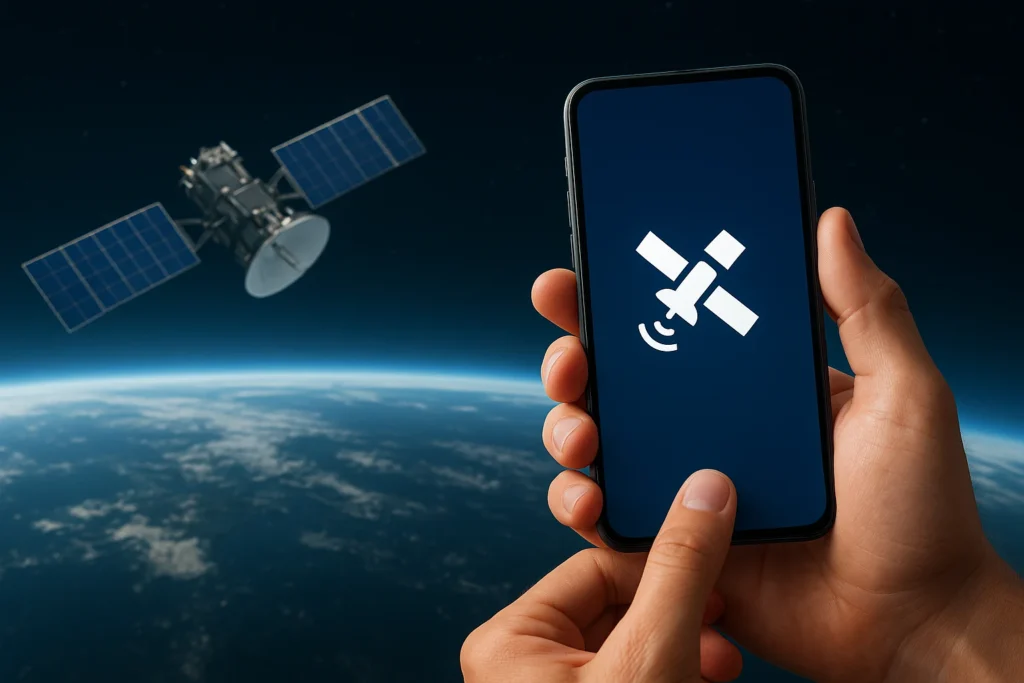

The Lost Hiker Who Called Home From Nowhere
In the dense, mist-shrouded valleys of Norway’s Jotunheimen mountains, a seasoned hiker named Anya found herself in a situation she had trained for but never truly expected. A sudden rockslide had altered her familiar path, twilight was descending faster than anticipated, and her phone displayed those two dreaded words: “No Service.” A decade earlier, this might have been the beginning of a tragic story. But on this crisp autumn evening in 2024, Anya simply opened a dedicated app on her smartphone, pointed it toward a clear patch of darkening sky, and within 90 seconds, sent a text message with her precise coordinates to mountain rescue services. The response came 12 minutes later: “Helicopter en route. Stay where you are.” Her ordinary smartphone had connected to a satellite orbiting 1,200 kilometers above the Earth’s surface.
Simultaneously, on the other side of the world, Dr. Elena Vargas, a field biologist deep within the Amazon Basin, faced a different kind of isolation. A sudden flash flood had inundated her research camp, washing away critical equipment and severing her last link to the outside world—a bulky, expensive satellite phone. With her team stranded but unharmed, she reached not for specialized gear, but for the smartphone in her pocket. Despite the display reading “No Service,” a subtle notification appeared: “Satellite Service Available for Emergency Messaging.” She composed a message with her precise geospatial coordinates, a situation summary, and immediate needs. Within minutes, a confirmation ping returned from the regional emergency hub. The age of isolation was over for both the Scandinavian hiker and the Amazonian scientist.
These parallel stories are no longer extraordinary. They are becoming daily reality from the fjords of Scandinavia to the outback of Australia, from the Himalayan foothills to the Amazon basin. A silent connectivity revolution is unfolding not through towers on hilltops, but through constellations of advanced satellites in low Earth orbit. Telecom giants and ambitious space companies are weaving a global communications safety net that promises to eliminate the concept of “dead zones” forever. This isn’t just about emergency SOS signals—it’s about enabling basic, vital communication for the approximately 3.7 billion people who live outside reliable cellular coverage, fundamentally reshaping global economics, safety, and human connection.
What began as niche technology for explorers and mariners is rapidly becoming mainstream consumer infrastructure. With experts predicting widespread adoption within three years, particularly across developing nations with limited traditional tower infrastructure, we stand at the precipice of perhaps the most significant expansion of human connectivity since the internet itself went mobile. Financial analysts are observing explosive growth: the nascent satellite direct-to-device (D2D) market, valued conservatively at $2.5 billion in 2024, is now projected to exceed $43 billion by 2034, reflecting a robust Compound Annual Growth Rate (CAGR) of over 32%. This comprehensive exploration will trace the extraordinary journey of satellite-to-smartphone technology—from its Cold War origins to its present-day commercial race, through its complex technical wizardry, to its profound implications for every person who carries a mobile device.
Part I: The Architects of the Sky—Understanding the Technology
Chapter 1: From Sputnik’s Beep to Smartphone Texts—A Historical Transformation
The concept of satellite communication is older than most realize. The Soviet Union’s Sputnik 1, launched in 1957, did little more than transmit a simple radio beep, yet it demonstrated the fundamental principle: objects in space could send signals to Earth. The first dedicated communications satellite, Telstar 1, launched in 1962, could relay television signals, telephone calls, and fax images, but required massive ground stations the size of football fields. For decades, satellite communication remained the exclusive domain of governments, media corporations, and maritime operators, requiring specialized, expensive equipment that bore no resemblance to consumer devices.
The turning point arrived not from a single breakthrough, but from a convergence of four technological revolutions. First, the smartphone transformed a communications device into a powerful, standardized computer with multiple radios and sophisticated antenna systems. Second, miniaturized satellite components driven by the CubeSat revolution made building and launching constellations economically feasible, reducing satellite size and cost by orders of magnitude. Third, reusable rocket technology pioneered by SpaceX dramatically reduced launch costs from approximately $65,000 per kilogram to under $1,500 per kilogram, making massive constellations financially viable. Finally, advances in software-defined radio and phased-array antennas allowed satellites to form precise, steerable beams that could track individual devices on the Earth’s surface with unprecedented accuracy.
This convergence has birthed what the industry calls “non-terrestrial networks” (NTN)—communication infrastructure that exists not on Earth, but above it. Unlike traditional satellite phones that require bulky hardware and connect to satellites 35,786 kilometers away in geostationary orbit, modern NTN systems leverage low Earth orbit (LEO) constellations between 500-1,500 kilometers high. This proximity reduces signal delay (latency) from 600+ milliseconds to under 40 milliseconds, making basic messaging feel nearly instantaneous and enabling entirely new classes of applications that were impossible with previous-generation satellite technology.
Chapter 2: The Technical Symphony—How Your Phone Talks to the Void
To understand this technological marvel, imagine a celestial ballet performed at hypersonic speeds. A satellite in LEO travels at approximately 27,000 kilometers per hour, completing an orbit every 90-120 minutes. As it streaks across the sky, it must simultaneously: maintain its precise orbit, avoid space debris, manage power from its solar panels, communicate with ground stations and other satellites, and—most critically for our purposes—maintain a stable connection with thousands of moving smartphones on the surface below. This requires solving three fundamental physics problems that have historically prevented direct satellite-to-smartphone communication.
The link budget challenge represents the first major hurdle. Historically, satellite phones needed large, power-hungry external antennas because the distance to orbit was too great for a small internal phone antenna. Modern LEO constellations overcome this through sophisticated high-gain spot-beam antennas that concentrate transmission energy into tight, focused “spots” on the ground, combined with ultra-sensitive receiver arrays on the satellite. This technological pairing closes the required link budget, allowing the weak signal from a standard smartphone antenna to successfully complete the orbital journey and return.
The connection process itself begins with what engineers call “acquisition and synchronization.” When your smartphone detects no terrestrial network (or receives a command from a carrier app), it begins scanning for satellite signals in specially allocated frequency bands. Modern smartphones already contain GPS receivers that listen to satellite signals; the new satellite communication chipsets add similar capabilities for communication bands. Once your phone detects a satellite’s “pilot signal,” it synchronizes its timing and establishes a basic link using protocols adapted from 4G/5G standards. The satellite itself contains a specialized, space-hardened version of a standard cellular base station—a gNodeB (for 5G) or eNodeB (for 4G) modem—that allows it to appear to your phone as just another cell tower, communicating using the phone’s existing, globally standardized radio protocols.
The core technical challenge remains overcoming the immense distance. A cell tower might be 5 kilometers away; a LEO satellite is 500 kilometers away—100 times farther. The signal strength diminishes with the square of the distance, meaning the satellite signal is approximately 10,000 times weaker by the time it reaches your phone. To compensate, satellites employ increasingly sophisticated beam-forming technologies while smartphones use longer transmission times and sophisticated error correction to piece together messages from faint signals. The physics of this connection creates inherent limitations that will shape the technology’s evolution for years to come.
Chapter 3: Two Technological Philosophies—The 4G Bridge vs. The NTN Future
The industry is currently advancing on two parallel technological paths, each with distinct advantages, trade-offs, and philosophical approaches to connecting smartphones from space. These approaches represent fundamentally different strategies for bringing satellite connectivity to the mass market.
Table: Comprehensive Comparison of Satellite Connectivity Approaches
| Technical Dimension | Unmodified 4G/LTE Adaptation | 3GPP NTN Standards (Release 17/18) | Proprietary Systems (e.g., Iridium, Globalstar) |
|---|---|---|---|
| Core Philosophy | Repurpose existing terrestrial tech for space | Build new standards optimized for space environment | Develop custom, end-to-end optimized systems |
| Device Compatibility | Works with current smartphones (after software update) | Requires new chipsets in future devices | Requires specialized hardware |
| Typical Latency | 40-60 milliseconds | 30-50 milliseconds | 100-300 milliseconds |
| Supported Services | Text, basic data, emergency alerts | Voice, video, broadband data in future iterations | Voice, text, low-speed data |
| Spectral Efficiency | Moderate (uses terrestrial spectrum creatively) | High (optimized for satellite constraints) | Variable (often uses dedicated MSS spectrum) |
| Deployment Timeline | Currently active (Starlink, Lynk) | Phased rollout beginning 2025-2026 | Mature systems operating for decades |
| Business Model | Partnership with terrestrial carriers | Future integrated networks | Direct-to-consumer subscriptions |
| Key Advantage | Immediate availability, leverages existing devices | Long-term performance and scalability | Proven reliability, global coverage |
The unmodified 4G approach represents the “fast path”—taking existing cellular technology and adapting it through software and specialized satellite payloads. Companies like SpaceX’s Starlink and Lynk Global use this method to deliver services to current smartphones. The satellites essentially function as “cell towers in space” running modified eNodeB base stations. This approach delivers services quickly but faces inherent limitations: smartphones aren’t designed for satellite links, requiring them to transmit at maximum power for extended periods, which drains batteries rapidly. It also uses complex, proprietary algorithms on the satellite to compensate for Doppler shift (the dramatic change in radio frequency as a satellite races past at 27,000 kph) and timing advance.
The 3GPP NTN standards (emerging from Release 17 and the forthcoming Release 18 of the 3GPP specifications that govern cellular technology) take a more fundamental approach. These standards introduce modifications specifically for the satellite environment: longer timing windows to account for signal delay, enhanced Doppler shift compensation for fast-moving satellites, and more robust protocols for intermittent connections. Phones designed with these standards (beginning with select 2025 models) will communicate with satellites far more efficiently. The 3GPP NTN Standard represents the consensus long-term solution, creating a robust, standardized framework specifically designed to manage the unique challenges of the space environment through standardized protocols that embed Doppler and timing compensation instructions directly into the cellular framework.
Simultaneously, established proprietary systems like Iridium Certus and Globalstar continue to serve dedicated markets with mature, reliable services. These systems often provide the backbone for emerging smartphone features—like Apple’s Emergency SOS via satellite, which uses Globalstar’s network with custom modifications to iPhone firmware. Globalstar strategically utilizes its dedicated Mobile Satellite Service (MSS) S-band spectrum for this service, securing its position in the critical life-safety segment of the D2D market.
Chapter 4: The Invisible Infrastructure—Ground Networks and Spectrum
The satellites themselves capture the imagination, but they represent only half the system. Every satellite connection eventually routes through ground stations (technically called “gateways” or “earth stations”). These facilities, strategically positioned around the globe, feature large parabolic antennas that maintain continuous contact with satellites passing overhead. The ground station network performs critical functions: routing traffic to and from the terrestrial internet, managing network resources, tracking satellite health, and serving as the crucial link between the orbital constellation and the existing global telecommunications infrastructure.
The architecture of these ground networks is evolving rapidly. Early systems relied on numerous ground stations to maintain continuous contact with LEO satellites, but next-generation systems are incorporating inter-satellite laser links that allow satellites to communicate with each other in space, reducing the need for constant ground station contact and enabling truly global coverage even over oceans where ground stations are impractical. This mesh network approach represents a fundamental shift in satellite architecture, creating a resilient, distributed system that can route traffic through multiple orbital paths to ensure continuous connectivity.
The spectrum allocation challenge represents one of the most complex aspects of satellite D2D deployment. Radio spectrum is a finite resource divided into bands with different propagation characteristics. Satellite operators primarily utilize two categories: Mobile Satellite Service (MSS) spectrum, which is allocated specifically for satellite-to-ground communications, and partnerships that allow use of terrestrial mobile spectrum under carefully defined conditions. The central dispute in the industry is whether to prioritize terrestrial mobile spectrum (which requires mobile network operator partnership and cross-border agreements) or MSS dedicated spectrum (which is globally allocated but highly limited). The emerging trend is toward a hybrid model, but this requires dozens of bilateral regulatory approvals and international coordination.
The regulatory landscape resembles a global patchwork quilt. In the United States, the FCC’s 2024 Supplemental Coverage from Space (SCS) framework established rules allowing satellite operators to partner with terrestrial carriers to use their licensed spectrum from space, providing crucial regulatory clarity. The European Union is developing its own European Connectivity Constellation with associated spectrum policies under CEPT/ETSI frameworks. Meanwhile, the International Telecommunication Union (ITU) coordinates global spectrum allocation through its World Radiocommunication Conferences, with satellite D2D being a major topic at WRC-23 and the upcoming WRC-27. Similar harmonized regulations are needed across all regions to enable true global roaming and service delivery without fragmentation.
Part II: The Global Race—Players, Partnerships, and Geopolitics
Chapter 5: Constellation Constellations—Mapping the Orbital Players
The low Earth orbit environment has transformed from relative emptiness to a busy orbital highway hosting multiple mega-constellations with distinct architectures, ambitions, and business models. This orbital real estate has become the new frontier in the global connectivity race, with multiple billion-dollar ventures competing for dominance.
SpaceX’s Starlink has emerged as the most formidable player through relentless execution and vertical integration. With over 6,000 operational satellites and plans for 12,000 in its first-generation constellation (with approval for 30,000 ultimately), Starlink has achieved the scale needed for continuous global coverage. Its D2D service, announced in 2022 through a partnership with T-Mobile, leverages modified second-generation Starlink satellites with custom “eNodeB” payloads. SpaceX’s vertical integration—controlling rocket manufacturing, launches, satellite production, and ground infrastructure—gives it unprecedented cost and speed advantages. The company’s recent acquisition of EchoStar’s spectrum portfolio for approximately $17 billion further consolidated its position, creating a powerful vertically integrated model that controls both the space and ground segments of the connectivity value chain.
AST SpaceMobile has taken a dramatically different approach, focusing on technological sophistication rather than sheer scale. Their BlueWalker 3 test satellite, with its unprecedented 64-square-meter phased array antenna (the largest commercial communications array ever deployed in low Earth orbit), demonstrated the ability to deliver 4G/5G equivalent speeds directly to standard smartphones. Rather than building its own complete constellation initially, AST has forged partnerships with major mobile network operators worldwide—including AT&T, Verizon, Vodafone, Rakuten, and others—creating what amounts to a global consortium of terrestrial carriers with a shared space infrastructure. AST’s strategy is built around deploying gigantic satellites—the “BlueBird” platform—with antenna arrays spanning up to 64 square meters, generating enough power and sensitivity to facilitate unmodified, two-way voice and video calls from LEO to standard devices.
The planned merger between Lynk Global and Omnispace (with strategic investment from satellite veteran SES) represents a third model: the spectrum-focused consolidator. Omnispace brings valuable globally coordinated S-band spectrum rights, while Lynk contributes its proven satellite technology and commercial partnerships with mobile operators in over 30 countries. SES adds its extensive experience operating geostationary satellites and existing enterprise customer relationships. Together, they aim to create a neutral host network serving multiple mobile operators without the vertical integration ambitions of SpaceX. Lynk adopts a strategy focused on scalability and affordability, positioning itself as a global wholesaler partnering with Mobile Network Operators (MNOs) across the developing world with low-cost, rapidly deployable satellites optimized for basic two-way messaging and IoT data.
Other significant players include:
- Amazon’s Project Kuiper: With FCC approval for 3,236 satellites and heavy investment from the retail/cloud giant, Kuiper represents a sleeping giant preparing to enter the D2D arena with the backing of one of the world’s most powerful technology ecosystems.
- Iridium Next: The complete overhaul of Iridium’s constellation (66 cross-linked satellites) provides truly global coverage including poles, with D2D capabilities through partnerships and a focus on enterprise and government markets.
- Globalstar: The backbone of Apple’s Emergency SOS service, with a leaner constellation of 24 satellites but valuable spectrum and smartphone integration that secures its position in the critical life-safety segment.
- Eutelsat OneWeb: Originally conceived as broadband for governments and enterprises, now exploring D2D applications through its 648-satellite constellation with strong backing from the UK government and Bharti Global.
- Chinese Constellations (Guowang, Hongyan): Ambitious national projects aiming for 13,000+ satellites combined, with clear geopolitical motivations for connectivity independence and supporting Beijing’s Belt and Road Initiative.
Chapter 6: The Partnership Ecosystem—Carriers, Handset Makers, and App Developers
The true measure of satellite D2D’s success lies not in satellites launched, but in terrestrial partnerships forged. The technology’s commercial viability depends on seamless integration into existing mobile ecosystems, creating invisible connectivity that works through the devices and plans consumers already use.
Table: Global Satellite-Smartphone Partnership Landscape (2024)
| Satellite Operator | Mobile Network Partners | Handset Partners | Service Model | Current Coverage |
|---|---|---|---|---|
| SpaceX Starlink | T-Mobile (USA), Optus (Australia), Rogers (Canada), KDDI (Japan), Entel (Chile/Peru), Salt (Switzerland) | Standard smartphones (Android/iOS) | Bundled with cellular plans, emergency services free | North America, Europe, Australia, partial South America/Asia |
| AST SpaceMobile | AT&T (USA), Verizon (USA), Vodafone (Europe), Rakuten (Japan), Orange (MENA), Telefónica (LatAm) | Standard smartphones (initially select models) | Premium add-on to existing cellular plans | Test coverage in select areas, commercial launch 2025 |
| Lynk Global | 40+ MNOs in 30+ countries (many undisclosed) | Standard smartphones | “Satellite as a Service” wholesale to carriers | Caribbean, Africa, Asia-Pacific islands |
| Globalstar | Apple (global exclusive for Emergency SOS) | iPhone 14 and newer | Free emergency service for 2 years, then subscription | Global (except polar regions) |
| Iridium | No direct MNO partnerships (enterprise focus) | Specialized devices, some smartphone integration | Direct subscription, enterprise contracts | Truly global (including poles) |
| Huawei | China Mobile, China Telecom | Select Huawei smartphones | Bundled with premium plans | China, Belt and Road regions |
The business models emerging from these partnerships reveal varied approaches to monetization in this nascent market:
- Emergency Service Bundling: Basic SOS functionality included free for a period (typically 2 years) with premium smartphones, transitioning to subscription—exemplified by Apple’s partnership with Globalstar.
- Premium Connectivity Add-ons: Monthly subscriptions (typically $5-15/month) for messaging and basic data beyond emergencies, often as tiered add-ons priced based on usage (e.g., pay-per-message).
- Wholesale Network Access: Satellite operators selling capacity to mobile operators who bundle it with their services, creating seamless integration for consumers.
- Enterprise/Government Contracts: Custom solutions for industries like shipping, aviation, energy, and public safety with specialized requirements and higher willingness to pay.
- IoT/M2M Focus: Low-bandwidth connectivity for sensors and tracking devices in remote locations, enabling global Internet of Things applications.
These partnerships often operate under the Hybrid Operator Bundle Model, where the MNO integrates the satellite link into their top-tier plans as a seamless feature, only activating the service when the phone detects the complete absence of a ground signal. This model ensures that the user’s primary connection remains the high-speed terrestrial 5G network, with the satellite serving as an essential, high-reliability fallback. The magic of D2D for the consumer is its invisibility—it’s integrated via roaming agreements and spectrum leasing that allow the smartphone to utilize the satellite network as an extension of the terrestrial carrier without requiring specialized hardware or complicated setup procedures.
Handset manufacturers are navigating this new landscape strategically. Apple made the first major move with Emergency SOS, embedding custom components in iPhone 14 and newer models and securing an exclusive partnership with Globalstar. Google followed with satellite SOS in Pixel devices, working with various partners. Samsung, Huawei, and Xiaomi have all announced satellite capabilities in flagship models, with Chinese manufacturers particularly focused on creating closed ecosystems that serve both domestic needs and diplomatic goals. The industry is now converging around the 3GPP NTN standards to avoid fragmentation, with Qualcomm and MediaTek developing chipsets that will bring satellite connectivity to mid-range devices by 2026, dramatically expanding the addressable market.
Chapter 7: The Geopolitics of Orbit—Nation-States and Sovereignty
Satellite D2D technology exists at the intersection of telecommunications policy, national security, and economic competitiveness—making it inherently geopolitical. Nations recognize that connectivity sovereignty has joined food, water, and energy security as fundamental national interests in the digital age. The control over communication infrastructure has become a critical component of national power, leading to distinct approaches across different regions and political systems.
The United States has embraced a largely commercial approach, with regulatory frameworks designed to accelerate private investment while maintaining oversight through the FCC and Department of Defense. The Space Force’s interest in resilient communications has led to programs like “Proliferated Low Earth Orbit” which could leverage commercial constellations for military purposes, creating a public-private partnership model for national security communications. The U.S. approach emphasizes innovation and competition through market-driven mechanisms with light-touch regulation, though with separate national security oversight processes for sensitive applications.
China has adopted a distinctly national champion model with tight integration with industrial policy. The “Guowang” (national network) constellation plan calls for approximately 13,000 satellites, with state-owned enterprises leading development and clear emphasis on technological self-sufficiency. Chinese manufacturers like Huawei are integrating satellite capabilities into smartphones, creating a closed ecosystem that serves both domestic needs and Beijing’s Belt and Road Initiative diplomatic goals. This approach reflects concerns about technological dependency and the strategic importance of controlling critical infrastructure, with the state playing a dominant role in directing investment and development priorities.
The European Union is pursuing a middle path with its European Connectivity Constellation—a public-private partnership aiming to provide sovereign connectivity while fostering European aerospace industry. The initiative reflects concerns about dependency on non-European constellations for critical communications and represents a blended approach that combines public investment with private sector expertise. Europe’s strategy emphasizes digital sovereignty and integration with broader digital transformation initiatives, seeking to balance innovation with strategic autonomy in an increasingly contested technological landscape.
India, Japan, and South Korea have all announced national satellite broadband initiatives with D2D components, viewing the technology as essential for connecting remote regions and maintaining technological competitiveness. Each has taken slightly different approaches: India focuses on cost-effective solutions for its vast rural population, Japan emphasizes technological sophistication and reliability for its disaster-prone geography, and South Korea prioritizes integration with its advanced terrestrial networks and export-oriented technology sector.
Meanwhile, many nations in Africa, Southeast Asia, and Latin America face difficult decisions about whether to rely on global commercial constellations or develop regional solutions. Many are adopting leapfrog strategies that embrace new technologies to bypass traditional infrastructure limitations, combined with regional cooperation models (like the African Union space policy) and public service obligations in licensing to ensure national interests are protected. These nations often balance the need for affordable connectivity with concerns about dependency on foreign-controlled infrastructure.
The orbital congestion and space debris problem adds urgency to these geopolitical discussions. With tens of thousands of new satellites planned for LEO, coordination through organizations like the ITU and UN Committee on the Peaceful Uses of Outer Space becomes critical to prevent collisions that could render valuable orbital regions unusable. The “tragedy of the commons” in space is no longer theoretical—it’s a daily management challenge requiring international cooperation even amid geopolitical competition. Operators are increasingly required to have robust, verifiable plans for satellite deorbiting and collision avoidance to ensure the sustainability of LEO for future generations, adding another layer of complexity to the regulatory environment.
Part III: Transformation on the Ground—Real-World Impact Across Sectors
Chapter 8: Redefining Emergency Response and Public Safety
When Hurricane Fiona struck Puerto Rico in September 2022, it wasn’t just another severe weather event—it became a real-world test of emerging satellite D2D technology. With terrestrial networks severely damaged, over 150,000 people used satellite connectivity features on iPhones and other devices to contact emergency services, check on relatives, and receive critical updates. The lessons learned transformed emergency management planning across hurricane-prone regions, demonstrating the resilience value proposition of orbital connectivity that bypasses damaged ground infrastructure entirely.
Similar validation occurred during the 2024 Taiwan earthquake, where early satellite D2D systems proved their value when widespread outages affected fixed and mobile networks. These real-world tests have provided compelling evidence for the technology’s role as a critical backup system during natural disasters, conflict situations, and other events that compromise terrestrial infrastructure. The statistics paint a compelling picture of impact. According to a 2024 study by the Global Emergency Communications Institute, satellite-to-device technology has already been implicated in:
- 38% reduction in search-and-rescue response times in wilderness areas
- 72% increase in successful emergency interventions in marine environments
- Over 5,000 documented lifesaving uses in the first 18 months of widespread availability
- 94% user satisfaction among those who have used emergency satellite features
Beyond reactive emergency response, the technology enables proactive disaster resilience. Wireless Emergency Alerts (WEAs) delivered via satellite can reach entire populations regardless of terrestrial infrastructure damage. During the 2023 Maui wildfires, satellite-delivered evacuation warnings reached residents in areas where cell towers had already been destroyed by approaching fires—a capability that emergency managers describe as “game-changing.” The ability to push Wireless Emergency Alerts (WEAs) directly to every compatible device in a crisis area, regardless of tower status, represents a major advance in public safety, potentially reducing casualties by accelerating evacuation orders and critical warnings.
Public safety agencies are integrating satellite D2D into their operational frameworks at an accelerating pace. The U.S. Federal Emergency Management Agency (FEMA) now includes satellite connectivity in its disaster planning templates and response protocols. Mountain rescue teams from Scotland to New Zealand issue standardized protocols for distressed individuals to use smartphone satellite features, incorporating them into training programs for both rescuers and the public. The International Maritime Organization is updating Global Maritime Distress and Safety System (GMDSS) regulations to incorporate direct-to-device capabilities for recreational boaters who comprise the majority of maritime distress incidents. For federal agencies and local emergency services, D2D enables continuous command and control communication when deploying into disaster zones, while Search and Rescue (SAR) teams can maintain constant contact, relaying crucial geo-tagged imagery and thermal data from remote or inaccessible locations.
Chapter 9: The Developing World Leapfrog—Bridging the Digital Divide
While emergency services capture headlines in developed nations, the most profound impact of satellite D2D may be in the developing world, where it enables what economists call “technological leapfrogging.” Just as many developing nations skipped landline telephony and went directly to mobile phones, they now have the potential to skip traditional cellular infrastructure and go directly to integrated terrestrial-satellite networks. This leapfrogging addresses the persistent problem of the Digital Divide, connecting the roughly 2.6 billion people worldwide who still lack reliable, consistent internet access—a population often clustered in rural or geographically challenging regions where traditional cell towers are economically unviable.
Consider the mathematics of traditional cellular deployment. A typical cell tower costs $150,000-$300,000 to build, with additional expenses for land acquisition, backhaul connectivity, power infrastructure, and ongoing maintenance. In sparsely populated regions with challenging terrain—whether the Mongolian steppe, Amazon rainforest, or African savannah—the return on investment might never materialize, leaving these regions perpetually unconnected. Satellite D2D changes this equation completely—coverage becomes essentially “free” from an infrastructure perspective once the constellation is operational, with costs borne by users through service fees rather than massive public or private infrastructure investments. This economic reality makes satellite connectivity uniquely suited to address the last-mile problem in low-density regions where traditional approaches have consistently failed.
The implications for development are staggering and multidimensional:
- Agricultural transformation: Farmers in remote areas can access weather forecasts, market prices, and agricultural extension services through basic messaging. In a pilot program in rural Kenya, farmers using satellite-connected smartphones saw 23% higher prices for their crops due to better market information and timing, directly increasing household income and food security. Precision agriculture becomes possible even in remote regions, with farmers receiving real-time weather forecasts, soil sensor data (via low-bandwidth IoT connectivity), and updated commodity prices directly to their basic feature phones.
- Healthcare delivery: Community health workers can consult with specialists, access medical databases, and coordinate patient transportation. Studies in remote Amazonian communities show 40% reductions in medically unnecessary evacuations through better remote consultation, saving limited resources and reducing patient stress. For isolated communities, a basic satellite connection enables telemedicine where a local healthcare worker can conduct a remote consultation with a specialist hundreds of miles away, dramatically improving outcomes in areas with critical doctor shortages.
- Education access: Children in communities without schools can participate in distance learning through low-bandwidth educational content. The One Laptop Per Child initiative is now evolving into “One Connected Child” with satellite-enabled tablets that can download educational materials even in regions without any terrestrial connectivity. Tele-education becomes feasible, allowing children in remote villages to access essential schooling materials and interactive learning platforms.
- Financial inclusion: Mobile banking and digital payments become possible without terrestrial networks, potentially bringing 1.7 billion unbanked adults into the formal financial system. This integration into digital finance represents perhaps the most powerful economic empowerment tool, enabling savings, credit, insurance, and participation in the modern economy.
Perhaps most significantly, satellite D2D creates what development economists call “the connectivity multiplier effect”—each percentage point increase in connectivity correlates with approximately 0.3% increase in GDP growth in developing economies, according to World Bank research. By bringing previously unconnected communities online, D2D integrates them into the global economy, facilitating mobile banking, e-commerce, and access to new labor markets, fulfilling the economic promise that a 1% increase in broadband penetration can generate significant GDP growth. The technology doesn’t just connect people; it connects them to opportunity, markets, knowledge, and services that were previously inaccessible.
Chapter 10: Industry Transformation—From Shipping to Energy to Tourism
Beyond consumer and developmental applications, satellite D2D is quietly revolutionizing entire industries that operate beyond reliable terrestrial coverage, creating what might be called the ‘Always-On’ Global Grid for industrial operations. These sectors are accelerating their adoption of D2D to achieve unprecedented operational oversight, safety assurance, and efficiency improvements.
The maritime sector, long dependent on expensive, specialized satellite equipment, is experiencing a democratization of connectivity through D2D technology. Small commercial vessels, fishing boats, and recreational craft that could never justify traditional satellite systems (costing thousands of dollars for equipment and hundreds per month for service) can now access basic communications for as little as $10-30 per month. The implications are profound and multifaceted:
- Enhanced safety: Over 80% of maritime distress incidents involve vessels under 20 meters—precisely those least likely to have traditional satellite systems. D2D provides these vessels with affordable emergency communications and basic weather updates.
- Operational efficiency: Fishermen can locate optimal fishing grounds, verify regulations, and arrange meet-ups with collection vessels using basic messaging, improving catch efficiency and reducing waste.
- Regulatory compliance: Automatic identification and reporting become feasible for smaller vessels, improving maritime domain awareness and regulatory oversight.
- Asset tracking: Shipping and logistics companies can implement low-cost, continuous asset tracking for global shipping containers and truck fleets, eliminating “blind spots” over oceans or remote landmasses and providing end-to-end telemetry and compliance data.
The aviation industry represents another frontier with distinct applications. While commercial aviation has long had satellite connectivity through specialized systems, general aviation (private planes, charter services, medical evacuation) has been underserved due to cost and complexity barriers. Satellite D2D enables several transformative applications:
- Basic cockpit communications in remote areas and over oceans where traditional VHF radio is unavailable
- Passenger connectivity on routes without ground-based systems, enhancing the passenger experience
- Unmanned aerial vehicle (UAV) operations beyond visual line of sight, enabling commercial drone applications over long distances
- Essential Aircraft Communications Addressing and Reporting System (ACARS) data transfers between aircraft and ground operations, providing redundancy and global coverage for fundamental aviation communications
The energy and resource extraction industries operate in some of Earth’s most remote locations, from offshore oil platforms to mining operations in extreme environments. Satellite D2D provides critical capabilities for these sectors:
- Continuous monitoring of pipelines, wellheads, and transmission lines through IoT sensors with global connectivity
- Safety communications for field crews working in areas without cellular coverage, ensuring worker safety and emergency response capability
- Environmental sensor networks that can operate independently of local infrastructure, providing real-time data on emissions, leaks, or other environmental factors
- Critical safety communications for solitary field workers and continuous monitoring of pipeline sensors and drilling platforms, allowing for remote diagnostics and preventative maintenance
Even the adventure tourism industry is transforming in response to this technology. Guides in remote destinations from Patagonia to the Himalayas now carry satellite-connected devices as standard equipment, enhancing both safety and the customer experience. Luxury safari camps, wilderness lodges, and expedition cruise ships market “always reachable” connectivity as a premium feature rather than a limitation, appealing to clients who want remote experiences without complete isolation. This sector illustrates how D2D is shifting from emergency-only technology to an expected amenity in even the most remote tourist destinations.
Chapter 11: The Environmental and Scientific Applications
An unexpected but profoundly important beneficiary of satellite D2D technology is the environmental monitoring and scientific research community. The ability to place sensors anywhere on Earth with guaranteed connectivity—without building local infrastructure—is revolutionizing data collection for climate science, conservation, and environmental management. This represents perhaps the most socially valuable application beyond emergency services, creating a global nervous system for planetary health monitoring.
Climate change research benefits tremendously from ubiquitous connectivity. Glaciologists can place sensors on remote ice sheets that transmit data continuously rather than storing it for seasonal collection, providing real-time insights into melting patterns and ice dynamics. Oceanographers can deploy floating sensor arrays (drifting buoys, autonomous vehicles) that communicate findings in real-time, creating dynamic maps of ocean temperature, acidity, and current patterns. Atmospheric scientists can maintain monitoring stations in pristine environments without the visual pollution and infrastructure requirements of communications towers, gathering baseline data unaffected by local human activity. The polar regions, in particular, stand to benefit enormously, as they host critical climate processes but have minimal existing infrastructure.
Wildlife conservation presents particularly compelling use cases that blend technology with ecological protection. Animal tracking collars have historically stored data locally or transmitted it intermittently when animals passed near specialized receivers, creating data gaps and delays. Satellite D2D enables a new paradigm in conservation technology:
- Real-time tracking of migratory species across oceans and continents, revealing previously unknown migration routes and resting areas
- Instantaneous poaching alerts when collars detect gunshots or unusual movements, enabling rapid anti-poaching responses
- Health monitoring through biometric sensors on endangered species, tracking heart rate, temperature, and activity patterns
- Human-wildlife conflict mitigation through proximity alerts when animals approach human settlements, preventing conflicts before they occur
- Population dynamics studies with continuous data rather than periodic samples, improving conservation planning and resource allocation
The Internet of Things (IoT) ecosystem for environmental applications is expanding exponentially thanks to affordable satellite connectivity. Soil moisture sensors in precision agriculture, water quality monitors in remote watersheds, air pollution sensors in wilderness areas, seismic monitors in tectonically active regions—all become economically feasible with low-cost satellite connectivity that doesn’t require local infrastructure. The data these networks generate supports everything from sustainable farming practices to early wildfire detection to water resource management to natural disaster early warning systems. We are witnessing the emergence of a global sensor network that can monitor planetary health in ways previously impossible, creating unprecedented understanding of Earth systems and human impacts.
Part IV: The Challenges Ahead—Technical, Economic, and Social Hurdles
Chapter 12: The Physics Problem—Inherent Limitations of Satellite Links
For all its promise, satellite D2D technology faces fundamental physical constraints that will shape its evolution and appropriate applications. Understanding these limitations is crucial for realistic expectations, appropriate deployment, and effective user education. These are not temporary engineering challenges but inherent properties of communicating across vast distances through the atmosphere.
The line-of-sight requirement presents the most immediate and practically significant constraint. Satellite signals cannot penetrate most buildings, dense forest canopies, or urban “canyons” between tall buildings. While future systems might use signal reflection techniques or satellite diversity (multiple satellites providing redundant paths), the technology will likely remain primarily for outdoor and open-area use. This limitation necessitates careful user education to prevent dangerous overreliance in inappropriate environments—someone expecting to call for help from inside a cave or collapsed building may find the technology unavailable when most needed. Service requires optimal orientation (pointing the phone at the sky) and is heavily affected by rain fade and atmospheric interference, particularly at higher frequencies.
Latency, while dramatically improved from traditional geostationary systems, remains higher than terrestrial networks. The speed-of-light round trip to LEO satellites (minimum approximately 500 km up and 500 km down) creates unavoidable delays of 25-50 milliseconds under ideal conditions, compared to 5-20 milliseconds for terrestrial 5G. While negligible for messaging and acceptable for voice calls, this becomes problematic for real-time applications like gaming, financial trading, or certain industrial control systems that require millisecond precision. The latency is further affected by the need for Doppler shift compensation—the dramatic change in radio frequency as a satellite races past at 27,000 kph—which requires computational processing that adds additional delay.
Capacity constraints represent perhaps the most significant long-term challenge for mass adoption. Each satellite beam covers hundreds of square kilometers, with all users in that area sharing limited bandwidth. Early systems prioritize connection density over individual speed—a single satellite might support thousands of simultaneous text messages but only dozens of simultaneous voice calls. As user numbers grow, intelligent traffic management will become critical, potentially prioritizing emergency communications during congestion. The current systems are bandwidth-limited by design and economics; even as technology improves, these networks are optimized for sparse usage (remote areas) and cannot compete with terrestrial fiber-backed 5G networks for density or speed. Users must manage expectations: satellite is for communication and essential data, not high-bandwidth applications like 4K streaming or large file downloads.
The battery consumption problem stems from basic physics and presents a practical limitation for users. Communicating with satellites 500+ kilometers away requires significantly more power than communicating with a cell tower 5 kilometers away—typically 5-10 times higher battery drain during satellite transmission compared to terrestrial cellular. This is primarily because the smartphone must transmit at higher power to reach the distant satellite, and the transmission times are longer due to the weak signal requiring repetition and error correction. While chipset improvements and more efficient protocols will help, the fundamental power requirement difference will likely persist due to the laws of physics, making satellite connectivity a feature used sparingly rather than continuously without access to charging.
Chapter 13: The Economic Equation—Building Sustainable Business Models
The satellite D2D industry faces a classic infrastructure dilemma: enormous upfront capital requirements with uncertain long-term revenue streams. Building a global constellation costs $5-10 billion before serving the first customer, with additional billions required for continuous replenishment as satellites reach end-of-life (typically 5-7 years in the harsh radiation environment of LEO). The sheer scale of investment—up to $50 billion over the next decade across the industry—required to build, launch, and operate these constellations demands a clear, scalable path to profitability that has yet to be fully demonstrated at mass-market scale.
The revenue models face particular challenges that differ significantly from terrestrial networks:
- Emergency services, while socially valuable and excellent for market education, generate little direct revenue, especially when offered as “free” features to sell premium smartphones. This creates a paradox where the most visible application may be the least profitable.
- Consumer subscriptions must be priced low enough for mass adoption but high enough to recover astronomical infrastructure costs. This often means offering D2D services as tiered add-ons, priced based on usage (e.g., pay-per-message), but such models have historically struggled to achieve the revenue density of flat-rate terrestrial plans.
- Enterprise markets, while willing to pay premium prices for reliability and coverage, represent limited total addressable market compared to consumer potential. Enterprise customers also demand higher service levels and custom solutions that increase operational complexity and cost.
- Developing world users, who stand to benefit most socially and represent the largest untapped market, often have the least ability to pay. ARPU (Average Revenue Per User) in these regions may be only a few dollars per month, requiring extraordinary subscriber numbers to justify the infrastructure investment.
Industry analysts project a “shakeout period” between 2026-2030 as early constellations reach capacity limits and revenue realities confront optimistic projections. The likely outcome is industry consolidation into 2-3 major global operators complemented by regional specialists and government-backed constellations for strategic purposes. This mirrors the consolidation seen in previous infrastructure-intensive industries like railroads, telecommunications, and airlines. The most successful models, like Starlink’s, are becoming vertically integrated, controlling both the space and ground segments. This high barrier to entry limits competition and concentrates market power, raising future concerns about competitive pricing and universal access obligations.
The spectrum economics add further complexity to the business model challenge. Auction prices for terrestrial spectrum have reached billions of dollars in major markets, creating pressure to generate corresponding returns from satellite usage of that spectrum. Meanwhile, traditional MSS spectrum holders face demands to “use it or lose it” as regulators seek more efficient utilization of scarce spectrum resources. Operators must devise pricing strategies that are affordable enough to attract low-income users in developing nations, yet premium enough in wealthy nations to cover the high capital expenditure and spectrum costs. This bifurcated pricing approach is challenging to execute without appearing discriminatory or creating arbitrage opportunities.
Chapter 14: The Regulatory Maze—Global Rules for a Borderless Technology
Satellite D2D technology operates in a regulatory environment designed for a different era of geographically bounded communications. The fundamental challenge: communications regulation is fundamentally national, while satellites are fundamentally global. A satellite passing over multiple countries in minutes must comply with each nation’s regulations regarding spectrum use, content restrictions, data privacy, and emergency service obligations—a practical impossibility under traditional regulatory frameworks.
The licensing dilemma illustrates this perfectly and requires innovative solutions:
- Mutual recognition agreements between nations with compatible regulations, creating regulatory zones rather than nation-by-nation approval
- “Flag of convenience” approaches where services are licensed in permissive jurisdictions but serve users globally, similar to maritime registration
- Technical measures like beam shaping and power control to comply with national restrictions on where signals can be received
- Partnerships with local operators who handle regulatory compliance and act as the service face within each jurisdiction
- International frameworks developed through bodies like the ITU that create harmonized rules for cross-border satellite services
Data sovereignty and privacy present particularly thorny issues with no clear global consensus. When a message originates in one country, transits through a satellite registered in another country, routes through ground stations in a third country, and terminates in a fourth country—which nation’s privacy laws apply? The situation recalls early internet jurisdictional debates but with added physical dimension and national security implications. Different regions have dramatically different approaches: the EU’s GDPR emphasizes data protection and localization, the U.S. has sectoral approaches with national security exceptions, while many developing nations have limited data protection frameworks. Satellite operators must navigate this patchwork while maintaining consistent user experience and service quality.
Emergency service obligations vary dramatically across jurisdictions and present operational challenges. In the United States, E911 regulations mandate precise location accuracy (within 50 meters for most calls) and direct routing to appropriate emergency services, requiring sophisticated location determination and routing capabilities. In the European Union, eCall regulations for vehicles establish different requirements for automated emergency calls. In many developing nations, formal emergency services barely exist or are inaccessible in remote regions. Satellite operators must design systems flexible enough to accommodate this patchwork while maintaining consistent user experience—a significant technical and operational challenge. The development of global minimum emergency access standards through international bodies is becoming increasingly urgent as the technology spreads.
The security implications of ubiquitous satellite connectivity concern governments worldwide, particularly regarding sovereignty and control. The same technology that enables a hiker to call for help could enable coordination by malicious actors in remote areas beyond traditional surveillance. Export controls on encryption technology (like those governing strong cryptography in the U.S.) may conflict with the need for end-to-end security in communications. Lawful intercept requirements vary by nation and may be technically challenging to implement in systems where traffic may bypass national infrastructure entirely. National security concerns are leading some nations to develop sovereign constellations rather than rely on commercial international systems, particularly for government and military communications.
Chapter 15: The Social Dimension—Connectivity as Double-Edged Sword
Beyond technical and economic challenges, satellite D2D raises profound social questions about our relationship with technology, community, and autonomy. These considerations are often overlooked in the enthusiasm for technological progress but will significantly shape how the technology impacts society and whether its benefits are equitably distributed.
The digital divide narrative often assumes more connectivity is invariably better, but anthropologists, sociologists, and community advocates offer more nuanced perspectives. Some remote communities have consciously limited connectivity to preserve cultural practices, control outside influence, maintain social cohesion, or protect traditional knowledge systems. Satellite D2D, by being impossible to locally restrict (short of Faraday cages or signal jamming, which have their own issues), potentially overrides these community decisions about technology adoption and pace of change. The technology challenges fundamental notions of local autonomy and self-determination, imposing connectivity rather than enabling communities to choose if, when, and how to connect. There are documented cases of indigenous communities experiencing social disruption, addiction to external media, and erosion of traditional practices after sudden internet access—concerns that should inform responsible deployment.
The always-reachable expectation carries psychological consequences that are only beginning to be understood. The mental refuge of being truly disconnected becomes increasingly rare in a world of ubiquitous connectivity. The “right to disconnect” movement, gaining traction in labor laws worldwide (particularly in Europe), faces new challenges when employees can theoretically be reached anywhere on Earth. The boundary between work and personal life, already eroded by smartphones and home internet, could disappear entirely for professions that operate in remote areas like field research, resource extraction, or adventure tourism. There are legitimate concerns about burnout, stress, and the erosion of non-digital experiences when connectivity becomes truly inescapable.
Cultural homogenization concerns emerge when considering the developing world applications. While connectivity brings educational and economic opportunities, it also brings global media, advertising, consumer values, and social platforms that may overwhelm local cultures, languages, and traditions. The experience of previously isolated indigenous communities suddenly gaining internet access provides cautionary tales of social disruption, addiction to external content, and cultural erosion. The design of these systems—which languages and interfaces they support, what content is accessible by default, how algorithms surface information—will significantly influence these cultural impacts. There are important questions about whether satellite connectivity will primarily serve as a pipeline for global cultural exports or as a platform for local content and communication.
Yet these concerns must be balanced against demonstrable benefits: lives saved in emergencies, economic opportunities created, knowledge shared, and human connections maintained across distances. The challenge becomes developing conscious connectivity—frameworks that maximize benefits while mitigating harms, that respect cultural diversity while enabling global solidarity, that empower local choice while providing access to global resources. This requires multidisciplinary approaches that include not just engineers and entrepreneurs, but social scientists, community leaders, ethicists, and policymakers in the design and deployment of these systems. It suggests the need for adaptive approaches that allow communities to control how connectivity integrates into their social fabric rather than having it imposed uniformly.
Part V: The Future Orbiting Into View—2025 and Beyond
Chapter 16: The Technology Roadmap—From Text to Broadband
The satellite D2D evolution will unfold in distinct generations, each expanding capabilities, refining implementation, and addressing limitations of previous approaches. This roadmap is already taking shape through standards development, prototype demonstrations, and announced corporate plans spanning the next decade.
Generation 1 (2022-2025): The Emergency Era
- Focus: Basic messaging, SOS functionality, emergency alerts
- Typical speeds: 100 bps – 10 kbps (sufficient for text but little else)
- Device requirement: Software updates to existing phones with compatible chipsets
- Key players: Apple/Globalstar, SpaceX/T-Mobile, Lynk, Huawei
- Business model: Safety feature bundled with premium devices, limited subscriptions
- Technical approach: Proprietary adaptations of existing 4G/LTE protocols
- Primary use cases: Emergency communications, basic texting in remote areas
- Limitations: Requires clear sky view, high battery consumption, messaging-only
Generation 2 (2025-2028): The Communication Era
- Focus: Voice calls, basic data services, two-way messaging, IoT connectivity
- Typical speeds: 10-100 kbps (voice calls, basic web browsing, small file transfers)
- Device requirement: NTN-capable chipsets in new devices, backward compatibility for text
- Key players: AST SpaceMobile, Starlink Gen2, Huawei, Samsung with NTN chips
- Business model: Premium subscription add-ons, enterprise packages, developing world bundles
- Technical approach: Early 3GPP NTN implementations, improved beam forming
- Primary use cases: Voice calls in remote areas, basic internet access, industrial IoT
- Limitations: Still requires relatively clear view, noticeable latency for voice
Generation 3 (2028-2032): The Integration Era
- Focus: Seamless terrestrial-satellite handoff, moderate data, integrated services
- Typical speeds: 100 kbps – 1 Mbps (reasonable web browsing, larger file transfers)
- Device requirement: Standard in mid-range and premium devices, sophisticated antennas
- Key players: Consolidated global operators, major smartphone manufacturers
- Business model: Integrated into standard cellular plans, differentiated pricing tiers
- Technical approach: Mature 3GPP NTN standards, AI-optimized networks
- Primary use cases: Always-connected experience, backup for terrestrial dead zones
- Advancements: Better indoor penetration, lower battery impact, reduced latency
Generation 4 (2032+): The Broadband Era
- Focus: True broadband anywhere, IoT ecosystem, integrated 6G networks
- Typical speeds: 1-10 Mbps initially, eventually 100+ Mbps with advances
- Device requirement: Standard in all but most basic devices, advanced antenna systems
- Key players: Fully integrated 6G networks, universal service providers
- Business model: Connectivity as universal utility, blended with terrestrial service
- Technical approach: Fully integrated non-terrestrial 6G networks, quantum enhancements
- Vision: Elimination of connectivity dead zones as a concept, truly global broadband
The transition between these generations will be driven by several converging technological breakthroughs:
- Advanced antenna systems: Electronically steerable antennas that can track satellites without physical movement, improving signal acquisition and stability
- Inter-satellite links: Laser connections between satellites creating space-based mesh networks that reduce latency and ground station dependency
- AI-driven network optimization: Machine learning algorithms predicting demand, allocating resources, optimizing beam steering, and managing handovers
- Energy harvesting technologies: More efficient solar cells, ambient RF energy harvesting, and improved battery technologies to address power constraints
- Advanced materials: Lighter, more radiation-resistant satellite components, deployable structures, and improved thermal management
- Quantum technologies: Quantum key distribution for security, quantum sensors for positioning, and quantum computing for network optimization
Chapter 17: Market Projections and Economic Impact
The satellite D2D market represents one of the fastest-growing segments in both the space and telecommunications industries, with transformative potential for the global economy. According to comprehensive analysis from Northern Sky Research, Euroconsult, and Morgan Stanley, the market will evolve through distinct phases with varying regional dynamics and sectoral emphasis.
Table: Satellite D2D Market Projections and Economic Impact (2024-2034)
| Market Segment | 2024 Market Size | 2030 Projection | 2034 Projection | CAGR (2024-2034) | Primary Drivers |
|---|---|---|---|---|---|
| Consumer Services | $0.8 billion | $18.2 billion | $28.5 billion | 68% (early), 45% (long-term) | Smartphone integration, safety concerns, adventure tourism, remote living |
| Enterprise IoT | $1.2 billion | $14.7 billion | $22.8 billion | 52% | Asset tracking, remote monitoring, industrial automation, supply chain visibility |
| Government/Public Safety | $0.9 billion | $8.3 billion | $12.1 billion | 45% | Emergency communications, national security, disaster response, border monitoring |
| Backhaul/Network Extension | $0.6 billion | $5.1 billion | $7.3 billion | 43% | Rural connectivity, developing world infrastructure, temporary deployments |
| Maritime/Aviation | $0.5 billion | $3.2 billion | $4.8 billion | 37% | Small vessel connectivity, general aviation, UAV operations, passenger services |
| TOTAL | $4.0 billion | $49.5 billion | $75.5 billion | 54% (average) | Convergence of multiple growth drivers |
These projections translate to significant macroeconomic impact beyond direct revenues:
- Direct employment in satellite D2D sector: Approximately 25,000 jobs currently across manufacturing, launch services, operations, and ground segments, projected to reach 150,000 by 2030 as the ecosystem matures and expands
- Indirect economic impact through improved connectivity: Estimated at 3-5x direct market size through productivity improvements, new services, and economic inclusion
- Developing world GDP impact: Potential 0.5-1.5% additional annual GDP growth in least-connected nations through financial inclusion, market access, and productivity gains
- Productivity gains in remote industries: 15-25% estimated improvement in sectors like fishing, forestry, remote mining, and agriculture through better coordination, monitoring, and market access
- Reduced emergency response costs: Estimated 20-30% reduction in search and rescue operations and disaster response through better coordination and earlier intervention
The investment landscape reflects this optimism but with characteristic volatility. Venture capital investment in space technology generally has grown from $1.1 billion in 2016 to over $17.2 billion in 2023, with satellite communications attracting the largest share. Public markets have shown more volatility, with satellite stocks experiencing significant swings based on launch successes/failures, regulatory developments, and quarterly subscriber numbers. The long-term trend, however, points toward mainstreaming of space infrastructure investment as part of diversified portfolios, with space increasingly seen as a utilities-like sector rather than pure technology speculation. We’re seeing the emergence of specialized space investment funds, increased institutional participation, and growing interest from infrastructure investors seeking long-term stable returns.
Regional growth dynamics show distinct patterns and opportunities:
- North America: Early adopter market with premium pricing, driving innovation but eventually saturating
- Europe: Regulatory-led adoption with emphasis on sovereignty and integration, moderate growth
- Asia-Pacific: The future growth engine with India, China, and Southeast Asia representing the largest potential market due to population and geography
- Africa: Highest need but challenging economics, requiring innovative business models and partnerships
- Latin America: Geographic necessity driving adoption, particularly in Amazon regions and mountainous areas
Chapter 18: The 6G Convergence—When Terrestrial and Celestial Networks Merge
The ultimate destination for satellite D2D technology is not as a separate service, but as an integrated component of next-generation cellular networks—a seamless blend of terrestrial and non-terrestrial infrastructure. The 3GPP standardization process is already laying this groundwork through Release 17 (initial NTN support), Release 18 (enhancements), and the forthcoming Release 19/20 which will shape what the industry calls “6G”—the first generation of cellular technology designed from inception to include non-terrestrial components as a fundamental architectural element rather than an afterthought.
This convergence will manifest in several key ways that redefine the user experience and network capabilities:
- Unified user experience: Devices will automatically and intelligently select the best available network (terrestrial 5G/6G, satellite, or high-altitude platform systems) without user intervention, based on availability, cost, latency requirements, and application needs.
- Seamless mobility: Connections will hand off between terrestrial and satellite networks mid-session without dropping, using advanced prediction algorithms that anticipate coverage gaps and prepare alternative paths before they’re needed.
- Common core network: The same authentication, billing, policy management, and service platforms will manage both terrestrial and satellite connections, simplifying operations and creating consistent user experiences.
- Orchestrated resource management: Network intelligence will allocate traffic based on capacity, latency requirements, energy considerations, and cost across all available links, optimizing both user experience and network efficiency.
- Application-aware networking: Applications will communicate their requirements to the network (latency tolerance, bandwidth needs, reliability thresholds), allowing intelligent path selection tailored to specific use cases from emergency communications to entertainment streaming.
The architectural implications of this convergence are profound and represent a fundamental shift in network design. Traditional hierarchical network designs (devices → towers → core network) evolve into mesh networks where satellites communicate with each other, with towers, with high-altitude platforms, and directly with devices in a dynamic, adaptive topology. This creates unprecedented resilience—if a natural disaster, conflict, or technical failure disrupts ground infrastructure, the space-based layer maintains connectivity and can potentially route around the disruption. It also enables entirely new service architectures where computing and storage resources can be distributed across terrestrial and orbital elements based on optimal location rather than historical constraints.
The service implications are equally transformative and will redefine what applications are possible. Applications will no longer be designed for “connected” or “disconnected” states, but for graceful degradation across connectivity quality levels. A video call might transition from HD over terrestrial 5G to audio-only over satellite to store-and-forward messaging when no connection is available—all automatically, based on what the network can provide at that moment and location. This capability will enable truly continuous services that work everywhere without the binary connectivity assumptions that constrain today’s applications. We’ll see the emergence of location-independent services that function identically whether users are in urban centers, remote wilderness, or at sea.
The development of 6G standards (expected around 2030) is already incorporating satellite as a core component rather than supplemental capability. Key research areas for 6G NTN include:
- Terahertz communications for extremely high bandwidth satellite links
- Reconfigurable intelligent surfaces to reflect and focus signals in challenging environments
- Integrated sensing and communications using the same spectrum for both functions
- AI-native network architectures with machine learning embedded at all layers
- Quantum-secured communications for inherently secure satellite links
- Holographic communications requiring the ultra-high bandwidth and low latency that integrated networks can provide
This convergence represents more than just technical integration—it signifies a philosophical shift from viewing satellite as a separate, specialized service to understanding connectivity as a unified field encompassing all available transmission media. The boundary between “cellular” and “satellite” will dissolve for users, replaced by a continuum of connectivity options managed intelligently by the device and network to provide the best possible experience wherever they are.
Chapter 19: The Long-Term Vision—Connectivity as Universal Utility
Looking beyond the next decade, satellite D2D technology points toward a fundamental reimagining of connectivity from commercial service to public utility—as essential and universally available as electricity, clean water, or road networks. This vision represents the culmination of the connectivity revolution, where access to communication becomes a fundamental right rather than a commercial product, available to all humans regardless of location or economic circumstance.
Several converging trends support this evolution from service to utility:
Technological democratization will continue as costs decline through economies of scale, reusable launch systems, manufacturing innovations, and increased competition. The “experience curve” phenomenon (where costs decline 20-30% with each doubling of cumulative production) that transformed computing, solar power, and genetic sequencing will similarly transform satellite infrastructure. We can anticipate order-of-magnitude cost reductions in satellite manufacturing and launch over the next 15 years, making constellation deployment increasingly affordable. Simultaneously, device integration costs will plummet as satellite capabilities become standard features in chipsets rather than expensive additions, following the same path as GPS, which transformed from military technology to standard smartphone feature in less than a decade.
Regulatory evolution will increasingly recognize connectivity as essential infrastructure, similar to roads or electricity grids. This recognition could support several policy shifts:
- Universal service obligations for satellite operators serving populated areas, ensuring minimum coverage regardless of profitability
- Subsidies or cross-subsidization for service in underserved regions, potentially funded through small levies on premium services or general taxation
- Integration into international development frameworks as critical infrastructure for achieving Sustainable Development Goals
- Standards for emergency access regardless of subscription status, ensuring life-saving communications are always available
- Interoperability requirements preventing walled gardens and ensuring users can communicate across different providers
Global governance frameworks will emerge to manage orbital resources as a “global commons” requiring coordinated stewardship rather than unfettered competition. Current discussions at the United Nations Committee on the Peaceful Uses of Outer Space (COPUOS) point toward future frameworks balancing national interests with global coordination needs, particularly regarding:
- Orbital slot allocation and congestion management to prevent collisions and ensure sustainable use
- Debris mitigation and removal requirements to address the growing space junk problem
- Spectrum harmonization to prevent interference and maximize efficient use
- Dispute resolution mechanisms for conflicts between operators or nations
- Safety standards for nuclear power sources, collision avoidance, and end-of-life disposal
The alternative—unregulated competition leading to catastrophic orbital collisions that render valuable orbital regions unusable for generations—is increasingly recognized as unacceptable to all spacefaring nations, creating impetus for cooperation even amid competition.
The economic models will likewise evolve to support universal access. Today’s subscription-based approaches might give way to more inclusive models:
- Connectivity taxes or levies bundled with device purchases or premium services, creating pooled funds for universal access
- Advertising-supported basic services in exchange for limited connectivity, similar to public Wi-Fi models
- Public-private partnerships where governments guarantee minimum payments for coverage of underserved areas
- Development-funded connectivity in least-developed regions through international aid and development banks
- Community networks where local cooperatives own and operate ground equipment with wholesale satellite access
- Barter systems where connectivity is exchanged for local goods, services, or data in cash-constrained communities
In this long-term vision, the question shifts from “how much does connectivity cost?” to “how do we maximize the benefits of universal connectivity?” The focus becomes applications, content, services, and the human connections they enable rather than the infrastructure itself. Connectivity becomes the platform upon which solutions to other challenges are built—education delivery in remote areas, telemedicine for isolated communities, market access for subsistence farmers, democratic participation for marginalized groups, cultural preservation through digital archives, and environmental monitoring through distributed sensors.
This vision of connectivity as a universal utility doesn’t imply it will be free—all utilities have costs—but rather that it will be universally accessible at affordable rates, reliably available, and considered essential infrastructure for modern life. Much like electricity transformed what was possible in homes and businesses in the 20th century, universal connectivity will redefine what’s possible for individuals and communities in the 21st, particularly for those historically excluded from the digital revolution. The satellite D2D revolution, combined with terrestrial networks, provides the technical means to achieve this vision within our lifetimes.
Part VI: Navigating the Connected Future—A Practical Guide
Chapter 20: For Consumers—Choosing Services and Using Them Wisely
As satellite D2D services proliferate, consumers face increasingly complex choices between different providers, service models, and device requirements. Navigating this landscape requires understanding both capabilities and limitations, assessing personal needs against what’s actually available, and developing realistic expectations about performance and reliability. This practical guidance aims to cut through marketing claims and provide actionable information for making informed decisions.
Current options for smartphone users (as of 2024-2025):
- iPhone 14 or newer: Emergency SOS via satellite (free for 2 years, then subscription expected), works with Globalstar network for emergency use only, requires iOS 16.1 or later.
- Google Pixel 7 or newer: Emergency SOS via satellite (region dependent, expanding), works with various partners including Globalstar and others, integrated into Android 14+.
- Selected Android flagships (Samsung Galaxy S24 series, Huawei Mate 60+, Xiaomi 14 Ultra): Various implementations rolling out through 2024-2025 with different partners and capabilities.
- All smartphones with carrier partnerships: T-Mobile users (with Starlink), Rogers users (with Starlink), Optus users (with Starlink) etc. can access basic services through carrier apps or built-in features.
- Dedicated satellite messengers: Garmin inReach, Spot X, Zoleo for those needing more reliable two-way messaging beyond emergencies.
Choosing a service involves considering multiple factors:
- Coverage areas: Not all services work everywhere; check coverage maps for your frequent travel areas (polar regions, specific oceans, etc.)
- Message types: Some only support preset messages (“I’m safe,” “Send help,” etc.), others allow free text composition, and emerging services support voice
- Response systems: Some connect directly to emergency services (like 911/112), others to intermediary commercial monitoring centers
- Battery impact: All significantly drain battery; understand how much (typically 10-20% per message under ideal conditions) and plan accordingly
- Subscription costs: Free trials are ending; understand long-term pricing, contract terms, and what happens if you stop paying
- Device compatibility: Ensure your specific device model and software version are supported, not just the brand
- Network partnerships: Understand which satellite network provides the service and their reliability record
Best practices for use to ensure reliability when needed:
- Test before you need it: Familiarize yourself with the interface, message composition, and satellite finding process before emergencies, using test modes if available
- Understand limitations: Messages may take several minutes to send/receive; requires clear sky view with minimal obstructions; performance degrades in bad weather
- Prepare messages in advance: When possible, compose messages before attempting connection to minimize transmission time and battery use
- Conserve battery: Use low-power modes, carry backup power banks, understand how to maximize battery life during satellite use
- Have backup plans: Satellite connectivity should complement, not replace, other safety measures like trip plans with others, physical maps, and traditional emergency equipment
- Practice positioning: Learn how to best position your device for signal acquisition (typically vertical orientation, clear view of open sky)
- Know the SOS process: Understand exactly what happens when you trigger emergency services—who responds, what information they receive, expected response times
Future device considerations as the technology evolves:
- 2025+ devices will increasingly have 3GPP NTN capabilities built into chipsets rather than software add-ons
- Mid-range phones will gain features by 2026-2027 as economies of scale reduce chipset costs
- Specialized devices (smartwatches, vehicle systems, dedicated messengers) may offer better performance for specific use cases
- Antenna improvements will gradually improve performance, particularly for next-generation devices designed with satellite in mind
- Carrier switching may become easier as standards mature, reducing lock-in to specific providers
Chapter 21: For Businesses and Organizations—Integration Strategies
Enterprises across sectors are exploring how satellite D2D connectivity can enhance operations, improve safety, reduce costs, and create new service offerings. Successful integration requires careful assessment, planning, and implementation tailored to specific industry needs and operational contexts. This framework provides a structured approach to evaluating and adopting satellite connectivity for business applications.
Assessment framework for adoption:
- Operational analysis: Map where operations extend beyond terrestrial coverage (remote sites, transportation routes, marine operations). Assess how critical connectivity is in those areas for safety, efficiency, and compliance.
- Use case prioritization: Sequence implementation from highest to lowest priority: (1) Safety communications → (2) operational coordination → (3) data transmission → (4) customer-facing services → (5) ancillary applications.
- Technology evaluation: Compare standalone devices vs. smartphone integration vs. custom solutions based on cost, user acceptance, and technical requirements.
- Cost-benefit analysis: Quantify subscription costs against operational improvements, risk reduction, compliance benefits, and potential revenue generation.
- Implementation roadmap: Develop phased approach: pilot programs → limited deployment → full integration, with evaluation at each stage.
- Vendor selection: Evaluate providers based on coverage, reliability, cost, support, and strategic alignment with business needs.
- Change management: Plan for training, process updates, and cultural adaptation to new connectivity capabilities.
Sector-specific implementation examples with proven approaches:
Adventure Tourism and Outdoor Recreation:
- Guides carry satellite-connected devices as mandatory equipment
- Established check-in protocols with home base at scheduled intervals
- Emergency contingency planning incorporating satellite capabilities
- Marketing “always reachable” as safety feature to clients
- Equipment integration (satellite buttons on rental equipment, vehicles)
- Guide training on effective use and limitations
Remote Industrial Operations (Mining, Energy, Forestry):
- Mandatory safety check-ins for field crews at remote sites
- Equipment telemetry from remote installations (pump status, sensor data)
- Supply chain coordination for deliveries to inaccessible locations
- Environmental monitoring compliance reporting
- Emergency response integration with onsite medical capabilities
- Geofenced automatic status reporting when entering/existing work zones
Agricultural Enterprises:
- Sensor networks in remote fields (soil moisture, crop health, weather)
- Coordination between dispersed teams and equipment operators
- Market connectivity from remote areas for price information and sales
- Weather and pest alert systems with location-specific warnings
- Livestock tracking and monitoring over large grazing areas
- Irrigation system monitoring and control
Maritime Businesses:
- Small vessel tracking and two-way communication
- Fishery coordination and regulatory compliance reporting
- Safety systems for coastal tourism operations
- Environmental monitoring (water quality, wildlife observations)
- Port logistics and coordination
- Automated distress signaling integrated with vessel systems
Transportation and Logistics:
- Over-the-road asset tracking through cellular dead zones
- Cold chain monitoring for temperature-sensitive shipments
- Driver communication and emergency response
- Theft recovery and geofence alerts
- Border crossing documentation and coordination
- Last-mile delivery coordination in underserved areas
Implementation challenges for businesses and mitigation strategies:
- Device management across dispersed workforce: Use mobile device management (MDM) solutions, standardized equipment, and clear policies
- Usage policies to control costs: Implement fair use policies, tiered access, and monitoring of usage patterns
- Training requirements for effective use: Develop role-specific training, regular refreshers, and clear standard operating procedures
- Integration with existing communication systems: Use APIs, middleware, or dedicated integration platforms to connect satellite with existing systems
- Regulatory compliance across operational areas: Work with providers who handle regulatory complexities, maintain compliance documentation
- Cultural adoption: Address resistance through demonstrated value, leadership endorsement, and user-friendly implementations
- Support and maintenance: Plan for device support, replacement cycles, and technical assistance for users
Emerging business models enabled by satellite D2D that forward-thinking companies are exploring:
- Remote asset management services for distributed infrastructure
- Global IoT platform providers specializing in satellite-connected sensors
- Adventure safety as a service for outdoor operators and individuals
- Developing world fintech solutions leveraging ubiquitous connectivity
- Environmental monitoring networks for climate research and compliance
- Supply chain visibility platforms with truly end-to-end tracking
- Emergency response coordination services for enterprises with remote operations
- Data brokerage from distributed sensors in inaccessible locations
- Location-based services that work identically everywhere
- Hybrid network optimization dynamically blending terrestrial and satellite links
Chapter 22: For Policy Makers and Regulators—Frameworks for the Future
Governments and regulatory bodies face the dual challenge of encouraging innovation and investment while protecting public interests, ensuring fair competition, and addressing legitimate concerns about security, sovereignty, and safety in the satellite D2D domain. Effective policy frameworks must balance multiple, sometimes competing objectives while remaining flexible enough to adapt to rapid technological change. This guidance synthesizes emerging best practices and considerations for policymakers worldwide.
Key policy considerations that must be balanced:
- Spectrum management: Balancing terrestrial and satellite needs, encouraging efficient use, preventing harmful interference, and planning for future needs
- Universal access: Ensuring connectivity reaches underserved populations, addressing digital divides, and preventing redlining of unprofitable areas
- Public safety: Establishing emergency service obligations, ensuring reliable emergency access, and integrating with existing public safety systems
- Market competition: Preventing monopolistic control of essential infrastructure, ensuring interoperability, and fostering innovation through competition
- Security concerns: Addressing legitimate national security issues, establishing lawful intercept capabilities, and protecting critical infrastructure
- Orbital sustainability: Preventing space debris, ensuring responsible end-of-life disposal, and managing orbital congestion
- Consumer protection: Ensuring transparent pricing, reliable service, privacy protections, and recourse for service issues
- International coordination: Harmonizing approaches across borders, respecting sovereignty, and enabling global services
- Technical standards: Encouraging interoperability, safety, and efficiency through appropriate standards without stifling innovation
- Economic development: Leveraging connectivity for broader economic goals, job creation, and innovation ecosystems
Model regulatory approaches emerging worldwide that reflect different priorities and contexts:
United States (FCC-led, market-driven approach):
- Supplemental Coverage from Space (SCS) framework for spectrum sharing
- Light-touch regulation emphasizing innovation and competition
- Separate national security review processes for sensitive applications
- Market-led universal service with limited subsidies for underserved areas
- Technical standards primarily developed through industry consensus
- Reliance on commercial providers for capability development
European Union (EC-led, sovereignty-focused approach):
- European Connectivity Constellation initiative with public-private partnership
- Strong emphasis on digital sovereignty and strategic autonomy
- Integrated approach linking connectivity with broader digital strategy
- Higher emphasis on privacy (GDPR alignment) and consumer protection
- Environmental considerations including space sustainability
- Balance between innovation and precautionary regulation
China (MIIT-led, national champion model):
- State-directed development with national champions (e.g., GuoWang constellation)
- Tight integration with industrial policy and national strategic goals
- Emphasis on technological self-sufficiency and reduced foreign dependency
- Strategic focus on Belt and Road connectivity and influence
- Rapid deployment enabled by centralized decision-making
- Domestic ecosystem development (devices, apps, services)
Developing nation approaches (varies by region and capacity):
- Regional cooperation models: African Union space policy, ASEAN coordination
- Leapfrog strategies: Embracing new technologies to bypass traditional infrastructure limitations
- Public service obligations: Requiring coverage commitments in exchange for licenses
- International partnership models: Leveraging global providers while building domestic capacity
- Progressive regulation: Starting with light regulation and increasing as markets mature
- Development integration: Linking connectivity policy with broader development goals
Priority policy initiatives for the coming 3-5 years that address immediate needs:
- Global minimum emergency access standards ensuring basic SOS functionality worldwide
- Orbital traffic management frameworks to prevent collisions and debris accumulation
- Cross-border service provision agreements enabling seamless roaming and services
- Universal service funding mechanisms for truly underserved areas
- Cybersecurity certification for space systems addressing unique orbital vulnerabilities
- End-of-life disposal requirements for satellites with verification mechanisms
- Spectrum harmonization initiatives reducing fragmentation across regions
- Data sovereignty frameworks balancing privacy, security, and global services
- Disaster response protocols integrating satellite capabilities into emergency management
- Competition safeguards preventing abuse of essential infrastructure dominance
The role of international organizations in facilitating coordinated approaches:
- International Telecommunication Union (ITU): Spectrum coordination, technical standards, development assistance
- UN Committee on the Peaceful Uses of Outer Space (COPUOS): Space governance, debris mitigation guidelines, regulatory frameworks
- International Civil Aviation Organization (ICAO): Aviation safety integration, cockpit communications standards
- International Maritime Organization (IMO): Maritime safety integration, GMDSS updates
- World Bank/UNDP: Development applications, funding mechanisms, capacity building
- World Trade Organization (WTO): Trade aspects of satellite services, cross-border issues
- Regional organizations: EU, ASEAN, AU, OAS developing regionally appropriate approaches
Implementation considerations for policymakers:
- Phased approaches: Start with limited pilots or sandboxes before full regulation
- Stakeholder engagement: Include all affected parties in policy development
- Technology neutrality: Regulate outcomes rather than specific technologies
- Adaptive frameworks: Build in mechanisms for regular review and adjustment
- Capacity building: Invest in regulatory expertise and technical understanding
- International alignment: Coordinate with other nations while respecting local needs
- Evidence-based decisions: Base policies on data and analysis rather than assumptions
- Transparent processes: Build trust through open, predictable regulatory processes
Conclusion: The Celestial Canopy—Humanity’s New Communications Layer
As we stand at this inflection point in communications history, it’s worth reflecting on what the satellite D2D revolution truly represents. This is not merely another incremental improvement in connectivity, like the transition from 4G to 5G with faster speeds and lower latency. It represents something more fundamental: the elimination of geography as a barrier to basic communication. For the first time in human history, two people can exchange messages regardless of whether they stand in Manhattan, the Mongolian steppe, the Amazon rainforest, or the middle of the Pacific Ocean. The implications ripple across every dimension of human society—from how we conduct commerce to how we respond to disasters, from how we explore our planet to how we understand our place within it.
The statistics underscore the transformation underway: a market growing from $2.5 billion to $43 billion in a decade, constellations multiplying from hundreds to tens of thousands of satellites, and the potential to connect billions who have never known reliable communication. But beyond the numbers lies a more profound story about human connection, safety, opportunity, and our relationship with technology itself. We are witnessing the emergence of what might be called a “celestial canopy”—a layer of connectivity that blankets the Earth, invisible but always present, offering a fundamental backup to our terrestrial networks and primary access for those beyond their reach.
Yet this technology arrives not as an unalloyed good, but as a tool—one that amplifies both human ingenuity and human folly, that connects us to both opportunity and overload, that promises both global community and cultural homogenization. Our challenge is not merely to deploy the technology, but to guide its integration into society in ways that maximize benefits while mitigating harms, that respect diversity while enabling connection, that empower individuals while strengthening communities. The satellites themselves are neutral—networks of metal and silicon orbiting silently above us. What gives them meaning is what we choose to do with them: who we connect with, what we communicate, how we help one another.
The companies building these constellations envision a future where their infrastructure becomes as invisible and essential as the electrical grid or road network. The governments regulating them seek to balance innovation with public interest, competition with coordination, sovereignty with global cooperation. The users adopting them simply want to stay connected—to loved ones, to help, to information, to opportunity. Bridging these perspectives requires ongoing dialogue, adaptable frameworks, and shared commitment to connectivity as a public good rather than purely a commercial product.
Looking forward, the trajectory points toward increasingly seamless integration. The boundary between “cellular” and “satellite” will dissolve for users, replaced by intelligent systems that select the best available connection without requiring thought or action. Applications will adapt dynamically to available bandwidth, enabling continuous services rather than binary connected/disconnected experiences. Connectivity will increasingly be viewed not as a luxury or even a service, but as a utility—as fundamental to modern life as electricity or clean water. This vision of universal connectivity represents perhaps the most ambitious infrastructure project in human history, spanning not just nations but the planet itself, not just terrestrial construction but orbital engineering.
The final frontier of connectivity is not space itself, but our wisdom in using this extraordinary capability. As the satellites pass silently overhead, connecting the unconnected, reaching the unreachable, they offer not just a technical solution to communication gaps, but an invitation to reimagine what it means to be connected inhabitants of a small planet in the vastness of space. They challenge us to build not just networks, but communities; not just coverage, but inclusion; not just connectivity, but meaningful connection.
The network is being built. The connections are being established. The future is being written—in bits transmitted through the void, connecting humanity one message at a time, from the deepest wilderness to the highest orbit. The age of isolation is ending, and a new chapter in human connectivity is beginning. Our responsibility is to ensure that chapter tells a story not just of technological achievement, but of human flourishing; not just of global reach, but of local benefit; not just of connection everywhere, but of community anywhere. The celestial canopy is forming overhead—what we make of it remains our shared human project.