
Prologue: The Echoes in the Stone
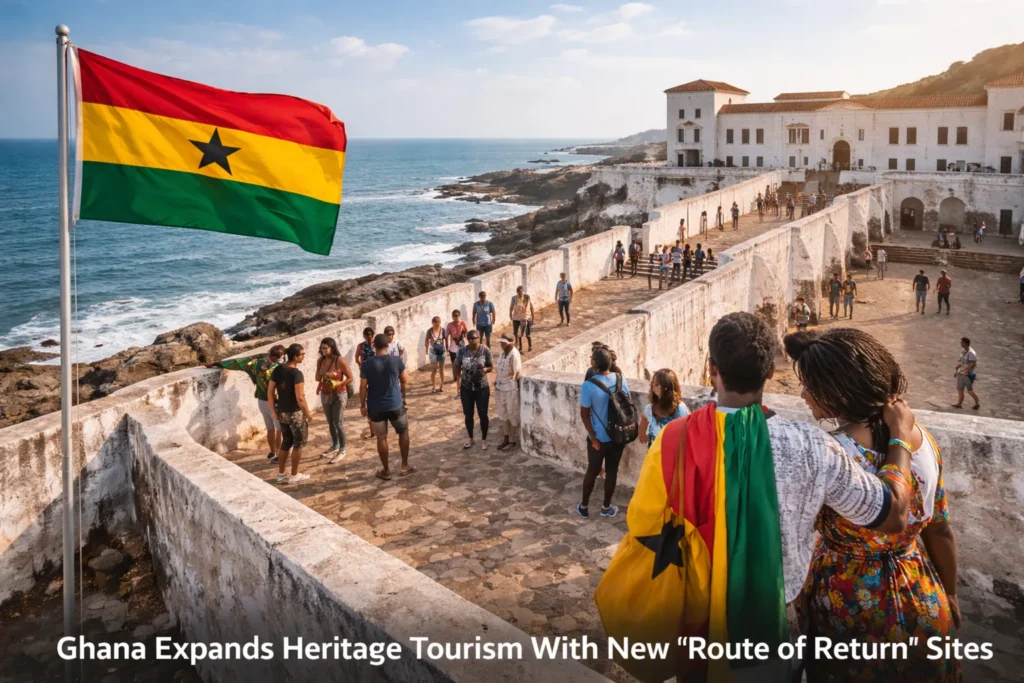
The Atlantic’s waves have carved the Ghanaian coastline for millennia, but no erosion runs deeper than the one etched by human history into the very soul of this land. At Cape Coast Castle, the ocean’s roar is punctuated by a different sound—the collective, shuddering breath of visitors standing in the dim, cavernous female dungeon. The air here is thick, heavy with the memory of centuries. On the wall, a single shaft of light cuts through the darkness from a hole too high to reach, the same hole through which enslaved women caught glimpses of a sky they would never again know as free people. Today, a different light enters: the light of recognition, of pilgrimage, of return. This is the ground zero of one of the most profound cultural movements of our time—Ghana’s “Route of Return”—a living, breathing, expanding testament to the idea that history’s most painful doors can be reopened, and its most brutal journeys can be walked in reverse.
What began as the 2019 “Year of Return,” a poignant commemoration of the quadricentennial of the arrival of the first enslaved Africans in Virginia, has transcended its initial calendar boundaries to become something far more monumental: a permanent state of homecoming. It has evolved from a year-long event into the decade-spanning “Beyond the Return” initiative, a national philosophy that has recalibrated Ghana’s relationship with its global diaspora. This is not merely a tourism campaign; it is an act of historical reparation, a strategic economic renaissance, and a deep, spiritual dialogue between a motherland and her scattered children. With an ambitious expansion that includes newly preserved forts, dedicated cultural museums, and comprehensive oral-history archives, Ghana is systematically building what can only be described as an infrastructure of memory and reconnection. Bolstered by overwhelming global response, Ghana’s Tourism Authority projects a transformative 30% growth in heritage-related travel by 2027, a figure that underscores Ghana’s ascendance as the undisputed spiritual and cultural nexus for the African diaspora’s pilgrimage home.
This movement’s immense power stems from its dual resonance, a harmonic convergence of need and offer. For the descendant of the enslaved, often adrift in a world that systematically erased their specific origins, Ghana offers coordinates. It provides a tangible geography for a grief that was placeless, a homeland for an identity that was rendered stateless. It is the chance to walk the laterite paths ancestors once trod, to hear the cadence of languages that might have formed their first lullabies, to taste foods that echo in genetic memory. For Ghana, this represents a masterstroke of cultural diplomacy fused with visionary economics, leveraging unflinching historical truth and profound emotional pilgrimage to fuel sustainable development, create dignified employment, and project formidable soft power on the global stage. This endeavor moves far beyond revisiting history; it is about seizing its narrative, bending its arc toward justice, and directing its legacy toward a future of shared prosperity and healed identities.
Foundations in Stone and Spirit: The Coastal Crucible of Memory
To comprehend the gravitational, almost physical pull of Ghana’s “Route of Return,” one must first submit to the haunting, sacred geography of its coastline. Stretching approximately 350 miles along the Gulf of Guinea, this shore is a unique palimpsest of human endeavor and suffering. It is dotted with forty-two documented forts, castles, and trading posts, the densest concentration of such structures on earth, with twenty-eight of the most significant collectively designated a UNESCO World Heritage Site. These formidable edifices, built successively by Portuguese, Dutch, Danish, Swedish, Brandenburgers, and British traders between 1482 and the late 18th century, were not primarily military bastions but commercial engines—factories designed for the mass production of human misery. They are the physical ledger of the transatlantic slave trade, their stones holding the accounting of profit and loss written in human life.
Each fortress is a world unto itself, a layered archaeological and emotional text:
- Elmina Castle (Castelo de São Jorge da Mina): Erected by the Portuguese in 1482, its whitewashed walls stand as the oldest European building still standing in sub-Saharan Africa. Initially named “The Mine” for its role in the gold trade, its purpose mutated grotesquely. The central courtyard, where captives were paraded, inspected, and branded, is overshadowed by the stark, existential contrast between the airy, sea-facing chambers of the European governors—adorned with imported tiles and blessed by sea breezes—and the dark, suffocating dungeons below. Here, hundreds at a time were shackled in their own waste, with only a narrow slit for air, the sound of the Atlantic a constant torment. The castle’s chapel, situated directly above the moaning dungeons, stands as one of history’s most chilling monuments to moral bankruptcy, where chaplains prayed for the souls of traders while ignoring the living hell beneath their feet.
- Cape Coast Castle: Under British control, this became the administrative heart of the trade on the Gold Coast. Its infamous “Door of No Return” is a small, heavy wooden portal, a literal and symbolic threshold. It leads directly from the pitch-black male dungeons, through the thick outer wall, onto a narrow plank and into waiting slave ships. Historians estimate that over four centuries, approximately 12.5 million Africans were forcibly embarked from the West African coast, with perhaps 1.5 million perishing in the unspeakable horrors of the Middle Passage. A significant portion of those who survived passed through doors like this. Today, the castle also houses a remarkous museum, one of the first on the continent to critically address the slave trade from an African perspective, providing essential context and honoring resilience.
- The Lesser-Known Sentinels: Sites like Fort Amsterdam, Fort Patience, Fort San Sebastian, and Fort Prinzenstein each hold specific, harrowing histories. Fort Prinzenstein in Keta, for example, was a key holding site for captives from the interior before their shipment west. The accelerated preservation of these sites under the “Route of Return” initiative is crucial; it ensures the narrative is not centralized but dispersed, illustrating the vast, industrialized, and normalized scale of the enterprise. It prevents the story from being simplified to two or three locations, instead painting a picture of a coast entirely dedicated to this commerce.
For centuries after the trade’s abolition, these structures stood as silent, uncomfortable sentinels to a past many wished to forget—colonizers, independent nations, and a world eager to move on. Their transformation began in earnest with Ghana’s independence in 1957. The visionary leader Kwame Nkrumah recognized their symbolic power. He saw them not merely as monuments to a horrific past, but as essential pedagogical tools for Pan-African education and unity. In a powerful act of reclamation, he used Cape Coast Castle as a venue for political rallies, symbolically transforming a site of Black subjugation into a platform for Black empowerment. This laid the indispensable ideological groundwork for what would become heritage tourism.
The preservation work today, often undertaken with meticulous care in partnership with international bodies like UNESCO, the Smithsonian Institution, and the Dutch government, is an act of profound responsibility. It involves not just the physical restoration of crumbling stonework—repairing batter walls, stabilizing foundations against the relentless sea—but ethical curation. This is the complex work of deciding how to present narratives of unspeakable trauma without exploitation, how to honor the memory of the enslaved as individuals rather than anonymous victims, and how to contextualize these sites within the broader, glorious sweep of Ghanaian history that both predates and heroically survived the slave trade. It is about balancing raw historical truth with the psychological safety of visitors, many of whom are descendants coming to confront a family trauma.
The emotional experience of visiting these castles is consistently described as a rite of passage, a transformative threshold. Diaspora visitors speak of a visceral, somatic reaction that transcends intellectual understanding. It is a feeling of ancestral presence, a wave of overwhelming grief that sometimes gives way to a strange, profound peace, or a powerful sense of completing a circle broken by history. This catharsis is the beating emotional heart of the “Route of Return.” It transforms the castles from static museums into active sites of communal mourning, historical witness, and spiritual reclamation. They become the unavoidable, powerful genesis for a journey that then seeks to answer the critical, haunting question: What, in all its magnificent complexity, were these people taken from?
Charting the Expanded Map: The “Route of Return” as a Living Ecosystem
The strategic genius of Ghana’s current approach lies in its profound understanding that heritage tourism cannot, and must not, begin and end at the coast. The slave trade was a terminal, catastrophic event in a much longer, richer, and more resilient story. The expanded “Route of Return” is therefore deliberately designed as a multi-faceted, nationwide network—a living ecosystem—that provides a holistic, nuanced, and ultimately empowering experience. It consciously moves the narrative from one solely of victimhood and departure to one celebrating resilience, cultural wealth, contemporary vitality, and future collaboration.
This ambitious expansion is manifested through several deeply interconnected, mutually reinforcing strands of development:
1. The Preservation of Interior Sites and Northern Corridors: Unearthing a Deeper History
While the coastal castles were the final exit points, the enslavement networks were a vast, continent-spanning spiderweb, stretching thousands of miles into the interior. The new route brings these critical, often overlooked chapters to light, challenging a solely Euro-centric narrative of the trade.
- Salaga Slave Market (East Gonja District): This site reveals a different, complex facet of the trade: the trans-Saharan and internal African slave markets. Here, visitors do not see European-built stone castles but the haunting landscape of the market itself. They can stand before the “slave wells”—deep, hand-dug pits where captives were washed before being presented for sale—and under the ancient, gnarled baobab tree where transactions were finalized. The presentation, often led by local guides from the Gonja people, relies heavily on oral tradition, passed down through generations. This offers a perspective distinct from and often in tension with the European ledgers and logs that dominate coastal history. It engages visitors with the difficult, necessary reality of African complicity and the trade’s vast inland reach, complicating the historical picture in a way that is essential for true understanding.
- Pikworo Slave Camp (Nania, near Paga): This site, with its haunting, natural rock formations used as cells, feeding basins carved into stone, and a “talking drum” rock used for communication, tells a story of capture, holding, and the long, brutal march southward toward the coast. Its power lies in its stark, unadorned simplicity, forcing imagination to fill in the horrors.
- The “Slave Rivers” and Routes: Initiatives are underway to map and mark the overland trails, like the one from Salaga to the coast at Keta, turning them into reflective walking paths. These routes, often following old footpaths through forests and across rivers, make the scale of the journey tangible.
2. The Rise of Dedicated Cultural Institutions: Curating the Narrative
A new generation of museums and archives is shifting the focus from the point of exit to the substance and splendor of the cultures that persisted, thrived, and innovated.
- The Pan African Heritage Museum (Under construction in Winneba): Conceived as a flagship institution of global significance, its mission is to curate and celebrate the entire spectrum of history, artistry, philosophy, and intellectual contributions of people of African descent worldwide. More than a museum, it is envisioned as a “healing city,” with gardens, performance spaces, and research centers. It aims to position Ghana as the premier global repository for diasporic memory and achievement, a place where the scattered family can see its collective greatness reflected.
- Community-Based Oral-History Archives: While grand museums are vital, so are intimate, local projects. Initiatives like the “Talking Drums” archive or the “Voices of the Volta” project work with anthropologists and linguists to record the memories, folklore, proverbs, music, and traditions of elders in villages along the historic slave routes. Using high-quality audio and video, they ensure that living memory is digitized and preserved before it is lost to time. These archives become invaluable, authentic resources for researchers, filmmakers, and diaspora visitors seeking specific ethnic or regional connections, allowing them to hear the voice of a potential ancestor’s culture.
3. Integration with Vibrant, Living Culture: The Heartbeat of the Present
The route is intentionally woven into the vibrant fabric of contemporary Ghanaian life, refusing to let history be a sepia-toned relic. It connects pilgrims to:
- Festivals: Participation is encouraged in events like Panafest (the Pan-African Historical Theatre Festival, a biennial celebration of arts and culture rooted in liberation), the Edina Bronya Festival in Elmina (a vibrant New Year’s celebration blending traditional and Christian elements), or the Homowo Festival of the Ga people (a triumphant “hooting at hunger” celebration). These are not performances for tourists but lived community events where visitors can witness and share in the joy, resilience, and spiritual richness of a culture that endured.
- Arts and Crafts Centers: Visits to places like the Aburi Woodcarving Village, the Bonwire Kente Weaving Centre (the birthplace of the iconic cloth), or the Ahwiaa Woodcarving Village showcase artistic traditions that flourished for centuries. Learning about the profound symbolism in kente cloth patterns (like “Adwenasa,” meaning “my skill is exhausted,” reflecting its complexity) or adinkra symbols (like “Gye Nyame,” meaning “Except for God,” representing omnipotence) provides visitors with a visual and philosophical language of identity, values, and history that many in the diaspora eagerly adopt and incorporate into their own lives.
- Sacred and Traditional Sites: The route includes spiritually significant stops like the Larabanga Mosque (one of West Africa’s oldest, built in the distinctive Sudano-Sahelian style), the Okomfo Anokye Sword Site in Kumasi (where a legendary priest planted a sword that cannot be pulled, symbolizing Ashanti unity), and various sacred groves. These places root the visitor in spiritual and political histories that are entirely separate from the narrative of the slave trade, powerfully affirming a deep, autonomous, and sophisticated civilizational history.
4. The Ancestral DNA and Genealogy Tourism Nexus: The Personalization of History
A critical, technology-driven component of the modern journey is genealogy. Companies like African Ancestry, MyHeritage, and 23andMe have partnered with Ghanaian tour operators and research institutions. Visitors can now provide DNA samples that are matched with specific ethnic groups and genetic populations in Ghana and neighboring West African countries. While the science has limitations in pinpointing exact villages and carries important ethical discussions about data privacy, its emotional impact is undeniable. Receiving a report suggesting, for example, strong genetic links to the Akan, Ga-Adangbe, or Ewe people while physically standing in the corresponding region is a powerfully personalizing moment. It transforms a general pilgrimage of solidarity into a specific, intimate homecoming. This data can guide individuals to the very districts, towns, and communities their ancestors may have called home centuries ago, where they might, through arranged cultural exchange, participate in a custom-made “naming ceremony” to receive a local name and be symbolically welcomed back into the fold.
The following table outlines the strategic diversification and deepening of the “Route of Return,” illustrating how it offers multiple, interconnected entry points into the layered reality of Ghanaian heritage:
| Route Segment & Theme | Key Sites & Experiences | Primary Narrative & Visitor Takeaway | Stage of Development & Future Vision |
|---|---|---|---|
| The Coastal Crucible (Confrontation) | Cape Coast & Elmina Castles; “Door of No Return” reversal ceremonies; Fort Prinzenstein; the Cannon. | Facing the brutal, industrialized reality of the transatlantic slave trade; collective mourning & the powerful symbolism of physical return. | Mature. World-class restoration & interpretation. Future: Enhanced digital immersion, deeper descendant storytelling integration. |
| The Northern Corridors (Complexity) | Salaga Slave Market; Pikworo Slave Camp; Larabanga Mosque; the Slave Route trails. | Understanding the vast inland reach & African dimensions of slave networks; appreciating the depth of pre-colonial Sahelian culture & architecture. | Growing & Expanding. Infrastructure improving. Future: Better road networks, community-owned guide consortia, integrated cultural performances. |
| Cultural Reanimation (Celebration) | Panafest; Homowo/Odwira Festivals; Kente & Adinkra workshops; traditional cooking classes; drumming/dance immersion. | Engaging with the vibrant, living culture that not only survived but thrived; experiencing joy, communal spirituality, and sublime artistic mastery. | Vibrant & Expanding. High visitor participation. Future: More homestays, “culture apprenticeship” programs, diaspora-artist collaborations. |
| Genealogy & Personal Reconnection (Integration) | DNA ancestry partnership programs; community naming ceremonies; visits to specific ancestral regions; family history research aid. | Personalizing the journey from collective identity to personal lineage; symbolic reintegration into a community through ritual and shared identity. | Emerging & High-Growth. Technology-driven and deeply personal. Future: Ethical frameworks for DNA use, expanded village partnerships, genealogy tourism certifications. |
| The Pan-African Future (Collaboration) | Kwame Nkrumah Memorial Park; W.E.B. Du Bois Centre; George Padmore Library; Pan African Heritage Museum (future). | Connecting the historical return to a political & intellectual vision for African/diasporic unity, empowerment, and future collaboration in business, arts, and tech. | Developing & Visionary. Ideological cornerstone. Future: Business incubators, academic exchanges, permanent diaspora innovation hubs. |
The Pilgrim’s Progress: An Anatomy of the Modern Homecoming
To truly humanize the statistics and understand the transformative power of this journey, we must follow the emotional and physical odyssey of a pilgrim. Let’s trace the path of Amina, a 45-year-old cardiovascular surgeon from Houston, Texas. Her journey, a composite of thousands of real experiences, encapsulates the multi-layered, profound encounter the “Route of Return” is meticulously designed to facilitate.
Stage 1: The Call and the Preparation (The Awakening).
Amina’s journey begins not at Kotoka International Airport, but years earlier in the quiet of her suburban home. The trigger might be a compelling documentary like “The 1619 Project,” a DNA test result that flashes “60% Ghanaian,” or a stirring conversation at a Black cultural center. She feels a pull, a need to “know.” She researches extensively, reading works by historians like David Olusoga and philosophers like Kwame Anthony Appiah. She books a 14-day tour with a Ghanaian-owned operator specializing in diaspora homecomings, one that promises cultural sensitivity and community access. Her preparation involves not just packing but emotional and psychological fortification; she attends pre-travel webinars that warn of the intensity of the castle visits and discuss the complexities of modern Ghana. This preparatory phase is crucial—it frames the trip not as a leisure vacation but as a sacred pilgrimage, a quest with weight and purpose.
Stage 2: Confrontation and Catharsis (The Coastal Reckoning).
Her first days in Ghana are a sensory overload—the heat, the colors, the lively chaos of Accra. But the real journey starts on the road to Cape Coast. The guided tour of Elmina Castle is emotionally devastating. Her guide, Kwame, a PhD candidate in history, does not sensationalize. He speaks softly, citing numbers, telling specific stories of resistance. In the female dungeon, he points to the “condemned cell” for rebellious women and describes the “door of return” through which they were taken to be thrown into the sea. He leads the group in a moment of silence, then a libation ceremony, pouring a little water on the stone floor “for the ancestors.” When it is time, Amina walks with her group in a slow, solemn procession back through the Door of No Return, now reframed as the “Door of Return.” As she steps back onto African soil, she is overcome with sobs, held by newfound “travel family.” Yet, later, she describes feeling a “weight she didn’t know she carried had lifted.” The inherited, abstract trauma now has a name, a place, and has been communally acknowledged. This catharsis is a well-documented, almost universal phenomenon among diaspora pilgrims.
Stage 3: Reconnection and Celebration (The Cultural Embrace).
The tour deliberately pivots. From the heaviness of the coast, they travel to Kumasi, the historic heart of the Ashanti Kingdom. They visit the Manhyia Palace Museum, learning about the sophisticated pre-colonial governance, legal system, and military prowess of the Ashanti, a formidable empire that resisted British colonization for nearly a century. Amina tries her hand at adinkra cloth stamping at a workshop in Ntonso, learning the meanings. The “Sankofa” symbol—a bird looking backward with an egg in its mouth—resonates deeply: “go back and get it.” She attends a vibrant, participatory drumming and dance workshop; the complex polyrhythms feel strangely familiar in her body. She savors meals, learning to eat fufu with her right hand, enjoying the communal nature of the bowl. This phase actively answers the question, “What was taken?” with a resounding, joyful display of cultural continuity, sophistication, and vitality. It replaces mourning with celebration, loss with rediscovery.
Stage 4: Personalization and Integration (The Community Welcome).
Because Amina’s DNA results indicated strong links to the Ewe people in the Volta Region, her tour includes a special detour. In a small village near Ho, arranged through a partnership between her tour operator and the local chief’s council, she participates in a “naming ceremony.” After consultations with elders about her birth day and character, they bestow upon her an Ewe name: “Akosua” (for a girl born on Sunday) with the surname “Agbenyegah” (meaning “life is greater than wealth”), linking her to a specific clan. Dressed in beautiful, specially chosen Ewe cloth, she is introduced to the community. There is drumming, dancing, and sharing of local drink. For Amina, this is the transcendent climax of her journey. It is a formal, ritualized, and deeply moving act of welcome and reinstatement into a social fabric. She is no longer just a visitor or a descendant; she has a name, a people, and a symbolic home. She is given the cloth as a physical token of this new identity.
Stage 5: Reflection and Forward Vision (The Future Partnership).
The final leg brings her back to Accra with a new perspective. She visits the Kwame Nkrumah Memorial Park, reflecting on the first president’s dream of a unified Africa that intrinsically included its diaspora. She tours the W.E.B. Du Bois Centre, where the great African-American scholar spent his final years editing the Encyclopedia Africana, finding in Ghana a haven from American racism. Here, the narrative shifts decisively from past to future. She attends a “Diaspora Dialogue and Investment Forum,” where Ghanaian ministers and entrepreneurs outline opportunities in agribusiness, renewable energy, and tech. The trip concludes not with a farewell, but with a beginning—the seeds of an ongoing relationship. Amina leaves not just with photos and souvenirs, but with a certificate from her naming ceremony, the contact of a real estate agent, and the business card of a local tech founder. Her pilgrimage has birthed a potential new future: as a frequent returner, a remote worker, an investor, or even a future resident.
The Engine of National Development: Economic Realities and Strategic Growth
The “Route of Return” is, at its core, a profound spiritual and emotional undertaking. Yet, its long-term sustainability and its ability to benefit Ghanaian citizens are underpinned by a clear-eyed, sophisticated economic rationale. The Ghanaian government has strategically positioned this sector as a cornerstone of its national development agenda, perfectly aligned with the “Ghana Beyond Aid” vision championed by President Nana Akufo-Addo. The economic impact is not a side effect; it is a designed, multi-sectoral outcome that is transforming communities.
Direct Economic Injection and Revenue Generation:
The “Year of Return” (2019) provided a dramatic, undeniable proof of concept. An estimated 1.1 million international visitors arrived, with diaspora travelers constituting a significant and high-spending portion. They contributed roughly $1.9 billion to the Ghanaian economy. Crucially, diaspora tourism economics differ from standard leisure travel. These pilgrims tend to stay longer (often 2-3 weeks), spend more per day on shopping (high-quality art, custom-made clothing, artifacts), use premium services, and frequently travel in multi-generational family groups, amplifying expenditure. This revenue is a critical and stable source of foreign exchange, vital for a nation whose currency, the cedi, can face volatility. The projected 30% growth in heritage travel by 2027 suggests this could evolve into a multi-billion dollar annual pillar of the economy, rivaling or surpassing traditional exports like cocoa in terms of net value and job creation.
Job Creation, Skills Development, and Professionalization:
Tourism is one of the world’s most labor-intensive industries, and Ghana’s boom has created a cascade of employment opportunities, particularly for the youth who face high unemployment rates.
- Direct Hospitality & Services: Jobs in hotels, resorts, eco-lodges, restaurants, bars, and transportation (drivers, tour company staff).
- The Heritage Curation Economy: Employment for trained tour guides, curators, archivists, security personnel, maintenance and conservation specialists for historical sites. The Ghana Tourism Authority has implemented rigorous mandatory guide certification programs, which include modules on historical accuracy, psychological first aid, and cross-cultural communication. This professionalization raises service standards, ensures quality control, and turns guiding from a casual job into a respected, skilled career with better wages.
- The Creative Arts Revival: Sustained demand has revitalized traditional arts. Musicians, dancers, actors for cultural performances, master kente weavers, adinkra stampers, woodcarvers, beadmakers, and potters now have a thriving, dependable market. This helps reverse the brain drain of artistic talent and preserves intangible cultural heritage by making it economically viable.
Catalyzing Infrastructure and Spatial Development:
The surge in demand has acted as a powerful catalyst for both public and private investment in national infrastructure.
- Aviation: New direct flights have been established connecting Accra’s Kotoka International Airport to major diaspora hubs like Washington D.C., New York, Atlanta, and London, with discussions ongoing for routes to Toronto, Brazil, and the Caribbean.
- Urban and Rural Development: In cities like Cape Coast and Elmina, once-sleepy fishing towns are experiencing a controlled construction boom of new mid-range and boutique hotels, guesthouses, and restaurants. Crucially, investment is also being pulled into the interior. Roads to key sites like Salaga are being paved, regional airports in Tamale and Kumasi are being upgraded, and utilities (water, electricity, internet) are being improved. This development, driven by tourism potential, benefits local populations year-round, improving quality of life and enabling other economic sectors.
Diaspora Direct Investment (DDI): The Ultimate Economic Integration
Perhaps the most significant long-term economic benefit is the channeling of diaspora financial capital, skills, and networks into productive sectors of the Ghanaian economy. Deeply moved by their experience and sense of connection, many visitors explore tangible investment. Ghana has been proactive in facilitating this through:
- The Diaspora Affairs Office within the Ghana Investment Promotion Centre (GIPC), which serves as a one-stop shop.
- The “Right of Abode” status (a permanent residency) and a clear, though demanding, pathway to citizenship for members of the African diaspora.
- Targeted investment forums and pitch events during major festivals like Panafest or the annual “December in GH” celebrations.
Investments are flowing into diverse areas: real estate (building or buying homes, developing rental properties), hospitality (starting boutique hotels, safari lodges, or restaurants), agribusiness (organic fruit farms, shea butter processing, aquaculture), and tech startups (fintech, edtech, renewable energy). This represents a seismic shift from personal remittances (money sent to family for daily upkeep) to structured, equity-based, job-creating productive investment. The diaspora is evolving from a source of sentimental travel and charity into a co-development partner, actively building the Ghana they are reconnecting with.
Navigating the Crossroads: Ethical Challenges and Imperatives for Sustainable Growth
For all its remarkable success and positive momentum, the “Route of Return” operates within a complex landscape of ethical dilemmas and practical challenges. Its long-term health and moral integrity depend on recognizing and thoughtfully managing these tensions.
1. The Infrastructure-Experience Gap: Bridging the Divide.
While major sites like Cape Coast Castle are well-maintained, many other critical locations suffer. Poor road networks can make journeys to interior sites long, uncomfortable, and unsafe during rainy seasons. Inconsistent electricity, water shortages, and inadequate sanitation facilities at some locations can mar the visitor experience and starkly underscore the inequalities between the tourist’s world and the local reality. The government’s stated push to use a portion of tourism revenue to improve critical public infrastructure is essential. This must be accelerated and executed transparently, ensuring that communities hosting these sites see tangible improvements in their daily lives—better roads, schools, and clinics—minimizing any sense of exploitation.
2. The Commodification of Trauma: Walking the Ethical Tightrope.
There is an ever-present, delicate balance between accessible education and respectful, dignified commemoration. The risk of “trauma tourism”—where human suffering is packaged, sanitized, and sold as an experience—is real and corrosive. Best practices, increasingly codified by the Ministry of Tourism and leading operators, include:
- Mandatory, in-depth sensitivity training for all guides, often involving psychologists and historians.
- Strictly limiting vendor activity and loud solicitation directly at dungeon entrances and other sensitive areas.
- Designating quiet zones and spaces for solitary reflection away from tour groups.
- Actively involving descendant communities and diaspora scholars in the curation and narrative decisions at museums and sites, ensuring the story is told with them, not just about them.
3. The Citizenship and Belonging Dilemma: The Price of Home.
Ghana’s constitutional provision for diaspora right of abode and citizenship is historically groundbreaking and symbolically powerful. However, the administrative process is often criticized for being bureaucratically slow, prohibitively expensive, and opaque. Application fees, legal costs, and investment requirements can run into tens of thousands of dollars, creating a system where only the relatively affluent can formalize their legal belonging. This risks creating a two-tiered diaspora reality: a wealthy, propertied “returnee” class and the vast majority who can only afford to visit, unable to secure the permanent stake they may desire. Streamlining the process, creating tiered investment options, and introducing transparency are major challenges for ensuring the homecoming is equitable and inclusive.
4. Ensuring Equitable Distribution: Who Really Benefits?
A core, persistent ethical question is: who captures the value? There is a palpable danger that large, sometimes foreign-owned hotel chains, international tour operators, and well-connected intermediaries capture the lion’s share of revenue, while local communities living in the shadow of the castles remain in poverty. Successful, replicable models are emerging to combat this:
- Formal Revenue-Sharing Agreements: A negotiated percentage of castle entry fees is directed to a community development fund, used for local projects chosen democratically.
- Local Hiring Mandates: Tour operators and site managements are encouraged or required to hire guides, security, and staff from the immediate surrounding communities.
- Support for Community-Based Tourism Enterprises (CBTEs): NGOs and social enterprises help villages organize homestays, provide authentic meals, offer craft workshops, and lead nature walks, allowing tourists to spend money directly in the community and fostering genuine cultural exchange.
5. Managing Expectations and Psychological Impact: The Burden of Healing.
The journey can be psychologically destabilizing for both visitor and host. Some diaspora visitors arrive with romanticized, even mythologized expectations of an immediate, universal “welcome home” from all Ghanaians, not recognizing Ghana as a complex, modern, stratified society with its own issues. Conversely, the intense emotional experience at the castles can trigger unresolved racial trauma, depression, or identity crises. Leading tour operators are now incorporating pre-travel psychological briefings, on-tour group processing sessions led by facilitators, and post-travel follow-up resources to help pilgrims integrate their experience. Similarly, educating visitors on contemporary Ghanaian social norms, economics, and politics helps manage expectations and foster mutual respect.
Ghana’s Global Ripple Effect: Redefining Diaspora Engagement Worldwide
Ghana’s model has achieved something extraordinary: it has moved the African diaspora from the periphery of continental policy to its very center. Its success has sent powerful ripples across the Atlantic world and the African continent, actively redefining the geopolitics, economics, and very concept of diaspora engagement.
A Continental Template and the Birth of a Heritage Circuit:
Witnessing Ghana’s diplomatic and economic gains, other West African nations with significant slave trade histories are launching or reinvigorating their own initiatives. Benin has invested heavily in the “Route des Esclaves” in Ouidah, culminating at the “Door of No Return” arch on the beach, and opened the striking International Museum of Memory and Slavery. Nigeria is aggressively promoting the Badagry Heritage Museum and the Black Heritage Festival in Lagos. Senegal continues to develop Gorée Island. The Gambia promotes its “Kunta Kinteh Island” and Roots Festival. Ghana’s pioneering role has effectively created a competitive yet collaborative regional heritage circuit. This encourages multi-country tours, allowing pilgrims to gain a more comprehensive, nuanced understanding of the trade’s different facets and the diverse cultures it impacted, ultimately benefiting the entire region.
The “Sixth Region” Materialized: From Concept to Reality.
The African Union’s formal designation of the African diaspora as its “Sixth Region” in 2003 was a powerful political concept, but for years it remained largely rhetorical. Ghana has given it tangible, operational meaning. Through consistent government policy, presidential advocacy, high-profile events, and now a thriving ecosystem of return, Ghana has positioned itself as the de facto capital and welcoming gateway for this global Sixth Region. This grants Ghana immense soft power and moral authority on the world stage, strengthening its diplomatic hand in forums from the UN to the Commonwealth, and elevating its international profile far beyond what its size or GDP would traditionally command.
Influencing Global Conversations on Justice and Memory:
The pilgrimage to Ghana has become a near-mandatory rite of passage for prominent African-American, Afro-Caribbean, and Afro-European leaders, artists, intellectuals, and influencers. When delegations of U.S. Congressional Black Caucus members, Hollywood icons like Idris Elba and Lupita Nyong’o, music superstars like Cardi B and Stevie Wonder, and business titans like Netflix co-CEO Ted Sarandos visit and share their profound experiences with millions of followers, it amplifies Ghana’s narrative globally. This, in turn, directly influences conversations about reparations, racial justice, historical memory, and identity in North America and Europe. Ghana is frequently cited in these debates not as a victim, but as an agent—a model for how to confront historical trauma with dignity and transform it into a foundation for future unity and development.
The Academic and Knowledge Economy: Becoming the Global Hub.
Ghana is rapidly becoming an indispensable global center for the scholarly study of the African diaspora, the transatlantic slave trade, and post-colonial reconciliation. Universities like the University of Ghana, Legon, are establishing specialized institutes and attracting research fellowships, international conferences, and endowed chairs. The W.E.B. Du Bois Centre functions as a research hub. This builds a sophisticated knowledge economy around heritage, creating high-value jobs for academics, archivists, digital humanists, and researchers. It ensures that Ghana remains the authoritative curator and interpreter of its own history and the diasporic experience, preventing the narrative from being outsourced to foreign institutions.
The Horizon: Envisioning the Next Decade of Return and Co-Creation
The “Route of Return” is not a completed project to be admired, but a living, organic pathway that must evolve. Its future trajectory points toward greater depth, technological integration, personalization, and a shift from reconnection to mutual creation.
1. Technological and Digital Integration: Enhancing Access and Understanding.
The near future will see the widespread adoption of immersive technology at historical sites. Augmented reality (AR) glasses or tablet apps could allow visitors to point at a dungeon and see a historically accurate overlay of how it looked when occupied, or hear narrated testimonies from archival records. Virtual reality (VR) pre-travel experiences could prepare pilgrims emotionally. More fundamentally, blockchain technology could be used to create secure, verifiable digital certificates for diaspora citizenship, land title deeds, or investment contracts, reducing fraud and bureaucracy. Digital platforms could also allow for “virtual pilgrimage” for those who cannot travel physically, creating 360-degree tours with expert commentary and live Q&A sessions with guides in Ghana.
2. From Roots to Routes: The Business of Building a Shared Future.
The focus will increasingly mature from “finding roots” to “building routes”—creating durable channels for ongoing contribution. We will see the formalization of:
- Diaspora Venture Capital Funds and Angel Networks specifically targeting Ghanaian and West African startups in tech, green energy, and creative industries.
- Skills-Based Volunteering and “Diaspora Sabbatical” Programs that link mid-career and retired diaspora professionals (doctors, engineers, architects, teachers) with Ghanaian institutions for knowledge transfer projects.
- Structured Educational Exchanges and “Twinning” Programs between schools in Ghana and schools in diaspora communities, fostering the next generation’s connection through shared curricula, pen-pal programs, and teacher exchanges.
3. Sustainability and Eco-Heritage: Healing the Land and the Past.
The next phase will more deeply integrate environmental stewardship with historical healing. “Eco-heritage” tours could combine castle visits with participatory reforestation projects in degraded sacred groves, wildlife conservation volunteering in national parks, or support for sustainable agriculture cooperatives. This links the healing of historical wounds with the healing of the land, appeals to environmentally conscious travelers, and creates a holistic narrative of restoration. It also ensures tourism does not degrade the very environment that forms part of the heritage.
4. Deepening the African Continental Dialogue: The Trans-West African Heritage Corridor.
The route will logically expand into a “Trans-West African Heritage Corridor,” an officially promoted network with streamlined visa protocols and integrated travel packages facilitating journeys from Ghana to Togo, Benin, Nigeria, and Côte d’Ivoire. This promotes regional economic integration, offers pilgrims a more comprehensive understanding of pre-colonial and colonial histories, and distributes economic benefits more broadly across the region. It turns a national project into a continental one.
Epilogue: The Circle Remains Unbroken, The Journey Continues
The story of Ghana’s “Route of Return” is, in its most essential form, the story of a circle being closed after four centuries of rupture. It is a story told not in grand political declarations alone, but in the intimate, human moments: the quiet tears shed in a Cape Coast dungeon, the joyous sweat of a dance at a Homowo festival, the solemn weight of a new name bestowed in a Volta village, the hopeful handshake sealing an investment in an Accra startup.
Ghana has undertaken a monumental, morally audacious task: to stare unflinchingly at the worst of human history enshrined in its own geography, and to consciously, deliberately transform those sites from monuments to a crime into catalysts for global healing, deep understanding, and shared prosperity. It has offered the diaspora not just an apology for the past, but an open-handed invitation to a shared future.
The economic forecasts of 30% growth are significant, but they are merely the quantifiable surface of a deeper, more profound tectonic shift occurring in the realm of identity and historical justice. The real, immeasurable success is tallied in the restoration of wholeness to fragmented identities, the mending of the psychic wounds inflicted by the Middle Passage, and the creation of a new, global African family that is actively co-creating its destiny. The “Door of No Return” has been, in the hearts and rituals of those who walk back through it, re-christened as the “Door of Return.” And in that simple, powerful act of reversal, Ghana has achieved something extraordinary. It has not only expanded its heritage tourism—it has expanded the very possibility of justice, the very definition of belonging, and the very meaning of home for millions across the globe.
The journey continues. The route, now clearly marked by the footsteps of pilgrims and the investments of returnees, is open. It winds from the coast to the savanna, from the past to the future, from memory to creation. And it awaits all who hear the call to walk it.