
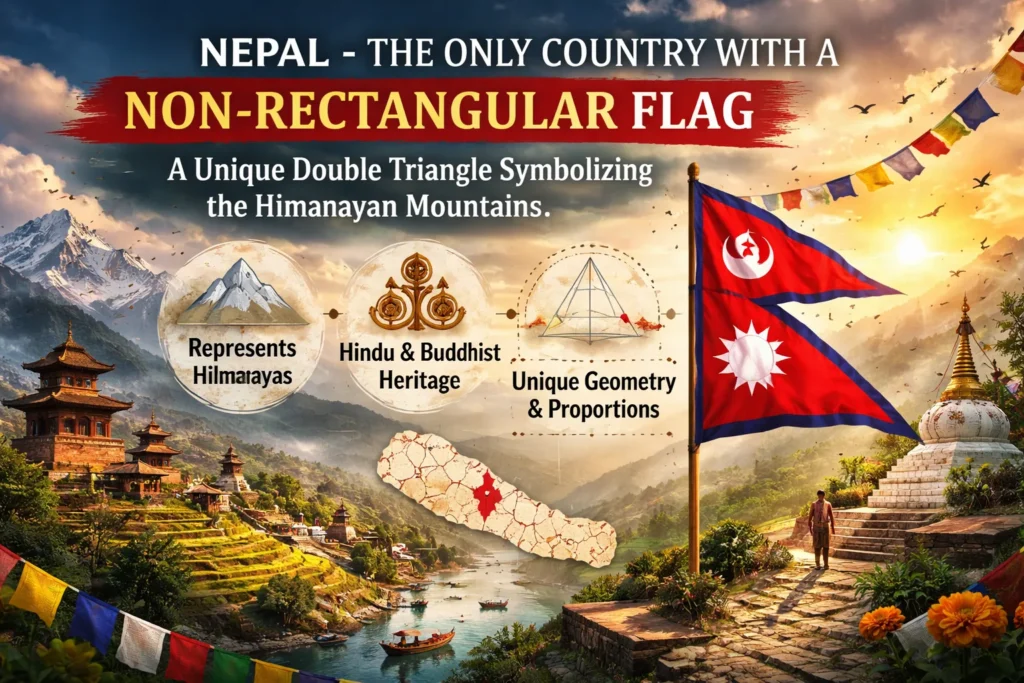

Introduction: A Flag Unlike Any Other
When you close your eyes and picture a flag, what do you see? For most of us, the image that appears is rectangular—perhaps the stars and stripes of the United States, the tricolor of France, or the Union Jack of the United Kingdom. This mental picture is so deeply ingrained that we rarely question it. Flags are rectangles, just as surely as the sky is blue and grass is green. Or so we think.
But tucked away in the Himalayan mountains, nestled between the global giants of China and India, lies a country that has spent centuries defying this expectation. Nepal, a nation of breathtaking landscapes and ancient traditions, flies a flag that looks like nothing else on Earth. It doesn’t wave as a rectangle. It doesn’t flutter as a square. Instead, it cuts through the wind with two distinct triangular peaks, creating a silhouette that immediately tells you: this place is different.
The Nepalese flag stands alone in the community of nations. It is the only national flag in the world that isn’t rectangular or square. Every other country—all 192 others recognized by the United Nations—has a flag that fits within the familiar four-sided shape. Nepal alone breaks the mold, and it has been doing so for centuries.
But here’s what makes this truly fascinating: the flag’s unusual shape isn’t an accident of history or a random design choice. It represents one of the most mathematically precise flag designs ever created, with geometric specifications so detailed that they span multiple pages of the Nepalese constitution. The flag isn’t just a symbol—it’s a mathematical statement, a cultural declaration, and a spiritual representation all folded into one remarkable design.
When you look at the Nepalese flag, you’re not just seeing a national symbol. You’re seeing thousands of years of Hindu and Buddhist tradition distilled into geometric form. You’re seeing the Himalayan mountains rendered in crimson and blue. You’re seeing the sun and moon take their places in a celestial dance that has played out above the world’s highest peaks since long before recorded history.
And perhaps most remarkably, you’re seeing a design that almost didn’t survive the modern era. When nations around the world standardized their flags into neat rectangles during the 19th and 20th centuries, Nepal held firm. When vexillologists—people who study flags—developed elaborate systems for categorizing flag shapes, Nepal refused to fit in. When the United Nations needed to line up flagpoles with identical rectangular flags, Nepal’s representatives politely declined to change.
This is the story of that flag. It’s a story of mountains and mathematics, of ancient traditions and modern politics, of crimson cloth and cosmic symbolism. It’s the story of how one small nation looked at the rectangular flags of the world and said, “No thank you. We’ll keep our triangles.”
The Crimson Canvas: Understanding Nepal’s Flag Design
Let’s begin by really looking at the flag. Not just glancing at it, but studying it the way a painter studies a masterpiece or a mathematician studies an equation. Because the Nepalese flag rewards close attention in ways that few other flags do.
The flag consists of two stacked triangles. The upper triangle is smaller and sits atop a larger lower triangle, creating a shape that immediately brings to mind the Himalayan peaks that define Nepal’s northern border. This isn’t coincidental—the triangular shape directly represents the mountains that have shaped Nepalese culture, religion, and identity for millennia.
The background color is crimson red. But this isn’t just any red. It’s a specific shade that holds deep meaning in Nepalese culture. Crimson represents the rhododendron, Nepal’s national flower, which paints the Himalayan foothills in brilliant red during the spring blooming season. But the color runs deeper than flowers. Red also symbolizes victory in war, the brave spirit of the Nepalese people, and the color of the national flower isn’t just a pretty detail—it’s a reminder that this flag grows from the very soil of Nepal.
Around the edges runs a border of deep blue. This blue isn’t decorative, though it certainly adds visual appeal to the design. The blue represents peace and harmony, specifically the peace that comes from the Buddhist traditions that have flourished in Nepal for over two thousand years. The blue border acts as a frame, containing the red of bravery and war within the blue of peace—a visual reminder that Nepal’s strength serves its commitment to harmony.
Inside these two triangles, the design becomes even more interesting. Within each triangle sits a celestial symbol. In the upper triangle, you’ll find a crescent moon with a small crescent shape beside it—together they form a stylized representation of the moon. In the lower triangle sits a sun, depicted as a twelve-pointed star.
These aren’t random placements. The moon in the upper triangle represents the cool and calm nature of the Himalayan peaks, while also symbolizing the shade and coolness that the mountains provide. The sun in the lower triangle represents the heat and intensity of the lower Terai region, the flat lands along the Indian border where temperatures soar and the land is fertile and productive.
Together, the sun and moon carry another meaning that every Nepalese child learns: the flag symbolizes the hope that Nepal will last as long as the sun and moon themselves. It’s a poetic sentiment, but one grounded in the very real desire for national longevity in a region where kingdoms have risen and fallen for thousands of years.
But here’s where things get truly fascinating. Every element of this flag—the exact shape of the triangles, the precise position of the sun and moon, the specific curve of the crescent, the angle of each point—is defined mathematically in the Nepalese constitution. We’re not talking about vague descriptions like “a sun in the lower triangle” or “a blue border around the edge.” We’re talking about geometric constructions that would make a high school math teacher proud.
The constitution includes step-by-step instructions for constructing the flag using nothing but a compass and straightedge—the same tools that ancient Greek mathematicians used to create their geometric proofs. It specifies exact measurements: the flag is constructed on a circumscribed circle of a certain size, with specific points connected in specific ways to create precisely the right shape.
This mathematical precision makes the Nepalese flag unique in another way: it’s arguably the most complicated national flag to draw accurately. While you could sketch most flags freehand and get reasonably close, the Nepalese flag requires careful attention to geometric relationships. The proportions of the two triangles, the placement of the celestial symbols, even the width of the blue border—all follow mathematical rules that have been encoded in law.
Mountains in the Mind: The Himalayan Symbolism
To understand why Nepal’s flag looks the way it does, you have to understand Nepal’s relationship with mountains. This isn’t just a matter of geography—it’s a matter of identity, spirituality, and national character.
Nepal contains eight of the world’s fourteen highest mountains, including Mount Everest, which the Nepalese call Sagarmatha—”Forehead of the Sky.” The Himalayas aren’t just a border feature; they’re the backbone of the nation. They determine where people live, how they travel, what they grow, and how they understand their place in the universe.
When ancient Nepalese designed their flag, they didn’t think in terms of abstract geometry. They thought in terms of the world they could see every day. And what they saw were mountains—massive, imposing, eternal mountains that seemed to touch the sky itself.
The triangular shape of the flag directly mirrors the triangular profile of mountains. When you stand in the Kathmandu Valley and look north, you see peak after peak rising in triangular form against the sky. This shape became so deeply associated with Nepal that it naturally found its way into the national symbol.
But there’s more to it than simple representation. In Hindu and Buddhist cosmology, mountains hold special significance. Mount Meru, the mythical mountain at the center of all universes, appears in the sacred texts of both religions. It’s described as the axis mundi—the point around which everything revolves, the connection between Earth and the heavens.
The triangular peaks of Nepal’s flag can be read as representations of this cosmic mountain. They point upward, toward the divine, while remaining firmly rooted in the Earth. They remind viewers that Nepal sits at the intersection of the mundane and the sacred, the earthly and the celestial.
This symbolism extends to the sun and moon as well. In Himalayan cultures, the sun and moon aren’t just celestial bodies—they’re deities with personalities, stories, and direct influence on human affairs. The sun god Surya rides his chariot across the sky each day, pulled by seven horses. The moon god Chandra waxes and wanes according to ancient cycles that mirror the rhythms of human life.
By placing these symbols within the mountain-shaped triangles, the flag creates a complete cosmic picture: the heavens above, the mountains connecting heaven and earth, and the nation of Nepal at the center of it all. It’s a worldview expressed in cloth and color.
The crimson background adds another layer to this mountain symbolism. The rhododendron, which gives the flag its color, grows abundantly in the Himalayan forests. When these flowers bloom in spring, they transform mountain slopes into seas of red. The flag captures this moment, freezing it in time as a permanent reminder of Nepal’s natural beauty.
Even the blue border connects to the mountains. At high altitudes, the sky takes on a deep, intense blue that visitors often remark upon. This Himalayan blue—clearer and deeper than sky at lower elevations—frames the crimson mountains just as the actual sky frames the actual peaks.
For Nepalese people, these aren’t abstract symbols. They’re immediate and personal. A farmer in the Terai looks at the flag and sees the mountains that provide water for his fields through glacial melt. A Sherpa in the high Himalayas looks at the flag and sees the peaks she climbs. A merchant in Kathmandu looks at the flag and sees the natural fortress that has protected his city for centuries.
The Geometry of Identity: Mathematical Precision in the Constitution
Now we come to one of the most remarkable aspects of the Nepalese flag: its mathematical definition. Most countries describe their flags in relatively simple terms. The French flag is “three vertical bands of blue, white, and red.” The Japanese flag is “a red circle on a white background.” The Canadian flag is “red fields with a white square featuring a red maple leaf.”
Nepal’s constitution takes a different approach. When you read the section describing the national flag, you don’t find simple descriptions. Instead, you find geometric constructions that read like something from a mathematics textbook.
Here’s a small sample of what the constitution actually says about constructing the flag:
“Method of Making the Shape inside the Border: (1) On the lower portion of a crimson cloth draw a line AB of the required length from left to right. (2) From A draw a line AC perpendicular to AB making AC equal to AB plus one third AB. From AC mark off D making line AD equal to line AB. Join BD.”
This continues for pages. The constitution specifies exactly how to determine every point, every line, every curve. It describes how to construct the moon with its specific crescent shape, how to position the sun with its twelve rays, how to ensure the blue border has exactly the right width in proportion to the rest of the flag.
Why such precision? Partly, it’s about consistency. Nepal wanted to ensure that every flag, whether flying from a government building or carried by a soldier or displayed in a classroom, would look exactly the same. With a simple rectangular flag, you can achieve consistency with basic measurements. With a complex double-triangle shape containing precise celestial symbols, you need mathematical rigor.
But there’s another reason, rooted in Nepalese culture. Mathematics has long held a special place in Hindu and Buddhist traditions. Ancient Indian mathematicians developed concepts like zero, decimal systems, and advanced geometry centuries before they appeared in Western mathematics. This mathematical tradition influenced Nepal, where precise geometric construction became associated with sacred architecture, religious art, and ritual objects.
The flag’s construction methods reflect this tradition. By specifying that the flag must be constructed using compass and straightedge—the classical tools of geometric construction—the constitution connects the modern nation to ancient mathematical practices. It’s as if the flag itself carries forward a tradition of precision that goes back thousands of years.
The mathematical complexity has practical consequences. When Nepal joined the United Nations, officials faced a dilemma: how do you display a non-rectangular flag alongside 192 rectangular ones? The UN flag display typically involves rows of flagpoles with flags of identical size and shape. Nepal’s flag simply didn’t fit the system.
The solution was creative. UN officials arranged for Nepal’s flag to be displayed on its own, slightly separate from the rows of rectangular flags, with its own pole and its own proportions. It stands out—literally—from the uniformity of the others, which somehow seems appropriate for such a unique nation.
Mathematicians have studied the Nepalese flag with interest. Its proportions involve irrational numbers and geometric relationships that emerge naturally from the construction method. The ratio between various parts of the flag creates what mathematicians call “dynamic symmetry”—proportions that feel naturally balanced because they derive from geometric principles found throughout nature.
One particularly interesting aspect is how the flag’s shape changes depending on how it’s displayed. When hanging limp on a still day, the double triangle is clearly visible. But when the wind catches it, the flag transforms. The two triangles billow and flow, creating constantly changing shapes that never quite match the static design. It’s as if the flag comes alive, the mountains moving and shifting like actual peaks seen from different angles.
A Journey Through Time: The Flag’s Ancient Origins
How old is Nepal’s unusual flag? That question doesn’t have a simple answer, because the flag’s design evolved over centuries before becoming officially standardized.
Historical records suggest that triangular flags have flown over the territory now known as Nepal for at least 2,000 years. Ancient kingdoms in the region used pennants and triangular banners as military standards, religious symbols, and royal insignia. These early flags varied in design but consistently featured the triangular shape that would eventually become definitive of the region.
The specific combination of elements—double triangle, crimson color, celestial symbols—emerged gradually. The Malla kings, who ruled various city-states in the Kathmandu Valley from the 12th to the 18th centuries, used flags that incorporated many of these features. Their banners often featured red backgrounds, symbolic representations of gods and celestial bodies, and the distinctive triangular shape.
When Prithvi Narayan Shah unified the various kingdoms into modern Nepal in the late 18th century, he needed a flag that could represent the new nation. Rather than invent something completely new, he drew on these existing traditions. The double triangle flag that flew over his unified kingdom incorporated elements from various regional flags, creating a composite symbol that could unite diverse peoples under one banner.
But the flag wasn’t immediately standardized. For decades after unification, variations existed. Different regions used slightly different versions. Some flags had more elongated triangles. Others placed the sun and moon in different positions. The blue border varied in width. It wasn’t until the 20th century that Nepal moved toward a single, precisely defined national flag.
The turning point came in 1962. Nepal was undergoing significant political changes, moving away from a century-old system of hereditary prime ministers toward a more modern constitutional framework. As part of this transition, the government decided to standardize the national flag once and for all.
A committee studied historical flags, consulted with scholars, and developed the precise geometric specifications that would eventually be written into the constitution. They made some changes from earlier versions—slightly adjusting the shapes of the celestial symbols, standardizing the proportions—but maintained the essential character of the ancient design.
When the new constitution was adopted, the flag’s description took its place alongside fundamental laws and principles. This wasn’t just a symbol tacked on as an afterthought. The flag was woven into the constitutional fabric of the nation, given the same legal weight as provisions about citizenship, governance, and fundamental rights.
Since then, the flag has remained unchanged. While Nepal has experienced tremendous political upheaval—a civil war, the abolition of the monarchy, the establishment of a republic—the flag has endured. It flew over the royal palace and now flies over the presidential residence. It was carried by royalist soldiers and by Maoist rebels. Through all the changes, the double triangle has remained constant, a symbol of continuity in a nation of change.
Vexillological Rebellion: Why Nepal Refuses the Rectangle
To appreciate how unusual Nepal’s flag really is, you need to understand the context. In the world of flags, rectangles dominate so completely that most people don’t even realize there’s an alternative.
This wasn’t always the case. Historically, flags came in many shapes. Ancient military standards took forms ranging from animal shapes to abstract designs. Medieval European flags included forked tails, streamers, and elaborate shapes that bore little resemblance to modern rectangles. Naval flags often featured complex shapes designed to be recognizable at sea.
But over time, rectangles won. There are practical reasons for this. Rectangular flags are easier to manufacture, easier to store, easier to display. They fly better in the wind, presenting a clear surface that can be seen from a distance. They stack neatly, roll efficiently, and fit standardized flagpole systems.
By the 20th century, the rectangle had become so dominant that international organizations like the United Nations could assume all national flags would fit the same basic shape. When new nations emerged from decolonization, they almost invariably adopted rectangular flags, following the global norm.
Nepal refused to follow this trend. When other nations standardized, Nepal held firm. When international pressure might have encouraged conformity, Nepal stood its ground. The double triangle wasn’t just a flag—it was a statement that Nepal would define itself on its own terms.
This refusal to conform extends beyond flag shape. Nepal is one of the few countries never to have been colonized. While neighbors India, Pakistan, Bangladesh, and Bhutan all experienced varying degrees of colonial control, Nepal maintained its sovereignty throughout the colonial era. The flag’s uniqueness reflects this independent history—it’s the flag of a nation that has always charted its own course.
Switzerland’s flag is square. Vatican City’s flag is square. Every other national flag is rectangular. Only Nepal breaks the mold with its double triangle. This makes the Nepalese flag not just unique but iconic—immediately recognizable to anyone who knows even a little about world flags.
The practical challenges of this uniqueness are real. When Nepalese diplomats attend international conferences, their flag stands out among the rows of rectangles. When Nepalese athletes compete in the Olympics, their flag looks different from all others during the opening ceremony. When Nepalese products are exported, their packaging must accommodate an unusual shape for country-of-origin labeling.
But these challenges have become points of pride. Nepalese people don’t apologize for their unusual flag—they celebrate it. Schoolchildren learn to draw it with geometric precision. Artists incorporate its shape into creative works. The flag appears everywhere from government buildings to private homes, always unmistakably Nepalese.
The Celestial Dance: Sun and Moon Symbolism
The sun and moon on Nepal’s flag deserve special attention. They’re not just decorative elements—they’re rich with meaning that connects to every aspect of Nepalese life.
Let’s start with the moon in the upper triangle. In Hindu tradition, the moon is associated with coolness, calmness, and the mind. It represents the gentle, reflective aspects of consciousness. The moon also connects to the lunar calendar that governs many Nepalese festivals and religious observances.
The specific depiction on the flag shows a crescent moon with a small crescent beside it. This isn’t just any crescent—it’s carefully constructed to represent the moon in a particular phase. The constitution specifies exactly how to draw it, ensuring that every flag shows the same lunar image.
In the lower triangle, the sun appears as a twelve-pointed star. Twelve is a significant number in Hindu and Buddhist traditions—there are twelve months in the year, twelve signs of the zodiac, twelve Adityas (solar deities) in Hindu scripture. The sun’s rays extend outward, symbolizing the sun’s life-giving energy spreading across the land.
Together, the sun and moon represent fundamental dualities that appear throughout Nepalese thought: heat and coolness, day and night, activity and rest, the lowlands and the highlands. They also represent the hope that Nepal will endure as long as these celestial bodies continue their eternal dance across the sky.
But there’s another layer of meaning that connects to Nepal’s geography. The sun in the lower triangle represents the Terai region, the flat, hot lowlands along the Indian border where most of Nepal’s agriculture takes place. The moon in the upper triangle represents the cool, high Himalayan region. Together, they symbolize the complete nation, from the tropical lowlands to the arctic peaks.
This geographic symbolism extends to the relationship between the two triangles. The larger lower triangle represents the greater land area of the Terai and the mid-hills, where most Nepalese live. The smaller upper triangle represents the higher, less populated Himalayan region. The flag thus mirrors Nepal’s population distribution as well as its geography.
The sun and moon also carry dynastic significance. The moon was traditionally associated with the Shah dynasty, which ruled Nepal for nearly 250 years until the monarchy was abolished in 2008. The sun was associated with the Rana dynasty, which held hereditary prime ministerial power for over a century. By including both symbols, the original flag represented the unity of these two powerful families.
When Nepal became a republic, some questioned whether the flag should change. After all, it contained symbols directly associated with the abolished monarchy. But the sun and moon had broader meanings that transcended any particular dynasty. They represented the nation itself, not just its rulers. The flag remained unchanged, its celestial symbols now understood as representing the eternal nature of Nepal rather than any particular family.
The Border of Peace: Understanding the Blue Edge
That deep blue border around Nepal’s flag might seem like a minor detail, but it carries significance that rewards close attention.
Blue in Buddhist tradition represents infinite space, pure light, and the boundless nature of enlightenment. It’s the color of the sky, which Buddhists contemplate as a symbol of the mind’s true nature—clear, vast, and unobstructed. The blue border around Nepal’s flag can be read as a reminder of this Buddhist teaching, framing the crimson nation within the infinite space of enlightened awareness.
Historically, blue also represented the peace that Nepal sought with its neighbors. Throughout its history, Nepal has navigated complex relationships with powerful neighbors—first with Tibet to the north, then with British India, then with modern China and India. The blue border symbolized Nepal’s desire for peaceful relations, a wish that the crimson of national strength would always be contained within the blue of international harmony.
The specific shade of blue matters too. It’s not a pale sky blue but a deep, rich blue that matches the color of the clear Himalayan sky at dawn. This particular blue appears throughout Nepalese art, especially in Buddhist thangka paintings where it represents the transcendent wisdom of enlightened beings.
In practical terms, the blue border serves another purpose: it defines the flag’s edge. Because the flag’s shape is complex, with angles and curves that don’t form a simple rectangle, the border helps viewers understand where the flag ends and the background begins. It frames the design, giving it visual coherence that might otherwise be lacking.
The border’s width is precisely specified in the constitution. It must be exactly one-fifth the width of the blue portion at certain points, with specific relationships to other measurements. This precision ensures that the border always appears in proper proportion, never overwhelming the crimson field or becoming too thin to notice.
When the flag flies, the blue border creates an interesting visual effect. As the wind moves the fabric, the border appears and disappears, sometimes visible along one edge, sometimes along another. This dynamic quality reflects the nature of peace itself—sometimes obvious, sometimes subtle, but always present as a framing condition for national life.
A Flag for All Seasons: The Flag in Nepalese Life
For Nepalese people, the flag isn’t just a government symbol—it’s part of daily life. It appears in contexts ranging from religious ceremonies to sporting events, from school classrooms to mountain expeditions.
During Dashain, Nepal’s most important festival, the flag takes on special significance. Families fly flags from their homes, not just the national flag but also smaller versions used in rituals. The crimson color connects to the festival’s themes of victory and celebration, while the celestial symbols remind participants of the cosmic dimensions of the holiday.
In Buddhist monasteries throughout Nepal, the flag appears alongside prayer flags and religious banners. Monks explain the flag’s symbolism in terms that connect to Buddhist teachings: the two triangles representing wisdom and compassion, the sun and moon representing relative and absolute truth, the blue border representing the enlightened mind that contains all phenomena without attachment.
Schools teach children to draw the flag with geometric precision. This isn’t just an art lesson—it’s a mathematics lesson, a history lesson, and a civics lesson all combined. Students learn the constitutional specifications, practice constructing the shapes with compass and straightedge, and discuss the meanings of each element.
For Nepalese living abroad, the flag serves as a powerful connection to home. Community associations display it at cultural events. Restaurants fly it to announce their Nepalese identity. Families hang it in their homes, teaching children born overseas about the mountains they may never see but which remain part of their heritage.
The flag has even found its way into mountaineering culture. Expedition teams heading for Everest and other Himalayan peaks often carry flags to plant on summits. The double triangle looks striking against the mountain backdrop, a human-made symbol claiming temporary kinship with the ancient peaks.
During political protests, the flag appears on both sides. Government supporters wave it to show loyalty to the state. Opposition groups wave it to claim that they represent true patriotism. The flag’s meaning shifts depending on context, but its power remains constant—it represents Nepal itself, whatever that might mean to different people at different times.
Mathematical Marvel: The Flag as Geometric Wonder
Let’s dive deeper into the mathematical aspects of the flag, because they truly set it apart from every other national symbol in the world.
The constitutional description of the flag runs to several pages and reads like a geometric proof. It begins with simple instructions: draw a line AB of specified length. From this starting point, everything else follows through a series of constructions that would be familiar to Euclid or Pythagoras.
The construction relies heavily on circles. Points are defined by intersections of circles with lines. Angles emerge from geometric relationships rather than degree measurements. The entire flag can be constructed using only a compass and straightedge—no rulers, no protractors, no measuring tools beyond the initial length AB.
This method of construction has profound implications. It means the flag exists in a world of pure geometry, where relationships matter more than absolute measurements. A flag made from a 10-centimeter AB looks exactly like a flag made from a 10-meter AB, because the proportions remain constant.
The specific proportions involve some fascinating mathematics. The ratio between various parts of the flag creates what mathematicians call “irrational numbers”—numbers that can’t be expressed as simple fractions. These arise naturally from geometric constructions involving circles and right angles.
For example, the position of the moon involves the intersection of circles that create proportions related to the golden ratio, a mathematical constant that appears throughout nature and art. Whether this was intentional or simply emerged from the geometric method is debated, but it adds another layer of mathematical interest to the design.
The twelve-pointed sun also involves interesting geometry. Constructing a perfect twelve-pointed star requires dividing a circle into twelve equal parts, which can be done using compass and straightedge through a series of constructions. The constitution specifies exactly how to position this sun within the lower triangle, ensuring consistent results.
Mathematicians have studied the flag’s proportions and found that they create what’s called “dynamic symmetry”—a type of proportion that feels naturally balanced because it derives from geometric principles found in growth patterns, natural forms, and classical art. The flag’s shape isn’t just arbitrary; it’s mathematically harmonious in ways that our brains perceive even if we can’t articulate why.
This mathematical precision has practical benefits. When flags need to be manufactured, the geometric specifications ensure consistency. Whether a flag is hand-sewn by traditional artisans or machine-produced in a modern factory, the same geometric rules apply. Anyone can verify a flag’s correctness by checking it against the constitutional construction.
The Flag and the World: International Recognition
How does the world respond to Nepal’s unusual flag? The answer reveals something about how we think about national symbols and international norms.
At the United Nations, Nepal’s flag required special arrangements. The standard flag display at UN headquarters features rows of identical flagpoles with flags of uniform size and shape. Nepal’s flag simply couldn’t fit into this system—it would look wrong on a pole designed for rectangles, and its proportions would be off if scaled to match rectangular dimensions.
The solution was to give Nepal its own pole, slightly separated from the others, with the flag displayed at a scale that shows its unique shape properly. This physical separation mirrors Nepal’s historical separation from colonial control and its independent path in international affairs.
During the Olympic Games, Nepal’s flag stands out during the opening ceremony. As athletes parade into the stadium, carrying their national flags, the Nepalese delegation inevitably draws attention. The double triangle is unmistakable among the sea of rectangles, a visual reminder that one nation refused to conform.
International flag collections, whether in museums or private collections, always highlight Nepal’s flag as something special. Flag enthusiasts—vexillologists—consider it one of the most interesting flags in the world, not just for its shape but for the rich symbolism and mathematical precision behind the design.
When Nepal engages in diplomacy, the flag serves as an icebreaker. Foreign officials often comment on it, asking about its meaning and history. This gives Nepalese diplomats an opening to discuss their country’s unique culture, independent history, and rich traditions. The flag becomes a conversation starter, a way to move beyond formal diplomatic exchanges into genuine cultural exchange.
Tourists visiting Nepal often comment on the flag. They photograph it against mountain backdrops, buy miniature versions as souvenirs, and learn its symbolism from guides and locals. For many visitors, the flag becomes a lasting memory of their time in Nepal, a symbol they can display at home to remind them of Himalayan adventures.
The flag has even influenced other designs. Some organizations have adopted triangular or non-rectangular flags in homage to Nepal’s example. While no other nation has followed Nepal’s lead—rectangles remain dominant—the Nepalese flag proves that alternatives are possible, that national symbols need not conform to international expectations.
Crafting the Flag: Traditional and Modern Methods
Making a Nepalese flag presents unique challenges. Unlike rectangular flags, which can be cut from continuous rolls of fabric with simple straight cuts, the Nepalese flag requires precise cutting of complex shapes.
Traditional flag makers approach this challenge with reverence. They begin with the blue border fabric, cutting it according to the geometric specifications. Then they cut the crimson field, carefully matching the shape to ensure the border will fit properly around it. The sun and moon are often appliquéd—cut from fabric and sewn onto the crimson background—requiring steady hands and careful attention to detail.
Modern manufacturing uses computer-guided cutting systems programmed with the flag’s geometric specifications. These systems can produce hundreds of identical flags, each matching the constitutional requirements exactly. But even with modern technology, the flag’s complexity means it costs more to produce than simple rectangular flags.
The fabric itself matters too. Traditional flags use cotton or silk, materials that fly well and accept dyes beautifully. Modern flags often use synthetic materials like polyester, which last longer in outdoor conditions and resist fading from sun exposure. Whatever the material, the crimson must be exactly right—not too orange, not too purple—and the blue must match the specified shade.
Embroidering the sun and moon adds another layer of craftsmanship. On formal flags, these symbols are often embroidered rather than printed or appliquéd, creating texture and depth that printed versions lack. The twelve rays of the sun must be evenly spaced, the crescent moon smoothly curved—details that require skilled hands and careful attention.
When flags become worn or damaged, disposal follows traditional practices. In Hindu and Buddhist cultures, objects bearing sacred symbols shouldn’t simply be thrown away. Old flags are often burned in ceremonial contexts, their elements returned to the elements with appropriate rituals. This respect for the flag as more than just cloth reflects the deep reverence Nepalese people hold for their national symbol.
Looking Forward: The Flag’s Future
What does the future hold for Nepal’s unique flag? In a world of increasing standardization, will the double triangle survive?
All evidence suggests it will. The flag has survived political upheaval, constitutional changes, and the transition from monarchy to republic. It has flown through civil war and peace, through natural disasters and reconstruction. Through all these changes, the flag has remained constant—a fixed point in a changing world.
Young Nepalese people express pride in their flag’s uniqueness. In an age when global culture often means sameness—the same brands, the same music, the same fashion—the flag represents something authentically local, something that can’t be found anywhere else. Social media posts featuring the flag often highlight its unusual shape, with commenters from around the world expressing surprise and admiration.
The flag has adapted to digital contexts too. Emoji versions exist, though they struggle to capture the precise shape. Graphic designers have created simplified versions for digital use, balancing accuracy with the practical constraints of small screens. The flag appears in video games, movies, and international news coverage, always recognizable despite variations in how it’s rendered.
Some have proposed changes to the flag over the years. After the monarchy ended, a few voices suggested removing the royal symbols. When Nepal adopted a new constitution, there were discussions about updating the flag to reflect the new republic. But each time, the flag’s deep cultural roots protected it from change. It wasn’t just a royal symbol—it was Nepal itself.
The flag’s mathematical definition ensures its future consistency. As long as the constitution remains in force, the flag’s specifications are legally protected. Future generations will construct it the same way, preserving the precise geometry that makes it unique.
In international forums, Nepal’s flag will continue to stand out. At the United Nations, at Olympic Games, at world expositions and diplomatic conferences, the double triangle will fly alongside the rectangles—different but equal, unique but respected. It serves as a reminder that nations can maintain their distinct identities while participating in the global community.
For Nepalese people, the flag will continue to represent home. Whether they live in Kathmandu or New York, in Himalayan villages or Australian cities, the double triangle connects them to their roots. It speaks of mountains and moons, of ancient traditions and mathematical precision, of a small nation that refused to become just another rectangle in a world of rectangles.
The Flag in Literature and Art
Beyond its official uses, Nepal’s flag has inspired countless works of art, literature, and cultural expression. Poets have written verses comparing its crimson to the blood of martyrs and the petals of rhododendrons. Painters have incorporated its shape into landscapes, using the flag as a focal point that draws together mountains, sky, and human presence.
In Nepalese literature, the flag appears as a recurring symbol. Novels set during times of political upheaval often feature scenes where characters gather around the flag, finding unity in its familiar shape. Poems addressed to the nation frequently invoke the sun and moon, the crimson field, the blue border as touchstones of identity.
Traditional Newar art, with its intricate patterns and rich symbolism, has incorporated flag motifs for centuries. Ancient manuscripts show triangular banners flying from temple roofs, accompanying processions, marking sacred spaces. These artistic representations provide historical evidence of the flag’s long evolution, showing how its essential elements persisted through changing artistic styles.
Contemporary Nepalese artists continue to explore the flag’s possibilities. Some deconstruct it, examining its elements in isolation. Others incorporate it into installations that comment on nationalism, identity, and belonging. The flag’s unique shape offers artistic possibilities that rectangular flags don’t—it can be folded, draped, and arranged in ways that create constantly changing compositions.
Photographers have made the flag a subject of endless fascination. Images show it flying against Everest’s peak, waving in Kathmandu’s crowded streets, hanging limp on still afternoons in remote villages. Each photograph captures a different mood, a different relationship between the symbol and its setting.
The Flag in Education
Nepalese schools devote significant attention to the national flag. Students don’t just learn to recognize it—they learn to construct it, to understand its symbolism, to appreciate its uniqueness.
Mathematics classes incorporate flag construction into geometry lessons. Students work through the constitutional specifications, drawing the flag step by step with compass and straightedge. This exercise teaches geometric principles while connecting them to national identity. Students see that mathematics isn’t just abstract—it’s embedded in the symbols they encounter every day.
Social studies classes explore the flag’s history and meaning. Students learn about the Malla kings, about Prithvi Narayan Shah’s unification, about the 1962 standardization. They discuss the sun and moon symbols, considering what these celestial bodies meant to their ancestors and what they mean today. They examine the flag’s role in national events, from festivals to protests to international competitions.
Art classes challenge students to represent the flag in various media. Some paint it, focusing on getting the colors exactly right. Others create collages, assembling the flag from found materials. Still others design variations, imagining how the flag might look if different elements were emphasized or transformed.
Civics education emphasizes proper flag etiquette. Students learn when and how to display the flag, how to handle it with respect, what to do when flags become worn. This education instills not just knowledge but reverence, ensuring that each generation understands the flag’s importance.
For Nepalese students studying abroad, this education takes on added significance. They find themselves explaining their flag to classmates and teachers, serving as informal ambassadors for their nation. The knowledge gained in Nepalese classrooms prepares them for this role, giving them confidence in discussing their national symbol.
The Flag and Religion
Nepal’s flag exists at the intersection of Hinduism and Buddhism, the two great religious traditions that have shaped the nation’s culture. Its symbolism draws from both, creating a synthesis that reflects Nepal’s unique religious landscape.
In Hindu contexts, the flag’s crimson connects to the color of auspiciousness, of marriage ceremonies, of festival celebrations. The sun and moon invoke solar and lunar dynasties, cosmic cycles, the rhythm of days and months. The triangular shape recalls the sacred geometry of temples, where pyramids and spires point toward the heavens.
In Buddhist contexts, the flag’s blue border evokes the infinite sky of enlightened awareness. The crimson field suggests the compassionate heart that characterizes awakened beings. The two triangles can be read as wisdom and compassion, the two wings of Buddhist practice that together enable enlightenment.
At major religious festivals, the flag appears alongside specifically religious symbols. During Indra Jatra in Kathmandu, the flag flies from houses and temples as the living goddess Kumari processes through the streets. During Buddha Jayanti, celebrating the Buddha’s birth, enlightenment, and death, the flag joins prayer flags on monastery roofs.
Pilgrims to sacred sites often carry small flags, planting them at shrines or leaving them as offerings. At Muktinath, a temple sacred to both Hindus and Buddhists, thousands of flags flutter in the wind, their crimson visible from far across the arid landscape. At Lumbini, the Buddha’s birthplace, the flag marks the presence of Nepalese pilgrims among the international visitors.
For many Nepalese, the flag’s religious dimensions matter more than its political meanings. They see it not as a symbol of state but as a sacred object, deserving of the same respect shown to religious icons. This reverence protects the flag from casual disrespect, ensuring that even those who disagree with the government still honor the national symbol.
The Flag and Identity
What does it mean to be Nepalese? The question has no single answer, given the nation’s extraordinary diversity of ethnicities, languages, and cultures. But the flag offers one answer: being Nepalese means sharing a symbol, a history, a connection to these mountains and this sky.
For Nepal’s many ethnic groups—Sherpa, Tamang, Gurung, Rai, Limbu, Tharu, Newar, and dozens more—the flag represents what they share rather than what divides them. A Sherpa from the high Himalayas and a Tharu from the southern plains may speak different languages, follow different customs, worship different deities. But they recognize the same flag, claim the same national identity.
This unifying function becomes especially important during times of division. When political conflicts threaten to tear the nation apart, the flag offers common ground. Both sides may claim to represent the nation’s true interests, but both rally under the same symbol. The flag doesn’t take sides—it simply marks the nation, whatever that nation might become.
For Nepalese living abroad, the flag’s unifying power intensifies. In foreign countries, distinctions among ethnic groups matter less than shared national origin. A restaurant serving Newar cuisine attracts customers from all Nepalese communities, who come not just for the food but for the chance to speak their languages, share their memories, and see their flag.
Second-generation Nepalese, born outside Nepal, often feel the flag’s pull most strongly. They may never have seen the Himalayas, never celebrated Dashain in a Nepalese village, never spoken their parents’ languages fluently. But the flag connects them to a heritage they might otherwise lose. It represents roots they can claim even when they can’t fully understand them.
This identity function explains why proposals to change the flag have always failed. Changing the flag would mean changing what it means to be Nepalese—or at least, changing the symbol that represents that meaning. For a diverse nation held together more by symbols than by homogeneity, such a change feels threatening. Better to keep the familiar flag, with all its historical baggage, than to risk losing the unity it represents.
The Flag in Times of Crisis
Natural disasters, political upheavals, economic crises—Nepal has faced them all. Through each challenge, the flag has flown as a symbol of endurance.
The 2015 earthquake, which killed nearly 9,000 people and destroyed countless homes, brought the flag into sharp focus. In the immediate aftermath, survivors wrapped themselves in flags. Rescue workers flew flags from temporary camps. International media coverage showed the flag rising from the rubble, a sign that Nepal would rebuild.
During the civil war that lasted from 1996 to 2006, both government forces and Maoist rebels claimed the flag. Government soldiers wore it on their uniforms. Maoist fighters carried it in their marches. Both sides insisted they were the true patriots, the real defenders of Nepal. The flag itself couldn’t choose—it simply marked the nation that both sides claimed to serve.
When the monarchy ended in 2008, some worried that the flag would end with it. After all, the flag contained symbols associated with the royal family. But the transition proceeded peacefully, and the flag remained. Republic Day celebrations featured the same flag that had flown over royal palaces, now repurposed as a symbol of popular sovereignty.
Economic blockades, when India restricts goods crossing the border, bring their own challenges. But Nepalese resilience, symbolized by the flag, has always prevailed. During the 2015 blockade, which created severe shortages of fuel and medicine, flags appeared in protest marches and solidarity gatherings. They reminded everyone that Nepal had survived difficult times before.
Through every crisis, the flag serves the same function: it reminds Nepalese who they are. Not just individuals facing hardship, but members of a nation with deep roots and a long history. The flag says: others have faced challenges before you, and they endured. You will endure too.
The Flag and the Mountains
No discussion of Nepal’s flag would be complete without returning to the mountains that inspired it. The connection between flag and peaks runs deeper than mere resemblance—it’s a relationship that shapes how Nepalese understand both symbols.
Consider how mountains appear in Nepalese consciousness. They’re not just geological features but living presences, home to gods and spirits, sources of life-giving water, markers of identity. Every Nepalese knows that their country contains the world’s highest point. This knowledge shapes national pride in ways that transcend politics.
The flag’s triangular peaks echo this mountain consciousness. When Nepalese look at their flag, they see not just cloth but landscape. They see the peaks that define their nation’s northern border, that draw climbers from around the world, that provide water for their fields and forests for their animals.
This connection becomes explicit when the flag is displayed in mountain settings. A flag flying at Everest Base Camp, surrounded by towering peaks, creates a dialogue between symbol and reality. The flag’s triangles echo the mountains behind it, while the mountains give the flag’s shape its ultimate meaning.
For climbers reaching Everest’s summit, planting the flag represents the culmination of immense effort. Photographs of flags on the summit circulate worldwide, making the Nepalese flag one of the most photographed national symbols in extreme environments. These images reinforce the connection between flag and mountains, showing the symbol in its natural context.
The flag’s colors also connect to mountain landscapes. Crimson rhododendrons bloom on mountain slopes, their color matching the flag’s field. Blue sky arches above the peaks, matching the flag’s border. The flag doesn’t just represent mountains abstractly—it reproduces their actual colors.
The Flag in Daily Life
Beyond ceremonies and crises, beyond politics and religion, the flag appears in countless everyday contexts. It’s woven into the fabric of Nepalese life in ways that residents may barely notice but would immediately miss.
Taxicabs in Kathmandu often display small flags on their dashboards or antennas. Shopkeepers paint flags on their signs, signaling Nepalese ownership. Schoolchildren paste flag stickers on their notebooks. The flag appears on currency, on government documents, on packaging for products ranging from tea to textiles.
During World Cup football matches, even though Nepal rarely qualifies, fans paint flags on their faces and wave them during broadcasts of other teams’ games. The flag marks their presence as spectators, connecting them to a global community of football fans while maintaining their distinct identity.
Weddings often incorporate the flag, especially when couples marry across ethnic or regional lines. The flag represents their shared nationality, the common ground that transcends their different backgrounds. Wedding photographers capture images of couples with the flag, documenting not just their union but their place in the national community.
Funerals, too, may feature the flag. When notable citizens die, their coffins are draped in the national flag before burial or cremation. Veterans’ funerals include flag presentations to families. The flag marks the passage from life to death, accompanying citizens on their final journey.
Even in casual conversation, the flag appears. People say “under the flag” to mean “in Nepal.” They describe something as “flag-colored” to mean crimson and blue. The flag has entered the language, becoming not just a symbol but a way of speaking about national identity.
The Flag and the Future
As Nepal develops, modernizes, and engages more deeply with the global community, its flag will continue to evolve in meaning if not in form. New generations will interpret its symbols in new ways, finding relevance for ancient designs in contemporary contexts.
Young Nepalese, connected to global culture through social media and international travel, still claim the flag as their own. They incorporate it into digital art, share flag images across platforms, use flag emoji in their communications. The flag’s uniqueness appeals to their desire for distinct identity in a homogenizing world.
Environmental consciousness may add new layers to the flag’s meaning. As climate change threatens Himalayan glaciers, the flag’s mountain symbolism takes on urgency. Protecting the flag means protecting the mountains it represents, giving environmental activism a patriotic dimension.
Tourism, already vital to Nepal’s economy, will continue to spread awareness of the flag. Visitors return home with flag souvenirs, flag photographs, flag stories. They become informal ambassadors, sharing Nepal’s uniqueness with friends and family who may never visit.
Political evolution will likely continue, with the flag remaining constant through whatever changes come. Whether Nepal remains a federal democratic republic or evolves into something else, the flag will almost certainly endure. Its deep roots in Nepalese culture protect it from the political winds that blow through government buildings.
For Nepalese around the world, the flag will continue to represent home. Whether they live in Kathmandu or New York, in Himalayan villages or Australian cities, the double triangle connects them to their roots. It speaks of mountains and moons, of ancient traditions and mathematical precision, of a small nation that refused to become just another rectangle in a world of rectangles.
Conclusion: More Than a Flag
The Nepalese flag is many things. It’s a geometric construction, specified with mathematical precision in the national constitution. It’s a cultural symbol, carrying thousands of years of Hindu and Buddhist tradition. It’s a statement of independence, a refusal to conform to international norms. It’s a representation of mountains, sun, moon, and the eternal hope that Nepal will last as long as the celestial bodies themselves.
But above all, it’s a reminder that national symbols can be deeply meaningful. In a world where many flags feel interchangeable—different colors arranged in similar patterns—Nepal’s flag stands apart. It couldn’t be mistaken for any other. It couldn’t belong to any other nation. It is uniquely, unmistakably, irreplaceably Nepalese.
When you see that double triangle fluttering against the Himalayan sky, you’re seeing more than just cloth and color. You’re seeing centuries of history, layers of meaning, and the mathematical beauty of geometric precision. You’re seeing a nation that has always done things its own way, from the peaks of Everest to the plains of the Terai.
The next time you picture a flag, remember Nepal. Remember that flags don’t have to be rectangles. Remember that a small nation in the mountains chose to be different, and that difference became part of its identity. In a world of standardization, Nepal’s flag proves that uniqueness has value—that sometimes, the most powerful statement is simply being yourself.
The crimson triangles will continue to fly. The sun and moon will continue their eternal dance. And the blue border will continue to frame it all, containing the strength of Nepal within the peace it seeks with the world. For as long as the mountains stand and the rivers flow, Nepal’s non-rectangular flag will wave—unique, mathematical, and unmistakably Nepalese.
This flag, this double triangle, this crimson field with blue border and celestial symbols—it represents something that can’t be replicated. It represents a nation that looked at the rectangular flags of the world and chose a different path. It represents mountains that touch the sky, rivers that flow from glaciers, people who have maintained their independence through centuries of change. It represents Nepal itself, in all its complexity and beauty.
And that’s why it matters. Not because it’s mathematically interesting, though it is. Not because it’s historically significant, though it’s that too. But because it means something to the people who live under it, who fight for it, who honor it, who will pass it to their children and their children’s children. The flag of Nepal is more than cloth and color. It’s the nation made visible, the mountains made manifest, the people made one.
When you understand that, you understand everything.


Boostaro is a purpose-built wellness formula created for men who want to strengthen vitality, confidence, and everyday performance.
HeroUP is a premium mens wellness formula designed to support sustained energy, physical stamina, and everyday confidence.
ProDentim is a distinctive oral-care formula that pairs targeted probiotics with plant-based ingredients to encourage strong teeth, comfortable gums, and reliably fresh breath.
Mitolyn is a carefully developed, plant-based formula created to help support metabolic efficiency and encourage healthy, lasting weight management.
PurDentix is a revolutionary oral health supplement designed to support strong teeth and healthy gums. It tackles a wide range of dental concerns
Gluco6 is a natural, plant-based supplement designed to help maintain healthy blood sugar levels.
Arialief is a carefully developed dietary supplement designed to naturally support individuals dealing with sciatic nerve discomfort while promoting overall nerve wellness.
Maintaining prostate health is crucial for men’s overall wellness, especially as they grow older. Conditions like reduced urine flow, interrupted sleep
InsuLeaf is a high-quality, naturally formulated supplement created to help maintain balanced blood glucose, support metabolic health, and boost overall vitality.
Manergy is an advanced male vitality supplement created to help support healthy testosterone levels
NerveGenics is a naturally formulated nerve-health supplement created to promote nerve comfort, cellular energy support, antioxidant defense
ProstAfense is a premium, doctor-crafted supplement formulated to maintain optimal prostate function, enhance urinary performance, and support overall male wellness.
NerveCalm is a high-quality nutritional supplement crafted to promote nerve wellness, ease chronic discomfort, and boost everyday vitality.
Kerassentials is an entirely natural blend crafted with 4 potent core oils and enriched by 9 complementary oils and vital minerals.