
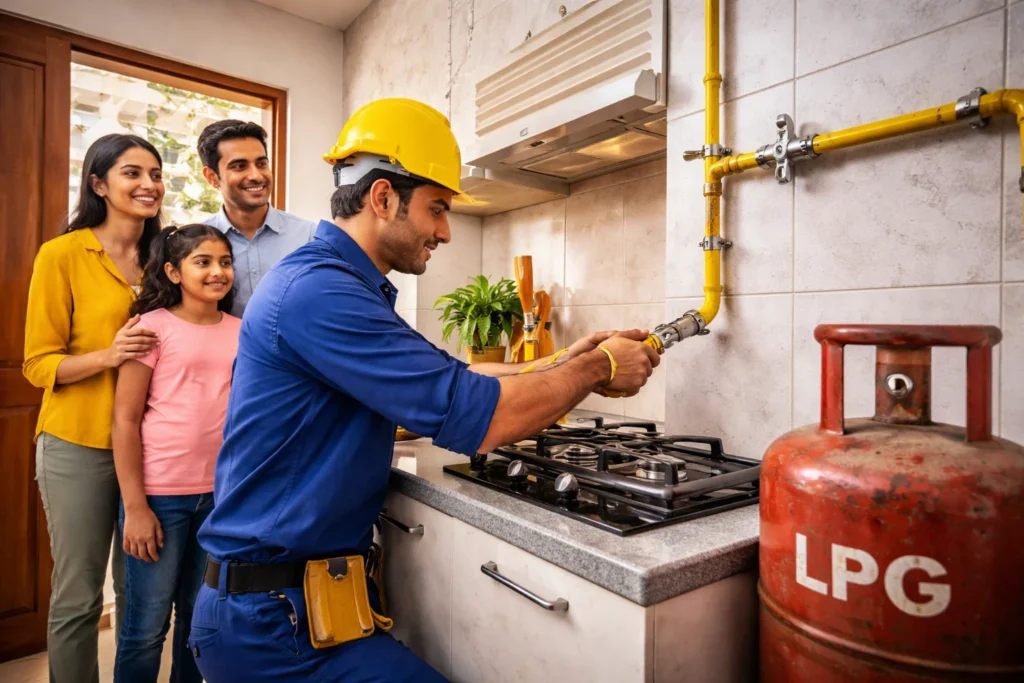

Part One: The Familiar Sound of Home
For decades, the sound of a pressure cooker whistling on a liquefied petroleum gas (LPG) stove has been the morning alarm for millions of Indian households. It’s the sound of chai being made, lunch being prepared, and families gathering before they scatter to schools and offices. That blue cylinder, standing in the corner of the kitchen, has been a silent but essential member of the family. It represents security, subsidy, and a familiar way of life that has spanned generations.
There is a certain rhythm to life with an LPG cylinder. You know exactly how many days it will last based on how many rotis you make and how many cups of tea your family drinks. You know the number of the local distributor by heart. You know the weight of the cylinder when it arrives—heavy and full of promise—and you know the lightness of it when it is about to run out, just in time for a holiday when you need it most.
But recently, a piece of news has caused a lot of chatter in colony parks, at family WhatsApp groups, and during evening adda sessions. The government has issued a directive that changes the rules of the game. The message is simple yet profound: if piped natural gas (PNG) is available in your area, you must switch to it. If you don’t, after three months, your LPG supply will be stopped. No more bookings. No more refills. The cylinder that has stood faithfully in your kitchen for years will be taken away, and the connection you relied upon will be deactivated.
For many, this feels like a sudden disruption. It feels like the government is reaching into their kitchens and dictating how they should cook. There is anxiety, confusion, and a fair amount of anger. But is this really a storm in a teacup, or is it a necessary step toward a cleaner, safer, and more efficient future? Is this an arbitrary rule, or is it the culmination of years of planning and infrastructure development that most of us never noticed happening beneath our feet?
Let’s break it down. Not with complicated jargon or bureaucratic language, but with the simple logic of how it affects your home, your wallet, and your daily life. Let’s step into the kitchens of ordinary Indians to understand what this change means.
Part Two: The Day the Cylinder Didn’t Come
Imagine Mrs. Asha Sharma, a retired school teacher living in a quiet residential sector in Noida, just outside Delhi. For thirty years, her routine was simple and unwavering. She cooked three meals a day for her husband before he passed away, and now she cooks for herself and her visiting grandchildren during holidays. When the LPG cylinder was empty, she would call the distributor, and within a few days, a delivery person would haul the heavy red cylinder up to her second-floor flat. It was reliable, if a bit of a hassle. She had a spare cylinder always ready, sitting in her utility area, just in case.
One Tuesday morning, she got a message on her phone. It wasn’t the usual delivery confirmation or the subsidy credit alert. It was a formal notice from the oil marketing company. It stated that since PNG pipelines had been laid in her sector two years ago, she had a limited time to make the switch. The message was stark: if she didn’t apply for a PNG connection within three months, her LPG subsidy and her connection would be canceled.
“Cancel my gas? On what grounds?” Mrs. Sharma thought, her brow furrowed as she read the message twice. She set down her steel glass of filter coffee and stared at the red cylinder in her kitchen. She liked her cylinder. She understood it completely. She knew exactly how long it lasted. She understood the bill—there were no surprises. The idea of a “gas pipeline” sounded like something that belonged in a factory or a large commercial kitchen, not in her modest home. Would it be safe? Would it be expensive? What if there was a leak? Who would she call if something went wrong?
This confusion is exactly what millions of Indians are feeling right now. The government’s new mandate isn’t just a suggestion; it is a policy aimed at optimizing resources, ensuring safety, and completing the infrastructure cycle. But to understand the “why,” we need to look deeply at the two different ways gas reaches our stoves. We need to understand the history, the chemistry, and the economics of these two blue flames.
Part Three: The Two Blue Flames: LPG vs. PNG
Before we decide whether this move is good or bad, we have to understand the fundamental difference between the two types of fuel. Think of it like the difference between buying water in large twenty-liter bottles versus having a direct pipeline connection from the municipal supply. Both give you water, but the experience, the cost structure, and the reliability are worlds apart.
Liquefied Petroleum Gas (LPG) is what we have in the cylinders. It is a mixture of propane and butane, two hydrocarbons that are gaseous at room temperature but can be turned into a liquid under moderate pressure. That is why it arrives in a liquid form inside a heavy steel cylinder. When you open the valve, the pressure drops, and it turns back into gas. You pay for the cylinder upfront—a fixed amount for a fixed quantity, usually 14.2 kilograms for domestic use. When it’s empty, you wait for a replacement. It’s a finite package of energy. You are buying energy in a container.
The journey of LPG is complex. It is extracted from natural gas processing and petroleum refining. It is then transported in bulk via ships, trains, and trucks to bottling plants, where it is filled into cylinders. Those cylinders are then loaded onto smaller trucks and delivered to distributors, and finally to your home. Every step involves logistics, fuel consumption, and labor. When you book a cylinder, you are tapping into a massive, nationwide supply chain.
Piped Natural Gas (PNG) is a different beast entirely. It is primarily methane, the simplest hydrocarbon. It is not stored in your house at all. It travels to you through an underground network of pipelines, just like water or electricity. You don’t have to book a refill. You don’t have to wait for a delivery person to climb your stairs. You don’t have to keep a spare cylinder taking up space in your kitchen. You simply open the knob, and the gas flows continuously, day and night. You pay only for what you use, measured by a meter installed at your doorstep, just like your electricity bill.
The journey of PNG is much simpler once the infrastructure is built. It flows from gas fields or import terminals through high-pressure trunk pipelines that cross state borders. From there, it enters city-specific networks and finally branches out into smaller pipes that lead directly to your stove. It is a continuous flow, not a batch delivery.
While both fuels make your food hot and your chai brewing, the journey they take to your kitchen is vastly different. And it is this difference—the efficiency of pipelines versus the logistical burden of cylinders—that the government is betting on for the future of urban India.
Part Four: Why the Sudden Push? A Story of Infrastructure Beneath Our Feet
To understand the urgency behind this directive, we have to look at the bigger picture that most of us never see. Over the last decade, India has invested billions of dollars in building a national gas grid. This isn’t just a few pipes here and there. It is a massive, coordinated effort to create a network that spans the country, connecting the gas-rich western coast to the energy-hungry northern and eastern states.
The government launched the Pradhan Mantri Urja Ganga project, which is a 2,600-kilometer pipeline that aims to provide piped gas to not just cities but also to industries and refineries along the route. Similar projects like the Kochi-Koottanad-Bengaluru-Mangalore pipeline and the Mehsana-Bhatinda pipeline have been laid to ensure that natural gas reaches every major urban center.
The idea was simple and logical: if you build a pipeline to a city, it is inefficient, costly, and environmentally wasteful to also keep sending LPG trucks to the same neighborhood. It’s like having a tap with running water in your house but still choosing to buy water from a tanker that comes once a week. It doesn’t make sense from an efficiency perspective.
When the government lays pipelines under your street, they incur a massive capital cost. They dig up roads, disrupt traffic, and invest public money. They do this assuming that residents will eventually use the network. It is a bet on the future. If people refuse to connect, the pipelines remain underutilized, and the entire infrastructure project—the billions spent, the roads dug up, the planning efforts—fails to serve its purpose. The pipelines become expensive metal tubes buried in the ground with no one using them.
The new rule—that households in “PNG-ready” areas must switch within three months—is the final push in this infrastructure story. It is the government closing the loop. It is saying, “We have built the highway. Now it’s time to use it.” It ensures that the pipelines that have been laid beneath the feet of citizens actually serve those citizens, rather than remaining idle assets.
Part Five: The Three-Month Countdown: What Does It Mean in Practice?
The directive is clear but comes with a warning that has caused understandable anxiety. If you live in an area where the pipeline infrastructure is already in place and the city gas distributor has declared the area “PNG-ready,” a clock starts ticking. You have three months to apply for a PNG connection. During this period, you can continue using your LPG cylinders. You can book refills. Nothing changes immediately.
But if you ignore the notices—if you refuse to apply, if you delay the paperwork, or if you simply decide that you prefer your cylinder—the government will instruct the oil marketing companies (like Indian Oil, Bharat Petroleum, and Hindustan Petroleum) to stop supplying LPG cylinders to your registered address. This means no more refills. Your connection will be surrendered automatically. The cylinder in your kitchen will be the last one you ever receive.
However, there is a crucial detail here that needs to be emphasized: this applies only where PNG is available. The word “available” is key. If you live in a remote village in Bihar, a hillside town in Himachal Pradesh, or a part of a city where pipelines haven’t been laid yet, you have nothing to worry about. Your LPG cylinder will continue to come as usual for the foreseeable future. The mandate is specifically for areas where the government has already invested in the pipeline infrastructure.
For those in cities like Delhi NCR, Mumbai, Thane, Navi Mumbai, Ahmedabad, Pune, Surat, Vadodara, Kanpur, Lucknow, Agra, Meerut, and parts of Kolkata and Chennai, where the network is dense and expanding, the change is imminent. If you live in a high-rise apartment in Noida Extension or a bungalow in South Delhi, chances are that the pipeline is already outside your door.
Part Six: The Safety Factor: A Silent Concern That Rarely Gets Discussed
Let’s go back to Mrs. Sharma’s kitchen for a moment. Aside from the hassle of booking cylinders and the physical effort of managing the heavy container, there was always a low-level anxiety that she never spoke about. Was the cylinder seal intact? Was the rubber pipe old and cracked? Could there be a slow leak that she couldn’t smell? Every time she heard a news report about a cylinder explosion in a nearby locality, she would go and check her own regulator, her pipe, her valve.
One of the biggest, most unspoken advantages of PNG is safety. It is a topic that rarely makes it into the headlines, but it is the most important reason why urban areas are transitioning away from cylinders. LPG, as mentioned earlier, is heavier than air. If there is a leak, the gas doesn’t rise. It settles at ground level, pooling invisibly in low-lying areas like kitchens. It can travel along floors, find its way to a spark from a refrigerator compressor, a geyser pilot light, or even the simple act of switching on a light, and trigger a devastating explosion. The confined spaces of modern apartments, where kitchens are often enclosed, increase this risk.
PNG, on the other hand, is lighter than air. It is mostly methane, which rises. If there is a leak in your kitchen, the gas will naturally dissipate upward. It will find its way out through windows, exhaust fans, or ventilation gaps. It doesn’t pool at the floor, waiting for a spark. Furthermore, PNG is supplied at low pressure—much lower than the pressure inside an LPG cylinder. The risk of a sudden, catastrophic release of pressurized gas is eliminated.
The pipelines themselves are underground, made of durable materials like polyethylene or steel, and are continuously monitored for pressure drops that might indicate a leak. This removes the risk of a delivery person dropping a heavy cylinder while climbing stairs, of a cylinder valve getting damaged during transport, or of a cylinder tipping over in the kitchen and shearing off the regulator.
From a pure safety perspective, for families living in high-rise apartments and densely packed urban neighborhoods, PNG is objectively safer. It is a system designed to minimize the points of failure that cause the accidents we occasionally see in the news.
Part Seven: The Economics: Counting Your Rupees and Paise
When people hear about a mandatory switch, the first question that leaps to mind is always financial. No one wants to make a change that makes their monthly budget tighter. In a country where household expenses are meticulously tracked, any change to a utility bill is treated with suspicion.
Initially, switching to PNG involves a capital cost. There is no way around it. You need to pay a security deposit for the gas meter and the pipeline installation. This amount varies significantly by city and by the gas utility company. In some cities, it might be as low as ₹3,000. In others, particularly where the pipeline needs to be drawn from the main line to a high-rise apartment, it could be ₹8,000 or more. For many families, this is a significant lump sum to pay, especially in a month where there might be other large expenses like school fees or medical bills.
However, the operational costs tell a different story, and this is where the long-term savings come into play. PNG is generally 15% to 20% cheaper than LPG on a per-unit-energy basis. What does that mean in real terms? If a family spends an average of ₹1,000 per month on LPG (averaging out over the months between cylinder refills), they are likely to spend ₹800 to ₹850 per month on PNG for the same amount of cooking. Because you pay only for what you use, you might also become more conscious of waste. A cylinder is a fixed cost—once it’s paid for, there is no incentive to conserve. With PNG, every minute the stove is on is reflected on the meter, encouraging efficient use.
Moreover, there is the hidden cost of LPG that we often ignore because we have grown accustomed to it. There is the cost of the advance payment for the cylinder itself—a security deposit that ties up money. There is the cost of the delivery fee in some areas where distributors charge a small amount for home delivery. There is the opportunity cost of waiting at home for the delivery person, taking a half-day off work or rearranging your schedule. There is the cost of maintaining a spare cylinder, which means you have money locked into two cylinders instead of one.
With PNG, you never run out of gas in the middle of cooking a meal for guests. There is no “booking” stress. There is no last-minute panic when the cylinder runs out on a Sunday evening and the distributor is closed. For working couples, single professionals, and nuclear families, the convenience alone often justifies the initial installation cost within the first year of use.
Part Eight: The Story of a Smooth Transition: Learning from Those Who Switched
Let’s look at the experience of Mr. Krishnamurthy Iyer in Chembur, Mumbai. When the pipeline came to his cooperative housing society five years ago, he was one of the most vocal resistors. He was a retired bank manager, a stickler for routine, and a man who believed that if something wasn’t broken, there was no need to fix it. “I have been using cylinders for forty years. My father used cylinders. Why should I change now?” he would tell his neighbors at the society meetings.
But when his society decided to make the switch collectively to avoid the hassle of cylinder deliveries in the narrow lanes of their old building, he had to comply reluctantly. The society passed a resolution, and all members agreed to pay for the internal pipeline installation. Mr. Iyer signed the paperwork with a heavy heart, convinced that he was being forced into a more expensive and complicated system.
The first month, he was nervous. He would walk to the meter box outside his flat every morning to check the reading. He kept a notebook where he logged the daily usage, comparing it to his old cylinder consumption. He was convinced that the meter was running too fast, that there was some invisible leak siphoning away his money.
“It was like seeing a ghost every time I looked at that meter,” he laughs now, sitting in his kitchen. “I was afraid of it. I didn’t trust it. But after the first bill arrived, I realized I was paying nearly ₹300 less than what I used to spend on two cylinders a month. Plus, I didn’t have to keep a spare cylinder in my tiny kitchen. My wife says the kitchen feels bigger now without that red cylinder sitting in the corner. We have more counter space.”
Mr. Iyer’s story is remarkably common across cities where PNG was introduced years ago. The resistance, the suspicion, the fear of the meter—it all melts away after the first two or three billing cycles. The fear of the unknown gives way to the comfort of convenience and the pleasant surprise of lower bills.
Part Nine: But What About the Subsidy? The Ujjwala Question
A major concern that has been raised across the country, and one that requires careful discussion, is the loss of the LPG subsidy for millions of families. Under the Pradhan Mantri Ujjwala Yojana (PMUY), launched in 2016, the government provided free LPG connections to women from below-poverty-line households. As of today, over nine crore families have benefited from this scheme. For these families, the subsidy on refills—the money that gets credited directly to their bank accounts—makes LPG affordable.
The new directive raises a deeply concerning question: what happens to the subsidy if you switch to PNG? If a Ujjwala beneficiary lives in a city where pipelines have been laid, are they now forced to switch to a system that doesn’t offer the same financial support?
Currently, the subsidy structure for PNG is not the same as for LPG. While LPG subsidies are directly transferred to the bank account under the DBTL (Direct Benefit Transfer of LPG) scheme, PNG does not have a direct, per-unit subsidy in the same way. Natural gas prices are regulated by the government through the Petroleum and Natural Gas Regulatory Board (PNGRB), but the subsidy is not tied to individual consumer accounts.
In some states, the government offers a slight reduction in the price of PNG for domestic consumers compared to commercial or industrial users, effectively a cross-subsidy. But this is not the same as the cash transfer that Ujjwala beneficiaries receive for LPG.
For Ujjwala families, this is a critical point of friction. The government has indicated in various policy documents that the long-term goal is to eventually bring PNG into the subsidy net, perhaps through a direct transfer mechanism similar to LPG. However, for now, the mandate stands: if PNG is available in your area, the subsidized LPG cylinder is no longer an option. This is a significant social and economic issue that will need to be addressed as the rollout expands into areas with high concentrations of Ujjwala beneficiaries.
Part Ten: The Environmental Story: The Air We Breathe Every Day
Beyond the confines of our kitchens, there is a larger story unfolding—one about the air in our cities, the smog that settles over the northern plains every winter, and the invisible pollutants that affect our lungs. We often hear about pollution and blame it on cars, factories, and construction dust. And rightfully so. But the burning of fuel in millions of homes adds to the cumulative burden.
LPG is already considered a clean fuel compared to wood, coal, or kerosene. It burns with a blue flame and produces far fewer harmful particulates. But PNG is even cleaner. Methane, the primary component of PNG, burns more completely than the propane-butane mix in LPG. It produces almost no particulate matter—the tiny, inhalable particles that lodge themselves in our lungs and cause respiratory illnesses over time.
When millions of households in a city burn LPG, there are two sources of emissions. The first is the combustion itself in the kitchen. The second, often overlooked, is the emissions from the thousands of trucks that transport cylinders across the city every day. These trucks run on diesel, contributing to the city’s particulate matter and nitrogen oxide levels.
By switching to PNG, cities reduce the number of heavy vehicles on the roads—the cylinder trucks—and lower the overall carbon footprint of cooking. It is a small step for a single kitchen, but when multiplied by millions of households, it becomes a giant leap for the city’s air quality. In cities like Delhi, where air pollution is a perennial public health crisis, every reduction in emissions matters.
Part Eleven: The Disconnect: When ‘Availability’ Isn’t Really Available
Now, let’s address the elephant in the room that has been causing the most frustration on social media and in resident welfare association meetings. The government’s directive says households must switch where PNG is “available.” But what does “available” actually mean in practice?
In many parts of the country, the pipelines have been laid on the main road, but the internal connections to the apartment buildings or individual homes haven’t been completed. There is a significant difference between “gas is in the area” and “gas is at your doorstep.” The main pipeline might run along the boundary of the colony, but the branching lines that bring the gas into the individual kitchens might be months or even years away from completion.
Residents in such areas are worried—and justifiably so. They are receiving notices to switch within three months, but when they approach the city gas utility company, they are told there is a waiting list, or that the society hasn’t given the No Objection Certificate (NOC), or that the internal piping design hasn’t been approved yet, or that the contractor hasn’t been assigned. The three-month clock is ticking, but the mechanism to comply is not in place.
This is a genuine logistical lag that creates tremendous anxiety. The three-month deadline should ideally start only when the internal infrastructure is ready for the household to connect seamlessly. If you are facing this situation, it is crucial to document your attempts to apply for a connection. Keep copies of your application forms, emails, and acknowledgment receipts. Communicate with the local distributor and the utility company in writing. If your society is delaying the NOC, raise the issue at the society meeting. The goal is to create a paper trail that shows you are trying to comply but are being delayed by factors beyond your control.
Part Twelve: How to Navigate the Switch: A Practical Step-by-Step Guide
If you have received a notice or heard through neighbors that your area is on the list for PNG implementation, panicking won’t help. A methodical approach will make the transition smoother, less stressful, and potentially cheaper. Here is a detailed step-by-step guide to navigating this transition.
Step 1: Verify Availability
Do not rely solely on the notice that might have been slipped under your door. Notices can be generic. Check with your local LPG distributor, and more importantly, check with the city’s gas distributor. In Delhi and NCR, that is Indraprastha Gas Limited (IGL). In Mumbai, it is Mahanagar Gas Limited (MGL). In other cities, it might be Adani Gas, Gujarat Gas, or other authorized entities. Confirm if your specific street, lane, or society is officially declared “PNG-ready” and whether the internal connections are available.
Step 2: Society Coordination
If you live in an apartment complex, this is not an individual issue—it is a collective issue. Most societies have to give a collective NOC for the pipeline to be drawn inside the building. The utility company will not run individual lines into a building unless the Resident Welfare Association (RWA) or the managing committee approves it. Coordinate with your neighbors. Often, if the whole society applies together, the installation cost per household comes down because the utility can do bulk installations and save on labor costs. The process is also faster because the utility company prioritizes bulk applications.
Step 3: Understand the Costs in Detail
When you apply, ask for a clear, written breakup of the security deposit and installation charges. Don’t just pay what is asked without understanding it. Compare this one-time cost with the cost of maintaining an LPG connection. Remember that you will get a refund on your LPG security deposit when you surrender your cylinder. That money can offset the new deposit. Ask about any additional costs for modifying your kitchen or your stove.
Step 4: Book Your Installation Slot Early
Once you decide to switch, do not delay. The utility companies are currently handling a high volume of requests in cities where the mandate has been announced. Getting in early ensures you secure a slot before the rush. It also ensures that you don’t find yourself at the end of the three-month deadline with no connection and no LPG refills. Early birds often get better service because the installation teams are not overwhelmed.
Step 5: Kitchen and Stove Modification
This is a step that many people overlook. PNG stoves are calibrated differently from LPG stoves. The jets—the tiny nozzles through which the gas flows into the burner—have different diameters. You may need to change the jets in your existing stove. Some modern stoves come with dual-fuel capability and can be switched by simply turning a knob or flipping a part. But many older stoves require a mechanic to swap the jets. This is a small but essential step to ensure that the flame is the correct blue color and that the stove is burning efficiently. Using an LPG stove with PNG without changing the jets can result in a yellow, sooty flame that wastes gas and blackens your utensils.
Step 6: Surrender Your LPG Connection Gracefully
Once your PNG connection is active and you have tested it, you need to surrender your LPG connection. Do not wait for them to cancel it. Go to your LPG distributor, submit the surrender form, and return the cylinder and regulator. Collect your security deposit refund. This closes the loop properly and ensures you don’t have any outstanding liabilities.
Part Thirteen: The Human Element: Leaving What Is Familiar
Despite the logic of safety, cost, convenience, and environmental benefits, there is a deep human element to this transition that we cannot afford to ignore. The red LPG cylinder is more than a fuel source. It is a symbol of energy independence. For many women, especially in families where they are the primary managers of the kitchen, the cylinder represents a system they understand completely.
They know the distributor by name. They know the delivery person’s face. They know how to check for leaks with soap water—a skill passed down from mother to daughter. They know how to tilt the cylinder to get the last bit of gas out when it is running low. The system is imperfect, but it is known. It is predictable.
The idea of a “gas meter” running in the corner of the building or on the outside wall feels like a new, impersonal boss monitoring their usage. It feels like the government is installing a surveillance device on their cooking habits. “I feel like I’ll be cooking under a microscope,” said Sunita, a homemaker in Gurugram, when asked about the switch. “With the cylinder, I know exactly what I’m paying for. It’s a fixed cost. This meter… what if it runs fast? What if it’s faulty? What if they overcharge me and I have to fight with a company I don’t know?”
This anxiety is valid, and it should not be dismissed as mere resistance to change. However, like electricity meters and water meters, gas meters are sealed and tested by government-approved authorities before installation. They are calibrated to ensure accuracy. If you suspect a fault, you have the right to request a meter check. The utility company is obligated to test it in your presence. Over time, as neighbors share their bills and the numbers prove to be consistent, the anxiety subsides.
Part Fourteen: The Future of Cooking Fuel in India: A Long View
This directive is not an isolated event. It is not a random policy change announced by a distant bureaucracy. It is a glimpse into the future of India’s energy policy, a future that is already unfolding. The government has set a clear and ambitious target: to increase the share of natural gas in the country’s energy mix from the current level of about 6% to 15% by 2030. This is not just a number; it is a strategic shift aimed at reducing the country’s carbon emissions, lowering dependence on imported crude oil, and building a more resilient energy infrastructure.
To achieve this target, the domestic kitchen is one of the biggest battlegrounds. By moving households from bottled gas to piped gas, the government stabilizes demand. A pipeline network needs a steady, predictable flow of customers to be economically viable. Residential customers provide that base load. Furthermore, every household that switches reduces the demand for imported LPG, which saves foreign exchange and reduces the country’s vulnerability to global oil price fluctuations.
For the average citizen, this means that over the next decade, if you live in a city, PNG will likely become the default cooking fuel, just as tap water and electricity are the defaults. The LPG cylinder will gradually become a backup fuel—available for rural areas where pipelines are not feasible, for commercial establishments in non-pipeline zones, and for specialized industrial uses. The cylinder will not disappear overnight, but its role in the urban household will diminish.
Part Fifteen: Debunking Common Myths That Spread on WhatsApp
As with any major policy change, rumors spread faster than official information. In the age of WhatsApp forwards, myths have a life of their own. Let’s clear up a few of the most persistent myths floating around.
Myth 1: The government is banning LPG entirely across the country.
Fact: No. This is the most common and most fear-inducing myth. LPG is only being phased out in areas where PNG infrastructure is already established and available at the doorstep. Rural India, small towns, and urban areas without pipeline networks will continue to receive LPG for the foreseeable future. The government has no plan to ban LPG nationwide.
Myth 2: PNG is much more expensive than LPG.
Fact: On a per-unit heat basis—meaning for the same amount of cooking energy—PNG is generally 15 to 20 percent cheaper than LPG. Your monthly bill is likely to decrease, not increase, provided your cooking habits remain the same. The initial installation cost is a one-time expense, but the recurring cost is lower.
Myth 3: I will lose the security deposit I paid for my LPG cylinder.
Fact: No. When you surrender your LPG cylinder, regulator, and the connection, you are entitled to a full refund of your security deposit. This is not a loss; it is a transfer of assets. You can use that refund to offset the new PNG security deposit.
Myth 4: The PNG connection process takes months and involves endless paperwork.
Fact: While it does require some paperwork—identity proof, address proof, and a completed application form—most city gas distributors now offer online applications and digital payment options. The process has been streamlined significantly in recent years. If the internal piping in your building is already in place, the installation can happen within days.
Myth 5: PNG is unsafe because gas is flowing through pipes under pressure.
Fact: Actually, the opposite is true. The underground pipelines are made of durable materials and are monitored continuously. The pressure in the PNG system is much lower than the pressure inside an LPG cylinder. The risk of a sudden, explosive leak is significantly lower with PNG.
Part Sixteen: A Collective Responsibility Toward Modern Infrastructure
Ultimately, the switch to PNG is a collective move toward modernization. It mirrors what developed nations did decades ago. In countries like the United States, the United Kingdom, Japan, and most of Western Europe, cooking with bottled gas in a city is a rarity. It is seen as an outdated, inefficient, and somewhat unsafe method. Pipelines are the norm. Gas, like water and electricity, flows into the home through a network of underground pipes.
For India, a country that is currently building new infrastructure at a record pace—new airports, new metro lines, new highways—skipping the cylinder stage in urban areas is a sign of maturity. It means we are building cities that are not just bigger, but better. Cities that are safer, cleaner, and more efficient. It means we are learning from the experiences of older, more developed nations and avoiding the inefficiencies they are now trying to undo.
When a city adopts piped gas at scale, it reduces the number of heavy trucks on its roads, reducing road wear and tear. It reduces the number of LPG storage points—the distributor godowns—that exist in residential areas, reducing fire hazards. It simplifies urban planning. It allows for a more rational, organized approach to energy distribution.
Part Seventeen: A Final Word for Mrs. Sharma and Millions Like Her
Let’s return to Mrs. Sharma in Noida. After a week of confusion, a few phone calls to her son who works in Delhi, and a conversation with her neighbor who had already switched to PNG, she finally decided to take the plunge. She applied online, paid the security deposit, and within ten days, a technician came and installed the meter outside her flat. A plumber changed the jets on her stove, which cost her an extra five hundred rupees.
On the first day, she was nervous. She kept looking at the meter, watching the numbers turn slowly as she cooked her lunch. But after a week, she stopped checking. The gas flowed reliably. There was no need to book a cylinder. There was no need to wait for delivery. The kitchen felt cleaner without the cylinder standing in the corner.
“It’s hard to teach an old dog new tricks,” she chuckled when her son called to ask how the new system was working. “But if it’s safer, and if it’s a little cheaper, who am I to argue? I just wish they had explained it better in the beginning instead of just sending a threatening notice. A little explanation goes a long way.”
That is the crux of the issue. The policy itself is sound. It is based on safety, efficiency, and long-term planning. But the communication needs to be kinder, more patient, and more localized. For families who have relied on the cylinder for generations—who have built their cooking routines around it—the transition requires not just a new pipe and a new meter, but a shift in mindset. It requires trust. And trust is built through clear, respectful communication, not just official notices.
Part Eighteen: Looking Ahead: What the Next Five Years Hold
As we look ahead, the pace of this transition will only accelerate. The government has authorized dozens of new geographical areas for city gas distribution in recent bidding rounds. In the next five years, hundreds of new cities and towns will get PNG networks for the first time. The number of households connected to piped gas is expected to grow from the current few crore to over ten crore.
For the average citizen, this means that if you haven’t received a notice yet, you likely will in the coming years. The infrastructure is spreading. The policy is consistent. The direction is clear.
For those who are early in this journey—the Mrs. Sharmas of today—the experience will become the template for others. Their stories of initial anxiety followed by eventual satisfaction will be shared in family circles. Their kitchens will become the model that others follow.
Conclusion: Embracing the New Flame in Our Kitchens
As we move forward together through this transition, the kitchen will remain the heart of the Indian home. Whether the flame comes from a cylinder or a pipeline, the love in the food remains the same. The roti will still be made with care. The dal will still simmer for hours. The chai will still be shared with neighbors who drop by unannounced.
The new mandate is a turning point. It asks us to trade the familiar red cylinder for an invisible network beneath our feet. It asks us to trade the anxiety of running out of fuel at the wrong moment for the peace of mind of a continuous, unbroken flow. It asks us to pay a little upfront to save more later. It asks us to trust in a system that is safer and cleaner, even if it is unfamiliar.
If you live in a city with pipelines, the three-month countdown is not a threat. It is a transition period—a window of time designed to help you make the shift on your own terms. Use that time wisely. Talk to your neighbors. Understand the costs. Book your installation. Modify your stove. Surrender your cylinder. Close the old chapter and open the new one.
The goal is a future where no one has to wait for a gas cylinder delivery. A future where kitchens are safer, especially for families with young children and elderly members. A future where the air in our cities is a little cleaner because millions of households have made a small change. It’s a future that starts with a simple decision: to let go of the cylinder and welcome the pipeline.
The blue flame in your kitchen will still dance the same way. Your food will still taste the same. But the journey that flame takes to reach you will be quieter, safer, and more in tune with the modern city that India is becoming. And that, perhaps, is a change worth embracing.



Super-Duper site! I am loving it!! Will be back later to read some more. I am taking your feeds also
Such a hidden gem! I wasn’t expecting much but this site exceeded all my expectations. Huge thanks to bd7c7770 for the awesome service.
I love the variety of games available here. There is always something new to try and the bonuses are actually fair. Great vibes all around at ab777casino.
I’ve tried a few sites recently and phjili30 is definitely one of the smoothest. The games load fast and the interface is very user-friendly. Highly recommended for anyone looking for a reliable spot!
Terrific work! This is the type of info that should be shared around the internet. Shame on the search engines for not positioning this post higher! Come on over and visit my site . Thanks =)
I’ve been looking for a reliable way to access my account and this is by far the smoothest experience. Everything loads fast and the interface is super intuitive. Check out nogod888login for a hassle-free start.
Solid platform with a lot of exciting options. I really appreciate the transparency in their terms. Give phkavbet a go