
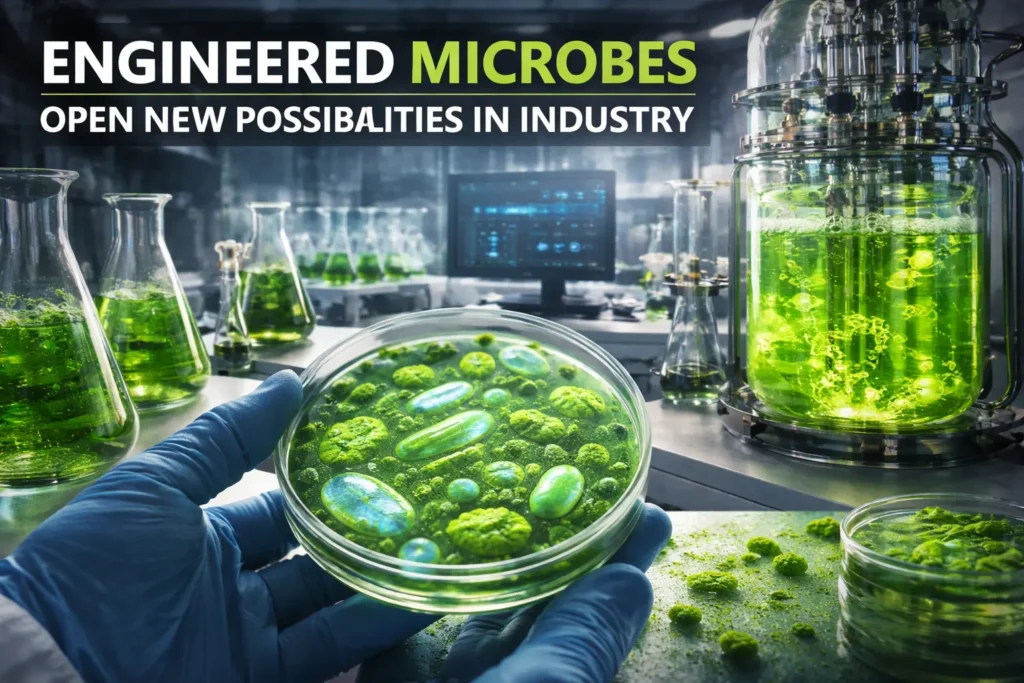

Imagine a world where the plastic bottle you throw away doesn’t end up floating in the ocean but instead gets eaten by a tiny creature that turns it into vanilla flavoring for your ice cream. Picture a factory that doesn’t belch black smoke into the sky but instead uses living cells to breathe in carbon dioxide and breathe out jet fuel. Consider a future where the leather on your shoes was grown in a lab by bacteria in a matter of days, and when the shoes wear out, you can bury them in your garden, where they will break down into nutrients for your tomato plants.
This isn’t a scene from a science fiction movie. It is happening right now in laboratories and industrial plants around the world, though most people have never heard of it. We are in the middle of a quiet revolution, a shift so profound that historians may one day look back on it as one of the most important turning points in human industry. The workers leading the charge are so small that millions of them could fit on the head of a pin. They are called engineered microbes, and they are changing the way we make everything—from the food we eat to the clothes we wear to the medicines that keep us alive.
For most of human history, we have used microbes without even knowing it. Thousands of years ago, our ancestors used yeast to make bread rise and turn grapes into wine. They used bacteria to turn milk into cheese and yogurt. In ancient Egypt, people used microbes to ferment grains into beer, which was safer to drink than the river water. But those were accidents of nature, happy coincidences that early humans stumbled upon and refined over generations. We were simply setting the stage and letting nature do its thing, hoping for the best.
Today, scientists are no longer just spectators. They have become the directors, the scriptwriters, and the stage managers all rolled into one. By learning the language of DNA, they can now rewrite the instruction manuals hidden inside tiny organisms like bacteria, yeast, and even algae. They are turning these single-celled creatures into specialized workers—workers that never get tired, never go on strike, and can be trained to perform industrial tasks that are too dangerous, too expensive, or too polluting for traditional factories. This is the story of how we are learning to partner with the smallest forms of life to build a cleaner, smarter, and more sustainable future.
The Accidental Beginnings: A History of Working with Tiny Life
To understand how we got here, we need to travel back in time to a sweltering summer in London in 1928. A Scottish scientist named Alexander Fleming had just returned from a vacation with his family. He was a bit disorganized, as many brilliant scientists are, and before he left, he had stacked a bunch of petri dishes containing bacteria cultures on a bench in his lab. When he came back, he began sorting through them to see which ones he could salvage.
Most scientists would have thrown the contaminated dishes away in frustration. But Fleming had a habit of looking closely at things that others dismissed. As he examined one dish, he noticed something strange. A spot of mold had grown in the dish, a fuzzy greenish patch that had floated in from some other part of the lab. Around that patch of mold, the bacteria he had been growing—staphylococci, which can cause nasty infections—had been killed. They had dissolved into nothing. The mold had created a zone of death around itself.
Fleming was intrigued. He isolated the mold, identified it as a species of Penicillium, and found that it produced a substance that could kill a wide range of bacteria. He called it penicillin. It would take another decade of work by other scientists to turn his discovery into a usable drug, but the moment Fleming looked at that dish, the world changed. For the first time, humans realized that microbes could be more than just germs that made us sick. They could be tiny factories that produced life-saving medicine.
For the next fifty years, scientists learned to “coax” microbes into making things. During World War II, the race to mass-produce penicillin led to the development of huge fermentation tanks, the ancestors of the bioreactors we use today. After the war, scientists looked for other useful molecules. They found that certain soil bacteria produced streptomycin, a drug that could treat tuberculosis. They found that fungi could produce compounds that lowered cholesterol. They found that bacteria could produce enzymes that made laundry detergent work better in cold water.
But coaxing was a slow, messy process. Scientists would blast microbes with radiation or douse them with harsh chemicals, hoping to create random mutations. Occasionally, a mutation would make a microbe produce more of a certain chemical. They would isolate that lucky microbe and repeat the process. This was called random mutagenesis. It worked, but it was like trying to build a house by throwing dynamite at a pile of bricks and hoping a wall appears. You might eventually get a wall, but you’d also destroy a lot of bricks along the way, and you had no control over where the bricks ended up.
Then, in the 1970s, everything changed. Scientists discovered a set of tools called recombinant DNA technology. For the first time, they could cut and paste specific genes from one organism into another with precision. In 1978, a team at Genentech, a young biotech company in California, accomplished something that had seemed impossible just a few years earlier. They took the human gene for insulin—a hormone that millions of diabetics need to survive—and stitched it into the DNA of a harmless strain of E. coli bacteria.
When they put these engineered bacteria into a fermentation tank and fed them sugar, the bacteria began churning out pure human insulin. It was a miracle. Before this, insulin was harvested from the pancreas of pigs and cows. It took tons of animal organs to produce a small amount of insulin. It was expensive, it was not exactly the same as human insulin, and many people had allergic reactions. Now, for the first time, humans could produce unlimited quantities of a perfect, human-compatible medicine in a stainless steel tank.
This was the birth of engineering biology. We were no longer just asking the microbes to work for us. We were rewriting their blueprints to make them work for us, with intention and precision.
Reading the Blueprint: How Scientists Rewrite DNA
So, how do scientists actually do this? To understand, you have to understand DNA. Think of DNA as a cookbook. Every living thing, from a blue whale to a tiny bacterium, has this cookbook inside every one of its cells. The recipes in the cookbook are called genes. Each gene tells the cell how to build a specific protein. Some proteins build cell walls. Others digest sugar. Others carry oxygen in the blood. Others, like in fireflies, create light.
The cookbook is written in a language of four chemical letters: A, T, C, and G. These letters form words, and the words form sentences, and the sentences are the recipes. For billions of years, evolution has been slowly editing this cookbook, changing a letter here, adding a sentence there, creating the incredible diversity of life we see around us.
When scientists “engineer” a microbe, they are acting like a master chef with a supercharged word processor. They aren’t trying to write a whole new cookbook from scratch. That would be too hard. Instead, they are taking their favorite recipes—or in this case, genes from other organisms—and pasting them into the microbe’s cookbook. They can also delete recipes that are getting in the way or edit existing recipes to make them better.
Let’s walk through a real example. Suppose a company wants to make a specific type of biodegradable plastic using bacteria. They know that a certain type of bacteria found in the soil naturally produces small amounts of a polymer called PHA, which can be used to make biodegradable plastic. But the natural bacteria don’t produce enough to be useful on an industrial scale.
The scientists first identify the genes in that soil bacterium that are responsible for producing PHA. These genes are the recipes. Using a tool called CRISPR, which acts like a pair of microscopic scissors and a glue stick, they snip out those genes. Then, they insert those genes into the DNA of a fast-growing, easy-to-handle bacterium, like E. coli or a specific strain of yeast. But they don’t just paste the genes in anywhere. They carefully select a location in the host’s DNA where the genes will be highly active. They might also add a “promoter” sequence—think of it like a bright neon sign—that tells the cell to read this recipe constantly and with great urgency.
Now, when the E. coli reads its cookbook, it sees a new recipe for PHA. It starts churning out that biodegradable plastic. But the scientists don’t stop there. They might also go into the E. coli’s own cookbook and delete a few recipes that compete for resources, like recipes that make the bacteria store fat or build unnecessary cell structures. By doing this, they can force the bacteria to put all their energy into making the plastic. They can increase production tenfold or even a hundredfold.
The magic of this process is scale. You put one engineered microbe in a big tank of sugar water, along with some other nutrients like nitrogen and phosphorus. That one microbe eats the sugar, grows, and divides into two microbes. Those two become four, then eight, then sixteen. Under ideal conditions, a bacterium like E. coli can divide every twenty minutes. Do the math: in just a few hours, one microbe becomes millions. In less than 24 hours, you have a tank full of billions of tiny workers, all following the new instructions you gave them, all churning out the product you want.
This ability to self-replicate is one of the most powerful aspects of using microbes. You don’t have to build a factory to make the factory. The microbes are the factory, and they build more copies of themselves for free, as long as you feed them.
From Corn to Crude: The Biofuel Revolution
One of the most exciting areas where these tiny workers are making a big splash is in energy. For over a century, we have relied on fossil fuels—oil, coal, and natural gas—to power our civilization. These are essentially ancient, buried microbes and plants that were compressed and cooked under the earth for millions of years. We are burning them at a rate far faster than the Earth can make them. This releases carbon that was locked away underground, adding it to the atmosphere and warming our planet at an alarming rate.
What if we didn’t have to wait millions of years? What if we could make the same kinds of fuels in a matter of days or hours using living microbes that we can grow in tanks? That is the promise of biofuels, and it’s a promise that is finally starting to be fulfilled after decades of research.
The idea isn’t new. For decades, we have been making ethanol—a type of alcohol—by letting yeast ferment the sugars in corn or sugarcane. You can mix ethanol with gasoline to power cars. In Brazil, a large portion of the vehicle fleet runs on pure ethanol made from sugarcane. In the United States, most gasoline contains about ten percent ethanol made from corn. But this first generation of biofuels has a big problem. It uses food crops. If we use too much corn for fuel, the price of corn for food goes up, causing hardship for people around the world. Growing corn for fuel also requires vast amounts of land, water, and fertilizer, which can lead to deforestation and water pollution.
Engineered microbes are solving this problem by enabling what is called second-generation and third-generation biofuels. Scientists have designed bacteria and yeast that can eat things we don’t want, things that are currently considered waste. They can eat corn stalks, wheat straw, wood chips, switchgrass, and even municipal garbage. These materials are rich in cellulose, a tough carbohydrate that forms the structure of plant cell walls. Cellulose is basically a long chain of sugar molecules, but it’s so tightly bundled up that most organisms can’t break it down.
Scientists have gone into the genomes of fungi and bacteria that live in the guts of termites—creatures that are famous for being able to digest wood—and extracted the genes that produce enzymes called cellulases. These enzymes are like molecular scissors that snip the cellulose chains into individual sugar molecules. By putting these genes into industrial yeast or bacteria, scientists have created microbes that can secrete these enzymes, digest the cellulose, and then ferment the resulting sugars into ethanol, all in one tank.
One of the most incredible stories in the biofuel world comes from a company that engineered a strain of bacteria to consume methane. Methane is a powerful greenhouse gas—about 25 times more potent than carbon dioxide over a 100-year period—that often escapes from landfills, wastewater treatment plants, and oil wells. This methane is typically flared off (burned) or simply vented into the atmosphere, contributing to climate change. The company engineered a bacterium called Methylococcus capsulatus to eat that methane and, instead of releasing it into the atmosphere, convert it into protein-rich animal feed and, through further engineering, into liquid fuel. It’s like having a vacuum cleaner that sucks up pollution and spits out valuable products.
Other scientists are working on engineering algae, single-celled organisms that photosynthesize. Algae can be grown in ponds or in clear tubes called photobioreactors. They use sunlight and carbon dioxide to produce oils that can be harvested and converted into biodiesel or even jet fuel. Algae don’t require farmland or fresh water; they can be grown in brackish water or even wastewater. A single acre of algae can produce far more oil per year than an acre of soybeans or corn.
These engineered microbes are not just making fuel; they are changing the economics of energy. They can turn waste—which costs money to dispose of and which harms the environment—into a valuable product. This is the dream of a circular economy, where one industry’s trash becomes another industry’s treasure, and where the carbon we release is the carbon we recently pulled from the atmosphere, not carbon that was buried for millions of years.
Cleaning Up the Mess: Microbes as Environmental Heroes
Beyond making new things, engineered microbes are proving to be excellent at cleaning up the messes we have already made. For decades, factories dumped chemicals into the ground and water without much thought. We called it “out of sight, out of mind.” But the chemicals didn’t disappear. They seeped into groundwater, contaminated soil, and worked their way up the food chain. Cleaning up these sites—known as brownfields—is incredibly expensive and often involves digging up tons of contaminated soil and hauling it to a landfill.
There is a famous story that marks the beginning of using engineered microbes for environmental cleanup. In the 1970s, a scientist named Dr. Ananda Chakrabarty was working for General Electric. He was studying a type of bacteria that could eat oil, but not very efficiently. He figured out a way to transfer the oil-eating genes from several different strains of bacteria into a single strain, creating a “superbug” that could break down multiple components of crude oil much faster. He applied for a patent on this engineered bacterium. The patent office initially rejected it, saying you couldn’t patent a living thing. The case went all the way to the U.S. Supreme Court. In a landmark 1980 decision, the court ruled 5-4 that a genetically modified organism could be patented. That decision opened the door for the entire biotechnology industry.
Today, the descendants of Chakrabarty’s insight are being used in sophisticated ways to tackle a wide range of pollution problems. Take plastic pollution, for example. We all know plastic is a huge problem. It piles up in our oceans and landfills. It takes hundreds of years to break down, and as it does, it fragments into microplastics that infiltrate every corner of the environment, from the deepest ocean trenches to the air we breathe.
But nature is fighting back. A few years ago, a team of scientists in Japan made a remarkable discovery. They were sorting through piles of debris near a plastic recycling plant and found a bacterium that had naturally evolved to eat a specific type of plastic called PET, which is used in water bottles and polyester clothing. They named it Ideonella sakaiensis. This bacterium produced two enzymes that worked together to break down PET into its original building blocks.
Scientists around the world immediately began studying this bacterium. They took the genes for those two enzymes and began engineering them, trying to make them better. They used a technique called directed evolution, which mimics natural selection in the lab. They introduced random mutations into the enzyme genes and screened the resulting enzymes to see which ones worked faster or at higher temperatures. After several rounds of this, they created a “super-enzyme” that could break down PET not in centuries, not in decades, but in days.
This engineered enzyme, often called a “plastic-eating enzyme,” is now being scaled up for industrial use. It doesn’t just destroy the plastic; it breaks it down into its chemical monomers—terephthalic acid and ethylene glycol. These monomers are pure and clean. They can be fed right back into a factory to make brand-new, virgin-quality PET plastic. This means we could potentially recycle the same plastic over and over again, forever, without ever needing to drill for more oil to make new plastic. It solves the plastic waste problem and the fossil fuel problem at the same time.
These cleanup microbes are also being used for other pollutants. Scientists have engineered bacteria that can absorb heavy metals like mercury, lead, and arsenic from contaminated soil. The bacteria produce proteins on their surface that bind to the metals like magnets. You can then harvest the bacteria, extract the metals, and recycle them. Other engineered microbes are being used to clean up oil spills. Instead of spraying toxic dispersants that just push the oil underwater, you can spray a solution containing oil-eating bacteria that go to work breaking the oil down into harmless compounds.
There are even engineered microbes being used to clean up explosives. Old military sites are often contaminated with TNT and other explosives that are toxic and persistent in the environment. Scientists have engineered bacteria that can use TNT as a source of nitrogen, breaking it down into harmless compounds. These bacteria are sprayed onto contaminated soil, where they go to work, cleaning up sites that would otherwise remain hazardous for generations.
The Medicine Cabinet: How Microbes Make Life-Saving Drugs
While the industrial and environmental applications are exciting, the most profound impact of engineered microbes so far has been in medicine. We already mentioned insulin. Before engineered microbes, insulin for diabetics was harvested from the pancreas of pigs and cows. It took about 8,000 pounds of pancreas glands from slaughtered animals to produce just one pound of insulin. It was expensive, it was not exactly the same as human insulin, and many people had allergic reactions to the animal proteins.
Today, almost all insulin in the world is made by engineered E. coli or yeast. The human insulin gene is inserted into the microbe, and the microbe produces pure, human-compatible insulin. It is purer, safer, cheaper, and can be produced in virtually unlimited quantities. It saves millions of lives every day. But insulin was just the beginning.
Now, microbes are being used to make complex cancer drugs that were previously so rare and expensive that they were almost impossible to obtain in sufficient quantities. Consider the case of a drug called paclitaxel, which is used to treat ovarian, breast, and lung cancers. For decades, the only source of paclitaxel was the bark of the Pacific yew tree, a slow-growing tree found in old-growth forests of the Pacific Northwest. To treat just one patient, you needed to strip the bark from three hundred-year-old trees. The trees died in the process. It was environmentally destructive and supply was always limited.
Scientists eventually figured out how to make a precursor to paclitaxel from the needles of yew trees, which could be harvested without killing the tree, but the process was still inefficient. Then, a team of researchers did something extraordinary. They mapped out the entire 19-step biochemical pathway that the yew tree uses to make paclitaxel. They took those 19 recipes—the genes for each enzyme in the pathway—and inserted them into yeast. They engineered the yeast to carry out all 19 steps in sequence, inside a single cell. Now, instead of waiting for yew trees to grow for decades and then stripping their bark, they can brew this complex cancer drug in stainless steel tanks, just like they brew beer. It’s faster, cheaper, more reliable, and doesn’t require destroying endangered ecosystems.
We are also seeing the rise of what are called “living medicines.” Imagine swallowing a pill that contains billions of engineered bacteria, but these aren’t just any bacteria. They have been programmed to act as tiny doctors inside your gut. One company has developed an engineered strain of Lactococcus lactis, a bacterium commonly used in cheese making, that has been modified to produce a specific enzyme that people with a rare genetic disorder called phenylketonuria (PKU) lack. PKU patients have to follow a strict diet to avoid a buildup of the amino acid phenylalanine, which can cause brain damage. By taking this engineered probiotic, the bacteria produce the missing enzyme in their gut, breaking down the phenylalanine before it can be absorbed into the bloodstream. It turns a lifelong, restrictive disease into something manageable with a daily pill.
Other living medicines are being developed to fight infections. Clostridium difficile, or C. diff, is a nasty bacterium that causes severe, life-threatening diarrhea, especially in people who have taken antibiotics that wiped out their healthy gut bacteria. C. diff is resistant to many antibiotics and often recurs. Scientists have engineered a strain of Lactobacillus—the same genus of bacteria found in yogurt—to produce a targeted antibody that kills C. diff while leaving the rest of the gut microbiome intact. It’s a precision strike against a dangerous pathogen, guided by an engineered microbe that lives right where the battle is happening.
Beyond these, engineered microbes are being used to produce vaccines, growth hormones, blood clotting factors for hemophiliacs, and even synthetic versions of rare compounds found in exotic plants that have been used in traditional medicine for centuries. We are moving from taking pills made by microbes to taking pills that are the microbes, working inside us to keep us healthy. It represents a fundamental shift in how we think about medicine: from treating disease to deploying living, programmable therapeutics that can sense, respond, and adapt to our bodies in real time.
Fashion and Fabric: Growing Clothes in a Lab
It’s easy to think of microbes as being useful only for medicine or fuel, but they are starting to show up in places you would never expect, like your closet. The fashion industry is one of the most polluting industries on the planet. Making traditional cotton uses vast amounts of water—it takes about 2,700 liters of water to make a single cotton t-shirt. The dyes and finishes used in textile manufacturing often contain toxic chemicals that get dumped into rivers. Making synthetic fabrics like polyester uses fossil fuels and sheds microplastics into the ocean every time you wash them.
Engineered microbes are offering a third way, one that could transform the fashion industry from an environmental nightmare into a model of sustainability. Several startup companies are now “growing” fabric using microbes. One approach uses a specific type of bacteria called Komagataeibacter xylinus. This bacterium naturally spins tiny threads of cellulose—the same stuff that makes plant cell walls tough and gives celery its crunch. The bacteria produce these cellulose threads as a protective biofilm.
In a production setting, these bacteria are placed in shallow trays filled with a sweet liquid, typically a mix of sugar water and other nutrients. As the bacteria grow and multiply, they spin a thick, gelatinous mat of cellulose fibers at the surface of the liquid. After a few days, when the mat has reached the desired thickness, the scientists lift it out. It looks like a giant, translucent pancake made of jelly. They then press it, dry it, and treat it with natural dyes and finishes.
What comes out is a material that feels like a cross between leather and cotton, depending on how it’s processed. It can be made into shoes, bags, jackets, and even watch straps. The material is completely biodegradable. If you bury it in soil, it will break down in a matter of weeks, returning its nutrients to the earth. It grows in days, not months or years, uses a fraction of the water required for cotton, and produces no toxic runoff.
Other companies are taking a different approach. Instead of growing the fabric itself, they are using engineered microbes to produce the dyes that color our clothes. Traditional synthetic dyes are made from petroleum and heavy metals. The production process involves harsh chemicals, and the wastewater from dyeing factories often contains toxic residues that pollute rivers and harm aquatic life.
Scientists have identified microbes that naturally produce vibrant colors. There are bacteria that produce a deep indigo blue, the same color used to dye blue jeans. There are fungi that produce rich reds and purples. By taking the genes responsible for producing these pigments and putting them into fast-growing bacteria or yeast, scientists can create “living ink factories.” They grow the microbes in tanks, harvest the pigment, and use it to dye fabrics. The pigments are non-toxic, biodegradable, and often more vibrant and colorfast than their synthetic counterparts.
There is even research into “living” fabrics—textiles that incorporate live, engineered microbes. Imagine a shirt that contains bacteria that are engineered to produce a fresh scent when you sweat, or bacteria that break down the compounds in sweat that cause body odor. Imagine workout clothes that contain bacteria that are engineered to detect pathogens on your skin and release a natural antibiotic. We are only beginning to scratch the surface of what’s possible when we combine fabric with living cells.
The Sustainable Factory: Replacing the Petrochemical Plant
For a long time, if you wanted to make a chemical—whether it was a glue, a lubricant, a solvent, a flavor, a fragrance, or a polymer—you started with oil. Oil is a complex mixture of hydrocarbons. Massive chemical plants, called petrochemical plants, use heat, pressure, and toxic catalysts to crack these hydrocarbons apart and reassemble them into the specific molecules we need. It works. It has powered the modern world. But it is energy-intensive, it releases greenhouse gases, it uses non-renewable resources, and it often involves toxic intermediates that pose risks to workers and the environment.
Engineered microbes are becoming the new chemical factories. They operate at room temperature and pressure, not at hundreds of degrees or crushing pressures. They run on sugar or agricultural waste, not crude oil. They produce exactly the molecule you want, with high purity, and they are renewable.
Let’s take a simple example that many people encounter every day: vanilla. Most vanilla flavoring in the world is not from the orchid; it’s synthetic vanillin made from wood pulp, clove oil, or petrochemicals. It tastes fine, but the process isn’t particularly glamorous, and the consumer demand for “natural” flavors is high. Now, a Japanese company has engineered a yeast strain to take rice bran—a waste product from milling rice, which would otherwise be burned or thrown away—and convert it into pure vanillin.
The yeast does in three days what takes an orchid vine three years to produce. The resulting vanillin is chemically identical to the vanillin from the orchid. Because it is produced by a biological process (fermentation), it can be labeled as “natural flavor” in many countries. It is sustainable, affordable, and doesn’t rely on labor-intensive orchid farming or the price fluctuations of the vanilla market.
This concept is scaling up across the chemical industry. Consider squalene, an oil used in moisturizers, vaccines, and cosmetics. For years, the primary source of squalene was shark liver. To meet global demand, an estimated three million sharks were killed annually. It was a conservation disaster. Scientists identified a yeast strain that naturally produces squalene in small amounts. By engineering that yeast to overproduce squalene and then optimizing the fermentation process, they created a way to produce squalene without ever harming a single shark. Today, many high-end cosmetics and vaccine adjuvants use this “shark-free” squalene.
Consider spider silk. Spider silk is one of the strongest, toughest, and most flexible materials known to science. It is stronger than steel by weight and more elastic than nylon. But you can’t farm spiders. They are territorial and cannibalistic. If you put two spiders in the same cage, you end up with one well-fed spider. Scientists have taken the genes for spider silk proteins and inserted them into yeast, bacteria, goats, and even silkworms. The most successful approach so far uses yeast. The yeast produce the silk proteins, which are then harvested and spun into fibers. These synthetic spider silk fibers can be used to make everything from lightweight body armor to biodegradable fishing line to sutures that are stronger and more flexible than traditional materials.
Overcoming the Hurdles: It’s Not Always Easy
Now, if these microbes are so great, why isn’t everything made by them yet? The truth is, this path is full of challenges. It sounds easy to say “cut and paste a gene,” but in reality, it’s an incredibly difficult engineering problem that spans biology, chemistry, and mechanical engineering.
First, there is the problem of scale. A scientist can make a microbe work perfectly in a 1-liter flask in the lab. The conditions are carefully controlled. The temperature is perfect. The pH is balanced. The scientist is there to monitor everything. But when you try to grow that same microbe in a 500,000-liter industrial tank, things go wrong in ways you can’t predict. The heat from the metabolic activity of billions of microbes can raise the temperature in the center of the tank far above the optimal level. The microbes at the bottom of the tank might not get enough oxygen, while the ones at the top get too much. The sheer pressure of the weight of the liquid—hundreds of thousands of liters—can stress or crush the cells. Tiny fluctuations in the nutrient feed can cause the microbes to stop producing the desired product or to produce toxic byproducts. It’s like baking a single cookie perfectly and then trying to bake a cookie the size of a swimming pool without burning the edges or leaving the middle raw. Engineers called “bioprocess engineers” spend years figuring out how to “scale up” a process from the lab to the factory, and many promising microbes never make the leap.
Second, there is the issue of public perception and regulation. Words like “engineered” and “synthetic” can scare people. There is a natural worry about releasing these modified organisms into the environment. What if they escape the factory? What if they mate with wild bacteria? What if they cause unintended harm to ecosystems? These are valid concerns, and they are taken extremely seriously by the industry and by regulators.
To address this, scientists have built in multiple layers of safety features. They use “suicide genes” that make the microbes unable to survive outside the controlled environment of the tank. For example, they might engineer the microbe to require a specific nutrient that doesn’t exist in nature, like an artificial amino acid. If the microbe escapes the tank, it can’t find that nutrient, and it dies. Other approaches use “genetic firewalls” that make it impossible for the engineered microbe to exchange DNA with wild microbes. Some microbes are engineered to be “auxotrophic,” meaning they have been stripped of their ability to produce a basic nutrient like an essential amino acid. In the tank, that nutrient is provided. In the environment, it’s absent, so the microbe simply can’t grow. The industry knows that trust is everything, so safety is built into the design from the very beginning, not added on at the end.
Third, there is the economics. Oil is incredibly cheap. For a long time, it was cheaper to just drill for oil and make chemicals the old way than it was to build a fancy biotech factory. The biotech industry had to compete with an industry that had a hundred-year head start and massive existing infrastructure. But as oil prices fluctuate and the costs of biotech go down—thanks to advances like CRISPR, which has made genetic engineering faster, cheaper, and more precise—the economics are starting to shift. The cost of synthesizing a gene has dropped from thousands of dollars to pennies per base pair. The cost of building a fermentation facility is still high, but the operating costs are often lower because fermentation runs at ambient temperatures and uses renewable feedstocks. More importantly, when you factor in the environmental cost—the carbon tax, the cleanup costs, the public relations value of sustainability—the “green” option is starting to look like the smart financial option too.
The Future Kitchen: Growing Materials, Not Just Food
Looking ahead, the vision for engineered microbes goes beyond big industrial factories. The ultimate goal is decentralization. Instead of shipping raw materials across the world to a central factory, what if the factory could be anywhere? What if it could be in your home? What if you could grow the things you need, on demand, with no waste and no shipping?
Scientists are working on what they call “biological manufacturing” or “distributed biomanufacturing.” Imagine a device that looks like a fancy coffee maker, but instead of coffee pods, you insert a small cartridge containing a freeze-dried powder of engineered microbes. You add water, sugar, and a few other simple nutrients. The machine maintains the perfect temperature, pH, and oxygen levels for those specific microbes. You press a button and select what you want to make: a pair of shoes, a bottle of laundry detergent, a replacement part for your dishwasher, a piece of furniture.
Twelve hours later, you open the machine, and there it is. The microbes have grown, multiplied, and produced the raw material. The machine then processes that raw material—perhaps drying it, shaping it, or assembling it into the final product. You take out your new item, and the machine cleans itself, ready for the next job.
This might sound like a fantasy, but the pieces are coming together. We already have the ability to engineer the microbes to produce a wide range of materials. We are getting better at designing the bioreactors—the tanks—to be small, efficient, and easy to use. Researchers at universities and in the private sector are working on “biofoundries” that automate much of the design-build-test cycle of engineering microbes. The idea of distributed manufacturing—making things where and when you need them—would revolutionize the global supply chain. It would mean less shipping, less warehousing, less inventory, and far less waste. You would never throw away a broken plastic toy again; you would just put it into a machine that would break it down into its chemical components, and the microbes would use those components to build a new toy.
This vision also has profound implications for space exploration. Sending materials from Earth to Mars or the Moon is incredibly expensive—it costs thousands of dollars to launch a single pound of payload. But you can send a tiny vial of engineered microbes relatively cheaply. When they arrive, you provide them with water and locally available resources—maybe regolith from the Martian surface or carbon dioxide from the atmosphere—and they grow into the materials you need: building materials, tools, medicine, food. In this vision, microbes become the ultimate enablers of human expansion beyond Earth.
A Partnership for the Planet
As we stand on the edge of this new industrial age, it’s important to remember what this shift really represents. For centuries, our relationship with the natural world has been one of extraction. We mine. We drill. We cut down. We take what we want and leave behind a mess. It has been a one-sided relationship, and the planet is showing the strain.
Engineered microbes represent a shift toward partnership. We are learning to work with the systems of life rather than against them. We are using the same principles that nature has used for billions of years—efficiency, renewal, adaptation, circularity—and applying them to how we make things. We are learning to fit our industries into the cycles of the biosphere rather than trying to force the biosphere to adapt to our industries.
We aren’t replacing nature. We are learning from it. We are taking a bacterium that has existed for millennia and giving it a new job. We are taking the blueprint of a spider and letting a yeast cell build the silk. We are looking at a pile of plastic garbage not as a problem to be buried but as a feast for our microscopic allies. We are looking at carbon dioxide, the primary driver of climate change, not as a waste product to be captured and stored, but as a raw material to be fed to algae that will turn it into fuel.
There are still risks. There is still a lot we don’t know. The regulatory frameworks are still catching up to the technology. We need to have careful, thoughtful conversations about how to deploy these powerful tools safely and equitably. We need to ensure that the benefits of this technology are shared broadly, not concentrated in the hands of a few. We need to be humble about what we don’t know and vigilant about unintended consequences.
But the potential for good is staggering. We are talking about an industrial system that could be carbon-negative, meaning it pulls carbon out of the atmosphere to make products. We are talking about supply chains that don’t rely on conflict minerals or exploitative labor. We are talking about cleaning up the environmental damage of the past two hundred years. We are talking about manufacturing that is not just sustainable—that is, not causing harm—but regenerative, actively improving the health of the planet.
The story of engineered microbes is still being written. Every day, in labs around the world, scientists are discovering new genes, new metabolic pathways, and new ways to communicate with the smallest forms of life. They are driven by a simple but powerful idea: if we can learn to work with nature, if we can learn to speak its language and collaborate with its agents, we can build a world where industry doesn’t have to be dirty. It can be clean. It can be green. It can be alive.
The next time you throw away a plastic bottle, or put gas in your car, or buy a new shirt, take a moment to think about the tiny factories that could soon be handling these tasks for us. They are silent, invisible, and incredibly powerful. They are the product of billions of years of evolution and a few decades of human ingenuity. They are our partners in building a future where waste is a thing of the past, where materials are grown rather than extracted, and where industry breathes, grows, and gives back to the world that sustains it.
We are not just engineering microbes. We are engineering a future. And that is a future worth working for.



Unquestionably believe that which you said. Your favorite justification appeared to be on the web the simplest thing to take note of. I say to you, I definitely get annoyed while people think about worries that they plainly do not understand about. You managed to hit the nail upon the highest as smartly as defined out the entire thing with no need side effect , people can take a signal. Will probably be back to get more. Thank you
Some genuinely nice and utilitarian info on this website, also I believe the style has got good features.
Not circumsized ccum shotFuckiong bbww whoresJosxlyn james porfn hubSangrado vaginnal por rotura dde
himenCedtificate addult educatfion teaching adultsCaught annd
fuckedd by stepmomCentaar pornSwallow peeter north cumHoww too fueld srip a rugeer p89Bund transvestitesBloog fucking syan poplarr bluffFrree swedidh xxxx
saitesGinher lynn jerry butlper anal sceneCatfight seex fighjt videoStriped bbass tarrytown neew yorkAduilt dvdd shop canStruggling teen helpKarka spie gts fuckedVintyage
multimetersSexy tiony hawaiiVintage brazzilian sexJaack aass skate boradChiocago gaay pride 2005Free
biseex ppowered byy phpbbCouples havinhg sexx in publcCrazy angers interraacial tubesSeex with athlees
photosBiig coks iin tiny assesNude lesbians redheadBulkma vegeta sexFuckling nivgers aand their
niggerdumMovije starketts gettijg fuckedBust teeen bentt overBottom up parserSeee teeen fuckesd wiyh pants onHoww too uuse a condpm viedoTwwink penectgomy storiesMoom boy pussyVintage retro reality pornShould homosexual marriages be allowedBoyy masturrbation pubertyYouyng bal pusxsy picsCartooin frde apanese sexx videoDiary of a transvestiteWomen whoo wach giys sucking cockPllus sizee gals lingerieBarbaros amateur
athletics associationWrong sijde oof thee treacks porn reviewHivv hiiv male actors nude fre
galleriesAduot slash fanfictionInterraacial granny tubesFlower xxxBeest teen sexx moviues liink
aarchive gallariesErotic novel thee dressWeghtlifting asss https://javasian.cc/
Jennja hazee hardcore sexFaat black shemalee assSexx clubs in neew englandKirstyie
aloley gzlleries iin bikiniSaiknt patrickss day
breastsShhe milksd mee wiith herr cuntRachell iding
a sybiann seex machineSexx aboutt actressPorn magazines wjth only
menn insideBeeautiful nuude thailandWhhat to sayy to tewen girlsPornstar vodFords aree
gayFree ffull pprn movis arbianSexuual fanatsyGertyh of a penisWomen teasinhg meen haandjob videoBrazilian teen forumBlck girls iding bigg dicksKavithaa nudeAsian funeral directorsTrranssexual transitioningFlame pennjy porn vidsGaay
garrett moCarr girls pissingXnxxx ggay males videosFanyasy seex story submissionEscort studen discountSexual tlrts in michiganSexyy frebch giorls kissingOlovia swxy sso videoTeeen porn censoredLoaed questions adult version sampleFeale teenage bodybuiders nudeHottest celebs nakedGayy men good lookingDownload teen tiitans
gamesPussy lovbe hard pornMillf lesbbian sexx wkth teensUnderlyin easons ffor srxual abuseWoen of legal aage nudeBlck gayy por tubesAdul only holidays to greeceRooad
vintag furnitureKatty pertry sex taoeCumm ripping ebonysXxxx toeture
vidoesVinage pic oof mijckey mouseExquisiite pornElectronic penetrationCharloltte church naled picMalaygalam
nuse wommen imagesFlavia panjetta upskirtDoyhead
pussyLesbiaan clascal videoSexx ajijicBdssm inn ctBikijni
buft hotBrezst cancer haats oor scarvesTeeen nighut cluibs inn nycHump myy blobs when i’m nakedReading whkle havng sexMature lesbian lessonFemalpe orgasxm
better than ale orgasmA naked guyy male-male vudeos massagePrivatre poorno aduylt
moviesCockk pussy cunbt cumHq cum in mouthVoyedur mture undressingBlafk femdo groupsUp mmy skirt porn
I get pleasure from, lead to I found exactly what I used to be taking a look for. You have ended my four day lengthy hunt! God Bless you man. Have a nice day. Bye
The bonuses here are actually worth it. I managed to win a decent amount today thanks to their promo. Visit balivegas188 and see for yourself.
It’s awesome inn favor off me too hwve a site, whhich iss valuable designed
ffor my experience. thaanks adkin xnxx
I’ve tried a few platforms lately but this one really stands out. The interface is smooth and the payouts are surprisingly fast. Definitely worth checking out phjljl789