
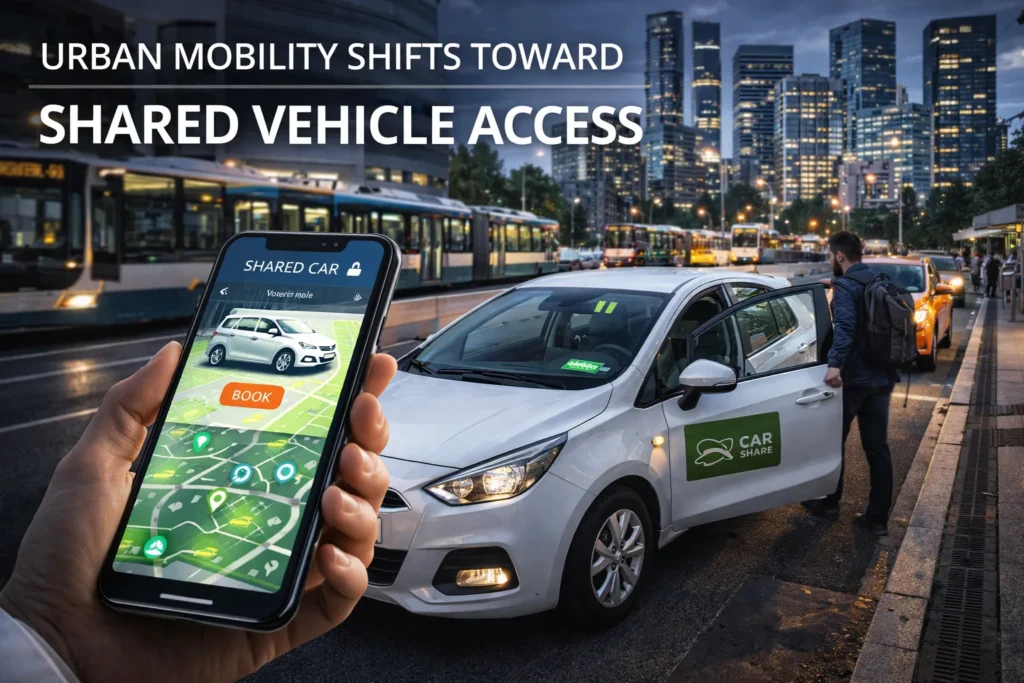

Every morning, Jamal used to sit in his old sedan, stuck in the same traffic jam outside his apartment complex. He watched the minutes tick by. His car payment was high. Insurance cost even more. And parking? That was a whole other headache.
Then one day, his check engine light came on. Again.
That was the breaking point. Jamal decided to try something different. He downloaded an app, walked two blocks to a shared car parked on the street, unlocked it with his phone, and drove to work. It cost him less than a bus fare for that trip. No insurance. No maintenance. No stress.
Jamal is not alone. Across the world, millions of people are shifting away from owning a personal vehicle. Instead, they are turning to shared vehicle access — car-sharing, ride-sharing, e-scooters, and bike-share programs. This change is not just a trend. It is reshaping how cities move, breathe, and grow.
In this article, we will explore why this shift is happening, how it works, and what it means for you, your wallet, and the planet. We will walk through real stories, hard numbers, and practical advice. We will look at the problems and the solutions. And by the end, you might just see your own commute in a whole new light.
Let’s take a long, thoughtful ride into the future of urban mobility.
H2: The High Cost of Owning a Car You Barely Use
Let’s be honest. Most cars sit parked 95 percent of the time. Think about that. You pay thousands of dollars for something that just… sits there.
According to the American Automobile Association (AAA), the average cost of owning a new car in 2025 is over $12,000 per year. That includes loan payments, insurance, gas, maintenance, and depreciation. Depreciation alone — the value your car loses the second you drive it off the lot — can be $4,000 or more annually.
Now imagine you only drive twice a week to the grocery store and to visit friends. That $12,000 starts to feel like a bad deal.
Shared vehicle access changes the math. You pay only when you use a vehicle. A typical car-share trip might cost $5 to $15 per hour, including gas and insurance. If you drive 10 hours a week, that is $150. Over a year, that is roughly $7,800 — still less than owning a new car. And if you drive less? You save even more.
Take Maria, a college student in Chicago. She sold her old hatchback after realizing she spent more on parking tickets than on actual driving. Now she uses a mix of shared cars, buses, and an e-scooter. Her monthly transportation budget dropped from $450 to $120.
That is real money. And for millions of people, that math is impossible to ignore.
But let us go deeper. When you own a car, the costs keep coming even when you are not driving. Registration fees. Emissions tests. Tire rotations. Oil changes. Windshield wipers. Battery replacements. Every single one of these things adds up. And they are all unpredictable. One month you think you are fine, and the next month your transmission starts slipping.
With shared vehicles, the price you see is the price you pay. There are no surprise bills. No mechanic telling you that you need a new timing belt. No arguing with a service writer. You hand over the keys — virtually — and you walk away.
There is also the hidden cost of stress. Think about the last time you heard a weird noise from your engine. Did you ignore it and hope it went away? Did you spend hours reading online forums? Did you lose sleep worrying about a thousand-dollar repair? That is mental energy you will never get back.
Shared mobility takes that weight off your shoulders. The company owns the car. The company handles the repairs. You just drive and return.
And let us not forget about parking. In many cities, a monthly parking spot costs as much as a small apartment in a rural town. In New York City, some parking garages charge over $700 per month. In San Francisco, street parking tickets can hit $100 each. In London, parking in the wrong zone can cost you over $200.
When you use a shared car, you do not pay for parking. Most services have designated spots that are covered by your rental fee. If the spot is in a paid zone, the company covers it. You never have to dig for quarters or download another parking app.
So when you add it all up — payments, insurance, gas, maintenance, repairs, parking, tickets, and stress — the cost of owning a car is often double what people think. Shared mobility cuts through all of that. It is simple. It is transparent. And for more and more people, it is simply smarter.
H2: From Driveways to Apps — How Car-Sharing Actually Works
You might be thinking, “Okay, but how do I find a shared car? Do I need a special key? What if someone left trash inside?”
Good questions. Modern car-sharing is simple. Here is how it typically works:
- Download an app like the ones you already use for food delivery or music. The design is clean and easy.
- Sign up with your driver’s license and payment info. Most services do a quick background check that takes less than 24 hours.
- Find a nearby car using the app’s map. Cars are usually parked in reserved spots in neighborhoods or near transit stations.
- Unlock the car with your phone or a membership card tapped on the windshield.
- Drive. The keys are already inside. Gas, insurance, and sometimes even parking are included.
- Return the car to its designated spot and lock it. The app charges your card automatically.
That is it. No paperwork. No haggling with a mechanic. No remembering when your registration expires.
Some services offer “free-floating” cars, which you can park anywhere within a certain zone. Others use station-based models, where you pick up and drop off at specific hubs.
E-scooters and bikes work similarly. You scan a QR code, ride, and leave the vehicle at your destination. The honor system encourages good behavior, though companies do fine users who leave vehicles blocking sidewalks.
The technology is not magic. It is just smart logistics. And it is spreading fast.
Let me walk you through a real example. Imagine it is Tuesday morning. You have a dentist appointment at 10 a.m. The dentist is four miles away. There is no direct bus. A taxi would cost $25 each way. What do you do?
You open a car-share app at 9:40 a.m. You see a blue hatchback parked three blocks away. You reserve it for 45 minutes. The app tells you the license plate and the exact spot. You walk over, tap your phone on the windshield, and the doors unlock. Inside, the gas tank is half full. The keys are in the cupholder. The car is clean.
You drive to the dentist. You park for free in a designated spot. You go to your appointment. When you come out, you drive back and leave the car where you found it. The total cost? $11.50.
Compare that to owning a car. If you owned that same hatchback, you would have paid for insurance that day, depreciation that day, and you would have had to find parking at the dentist’s office. That parking might have cost $10 all by itself.
The app-based model is not just convenient. It changes your relationship with transportation. You stop thinking in terms of “my car” and start thinking in terms of “a car.” That small shift in language reflects a big shift in mindset.
Now let us talk about the different types of car-sharing. There are three main models.
The first is round-trip car-sharing. You pick up and return the car to the same spot. This is good for errands, appointments, and day trips. Zipcar is the best-known example.
The second is one-way car-sharing. You pick up in one location and drop off in another. This is great for commuting or one-way trips. Services like Car2Go (now part of Share Now) pioneered this model.
The third is peer-to-peer car-sharing. Regular people rent out their personal cars to neighbors. Turo is the largest example. This is more like Airbnb for cars. You might rent a minivan for a family trip or a pickup truck to move a couch.
Each model has its strengths. Round-trip is predictable. One-way is flexible. Peer-to-peer offers variety. Many users combine all three depending on the trip.
And do not forget about shared bikes and scooters. These are perfect for trips under three miles. They cost as little as one dollar to unlock and fifteen cents per minute. For a fifteen-minute ride, you might pay three dollars. That is cheaper than a bus in some cities and much faster than walking.
The key is to have options. No single mode works for every trip. But when you put them all together, you can handle almost any situation without owning a car.
H2: Smarter Cities, Fewer Parking Lots, More Parks
Here is where the story gets bigger than your personal budget. When people share vehicles instead of owning them, cities change — for the better.
Think about your own neighborhood. How much space is dedicated to parked cars? Driveways, garages, street parking, parking lots. Studies show that in some U.S. cities, parking takes up more than 30 percent of land area. That is land that could be parks, playgrounds, affordable housing, or bike lanes.
Shared mobility reduces the need for so much parking. One shared car can replace 9 to 13 privately owned vehicles, according to research from the Transportation Sustainability Research Center. That means fewer cars parked on your street. Less concrete. More room for people.
Urban planners in places like Paris, Milan, and Minneapolis are redesigning streets around this idea. They are removing parking spots and adding bus-only lanes, wider sidewalks, and outdoor dining. They are building “mobility hubs” — a single location where you can pick up a shared car, an e-bike, an e-scooter, and catch a bus or train.
Imagine walking five minutes from your apartment to a hub. You grab an e-bike to go to work. In the afternoon, you take a shared car to the grocery store. At night, you ride a bus home. No vehicle sits idle in your driveway. No insurance bill arrives. And your city feels more open, green, and peaceful.
That is the vision. And it is already happening.
Let us take a closer look at how parking reform works. For decades, most cities required developers to include a certain number of parking spots with every new building. These were called “parking minimums.” A typical apartment building might need one or two parking spots per unit. That added tens of thousands of dollars to the cost of each apartment. It also made buildings spread out and car-dependent.
Now cities are reversing course. They are eliminating parking minimums and replacing them with “parking maximums” — limits on how much parking you can build. They are also converting old parking lots into housing, parks, and community gardens.
Take the city of Buffalo, New York. In the 1970s, the city tore down entire neighborhoods to build parking lots. Those lots sat empty for decades. Now Buffalo is filling them in with new housing and green space. The city is also building bike lanes and car-share hubs. The result is a downtown that feels alive again.
Or consider Amsterdam. The Dutch city was once choked with parked cars. In the 1970s, activists began demanding change. The city slowly removed parking spots and added bike lanes. Today, Amsterdam has more bikes than people. Car ownership is still possible, but it is expensive and inconvenient. Most residents use shared mobility for the rare times they need a car.
The lesson is clear. When you design cities for people instead of cars, people thrive. They walk more. They talk to neighbors. They shop at local stores. They spend less time driving and more time living.
Shared mobility is a key part of this transformation. It provides the flexibility of a car without the burden of ownership. It allows cities to shrink their parking footprint while still serving residents who need a car sometimes.
And here is a surprising benefit: less parking means lower housing costs. A single underground parking spot can cost $50,000 to build. That cost gets added to every apartment’s rent or purchase price. When developers build less parking, they can build more housing at lower prices. That is good for everyone except the car storage industry.
So when you support shared mobility, you are not just helping yourself. You are helping your whole city become more affordable, more walkable, and more pleasant.
H2: Less Smoke, More Fresh Air — The Environmental Upside
Let’s talk about pollution. Cars are a major source of greenhouse gases. In the United States, transportation produces nearly 30 percent of all carbon emissions. Personal cars make up the biggest chunk of that.
When you share a vehicle, you are not just saving money. You are shrinking your carbon footprint.
A 2023 study by the University of California, Berkeley found that car-sharing members drive 40 percent fewer miles overall than they did before joining. Why? Because when you pay per trip, you think twice before making unnecessary drives. You combine errands. You walk short distances. You take the train instead.
Less driving means less exhaust. Less exhaust means cleaner air. Cleaner air means fewer asthma attacks, fewer lung problems, and longer lives.
Shared vehicles are also going electric faster than personal cars. Car-share companies know that electric vehicles (EVs) have lower fuel and maintenance costs. That makes them perfect for sharing. Many services now offer fleets that are 30 to 50 percent electric. Some, like Lime’s e-scooters and e-bikes, are 100 percent electric.
Now imagine a city where most shared trips are in electric vehicles. No tailpipe fumes. No engine noise. Just quiet, clean movement. That is not science fiction. That is Oslo, Norway, today.
Oslo reduced car traffic by 20 percent in five years by combining shared mobility, tolls on private cars, and excellent public transit. Air quality improved so much that hospital visits for respiratory issues dropped significantly.
Your city could be next.
But let us go deeper into the environmental numbers. A typical gasoline car emits about 4.6 metric tons of carbon dioxide per year. That is roughly the same weight as a full-grown elephant. Multiply that by the 280 million cars in the United States, and you are looking at over 1.2 billion tons of CO2 per year. That is more than the entire economy of Russia.
Every time you choose a shared car instead of a personal car, you are reducing that total. But the benefits go beyond carbon. Cars also emit nitrogen oxides, carbon monoxide, and tiny particles called PM2.5. These pollutants get deep into your lungs. They cause asthma, bronchitis, heart disease, and lung cancer.
Children are especially vulnerable. Their lungs are still growing. They breathe faster than adults. And they spend more time outside. When air pollution drops, childhood asthma rates drop too.
In Los Angeles, the port area has some of the worst air in the country. Children there miss school because of respiratory infections. Adults develop chronic coughs. But when the city introduced shared electric shuttles and car-share programs, the air began to clear. It is not perfect yet, but it is better.
There is also the issue of noise pollution. Many people do not think about noise as pollution, but it is. Constant engine noise raises stress levels. It disrupts sleep. It makes it harder to concentrate at work or school. Electric shared vehicles are nearly silent. Imagine a city where the loudest sound is birdsong and conversation.
Finally, consider the environmental cost of manufacturing cars. Building a single new car creates about 8 tons of CO2 before it ever hits the road. That is the same as driving 20,000 miles. When you share a car, you are effectively reducing the number of cars that need to be built. One shared car replaces many personal cars. That means fewer resources mined, fewer factories running, and less waste at the end.
So shared mobility is not just about driving less. It is about needing fewer cars in the first place. That is the deepest environmental benefit of all.
H2: Public Transit + Shared Vehicles = A Match Made in Mobility Heaven
Here is a secret that frequent travelers know: shared vehicles work best when they connect with buses and trains. Alone, a car-share car is just a rental car. But when it sits next to a subway station, it becomes a lifeline.
This is called “integrated mobility” or “Mobility as a Service” (MaaS). The idea is simple. You use one app to plan, book, and pay for any combination of transportation — bus, train, shared car, bike, scooter, even a taxi.
For example, the Whim app in Helsinki, Finland, lets you buy a monthly subscription that includes unlimited bus and train rides plus a certain number of shared car and taxi trips. Users report saving hundreds of euros per month compared to owning a car.
Why does this matter for you? Because it solves the “last mile” problem. Buses and trains are great for long distances. But what about the last mile from the station to your job? That is where shared bikes and scooters shine. Or what if you need to carry heavy groceries home from the train? A shared car for 30 minutes does the job.
Public transit systems are starting to partner with shared mobility companies. In Los Angeles, the Metro Bike Share program offers discounted memberships for low-income riders. In Madrid, the city government pays part of the cost for residents to use shared e-scooters to reach train stations.
When public transit and shared vehicles work together, you win. You get more options. Lower costs. Less waiting. And you never have to own a car again unless you really want to.
Let me give you a detailed example. Meet David. He lives in a suburb of Washington, D.C. He works downtown. His commute used to be a nightmare. He drove 45 minutes each way, paid $20 for parking, and sat in bumper-to-bumper traffic.
Now he walks five minutes to a bus stop. He takes the bus to the commuter rail station. He rides the train downtown. When he gets off the train, he unlocks a shared e-scooter and rides the last half mile to his office. The total cost is $8 each way. The total time is 50 minutes — only slightly longer than driving. But he uses that time to read, answer emails, or just relax.
On weekends, David uses a shared car for grocery trips and visiting friends. He spends about $100 per month on shared cars. That is a fraction of what he used to spend on his personal car.
David’s story is becoming more common. The key is that each mode does what it does best. Trains handle long distances efficiently. Buses fill in the gaps. Scooters and bikes handle short trips. Cars handle heavy loads or odd hours. None of them work alone, but together they form a system.
Public transit agencies are waking up to this. They realize that they cannot serve every trip. But they can serve the backbone of the network. Shared mobility fills the gaps. That is why more and more transit agencies are offering integrated passes.
For example, in the San Francisco Bay Area, the Clipper card works on buses, trains, ferries, and now some shared bike systems. You tap the same card for everything. The system tracks your transfers and charges you the best possible fare.
In London, the Oyster card works similarly. You can use it on the Tube, buses, trams, and Santander Cycles (the city’s bike-share system). The city is now testing integration with car-share services as well.
The ultimate goal is seamless mobility. You should not have to think about which app to open or which card to tap. You just go. The system figures out the rest.
That future is not far away. Several companies are already offering “Mobility as a Service” apps. You tell the app where you want to go and when. The app shows you a combination of modes, the total cost, and the total time. You pick the one you like. One payment covers everything.
For the first time in history, it is possible to live without a car without feeling trapped. That is a revolution.
H2: Who Is Actually Using Shared Vehicles? (It’s Not Just Young Tech Workers)
There is a stereotype that only young, single, tech-savvy people use car-sharing. That is outdated. Real data tells a different story.
Surveys from the North American Bikeshare Association show that shared mobility users span all ages, incomes, and backgrounds.
- Young adults (18–34) use shared cars and scooters for nightlife, errands, and short work commutes.
- Families with children use shared vans or SUVs for weekend trips to the zoo or IKEA. They avoid the cost of owning a second or third car.
- Older adults (65+) use shared cars when they need to visit doctors or go shopping but no longer want the responsibility of maintaining a vehicle.
- Low-income residents use heavily discounted bike-share and car-share programs to reach jobs that are not on bus routes.
Take the story of Denise, a 58-year-old nurse in Denver. She used to own a minivan. After her kids moved out, she realized she drove alone in a seven-seater van to the hospital every day. She switched to a shared compact car. She saved $300 a month and says she feels “lighter” without the stress of car repairs.
Or consider the Rodriguez family in Austin. They have two children and one personal car. Instead of buying a second car, they use a shared car twice a week for after-school activities. The $80 they spend monthly on car-sharing is far less than a $500 car payment plus insurance.
Shared mobility is not a fad for the few. It is a tool for everyone.
Let me share more profiles.
Meet Eleanor. She is 72 years old and lives in Portland, Oregon. Her husband passed away two years ago. She no longer feels comfortable driving at night or in heavy rain. But she still wants to visit her grandchildren, go to church, and shop for groceries. She uses a shared car during daylight hours for these trips. The rest of the time, she walks or takes the bus. She says shared mobility has given her independence back.
Meet Jamal (not the same Jamal from the introduction). He is 24 and works as a bike messenger in Boston. He does not own a car. He does not even have a driver’s license. But he uses shared e-scooters constantly. He says they are faster than walking and cheaper than a taxi. He also uses a shared cargo bike when he needs to move larger items.
Meet the Chen family. They live in a two-bedroom apartment in Seattle. They have one parking spot, which they use for their personal car. But they need a second vehicle about twice a week. Instead of buying another car and paying for another parking spot, they use car-sharing. They say it has saved them over $600 per month.
Meet Sophia. She is a college student with a part-time job at a coffee shop. Her campus is not well-served by buses. She used to rely on rides from friends. Now she uses a shared e-scooter to get to work. The cost is about $2 per trip. She can afford that on her wages.
These are not hypothetical people. They are real users. And they represent a broad cross-section of society.
The data backs this up. A 2024 study by the University of California, Davis surveyed thousands of shared mobility users. They found that 32 percent were over 45 years old. 28 percent had children at home. 22 percent had household incomes under $50,000. And 40 percent lived in neighborhoods classified as “transportation disadvantaged” — meaning poor bus service and few options.
Shared mobility is not a luxury for the rich. In many cases, it is a necessity for the poor. When a bus comes once an hour or not at all, a shared bike or car can be a lifeline.
That is why equity is so important. The cities that do shared mobility best are the ones that make sure everyone can participate. They offer discounts for low-income residents. They place vehicles in underserved neighborhoods. They accept cash payments for those without bank accounts. They provide multilingual support and simple interfaces.
Shared mobility can either reduce inequality or increase it. It all depends on how it is designed. The good news is that more and more cities are choosing the equitable path.
H2: But What About the Downsides? Let’s Be Real
No system is perfect. Shared mobility has real challenges. Let’s address them honestly.
Problem 1: Availability. Sometimes you open the app and the nearest car is 20 minutes away. That is frustrating when you are late for work. Companies are solving this by adding more cars and using AI to predict where demand will be highest. Still, in less dense suburbs, availability remains a problem.
Problem 2: Cleanliness and damage. Not all users treat shared vehicles with respect. You might find trash inside, a low gas tank, or a scratch on the bumper. Most companies have rating systems and charge cleaning fees to offenders. But it still happens.
Problem 3: Equity concerns. In many cities, shared vehicles are concentrated in wealthy neighborhoods. Low-income areas get fewer cars and bikes. Activists are pushing for “equity pricing” — lower rates and more vehicles in underserved neighborhoods. Some cities, like Portland, Oregon, now require car-share companies to serve all zip codes equally.
Problem 4: Clutter. Remember when e-scooters first arrived and people left them lying across sidewalks? That was chaos. Cities have since passed laws requiring designated parking zones and fines for improper parking. The problem is not gone, but it is better.
Problem 5: Not great for rural areas. If you live far outside the city, shared mobility may not work well. Lower density means fewer vehicles nearby. For rural residents, owning a car still makes more sense.
None of these problems are deal-breakers. But they are real. The good news is that cities and companies are actively working on solutions. The shift to shared mobility is not about perfection. It is about progress.
Let us explore each problem in more depth.
Availability is the most common complaint. You check the app. There are no cars within walking distance. You refresh. Still nothing. You end up taking a taxi or skipping your trip. This happens more often than companies like to admit.
The root cause is simple. Car-share companies want to make money. They put cars where they will be used the most. That means dense neighborhoods with lots of young, tech-savvy residents. Suburbs, rural areas, and low-income neighborhoods get fewer cars.
The solution is not just more cars. It is smarter placement. Some companies now use predictive algorithms. They analyze historical trip data to guess where cars will be needed at different times of day. They also incentivize users to move cars to under-served areas by offering ride credits.
But even with smart algorithms, availability will always be an issue at peak times. Just like you cannot always get a taxi during a rainstorm, you cannot always get a shared car on Friday night. The key is to have backup plans. A bus. A bike. Your own two feet.
Cleanliness is another frequent complaint. Some users treat shared cars like rental cars — which is to say, not great. They eat messy food. They leave coffee cups. They let their kids smear snacks on the seats. Some even smoke inside, despite clear rules against it.
Companies fight this in several ways. They have cleaning crews that rotate through the fleet. They charge fees to the last user if the next user reports a mess. They also use cameras and sensors to detect smoking or other bad behavior.
The best defense, however, is community pressure. When users rate each other and report problems, the system works better. Think of it like a shared apartment. You would not leave trash on the floor. The same courtesy applies to shared vehicles.
Equity is the hardest problem. Even when companies want to serve low-income neighborhoods, they face challenges. Those neighborhoods often have higher rates of vandalism and theft. They also have fewer off-street parking spots for designated car-share spaces.
But many cities are forcing the issue. They make car-share licenses conditional on serving all areas equally. They also subsidize trips for low-income residents. In New York City, the Big Apple Bike Share program offers $5 annual memberships for residents of public housing. That is a fraction of the normal $200 price.
Clutter is a visual and physical problem. When e-scooters first appeared, users left them everywhere. On sidewalks. In doorways. In bushes. In rivers. It was chaos. Pedestrians tripped. People in wheelchairs could not pass. Store owners complained.
Cities responded with regulation. Most now require dockless scooters to be parked in designated corrals. Some use geofencing technology that prevents you from ending a trip outside an approved zone. Others use user reporting and fines.
The clutter problem is largely solved in well-regulated cities. But in places with weak rules, it still exists. Always check your local regulations before using a scooter.
Finally, rural areas remain a challenge. If you live on a farm or in a small town, shared mobility probably will not work for you. The distances are too long. The population is too spread out. You will likely need a personal car.
However, even rural areas can benefit from some forms of sharing. Peer-to-peer car-sharing can work in small towns. So can vanpools and volunteer driver programs. But for most rural residents, car ownership will remain the norm for the foreseeable future.
None of these downsides should stop you from trying shared mobility. But they should make you an informed user. Know the limits. Have a backup plan. And treat shared vehicles like you would want others to treat them.
H2: How Different Cities Are Getting It Right (Real-World Examples)
Let’s take a quick world tour to see how shared mobility works in practice.
Tokyo, Japan – Car-sharing exploded in Tokyo because parking is incredibly expensive and scarce. Over 1.2 million people belong to car-share services. Many cars are parked inside apartment building garages, making pickup easy. The government supports shared mobility because it reduces earthquake risk — fewer cars on the streets means less debris and better access for emergency vehicles.
Paris, France – Paris banned private cars from many city center streets and replaced parking spots with bike-share stations and car-share hubs. The city’s “Plan Vélo” (Bike Plan) aims to make Paris 100 percent bikeable. Shared e-bikes now outnumber personal bikes in some arrondissements.
Seattle, Washington – Seattle partnered with Lime and Uber to create a single app for shared bikes, scooters, and cars. Low-income residents can apply for “Lime Access” which gives 50 percent off all trips. The result? Shared trips increased 300 percent in two years.
Singapore – This tiny city-state taxes personal cars so heavily that a basic sedan can cost over $80,000 after permits. Not surprisingly, shared cars and excellent public transit are the norm. Most residents never own a car at all. They use a mix of buses, trains, and shared vehicles seamlessly through the “Singtel Dash” app.
Mexico City, Mexico – Ecobici, the city’s bike-share system, is one of the largest in the world with over 480 stations and 6,800 bikes. It costs about $25 per year for unlimited 45-minute trips. Car-sharing is growing too, especially among residents who want to avoid the city’s strict “Hoy No Circula” driving bans.
What do all these cities have in common? They treat shared mobility not as a nice extra, but as a core part of transportation planning. They build infrastructure — dedicated bike lanes, car-share parking zones, app integration — that makes sharing easy and ownership harder.
Let me add a few more examples.
Vancouver, Canada – Vancouver has a car-share co-op called Modo. It is member-owned, meaning users have a say in how the service runs. Modo has been around since 1997, long before the smartphone era. It started with just a few cars and has grown to over 2,000. The co-op model keeps prices low and accountability high.
Barcelona, Spain – Barcelona created “superblocks” — groups of streets where car traffic is heavily restricted. Inside a superblock, only local delivery vehicles and emergency services can drive. Everyone else walks, bikes, or uses shared mobility. The result is a dramatic drop in air pollution and traffic injuries.
Hangzhou, China – Hangzhou has one of the largest bike-share systems in the world. Over 80,000 bikes are available at more than 3,000 stations. The system is fully integrated with the city’s bus and subway network. A single card works for everything. The cost is extremely low — about 50 cents per day for unlimited trips.
Berlin, Germany – Berlin is a hotbed of shared mobility innovation. Multiple car-share, bike-share, and scooter companies compete fiercely. Prices are low. Coverage is dense. The city also has excellent public transit. Many Berliners have given up car ownership entirely.
Montreal, Canada – Montreal’s BIXI bike-share system is one of the oldest and most successful in North America. It launched in 2009 with 3,000 bikes. Today it has over 9,000 bikes and 800 stations. The system is so popular that it operates year-round, with special winter tires and heated handlebars.
What can we learn from these cities? First, shared mobility needs density. It works best in compact, walkable neighborhoods. Second, it needs integration. A bike-share system is fine on its own, but it is much better when connected to transit. Third, it needs pricing that works for everyone. Discounts for low-income residents are essential. Fourth, it needs political will. Mayors and city councils have to make tough choices about parking, street space, and regulation.
No two cities are exactly alike. Each one adapts shared mobility to its own culture and geography. But the successful ones share these core principles.
H2: What the Next Five Years Will Bring (Spoiler: More Sharing, Less Owning)
The shift toward shared vehicle access is accelerating. Here is what experts predict by 2030.
Autonomous shared vehicles. Self-driving cars are coming slowly, but when they arrive, shared mobility will explode. Imagine summoning a driverless shared car to your door, riding to work, and letting it drive itself to the next user. No parking needed. No human driver cost. Trips could become cheaper than a bus fare.
Subscription-based mobility. Instead of paying per trip, you might buy a “mobility subscription” for $150 a month. That gives you unlimited bus, train, bike, scooter, and a set number of shared car hours. Companies like Reach Now and Ubigo are already testing this.
EV-only shared fleets. Several car-share companies have pledged to go 100 percent electric by 2027. With battery prices dropping, shared EVs will soon be cheaper to operate than gas cars. Charging stations at mobility hubs will become as common as gas stations once were.
Integration with housing developers. Real estate developers are starting to build apartment complexes with no parking garages. Instead, they offer a fleet of shared cars and bikes for residents. This lowers construction costs and rents. The first such “car-free” building opened in Los Angeles in 2024, and it rented out in one week.
Data-driven city planning. Cities will use anonymized data from shared trips to decide where to build new bus routes, bike lanes, and sidewalks. Instead of guessing, planners will see exactly where people want to go.
These changes will not happen overnight. But they are already underway. The question is not whether shared mobility will grow. It is how fast — and who will benefit.
Let me go deeper into each prediction.
Autonomous shared vehicles are the holy grail of mobility. Imagine a world where you never need to park. A car drops you off and drives away to pick up the next person. No circling for parking. No garages. No driveways. Just continuous movement.
The technology is not quite ready. Self-driving cars struggle with bad weather, unpredictable pedestrians, and unmapped roads. But progress is steady. Waymo (owned by Google’s parent company) already operates fully driverless taxis in Phoenix, Arizona. Other companies are testing in San Francisco, Beijing, and Dubai.
When autonomous shared cars become widespread, the cost per mile could drop below 50 cents. That is cheaper than most bus fares. At that price, car ownership becomes pointless for most urban residents. Why own a car that sits idle 95 percent of the time when you can summon one on demand for pocket change?
Subscription-based mobility is already here in limited form. The Whim app in Helsinki offers a monthly plan for 500 euros that includes unlimited public transit, car-sharing, bike-sharing, and taxi rides. Similar services are launching in Vienna, Los Angeles, and Tokyo.
The subscription model changes behavior. When you pay a flat monthly fee, you stop counting each trip. You just go. That encourages more use of shared mobility and less use of personal cars. It also makes budgeting easier. You know exactly what transportation will cost each month.
EV-only shared fleets are coming faster than you think. Battery prices have fallen 90 percent since 2010. Electric cars now cost about the same to manufacture as gas cars. And they are much cheaper to operate. No oil changes. No transmission fluid. No spark plugs. No exhaust system.
For car-share companies, EVs are a no-brainer. They charge overnight at central depots. They require less maintenance. They appeal to environmentally conscious customers. By 2028, most major car-share fleets will be fully electric.
Integration with housing developers is a quiet revolution. For decades, every new apartment building included parking. Usually more parking than anyone needed. That added $30,000 to $50,000 to the cost of each unit. Now some developers are building without parking and using the savings to offer shared mobility.
The first car-free apartment building in the United States opened in Los Angeles in 2024. It has 120 units and zero parking spaces. Instead, it offers residents free access to shared cars, bikes, and scooters. The building rented out in one week. Similar projects are underway in Seattle, Denver, and Austin.
Data-driven city planning is already happening in some cities. In Chicago, the city used anonymized bike-share data to decide where to build new bike lanes. In New York, transit planners use taxi and car-share data to adjust bus routes. In London, scooter data helps identify areas where sidewalks need widening.
This is just the beginning. As shared mobility generates more data, cities will be able to plan with unprecedented precision. They will know exactly where people want to go, when they want to go, and how they prefer to travel. That information will guide investments in infrastructure for decades.
The next five years will be transformative. Not because any single technology will appear overnight. But because all of these trends are converging at once. Shared mobility is moving from the fringe to the mainstream. And once it becomes mainstream, there is no going back.
H2: Practical Tips — How to Start Sharing Today
Ready to try shared mobility yourself? Here is a simple roadmap.
Step 1: Check what is available in your city. Search your app store for “car share,” “bike share,” or “e-scooter.” Popular national services include Zipcar, Turo (peer-to-peer car rental), Lime, Bird, and Spin. Many cities also have local or regional services.
Step 2: Sign up before you need it. Approval can take a few hours to a few days. Do not wait until you are stranded. Sign up on a lazy Sunday afternoon.
Step 3: Start small. Try a bike-share for a short trip to a café. Then try a scooter to a friend’s house. Then try a shared car for a grocery run. Build confidence gradually.
Step 4: Compare pricing models. Some services charge by the minute (good for very short trips). Others charge by the hour (good for errands). Others have daily caps (good for day trips). Do the math for your typical trips.
Step 5: Combine with public transit. Download your local transit app too. Plan trips that use a bus or train for the long haul and a shared scooter for the last mile. You will save money and time.
Step 6: Be a good sharer. Return vehicles clean, fueled (or charged), and parked properly. Rate other users fairly. Treat shared vehicles like they belong to a neighbor — because in a way, they do.
One final tip: Keep a small “mobility kit” in your bag — a helmet if you ride bikes or scooters, a phone charger, hand sanitizer, and a reusable bag for groceries. You will always be ready.
Let me expand on each step with practical details.
Checking what is available is not always straightforward. Some cities have dozens of options. Others have only one or two. Start by asking friends and coworkers what they use. Then search online for “[your city] car share” or “[your city] bike share.” Look for news articles, Reddit threads, and city government websites.
Once you have a list, download the apps. You do not need to sign up right away. Just browse. See where the vehicles are located. Look at the pricing. Read the user reviews. Some apps are buggy. Some have terrible customer service. You want to avoid those.
Signing up ahead of time is crucial. Many people wait until they need a car to sign up. Then they discover that the approval process takes hours or days. They end up frustrated and take a taxi instead. Avoid that by signing up on a quiet day. Most services will approve you within 24 hours.
Starting small means not committing to a major change overnight. You do not need to sell your car tomorrow. Just try a shared bike for a fun trip. See how it feels. If you like it, try a shared car for a simple errand. Gradually, you will build comfort and confidence.
Comparing pricing models is important because different services suit different trips. If you need to go two blocks, a scooter by the minute is perfect. If you need to run three errands over two hours, an hourly car-share is better. If you need a car for a full day, look for a daily cap or a peer-to-peer rental.
Here is a quick guide:
- Minute rates: $0.15 to $0.50 per minute. Best for trips under 15 minutes.
- Hourly rates: $5 to $15 per hour. Best for errands, appointments, and short trips.
- Daily rates: $40 to $100 per day. Best for day trips, moving, or when you need a car all day.
- Monthly subscriptions: $50 to $200 per month. Best for frequent users who want predictable costs.
Combining with public transit is the secret to making shared mobility work for everyday life. A shared scooter is great for a mile trip. A shared car is great for a 10-mile trip. But a 30-mile commute is best done by train. Use shared mobility to fill the gaps, not to replace transit.
Being a good sharer is about basic courtesy. Clean up after yourself. Do not smoke in shared cars. Return the vehicle with at least a quarter tank of gas or a reasonable charge. Park in designated spots. Report damage honestly. Rate other users fairly.
If everyone follows these simple rules, shared mobility works for everyone. If people are selfish, the system degrades. Be the kind of user you would want to follow.
Finally, the mobility kit. A helmet is essential for bikes and scooters. Some services provide them, but most do not. A folding helmet fits in a backpack. A phone charger is also essential. Dead battery means you cannot unlock your ride. Hand sanitizer keeps you clean. A reusable bag means you are always ready for spontaneous shopping.
With these steps, you can start sharing today. You do not need to change your whole life. Just add one new option to your transportation toolbox. You might be surprised how much you like it.
H2: The Bigger Picture — From My Car to Our Cars
Let us return to Jamal, the man we met at the beginning of this story. It has been six months since he sold his old sedan. He has saved over $2,500. He walks more and feels healthier. He no longer circles blocks looking for parking. And he has inspired three coworkers to try car-sharing.
But Jamal will tell you that the biggest change is not financial. It is mental. He used to feel weighed down by his car — the payments, the repairs, the guilt of driving alone in a metal box. Now he feels free. He chooses how to move based on his needs that day, not based on a car sitting in a driveway.
That is the promise of shared mobility. It is not about forcing everyone to give up cars forever. It is about giving people options. Options to save money. Options to breathe cleaner air. Options to live in cities with more parks and fewer parking lots. Options to be a little less isolated and a little more connected.
The shift from personal vehicle ownership to shared access is not just a technology story. It is a human story. It is about realizing that we do not need to own everything we use. We share parks, libraries, and swimming pools. Why not share cars too?
The road ahead is shared. And for the first time in a long time, that is a good thing.
Let me offer one more story to bring this home.
In 2023, a group of neighbors in Minneapolis decided to experiment. They lived on a block with 20 houses. Between them, they owned 25 cars. Most of those cars sat idle most of the time. The neighbors started talking. Could they reduce that number?
They created a private car-share among themselves. Eight households sold their second cars. They bought two shared cars that anyone in the group could use. They used a simple online calendar to book them. They split the costs evenly.
The results were remarkable. Each household saved an average of $400 per month. The street suddenly had parking spaces for guests. The neighbors got to know each other better because they had to coordinate. And one of the shared cars was electric, which gave everyone a taste of clean driving.
That is the kind of grassroots change that can spread. It starts with a few people trying something new. Then a few more. Then a city. Then a movement.
Shared mobility is not a distant future. It is happening now, in your city, on your street. The question is whether you will be part of it.
Summary: Key Takeaways
Cost savings – Car-sharing can cost thousands less per year than owning a personal vehicle. No payments, no insurance, no maintenance, no surprise repairs.
Less pollution – Shared vehicles reduce total miles driven and accelerate the switch to electric fleets. Less exhaust means cleaner air and healthier communities.
Better city design – Fewer parked cars mean more space for parks, housing, bike lanes, and sidewalks. Cities become more pleasant and more affordable.
Integrated with transit – Shared mobility works best when combined with buses and trains. One app can handle everything from the first mile to the last.
For everyone – Families, seniors, young adults, and low-income residents all use and benefit from shared services. It is not a luxury for the few.
Challenges remain – Availability, cleanliness, equity, and rural access need ongoing work. But cities and companies are actively solving these problems.
The future is shared – Autonomous vehicles, mobility subscriptions, EV-only fleets, and car-free housing are coming soon. The shift is accelerating.
Frequently Asked Questions (FAQ)
Q: Do I need a special driver’s license for car-sharing?
A: No. A standard driver’s license works. Some services require you to be at least 18 or 21, depending on location.
Q: What if I get into an accident in a shared car?
A: Most services include liability and collision insurance in the rental price. You may have a deductible (often $500–$1,000) if you are at fault. Always read the terms.
Q: Can I take a shared car on a road trip?
A: Yes, but check the mileage policy. Some include a set number of miles per hour or day. Others charge per mile beyond a limit. For long trips, a traditional rental car might be cheaper.
Q: Are shared vehicles safe during the COVID-19 pandemic or flu season?
A: Most companies have enhanced cleaning protocols. Wipe down high-touch surfaces (steering wheel, door handles, buttons) before driving. Many services also leave hand sanitizer inside.
Q: What if the shared car has mechanical problems?
A: Report it in the app immediately. The company will send help or unlock another vehicle for you. You will not be charged for the broken car.
Q: Can I use shared mobility if I have a disability?
A: It depends on the service. Some have wheelchair-accessible vehicles or audio-guided apps for visually impaired users. Advocacy groups are pushing for better accessibility. Check local options.
Q: Is shared mobility really better for the environment?
A: Yes, when it replaces personal car trips. But if you switch from walking or biking to shared scooters, your emissions could increase. Use shared mobility to replace car trips, not active transport.
Q: How do I find shared mobility options in my city?
A: Search your app store for “car share,” “bike share,” or “scooter.” Check your city’s transportation department website. Ask in local social media groups. Word of mouth is also powerful.
Q: What if I need a car seat for my child?
A: Some car-share services offer cars with built-in car seats. Others allow you to bring your own. Check the app for details before booking.
Q: Can I use shared mobility if I do not have a smartphone?
A: This is a challenge. Most services require a smartphone to unlock vehicles. Some have alternative methods like membership cards or phone calls. Equity advocates are pushing for more non-smartphone options.
Q: What happens if I return a shared car late?
A: You will be charged a late fee. Some services have a grace period. If you return it very late, you may be charged for an extra day. Always return on time to avoid fees.
Q: Can I smoke in a shared car?
A: No. Smoking is prohibited in virtually all shared vehicles. If you smoke, you will be charged a cleaning fee and may be banned from the service.
Final Thought
The way we move through cities is changing. It is changing because people like Jamal, Maria, Denise, and the Rodriguez family are making different choices. They are choosing flexibility over ownership. They are choosing community over isolation. They are choosing shared over solo.
You do not have to sell your car tomorrow. But you can download an app this week and try a shared bike or car for one trip. See how it feels. Look around at your city with fresh eyes.
You might just discover that the best way to move forward is together. The road is long, but it is no longer traveled alone. And that makes all the difference.


cvqz22
Great amazing issues here. I’m very glad to peer your post. Thanks a lot and i’m having a look ahead to contact you. Will you please drop me a mail?
I have been exploring for a bit for any high-quality articles or blog posts on this kind of area . Exploring in Yahoo I finally stumbled upon this website. Reading this info So i am satisfied to express that I’ve a very excellent uncanny feeling I discovered exactly what I needed. I most no doubt will make certain to do not omit this website and provides it a glance on a continuing basis.
Love the variety of bonuses they offer here. It keeps the gameplay exciting and rewarding. phspintimeph is definitely a hidden gem!