
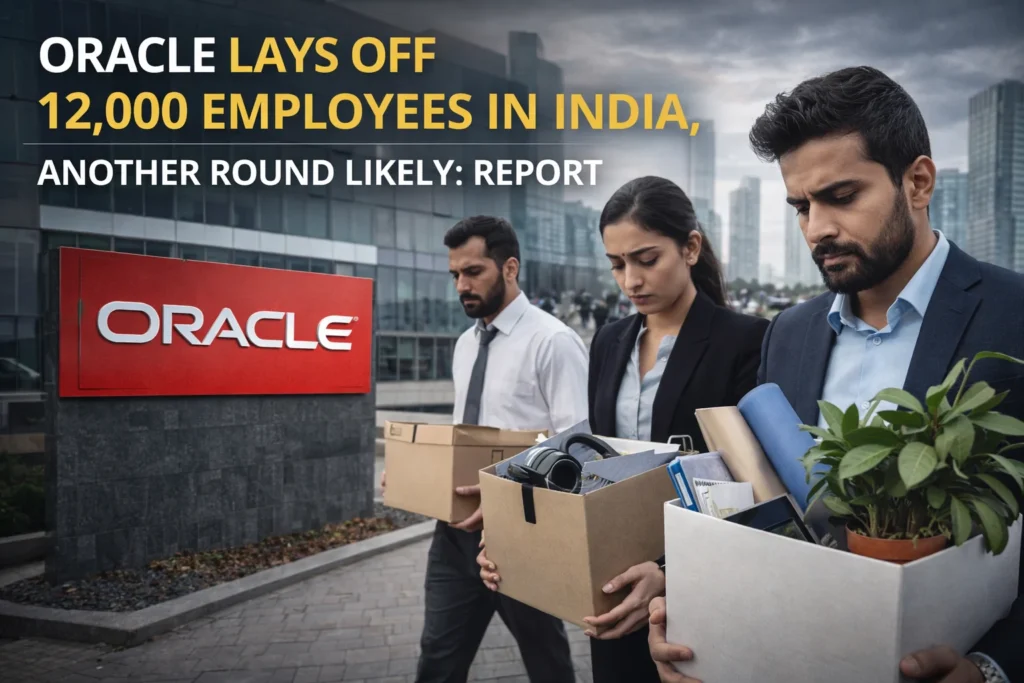

Chapter One: The Morning Everything Changed
The alarm went off at 5:45 AM, just like it did every weekday. Ramesh, a senior cloud architect who had been with Oracle for eleven years, reached for his phone to silence it. But instead of the usual flood of notifications from Slack and email, there was only one message that mattered. It was from HR. The subject line read: “Important Update Regarding Your Role.”
His thumb hovered over the notification for a moment before he tapped it open. The words blurred together at first. “Organizational restructuring.” “Position eliminated.” “Final working day.” He read it three times before the meaning fully settled in. Eleven years of building systems, mentoring junior engineers, working late nights to meet deadlines, celebrating project launches with his team—all of it condensed into a few paragraphs of corporate language.
Across Bengaluru, Hyderabad, Noida, and Pune, thousands of similar scenes were unfolding. Some employees received the email at 6:00 AM. Others got it late the previous evening, spending a sleepless night staring at the ceiling before the reality of unemployment fully hit. For many, the notification came with an immediate lockout from company systems. One moment they had access to years of work, code they had written, presentations they had crafted, emails with colleagues who had become friends. The next moment, everything was gone.
A young woman named Priya had just returned from maternity leave three weeks earlier. She had spent her entire career at Oracle, joining as a fresh graduate from a small engineering college in Mysore. She had grown up in the company, learned everything she knew about software development within its walls. Now, with a six-month-old baby at home and a newly purchased apartment with a twenty-five-year loan, she sat in her home office and let the tears come. Her husband, who worked for a different tech company, held her hand and told her they would figure it out. But in that moment, neither of them knew what that would look like.
The sheer scale of what happened that day is difficult to comprehend without stepping back. Oracle employed approximately 30,000 people across India. The 12,000 job cuts meant that four out of every ten employees were suddenly without work. In the tech corridors of Bengaluru—where Oracle has had a significant presence for over two decades—the news spread like wildfire. WhatsApp groups that had once been used to coordinate lunch orders and carpool schedules became support networks overnight. Former colleagues who had moved on to other companies began posting job openings. Recruiters, sensing opportunity, started cold-messaging affected employees on LinkedIn within hours.
But beneath the flurry of activity lay a quieter, more painful reality. These were not just jobs being eliminated. These were careers, identities, and carefully constructed lives being dismantled in a matter of hours.
Chapter Two: The Architecture of a Layoff
To understand what happened at Oracle, you have to understand how a layoff of this magnitude is planned and executed. It does not happen overnight. The decision to cut 12,000 jobs in India—and 30,000 globally—was likely made months earlier, in boardrooms and executive meetings far from the cubicles where the actual work took place.
The process typically begins with financial modeling. A company like Oracle has access to detailed data on every employee: their salary, their tenure, their performance ratings, their role, their location, their projects. When the decision is made to reduce costs, the finance team works with human resources to determine how much money needs to be saved. Then comes the harder question: who stays and who goes?
In Oracle’s case, the cuts appear to have been strategically targeted. The biggest impacts were felt in the Oracle Fusion Cloud Applications division, which handles enterprise software for businesses, and the Oracle Cloud Infrastructure division, which competes with Amazon and Microsoft in the cloud computing space. Within these divisions, certain teams were hit harder than others. Employees working on legacy database products—the bread and butter of Oracle’s business for decades—were particularly vulnerable. So were those in roles that could potentially be automated or consolidated.
There is also the question of geography. India has long been a cost-effective location for technology companies to base their operations. Salaries in India, while substantial by local standards, are significantly lower than comparable roles in the United States or Europe. This has traditionally made Indian operations more secure during downturns—why cut a well-performing team in Bengaluru when you could cut a more expensive team in California? But the Oracle layoffs suggest that this assumption is no longer reliable. When the scale of cost-cutting is large enough, no location is safe.
The timing of the layoffs is also significant. March is the end of the fiscal year for many companies, including Oracle. It is a natural moment to make structural changes, close out budgets, and set new priorities for the year ahead. By executing the layoffs at this time, Oracle could show investors a cleaner financial picture for the coming fiscal year, with reduced operating expenses already baked into the numbers.
But for the employees, the timing was cruel. Many had just received their annual performance reviews and bonus letters. Some had been told they were top performers, only to be laid off weeks later. A few had recently received promotions. One employee, who had been with Oracle for fifteen years, was reportedly in the middle of training a new hire when she received her termination notice. She had to log off her computer in the middle of a screen-sharing session, unable to even say goodbye to her colleagues.
Chapter Three: The Severance Puzzle
In the aftermath of the layoffs, attention quickly turned to the severance package. Oracle’s offer to its Indian employees was specific and, in some ways, generous by Indian standards. The package included fifteen days of salary for every completed year of service, plus one month of salary as notice period pay, plus encashment of unused leave, plus gratuity for eligible employees, plus a two-month salary top-up.
For a long-term employee like Ramesh, with eleven years of service, this would amount to a significant sum. But there was a catch that complicated everything. The severance benefits were only available to employees who agreed to “voluntarily and amicably resign” from the company.
This is a common legal structure in corporate layoffs, but its implications are deeply personal. By requiring employees to sign resignation letters, the company transforms what is essentially a termination into a voluntary departure. This has implications for everything from unemployment benefits to future employment verification. It also places an additional emotional burden on employees who are already dealing with the shock of losing their jobs.
Some employees hesitated. They consulted lawyers, family members, and trusted colleagues. What if they refused to sign? Would the company still pay them? Would they be terminated without severance? The uncertainty added to the stress of an already difficult situation.
For most, the choice was clear. With mortgages, school fees, and monthly expenses to cover, the severance money was essential. They signed the papers, often without having the time to fully read or understand them. One former employee described the experience as being handed a document and being told, “Sign this if you want to get paid.” He signed. He had no other choice.
The severance package also revealed something about Oracle’s priorities. The company had set aside $2.1 billion for restructuring costs globally. That money was already accounted for in their financial planning. The layoffs were not a desperate measure by a struggling company. They were a calculated move by a profitable corporation with $300 billion in cloud contracts on the horizon. The human cost was simply part of the calculation.
Chapter Four: The Voices of the Affected
In the days following the layoffs, social media became a gathering place for Oracle’s displaced employees. LinkedIn, in particular, transformed into a digital support group where people shared their stories, offered help to one another, and announced their availability for new opportunities.
One of the most striking aspects of these posts was the tone. There was very little anger, very few accusations, and almost no public venting. Instead, what emerged was a collective expression of gratitude and resilience that surprised many outside observers.
Venkatraman Raghuraman, a graduate of the National Institute of Technology, shared a post that captured the mood. He described the layoff as an unexpected development, particularly after the significant effort he had invested in building impactful projects. But rather than dwelling on the disappointment, he chose to focus on what came next. He wrote about his experience in strategic planning, operations, and supply chain leadership, and he asked his network to keep him in mind for suitable opportunities. The post ended with a note of gratitude to his former colleagues and a statement of confidence in the future.
Another former employee, a woman who had been with Oracle for seven years, wrote a longer reflection on her career. She talked about joining the company as a junior developer, the mentors who had guided her, the projects that had challenged her, and the friendships that had sustained her. She described the layoff as a shock but also as a gift of sorts—an opportunity to pause, reflect, and consider what she truly wanted from the next phase of her career. She mentioned that she planned to take a few weeks off before starting her job search, something she had not done since graduating from college.
A third voice came from a young man who had been with Oracle for just over a year. He was the first person in his family to work for a multinational technology company. His parents had celebrated his hiring as a moment of validation for all the sacrifices they had made to put him through engineering college. When he called to tell them he had been laid off, there was silence on the line. Then his father said, “You will find something better. You always do.” He posted about that conversation, not to complain, but to honor his father’s faith in him.
Perhaps the most surprising post came from an employee who had been laid off in the previous round of cuts, months earlier. He wrote a note of solidarity to the newly affected workers, sharing his own journey from shock to acceptance to a new role at a different company. He ended with a simple message: “This is not the end of your story. It is the beginning of a new chapter.”
These posts, and hundreds like them, painted a picture of a workforce that was hurting but not broken. The professionalism and grace displayed by Oracle’s former employees in the face of sudden unemployment spoke to the caliber of talent that India’s tech industry has cultivated over the past three decades.
Chapter Five: The Warning Signs
For those who had been paying close attention, the massive layoff of March 2026 did not come entirely without warning. The signs had been accumulating for months, even years, if you knew where to look.
Between August and September of 2025, Oracle had already cut over 3,000 jobs across its operations in the United States, Canada, and India. At that time, the India impact was relatively small—around 100 positions—and the news did not generate the same level of attention. But it was a signal that Oracle was in a cost-cutting mood, and that no region was immune.
More troubling were the reports that emerged about working conditions in Oracle’s India operations. Merugu Sridhar, a former Oracle employee, went public with a startling claim. He said he had been laid off in September 2025 after protesting against mandatory sixteen-hour work shifts. According to Sridhar, the company had been pushing its Indian employees to work extended hours to align with global teams and meet aggressive deadlines. When he spoke up about the unsustainable nature of these demands, he was let go.
Sridhar’s story resonated with other current and former Oracle employees who described a culture of increasing pressure. There were reports of employees being asked to work through weekends, of managers tracking login and logout times with new intensity, of a growing sense that the company was squeezing more work out of fewer people. In retrospect, these signs pointed to an organization that was already restructuring its workforce, even before the formal layoffs began.
Another warning sign came from Oracle’s shifting investment priorities. Throughout 2025, the company made a series of announcements that signaled a dramatic pivot toward artificial intelligence and cloud computing. The September 2025 deal with OpenAI—a five-year, $300 billion commitment to provide cloud infrastructure for the company behind ChatGPT—was the clearest signal yet. Oracle was no longer content to be the database company. It wanted to be the AI cloud company.
This pivot required massive capital investment. Reports suggested that Oracle might need up to $156 billion in capital expenditure to fulfill its OpenAI commitment, along with roughly three million graphics processing units, the specialized chips required to train and run AI models. To fund this ambition, the company took on nearly $58 billion in new debt in just two months in early 2026.
Where does the money for these investments come from? Partly from revenue growth. But partly from cost-cutting. And when a company needs to cut costs on a large scale, the largest single expense category is always employee salaries and benefits.
The layoffs, in this context, were not a sign of weakness. They were a sign of a company making a deliberate, aggressive bet on its future. The employees who were let go were not necessarily underperforming. They were simply in the wrong place at the wrong time, working on products and in roles that did not align with the company’s new direction.
Chapter Six: The Numbers Behind the Story
To fully appreciate the scale of what happened at Oracle, it helps to look at the numbers in context.
Before the layoffs, Oracle employed approximately 30,000 people in India. These employees were spread across multiple locations, with the largest concentrations in Bengaluru, Hyderabad, and Noida. Oracle had been in India for over two decades, and its operations had grown steadily over that time. For many Indian technology professionals, working for Oracle was considered a career achievement—a sign that you had arrived in the big leagues of global enterprise software.
The 12,000 job cuts represented forty percent of that workforce. To put that number in perspective, imagine a small city losing four out of every ten working adults overnight. The economic impact would be devastating, and the social impact would ripple outward for years. That is essentially what happened in the tech hubs where Oracle had a major presence.
Globally, the numbers were similarly staggering. Oracle had approximately 162,000 full-time employees worldwide as of May 2025. The 30,000 global layoffs represented nearly nineteen percent of the total workforce. This was not a routine trimming of underperformers or a natural attrition adjustment. This was a fundamental reshaping of the company’s human capital.
The financial implications for Oracle were significant but manageable. The company had set aside $2.1 billion for restructuring costs in the current fiscal year. That number represented roughly three percent of Oracle’s annual revenue, which exceeded $60 billion. In other words, Oracle could afford to pay for these layoffs many times over without threatening its financial stability.
This financial reality makes the layoffs harder to accept for those who lost their jobs. It is one thing to be let go because a company is struggling and cannot afford to keep you. It is another thing entirely to be let go because a profitable company has decided to redirect its resources toward a different set of priorities. The message, whether intended or not, is that the work you were doing no longer matters enough to the company to justify your salary.
Chapter Seven: The AI Factor
The single most important factor driving Oracle’s decision to cut so many jobs is the rapid advancement of artificial intelligence. This is not just about Oracle. Across the technology industry, companies are grappling with what AI means for their workforce, their business models, and their long-term strategies.
For Oracle, the AI opportunity is both vast and specific. The deal with OpenAI is the centerpiece of their strategy. OpenAI, the creator of ChatGPT, needs massive amounts of computing power to train increasingly sophisticated AI models. Oracle’s cloud infrastructure, with its specialized hardware and global footprint, is positioned to provide that computing power. The five-year, $300 billion contract is the largest in Oracle’s history, and it fundamentally changes the company’s trajectory.
But fulfilling a contract of this size requires enormous investment. Oracle needs to build new data centers, acquire hundreds of thousands of specialized chips, and hire engineers with expertise in AI infrastructure. All of this costs money. And in the short term, that money has to come from somewhere.
The layoffs are part of a broader reallocation of resources. Money that was previously spent on salaries for employees working on mature products and legacy systems is now being redirected toward AI infrastructure. Jobs that involve maintaining existing systems are being eliminated, while new jobs are being created—just not in the same numbers or locations.
There is also a more uncomfortable possibility. AI itself may be replacing some of the jobs that were eliminated. As AI tools become more capable, companies need fewer people to perform certain types of work. Code that once required teams of developers to write can now be generated by AI assistants. Customer support that once required large call centers can now be handled by AI chatbots. Documentation that once required technical writers can now be created by AI systems that analyze the code itself.
Whether AI directly replaced the specific jobs eliminated at Oracle is impossible to know without internal data. But the broader trend is clear. The technology industry is entering a period where AI will increasingly augment—and in some cases replace—human workers. The Oracle layoffs may be an early example of what this transition looks like in practice.
Chapter Eight: The Industry-Wide Context
Oracle is far from alone in making deep cuts to its workforce. The technology industry has been undergoing a prolonged period of restructuring, with layoffs occurring regularly at even the largest and most profitable companies.
Amazon, the e-commerce and cloud computing giant, reportedly slashed approximately 16,000 roles in January 2026 alone. This followed earlier cuts of 14,000 positions. The company cited similar reasons: a shift in strategic priorities, a need to become more efficient, and significant investments in AI infrastructure.
Microsoft, another major player in the AI space, has also been making workforce adjustments. While the company has not announced layoffs on the scale of Oracle or Amazon, it has been quietly eliminating roles and reorganizing teams to align with its AI-first strategy. The company’s partnership with OpenAI—which predates Oracle’s deal and is even more deeply integrated into Microsoft’s products—has required similar shifts in resource allocation.
Meta, the parent company of Facebook, Instagram, and WhatsApp, began laying off hundreds of employees in the weeks leading up to Oracle’s announcement. CEO Mark Zuckerberg had declared 2023 the “year of efficiency,” and the company has continued to streamline operations since then, eliminating roles that are not directly aligned with its AI and metaverse ambitions.
Even Google, long considered one of the most stable employers in the technology industry, has gone through multiple rounds of layoffs. The company has cut thousands of jobs across its various divisions, including in its core search and advertising businesses, as it redirects resources toward AI initiatives.
What these companies have in common is that they are all profitable. They are not laying off employees because they are losing money. They are laying off employees because they are making strategic choices about where to invest for the future. The AI revolution is expensive, and the cost is being borne, at least in part, by the workers who are being let go.
For India’s technology sector, this industry-wide trend is deeply concerning. India has built its economic growth over the past two decades on the foundation of technology services. Millions of Indian professionals work for multinational technology companies, either directly or through outsourcing firms. If the global technology industry is entering a period where fewer human workers are needed, India’s economy will feel the impact more acutely than almost any other country.
Chapter Nine: The Human Geography of a Layoff
To understand the full impact of the Oracle layoffs, you have to leave the corporate offices and follow the affected employees home. Their stories unfold in apartments and houses across India’s major cities, each one a small drama of fear, resilience, and adaptation.
In Bengaluru, a city that has become synonymous with India’s technology boom, the layoffs hit particularly hard. Bengaluru is not just where Oracle employees work. It is where they live, raise their families, and build their futures. The city’s infrastructure, its schools, its healthcare system, its real estate market—all have been shaped by the presence of a large, well-compensated technology workforce.
When 12,000 people suddenly lose their jobs in a single day, the ripple effects are immediate. Landlords start worrying about rent payments. Schools start wondering if fees will be paid on time. Banks start monitoring loan accounts more closely. Small businesses that cater to tech workers—the coffee shops, the restaurants, the gyms, the salons—see their customer base shrink overnight.
One former Oracle employee, a project manager named Anjali, had been in the process of buying her first apartment when the layoff happened. She had already paid the booking amount and was waiting for her home loan to be approved. The bank had based its approval on her Oracle salary and her years of stable employment. When she informed them of her job loss, the loan was put on hold. The apartment, which she had already started imagining as her future home, suddenly seemed impossibly distant.
Another employee, a database administrator named Vikram, had been supporting his elderly parents and his younger sister’s college education. His father had retired from a government job with a modest pension, and Vikram’s salary was the difference between comfort and struggle for the family. When he lost his job, he did not tell his parents immediately. He waited until he had a plan, until he could present the news not as a crisis but as a transition. The week between receiving the layoff notice and telling his family was one of the most difficult of his life.
A third employee, a young software developer named Kiran, had been planning his wedding for later in the year. The venue was booked, the invitations were printed, and the deposits were paid. His fiancée, also a technology professional, worked for a different company that had not yet announced layoffs. But the uncertainty was now part of their life together. They talked about postponing the wedding, scaling it back, finding a way to make it work on one income if necessary. The joy of planning a wedding was suddenly shadowed by the anxiety of financial insecurity.
These individual stories, multiplied by thousands, add up to a collective experience that is difficult to capture in statistics. The Oracle layoffs were not just a business story. They were a human story, unfolding in homes and hearts across India.
Chapter Ten: The Response from Within
Not everyone who was impacted by the layoffs remained silent. Some current and former employees chose to speak out, either to share their experiences or to advocate for better treatment of workers.
One group of employees reportedly reached out to labor authorities in Karnataka, where Oracle’s Bengaluru operations are based, to inquire about their rights under Indian labor law. India’s labor regulations, particularly those governing layoffs and severance, have traditionally favored workers in organized sectors. However, the technology industry has often operated in a gray area, with employees classified in ways that limit their protections.
The “voluntary resignation” requirement in the severance package raised particular concerns. Under Indian law, employees who are terminated without cause may have stronger legal claims than those who resign voluntarily. By requiring employees to sign resignation letters, Oracle may be limiting its legal exposure while also potentially denying workers access to certain benefits.
Legal experts who reviewed the severance package noted that while the financial terms were reasonable by industry standards, the structure of the agreement gave employees little bargaining power. With their jobs already gone and their access to company systems already terminated, employees had no leverage to negotiate the terms of their departure. They could either sign and receive severance, or refuse to sign and potentially receive nothing.
Some employees chose to consult with labor lawyers to explore their options. A few reportedly decided to challenge the layoffs, either individually or collectively. But legal action takes time, and time is a luxury that many laid-off workers cannot afford. With bills to pay and families to support, most opted to take the severance money and focus their energy on finding new jobs.
Chapter Eleven: What Comes Next
As the immediate shock of the layoffs began to fade, attention turned to the future. For the affected employees, that meant job hunting. For Oracle, it meant moving forward with its restructuring plans. For the broader technology industry, it meant watching to see what lessons would be learned from this massive workforce reduction.
The news that another round of layoffs was likely within a month added urgency to the situation. Employees who survived the first cut could not relax. They knew that their jobs might still be at risk. The uncertainty created a tense atmosphere within Oracle’s remaining India operations, with employees looking over their shoulders and wondering who might be next.
For those who had already lost their jobs, the immediate priority was finding new employment. India’s technology industry, despite the layoffs at Oracle and other large companies, was still hiring. Smaller companies, startups, and global capability centers of other multinational corporations all had open positions. The question was whether the supply of displaced Oracle talent would exceed the demand.
Some former Oracle employees found new roles quickly. Their experience at a globally recognized company, combined with their technical skills and professional networks, made them attractive candidates. A few were hired by competitors who saw an opportunity to acquire talent that Oracle had let go. Others found positions at Indian startups that valued their experience in enterprise software and cloud infrastructure.
But not everyone found a new job immediately. The technology job market, while still active, had become more competitive. Companies were being more selective, and the days of receiving multiple offers within weeks of starting a job search were over for many. Some former Oracle employees faced the prospect of extended unemployment for the first time in their careers.
For those who struggled to find new roles, the severance package provided a cushion. The lump sum payment, combined with savings, allowed some to take their time in finding the right next opportunity. Others had to make difficult choices about reducing expenses, dipping into retirement savings, or accepting roles that paid less than their Oracle salaries.
The long-term impact on these workers’ careers remains to be seen. Some will undoubtedly land in better positions, with more interesting work and higher pay. Others will face a more difficult path, with gaps in their employment history and the lingering uncertainty of having been laid off from a prestigious employer.
Chapter Twelve: Lessons for the Future
The Oracle layoffs of March 2026 offer lessons for employees, employers, and policymakers alike.
For employees, the lesson is clear: no job is permanent. Even at a stable, profitable company with a long history in India, your employment can end with an email. The days of joining a company and staying there for an entire career are over, if they ever truly existed. Workers need to plan accordingly, building emergency savings, maintaining professional networks, and continuously developing new skills that will remain valuable even as industries evolve.
The layoffs also highlight the importance of understanding your rights as an employee. Many of the Oracle workers who were laid off had never read their employment contracts carefully. They had never considered what would happen if they were let go. They had never consulted a lawyer about their protections under Indian labor law. In the aftermath of the layoff, they found themselves scrambling to understand their legal position at the worst possible time.
For employers, the Oracle layoffs offer a different set of lessons. The way a company treats its employees during a layoff affects its reputation for years to come. The employees who were let go will become alumni of the company, and they will share their experiences with potential future employees, with customers, and with the broader public. A layoff handled with dignity, transparency, and generosity can preserve goodwill. A layoff handled poorly can damage a company’s ability to attract and retain talent for years.
Oracle’s handling of the layoffs received mixed reviews. The severance package was financially generous by industry standards, but the requirement to sign resignation letters and the abrupt termination of system access left many employees feeling dehumanized. The lack of communication from senior leadership—beyond the impersonal email notifications—added to the sense that employees were being treated as numbers rather than people.
For policymakers, the Oracle layoffs raise important questions about the future of work in India. The technology sector has been a primary driver of economic growth and job creation for two decades. If AI and automation begin to reduce the number of jobs in this sector, what will replace them? How will India provide employment for the millions of young people entering the workforce each year? What safety nets need to be in place to support workers who are displaced by technological change?
These are not easy questions, and they have no simple answers. But the Oracle layoffs serve as a reminder that the future is arriving faster than many expected. The comfortable assumption that technology jobs would always be plentiful and secure has been shaken. In its place is a more complex reality, one in which workers must navigate constant change, companies must balance efficiency with humanity, and policymakers must anticipate challenges before they become crises.
Chapter Thirteen: The Resilience of the Human Spirit
Despite the pain and uncertainty of the past days and weeks, what emerges most strongly from the Oracle layoffs is not despair but resilience. Again and again, the former employees who shared their stories spoke not of defeat but of determination. They expressed gratitude for what they had learned, confidence in what they could do, and hope for what lay ahead.
This resilience is not accidental. It is the product of a culture that values hard work, education, and perseverance. The same qualities that brought these employees to Oracle in the first place—the intelligence, the discipline, the willingness to work long hours to solve difficult problems—are the qualities that will carry them forward into whatever comes next.
There is also a sense of community that has emerged from the crisis. The former Oracle employees who have been laid off are not competing against each other for a shrinking pool of jobs. They are helping each other, sharing leads, offering referrals, providing emotional support. The WhatsApp groups and LinkedIn networks that formed in the immediate aftermath of the layoffs have become genuine communities, bound together by a shared experience and a mutual commitment to help one another succeed.
One former employee started a public spreadsheet of laid-off Oracle workers, listing their skills, experience levels, and contact information. The spreadsheet was shared across social media and quickly gained hundreds of views from recruiters and hiring managers looking to tap into this pool of talent. Another former employee organized virtual networking sessions, bringing together displaced workers to share job search strategies and practice interview skills. A third started a mentorship program, pairing senior engineers who had been laid off with junior developers who were looking to advance their careers.
These grassroots efforts cannot replace the jobs that were lost, but they can make the transition easier for those who are navigating it. They are a reminder that even in moments of corporate indifference, human connection matters. The company may have let these workers go, but the workers have not let go of each other.
Chapter Fourteen: The Road Ahead
As the days turn into weeks and the weeks turn into months, the Oracle layoffs will recede from the headlines. New stories will capture the public’s attention. The 12,000 former employees will find new jobs, start new ventures, or chart new paths in their careers. Some will look back on this moment as a turning point, a challenge that forced them to grow in ways they never expected. Others will carry the scar of this experience for years, a reminder of the precariousness of even the most stable-seeming career.
For Oracle, the road ahead is about execution. The company has made its bet on AI and cloud computing. Now it must deliver on the promise of its OpenAI partnership and the other initiatives that drove its strategic pivot. The layoffs have provided the financial flexibility to make these investments, but they have also created uncertainty and disruption within the organization. The employees who remain must do more work with fewer colleagues, and they must do it under the shadow of potential future layoffs.
The coming months will test whether Oracle’s strategy is as sound as its executives believe. If the AI investments pay off and the company’s growth accelerates, the layoffs may be remembered as a necessary step in a successful transformation. If the strategy falters, the layoffs will be seen as a short-sighted move that damaged the company’s culture and capabilities for no lasting benefit.
For India’s technology sector, the road ahead is about adaptation. The Oracle layoffs are not an isolated event but a signal of broader changes to come. The era of endless growth in technology employment may be ending. The era of AI-driven transformation is beginning. Workers, companies, and policymakers must all adapt to this new reality, finding ways to thrive in an environment where the only constant is change.
Conclusion: A Story Still Being Written
The story of Oracle’s layoffs in India is not over. It continues to unfold in the lives of the 12,000 people who lost their jobs, in the strategies of the company that let them go, and in the broader technology industry that is reshaping itself around artificial intelligence.
What will be remembered about this moment? Perhaps it will be remembered as a painful but necessary transition, a moment when a great company made difficult choices to secure its future. Or perhaps it will be remembered as a cautionary tale, a warning about what happens when efficiency becomes the only value that matters.
But for the individuals who lived through it, the memory will be more personal. They will remember where they were when they got the email. They will remember the phone calls they made to family members, the conversations with spouses about what it all meant, the sleepless nights and anxious days. They will remember the colleagues who reached out to offer help, the former managers who wrote recommendation letters, the recruiters who saw potential in them even when they felt most vulnerable.
And they will remember how they responded. Not with bitterness, though bitterness would have been understandable. Not with despair, though despair would have been justified. But with resilience, with community, with a determination to write the next chapter of their lives on their own terms.
That is the story that matters most. Not the corporate strategy or the financial calculations or the industry trends. But the human story of people facing an unexpected challenge and finding within themselves the strength to keep going. That story is still being written, day by day, by 12,000 authors who never asked to become part of this narrative but who are determined to shape how it ends.



hsdpkx
You really make it appear really easy with your presentation but I in finding this topic to be actually one thing that I think I might never understand. It sort of feels too complex and very broad for me. I am having a look ahead to your next submit, I will attempt to get the dangle of it!
Wonderful website. Plenty of useful information here. I am sending it to several friends ans also sharing in delicious. And certainly, thanks for your effort!
Excellent website. Plenty of useful info here. I am sending it to several buddies ans additionally sharing in delicious. And naturally, thank you for your sweat!
Fast deposits and even faster withdrawals. That is all I really care about and this site delivers. br6733aa is my new go-to site.
I was struggling to find a stable login link until I found this. Now I can access my account without any issues. Thanks to hura500login for the help.
Everything about this site feels secure and legit. I feel comfortable depositing my funds here. Big thanks to idmacan123 for the top service.
The 12,000 India layoffs are framed around AI and cloud expansion, but the personal stories and severance details are where the real cost shows—especially if the cuts hit legacy support roles while cloud hiring continues elsewhere. It would help to know whether Oracle is offering redeployment or just one-time packages, because that distinction decides whether this is genuine restructuring or straightforward cost arbitrage.