
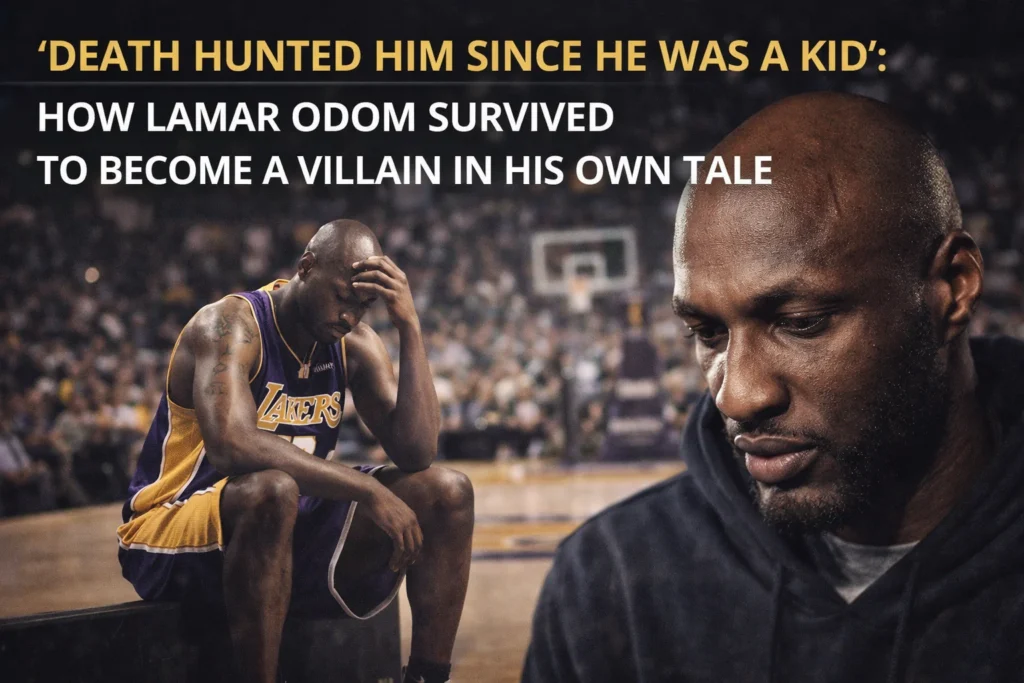

Prologue: The Night Death Almost Won
There is a version of Lamar Odom’s story that ends in a small room at the Love Ranch, a legal brothel nestled in the dusty Nevada desert, on October 13, 2015. In that version, the story closes with a flurry of breaking news alerts, a collective gasp from the sports world, and a lingering question about what might have been. The headlines write themselves: former NBA champion found unconscious, overdose suspected, a life cut short at thirty-five. The tributes would have poured in from Kobe Bryant, from Phil Jackson, from every teammate who ever shared a locker room with the gentle giant from Queens. The think pieces would have analyzed his career, his championship runs with the Los Angeles Lakers, his complicated relationship with fame, his struggles with loss and addiction. And then, like so many cautionary tales before his, the world would have moved on, leaving behind a legacy that was equal parts brilliance and tragedy.
But that is not the version that happened. Lamar Odom did not die that night. He survived twelve strokes. He survived six heart attacks. He survived a coma that lasted four days, a coma so deep that doctors told his family to prepare for the worst. They said if he woke up at all, he would likely never walk again. They said he would probably never speak again. They said the brain damage would be catastrophic, that the man who entered that hospital would not be the man who left it.
Against every medical expectation, against every statistical probability, Lamar Odom opened his eyes. He learned to walk again. He learned to talk again. He survived something that should have killed him, and in doing so, he was given something most people never get: a second chance at life. But here is the uncomfortable truth that the documentaries and the interviews and the comeback stories don’t always capture: surviving is not the same as living. And sometimes, the man who survives becomes someone the people who loved him barely recognize.
What follows is the story of a man who has been running from death since he was twelve years old. It is a story about grief that never gets processed, about talent that could have changed the game of basketball, about a kindness so genuine that it masks a pain so deep. It is a story about a whirlwind romance with one of the most famous families in the world, and about how that romance became a public battlefield for a private war. It is a story about addiction that doesn’t care about championships or money or fame. And it is a story about what happens when the person who saves you finally realizes that you don’t want to be saved.
This is the story of Lamar Odom: the villain in his own tale.
Part One: The Boy Who Lost Everything Before He Became a Man
South Jamaica, Queens: Where Survival Was the First Lesson
Long before the bright lights of the NBA, before the championship parades, before the reality television cameras and the tabloid headlines, Lamar Odom was just a kid trying to survive in South Jamaica, Queens. This was New York City in the 1980s, a time when the crack epidemic was tearing through neighborhoods like a slow-burning fire, when the crack vials on the street corners were as common as fire hydrants, when families were being shattered by a drug that seemed designed to destroy everything it touched.
Lamar Joseph Odom was born on November 6, 1979. His father, Joe Odom, was a man who loved his son but loved heroin more. He was a presence that came and went like a weather pattern, sometimes there, mostly not, always unreliable. When Joe was around, he brought chaos. When he wasn’t, the silence was its own kind of damage. For a young boy trying to understand why his father wasn’t like the other fathers, the explanation was simple and devastating: the drugs had taken him. Even then, before Lamar had ever tried a substance himself, he understood what addiction could do to a person. He understood that it could turn a man into a ghost who haunted his own family.
The person who held everything together was Cathy Mercer, Lamar’s mother. She was the constant, the anchor, the one who made sure there was food on the table and a roof over their heads. She worked long hours, came home exhausted, but always had time to listen to Lamar talk about his day, about the basketball game he played after school, about the moves he was practicing on the cracked blacktop courts that dotted their neighborhood. She saw something special in her son, something that went beyond the ordinary. She saw a kid who could be more than the circumstances he was born into.
When Lamar was in elementary school, Cathy sat him down for a conversation that would shape the rest of his life. She told him that he had a gift. She told him that basketball could be his ticket out of Queens, that if he worked hard enough and stayed focused, he could go places that kids from their neighborhood only dreamed about. She made him a promise: if he stayed dedicated to the game, she would do everything in her power to support him. It was a promise she kept until her dying breath.
But the summer after Lamar turned twelve, everything changed. Cathy started getting sick. At first, it was just fatigue, the kind of tiredness that comes from working too hard and sleeping too little. But then came the pain, the weight loss, the pallor that no amount of makeup could hide. The doctors ran tests and delivered a diagnosis that felt like a death sentence: colon cancer. It was aggressive. It was advanced. And by the time they found it, it was already spreading.
What happened over the next several months is something Lamar rarely talks about, even now. He watched his mother, the strongest person he had ever known, shrink before his eyes. He watched the chemotherapy drain the color from her skin and the life from her eyes. He watched her fight with everything she had, and he watched the cancer keep winning. And in the final days, when the pain was too much and the treatments had stopped working, Cathy Mercer called her son to her bedside and gave him the last piece of advice she would ever give.
“Be nice to everybody,” she told him. Her voice was weak, but her eyes were steady. “Be nice to everybody, and everything will be all right.”
Lamar made a promise to his mother that day. He would be nice to everybody. He would carry her kindness with him wherever he went. He would make sure that the world saw the best of who she had raised him to be. It was a promise he kept, maybe too well. Because kindness, when it is born from grief, can sometimes be a mask. And masks, if worn long enough, become impossible to take off.
Cathy Mercer died on Mother’s Day weekend, 1992. Lamar Odom was twelve years old. He was a boy who had just lost the only person who had ever been truly reliable in his life. And in the vacuum left by her absence, something began to grow. Not anger, not resentment, but something maybe more dangerous: a silence. A refusal to process what had happened. A determination to keep moving forward so fast that the grief couldn’t catch him.
The Grandmother Who Stepped In
After Cathy died, Lamar went to live with his grandmother, Mildred Mercer. She was a no-nonsense woman who had already raised her own children and thought she was done with the raising business. But when her grandson showed up on her doorstep with hollow eyes and a silence that was louder than any scream, she didn’t hesitate. She took him in, fed him, clothed him, and made sure he went to school. She loved him in the way that grandmothers do: fiercely, quietly, without fanfare.
Mildred was the kind of woman who didn’t believe in excuses. You got up in the morning, you did what needed to be done, and you didn’t complain about it. She saw Lamar’s talent for basketball and encouraged it, but she also made sure he understood that talent without discipline was just potential wasted. She drove him to practices and games, sat in the stands at every tournament, and never let him forget that his mother had believed he could be something special.
But Mildred was not a replacement for Cathy. No one could have been. And while Lamar poured himself into basketball, using the game as both an escape and a purpose, the grief of losing his mother sat somewhere deep inside him, unexamined and unprocessed. He never went to therapy. He never talked about it with anyone. He just kept playing, kept smiling, kept being nice to everybody. And somewhere in the back of his mind, he made a calculation that would define his adult life: if you keep moving fast enough, the sadness can’t catch you.
The Emergence of a Basketball Prodigy
By the time Lamar Odom entered Christ the King Regional High School in Queens, he was already being talked about in basketball circles. He was tall, already pushing six feet in middle school, but it wasn’t just his height that made him special. It was the way he moved. Big men in basketball were supposed to be clumsy, limited to the paint, dependent on smaller players to get them the ball. Lamar Odom handled the ball like a point guard. He passed with a vision that seemed almost supernatural. He could shoot from outside, drive to the basket, post up smaller defenders, and guard multiple positions on defense.
Coaches who saw him play used the same word over and over: unique. He was not a center trapped in a guard’s body or a guard trapped in a center’s body. He was something entirely new, a player who didn’t fit into any of the traditional boxes. When people started comparing him to Magic Johnson, it wasn’t just hype. Like Magic, Lamar had the size of a forward and the skills of a guard. Like Magic, he made everyone around him better. Like Magic, he played with a joy that was infectious.
But Lamar’s path to basketball stardom was never straightforward. He bounced between high schools, leaving Christ the King for St. Thomas Aquinas in New Jersey, then transferring again. There were whispers about grades, about focus, about the distractions that came with being one of the most hyped high school players in the country. The truth was simpler and sadder: Lamar was a kid carrying more weight than any teenager should have to carry, and basketball, which had always been his escape, was starting to feel like a pressure cooker.
After a brief and complicated stint at the University of Nevada, Las Vegas, where he played in only a handful of games before eligibility issues forced him to leave, Lamar landed at the University of Rhode Island. It was not the glamorous college basketball experience he might have had at a Duke or a North Carolina. It was cold, it was remote, and it was exactly what he needed. Under head coach Jim Harrick, Lamar flourished. He averaged 17.6 points per game, led the Rams to the Atlantic 10 tournament championship, and showed the country what everyone who had seen him play in Queens already knew: this kid was special.
In his one season at Rhode Island, Lamar put up numbers that would have been remarkable for any player, let alone a freshman. But it wasn’t the statistics that made NBA scouts salivate. It was the way he played. He had a feel for the game that couldn’t be taught. He saw plays develop two or three steps ahead of everyone else. He made passes that other players wouldn’t even attempt. And at six-foot-ten, he did things that players his size simply did not do.
When the 1999 NBA Draft arrived, Lamar Odom was projected as a top-five pick. The Los Angeles Clippers, a franchise that had spent most of its existence in the league’s basement, selected him with the fourth overall pick. In his first NBA game, Lamar put up thirty points and twelve rebounds. It was a statement: the left-handed Magic Johnson had arrived.
Part Two: The NBA Years
Rookie Sensation and Early Success
The late 1990s and early 2000s NBA was a different world from the league today. The game was slower, more physical, dominated by big men like Shaquille O’Neal and Tim Duncan. But Lamar Odom didn’t fit that mold, and that was exactly what made him so exciting. He was a forward who could bring the ball up the court, who could initiate the offense, who could create shots for himself and his teammates. In an era when positions were rigidly defined, Lamar blurred all the lines.
His rookie season with the Clippers was everything the franchise had hoped for. He averaged 16.6 points, 7.8 rebounds, and 4.2 assists per game. He was named to the NBA All-Rookie First Team. More importantly, he made the Clippers interesting for the first time in years. Alongside young players like Darius Miles and Quentin Richardson, Lamar helped turn the Clippers into what basketball fans called the “Lob City” precursor—a young, athletic, exciting team that played above the rim and ran the floor with abandon.
But even as his career was taking off, the old patterns were returning. The grief that Lamar had spent his teenage years outrunning was starting to catch up. The trauma of losing his mother, the abandonment by his father, the pressure of being a young millionaire with more money than he had ever imagined—it all began to manifest in ways that were harder to hide.
In 2001, Lamar was suspended by the NBA for violating the league’s anti-drug policy. The substance was marijuana, and at the time, the story was framed as a young player making a mistake, a minor infraction that would be quickly forgotten. But for those who knew Lamar well, the suspension was a warning sign. The man who had promised his dying mother to be nice to everybody was finding other ways to numb the pain that niceness couldn’t reach.
A year later, he was suspended again. This time, the league’s patience was thinner. Lamar checked himself into a rehabilitation facility, and for a while, it seemed like he had gotten things under control. He returned to the Clippers, finished the season, and looked forward to a fresh start. But the pattern was set. The off-seasons were when the trouble came. When the structure of the NBA schedule disappeared, when the games stopped and the long months of nothing stretched out ahead of him, the darkness had room to breathe.
The Miami Heat Years and a Change of Scenery
In 2003, Lamar signed with the Miami Heat as a free agent. It was a homecoming of sorts—Florida was closer to the Bahamas, where his father was from, and the Heat were building something special around a young guard named Dwyane Wade. Lamar was supposed to be the veteran presence, the versatile forward who could do a little bit of everything while the rookie sensation found his footing.
For one season, it worked. Lamar averaged 17.1 points, 9.7 rebounds, and 4.1 assists. He and Wade developed a chemistry that made the Heat one of the more exciting teams in the Eastern Conference. They made the playoffs, won a series, and looked like a franchise on the rise. But the off-season that followed would change everything.
In the summer of 2004, the Los Angeles Lakers made one of the most seismic moves in NBA history. They traded Shaquille O’Neal to the Miami Heat. And to make the salaries work, Lamar Odom was included in the deal. He was going back to Los Angeles, but not to the Clippers. He was going to the Lakers, the most glamorous franchise in basketball, the team that had defined the league for generations. He was going to play alongside Kobe Bryant.
The Lakers Years: Championships and Hidden Cracks
The trade that sent Shaquille O’Neal to Miami was, at the time, one of the most controversial moves in Lakers history. Shaq was still a dominant force, still capable of carrying a team to a championship. But the tension between Shaq and Kobe Bryant had become unbearable, and the Lakers chose Kobe. In exchange, they got Lamar Odom, along with Caron Butler and Brian Grant. It was a trade that was widely criticized. The Lakers had traded a sure thing for a collection of parts.
But Lamar Odom approached the trade with the same grace that had defined his career. He didn’t complain about being the guy who was traded for a legend. He didn’t mope about leaving a Miami team where he had finally found a rhythm. He showed up in Los Angeles, put on the purple and gold, and went to work.
The first few seasons with the Lakers were a transition period. Kobe was trying to prove he could win without Shaq, and the supporting cast was still being assembled. Lamar played well, but the team struggled to find consistency. When Phil Jackson returned to coach the Lakers in 2005, he saw something in Lamar that others had missed. Here was a player who could do a little bit of everything, a forward who thought like a point guard, a Swiss Army knife who could fill whatever role the team needed.
Phil Jackson, who had coached Michael Jordan and Scottie Pippen and Shaq and Kobe, who had won more championships than almost anyone in the history of the sport, recognized that Lamar Odom was a different kind of player. He wasn’t a superstar in the traditional sense. He wasn’t going to lead the league in scoring or demand the ball every possession. But he made the players around him better. He was the glue, the connector, the person who could take a collection of talented individuals and turn them into a team.
In 2008, the Lakers made it to the NBA Finals, where they lost to the Boston Celtics in six games. It was a bitter defeat, but it was also proof that the Lakers were back. The following season, with the addition of Pau Gasol, the Lakers returned to the Finals and this time defeated the Orlando Magic to win the championship. Lamar was a crucial part of that team, starting at forward and providing the versatility that made the Lakers’ offense so difficult to defend.
The 2009-2010 season was Lamar’s finest as a professional. Phil Jackson asked him to come off the bench, to be the sixth man, to provide a spark when the starters needed a rest. It was a sacrifice—most players want to start, want to see their name in the starting lineup every night—but Lamar agreed without hesitation. He embraced the role, and the Lakers were better for it. They won sixty-five games, returned to the Finals, and defeated the Boston Celtics in a seven-game series that was one of the greatest Finals in NBA history.
Lamar was named the NBA’s Sixth Man of the Year that season. It was a recognition of what everyone in the Lakers organization already knew: he was the heart of that team. Kobe Bryant was the closer, the assassin, the one who took the big shots. Pau Gasol was the finesse, the skill, the European elegance. But Lamar was the heart. He was the guy who kept the locker room loose, who made everyone laugh, who reminded his teammates that basketball was supposed to be fun.
What no one knew, what Lamar hid behind his smile and his kindness, was that the off-season cocaine binges had never really stopped. He was functioning, winning, smiling for the cameras—but underneath it all, the machinery of addiction was grinding away.
Part Three: The Loss That Broke Him
Jayden: The Son Who Was Gone Too Soon
On June 28, 2006, Lamar Odom’s life changed in a way that no amount of basketball success could ever repair. His six-month-old son, Jayden, died in his sleep. The cause was sudden infant death syndrome, or SIDS—a cruel, unexplained phenomenon that takes healthy babies without warning, without reason, without any way for parents to prepare themselves.
Jayden’s mother was Liza Morales, Lamar’s high school sweetheart. They had been together for years, through the ups and downs of his basketball career, through the moves from Queens to Rhode Island to Los Angeles. They had a daughter, Destiny, born in 1998, and a son, Lamar Jr., born in 2002. And on that summer day in 2006, they lost their youngest child.
The tragedy was compounded by where Lamar was when it happened. He was not at home. He was not with his family. He was out partying with friends, celebrating the end of the season, doing the kind of things that NBA players with money and time on their hands do in the summer. When he got the call, the guilt hit him like a physical force. He rushed home, but it was too late. Jayden was gone.
In the days and weeks that followed, Lamar tried to process what had happened. He tried to be there for Liza, for Destiny, for Lamar Jr. He tried to be strong. But the guilt was overwhelming. The what-ifs played in his head on a loop: what if he had been home, what if he had checked on Jayden one more time, what if, what if, what if. And alongside the guilt was the grief, the kind of grief that doesn’t have an off switch, that doesn’t get easier with time, that settles into your bones and stays there.
For Liza Morales, the loss of Jayden was devastating in its own way. She had been the one at home, the one who put the baby to bed, the one who found him when he didn’t wake up. And she had to deal with the fact that the father of her children, the man she had been with since high school, had been out partying when their son died. It was a wound that would never fully heal.
Lamar’s drug use, which had been intermittent and mostly recreational, began to shift after Jayden’s death. The marijuana and the occasional cocaine use became something else. Something more frequent. Something more necessary. When the grief was too much, when the guilt was suffocating, the drugs offered a way out. They quieted the noise in his head. They made the world softer, easier, more bearable. For a few hours, at least, they made him forget.
What Lamar didn’t understand, what he wouldn’t understand for years, was that the drugs weren’t helping him process his grief. They were helping him avoid it. And avoidance, as anyone who has ever lost someone knows, is not healing. It is just postponement. The grief will be there when you come back. It will always be there. And if you keep running from it long enough, it will eventually catch you.
Liza: The Woman Who Loved Him First
Liza Morales was there before the fame, before the money, before the reality television cameras and the Kardashian whirlwind. She was there when Lamar was a kid from Queens with a basketball and a dream. She was there when his mother died, when he was trying to figure out who he was and what he wanted to be. She believed in him when no one else did, and she loved him in the quiet, steady way that doesn’t make headlines but holds families together.
Their relationship was not perfect—no relationship is—but it was real. They had children together. They built a life together. When Lamar was traded to Miami, she moved to Florida with him. When he was traded to the Lakers, she moved to Los Angeles. She was the constant, the one who kept the home fires burning while he traveled the country playing basketball.
But Jayden’s death changed something between them. The guilt that Lamar carried made him pull away. The grief that Liza carried made her need him more. And the drugs, which were becoming an increasingly large part of Lamar’s life, created a distance that neither of them knew how to bridge.
In the years after Jayden’s death, Lamar and Liza drifted apart. They were still together, still raising their children, still showing up for family events. But the foundation had cracked. And when Lamar’s career took him in new directions, when the whirlwind of the Kardashian fame machine swept him up, the cracks became canyons that neither of them could cross.
Part Four: The Kardashian Whirlwind
How They Met: A Party, a Host, and a Five-Thousand-Dollar Gig
In August 2009, Lamar Odom was at the top of the world. He had just won an NBA championship with the Lakers. He was coming off a season where he had played some of the best basketball of his career. He was rich, famous, and living in Los Angeles, a city that rewards those qualities more than almost anywhere else on earth.
He was also, in his personal life, adrift. His relationship with Liza Morales was essentially over, though neither of them had officially ended it. The death of Jayden still haunted him. The drugs were a constant companion. And into this complicated, messy, emotionally fragile moment walked Khloé Kardashian.
Khloé was hosting a party that summer, a gig she was paid five thousand dollars to attend. She was already famous, though not yet the global icon she would become. The Kardashian family had launched their reality show, Keeping Up with the Kardashians, in 2007, and it was already a massive hit. But Khloé was still finding her place in the family dynamic, still figuring out who she was outside of her sisters’ shadows.
When Lamar walked into that party, he didn’t know who Khloé was. He just saw a beautiful woman and decided to introduce himself. Khloé, who had dealt with her share of men who were interested only in her fame, played hard to get. She wouldn’t give him her number. She wanted to see if he would work for it.
He did. Lamar tracked her down through their shared business manager, a man named Michael Rucker. He called her, asked her out, and showed up to their first date in a chauffeur-driven car, a gesture that was either romantic or excessive depending on your perspective. Khloé found it charming.
What followed was the kind of whirlwind romance that feels like it belongs in a movie. They dated for a month—just thirty days. And then, on September 27, 2009, they were married in a lavish Beverly Hills ceremony. There were 250 guests, a ten-piece orchestra, and a performance by Babyface. Khloé wore a Vera Wang gown. Lamar wore a custom suit. The world watched, and the world wondered: what could these two people, from such different worlds, possibly have in common?
The Marriage: Love, Cameras, and Hidden Truths
Khloé later admitted that she understood why people were skeptical. “We were getting married in thirty days,” she said in an interview years later. “So that is insane.” But she was in love. Or at least, she believed she was. Lamar was charismatic, vulnerable, honest about his past. He told her about his mother, about Jayden, about the struggles he had faced. He didn’t hide his demons. He laid them out in front of her, and she chose to love him anyway.
For the first few years, it seemed like the marriage might actually work. Lamar and Khloé got matching tattoos—her initials on his hands, his on her wrist. They bought a house together, a mansion in Tarzana that became the setting for their own reality show, Khloé & Lamar. The show ran for two seasons and gave viewers an inside look at their relationship. It was Lamar who had pushed for the show. He was drawn to the Kardashian family’s orbit, to the cameras, to the spotlight. After years of being a supporting player in the Lakers’ championship runs, he seemed to enjoy being the center of attention for once.
But behind the scenes, the addiction was growing. The cocaine use, which had been an off-season problem, was becoming a year-round problem. The marijuana, which Lamar had always maintained was just a way to relax, was becoming a crutch. And the combination of fame, money, and access meant that there were always people willing to help him find what he was looking for.
What Khloé didn’t know when she married Lamar—what she couldn’t have known—was that she was marrying not just a man but an addiction. And addiction, as anyone who has ever loved an addict knows, is a jealous partner. It demands attention. It demands secrecy. It demands that everything else—work, family, love—take a back seat.
The Monstrous Truth Comes Out
In the documentary Untold: The Death & Life of Lamar Odom, Khloé Kardashian does something remarkable: she tells the truth. The whole truth. And it is devastating.
She recalls the first time Lamar disappeared for two days. She called everyone she knew, terrified that something had happened to him. When he finally came home, he blamed it on Jayden’s death—the son he lost years earlier. And Khloé, who had never experienced anything like that, didn’t know what to do. She believed him. She wanted to help.
But the disappearances became more frequent. The excuses became thinner. And eventually, Khloé had to face the truth: her husband was a drug addict, and she had no idea how to save him.
She recalls finding tinfoil and spoons in his car, evidence that he was freebasing cocaine, turning it into crack for a stronger high. She recalls cleaning up hotel rooms before housekeeping could see, terrified that a maid would sell the story to the tabloids. She recalls pumping his stomach after an overdose, arranging at-home detox centers, and spending countless nights searching for him in alleys and cheap motels.
“I was such an enabler without knowing I was an enabler,” she admits in the documentary. “But I just felt such a responsibility to cover this up, hold it together and protect him.”
The infidelity added another layer of pain. At one point, a woman Lamar had been seeing called Khloé directly. “I’ve been fing your husband,” the woman said. “He is so fed up and he just keeps wanting money and drugs and I gotta get off this ride. So will you come and pick him up?”
Khloé went. She always went. She did everything she could to keep him alive—and to keep the secret of how bad things had gotten.
In 2013, after years of trying to hold it together, she filed for divorce. Lamar signed the papers in July 2015. All that was left was for a judge to sign off.
Part Five: The Night Everything Ended
The Love Ranch: A Place Where Dreams Go to Die
Three months after the divorce papers were signed, Lamar Odom checked into the Love Ranch, a legal brothel in rural Nevada, about halfway between Las Vegas and the Mexican border. The Love Ranch was the kind of place that existed in the gray areas of American life: legal under Nevada law, but operating in a moral space that most people preferred not to think about. It was a place where men with money could go to act out their fantasies, away from the judgment of the outside world.
Lamar had been on a cocaine binge that had lasted for days. He was alone, or as alone as someone can be in a brothel surrounded by people whose job is to provide companionship. He was using drugs, drinking, doing the things that he had been doing for years, the things that had cost him his marriage, his reputation, and almost his life.
On October 13, 2015, Lamar Odom was found unconscious in his room. He had suffered kidney failure, multiple heart attacks, and twelve strokes. He was rushed to a Las Vegas hospital and placed in a medically induced coma. Doctors gave him little chance of survival. If he did wake up, they said, he would likely never walk or talk again.
The news broke like a bomb. TMZ, ESPN, every outlet in the country was reporting on Lamar Odom’s overdose. And Khloé Kardashian—who was technically still his wife because the divorce hadn’t been finalized—rushed to his side.
The Hospital Vigil: Four Months of Hell
What happened in the days and weeks that followed is almost too strange to believe. According to Khloé, Lamar’s estranged father, Joe Odom, arrived at the hospital ready to make medical decisions. She claims he would have pulled the plug on his own son if she hadn’t intervened. To get him to leave, she gave him a hundred dollars, a pair of Nikes, and a hotel room for the night. She then took control of Lamar’s medical care.
For four months, Khloé stayed by his side. She never left the hospital. She worked with doctors, pushed him through rehab, and was determined to get him walking again. When Lamar woke up, he was surprised to find her there. “I remember waking up and her showing me pictures of my mother,” he told a reporter later. “I was surprised by how quick she was to show her devotion to me.”
Against all odds, Lamar survived. He relearned how to walk. He relearned how to talk. His doctors called him a walking miracle. “Medically impossible,” they said, for someone to survive what he had survived.
But survival, as Khloé would soon learn, was not the same as recovery.
Part Six: The Villain Emerges
The Moment the Mask Fell Off
When Lamar was discharged from the hospital, Khloé rented him a house to recover in. She continued to support him. She believed, maybe, that this was the wake-up call he needed. That the man who had been running from death for his entire life had finally been caught—and could now change.
Then she smelled crack.
She stopped by the house one day and knew immediately what she was smelling. She walked into his bedroom and found him sitting on the edge of the bed, smoking crack. “I just punched him in his face,” she says in the documentary, the anger still fresh in her voice.
That was the moment everything changed. Khloé realized that Lamar had been playing her. He had let her believe he was recovering while he was still using. He had let her pour her energy, her money, her love into saving him—all so she could continue to enable his lifestyle.
“I said, ‘By Monday, you need out of this house. I’m done. I’m not paying for a thing and I never want to speak to you again.'”
In May 2016, she filed for divorce again. This time, she followed through. The divorce was finalized in December 2016.
In the documentary, Lamar does not push back against Khloé’s version of events. He does not show much appreciation for the considerable efforts she made to save his life. He does not seem to fully grasp what she sacrificed for him. And that, perhaps, is the tragedy of the story. She transitions from reality-TV foil to hero, while he flips from sympathetic protagonist to unmistakable villain.
The Aftermath: A Man Still Searching
If you think that story has a neat ending—that Lamar hit rock bottom, found God, got sober, and lived happily ever after—you haven’t been paying attention.
In January 2026, Lamar was arrested in Las Vegas for driving under the influence. It was his second DUI arrest, following one in 2013. Police said he was driving more than forty-one miles per hour over the speed limit.
He pleaded not guilty. His trial was set for July 2026.
After the arrest, Lamar voluntarily checked into a thirty-day rehabilitation program in Los Angeles. His manager said it was a personal decision to “reset and focus on his health.” Lamar admitted that he had been using marijuana and was afraid it might lead to something worse.
As of late February 2026, Lamar said he was “fifty-six or fifty-seven days sober.” No alcohol. No pot. No marijuana. He told a reporter that he was focused on growing “mentally and spiritually” and that he was trying to follow the “Mamba mentality” inspired by his late teammate, Kobe Bryant.
But the documentary shows a man who still thinks like a user. He jokes about partying in Vegas and “marrying somebody” as the credits roll. He talks about a recurring dream in which he sees Kobe Bryant again and is told “the afterlife is not what people make it out to be.” Worryingly, Lamar appears curious enough to test that message.
His daughter, Destiny, puts it bluntly in the documentary: “He just acted like the coma thing never really happened.”
Part Seven: The Psychology of a Man Who Can’t Quit
Running from Death Since He Was a Kid
There is a way of understanding Lamar Odom where everything in his life is in reaction to death hunting him since he was a kid. His father was an addict. His mother died when he was twelve. His grandmother, who raised him, passed away just as his career was taking off. His baby son died. His cousin was murdered. He went to a funeral and got in a car crash. He lost friends to drugs. He lost Kobe Bryant.
And through it all, he kept smiling. He kept being the nice guy. He kept giving to others while slowly destroying himself.
That is the part of the story that doesn’t fit neatly into a documentary. The kindness and the addiction are not separate things. They come from the same place—a desperate need to feel something, to connect, to quiet the grief that has been following him since childhood.
Psychologists have a term for what Lamar has been doing for most of his life: avoidance coping. It is the tendency to push away painful emotions, to distract oneself from difficult feelings, to keep moving so fast that the sadness can’t catch up. In the short term, avoidance coping works. It gets you through the day. It lets you function. It allows you to smile at strangers and make them feel good.
But in the long term, avoidance coping is a trap. The emotions you push away don’t disappear. They accumulate. They fester. And eventually, they demand to be felt. For Lamar, the drugs were the ultimate avoidance tool. They didn’t just push the grief away—they obliterated it, at least for a few hours. But when the high wore off, the grief was still there, waiting. And so he needed more. And more. And more.
The Kindness That Masks the Pain
Everyone who knows Lamar Odom will tell you the same thing: he might be the kindest person they have ever met. He pays for strangers’ kids to go to college. He visits sick children in hospitals when no cameras are around. He takes rookie players under his wing and buys them suits. He treats everyone, from the janitor to the team owner, with the same easy warmth.
But kindness, when it is born from grief, can sometimes be a mask. Lamar’s mother told him to be nice to everybody, and he took that instruction to heart. He became the nicest guy in the room, in the locker room, in the NBA. He made sure that no one ever saw the pain underneath. He made sure that everyone who met him walked away feeling good about themselves.
What he didn’t do was take care of himself. The kindness he extended to everyone else was never extended inward. He never gave himself permission to be angry, to be sad, to fall apart. He never let anyone see the cracks. And so the cracks grew deeper, wider, more dangerous.
The Coma That Changed Nothing
The most heartbreaking part of Lamar Odom’s story is that the coma—the near-death experience that should have been a wake-up call—changed almost nothing. His daughter Destiny says it plainly: “He just acted like the coma thing never really happened.”
It is hard to understand how someone could survive twelve strokes and six heart attacks and not come out the other side fundamentally changed. But addiction doesn’t work that way. Addiction doesn’t respond to logic. It doesn’t respond to fear. It doesn’t respond to love. It responds only to itself.
There is a scene in the documentary where Lamar is asked about his future. He talks about his dreams, his hopes, the things he wants to do. And there is something in his voice, something in his eyes, that suggests he believes he has all the time in the world. He doesn’t. He has already used up more than his share of second chances.
Part Eight: The People Who Tried to Save Him
Khloé Kardashian: The Wife Who Refused to Give Up
Khloé Kardashian has been criticized for many things over the years—her relationships, her business decisions, her place in her famous family. But no one can say she didn’t try to save Lamar Odom. She gave him four years of her life, years that were filled with fear, anxiety, and heartbreak. She cleaned up his messes, covered for his absences, and did everything in her power to keep him alive.
In the documentary, Khloé is brutally honest about what those years were like. She talks about the terror of not knowing where he was, the shame of hiding his addiction from the world, the anger that came when she realized he had been lying to her all along. She does not romanticize her role. She does not pretend to be a saint. She just tells the truth.
When she finally walked away, it was not because she stopped loving him. It was because she realized that her love was not enough to save him. And that staying with him was not helping him—it was enabling him.
Liza Morales: The Mother of His Children
Liza Morales has largely stayed out of the spotlight since her relationship with Lamar ended. She has focused on raising their children, Destiny and Lamar Jr., and building a life away from the chaos that surrounded her former partner. But her perspective on Lamar’s story is essential, because she knew him before the fame, before the addiction, before the Kardashians.
She watched the man she loved slowly destroy himself. She watched him choose drugs over his family, over his children, over his own life. She raised their kids mostly on her own, protecting them as much as she could from the turbulence that surrounded their father.
In interviews, Liza has spoken about the pain of watching Lamar spiral, the frustration of not being able to help him, the sadness of knowing that the man she fell in love with was still somewhere inside the addict, but unreachable.
Destiny and Lamar Jr.: The Children Left to Pick Up the Pieces
The most overlooked victims of Lamar Odom’s addiction are his children. Destiny was born in 1998, when Lamar was still a teenager. Lamar Jr. was born in 2002. They grew up watching their father rise to the heights of professional success and descend into the depths of addiction. They lost a baby brother to SIDS. They lost their father to drugs, even when he was physically present.
Destiny, in particular, has been vocal about the impact her father’s choices have had on her life. In the documentary, she is honest about her frustration, her anger, and her love for a man who has repeatedly let her down. She does not excuse his behavior, but she also does not abandon him. She is still there, still hoping, still waiting for him to get it right.
Kobe Bryant: The Brother Who Was There
The death of Kobe Bryant in January 2020 was a devastating blow to everyone who knew him, but for Lamar Odom, it was something more. Kobe was not just a teammate. He was a brother. He was the one who pushed Lamar to be better, who demanded excellence, who saw something in him that others sometimes missed.
In the years after the coma, Lamar has spoken often about Kobe’s influence on his life. He talks about the “Mamba mentality”—the relentless pursuit of excellence that defined Kobe’s career and his life. He tries to apply that mentality to his own recovery, to his own efforts to stay sober, to his own attempts to be a better father and a better person.
But the loss of Kobe was also a reminder of how fragile life is. Kobe was forty-one years old when he died. He was healthy, successful, beloved. He had survived seventeen NBA seasons and emerged on the other side as a cultural icon, a devoted father, a man who had figured out how to balance greatness with grace. And then, in a moment, he was gone.
For Lamar, Kobe’s death was a reminder that no one is promised tomorrow. It was also a reminder that survival is not the same as living.
Part Nine: The Road Ahead
A Man Still Searching
As of 2026, Lamar Odom is forty-six years old. He has been given more second chances than almost anyone in the history of professional sports. He has survived things that should have killed him. He has been loved by people who had every reason to walk away. He has been supported, prayed for, and given the benefit of the doubt more times than anyone can count.
And still, he struggles.
The DUI arrest in January 2026 was a reminder that the old patterns are never far away. The thirty-day rehab stay that followed was a reminder that recovery is not a destination but a process. The fifty-seven days of sobriety that he had as of late February were a reminder that every day is a choice, and every choice matters.
In interviews, Lamar talks about wanting to grow “mentally and spiritually.” He talks about following the “Mamba mentality.” He talks about being grateful for life, for his children, for the people who have stood by him. And there is no reason to doubt that he means every word of it.
But meaning it and doing it are two different things.
The Question That Remains Unanswered
The central question of Lamar Odom’s life has not changed since he was twelve years old, sitting at his mother’s bedside, promising to be nice to everybody. The question is this: can he outrun the grief that has been chasing him his entire life? Or will it eventually catch up with him, the way it caught up with his father, the way it caught up with so many others who tried to outrun their demons?
Ryan Duffy, the director of the Untold documentary, put it this way: “The guy’s perspective is simple: I survived this night in Nevada—where, by all accounts, I should be dead. There was divine intervention involved in my survival. And that means I need to do something. I need to find some meaning. But he doesn’t know what the f*** that is. Where he is now is in a place of just searching. And he’s comfortable with that uncertainty.”
That uncertainty is what makes Lamar Odom’s story so hard to watch—and so hard to look away from. He is not a cautionary tale who learned his lesson. He is not a redemption story with a tidy ending. He is a man still in the middle of his own messy, painful, complicated life. A man who has survived death multiple times but still doesn’t know how to live.
What We Learn from a Man Who Can’t Quit
There is no moral to Lamar Odom’s story. There is no lesson neatly packaged at the end. There is just a man, still standing, still fighting, still searching for something that might finally make the grief go away.
Maybe the lesson is that kindness and self-destruction can coexist. That you can be the nicest guy in the room and still be slowly killing yourself. That love, no matter how fierce, is not enough to save someone who doesn’t want to be saved.
Maybe the lesson is that recovery is not a straight line. That you can have fifty-seven days of sobriety and still be one bad decision away from fifty-seven days of something else. That the past is never really past, and the demons you thought you had exorcised are always waiting for a moment of weakness to return.
Or maybe the lesson is simpler: that Lamar Odom is human. That he has been hurt in ways that most of us cannot imagine. That he has made mistakes, terrible mistakes, mistakes that have cost him the people he loves and almost cost him his life. And that he is still trying, even when trying feels like the hardest thing in the world.
Epilogue: The Man Who Survived
In the end, The Death & Life of Lamar Odom does not give us a hero or a villain. It gives us a human being—flawed, struggling, sometimes infuriating, sometimes heartbreaking. A man who survived when he probably shouldn’t have and is still trying to figure out what to do with that.
Lamar Odom has been hunted by death since he was a kid. Death has taken his mother, his grandmother, his baby son, his cousin, his friends, his teammate. Death has come for him personally, more than once, and each time he has somehow slipped away.
But death is patient. Death waits. And Lamar Odom, for all his talent, for all his kindness, for all his charm, is still running.
The question is not whether death will eventually catch him. Death catches everyone. The question is whether, before that day comes, Lamar Odom will finally stop running. Whether he will turn around and face the grief that has been chasing him all these years. Whether he will let the people who love him help him carry the weight that has been crushing him since he was a boy.
His mother told him to be nice to everybody. She didn’t tell him to be nice to himself. Maybe that is the lesson he still needs to learn. Maybe that is the meaning he is still searching for.
As Lamar himself says in the documentary, reflecting on his survival: “When I woke up, the doctors told me I’d probably never walk and talk again. So, us having this conversation is a win. All of my doctors say I’m like a walking miracle because it’s, like, medically impossible for somebody to survive twelve strokes and six heart attacks while in a coma. And so I just take it day by day, and I’m more than grateful for life.”
It is a beautiful sentiment. Whether he can live it—day by day, without running, without hiding—is the question that remains unanswered.
For now, Lamar Odom is alive. He is searching. He is, by his own admission, not the same person he was. “I’m not the same person. I do everything in my strength to protect my sobriety,” he told a reporter recently.
Whether that strength will be enough—whether the man who has been hunted by death his entire life can finally stop running—is a question only time can answer. And time, as Lamar Odom knows better than most, is the one thing you never get back.
The story of Lamar Odom is not over. It is still being written, day by day, choice by choice. In the rehab centers he checks into and sometimes leaves too early. In the relationships he is trying to repair with his adult children. In the courtrooms and the probation hearings. In the moments of clarity where he admits the truth about what he has done and who he has been.
He is the villain in his own tale—but villains, in the best stories, are not irredeemable. They are just people who have lost their way. And sometimes, if they are lucky, if they are loved, if they can finally stop running, they find their way back.
Maybe Lamar Odom will find his way back. Maybe the kindness his mother planted in him will finally bloom inward as well as outward. Maybe he will learn to be nice to himself.
Or maybe not. Maybe the grief will keep chasing him. Maybe the drugs will keep calling. Maybe the story will end the way it almost ended in that Nevada brothel, with a man alone in a room, running from something he could never outrun.
Either way, Lamar Odom has given us something valuable: a reminder that every life is complicated, every struggle is real, and every person is more than the worst thing they have ever done.
He survived. Now he has to figure out what comes next.
Afterword: A Legacy Still Being Written
Lamar Odom’s basketball legacy is secure. He was a two-time NBA champion. He was the Sixth Man of the Year. He was one of the most unique talents of his generation—a six-foot-ten point forward who could do things no one his size had any business doing. He helped usher in the era of positionless basketball, even if he doesn’t get enough credit for it.
But his real legacy is still being written. It is being written in the rehab centers he checks into and sometimes leaves too early. In the relationships he is trying to repair with his adult children, Destiny and Lamar Jr. In the DUI trials and the probation hearings. In the moments of clarity where he admits, “I know cocaine isn’t the way to go, but it’s a high that feels so good, you wish you could capture it and put it in a bottle so you can have it the next day.”
That is the voice of an addict. It is honest, self-aware, and utterly powerless all at once.
For now, Lamar Odom is alive. He is searching. He is, by his own admission, not the same person he was. Whether that strength will be enough—whether the man who has been hunted by death his entire life can finally stop running—is a question only time can answer.
And time, as Lamar Odom knows better than most, is the one thing you never get back.



Regards for all your efforts that you have put in this. very interesting info .
Had a great experience with the payouts here. Everything was handled professionally and arrived on time. Big thanks to brzzwin26 for the great service.
Good post but I was wanting to know if you could write a litte more on this subject? I’d be very grateful if you could elaborate a little bit further. Many thanks!
Finally found a place that doesn’t lag during peak hours. The bonuses are decent and the vibe is just right. Highly recommend vnzm88 to everyone.