
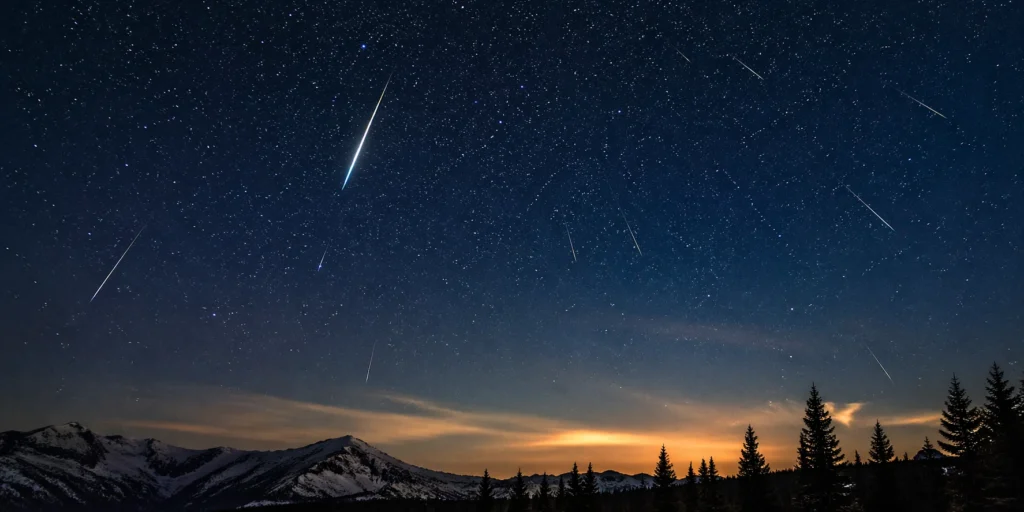

Every spring, something quiet and beautiful happens above our heads. The sky puts on a show that doesn’t need tickets, special effects, or even a screen. All you need is a little patience, a dark spot outside, and the courage to stay up late or wake up very early.
That show is called the Lyrid meteor shower.
If you’ve never seen a shooting star before, the Lyrids are a perfect place to start. They’re not the biggest or flashiest meteor shower of the year, but they have something special. They are reliable. They are old. And they arrive just as winter finally loosens its grip and the world starts to feel alive again.
In 2026, the Lyrids are expected to be one of the most talked-about sky events of April. Not because they’ll break any records, but because the conditions are good enough that almost anyone in the Northern Hemisphere can step outside and see something unforgettable.
Let’s walk through everything you need to know. When to look up. Where to go. How to make sure you don’t miss it. And maybe, along the way, we’ll talk about why humans have been staring at shooting stars for thousands of years.
H2: First, What Actually Is a Meteor Shower?
Before we dive into dates and times, let’s back up. Imagine you’re driving down a country road at night in the middle of summer. Your headlights cut through the darkness, and every few seconds, a tiny bug smacks into your windshield. It’s annoying, but also kind of fascinating. Each little splat is a collision between your car and something very small moving very fast.
Now blow that idea up to the size of a planet.
Earth is always moving. Every single day, our planet travels about 1.6 million miles through space. That’s fast. And space is not empty. It’s full of dust, tiny rocks, and leftover crumbs from comets and asteroids. Most of the time, those crumbs are so small and spread out that we never even notice them. But sometimes, Earth passes through a particularly thick patch of old comet dust. When that happens, we get a meteor shower.
Comets are like dirty snowballs flying through space. They’re made of ice, rock, dust, and frozen gases. When a comet gets close to the sun, the ice turns directly into gas — a process called sublimation. That gas blows off the comet’s surface, carrying dust and tiny rock fragments with it. Over hundreds or thousands of years, that dust spreads out along the comet’s orbit, forming a river of debris.
Earth orbits the sun, and every year around the same time, we plow right through one of those old debris trails. Those tiny bits of dust hit our atmosphere at insane speeds — around 110,000 miles per hour. At that speed, even a grain of sand creates intense friction with the air. That friction heats the particle to thousands of degrees, and it burns up in a bright flash. That burning streak of light is what we call a meteor, or a “shooting star.”
The Lyrids are caused by a comet named Thatcher (officially C/1861 G1). It was discovered by a man named A. E. Thatcher back in 1861. He spotted it from New York using a telescope. At the time, nobody knew it would become famous. Comet Thatcher takes about 415 years to go around the sun once. The last time it came close to Earth was in 1861. The next time? Not until the year 2276. That’s more than 250 years from now. Everyone you know will be gone. But the dusty trail that comet left behind? We hit that every April like clockwork. That’s a strange and wonderful thing to think about.
H2: When Will the Lyrid Meteor Shower Happen in 2026?
Let’s start with the big picture. The Lyrids are active every year between April 16 and April 25. That’s a ten-day window. For about ten days every spring, you have a chance to see Lyrid meteors. But here’s the key: most of those nights are relatively quiet. You might see only a handful per hour — maybe three or four if you’re lucky.
The reason is simple. The comet’s debris trail isn’t evenly thick. It has a dense center and much thinner edges. Earth takes a few days to cross the entire trail. When we’re passing through the thin edges, the meteor rate is low. When we pass through the dense center, the rate goes way up.
That dense center is called the peak.
In 2026, the peak happens during the early morning hours of April 22.
Let me say that again in a storytelling way because it’s important: If you set your alarm for around 3 a.m. on April 22, 2026, you are choosing the very best moment of the entire year to see a Lyrid. This is not an exaggeration. Astronomers calculate these things down to the hour. The difference between the peak night and the night before can be the difference between seeing 15 meteors in an hour or seeing three.
But don’t worry if you can’t go outside on the exact peak morning. We’ll talk about backup nights later. For now, just circle April 22 on your calendar. Write “LYRIDS – WAKE UP EARLY” in big letters. You’ll thank yourself later.
Why early morning? That’s a great question, and the answer has to do with geometry and the way Earth spins. The meteors in a shower all seem to come from one small area of the sky. That area is called the “radiant.” For the Lyrids, the radiant is near the bright star Vega, in the constellation Lyra. The radiant rises in the northeast around midnight and climbs higher as the night goes on. It reaches its highest point in the sky — almost directly overhead for many Northern Hemisphere locations — right before dawn. The higher the radiant, the more meteors you see. That’s why the hours between 2 a.m. and 5 a.m. are the golden hours.
H2: What Time Exactly Should You Go Outside?
Here’s where a lot of people get confused — and end up disappointed. They go outside at 9 p.m., look up for ten minutes, see nothing, and go back inside. Then they tell their friends, “Meteor showers are boring. I didn’t see anything.”
But here’s the truth: they went outside at the wrong time.
Watching a meteor shower at 9 p.m. is like going to a beach at low tide and saying the ocean is boring. You just have to know when the tide comes in. For meteor showers, the “tide” comes in after midnight.
The Lyrids are best seen in the predawn hours, between about 2 a.m. and 5 a.m. local time (wherever you live). Let me explain why.
Imagine Earth as a big spaceship flying through space. During the day, you’re on the side of the spaceship facing the sun. That’s daytime. During the night, you’re on the side facing away from the sun. But there’s another way to think about it. Earth is not just spinning; it’s also moving forward along its orbit. That forward motion means one side of Earth is always “plowing ahead” into space, while the other side is trailing behind. The meteors hit the front windshield, not the back window. After midnight, your part of Earth is rotating into the forward-facing side. Before midnight, you’re on the trailing side. That’s why you always see more meteors in the second half of the night.
For the Lyrids in 2026, there’s another factor to consider: the moon.
The moon will be in a waxing gibbous phase around the peak. That means it will be more than half full but not quite full. It will be fairly bright. A bright moon is bad for meteor watching because moonlight washes out fainter meteors. The good news is that the moon will set a few hours before dawn. So the darkest, best hour will be roughly from 3:30 a.m. to 4:30 a.m. on April 22. That’s your golden window. The moon will be gone. The radiant will be high. And the sky will still be dark enough to see fainter shooting stars.
One warning though: sunrise comes fast in April. By 5:30 a.m. in most places, the sky starts turning from black to deep blue. By 6 a.m., it’s orange and pink. As the sky brightens, fainter meteors vanish. Only the brightest ones will still be visible. So don’t wait until the last minute. Give yourself at least an hour of watching time starting no later than 3:30 a.m.
If you’re not a morning person, here’s a trick. Go to bed early on April 21 — like 8 p.m. or 9 p.m. Set your alarm for 3 a.m. When it goes off, don’t think. Just get up, put on warm clothes, grab a blanket, and walk outside. The first five minutes will be hard. But once you see your first meteor, you’ll be wide awake. I promise.
H2: How Many Meteors Will You Actually See?
Let’s be real with each other. You’ve probably seen those amazing time-lapse videos online where meteors rain down like fireworks every two seconds. A streak here, a streak there, then a huge fireball that lights up the whole sky. Those videos are beautiful, but they’re also misleading. They’re often compressed time, or they’re from the Perseids in August or the Geminids in December — which are much stronger showers.
The Lyrids are more… modest. But in a good way. They’re like a quiet conversation instead of a loud party. And sometimes quiet conversations are more meaningful.
On a normal night away from the peak, under a typical suburban sky, you might see 5 to 10 meteors per hour. That’s one every six to twelve minutes. Enough to keep you interested, but not so many that you feel overwhelmed.
At peak, under a perfectly dark sky with no moon and the radiant straight up, astronomers say you could see 10 to 20 meteors per hour. That’s the theoretical maximum. In real life, most people will see something closer to 10 to 15. That’s still one meteor every four to six minutes on average. Enough time to make a wish, stretch your neck, sip some hot cocoa, and wait for the next one.
But here’s the thing about the Lyrids: they are unpredictable. Every few decades, they surprise everyone. In 1922, observers in Greece reported seeing more than 90 meteors per hour. In 1945, Japan saw a burst of over 100 per hour. In 1982, skywatchers in Florida counted nearly 100 per hour. These bursts are called “outbursts,” and no one knows exactly when they will happen. Some years, the Lyrids are quiet. Other years, they roar.
Will 2026 be an outburst year? Most astronomers say probably not. But that’s the fun of skywatching. You never really know. The comet’s debris trail is clumpy. Earth might hit a clump. Or it might not. The only way to find out is to go outside and look.
Even 10 to 15 shooting stars in one hour is a beautiful thing. Think about it. You’re watching tiny pieces of a comet that hasn’t been near Earth since the Civil War era. Those pieces have been drifting through space for over 160 years. And then, in one second, they turn into light and vanish. You are the first and last living thing to ever see that particular grain of dust. That’s special, no matter how many there are.
H2: Where Should You Go to See the Lyrids?
You can technically watch from your backyard. Let me be honest: if you live in a city or suburb with streetlights, porch lights, car headlights, and bright security lights, you might see only the brightest 2 or 3 meteors all night. That’s like going to a concert but standing outside the venue with earplugs in. You’ll hear something, but you’ll miss almost everything.
To really experience the Lyrids, you need dark skies.
What do I mean by dark skies? I mean a place where you can see the Milky Way with your naked eyes. A place where there are so many stars that you have trouble finding the constellations you know. A place where the only light comes from the moon, the stars, and maybe a distant farmhouse a mile away.
Here’s how to find a good spot:
First, understand light pollution. Every city, town, and even small village creates a dome of light that rises into the sky. That light scatters off particles in the atmosphere and washes out the stars. The closer you are to a city, the worse the light pollution. Most people in North America and Europe live under skies that are at least moderately polluted. You can’t see the Milky Way from a typical suburb. You can barely see it from the edge of a small town.
Second, use a light pollution map. There are several free ones online. Look for areas colored gray, blue, or black. Those are the darkest skies. Avoid white, red, or orange areas. Those are cities and bright suburbs. You don’t need to drive to a completely black zone. A blue or gray zone is plenty dark enough for the Lyrids.
Third, drive 30 to 60 minutes outside any major city. Even a small town of 5,000 people creates a noticeable light dome. Get past that dome. If you live in a rural area, you might already have good skies. If you live in a big city like New York, Los Angeles, London, or Chicago, you’ll need to drive at least an hour — probably closer to two hours — to find truly dark skies.
Fourth, find a state park, national forest, or rural field. Public lands are often great choices because they’re far from cities and they’re open to visitors at night. National forests are usually open 24 hours. State parks sometimes close at sunset, so check ahead. A rural cemetery is another option — they’re often empty at night, dark, and quiet. Just be respectful. Private farm fields can work too, but always ask permission first. Farmers are usually friendly if you explain what you’re doing.
Fifth, avoid trees and hills to the northeast. The radiant of the Lyrids is near the constellation Lyra, which rises in the northeast. You want a clear, unobstructed view in that direction. A hill to the northeast will block your view of the radiant. A line of tall trees will do the same. Scout your spot during the day so you know what the horizon looks like.
If you absolutely cannot leave the city, don’t give up. Find a dark corner of a large park away from direct lights. A rooftop if you have access. A schoolyard after hours. An empty parking lot on the edge of town. You’ll still see fewer meteors, but you might catch a few bright ones. And sometimes one bright meteor is enough to make the whole night worth it.
H2: Do You Need a Telescope or Binoculars?
Short answer: No. Longer answer: Please don’t use them.
I’ve seen people drag expensive telescopes out to meteor showers, and I always feel bad for them. They spend twenty minutes setting up. They look through the eyepiece. They see a tiny circle of sky with a few stars in it. And they miss almost every meteor.
Here’s why. Meteors move fast and unpredictably across the sky. They can appear anywhere — overhead, near the horizon, east, west, north, south. A telescope or binoculars only shows you a tiny, zoomed-in circle. That circle covers maybe 1% of the sky at most. The other 99% is invisible to you. So even if a bright meteor blazes right over your head, you won’t see it because you’re staring at a small patch near the Big Dipper.
The best “tool” for watching a meteor shower is your own two eyes. Human eyes have a wide field of view — almost 180 degrees if you include peripheral vision. They adjust to darkness over time. They can detect fast movement. They’re perfect for this job.
That said, if you already own binoculars and you want to bring them, feel free. Use them between meteors. Scan the Milky Way if it’s visible. Look at star clusters like the Pleiades. Look at the fuzzy patch of the Andromeda Galaxy. But when you’re actively watching for shooting stars, put them down. Just lie back and look up with your naked eyes.
One more thing: if you wear glasses, wear them. If you have trouble seeing at night, there’s no shame in using your prescription. You want your vision to be as sharp as possible.
H2: How to Find the Radiant Point (Without Being a Rocket Scientist)
Every meteor in a shower will appear to come from the same small area of the sky. That area is called the radiant. For the Lyrids, the radiant is near the bright star Vega, in the constellation Lyra (the Harp).
You don’t need to memorize constellations. You don’t need a star chart. Here’s the easy, step-by-step way to find the radiant:
Step one: Go outside around 3 a.m. on April 22. Face northeast. Not east, not north — northeast. If you have a compass on your phone, use it. If not, find the Big Dipper first. The Big Dipper is in the northern sky. Once you find the Big Dipper, look to your right (east) and up a little.
Step two: Look for the brightest star in that part of the sky that’s not a planet. That’s probably Vega. Vega is one of the brightest stars in the entire night sky. It has a bluish-white color. It’s so bright that it’s often the first star you see after sunset in the summer. In April, it rises around midnight and climbs high by dawn.
Step three: Once you’ve found Vega, you’ve found the radiant. The meteors will seem to spray outward from near Vega. But here’s the most important pro tip of this entire article: Don’t stare directly at Vega.
If you stare directly at the radiant, you’ll see short, stubby meteors. They’ll look like little dashes that appear and disappear in the same spot. That’s because you’re looking straight down the “pipeline” of the debris trail. The meteors are coming right at you, so they look short.
Instead, look about 30 to 45 degrees away from Vega. That’s like holding your arm straight out and making a fist. One fist width at arm’s length is about 10 degrees. So three to four fists away from Vega in any direction. When you look away from the radiant, you see the meteors from the side. They look longer, slower, and more dramatic. They streak across large parts of the sky. That’s the classic shooting star look.
A good rule of thumb: point your feet toward the northeast, where the radiant is, and look straight up. That puts the radiant at your feet and the sky above you. You’ll see meteors crossing from northeast to southwest, from north to south, and everywhere in between.
H2: What Should You Bring? (A Simple Checklist)
Nothing ruins a meteor watch faster than being cold, uncomfortable, or bored. I’ve made every mistake in the book. I’ve gone out in shorts on a 40-degree night. I’ve forgotten a chair and sat on wet grass. I’ve brought nothing to drink and gotten thirsty after ten minutes. I’ve looked at my phone every thirty seconds and ruined my night vision.
Don’t be like young me. Here’s what experienced skywatchers bring:
A reclining lawn chair or a thick blanket. This is the most important item after your own eyes. Lying flat lets you see the whole sky without straining your neck. If you sit in a regular chair and look up for an hour, your neck will hurt for two days. A zero-gravity chair is perfect. A cheap camping chair that leans back is great. Even a yoga mat on the ground works. Just don’t lie directly on cold ground without insulation — you’ll lose body heat fast.
Warm clothes. April nights are tricky. In many places, daytime temperatures might reach 60 or 70 degrees. But after midnight, the temperature can drop into the 30s or 40s. Wear layers. A base layer of long underwear, a middle layer of fleece or wool, and an outer layer of a windproof jacket. Wear a warm hat — you lose a lot of heat through your head. Wear gloves. Your hands will get cold just holding still. You can always take layers off. You can’t magically make a jacket appear.
A hot drink in a thermos. Coffee, tea, or hot chocolate keeps you awake and warm. The act of drinking something hot raises your core temperature and makes the cold feel less miserable. Avoid alcohol. Alcohol makes you feel warm temporarily, but it actually lowers your core body temperature and impairs your night vision. Save the beer for after you go back inside.
A red flashlight (or put red tape over a regular one). White light destroys your night vision. It takes about twenty minutes for your eyes to fully adapt to the dark. One glance at a white phone screen resets that clock to zero. Red light preserves your night vision. You can buy a cheap red LED flashlight online, or you can put red electrical tape over a regular flashlight. Some headlamps have a red mode. Use it.
Bug spray. Spring mosquitoes are no joke. They come out in April in many parts of the world. A few bites won’t kill you, but they’ll annoy you enough to ruin your focus. Spray yourself before you go outside. If you hate the smell of DEET, use a natural repellent like picaridin or oil of lemon eucalyptus.
Snacks. Simple, quiet snacks. Granola bars. Nuts. Dried fruit. Crackers. Nothing crinkly that makes a lot of noise. Nothing that requires a bright light to see. And for the love of all that is good, nothing that will make you sticky.
Patience. Meteors come in waves. You might see three in one minute, then nothing for ten minutes. That’s normal. Don’t check your phone every 30 seconds. Don’t look at the time. Don’t get frustrated. Just relax and let the sky come to you. Think of it like fishing. You don’t catch a fish every cast. But when you do, it’s worth the wait.
Leave your phone in your pocket unless absolutely necessary. If you must use it, turn the brightness all the way down and use a red filter app. Better yet, leave it in the car. The world will still be there when you get back.
H2: What Else Makes the Lyrids Special?
Every meteor shower has its own personality. The Perseids are the summer blockbuster. The Geminids are the winter spectacular. The Quadrantids are the short, intense burst in January. But the Lyrids are different. They are one of the oldest known meteor showers.
Let me say that again. People have been watching the Lyrids for more than 2,700 years.
Chinese records describe people seeing them in 687 BC. That’s before the Roman Republic. Before the Buddha. Before the construction of the Parthenon in Athens. Ancient Chinese astronomers wrote, “In the middle of the night, stars fell like rain.” They didn’t know about comets. They didn’t know about Earth’s orbit. They just looked up and saw the sky falling, and they recorded what they saw.
Think about that for a moment. Ancient farmers, emperors, and poets watched the same streaks of light you might see in 2026. They made wishes. They told stories. They wondered what it meant. And here we are, thousands of years later, doing the exact same thing.
That gives me chills, honestly. The comets are gone. The people are gone. Their civilizations have crumbled. New ones have risen. But the dust keeps falling, year after year, like a message from deep time. The Lyrids are a reminder that some things are older than memory.
Also, the Lyrids are known for producing fireballs. A fireball is a meteor that is unusually bright — brighter than the planet Venus. Some fireballs leave behind a glowing trail that lasts for a second or two. That trail is called a “persistent train.” It looks like a thin, glowing smoke ring hanging in the air. You can watch it twist and fade in the wind.
Not every Lyrid is a fireball. Most are faint and fast. But if you watch for an hour, you have a decent chance of seeing one. When you do, you’ll hear yourself gasp. I promise. There’s nothing else like it in nature. A sudden flash of light that seems to come from nowhere, lasts less than a second, and leaves you wondering if you really saw it at all.
H2: What If April 22 Is Cloudy? Do You Have a Second Chance?
Absolutely. This is one of the most encouraging things about the Lyrids.
Because the shower’s peak is relatively broad — about 12 to 24 hours wide — the mornings of April 21 and April 23 are also very good. They won’t be quite as active as April 22, but you could still see 5 to 10 meteors per hour under dark skies. That’s still a solid showing.
So if the weather forecast for April 22 looks terrible — rain, thick clouds, a snowstorm (hey, it’s spring — anything can happen) — just try the day before or after. Even the nights of April 20 and April 24 are worth a short look. You might see three or four meteors in an hour. That’s not a lot, but it’s still three or four more than you would have seen from your couch.
Here’s a strategy: Watch the weather forecast closely starting around April 18. Look for the clearest, darkest night between April 20 and April 24. Pick that night. Go out around 3 a.m. Watch for at least an hour. Don’t overthink it. Don’t wait for the “perfect” night that never comes. Just go.
Don’t let perfect be the enemy of good. A single shooting star on a so-so night is better than zero shooting stars on a night you stayed inside because you were waiting for conditions that never arrived.
H2: Common Myths About Meteor Showers (And the Truth)
There’s a lot of bad information floating around the internet about meteor showers. Let’s clear up a few things so you don’t get tricked.
Myth #1: You need to face a certain compass direction.
Truth: Meteors appear all over the sky. The radiant is in the northeast, but shooting stars can pop up anywhere — overhead, west, south, even behind you. Just look at the largest, darkest patch of sky you can find. Many experienced observers recommend looking about halfway between the radiant and the zenith (straight up). But don’t lock yourself into one direction. Move your eyes around. Scan.
Myth #2: Meteor showers are dangerous.
Truth: These dust particles are smaller than a grain of sand. Most are the size of a grain of rice or smaller. They burn up 50 to 75 miles above your head. Nothing reaches the ground. The only danger is falling asleep outside and getting a sunburn the next day, or tripping over a rock in the dark. Bring a red flashlight and watch your step.
Myth #3: You have to stay up all night.
Truth: Set an alarm for 3 a.m., watch for an hour, and go back to bed. That’s smarter than being exhausted and grumpy the next day. Some people romanticize staying up all night under the stars. That’s fine if you enjoy it. But it’s not necessary. An hour of focused viewing at the right time is better than four hours of tired, distracted viewing.
Myth #4: The Lyrids are only for people in one country.
Truth: The Lyrids are visible from almost anywhere on Earth, except near the South Pole. North America, Europe, Asia, and North Africa all get a great view. Southern Hemisphere viewers see them lower in the sky, but still visible. If you live in Australia, New Zealand, South Africa, or South America, you can still watch. The radiant will be closer to the northern horizon, but you’ll see meteors.
Myth #5: You need to be an expert to enjoy a meteor shower.
Truth: Some of the best meteor watchers I know can’t name a single constellation. They just lie down and look up. That’s all it takes. You don’t need to know Vega from Betelgeuse. You don’t need to understand orbital mechanics. You just need dark skies, patience, and the willingness to be amazed.
Myth #6: Meteor showers only happen once a year.
Truth: There are dozens of meteor showers every year. The Lyrids are just one of them. The Perseids in August, the Orionids in October, the Leonids in November, the Geminids in December — the list goes on. If you miss the Lyrids, don’t worry. Another shower is never far away.
H2: How to Explain the Lyrids to a Friend or Kid
Sometimes the best part of skywatching is sharing it. If you bring a friend, sibling, child, or neighbor, don’t overwhelm them with facts. Don’t recite the history of Comet Thatcher. Don’t explain the difference between a meteor and a meteorite (most people don’t care). Just keep it simple and fun.
Here’s a script you can use:
“Every April, Earth flies through a trail of old comet dust. When that dust hits our air at 100,000 miles per hour, it burns up and makes a light streak. Those are shooting stars. We’re going to lie down, look up, and count how many we see. First one to spot a fireball wins bragging rights. No phones. No flashlights. Just us and the sky.”
Keep it simple. Keep it fun. Bring snacks. And if a kid asks why the stars move, tell them it’s Earth spinning, not the stars. That alone will blow their mind. Most adults don’t even realize that.
If you’re bringing young children, manage expectations. A five-year-old might not have the patience to wait ten minutes between meteors. That’s okay. Show them one or two, then let them play with a red flashlight or look at the moon through binoculars. The goal is to create a positive memory, not to turn them into a professional astronomer in one night.
H2: A Quick Look Ahead – Lyrids 2026 vs. Other Showers
How do the Lyrids compare to other meteor showers in 2026? Let’s break it down.
Lyrids (peak: April 22, 2026)
Typical peak rate: 10–20 meteors per hour
Moon condition: Waxing gibbous (sets before dawn — not a major problem)
Best for: Spring night owls and early birds who don’t mind a little cold
Eta Aquariids (peak: May 5, 2026)
Typical peak rate: 30–50 meteors per hour
Moon condition: Waning gibbous (bright, but sets before dawn)
Best for: Southern Hemisphere viewers (it’s low in the north)
Perseids (peak: August 12, 2026)
Typical peak rate: 50–75 meteors per hour
Moon condition: New moon (perfect — no moonlight at all)
Best for: Summer family camping trips, warm nights, everyone
Orionids (peak: October 21, 2026)
Typical peak rate: 10–20 meteors per hour
Moon condition: Waxing gibbous (sets after midnight)
Best for: People who like Halloween vibes and fast meteors
Geminids (peak: December 14, 2026)
Typical peak rate: 100–120 meteors per hour
Moon condition: Crescent moon (great — sets early)
Best for: Hardcore winter skywatchers who don’t mind freezing
The Lyrids aren’t the biggest show of the year. They’re not the brightest or the most reliable. But they’re the first reliable warm-weather meteor shower after a long, cold winter. For many people, the Lyrids feel like a promise: summer is coming, and the sky is waking up again.
There’s also something to be said for being early. By August, everyone and their grandmother is talking about the Perseids. The Lyrids are quieter. More personal. You might be the only person for miles watching. That solitude is part of the magic.
H2: The History and Science Behind Comet Thatcher
Let’s go a little deeper for those who want to know more. Comet Thatcher — official name C/1861 G1 — was discovered on April 5, 1861, by a man named A. E. Thatcher. He was an amateur astronomer living in New York. He spotted the comet through a small telescope. At the time, comets were discovered fairly often. Nobody knew this one would become famous.
Comet Thatcher has an orbital period of about 415 years. That means it takes 415 years to go around the sun once. For comparison, Halley’s Comet takes about 76 years. Comet Thatcher is a long-period comet. Its orbit is highly elliptical — very stretched out. At its farthest point from the sun, it’s more than 50 times farther away than Earth is. At its closest point, it’s about as close as Earth’s distance from the sun.
The last time Comet Thatcher came close to Earth was in 1861. That was the year the American Civil War began. Abraham Lincoln became president. The first transcontinental telegraph was completed. Charles Dickens was still writing novels. The comet was visible to the naked eye for a few weeks. People wrote about it in newspapers and diaries.
The next time Comet Thatcher will come close to Earth is in the year 2276. No one alive today will see it. Your great-great-great-great-grandchildren might. But the debris trail the comet left behind — the trail of dust and rock that has been drifting in space for over 160 years — that trail intersects Earth’s orbit every single April. And every April, we plow through it.
That’s what makes meteor showers so wonderful. They are the ghosts of comets. The comet itself is far away, maybe beyond the orbit of Neptune, frozen and silent. But its dust keeps falling. Year after year. Century after century. Millennia after millennia. Long after the comet has crumbled to nothing, the dust will still be there.
H2: How Weather and Moon Phase Affect Your Viewing
Let’s talk about two things that can ruin a meteor shower: weather and moonlight.
Weather: You need a clear sky. Not partly cloudy. Not mostly cloudy. Clear. A single thin cloud can block a faint meteor. A bank of clouds on the horizon can hide half the sky. Check the weather forecast in the days leading up to April 22. Look for terms like “clear,” “mostly clear,” or “few clouds.” If the forecast says “partly cloudy,” you might still see some meteors, but your view will be interrupted. If it says “overcast” or “rain,” don’t bother. Stay home and try the next night.
Temperature matters too, but not for visibility. Cold air holds less moisture, so very cold nights are often the clearest. But cold nights are also uncomfortable. Dress warmer than you think you need. You can always take off a jacket. You can’t magically warm up.
Moonlight: The moon is the natural enemy of meteor watchers. A full moon lights up the sky so much that only the brightest meteors can compete. The Lyrids in 2026 have a waxing gibbous moon. That means the moon is more than half full but not completely full. It will rise in the afternoon and set in the early morning hours — around 3:30 to 4:00 a.m. in most locations.
That’s actually good news. The moon will be up for the first part of the night, but it will set before the best viewing window. So if you go out at 9 p.m., you’ll see a bright moon and very few meteors. If you go out at 3:30 a.m., the moon will be gone, and the sky will be dark.
The moon phase for the backup nights is similar. April 21 will have a slightly less bright moon. April 23 will have a slightly brighter moon. Either way, the moon sets before dawn on all three mornings. So the predawn hours are safe.
H2: Final Storytelling Tips for Your Best Lyrid Night
Let me paint you a picture of a successful Lyrid morning. I want you to imagine it so clearly that you can almost feel the cool air on your face.
It’s 3:15 a.m. on April 22, 2026. You park your car at a rural pull-off. There’s no one else around. The only sounds are the soft rustle of wind in the grass and the distant call of an owl. You turn off your headlights. For a moment, you stand still, letting your eyes adjust.
Then you look up.
The stars are so thick that at first, you can’t even find the constellations you know. The Milky Way spills across the sky like a river of milk. You see the Big Dipper. You see Cassiopeia. You see a faint, fuzzy patch that you think might be the Andromeda Galaxy.
You spread a blanket on the ground. You lean back in your camp chair. You sip lukewarm hot chocolate from a thermos. The air smells like damp grass and pine trees. There’s no wind. It’s cold, but your layers keep you warm.
For the first five minutes, you see nothing. You start to wonder if you came out too early. Maybe the peak is over. Maybe you misread the article.
Then — a silent white line scratches across the sky near the Big Dipper. It’s gone in less than a second, but you saw it. You smile.
Two minutes later, another one. This one is longer and slower. It has a faint orange tail. You whisper, “Whoa.”
By 4:15 a.m., you’ve counted eleven meteors. One of them was a fireball — a brilliant blue-white flash that left a glowing trail behind it. The trail twisted in the upper atmosphere for a full two seconds before fading. You actually gasped out loud.
The sky to the east is turning gray. Venus rises like a brilliant lantern. The first hints of pink appear on the horizon. You know it’s time to go.
You pack up your blanket and your thermos. You take one last look at the sky. The stars are fading now, but you can still see a few. You feel small in the best possible way. Connected to something ancient. Awake while the rest of the world sleeps.
That’s the real reason to watch the Lyrids. Not for a number. Not for a photo. Not for bragging rights. For that quiet, humbling, beautiful feeling of looking up and realizing that you are part of something much, much bigger than yourself.
H2: Quick Recap – Lyrid Meteor Shower 2026 at a Glance
Here’s everything you need to remember, boiled down to a simple list.
- Dates: April 16–25, 2026 (peak: early morning of April 22)
- Best time: 2 a.m. to 5 a.m. local time (especially 3:30–4:30 a.m.)
- Best location: Dark skies, far from city lights, with a clear view of the northeast
- Expected rate: 10–20 meteors per hour at peak under ideal conditions
- Moon condition: Waxing gibbous (sets before dawn — not a major problem)
- No equipment needed: Just your eyes, warm clothes, and patience
- Backup nights: Mornings of April 21 and April 23
- Radiant location: Near the bright star Vega in the constellation Lyra (northeast sky)
- What to bring: Reclining chair or blanket, warm layers, hot drink, red flashlight, bug spray, snacks
- What not to bring: Telescope, binoculars (for meteor watching), white light, alcohol
H2: A Final Word of Encouragement
If you’ve never seen a meteor shower before, let me tell you something. The first time you see a shooting star, something changes. It’s not a big, dramatic change. You don’t suddenly become a different person. But for a moment — just a split second — you forget about your problems. You forget about work, school, money, politics, and everything else that weighs you down. You are just a human being, standing on a planet, watching a piece of a comet turn into light.
That moment is worth more than most things money can buy.
So go outside on April 22, 2026. Set your alarm. Drive away from the city lights. Lie down on a blanket. Look up. Wait. And when you see that first meteor — the one that makes you forget you’re tired, or cold, or alone — make a wish.
It doesn’t matter if wishes on shooting stars are “real.” What matters is that for one second, you allowed yourself to hope for something. And that, more than any comet or constellation, is what the night sky has always offered us: a reason to look up and wonder.
Clear skies, and happy meteor hunting. 🌠
Enjoyed this guide? Share it with a friend who needs more stars in their life. And if you miss the Lyrids, don’t worry — the Eta Aquariids come in early May. The sky never stops performing.



I would like to thnkx for the efforts you’ve put in writing this website. I’m hoping the same high-grade site post from you in the upcoming as well. In fact your creative writing skills has inspired me to get my own web site now. Actually the blogging is spreading its wings fast. Your write up is a good example of it.
you have a great blog here! would you like to make some invite posts on my blog?
Quick deposits and even quicker wins! I love how straightforward everything is on this site. Definitely visiting bet393 more often.
I have tried many platforms but this one truly stands out with its genuine vibe and honest gameplay. The design invites you to relax while the game library keeps things fresh and exciting. Support staff treat you like family and resolve anything in a heartbeat. It feels like a home away from home for us regulars. vpower777casino
The login process is seamless and the account management is very secure. I feel safe playing here and the rewards are generous. Visit studiobet78login today.
Finally found a platform that doesn’t lag during peak hours. The game variety here is top notch. Highly recommend bddb89 for anyone looking for a bit of fun.