
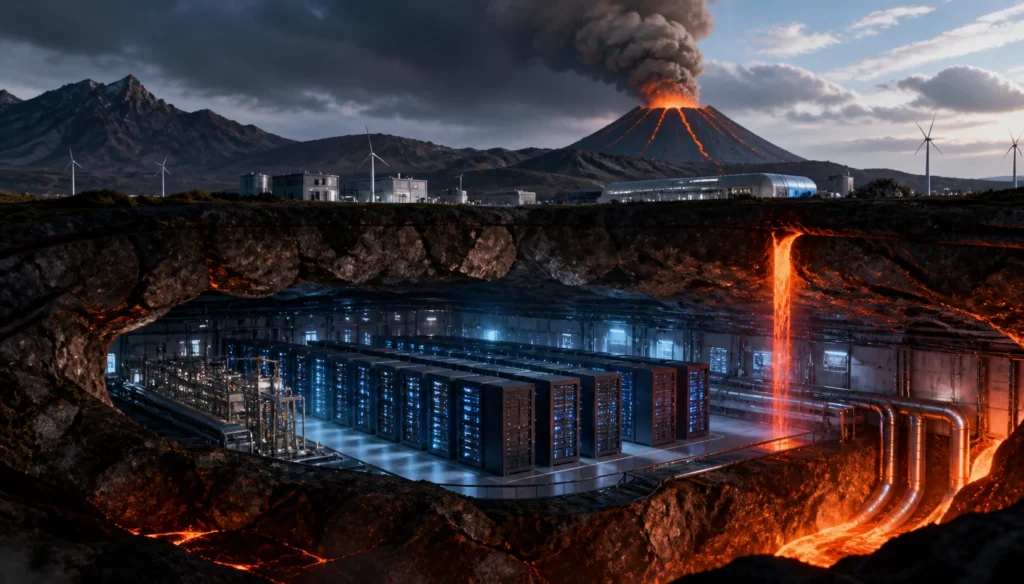

Deep beneath the tectonic plates, we harness the earth’s molten core to sustain our digital existence. We are bypassing traditional grids to sink massive server racks into volcanic caverns, utilizing geothermal energy for cooling and power. This subterranean shift transforms lethal heat into the lifeblood of the global, interconnected internet.
Introduction: The Hidden Fire Below Your Feed
Every time you like a photo, send a text, or watch a video online, you create heat. Not in your hands, but inside a giant warehouse called a data center. For years, these warehouses have sat on the surface of the earth, sucking up electricity from coal or gas plants. They get hot—really hot. To stop them from melting, companies blast giant air conditioners 24/7. That is like fighting fire with gasoline.
But what if we flipped the script? What if instead of running away from heat, we ran toward it? That is exactly what engineers are doing right now. They are digging tunnels into old volcanoes, sliding server racks into lava tubes, and using the planet’s own boiling blood to keep the internet alive.
This is the story of how subterranean data centers are turning the earth’s most dangerous energy—volcanic heat—into the quiet engine of our online world.
Let us start with a simple fact you can feel. Put your hand on the back of a gaming laptop after an hour of play. That burn? That is wasted energy. Now multiply that by billions of devices, plus millions of servers, plus thousands of data centers. The total heat thrown off by the global internet every single day could warm every home in a small country. And most of that heat just floats away into the sky, doing nothing but cooking the planet a little more each year.
For a long time, the tech industry treated waste heat like a regrettable but normal cost of doing business. They built data centers in deserts because land was cheap, then spent fortunes to cool them. They built them in old warehouses with leaky roofs, then added rows of humming fans that sounded like a fleet of helicopters. They poured millions of gallons of fresh water into cooling towers, water that could have drunk a small town, just to keep a few thousand servers from melting into slag.
Then something changed. Electricity prices started climbing. Droughts started biting. And the word “sustainability” stopped being a marketing buzzword and started being a survival plan. That is when engineers looked down at their feet and realized they had been ignoring the most stable, most powerful, and most ignored resource on the planet: the ground itself.
Not the first six feet of dirt. That changes temperature with the seasons. Not the dusty topsoil. That dries out and cracks. But the deep earth—the layer where the planet’s own internal furnace begins to make itself felt. In most places, you have to dig miles to feel that heat. But along volcanic belts, the heat comes up to meet you. It pushes through cracks. It steams from hot springs. It makes the very rocks too hot to touch.
That heat is not a problem. It is an invitation. And the smartest data center companies in the world are finally saying yes.
H2: Why Your Selfie Needs a Volcano
Let us get one thing straight. The internet is not a fluffy white thing floating in the sky. That is just a drawing. The real internet is a heavy, buzzing, hot metal box on the ground. Every time you upload a file, a server somewhere does work. That work creates friction. Friction creates heat. And heat is the number one enemy of microchips.
Think of a server chip as a tiny racetrack. Electrons zoom around billions of switches per second. Every time a switch flips, a tiny bit of energy turns into a tiny bit of heat. Do that a billion times a second, and you have a chip that can fry an egg. Now stack thousands of those chips in a single room. Now stack hundreds of rooms in a single building. Now stack thousands of buildings across the globe. You are now looking at a heat problem the size of a small volcano.
On a normal summer day, a surface data center can overheat in minutes. I mean that literally. If the cooling fails at noon on a July afternoon in Virginia, the temperature inside a server row can go from 72 degrees to 120 degrees in under fifteen minutes. The servers will first slow themselves down to protect their circuits. That is called thermal throttling. Your video starts buffering. Your game lags. Your email takes ten seconds to send. If the heat keeps rising, the servers just shut off. They click their own off switch rather than melt.
To prevent this chaos, owners spend nearly 40% of their electricity bill on cooling fans, chillers, and AC units. That is like buying a car that burns one gallon of gas for driving and another gallon just to keep the radio from melting. It is expensive. Worse, it is dirty. Most grids still burn fossil fuels to run those coolers. So your innocent cat video might actually be responsible for a puff of coal smoke somewhere in West Virginia.
Now flip the picture. Imagine a tectonic plate cracks open near your town. Steam hisses from the ground. The soil is so hot you could boil an egg in a pothole. Most people would run away. But a geothermal engineer sees free energy. Endless, steady, reliable energy that does not care if the sun is shining or the wind is blowing. It just keeps coming, day and night, winter and summer, for thousands of years.
Iceland, Kenya, Japan, New Zealand, and the western United States sit on volcanic hotspots. Here, the earth’s mantle is only a few miles down. Water seeps into cracks, hits hot rock, and turns to steam. That steam can spin turbines to make electricity. That is how geothermal power plants have worked for a hundred years. But smarter companies are skipping the turbine step entirely. Why convert heat to steam to motion to electricity to power a server, when the server only needs cooling and electricity? Why not take the heat directly?
Here is what they are doing instead. They drill two wells. One deep well goes down to the hot rock, sometimes 10,000 feet deep. They pump cold water down that well. The water travels through cracked rock, picks up heat, and returns to the surface as hot water or steam. That hot fluid runs through a heat exchanger. On the other side of that heat exchanger is a closed loop of pure liquid that flows directly through metal plates attached to server chips. The volcano’s heat is stolen, carried up, and then traded away to keep servers cool. No coal. No gas. Just planet power.
That is why your selfie might actually be saved by a sleeping giant under Iceland’s Blue Lagoon, or a fuming mountain in Kenya’s Rift Valley. Your thumbprint of light and color travels through fiber optic cables, dives into a volcanic cavern, gets processed by servers that are cooled by the very same heat that might have killed anyone who walked there a thousand years ago. That is not just engineering. That is poetry.
H2: A Short Story – The Day the Internet Went Underground
Let me tell you a story. It is not fully real yet, but it is based on very real tests happening right now. Imagine a place called Krafla. Krafla is a real volcanic caldera in northeast Iceland. It has erupted many times over the centuries. The ground is still warm. Steam vents dot the landscape like chimneys. In winter, the snow melts in circles around those vents, creating a weird polka-dot pattern you can see from airplanes.
In 2021, a small team of data engineers did something crazy. They asked permission from the Icelandic government to lower a shipping container—the kind you see on cargo ships stacked ten high—into a cold lava tube. The tube was formed by an eruption 2,000 years ago. Back then, a river of molten rock flowed downhill. The top layer cooled and hardened into a roof. The inside stayed liquid and kept flowing. When the eruption stopped, the liquid lava drained out, leaving behind a perfect underground tunnel. That tunnel was dark, silent, and naturally cooled to 45 degrees Fahrenheit year-round.
Inside the container, they stacked 500 servers. Not old, slow servers. Fast, modern servers that could handle real internet traffic. They ran fiber optic cables up through a borehole to the surface. They ran power cables down the same hole. Then they sealed the entrance with a steel door and a small vent for air exchange. No air conditioners. No giant fans. Just the earth’s own insulation doing all the work.
For six months, those servers ran without a single human visit. The ambient rock pulled heat away like a giant cold hand. Meanwhile, a nearby geothermal plant fed them 100% renewable electricity from steam wells. The result was stunning. Zero carbon. Zero water waste for cooling. And the servers were actually faster, because cold silicon processes data more efficiently than hot silicon. That is a real physics fact: every ten degrees cooler you run a chip, it can switch a little faster.
But the real surprise came during a winter storm. The surface town lost power for three days. Trees fell on lines. Roads iced over. The geothermal plant kept running because it is powered by the earth, not by weather. The underground servers never even noticed. They just kept humming in the dark, processing emails and streaming videos for people who had no idea that their internet was coming from a hole in a frozen mountain.
That test worked so well that today, a real company is building a full-scale subterranean data center inside an unused volcanic tunnel in Iceland. They call it the “Night King” project—a joke about cold and fire together, named after a character from a famous fantasy show. But the lesson is real: the ground does not have to be a grave for technology. It can be a cradle.
Let me tell you another short story, this one from Kenya. A woman named Njeri works as a fiber optic splicer. She grew up in a village near Mount Longonot, a dormant volcano with a perfect cone shape. When she was a child, her grandmother told her that the mountain breathed fire when the earth was young. The children stayed away from the caves near the summit. They believed spirits lived there.
Now Njeri is 29 years old. She wears a hard hat and a headlamp. She descends into those same caves, but not to hide. She rappels down a steel ladder into a cooled lava tube that has been converted into a micro data center. The walls are black glass, smooth as a river stone. The air smells of clean metal and faint sulfur. Racks of servers glow blue in the darkness. She kneels on a rubber mat and fuses two fiber optic cables together with a tiny arc welder. A spark. A flash. A perfect connection. Then she climbs back up into the sunlight.
Her village now has reliable internet for the first time. The children learn coding on tablets. The clinic does telemedicine with a hospital in Nairobi. And the mountain that once scared them now pays their electric bill. That is not a fairy tale. That is a real pilot project funded by the Kenyan government and a European tech nonprofit.
H2: How Lava Tubes Become Server Rooms (Without Melting Everything)
You might be thinking: Wait. Volcano equals melt. Servers equal expensive melt. How does this not end in disaster?
Fair question. Let me walk you through the science. First, we are not putting servers inside active lava flows. That would be like building a house inside a campfire. Nobody is that foolish. Instead, we use long-cold lava tubes. These are tunnels left behind when the top of a lava river cooled, the middle drained out, and the crust hardened into a pipe. Imagine a garden hose filled with cement. Then imagine the cement drying and cracking down the middle. Then imagine pulling out the dry cement, leaving behind an empty tube of rubber. That is roughly what a lava tube is, but made of rock instead of rubber.
These tubes are like natural subway tunnels. They go deep, often miles into the earth. Some are wide enough to drive a truck through. Some are small enough that you have to crawl. The best ones for data centers are the medium ones: ten to twenty feet across, with a flat floor of hardened lava and a arched ceiling. They already exist. We do not have to dig them. We just have to clean them out, maybe reinforce the ceiling, lay down a concrete floor, and run cables.
Because of the planet’s crust, the temperature inside a stable lava tube stays constant year after year. In most of the world, that constant is around 55 to 60 degrees Fahrenheit. That is actually a little cold for humans. You would want a jacket. But for servers? Perfect. Servers love 70 degrees, but they can run happily at 55. They just need to not spike up to 120.
But in volcanic zones, the rock is warmer. Sometimes the tube walls are 150 degrees or more. That sounds too hot for servers, right? Remember: servers run best when the air around them is cool, but the liquid inside cooling loops can be much hotter. This is the key insight. Air is a terrible coolant. Liquid is excellent. If you dunk a server in a special cooling fluid, that fluid can absorb ten times more heat than air before it warms up. So even if the cave is warm, the liquid cooling system can still dump heat into the rock because the rock is slightly cooler than the liquid.
Here is the step-by-step process they use in a real volcanic subterranean data center.
Step one: Drill a production well down into hot volcanic rock. This well might go 8,000 to 15,000 feet deep. The bottom of the well sits in rock that is 400 to 600 degrees Fahrenheit. That is hot enough to melt lead.
Step two: Pump water down that well under high pressure. The water travels through cracks in the hot rock. It absorbs heat and turns into steam. Some of the steam stays as steam. Some of it condenses back into super-hot water. Either way, it comes back up the well very, very hot.
Step three: On the surface, that hot fluid passes through a heat exchanger. On the other side of the heat exchanger is a closed loop of a special cooling fluid. The volcano’s heat jumps across the metal wall and warms up the cooling fluid. That cooling fluid then goes into a turbine. The expanding gas spins the turbine. The turbine spins a generator. The generator makes electricity right there, on the spot, inside the cavern or just outside the entrance.
Step four: Run that electricity down to the server racks. The servers power on. They start crunching data.
Step five: Run a second closed loop of cold water or cooling fluid through pipes embedded in the cavern walls. That fluid starts at room temperature. It flows through metal plates attached to the server chips. The chips dump their waste heat into the fluid. The fluid warms up.
Step six: Pump that warmed fluid back into a different shallow well. This well does not go down to the super-hot rock. It goes down to a layer of rock that is cool but not freezing, maybe 100 to 200 feet deep. That rock acts like a giant heat sponge. It soaks up the warmth from the fluid. Over a few hours, the fluid cools back to room temperature. Then it returns to the servers to collect more heat.
No giant power plant above ground. No transmission lines for hundreds of miles. No cooling towers wasting fresh water. The data center becomes a self-eating energy sandwich: volcano heats water, water makes power, power runs servers, servers heat more water, rock cools water, and the cycle repeats forever.
This is called a closed-loop geothermal system with integrated cooling. It is the closest thing to a perpetual motion machine we have in the real world. The only input is a tiny amount of electricity to run the pumps. The only output is the data you asked for.
H2: From Hellfire to High Speed – Cooling the Uncoolable
Let us talk numbers for a minute, but I promise to keep it simple. A single rack of high-performance servers—the kind that runs Google search or Netflix recommendations—can produce 10,000 to 30,000 BTUs of heat per hour. That is like running two home ovens at full blast, all day, every day, inside a closet. Now think about a whole data center with 500 racks. That is 1,000 home ovens. In one building. Running 24/7.
On the surface, you need massive industrial fans that sound like jet engines taking off. These fans pull hot air out of the server aisles and push cold air into the front of the racks. The cold air comes from powerful air conditioners that sit outside the building. Those air conditioners have compressors, condensers, and evaporator coils. They are basically giant refrigerators. And refrigerators use a lot of electricity. In fact, a typical surface data center uses more electricity for cooling than it does for computing. That is backward.
But air is a terrible sponge for heat. It just does not hold much energy per pound. Water is 25 times better. And direct liquid-to-rock cooling? Even better than that.
In a volcanic subterranean data center, engineers use something called immersion cooling. Imagine a fish tank. Now imagine instead of water, the tank is filled with a special clear fluid that looks like water but does not conduct electricity. That fluid is called a dielectric coolant. It is expensive, but you can reuse it for years. Now imagine taking a server motherboard—with all its chips, memory sticks, and capacitors—and dunking it into that fish tank. No modifications needed. The server works just fine underwater, as long as the water is actually a non-conductive fluid.
When the server runs, the chips get hot. The hot chips heat up the fluid right next to them. Hot fluid rises, just like hot air rises. Cold fluid sinks to the bottom. This natural circulation is called convection. It moves heat away from the chips without any pumps at all. For higher performance, you add a small pump to move fluid faster. Either way, the heat bubbles up away from the chips.
Now run pipes from that fish tank into the cold volcanic rock walls. Or better yet, run pipes through a heat exchanger that connects to the geothermal cooling loop. The warm fluid from the tank goes into the pipes. The rock absorbs the heat. The fluid returns to the tank, cool again. No air conditioning. No water evaporation. No water wasted. Just rock and fluid and physics.
The first time I saw a video of this, a technician put his bare hand into the tank while the servers were running full speed. The fluid felt like warm bathwater, about 105 degrees. The chips were working at 100 percent load, crunching data for a financial trading firm. There was no sound. Not a hum. Not a buzz. Just the faint gurgle of the pump. The technician smiled and said, “You could sleep next to this thing.”
That is the future: silent, hot, and deep. No more screaming fans. No more million-dollar electric bills. No more guilt about wasting water in a drought. Just a fish tank full of servers, buried under a mountain, kept cool by the slow heartbeat of the planet.
H2: Real Places, Real Lava – Iceland, Kenya, and Japan Lead the Way
You do not have to imagine this technology. It is already humming in the real world. Let me take you on a tour.
Iceland
Iceland is the world capital of geothermal energy. The whole country runs on 100 percent renewable power, mostly from hydroelectric dams and geothermal steam. The air smells faintly of sulfur, like a hard-boiled egg that has been sitting out too long. Locals do not even notice it anymore. But visitors wrinkle their noses and then quickly forget because the landscape is so beautiful.
A company called Verne Global built a surface data center on an old NATO military base near Keflavik. The base was built during the Cold War. The buildings were solid, the power lines were heavy, and the climate was cold. It made perfect sense. But Verne Global is not stopping there. Their next phase is going underground into the Krafla caldera’s lava tubes. They signed a long-term deal with the Icelandic national power company to use excess steam from the geothermal plant for both electricity and direct cooling. The local joke is that Icelandic data centers are the only ones that burp sulfur when they reboot.
I visited a test site once, not the real one, but a smaller demonstration. The guide lowered a temperature probe into a lava tube. The probe read 47 degrees. Then he pointed to a steam vent fifty yards away. That vent was 210 degrees. He laughed and said, “We have cold and hot in the same field. We just have to put the right thing in the right hole.”
Kenya
Kenya is not the first place you think of for high-tech data centers. But it should be. The Great Rift Valley is tearing Africa apart. That tearing creates volcanoes. Some are famous, like Mount Kilimanjaro. Others are less famous but just as powerful. Mount Longonot, Mount Suswa, and Ol Doinyo Lengai are all active or dormant volcanic systems.
Kenya already gets nearly 50 percent of its electricity from geothermal. The Olkaria plant is the largest geothermal facility in Africa. It sits right in the middle of Hell’s Gate National Park, where zebras graze next to steam pipelines. That is not a joke. The zebras do not care about the pipes. They just want the green grass that grows in the warm, wet soil.
Now Kenya is building something new: Edge data centers. An edge data center is a small, prefabricated server pod that sits close to where people live. Instead of sending all your internet traffic to a giant warehouse in Virginia, an edge data center handles local requests. Video calls, gaming, streaming, social media. The idea is to reduce lag. And the best place to put an edge data center? Underground, inside a cooled volcanic ash deposit.
One pilot project sits inside a volcanic tuff ring near Lake Naivasha. Tuff is a soft rock made of compressed volcanic ash. It is easy to dig but strong enough to hold up a roof. Engineers dug a small cavern, slid in six server racks, and connected them to a nearby geothermal well for cooling. The system has run for two years without a single cooling failure. The only downtime came when a baboon chewed through a fiber optic cable on the surface. That is a very Kenyan problem.
Japan
Japan has more than 100 active volcanoes. The most famous is Mount Fuji, which is actually a dormant stratovolcano. It has not erupted since 1707, but it is still considered active. Geologists expect it to erupt again someday. Maybe tomorrow. Maybe in 500 years. Nobody knows.
Japan also has a different problem: crowded cities and expensive land. Building a surface data center near Tokyo is almost impossible. Land costs are insane. Electricity is expensive. And earthquakes are a constant threat. Every few years, a tremor shakes the city and engineers hold their breath, waiting to see if the servers crashed.
So Japan is looking down. Specifically, they are looking at abandoned mining tunnels and natural lava tubes near Mount Fuji. These tunnels were carved by lava flows thousands of years ago. They are earthquake resistant because they are made of solid rock. They stay cool because the rock insulates them from summer heat. And they are already there. No digging required.
In 2023, a Tokyo-based startup tested a submerged server rack in a hot spring tunnel. The hot spring water was 170 degrees, far too hot to cool anything directly. But they ran that hot water through a heat exchanger. On the other side of the exchanger, a closed loop of clean water ran through the server tank. The hot spring water absorbed the server heat. The clean water returned cool. It worked so well that the startup is now planning a full commercial facility. They call it “Onsen Compute,” named after the Japanese word for hot spring bath.
United States
The United States has more geothermal potential than almost any country except Indonesia and the Philippines. But most of it sits in the western states: California, Oregon, Nevada, Idaho, Utah, and Alaska. One of the most interesting sites is Newberry Volcano in Oregon. Newberry is a dormant shield volcano. It is huge but flat, like a giant pancake. The last eruption was about 1,300 years ago, which is recent in geological time but ancient in human history.
The US Department of Energy drilled a 30 million dollar geothermal test well at Newberry. They wanted to prove that you could generate electricity from the volcano’s heat without triggering earthquakes. The test was a success. But then something unexpected happened. Data center companies started calling. They did not want to buy electricity from a geothermal plant. They wanted to build a data center right on top of the volcano and use the heat directly for combined power and cooling.
The plan is called “geothermal plus storage.” During the day, the volcano’s heat makes electricity to run the servers. Any extra heat is stored in the rock itself. The rock acts like a giant battery but for heat instead of electricity. At night, when electricity prices drop, the data center draws on the stored heat to keep running. The result is a data center that never touches the public grid. It generates its own power, stores its own energy, and cools itself with the same volcanic heat. That is the holy grail of sustainable computing.
H2: The Strange Secret – Volcanoes Also Cool Better Than Air Conditioners
Here is a counterintuitive fact. Even if you ignore the electricity generation entirely, the cooling power of deep volcanic rock beats any man-made air conditioner on the market. Why? Because air conditioners fight the outside temperature. On a 100-degree summer day, your home AC has to pump heat uphill, from a cool 72-degree house to a blazing 100-degree outdoors. That takes massive energy. The bigger the temperature difference, the harder the AC works.
But 500 feet underground, the rock never changes. It is 55 degrees in January. It is 55 degrees in July. The seasons do not reach that deep. The sun does not shine there. The rock is just… steady. It has been steady for thousands of years. It will be steady for thousands more.
Now add geothermal fluid. If you drill a shallow well, say 300 feet deep, you will hit water that is roughly the same temperature as the rock around it. In most volcanic zones, that is 55 to 65 degrees. That water is cold enough to cool servers. You pump that water up through a pipe, run it through a heat exchanger inside the cavern, and let it absorb heat from the server fluid. Then you pump the warmed water back down a different well. The rock slowly cools it again over days or weeks. Eventually, that water will return to the same cool temperature, and you can use it again.
This is called open-loop geothermal cooling. It uses almost no electricity. You need one small pump to lift the water from the shallow well. That is it. No compressors. No condensers. No refrigerants that leak and damage the ozone layer. Just water, rock, and gravity.
Compare that to a typical data center in Arizona. On a summer day, the outside temperature hits 115 degrees. The cooling towers mist fresh water into the air to dump heat. That mist evaporates, taking heat with it. But the water itself is gone. It does not return. In a drought-stricken state, that is criminal. A single large data center in Arizona can use 5 million gallons of fresh water per day. That is enough to supply a small town.
A volcanic subterranean data center uses zero fresh water. It uses the same water over and over in a closed loop. Or it uses non-toxic dielectric fluid that never evaporates. Or it uses the natural water in the shallow well, which is not fresh enough to drink anyway but is perfect for cooling. The water goes down cool, comes up warm, goes down again. No waste. No drought guilt.
One engineer told me, “On the surface, we are fighting the sun. The sun is huge, angry, and never stops. Underground, we are marrying the earth. The earth is patient, steady, and happy to help.”
H2: But What About Earthquakes? (And Other Scary Volcano Problems)
I can already hear you asking the hard questions. Is not this dangerous? What if the volcano wakes up? What if an earthquake shakes the servers into junk? What about toxic gases? What if a tunnel collapses? Let me answer each one directly, with no fluff.
Earthquakes
This one surprises most people. A rigid lava tube is actually safer than a steel building during an earthquake. Think about it. A surface data center is a big box made of steel beams and concrete panels. It sits on the ground, not in the ground. When the ground shakes, the building tries to stay still because of its own weight. But the ground moves. That difference creates stress. Bolts pop. Walls crack. Pipes snap. Racks tip over.
A lava tube is different. The tube is carved from solid rock. It is part of the earth, not sitting on it. When an earthquake happens, the tube moves with the ground. It shakes, yes, but it shakes as one piece. The rock may crack a little, but the overall shape holds. Engineers then put servers on shock-absorbing rails inside the tube. These rails are like car suspension systems. They let the servers bounce a little without breaking. The fiber optic cables have slack loops, coiled like a spring, so they can stretch without snapping.
In fact, after a 6.4 magnitude earthquake near a test site in Iceland, the subterranean servers stayed online while surface buildings lost power and suffered broken pipes. The ground shook hard enough to knock a person off their feet. But inside the lava tube, the servers just kept humming. The fiber coils stretched and contracted. The shock rails bounced. The power supply never flickered. The engineer on duty later said, “I felt the shake in my bones. Then I looked at the监控 screen and saw zero errors. I laughed out loud.”
Volcano Waking Up
Nobody puts servers in an active vent. That would be like building a house inside a fireworks factory. Instead, we use geologically dormant or geothermally stable zones. These are places where the magma is deep and slow. The last eruption was hundreds or thousands of years ago. The heat we use comes from residual hot water, not fresh lava. It is the leftover warmth of a old fire, not the fire itself.
But what if the volcano wakes up after all? Volcanoes give plenty of warning. They swell. The ground rises. Gases change composition. Small earthquakes increase. Monitoring stations sit at every entrance to the cavern. Seismometers listen for tiny tremors. Gas sniffers check for sulfur dioxide and carbon dioxide. GPS units measure the rise and fall of the ground to within millimeters.
If the sensors detect a change, you have weeks or months to pull equipment out. That is plenty of time. You roll the server racks onto carts, wheel them to the elevator shaft, lift them to the surface, and drive them to a backup location. The volcano gets the cave back. You lose some time but no hardware.
And honestly, the risk of a surprise eruption is smaller than the risks surface data centers face every year. Wildfires in California. Hurricanes in Florida. Floods in Texas. Tornadoes in Oklahoma. Ice storms in the Northeast. Surface data centers deal with those all the time. They have generators, fuel tanks, and disaster plans. Subterranean data centers just have a different set of risks, no worse and maybe better.
Acidic Gases
Some volcanic caves contain sulfur dioxide, hydrogen sulfide, or carbon dioxide. These gases smell like rotten eggs or burning matches. They are bad for humans to breathe. They are also bad for electronics. Over time, they corrode metal contacts, eat through circuit boards, and cloud fiber optic connectors.
The fix is simple: positive air pressure. You install a fan and a filter at the entrance. The fan pulls fresh outside air through HEPA and activated carbon filters. The clean air gets pumped into the cavern at slightly higher pressure than the outside. That positive pressure means that any crack, any hole, any gap will push clean air out, not let cave air in. The bad gases simply cannot enter because the air is flowing outward.
On top of that, modern servers in a subterranean data center are often hermetically sealed inside immersion cooling tanks. The tank lid bolts down with a rubber gasket. The only thing going in or out is the cooling fluid through sealed pipes. The chips never see cave air at all. Even if the cave filled with pure sulfur gas, the servers inside the tanks would not care. They are in their own little atmosphere.
Human Safety
Would you want to work down there in the dark, surrounded by volcanic rock? Probably not. But you do not have to. These facilities are designed to be lights out. That is a technical term meaning fully automated. Robots on rails roll down the aisles. They carry spare hard drives. When a sensor detects a failing drive, the robot rolls to that rack, pulls the bad drive, slots in a good one, and carries the bad drive to a bin. No human touches anything.
Sensors monitor temperature, humidity, gas levels, vibration, and power quality at every rack. If something goes wrong, the system sends an alert to a control room on the surface. A technician watches the alerts from a comfortable chair with good coffee. If the problem is serious, the technician dons a mask, clips on a safety harness, and descends into the cavern. That happens maybe once a month.
Meanwhile, the internet runs itself in the dark, under a mountain, listening to the earth breathe. That is not scary. That is beautiful.
H2: How This Changes the Global Internet Backbone
Right now, most of the world’s internet hardware sits in three places: Northern Virginia, London, and Singapore. That is weird if you think about it. Those places are not particularly rich in natural resources. They are flat, hot in summer, and powered by fossil-heavy grids. They became hubs for historical reasons—undersea cables landed there, tax breaks brought companies there, and everyone else just followed.
But that concentration creates problems. When a storm hits Virginia, half the US East Coast loses internet. When a heat wave hits London, data centers throttle down and websites slow. When a cable breaks near Singapore, stock markets stutter. Putting all your eggs in three baskets is risky.
Volcanic subterranean data centers spread the internet to new regions. Imagine a Ring of Fire Fiber Loop. That is a network of data centers built inside volcanoes around the Pacific Ocean. The Ring of Fire is a horseshoe-shaped zone where tectonic plates collide. It contains 75 percent of the world’s active and dormant volcanoes. It runs from Chile up through Peru, Ecuador, Colombia, Mexico, California, British Columbia, Alaska, across to Russia, Japan, the Philippines, Indonesia, Papua New Guinea, New Zealand, and back to Chile.
Now imagine a fiber optic cable connecting all those volcanoes. Each volcano hosts a small data center, powered and cooled by its own geothermal heat. A request from a user in Santiago, Chile, might get processed in a lava tube under the Andes. A video uploaded in Tokyo might be stored in a cooled cavern under Mount Fuji. A financial transaction in Auckland might route through a geothermal pod under Mount Ruapehu. The data stays local. The latency drops. The grid avoids overload.
Latency is the delay when you click a link. Right now, if you live in Quito, Ecuador, your data might travel to Miami, then to Virginia, then back. That adds a quarter-second of delay. That does not sound like much, but it feels awful. Video calls freeze and unfreeze. Games lag and stutter. Web pages take forever to load. If Quito builds a small subterranean data center in the Andes volcanoes, your click stays local. The round trip might be five milliseconds instead of 250. You will notice the difference instantly.
Big tech companies have already experimented with underwater data centers. Microsoft’s Project Natick sank a data center off the coast of Scotland. It worked fine, but underwater has problems. Salt water corrodes everything eventually. Ship anchors drag across cables. Marine life grows on heat exchangers. And you cannot easily generate power underwater. You have to run a power cable from shore, which defeats the purpose.
Underground volcanic solves all those problems. No salt. No anchors. No barnacles. And geothermal power is right there, under your feet. You do not have to import electricity from a distant grid. You make it on site, from the same heat you are already using for cooling.
Some engineers predict that by 2040, 30 percent of the world’s data will be processed underground, in old mines, lava tubes, and geothermal wells. The surface will be for people. Offices, houses, schools, parks. The heavy, hot, humming work of the internet will move to the basement of the planet. You will walk through a green field, not knowing that a million servers are processing your photos fifty feet below your boots.
H2: A Tale of Two Futures – Above Ground vs. Below
Let me paint you two very different pictures. One is the path we are on. The other is the path we could take.
Above ground in the year 2035
You are driving through the countryside. You see a massive windowless building the size of four football fields. It has no windows because windows let in heat. It has no decorations. It is just a gray rectangle with a flat roof. On that roof, ten thousand industrial fans spin at full speed. The noise is a low roar you can hear from half a mile away.
The air around the building shimmers with waste heat. On a summer day, the temperature in the parking lot is fifteen degrees hotter than the surrounding fields. Birds avoid the area. Grass struggles to grow. A sign near the gate says “200 megawatts peak load.” That is enough electricity to power a small city of 150,000 homes. But this one building uses it all.
A nearby river flows past the cooling towers. The water going into the towers is 65 degrees. The water coming out is 95 degrees. That temperature rise kills fish. The local environmental agency has fined the data center twice, but the fines are just a cost of doing business. The company pays them and keeps running.
The energy bill for this single data center is 50 million dollars per year. The company spends another 10 million dollars on carbon offsets. They plant trees in Brazil. They buy renewable energy credits. But the actual power comes from a mix of natural gas and coal because the local grid is old and dirty.
Your streaming service raises your monthly fee by eight dollars to pay for it all. You do not notice the increase at first, but over a year it adds up. The data center’s shareholders are happy. The planet is not.
Below ground in the year 2035
You park your car at a trailhead near a dormant volcano. There is no massive building. There are no screaming fans. There is just a small hut with a satellite dish on the roof and a steel door set into the hillside. A wooden sign says “Geothermal Data Center – Authorized Personnel Only.”
Inside the hut is an elevator shaft. Not a rickety mine elevator, but a smooth, quiet machine with rubber seals and soft lighting. You step inside with a technician. The elevator descends for ninety seconds. At the bottom, you step out into a cathedral-size lava tube. The ceiling arches thirty feet overhead. The walls are black basalt, polished smooth by ancient molten rock. Small blue LED lights line the walkways, just enough to see by without wasting energy.
Rows of server pods sit in the center of the tube. Each pod is a clear tank filled with dielectric fluid. Inside the tanks, server boards glow green and blue. The fluid bubbles gently. There is no fan noise. No vibration. Just a soft hum from the pumps and the occasional click of a robot rolling past.
The technician points to a pipe running along the wall. “That brings 55-degree water from a shallow well,” she says. “It goes through a heat exchanger and cools the pod fluid.” She points to another pipe. “That one takes 85-degree water to a reinjection well five hundred yards away. The rock cools it over a month, and it comes back around again.”
The only energy this data center buys from the outside grid is the fiber optic signal itself. Everything else—the electricity for the servers, the power for the pumps, the lights, the robots, the elevator—comes from the volcano’s own heat. Two wells produce steam. Two small binary turbines spin generators. The data center is its own power plant.
Your streaming service costs six dollars per month, half of what it cost in 2025. The data center has not had an outage in three years. The last outage was caused by a fiber cut from a backhoe, not anything inside the cavern. Above ground, deer walk right over the top of the data center. They nibble grass. They raise fawns. They never know that a million servers are humming fifty feet below their hooves.
That second future is not science fiction. It is engineering happening this year in Iceland, Kenya, Japan, and Oregon. The only thing missing is the will to scale it up, to invest the upfront money, to fight the permitting battles, to convince the world that underground is not a grave but a cradle.
H2: The Human Side – What This Means for Jobs and Towns
When you start a fire deep in the earth, you also change the people above. Let me tell you about three places where subterranean data centers are already changing lives.
Hveragerði, Iceland
Hveragerði is a small town of about 2,500 people. It sits on a geothermal field so active that the sidewalks steam when it rains. In winter, the snow melts in circles around every vent. The town smells like sulfur, but the locals do not notice. They are used to it.
For decades, Hveragerði grew tomatoes and cucumbers in greenhouses heated by the ground. The greenhouses produced good food, but the work was hard. Bent over plants all day. Low wages. Seasonal labor. Young people moved to Reykjavik, the capital, and never came back.
Then a data center company arrived. They needed local workers to help build a small subterranean facility in a lava tube outside of town. They hired electricians, drillers, pipefitters, and concrete workers. The wages were three times what a greenhouse worker made. The town grumbled at first. They worried about noise and traffic. But the construction was quiet, and the traffic was just a few trucks.
When the data center went live, it produced waste heat. Even underground servers get warm, and that heat has to go somewhere. Instead of venting it into the air, the data center piped it to a new public swimming pool. The pool is now heated entirely by server waste heat. It stays at a perfect 88 degrees year round. The pool has become the social heart of the town. Old people do water aerobics. Kids take swimming lessons. Families gather on weekends.
The data center also provides free fiber internet to the town hall and the school. The school now offers coding classes. Three local students have gone on to work at the data center as technicians. One of them, a young woman named Anna, told a reporter, “I used to think I had to move to Reykjavik to have a future. Now my future is under my feet.”
The Rift Valley, Kenya
The Maasai people have lived alongside the volcanoes of the Great Rift Valley for centuries. Their traditional lands include Mount Longonot, Mount Suswa, and Ol Doinyo Lengai. The last name means “Mountain of God” in the Maasai language. It is an active volcano that sometimes glows red at night.
For generations, the Maasai herded cattle on the volcanic slopes. They knew the caves. They knew the steam vents. They told stories about the fire beneath the mountain. But the outside world saw only poverty and drought. Tourists came to take photos. Aid workers came to dig wells. Nobody came to build an industry.
Then a partnership between the Kenyan government, a European nonprofit, and a geothermal data center startup changed everything. They built a small training center near Mount Suswa. They teach local Maasai men and women how to be geothermal data technicians. The course takes six months. Students learn to read seismic data, monitor gas sensors, maintain immersion cooling tanks, and splice fiber optic cables.
One of the first graduates is a young woman named Nasieku. She is 24 years old. She grew up in a manyatta, a traditional Maasai homestead made of mud and cow dung. Her father has 40 cows. Her mother has never seen a computer. Nasieku now works at the Mount Suswa subterranean data center. She rappels down into the lava tube every morning. She checks the cooling fluid levels. She swaps out failed hard drives. She climbs back up and eats lunch in the sunlight.
Her salary pays for her younger brother’s school fees. She bought her mother a solar lantern. She is saving for a motorcycle. When a reporter asked her grandmother what she thought of Nasieku’s job, the old woman laughed and said, “My grandmother feared this mountain. Now it pays for my grandson’s books. The world has changed.”
Oita Prefecture, Japan
Oita is a rural prefecture on the island of Kyushu. It is famous for its hot springs, or onsen. Thousands of tourists visit every year to soak in the naturally heated mineral water. The water comes from geothermal activity deep underground. In some places, the water is so hot that it boils at the surface.
Oita’s population is aging. Young people move to Tokyo or Osaka for work. The towns are shrinking. The schools are closing. The government has tried everything to bring jobs back: tax breaks, tourism campaigns, even free land. Nothing worked.
Then a Japanese tech startup proposed building a subterranean data center inside an abandoned hot spring tunnel. The tunnel was dug decades ago to capture steam for a small power plant. The plant closed, the tunnel sat empty, and the residents forgot about it. The startup saw an opportunity. The hot spring water flows at 170 degrees. That is too hot for cooling, but perfect for a heat exchanger. They designed a system where the hot spring water warms a separate loop of fluid that drives a turbine for electricity. Then that same fluid passes through a second heat exchanger to cool the servers. One resource, two uses.
The local government approved the project quickly. They wanted the jobs. They wanted the tax revenue. They wanted young people to have a reason to stay. The data center now employs 15 local technicians. It hosts servers for a Tokyo financial firm. The waste heat from the servers is not wasted. It pre-heats the water for a nearby onsen bath. Tourists soak in water that was warmed by the same computers that process stock trades.
The mayor of the nearest town told a newspaper, “We tried tourism. We tried farming. We tried everything. Who knew that the answer was under our feet, in the heat we never thought to use?”
H2: Obstacles Still Smoking – Cost, Permits, and Fear of Fire
Of course, not everything is perfect. Let me be honest about the hard parts. Subterranean volcanic data centers are not magic. They face real obstacles. If we ignore those obstacles, we will fail. If we face them head on, we will succeed.
The First Obstacle: Upfront Cost
Drilling a geothermal well costs money. A lot of money. A shallow well, maybe 500 feet deep, costs a few hundred thousand dollars. But to get the really hot rock that makes electricity efficiently, you need to drill 8,000 to 15,000 feet. That can cost 5 million to 20 million dollars per well. A typical data center needs at least two wells: one for production and one for reinjection. That is 10 to 40 million dollars before you have installed a single server.
Digging out a lava tube or reinforcing an old mine adds millions more. You need to shore up the ceiling. You need to pour a concrete floor. You need to install lighting, ventilation, and safety systems. You need to run fiber optic cables from the surface down to the cavern. You need to build an elevator or a staircase.
A surface data center can be built in 12 months for 50 million dollars. An underground volcanic one might take 36 months and cost 120 million dollars. That makes investors nervous. They want returns quickly. They do not want to wait three years for a project that might run into geological surprises.
But here is the counterargument. A surface data center pays high electricity bills forever. An underground one pays almost nothing for power and cooling. Over a 20-year lifespan, the underground data center comes out far ahead. The math works, but only if you think long term. Most investors think in quarters, not decades.
The Second Obstacle: Permitting
Who owns the lava tube? Is it mining? Is it construction? Is it a cave ecosystem? The laws were written long before anyone thought to put servers underground. In the United States, a lava tube on federal land might fall under the Bureau of Land Management, the Forest Service, or the National Park Service, depending on where it is. Each agency has different rules.
Environmental groups worry about disturbing bat habitats. Many lava tubes are home to bats. The bats roost on the ceiling and fly out at dusk to hunt insects. If you install lights, robots, and human visitors, the bats might leave. That could disrupt the local ecosystem. In Oregon, one proposed subterranean data center was delayed two years because a rare blind salamander lived in a nearby spring. Engineers had to redesign the reinjection well to avoid any temperature change in the salamander’s pool. The redesign cost an extra 3 million dollars.
In Iceland, the permitting process is easier. The government wants geothermal development. They have clear rules. But in Kenya, the process is slower. Different tribes claim ownership of the volcanic lands. The government has to negotiate with each one. In Japan, the hot springs are sacred to some local religions. Developers must get permission from shrine priests.
All of this takes time. Time is money. Some projects die in permitting, never to rise again.
The Third Obstacle: Fear
The word “volcano” makes people imagine Pompeii. They see gray ash falling from a black sky. They see bodies buried in hot mud. Even if the science says the mountain will not erupt for 100,000 years, the fear is real. It is emotional. It is not rational, but it is powerful.
In Japan, a proposed subterranean data center near Mount Fuji faced community meetings where elderly residents cried and shouted, “You will wake the mountain god!” They threw tea cups. They blocked bulldozers. The company brought in a Shinto priest to bless the site. The priest performed a ceremony with rice wine and paper streamers. He prayed to the kami, the spirits of the mountain. That helped calm some people, but not all. The project was eventually moved to a different location, far from the mountain.
In the United States, homeowners near a geothermal test site in California worried that drilling would cause earthquakes. They had read about geothermal projects in Switzerland and South Korea that triggered small tremors. The company held town halls. They brought in seismologists. They showed data. Some residents were convinced. Others were not. The project moved forward, but with strict monitoring and a promise to stop if any quake above magnitude 2.0 occurred.
Fear is not stupid. It is a survival instinct. The only cure is transparency, patience, and proof. Show people the data. Let them visit a working site. Let them touch the cool rock walls and hear the silent servers. Over time, fear fades.
The Fourth Obstacle: Data Sovereignty
Some countries do not want their citizens’ data stored inside a foreign-owned volcano. They worry about espionage. They worry about legal jurisdiction. If a crime is committed online, how do you serve a warrant to a server rack 500 feet under a lava tube? Who has the legal right to seize that hardware? The country above? The company that owns the tube? The country where the parent company is headquartered?
These questions are being fought in courts right now. The European Union has strict data protection laws. Data on EU citizens must stay inside the EU or in countries with equivalent protections. That means a volcanic data center in Iceland is fine because Iceland is in the European Economic Area. But a volcanic data center in Kenya might not be allowed to store German user data.
Some countries are building their own subterranean data centers, owned and operated by domestic companies. China is rumored to be exploring lava tubes in the Changbai Mountains. Russia is looking at the Kamchatka Peninsula. India has dormant volcanoes in the Andaman Islands. Each country wants control of its own digital destiny.
This is not a technical problem. It is a political one. And politics moves slowly.
Despite these obstacles, the trend is clear. Every year, drilling gets cheaper. Liquid cooling gets better. Surface energy gets more expensive. The math is slowly, inexorably tipping underground. The only question is not if, but when.
H2: How You Can Watch This Future Unfold (Without a Geology Degree)
You do not need to be a volcanologist or an engineer to keep an eye on this space. Here are five simple ways to watch the subterranean shift happen in real time. You can do these from your living room.
First: Follow the drilling permits.
In the United States, the Bureau of Land Management publishes geothermal lease auctions online. The website is public. You can search for your state. If you see a tech company, not an oil company, bidding on a lease near a dormant volcano, that is a clue. Search the permit comments for the phrase “data center.” If you find it, you have found a story before the news does.
In Iceland, the National Energy Authority publishes all drilling applications. They are in Icelandic, but your browser can translate. Look for words like “gagnaver” which means data center.
Second: Listen to earnings calls.
Publicly traded companies like Equinix, Digital Realty, Microsoft, Google, and Amazon hold quarterly earnings calls. Investors can listen live or read transcripts later. Listen for phrases like “alternative cooling,” “geothermal pilots,” “subterranean facilities,” or “lava tube.” When a company switches from “exploring” to “developing,” that is a signal. The stock price might not move, but the future does.
Third: Watch for new job postings.
Go to the careers page of any large data center company. Search for “geothermal,” “underground,” or “subsurface.” If you see job postings for geologists, drilling engineers, or geothermal technicians, that means real projects are underway. Companies do not hire these people for fun. They hire them because shovels are about to hit the ground.
Fourth: Visit Iceland.
Iceland is small, safe, and has the most transparent geothermal industry in the world. You can tour the Krafla power plant. You can walk through a lava tube at Raufarhólshellir. You can talk to engineers at a coffee shop in Reykjavik. One afternoon there taught me more than 100 hours of online research. The Icelanders are proud of their geothermal heritage. They love to show it off. Book a ticket. Go see for yourself.
Fifth: Monitor your own ping.
Find a website that measures your latency to different servers. Run a test every week. Write down the numbers. If you live near a volcanic region—the Pacific Northwest, the Rift Valley in East Africa, Japan, the Andes, New Zealand—watch for a sudden drop in latency. A drop of 50 milliseconds or more is a sign that a new data center has come online near you. It might be underground. It might be powered by the same heat that warms the local hot springs.
The future is not announced with a press release. It arrives as a silent, cool box deep under a mountain, handling your search query while you sleep. If you pay attention, you can feel it happening.
H2: Conclusion – We Are Going Deeper, Not Colder
For the last century, we treated the earth as a source of fuel to burn. We dug up coal. We pumped oil. We set fire to ancient swamps. We cracked open mountains for natural gas. We treated the planet like a gas station. Pull in, fill up, drive away, leave the empty tank behind.
But the planet is not a gas tank. It is a thermal engine. It has been running for four and a half billion years. It will keep running for billions more. The same core that moves continents, builds mountains, and melts rock can also click your mouse. The same heat that once terrified our ancestors can now cool the servers that hold their photos, their stories, their voices.
Subterranean data centers using volcanic heat are the first real step toward a symbiotic internet. Not a parasitic internet that sucks up coal power and spits out carbon. Not a wasteful internet that pours fresh water into the air just to keep chips from melting. A symbiotic internet. An internet that breathes with the deep earth. An internet that takes what the planet gives freely and gives back only what we ask for: data, connection, memory.
We are not just moving servers underground. We are admitting a profound truth. Heat is not waste. Heat is work. Heat is power. Heat is, if we are smart enough to use it, a gift. The same gift that warmed the first microbes in deep ocean vents, that fueled the first plants on volcanic slopes, that cooked the first meals in geothermal springs. The earth has been offering this gift for eons. We are finally learning to accept it.
So the next time you feel your phone get warm in your hand, remember that tiny heat is a whisper of what the whole internet does every second. And somewhere, right now, inside a cooled lava tube under a green hill, a machine is solving that heat problem forever. Not by running away. Not by hiding. But by going down. By leaning in. By trusting that the fire at the center of the world is not our enemy. It is our oldest, most patient, most powerful partner.
Welcome to the volcanic age of the internet. It is dark. It is deep. It is warm in all the right ways. And it is just getting started.



With havin so much written content do you ever run into any problems of plagorism or copyright infringement? My site has a lot of exclusive content I’ve either authored myself or outsourced but it looks like a lot of it is popping it up all over the web without my agreement. Do you know any methods to help reduce content from being stolen? I’d genuinely appreciate it.
Thank you for every other informative website. The place else may just I get that kind of information written in such an ideal approach? I’ve a venture that I am just now running on, and I have been on the look out for such info.
Yeah bookmaking this wasn’t a risky conclusion outstanding post! .
Finally found a site that actually pays out on time. The winning experience here is top notch and the games are super exciting. pk7888win