

The Video Store That Disappeared
Think back to 2005 for a moment. Imagine a Friday night. You are sixteen years old. You have just gotten your driver’s license. You have twenty dollars in your pocket from mowing lawns or babysitting. You drive to the local video store. The carpet smells like popcorn and plastic. Rows and rows of DVD cases stare back at you. You pick one movie. Maybe two if you are feeling rich. You walk to the counter. You hand over your cash. You drive home. You put the disc in the player. And you have to rewind if it is a tape. That was the deal. That was how entertainment worked for decades.
Now ask a seventeen-year-old about that process. Describe it in detail. They will probably laugh. Then they will look confused. Then they might ask why you did not just stream it. The idea of getting in a car, driving somewhere, and paying money for a physical object that only holds one movie sounds insane to them. It sounds like a history lesson. And in a way, it is.
A huge new study from Kantar and UC Berkeley has changed how we understand young people and their money. The researchers surveyed over 6,000 highly engaged entertainment fans across the United States, the United Kingdom, and Australia. These were not casual viewers or occasional gamers. These were people who live and breathe entertainment. They watch trailers the day they drop. They read reviews before buying. They talk about shows and games with their friends constantly.
The results show something clear and sharp. Gen Z does not play by the old rules. They love games. They love music. They love movies and TV shows. But they refuse to pay full price for most of them. And they have stopped buying physical copies almost entirely.
This is not a small shift in behavior. It is not a trend that will reverse next year. It is an earthquake. And the entertainment industry is still picking up the pieces.
The One Number That Explains Everything About Gaming
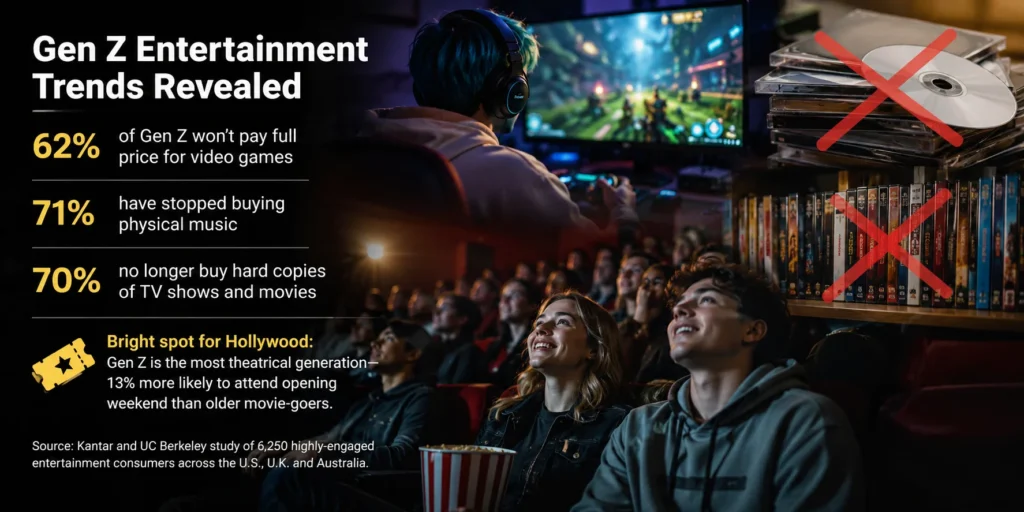
Let us start with the most stunning find from the study. According to the data, 62% of Gen Z will not pay full price for video games. Read that number again. Nearly two out of three young gamers will wait for a sale. They will buy used games from online marketplaces. They will subscribe to a service like Xbox Game Pass or PlayStation Plus. They will wait six months for a price drop. They will do almost anything except hand over $70 on launch day.
Now compare that to older gamers. People over thirty still grumble about high prices. They complain on Reddit and Twitter. They write angry reviews about microtransactions. But in the end, many of them still pay full price. They remember the old system. They remember saving allowance money for one big game every three months. They remember birthdays where the only gift they wanted was the newest Grand Theft Auto. That memory creates loyalty. It creates a willingness to pay.
Gen Z grew up completely differently. They grew up with free-to-play games like Fortnite, Apex Legends, and Roblox. These games cost nothing to download. They make money from skins and battle passes. A seventeen-year-old has never needed to pay $60 to have fun on a Saturday night. Why would they start now?
They also grew up with subscription services. For the price of one full game per month, they can access hundreds of games. Xbox Game Pass has over four hundred titles. PlayStation Plus has a massive library too. Paying full price for a single game when you could rent an entire library feels like throwing money away. And Gen Z hates wasting money.
A Generation That Knows the Value of Every Dollar
One easy mistake is to call Gen Z cheap. You hear this complaint all the time from older executives and frustrated marketers. “Kids these days just don’t want to spend money.” “They have no appreciation for quality.” “They expect everything for free.”
That is not fair. In fact, it is completely wrong.
Here is what is really happening. A thirty-five-year-old software developer sees a $70 game and thinks, “That is two dinners out. I can swing that. I work hard. I deserve a treat.” A nineteen-year-old college student sees that same $70 and thinks something very different. They think, “That is a week of groceries. That is three streaming subscriptions for an entire month. That is half my phone bill. That is almost two tanks of gas.”
Younger consumers have less disposable income. That is just a fact. Wages have not kept up with inflation for decades. Rent in most cities is absolutely insane. A one-bedroom apartment in a medium-sized city can easily cost $1,500 per month. Student loan debt is a nightmare that follows people for twenty years. Credit cards are scary. Savings accounts are empty.
So when Gen Z looks at a $70 video game, they do not see entertainment. They do not see a fun way to spend a weekend. They see a choice. A real choice with real consequences. Do I buy this game? Or do I pay my electric bill? Do I pre-order this sequel? Or do I put that money toward next month’s rent?
That is not being cheap. That is not being lazy. That is being realistic. That is being smart with very limited resources. And honestly, older generations could learn something from that mindset.
Why Waiting Feels Natural to Young Gamers
There is another layer to this story. Gen Z does not just wait for sales because they have less money. They wait because waiting feels normal to them. It feels like the smart move.
Think about how older gamers were trained. In the 1990s and 2000s, if you wanted a game, you bought it on launch day or you risked missing out. Physical copies sold out. Stores did not restock for weeks. If you waited, you might never get the game at all. There was no digital download. There was no “buy it later” button. There was just the store shelf and your wallet.
That scarcity mindset trained an entire generation to buy early and buy fast. It created FOMO before FOMO was a word.
Now flip the script. Gen Z has never known scarcity. Games are digital. They never sell out. You can buy Call of Duty on launch day at midnight. You can also buy it three years later with the same click of a button. There is no rush. There is no penalty for waiting.
In fact, there is a reward for waiting. A $70 game today will be $40 in three months. It will be $20 on a holiday sale. It might even be free on the Epic Games Store next year. One popular game gave away over fifteen free titles in a single year. Patience pays off directly. Gen Z knows this. They have seen it happen again and again.
The people pricing the games know this too. They have entire teams dedicated to pricing strategy. They know that younger players will wait. They know that older players will buy early. They build their business models around both groups. But they cannot change the underlying math. A digital game is not a limited resource. Waiting costs nothing. So why would anyone pay full price?
The Death of CD Shelves and DVD Racks
The study also looked at music and movies. The numbers there are just as dramatic. Actually, they are even more dramatic.
Seventy-one percent of Gen Z have stopped buying physical music entirely. That means no more CDs for the car. No more vinyl records for the bedroom wall. No more trips to the record store on Saturday afternoon. For seven out of ten young people, physical music is simply not part of their lives.
And it gets worse for movies and TV shows. Seventy percent no longer buy hard copies of TV shows and movies. No more DVD box sets of Friends. No more Blu-ray collections of the Marvel movies. No more special edition steelbooks that cost $50 and sit on a shelf forever.
Ask yourself a simple question. When is the last time you saw a teenager buy a CD? When is the last time you saw anyone under twenty-five walk out of a store with a physical album? If you cannot remember, that is the point. Physical media is not dying for Gen Z. It is already dead. It has been dead for years. They just never bothered to hold a funeral.
Now do not misunderstand. This does not mean Gen Z hates music. They love music. They listen to music constantly. They have headphones in during class, during work, during exercise, during chores. They make playlists for every possible mood. Driving playlist. Studying playlist. Crying playlist. Working out playlist. Falling asleep playlist. Hanging with friends playlist. Rainy day playlist.
But owning a physical album? That feels like owning a map when you have GPS. It is heavy. It takes up physical space in a world where space is expensive. A CD case is fragile. A vinyl record warps in the heat. And most importantly, you cannot carry two hundred CDs in your back pocket. You cannot switch from Taylor Swift to Kendrick Lamar without getting off the couch.
The same logic applies to movies and TV shows. Why buy a Stranger Things DVD box set when you can just open Netflix? Why store four seasons of The Office on a shelf when it lives on Peacock forever? Why spend $30 on a Blu-ray of a movie you will watch once when you could spend $15 on a streaming subscription for an entire month?
For Gen Z, owning a hard copy of a show feels about as useful as owning a fax machine. Or a landline telephone. Or a paper map. These things still exist. Some people still use them. But no young person looks at them and thinks, “Yes, that is the future I want.”
The Bright Spot That Surprised Everyone at Hollywood
Now here is where the story gets really interesting. If Gen Z hates paying full price for games, and refuses to buy physical media, and streams everything instead, then Hollywood must be terrified, right? Movie studios must be closing their doors. Theaters must be empty. The whole industry must be collapsing.
Not exactly. Not even close.
The study found something that made movie executives actually smile. Something that gave them real hope. Gen Z is the most theatrical generation. They are 13 percent more likely to attend opening weekend than older movie-goers.
Let that sink in for a moment. The same people who will not pay $70 for a video game will absolutely pay $15 for a movie ticket. The same people who will not buy a CD will stand in line for two hours to see a superhero film on Thursday night. The same people who refuse to own DVDs will drive thirty minutes to a theater, buy overpriced popcorn, and sit in a dark room with a hundred strangers.
Why? What is the difference?
The difference is experience. Going to the movies is not just about the movie. It is about the ritual. It is about the group text message that starts three days before. “Who is in for Thursday night?” “Which theater has the best seats?” “Are we doing dinner before or after?”
It is about the anticipation. The drive to the theater. The argument over which candy to sneak in. The debate about buttered popcorn versus regular. The scramble for good seats. The trailers that everyone talks over. The inside jokes that start during the movie and last for weeks.
You cannot stream that feeling. You cannot download that feeling. You cannot get that from a subscription service. The shared experience of opening night is something unique. It is something irreplaceable. And Gen Z craves it.
For this generation, the movie theater is a social event first and a viewing experience second. They go to be with people. They go to be part of something. They go because seeing a movie on Friday night and talking about it on Monday morning is still one of the best social glue activities ever invented.
And that is something Hollywood can actually build on. That is a bright spot. That is a reason for optimism.
What the Study Actually Looked At
Before we go any further, let us talk about the research itself. This is important because a lot of entertainment studies are paid for by companies with an agenda. A streaming service pays for a study, and shockingly, the study says streaming is great. A movie studio pays for a study, and amazingly, the study says going to the theater is important.
This study was different. Kantar and UC Berkeley ran the research independently. That means the brands paying for the research did not get to tweak the numbers. They did not get to remove embarrassing findings. They did not get to add fake positive results. The data is the data.
They surveyed 6,250 highly-engaged entertainment consumers across three major countries. That is a large sample size. That is enough people to be confident in the results. The countries were the United States, the United Kingdom, and Australia. These are wealthy, English-speaking nations with mature entertainment markets. The findings might be different in India or Brazil or Nigeria. But for the Western world, this is probably accurate.
And these were not casual fans. These were not people who watch one movie a month and call it a day. These were highly-engaged consumers. People who actually care about games, movies, and music. People who watch trailers on YouTube. People who read reviews before buying. People who talk about this stuff with their friends. People who plan their weekends around new releases.
So when these numbers say 62 percent of Gen Z will not pay full price for a game, that is not a casual gamer talking. That is someone who plays every week. That is someone who owns a console or a gaming PC. That is someone who knows exactly how much a game should cost. And they are saying no to $70. They are saying no to full price. And they are not looking back.
The Subscription Takeover That Nobody Saw Coming
How did we get here? How did a generation become so comfortable with not owning anything? Part of the answer is subscriptions. Subscriptions changed the entire mental model of entertainment.
Think about what a nineteen-year-old has access to today. For ten dollars a month, Spotify gives them millions of songs. Every album ever made by every artist they have ever heard of. Plus podcasts. Plus audiobooks on some plans. For fifteen dollars a month, Netflix gives them thousands of movies and TV shows. Add Disney Plus for another ten dollars. Add Max for another ten dollars. Add Hulu if you want. Add Apple TV Plus if you have an iPhone.
For gaming, Xbox Game Pass gives them hundreds of games for fifteen dollars a month. PlayStation Plus does the same. Even Nintendo has a subscription service now.
Add it all up. For less than the price of one full video game per month, a young person can access an almost infinite library of entertainment. They can watch ten movies. They can listen to a hundred albums. They can play twenty games. All for the same cost as buying one thing.
Older generations look at subscriptions and see an extra bill. Another monthly payment to track. Another auto-renewal to remember to cancel. Another small leak in the budget.
Gen Z looks at subscriptions and sees the main event. Why would you own one game when you can rent fifty? Why would you buy one album when you can stream everything ever made? Why would you purchase a movie when you can watch any movie at any time?
This is a completely different mental model. Older buyers think in terms of ownership. They want to hold something. They want to see it on a shelf. They want to know that it is theirs forever.
Gen Z thinks in terms of access. They do not want to keep things. Things are clutter. Things take up space. Things get lost or broken. They want to use things and then move on to the next thing. Access is freedom. Ownership is a burden.
The Used Game Market Is Back and Bigger Than Ever
Another factor that drives this behavior is the return of used games. Remember GameStop? Remember trading in three old games to get one new one? Remember the smell of that store? The walls of plastic cases? The creepy employee who tried to upsell you a warranty on a five-dollar game?
That model never really went away. It just went digital. And now it is bigger than ever.
There are online marketplaces where people sell digital game codes. Websites like Green Man Gaming, Fanatical, and others specialize in discounted codes. There are key-reseller sites where prices are even lower, though sometimes riskier. There are eBay listings for physical copies that include free shipping. There are Reddit forums where people trade codes directly.
Young gamers know all of these tricks. They know every single way to save money on a game. They will spend twenty minutes hunting for a discount code before they spend sixty seconds paying full price. This is not laziness. This is the opposite of laziness. This is effort directed at saving money.
And honestly? They are right to do all of this. A $70 game today will be $40 in three months. It will be $20 on a holiday sale in six months. It might be free on the Epic Games Store in a year. It might show up on Game Pass. It might be included with PlayStation Plus.
Patience pays off. Waiting is profitable. And Gen Z knows this better than any generation before them. The people who price the games know this too. They know that a certain percentage of players will always buy on day one. They know another percentage will wait. They price accordingly. But they cannot force someone to buy who does not want to buy.
What This Means for Game Developers
So what happens when 62 percent of your younger audience refuses to pay full price? What does a game developer do with that information? How do you stay in business when your customers are trained to wait for sales?
Game developers are already changing their strategy. They have been changing for years. And the changes are getting bigger and faster.
First, they are leaning heavily into “live service” games. These are games that launch for free or very cheap, then make money over time through battle passes, skins, emotes, dances, characters, weapons, and other cosmetic items. The base game costs nothing. The optional stuff costs everything.
Fortnite does this better than anyone. The game is free. But some players have spent hundreds of dollars on skins. Apex Legends does the same thing. VALORANT does the same thing. Even traditional franchises like Call of Duty have added battle passes and cosmetic stores. The old model was selling a game once. The new model is selling a game forever.
Second, developers are putting more games into subscription services on day one. Microsoft has been aggressive with this strategy. Xbox Game Pass costs fifteen dollars per month. Every Microsoft first-party game launches on Game Pass immediately. A game like Starfield costs $70 to buy. Or it costs $15 to play through Game Pass for a month. Most Gen Z players pick option two. They can beat most games in a month. Then they cancel. Or they keep the subscription for another game.
Third, developers are making games shorter. This sounds counterintuitive, but it makes sense. A forty-hour single-player epic is a harder sell than a ten-hour tight experience. Shorter games cost less to make. They can charge less money. Or they can charge the same amount but convince players that they are getting better value. “Ten hours of amazing gameplay” is a better pitch than “forty hours of filler.”
Fourth, developers are embracing discounts and sales as a core strategy. They know that most sales will happen during a discount period. So they plan their release dates around sales events. Launch in October? Great. That means a Black Friday discount in November. A Christmas discount in December. A New Year discount in January. The game is on sale more often than it is full price.
None of these fixes are perfect. Gamers still complain. Developers still struggle to make money. But these strategies are better than pretending $70 is fine. They are better than pretending Gen Z will change their minds.
The Music Industry Learned This Lesson Ten Years Ago
The music industry went through this exact pain ten years ago. Remember when everyone freaked out about streaming? Remember when Taylor Swift pulled her entire catalog from Spotify? Remember when artists blamed streaming for destroying their income? Those were the death throes of the old model. And the old model died.
Now streaming is completely normal. It is the default. It is how almost everyone listens to music. Artists have adapted. They do not make most of their money from recorded music anymore. That money goes to streaming services and labels. Instead, artists make their real income from touring, merchandise, and licensing.
The recorded music is basically a business card now. It is a way to get people interested. It is a way to build a fan base. People discover an artist on Spotify. They listen to the album for free. Then they buy a concert ticket for $50. They buy a t-shirt for $30. They buy a poster for $20. That is where the money is. Not in the $10 album download.
Gen Z understands this perfectly. They have never known any different. They do not feel guilty about streaming an album a hundred times without buying it. That is how the system works now. The $15 monthly Spotify fee is their “music budget.” Everything else is extra. If they really love an artist, they will go to a show. They will buy merch. But they will not buy the CD.
Physical copies? Vinyl has made a small comeback as a collectible. Young people do buy vinyl records sometimes. But they buy them as decorations. They buy them to hang on walls. They buy limited edition colored pressings as an art object. Most of them do not even own a record player. The vinyl is not for listening. It is for showing off.
CDs are different. CDs are not making a comeback. A CD is a relic. A CD is a coaster. A CD is something you find in your parents’ basement and laugh at. For Gen Z, a CD is about as useful as a floppy disk.
Hollywood’s Big Chance and Bigger Problem
The opening weekend number is good news for Hollywood. It is genuinely good news. Movie theaters were dying before the pandemic. Then the pandemic almost killed them completely. Then streaming grew even faster. Many people thought theaters would never recover.
But this study shows that young people still value the theater experience. They still want to go. They are even more excited about opening weekend than older people. That is a real opportunity.
However, this is not a cure-all. It does not fix every problem. Here is the real challenge. A movie ticket costs $15 on average. A movie theater snack costs another $15 if you get popcorn and a drink. That is $30 for two hours of entertainment. Maybe two and a half hours if the movie is long. Compare that to a streaming subscription that costs $15 for an entire month. The math is brutal.
So Gen Z will go to the theater for big events. They will show up for Barbie. They will show up for Oppenheimer. They will show up for the next Avengers movie. They will show up for horror movies on opening weekend because the shared screaming is part of the fun. They will show up for Dune because it looks incredible on a huge screen.
But they will skip the smaller films. They will skip the romantic comedies. They will skip the dramas. They will skip the independent films. They will wait for those to hit streaming. Why pay $30 to see a quiet character study in a theater when you can watch it at home for free?
This creates a two-tier system. A two-track entertainment economy. Huge blockbuster movies make their money in theaters. Everything else goes straight to the couch or streaming after a very short window. That is fine for Marvel and Disney and Warner Bros. They have the big movies. It is terrible for indie filmmakers and mid-budget dramas. Those movies cannot compete. They get squeezed out.
Hollywood needs to figure out how to make the theater experience special again for all types of movies, not just explosions and superheroes. They need to make going to the movies feel like an event again. They need better seats. Better sound. Better food. Better trailers. Better everything.
Because if going to the movies becomes just another way to watch a screen, Gen Z will stay home. And once they stay home, they might never come back. The habit will be broken. And habits are hard to rebuild.
The Big Question: Who Is Actually Right Here?
Let us step back from the data and the strategies. Let us ask a harder and more uncomfortable question. Is Gen Z being unreasonable? Or are the entertainment companies being greedy?
Consider the numbers. A $70 video game costs more than many people make in a full day of work. The federal minimum wage in the United States is $7.25 per hour. A $70 game is almost ten hours of work at that wage. After taxes, it is even more. A $15 movie ticket plus $15 in snacks is two full hours of work at the same wage. A $12 CD is almost two hours of work.
From Gen Z’s perspective, the prices are simply too high for what you get. A game might be great. A movie might be amazing. An album might be life-changing. But ten hours of labor for one game? That feels wrong. That feels unfair. That feels like a system designed to take advantage of them.
But from the company’s perspective, making entertainment is incredibly expensive. A major video game can take five hundred people working for four years. That is two thousand person-years of labor. Salaries alone are tens of millions of dollars. Marketing is another tens of millions. A movie like Avengers: Endgame cost over $350 million to produce and market. A single album can take years to write, record, and produce.
If everyone pays less for everything, something has to give. That something might be quality. Or it might be jobs. Or it might be both. If games cost $40 instead of $70, maybe studios lay off half their staff. If movies make half as much money, maybe studios stop making risky or interesting films. If albums earn almost nothing, maybe artists stop recording entirely.
There is no easy answer here. There is no simple villain. The system is broken in different ways for different people. But the data from the Kantar and UC Berkeley study is absolutely clear. Gen Z has voted with their wallets. And they voted for sales, subscriptions, and streaming. Full price is out. Physical media is out. The old way is out.
How to Think Like Gen Z (Even If You Were Born in the 1900s)
If you grew up buying CDs and paying $60 for games and renting movies from Blockbuster, this entire article might feel confusing or frustrating. You might feel like young people are entitled. You might feel like they do not understand the value of things.
But you do not have to fight this change. You do not have to be angry about it. You can learn from it. Here is how to think like a younger consumer, even if you are not one anymore.
First, ask yourself honestly: do I need to own this thing? Most of the time, the answer is no. You need to play a game. You need to hear a song. You need to watch a movie. You do not need to keep the plastic case forever. You do not need to see the box on a shelf. You just need the experience. And you can get the experience without owning the object.
Second, learn to wait for sales. Almost everything goes on sale eventually. Games go on sale within three months. Movies go on sale within six months. Music goes on sale constantly. If you can wait a little while, you can save thirty to fifty percent. That money adds up fast.
Third, use subscriptions wisely. One streaming music service covers all your music needs. One or two video services cover most of your shows and movies. One game subscription covers most of your gaming. That covers ninety percent of what you want to watch, listen to, and play. The other ten percent you can buy on sale. You do not need every subscription at once. Rotate them. Cancel one. Start another.
Fourth, go to the theater for big movies. This is actually the one thing where Gen Z is undeniably right. The shared experience matters. You cannot get that alone on your couch. The crowd laughing together. The crowd gasping together. The applause at the end. That is real. That is valuable. That is worth the price of a ticket.
What the Future Looks Like (And It Is Not Full Price)
The Kantar and UC Berkeley study is not a prediction about the future. It is not a guess or an estimation. It is a description of what is already happening right now. The numbers are not opinions. They are measurements.
Gen Z is not going to wake up tomorrow and suddenly love $70 games. They are not going to start buying CDs again. They are not going to fill their shelves with DVD box sets. That future does not exist. It is not coming back.
The entertainment industry has two choices. It can fight this change and lose slowly and painfully. Or it can adapt and survive. Some companies are already adapting. Microsoft with Game Pass. Spotify with streaming. Netflix with original content. Movie theaters with premium experiences like IMAX, Dolby Cinema, and recliner seats with food service. These companies see the writing on the wall.
Other companies are still fighting. They are still charging $70 for standard editions. They are still releasing DVDs and Blu-rays no one buys. They are still confused about why young people are not showing up. They are still blaming the customers instead of changing their products.
The data is right there. Sixty-two percent. Seventy-one percent. Seventy percent. Those are not small margins. Those are not statistical noise. Those are clear, overwhelming majorities. Young people have spoken. And they spoke with their wallets.
Gen Z is not broken. They are not lazy. They are not cheap. They are not entitled. They are not stupid. They are just different. They grew up in a world where everything is available all the time, everywhere, instantly. Why would they pay full price for something they can get for free or cheap by waiting a little while? Why would they buy a physical object when the digital version works better? Why would they follow rules that no longer make sense?
That is not a flaw in their thinking. That is a flaw in the old way of doing business. The old way assumed scarcity. It assumed loyalty. It assumed that customers had no other options. Those assumptions are gone. And they are never coming back.
If you are still charging full price and wondering why nobody is buying, maybe it is time to look in the mirror. Maybe the problem is not the customer. Maybe the problem is the price.
The price is not right anymore. Gen Z figured that out a long time ago. The rest of us are just catching up. And the ones who catch up fastest will be the ones who succeed. The ones who refuse to change will be left behind. That is not a prediction. That is just business. That is just reality. That is just the future, arriving right on time.



I will right away grasp your rss as I can not to find your e-mail subscription link or newsletter service. Do you’ve any? Please let me recognise so that I may subscribe. Thanks.
It’s the best time to make some plans for the future and it’s time to be happy. I have read this submit and if I may just I want to counsel you some interesting things or suggestions. Perhaps you could write next articles referring to this article. I desire to learn even more things approximately it!
Really liking the interface and how easy it is to deposit. It makes the whole gaming experience so much better. Give bd289bet a go!
I have tested dozens of gambling platforms and this one stands out for its honest approach and clean design. Playing on my tablet feels just as good as on desktop and the game selection keeps getting refreshed with fresh titles. I also really appreciate how quick the withdrawal process is and how they keep their terms completely upfront. A trustworthy option for anyone who values transparency. bdckk444
I always was concerned in this subject and still am, regards for putting up.
I love the community vibe and the fair play aspect of this site. It feels like a trustworthy place to put my time and money. Definitely give phstrzbet a try.